HAL Id: hal-02014645
https://hal.archives-ouvertes.fr/hal-02014645
Submitted on 15 Feb 2019
HAL is a multi-disciplinary open access
archive for the deposit and dissemination of
sci-entific research documents, whether they are
pub-lished or not. The documents may come from
teaching and research institutions in France or
abroad, or from public or private research centers.
L’archive ouverte pluridisciplinaire HAL, est
destinée au dépôt et à la diffusion de documents
scientifiques de niveau recherche, publiés ou non,
émanant des établissements d’enseignement et de
recherche français ou étrangers, des laboratoires
publics ou privés.
Copyright
Modelling complex systems in Archaeology: general
issues and first insights from the ModelAnSet project
Frédérique Bertoncello, Marie-Jeanne Ouriachi, Célia da Costa Pereira,
Andrea Tettamanzi, Louise Purdue, Daniel Contreras, Dennis Fox, Nobuyuki
Hanaki, Rami Ajroud, Jérémy Lefebvre
To cite this version:
Frédérique Bertoncello, Marie-Jeanne Ouriachi, Célia da Costa Pereira, Andrea Tettamanzi, Louise
Purdue, et al.. Modelling complex systems in Archaeology: general issues and first insights from the
ModelAnSet project. Complex Systems Academy of Excellence, Nice, 2018, M. Argentina; S. Barland;
P. Reynaud-Bouret; F. Cauneau; K. Guillouzouic; U. Kuhl; T. Passot; F. Planchon, Jan 2018, Nice,
France. pp.145-154. �hal-02014645�
145
Modelling complex systems in
Archaeology: general issues
and first insights from the
ModelAnSet project
Frédérique Bertoncello, Marie-Jeanne Ouriachi, Célia Da Costa Pereira, Andrea Tettamanzi, Louise Purdue, Daniel Contreras, Dennis Fox, Nobuyuki Hanaki, Rami Ajroud, Jérémy LefebvreFrédérique Bertoncello
Université Côte d’Azur, CNRS, CEPAM - UMR 7264 CNRS, Nice. e-mail:frederique. [email protected]
Marie-Jeanne Ouriachi
Université Côte d’Azur, CNRS, CEPAM - UMR 7264 CNRS, Nice Célia Da Costa Pereira
Université Côte d’Azur, CNRS, I3S - UMR 7271 CNRS, Nice Andrea Tettamanzi
Université Côte d’Azur, CNRS, I3S - UMR 7271 CNRS, Nice Louise Purdue
Université Côte d’Azur, CNRS, CEPAM - UMR 7264 CNRS, Nice Daniel Contreras
SWCA Environmental Consultants, Salt Lake City, UT, USA; IMBE, Aix-Marseille Univer-sité, Aix-en-Provence
Dennis Fox
Université Côte d’Azur, Université Nice Sophia Antipolis, ESPACE - UMR 7300 CNRS, Nice
Nobuyuki Hanaki
Université Côte d’Azur, Université Nice Sophia Antipolis, GREDEG - UMR 7321 CNRS, Nice
Rami Ajroud
Abstract Complexity theory provides useful concepts for archaeological issues related to the understanding of past societies and their environ-ment. More specifically, Agent-Based Modelling is a relevant tool to ex-plore scenarios and to test hypotheses about the impacts of complex socio-environmental interactions on the transformations of ancient settlement sys-tems evident in archaeological records. After a short historiography of com-plex systems modelling in Archaeology, this paper focus on the mains is-sues of archaeological simulation models. As a case study, we briefly present the model under development within the ModelAnSet project supported by UCAJEDIComplex Systems Academy of Excellence. Agent-Based Modelling
is used to explore the respective impacts of environmental and social fac-tors on the settlement pattern and dynamics during the Roman period in South-Eastern France.
1 Archaeology and Complex Systems
Interest for system and complexity theories is not new in Archaeology: it fol-lows the deep renewal of the concepts and methodologies of the discipline brought by the New Archaeology movement, which developed at the end of the 1960’s in the US and England [1–3]. The New Archaeology provides a quantitative and systemic approach, where past societies are considered as systems formed by many interacting components. Instead of explaining cultural change and the transformation of societies by external influence, as it was usual in classical Archaeology, New Archaeology considered that change results from the interactions between the components of the system. As a processualist movement, the New Archaeology focusses on dynamics and seeks to identify regularities on archaeological records, in order to de-fine general rules in the functioning of past societies.
During the 1980’s the interest for complex system approaches slackened under the influence of the post-processualists critics against the New Ar-chaeology, pointing out especially its lack of attention to the context (histor-ical, social, environmental, etc.) in the particular evolutions of societies and to the role of the individuals as active agents of these evolutions.
The renewal came at the end of the 1990’s under the influence of both conceptual and technical developments [4–7]. Complex Adaptive Systems, as a strand of complexity theory, provided relevant concepts to study long-term social changes [8], while increasing computing capacity and the
de-Jérémy Lefebvre
Modelling complex systems in Archaeology 147
velopment of platforms for Cellular Automata and Agent-Based Modelling eased the use of these tools by archaeologists [9]. By focusing on the role of interactions between the systems components and on the way these micro-level interactions generate new macro-micro-level properties and structures of the system, Complex Adaptive Systems theory is particularly well suited to con-sider questions that are perennial in Archaeology, such as the question of ori-gin (for example: How urban centers arose from scattered settlements? How chiefdom developed from a previously egalitarian social organisation? etc.). The concepts of emergence and self-organisation, which are key-concepts in complexity theory, also led to new approaches to the question of innovation, which is central in the study of socio-systems, whether it is technical, cul-tural or societal innovation [10]. In other words, complexity theory provides a relevant framework to address the question of change, which is fundamen-tal in historical sciences.
2 Why model in Archaeology?
It is worth recalling that Archaeologists, like other scientists, have always used models, even the most discursive informal explanation for “how” or “why” something happened in the past, is already a model [6]. But archaeo-logical data present some specificities which invite one to turn to more for-mal models. Indeed, what we observe in Archaeology are remains of pro-cesses but not the propro-cesses that produced these remains. Archaeologists can thus only observe snapshots of the past, but no dynamics. We must there-fore infer past dynamics (processes, behaviour) from a static archaeological record [11]. The usual means to do this are to compare the patterns in the archaeological record with the patterns expected from the supposed under-lying process or behaviour. The selection of candidate underunder-lying processes or behaviour is usually based on common sense, previous knowledge, other sources of information (ancient texts for example), ethnographic analogies and environmental regularities, or in some very specific cases, experimen-tal archaeology [12]. But to prove or disprove an interpretation is difficult in Archaeology as, like in other social sciences, the popperian model of the-ory testing by experimentation and refutation is not applicable, except for very specific and narrow topics [13]. A theory is then usually – and never absolutely – confirmed by the accumulation of convergent indices, while the discovery of contradictory elements will dismiss it. This explains why con-current interpretations and theories about the same phenomenon can coexist in Archaeology as in many social sciences. In this context, models are very useful tools to test our hypothesis and theories by looking at the dynamic
consequences of these theories, as simulation models help identifying which processes or behaviour could have created the archaeological patterns we observe. The idea is not to reproduce past reality, which is out of reach, but to select within our hypothesis which ones are the most plausible. In that sense, models are tools to think, not only to test hypotheses but also to elab-orate them. They provide a testing of an hypothesis of process more than a proof of the existence of process (“c’est une mise à l’épreuve plus qu’une preuve”: [14]).
3 Agent-Based Modelling
Within the range of available simulation tools, Agent-Based Modelling is the most developed in Archaeology [12,15]. Some reasons are technical, ABM being more flexible than, for example, Dynamical Systems Models as it does not require formal mathematical expression of the model and uses algorithmic formalism that is closer to natural language, and thus more ac-cessible to social scientists. Another advantage of ABM concerns the model outputs: ABM allows one to explore the outcome of behaviour aggregated at a coarse-grained spatial and temporal resolution, which fits the resolution of the archaeological records. But more fundamentally, ABM is particularly well suited to explore the evolution of past societies, which involves com-plex interactions between social processes and natural phenomena, such as climatic change: agents interact between each other and also with their envi-ronment, and ABM is particularly relevant to model these interactions and feedback, and their effects on the system dynamics. This usually requires the combination of several sub-models (social, palaeoclimatic, or palaeoen-vironmental, for example), leading to very complex models, for example, the Artificial Anasazi model [16], the Village Ecodynamics Project ( [9,17] or the ENKIMDU Model [18]. Another interest of ABM is that it allows to take into account “cognitive” or “deliberative” agents and not only rule-based reactive agents, a possibility that opens very interesting perspectives to differentiate agents’ behaviour according to their knowledge, beliefs, de-sires and goals [19]. ABM thus has the potential to model long-term social change without losing sight of the individual actions that underly it. In that sense, ABM might help reconcile processual interest in societal systems with post-processual concern for human agency [15].
However, these modelling practices remain the minority in Archaeology and concern a small quantitative community, interested in specific issues such as human evolution, evolutionary Archaeology or long-term socio-natural studies. In France, their development started recently, through the
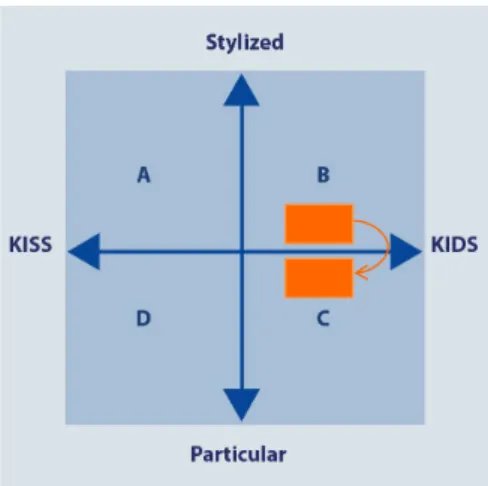
Modelling complex systems in Archaeology 149 Fig. 1 The descriptive grid
to classify models of spatial systems according to their level of abstraction and simplification (figure pub-lished in Banos et al. 2017, p. 102 and reproduced with the authorisation of A. Banos and L. Sanders)
collaboration of archaeologists and geographers who share common inter-ests in the long-term evolution of settlement systems, such as in the ANR project, TransMonDyn [20].
4 Abstraction vs Singularity; Simplification vs Realism
If models are used to test hypotheses about the processes supposed to have generated the observed archaeological patterns, validation of the model im-plies to compare the simulated outputs with archaeological records. This re-quires a rather good match between the model and “reality”. But too realistic models are not necessarily better. Firstly because they might suggest that the model is an exact replica of real world, which is never the case as modelling always require simplification and schematisation. This is particularly critical in Archaeology where the observed records are only partial remains of past reality. In addition, there is a risk that such a specific and detailed model does not bring any new knowledge than the ones entered as inputs. There is indeed a tension amongst complex systems models between, on the one hand, simplification and abstraction and, on the other hand, realism and singularity. These opposite polarities in the modelling practices have been formalized by Lena Sanders and Arnaud Banos [21]. They proposed a de-scriptive grid to classify models of spatial systems according to the level of abstraction of the modelled phenomenon, from the most particular to the most stylized, and to the level of simplification of the model itself, which can be evaluated according to the KISS and KIDS principles (see Fig.1).
0% 5% 10% 15% 20% 25% 30%
8BC 7BC 6BC 5BC 4BC 3BC 2BC 1BC 1AD 2AD 3AD 4AD 5AD 6AD 7AD 8AD
Argens Bourgogne Berry Languedoc
Auvergne Pré-Alpes Tave-Ceze
Fig. 2 % of settlements per century in 7 micro-regions of Southern and Central France ( c
ArchaeDyn, ANR-08-BLAN-0157-01, 2008-2012).
The “Keep It Simple, Stupid!” or KISS principle, stated by Robert Ax-elrod [22], claims that the complexity of a model lies in the results of the simulation, not on the hypotheses, which must be as simple as possible and reflect the main fundamental processes of the simulated phenomenon. To the contrary, the “Keep It Descriptive, Stupid!” or KIDS principle, devel-oped by Bruce Edmond and Scott Moss in reaction to the previous, focus on the hypotheses, which must be closer to reality in order to be able to explain the simulated results [23]. These type of models are thus more complex than KISS models.
5 The ModelAnSet project
These polarities can also be viewed as various steps in the building process of a model itself and we will take as an example the model we are building within the ModelAnSet project (Modelling the role of socio-environmental interactions on Ancient Settlement Dynamics), supported by UCAJEDI Com-plex Systems Academy of Excellence. Agent-Based Modelling is used to ex-plore the respective roles of environmental and social factors in the evolu-tion of the settlement pattern and dynamics during the Roman period in South-Eastern France. The initial motivation to develop the model was to better understand which processes could explain two typical
characteris-Modelling complex systems in Archaeology 151
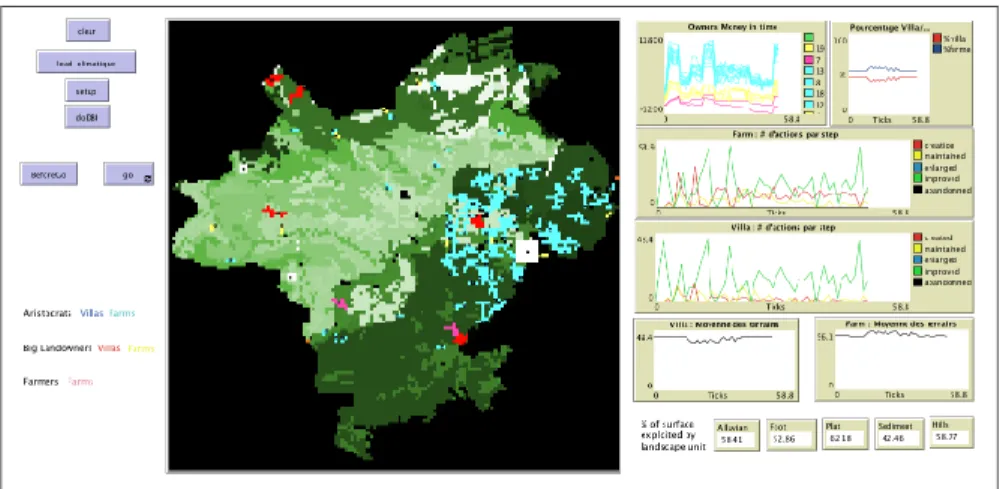
Fig. 3 Implementation of the ModelAnSet ABM on the NetLogo platform (1st version, Jérémy Lefebvre and Rami Ajroud, January 2018)
tics of Gallo-Roman settlement pattern during the first three centuries of the Christian era. Archaeological records evidence a strong increase in the number of rural settlements in Gaul from the 1st c. BC, followed by a steep decrease in the 2ndc. AD (see Fig.2).
This is concomitant with the development of a new type of rural set-tlement, the villa, which conveys from Rome new ways of life and land-exploitation to the conquered provinces. Our aim is to test the impact of social and natural processes on these evolutions through the simulation of the behaviour of Gallo-Roman landowners, who were the main actors of land exploitation and settlement.
According to historical and archaeological data, we defined different be-haviours of the landowners according to their socio-economical status and their perception of land rentability. We consider that the main factors in-fluencing land rentability to be climatic change, which impacts land fertil-ity, and the macro-economical context that impacts the economical power of the landowners. These parameters were also defined from multidisci-plinary sources of knowledge. According to their economical power and the rentability of their rural exploitations, agents (the landowners) can make various decisions about their exploitations: they can enlarge, improve or maintain them without change, or abandon them or create a new exploita-tion, either a farm or a villa. Thus, repeated landowner decision-making produces a changing macro-level settlement pattern, in terms of number, type and spatial location of the settlements. The model includes feedback between agents’ behaviour and the properties of their environment, as they
Fig. 4 Position of the Mod-elAnSet model on Banos and Sanders graph to classify models of spa-tial systems according to their level of abstraction and simplification (figure adapted from Banos et al. 2017, p. 102 and published with the authorisation of A. Banos and L. Sanders)
can improve land productivity but also degrade it by over-exploitation. Al-though the hypotheses to test are rather generic, they were instantiated in a specific geographical context, which is the territory of the Roman colony of Forum Iulii, actual Fréjus in the South-East of France (Var department ; see Fig.3).
This instantiation helped calibrate some model parameters (for example, defining the relative proportions of towns, villas and farms in the settlement system) and will mainly allow us to place the simulation in a realistic envi-ronment based on the actual landscape of this area. As envienvi-ronmental factors play an important part in the model dynamic, we assume that this effort to-wards environmental realism is required to be able to compare the model re-sults with the archaeological records, although this instantiation is not fully implemented yet in the ABM.
If we go back to the Banos and Sanders graph, we can thus place our model towards the descriptive side of it, closer to the KIDS principle. In its present version, which uses a virtual environment made of 5 environmental units randomly situated, the model is still rather stylized, and can then be placed in the B quarter of the graph, but when the realistic environment will be implemented, the model will definitely increase its singularity, moving to the C quarter (see Fig.4).
Conclusion
In a discipline such as Archaeology, where dynamics cannot be observed, simulation models are the only tools allowing us to generate processes and
Modelling complex systems in Archaeology 153
test their relevance to produce the observed archaeological records. This re-quires a certain amount of realism for the models, although a good fit be-tween the modelling results and the observed patterns is not a sufficient proof as different processes can create similar patterns. Rather than offering an absolute validation, models allow us to reduce the range of candidate processes by focussing on the most effective ones. This is what we seek with the ABM under development within the ModelAnSet project.
References
1. Flannery K.: Archaeology systems theory and early Mesoamerica, In: Meggers B.J. (ed.). Anthropological Archaeology in the Americas, Washington, D.C., Anthropo-logical Society of Washington, p. 67-87 (1968)
2. Clarke D.L.: Analytical Archaeology, London, Methuen, p. 684 (1968) 3. Clarke D.L. (ed.): Models in Archaeology, London, Methuen (1972)
4. Van der Leeuw, S., McGlade J. (eds): Time, Process and Structured Transformation in Archaeology, Routledge, London (1997)
5. Kohler T.A., Gumerman G. (eds.): Dynamics in Human and Primate Societies: Agent-based Modeling of Social and Spatial Processes, Santa Fe Institute Studies in the Sci-ences of Complexity. Oxford University Press, New York (2000)
6. Kohler T.A., van der Leeuw S. (eds.): Model-Based Archaeology of Socionatural Sys-tems, SAR Press, Santa Fe (2007)
7. Bentley A., Maschner H.D.G.: Complex Systems and Archeology. Empirical and theo-retical applications, Foundations of Archaeological, Inquiry, University of Utah Press, p. 160 (2003)
8. Wood, J. J., Matson R. G.: Two models of sociocultural systems and their implications for the archaeological study of change. In: Renfrew C. (ed.) . The Explanation of Culture Change. London, Duckworth, p. 673-683 (1973).
9. Kohler T.A.: Complex Systems and Archaeology. In: Hodder, I. Archaeological Theory Today (2nd ed.), Polity Press, Cambridge (2012)
10. Lane D., Pumain D., van der Leeuw S., West G. (eds.): Complexity Perspectives in Innovation and Social Change, Springer, Methodos Series (2009)
11. Binford L. R.: Bones: Ancient Men and Modern Myths, Academic Press, New York (1981).
12. Lake M.W., 2015: Explaining the Past with ABM: on Modelling Philosophy. In: Wurzer G., Kowarik K., Reschreiter H. (eds.). Agent-Based Modeling and Simulation in Archaeology (Advances in Geographic Information Science). Springer-Verlag, Berlin p. 3-36 (2015)
13. Fusco G., Bertoncello F., Candau J., Emsellem K., Huet T., Longhi C., Poinat S., Pri-mon J.-L., Rinaudo C.: Faire science avec l’incertitude : réflexions sur la production des connaissances en Sciences Humaines et Sociales. Actes de la Table ronde “Incerti-tude et connaissances en SHS : production, diffusion, transfert. Juin 2014, Nice (2015) https://halshs.archives-ouvertes.fr/halshs-01166287
14. Tannier C., Franc A., Ouriachi M.-J., Zadora-Rio E.: Entre modèles et récits, les tran-sitions dans les systèmes de peuplement. In: Sanders L. (ed.). Peupler la terre. De la préhistoire à l’ère des métropoles. Tours, Presses Universitaires François Rabelais p. 387-407 (2017).
15. Lake M.W.: Trends in Archaeological Simulation, Journal of Archaeological Method and Theory 21, p. 258–287 (2014)
16. Axtell R.L., Epstein J.M., Dean J.S., Gumerman G.J., Swedlund A.C., Harburger J., Chakravarty S., Hammond R., Parker J., Parker M.: Population growth and collapse in a multiagent model of the kayenta anasazi in long house valley, PNAS, 99 (Suppl 3), 7275 (2002)
17. Kohler T.A., Johnson C.D., Varien M., Ortman S., Reynolds R., Kobti Z., Cowan J., Kolm K., Smith S., Yap L.: Settlement ecodynamics in the prehispanic central Mesa Verde region. In: Kohler T. A., van der Leeuw S. (eds.). The model-based archaeology of socionatural systems, SAR Press, Santa Fe, NM, p. 61–104 (2007).
18. Wilkinson T.J., Christiansen J., Ur J., Widell M., Altaweel M.: Urbanization within a dynamic environment: modeling Bronze Age communities in upper Mesopotamia, American Anthropologist 109 (1), p. 52–68 (2007)
19. Bratman M.: Intentions, Plans, and Practical Reason, Harvard University Press, Cam-bridge (1987).
20. Sanders L. (ed.): Peupler la terre. De la préhistoire à l’ère des métropoles, Tours, Presses Universitaires François Rabelais, p. 527 (2017)
21. Banos A., Sanders L.: Modéliser et simuler les systèmes spatiaux en géographie. In Varenne F., Silberstein M. (dir). Modéliser et Simuler - Epistémologies et pratiques des modèles et des simulations. Paris, Matériologiques, p. 833-863 (2013).
22. Axelrod R.: The Complexity of Cooperation: Agent-Based Models of Competition and collaboration, Princeton, Princeton University Press, (1997)
23. Edmonds B., Moss S.: From KISS to KIDS in Multi-Agent and Multi-Agent Based Simulation, Lecture Notes in Computer Science, 3415, 130-144 (2005)
24. Banos A., Le Néchet F., Ouriachi M.-J., Franc A.: Simuler des transitions : une in-troduction aux modéles spatio-temporels, In Sanders L. (ed.). Peupler la terre. De la préhistoire à l’ère des métropoles. Tours, Presses Universitaires François Rabelais, p. 89-110 (2017)
25. Kohler T.A., Varien M.D. (eds.): Emergence and Collapse of Early Villages: Models of Central Mesa Verde Archaeology, University of California Press, Berkeley, (2012). (http://www.ucpress.edu/ebook.php?isbn=9780520951990)