Délivré par l'Université de Montpellier
Préparée au sein de l’école doctorale 459: Sciences Chimiques Balard
Et de l’unité de recherche Institut de Chimie Séparative de Marcoule
Spécialité : Chimie Séparative, Matériaux et Procédés
Présentée par Clémence Gausse
Soutenue le 13 décembre 2016 devant le jury composé de
M. Christophe DEN AUWER, Professeur, Université de Nice Rapporteur Mme Nathalie MONCOFFRE, Directrice de recherche, IPNL Rapporteur M. Stefan NEUMEIER, Docteur, Forschungszentrum Juelich Examinateur M. Thomas VERCOUTER, Ingénieur, CEA/DPC/SEARS/LANIE Examinateur M. Jerzy ZAJAC, Professeur, Université de Montpellier Examinateur M. Nicolas DACHEUX, Professeur, Université de Montpellier Directeur de thèse Mme Stéphanie SZENKNECT, Ingénieur, CEA/DEN/ICSM Co-encadrante M. Adel MESBAH, Chargé de recherche CNRS, ICSM Co-encadrant, Invité
Synthesis and dissolution
of phosphate matrices having the
monazite structure type
Synthèse et dissolution
Tout d'abord je souhaite remercier le professeur Nicolas Dacheux pour m'avoir accueillie au sein de l'Institut de Chimie Séparative de Marcoule et pour avoir dirigé mon travail de thèse au sein du Laboratoire des Interfaces de Matériaux en Évolution. Je ne saurai exprimer toute ma gratitude envers cette personne riche de savoir scientifique, et qui fait que ce travail ait pu voir le jour aujourd''hui.
Je remercie chaleureusement Stéphanie Szenknect qui a co-encadré d'une main de maître ce travail de thèse, et qui a toujours été présente pour me soutenir et m'aider dans mon travail. Merci aussi pour sa patience, sa gentillesse, sa bonne humeur et sa touche de féminité dans ce laboratoire où la testostérone est prédominante.
Je remercie également Adel Mesbah d'avoir co-encadré ce travail de thèse, et d'avoir tenté de m'initier à l'art de la résolution cristallographique.
Un grand merci à Nicolas Clavier d'avoir relu et trouvé toutes les (petites) coquilles de mon manuscrit. Je n'oublierai pas nos discussions scientifiques ou non, mais surtout les belles métaphores dont lui seul a le secret (la jambe de bois et le col roulé restera ma préférée).
J'adresse également mes remerciements à Stefan Neumeier pour sa bonne humeur et ses conseils scientifiques lors de mes visites à l'Institut de Recherche sur le Climat et l'Energie de Jülich. Je pense aussi à Guido Deissman pour ses remarques pertinentes lors des calculs thermodynamiques. Merci aussi à Yulia pour les bons moments passés ensemble lors de mes séjours à Jülich.
J'adresse mes sincères remerciements aux docteurs Nathalie Moncoffre et Christophe Den Auwer pour avoir accepté de juger ce travail en tant que rapporteurs, ainsi qu'au professeur Jerzy Zajac et au docteur Thomas Vercouter pour avoir participé à ce jury de thèse.
Ce travail de thèse n'aurait évidemment pu être réalisé sans l'aide de toutes les personnes qui ont collaboré au cours de ce travail. Je pense en premier lieu à Véronique Dubois et Tony Chave pour leur précieuse aide lors de mes nombreuses journées passées devant l'ICP-AES : je suis presque une experte maintenant grâce à vous, ainsi qu'à Bruno Corso pour la DRX. Un énorme merci aux microscopistes Renaud Podor, Johan Ravaux remplacé par Joseph Lautru (MEBE) et Mickaël Odorico (AFM) pour ses nombreuses heures passées ensemble à chercher et retrouver les zones du suivi de dissolution.
Merci à toutes les personnes du LIME passées ou présentes qui ont rendu cette thèse enrichissante à tout point de vue : Laurent, Julien, Alvarito, Fanny, Paul, David, Victor, Thomas mais aussi les stagiaires Ilyès, Florent, Julia, Laura, Dorian…
De manière générale, je voudrais remercier toutes les personnes de l'ICSM pour leur sympathie et la bonne ambiance qu'il y règne grâce à eux. Cette grande famille ne roulerait pas aussi bien sans les "mamans" : Hélène, Alice, Aurélie, Vainina, Mathilde…
Un grand merci à mes (ex)copains de bureau pour avoir supporté toutes mes sautes d'humeur et pour tous ces moments (sérieux ou non) durant ces trois années : Flo, Viovio, Kevina (même si je ne t'aime pas), Karima, Beber et petit Théo (chance bonne, you can do it, I did it !).
Et enfin ces trois années n'auraient pu être possible sans le "Noyau" (Vio, Vince, Flo, Maurice, Camille, Benoît, Kevina) et ses "Electrons" (Millie, Benj, Régis, Aurélie & Guigui, Kikinouille), la Colloc' alias la Disco'Tresques (petit Théo, Thom, Zizi, Yannis, Brossard & Carine, Germain, Adeline) et mes amis de toujours (Fleur, Antoine & Charlotte, Agathe – non je ne travaille pas sur le traitement de l'eau, Anaïs). Merci du fond du cœur à vous tous.
Merci à toute ma famille et les amis que je n'ai pas cité, pour leur soutien et leur présence durant toutes ces années.
Introduction
... 0
References
... 9
Chapter I. Review on radwaste ceramics for the specific immobilization of
actinides: structure and properties of monazite LnPO
4... 11
I.1.
Zirconolite ... 15
I.2.
Britholite
... 18
I.3.
Thorium phosphate diphosphate: β-TPD ... 22
I.4.
Monazite and related monazite/cheralite solid solutions ... 25
I.4.1. The structural flexibility of monazite ... 25
I.4.2. Densification through sintering ... 31
I.4.3. Long-term behavior: chemical durability and saturation processes during leaching tests... 32
I.4.3.1. Chemical durability: kinetic aspect ... 32
I.4.3.2. Saturation processes ... 37
I.4.3.3. Resistance of the materials to radiation damages ... 42
Summary
... 44
Reference
... 47
Chapter II. Reconsideration of the rhabdophane structure REEPO
4·0.667H
2O
(REE = La to Dy) and conversion into monazite REEPO
4... 55
II.1. Preparation of the rhabdophane type samples ... 61
II.2. Resolution and description of the SmPO
4·0.667H
2O structure ... 62
II.2.1. Resolution of the structure of SmPO4·0.667H2O ... 62
II.2.2. Description of the structure of SmPO4·0.667H2O ... 64
II.2.4. Generalization to the lanthanides series La ‒ Dy ... 69
II.2.5. Characterization of the prepared powders ... 71
II.3. Thermal behavior of the Sm-rhabdophane SmPO
4·0.667H
2O ... 73
II.3.1. Thermogravimetric analyses (TGA experiments) ... 73
II.3.2. In situ PXRD experiments ... 74
II.3.3. Transformation from the rhabdophane to the monazite and characterization of the monazite samples ... 79
Summary
... 81
References
... 84
Chapter III. Dissolution kinetics of monazite LnPO
4(Ln = La to Gd): a
multiparametric study ... 87
III.1. Materials and methods ... 91
III.1.1. Experimental settings ... 91
III.1.1.1. Leaching experiments in dynamic conditions ... 91
III.1.1.2. Batch experiments ... 92
III.1.1.3. Elementary analyses in the solution ... 92
III.1.1.4. Characterization of the solids phases ... 92
III.1.2. Definitions and determination of the normalized dissolution rates ... 93
III.2. Results and discussions ... 98
III.2.1. General trends of the dissolution ... 98
III.2.2. Influence of the acidity ... 103
III.2.3. Influence of the temperature ... 106
III.2.4. Influence of deviation from equilibrium on the monazite dissolution rate 112
Summary
... 118
Chapter IV. Determination of the solubility of rhabdophane LnPO
4·0.667H
2O (Ln
= La to Gd) 127
IV.1. Experimental section ... 130
IV.1.1. Description of the solubility experiments ... 130
IV.1.2. Thermodynamic interpretation of solubility experiments ... 132
IV.2. Results & discussions ... 137
IV.2.1. Thermodynamic constants determined by under-saturation experiments .. 137
IV.2.2. Thermodynamic constants determined by over-saturation experiments .... 142
IV.2.3. Comparison with the literature data ... 149
IV.2.4. Determination of thermodynamics data associated to the rhabdophane solubility ... 153
Summary
... 161
References
... 166
Chapter V. Monitoring the structural and microstructural evolution of LnPO
4monazite (Ln = La, Nd) during dissolution: implications regarding the
evaluation of the chemical durability ... 169
V.1. Experimental
... 176
V.1.1. Preparation of LnPO4 (Ln = La, Nd) monazite pellets ... 176
V.1.1.1. Description of the sintering conditions ... 176
V.1.1.2. Characterization of the pellets ... 178
V.1.2. Dissolution experiments ... 181
V.1.3. Characterization of the evolving interface ... 182
V.1.3.1. Operando experiments followed by ESEM ... 182
V.1.3.2. Operando experiments followed by AFM ... 182
V.1.3.3. Operando experiments followed by GI-XRR ... 183
V.2. Results & discussions ... 185
V.2.1. Monitoring the microstructural evolution of monazite pellets by ESEM ... 185
V.2.2. Monitoring of the local and global microstructural evolution by AFM and GI-XRR ... 192
V.2.3. Monitoring of the structural evolution at the solid/solution interface ... 200
Summary
... 203
References
... 208
Chapter VI. Synthesis of Ln
1-2xTh
xCa
xPO
4·0.667H
2O rhabdophane and estimation
of solubility product ... 211
VI.1. Synthesis and characterization of Nd
1-2xCa
xTh
xPO
4·0.667H
2O samples. 215
VI.1.1. Synthesis ... 215VI.1.2. Characterization ... 215
VI.1.2.1. SEM ... 215
VI.1.2.2. Determination of the chemical composition ... 216
VI.1.2.3. PXRD... 217
VI.1.3. Optimization of the synthesis process ... 220
VI.1.3.1. Influence of the temperature of the temperature ... 220
VI.1.3.2. Influence of the heating time ... 221
VI.1.3.3. Influence of the calcium ratio ... 223
VI.2. Stabilization of Nd
0.8Ca
0.1Th
0.1PO
4·0.667H
2O in solution ... 225
VI.2.1. Materials and methods ... 225
VI.2.1.1. Under-saturation experiments ... 225
VI.2.1.2. Analyses of solution ... 225
VI.2.1.3. Analyses of solids phases ... 226
VI.2.2. Definitions and calculations ... 226
Summary
... 233
References
... 238
Conclusion
... 239
References
... 251
Appendices
... 253
A.1.
Database used for speciation calculations... 255
A.2.
Initial composition of the precipitation medium ... 256
A.3.
Thermodynamic data ... 257
A.4.
Rietveld refinements of lanthanides phosphates obtained by over–
saturation experiments ... 258
A.5.
Rhabdophane
LnPO
4·0.667H
2O:
under–
and
over–saturation
experiments ... 259
A.6.
Wavelengths used for the determination of the elemental concentrations
by ICP–AES ... 267
References
... 268
Chapter I
Figure I.1. Projection of the crystal structure of zirconolite-2M along the b axis 8. ... 16 Figure I.2. Dissolution rates for different materials depending on temperature. 2 ... 17 Figure I.3. Representation of the fluoroapatite structure along c axis 18. ... 19 Figure I.4. Representation of the β-TPD structure along a axis (a) and environment of thorium
in the structure (b)46. ... 22 Figure I.5. Variation of log RL versus log [H3O+] for pure TPD (▲), TPD doped with 241Am
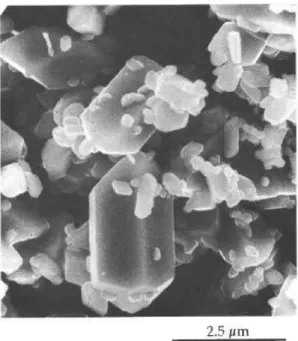
() or 244Cm (), TPuPD solid solutions (x = 0:4: and x = 1:0: ▼.) (298 K, I = 0:1 M)59. ... 24 Figure I.6. Representation of the crystal structure of LnPO4 monazite according to Ni et al. 74. ... 26 Figure I.7. SEM images of crystals of La0.5Ca0.25U0.25PO4 synthesized in 30 m H3PO4 at 1053
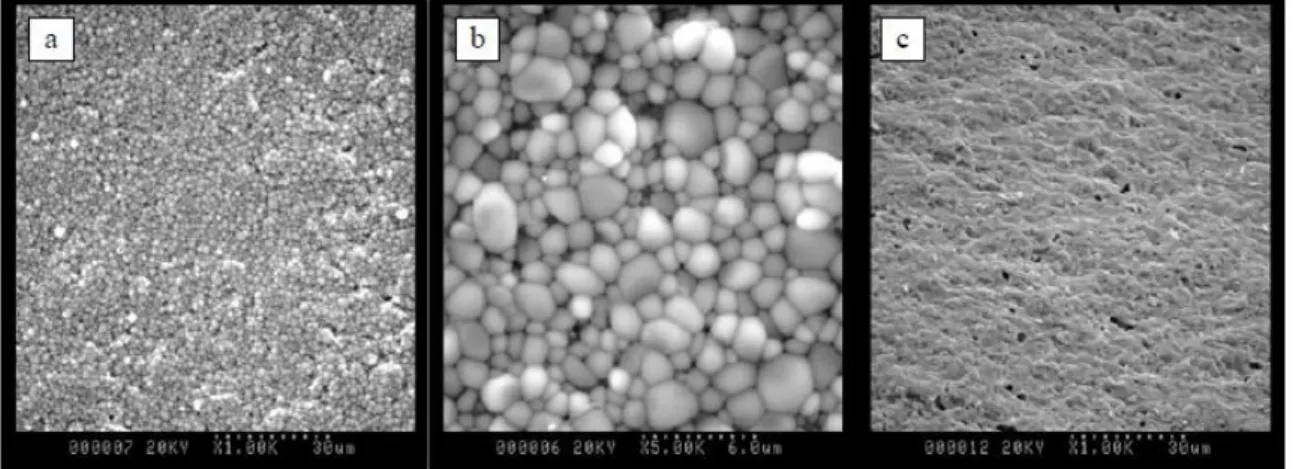
K, 200 MPa and under reducing conditions (Ni + NiO buffer)111. ... 30 Figure I.8. SEM observations of a sintered Ca0.5Th0.5PO4 sample at 1573 K for 6 h: surface (a)
and (b), frontal breaking (c). ... 32 Figure I.9. Comparison of log RL of fluoroapatite 153, 154 (▬), monazite 155 (▬) and borosilicate
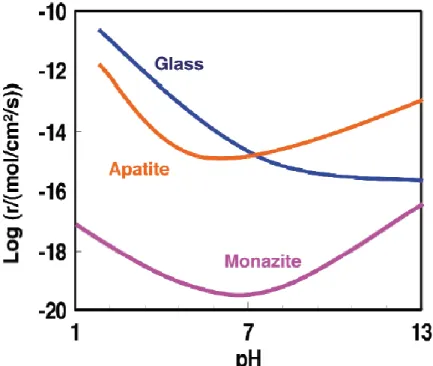
glass 156 (▬) as a function of the pH and at 353 K 146. ... 35 Figure I.10. Nature of precipitated lanthanide phosphate depending on the heating temperature
and the ionic radius of the lanthanide element (: monazite; : rhabdophane; : mixture of monazite and rhabdophane) apart from Du Fou de Kerdaniel et al.157. ... 40 Figure I.11. Links between rhabdophane and monazite during heat treatment or leaching
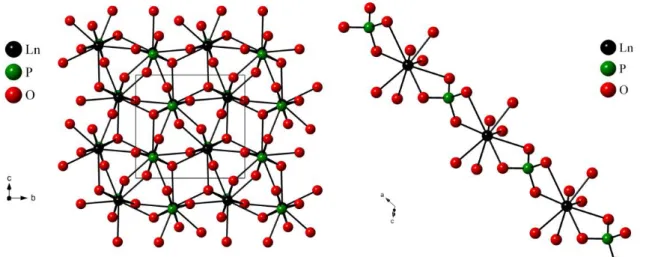
steps172, 173. ... 41
Chapter II
Figure.II.1. PXRD pattern of SmPO4·0.667H2O showing the Rietveld plot of the observed, calculated and the difference between observed and calculated data. ... 62 Figure.II.2. Observed and calculated patterns of SmPO4·0.667H2O after Rietveld refinement
considering hexagonal 1, 2 and monoclinic 23 systems... 63 Figure.II.3. General view of the structure of SmPO4·0.667H2O along the [101] direction. ... 64 Figure.II.4. Local coordination of Sm atoms in the structure of SmPO4·0.667H2O. ... 66 Figure.II.5. Representation of the water molecules network inside the channels in the
SmPO4·0.667H2O structure. ... 67 Figure.II.6. Representation of the structures of SmPO4·0.667H2O (a), CaSO4·0.625H2O (b)
and CaSO4·0.5H2O (c). ... 68 Figure.II.7. PXRD patterns of the rhabdophane end-members LnPO4·0.667H2O (Ln = La to
Dy) (a) and refined unit cell volume vs the average lanthanide ionic radius (1/3 rLnCN8 + 2/3 rLnCN9) (b). ... 70 Figure.II.8. ESEM images of the prepared rhabdophane LnPO4·0.667H2O samples. ... 72 Figure.II.9. TGA weight loss curve showing the hydration reversibility in the SmPO4·nH2O ... 74
Figure.II.10. In situ PXRD patterns showing the successive structural transitions from hydrated rhabdophane SmPO4·nH2O to the final monazite SmPO4. ... 75 Figure.II.11. Representation of the structure of anhydrous rhabdophane SmPO4 along the c
axis. ... 76 Figure.II.12. Variation of the unit cell parameters vs heating temperature showing the
transformation of SmPO4·0.667H2O rhabdophane to SmPO4 monazite (a) and a zoom at a low temperature showing the reversible swelling of the unit cell corresponding to the transformation between hydrated and anhydrous rhabdophane (b). ... 77 Figure.II.13. Dilatometric experiment obtained on the compound SmPO4·0.667H2O showing
a swelling of 1 % corresponding to the dehydration and the structure transition into anhydrous rhabdophane. ... 78 Figure.II.14. PXRD patterns of pure monazite end-member LnPO4 (Ln = La to Gd) prepared
by thermal conversion of the starting rhabdophanes LnPO4·0.667H2O. ... 79 Figure.II.15. ESEM images of the pure end-member monazite LnPO4 synthesized. ... 80
Chapter III
Figure.III.1. a: Typical evolution of the elementary concentrations measured in solution at the outlet of the flow-through reactor during the dissolution of a monazite sample (NdPO4 monazite, 0.1 M HNO3, T = 298 K). ... 99 Figure.III.2. Evolution of the normalized weight losses NL(La) (full symbols) and NL(P) (open
symbols) during the dissolution of LaPO4 determined under dynamic conditions at 298 K and several nitric acid solutions (/ : 0.1 M; / : 0.5 M; ▲/:0.75 M; ▼/: 1 M HNO3). ...103 Figure.III.3. Variation of the normalized dissolution rate of LnPO4 versus the proton activity
determined at room temperature under dynamic conditions (: La; : Ce; ▲: Pr;
▼: Nd;: Sm; ◄: Eu; ►: Gd). ...104 Figure.III.4. Evolution of the normalized weight losses NL(La) (full symbols) and NL(P) (open
symbols) determined during the dissolution of LaPO4 monazite in 0.1 M nitric acid solution at various temperatures using dynamic conditions (/: 298 K; /: 313 K; ▲/:333 K; ▼/: 363 K). ...106 Figure.III.5. a: Variation of the logarithm of the normalized dissolution rates RL(Ln) versus the
reciprocal temperature during dissolution of monazites LnPO4 (: La ; : Ce ; ▼: Nd ; ►: Gd). The dissolution rate in far-from-equilibrium conditions (solid orange line) is plotted for comparison purpose. ...107
Figure.III.6. PXRD patterns of NdPO4 monazite before (blue) and after dissolution in 0.1 M HNO3 for several temperatures (298 K: black; 313 K: red; 343 K: pink; 363 K:
orange). ...111
Figure.III.7. Evolution of NL(i) obtained during the dissolution of NdPO4 in 0.1 M HNO3 at 298 K. Black dash line represents the linear regression of the NL(Nd) data determined before 15 days. Black solid line represents the linear regression of the NL(Nd) variation determined between 115 days and 362 days (end of experiment).
The slope of this line corresponds to the RL,t(Nd) value. For comparison purpose, the slope of the green dash line is the RL,0 value obtained in dynamic dissolution under the same conditions. ...112 Figure.III.8. Impact of the saturation index relative to the precipitation of Nd-rhabdophane on
the normalized dissolution rate of Nd-monazite observed during static experiments () and dynamic experiments () performed in 0.1 M HNO3 at 298 K. The dashed line corresponds to one possible fitting of the f(∆Gr) function taking into account Equation (III.16.) (R² = 0.963). ...116 Figure.III.9. ESEM micrographs of powdered Nd-monazite before dissolution (a) and after
220 days of dissolution in 0.1 M HNO3 at 298 K (b). ...117
Chapter IV
Figure.IV.1. Evolution of elementary concentration in solution during the formation of the precipitate (over-saturation experiment) and the dissolution of this precipitate (under-saturation experiment)6. ...131 Figure.IV.2. Evolution of the neodymium () and phosphorus () elementary concentrations
and pH (×) during the dissolution of NdPO4·0.667H2O in 0.1 mol.L-1 HCl solution at 298 K (a) and at 343 K (b). ...138 Figure.IV.3. PXRD patterns and ESEM micrographs of LaPO4·0.667H2O (a),
NdPO4·0.667H2O (b) and DyPO4·0.667H2O (c) samples obtained at the end of the dissolution experiments (0.1 mol.L-1 HCl, T = 298 K and 343 K). ...139 Figure.IV.4. Evolution of Nd (■) and P (●) elementary concentrations during over-saturation
experiments conducted at: (a) 298 K, (b) 333 K, (c) 343 K and (d) 363 K. ...143 Figure.IV.5. PXRD patterns and ESEM micrographs of LaPO4·0.667H2O (a),
NdPO4·0.667H2O (b) and DyPO4·0.667H2O (c) obtained from over-saturation experiments after establishment of the thermodynamic equilibrium. ...145 Figure.IV.6. Variation of the solubility products of rhabdophane versus the ionic radius of the
lanthanide element for various temperatures. Over-saturation experiments ( : 298 K, ■ : 333 K, ● : 343 K, ▲: 363 K) and under-saturation experiments ( : 298 K, : 343 K). ...149 Figure.IV.7. Standard solubility products reported in literature for LnPO4 at 294 - 298 K
compared to the solubility products of LnPO4·0.667H2O rhabdophanes determined in this work. The data obtained in this study corresponds to the solubility product determined from under-saturation experiments. ...150 Figure.IV. 8. a: Variation of ln Ks, 0o of the rhabdophanes versus the reciprocal temperature.
Dashed lines correspond to the linear function fitted for Pr (blue line), Nd (pink line) and Gd (violet line). ...154
Figure.IV.9. Comparison between the enthalpy of formation of rhabdophane determined by solubility experiments in this work from over and under-saturation experiments(), and the data reported by Ushakov et al. 31 for monazite from oxide-melt solution calorimetry (). Red circles () stand for the data of Ushakov
recalculated by considering the addition of 0.667 water molecules per mole of LnPO4. ...156 Figure.IV.10. Comparison of the rhabdophane and monazite structures. ...158 Figure.IV.11. Variation of the calculated Gibbs energy associated to the reaction of dissolution
of NdPO4 monazite and NdPO4·0.667H2O rhabdophane versus the temperature. Blue symbols are experimental results obtained by dissolution of NdPO4 performed in the stability domain of the monazite, pink symbols are experimental results obtained for the rhabdophane in this work, black symbols are experimental results obtained by dissolution of NdPO4 monazite in the stability domain of rhabdophane, grey symbols are experimental results obtained for rhabdophane by over-saturation. Pink line corresponds of the linear fit of the data obtained in this work. Continuous blue line corresponds to the linear fit of the data obtained by Poitrasson et al.26 between 373 K and 573 K. Dashed blue line corresponds to the linear fit of the data obtained by Poitrasson et al.26 and Cetiner et al.21 between 373 K and 573 K. Considering the uncertainties, both phases could be stable at a temperature located in the dashed area. ...159
Chapter V
Figure.V.1. SEM micrographs of as-prepared LnPO4 (Ln = La and Nd) powders and milled LnPO4 powders. ...176 Figure.V.2. a: Dilatometric curves of the “as-prepared” NdPO4 pellet (blue) and the “milled”
NdPO4 (red) heated at 1673 K for 8 h. ...177 Figure.V.3. SEM observations of sintered LaPO4 (a) and NdPO4 (b) pellets and of a selected
region of interest at the surface of each sample. ...180 Figure.V.4. ESEM observations in Secondary Electron mode of one selected region of interest
at the surface of the LaPO4 (a) and NdPO4 (b) pellets during their dissolution in 0.1 M and 0.25 M HNO3 at 363 K, respectively. This series of images (at medium magnification) was used to estimate the evolution of 2D-porosity. The green, orange and pink circles highlight triple junctions, grain detachment and the some altered grains, respectively. The blue, red and yellow arrows indicate locations of the fissure, the intra-granular pore and the grain boundary, respectively. ...187 Figure.V.5. a: ESEM evolution of the smallest indentation mark during the dissolution of
LaPO4 monazite pellet in 0.1 M HNO3 at 363 K...188 Figure.V.6. ESEM images of NdPO4 pellet recorded at highest magnification. Orange circles
show the grain detachments; pink circles indicate the “flat pores”; green arrows underline the opening of grain boundaries; white arrows highlight the opening of triple junctions. ...191 Figure.V.7. AFM height images of a 10 µm² selected surface area of the La-monazite sample
recorded in the ESEM red area (a, see Figure V.3) and of a 20 µm² selected surface area of the Nd-monazite sample recorded in the ESEM blue area (b, see Figure V.3) for several dissolution times. The green, orange and pink circles highlight triple junctions, grain detachment and the some altered grains, respectively. The blue, red
and yellow arrows indicate the locations of the crack, the intra-granular pore and the grain boundary, respectively, where depth profiles were recorded. ...193 Figure.V.8. Depth profiles of triple junction (green circle) (a), crack (blue arrows) (b), grain
boundary (yellow arrows) (c) and intra-granular pore (red arrows) (d) recorded during dissolution of La-monazite sample. ...195 Figure.V.9. Depth profiles of the grains surrounded by a pink circle (a, b) and the grain
surrounded by an orange circle (c). ...197 Figure.V.10. Experimental (symbols) and simulated (lines) XRR curves obtained during the
dissolution at 363K of LaPO4 in 0.1 M HNO3 (a) and of NdPO4 in 0.25 M HNO3 (b), respectively. ...199 Figure.V.11. Grazing-incidence X-Ray diffraction patterns collected during the dissolution at
363K of La-monazite pellet in 0.1 M HNO3 (a,b) and of Nd-monazite pellet in 0.25 M HNO3 (c,d), respectively, for incident angles of 1° (a,c) and 0.4°(b,d). Green sticks are Bragg position associated to LnPO4 rhabdophane (JCPDS #034-1380). ...202
Chapter V
Figure.VI.1.SEM observations of Nd1-2xCaxThxPO4·0.667H2O samples by SEM. ...216 Figure.VI.2. PXRD patterns of Nd1-2xCaxThxPO4·0.667H2O compounds. ...217 Figure.VI.3. Variation of the unit cell volumes of Nd1-2xCaxThxPO4·0.667H2O samples versus
expected x values. ...218 Figure.VI.4. PXRD patterns collected for Nd0.8Ca0.1Th0.1PO4·0.667H2O samples obtained at
383 K and 423 K. The stars indicate the first XRD lines of the TPHPH phase. ...220 Figure.VI.5. Morphology of the Nd0.8Ca0.1Th0.1PO4·0.667H2O samples prepared at 383 K and
at 423 K...221 Figure.VI.6. a: PXRD patterns of Nd0.8Ca0.1Th0.1PO4·0.667H2O synthesized at 383 K during 2
days (black), 4 days (red) and 7 days (blue). ...222 Figure.VI.7. a: PXRD patterns collected for the samples prepared at 383 K for 2 days (x = 0.1)
using different excess of calcium (0 mol.%: black, 100 mol.%: red, 400 mol.% and blue; 900 mol.%: green)...224 Figure.VI.8. Evolution of the elementary concentrations CNd (), CTh () and CP ()
measured by ICP-AES during the dissolution in 0.25 M HNO3 of EDF52 sample at 298 K (a) and of DQ223 sample at 298 K (b), 333 K (c) and 363 K (d). ...228 Figure.VI.9. a: PXRD patterns of EDF52 sample before (black) and after (red) dissolution in
Appendices
Figure A.1. Evolution of the elementary concentrations of lanthanum () and phosphorus () and pH (×) during the dissolution of LaPO4·0.667H2O in 0.1 M HCl solution at 298 K (a) and 343 K (b). ...259 Figure A.2. Evolution of the elementary concentrations of cerium () and phosphorus () and
pH (×) during the dissolution of CePO4·0.667H2O in 0.1 M HCl solution at 298 K (a) and 343 K (b). ...259 Figure A.3. Evolution of the elementary concentrations of praseodymium () and phosphorus
() and pH (×) during the dissolution of PrPO4·0.667H2O in 0.1 M HCl solution at 298 K (a) and 343 K (b). ...260 Figure A.4. Evolution of the elementary concentrations of samarium () and phosphorus ()
and pH (×) during the dissolution of SmPO4·0.667H2O in 0.1 M HCl solution at 298 K (a) and 343 K (b). ...260 Figure A.5. Evolution of the elementary concentrations of europium () and phosphorus ()
and pH (×) during the dissolution of EuPO4·0.667H2O in 0.1 M HCl solution at 298 K (a) and 343 K (b). ...261 Figure A.6. Evolution of the elementary concentrations of gadolinium () and phosphorus ()
and pH (×) during the dissolution of GdPO4·0.667H2O in 0.1 M HCl solution at 298 K (a) and 343 K (b). ...261 Figure A.7. Evolution of the elementary concentrations of dysprosium () and phosphorus ()
and pH (×) during the dissolution of DyPO4·0.667H2O in 0.1 M HCl solution at 298 K (a) and 343 K (b). ...262 Figure A.8. Evolution of the elementary concentrations of La (■) and P (●) during over– saturated experiments conducted at: (a) 298 K, (b) 333 K, (c) 343 K and (d) 363 K. ...262 Figure A.9. Evolution of the elementary concentrations of Ce (■) and P (●) during over– saturated experiments conducted at: (a) 298 K, (b) 333 K, (c) 343 K and (d) 363 K. ...263 Figure A.10. Evolution of the elementary concentrations of Pr (■) and P (●) during over– saturated experiments conducted at: (a) 298 K, (b) 333 K, (c) 343 K and (d) 363 K. ...263 Figure A.11. Evolution of the elementary concentrations of Sm (■) and P (●) during over– saturated experiments conducted at: (a) 298 K, (b) 333 K, (c) 343 K and (d) 363 K. ...264 Figure A.12. Evolution of the elementary concentrations of Eu (■) and P (●) during over– saturated experiments conducted at: (a) 298 K, (b) 333 K, (c) 343 K and (d) 363 K. ...264 Figure A.13. Evolution of the elementary concentrations of Gd (■) and P (●) during over– saturated experiments conducted at: (a) 298 K, (b) 333 K, (c) 343 K and (d) 363 K. ...265
Figure A.14. Evolution of the elementary concentrations of Tb (■) and P (●) during over– saturated experiments conducted at: (a) 298 K, (b) 333 K, (c) 343 K and (d) 363 K. ...265 Figure A.15. Evolution of the elementary concentrations of Dy (■) and P (●) during over– saturated experiments conducted at: (a) 298 K, (b) 333 K, (c) 343 K and (d) 363 K. ...266
Chapter I
Table I.1. Normalized dissolution rates reported for several monazite/cheralite solid solutions in various acid media at 363 K and comparison with data reported for several monazite samples 38, 62, 92, 126-131. ... 36 Table I.2. logKs, 0o associated to the neoformed phosphate-based phases for actinide and
lanthanide elements 62. ... 38
Chapter II
Table.II.1. Selected interatomic distances (Å) in SmPO4·0.667H2O. ... 65 Table.II.2. Unit cell parameters of the rhabdophane-type LnPO4·0.667H2O (Ln = La-Dy)
compounds collected at room temperature and refined on the basis of the C2 space group. ... 71 Table.II.3.. Specific surface area of the synthesized rhabdophanes. ... 72 Table.II.4. Characteristics of the dehydration steps of LnPO4·nH2O, obtained from TGA
experiments. ... 73 Table.II.5. Specific surface area of the monazite prepared from rhabdophanes after heating at
1173K for 6 hours. ... 80
Chapter III
Table.III.1. Normalized dissolution rates RL,0(Ln) and RL,0(P) and associated congruence ratio r = RL,0 (Ln)/RL,0 (P) obtained during leaching tests of LnPO4 monazite samples performed in 0.1M HNO3 solution, at various temperatures (298 K – 363 K). ...101 Table.III.2. Normalized dissolution rates RL,0(Ln) and RL,0(P) and associated congruence ratio
r = RL,0 (Ln)/RL,0 (P) obtained during leaching tests of LnPO4 monazite samples performed in 0.1 M to 1 M HNO3 solutions, at 298 K. ...102 Table.III.3. Partial orders related to the protons activity and associated dissolution rate
constants determined during the dissolution of LnPO4 monazite samples in 0.1 M HNO3 at 363 K and comparison with the data reported for several cheralite and monazite/cheralite solid solutions determined in 0.1 M HNO3 at 343 K26. ...105 Table.III.4. Apparent activation energies and the associated dissolution rate constants
associated to the dissolution reaction of LnPO4 monazite.Eapp,1 is the apparent activation energy determined between 298 K and 313 K, Eapp,2 determined between 313 K and 363 K and Eapp is the apparent activation energy determined in the all range of temperature studied. ...108 Table.III.5. Elementary concentrations CNd, and CP as well as RL(Nd) values measured at
different times during the static dissolution of NdPO4 in 0.1 M HNO3 at 298 K. Associated calculated ions activities, ion activity product (IAP*), saturation index (SI) relative to the rhabdophane NdPO4·0.667H2O, and ∆Gr. The last line of data corresponds to the same calculations determined during the dynamic experiment performed under the same conditions. ...114
Chapter IV
Table.IV.1. Elementary concentrations and pH values obtained at equilibrium, calculated molalities of the predominant species, equilibrium constants involving the predominant aqueous species in solution (log ∗ 𝐾𝑠) and standard solubility products obtained for LnPO4·0.667H2O for under-saturation experiments performed at different temperatures in 0.1 mol.L-1 HCl solution. ...141 Table.IV.2. Elementary concentrations and pH values obtained at thermodynamic equilibrium,
calculated molalities of the predominant species, equilibrium constants involving the predominant aqueous species in solution (log ∗ Ks) and standard solubility products obtained for LnPO4·0.667H2O from over-saturation experiments performed at different temperatures. Experiments in gray were associated to the presence of an additional phase. ...147 Table.IV.3. Values of logKs, 0 o298 K from over-saturation and under-saturation
experiments, logKs, 0 o298 K and ∆RGo298 K calculated by averaging over- and under-saturation solubility products, uncertainties calculated as twice the standard error (except for Gd), ∆RHo, ∆RSo were deduced from the Van’t Hoff plot of the solubility results. ∆fGo, ∆fHo, ∆fSo and Smo were calculated using the thermodynamic data of reaction determined in this study and the auxiliary data provided in Table A6. ...155 Table.IV.4. Standard molar enthalpies of formation and standard molar entropy of LnPO4 at
298 K reported in the literature. ...157
Chapter V
Table.V.1. Main characteristics of the sintered samples of LaPO4 and NdPO4. ...179 Table.V.2. Evolution of the roughness of the solid surface of LnPO4 (Ln = La, Nd) determined
by AFM and GI-XRR. Evolution of electronic density and porosity during dissolution evaluated by GI-XRR. ...198
Chapter VI
Table.VI.1. Chemical composition of Nd1-2xCaxThxPO4·0.667H2O compounds determined by total dissolution and ICP-AES analyses. ...216 Table.VI.2. Ionic crystal radius (expressed in Å) for Ca2+, Th4+ and Nd3+ cations extracted from
the Shannon’s tables12. ...219 Table.VI.3. Initial composition of Nd, Th and Ca cations of Nd0.8Ca0.1Th0.1PO4·0.667H2O”
samples. ...226 Table.VI.4. Molar ratio of Nd and Th in the solid phase before dissolution, elementary
concentrations and molar ratio Nd/P and Th/P in solution at equilibrium during the dissolution of “Nd0.8Th0.1Ca0.1PO4·0.667H2O” in 0.25 M HCl at various temperatures. ...232
Table.VI.5. pH values obtained at equilibrium, calculated molalities and activities of predominant species, saturation index related to TPHPH and estimated ions activities products obtained from “Nd0.8Th0.1Ca0.1PO4·0.667H2O” samples at 0.25 M HCl solution at different temperatures. ...232
Appendices
Table A.1. The main aqueous complexation reactions used for the solubility products calculations included in the LLNL thermodynamic database 1. ...255 Table A.2. Densities of 0.1 M hydrochloric acid and nitric acid solutions and 0.25 M
hydrochloric acid and nitric acid solutions used in the PHREEQC simulations2. ...256 Table A.3. Initial composition of the precipitation medium for the over–saturated experiments.
[LnCl3] is the concentration of the lanthanide solution prepared and analyzed by ICP–AES before the syntheses. ...256 Table A.4. Thermodynamics properties of the compounds used in this study at 298 K.3-5 ...257 Table A.5. Refined weight amounts for each phosphate phase obtained by over–saturation
experiments ...258 Table A.6. Wavelengths used for the determination of the elemental concentrations by ICP-AES. ...267
0
1
Currently, the nuclear waste storage in deep geological repository is based on a multi-barrier concept by evaluating simultaneously the performance of the conditioning matrix, the container, the engineered barrier and the selected site in various scenarios. Therefore, it is of primary importance that conditioning matrices show a remarkable chemical flexibility in order to be able to incorporate sufficient amount of selected radionuclides, a remarkable chemical durability in order to prevent the release of radionuclides in the environment and a high resistance to radiation damages. Up to now, radwaste coming from the reprocessing of spent nuclear fuels, except uranium and plutonium which are recycled, are incorporated into borosilicate glasses “R7T7”. This glass matrix is considered as “universal” since it can incorporate all the radionuclides derived from nuclear waste solutions. However, in the context of advanced reprocessing of spent nuclear fuels, it appeared necessary to consider the specific conditioning of several long-life radionuclides coming from high level radioactive wastes (HLW). From the last forty years, the development of specific conditioning of radionuclides was performed worldwide.
In France, the nuclear waste management was ruled by the Bataille’s law 1. In this framework, one of the fields of research developed was the selection of several materials, suitable as specific matrices for the specific conditioning of long-lived radionuclides (typically minor actinides, long life fission products, and eventually excess plutonium coming from dismantled nuclear weapons). In this context, four materials were finally selected in France as promising candidates for the specific conditioning of minor actinides, namely: zirconolite (Ca1−xAnx3+)(Zr1−yAn4+y )Ti2−xAlxO7, britholite Ca9An1−x3+ Anx4+(PO4)5−x(SiO4)1+xF2, monazites (LnPO4) and associated monazite/cheralite solid solutions (Ln1−x−2yAnx3+CayAny4+PO4), thorium phosphate-diphosphate (β − Th4−xAnx4+(PO4)P2O7) with β-TPD/monazite associations.
The selection process of such materials was based on a two-step process: the first one was called “scientific feasibility”. It involved the design of materials that could incorporate surrogate elements of either trivalent or tetravalent actinides in their crystalline structure. Then, the evaluation of their capability to sinter and of their chemical durability was undertaken in order to select the most promising matrices. The second step was called “technical feasibility”. It consisted not only of the preparation, characterization and sintering of actinide-based materials, but also of the study of their chemical durability through the development of long-term leaching tests (in the presence or absence of environmental materials) and the structural stability under irradiation. In this aim, the behavior of samples under external irradiation using
2
heavy ions or particles, or doped with highly radioactive radionuclides, such as 238Pu, were studied 2, 3.
In parallel, the long-term stability of the selected matrices was evaluated through the comparison with natural analogues and the development of predictive models 4. For several selected matrices, such analogues were found to remain crystallized (absence of metamictization, i.e. amorphization due to radiation damages) despite the high doses they received. This important property was explained, as instance, by a low temperature annealing of crystals defects caused by irradiation5. The high chemical durability of such natural analogues was also demonstrated by determining the pressure-temperature-time conditions associated to their formation and by studying their alteration under various geochemical conditions5-8. Additionally, natural analogues also contributed to the better understanding of the possible substitutions allowing to the incorporation of large amounts of minor actinides or long life fission products9-15.
Even if the research efforts dedicated to such ceramic materials slowed down since the end of the Bataille’s act in 2006 in France, it is not the case at the international level with the development of several national programs worldwide. As instance, the German Joint Research Project “Fundamental studies on conditioning of long-lived radionuclides in ceramic waste forms” was selected by the Federal Ministry of Education and Research (BMBF) in 2013. The Institute of Energy and Climate Research – IEK6 of the Jülich Forchungszentrum was in charge of this project and contributed to all work packages that included the development and optimization of synthesis routes, the structural and microstructural characterization of the prepared materials, the study of the thermodynamic stability and reactivity under conditions relevant to geological disposal and finally the studies dedicated to the resistance of the ceramics to radiation damages. In this project, five materials were selected: monazites (LnPO4; Ln = La-Gd), pyrochlores (Ln,An)2(Zr,Hf)2O7, apatite Me10(XO4)6Y6, layered double hydroxides [M1−yII L
y III(OH)
2]y+[Xn−]y
n[H2O]z and phosphosilicates.
This PhD work was initiated in the context of the cooperation between the Institute of Separative Chemistry of Marcoule (ICSM – UMR5257) and the IEK-6 (FZ Jülich). It was dedicated to the study of the monazite and associated monazite/cheralite solid solutions. Beyond the fact that, as described above, the monazite appears as a suitable matrix for the specific conditioning of minor actinides, it also constitutes a mineral phase of interest since it represents one of the major sources of rare earth elements on Earth. That is the reason why the
3
study of the chemical durability of the monazite is of great interest for the extraction of rare earth elements from ores. As a result, a renewed interest of the international community for this phase has been observed since few years, in particular after 2013, with 50 to 70 published papers published per year (source items with “monazite” in title indexed within Web of Science Core Collection).
In this context, this PhD-work was dedicated to the preparation of several monazites LnPO4 (Ln = La → Gd) and to the better understanding of the chemical durability of these materials with the help of a combined approach based on the kinetics and thermodynamics of dissolution. The manuscript is thus divided in six chapters describing:
- the different matrices selected in France as “promising candidates” and more precisely, an overview of the state of the art on monazites and associated monazite/ cheralite solid solutions. This first chapter also includes the description of the different crystal structures, the ability of these matrices to incorporate tri- and tetravalent elements, the different chemical routes reported in literature, their sintering capability and finally the study of their long-term behavior;
- the crystal structure of rhabdophane LnPO4·0.667H2O (Ln = La → Dy) which was selected as the low-temperature precursor of monazite in this work. This chapter especially includes the reexamination of the crystal structure of the rhabdophane thanks to synchrotron radiation and of the hydration rate. Moreover, the thermal conversion of rhabdophane into monazite was performed;
- the chemical durability of monazites LnPO4 (Ln = La → Gd) with the help of the expression of the normalized dissolution rate far from equilibrium. The influence of several parameters including acidity and temperature on the normalized dissolution rates was investigated under dynamic conditions. The impact of the saturation processes of the solution on the normalized dissolution rate was also examined through the development of static experiments. These results allowed the determination of the partial order of the reaction related to the proton activity as well as the apparent activation energy and underlined the important role of rhabdophane during the establishment of saturation processes;
- the solubility of rhabdophane through the determination of the solubility product as well as the thermodynamic data associated to the formation rhabdophane. Therefore, solubility experiments were conducted for LnPO4·0.667H2O (Ln = La → Dy) using over-saturated and under-saturated conditions at different temperatures (298 K to
4
393 K). The structure of the neoformed phases was carefully controlled in the entire range of temperatures in order to attribute unambiguously the solubility products (𝐾𝑠,0𝑜 ) and the derived thermodynamic data (Δ
rG°, ΔrH°, ΔrS°, ΔfG°, ΔfH°and Sm°) to the rhabdophane phases.
- the monitoring of the structural and microstructural evolution of LnPO4 monazite pellets during dissolution by combining surface analyses such as ESEM, AFM, GI-XRR and GI-XRD. The different results obtained were then combined in order to gain a thorough understanding of the dissolution mechanism and to evaluate the chemical durability of the probed material;
- the synthesis of Th-rhabdophane type compounds having a general formula of Nd1-2xCaxThxPO4·0.667H2O obtained by wet chemistry route. Therefore, the conditions favorable to the synthesis of these compounds were determined. The prepared solids were characterized in order to evaluate the structural modifications associated with the substitution of Nd3+ by Th4+ and Ca2+. Preliminary solubility experiments were also performed in order to evaluate the thermodynamic stability of such hydrated phases.
Finally, the main conclusions arising from this work as well as research perspectives are discussed at the end of the manuscript.
5
Actuellement, le stockage des déchets nucléaires en formation géologique profonde repose sur un concept multi-barrières dans lequel les performances de la matrice de confinement et du conteneur, de la barrière ouvragée et du milieu géologique sont évaluées conjointement à travers différents scénarios. Dans ce contexte, la matrice de confinement est alors la première barrière au relâchement des radionucléides vers l’environnement. Pour cette raison il apparaît primordial que les matrices de confinement sélectionnées présentent une flexibilité chimique importante de façon à pouvoir incorporer au sein de leur structure de nombreux radioéléments, ainsi qu’une excellente durabilité chimique et une grande résistance à l’irradiation de manière à conserver les propriétés de confinement initiales. En France, les radionucléides issus du retraitement du combustible nucléaire usé, à l’exception de l’uranium et du plutonium qui sont recyclés, sont actuellement incorporés dans les verres borosilicatés de type "R7T7". Cette matrice est considérée comme "universelle" puisqu’elle autorise l’incorporation de l’ensemble des produits de fission, des produits d’activation et des actinides mineurs. Cependant, dans l’éventualité d'un retraitement poussé du combustible usé et afin d’optimiser la gestion de certains déchets, le conditionnement spécifique de certains radionucléides de longue période a également été envisagé au sein de matrices spécifiques de confinement depuis une quarantaine d'années.
Depuis plusieurs décennies, la gestion à long terme des déchets radioactifs issus de la filière électronucléaire française s’est inscrite dans loi Bataille, votée le 30 décembre 19911. Cette loi décrivait plusieurs axes de recherches à poursuivre dans le domaine de la séparation poussée et de la transmutation, de l’entreposage de longue durée et du stockage en formation géologique profonde. Ainsi, l’étude et le développement de nouveaux matériaux susceptibles de permettre un confinement spécifique efficace de certains radionucléides de longues périodes (dont les actinides mineurs) ont été réalisés. Ainsi, sur la base des propriétés relevées, quatre matériaux céramiques ont été retenus comme candidats potentiels pour assurer le conditionnement spécifique des actinides. Il s'agit de la zirconolite (Ca1−xAnx3+)(Zr1−yAn4+y )Ti2−xAlxO7, de la britholite Ca9An1−x3+ Anx4+(PO4)5−x(SiO4)1+xF2, des monazites LnPO4 et des solutions solides monazite/chéralite associées Ln1−x−2yAnx3+Ca
yAny4+PO4, du phosphate-diphosphate de thorium β − Th4−xAnx4+(PO4)P2O7 et des composites β-PDT/monazite.
Le processus d’évaluation ayant abouti à la sélection de ces matrices spécifiques s’est déroulé en deux étapes. La première, qualifiée de "faisabilité scientifique" consistait à identifier les matériaux d’intérêt sur la base de leur capacité à incorporer des radionucléides (par exemple
6
des actinides aux degrés d’oxydation III et IV), évaluer leur capacité de frittage ainsi que leur durabilité chimique. La seconde étape, appelée "faisabilité technique", consistait à préparer et à caractériser des matériaux incorporant les actinides, à optimiser les conditions de densification et à étudier leur comportement à long terme à travers la mise en place de tests de lixiviation sur de longues périodes (en présence ou non de matériaux d’environnement) et l’étude de leur stabilité sous irradiation. Dans ce but, certains échantillons ont été soumis à des irradiation externes tandis que d’autre ont été dopés avec des radionucléides de très fortes activités spécifiques tels que le plutonium 238Pu 2, 3. Ainsi, l’étude poussée d’analogues naturels et le développement de modèles prédictifs ont permis d’évaluer le comportement à long terme des matrices sélectionnées 4. Cette approche, notamment basée sur la description précise d’échantillons naturels, sur la compréhension des mécanismes de formation de ces phases minérales et des mécanismes d’altération chimique, a contribué à une meilleure connaissance du comportement à long terme des matériaux synthétiques. Pour plusieurs des matrices sélectionnées, les analogues naturels demeurent parfaitement cristallisés (absence de métamictisation, c’est-à-dire d’amorphisation sous irradiation) notamment en raison d’un recuit à basse température des défauts cristallins générés par l’irradiation 5. La grande durabilité chimique des analogues naturels a également été démontrée en analysant les conditions associées à leur formation (pression-température-temps) ainsi que les processus conduisant à leur altération5-8. L’analyse chimique de tels analogues naturels a également contribué à une meilleure compréhension des substitutions autorisant l’incorporation de grandes quantités d’actinides mineurs ou de produits de fission de longue période9-15.
Bien que l’intensité des recherches dans le domaine des matériaux céramiques pour le conditionnement spécifiques des actinides ait diminué en France depuis la fin de la loi Bataille (2006), plusieurs programmes nationaux ont vu le jour à l’échelon international. A titre d’exemple, un projet de recherche allemand financé par le Ministère de l’Education et de la Recherche (BMBF), d’une durée de trois ans (2013-2016), a porté sur l’étude du conditionnement spécifique de radionucléides de longue période dans des matrices céramiques. L’Institut pour la recherche sur l’Energie et le Climat (IEK-6) du centre de recherches de Jülich a coordonné ce projet et a participé aux différentes tâches développées dans le cadre de ce projet, dont le développement et l’optimisation des voies de synthèses, la caractérisation structurale et microstructurale des phases synthétisées, l’étude de la stabilité thermodynamique et de la réactivité chimique de ces phases dans des conditions de stockage en formation géologique profonde et enfin l’évaluation de leur résistance à l’irradiation. Dans le cadre de ce
7
projet, cinq matériaux ont été sélectionnés : les monazites (LnPO4; Ln = La→Gd), les pyrochlores (Ln,An)2(Zr,Hf)2O7, l’apatite Me10(XO4)6Y6, les hydroxydes lamellaires doubles ([M1−yII L
y III(OH)
2]y+[Xn−]y
n[H2O]z) ainsi que les phosphosilicates.
Ce travail de thèse s’inscrit donc dans le cadre d’une collaboration entre l’Institut de Chimie Séparative de Marcoule (ICSM-UMR5257) et l’IEK-6 du centre de recherches de Jülich. Il a porté sur l’étude de la monazite et les solutions solides associées de type monazite/chéralite. Au-delà de l’intérêt porté aux phases monazitiques pour le conditionnement spécifique des actinides, ces phases minérales représentent l’une des principales sources d’éléments Terre Rare sur Terre. L’étude de leur durabilité chimique est donc également d’un vif intérêt pour l’extraction de terres rares contenues au sein de ces minerais. En effet, la forte pression actuelle sur l’approvisionnement en éléments terres rares à l’échelle mondiale entraîne un regain d’intérêt pour l’étude des monazites depuis 2013 avec la publication annuelle de 50 à 70 articles (source Web of Science Core Collection, pour des articles dont le titre contient le mot « monazite »).
Dans ce contexte, ce travail de thèse a été consacré à la synthèse de monazites LnPO4 (Ln = La → Gd), ainsi qu’à l'étude cinétique et thermodynamique de leur dissolution. Ainsi, le manuscrit est construit en six chapitres décrivant :
- l'état de l'art concernant les différentes matrices sélectionnées et étudiées en France et plus précisément la monazite et les solutions solides de type monazite/chéralite. Ce premier chapitre comprend également la description de leur structure cristallographique, de leur capacité à incorporer des éléments actinides tri- et tétravalents, des différentes voies de synthèses reportées dans la littérature, de leur comportement au frittage et enfin de leur durabilité chimique ;
- la synthèse et la caractérisation de rhabdophanes LnPO4 , 0667H2O (Ln = La → Dy), utilisées en tant que précurseurs à basse température de la monazite. Cette étude a notamment consisté à réexaminer la structure de la rhabdophane en menant des expériences de diffraction sur poudre sous rayonnement synchrotron et à préciser la localisation et le nombre de molécules d’eau structurales. Enfin, la conversion thermique de la rhabdophane en monazite LnPO4 a été suivie par des expériences DRX in situ.
- l’étude cinétique multiparamétrique de dissolution de la monazite LnPO4 (Ln = La → Gd). L'influence de plusieurs paramètres dont l'acidité, la température
8
et la nature de l’élément lanthanide a été évaluée en conditions dynamiques. L'impact de phénomènes de saturation liés à la précipitation de la rhabdophane sur la vitesse de dissolution normalisée a également été quantifié au moyen d’expériences réalisées en conditions statiques. Ces résultats ont permis d’établir l'expression multiparamétrique de la dissolution et d’appréhender le comportement à long-terme des céramiques de type monazites ;
- la solubilité des rhabdophanes de formule LnPO4 , 0,667H2O (Ln = La Dy) ainsi que la détermination des données thermodynamiques associées à leur formation. Pour mener à bien ce travail, des expériences de solubilité ont été menées à différentes températures (298 K - 363 K) en conditions de sur- et de sous- saturation (respectivement par précipitation et dissolution de la rhabdophane). La nature de la phase néoformée a été contrôlée afin d'attribuer sans ambiguïté les produits de solubilité (𝐾𝑠,0𝑜 ) et les grandeurs thermodynamiques associées (Δ
rG°, ΔrH°, ΔrS°, ΔfG°, ΔfH°et Sm°) à la phase rhabdophane ;
- le suivi operando de l'évolution structurale et microstructurale de monazites frittées en cours de dissolution par des techniques de caractérisation de surface complémentaires, telles que MEBE, AFM, XRR et DRX sous incidence rasante. Les différents résultats obtenus ont été combinés afin d’évaluer la réactivité de la surface des pastilles frittées et de mieux comprendre les mécanismes de dissolution mis en œuvre.
- l’optimisation du protocole de synthèse de rhabdophanes dopées avec du thorium, de formule générale Nd1-2xCaxThxPO4 , 0,667H2O, en tant que précurseur à basse température des solutions solides de type monazite/chéralite. Des études préliminaires visant à évaluer la stabilité thermodynamique de cette phase ont également été réalisées.
9
References
1. Loi n°91-1381 du 30 décembre 1991 relative aux recherches sur la gestion des déchets radioactifs.
2. Deschanels, X., Picot, V., Glorieux, B., Jorion, F., Peuget, S., Roudil, D., Jégou, C., Broudic, V., Cachia, J., Advocat, T., Journal of Nuclear Materials 2006, 352 (1), 233-240.
3. Picot, V., Deschanels, X., Peuget, S., Glorieux, B., Seydoux-Guillaume, A.-M., Wirth, R., Journal of Nuclear Materials 2008, 381 (3), 290-296.
4. Dacheux, N., Clavier, N., Podor, R., American Mineralogist 2013, 98 (5-6), 833-847. 5. Ewing, R. C., Wang, L., Reviews in mineralogy and geochemistry 2002, 48 (1),
673-699.
6. Pourtier, E., Devidal, J.-L., Gibert, F., Geochimica Et Cosmochimica Acta 2010, 74 (6), 1872-1891.
7. Tropper, P., Manning, C. E., Harlov, D. E., Chemical Geology 2011, 282 (1), 58-66. 8. Schmidt, C., Rickers, K., Bilderback, D. H., Huang, R., Lithos 2007, 95 (1), 87-102. 9. Montel, J.-M., Comptes Rendus Geoscience 2011, 343 (2–3), 230-236.
10. Boyer, L., Savariault, J.-M., Carpena, J., Lacout, J.-L., Acta Crystallographica Section C: Crystal Structure Communications 1998, 54 (8), 1057-1059.
11. Carpena, J., Boyer, L., Lacout, J., CEA Patent 1998, (98), 11334.
12. Carpena, J., Kienast, J.-R., Ouzegane, K., Jehanno, C., Geological Society of America Bulletin 1988, 100 (8), 1237-1243.
13. Cuney, M., Mathieu, R., Geology 2000, 28 (8), 743-746.
14. Curie, M., Comptes Rendus hebdomadaires des séances de l'Académie des Sciences de Paris 1898, 126 (1), 1101-3.
15. Overstreet, W. C. The geologic occurrence of monazite; 2330-7102; [US Geological Survey; for sale by the Supt. of Docs.] US Govt. Print. Off.: 1967.
11
13
The first chapter of this manuscript is dedicated to an overview of the different matrices selected in France as “promising ceramics”, including the description of their crystal structure, their ability of incorporate tri- and tetravalent elements, the different chemical routes developed, their sintering capability and finally the study of their long-term behavior.
14
Le premier chapitre de ce manuscrit vise à décrire les différentes matrices de conditionnement spécifique des actinides sélectionnées en France, leur structure cristallographique, leur capacité à incorporer des éléments tri- et tétravalents, les différentes voies de synthèse répertoriées, leur aptitude au frittage et enfin leur durabilité chimique.
15
I.1. Zirconolite
Zirconolite is a titanate material with general formula CaZrxTi3-xO7 (0.8 < x < 1.37), which was first studied by ANSTO (Australian National Science and Technology Organization) in the framework of SYNROC (SYNthetic ROCks) preparation1. The SYNROC is composed of different minerals such as hollandite BaAl2Ti6O16, perovskite CaTiO3, Ba-felspar BaAl2Si2O8, kalsilite KAlSiO4, leucite KAlSi2O6, rutile TiO2 and zirconolite. Zirconolite presents a high versatility for the incorporation of tri- and tetravalent ions thanks to several substitution sites. For example, the incorporation of trivalent actinides is performed by substitution in the calcium sites and titanium is simultaneously substituted by aluminum for charge balance, leading to solid solutions Ca1−xAnx3+ZrTi
2−xAlxO7. By the same way, it is also possible to accommodate rare earth elements and hafnium. Concerning the incorporation of tetravalent actinides, zirconium can be substituted leading to materials with a general formula CaZr1−xAn𝑥4+Ti
2O72.
Moreover, four different crystal structures are reported in the literature for the zirconolite 3-5:
- Zirconolite-3O crystallizes in the orthorhombic symmetry with space group Cmca (a = 10.148 Å, b = 14.147 Å, c = 7.278 Å);
- Zirconolite-3T corresponds to a tetragonal symmetry with space group P312 (a = 7.287 Å, c = 16.886 Å);
- Zirconolite-2M, which is the main structure, crystallizes in a monoclinic system C2/c (a = 12.4458 Å, b = 7.2734 Å, c = 11.3942 Å and β = 100.53°);
- Zirconolite 4M exhibits a monoclinic symmetry C2/c (a = 12.553 Å, b = 7.248 Å, c = 23.081 Å and β = 84.799°) but its structure is between zirconolite 2M and pyrochlore (it occurs when zirconolite is doped with 0.5 to 0.8 Nd atom per formula unit) 6.
16
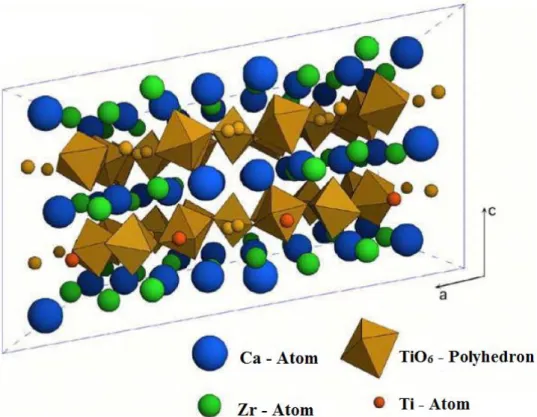
The crystal structures are described as TiO6 octahedrons sheets alternating with planes of Ca and Zr atoms. The octahedrons layers can be rotated and replaced to derive different symmetries 3. White et al. 7 suggested that the monoclinic system is the simplest structure from which the other systems can be derived, as its crystal structure has only two layers. The crystal structure of zirconolite-2M is presented in Figure I.1. The first layer contains Ti atoms surrounded by 6 O atoms. The second is constituted by alternating Ca atoms (coordination of VIII) and Zr atoms (coordination of VII).
Figure I.1. Projection of the crystal structure of zirconolite-2M along the b axis 8.
In order to prepare samples containing significant amounts of actinides or lanthanides, two syntheses routes have been studied. The first one, developed by ANSTO, is a sol-gel synthesis 9, 10. It consisted of the mixing of calcium, lanthanide or actinide solutions with zirconium, titanium and aluminum alkoxides in nitric acid medium. The mixture was dried and calcined at 1023 K. Then, the solid was milled, pressed at room temperature and sintered at 1673 K for 4 to 96 hours. Zirconolite-2M was obtained as the major phase (98 wt.%) with about 2 wt.% of secondary phases (ZrTiO4 and CaTiO3). The process has been optimized and led to a single phase Ln-doped ceramic, where ZrTiO4 was the only minor phase 2, 11. Moreover, those samples exhibited good sintering capability with a relative density of 90-95 % compare to the calculated value 12.
17
The second synthesis route involved a high temperature melting process in cold crucible. A mixture of oxides was introduced in stoichiometric proportions in the cold crucible and melted at 1723-2073 K. The obtained liquid was then cooled in order to obtain zirconolite in glass-ceramic or ceramic form 2, 13. This melting process led, however, to polyphased systems composed by zirconolite, perovskite, rutile, and zirconia (ZrO2). In zirconolite glass-ceramics, the actinides and surrogate elements (Ce, Nd) were equally distributed between residual glass and zirconolite. The final samples contained mainly zirconolite (70 vol.%) with the additional secondary phases mentioned above.
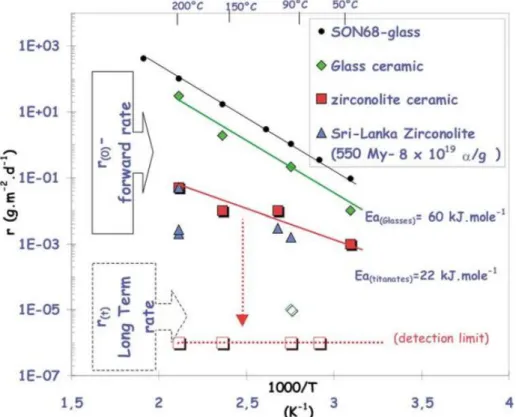
The chemical durability of zirconolite was studied at 363 K between pH = 2 and pH = 13. It showed that the normalized dissolution rates, based on the calcium release, were below 10-2 g.m-2.d-1, which is two orders of magnitude lower than that reported for borosilicate and aluminosilicate glasses, and also for zirconolite glass ceramics as shown in Figure I.2 2.
Figure I.2. Dissolution rates for different materials depending on temperature 2.
Moreover, this initial normalized dissolution rates decreased quickly down to the detection limits, which revealed the “absence” of leaching (in fact its strong deceleration). This phenomenon was due to the formation of neoformed phases (titanium, zirconium and aluminum hydroxides) at the sample surface that acted as protective layer 11. Natural metamict zirconolites bearing up to 20 wt.% of thorium presented similar normalized dissolution rates than synthetic crystallized zirconolite 14. However, Ewing et al. 15 showed
18
that the normalized leaching rates were 15 times higher for amorphous zirconolite than for the crystallized zirconolite.
The resistance of zirconolite to radiation damages was also studied. The helium diffusion coefficient (implantation of He3+) has been determined between 573 and 1103 K (D0 = 5 ×10⁻⁷ cm-2.s-1 and EA = 1.05 eV) and indicated that to cross 10µm at 323 K, helium needs 10 millions of years. Deschanels et al.16 doped zirconolite samples with 10 wt.% of plutonium then studied their amorphization. A swelling of about 0.4 % /1018 α.cm-3 was observed. While it generated micro-cracks in the sample, it did not seem to modify the conditioning properties of zirconolite as well as the associated chemical durability (which can be rather surprising considering the associated increase of the reactive surface area due to the presence of micro-cracks).
I.2. Britholite
Britholite, Ca9An1−x3+ Anx4+(PO4)5−x(SiO4)1+xF2, belongs to the apatite family 17. The general chemical formula of apatites can be written as Me10(XO4)6Y6 where Me stands for divalent cation (Ca2+, Sr2+, Ba2+, Pb2+ etc.), XO4 is an trivalent anionic tetrahedron when X = P, V or As, that can be replaced by tetravalent (SiO44−) or divalent (CO
3
2−) entities, and Y represents monovalent anion like F-, Cl-, and OH- and can be replaced by divalent anion such as O2- or by oxygen vacancies.
The incorporation of monovalent (Na+, K+, Cs+), trivalent (Ln3+, Al3+, An3+) and tetravalent (Th4+, U4+, Pu4+) ions are usually performed via substitution in the Me sites. The formation of britholites, which allows the incorporation of actinides, is obtained by coupled substitution [Ca2+, PO
4
3−] ↔ [Ln3+, SiO 4
4−] in order to satisfy the electronegativity in the apatite structure.
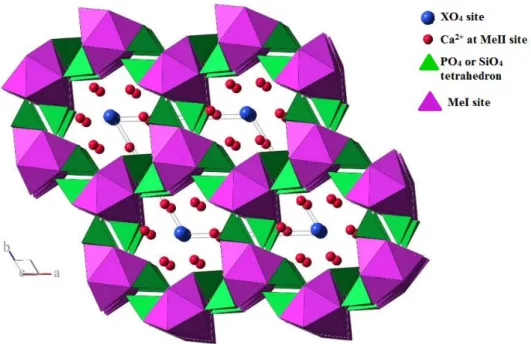
The apatite family crystallizes in hexagonal system with a space group P63/m)18, as presented in Figure I.3. Phosphate groups are arranged nearly compactly while divalent elements are present in two sites. Conversely to calcium or fluorine sites, no vacancies have been observed on the phosphate sites. There are considered as the skeleton of the structure 19. Four calcium atoms are present in the first Me site (MeI) surrounded by nine oxygen atoms whereas the six other calcium atoms are present in the second site (MeII, present at the periphery of the channels) surrounded by six oxygen atoms. Y anions are present in the channels formed by the phosphate and cations arrangements. Their precise localization
19
depends on their chemical nature. The presence of the Y anions in the channels can explain why such elements are more easily released from the structure during leaching tests.
Figure I.3. Representation of the fluoroapatite structure along c axis 18.
Boyer et al.18 showed that Nd-britholite crystallizes in the same system than apatite with the same space group. The coupled substitution of calcium atom by neodymium and simultaneously of phosphate group by silicate group does not create a huge distortion within the structure. The variations of unit cell parameters are only due to the distortion of the polyhedrons surrounding the cationic sites. They also determined that lanthanides ions were preferentially present in the MeII site20. In the same way, modeling of the Pu(III) incorporation led to the same conclusions with 75% of plutonium and neodymium present in the MeII sites 21, 22.
Natural apatites were found to contain significant amounts of tetravalent actinides, especially in that coming from the Oklo site where uranium and fission products were incorporated as inclusions or directly in the structure. Up to 100 ppm of thorium and from 10 to 1000 ppm of uranium were found in the apatite structure23.
Neodymium-bearing britholite Ca9Nd(PO4)5(SiO4)F2 was chosen as conditioning matrix due to studies realized on natural analogues. The low calcium substitution, the molar ratio SiO4/PO4 around 1/5 and the presence of fluor corresponded to a compromise between the chemical durability of the materials and their resistance to radiation damages24-26. Neodymium was incorporated thanks to the coupled substitution: [Ca2+, PO
4 3−] ↔ [Nd3+, SiO
4
![Figure I.5. Variation of log R L versus log [H 3 O + ] for pure TPD (▲), TPD doped with 241 Am () or 244 Cm (), TPuPD solid solutions (x = 0:4: and x = 1:0: ▼.) (298 K, I = 0:1 M) 59 .](https://thumb-eu.123doks.com/thumbv2/123doknet/12729556.357219/50.892.118.750.109.578/figure-variation-versus-pure-doped-tpupd-solid-solutions.webp)