Evaluation of Cultural Practices for Potential to Control Strawberry
Sap Beetle (Coleoptera: Nitidulidae)
REBECCA L. LOUGHNER,1,2GREGORY M. LOEB,1SONIA SCHLOEMANN,3 ANDKATHLEEN DEMCHAK4
J. Econ. Entomol. 101(3): 850Ð858 (2008)
ABSTRACT Strawberry sap beetle, Stelidota geminata (Say) (Coleoptera: Nitidulidae), adults and larvae feed on and contaminate marketable strawberry (Fragaria L.) fruit. The beetle is a serious pest in the northeastern United States, with growers in multiple states reporting closing Þelds for picking prematurely due to fruit damage. Three options were evaluated for potential to reduce strawberry sap beetle populations. First, the inßuence of plant structure on accessibility of fruit in different strawberry cultivars to strawberry sap beetle was assessed by modifying plant structure and exposing caged plants to strawberry sap beetle adults. Severity of damage to berries staked up off the ground was similar to damage to those fruit contacting the soil, showing that adults will damage fruit held off the ground. Second, baited traps were placed at three distances into strawberry Þelds to determine whether overwintered beetles enter strawberry Þelds gradually. Adult beetles were Þrst caught in the straw-berries⬇19 d after occurring in traps placed along edges of adjacent wooded areas. The beetles arrived during the same sampling interval in traps at all distances into the Þelds, indicating that a border spray is unlikely to adequately control strawberry sap beetle. Third, the number of strawberry sap beetle emerging from strawberry for 5 wk after tilling and narrowing of plant rows was compared in plots renovated immediately at the end of harvest and in plots where renovation was delayed by 1 wk. In the 2-yr study, year and not treatment was the primary factor affecting the total number of emerging strawberry sap beetle. Overall, limited potential exists to reduce strawberry sap beetle populations by choosing cultivars with a particular plant structure, applying insecticide as a border spray, or modifying time of Þeld renovation.
KEY WORDS Stelidota geminata, insect movement, integrated pest management
Strawberry sap beetle, Stelidota geminata (Say) (Co-leoptera: Nitidulidae), is a serious arthropod pest of strawberry (Fragaria L.) in the northeastern United States. Growers and extension personnel from multi-ple states have reported harvest being prematurely ended in strawberry Þelds with high densities of straw-berry sap beetle due to adult feeding and presence of the larvae. The beetles were present at all of 14 New York farms sampled in 2002 (Loughner et al. 2007b), although they were not regarded as a pest in all loca-tions. Once beetles do become a problem at a partic-ular farm, control tends to be a yearly challenge.
Strawberries in New York and other northern states are most frequently grown in a perennial matted-row production system. Straw is used to cover plants to prevent winter injury, and it is left between the rows of plants through harvest to suppress weeds (Pritts and
Handley 1998). Strawberry sap beetle adults overwin-ter primarily in leaf litoverwin-ter in nearby wooded areas, and they move into strawberry Þelds as fruit ripens in early June (Loughner et al. 2007a). The beetles feed on ripening berries and females oviposit in soil surround-ing the fruit. Larvae also feed on fruit, and then they pupate in nearby soil. The Þrst generation develops from egg to adult in⬇3 wk. Additional generations are possible depending on availability of other later-rip-ening fruit crops, such as raspberry and blueberry, near the strawberry Þeld (Loughner et al. 2007a).
Adults generally are not noticed at lower densities in strawberry Þelds by pick-your-own customers as beetles tend to scatter when fruit is disturbed for harvest; however, presence of larvae in the fruit is a source of customer complaints. Current recommen-dations for control of strawberry sap beetle are to improve Þeld sanitation and to apply one of two py-rethroid insecticides: bifenthrin (Brigade) and fen-propathrin (Danitol); labeled for use against straw-berry sap beetle in strawstraw-berry in New York (Pritts and Bushway 2003). Although pyrethroids are very toxic to strawberry sap beetle under laboratory conditions (Williams et al. 1999), their effectiveness in the Þeld is highly variable (Rhainds and English-Loeb 2002). A
1Department of Entomology, New York State Agricultural
Exper-iment Station, Cornell University, 630 W. North St., Geneva, NY 14456.
2Corresponding author, e-mail: [email protected].
3Department of Plant and Soil Sciences, University of
Massachu-setts, Amherst, MA 01003.
4Department of Horticulture, 107A Tyson Bldg., The Pennsylvania
State University, University Park, PA 16802.
parasitic wasp, Microctonus nitidulidis Loan, has been reported to greatly reduce strawberry sap beetle egg production in the laboratory; however,⬍1% of straw-berry sap beetle collected in the Þeld were parasitized (Weiss and Williams 1979). Although improving Þeld sanitation reduces the fruit residue available to straw-berry sap beetle, the removal of damaged fruit is not economically feasible in commercial operations. Po-tential alternative methods of controlling strawberry sap beetle in strawberry include 1) selecting cultivars less likely to be damaged by beetles, 2) applying a border spray in the spring as beetles move into Þelds, and 3) renovating Þelds promptly to reduce the num-ber of strawnum-berry sap beetle emerging after strawnum-berry harvest.
Characteristics of strawberry cultivars may inßu-ence the extent of strawberry sap beetle damage. Ca-sual observation suggests that 1) strawberry cultivars vary in tendency of fruit to touch the ground and 2) decreased strawberry sap beetle damage is associated with cultivars having less fruit touching the ground. Rhainds and English-Loeb (2002) observed more adults and larvae on berries touching the ground than fruit that is above the ground. Strawberry sap beetle eggs are oviposited in the upper soil surface, and emerging larvae travel to ripe fruit to feed (Weber and Connell 1975). Presumably, larvae are more likely to encounter fruit that is touching the ground than fruit that is not touching. Beetles also may primarily be near the soil surface because the ripest fruit tends to be on the ground or because berries held in the air are less accessible or are more risky locations to feed. The beetles are sensitive to desiccation in the laboratory (unpublished data), and feeding on fruit in the canopy may not provide adequate protection from the envi-ronment or from predators.
For variation in plant structure to be important in improving strawberry sap beetle management, beetle preference for unmarketable berries on the ground would need to be very strong to justify growing a different cultivar that may be less desirable for other reasons. Cultivar selection is limited by multiple fac-tors including a certain ripening time, performance in the soil and climatic conditions of a speciÞc location, and customer preference for color, taste, and size of fruit (Pritts and Bushway 2003). If reducing the amount of fruit in contact with the ground simply forces beetles to feed on fruit held off the ground, no signiÞcant reductions in the beetle population would occur. Assessing the potential role of plant structure in strawberry sap beetle management involves determin-ing 1) whether variation in plant structure exists among strawberry cultivars, 2) whether strawberry sap beetle are able to feed on fruit in the plant canopy, and 3) whether densities of naturally infesting adult strawberry sap beetle vary with cultivar.
Habitat surrounding strawberry Þelds has the po-tential to signiÞcantly inßuence the beetle population. Strawberry sap beetle occurred in strawberry as a pest as early as the 1950s (Connell 1980), although the beetle also has been collected in forests along with other nitidulids (Keeney et al. 1994). Strawberry sap
beetle has been caught in baited traps earliest in wooded areas, followed by traps in grassy transition areas, and Þnally in strawberry Þelds (Williams et al. 1996), suggesting that many if not all strawberry sap beetle adults overwinter outside the strawberry Þeld and that they move in as fruit begins to ripen. Williams et al. (1996) concludes that “understanding of the movement and migration of the strawberry sap beetle facilitates pest management strategies such as biolog-ical or cultural control methods, or the use of toxic baits.” If movement of the beetles into the strawberry Þeld occurs over several days, it might be possible to apply insecticide diluted with a greater amount of water to only the Þeld borders to improve coverage. An understanding of beetle migration into straw-berry may also allow traps to be deployed to attract and kill strawberry sap beetle with toxic baits. Mass traps with food odor and synthetic aggregation pher-omone attractive to both male and female beetles have been used to effectively suppress other nitidulids,
Car-pophilusspp., in Australian stone fruit orchards (James et al. 2001; Hossain et al. 2006). Disk-shaped gland structures containing C. freemani aggregation phero-mone attached to trachea in male abdomens were identiÞed and similar structures were found in males of another seven sap beetle species including straw-berry sap beetle (Dowd and Bartelt 1993). Although an aggregation pheromone has not been speciÞcally identiÞed for strawberry sap beetle, the presence of the gland structures strongly suggests that a phero-mone exists. Earlier arrival of male beetles at traps in the Þeld would provide evidence the beetles are using the aggregation pheromone as a method of locating mates and food resources within the strawberry Þeld. Although data from a related nitidulid Glischrochilus
quadrisignatus(Say) suggests females are mated be-fore overwintering (Foott and Timmins 1979), straw-berry sap beetles do mate multiple times (unpublished data), and the exact role of an aggregation pheromone in host and mate location in strawberry sap beetle as well as other species is not certain. The location in the Þeld where beetles occur Þrst also would indicate where attract-and-kill traps should be placed for max-imum effectiveness in capturing beetles before they can damage fruit.
Treatment of strawberry Þelds after harvest is a third area where it might be possible to reduce the number of strawberry sap beetle. Fruiting in the June-bearing strawberry cultivars grown in New York is Þnished by early July. Fields are then renovated by applying a broadleaf herbicide, mowing leaves off the strawberry plants, and rototilling to narrow the straw-berry rows. Because the strawstraw-berry sap beetle popu-lation in the strawberry Þeld primarily consists of larvae and pupae at this time, it has been hypothesized that rototilling, if done promptly, could destroy im-mature beetles before they complete development. Research in Maryland suggests that prompt renova-tion compared with renovarenova-tion delayed by 4 wk does reduce strawberry sap beetle emergence (G. Dively, unpublished data). The investigation of renovation time presented herein examines the applicability of
the prompt renovation approach to strawberry sap beetle control in the more northern location of New York.
Strawberry sap beetle has proven very difÞcult to control and reasons for the variable effectiveness of current insecticide applications are not well under-stood. This series of experiments were designed to speciÞcally evaluate several potential alternative strawberry sap beetle management options that have been proposed by growers and extension personnel. The objective was to look for very signiÞcant effects at a small scale in these initial evaluations of cultivar growth habit, movement of beetles into strawberry, and time of renovation. For any of these three areas that show promise of signiÞcant impact on beetle populations, further trials would be necessary to bet-ter understand the strawberry sap beetle biology that is involved and to test proposed options at a commer-cial scale when appropriate.
Materials and Methods
Strawberry Field Plots. Five Þeld plots were used to
investigate the effect of strawberry management prac-tices. The Þrst was planted in 2003 at the New York State Agricultural Experiment Station (NYSAES) Re-search North Farm in Geneva, NY. Fourteen cultivars were planted in randomized plots of four 3.7-m grouped rows in each of three blocks. Due to poor plant establishment in two of the blocks, only one block was used for the sampling. The second plot was planted in 2002 at the NYSAES Darrow Farm in Ge-neva, NY, and it was arranged in 10 sections, each with three grouped 5.5-m rows of both ÔCavendishÕ and ÔEarliglow.Õ A third plot with 28 cultivars in four rep-licated blocks was located at Penn StateÕs Horticulture Research Farm at Rock Springs, PA. Each cultivar was planted in one 5.8-m row within each block. Two additional sites at commercial strawberry farms in Penn Yan, NY, and Northborough, MA, were used to monitor the migration of overwintering adults and for renovation timing studies, respectively. The multiple strawberry Þelds at the Penn Yan site were grown in proximity to other small fruit crops, a mixture of Þeld crops, and surrounding wooded areas.
Comparison of Plant Structure among Cultivars.
The four individual rows of each cultivar in the Re-search North Farm plot were treated as replicates for sampling. Twenty-Þve clusters of fruit were examined from one side of the row to the row center, beginning at⬇0.5 m from the end of each row. Data were re-corded by cluster for 1) the number of ripe berries touching the ground; 2) the number of ripe berries held off the ground, including fruit laying on top of another berry; and 3) number of green and partially ripe fruit. Because fully expanded ripe fruit are gen-erally heavier than green fruit, the proportion of ripe fruit also was recorded. The proportion of fruit ripe and the proportion of ripe fruit touching the ground were analyzed. The comparison of touching and non-touching fruit was limited only to ripe fruit, such that confounding of ripening time with plant structure was
reduced. No assessment of strawberry sap beetle dam-age was done as the natural density of beetles in the plot was too low to provide enough data for analysis and inoculation of the Þeld with beetles was not pos-sible due to a preexisting research project in the plot. If variability does exist in strawberry plant growth habit, there should be a signiÞcant effect of cultivar for proportion of ripe fruit touching the ground.
Plant Structure Manipulation. Earliglow at the
Dar-row Farm was selected because its fruit ripens early, about the time overwintered strawberry sap beetle adults become active in the spring. Locations were identiÞed within the plot where several clusters with a ripe primary fruit were in proximity. Each location was randomly assigned to one of four treatments: 1) berries staked up and 30 strawberry sap beetle re-leased, 2) berries staked up and no strawberry sap beetle released, 3) berries pinned down and 30 straw-berry sap beetle released, 4) berries pinned down and no strawberry sap beetle released. In total, 32 locations were included in the completely randomized design to provide eight replications for each treatment.
Six clusters with the ripest fruit were selected at each location. Clusters of fruit were either pinned down in direct contact with the ground or supported up off the ground by using stakes with 1.3-cm-diam-eter wire loops at one end. Any additional clusters were removed from the immediate area. Each set of six clusters was then covered with a 87- by 41- by 31-cm plastic container (Sterilite Corporation, Townsend, MA) ventilated with thirty-six 6.5-cm-diameter holes in the top and upper portions of sides. Aluminum window screening and nylon knit fusible interfacing (HTC-Handler Textile Corp., Secaucus, NJ) were taped over the holes to prevent entry or exit of beetles. Outer sides of the cage were covered with white self-adhesive covering (Pliant Solutions Corp., N. Rid-geville, OH) to reduce heat buildup.
Strawberry sap beetle adults were collected with whole wheat bread dough baited traps at a commercial strawberry Þeld in western New York on 13 June 2005, and they were released into cages of the appropriate treatments the following morning. Two days after in-oculation with beetles, the number of ripe fruit in each of the following categories was recorded by cluster: 1) strawberry sap beetle damage and strawberry sap bee-tle adults present on fruit, 2) strawberry sap beebee-tle damage and no strawberry sap beetle adults present, 3) no strawberry sap beetle damage and strawberry sap beetle adults present, and 4) no strawberry sap beetle damage and no strawberry sap beetle adults present. Because small amounts of slug damage can sometimes seem similar to adult strawberry sap beetle feeding sites, the proportion of damaged fruit was analyzed after adjusting means in the strawberry sap beetle inoculated cages to exclude the mean propor-tion of fruit classiÞed as damaged in the control cages corresponding to each treatment. If strawberry sap beetle are unable or unwilling to feed on the fruit in the plant canopy, there should be more damage to fruit in cages with fruit pinned to the ground com-pared with cages with fruit staked up off the ground.
Density of Naturally Infesting Strawberry Sap Bee-tle. Sixteen of the cultivars in the Penn State
Hor-ticulture Research Farm plot were selected for sampling to represent those commonly grown com-mercially. In 1.2Ð2.4-m row sections, the number of adult strawberry sap beetle present on or underneath the fruit was recorded for each plot. Evaluation was done over 2 wk as primary berries ripened in the different cultivars. The density of strawberry sap bee-tle was calculated for each row section sampled. If strawberry sap beetle prefer certain cultivars for any reason in an open-Þeld environment, signiÞcant vari-ation in beetle density with cultivar is expected. Bee-tles move into strawberry after overwintering in wooded areas (Loughner et al. 2007a), and a markÐ recapture experiment showed adults can move up to at least 17 and 50 m in strawberry and fallow Þelds, respectively (Loughner et al. 2007b), indicating adults are mobile enough to choose between cultivars in the plot sampled.
Migration of Overwintering Adults. Four to six lines
of traps were placed 15 m apart in each of Þve straw-berry Þelds bordered by wooded edges at the Penn Yan site on 14 April 2003. Traps were placed at four locations along each line: edge of wooded area, edge of strawberry Þeld, 27.6 m into the Þeld, and 40.8 m into the Þeld, with the furthest distance representing the center of the narrowest Þeld sampled. The niti-dulid inventory traps used were modiÞed from those used by Williams et al. (1994). A 0.95-liter polypro-pylene deli container was baited with⬇30 g of whole wheat bread dough wrapped in nylon fusible knit interfacing material and secured with a rubber band. The opening of the container was screened (seven holes per cm) to exclude larger species of arthropods. A golf course cup cutter was used to dig a hole such that the top of the trap was at soil level. A 30.5- by 30.5-cm piece of rooÞng shingle served as a rain shield and was placed over the trap. Traps were checked daily for strawberry sap beetle adults from 15 April to 29 May 2003, after which time traps were checked every three days until 22 June. Bait was exchanged at 3-day intervals. Male and female strawberry sap beetle in each trap were counted for each sampling interval. If strawberry sap beetle gradually moves into the Þeld, a progression of strawberry sap beetle across the three distances into the Þeld should occur over time.
Renovation of Strawberry Plots. Two manipulative
experiments were used to investigate the effect of renovation on the strawberry sap beetle population. The working hypothesis for both is that rototilling may kill larvae or pupae in the soil if the timing of reno-vation corresponds with a time when a large portion of the strawberry sap beetle population is in a vulner-able life stage. Whereas neither experiment was de-signed to explicitly test the impact of tillage, if any of the treatment effects are large, these trials can serve as a starting point for a more in depth investigation of tillage and strawberry sap beetle population dynamics. The Þrst was the comparison of the number of beetles emerging from the Darrow Farm plot where renovation was conducted promptly or delayed by⬇1
wk. The Darrow Farm is a research facility with small acreages of strawberry and a low strawberry sap beetle density, making it necessary to inoculate the plot used in this study. Strawberry sap beetle adults were col-lected in traps baited with whole wheat bread dough at a commercial strawberry Þeld in western New York in early June of 2004 and 2005. Approximately 3,400 adult beetles were released in the plot as fruit began to ripen in 2004, and⬇1,500Ð2,000 were released in 2005, such that the offspring of the released overwin-tered adults would begin emerging from the Þeld at about the time the early renovation treatment was applied.
The herbicide 2,4-dichlorophenoxyacetic acid was applied in early to mid-July, and the mowing of straw-berry foliage conducted 1 wk later in both years. The 10 plot sections (5.5 by 5.5 m) were then assigned in a completely randomized design to either rototilling immediately after mowing (prompt renovation) or rototilling 7Ð10 d after mowing (delayed renovation). Treatments were randomly reassigned to sections the following year. Emergence cages were placed in both treatments on the same day, and the cages in the delayed rototilling were removed brießy on the day tilling was done. Cages were the same as those used in the plant structure manipulation except for the mod-iÞcation that the open end of a 237-ml glass jar wrapped in aluminum foil was inserted through a 7-cm-diameter hole in the cage. The jar held bait made from 30 g of whole wheat bread dough and wrapped in interfacing. Fiberglass window screen was placed over the jar opening before jars were attached to the ring and inserted into the cage. Four cages were placed in each of the 10 sections on the day the prompt renovation occurred. Cages were spaced⬇3 m apart and centered lengthwise in the middle row of each of the two cultivars within a section. Dough baits were replaced and the adult beetles in the jar counted twice weekly for 5 wk after the cages were placed in the plot. The total number of beetles emerged per cage in each year was analyzed.
The second experiment was the comparison of bee-tle emergence from renovated versus nonrenovated portions of the Northborough strawberry planting. Originally intended as an extension of the previous experiment to a commercial strawberry Þeld, beetle emergence was compared in rototilled and nonroto-tilled sections of a strawberry Þeld before the Þeld being plowed under for planting of another crop. Her-bicide was applied to the entire planting, and every other row of strawberries was rototilled completely under. Cages were placed in the four corners and in the center of the Þeld in pairs with one cage over a row of strawberries where no tilling had occurred and the second over a row of strawberries that had been ro-totilled under. Bait was replaced weekly and the total number of adults emerged over 5 wk analyzed. If prompt rototilling or tilling compared with not tilling consistently reduces the emerging strawberry sap bee-tle population across years then time of renovation may be an important consideration in strawberry sap beetle management.
Statistical Analysis. Data presented in all Þgures is
nontransformed and means are presented with stan-dard errors throughout the results. All statistical anal-yses were done as an analysis of variance (ANOVA) by using SAS version 9.1 (SAS Institute 2006). Normality of data was improved through transformation before analysis, if necessary. Either a natural log or natural log⫹ 1 transformation was used for all data presented, with two exceptions. The proportion of fruit touching the ground in the comparison of plant structure sec-tion was left untransformed and the transformasec-tion arcsine公 [(x ⫹ (3/8))/(n ⫹ (3/4))] (Zar 1996) was applied to the proportion of damaged fruit in the plant structure manipulation. For the strawberry plot ren-ovation study, one data point was missing from the last sampling date in 2005. To permit analysis of the total number of strawberry sap beetle emerged during the Þve wk, the value for the missing data point was es-timated from the mean of the other three cages in the observational unit on the missing date.
Results
Comparison of Plant Structure among Cultivars.
The mean⫾ SE for proportion of fruit ripe across all cultivars in the Research North Farm trial plot was 0.65⫾ 0.02, with individual cultivar means ranging from 0.38⫾ 0.04 for Serenity to 0.96 ⫾ 0.02 in
Evan-geline (Fig. 1A). The proportion of fruit ripe differed signiÞcantly with cultivar (F⫽ 8.88; df ⫽ 13, 42; P ⬍ 0.0001). Of the ripe fruit present, a mean overall pro-portion of 0.52⫾ 0.02 fruit were touching the ground. Means for individual cultivars ranged from 0.31⫾ 0.05 in Evangeline to 0.71⫾ 0.07 for Cabot (Fig. 1B), with differences among cultivars also signiÞcant for the proportion of fruit touching the ground (F⫽ 7.33; df ⫽ 13, 42; P⬍ 0.0001).
Plant Structure Manipulation. The total number of
fruit in the cages across treatments was similar; there-fore, the proportion of berries damaged in each cage was analyzed. Strawberry sap beetle adults were seen feeding on both pinned down and staked up fruit in inoculated cages during data collection. Although damaged fruit was found in the noninoculated con-trols, no strawberry sap beetle were seen in these cages. Slugs, which can cause damage that looks sim-ilar to that of strawberry sap beetle, were present across all treatments. After adjusting means in inoc-ulated cages for damage from slugs, the proportion of damaged fruit was similar (F⫽ 3.63; df ⫽ 1, 14; P ⫽ 0.0774) for berries that were pinned down (mean⫽ 0.21, SE⫽ 0.05) and for berries that were staked up (mean⫽ 0.09, SE ⫽ 0.03).
Density of Naturally Infesting Strawberry Sap Bee-tle. The number of strawberry sap beetle was low
across the entire planting at the Penn State Horticul-Fig. 1. Mean⫾ SEM for proportion of total fruit ripe (A) and proportion of ripe fruit touching the ground (B) for 14 strawberry cultivars in a trial garden planting at the Research North Farm in Geneva, NY. Nontransformed means are shown.
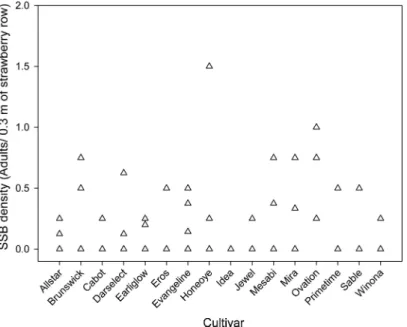
ture Research Farm; however, at least one strawberry sap beetle adult was found in all but one plot. None of the 16 cultivars sampled had signiÞcantly greater den-sities of naturally infesting strawberry sap beetle (F⫽ 1.43; df⫽ 15, 48; P ⫽ 0.1736) (Fig. 2).
Migration of Overwintering Adults. Strawberry sap
beetle adults were Þrst found in baited traps in wooded areas adjacent to strawberry Þelds beginning in early May 2003 (day 130) and Þrst occurred in traps inside the Þelds⬇2.5 wk later on day 147 (Fig. 3). For any given location, date of Þrst arrival of male and female strawberry sap beetle to the traps was not signiÞcantly different (Table 1). Strawberry sap
bee-tle were caught signiÞcantly earlier in traps along the wooded edge than at any of the locations within straw-berry Þelds (Table 1; Fig. 3). After these initial trap catches, the mean number of strawberry sap beetle increased greatly in all four trap locations on day 164, and then it dropped sharply on the following sampling date (Fig. 3). The decrease was associated with both a drop in temperature and an application of fen-propathrin (Danitol 2.4 EC) at label rate (0.4 kg [AI]/ ha) by the grower to the strawberry Þelds. Captures increased again in all locations on day 170. Sampling was ended on 22 June (day 173) when beetles were observed in ripe strawberry fruit. At this time, ripening fruit was competing with the bread dough attractant, resulting in a second large drop in mean strawberry sap beetle per trap (Fig. 3). Overall, the largest effect Fig. 2. Density of strawberry sap beetle (SSB) in each of four replicate plots for 16 strawberry cultivars in a trial garden planting at the Penn State Horticulture Research Farm in Rock Springs, PA. For cultivars where less than four data points occur, multiple replicate plots had the same mean and the data points overlay one another.
Fig. 3. Mean strawberry sap beetle (SSB) adults per bread dough baited trap caught from early May to mid-June 2003 in Þve strawberry Þelds adjacent to a wooded area. Traps were located along wooded edges adjacent to straw-berry Þelds, at the edge of strawstraw-berry Þelds, and at 27.6 or 40.8 m into the Þelds. All three locations within strawberry Þelds are shown as solid lines.
Table 1. ANOVA and mean separation for Julian date of first strawberry sap beetle capture along wooded edges adjacent to strawberry fields, at the edge of strawberry fields, and at 27.6 or 40.8 m into fields
Effect F df P Meana,b ConÞdence
intervala
Gender 0.09 1,196 0.7655 Trap location 86.94 3,196 ⬍0.0001
Wooded edge 143a 141Ð146
0.0 m 161b 157Ð164 27.6 m 162b 159Ð166 40.8 m 163b 160Ð167 Gender⫻ trap location 0.36 3,196 0.7785 a
Means and conÞdence interval limits shown were backtrans-formed after analysis.
b
Means followed by the same letter are not signiÞcantly different at P⬍ 0.05.
was earlier appearance of beetles in the woods traps followed by rapid movement over all distances into Þelds within a single 3-d sampling interval.
Renovation of Strawberry Plots. No signiÞcant
in-teraction was present between time of renovation and year (F ⫽ 3.22; df ⫽ 1, 16; P ⫽ 0.0917) for total strawberry sap beetle adults emerged over the 5 wk after renovation (Fig. 4). Although the time of reno-vation had no effect on the number of strawberry sap beetle (F⫽ 1.75; df ⫽ 1, 16; P ⫽ 0.2042), year was highly signiÞcant (F⫽ 55.12; df ⫽ 1, 16; P ⬍ 0.0001). In the Northborough plot, there was no signiÞcant difference in adult emergence from the renovated and nonrenovated plots (F⫽ 2.44; df ⫽ 1, 4; P ⫽ 0.1933). The number of beetles captured at this site were low, with only two occasions where⬎10 strawberry sap beetle were in any single trap when samples were collected. An additional unreplicated comparison in 2004 of prompt versus delayed renovation in a com-mercial strawberry Þeld at the Penn Yan site showed a similar pattern of adult emergence as seen at the other sites in 2004 (data not presented).
Discussion
Comparison of Plant Structure among Cultivars.
Sampling and manipulative experiments were de-signed to better understand how variation in plant structure of strawberry cultivars could impact fruit resources available to strawberry sap beetle. The 14 cultivars sampled at the NYSAES Research North Farm differed in plant structure as measured by the proportion of berries touching the ground. ÔSerenityÕ had a high proportion of fruit touching the ground before most of the fruit had ripened, whereas ÔEvan-gelineÕ had a low proportion of fruit in contact with the ground at peak ripeness. Conclusions are somewhat limited by the pseudoreplicated design of the sam-pling; however, the Þnding that berries on Evangeline are less likely to come in contact with the ground Þts with anecdotal reports from strawberry growers of the cultivar tending to 1) hold fruit off the ground and 2) be less damaged by strawberry sap beetle in the Þeld.
Plant Structure Manipulation. The hypothesis that
plant structure may be useful in developing control tactics is based on the assumption that berries in con-tact with the ground are more likely to be damaged by strawberry sap beetle. In the plant structure manip-ulation experiment, strawberry sap beetle adults both damaged and were present on fruit clusters staked up off the ground. After controlling for slug damage, the proportions of damaged berries suggest that fruit held off the ground is equally likely to be damaged by strawberry sap beetle as fruit touching the ground, at least under the condition that fruit held off the ground is the only food available and the beetles are conÞned in cages. The cages in this experiment do introduce the conditions of potential increased humidity and tem-perature, protection from predators outside the cage, and no ability of the beetles to disperse. The lack of signiÞcant difference in damage is less important than the Þnding that strawberry sap beetle fed on berries staked up off the ground in the relatively optimal conditions of the cages, indicating that strawberry sap beetle do not feed exclusively on fruit touching the ground and under the right conditions will damage fruit in the plant canopy. The willingness of the beetles to feed on these typically less desirable fruit suggests that breeding for cultivars to hold more fruit off the ground may reduce problems with strawberry sap beetle, but is unlikely to eliminate damage especially on farms with high strawberry sap beetle densities. Although only adult damage was evaluated in this experiment, the presence of larvae also causes eco-nomically signiÞcant damage in ripening fruit. The larvae may be more likely to infest fruit on the ground than fruit in the plant canopy because strawberry sap beetle oviposits in the soil, although further experi-ments would be necessary to test this hypothesis.
Density of Naturally Infesting Strawberry Sap Bee-tle. Although proportion of fruit touching the ground
may vary with cultivar, some fruit in all cultivars is in direct contact with the ground. The beetles may pref-erentially feed on fruit touching the ground and only damage fruit in the canopy when densities of straw-berry sap beetle are high. Damage to fruit in the plant canopy has been reported in such situations at com-mercial farms. Even a comparatively low proportion of fruit in contact with the ground may provide straw-berry sap beetle with a sufÞcient food resource, such that there is a similar density of beetles across all cultivars as found in the Penn State Horticulture Farm trial plot. Although the population of strawberry sap beetle in the plot was low, beetles were found in almost all plots, suggesting that some beetles would be found in a planting of any cultivar. Overall, the po-tential for directly impacting the strawberry sap beetle population by choosing a strawberry cultivar with a particular growth habit seems to be no more viable commercially than improving Þeld sanitation through removal of fruit residue.
Migration of Overwintering Adults. Beetles were
caught earlier in nearby wooded areas compared with strawberry Þelds as in Williams et al. (1996) however, there was no evidence of a delay between strawberry Fig. 4. Mean⫾ SEM for the number of strawberry sap
beetle (SSB) per trap in strawberry plots renovated either promptly after the end of harvest or after a delay of 7Ð10 d. Adults were collected for 5 wk after the early renovation treatment in both 2004 and 2005 in all plots. Nontransformed means are shown.
sap beetle occurring in traps at the Þeld edge and traps in the interior of the Þeld (Fig. 3). The window of opportunity to apply an insecticide to only the border rows of the strawberry Þeld seems to be less than the 3-d sampling interval if it exists at all. Given the uni-form appearance of beetles across traps in the Þeld, it is unlikely that applying an insecticide to the Þeld border would reduce the strawberry sap beetle pop-ulation. If an earlier arrival of males compared with females in traps had been found, this would have suggested that males are arriving at the food source, then producing aggregation pheromone to attract conspeciÞcs for mating and shared food use. However, the absence of a signiÞcant interaction between gen-der and trap position indicated that either males and females enter the Þeld and locate a food source at the same time or that a difference in arrival time was not detectable within the 3-d sampling interval.
Although the insecticide application could have been partially responsible for the decrease in beetles in traps on day 167, the number of beetles in the wooded areas dropped along with counts in the Þelds. In most cases, the wooded edge was too far from the strawberry Þeld (15Ð25 m) for signiÞcant spray drift to have affected strawberry sap beetle in the leaf litter under the trees and the decrease in captures was probably related to the associated drop in tempera-ture. There is no indication that beetles move back and forth between the woods and Þeld on a regular basis. Assuming the insecticide contributed to the decreased counts in the Þeld, any beneÞts were not long-term and had little impact on damage to the fruit, because the number of beetles captured increased on the fol-lowing sampling date.
Renovation of Strawberry Plots. Year was the
pri-mary factor contributing to variation in the total num-ber of strawnum-berry sap beetle adults emerging from strawberry plots treated with prompt or delayed ren-ovation. The lack of a consistent treatment effect (Fig. 4) suggests that renovating promptly does not always, if ever, reduce the number of strawberry sap beetle in the next generation. This is in contrast to data from Maryland (G. Dively, unpublished data) where sig-niÞcantly fewer beetles emerged from plots renovated promptly after harvest compared with plots in which renovation was delayed by 4 wk. The delay in reno-vation differed by 3 wk between the two studies, and it may be a key reason why there was no consistent difference between prompt and delayed renovation in New York. The lower overall numbers at the Darrow site in 2005 may have come from a combination of fewer beetles being available to inoculate the plot compared with 2004 and a hot, dry summer unlike the cool, wet summer in 2004. The unusually warm tem-perature in 2005 likely shortened strawberry sap bee-tle developmental time, and when coupled with a week delay due to rain in renovating the plots, may have allowed some beetle emergence to have oc-curred before cages being placed in the Þeld. If a large number of early emerging beetles was the cause of reduced beetle captures in 2005, it suggests that once the beetles emerge they leave the strawberry Þeld.
Although weather conditions may interact with ren-ovation timing to impact beetle emergence, the po-tential seems limited to plan renovation such that it adequately reduces the number of strawberry sap bee-tle. Current recommendations to renovate promptly still have value given other beneÞts such as more time for plant regrowth.
Overall Summary. The objective of this research
was to evaluate three ways for improving strawberry sap beetle control that have been suggested by straw-berry growers. Although the modiÞcations to cultural practices examined in this study are unlikely to sig-niÞcantly reduce strawberry sap beetle population size or damage to marketable fruit, the work has pro-vided insight into some underlying strawberry sap beetle biology. Although adult beetles are typically found in the Þeld underneath ripe fruit, the cultivar growth habit study shows the beetles are not limited to feeding on fruit in contact with the ground. Strawberry sap beetle adults were initially thought to be poor ßyers (Van Dam et al. 2000), and there has been speculation that the beetles might walk into Þelds in the spring. Results from a markÐre-capture experiment described in Loughner et al. (2007b) and the rapid entry of overwintering adults into Þelds in this study indicate beetles are quite capable of ßight.
The earlier capture of beetles along wooded edges near Þelds may offer an alternative approach to straw-berry sap beetle management. Williams et al. (1996) and Rhainds and English-Loeb (2002) suggest placing mass traps baited with an aggregation pheromone, food odor, and an insecticide in wooded edges just before strawberry fruit ripening. The traps would be expected to attract both male and female strawberry sap beetle and reduce the strawberry sap beetle pop-ulation by capturing beetles before they enter the strawberry Þeld. Further work is needed to determine the potential of this method for reducing strawberry sap beetle damage to acceptable levels.
Acknowledgments
We thank the following individuals for assistance with Þeldwork: Steve Hesler, Sara Villani, Jason Nyrop, Charles Moser, Carrie Loomis, Liz Loomis, Matt Giardino, and the Field Research Unit crew in New York; Arthur Tuttle in Massachusetts; and Kelly Dezura and Robert Cushman in Pennsylvania. We are grateful for the assistance of Alan Tomion and Jim Coulter in New York and Mo Tougas in Massachusetts in allowing us to conduct portions of this work at their farms. This research was supported by funding from a CSREES, USDA Regional Integrated Pest Management Program-Northeast Region grant, the New York State Inte-grated Pest Management Program, and the Mike Villani Graduate Student Research Award.
References Cited
Connell, W. A. 1980. Stelidota geminata (Say) infestations
of strawberries (Coleoptera: Nitidulidae). Entomol. News 91: 55Ð56.
Dowd, P. F., and R. J. Bartelt. 1993. Aggregation pheromone
glands of Carpophilus freemani (Coleoptera: Nitidulidae) and gland distribution among other sap beetles. Ann. Entomol. Soc. Am. 86: 464 Ð 469.
Foott, W. H., and P. R. Timmins. 1979. The rearing and
biology of Glischrochilus quadrisignatus (Coleoptera: Nitidulidae) in the laboratory. Can. Entomol. 111: 1337Ð 1344.
Hossain, M. S., D. G. Williams, C. Mansfield, R. J. Bartelt, L. Callinan, and A. L. Il’ichev. 2006. An attract-and-kill
sys-tem to control Carpophilus spp. in Australian stone fruit orchards. Entomol. Exp. Appl. 118: 11Ð19.
James, D. G., B. Vogele, R. J. Faulder, R. J. Bartelt, and C. J. Moore. 2001. Pheromone-mediated mass trapping and
population diversion as strategies for suppressing Car-pophilus spp. (Coleoptera: Nitidulidae) in Australian stone fruit orchards. Agric. For. Entomol. 3: 41Ð 47.
Keeney, G., M. S. Ellis, D. Richmond, and R. N. Williams. 1994. A preliminary study of the Nitidulidae
(Co-leoptera) in Shawnee State Forest, Ohio. Entomol. News 105: 149 Ð158.
Loughner, R. L., G. M. Loeb, K. Demchak, and S. Schlo-emann. 2007a. Evaluation of strawberry sap beetle
(Co-leoptera: Nitidulidae) use of habitats surrounding straw-berry plantings as food resources and overwintering sites. Environ. Entomol. 36: 1059 Ð1065.
Loughner, R. L., G. M. Loeb, and W. W. Turechek. 2007b.
Strawberry sap beetle (Coleoptera: Nitidulidae) distri-bution in New York and differential movement in two types of habitat. J. Entomol. Sci. 42: 603Ð 609.
Pritts, M., and D. Handley. 1998. Strawberry production
guide for the Northeast, Midwest and Eastern Canada. Northeast Regional Agricultural Engineering Service, Cooperative Extension Service, Ithaca, NY.
Pritts, M., and L. Bushway. 2003. Pest management
guide-lines for berry crops 2003. Cornell Cooperative Exten-sion, Ithaca, NY.
Rhainds, M., and G. English-Loeb. 2002. Impact of
insecti-cide application and mass trapping on infestation by strawberry sap beetles (Coleoptera: Nitidulidae). J. En-tomol. Sci. 37: 300 Ð307.
SAS Institute. 2006. UserÕs manual, version 9.1. SAS
Insti-tute, Cary, NC.
Van Dam, W. A., R. N. Williams, and R.A.J. Taylor. 2000.
Flight performance of some nitidulid beetles (Co-leoptera) using a computer-monitored ßight mill. J. Agric. Urban Entomol. 17: 143Ð151.
Weber, R. G., and W. A. Connell. 1975 Stelidota geminata
(Say): studies of its biology (Coleoptera: Nitidulidae). Ann. Entomol. Soc. Am. 68: 649 Ð 653.
Weiss, M. J., and R. N. Williams. 1979. A new parasite of the
strawberry sap beetle. Ohio Report on Res. and Devel-opment in Agriculture, Home Economics, and Natural Resources. 64: 3Ð5.
Williams, R. N., M. S. Ellis, D. S. Fickle, and S. T. Bloom. 1996. A migration study of Stelidota geminata
(Co-leoptera: Nitidulidae). Great Lakes Entomol. 29: 31Ð35.
Williams, R. N., M. S. Ellis, and G. Keeney. 1994. A bait
attractant study of the Nitidulidae (Coleoptera) at Shaw-nee State Forest in southern Ohio. Great Lakes Entomol. 27: 229 Ð234.
Williams, R. N., D. S. Fickle, and M. R. Ahmed. 1999.
Bio-assay evaluation of insecticides on strawberry fruit and foliate, 1998. Arthropod Manag. Tests. C26.
Zar, J. H. 1996. Biostatistical analysis. Prentice Hall, Upper
Saddle River, NJ.