for Best-Effort Content-Based Networks
Doctoral Dissertation submitted to the
Faculty of Informatics of the Università della Svizzera Italiana in partial fulfillment of the requirements for the degree of
Doctor of Philosophy
presented by
Amirhossein Malekpour
under the supervision of
Prof. Antonio Carzaniga, Prof. Fernando Pedone
Prof. Matthias Hauwswirth Università della Svizzera Italiana, Switzerland
Prof. Mehdi Jazayeri Università della Svizzera Italiana, Switzerland
Prof. Benoît Garbinato University of Lausanne, Lausanne, Switzerland
Prof. Bettina Kemme McGill University, Montreal, Canada
Prof. Peter Triantafillou University of Patras, Rio, Greece
Dissertation accepted on November 2012
Prof. Antonio Carzaniga
Research Advisor
Università della Svizzera Italiana, Switzerland
Prof. Fernando Pedone
Research Advisor
Università della Svizzera Italiana, Switzerland
The PhD program Director Prof. Antonio Carzaniga
PhD Program Director
I certify that except where due acknowledgement has been given, the work pre-sented in this thesis is that of the author alone; the work has not been submitted previously, in whole or in part, to qualify for any other academic award; and the con-tent of the thesis is the result of work which has been carried out since the official commencement date of the approved research program.
Amirhossein Malekpour Lugano, November 2012
years from now, when the sun
explodes we’re not going to
run out of discoveries.
- Paul Romer
Content-based publish/subscribe (or simply content-based) networking is a relatively new communication paradigm compared to IP networking, with a different approach to addressing network hosts. In content-based networking addressing as well as in-formation dissemination center around inin-formation and interests. A host’s address is represented by its interest and information is routed by a network of brokers to hosts with relevant interests. We advocate the idea that content-based networking should be implemented and offered as a basic network service and be accessible everywhere and to all applications.
Best-effort content-based systems which substantiate this idea are high-throughput low-delay publish/subscribe systems in which messages are treated as datagrams with-out end-to-end or in-network acknowledgments and flow control. In such systems, publishers (senders) do not avoid or even detect congestion, and brokers respond to congestion by simply dropping overflowing messages. These systems are therefore un-able to provide reliun-able message delivery and fair resource allocation and to properly handle traffic anomalies, which may degrade the overall quality of service. Further-more, extensive usage of concurrent matching and routing algorithms in broker soft-ware causes frequent message reordering in the brokers and ultimately out-of-order delivery of messages to clients. These shortcomings of best-effort content-based sys-tems impede their deployment for many applications and environments. For instance, the lack of congestion control hinders the deployment of such systems in the open In-ternet, where congestion-unaware flows are considered a major threat to the stability of the network.
With this motivation, we propose an end-to-end “transport protocol” that improves three key properties of best-effort content-based systems namely, message ordering, reliability, and congestion control. These essential requirements have been previously addressed at the protocol and broker-level, at the cost of much higher complexity and lower messaging efficiency. On the contrary, our guiding principle in designing this transport protocol is to view the underlying best-effort publish/subscribe network as a black box and only assume that it provides a general publish/subscribe API. This design principle has multiple advantages. First, the transport protocol works with vir-tually every best-effort content-based system, for it makes no assumptions about the underlying network. Second, individual clients can optionally take advantage of this
viii
transport protocol for better quality of service while those with relaxed requirements can opt out and avoid unnecessary overheads. More importantly, the end-to-end proto-col has a minimum impact on the favorable performance and inherent simplicity of the best-effort network since it does not require the involvement of the broker network.
Our methodology in developing this transport protocol, on the one hand, is based on understanding the body of related research on end-to-end solutions for FIFO order-ing, reliability and congestion control, and on the other hand, dealing with challenges in adopting them for our purpose. This requires understanding the key distinguishing characteristics of traffic in content-based networks, and their practical implications on the design of the transport protocol. In particular, message loss detection is a canonical issue which we discuss in detail in the thesis.
Our transport protocol is comprised of three separate components for FIFO order-ing, reliability, and congestion control, where the FIFO ordering protocol is prerequisite for the other two. Our FIFO ordering protocol, which is also responsible for loss de-tection, is probabilistic in that it does not guarantee deterministic FIFO ordering on all messages but it eliminates a vast majority of out-of-order deliveries. This compromise in the precision of message ordering is to minimize its overhead on the network. The reliability and congestion control protocols are inspired by existing proposals for IP multicast. We will detail the challenges in adopting these protocols for our purpose and propose methods and enhancements for their application in our target context. In brief, the reliability component of our protocol is based on a technique, similar to reli-able multicast, that takes advantage of collaborative caching and retrieval of messages by the clients through a request/repair process. The proposed congestion-control pro-tocol is also inspired by an existing rate-control scheme for IP multicast. This propro-tocol uses an equation-based flow-control algorithm that reacts to congestion in a manner similar to and compatible with TCP. For the purposes of fairness and efficiency, this protocol is also content-aware, meaning that it modulates specific content-based traf-fic flows along a congested path.
We have a complete implementation of the proposed transport protocol. Experi-mental results with a best-effort content-based system and our transport protocol re-veal that the protocol improves message ordering and reliable delivery by up to 95%. Also, congestion control protocol eliminates a large number of messages losses and pro-vides considerably better resource sharing among concurrent content-based and TCP flows. Most importantly, our results show that these improvements come with a mini-mum compromise in the throughput and end-to-end delay of the messaging service. In summary, the experimental results are encouraging and confirm our fundamental hy-pothesis that the basic service provided by best-effort content-based networks can be significantly improved in terms of key quality measures, using an end-to-end transport protocol.
I am thankful to my advisors Antonio Carzaniga and Fernando Pedone for their pa-tience, friendship and invaluable involvement in the development of my research. With Fernando and Antonio on board, one never longs for better technical insight, sharper and more constructive criticism and interesting ideas.
I am grateful to my dissertation committee members, Mehdi Jazayeri, Matthias Hauwswirth, Peter Triantafillou, and, Bettina Kemme, for their insightful comments. In particular, I would like to thank Benoît Garbinato for his constructive feedback and also for the collaboration during the first two years of my studies.
During the past five years I was privileged to enjoy the company of a group of friends and colleagues in the Distributed Systems lab and the Faculty of Informatics. Thanks to Vaide Narvaez, Lasaro Camargos, Marcin Wieloch, Nicolas Schiper, Marco Primi, Daniele Sciascia, Alex Tomic, Eduardo Bezerra, Parisa Jalili, Ricardo Padilha, Daniele Sciascia, Leandro Pacheco, Cyrus Hall, Jeff Rose, Shima Gerani, Mehdi Mirza-aghaei, Navid Ahmadi, Hamid Ghods, Parvaz Mahdabi, Mark Carman, Giovanni Tof-fetti, Mircea Lungu, Aliaksei Tsitovich, Marco Pasch, Edgar Pek, Lile Hattori, Paolo Bonzini, Giovanni Ciampaglia, Giovanni Ansaloni, Elisa Larghi, Janine Caggiano, Dani-jela Milicevic and many others for their contributions to my social and academic life. Mostafa Keikha, thank you for being a great pal, for helping me improve my math and for the Friday afternoon statistics group reading. Adina Mosincat, my beloved col-league and friend, you are missed and I will never forget you. Thanks to Mouna Allani for our fruitful collaboration on Streamline project.
Last but not least, I am grateful to my family for their patience and love, for being there whenever I needed them. Dad, thank you for asking me, every time we had a phone conversation, if I was working on a new paper, and mom, thanks for not asking. Leila, Parisa, Mehran and little Raha, thank you for cheering me up and always reminding me of what a wonderful family I have.
Contents xi
List of Figures xv
List of Tables xix
1 Introduction 1
1.1 Motivation and Rationale . . . 3
1.2 Challenges and Solution Overview . . . 5
1.3 Structure of the Dissertation . . . 7
2 Background and Related Research 9 2.1 Language Models . . . 9
2.2 Subscription Representation and Matching . . . 11
2.3 Architecture and Event Routing . . . 11
2.4 Reliable Delivery and Ordering . . . 13
2.4.1 Reliable versus best-effort systems . . . 14
2.4.2 Reliable delivery . . . 15
2.4.3 Ordered delivery . . . 17
2.5 Scalability and Load Balancing . . . 19
2.6 Congestion Control . . . 19
2.7 Siena B-DRP . . . 20
3 FIFO Ordering 23 3.1 Overview of Problem and Solution . . . 25
3.1.1 FIFO ordering . . . 27
3.2 Probabilistic FIFO Ordering . . . 29
3.2.1 Model of end-to-end delay . . . 29
3.2.2 Measuring delay differences . . . 29
3.2.3 End-to-end delay distribution . . . 31
3.2.4 Distribution of delay differences . . . 33
3.2.5 Determining the latch time . . . 34
xii Contents
3.2.6 Publication record . . . 35
3.3 Loss Detection . . . 37
3.4 Algorithmic Description . . . 37
3.5 Evaluation . . . 40
3.5.1 Network delay model validation . . . 40
3.5.2 Effectiveness of the ordering protocol . . . 42
3.5.3 Adaptivity of the protocol . . . 45
3.6 Conclusion . . . 45
4 Reliability 47 4.1 Context and Preliminaries . . . 48
4.1.1 Reliable IP multicast . . . 48
4.1.2 Problem and overview of the solution . . . 49
4.2 End-to-end Loss Recovery . . . 51
4.2.1 Message loss detection . . . 51
4.2.2 Routing requests . . . 51
4.2.3 Sending repairs . . . 54
4.2.4 Adaptive message cache . . . 54
4.2.5 Interaction with FIFO ordering protocol . . . 57
4.3 Discussion . . . 57
4.4 Evaluation . . . 58
4.4.1 Experimental setup and workload . . . 59
4.4.2 Recovery effectiveness . . . 60
4.4.3 Performance and network overhead . . . 63
4.4.4 Adaptive cache . . . 64
4.5 Conclusion . . . 66
5 Congestion Control 67 5.1 Context and High-Level Design . . . 68
5.1.1 Congestion control for IP multicast . . . 68
5.1.2 TCP friendly multicast congestion control . . . 69
5.1.3 Content-aware rate control . . . 70
5.1.4 High-level design . . . 72
5.2 Content-Aware Congestion Control Protocol . . . 73
5.2.1 Content-based flows . . . 73
5.2.2 Congestion control protocol . . . 73
5.2.3 Dealing with imprecise loss detection . . . 78
5.3 Evaluation . . . 80
5.3.1 Experimental setup . . . 80
5.3.2 Effectiveness, stability, and responsiveness . . . 81
5.3.3 Fairness among concurrent content-based flows . . . 83
5.3.5 Large scale deployment . . . 84 5.3.6 Concurrent operation with the recovery protocol . . . 86 5.4 Conclusion . . . 88
6 Conclusion 89
6.1 Summary of Work . . . 89 6.2 Future Research . . . 91
A Statistics of the sum of two Laplacian random variables 95
A.0.1 Probability Density Function . . . 95 A.0.2 Cumulative Density Function and Quantile Function . . . 96 A.0.3 Parameter Estimation . . . 97
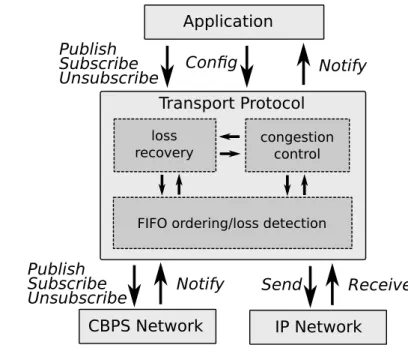
1.1 Schematic diagram of the transport protocol and its interface with ap-plication and the underlying IP and content-based publish/subscribe (CBPS) networks . . . 6 2.1 Two types of publish/subscribe architecture. (a): Peer-to-peer
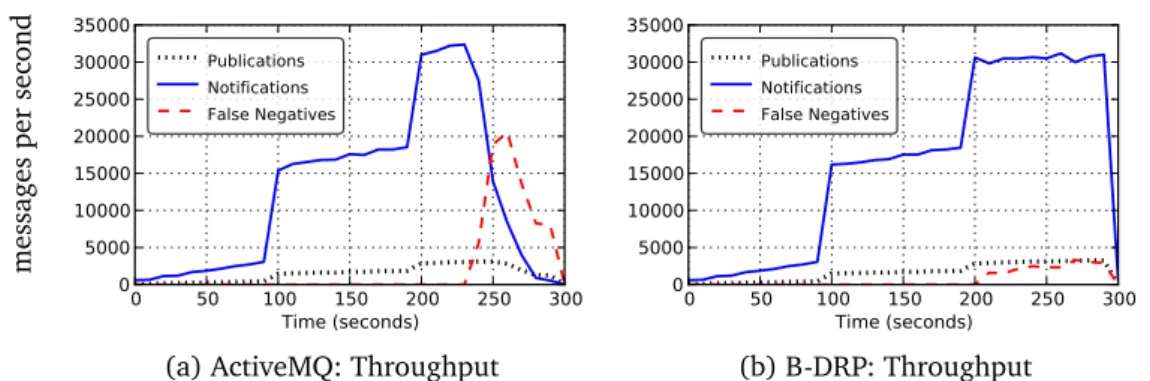
(b):Broker-based . . . 12 3.1 Throughput of ActiveMQ and B-DRP in an 8-broker network. . . 25 3.2 FIFO violations of B-DRP in an 8-broker network corresponding to
Fig-ure 3.1 . . . 25 3.3 Illustration of how a FIFO violation occurs . . . 27 3.4 (a) End-to-end delays for a sender/receiver pair 3 brokers apart. (b)
Cu-mulative distribution of end-to-end delay samples fitted in a 5-phase hypoexponential distribution. . . 31 3.5 Histogram of the delay difference for a sender and receiver separated
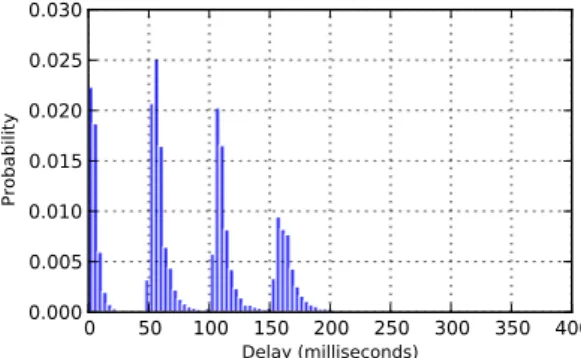
by 5 brokers. The thick line is the approximation with the sum of two Laplacian random variables. . . 31 3.6 By virtually increasingδ, we avert a FIFO violation . . . 34 3.7 Message m6carrying a publication record of size 4 . . . 35 3.1 Probabilistic ordering FIFO algorithm run by a recipient for each publisher 38 3.8 Distribution of end-to-end delay for all of the delivered messages during
the first 90 seconds of the experiment. . . 40 3.9 End-to-end delays of every two consecutive messages for a chosen pair
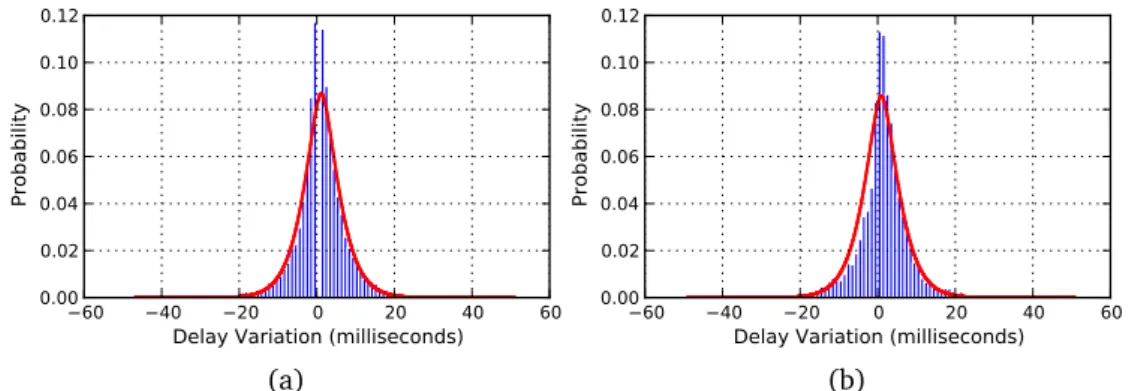
of sender and receiver. . . 41 3.10 Delay variation distribution for messages with end-to-end delay of (a) delay(m) ≤
1500ms and (b) delay(m) > 1500ms respectively. . . 42 3.11 Effectiveness of different FIFO algorithms in an 8-broker setup: the total
number of incurred FIFO violations with and without ordering. . . 43 3.12 Effectiveness of different FIFO algorithms in an 8-broker setup: the
av-erage extra delay caused by different ordering algorithms. . . 43 3.13 Effectiveness of different FIFO algorithms in a 46-broker setup: the total
number of FIFO violations with and without ordering. . . 44
xvi Figures
3.14 Effectiveness of different FIFO algorithms in a 46-broker setup: the av-erage extra delay caused by different ordering algorithms. . . 45 3.15 From top to bottom: timestamps of out of order receptions; publication
rate; probability of a FIFO violation; latch time in enhanced mode with a publication record of size 25; latch time in basic mode. . . 46 4.1 Message m5is lost before reaching B and C (a); having received m9(b),
C publishes a request for m5(d); A replies with a repair (d). . . . 53 4.2 Probabilistic ordering FIFO algorithm run by a recipient for each publisher 56 4.2 Probability of loss detection for (a) different sizes of publication record
and match probability, (b) different sizes of publication record, match probability and different number of nodes sharing a loss (2, 3, 5 from bottom to top in each line category). . . 57 4.3 (a) Number of receivers for cumulative distribution of messages. (b) Match
probability for cumulative distribution of subscriber/publisher pairs. . . 60 4.4 Aggregate publication and notification rates in (a) 12-broker and (b)
46-broker networks. . . 60 4.5 Impact of publication-record size on the effectiveness of the recovery
protocol in (a) 12-broker and (b) 46-broker networks. . . 61 4.6 (a) Changes in the aggregate rate of false negatives (message loss) with
and without the recovery protocol, for (a) 12-broker and (b) 46-broker networks. . . 62 4.7 Cumulative distribution of the end-to-end delay for original and repair
messages and request/repair delay for (a) 12-broker and (b) 46-broker networks. . . 62 4.8 (a) Aggregate publication rate, request, and repair messages during the
experiment for (a) 12-broker and (b) 46-broker networks. . . 63 4.9 Delivery delay with and without the recovery protocol in (a) 12-broker
and (b) 46-broker networks. . . 64 4.10 Changes in the cache hit ratio in (a) 12-broker and (b) 46-broker
net-works. . . 65 4.11 Changes in the minimum, mean, and maximum cache size of all nodes
in (a) 12-broker and (b) 46-broker networks . . . 65 5.1 The output of TCP response function: (a) for values of p ∈ [0.01, 0.1]
and tRT T ∈ {10, 20, 100, 200} milliseconds. (b) for values of tRT T ∈ [10, 200] milliseconds and p ∈ {0.001, 0.01, 0.1}. . . 70 5.2 Content-aware rate control . . . 71 5.3 Content-aware congestion control: C’s involvement in the congestion
control process is not necessary . . . 72 5.4 Transport header in a publication message. . . 74 5.5 Per-publisher session state maintained by a subscriber. . . 75
5.3 Congestion monitoring and control run by a subscriber for each pub-lisher from which there is an incoming message flow . . . 76 5.6 A publisher’s congestion control state . . . 77 5.4 Processing feedback message M received from subscriber s . . . . 78 5.7 Loss event rate (left) and TCP response function (right) computed for
the ideal receiver (top), publication record of size 5 (middle) and pub-lication record of size 2 (bottom). . . 80 5.8 Experiment topology . . . 80 5.9 The effect of variable input load (a) without and (b) with congestion
control in place. Top: traffic rate (Kbps) on the bottleneck link. Bottom: aggregate publication, reception, and false negative rate (messages per second) during the experiment. . . 81 5.10 Effects of variable bottleneck link capacity (a) without and (b) with
con-gestion control. Top: traffic rate (Kbps) on the bottleneck link. Bottom: aggregate publication, reception, and false negative rate (messages per second) during the experiment. . . 82 5.11 The solid lines show reception rates (mps) for 3 pairs of publishers and
subscribers sharing the bottleneck link (a) without and (b) with con-gestion control in effect. The dotted lines show the fair share of each flow. . . 83 5.12 TCP and content-based reception rate (Kbps) for a TCP flow and a
pub-lish/subscribe flow sharing a bottleneck link (a) without and (b) with congestion control in place. The horizontal dotted lines show the ideal fair share. . . 84 5.13 Broker topology for large scale experiment . . . 85 5.14 Publication, reception, and false negative rate (mps) in a large scale
network (a) without and (b) with congestion control in place. . . 85 5.15 (a) the number of received feedback messages (mps) for one of the
publishers. (b) changes in the number of entries in the publisher’s state table. . . 86 5.16 Experiment topology with both recovery and congestion control
proto-cols in use . . . 86 5.17 Network dynamics (a) without and (b) with transport protocol in place.
Top and middle: traffic rate (Kbps) on the two bottleneck links. Bottom: aggregate publication, reception, and false negative rate (messages per second) during the experiment. . . 87 5.18 Changes in (a) total number of request/repair messages (mps), (b)
4.1 Parameters used in the calculation of the cache size. . . 55
Introduction
In publish/subscribe communication the addressing of messages is implicit and con-trolled by receivers. Receivers express their interests through subscriptions that state conditions on the content of messages, while senders simply publish messages without any set address. Each message is then delivered to all receivers whose interests match the content of the message. This messaging paradigm aims to eliminate some of the inefficiencies of IP networks that became evident with the exponential growth of avail-able information and the number of connected devices on the Internet. For one, in IP networks a host’s address pertains to its location while in publish/subscribe networks a client’s addresses is tied to its interests and hence mobile with the client itself. For another, in IP networks access to desired content is usually facilitated through multiple tiers of centralized or distributed services that work atop IP, such as the domain name system (DNS), directory services and web services. Publish/subscribe communication eliminates or reduces the need to many of these services, for the addressing and rout-ing protocols in these networks evolve around content and interests instead of devices and physical locations.
Publish/subscribe communication is already used in several types of applications and seems generally useful to virtually all data-driven applications. Examples of such uses include system monitoring and management (e.g., management of a large data center), information dissemination (e.g., news), resource discovery and sharing (e.g., service discovery in a “cloud” computing infrastructure, proactive search in on-line auc-tions), stream processing (e.g., analysis of financial data), and distributed simulations (e.g., multi-player gaming)[BRS02; EFGK03].
The successful deployment of this communication paradigm has motivated the de-velopment of such standards as Java Messaging Service (JMS)1and Advanced Message Queuing Protocol (AMQP)2, followed by enterprise-level implementations like Apache ActiveMQ and IBM MQ Series. Publish/subscribe networking has also been the subject
1http://java.sun.com/products/jms 2http://www.amqp.org
2
of substantial research in academia to devise and implement robust and efficient pub-lish/subscribe systems [BCM+99; CRW01; CDKR02; PB02; FJLM05; BMVV05; RPS06]. For the purposes of scalability and fault tolerance, a publish/subscribe system is usually implemented as a distributed service, and falls into either of the two major ar-chitectural categories: peer-to-peer and broker-based systems. In the broker-based net-work design, which is the focus of this thesis, a netnet-work of brokers functions as a rout-ing substrate which efficiently routes messages to their intended receivers. Content-based publish/subscribe networks (or simply content-Content-based networks) are a type of publish/subscribe system with rich addressing schemes that allow clients to express fine-grained details about the information they are willing to receive.
Content-based networks like any other communication system face an array of chal-lenges such as scalability, security and privacy, authenticity, message ordering, reliabil-ity, fair resource sharing, and efficiency in terms of throughput and communication delay. Unfortunately, these are conflicting goals, in the sense that an improvement for one of them typically implies a loss for another. Therefore, system designers often tar-get and optimize a subset of these factors based on the application requirements. In the set of requirements for a content-based network, three crucial elements are message ordering, reliability, and fair resource usage. The importance of these three measures is that they are among the basic properties of any communication system and directly affect its quality of service.
In this dissertation, by message ordering we mean FIFO ordering which is a basic ordering guarantee in communication and distributed systems. According to FIFO ordering, for any given sender, messages must be delivered in the same order they were sent. Many applications rely on FIFO ordering to ensure the consistency of actions between a sender and a receiver or among different receivers. FIFO ordering is also a building block for more involved ordering semantics such as causal ordering. By reliability, we mean reliable delivery, that is ensuring that messages are received by their intended recipients. Naturally, the reliability of a communication system is crucial to the effective functionality and often to the ultimate correctness of an application that relies on it. Furthermore, since a communication system is often a shared resource among multiple clients, it is imperative to ensure that all clients have access to their fair share of the network resources. In other words, it is often desirable to prevent a single client from exhausting network resources, causing other clients to suffer from inability to communicate. An important observation is that these requirements are in many ways intertwined, meaning that satisfying or improving one is often a prerequisite for another. As a result, these problems are often addressed in unison, in the form of a set of protocols with complementary functionalities.
Based on the aforementioned quality measures, we can classify the current broker-based architectures into two categories. In the first category, FIFO ordering and reliable message delivery are built in the protocol and implemented by the broker network. While these properties are favorable advantages from the client’s perspective,
provid-ing such guarantees complicates protocol and broker design and is costly at run-time. In particular, providing such guarantees usually requires compromising throughput, scalability, and message delivery delay. Obviously, mission-critical applications with stringent message ordering and delivery requirements opt for this class of systems while applications that need to scale to a very large set of loosely coupled clients or require rapid message delivery opt for an alternative design.
On the contrary, in the so called best-effort design, protocols do not provide such guarantees but instead aim for maximum throughput and minimum end-to-end de-livery delay. So, typically, these systems do not log messages to a persistent storage, nor do they implement any mechanism to guarantee message ordering or fair resource usage. Acknowledgment messages are not used and no explicit congestion control mechanism is in place. The advantage of these systems is that they allow for more streamlined message processing, with simpler protocols and with broker designs closer to those of network routers. This design allows for various types of performance op-timizations, hardware-assisted implementations, and extension through modular de-sign. Moreover, these protocols thanks to a simple core specification have better prospects for widespread adoption on the Internet. One of the primary reasons for this is that service providers are reluctant to adopt protocols which impose potential high costs, are difficult to analyze, and interoperate and require complex configura-tions. Still, despite their better performance and simplicity, the unreliable nature of best-effort systems seems to limit their deployment significantly, especially in critical application domains.
1.1
Motivation and Rationale
This dissertation centers around the idea that content-based publish/subscribe (or sim-ply content-based networking) should be seen as a basic networking protocol with efficient and scalable message routing as its primary functionality, much like in con-ventional IP networking. Such a design opts for a layered and modular protocol stack resembling that of TCP/IP, in which the client side network stack or middleware builds optional enhancements atop the underlying unreliable communication primitives. In essence, we look at the best-effort publish/subscribe protocol as an underlying high-throughput but unreliable network service, and build a transport protocol that targets end-to-end FIFO ordering, reliable delivery and congestion control. By an end-to-end solution we mean considering the broker network as a black box and having clients involved in providing these services without making any particular assumption about the internals of routing and forwarding infrastructure.
This modular approach will allow a wider range of applications to take advantage of a best-effort service with optional additional costs in return for a better service. For instance, maintaining FIFO ordering within brokers can be memory intensive and would delay all messages without distinction. By contrast, when ordering is handled
4 1.1 Motivation and Rationale
by end-points, it is up to the client to decide the right balance between strictness of the ordering and cost in terms of additional delivery delay. Moreover, this design is applicable to virtually every publish/subscribe system, regardless of their architectures, routing protocols, and broker technologies.
The principles of end-to-end protocol design for data networks can be traced back to the first years of ARPANET[Bar64; MW88] where end-to-end protocols were devised to eliminate out-of-order reception of messages. Later, Saltzer et al.[SRC84] in their seminal work titled “End-to-end arguments in system design” maintain “end-to-end argument” as an essential design principle in communication systems:
“In a system that includes communications, one usually draws a modular boundary around the communication subsystem and defines a firm interface between it and the rest of the system. When doing so, it becomes apparent that there is a list of functions each of which might be implemented in any of sev-eral ways: by the communication subsystem, by its client, as a joint venture, or perhaps redundantly, each doing its own version. In reasoning about this choice, the requirements of the application provide the basis for the following class of arguments: The function in question can completely and correctly be implemented only with the knowledge and help of the application standing at the endpoints of the communication system. Therefore, providing that ques-tioned function as a feature of the communication system itself is not possible, and moreover, produces a performance penalty for all clients of the commu-nication system. (Sometimes an incomplete version of the function provided by the communication system may be useful as a performance enhancement.) We call this line of reasoning against low-level function implementation the end-to-end argument.”
A natural question follows this statement: is the end-to-end argument applicable to content-based networks?The answer to this question requires answering the following canonical question: is it possible to implement message ordering and reliable delivery completely and correctly with an end-to-end approach? In IP networking, TCP is a very successful adoption of the end-to-end argument that is, reliable message delivery and message ordering are completely and correctly provided by end-to-end protocols. At a first glance one might think that a transport protocol for content-based networks can implement the same solutions that exist in TCP. Unfortunately, there are some in-herent properties of data flows in content-based networks that obstruct adoption of TCP mechanisms for content-based networks. In particular, precise end-to-end loss de-tection which is necessary for reliable message delivery, FIFO ordering and congestion detection requires a set of changes that cause significant overhead to the network and fall into contrast with the design principles of the publish/subscribe communication.
Thus, we find a middle ground between precision and practicality of loss detection and propose a loss detection mechanism that is prone to errors but has practical values
to our transport protocol. As a result, the reliability and ordering components of our transport protocol are probabilistic in the sense that FIFO violations or message losses are not completely eliminated, but their probability of occurrence is reduced. In other words, the end-to-end transport protocol eliminates the vast majority of FIFO violations and recovers many of the lost messages, effectively enhancing service quality that is experienced by the application. Similarly, our congestion control protocol may exhibit suboptimal resource sharing due to its reliance on loss detection, but we will show that it is able to largely reduce the negative effects of congestion and improve fairness. Therefore, we emphasize that the primary purpose of this research is not to replace reliable publish/subscribe networks but to propose, implement, and evaluate a set of end-to-end protocols that improve the quality of service of best-effort content-based networks with minimum sacrifice in their favorable properties. Moreover, we hope that the contributions of this work will pave the way in designing “complete and correct” end-to-end protocols for CBPS networks in the future.
1.2
Challenges and Solution Overview
The three components of our end-to-end transport protocol are FIFO ordering, relia-bility and congestion control. These problems have been extensively studied and ad-dressed in the domain of distributed systems and data networks. Throughout the thesis we will study the applicability of the existing relevant solutions to our problem. This requires understanding the distinguishing characteristics of traffic in a content-based network and its practical implications for the components of our end-to-end protocol.
In unicast or multicast IP networks, traffic originating from a given source is chan-neled in a flow whose recipients are interested in all of its constituting packets (e.g, a media stream or a file). On the contrary, in a content-based network, each published message is usually an independently meaningful object which based on a subscriber’s subscription might be of interest to it (selective reception). This property is the root of two key distinguishing factors between IP networks and content-based networks. First, as a consequence of selective reception, source-based sequence numbers are in-applicable to detect message loss on the receiver side. This is a major challenge in the adoption of mechanisms used in TCP or any of the existing reliability schemes for IP multicast. Second, publish/subscribe networks although categorized as one-to-many communication systems, do not incorporate the notion of group membership nor do they have the means for explicit addressing of a set of nodes. This is in contrast to IP multicast, in which group membership is a well defined concept where all group members are addressed using the multicast address dedicated to the group.
In this work, we introduce mechanisms to tackle these two problems. We propose a probabilistic loss detection algorithm that takes advantage of an efficient encoding scheme and augments messages with information that enables receivers to detect mes-sage losses with a configurable precision. We also elaborate on how the underlying
6 1.2 Challenges and Solution Overview
CBPS Network
Application
Transport Protocol
FIFO ordering/loss detection loss
recovery congestion control
Publish Subscribe Unsubscribe Notify Notify IP Network Send Receive Publish Subscribe Unsubscribe Config
Figure 1.1. Schematic diagram of the transport protocol and its interface with appli-cation and the underlying IP and content-based publish/subscribe (CBPS) networks
publish/subscribe network can be used to route control messages to a set of sub-scribers. These solutions enable us to tailor the existing protocols for reliability and congestion control for IP multicast to content-based networks.
Figure 1.1 illustrates how the transport protocol sits between the application and the publish/subscribe network. The transport protocol communicates with other end-points through the publish/subscribe network as well as the IP network to exchange control messages. Publish/subscribe API calls (subscribe, unsubscribe, publish) by the application are intercepted by the transport protocol and relayed to the network after necessary processing and adding required transport headers. The publish/subscribe API is extended to provide means for adjustment of the protocol parameters.
Notifications are first received by the transport protocol, processed, possibly buffered by the FIFO ordering component for ordered delivery, and finally delivered to the ap-plication after removing their transport header. The FIFO ordering component is also responsible for the probabilistic loss detection that is essential to the functionality of re-liability and congestion control protocols. Rere-liability and congestion control protocols can be independently disabled or enabled. When both of these protocols are in use, the reliability component consults congestion control before sending out any control message to ensure that congestion control policies are not violated by the generated outgoing traffic.
The FIFO ordering component of our transport protocol is a probabilistic mecha-nism that attempts to reduce the number of out-of-order deliveries that are visible to
the application, at the cost of a minimum additional delay. In other words, having re-ceived a set of messages whose delivery to the application might cause potential FIFO violations, the protocol treats messages in a way that the probability of the potential FIFO violations after the delivery of the involved messages is reduced to a configurable value. More specifically, this is the probability of a single FIFO violation and can be chosen by the client as a configuration parameter. This parameter also affects the extra cost (in terms of delivery delay) of using the ordering protocol. This scheme builds a model for the distribution of end-to-end delay as a random variable, which is then used to determine a latch time for each message. This probabilistic design implies that the protocol is not able to guarantee the FIFO delivery of messages but instead, aims at reducing the probability of each instance of a FIFO violation. The end result is that the total number of FIFO violations that the application incurs is significantly reduced, subject to a minimum extra cost in message delivery delay.
The reliability component of our transport protocol is an adoption of Scalable Re-liable Multicast[FJL+97] which is a generic reliability scheme for applications running on IP multicast. Loss recovery is performed through a request/repair process dur-ing which nodes recover lost messages from other receivers. Our protocol includes a novel approach to routing request messages to their intended receivers through the publish/subscribe network.
The third component of the transport protocol is a content-aware congestion con-trol protocol that is designed to prevent persistent congestion and to improve fairness when scarce network resources are shared among concurrent flows. This protocol is inspired by TCP friendly multicast congestion control[WH01] and is TCP friendly in the sense that its long term throughput is not more than that of TCP under the same network dynamics.
1.3
Structure of the Dissertation
Chapter 2 reviews the core properties of the publish/subscribe technology and high-lights the points of distinction between different systems: namely language and archi-tectural models. We then discuss the related research with a particular focus on the problems that we intend to study in this thesis. The next three chapters discuss the main components of the transport protocol. In Chapter 3 we discuss the FIFO ordering component of our transport protocol. In Chapter 4 and Chapter 5 we detail reliabil-ity and congestion control components respectively. Finally, Chapter 6 concludes the thesis and outlines future research directions.
Background and Related Research
In this section, we review the relevant literature and discuss the state of the art in publish/subscribe systems with an emphasis on the topics that relate to the contri-butions of this thesis. We first review language and architectural models, describing how different systems define syntax and semantics of publications and subscriptions. There is a large body of work on subscription representation, processing, and summa-rization. Here we briefly mention the main topics and notable publications on these areas. We will review the existing prominent architectures, highlight major challenges in designing such systems, and discuss proposed solutions. We then turn our atten-tion to the three specific aspects that relate to the thesis, namely message ordering, reliable message delivery, and congestion control. Finally, we review Siena B-DRP, an implementation of the Siena publish/subscribe system which we use as the underlying network for all the experimental analyses presented in this thesis.
2.1
Language Models
The language model of a publish/subscribe system specifies how subscriptions and pub-lications are expressed. It also defines rules according to which messages match sub-scriptions. Generally, there are two main categories of language models: topic-based and content-based. In the topic-based model[CDKR02; OB06; CMTV07a; CMTV07b; BBQ+07; JZR+09] subscriptions and publications are associated with a topic (tag). Topics usually have a hierarchical structure like topic.sub-topic.sub-sub-topic in which parts of the topic are delimited by a “.” and each part covers a number of subtopics. An example of a topic is sports.football.uk.liverpool. In subscriptions, usage of wildcards are usually allowed, for instance sports.football.* where “*” matches any word. Match-ing in this model is easily performed by a character-by-character comparison between the subscription and the publications.
On the other hand, the content-based language model [SA97; BCM+99; GKP99; CDNF01; FJL+01; CRW01; PB02; FMMB02; FGKZ03; GSAA04; TA04; FJLM05; CS05;
10 2.1 Language Models
RPS06; DGH+06; BFG07; JHMV09; AT11] provides a rich set of operators that fa-cilitates advanced and fine grained filtering and selection of messages. The set of operators and language syntax differs from a system to another, though in essence all of them provide similar facilities. In this thesis we will use the expressive and gen-eral model proposed by Carzaniga et al. [CRW01]. In this language model, events or messagesare assigned a tuple of attributes, each attribute composed of a name and a value. These attributes are typed with one of the three main types: numeric, boolean, and string. For instance, (symbol=“AMD”, price=100, market=“NYSE”) exemplifies a message with three attributes.
A constraint defines a filtering rule on the type, name, and value of a single at-tribute. For example, (price< 120) mandates existence of an attribute in the message, named “price” with a value less that 120 (type of the attribute is implied). A conjunc-tion of constraints is called a filter which allows for defining conjunctive filtering rules on multiple attributes. For instance, (symbol=“IBM” ∧ price < 120) is a filter with two constraints. Finally, a predicate (commonly called subscription) is a disjunction of mul-tiple filters which represents the complete form of a subscriber’s interests. An example of a predicate is ((symbol= “IBM” ∧ market=“NYSE” ∧ price < 120) ∨ (symbol=“AMD” ∧ market=“NYSE” ∧ price < 100)). In addition to equality, some systems provide string matching operators including substring, string prefix and suffix[CRW01; TE04; AT07]. While most common content-based publish/subscribe systems offer operators of numerical, boolean, and string type, there are proposals for richer operators to support specific applications. For instance, to facilitate dissemination of geographical informa-tion (e.g., posiinforma-tion of a user or an object) with the aid of a publish/subscribe network Konstantinidis et al. [KCW11] propose enhancements for supporting 2D spatial ob-jects. Some systems define the notion of a composite event which reflects occurrence of a given pattern in a set of events[Cou02; LJ05; JE10]. Accordingly, there are com-posite subscriptions to detect correlations among events or to find a given pattern in them. For instance, ((symbol=“AMD” ∧ price=$X) & (symbol=“AMD” ∧ price < $X)) yields a match only if the two subsequent events indicate a decrease in the value of the attribute “price” (the operator “&” specifies two consecutive events). Similarly, para-metric subscriptions [JJE10] allow a subscriber to parametrize its subscription (e.g., (symbol=“AMD” ∧ price=$X), where $X is the parameter) and update the correspond-ing parameter durcorrespond-ing runtime, instead of unsubscribcorrespond-ing and subscribcorrespond-ing anew for the new value.
A third approach to publish/subscribe takes advantage of extended markup lan-guage (XML) to describe events in XML format along with XPath1 or XQuery2 to de-scribe subscriptions. [SCG01a; CF04; DRF04]. The major drawback of these systems is the processing overhead of the XML files which is an obstacle to system’s scalability. Finally, in this subsection we explain two notions of subscription covering and
sub-1http://www.w3.org/TR/xquery/ 2http://www.w3.org/TR/xpath/
scription overlap that will be frequently referred to, in this thesis. Considering two subscriptions S1and S2and the set of all messages that match these two subscriptions, M1and M2respectively, we say S1 covers S2 if M2⊆ M1. Also, S1 and S2are said to be
overlapping subscriptions if M1∩ M26= ;.
2.2
Subscription Representation and Matching
The publish/subscribe communication paradigm is intended to facilitate development of high throughput, large-scale applications. Obviously, efficient event matching is crucial to this goal. Since the appearance of the first publish/subscribe systems, much research has been done to devise processor- and memory-efficient matching algorithms that take advantage of commodity hardware and multicore technology[ASS+99; PFLS00; CCC+01; FJL+01; CW03; FFTJ09; CTCHW09; RCF+09]. Deployment of specialized hardware has also drawn attention recently. Margara and Cugola[MC11] propose us-ing Graphical Processus-ing Units (GPU) while Sadoghi et al.[SLS+10; SSJ11] use FPGAs for high speed event matching.
Beside the large body of research on matching static subscriptions (subscriptions whose format does not change), there are also works on matching dynamic subscrip-tions like composite subscripsubscrip-tions ([LJ05]) and stateful subscriptions ([DGH+06]) which require stateful matching. This means that in addition to the subscriptions, bro-kers also need to maintain soft state about previously matched messages and account for this state for matching the next incoming messages.
Subscription matching is an interconnected problem with subscription representa-tion where the goal is to represent and aggregate subscriprepresenta-tions in a compressed manner with minimum sacrifice in accuracy. This helps preserve memory at each individual broker, reduces network bandwidth usage and leads to better matching throughput [TE04; LHJ05; CTCHW09; BFG07; JE11].
2.3
Architecture and Event Routing
Typically, a publish/subscribe system is a network of processes that take on the role of publisher, subscriber, or event router (or a subset of these). The interaction among these components is usually intertwined with the event routing mechanism. Broadly speaking, publish/subscribe systems fall into one of the two architectural types: peer-to-peer systems and broker based systems (See Figure 2.1).
In broker-based systems, a network of brokers routes subscriptions and messages among publishers and subscribers. Examples of such systems are Siena [CRW01], JEDI[CDNF01], Hermes [PB02], PADRES [FJLM05] and various implementations of
12 2.3 Architecture and Event Routing
App
App
App
App
App
App
App
App
Broker
(a) (b)Figure 2.1. Two types of publish/subscribe architecture. (a): Peer-to-peer (b):Broker-based
JMS such as Apache Active MQ3 and IBM WebSphere MQ.4 Cluster-based architec-ture is a variation of the broker-based model proposed in[JMV08] where brokers are grouped into clusters in order to achieve better scalability.
In peer-to-peer publish/subscribe systems subscriptions and publications are routed by peers without reliance on any broker network [GSAA04; BEG04; AT06; CW06; CVJ11; AT11]. Data Distribution Service (DDS)5 is a prominent architecture of peer-to-peer publish/subscribe system, defined as a formal specification developed by the Object Management Group.6 There is a variety of proprietary implementations of the standard such as PrismTech’s OpenSplice and RTI DDS. These systems are usually tar-geted at specific applications such as real-time processes and military purposes.
Predicate and event routing algorithms are directly influenced by architectural de-sign and the underlying assumptions about the network topology e.g., if the broker network is an acyclic graph or a general mesh. Most routing algorithms for pub-lish/subscribe systems account for covering relations among predicates and filters. in order to reduce the amount of state that has to be propagated throughput the network and maintained in the brokers’ routing table. [CRW01; CRW04; LHJ05; TK06]
For broker-based systems a variety of routing protocols has been proposed, many of which adopt a variation of reverse path forwarding[BCM+99; CRW01; FMMB02; CW03; LMJ08]. In these systems, publishers issue advertisement messages that are propagated throughout the network, effectively creating a tree, rooted at the pub-lisher’s home broker[CRW01; LHJ05; LMJ08]. Filters are then routed towards bro-kers with matching advertisements on the formed trees. This process enables the in-termediate brokers to populate their routing tables to route messages. There are also broker-based systems that incorporate routing schemes similar to those used in IP net-works where a variant of a link-state[MRI+80] or distance vector [GLAM97] routing protocol is used. Siena B-DRP[CTCHW09] is an example of such systems that works
3http://activemq.apache.org
4http://www-01.ibm.com/software/integration/wmq 5http://portals.omg.org/dds
atop any conventional distance vector or link state routing protocol.
In a separate class of broker-based systems, certain topics or contents are associated with rendezvous points in the network, typically using a predefined hash function. Subscriptions and events are routed to the rendezvous point, ensuring that they will intersect at some intermediate broker or eventually at the rendezvous point from which they will be propagated along a tree rooted at that rendezvous point. Optimizations are applied to avoid unnecessary routing of events towards the rendezvous point where routing decisions can be made locally. Most of the systems in this class rely on a DHT to map topics or contents to certain brokers in the network[PB02; BMVV05; JHMV09].
Peer-to-peer publish/subscribe systems rely on conventional query and message routing algorithms previously proposed for structured and unstructured peer-to-peer networks, including distributed hash tables (DHT) and epidemic algorithms. In partic-ular, DHTs have been shown to effectively facilitate event routing in large scale peer-to-peer networks, while providing favorable reconfigurability in response to failures. For instance, Scribe [CDKR02], PastryString [AT06] and Marshmallow [GLZ11] are based on Pastry[RD01]; SPICE [CQL08] works atop Tapestry [ZHS+04]; FEL [CW06] and the work by[TBF+03] are based on Chord [SMLN+03]; and Meghdoot [GSAA04] relies on CAN[RFH+01]. There are also DHT-independent publish/subscribe systems that view the underlying DHT as a black box with a common lookup API [TAaJ03; TA04; BMVV05; AT05; BFDG07; AT11].
Among the publish/subscribe systems that are built upon unstructured networks, [CF05; CP05; VRKS06; CMTV07b; BBQ+07] are notable works that rely on epidemic
algorithms like CYCLONE [VGS05] that facilitate dynamic self management for the overlay. One of the primary challenges in this category of systems is the optimal con-struction of the overlay in a way that peers with similar interest shape clusters in or-der to reduce event propagation delay and network resource usage[BBQV04; OR10; GCV+10; CJV10; CVJ11; OR11].
Finally, few proposals leverage generic multicast protocols like IP multicast for event dissemination. Event space is partitioned into smaller partitions and each par-tition is assigned to a distinct multicast group. Here again, the primary concern is to reduce the number of partitions (and hence the number of multicast groups). Unfor-tunately, the lack of wide availability of multicast protocols obstructs the deployment of such protocols on the Internet[OAA+00; CS05; EGN08; Hol11].
2.4
Reliable Delivery and Ordering
Message oriented middleware and in particular, content-based publish/subscribe sys-tems, have a wide range of applications in enterprise environments. Mission criti-cal applications usually have stringent requirements in terms of delivery guarantees and ordered delivery, so to support such applications, system architects opt for pub-lish/subscribe systems that provide such guarantees. As we will discuss in this section,
14 2.4 Reliable Delivery and Ordering
most publish/subscribe systems address these two issues within the same technical framework, with logging on persistent storage and hop-by-hop acknowledgement mes-sages inside the broker network.
Of the numerous types of ordering guarantees that have been defined in the con-text of fault tolerant systems [HT93; DSU04], some can be directly applied to pub-lish/subscribe communication. In this thesis, we consider the most basic form of or-dering, that is known as FIFO ordering. This means that if two messages m1 and m2
sent by the same sender are delivered to a receiver, then they must be delivered in the same order they were sent. Violation of this property can cause wrong or inconsistent decisions by different receivers. Hereafter, we refer to FIFO message ordering simply as message ordering. Also, various forms of reliability have been studied, along with various methods to achieve them[BSB+02; BZA03; PB02; FJLM05; KJ09]. However, in this chapter we refer primarily to a form of reliable delivery also known as message persistencein such standards as the Java Messaging Service specification. According to this delivery mode, the service must guarantee not to lose messages due to failures of message brokers.
2.4.1
Reliable versus best-effort systems
Reliable publish/subscribe systems strive to ensure that any subscriber will receive all of the published messages that match its subscriptions and the receiver will not receive messages “out-of-order” (i.e., according to some ordering semantics)[BSB+02; BZA03; PB02; FJLM05; KJ09]. Guaranteed delivery and service availability are provided by broker replication, deployment of redundant links and logging of messages on durable storage. Moreover, reception of messages by the intermediate brokers and the final recipients are acknowledged at each hop. These solutions are known as store and forwardsystems. Persistent storage and ordered delivery are clearly favorable (and for some applications essential) service qualities. Nevertheless, providing these guarantees come at the cost of lower messaging throughput and higher delivery delay.
On the other hand, systems in the “best-effort” class[JZR+09; CRW01; CDNF01; SCG01a] do not offer guaranteed delivery but instead try to maximize throughput and reduce end-to-end delay through a simple design that satisfies a minimal set of tasks. Messages in these systems are similar to IP datagrams, receiving a best-effort treatment. So, typically these systems do not log messages to persistent storage, nor do they guarantee ordered delivery of any kind. Also, unlike most systems in the previous category, the best-effort systems do not use any sort of acknowledgment messages or flow control. This simplicity in protocol allows for a simple broker design that makes optimum usage of multicore processors through concurrent matching and forwarding algorithms. In fact, brokers in such systems have functionalities and tasks similar to those of routers in IP networks, with a primary task of routing and forwarding messages. This category of systems in their basic form are suitable for interactive and realtime applications or applications that require scalability and are tolerant to
occasional message losses or FIFO violations.
As we mentioned before, the purpose of this thesis is to combine the best of both worlds i.e., to bring better reliability, message ordering and congestion awareness to best-effort systems with an end-to-end solution that requires a minimum sacrifice in terms of messaging throughput and delivery delay. With this objective, we will next review reliable publish/subscribe systems and detail various approaches to offer guar-anteed and ordered message delivery in this context.
2.4.2
Reliable delivery
Kazemzadeh and Jacobsen[KJ11] tackle the problem of partitioning in a network of brokers, which can happen as a result of broker failures. The underlying assumption in this work is that brokers are structured in a tree rather than a mesh. To facilitate tolerance against network partitioning, brokers maintain local knowledge about their immediate neighboring brokers as well as brokers located within a given distance (in terms of broker hop). This allows a broker to bypass network partitions and directly connect to working brokers in its downstream. As a result, the broker network is able to rapidly reconstruct itself from a set of disconnected partitions. The protocol also in-corporates a mechanism to ensure that publications are forwarded to a given subscriber only when all of the intermediate brokers are aware of the complete subscription set of that subscriber. This is a method to disallow gaps in the stream of messages delivered to a subscriber.
Yuanyuan[ZSB04] et al. address the same issue by placing two or more brokers in small broker groups. Broker groups are connected through multiple propagation trees which provide redundant routing paths to counter link failure and facilitate load balancing. However, utilization of multiple propagation trees creates the possibility of incomplete or inconsistent subscription information as well as gaps in delivered mes-sages (e.g., in case of using different trees to route mesmes-sages to a given subscriber). To address this challenge, this approach relies on virtual time (VT) vectors to convey tem-poral consistency in propagating incremental subscription information along different trees. Brokers maintain VT vectors for their subscription information and messages carry a VT vector that indicates their publication timestamp. Brokers decide if they have the necessary information to route the message, by comparing their VT vector with that of a message. If the test indicates insufficient or out-of-date information, the brokers conservatively flood the message to all neighbors on a routing tree (hence eliminate the possibility of causing a gap by falsely filtering a message). Although the proposed method does not require subscription state agreement across redundant paths it requires separate protocols to maintain the broker network in groups and mul-tiple overlays.
Ostrowski and Birman[OB06] divide the publish/subscribe network to scopes where reliability is provided within each scope using a mechanism that may vary from one scope to another. The authors briefly mention the possibility of combining reliable
16 2.4 Reliable Delivery and Ordering
multicast protocols like Scalable Reliable Multicast (SRM)[FJL+97] and Reliable Mul-ticast Transport Protocol (RMTP)[LS96] with an unreliable publish/subscribe protocol to provide reliability within one scope. The idea is that scopes are arranged in a tree, forming a hierarchy of scopes. Within each scope there is a second tree of receivers where delivery of each message is acknowledged to the root of the tree and lost mes-sages are recovered from the root. If a lost message can not be recovered by the local root it is forwarded to the upper node the in scope tree, and the recovery process continues in a recursive fashion (similar to RMTP). However, the proposed general ap-proach is limited to topic-based publish/subscribe systems. Even so, this work lacks a precise and concrete plan on how it can be implemented.
Bhola et al. [BSB+02] propose a mechanism in which publishers and subscribers together with brokers form a knowledge graph. Soft state information labeled as knowl-edgeand curiosity flow downstream and upstream among the nodes of the tree. Using these state messages, nodes decide about the delivery order of the events and ensure one-time guaranteed delivery even in the presence of failure. While this method can guarantee FIFO and total order delivery, it introduces complexities in the implemen-tation of the broker and does not integrate with any broker technology in a seamless manner.
Yoon et al. [YMJ11] study algorithms for instantaneous restructuring of broker overlay in response to failures or in order to optimize overlay in terms of delivery de-lay, based on the current subscription or publication pattern. The authors first define a set of requirements for a publish/subscribe network, in terms of ordered and guar-anteed delivery and then propose algorithms for overlay reconfiguration that respect the defined properties. To this end, a set of primitives and operations are worked out (for instance to remove or add an inter-broker link) using which the broker topology can be restructured. The limitation of this work comes from the assumption that the broker network is a tree, instead of a general overlay.
Costa et al.[CMPC03] propose using epidemic and peer-to-peer techniques to pro-vide reliability in publish/subscribe networks. This work includes two separate pro-tocols both relying on gossip-based message dissemination. The first protocol called active push with positive digest, is a push-based gossip protocol in which a receiving node7 periodically gossips a digest of its recently received messages which match one of its subscriptions s. The choice of s is based on a configurable strategy (e.g., ran-domly chosen from the set of local subscriptions). The gossip message is labelled with sand then routed towards other nodes with similar interest. Each receiving node that has s as one of its local subscriptions compares the digest with the list of its received messages. If the comparison indicates a lost message a request is sent to the source of the message to recover the lost event.
The second protocol proposed by Costa et al. is named reactive pull based with
neg-7This work does not explicitly distinguish between a broker or an ordinary client, hence we call it a node here.
ative digest, requires publishers to tag each message with the unique identifier of the subscription that matches the message, assuming that the all publishers have global knowledge about all subscriptions in the network. The message also bears a sequence number that is associated with the subscription that matched the message. This re-quires the publisher to maintain a separate sequence number for each distinct predi-cate in the network. Subscribers, upon reception of a message, compare its sequence number with their expected sequence number, which enables them to detect a mes-sage loss. A lost mesmes-sage is then recovered either from the publisher or from another subscriber using gossiping. The first protocol provides reliability in probabilistic terms in the sense that loss detection (and hence message recovery) is not guaranteed. The second protocol is prone to poor scalability due to the fact that publishers need to maintain a separate sequence number for all predicates in the network.
Esposito et al. [ECG09; ERB+12] try to provide both reliability and timely message delivery in best-effort topic-based systems targeted for Internet scale deployment. The proposed protocol is comprised of two phases. First, a dissemination phase in which the publisher transmits the original data messages along with redundant messages which are a linear combination of the original messages (through network coding), in order to provide redundancy. The second phase is recovery, when a subscriber detects a messages loss (using timeouts) and starts a gossip-based recovery process to recover the lost event. This approach is in fact similar to that of Ricochet [BBPP07] which targets reliability and timeliness for overlay multicast. Unfortunately, the protocols proposed in the two previous works suffer from inherent limitations of gossip based communication, specially substantial resource usage and propagation delay in larger networks.
2.4.3
Ordered delivery
Aguilera and Storm[AS00] propose a bias algorithm to deterministically provide uni-form total order of messages. In this scheme, some of the nodes act as merger nodes, each one responsible for a subset of subscribers. All of the events go through the merger nodes to be ordered in a globally uniform manner and then they are forwarded to subscribers. This algorithm functions based on the assumption that publishers have access to synchronized clocks and they have a known publish rate. Although this algo-rithm has the interesting ability to determine an upper bound on the delivery delay, it may cause substantial delivery delays and confine scalability. Furthermore, there needs to be a smart assignment of subscribers to merger nodes in order to share the balance among them and prevent overloading of some mergers.
The method described by Lumezanu et al.[LSB06] provides causally ordered mes-sage delivery to the members of any two overlapping subscription groups. A sub-scription group is a set of subscribers with equal subsub-scriptions and it is possible for subscription groups to have common members. This work is based on the observation that when events are routed to overlapping subscription groups via different routing
18 2.4 Reliable Delivery and Ordering
paths it is possible for subscribers to receive events in an inconsistent order. To address this problem the authors utilize a set of sequencing atoms, that is a set of receivers in the network, that sequence messages by assigning globally consistent sequence numbers. The challenge is to place sequencers at the intersection of different routing paths so that messages en route to overlapping groups undergo the same sequencing operation. This work is based on the assumption that links guarantee FIFO message ordering.
Platina[Pla11] argues that when sequencers are used to assign sequence numbers to all events published to a given topic, it is possible for a set of subscribers whose sub-scription include multiple topics, to receive events in a non-uniform order. This is due to the fact that sequence numbers assigned to events of two different topics have no ordering relation. The author then describes an algorithm to provide Total Notification Order (TNO)in which for any two events ei and ej, all subscribers that receive both of them must receive them in the same order. Thus, TNO is semantically similar to Weak Total Order where the ordering agreement is limited to a given view of the network [DSU04]. This work assumes that channels provide FIFO message ordering and topics have a predefined total order. To achieve TNO, Platina uses a set of topic managers where the manager of a given topic has a knowledge about all subscriptions (as well as their respective subscribers) that include that topic. Before publishing a message to a given topic T , publishers obtain a sequence number from the topic manager MT as-signed to that topic. To issue a sequence number, the topic manager sends a request to the topic manager responsible for the immediately preceding topic T0 in the ordering sequence, provided that T and T0 are both included in more than one subscription. This process continues recursively, while each topic manager adds the sequence num-ber of the latest message published to that topic to a vector attached to the message. The result is sent back to the publisher in the form of a vector of sequence numbers which enables the receiving subscribers to deliver events of different topics according to a uniform order.
Zhange et al. [ZMJ11] study and propose methods to implement total order in pub-lish/subscribe systems. They introduce three levels of total order in publish/subscribe networks: First, per publisher total order in which for any two messages m and m0 pub-lished by a given publisher all subscribers that deliver m and m0 must agree on their delivery order. Second, local total order where for any two messages, m and m0if they have the same set of receivers then those receivers must agree on the delivery order of m and m0. Finally, pairwise total order is defined for any two messages irrespective of their publisher or their set of receivers. Total ordering is optional i.e., it is enabled at the request of a publisher or subscribers. The process involves a conflict detection phase where by checking the content of a message published by a publisher and ad-vertisements of other publishers in the network, a broker determines if there is the possibility of an ordering conflict. In the second phase, the resolution phase, brokers that route the conflicting messages to the subscribers defer their delivery until there is indication that all brokers agree upon the delivery order of messages. This protocol
is designed to work with routing protocols based on advertisement and reverse path routing[CRW01] and assumes an acyclic broker topology.
2.5
Scalability and Load Balancing
Like any other communication paradigm, scalability is one of the main factors by which the usability of a publish/subscribe system is measured. Two main components of scal-ability in these systems are the scal-ability to serve a large number of clients (or subscrip-tions) and the capacity to handle high publication rates. In large networks with many clients and/or high aggregate input load, parts of the broker network may not be able to handle the high rate of incoming messages.
Cheung et al.[YCJ06] propose a method to handle the excessive load when there are a large number of clients associated with a broker. Load balancing is achieved by moving the responsibility of some of the subscribers to the brokers with underuti-lized capacity. In[LMJ08] the authors propose a routing scheme that routes messages through different paths in order to distribute forwarding and routing load among mul-tiple brokers and bypass overloaded links and brokers.
Jafarpour et al.[JMV09] propose a load balancing scheme for their cluster-based architecture. Brokers are statically grouped into clusters in such a way that clients whose subscriptions are highly probable to match popular events (and hence require more matching and forwarding effort) are distributed equally among clusters. More-over, during the operation, the overloaded brokers can offload some of their tasks to other brokers in the same cluster. The downside of this technique is the administrative overhead associated with clustering the brokers; not to mention that there needs to be prior information or assumptions about the popular events.
2.6
Congestion Control
Congestion control and fair resource allocation have been one of the primary chal-lenges in any data communication system including publish/subscribe networks. The work by Pietzuch and Bhola [PB03] is the only published work we know of that ex-plicitly addresses congestion control for publish/subscribe networks with a focus on reliable broker-based systems. The authors propose two orthogonal protocols: first a protocol to address congestion caused by high rate publishers and a second protocol to control the rate at which brokers recover from failure by requesting lost messages from the publishing end (pubend).
This first mechanism tries to keep the publish rate to the rate that the slowest link in the broker network can handle. This scheme requires involvement of the broker network in the congestion control process where there are upstream and downstream congestion control messages along the route between the publisher’s home broker and