HAL Id: hal-02383277
https://hal.archives-ouvertes.fr/hal-02383277
Submitted on 21 Sep 2020HAL is a multi-disciplinary open access archive for the deposit and dissemination of sci-entific research documents, whether they are pub-lished or not. The documents may come from teaching and research institutions in France or abroad, or from public or private research centers.
L’archive ouverte pluridisciplinaire HAL, est destinée au dépôt et à la diffusion de documents scientifiques de niveau recherche, publiés ou non, émanant des établissements d’enseignement et de recherche français ou étrangers, des laboratoires publics ou privés.
Cuticular Hydrocarbons in Social Insects
Anne-Geneviève Bagnères
To cite this version:
Anne-Geneviève Bagnères. Cuticular Hydrocarbons in Social Insects. Encyclopedia of Social Insects, Springer International Publishing; Springer International Publishing, pp.1-4, 2020, �10.1007/978-3-319-90306-4_160-1�. �hal-02383277�
Cuticular Hydrocarbons in Social Insects Author: Anne-Geneviève Bagnères
CEFE, UMR CNRS 5175, Montpellier France Email: [email protected]
All insects are covered by an epicuticular lipid layer comprising of long hydrocarbon chains generally termed cuticular hydrocarbons (CHCs)(2). In social insects, CHCs play multiple roles: they primarily serve structural and anti-desiccation functions, but they are also involved in various forms of signalling. More specifically, starting in the 1980s, researchers began to discover that CHCs play a role in interspecific, intercolonial, and interindividual recognition. Within colonies, they can convey information about nestmate status, kinship, caste, and fertility. They also act as sexual pheromones. In large part, they form signature mixtures, but they can also function as contact pheromones and primer pheromones.
CUTICULAR HYDROCARBONS AS SIGNALS
Extensive research has examined the semiochemical role of CHCs in ants and other social insects. Using
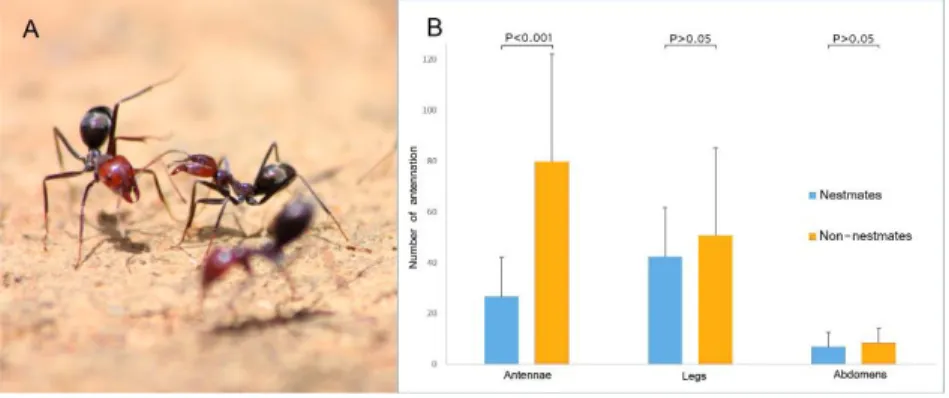
behavioural tests employing covered dummies and electrophysiological data, studies have shown that individuals can recognise alien CHC mixtures, i.e., mixtures associated with other colonies or species. While the bodily location of the CHC signal varies among insects, the antenna seems to be the main organ involved in signal perception (Fig. 1). More specifically, the antenna’s basiconica sensilla act as receptors for the sensory signals conveyed by CHCs, and via their multiple olfactory receptor neurons (ORNs) then transmit the information to the central nervous system, allowing individuals to differentiate between CHCs from nestmates versus non-nestmates or from queens versus workers (Fig. 2). Social insects can also distinguish among hydrocarbon types (e.g., linear alkanes, alkenes, methyl-branched alkanes). It was traditionally consensual that the olfactory receptors (ORs) in the 9-exon subfamily, which are part of a specialised olfactory subsystem in the antennal lobe (T6 glomeruli), are responsible for CHC discrimination. However, recent discoveries revealed that many other glomeruli and ORs in the antennal lobe may also be involved. Regardless of the specifics, OR neurons can differentiate between enantiomers methyl-branched hydrocarbons that act as pheromones and, in some cases, can distinguish among primer pheromones regulating colony reproduction. Social insects employ (R) methyl-branched enantiomers, a configuration that is highly conserved within this group. That said, both (R) and (S) enantiomers exist and could play a role in regulating social behaviour (1). It has been found that, over the course of honeybee development (pupae to mature adults), there are differences in the expression of the various genes involved in CHC
biosynthesis, which results in stage-specific differences in CHCs. FACTORS RESPONSIBLE FOR CUTICULAR HYDROCARBON VARIATION
In social insects, there are chemosystematic differences among orders and genera. In the termite genus
Reticulitermes, chemosystematic data have yielded helpful insights on species delimitation, which correspond
fairly well to phylogeographic data obtained via analyses of nuclear and mitochondrial DNA. However, in other taxa, such as the ant genus Crematogaster, only species-level variation has proven useful. Indeed, it is important to understand that external selection pressures exerted on social insects may often result in rapid adaption in terms of their chemical signatures. Furthermore, biotic and abiotic factors can shape CHC patterns. For example, social parasites, stress, geographical features, climate change, status as an invader, and microbial symbionts can also affect a social insect’s chemical signature. Furthermore, such variation can then scale up: in paper wasps, nest odour can change following the state (parasitized or not) and the scale of parasitism.
HORMONAL AND ENZYMATIC REGULATION OF CUTICULAR HYDROCARBONS
CHCs are associated with juvenile hormone (JH) titres, behaviour, caste status, and reproduction. In the last few years, research in various social insect taxa has looked at how endocrine factors affect the release and the relative proportions of the compounds that serve as primer pheromones. It has been found that cuticular changes,
notably those occurring during development and reproduction, are under the direct or indirect control of JH and various enzymes (5).
KEY ROLES IN RECOGNITION
In the 1990s, CHCs were discovered to play a role in recognition. Since then, further research has demonstrated that CHCs are influenced by lifestyle (e.g., social parasitism) and are involved in caste and brood discrimination, task allocation, and behaviour (e.g., the honeybee waggle dance). It is clear that one of the main roles of CHCs in social insects is to convey reproductive status—within colonies, individuals are highly specialised, and most do not reproduce. In social species, it has been demonstrated that workers recognise reproductives based on their CHCs. In particular, the queen pheromone seems to have been conserved across diverse taxa. Non-volatile saturated hydrocarbons, and sometimes unsaturated hydrocarbons, are used to advertise queen fecundity and/or suppress worker reproduction (7); they can also serve to differentiate virgin, egg-laying, and non-egg-laying females. Such fertility signalling has been documented in native ants as well as in invasive ants, such as the Argentine ant. In wasps the role of CHCs as fertility signals is less clear Although reproduction-related patterns in CHCs have been observed, strong evidence of fertility signalling has yet to be obtained. As mentioned above, variation in CHCs is linked to hormonal changes. The relationship between CHCs and reproductive status has been demonstrated in different social insects, such as drywood termites (6), and the existence of cuticular royal pheromones was recently described in a subterranean termite. This reproductive signal can also convey dominance, as has been seen in social parasites. In most social insects and regardless of colony size, the earliest-described and most prominent role of CHCs is in nestmate recognition. However, more recently, it was shown that CHCs could also help to appease non-nestmates (4).
CUTICULAR HYDROCARBONS AND SOCIOBIOLOGY: A CONCLUSION
In social insects, the antenna is the organ that perceives and decodes the signal conveyed by CHCs, often resulting in changes in social behaviour. For example, social insects rely on CHCs to transmit information about factors such as reproductive status, group membership, and resource location, among others. Queen pheromones seem to have evolved from signals used in solitary ancestors (particularly in Hymenoptera), but there is a need for research comparing CHCs in solitary and social species to determine if the relationship of CHCs with physiology, behaviour, and reproductive status is also ancestral (8). The debate over the signal honesty of queen pheromones is ongoing. Regardless, most forms of communication in social insects (e.g., regarding nestmate status, kinship, food location, recruitment, trail establishment, and alarm signalling) probably evolved from ancestral forms of communication. It has been shown that solitary insects and more basal social insects invest less in communication (12). Many interesting questions remain to be explored when it comes to the evolution of communication
systems that use contact semiochemicals such as cuticular hydrocarbons. Also, many studies have focused on just a few models, such as honeybees or certain ant species. Although efforts have been made over recent years to improve model diversity, it is important to consider even a broader range of social insect taxa.
Figure 1 - Specificity of the antenna as the main organ involved in CHC perception. From Wang et al. (11)
Figure 2 Olfactory information is treated by two subsystems: signals from basiconic sensilla, other olfactory cues within the main AL. Under the previous hypothesis, CHCs were specifically detected by 9-exon ORs (within basiconic sensilla), while other odorants (non-CHCs) were detected by non-9-exon ORs. Together with previous work from Sharma et al. (9), the new study by Slone et al. (10) shows that these are not exclusive categories and favors a combined model of ant social odor processing in which both subsystems process all odorants. CB central body, LH lateral horn, MB mushroom bodies, OL optic lobe. (From Patrizia d’Ettorre et al. (3)
FURTHER READING
1. Bello J. E., J. S. McElfresh, & J. G. Millar. 2015. Isolation and determination of absolute configurations of insect-produced methyl-branched hydrocarbons. Proceedings of the National Academy of Sciences 112(4): 1077-1082. https://doi.org/10.1073/pnas.1417605112
2. Blomquist G. J, & A.-G. Bagnères. 2010. Insect Hydrocarbons: Biology, Biochemistry and Chemical Ecology. 20 Chap. Cambridge University press. ISBN 9780521898140. 500p.
3. d’Ettorre, P., Deisig, N., & Sandoz J.-C. 2017. Decoding ants’ olfactory system sheds light on the evolution of social communication. Proceedings of the National Academy of Sciences 114 (34) 8911-8913.
https://doi.org/10.1073/pnas.1711075114
4. Elia, M., Khalil, A., Bagnères, A.-G.; & Lorenzi, M.C. (2018). Appeasing their hosts: a novel strategy for parasite brood. Animal Behaviour, 146, 123–134. https://doi.org/10.1016/j.anbehav.2018.10.011 5. Falcón T., M. J. Ferreira-Caliman, F. Morais Franco Nunes, E. Donato Tanaka, F. Santos do Nascimento, M.
M. Gentile Bitondi. 2014. Exoskeleton formation in Apis mellifera: Cuticular hydrocarbons profiles and expression of desaturase and elongase genes during pupal and adult development. Insect Biochemistry
and Molecular Biology 50: 68-81. http://dx.doi.org/10.1016/j.ibmb.2014.04.006
6. Korb J. 2018. Chemical fertility signaling in termites: Idiosyncrasies and commonalities in comparison with ants. Journal of Chemical Ecology 44(9): 818–826. https://doi.org/10.1007/s10886-018-0952-2
7. Le Conte Y., &A. Hefetz. 2008. Primer Pheromones in Social Hymenoptera. Annual Review of Entomology 53: 523-542. https://doi.org/10.1146/annurev.ento.52.110405.091434
8. Oi C. A., J. S. van Zweden, R. C. Oliveira, A. Van Oystaeyen, F. S. Nascimento, & T. Wenseleers. 2015. The origin and evolution of social insect queen pheromones: Novel hypotheses and outstanding problems.
Bioessay 37: 808-831. https://doi.org/10.1002/bies.201400180
9. Sharma, K. R., et al. (2015). Cuticular hydrocarbon pheromones for social behavior and their coding in the ant antenna. Cell Reports, 12, 1261–1271.
10. Slone, J. D., et al. (2017). Functional characterization of odorant receptors in the ponerine ant,
Harpegnathos saltator. Proceedings of the National Academy of Sciences, 10.1073. https://doi.org/10.
1073/pnas.1704647114.
11. Wang Q, Goodger JQD, Woodrow IE, Elgar MA. 2016 Location-specific cuticular hydrocarbon signals in a social insect. Proc. R. Soc. B 283: 20160310. http://dx.doi.org/10.1098/rspb.2016.0310
12. Wittwer B., A. Hefetz, T. Simon, L. E. K. Murphy, M. A. Elgar, N. E. Pierce, & S. D. Kocher. 2017. Solitary bees reduce investment in communication compared with their social relatives Proceedings of the