HAL Id: hal-00990299
https://hal-univ-rennes1.archives-ouvertes.fr/hal-00990299
Submitted on 13 May 2014
HAL is a multi-disciplinary open access archive for the deposit and dissemination of sci-entific research documents, whether they are pub-lished or not. The documents may come from teaching and research institutions in France or abroad, or from public or private research centers.
L’archive ouverte pluridisciplinaire HAL, est destinée au dépôt et à la diffusion de documents scientifiques de niveau recherche, publiés ou non, émanant des établissements d’enseignement et de recherche français ou étrangers, des laboratoires publics ou privés.
Advanced age remains an achilles heel for liver
resections.
Laurent Sulpice, Michel Rayar, Boris Campillo, Claire Pery, Antoine Guillaud,
Bernard Meunier, Karim Boudjema
To cite this version:
Laurent Sulpice, Michel Rayar, Boris Campillo, Claire Pery, Antoine Guillaud, et al.. Advanced age remains an achilles heel for liver resections.. World Journal of Surgery, Springer Verlag, 2014, 38 (4), pp.918-26. �10.1007/s00268-013-2367-0�. �hal-00990299�
Advanced age remains an Achilles heel for liver resections.
Laurent Sulpice, MD
1,3, Michel Rayar, MD
1, , Boris Campillo, MD
2, Claire Pery MD
1,
Antoine Guillaud, MD
1, Bernard Meunier, MD
1and Karim Boudjema, MD, PhD
1,31- Service de Chirurgie Hépatobiliaire et Digestive. Centre Hospitalier Universitaire de
Rennes, Université de Rennes 1, France
2- INSERM, UMR936, Département d‟Information Médicale, Université de Rennes 1, France 3- INSERM, UMR991. Foie, métabolisme et cancer. Université de Rennes1, France
Running title: Liver resection in elderly patients Key words: Liver resection, elderly patients, mortality
Correspondence
Docteur Laurent Sulpice
Service de Chirurgie Hépatobiliaire et Digestive, Hôpital Pontchaillou, Centre
Hospitalier Universitaire, Université de Rennes 1, Rennes, France
Email : [email protected]
Telephone: + 33 2 99 28 84 98
Fax: + 33 299 28 41 29
Word count: 2449
Conflicts of interest: The authors have no conflicts of interest to declare Funding: The study received no external support
Author contributions: LS conceived and designed study, undertook the analysis and
interpretation of data, and wrote and finalized the manuscript. CP collected data and
undertook interpretation of data. BC provided the statistical analysis. MR revised the
manuscript, AG collected data and proof-read the manuscript. BM revised the manuscript.
ABSTRACT
Background: As general population is aging, surgery in elderly patients become a major public health issue. This basic question is especially true for liver resection (LR). The aim of
this study was to evaluate the operative risks of LR in elderly.
Method: Retrospective analysis of a large recent and monocentric database of LR performed between January 1, 2005 and May 31, 2011. Patients were categorized into 3
groups (<60, 60 to 74 and ≥75 years old) to analyze postoperative outcomes as well as 1-year mortality. Clinicopathological factors likely to influence outcomes were assessed by
univariate and multivariableanalysis.
Results: 1001 consecutive LR were performed in 912 patients (mean age 62±13 years). The distribution of the LR was 372 (37.2%), 477 (47.6%) and 152 (15.2%) in patients<60 y,
60 to 74 y and ≥75 y old, respectively. The overall morbidity and mortality rates were 33.3% and 2.5%, respectively. An age ≥75 years was independently associated with postoperative mortality (OR 4.75 (95%CI [1.5; 15.1]; p=0.008) and 1-year mortality OR 2.8 (95%CI [1.2;
6.6]; p=0.015), while the rate of postoperative complications (p=0.216), even major
complications (p=0.09), was not increased. The other independent risk factors of mortality
were a cirrhotic liver (p=0.017), preoperative arterial chemoembolization (p=0.001), caval
vein clamping (p=0.001) and intraoperative blood transfusion (p=0.044).
Conclusion: Age beyond 75 years represent a risk factor of death after LR and should be avoided after chemoembolization or in cirrhotic patients. A specific assessment using
INTRODUCTION
Liver resection (LR) is the most suitable curative treatment for multiple benign and malignant
liver diseases. With recent advances in surgical techniques, perioperative management and
postoperative care, LR has become increasingly common, and the risks associated with this
major procedure have decreased. In Western countries, increased longevity leads to
subsequent increasing indications for liver resection in elderly patients.
Recently, an editorial in Lancet (1) emphasized the need to provide the same care to elderly
patients and younger patients whenever possible. Many papers have reported the absence
of differences between elderly and younger patients in terms of postoperative morbidity and
mortality.(2;3)
During the last decades, the definition of „elderly‟ has evolved. While patients aged less than 60 yrs old are nowadays considered to be young, most of the studies dealing with the impact
of age on postoperative outcome have focused on the 60-75 yrs interval. Geriatricians now
consider 75 years to be the age over which elderly and geriatric management starts.(4) In
this setting, the feasibility and benefits of LR in elderly patients remain unclear, due to small
sample sizes and the wide period of analysis. While some reports showed higher
postoperative mortality and morbidity rates related to age (5;6), others were unable to
demonstrate any increasing morbidity or mortality after LR related to aging,(7) especially
when the indication of LR was colorectal metastases(8) (CRM) or hepatocellular
carcinoma(9).
The aim of this study was to analyze the outcomes after LR including the 1-year mortality in
a large recent and monocentric series of patients with a special focus on age. Secondary
objectives were to identify predictors of postoperative mortality that may be corrected
preoperatively to decrease the risks of postoperative complications after LR in elderly
PATIENTS AND METHODS
Patients
The study population included all of the consecutive liver resections (LR) without biliary
anastomosis that were performed at a single tertiary referral center between January 2005
and May 2011. The clinical data were retrospectively collected from a liver resection
database and analyzed after Institutional Review Board approval was obtained. (Opinion n°
12-60)
Preoperative assessment, surgical procedure and perioperative care
Before surgery, each patient was evaluated by a thoracoabdominopelvic computed
tomography (CT) scan with intravenous contrast. A measure of the future liver remnant
volume (LRV) was performed when required, and portal vein embolization was performed
when the LRV/Total liver volume ratio was < 35%. For malignant diseases, patients were
considered to be curable if the tumors could be resected with macroscopically negative
surgical margins.
All LR were performed as open or laparoscopic procedures by senior hepatic surgeons.
Continuous or intermittent pedicle clamping (Pringle maneuver), or selective clamping of the
pedicles for the segment to be resected, was performed in most cases. Two closed-suction
drains were placed in the resection space and removed on the fifth post-operative day
(POD) when drainage was minimal, serous and non-bilious.
The resections were categorized according to the International Hepato-Pancreato-Biliary
Association classification for liver resections (
(IHPBA, Brisbane 2000)
i.e. resection of (i)two or less, (ii) three and four or (iii) more than four segments were defined as (i) minor
All patients received antibiotic prophylaxis. A daily subcutaneous injection of
low-molecular-weight heparin sodium was started as a prophylactic against deep venous thrombosis on
POD 1.
Collected data
The preoperative data included general patient characteristics (age, sex and BMI score,
cirrhosis), prior surgical history and primary tumor histopathology.
The perioperative data consisted of the operation duration, pedicle clamping or selective
clamping of the pedicles for vascular resection when needed, vena caval clamping,
concomitant abdominal surgery, and transfusion needs.
The postoperative data included the hospital length of stay (HLS), need for intensive care,
reoperations, and rehospitalization. Liver failure was defined by the “50-50” syndrome on postoperative day 5 (including serum bilirubin >50 µmol/L and prothrombin time <50%).(11)
Postoperative complications were assessed and classified according to the Clavien-Dindo
classification system.(12) Major complications were categorized as grades III-V and were
defined as morbidity requiring radiological or surgical intervention. Postoperative mortality
was defined as death occurring during the initial hospital stay or within 30 days after surgery
Statistical analysis
Statistical analyses were performed with SPSS Statistics 17.0 software for Windows (SPSS
Inc., Chicago, IL).
Data from the study population were described either by means and standard deviations or
by absolute and relative frequencies, for quantitative and qualitative data, respectively.
To determine the cut-off over which mortality (perioperative and 1-year) was increased,
accuracy curves were realized.
To evaluate the cut-off over which mortality and morbidity were increased, we pooled the
patients in 3 groups: Less than 60 yrs, 60 to 74 yrs and 75 yrs old or older. Patient
characteristics, perioperative parameters and outcomes were compared between the 3
groups.
The Chi square test or the Fisher exact test were used to compare qualitative data and the
Student‟s t-test was used to compare quantitative data between groups.
The perioperative and 1-year mortality were studied according to the patient characteristics,
including age before liver resection, and perioperative factors. A univariate analysis was
performed with the Chi-square test or the Fisher exact test when necessary. Factors
associated with death with a p value < 0.2 were tested in a multiple logistic regression model
using the forward selection procedure and the Wald test to assess their independent
RESULTS
Demographic and operative data
Between January 2005 and May 2011, 1001 consecutive liver resections were performed in
912 patients (626 men and 286 women). The mean age at the time of resection was 62 ± 13
years. Two, three, four, or five successive resections were performed in 70, 6, 1 and 1
patients, respectively. Among the LR, 504 (50.3%) were performed for liver metastasis, 375
(37.5%) and 122 (12.2%) for primary liver malignant tumor and benign lesion respectively.
The indications for LR are reported in table 1.
The demographic characteristics and operative data in the <60, 60 to 74 yrs, and ≥ 75 age groups are reported in Table 2. One hundred and fifty two patients were ≥ 75 yrs (15.2%); in this group, patients had a significantly lower BMI and cirrhotic livers were less frequent.
Postoperative mortality (table 3)
The overall postoperative mortality rate was 2.6 %. The distribution of mortality according to
the 3 age groups is shown in Figure 1(A). The cutoff of age over which perioperative
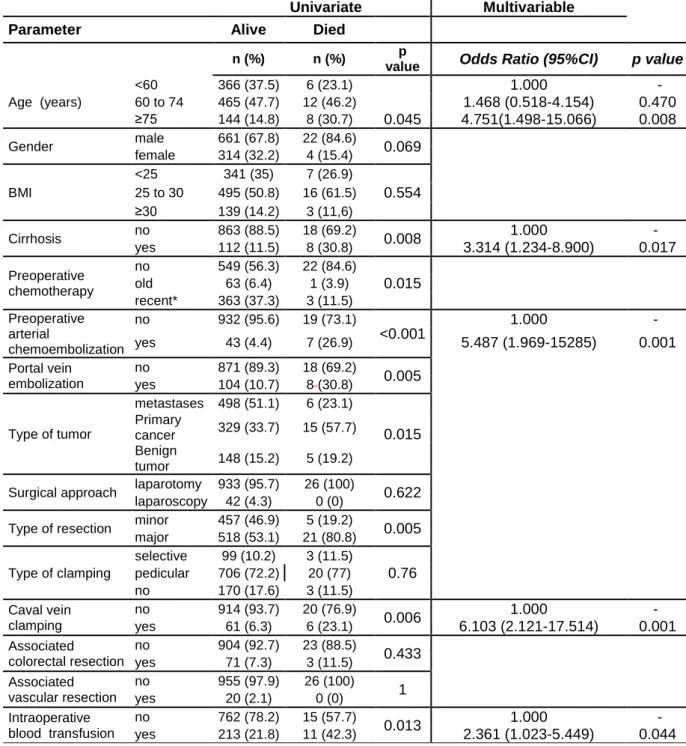
mortality was increased, was represented in figure 2.Among the 15 factors assessed by the
univariate analysis, age ≥ 75 years (p=0,045), cirrhosis (p=0,008), preoperative chemotherapy (p=0,015), preoperative arterial chemoembolization (p<0,001), preoperative
portal vein embolization (p=0,005), primary cancer (p=0,015), major hepatectomy (p=0,005),
caval vein clamping (p=0,006) and intraoperative blood transfusion (p=0,013) were
significantly related to postoperative mortality. On the multivariable analysis, intraoperative
blood transfusion (OR=2.4; confidence interval (CI) 95% [1; 5.5]; p=0.044), cirrhotic liver
(OR=3.3; CI 95% [1.2; 8.9]; p=0.017), age ≥ 75 yrs (odds ratio [OR] 4.75; [CI] 95% [1.5; 15.1]; p=0.008), preoperative arterial chemoembolization (OR=5.5; CI 95% [2; 15.3];
p=0.001), and intraoperative caval vein clamping (OR=6.1; CI 95% [2.1; 17.5]; p=0.001)
Postoperative complications (tables 4 and 5)
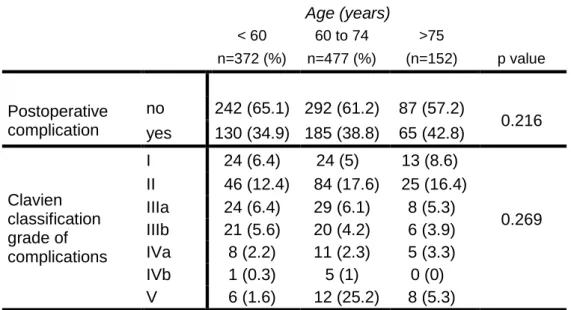
The overall morbidity rate was 33.3%, without a significant difference between the 3 age
groups (p=0,216). There was no significant difference between the 3 groups (p=0,269) in the
postoperative complications according to the Clavien-Dindo classification (table 4).
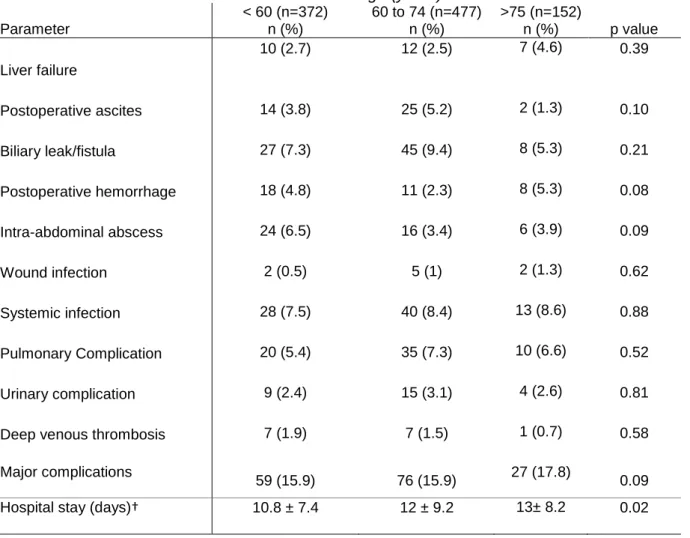
Except for the hospital stay (p=0,02), there were no significant differences between the three
groups, regarding the type of complications (table 5).
1-year mortality (table 6)
The overall 1-year mortality rate was 5.5%. The distribution of 1-year mortality according to
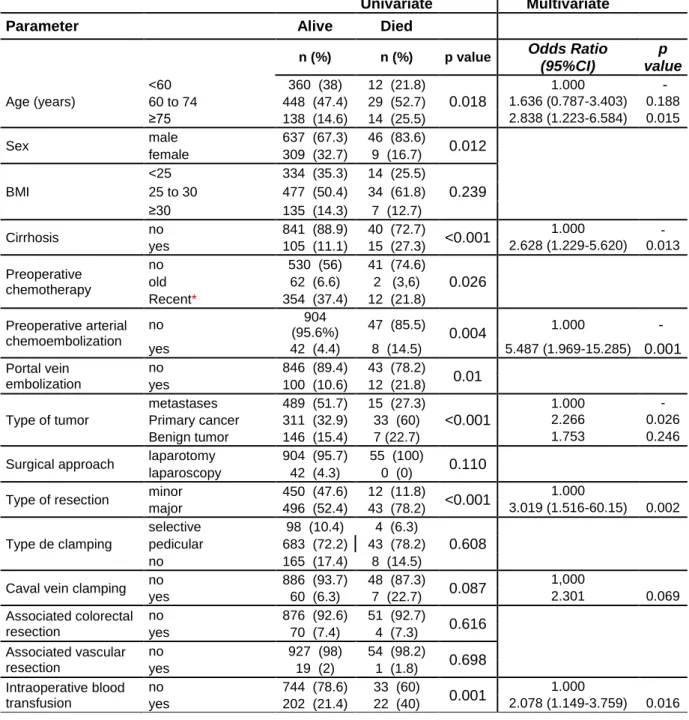
the 3 groups of age is shown in figure 1(B). In the univariate analysis, age ≥ 75 years (p=0.018), sex (male, p=0.012), cirrhosis (p<0.001), preoperative chemotherapy (p=0.024),
preoperative arterial chemoembolization (p=0.004), portal vein embolization (p=0.01),
primary cancer (p<0.001), major hepatectomy (p<0.001) and intraoperative blood transfusion
(p=0.001) were significantly associated with an increased 1-year mortality. In the multivariate
analysis, age ≥ 75 years (OR 2.8; CI 95% [1.2; 6.6]; p=0.015), cirrhosis (OR=2.6; CI 95% [1.2; 5.6]; p=0.013), preoperative arterial chemoembolization (OR=5.5; CI 95% [2; 15.3];
p=0.001), primary cancer (OR=2.3; CI 95% [1.1; 4.6]; p=0.026), major hepatectomy (OR=3;
CI 95% [1.5; 6]; p=0.002) and intraoperative blood transfusion (OR=2.1; CI 95% [1.1; 3.8];
DISCUSSION
The main endpoint of the study was to analyze the impact of age on morbidity and mortality
after liver resection. The results showed that ≥ 75 years of age was associated with increased postoperative and 1-year mortality. Preoperative portal vein embolization,
chemoembolization, cirrhotic liver, intraoperative blood transfusion and caval vein clamping
were also independent predictive factors of increased postoperative and 1-year mortality. No
difference was found regarding the postoperative mortality between patients < 60 years and
those aged 60 to 74 years.
Similarly, the present results show that an age over 75 years old was a predictive factor for a
longer hospital stay, which is consistent with the results of Cho and colleagues.(13)
Compared with most of the previous studies, this work included a large number of patients
resected by expert senior surgeons in a tertiary referral center in a short and recent period.
These results may be predictive of the reality of liver surgery in the near future. Indeed, in
the beginning of the 21st century, there were approximately 600 million elderly people
worldwide, which is three times more than 50 years ago. Within the same period, the elderly
population has been aging, with an increasing rate of people ≥ 80 years old.(14) Due to these changing demographics, the elderly now account for > 60% of all new cancer cases
and > 70% of cancer deaths.(15) This trend implies an expansion of surgical indications for
increasingly older patients.
In spite of the improved outcomes observed at high volume centers due to the advances in
surgical management and postoperative care, LR is still associated with an increased
mortality in elderly. Our results are consistent with previously reported data showing that the
mortality risk after liver resection increased from 2.9 to 6.7 times in patients aged less or
more than 75 years, respectively (16). The novelty of our results was based on a higher
postoperative mortality rate while postoperative morbidity according to the Clavien-Dindo
classification was similar. There was no difference in liver failure or other liver-specific
younger patients can, as previously described by Cook et al after resection of colorectal liver
metastases.(17)
These results go against the idea that success in LR is linked to liver regeneration (LRG).
Indeed, in the elderly, it is established that LRG is impaired (18) and delayed.(19) During
aging, the liver is subjected to physiological changes such as alterations in hepatocyte
morphology(20) and lower blood flow(21). These factors can reduce the liver‟s tolerance to ischemic damage and can lead to an alteration of liver function during LR.
The imbalance between increased mortality without increasing morbidity reflects the lower
possibility of adaption and response to any stress and complications in this subpopulation of
patients. Advanced age should not be regarded as an absolute contraindication to hepatic
resection, but should encourage a careful selection of surgical candidates. This preoperative
selection process should be based on the comorbidities and tumor type thorough
preoperative evaluation and a close collaboration between the surgeon, anesthesiologists
and geriatricians.
According to our multivariate analysis, 4 other independent risk factors for postoperative
mortality were statistically significant: preoperative cirrhosis, preoperative arterial
chemoembolization, caval vein clamping and intraoperative blood transfusion. These results
strongly suggest that LR should be avoided in elderly patients with cirrhosis and therefore
could be discussed for HCC. Nevertheless, Yamada et al (22) reported the short and
long-term safety of LR for HCC in super-elderly patients, even those > 80 years old.(2;3;23)
These results might be explained in part by the small sample size (n=11) for the
super-elderly group as well as selection bias. No patient in the Yamada study had an American
Society of Anesthesiologists-Physical Status (ASA-PS) score ≥ 2. Recently, Ide et al. also emphasized that the mortality rate was similar in young (<75 years) and elderly (>75 years)
patients with HCC.(24) They demonstrated that only surgical stress-preoperative risk score
(PRS) was linked to postoperative morbidity in elderly.
Referring to our results, LR appears to be safe as long as the liver is non-cirrhotic, a
(CRLM).(17;25;26) Regarding the latest indication, the largest series currently published (25)
reported 37.8% morbidity and 5% mortality rates, which are percentages that are
comparable to our results.
Furthermore, the results showed that intraoperative blood transfusion was associated with
increased postoperative mortality. These results are in line with the findings of Shiba et
al.(27) Patients who received blood transfusion during LR were more likely to have a longer
postoperative length of stay and Clavien Grade IIIa or more complications.(28) These data
emphasize the need to minimize bleeding during LR, which may be facilitated by the
management of this condition at a referral center.
The difficulty in gerontosurgery is linked to the evaluation of the physiological status of
patients. Aging leads to reduced renal, hepatic, cardiopulmonary functional reserve and
nutritional status. The ASA score is widely and often exclusively used, but has proven not to
be sensitive enough for elderly patients undergoing major surgery.(29;30) More specific
scores should be used in the elderly to better select patients before LR
.
Using surgery geriatric indices such as the Charlson score (31;32), Cumulative Illness Rating Scale, orKaplan-Feinstein index (33) might lead to better appraisal of the physiological age. These
geriatric indices have proven to be simple, reliable, and sensitive. Unfortunately, these
factors could not be assessed in this retrospective study. Indeed, as comorbidities were not
available in our liver resection database for the entire population, they could not be
analyzed. This lack of data requires us to interpret our results with caution. Besides, this
limitation is also encountered in other large retrospective study previously published on the
same topic.(25)
In summary, from this large series of LR at one tertiary referral center of liver surgery, we
have identified the cut-off age that is closely correlated with an increased risk of mortality. An
age over 75 years was independently associated with increased postoperative and 1-year
mortality while postoperative morbidity, especially major complications, was not affected.
related to age. A careful selection of elderly patients undergoing LR, avoiding patients with
cirrhosis, and a specific assessment of the patient‟s general condition using geriatric indexes
REFERENCES
1. Ageing well: a global priority. Lancet 2012;379(9823)1274.
2. Poon RT, Fan ST, Lo CM, et al. Hepatocellular carcinoma in the elderly: results of surgical and nonsurgical management. Am.J.Gastroenterol. 1999;94(9)2460-2466.
3. Ferrero A, Vigano L, Polastri R, et al. Hepatectomy as treatment of choice for hepatocellular carcinoma in elderly cirrhotic patients. World J.Surg. 2005;29(9)1101-1105.
4. Arai H, Ouchi Y, Yokode M, et al. Toward the realization of a better aged society: messages from gerontology and geriatrics. Geriatr.Gerontol.Int. 2012;12(1)16-22.
5. Menon KV, Al-Mukhtar A, Aldouri A, et al. Outcomes after major hepatectomy in elderly patients. J.Am.Coll.Surg. 2006;203(5)677-683.
6. Figueras J, Ramos E, Lopez-Ben S, et al. Surgical treatment of liver metastases from colorectal carcinoma in elderly patients. When is it worthwhile? Clin.Transl.Oncol. 2007;9(6)392-400.
7. Riffat F, Chu F, Morris DL. Liver resection in octogenarians. HPB (Oxford) 2006;8(3)206-210.
8. de Liguori CN, van Leeuwen BL, Ghaneh P, et al. Liver resection for colorectal liver metastases in older patients. Crit Rev.Oncol.Hematol. 2008;67(3)273-278.
9. Mirici-Cappa F, Gramenzi A, Santi V, et al. Treatments for hepatocellular carcinoma in elderly patients are as effective as in younger patients: a 20-year multicentre experience. Gut 2010;59(3)387-396.
10. Strasberg SM. Nomenclature of hepatic anatomy and resections: a review of the Brisbane 2000 system. J.Hepatobiliary.Pancreat.Surg. 2005;12(5)351-355.
11. Balzan S, Belghiti J, Farges O, et al. The "50-50 criteria" on postoperative day 5: an accurate predictor of liver failure and death after hepatectomy. Ann.Surg. 2005;242(6)824-8,
discussion.
12. Dindo D, Demartines N, Clavien PA. Classification of surgical complications: a new proposal with evaluation in a cohort of 6336 patients and results of a survey. Ann.Surg. 2004;240(2)205-213.
13. Cho SW, Steel J, Tsung A, et al. Safety of liver resection in the elderly: how important is age? Ann.Surg.Oncol. 2011;18(4)1088-1095.
14. World population ageing. New York United Nations , 35. 2002.
15. Aapro MS, Kohne CH, Cohen HJ, et al. Never too old? Age should not be a barrier to enrollment in cancer clinical trials. Oncologist. 2005;10(3)198-204.
16. Bentrem DJ, Cohen ME, Hynes DM, et al. Identification of specific quality improvement opportunities for the elderly undergoing gastrointestinal surgery. Arch.Surg.
17. Cook EJ, Welsh FK, Chandrakumaran K, et al. Resection of colorectal liver metastases in the elderly: does age matter? Colorectal Dis. 2012;14(10)1210-1216.
18. Schmucker DL. Age-related changes in liver structure and function: Implications for disease ? Exp.Gerontol. 2005;40(8-9)650-659.
19. Sanchez-Hidalgo JM, Naranjo A, Ciria R, et al. Impact of age on liver regeneration response to injury after partial hepatectomy in a rat model. J.Surg.Res. 2012;175(1)e1-e9.
20. James OF. Gastrointestinal and liver function of old age. Clin.Gastroenterol. 1983;12(3)671-691.
21. Wynne HA, Cope LH, Mutch E, et al. The effect of age upon liver volume and apparent liver blood flow in healthy man. Hepatology 1989;9(2)297-301.
22. Yamada S, Shimada M, Miyake H, et al. Outcome of hepatectomy in super-elderly patients with hepatocellular carcinoma. Hepatol.Res. 2012;42(5)454-458.
23. Hanazaki K, Kajikawa S, Shimozawa N, et al. Hepatic resection for hepatocellular carcinoma in the elderly. J.Am.Coll.Surg. 2001;192(1)38-46.
24. Ide T, Miyoshi A, Kitahara K, et al. Prediction of postoperative complications in elderly patients with hepatocellular carcinoma. J.Surg.Res. 2013.
25. Adam R, Frilling A, Elias D, et al. Liver resection of colorectal metastases in elderly patients. Br.J.Surg. 2010;97(3)366-376.
26. Di BF, Berretta M, D'Amico G, et al. Liver resection for colorectal metastases in older adults: a paired matched analysis. J.Am.Geriatr.Soc. 2011;59(12)2282-2290.
27. Shiba H, Ishida Y, Wakiyama S, et al. Negative impact of blood transfusion on recurrence and prognosis of hepatocellular carcinoma after hepatic resection. J.Gastrointest.Surg.
2009;13(9)1636-1642.
28. Gruttadauria S, Saint Georges CM, Pagano D, et al. Impact of blood transfusion on early outcome of liver resection for colorectal hepatic metastases. J.Surg.Oncol. 2011;103(2)140-147.
29. Reddy SK, Barbas AS, Turley RS, et al. Major liver resection in elderly patients: a multi-institutional analysis. J.Am.Coll.Surg. 2011;212(5)787-795.
30. Sulpice L, Rayar M, D'Halluin PN, et al. Impact of age over 75 years on outcomes after pancreaticoduodenectomy. J.Surg.Res. 2012;178(1)181-187.
31. Charlson ME, Pompei P, Ales KL, et al. A new method of classifying prognostic comorbidity in longitudinal studies: development and validation. J.Chronic.Dis. 1987;40(5)373-383.
32. Buntinx F, Niclaes L, Suetens C, et al. Evaluation of Charlson's comorbidity index in elderly living in nursing homes. J.Clin.Epidemiol. 2002;55(11)1144-1147.
33. Extermann M. Measuring comorbidity in older cancer patients. Eur.J.Cancer. 2000;36(4)453-471.
TABLE LEGENDS
Table 1. The indications for liver resections according to the patient age.
Table 2. The demographic characteristics and surgical data according to the patient
age.
Table 3.
The risk factors for postoperative mortality.
Table 4. The postoperative complications according to the patient age.
Table 5. The type of postoperative complications according to patient age.
Table 6.
The risk factors for 1-year mortality.
FIGURE LEGEND
Figure 1. The impact of age on mortality. (A) perioperative mortality and (B) 1-year
mortality.
Table 1
. The indications for liver resections according to the patient age
Age (years) < 60 60 to 74 >75 n=372 (%) n=477 (%) n=152 (%) Liver metastases 200 (53.8) 237 (49.7) 67 (44.1) Primary tumors 75 (20.1) 205 (43) 64 (42.1) Benign tumor 97 (26.1) 35 (7.3) 21 (13.8)Table 2
. The demographic characteristics and surgical data according to the patient age.Parameter Age (years)
< 60 (n=372) 60 to 74 (n=477) >75 (n=152) p value Gender male 59.1% 75.9% 66.4% <0.001 female 40.9% 24.1% 33.6% BMI <25 46.2% 26.2% 33.6% <0.001 25 to 30 41.4% 57.4% 54.6% >30 12.4% 16.4% 11.8% Cirrhosis no 91.4% 84.7% 90.1% 0.008 yes 8.6% 15.3% 9.9%
Portal vein embolization no 90.3% 85.7% 94.7% 0.005
yes 9.7% 14.3% 5.3%
Type of resection minor 48.1% 44.9% 45.4% 0.627
major 51.9% 55.1% 54.6%
Type of clamping 0.446
selective 9.4% 11.5% 7.9%
pedicular 71.2% 72.3% 76.3%
no 19.4% 16.1% 15.8%
Caval vein clamping 0.278
no 92.2% 93.3% 96.1%
yes 7.8% 6.7% 3.9%
Perioperative radiofrequency 0.056
no 93.3% 96.2% 97.4%
yes 6.7% 3.8% 2.6%
Associated colorectal resection 0.917
no 92.5% 92.5% 93.4%
yes 7.5% 7.5% 6.6%
Associated vascular resection 0.227
no 97.6% 98.7% 96.7%
Table 3
. The risk factors for postoperative mortality.Univariate Multivariable
Parameter Alive Died
n (%) n (%) p
value Odds Ratio (95%CI) p value Age (years) <60 366 (37.5) 6 (23.1) 0.045 1.000 - 60 to 74 465 (47.7) 12 (46.2) 1.468 (0.518-4.154) 0.470 ≥75 144 (14.8) 8 (30.7) 4.751(1.498-15.066) 0.008 Gender male 661 (67.8) 22 (84.6) 0.069 female 314 (32.2) 4 (15.4) BMI <25 341 (35) 7 (26.9) 0.554 25 to 30 495 (50.8) 16 (61.5) ≥30 139 (14.2) 3 (11,6) Cirrhosis no 863 (88.5) 18 (69.2) 0.008 1.000 - yes 112 (11.5) 8 (30.8) 3.314 (1.234-8.900) 0.017 Preoperative chemotherapy no 549 (56.3) 22 (84.6) 0.015 old 63 (6.4) 1 (3.9) recent* 363 (37.3) 3 (11.5) Preoperative arterial chemoembolization no 932 (95.6) 19 (73.1) <0.001 1.000 - yes 43 (4.4) 7 (26.9) 5.487 (1.969-15285) 0.001 Portal vein embolization no 871 (89.3) 18 (69.2) 0.005 yes 104 (10.7) 8(30.8) Type of tumor metastases 498 (51.1) 6 (23.1) 0.015 Primary cancer 329 (33.7) 15 (57.7) Benign tumor 148 (15.2) 5 (19.2)
Surgical approach laparotomy 933 (95.7) 26 (100) 0.622
laparoscopy 42 (4.3) 0 (0)
Type of resection minor 457 (46.9) 5 (19.2) 0.005
major 518 (53.1) 21 (80.8) Type of clamping selective 99 (10.2) 3 (11.5) 0.76 pedicular 706 (72.2) 20 (77) no 170 (17.6) 3 (11.5) Caval vein clamping no 914 (93.7) 20 (76.9) 0.006 1.000 - yes 61 (6.3) 6 (23.1) 6.103 (2.121-17.514) 0.001 Associated colorectal resection no 904 (92.7) 23 (88.5) 0.433 yes 71 (7.3) 3 (11.5) Associated vascular resection no 955 (97.9) 26 (100) 1 yes 20 (2.1) 0 (0) Intraoperative blood transfusion no 762 (78.2) 15 (57.7) 0.013 1.000 - yes 213 (21.8) 11 (42.3) 2.361 (1.023-5.449) 0.044 *recent defined chemotherapy performed within 6 months before surgery.
Table 4.
The postoperative complications according to the patient age. Age (years) < 60 60 to 74 >75 n=372 (%) n=477 (%) (n=152) p value Postoperative complication no 242 (65.1) 292 (61.2) 87 (57.2) 0.216 yes 130 (34.9) 185 (38.8) 65 (42.8) Clavien classification grade of complications I 24 (6.4) 24 (5) 13 (8.6) 0.269 II 46 (12.4) 84 (17.6) 25 (16.4) IIIa 24 (6.4) 29 (6.1) 8 (5.3) IIIb 21 (5.6) 20 (4.2) 6 (3.9) IVa 8 (2.2) 11 (2.3) 5 (3.3) IVb 1 (0.3) 5 (1) 0 (0) V 6 (1.6) 12 (25.2) 8 (5.3)
Table 5.
The type of postoperative complications seen according to patient ageAge (years) Parameter < 60 (n=372) n (%) 60 to 74 (n=477) n (%) >75 (n=152) n (%) p value 10 (2.7) 12 (2.5) 7 (4.6) 0.39 Liver failure Postoperative ascites 14 (3.8) 25 (5.2) 2 (1.3) 0.10 Biliary leak/fistula 27 (7.3) 45 (9.4) 8 (5.3) 0.21 Postoperative hemorrhage 18 (4.8) 11 (2.3) 8 (5.3) 0.08 Intra-abdominal abscess 24 (6.5) 16 (3.4) 6 (3.9) 0.09 Wound infection 2 (0.5) 5 (1) 2 (1.3) 0.62 Systemic infection 28 (7.5) 40 (8.4) 13 (8.6) 0.88 Pulmonary Complication 20 (5.4) 35 (7.3) 10 (6.6) 0.52 Urinary complication 9 (2.4) 15 (3.1) 4 (2.6) 0.81
Deep venous thrombosis 7 (1.9) 7 (1.5) 1 (0.7) 0.58
Major complications
59 (15.9) 76 (15.9) 27 (17.8) 0.09
Hospital stay (days)† 10.8 ± 7.4 12 ± 9.2 13± 8.2 0.02
† Mean ± Standard deviation (SD)
Table 6
. The risk factors for 1-year mortality.Univariate Multivariate
Parameter Alive Died
n (%) n (%) p value Odds Ratio
(95%CI) p value Age (years) <60 360 (38) 12 (21.8) 0.018 1.000 - 60 to 74 448 (47.4) 29 (52.7) 1.636 (0.787-3.403) 0.188 ≥75 138 (14.6) 14 (25.5) 2.838 (1.223-6.584) 0.015 Sex male 637 (67.3) 46 (83.6) 0.012 female 309 (32.7) 9 (16.7) BMI <25 334 (35.3) 14 (25.5) 0.239 25 to 30 477 (50.4) 34 (61.8) ≥30 135 (14.3) 7 (12.7) Cirrhosis no 841 (88.9) 40 (72.7) <0.001 1.000 - yes 105 (11.1) 15 (27.3) 2.628 (1.229-5.620) 0.013 Preoperative chemotherapy no 530 (56) 41 (74.6) 0.026 old 62 (6.6) 2 (3,6) Recent* 354 (37.4) 12 (21.8) Preoperative arterial chemoembolization no 904 (95.6%) 47 (85.5) 0.004 1.000 - yes 42 (4.4) 8 (14.5) 5.487 (1.969-15.285) 0.001 Portal vein embolization no 846 (89.4) 43 (78.2) 0.01 yes 100 (10.6) 12 (21.8) Type of tumor metastases 489 (51.7) 15 (27.3) <0.001 1.000 - Primary cancer 311 (32.9) 33 (60) 2.266 0.026 Benign tumor 146 (15.4) 7 (22.7) 1.753 0.246 Surgical approach laparotomy 904 (95.7) 55 (100) 0.110
laparoscopy 42 (4.3) 0 (0)
Type of resection minor 450 (47.6) 12 (11.8) <0.001 1.000
major 496 (52.4) 43 (78.2) 3.019 (1.516-60.15) 0.002 Type de clamping selective 98 (10.4) 4 (6.3) 0.608 pedicular 683 (72.2) 43 (78.2) no 165 (17.4) 8 (14.5)
Caval vein clamping no 886 (93.7) 48 (87.3) 0.087 1,000
yes 60 (6.3) 7 (22.7) 2.301 0.069 Associated colorectal resection no 876 (92.6) 51 (92.7) 0.616 yes 70 (7.4) 4 (7.3) Associated vascular resection no 927 (98) 54 (98.2) 0.698 yes 19 (2) 1 (1.8) Intraoperative blood transfusion no 744 (78.6) 33 (60) 0.001 1.000 yes 202 (21.4) 22 (40) 2.078 (1.149-3.759) 0.016