HAL Id: jpa-00247155
https://hal.archives-ouvertes.fr/jpa-00247155
Submitted on 1 Jan 1995
HAL is a multi-disciplinary open access
archive for the deposit and dissemination of
sci-entific research documents, whether they are
pub-lished or not. The documents may come from
teaching and research institutions in France or
abroad, or from public or private research centers.
L’archive ouverte pluridisciplinaire HAL, est
destinée au dépôt et à la diffusion de documents
scientifiques de niveau recherche, publiés ou non,
émanant des établissements d’enseignement et de
recherche français ou étrangers, des laboratoires
publics ou privés.
On a Dynamical Model of Glasses
Jean-Philippe Bouchaud, Alain Comtet, Cécile Monthus
To cite this version:
Jean-Philippe Bouchaud, Alain Comtet, Cécile Monthus. On a Dynamical Model of Glasses. Journal
de Physique I, EDP Sciences, 1995, 5 (12), pp.1521-1526. �10.1051/jp1:1995104�. �jpa-00247155�
Classification
Physics
Abstracts05.40+j
64.70-p
61.20~pShort Communication
On
aDynamical
Model
of
Glasses
Jean-Philippe
Bouchaud(~),
AlainComtet(~,~)
and CécileMonthus(~>~)
(~
)Service
dePhysique
de l'EtatCondensé,
CEA-Saclay,
Orme des Merisiers,91191 Gif
s/
Yvette Cedex, France(~)Division
dePhysique
Théorique,
IPN,
Batiment 100, Université deParis-Sud,
91406 Orsay Cedex, France
(~)LPTPE,
Université P. et M.Curie,
4 PlaceJussieu,
75231 Paris Cedex 05, France(Received
13 Ju~le 1995,accepted
in final form 28September 1995)
Abstract. We
analyze
asimple
dynamical
model ofglasses,
based on the idea that eachparticle
istrapped
in a localpotential well,
which itself evolves due tohopping
ofneighbouring
particles.
Theglass
transition issignalled by
the fact that theequihbrium
distribution ceasesto be normahsable and
dynamics
becomesnon-stationary.
Wegenerically
findstretching
of the coi-relation function at low temperatures and aVogel-Fulcher
hke behaviour of the terminal time.Glasses bave a number of
fascinatingly
universalproperties
which are still notsatisfactorily
accounted for
theoretically
[1, 2].
A commonexperimental
feature is the'shouldering'
of trierelaxation laws. More
precisely,
trie relaxation of say triedensity
fluctuations evolvesfrom a
simple
Debye
exponential
athigh
temperature
(liquid)
to a two-step process at lowertemperature,
where the correlation functiondecays
fast to aplateau
value,
from which itsubsequently
decays
on a muchlonger
time scale. These two regimes arecalled,
respectively,
the
fl
and arelaxations;
the adecay
is often described in terms of a 'stretchedexponential'
with a characteristic time scale r
diverging
faster thanexponentially
with the temperature, andcontrolling
thetransport
properties
such as theviscosity.
The mostpopular
description
of thisdivergence
is theVogel-Fulcher
law: T+~
roe+,
wherero is a microscopic time scale
[3].
Onehas to note that
despite
its tremendousphenomenological
success, this lawpredicts
such anabrupt divergence
when T is lowered that it cannot be tested near TOCorrespondingly,
otherfunctional forms, such as r
+~
roe(~/~')~,
give
reasonable lits of the data[4, 5].
Furthermore,
the
Vogel-Fulcher
law hasonly
beenjustified
on rather heuristicgrounds
[6].Up
to now, the mostcomprehensive
theory
ofdynamical
processes mglasses
is the so-calledmode-coupling
theory,
developed
by
Gotze and others [5]. It is based on afamily
of schematicequations
coupling
thedensity
fluctuations m a non-hnear and retarded way.Generically,
theseequations
have asingularity
which is associated to an 'idealglass'
transitiontemperature
T~,
below which the correlation function does not
decay
to zerol'broken ergodicity').
Thistheory
1522 JOURNAL DE
PHYSIQUE
I N°12describes
satisfactorily
the overallshape
of the relaxationfunction,
at least for T > T~m
particular
the existence of the tworegimes fl
and a mentionnedabove,
and apower-law
divergence
of the 'terminal' time scale r as(T
T~)~~.
However,
comparison
withexperiments
I?i
shows that the transitiontemperature
T~,
if itexists,
is muchhigher
than theVogel-Fulcher
temperature,
leaving
a wholetemperature
interval[To,T~]
wheremode-coupling
predicts
a'fluctuation arrest'
Ii.e.
the aregime
disappears)
while theexperimental
relaxation time isstill finite
(and
behaves à laVogel-Fulcher).
A way out of this contradiction is to argue thatthe mode
coupling
theory
leaves out 'activatedprocesses'
which areresponsible
for thelong
time
relaxation,
and act to blur out thepower-law
divergence
of r nearT~.
Although
notunconceivable,
thispossibility
requires
the introduction of at least one extra freeparameter
to fit the
data,
which would be zero m the ideal transition scenario and is not found to beparticularly
small in theexperiments.
In other words, onemajor
aspect of themode-coupling
theory
is the existence of asingular
temperature
which however does not manifest itself verydirectly
experimentally
inparticular,
the terminal time r does not reveal any accidentaround T~
I?i.
Another rather more subtle
difficulty
associated with themode~couphng
theory
is thatthe
dynamical
equations
areformally
identical[8,
9] to thosedescribing exactly
some meanfield mortels of
spin-glasses
[8,10],
where the presence ofquenched
disorder is assumed fromthe start. In
glasses,
however,
thisquenched
disorder must be in some sense 'self-induced'.Although
some progress hasrecently
been made to substantiate such a scenarioIll,12],
it is notyet
clear whether theglassiness
found inmode-coupling
theories is or not an artefact ofthe very
approximation.
In this paper, we propose and solve a
simple
mortel ofglasses. Although
still ratherabstract,
we believe that it captures at least part of thephysics
mvolved in theglass
transition. Theshape
of the correlation functionevolves,
as the temperature isdecreased,
precisely
as inexperimental
glasses
inparticular,
the terminal timediverges according
to theVogeLfulcher
law. The
glass
transition issignalled by
the fact that theequilibrium
distribution ceases to benormahsable;
correlatively,
asargued
in[9,13,14],
aging
elfects arepresent
in theglass
phase.
The progressivefreezing
of aliquid
can bethought
as follows: eachparticle
is m a'cage',
i-e- a
potential
well ofdepth
e createdby
itsneighbours,
from which it can escapethrough
thermal activation
[15].
However,
smce apriori
allparticles
can move, the(random)
potential
well
trapping
any one of them is in fact timedependent,
furtherenhancing
theprobability
ofmoving.
In order to understand theglass
transition,
one must describehow,
m a self-consistentway, all motion ceases. We thus introduce a
density
of localpotential
depth
p(e), describing
trie fact that the
efficiency
of the'traps'
depend
on the environment[15].
Now,
the basicobject
on which we shall focus is theprobability
P(e, t)
that a givenparticle
is m a trap ofdepth
e attime t. This
probability
evolves because a givenparticle,
with ratero
exp-e/T,
leaves its trapand chooses a ne,v one with
,veight
p(e).
Doing
so, all theneighbounng
'traps'
are alfectedby
the motion which has takenplace.
In a mean fielddescription,
theresulting
evolution ofPie,
t)
is describedby
thefollowing
equation:
~~jl'~~
=-roexP
-())
Pif, t)
+rit)Plf)
+r(t)D)
P(f)
~~jl'~~
P(f,
t))j
(i)
wherer(t)
ero(exp
-e/T)
is the averagehopping
rateII...)
means an average overP(e,t)
itself).
The two first terms descnbe the direct elfect ofleaving
atrap,
while the third one expresses the fact that every'hop'
mduces a smallchange
m all theneighbouring
e's.Assummg
that the transition rate isproportional
to thedensity
of final states, the balanceequation
reads:r(t)
f
de'T(e
e')(P(e',t)p(e)
Pie,
t)
pie') ).
The fact that thechange
issmall,
justified
ina diffusion like
fashion,
with an effective diffusion constant Dproportional
to the width of T.More
general
forms for this diffusion term can also beconsidered,
and Will be discussed in[18].
With no incidence on the
following results,
we shall restrict e to bepositive
in line withour
trap
picture.
Equation
(1)
is thensupplemented
by
theboundary
condition:p(e)
~j~'~~
Pie,
t)~)
= 0 for e = 0
(2)
which means that e
= 0 is
a'reflecting'
point.
Infact,
equations
Il)
and(2)
can be takenas a definition of our
dynamical
mortel forglasses,
which must besupplemented
by
an initialcondition
Pie,
t =0).
Immediate
properties
ofequations
(1)
and(2)
are that: +m.
deP(e, t)
is a conservedquantity,
as it should.Î
. When T - cc, exp
-e/T
= 1 and theequilibrium
distribution issimply given by P~q(e)
ep(e),
asexpected
since there is no Boltzmann factorbiasing
the apriori
weights.
Let us now
study
theequilibrium
distribution at finite T.Setting
~~~~~~
=
0,
one obtainsôt
an
inhomogeneous
Schrodinger
equation
forP~q(e):
eXp
-())
~
r~ Î~~(3)
_ ~ô~
)j~~~
+v(f)Peq(~)
~
i~~~~
~ rP~~~with
the
boundary conditionequation
(2). As long
as
thisequation
admits
a'bound state',
a
normalisable
Peq(e)
exists andwe
hall call the resultingstate
'liquid'. However, as thetemper-ature ecreases,
the
ffectivepotential V
tends
to push P~q(e) towards largerand
ependingon
the
hape of p(e), an 'extended', nonstate
may appear -corresponding
toa
glass phase. It is easy to show that if p(e) ecreases slower hanxponentially
for
large e,the
bound state ceases to exist as oon
as T
<
cc, while if p(e) decays fasterthan
xponentially,the bound state
remams clown to
T
= o(we
shall
come backto
this
case elow).thus focus on the case
where
p(e)is
a simple xponential: p(e)e
)exp
-e/To,
here To
turns out to be the
glass
transition temperature. The reason for thisil
temperature at which the Boltzmann
weighting
factor exactly the fact that deeppotential wells
are
a priori extremelyrare.
uch a scenariois
remmiscent
of Derrida'senergy
mortel
[16], where the ransition temperature isexponential
density
of
stateswith
the Boltzmann factor.olving quation
(3)
forPeq(e)
in
T
> TO,
which
reads
Ii?i:
Peqlf) = W (Ilvlz) vlzo) + lx)lZvlzo) - vlz)Kvlx)j 14)
where
=
~~
,
T-To ~ vTo /ÙVÎ'
of rder v, and ~ uo
u malisationof
Peq(e)
andthe undarycondition
(2),1524 JOURNAL DE
PHYSIQUE
I N°12One can
check,
using
theproperties
of Besselfunctions,
that this lastequation
isidentically
satisfied when T
- cc, where v = 2 and r =
ro.
For T -To,
on the otherhand,
we find thatthe average
hopping
rate r vanisheslinearly,
asro~fi,
which isnumerically
found to be avery
good
approximation
for alltemperatures.
Moremterestingly,
however,
one finds that forT TO,
P~q(e) decays
asPeq(e)
ci@
exp~l~)°~
[19],
which means that the charactensticenergy scale is e"
=
@.
In order to make contact with
experimental
observables one must further define a(two-time)
correlation function. Thesimplest
one toconsider,
corresponding
tolarge
wavevectors q. issuch that
only particles
which have not moved at all contribute to thecorrelation,
1-e-Cjt,
t')
=
j~
deP(e, t')
exp-jfoexp
-jj)(t
t')j
j6)
but other
choices,
corresponding
e-g- toparticles
hopping
on a d-dimensional lattice and finiteq, are
possible
[18,20].
Equation
(6)
assumes inparticular
that the'width' of thepotential
wells is zero. In order to be more reahstic and take into account the fast vibration of the
particles
in their'cages',
asimple
modification is tomultiply
C(t,
t')
defined inequation
(6)
by
a'Debye-Waller'
factorCp(t,
t')
= exp ~~~~(~~~'~, where q is theprobing
wave vector.r(t)
describes the dilfusive motion in an harmonic
potential
well:r~(t)
=((
il
exp(-))];
(o
canbe
thought
as the 'size' of the cage, and((/ro
of the order of thehigh
temperatule
(liquid)
diffusion constant
[21].
One should howeveremphasize
that this way ofintroducing
thefl
peak,
although
physically
motivated,
is rather ad-hoc. Animportant
success of theMode-Coupling
Theory
is that thefl
regime appearsnaturally,
and is furthermorepredicted
to beintimately
connected to the a relaxation [5].
For T > TO, 1e. when
Peq(e)
exists, the correlation functiononly depends
on the dilferencet t'. One finds that
C(t) (defined
by Eq.
(6))
behaves as~~~~
Îro~
ÎÎÎ
Î(T)
~~~where
r(T)
=
rp~
exp(
fi)
is theVogel-Fulcher
time,
which verynaturally
appears withinthe present mortel
(althouôh
nodivergmg
length
scale isinvolved).
Fromequation
(7).
andFigure
1,
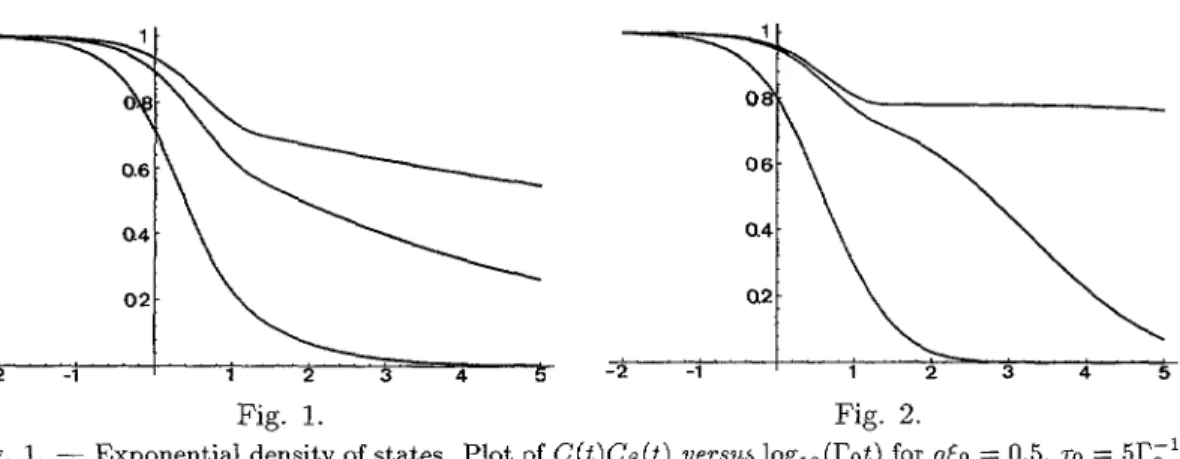
one sees thatC(t)Co(t)
hasprecisely
theshape
observed in mostexperimental
sit-uations,
provided
one takes into account theDebye-Waller
factorCp
defined above. Note the presence of two characteristic timescales,
a short(microscopic)
one To,corresponding
to thecage vibrations
(fl peak),
and along
oneT(T),
corresponding
to the apeak;
these two timescales
separate
extremely
fast as thetemperature
is reduced.When T <
To,
on the otherhand,
no normalisablePeq(e)
can befound,
whichcorresponds
tothe weak
ergodicity
breaking
situation described in[10,13,14].
In thissituation,
P(e, t)
neverreaches a
stationary
hmit,
butcontinuously
drifts towardslarger
andlarger
energies. Timetranslational invariance is
spontaneously
broken asC(t,
t')
never becomes a function of t t'alone,
a situation no,v referred to as'agmg'.
Infact,
one can show [18] thatC(tw
+t,
tw)
er r
C(t/tw),
with 1-C(u)
c~ u ~G for u - 0 and C c~ u~N for u - cc,precisely
as m the'trap'
mortel studied in[13].
Thissuggests
that the dilference between the'quenched'
mortel considered in[13]
(corresponding
to D e 0 inEq.
Il)
and the 'annealed' mortel consideredhere
is,
to some extent, irrelevant.All the above results are still
expected
to hold if thedensity
of statespie)
isapproximatively
exponential
belo~v a certain cut-off e~,provided
that T To >2TTole~.
Ifpie)
decays
fasterthan
exponentially,
forexample
asp(e)
c~ exp-(ele~)~,
thenstrictly
speaking
theglass
Fig.
l.Fig.
2.Fig.
l.Exponential
density
of states. Plot ofC(t)Cà(t)
versuslogi~(Pot)
for q(o " o-à, ro "5Pp~,
and
)
= 2., I.I, 1.03.
Fig.
2. Gaussian density of states. Plot ofC(t)Cà(t)
versuslogio(Fot)
forq(o
" o-à, To #
5Pj~,
and
£
= o-à, 0.25, 0,15. Note tllat tlle
plateau
observed for tlle lowest temperatureeventually
decays
to
zelo.
to a mean-field limit where trie local
trap
strength
is obtained as a sum of contributions fromthe
(large)
number ofneighbours.
Theequilibrium
distributionPeq(e)
isthen,
forlarge
e,given
by
expif
(£)~j,
and thecorresponding
C(t)
exhibits a considerable amount ofstretchmg
r
at laiv.
enough
temperatures.
C(t)
is mdeed very well fittedby
a stretchedexponential
atintermediate times
[22].
Thelong
time fall off ofC(t)
is in this casegiven by
C(t)
c~@)H
~ ~ ~2
with ~1
=
(~)
log
rot.
The terminal timeT(T)
diverges
as expj,
1e. much faster than anactivated
latin,
and,
as mentioned in theintroduction,
alsocompatible
with theexperimental
data[4, 5].
Theshape
ofC(t)Cp(t)
isplotted
inFigure
2 for dilferentTle~.
Itis, again,
very similar to theexpenmental
data. Inparticular,
the a relaxation for different temperatures can beapproximatively
[23]
rescaled onto aunique
master curve whenplotted
as a function offi,
as observed in
experiments
and numerical simulations[24],
andpredicted by
themode-coupling
theory
[5].In
conclusion,
we baveproposed
a very idealized mortel for theglass
transition,
which wehave solved in the
high
temperature
phase.
The results are found toreproduce
twoimportant
observations: trie
shouldering
andstretching
of the correlation and theVogel-Fulcher
hkedivergence
of trie terminal time scale. Trie former feature isusually
accounted forby
themode-coupling
theory
on the basis of a'phantom'
smgularity
~Arhich is removedby
exogeneous processes, m turnresponsible
for the finiteness of the terminal time at low temperatures. In line with previousanalysis
[4,15j,
thepresent
'trap'
mortelsuggests
thaf. thehypothesis
of a intermediate
temperature
transitionmight
not be necessary,although
a more detailed comparison ~A>ithexperimental
data isobviously
desirable,
inparticular
the relation between the(aging)
a andfl regime deep
in theglass phase
[9].Acknowledgments
JPB wants to thank Ni.
Adam,
C.Alba-Simionescu,
A. Barrat. L.Cugliandolo,
D.Dean,
J.I(urchan,
D.Lairez,
J. Ill.Luck,
E. Vincent andespecially
M. sliézard for manifmspiring
1526 JOURNAL DE
PHYSIQUE
I N°12References
[Ii
Fora review, see the interesting serres of papers in
Science,
267(1995)
1924.[2]
'Liquids,
freezing
andglass
transition', Les Houches 1989, 1.P. Hansen, D. Levesque. J.Zinn-Justin,
Eds.(North
Holland,1989)
inparticular
reference[si.
[3]
Vogel
H., Z.Phys.
22(1921)
645; FulcherG-S-,
J. Am. Ceram. Soc. 6(1925)
339.[4]
Ferry J-D-,
Grandine L.D. andFitzgerald E-R-,
J.Appt. Phys.
24(1953)
911; BasslerH.,
Phys.
Reu. Lett 58
(1987)
767 and references therein.[si Gotze W., m reference [2], p. 403 et sq.
[6] See
Kirkpatrick
T.R., Thirumalai D. andlvolynes
P-G- in reference [8];Vilgis
T., J.Phys.
Gond. Marrer 2(1990)
3667; Parisi G., Slo,vdynamics
inglasses,
preprint cond-mat 941115 and 9412034.[î]
For aenlightening
introduction to theexpenmental
controversy, see the serres of Comments mPhys.
Reu. E:Zeng X.C.,
Kivelson D. andTarjus
G.,Phys.
Reu. E 50(1994)
1711; Dixon P-K-,&Ienon N. and
Nagel S-R-,
Phys. Reu. E 50(1994)
171?; Cummms H-Z-, Li G., Phys. Reu. E 50(1994)
1720 and references therein, m particular Cummins H-Z-, Du W-M-, Fuchs M., Gotze W.,Hildebrand S., Latz A., Li G, and Tao N-J-, Phys. Reu. E 47
(1993)
4223.[8]
Kirkpatrick
T.R., Thirumalai D. andWolynes P-G-, Phys.
Reu. A 40(1989)
1045, and references therem. See aise Nieuwenhuizen Th., preprint(1995).
[9] Bouchaud
I.P.,
Cugliandolo
L., Kurchan J. and [lézardM.,
inpreparation.
[loi
Cugliandolo
L. and KurchanJ.,
Phys.
Reu. Lent. 71(1993)
173;Cugliandolo
L. and Le DoussalP., Large time
off-eqmlibrium
dynamics of a particlediffusing
m a random potential, preprintcond-mat 9505112;
Cugliandolo
L.,
Le Doussal P. and Kurchan J., preprint cond-mat 9509008. Fianz S, and MézardM., Europhys.
Lent. 26(1994)
209; Physica A 209(1994)
1.[iii
Kirkpatrick
T.R. and ThirumalaiD.,
J.Phys.
A 22(1989)
L149.[12] Bouchaud I.P. and Mézard à>I., J.
Phys.
f France 4(1994)
l109; &IarinariE.,
Parisi G. and RitortF., J.
Phys.
A 27(1994)
7615; J.Phys.
A 27(1994)
7647;Cugliandolo
L.F., KurchanJ.,
Parisi G. and Ritort F.,Phys.
Reu. Lent. 74(1995)
1012; Fianz S. and HertzJ., Phys.
Reu. Lent. 74(1995)
2114. See aise: Ritort F., Glassiness in a Model,vithout energy barriers, preprint cond-mat9504081.
[13] Bouchaud J.P., J.
Phys.
1Frailce 2(1992)
1705; Bouchaud I.P. and Dean D.S., J.Phys.
f France5
(1995)
265; Barrat A. and Mézard M., J.Phys.
Frailce 5(1995)
941.[14] Bardou F., Bouchaud
I.P.,
Emile O.,Cohen-Tannouji
C. andAspect
A.,Phys.
Reu. Lent. 72(1994)
203.[15] tiote that this
one-particle
density
of state can a prioridepend
on thedensity
of thehquid
and the temperature itself.[16] Derrida
B., Phys.
Reu. B 24(1981)
2613.[17] 0lhe
problem
of the convergence towards thisequilibrium
state isinteresting
and will be discussedm [18]
[18] Monthus
C.,
Bouchaud I.P. and Comtet A., in preparation. [19] Thissimple
exponential formis actually a
good
numerical approximation for ail values of é.[20] See e-g- Bouchaud I.P. and
Georges
A., Phys.Rep.
195(1990)
p. 142-143.[21] This model
emerged
from discussions with Al. Lairez and M. Adam: see Lairez D.,Raspaud
E.,Adam M., Carton I.P. and Bouchaud I.P., to appear m 'Die lfakromol. Chem.
Symp.'
(1995).
(o
and ro are
expected
todepend
some,vhat on temperature, but thisdependence
is much weaker than that of the terminal timeT(T).
[22] On this point, see, e-g-
Castaing
B. and Souletie J., J.Phys.
f Frailce 1(1991)
403.[23] Note that