HAL Id: hal-02167423
https://hal.inria.fr/hal-02167423
Submitted on 27 Jun 2019
HAL is a multi-disciplinary open access
archive for the deposit and dissemination of
sci-entific research documents, whether they are
pub-lished or not. The documents may come from
teaching and research institutions in France or
abroad, or from public or private research centers.
L’archive ouverte pluridisciplinaire HAL, est
destinée au dépôt et à la diffusion de documents
scientifiques de niveau recherche, publiés ou non,
émanant des établissements d’enseignement et de
recherche français ou étrangers, des laboratoires
publics ou privés.
The MetaCoq Project
Matthieu Sozeau, Abhishek Anand, Simon Boulier, Cyril Cohen, Yannick
Forster, Fabian Kunze, Gregory Malecha, Nicolas Tabareau, Théo
Winterhalter
To cite this version:
Matthieu Sozeau, Abhishek Anand, Simon Boulier, Cyril Cohen, Yannick Forster, et al.. The MetaCoq
Project. Journal of Automated Reasoning, Springer Verlag, 2020, �10.1007/s10817-019-09540-0�.
�hal-02167423�
(will be inserted by the editor)
The MetaCoq Project
Matthieu Sozeau, Abhishek Anand, Simon Boulier, Cyril Cohen, Yannick Forster, Fabian Kunze, Gregory Malecha, Nicolas Tabareau and Théo Winterhalter
Received: date / Accepted: date
Abstract The MetaCoq project1aims to provide a certified meta-programming envi-ronment in Coq. It builds on Template-Coq, a plugin for Coq originally implemented byMalecha(2014), which provided a reifier for Coq terms and global declarations, as represented in the Coq kernel, as well as a denotation command. Recently, it was used in the CertiCoq certified compiler project (Anand et al.,2017), as its front-end language, to derive parametricity properties (Anand and Morrisett,2018). However, the syntax lacked semantics, be it typing semantics or operational semantics, which should reflect, as formal specifications in Coq, the semantics of Coq’s type theory itself. The tool was also rather bare bones, providing only rudimentary quoting and unquoting commands. We generalize it to handle the entire Polymorphic Calculus of Cumulative Inductive Constructions (pCUIC), as implemented by Coq, including the kernel’s declaration structures for definitions and inductives, and implement a monad for general manipulation of Coq’s logical environment. We demonstrate how this setup allows Coq users to define many kinds of general purpose plugins, whose correctness can be readily proved in the system itself, and that can be run efficiently after extraction. We give a few examples of implemented plugins, including a parametricity translation and a certifying extraction to call-by-value λ-calculus. We also advocate the use of MetaCoq as a foundation for higher-level tools.
M. Sozeau
Pi.R2 Project-Team, Inria Paris and IRIF, France S. Boulier, N. Tabareau, T. Winterhalter Gallinette Project-Team, Inria Nantes, France C. Cohen
Université Côte d’Azur, Inria, France Y. Forster, F. Kunze
Saarland University, Germany A. Anand, G. Malecha BedRock Systems, USA
1 Introduction
Meta-programming is the art of writing programs (in a meta-language) that produce or manipulate programs (written in an object language). In the setting of dependent type theory, the expressivity of the language allows the case were the meta and object languages are actually the same, accounting for well-typedness. This idea has been pursued in the work on inductive-recursive (IR) and quotient inductive-inductive types (QIIT) in Agda to reflect a syntactic model of a dependently-typed language within another one (Chapman,2009;Altenkirch and Kaposi,2016). These term encodings include type-correcteness internally by considering only well-typed terms of the syntax, i.e. derivations. However, the use of IR or QIITs complicates considerably the meta-theory of the meta-language which makes it difficult to coincide with the object language represented by an inductive type. More problematically in practice, the unification of the syntax and its well-typedness makes it very difficult to use because any function from the syntax can be built only at the price of a proof that it respects typing, conversion or any other features described by the intrinsically typed syntax right away.
Other works have taken advantage of the power of dependent types to do meta-programming in a more progressive manner, by first defining the syntax of terms and types; and then defining out of it the notions of reduction, conversion and typing derivation (Devriese and Piessens, 2013; Van der Walt and Swierstra, 2013) (the introduction of (Devriese and Piessens, 2013) provides a comprehensive review of related work in this area). This can be seen as a type-theoretic version of the functional programming language designs such as Template Haskell (Sheard and Jones,2002a) or MetaML (Taha and Sheard,1997). This is also the approach taken by Malecha in his thesis (Malecha,2014) where he introduced Template-Coq, a plugin which defines a correspondence—using quoting and unquoting functions—between Coq kernel terms and inhabitants of an inductive type representing internally the syntax of the calculus of inductive constructions (CIC), as implemented in Coq. It becomes thus possible to define programs in Coq that manipulate the representation of Coq terms and reify them as functions on Coq terms. Recently, its use was extended for the needs of the CertiCoq certified compiler project (Anand et al.,2017), which uses it as its front-end language. It was also used byAnand and Morrisett (2018) to formalize a modified parametricity translation, and to extract Coq terms to a CBV λ-calculus (Forster and Kunze,2016). All of these translations however lacked any means to talk about the semantics of the reified programs, only syntax was provided by Template-Coq. This is an issue for CertiCoq for example where both a non-deterministic small step semantics and a deterministic call-by-value big step semantics for CIC terms had to be defined and preserved by the compiler, without an “official” specification to refer to.
The MetaCoq project described in this paper remedies this situation by providing a formal semantics of Coq’s type theory, that can independently be refined and studied. The advantage of having a very concrete untyped description of Coq terms (as opposed to IR or QIITs definitions) together with an explicit type checker is that the extracted type-checking algorithm gives rise to an OCaml program that can directly be used to type-check Coq kernel terms. This opens a way to a concrete solution to bootstrap Coq by implementing the Coq kernel in Coq. However, a complete reification of CIC terms and a definition of the checker are not enough to provide a meta-programming framework in which Coq plugins could be implemented. One needs access to Coq logical environments. We achieve this using theTemplateMonad, which reifies Coq general commands, such as lookups and declarations of constants and inductive types.
As far as we know this is the only reflection framework in a dependently-typed language allowing such manipulations of terms and datatypes, thanks to the relatively concise representation of terms and inductive families in CIC. Compared to the MTac project (Ziliani et al.,2015), Lean’s tactic monad (Ebner et al., 2017), or Agda’s reflection framework (Van der Walt and Swierstra, 2013), our ultimate goal is not to interface with Coq’s unification and type-checking algorithms, but to provide a self-hosted, bootstrappable and verifiable implementation of these algorithms. This opens the possibility to verify the kernel’s implementation, a problem tackled byBarras
(1999) using set-theoretic models. In addition, we advocate for the use of MetaCoq as a foundation to build higher-level tools. For example, translations, boilerplate generators, domain-specific proof languages, or even general purpose tactic languages.
Terminologically, we reserve the use of the name Template-Coq to denote reifica-tion of the internal syntax and logical environment of Coq, and also for the reificareifica-tion of the type-checking algorithm. We otherwise use the name MetaCoq when talking about definition of the formal semantics and certification of the algorithms.
Outline of the paper. In Section 2, we present the complete reification of Coq terms, covering the entire CIC and present a formal specification of typing derivations of these terms. In Section 3, we show the definition of theTemplateMonadfor general manipulation of Coq’s logical environment and use it to define plugins for various translations from Coq to Coq or λ-calculus (Section 4). Section 5 covers a modification toTemplateMonad that enables plugins to be run natively in OCaml. Finally, we discuss related and future work in Section 6.
2 A Formal Specification of Coq
In this section, we give a formal specification for Coq by giving syntax and semantics. We will proceed as follows. First, we give the syntax of Coq terms (Section 2.1) and environments (Section 2.2):
term : Set context : Set
Then, we give the formal semantics of those terms by defining the typing relation (Section 2.3), the reduction relation and the conversion relation (Section 2.4):
typing : context → term → term → Type red : context → term → term → Type conv : context → term → term → Type
Finally, Section 2.5 is devoted to typing environment and inductive types while Sec-tion 2.6 explains the management of universes.
2.1 Reification of Terms
The central piece of MetaCoq is the inductive typeterm(Figure 1) which represents the syntax of Coq terms (this language is called Gallina). This inductive follows directly the constr datatype of Coq terms in the implementation of Coq, except
Inductive term : Set B | tRel (n : nat) | tVar (id : ident)
| tEvar (ev : nat) (args : list term) | tSort (s : universe)
| tCast (t : term) (kind : cast_kind) (v : term) | tProd (na : name) (ty : term) (body : term) | tLambda (na : name) (ty : term) (body : term)
| tLetIn (na : name) (def : term) (def_ty : term) (body : term) | tApp (f : term) (args : list term)
| tConst (c : kername) (u : universe_instance) | tInd (ind : inductive) (u : universe_instance)
| tConstruct (ind : inductive) (idx : nat) (u : universe_instance) | tCase (ind_and_nbparams : inductive * nat) (type_info : term)
(discr : term) (branches : list (nat * term)) | tProj (proj : projection) (t : term)
| tFix (mfix : mfixpoint term) (idx : nat) | tCoFix (mfix : mfixpoint term) (idx : nat).
Fig. 1 MetaCoq’s representation of Coq terms mirrors Coq’s constr type.
for the use of OCaml’s native arrays and strings2. Some familiar constructions are recognizable: sorts, lambdas, applications, . . . Let’s review the different constructors.
ConstructortRelrepresents variables bound by abstractions (introduced bytLambda), dependent products (introduced bytProd) and local definitions (introduced bytLetIn). The natural number is a de Bruijn index. Thenameis a printing annotation:
Definition ident B string.
Inductive name B nAnon | nNamed (_ : ident).
Sorts are represented withtSort, which takes auniverseas argument. A universe can be either Prop, Set or a more complex expression representing one of the Type universes. The details are given in Section 2.6.
Type casts(t : A)are given bytCast.
n-ary application is introduced by tApp. In tApp t l,t is expected not to be an application, and l to be a non-empty list.
Example 1 The functionfun (f : Set → Set) (A : Set) ⇒ f Ais represented by: tLambda (nNamed "f")
(tProd nAnon (tSort [(Level.lSet, false)]) (tSort [(Level.lSet, false)])) (tLambda (nNamed "A") (tSort [(Level.lSet, false)]) (tApp (tRel 1) [tRel 0]))
The three constructorstConst,tIndandtConstructrepresent references to constants declared in a global environment. The first is for definitions or axioms, the second for inductive types, and the last for constructors of inductive types. In Coq, constants can be universe polymorphic, meaning that they can be used at different universe levels. In such a case, said universe levels are given in theuniverse_instancewhich is a list of levels. If the constant is not universe polymorphic, the instance is expected to be empty.
tCaserepresents pattern-matchings,tProjprimitive projections,tFixfixpoints and tCoFixcofixpoints.
2 An upcoming extension of Coq (Armand et al.,2010) with such features could address
Example 2 The addition on natural numbers Fixpoint add (a b : nat) : nat B
match a with | 0 ⇒ b | S a ⇒ S (add a b) end. Is represented by: tFix [{|
dname B nNamed "add";
dtype B tProd (nNamed "a") (tInd inat [ ])
(tProd (nNamed "b") (tInd inat [ ]) (tInd inat [ ])); dbody B tLambda (nNamed "a") (tInd inat [ ])
(tLambda (nNamed "b") (tInd inat [ ]) (tCase (inat, 0)
(tLambda (nNamed "a") (tInd inat [ ]) (tInd inat [ ])) (tRel 1)
[(0, tRel 0);
(1, tLambda (nNamed "a") (tInd inat [ ]) (tApp (tConstruct inat 1 [ ])
[tApp (tRel 3) [tRel 0; tRel 1]]))])); rarg B 0 |}] 0
whereinatis a notation for the inductive representingnat:
{| inductive_mind B "Coq.Init.Datatypes.nat"; inductive_ind B 0 |}
tVaris for named variables introduced in Coq sections or during interactive proofs. tEvarrepresents for existential variables, i.e. holes to be filled in terms. Typing of these two constructions is not defined in MetaCoq for the moment.
2.2 Reification of environment
In Coq, the meaning of a term is relative to an environment, which must be reified as well. We distinguish the global environment which is constant through a typing derivation, from the local context which may vary. The type of typing relation is:
typing : global_context → context → term → term → Type (similar forredandconv)
The local context records the types and potential bodies (for let-ins) of de Bruijn indexes:
Record context_decl B mkdecl { decl_name : name ;
decl_body : option term ; decl_type : term
}.
Definition context B list context_decl.
The de Bruijn index0is bound to the head of the list. Contexts are written in snoc order: we use the notation Γ ,, d for adding d to the head of Γ. We also use the abbreviationsvass x Aandvdef x t A for the two ways to build acontext_decl(with or without a body). Last, we use the notationΓ ,,, Γ ’for context concatenation. Remark 1 Contrarily to MetaCoq, in the OCaml code of Coq de Bruijn indices start at1for historical reasons.
The global environment consists of two parts: the graph of universes (described in Section 2.6) and a list of declarations, properly ordered according to dependencies. Definition global_declarations B list global_decl
Definition global_context B global_declarations * uGraph.t.
A declaration is either the declaration of a constant (a definition or an axiom, according to the presence of body) or of a block of mutual inductive types (which brings both the inductive types and their constructors to the context).
Inductive global_decl B
| ConstantDecl : kername → constant_body → global_decl | InductiveDecl : kername → mutual_inductive_body → global_decl.
The kernel namekernameis a fully qualified name (among modules), for instance the kernel name corresponding to nat is Coq.Init.Datatypes.nat.kername as a type is a synonym tostring.
The declaration of a constant is fairly easy: Record constant_body B {
cst_type : term; cst_body : option term;
cst_universes : universe_context }.
Theuniverse_contextindicates whether the constant is polymorphic or not. If so, it contains the constraints that the universe instances have to satisfy.
Declarations of inductives are more involved, they are described in Section 2.5.
2.3 Typing judgements
Now that we have terms and environments, we can describe formally all the typing rules of Coq. This is done by defining an inductive familytypingwhose definition looks like: Inductive typing (Σ : global_context) (Γ : context) : term → term → Set B | type_Rel n :
All_local_env typing Σ Γ → nth_error Γ n = Some decl →
Σ ;;; Γ ` tRel n : lift0 (S n) decl.(decl_type) | type_Sort (l : level) :
All_local_env typing Σ Γ →
Σ ;;; Γ ` tSort (Universe.make l) : tSort (Universe.super l) | ...
where " Σ ;;; Γ ` t : T " B (typing Σ Γ t T)
with typing_spine Σ Γ : term → list term → term → Prop B | type_spine_nil ty : typing_spine Σ Γ ty [ ] ty | type_spine_cons hd tl na A B s T B’ : Σ ;;; Γ ` tProd na A B : tSort s → Σ ;;; Γ ` T ≤ tProd na A B → Σ ;;; Γ ` hd : A → typing_spine Σ Γ (subst10 hd B) tl B’ → typing_spine Σ Γ T (hd :: tl) B’.
The typing rules include the basic dependent λ-calculus with let-bindings, global references to inductives and constants, pattern-maching, primitive projections and (co)fixed-points. Universe polymorphic definitions and the well-formedness judgment for global declarations are dealt with as well. The only ingredients missing are the termination check for fixed-points and productivity check for cofixed-points. They are work-in-progress.
Note that the typing rules use substitution and lifting operations of de Bruijn indexes (lift0,subst, . . . ), their definitions are standard. The typing relation also relies on the subtyping relation. It is described in Section 2.4.
We shall now take time to explain in details the rules one by one.
Variables. A variable is well typed when its de Bruijn index corresponds to a declara-tion in the (local) contextΓ. The following rule is not saying much more despite its looks.
type_Rel n decl :
All_local_env typing Σ Γ → nth_error Γ n = Some decl →
Σ ;;; Γ ` tRel n : lift0 (S n) decl.(decl_type)
decl is a declaration of type context_decl. The rule attests that the nth variable corresponds to thenth most recent declaration in the context and thus has the ascribed type. The latter is however lifted because the context containsndeclarations after it: Γ = ∆, decl_n, ..., decl1, decl0
withdecl_ntyped in∆, soΓis∆extended withS ndeclarations, hence thelift0 (S n). Finally,All_local_env typing Σ Γis asserting that the local contextΓis well-formed in global contextΣ. Later on this property is calledwf_local Σ Γbut here the dependency ontypingis being made explicit.
Sorts. Any sort corresponding to a level (without a+1) can be typed with its successor universe (with a+1), provided the context is well-formed.
type_Sort l :
All_local_env typing Σ Γ →
Σ ;;; Γ ` tSort (Universe.make l) : tSort (Universe.super l)
Remark 2 With this rule, only non-algebraic universes can be typed (see Section 2.6 for the definition of non-algebraic universes).
Type-casts. In Coq, a type-cast happens when you give a type explicitly to an expression:(t : A).tis checked to have typeAand the whole expression is also typed withA.
type_Cast t k A s :
Σ ;;; Γ ` A : tSort s → Σ ;;; Γ ` t : A → Σ ;;; Γ ` tCast t k A : A
In the rule it is required thatAis well-sorted, meaning that there exists (constructively) a sorts such thatAis of type tSort s. In Coq’s kernel, the k : cast_kindindicates which algorithm is used to check the conversion betweenAand the type oft. We ignore it for the moment in MetaCoq.
Dependent products. The dependent product, or Π-type,∀ x : A, Bis well typed when bothAandBare well typed (the latter in the context extended with assumption x : A).
type_Prod n A B s1 s2 : Σ ;;; Γ ` A : tSort s1 →
Σ ;;; Γ ,, vass n A ` B : tSort s2 →
Σ ;;; Γ ` tProd n A B : tSort (Universe.sort_of_product s1 s2)
The sort in which the product lives in roughly the maximum of the sorts of its compo-nents, accounting for impredicativity ofProp:
Definition sort_of_product domsort rangsort B
match (domsort, rangsort) with
| (_, [(Level.lProp,false)]) ⇒ rangsort | (u1, u2) ⇒ Universe.sup u1 u2
end.
λ-abstractions. Similarly the rule governing the typing of fun x : A ⇒ t is not surprising.
type_Lambda n n’ A t s1 B : Σ ;;; Γ ` A : tSort s1 → Σ ;;; Γ ,, vass n A ` t : B → Σ ;;; Γ ` tLambda n A t : tProd n’ A B
Notice the namesnandn’that are different in the term and the type; they are only printing hints and are irrelevant to typing, which is why this rule doesn’t force them to be the same.
let in expression. tLetIn x b B t reifies let x B b : B in t for which typing is pretty straightforward. Assumingt : Athe whole expression has typelet x B b : B
in A. type_LetIn x b B t s1 A : Σ ;;; Γ ` B : tSort s1 → Σ ;;; Γ ` b : B → Σ ;;; Γ ,, vdef x b B ` t : A → Σ ;;; Γ ` tLetIn x b B t : tLetIn x b B A
Applications. Typing applications is usually simple, but because MetaCoq features n-ary applications, we need to be careful when handling them.
type_App t l t_ty t’ : Σ ;;; Γ ` t : t_ty →
~ (isApp t = true) → l 6= [ ] → (* Well-formed application *) typing_spine Σ Γ t_ty l t’ →
Σ ;;; Γ ` tApp t l : t’
The conditions ~ (isApp t = true) and l 6= [ ] ensure that the application is well-formed: that istis not a nested application and it is applied to at least one argument. Thentyping_spine Σ Γ t_ty l t’states that a term of typet_tyapplied to a list of argumentslwill return a term of typet’. Let’s have a closer look at it:
typing_spine Σ Γ : term → list term → term → Prop B | type_spine_nil ty : typing_spine Σ Γ ty [ ] ty | type_spine_cons hd tl na A B s T B’ : Σ ;;; Γ ` tProd na A B : tSort s → Σ ;;; Γ ` T ≤ tProd na A B → Σ ;;; Γ ` hd : A → typing_spine Σ Γ (subst10 hd B) tl B’ → typing_spine Σ Γ T (hd :: tl) B’.
Basically, it iterates over every argument of the function, checking each time that the new function has a function type and is being applied to something in its domain. The argument is then substituted in the codomain which then is matched against a function type again, until there are no arguments left and the type can be returned as is.
Global constants. A constant can either refer to a global definition (stemming from Definition orLemmafor instance), or to an axiom (Axiom). It has a name which is a kername. Such a declaration can be universe polymorphic, so when referring to a constant, one needs to provide it with a universe instance (i.e. values for the universe variables in the definition).
type_Const cst u :
All_local_env typing Σ Γ →
∀ decl (isdecl : declared_constant (fst Σ) cst decl),
consistent_universe_context_instance (snd Σ) decl.(cst_universes) u → Σ ;;; Γ ` tConst cst u : subst_instance_constr u decl.(cst_type)
For a constant to be well typed, it first needs to indeed refer to a declared constant in the global context Σ, which is checked bydeclared_constant (fst Σ) cst decl, a synonym tolookup_env (fst Σ) cst = Some (ConstantDecl cst decl).
consistent_universe_context_instancehas a self-explanatory name: it checks that the instance is indeed an instance and verifies that if satisfies the constraints. The constant can thus be typed with the type found in the contextdecl.(cst_type), where the universes are substituted with the instance.
Inductive types. Typing an inductive type is very similar to typing a constant. This time ind is of type inductive which consists of akername (the name of the mutual-inductive block) and a natural number (the index of the considered mutual-inductive type in the block, starting at 0). Similarly to constants, inductive types can be universe polymorphic.
type_Ind ind u :
All_local_env typing Σ Γ →
∀ mdecl idecl (isdecl : declared_inductive (fst Σ) mdecl ind idecl), consistent_universe_context_instance (snd Σ) mdecl.(ind_universes) u → Σ ;;; Γ ` tInd ind u : subst_instance_constr u idecl.(ind_type)
Inductives are declared in the global context as well. mdeclcorresponds to the mu-tual block andideclcorresponds to the inductive of that block we’re interested in. declared_inductivechecks thatindindeed corresponds to these declarations inΣ.
Constructors of an inductive type. Inductive types come with their constructors. If the inductive type is declared, and the constructor is indeed a constructor, then it is welltyped.
type_Construct ind i u : All_local_env typing Σ Γ → ∀ mdecl idecl cdecl
(isdecl : declared_constructor (fst Σ) mdecl idecl (ind, i) cdecl), consistent_universe_context_instance (snd Σ) mdecl.(ind_universes) u → Σ ;;; Γ ` tConstruct ind i u : type_of_constructor mdecl cdecl (ind, i) u However, this time the constructor types come under the context corresponding to the mutual inductive types. Take for instance the mutual inductive typesevenandodd: Inductive even : nat → Prop B
| evenO : even 0
| evenS : ∀ n, odd n → even (S n)
with odd : nat → Prop B
| oddS : ∀ n, even n → odd (S n).
In this case,evenSis typed in contexteven : nat → Prop, odd : nat → Prop, which is why it can refer to both types, even before they are defined.
The purpose oftype_of_constructoris thus to substitute these variables by their actual definitions, as well as instantiating the universes.
Pattern matching. In the internals of Coq and MetaCoq, pattern-matching is refered to astCase. Dependent pattern-matching with general inductive types is no small task so we shall try and break down the typing rule, and thetCaseconstructor. type_Case ind u npar p c brs args :
∀ mdecl idecl
(isdecl : declared_inductive (fst Σ) mdecl ind idecl), mdecl.(ind_npars) = npar →
let pars B List.firstn npar args in
∀ pty, Σ ;;; Γ ` p : pty → ∀ indctx pctx ps btys,
types_of_case ind mdecl idecl pars u p pty = Some (indctx, pctx, ps, btys) →
check_correct_arity (snd Σ) idecl ind u indctx pars pctx = true → Exists (fun sf ⇒ universe_family ps = sf) idecl.(ind_kelim) → Σ ;;; Γ ` c : mkApps (tInd ind u) args →
All2 (fun x y ⇒ (fst x = fst y) * (Σ ;;; Γ ` snd x : snd y)) brs btys → Σ ;;; Γ ` tCase (ind, npar) p c brs : mkApps p (List.skipn npar args ++ [c ])
IntCase (ind, npar) p c brs,indis inductive type of the scrutineec,nparis the number of parameters of the inductive (arguments that are constant across all the constructors), p is the predicate or return type, while brs is a list of branches comprised of the number of arguments of the constructor and the term corresponding to the branch (with abstractions for the arguments of the constructor). For instance, consider the
following pattern-matching:
fun m P (PO : P 0) (PS : ∀ n, P (S n)) ⇒
match m as n return P n with
| 0 ⇒ PO | S n ⇒ PS n
end.
Ignoring the λs, it is quoted to tCase
(tLambda (nNamed "n") (tInd inat [ ]) (tApp (tRel 3) [ tRel 0 ])) (tRel 3) [
(0, tRel 1) ;
(1, tLambda (nNamed "n") (tInd inat [ ]) (tApp (tRel 1) [ tRel 0 ])) ]
Let’s focus on the rule now. As we did for inductive types, we check that the inductive type of the scrutinee is declared.
Σ ;;; Γ ` c : mkApps (tInd ind u) argschecks that the scrutineec is indeed in the right type, i.e., the inductive applied to some arguments. After checking thatnpar is indeed the number of parameters of the inductive type (mdecl.(ind_npars) = npar), we take them off the list of arguments (pars B List.firstn npar args). The rest are the indices of the inductive type and may vary depending on the branch.
Additionally, we check that the predicate (or return type) is well typed withΣ ;;; Γ ` p : pty.
types_of_casehas the purpose of producing the typing information required to type the branches:
– indctx corresponds to the context of the inductive type where the parameters have been instantiated bypars, it thus contains only the indices, (e.g.y : Awhen matching againstp : @eq A u v,Aandubeing the parameters);
– pctxis the same but for the type of the predicatep(in the example above it would just ben : nat);
– psis the sort targeted byp(basicallypquantifies overpctxto returnps—in particular it forcespto be a type once fully applied);
– btysis a list containing the expected type for each element ofbrs, the branches. check_correct_arity verifies that pctx is equal (modulo α-renaming) to indctx extended with a variable of the inductive applied to the parameters pars and the variables of contextindctx.
Then,Exists (fun sf ⇒ universe_family ps = sf) idecl.(ind_kelim)attests that the sort of the predcatepsbelongs to one the universe families that the inductive type can be eliminated to (ind_kelim). The universe family may beProp,Set orType and some inductives have restrictions for elimination; most inductive types defined inProp can only be eliminated intoPropitself, the only to bypass this restriction is using the so-called singleton elimination.
Finally, withAll2we iterate over bothbrsandbtysto check that the branches are indeed typed according to what is recorded inbtys, all the while checking that they agree on the number of arguments of the constructors (with thefstpart).
Primitive projections. In Coq there are two notions of record types. By default, when one defines the following record:
Record T B mk { pi1 : bool ; pi2 : nat }.
it is actually equivalent to the inductive type with one constructor Inductive T B mk (pi1 : bool) (pi2 : nat).
along with the definitions ofpi1 andpi2by pattern-matching.
It however possible to define records in a more primitive way. Using the global option Set Primitive Projections, the former record definition is still internally represented as an inductive, but this time, additionally to constructors, it has projections, corresponding topi1andpi2. Projections can be called with the syntaxt.(pi1)or as regular functions.
type_Proj p c u : ∀ mdecl idecl pdecl
(isdecl : declared_projection (fst Σ) mdecl idecl p pdecl) args, Σ ;;; Γ ` c : mkApps (tInd (fst (fst p)) u) args →
#|args| = ind_npars mdecl →
let ty B snd pdecl in
Σ ;;; Γ ` tProj p c
: subst0 (c :: List.rev args) (subst_instance_constr u ty)
As usual, declared_projection checks that Σ contains both the inductive and the projection declaration. The projection is applied to a termcof the record as ensured by the condition:
Σ ;;; Γ ` c : mkApps (tInd (fst (fst p)) u) args
Hereprojection stands forinductive * nat * nat, that is an inductive, a number of parameters and the index of the projected argument. We verify that the inductive is fully applied with#|args| = ind_npars mdecl, stating that the number of arguments corresponds to the number of parameters of the inductive type. Finally, we substitute these arguments,c, and the universes in the type of the projection to get the type of the term.
Fixed-points. In Coq, the fixed-point operator is primitive and completes pattern-matching for performing induction. One usually writes a fixed-point using the aptly named commandFixpoint. It is however possible to write them directly in a term with
fix. Let’s consider the following mutual fixed-point:
fix f1 (x1:X11) ... (xn1:X1n1) {struct xk1} : A1 B t1
with ...
with fn (x1:Xn1) ... (xnn:Xnnn) {struct xkn} : An B tn
for fj
This fixed-point will be of type∀ (x1:Xj1) ... (xnj:Xjnj), Aj. For it to be well typed there are three conditions:
– EachAihas to be a type;
– Eachtihas to be of typeAiin a context extended by the signatures of the fixed-points (allowing the recursive calls in the body):
Γ, f1:A1, . . . fn:An, x1:Xi1, . . . xni:Xini ` ti:Ai;
– A termination criterion has to be fulfilled. Such a criterion has not yet been implemented in MetaCoq.
Internally, a fixed-point is represented withtFix mfix idxwheremfix : list (def term)represents the mutual fixed-points, and idx : natspecifies which of them we want to refer to.defis the following record:
Record def (term : Set) : Set B mkdef { dname : name; (* the name fi **) dtype : term; (* the type Ai **)
dbody : term; (* the body ti (a lambda-term).
Note, this may mention other (mutually-defined) names **) rarg : nat (* the index ki of the recursive argument, 0 for cofixpoints **) }.
type_Fix mfix n decl :
let types B fix_context mfix in
nth_error mfix n = Some decl →
All_local_env typing Σ (Γ ,,, types) → All (fun d ⇒
Σ ;;; Γ ,,, types ` d.(dbody) : lift0 #|types| d.(dtype)) * (isLambda d.(dbody) = true
) mfix →
Σ ;;; Γ ` tFix mfix n : decl.(dtype)
First, we build a context containing the assumptions of the different definitions with types B fix_context mfix, and verify that the composite contextΓ ,,, typesis well-formed. Then we check thatidx indeed corresponds to one of the definitions of the block (nth_error mfix n = Some decl). Finally, for each of the definitions, we check that the body has the ascribed type (in the extended context, hence thelift0) and that they all correspond to functions. The return type is the ascribed type.
Cofixed-points. Co-fixed-points are handled in a very similar fashion to regular fixed-points. Even their representation is the same. Again, productivity conditions remain unchecked for the time being.
type_CoFix mfix n decl :
let types B fix_context mfix in
nth_error mfix n = Some decl →
All_local_env typing Σ (Γ ,,, types) → All (fun d ⇒
Σ ;;; Γ ,,, types ` d.(dbody) : lift0 #|types| d.(dtype) ) mfix →
Σ ;;; Γ ` tCoFix mfix n : decl.(dtype)
Conversion rules. We conclude with the usual conversion rule. type_Conv t A B s :
Σ ;;; Γ ` t : A → Σ ;;; Γ ` B : tSort s → Σ ;;; Γ ` A ≤ B → Σ ;;; Γ ` t : B
It is here stated with cumulativity (allowing to increase universes in contravariant positions), and it requires the new type to be well-sorted as well. We shall explain conversion and cumulativity in more details in the next subsection.
2.4 Conversion, Cumulativity and Reduction
The cumulativity, or subtyping, relation, is defined from one-step reductionred1 as follows:
Inductive cumul Σ Γ : term → term → Type B | cumul_refl t u : leq_term (snd Σ) t u → Σ ;;; Γ ` t ≤ u | cumul_red_l t u v : red1 (fst Σ) Γ t v → Σ ;;; Γ ` v ≤ u → Σ ;;; Γ ` t ≤ u | cumul_red_r t u v :
Σ ;;; Γ ` t ≤ v → red1 (fst Σ) Γ u v → Σ ;;; Γ ` t ≤ u
where " Σ ;;; Γ ` t ≤ u " B (cumul Σ Γ t u).
Basically,A ≤ BwhenAandBrespectively reduce toA’andB’such that cumulativity can be checked syntactically with leq_term. leq_termoperates as a congruence and invokes universe comparison when reaching sorts.
Conversion is derived from cumulativity going both ways: Definition conv Σ Γ T U B
(Σ ;;; Γ ` T ≤ U) * (Σ ;;; Γ ` U ≤ T). Notation " Σ ;;; Γ ` t = u " B (conv Σ Γ t u).
It is equivalent to having both terms reduce to α-convertible terms.
The main point of interest is thus how one-step reduction red1 is defined. It is introduced with the following command:
Inductive red1 (Σ : global_declarations) (Γ : context) : term → term → Type however, we will not put here all of its constructors. Most of them are congruence rules. For instance, fortLambda, the congruences are as follows.
| abs_red_l na M M’ N : red1 Σ Γ M M’ →
red1 Σ Γ (tLambda na M N) (tLambda na M’ N) | abs_red_r na M M’ N :
red1 Σ (Γ ,, vass na N) M M’ →
red1 Σ Γ (tLambda na N M) (tLambda na N M’)
A term reduces to another in one step, if one of its subterms does. It holds for all term constructors so we will now focus on actual computation rules.
β-reduction. A λ-abstraction may consume its first argument to reduce. red_beta na t b a l :
red1 Σ Γ (tApp (tLambda na t b) (a :: l)) (mkApps (subst10 a b) l)
letexpressions. A let expression can be unfolded as a substitution right away (this is called ζ-reduction):
red_zeta na b t b’ :
red1 Σ Γ (tLetIn na b t b’) (subst10 b b’)
It can also be unfolded later, by reducing a reference to thelet-binding: red_rel i body :
option_map decl_body (nth_error Γ i) = Some (Some body) → red1 Σ Γ (tRel i) (lift0 (S i) body)
It checks that theith variable inΓ corresponds to a definition and replaces the variable with it. It needs to be lifted because the body was defined in a smaller context.
Pattern-matching. Amatchexpression can be reduced with ι-reduction when the scrutinee is a constructor.
red_iota ind pars c u args p brs :
red1 Σ Γ (tCase (ind, pars) p (mkApps (tConstruct ind c u) args) brs) (iota_red pars c args brs)
Herein,iota_redis defined as follows: Definition iota_red npar c args brs B
mkApps (snd (List.nth c brs (0, tDummy))) (List.skipn npar args).
As List.nthtakes a default value, (0, tDummy)can be ignored, it basically picks the branch corresponding to the constructor and applies it to the indices of the inductive (List.skipn npar args).
Fixed-point unfolding. Even after they are checked to be terminating, fixed-points cannot be unfolded indefinitely. There is a syntactic guard to only unfold a fixed-point when its recursive argument is a constructor.
red_fix mfix idx args narg fn :
unfold_fix mfix idx = Some (narg, fn) → is_constructor narg args = true →
red1 Σ Γ (tApp (tFix mfix idx) args) (tApp fn args)
unfold_fix mfix idxallows to recover both the body (fn) and the index of the recursive argument (narg) whileis_constructor narg argschecks that the said argument is indeed a constructor.
Co-fixed-point unfolding. There are two cases where a co-fixed-point gets unfolded. One of them is when it is matched against.
red_cofix_case ip p mfix idx args narg fn brs : unfold_cofix mfix idx = Some (narg, fn) →
red1 Σ Γ (tCase ip p (mkApps (tCoFix mfix idx) args) brs) (tCase ip p (mkApps fn args) brs)
As for fixed-points,unfold_cofixreturns the body.
A co-fixed-point can also be unfolded when projected, behaving exactly the same way.
red_cofix_proj p mfix idx args narg fn : unfold_cofix mfix idx = Some (narg, fn) →
red1 Σ Γ (tProj p (mkApps (tCoFix mfix idx) args)) (tProj p (mkApps fn args))
δ-reduction. δ-reduction allows to unfold a constant (from the global contextΣ). red_delta c decl body (isdecl : declared_constant Σ c decl) u :
decl.(cst_body) = Some body →
red1 Σ Γ (tConst c u) (subst_instance_constr u body)
It can only be done if a definition is indeed found. Its universes (if it is universe polymorphic) are then instantiated.
Projection. When a constructor of a record is projected, it can be reduced to the corresponding field.
red_proj i pars narg args k u arg :
nth_error args (pars + narg) = Some arg →
red1 Σ Γ (tProj (i, pars, narg) (mkApps (tConstruct i k u) args)) arg
2.5 Typing environments
Local environment. As already mentionned in the typing rules, a local contextΓ is wellformed ifwf_local Σ Γholds. This type is an abbreviation ofAll_local_env typing
Σ Γ whereAll_local_envis defined by:
Inductive All_local_env (Σ : global_context) : context → Type B | localenv_nil : All_local_env Σ [ ] | localenv_cons_abs Γ na t u : All_local_env Σ Γ → typing Σ Γ t (tSort u) → All_local_env Σ (Γ ,, vass na t) | localenv_cons_def Γ na b t : All_local_env Σ Γ → typing Σ Γ b t → All_local_env Σ (Γ ,, vdef na b t).
Hence, the empty context is well-formed. A variable assumption is well-formed if the type is well-sorted and a variable definition is well-formed if the body is indeed of the given type.
The well-typedness of the local context is enforced in every typing judgment: typing_wf_local: ∀ Σ Γ t T, wf Σ → Σ ;;; Γ ` t : T → wf_local Σ Γ
Global environment. As opposed to local contexts, the well-typedness of the global environment is not enforced in typing judgments and have thus to be stated addi-tionally with the predicatewf Σ(as above for instance). This predicate is defined as on_global_decls (fst Σ) (snd Σ)where we have:
Definition on_constant_decl Σ d B
match d.(cst_body) with
| Some trm ⇒ typing Σ [ ] trm d.(cst_type)
| None ⇒ {u : universe & typing Σ [ ] d.(cst_type) (tSort u)}
end.
Definition on_global_decl Σ decl B
match decl with
| ConstantDecl id d ⇒ on_constant_decl Σ d
| InductiveDecl ind inds ⇒ on_inductive Σ ind inds
end.
Inductive on_global_decls φ : global_declarations → Type B | globenv_nil : consistent (snd φ) → on_global_decls φ [ ] | globenv_decl Σ d :
on_global_decls φ Σ →
on_global_decl (Σ, φ) d → on_global_decls φ (d :: Σ).
The empty environment is wellformed when the graph of universes has no inconsistencies. Well-formedness of constants is the same as for local contexts. Well-formedness of inductive declarations is outlined below. For each new declaration, the identifier is required to be fresh with respect to the previous ones.
Inductive declarations. In Coq, a block of mutual inductive types is declared as follows:
Inductive I1 params : A1 B c11 : T11 | ... | c1n1 : T1n1 ...
with Ip params : Ap B cp1 : Tp1 | ... | cpnp : Tpnp.
I1, . . .Ipare the names of the inductive types.A1, . . .Apare the arities. Thecijare the constructors and theTijtheir types.paramsis the context of parameters. This context can contain some let-bindings, we will write x1, . . . xn for the variables without body
bound in this context.
Remark 3 With respect to indices, parameters x1, . . . xn have to be constant in all
the conclusions of the types of constructors. However, they may vary in the types of arguments of constructors. A parameter is called uniform if it is constant through the whole inductive type, and non uniform otherwise.
In MetaCoq, a mutual block of inductive types is formally represented by a mutual_inductive_bodywhich, itself, consists mainly in a list ofone_inductive_body, one for each block.
(* Declaration of one inductive type *) Record one_inductive_body B {
ind_name : ident;
ind_type : term; (* closed arity: ∀ params, Ai *)
ind_kelim : list sort_family; (* allowed elimination sorts *) (* name, type, number of arguments for each constructor *) ind_ctors : list (ident * term * nat);
(* name and type for each projection (if any) *) ind_projs : list (ident * term)
}.
(* Declaration of a block of mutual inductive types *) Record mutual_inductive_body B {
ind_npars : nat; (* number of parameters *) ind params : context; (* types of the parameters *)
ind_bodies : list one_inductive_body; (* inductives of the block *) ind_universes : universe_context (* universe constraints *)
}.
A blockmutual_inductive_bodyis well-formed when:
– the context of parameters is well-formed:wf_local Σ ind params;
– ind_nparsis the number of assumptions (i.e. without let-in) inind params; – eachone_inductive_bodyis well-formed.
And a declaration of typeone_inductive_bodyis well-formed when:
– the arity ind_type is well-sorted in the empty context and starts with at least ind_nparsforalls “∀” (skipping the lets and casts);
– for each triplet(id,T,n)of the list of constructorsind_ctors, – Tis well-sorted under the context of arities:
I1:A01, . . . In:A0n` T :s where A0iis ∀params, Ai;
– Tis of the shape ∀params args, Ii x1 . . . xn t1 . . . tk where args are the real arguments of the constructor and Iiis the corresponding de Bruijn index; – for each pair(id, T)of the list of projectionsind_projs:
– the inductive type has no index;
– Tis well-sorted in the context of parameters extended by the considered inductive type:
params, x:Iix1 . . . xn` T :s.
This specification of inductive types is not fully complete: for instanceind_kelimis not checked yet. The main missing feature is the positivity criterion.
Remark 4 In Coq internals, there are in fact two ways of representing a declaration: either as a “body” or as an “entry”. The kernel takes entries as input, type-checks them and elaborates them into bodies. In MetaCoq, we provide both, as well as an erasing functionmind_body_to_entryfrom bodies to entries for inductive types.
2.6 Universes
The treatment of universes in Coq is both a strong feature and something hard to understand. We hope that MetaCoq can shed some light on it.
Coq relies on a hierarchy of universes:Prop,Set,Type0,Type1,Type2, . . . The universe
Setcan be seen as a strict synonym ofType0.
The hierarchy behaves as follows for typing: Prop:Type1
Type0:Type1:Type2. . .
And as follows with respect to cumulativity:
Prop⊆Type0⊆Type1 ⊆Type2. . .
In Coq, the user does not have to provide the universe level iof Typei but can
instead use typical ambiguity and simply writeType. The Coq system has then the responsibility of instantiating the universe levels properly. For flexibility, the universe levels are not definitely determined at declaration time. Instead, a universe variable for the level is introduced and only the most general constraints on this variable are recorded. In technical cases, the user can enforce the universe variable with the notation Type@{l}.
For instance, the following definition
Definition T : Type@{l1} B ∀ (A : Type@{l2}), A → Set.
will generate the constraintsSet < l1andl2 < l1wherel1andl2are universe variables.
Here, the set of constraints is satisfiable: it can be instantiated with, for instance, (l1 B 2,l2 B 1).
The Coq system maintains a set of constraints and updates it each time a new universe variable is introduced. The Coq system also manipulates some algebraic uni-verses which are of the formType@{max(l1,l2+1)}, as introduced inHerbelin and Spiwack
(2013). The level of these universes is uniquely determined byl1andl2. Thanks to the
Setkeyword,Type0 is the onlyTypeithat can be given explicitly by the user.
Formally, a universe is the supremum of a (non-empty) list of level expressions, and a level is eitherProp,Set, a global level or a de Bruijn polymorphic level variable. Polymorphic levels are used when type checking a polymorphic declaration (constant or inductive).
Inductive level B lProp | lSet | Level (_ : string) | Var (_ : N). Definition universe B list (level * bool). (* level+1 if true *)
A universe is called non-algebraic if it is a level (that is, of the form[(l, false)]), and algebraic otherwise.
A constraint is given by two levels and aconstraint_type: Inductive constraint_type B Lt | Le | Eq.
Definition univ_constraint B Level.t * constraint_type * Level.t.
The set of constraints (constraints) is implemented by sets as lists without duplicates coming from the Coq standard library. A valuation is an instance for all monomorphic and polymorphic levels in natural numbers. Monomorphic (global) levels are required to be positive so that we haveProp : Typefor any instance.
Record valuation B
{ valuation_mono : string → positive ; valuation_poly : nat → nat }.
We define the evaluation of valuation on monomorphic levels and then on universes. Fixpoint val0 (v : valuation) (l : Level.t) : Z B
match l with
| lProp ⇒ -1 | lSet ⇒ 0
| Level s ⇒ Zpos (v.(valuation_mono) s) | Var x ⇒ Z.of_nat (v.(valuation_poly) x)
end.
Fixpoint val (v : valuation) (u : universe) (Hu : u 6= [ ]) : Z B ...
Satisfaction of constraints is defined as expected. Then, a set of constraints is said to be consistent if there exists a valuation satisfying the constraints:
Definition consistent ctrs B ∃ v, satisfies v ctrs.
Last, given a set of constraints, two universes are said equal when they are equal for all valuation satisfying the constraints (idem for ≤):
Definition eq_universe (φ : uGraph.t) u Hu u’ Hu’ B ∀ v, satisfies v (snd φ) → val v u Hu = val v u’ Hu’. Definition leq_universe (φ : uGraph.t) u Hu u’ Hu’ B
∀ v, satisfies v (snd φ) → val v u Hu ≤ val v u’ Hu’.
The functionseq_termandleq_termused in conversion and cumulativity relations are defined as congruence on terms calling those two functions on sorts.
2.7 Toward Coq bootstrap
The reification of syntax is a first step toward the bootstrap of Coq. From this, one can reimplement some algorithm of the kernel such as type inference, type checking,
the test of conversion/cumulativity and so on. On the other hand, the reification of semantics is then a first step toward the certification of such reimplementation. From here, we can dream of a proof assistant whose critical algorithms are certified.
As a preliminary stage, we implemented the three aforementioned algorithms: (* typing_result is an error monad *)
check_conv: Fuel→ global_ctx → context → term → term → typing_result unit infer : Fuel→ global_ctx → context → term → typing_result term
check : Fuel→ global_ctx → context → term → term → typing_result unit Type checking is given by type inference followed by a conversion test. All the rules of type inference are straightforward except for cumulativity. The cumulativity test is implemented by comparing recursively head normal forms for a fast-path failure. We implemented weak-head reduction by mimicking Coq ’s implementation, which is based on an abstract machine inspired by the KAM. Coq ’s machine optionally implements a variant of lazy, memoizing evaluation (thelazyreduction strategy). That feature has not been implemented yet. A major difference with the OCaml implementation is that all of functions are required to be shown terminating in Coq. One possibility could be to prove the termination of type-checking separately but this requires to prove in particular the normalization of CIC which is a complex task. Instead, we simply add a fuel parameter to make them syntactically recursive and makemakeOutOfFuela type error.
We also implemented, the satisfiability check of universe constraints. In Coq, the set of constraints is maintained as a weighted graph called the universe graph. The nodes are the introduced level variables, and the edges are given by the constraints. Each edge has a weight which corresponds to the minimal distance needed between the two nodes:
Definition edges_of_constraint (uc : univ_constraint) : list edge B
let ’((l, ct),l’) B uc in match ct with | Lt ⇒ [(l,-1,l’)] | Le ⇒ [(l,0,l’)] | Eq ⇒ [(l,0,l’); (l’,0,l)] end.
We implemented some functions to manipulate the graph:
init_graph : uGraph.t (* contains only Prop and Set *) add_node : Level.t → uGraph.t → uGraph.t add_constraint : univ_constraint → uGraph.t → uGraph.t And some functions to query the graph:
check_leq_universe : uGraph.t → universe → universe → bool check_eq_universe : uGraph.t → universe → universe → bool
no_universe_inconsistency: uGraph.t → bool (* the graph has no negative cycle *) For the moment they all rely on a naive implementation of the Bellman-Ford algorithm as presented inCormen et al.(2009).
3 The Template-Coq Plugin
Along with the formal specification of Coq, the MetaCoq project also provides a plugin, called Template-Coq, which allows to move back and forth from concrete
syntax (the syntax of Coq as entered by the user) to reified syntax (as defined in the previous section).
concrete syntax reified syntax quote
unquote The plugin can reflect all kernel Coq terms.
We start by presenting the basic commands provided by the plugin to quote and unquote (Section 3.1), and then we describe in Section 3.2 the reification of the main Coq vernacular commands which can be used to automatize the use of quoting and unquoting. This makes it possible in particular to write plugins directly in Coq by combining such commands.
3.1 Basic commands
Quoting and unquoting of terms. The commandTest Quotereifies the syntax of a term and prints it. For instance,
Test Quote (fun x ⇒ x + 0). outputs the following
(tLambda (nNamed "x")
(tInd {| inductive_mind B "Coq.Init.Datatypes.nat"; inductive_ind B 0 |} [ ]) (tApp (tConst "Coq.Init.Nat.add" [ ])
[tRel 0; tConstruct {| inductive_mind B "Coq.Init.Datatypes.nat"; inductive_ind B 0 |} 0 [ ]]))
The commandQuote Definition f B (fun x ⇒ x + 0)records the reification of the term in the definitionfto allow further manipulations.
On the converse, the commandMake Definitionconstructs a term from its syntax. The example below defineszeroto be0of typeN.
Make Definition zero B tConstruct (mkInd "Coq.Init.Datatypes.nat" 0) 0 [ ]. wheremkInd na k : inductiveis thekthinductive of the mutual block of the namena.
Quoting and unquoting the environment. Template-Coq provides the command Quote Recursively Definition to quote an environment. This command crawls the environment and quotes all declarations needed to typecheck a given term.
For instance, the commandQuote Recursively Definition mult_syntax B mult(the multiplication on natural numbers) will definemult_syntaxof typeglobal_declarations * term. This first component is the list of declarations needed to typecheck the term mult. Namely, the declaration of the inductivenatand of the constantsaddandmult. The second component is the reified syntax of the term, here it is only:tConst "Coq. Init.Nat.mult" [ ].
The commandMake Inductiveprovides a way to declare an inductive type from its syntax. For instance, the following command defines a copy ofN:
Make Inductive (mind_body_to_entry
{| ind_npars B 0; ind_universes B [ ]; ind_bodies B [{|
Inductive TemplateMonad : Type → Prop B (* Monadic operations *)
| tmReturn : ∀ {A}, A → TemplateMonad A
| tmBind : ∀ {A B}, TemplateMonad A → (A → TemplateMonad B) → TemplateMonad B (* General commands *)
| tmPrint : ∀ {A}, A → TemplateMonad unit | tmMsg : string → TemplateMonad unit | tmFail : ∀ {A}, string → TemplateMonad A
| tmEval : reductionStrategy → ∀ {A}, A → TemplateMonad A | tmDefinition : ident → ∀ {A}, A → TemplateMonad A | tmAxiom : ident → ∀ A, TemplateMonad A
| tmLemma : ident → ∀ A, TemplateMonad A | tmFreshName : ident → TemplateMonad ident
| tmAbout : qualid → TemplateMonad (option global_reference) | tmCurrentModPath : unit → TemplateMonad string
| tmExistingInstance : qualid → TemplateMonad unit
| tmInferInstance : option reductionStrategy → ∀ A, TemplateMonad (option A) (* Quoting and unquoting commands *)
| tmQuote : ∀ {A}, A → TemplateMonad term
| tmQuoteRec : ∀ {A}, A → TemplateMonad (global_declarations * term) | tmQuoteInductive : qualid → TemplateMonad mutual_inductive_body | tmQuoteUniverses : TemplateMonad uGraph.t
| tmQuoteConstant : qualid → bool → TemplateMonad constant_entry | tmMkInductive : mutual_inductive_entry → TemplateMonad unit | tmUnquote : term → TemplateMonad {A : Type & A}
| tmUnquoteTyped : ∀ A, term → TemplateMonad A.
Fig. 2 The monad of commands
ind_name B "nat";
ind_type B tSort [(lSet, false)]; ind_kelim B [InProp; InSet; InType]; ind_ctors B [("O", tRel 0, 0);
("S", tProd nAnon (tRel 0) (tRel 1), 1)]; ind_projs B [ ] |}] |} ).
More examples on the use of quoting/unquoting commands can be found in the file test-suite/demo.v.
3.2 Reification of Coq Commands
Along with the reification of Coq terms, Template-Coq provides the reification of the main vernacular commands of Coq. This way, one can write plugins by combining such commands. To combine commands while taking into account that commands have side effects (notably by interacting with global environment), we use the “free” monadic setting to represent those operations. A similar approach was for instance used in Mtac (Ziliani et al.,2015).
The syntax of reified commands is defined by the inductive familyTemplateMonad (Fig. 2). In this family, TemplateMonad A represents a program which will eventually output a term of typeA. There are special constructorstmReturnandtmBindto provide
(freely) the basic monadic operations. We use the monadic syntactic sugarx ← t ;; u fortmBind t (fun x ⇒ u)andretfortmReturn.
The other operations of the monad can be classified in two categories:
– the traditional Coq operations (tmDefinitionto declare a new definition, etc.) – the quoting and unquoting operations to move between Coq term and their syntax
or to work directly on the syntax (tmMkInductiveto declare a new inductive from its syntax for instance).
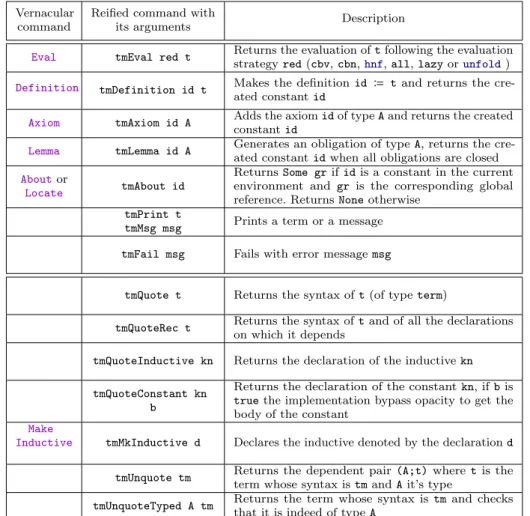
An overview of available commands is given in Table 1.
Vernacular command
Reified command with
its arguments Description
Eval tmEval red t Returns the evaluation of t following the evaluation strategy red (cbv, cbn,hnf, all, lazy orunfold) Definition tmDefinition id t Makes the definition id B t and returns the
cre-ated constant id
Axiom tmAxiom id A Adds the axiom id of type A and returns the created constant id
Lemma tmLemma id A Generates an obligation of type A, returns the cre-ated constant id when all obligations are closed Aboutor
Locate tmAbout id
Returns Some gr if id is a constant in the current environment and gr is the corresponding global reference. Returns None otherwise
tmPrint t
tmMsg msg Prints a term or a message tmFail msg Fails with error message msg
tmQuote t Returns the syntax of t (of type term)
tmQuoteRec t Returns the syntax of t and of all the declarations on which it depends
tmQuoteInductive kn Returns the declaration of the inductive kn tmQuoteConstant kn
b
Returns the declaration of the constant kn, if b is true the implementation bypass opacity to get the body of the constant
Make
Inductive tmMkInductive d Declares the inductive denoted by the declaration d
tmUnquote tm Returns the dependent pair (A;t) where t is the term whose syntax is tm and A it’s type
tmUnquoteTyped A tm Returns the term whose syntax is tm and checks that it is indeed of type A
Table 1 Main Template-Coq commands
A programprogof typeTemplateMonad Acan be executed with the commandRun TemplateProgram prog. This command is thus an interpreter forTemplateMonadprograms. It is implemented in OCaml as a traditional Coq plugin. The term produced by the program is discarded but, and it is the point, a program can have many side effects
like declaring a new definition, declaring a new inductive type or printing something. Typically, we run programs of typeTemplateMonad unit.
Let’s look at some examples. The following program adds two definitionsfoo B 12 andbar B foo + 1to the current context.
Run TemplateProgram (foo ← tmDefinition "foo" 12 ;; tmDefinition "bar" (foo +1)).
The program below asks the user to provide an inhabitant ofnat(here we provide 3 * 3), records it in the lemmafoo, prints its normal form, and records the syntax of its normal form infoo_nf_syntax(hence of typeterm). We use Program’s obligation mechanism3to ask for missing proofs, running the rest of the program when the user finishes providing it. This enables the implementation of interactive plugins.
Run TemplateProgram (foo ← tmLemma "foo" N ;; nf ← tmEval all foo ;;
tmPrint "normal form: " ;; tmPrint nf ;; nf_ ← tmQuote nf ;;
tmDefinition "foo_nf_syntax" nf_). Next Obligation.
exact (3 * 3). Defined.
The basic commands of Template-Coq described in 3.1 are implemented with suchTemplateProgram. For instance:
Definition tmMkDefinition id (tm : term) : TemplateMonad unit B tmBind (tmUnquote tm)
(fun t’ ⇒ tmBind (tmEval all (my_projT2 t’)) (fun t’’ ⇒ tmBind (tmDefinition id t’’) (fun _ ⇒ tmReturn tt))).
4 Writing Coq plugins in Coq
The reification of commands of Coq allows users to write Coq plugins directly inside Coq, without requiring another language like OCaml or an external compilation phase. In this section, we describe three examples of such plugins: (i) a plugin that adds a constructor to an inductive type, (ii) a plugin for extending Coq via syntactic translation as advocated in (Boulier et al.,2017) and (iii) a plugin extracting Coq functions to weak-call-by-value λ-calculus.
4.1 A Toy Example: A Plugin to Add a Constructor
Our first example is a toy example to show the methodology of writing plugins in Template-Coq. Given an inductive typeI, we want to declare a new inductive type I’which corresponds toIplus one more constructor.
For instance, let’s say that we have a syntax for lambda calculus: Inductive tm : Set B
| var : nat → tm | lam : tm → tm | app : tm → tm → tm.
3 In Coq, a proof obligation is a goal which has to be solved to complete a definition.
And that in some part of our development, we want to consider a variation oftmwith a new constructor, e.g. a “let in” constructor. Then we declaretm’with the plugin by: Run TemplateProgram
(add_constructor tm "letin" (fun tm’ ⇒ tm’ → tm’ → tm’)). This command has the same effect as declaring the inductivetm’by hand: Inductive tm’ : Set B
| var’ : nat → tm’ | lam’ : tm’ → tm’
| app’ : tm’ → tm’ → tm’ | letin : tm’ → tm’ → tm’.
but with the benefit that iftmis changed, for instance by annotating the lambda or adding one new constructor, thentm’is automatically changed accordingly. We provide other examples, e.g. with mutual inductives, in the filetest-suite/add_constructor.v. We will see that it is fairly easy to define this plugin using Template-Coq. The main function isadd_constructorwhich takes an inductive typeind(whose type is not necessarilyTypeif it is an inductive family), a nameidcfor the new constructor and the typectorof the new constructor, abstracted with respect to the new inductive. Definition add_constructor {A} (ind : A) (idc : ident) {B} (ctor : B)
: TemplateMonad unit B tm ← tmQuote ind ;;
match tm with
| tInd ind0 _ ⇒
decl ← tmQuoteInductive (inductive_mind ind0) ;;
ctor ← tmQuote ctor ;;
d’ ← tmEval lazy (add_ctor decl ind0 idc ctor) ;;
tmMkInductive d’
| _ ⇒ tmFail "The provided term is not an inductive"
end.
It works in the following way. First the inductive typeindis quoted, the obtained term tmis expected to be atIndconstructor otherwise the function fails. Then the declaration of this inductive is obtained by callingtmQuoteInductive, the constructor is reified too, and an auxiliary function is called to add the constructor to the declaration. After evaluation, the new inductive type is added to the current context withtmMkInductive. It remains to define theadd_ctorauxiliary function to complete the definition of the plugin. It takes amutual_inductive_bodywhich is the declaration of a block of mutual inductive types and returns anothermutual_inductive_body.
Definition add_ctor (mind : mutual_inductive_body) (ind0 : inductive)
(idc : ident) (ctor : term) : mutual_inductive_body B let i0 B inductive_ind ind0 in
{| ind_npars B mind.(ind_npars) ;
ind_bodies B map_i (fun (i : nat) (ind : inductive_body) ⇒ {| ind_name B tsl_ident ind.(ind_name) ;
ind_type B ind.(ind_type) ; ind_kelim B ind.(ind_kelim) ; ind_ctors B
let ctors B map (fun ’(id, t, k) ⇒ (tsl_ident id, t, k)) ind.(ind_ctors) in
if Nat.eqb i i0 then
let n B length mind.(ind_bodies) in let typ B try_remove_n_lambdas n ctor in
ctors ++ [(idc, typ, 0)]
else ctors;
ind_projs B ind.(ind_projs) |}) mind.(ind_bodies) |}.
The declaration of the block of mutual inductive types is a record. The fieldind_bodies contains the list of declarations of each inductive of the block. We see that most of the fields of the records are propagated, except for the names which are translated to add some primes andind_ctors,the list of types of constructors, for which, in the case of the relevant inductive (i0is its number), the new constructor is added.
4.2 The Program Translations Plugin
The following plugin expects a syntactic translation as defined inBoulier et al.(2017). It makes it possible to manipulate translated terms and, ultimately, to justify some logical extensions of Coq by postulating safe axioms. It is implemented in the file translations/translation_utils.v.
Two examples of syntactic translations are presented here: the parametricity trans-lation, and a “times bool” translation (which justifies the negation of functional exten-sionality). A few other examples are available in the directorytranslations.
In all generality, a translation is given by two functions[ ] andJ K from Coq terms to Coq terms such that they enjoy at least computational soundness and typing soundness:
M ≡ N
[M]≡[N]
Γ ` M:A JΓ K `[M] :JAK Given such a translation, the plugin provides four commands: – Translatewhich computes the translation[M]of a term M .
– TranslateRecwhich computes the translation of a term and of all constants on which it depends.
– Implement. This command computes the translationJAxK of a type Ax and asks the user to inhabitJAxK in proof mode. If the user succeeds (but not before), it declares an axiom of type Ax. If the program translation is sound (cf.Boulier et al.(2017)), it ensures that the axiom does not break consistency.
– ImplementExistingwhich is used to provide the translation of some terms by hand. It can be used to “implement” an existing axiom. It is also useful to experiment with translations only partially defined; for instance to provide the translation of a particular inductive type without defining the translation of all inductive types. To work, the plugin needs a translation. It is given by the following record: Class Translation B
{ tsl_id : ident → ident ;
tsl_tm : tsl_context → term → tsl_result term ;
tsl_ty : option (tsl_context → term → tsl_result term) ;
tsl_ind : tsl_context → string → kername → mutual_inductive_body → tsl_result (tsl_table * list mutual_inductive_body) }.
This record is aClassso that, using type classes inference, when a translation is provided, it is automatically found by Coq.
– tsl_identis how identifiers are translated. It will always be(fun id ⇒ id ++ "t") for us.
– tsl_tmis the main translation function implementing[ ]. It takes atermand returns aterm. The translation context contains the global environment and the previously translated constants, see below. The result is in thetsl_resultmonad which is an error monad:
Inductive tsl_error B
| NotEnoughFuel | TranslationNotFound (id : ident) | TranslationNotHandeled | TypingError (t : type_error).
The returned term can be of any type.tsl_tmis used by the commandsTranslate andTranslateRec.
– tsl_tyis the function translating typesJ K . This time, the returned term is expected to be a type. This function is used by the commandsImplementandImplementExisting which are not available whentsl_tyis not provided. This is the case for models which do not translate a type by a type (for instance: the standard model, the setoid model, . . . ).
– Last,tsl_indis the function translating inductive types. It returns:
– an extended translation table with the translations of the inductive type and its constructor;
– a list of inductive declarations which are used in the translation of the inductive type. Generally, an inductive is translated either by itself (in which case the list is empty), or by a new inductive whose constructors are the the translation of the original constructors (in which case the list is of length one).
The second argument oftsl_ind is technical: it is the path to the module in which the new inductives will be declared.
Translation context. In the translation plugin, the constants (definitions, axioms, inductive types and constructors), are translated one by one. They are recorded in a translation table so that the constants are not retranslated each time they appear. This association table is implemented as the list of the translated constants together with their translation.
Definition tsl_table B list (global_reference * term).
Thus, thetConstcase in thetsl_tmfunctio is generally implemented by: | tConst s univs ⇒ lookup_tsl_table table (ConstRef s)
and similarly fortIndandtConstruct.
Some translations that we implemented need to access the global environment in which the considered term makes sense. That’s why we define a translation context to be a global environment and a translation table:
Definition tsl_context B global_context * tsl_table.
4.2.1 Parametricity
Let’s describe the use of the plugin for the parametricity translation. Its implementation can be found intranslations/param_original.v.
The translation that we use here follows Reynolds’parametricity (Reynolds,1983;
Wadler,1989). We follow the already known approaches of parametricity for dependent type theories (Bernardy et al.,2012;Keller and Lasson,2012). We get an alternative
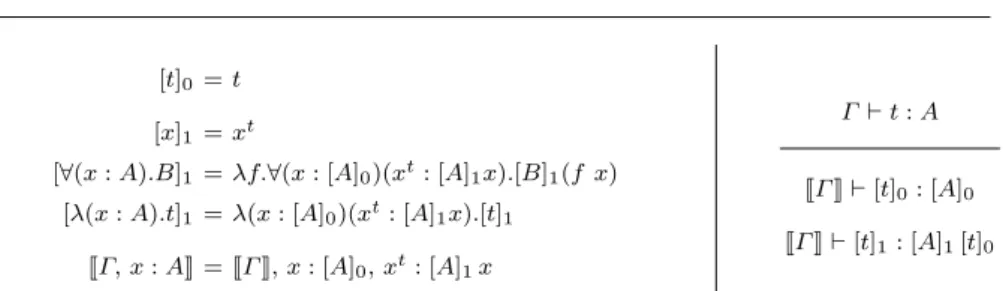
[t]0= t
[x]1= xt
[∀(x : A).B]1= λf.∀(x : [A]0)(xt: [A]1x).[B]1(f x)
[λ(x : A).t]1= λ(x : [A]0)(xt: [A]1x).[t]1
JΓ, x : AK = JΓ K, x : [A]0, x t: [A] 1x Γ ` t : A JΓ K ` [t]0: [A]0 JΓ K ` [t]1: [A]1[t]0
Fig. 3 Unary parametricity translation and soundness theorem, excerpt (fromBernardy et al. (2012))
implementation Lasson’s plugin ParamCoq4. For the moment, only the unary case is implemented. The translation is reminded in Figure 3.
The two components of the translation [ ]0 and[ ]1 are implemented by two
recursive functionstsl param0andtsl param1.
Fixpoint tsl param0 (n : nat) (t : term) {struct t} : term B match t with
| tRel k ⇒ if k >= n then (* global variable *) tRel (2*k-n+1)
else (* local variable *) tRel k
| tProd na A B ⇒ tProd na (tsl param0 n A) (tsl param0 (n+1) B)
| _ ⇒ ...
end.
Fixpoint tsl param1 (E : tsl_table) (t : term) : term B match t with
| tRel k ⇒ tRel (2 * k)
| tSort s ⇒ tLambda (nNamed "A") (tSort s)
(tProd nAnon (tRel 0) (tSort s)) | tProd na A B ⇒
let A0 B tsl param0 0 A in let A1 B tsl param1 E A in let B0 B tsl param0 1 B in let B1 B tsl param1 E B in
tLambda (nNamed "f") (tProd na A0 B0) (tProd na (lift0 1 A0)
(tProd (tsl_name na) (subst_app (lift0 2 A1) [tRel 0])
(subst_app (lift 1 2 B1) [tApp (tRel 2) [tRel 1] ]))) | tConst s univs ⇒ lookup_tsl_table’ E (ConstRef s)
| _ ⇒ ...
end.
In Figure 3, the translation is presented in a named setting. As a consequence, the introduction of new variables does not change references to existing ones and that’s why[ ]0is the identity. In the de Bruijn setting of Template-Coq, the translation
has to take into account the shift induced by the duplication of the context. Therefore, the implementationtsl param0of [ ]0 is no longer the identity. The argumentn of tsl param0represents the de Bruijn level from which the variables have to be duplicated.
There is no need for such an argument in tsl param1, the implementation of [ ]1,
because in this function all variables are duplicated. The implemented cases include pattern matching. Fixed-points are still work in progress.
Given those two functions, we can already translate some terms. For example, the translation of the type of polymorphic identity functions can be obtained by:
Definition ID B ∀ A, A → A.