HAL Id: hal-00707620
https://hal.archives-ouvertes.fr/hal-00707620
Submitted on 17 Jun 2012
HAL is a multi-disciplinary open access
archive for the deposit and dissemination of
sci-entific research documents, whether they are
pub-lished or not. The documents may come from
teaching and research institutions in France or
abroad, or from public or private research centers.
L’archive ouverte pluridisciplinaire HAL, est
destinée au dépôt et à la diffusion de documents
scientifiques de niveau recherche, publiés ou non,
émanant des établissements d’enseignement et de
recherche français ou étrangers, des laboratoires
publics ou privés.
A Goal Driven Approach to Modelling COTS
Acquisition Impacts
Colette Rolland
To cite this version:
Colette Rolland. A Goal Driven Approach to Modelling COTS Acquisition Impacts. Entreprise
Management and Resource Planning Systems, 1999, Italy. pp.1. �hal-00707620�
A goal driven approach to modelling COTS acquisition impacts
C. Rolland
C.R.I., UFR27, University of Paris1 Sorbonne
90, rue de Tolbiac, 75634 PARIS Cedex France [email protected]
Abstract
In this position paper we are concerned by modelling the impact of change due to the integration of COTS (commercial off-the-shelf) systems in an organisation. We advocate a position that suggests a model driven paradigm to reason about change in a goal driven manner. The suggested goal driven approach is sketched and exemplified with the integration of a COTS system in an electricity supply company.
1. Introduction
In the hope of reducing risks and costs associated with software development, organisations that rely on software systems are increasingly shifting from bespoke development to purchasing commercial off-the-shelf (COTS) products. As pointed out in [Finkelstein96], there is little or no systematic support available to guide procurement of COTS systems. Whereas attention being paid to COTS acquisition focuses on considerations such as functional capabilities, interfaces, architectural issues, and interoperability with legacy systems [Feblowitz 99], another important consideration is the impact that the COTS product will have on the actual running of the organisation.
In this position paper, we introduce an approach to guide a systematic construction of an impact model facilitating the reasoning about such an impact. The impact model is goal driven, it helps abstracting from details of business process changes to focus on key change issues and refine them in a step-wise manner to propagate them into business processes. It might include changes in roles and responsibilities of actors making decision on or performing processes. More fundamentally it embeds different possible scenarios for handling change, so that a pay-off analysis can be performed to evaluate the different scenarios for change and determine which is the most suitable one. The overall impact of a COTS acquisition might be small, with the COTS product fitting into the way the organisation currently operates; or the impact may be large, causing radical changes in the way the organisation functions. We believe that such a crucial impact analysis is difficult to perform in the absence of an artefact to reason upon. In the proposed approach the impact model plays this key role.
Our objective is furthermore, to guide the systematic construction of the impact model. The view is that of a
deployment process which determines, step by step, the impact of the forces and requirements for change on the
current functioning (captured in the As-Is model) and models these as change goals in the Impact model. Guidance shall be provided to support this deployment activity and to propagate the change into the business processes and their relationships with components of the COTS product.
The approach is sketched in section 2. In section 3, an example is introduced to illustrate the key steps in constructing the Impact model. Future plan for the development of the approach is introduced in conclusion.
2. The goal-driven approach
2.1 Impact modelling framework
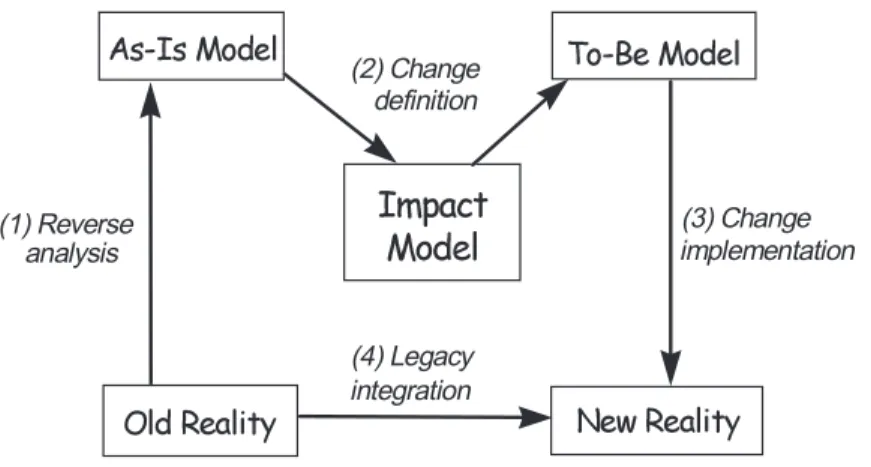
The approach extends the traditional view of change handling as shown in Fig. 1. Whereas the approach recognises the role of the As-Is and To-Be models, it introduces the Impact model. The As-Is model abstracts from the organisation current practice to describe (according to Jackson [Jackson95] ) indicative properties whereas the To-Be model describes optative properties reflecting how the organisation envisions to operate in the future. The process for handling the impact of change is captured in the Impact model. There are many alternative change routes and many models for the future can be envisioned that all comply with the vision for the future captured in the To-Be model. The role of the Impact model is to capture all these alternative scenarios for change. This should help reasoning on the alternative ways to handle the impact of change and to develop a pay-off analysis supporting the selection of the most appropriate scenario for change.
!"#! $%&'( )%"*' $%&'( +(& ,'-(./0 1'2 ,'-(./0 (1) Reverse analysis (2) Change definition (3) Change implementation (4) Legacy integration
!"#$%
&'()*
Figure 1 :The impact modelling framework
In this paper we focus on the change definition process, that is the process for constructing the Impact model that describes the alternative scenarios for changing the way an organisation operates in order to comply with the integration of a COTS product.
2.2 Impact definition process
Change is usually a response to some significant threat or opportunity arising outside the organisation. We shall refer to the cause of change as the contextual force for change. COTS products, as available software components may be looked upon as an opportunity to reduce costs and risks in system development and therefore may constitute an external contextual force of change for organisations. In other situations, a COTS product may be an opportunity to handle a more general cause of change. For example, in the Electricity Supply Industry (ESI) sector the deregulation rules imposed by the EU are external contextual forces that may lead to envision the acquisition of a COTS product which, in turn will generate its own requirements for changing the organisation.
The process for defining the impact of change (the impact definition process) is therefore a process controlled by the contextual forces of change and the requirements for change (the To-Be model), having the As-Is model as input and the Impact model as its output. This is illustrated in Fig. 2.
!"#$% &'()*)%)+* !"#! $%&'( )%*+',+-.( /%01'! 2'3-40'5'*+! 67%"8'9 #5:.1+ $%&'( input output
Figure 2 : The impact definition process 2.3 Goal driven modelling
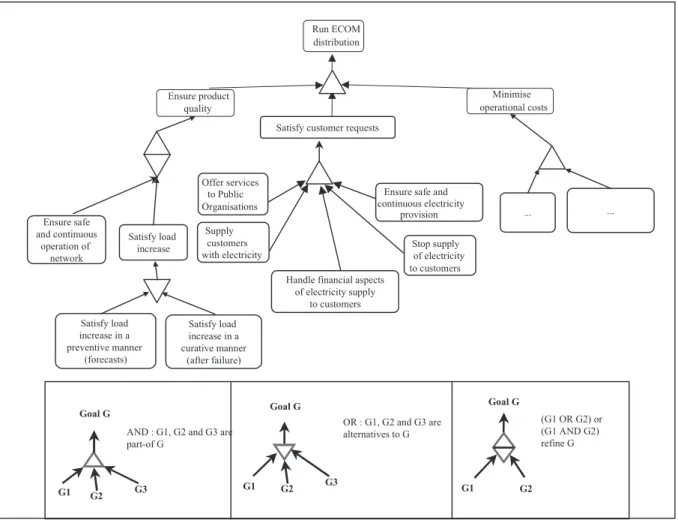
The approach advocates that all the models being involved in the impact definition process should be expressed at the intentional level, as goal hierarchies. As an illustration Fig. 3. presents an excerpt of the As-Is model of the ECOM company that we shall consider as an example in the next section. A goal is an objective that the company wants to achieve. It is usually formulated as a verb followed by some parameters. For example, in the goal statement ‘satisfy customer requests’, satisfy is the verb and customer requests is the object parameter. Goals are organised hierarchically from high level goals (the top levels of the hierarchy ) down to operationalised goals (the leaves of the hierarchy). An operationalised goal is implemented in a business process
whereas a non operationalised one expresses an intention that needs refinement in order to be related to operational processes. Refinement is done through OR, AND and AND/OR connectors (see notations in Fig. 3.). The former express exclusive choices whereas the latter refer to non exclusive ones. ANDed goals are complementary goals which are sub-goals of a given one. For example, the top level goal ‘Run ECOM
distribution” is decomposed in three sub-goals ‘Satisfy customer requests’, ’Ensure product quality’ and ’ Minimise operational costs’ whereas ‘Satisfy load increase in a prescriptive manner (forecast)’ and ‘Satisfy load increase in a curative manner (after failure)’ represent alternative choices to achieve ‘Satisfy load increase’.
Run ECOM distribution
Ensure product Minimise
operational costs quality
Satisfy customer requests
Offer services to Public Organisations Supply customers with electricity
Handle financial aspects of electricity supply
to customers
Ensure safe and continuous electricity provision Satisfy load increase Ensure safe and continuous operation of network Stop supply to customers of electricity ... ... Satisfy load increase in a curative manner (after failure) Satisfy load increase in a preventive manner (forecasts) Goal G G1 G2 G3
AND : G1, G2 and G3 are part-of G Goal G G1 G2 G3 OR : G1, G2 and G3 are alternatives to G Goal G G1 G2 (G1 OR G2) or (G1 AND G2) refine G
Figure 3 : Excerpt of the ECOM As-Is model
The goal driven approach to model both the impact definition process and the parameters which influence the change definition (i.e. the As-Is model, the contextual forces and the requirements for change, the To-Be model) allows to abstract from details of business processes to concentrate on more key issues. As a consequence, the reasoning about change can be dealt with progressively, at the intentional, objective level first and then, propagated down to the business process level.
2.4 Modelling the impact definition process through goal deployment
We propose to model the COTS impact using a goal deployment strategy that consists in generating the Impact model by studying the impacts of the contextual forces on the organisation current goals (the As-Is model). The impact analysis is performed step by step, descending the hierarchy of current goals. The impact goals are generated as the result of this impact analysis. Each impact goal may express either the improvement or revision of current goals or new goals directly or indirectly dependent of the COTS integration. We will see that this distinction is captured in a taxonomy of impact types. The process is organised as follows:
For each goal G in the current goal hierarchy and its immediate sub-goals SGi
For each contextual force CF
1) Deploy (G, SGi) with regards to CF in compliance with requirements
For each sub-goal SGi
1.1. Determine impact of CF on SGi
1.1.1. Define the corresponding impact goal Ci and introduce it in the Impact Model (IM) 1.1.2. Envision alternative scenario Cij for Ciand introduce them in the IM
1.2. Envision complementary goals Ckand introduce them in the IM 1.3. Envision alternative goals Ca and introduce in the IM
2) Develop goals Ck and Cain accordance with requirements for change
As it can be seen in this description (see the two external For each loops) the goal deployment process is iterative. Each iteration is composed of two main steps that consist in deploying the current goals (step 1: Deploy (G, SGi) with regards to CF) and then, developing the newly introduced goals (step 2: Develop goals Ck and Ca). Both shall be performed in compliance with the stated requirements for change.
Step 1.1.1 consists in determining the impact of the contextual force F on each SGi leading to impact goals in the Impact model. To support this step we are defining a taxonomy of impact types. Currently, we propose the following ones : introduce, adapt, replace, improve, cease, maintain and extend.
When all impact goals corresponding to the possible impacts have been introduced in the hierarchy, step 1.1.2 identifies alternative scenarios (goals) for these.
Step 1.2 consists in introducing new complementary goals Ck which could be necessary to comply with the impact goal C and might fit the requirements for change.
Step 1.3 consists in envisioning alternative goals Ca of C and introducing them in the hierarchy.
Finally, in step 2, all new impact goals which have been introduced during the deployment activity must be developed in detail.
We illustrate this process in a case of COTS integration in an Electricity Supply & Distribution company, ECOM, that must comply with the EU deregulation rules.
3. Illustration of the goal driven approach
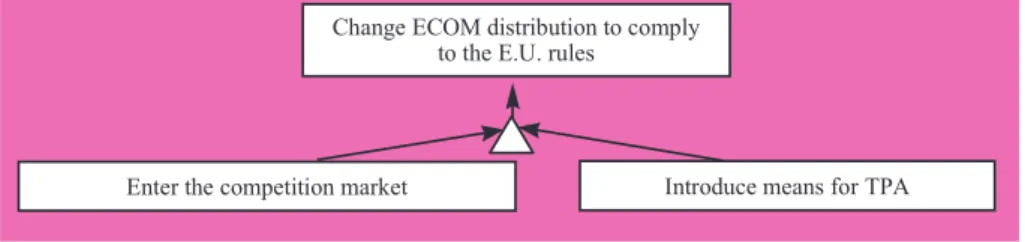
The case we consider in this paper is fictitious but inspired by a real situation. The company named ECOM faces the pressure for change due to the deregulation rules imposed by the EU. The contextual force for change is therefore external, and affects the entire company. However we restrict ourselves to the Distribution sector considering the contextual force ‘Change ECOM distribution to comply to the EU rules’. These rules require all European electricity utilities to enter the competition market and allow access to their network to third parties (Third Party Access - TPA). These are two sub-goals of the top contextual force expressed in the goal hierarchy of Fig. 4.
Change ECOM distribution to comply to the E.U. rules
Enter the competition market Introduce means for TPA
Figure 4 : Contextual forces for the ECOM company
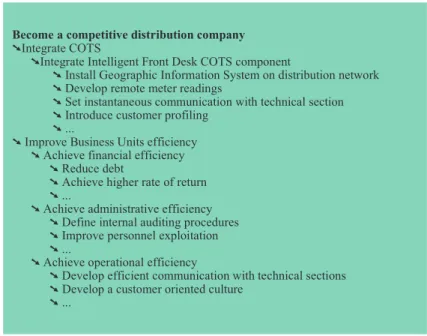
Managers are conscious of the radical change in the company culture that will have to occur to adapt the utility to a customer servicing company. They have made the decision to buy a COTS product to support customer servicing. The product provides an Intelligent Front Desk (IDF) component that we consider here. The IFD supports commercial employees to satisfy directly all customer requests for electricity connection and disconnection, that do not require technical experts. If an expert is required, the request is handled in a classic manner. For its proper functioning, the IFD requires information related to the current state of the distribution network, remote meter reading, instantaneous communication with the technical sections, etc.. These are requirements for change imposed by the COTS product installation that are parts of the requirements list presented in Fig. 5.
Besides, there are complementary requirements for change to those imposed by the COTS product installation that correspond to other aspects of the Distribution sector that are not covered by the IFD and
require changes. In Fig. 5. these are structured around administrative, financial and operational efficiency and presented in a hierarchical manner.
Become a competitive distribution company
➘Integrate COTS
➘Integrate Intelligent Front Desk COTS component
➘ Install Geographic Information System on distribution network ➘ Develop remote meter readings
➘ Set instantaneous communication with technical section ➘ Introduce customer profiling
➘ ...
➘ Improve Business Units efficiency ➘ Achieve financial efficiency
➘ Reduce debt
➘ Achieve higher rate of return ➘ ...
➘ Achieve administrative efficiency ➘ Define internal auditing procedures ➘ Improve personnel exploitation ➘ ...
➘ Achieve operational efficiency
➘ Develop efficient communication with technical sections ➘ Develop a customer oriented culture
➘ ...
Figure 5 : ECOM Requirements for change
In the following we illustrate some of the steps of the goal deployment process.
Fig. 6. illustrates the deployment mechanism (step 1.1) considering the impact of the contextual force “Enter the
competition market” on the current goal “Satisfy customer request” and taking the requirement “Integrate Intelligent Front Desk COTS component” into account. The immediate impact of the contextual force is the
distinction between non eligible customers and eligible customers. The former remain captive to ECOM whereas the latter are free to chose their electricity distributor. This leads to introduce in the Impact model two ANDed goals to deal with non eligible and eligible customers, respectively. “ Serve efficiently non eligible customers ” is of the type IMPROVE and “ Introduce new means to serve efficiently eligible customers ” is of the type
INTRODUCE.
Special efforts must be made for attracting eligible customers, otherwise they may join a rival company. It was felt that the IDF component is an appropriate means to handle this class of customers. Thus, in the Impact model the goal “ Introduce new means to serve efficiently eligible customers ” is refined into “Introduce Intelligent Front
Desk to serve eligible customers”. Vice versa, the decision was to keep a choice in the matter of serving non
eligible customers. The choice is reflected in the impact model by introduced three ORed goals to refine the goal “ Serve efficiently non eligible customers ” , namely “ Introduce IFD for serving efficiently non eligible
customers in one shot” , “ Introduce IFD for serving efficiently non eligible customers progressively” and “ Improve current practices for serving efficiently non eligible customers”. Indeed, there are arguments in favour
of the solution to keeping (with some improvement) at least for some time, the traditional way of serving non eligible customers: they are used to a certain practice, change is not in the country’s culture, postponing the immediate switch to the IFD way-of-working reduces the risk of COTS component installation problems and gives the opportunity to handle changes for the two classes of customers in a smoother manner. Fig. 6 reflects the decision to leave the three scenarios for change open for some more time and further evaluation analysis.
The goal deployment approach
- Reflect CF on CS - Elicit impact goals
Reorganise the ECOM distribution to comply with the EU rules
Serve efficiently non eligible customers
INTRODUCE IMPROVE
Introduce new means to serve efficiently eligible customers Change ECOM distribution to comply
to the E.U. rules
Enter the competition market Introduce means for TPA
Run ECOM distribution
Satisfy customer requests
Ensure product quality Minimise operational costs Become a competitive distribution company ➘Integrate COTS ➘Integrate Intelligent Front Desk COTS component
➘... ➘ ...
INTRODUCE Introduce IFD to serve
eligible customers Improve current practices
for serving efficiently non eligible customers
IMPROVE Introduce IFD for serving efficiently non
eligible customers in one shot INTRODUCE
Introduce IFD for serving efficiently non eligible customers progressively
INTRODUCE
Figure 6 : Illustrating step 1.1
Step 1.2 in the deployment process is meant to draw the attention of the change engineer to the indirect impacts by opposition to the direct impacts generated by the contextual forces. We suggest to look to those as ANDed goals to the impact goals introduced in step 1.1 in the Impact model. Fig. 7 illustrates this with the introduction of the goal “Introduce a customer oriented culture” ANDed to “ Serve efficiently non eligible customers” and “ Introduce
new means to serve efficiently eligible customers”.
Indeed the introduction of the IFD component requires to train the personnel towards a completely different attitude of customer servicing and this shall be extended at least progressively to all employees of the company.
T h e go a l d e plo y m e n t a p p ro a ch D ev e lo p C Gi ty p e d
« In tro d u ce »
B ec o m e a co m p e titiv e d istrib u tion c o m p a n y ➘ I n te g ra te C O T S
➘ I n te g ra te In te llig e n t F ro n t D e s k C O T S ➘ ...
➘ S e t in s t a n ta n e o u s c o m m u n ic a t io n w ith tec h n ic a l sec tio n ➘ I n tr o d u c e c u s to m e r p r o filin g ➘ ... ➘ ... ➘ Im p ro v e B us in e s s U n its e ff ic ie n c y ➘ ... ➘ A c h ie v e o p e r a tio n a l e ff ic ie n c y ➘ D e v e lo p a c u s to m e r o r ie n t e d c u ltu r e ➘ ... In tro d u ce o n e p o in t c o n ta c t p ro c ed u re IN T R O D U C E In tro d u ce th e fo llow in g - u p o f c u sto m er p ro filin g IN T R O D U C E E x te n d c urre n t L iaiso n p ro ce d u re s to se t in sta n tan e o u s c o m m u n ic a tio n E X T E N D
In tro d u ce c u sto m er p ro filin g fo r the in v estig a tio n of n e w cu stom e r ne e d s
IN T R O D U C E
R eo rg an ise th e E C O M d istrib u tio n to co m p ly w ith th e E U ru le s
IM P R O V E S erv e effic ie n tly n o n elig ib le cu stom e rs
In tro d u ce a c u sto m er o rie n ted cu ltu re
IN T R O D U C E
Figure 7 : Illustrating step 1.2 and step 2
Any impact goal of the type INTRODUCE needs refinement. This is captured in the deployment process in step 2. Fig. 7 illustrates the point with the impact goal “Introduce a customer oriented culture” and its deployment into four AND/ORed goals : “Extend current liaison procedures to set instantaneous communication”,
“Introduce customer profiling for the investigation of new needs”, “Introduce the following-up of customer
profiling” and “Introduce one point contact procedure”. The three first are direct consequences of the IFD
introduction : the IFD requires an instantaneous communication with the technical section and it provides means for customer profiling. Finally, the organisation felt that the last impact goal was required to succeed in radically changing the impersonal and bureaucratic way ECOM treats its customers today.
Finally, in order to illustrate the iterativeness of the impact model construction, let us comment the impact of the contextual forces and requirements onto the second level of goals considering the sub-goals of “Satisfy customer
requests” of the As-Is model. The corresponding part of the Impact model is presented in Fig. 8 and described
below.
In its current operation, ECOM provides services to other Public organisations and decides that it will cease to “Offer services to Public Organisations” whereas ECOM will maintain the goal (and corresponding processes) to “Ensure the safe and continuous provision of electricity’. First, because the current practice for managing the distribution network are judged satisfactory and secondly, because the COTS component has no impact on this goal .
However, the way ECOM “Supply customers with electricity” will change as connections will be performed on-line. This leads to replace the current goal by “Supply electricity via IFD”. Similarly, disconnection will be performed on-line via the IFD, thus leading to the impact goal “Disconnect customer via IFD” (REPLACE mode). Furthermore, the IFD component needs on-line information about the current state of the distribution network. This leads to introduce the goal “Introduce Geographic Information System (GIS)” in the impact model.
In addition, the introduction of the IFD component implies changes in (a) the way customer electricity consumption is measured as remote meter reading becomes mandatory and consequently (b) the way billing is done. This leads to replace the current goal “Handle financial aspects of electricity supply to customers” by “Automate financial aspects for electricity supply “ (type ADAPT) which is further decomposed in “Perform
remote meter reading” (type REPLACE) and “Extend billing module to collect remote meter readings” (type
EXTEND).
Run ECOM distribution
Ensure product quality
Minimise operational costs
The goal deployment approach
Cease services offered to Public Organisations
CEASE
ADAPT
EXTEND Automate the financial
aspects for electricity supply
Extend the billing module to collect remote meter
readings Introduce IFD for serving
efficiently non eligible customers
INTRODUCE
Satisfy customer requests
Offer services to Public Organisations Supply customers with electricity
Handle financial aspects of electricity supply
to customers
Ensure safe and continuous electricity provision Collect data on customer consumption Bill customer consumption ... Stop supply to customers of electricity REPLACE Supply electricity via
IFD
REPLACE
Disconnect customer via IFD
INTRODUCE Introduce
GIS Ensure the safe and continuous provision of
electricity MAINTAIN
REPLACE Replace manual meter
reading by remote meter reading
Figure 8 : Illustrating the iterative dimension of the process
The iterative process described in section 2 proceeds similarly to the illustration above, in a top down manner, for every goal of the As-Is model with its immediate sub-goals until the leaves of hierarchy are reached. In this way, the impacts of the COTS product introduction on the current operation of the organisation is systematically studied and expressed in the impact model.
4. Conclusion
The motivation for this work is the importance of the impact that a COTS product will have on the actual functioning of an organisation. Our concern is to define a systematic way of constructing a model showing explicitly the impact of the COTS product integration. The impact model shall help reasoning about the different alternative ways to handle the changes that this integration implies and select the most appropriate one. The goal driven approach introduced in this paper is a first step toward meeting this objective. There are a number of points that require further refinement and study :
1- the approach was illustrated at the goal level whereas it should include the propagation of impact onto the current processes,
2- the impact model shall be organised in layers. This shall help reasoning separately on strategic, tactical and operational goals,
3- goal graphs shall be extended to integrate actor dependencies, roles and responsibilities as impact shall be evaluated in these terms also,
4- guidance to accompany goal deployment must be developed, and finally
5- effort to identify generic and situated impacts shall lead to a library of impact patterns These are the perspectives of our future work.
5. References
[Feblowitz 99] : Feblowitz M., Greenspan S. Reubenstien H. Walford R., ACME/PRIME : Requirements acquisition for process-driven systems. In : Proc. Of the 8th International workshop on Software Specification and Design, IEEE Computer Society Press, Washington, DC, 1996, pp 36-45.
[Finkelstein96] : Finkelstein A., Spanoudakis G. Ryan M., Software package requirements and procurement. In : Proc. Of the 8th International workshop on Software Specification and Design, IEEE Computer Society Press, Washington, DC, 1996, pp 141-145.
[Jackson95] : JACKSON, M. (1995) Software requirements and specifications - A lexicon of practice, principles and prejudices. Addison Wesley Press, 1995.