HAL Id: hal-01108553
https://hal.inria.fr/hal-01108553
Submitted on 23 Jan 2015
HAL is a multi-disciplinary open access
archive for the deposit and dissemination of
sci-entific research documents, whether they are
pub-lished or not. The documents may come from
teaching and research institutions in France or
abroad, or from public or private research centers.
L’archive ouverte pluridisciplinaire HAL, est
destinée au dépôt et à la diffusion de documents
scientifiques de niveau recherche, publiés ou non,
émanant des établissements d’enseignement et de
recherche français ou étrangers, des laboratoires
publics ou privés.
How Test Generation Helps Software Specification and
Deductive Verification in Frama-C
Guillaume Petiot, Nikolai Kosmatov, Alain Giorgetti, Jacques Julliand
To cite this version:
Guillaume Petiot, Nikolai Kosmatov, Alain Giorgetti, Jacques Julliand. How Test Generation Helps
Software Specification and Deductive Verification in Frama-C. Tests and Proofs, Jul 2014, York, United
Kingdom. pp.204 - 211, �10.1007/978-3-319-09099-3_16�. �hal-01108553�
How Test Generation Helps Software Specification and
Deductive Verification in Frama-C
⋆Guillaume Petiot1,2, Nikolai Kosmatov1
, Alain Giorgetti2,3, and Jacques Julliand2
1
CEA, LIST, Software Reliability Laboratory, PC 174, 91191 Gif-sur-Yvette France [email protected]
2
FEMTO-ST/DISC, University of Franche-Comt´e, 25030 Besanc¸on Cedex France [email protected]
3
INRIA Nancy - Grand Est, CASSIS project, 54600 Villers-l`es-Nancy France
Abstract. This paper describes an incremental methodology of deductive verifi-cation assisted by test generation and illustrates its benefits by a set of frequent verification scenarios. We present STADY, a new integration of the concolic test generator PATHCRAWLERwithin the software analysis platform FRAMA-C. This new plugin treats a complete formal specification of a C program during test gen-eration and provides the validation engineer with a helpful feedback at all stages of the specification and verification tasks.
Keywords:static analysis, test generation, specification, Frama-C, deductive ver-ification
1
Introduction
Validation of critical systems can be realized using various verification methods based on static analysis, dynamic analysis or their combinations. Static analysis is performed on the source code without executing the program, whereas dynamic analysis is based on the program execution. Both are complementary and can be advantageously com-bined [10, 3, 14, 6, 7, 5, 18].
Among static techniques, formal deductive verification allows to establish a rig-orous, mathematical proof that a given annotated program respects its specification. The modular verification approach requires a formal specification (contract) for each function describing its admissible inputs and expected results. Modern theorem prov-ing tools can automatically establish many proofs of correctness, but achievprov-ing a fully successful proof in practice needs a lot of tedious work and manual analysis of proof failures by the validation engineers. Klein [15] estimates that the cost of one line of for-mally verified code is about $700. This high cost is explained by the great difficulty of understanding why a proof fails, and of writing correct and sufficiently complete speci-fications suitable for automatic proof of contracts for which loop variants and invariants can be required.
The main motivation of this methodology and tool paper is to study how automatic test generation can help to write a correct formal specification and to achieve its deduc-tive verification. The contributions of this paper include:
⋆The research leading to these results has received funding from the ARTEMIS Joint
– a brief presentation (in Sec. 2) of a combined STAtic/DYnamic tool named STADY. Within the software analysis framework FRAMA-C [11], this tool fills the gap be-tween deductive verification and test generation and allows to treat a complete formal specification (including pre-/postconditions, assertions, loop invariants and variants) during test generation with PATHCRAWLER[4];
– a methodology of iterative deductive verification taking advantage of feedbacks provided by test generation (in Sec. 3). Its benefits are illustrated on a set of frequent verification scenarios;
– a summary of experiments showing STADY’s bug detection power (in Sec. 3.4).
2
S
TAD
YTool Overview
The STADYtool integrates the concolic test generator PATHCRAWLER[4] into the
soft-ware analysis framework FRAMA-C [11], and in particular allows the user to combine
it with the deductive verification plugin WP[11].
FRAMA-C [11] is a platform dedicated to analysis of C programs that includes various source code analyzers as separate plugins such as WP performing weakest-precondition calculus for deductive verification, VALUEperforming value analysis by
abstract interpretation, etc. FRAMA-C supportsACSL(ANSI C Specification Language)
[2, 11], a behavioral specification language allowing to express properties over C pro-grams. Moreover,ACSLannotations play a central role in communication between plu-gins: any analyzer can add annotations to be verified by other ones and notify other plugins about results of the analysis it performed by changing an annotation status. The status can indicate that the annotation is valid, valid under conditions, invalid or undetermined, and which analyzer established this result [9].
For combinations with dynamic analysis, we consider the executable subset ofACSL
named E-ACSL [12, 19]. E-ACSL can express function contracts (pre/postconditions, guarded behaviors, completeness and disjointness of behaviors), assertions and loop contracts (variants and invariants). It supports quantifications over bounded intervals of integers, mathematical integers and memory-related constructs (e.g. on validity and initialization).
PATHCRAWLER [4] is a structural (also known as concolic) test generator for C programs, combining concrete and symbolic execution. PATHCRAWLERis based on a specific constraint solver, COLIBRI, that implements advanced features such as floating-point and modular integer arithmetics support. PATHCRAWLERprovides coverage strate-gies like k-paths (feasible paths with at most k consecutive loop iterations) and all-paths (all feasible paths without any limitation on loop iterations). PATHCRAWLERis sound, meaning that each test case activates the test objective for which it was generated. This is verified by concrete execution. PATHCRAWLER is also complete in the following sense: when the tool manages to explore all feasible paths of the program, all features of the program are supported by the tool and constraint solving terminates for all paths, the absence of a test for some test objective means that this test objective is infeasible, since the tool does not approximate path constraints [4, Sec. 3.1].
Given a C program annotated in the executable specification languageE-ACSL[11], STADYfirst translates its specification into executable C code, instruments the program
for error detection, runs PATHCRAWLER to generate tests for the instrumented code, and finally returns the results to FRAMA-C. To detect errors, the translation generates additional branches, enforcing test generation to trigger erroneous cases, and thus to generate inputs activating the error if such inputs exist. In this way, STADYtreats and triggers errors in assertions, postconditions, loop invariants and variants, and also in pre- and postconditions of called functions (also called callees). PATHCRAWLER
be-ing complete, whenever test generation terminates without findbe-ing any error after an exhaustive “all-path” coverage, we are sure that the translatedE-ACSLproperties hold.
If the coverage is only partial but no error occurred, the test generation increases the confidence that the program respects its specification but cannot guarantee it. However, errors can be found and used to invalidate the annotations in FRAMA-C even when the coverage is incomplete.
STADYcurrently supports most ACSL clauses. Quantified predicates \existsand \foralland builtin terms as\sumor\numofare translated as loops. Logic functions and
named predicates are handled, however recursivity is currently not supported.\old
con-structs are treated by saving the value of the formal parameters of a function. Validity checks of pointers are partially supported due to the current limitation of the underlying test generator: we can only check the validity when a base address is an input pointer.
assert,assumes,behavior,ensures,loop invariant,loop variantandrequiresclauses are
supported as well.assignsclauses and complex constructs like inductive predicates are
not handled yet and are part of our future work.
3
Verification Scenarios Combining Proof and Testing
During specification and deductive verification, test generation can automatically pro-vide the validation engineer with a fast and helpful feedback facilitating the verification task. While specifying a program, test generation may find a counter-example show-ing that the current specification does not hold for the current code. It can be used at early stages of specification, even when formal verification has no chances to succeed yet (e.g. when loop annotations, assertions or callees’ contracts are not yet written). In case of a proof failure for a specified program property during program proof, when the validation engineer has no other alternative than manually analyzing the reasons of the failure, test generation can be particularly useful. The absence of counter-examples after a rigorous partial (or, when possible, complete) exploration of program paths provides additional confidence in (resp., guarantee of) correctness of the program with respect to its current specification. This feedback may encourage the engineer to think that the failure is due to a missing or insufficiently strong annotation (loop invariant, assertion, called function contract etc.) rather than to an error, and to write such additional anno-tations. On the contrary, a counter-example immediately shows that the program does not meet its current specification, and prevents the waste of time of writing additional annotations. Moreover, the concrete test inputs and activated program path reported by the testing tool precisely indicate the erroneous situation. Notice that the objective is certainly not to fit the specification to (potentially erroneous) code, but to help the validation engineer to identify the problem (in the specification or in the code)with a counter-example. Let us illustrate these points on concrete verification scenarios.
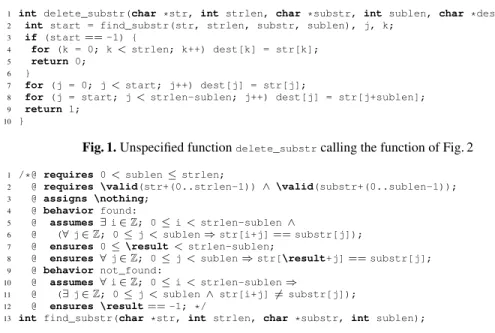
1 int delete_substr(char *str, int strlen, char *substr, int sublen, char *dest) {
2 int start = find_substr(str, strlen, substr, sublen), j, k;
3 if (start == -1) {
4 for (k = 0; k < strlen; k++) dest[k] = str[k];
5 return 0;
6 }
7 for (j = 0; j < start; j++) dest[j] = str[j];
8 for (j = start; j < strlen-sublen; j++) dest[j] = str[j+sublen];
9 return 1;
10 }
Fig. 1.Unspecified functiondelete_substrcalling the function of Fig. 2
1 /*@ requires 0 < sublen ≤ strlen;
2 @ requires \valid(str+(0..strlen-1)) ∧ \valid(substr+(0..sublen-1));
3 @ assigns \nothing;
4 @ behavior found:
5 @ assumes∃ i ∈ Z; 0 ≤ i < strlen-sublen ∧
6 @ (∀ j ∈ Z; 0 ≤ j < sublen ⇒ str[i+j] == substr[j]);
7 @ ensures 0≤ \result < strlen-sublen;
8 @ ensures∀ j ∈ Z; 0 ≤ j < sublen ⇒ str[\result+j] == substr[j];
9 @ behavior not_found:
10 @ assumes∀ i ∈ Z; 0 ≤ i < strlen-sublen ⇒
11 @ (∃ j ∈ Z; 0 ≤ j < sublen ∧ str[i+j] 6= substr[j]);
12 @ ensures \result == -1; */
13 int find_substr(char *str, int strlen, char *substr, int sublen);
Fig. 2.Verified functionfind_substrwith a “pretty-printed”E-ACSLcontract
Suppose Alice is a skilled validation engineer in charge of specification and deduc-tive verification of the functiondelete_substr(Fig. 1). We follow Alice throughout her
validation process. Thedelete_substrfunction is supposed to delete one occurrence of
a substringsubstrof lengthsublenfrom another stringstrof lengthstrlenand to put
the result intodest(pre-allocated for strlencharacters), whilestrandsubstrshould
not be modified. For simplicity, we use arrays rather than usual zero-terminated strings. Thedelete_substrfunction returns 1 if an occurrence of the substring was found and
deleted, and 0 otherwise. We assume Alice has already successfully proved the correct-ness offind_substr(Fig. 2) supposed to return the index of an occurrence ofsubstrin strif this substring is present, and −1 otherwise.
Alice first writes the following precondition (added before line 1 of Fig. 1):
requires 0 < sublen≤ strlen;
requires \valid(str+(0..strlen-1)); requires \valid(dest+(0..strlen-1)); requires \valid(substr+(0..sublen-1));
requires \separated(dest+(0..strlen-1), substr+(0..sublen-1)); requires \separated(dest+(0..strlen-1), str+(0..strlen-1));
typically strlen≤ 5;
We propose here the new clausetypically C;that extendsE-ACSLand defines the pre-conditionConly for test generation. It allows Alice to strengthen the precondition if she
desires to restrict the (potentially too big) number of paths to be explored by test gen-eration to user-controlled partial coverage. Here the clausetypically strlen ≤5asks to
cover all feasible paths wherestris of length5or less. Ignored by deductive
verifica-tion, this clause does not impact the proof. The extension ofACSLwith thetypically
keyword is an experimental feature, not available in the distributed version of FRAMA -C.
3.1 Early Validation
Now Alice specifies that the function can assign only the array dest, and defines the
postcondition for the case when the substring does not occur in the string. She adds the following (erroneous) clauses into the contract after the precondition defined above:
assigns dest[0..strlen-1]; behavior not_present:
assumes !(∃ i ∈ Z; 0 ≤ i < strlen-sublen ∧
(∀ j ∈ Z; 0 ≤ j < sublen ⇒ str[i+j] 6= substr[j]));
ensures ∀ k ∈ Z; 0 ≤ k < strlen ⇒ \old(str[k]) == dest[k];
ensures \result == 0;
To validate it before going further, Alice applies STADY. It runs test generation and reports that both ensures clauses are invalidated by the counter-examplestrlen = 2, sublen = 1,str[0] = ’A’,str[1] = ’B’,substr[0] = ’A’,dest[0] = ’B’and\result = 0.
Alice sees that in this case the stringsubstrhas to be found in the string strand the
behaviornot_presentshould not apply, so its assumesclause must be erroneous. This
helps Alice to correct the assumption by replacing6=with==, to get:
assumes !(∃ i ∈ Z; 0 ≤ i < strlen-sublen ∧
(∀ j ∈ Z; 0 ≤ j < sublen ⇒ str[i+j] == substr[j]));
Running STADYagain reports that all feasible paths withstrlen ≤5have been covered
(within 3.4 sec.) and 9442 test cases have been successfully generated and executed. Alice is now pretty confident that this behavior is correctly defined.
For the complementary case Alice copy-pastes thenot_presentbehavior and (wrongly)
modifies it into the following behavior:
behavior present:
assumes ∃ i ∈ Z; 0 ≤ i < strlen-sublen ∧
(∀ j ∈ Z; 0 ≤ j < sublen ⇒ str[i+j] == substr[j]);
ensures ∃ i ∈ Z; 0 ≤ i < strlen-sublen ∧
(∀ j ∈ Z; 0 ≤ j < sublen ⇒ \old(str[i+j]) == \old(substr[j])) ∧ (∀ k ∈ Z; 0 ≤ k < i ⇒ \old(str[k]) == dest[k]) ∧
(∀ l ∈ Z; i ≤ l < strlen ⇒ \old(str[l+sublen]) == dest[l]);
ensures \result == 1;
Again, Alice runs STADY. The tool reports an out-of-bounds error in accessing the
element ofstrat indexl+sublenin the lastensures. This helps Alice to understand that
the upper bound of index lshould be strlen-subleninstead of strlen. She fixes this
error and re-runs STADY. Test generation reports that 13448 test cases cover without errors the feasible paths forstrlen ≤5. Alice is now satisfied with the defined behaviors.
Notice that these cases exhibit errors in the specification. In other cases errors could be in the program (cf Sec. 3.4).
3.2 Incremental Loop Validation
Alice now specifies as follows the first for-loop at line 4 in Fig. 1:
loop invariant ∀ m ∈ Z; 0 ≤ m < k ⇒ dest[m] == \at(str[m],Pre);
loop assigns k, dest[0..strlen-1]; loop variant strlen-k;
Then Alice runs WP. The deductive verification tool cannot validate the postcondition ofdelete_substr, in particular because the other two loops are not yet specified.
How-ever, WPcould validate the annotations of the first loop. Here it fails, and Alice does not know whether it is because the loop specification is already incorrect, or because it is not complete enough to be verified. She runs STADY, which does not find any error in the loop specification and the postcondition, after 15635 test cases. Alice now be-lieves that loop specification is valid but incomplete. This confidence helps her to add an additional invariant
loop invariant 0≤ k < strlen;
defining the bounds for k. Alice tries again to prove the loop, and WP fails again. She runs STADYand this time the new loop invariant is invalidated. After analyzing the
failure on a simple counter-example, Alice understands that the loop invariantk <strlen
is not correct. Indeed,kis equal tostrlenafter the last iteration, so the loop invariant
should sayk ≤strlen. After fixing this error, WPsucceeds to prove the loop annotations. Similarly, Alice iteratively specifies and verifies the other two loops.
The now completely specified functiondelete_substrcan be fully proved by WP. However its default timeout (10 seconds per property) has to be significantly extended (e.g. to 50 seconds per property). The fact that test generation achieves (within only 4 sec.!) a significant partial coverage (restricted by thetypicallyclause for testing) and
finds no error convinces Alice to increase the timeout, that could be a waste of time when a counter-example can show why the program does not respect the specification. 3.3 Adaptation of Callees’ Contracts for Modular Verification
It often happens that the contract of a called function is fully proved, but is too weak to prove the caller. For instance assume that the clause at line 7 of Fig. 2 is missing. Running WPon the whole program, Alice sees thatfind_substris totally proved, but
the postcondition and loop annotations ofdelete_substrare not proved. Since test
gen-eration does not find any counter-example, Alice believes that some necessary clause is too weak or missing. Moreover, all properties depending on the behaviornot_found
being fully proved, Alice reasonably suspects that thefoundbehavior offind_substris
not strong enough.
3.4 Detecting Errors in Source Code
Counter-examples generated by STADYcan also help to detect potential errors in the code. To evaluate its bug detection ability, we specified inE-ACSL26 programs mostly taken from the TACAS 2014 Competition, generated 1088 mutants (that mimic frequent programming errors) and applied STADYto detect errors in them. TheE-ACSLcontract in mutants was not changed. 96.68% of non equivalent mutants have been successfully reported as buggy.
4
Conclusion and Future Work
We showed by a number of selected verification scenarios how automatic test generation provides a useful feedback that helps the validation engineer to test the conformance of
a program to its (even partial) specification, identify errors, understand them thanks to generated counter-examples, and finally find missing, insufficient or wrong annotations, or detect bugs in the code. These scenarios sketch an iterative methodology assisted by test generation that makes deductive verification easier, less costly in time, more interactive and less error-prone. We presented the STADYtool, integrating a concolic test generator into FRAMA-C. A more detailed description of the STADYtool, some
verification scenarios and initial experiments are available in [17].
Among previous combinations of static and dynamic analyses, [3, 14] developed combinations of predicate abstraction and software testing. [5] described HOL-TestGen, a formally verified test-system extending the interactive theorem prover Isabelle/HOL. The design of JML accommodates both deductive and runtime verification [16]. Com-binations of deductive verification and testing for imperative languages were recently studied and implemented for C# programs specified with Boogie in [18], and combining Dafny and Pex in [7]. In [8], the specification-based random testing tool Quickcheck is used to find counter-examples to invariants that have not been formally verified by au-tomated theorem provers. [13] described an approach to show the correctness of a Java program and in case of a verification failure to show a counter-example or to guide the user. A counter-example is found based on information contained in proof trees of failed verification attempts, so the process has to start with a proof attempt. In our approach it is not necessary to start with a proof, the user may start by testing if she thinks the program is more likely to contain bugs. [1] addressed the verification of first-order logic axioms, that are provided by the user to theorem provers and supposed to hold. In this work, model-based random testing is used to find counter-examples to axiomatizations, but no coverage is ensured.
Our work continues these efforts for C programs in the FRAMA-C framework and proposes a methodology of incremental specification and deductive verification assisted by test generation. TheSANTEmethod [6] proposed a combination of value analysis, slicing and test generation in order to detect runtime errors. Our present work combines deductive verification with testing, treats completeE-ACSLspecifications (whileSANTE
treated only simple assertions) and thus handles in addition a large class of functional properties that were not supported inSANTE.
Future work includes further evaluation of the proposed methodology, experiments on real-size programs and a better support ofE-ACSLconstructs in our implementation (inductive predicates, assigns clauses, validity checks for non-input pointers).
Acknowledgment.The authors thank the FRAMA-C and PATHCRAWLERteams for pro-viding the tools and support. Special thanks to Franc¸ois Bobot, Bernard Botella, Lo¨ıc Correnson, Pascal Cuoq, Bruno Marre, Julien Signoles and Nicky Williams for many fruitful discussions, suggestions and advice.
References
1. Ahn, K.Y., Denney, E.: Testing first-order logic axioms in program verification. In: TAP (2010)
2. Baudin, P., Cuoq, P., Filliˆatre, J.C., March´e, C., Monate, B., Moy, Y., Prevosto, V.: ACSL: ANSI/ISO C Specification Language, URL: http://frama-c.com/acsl.html
3. Beyer, D., Henzinger, T., Theoduloz, G.: Program analysis with dynamic precision adjust-ment. In: ASE (2008)
4. Botella, B., Delahaye, M., Hong Tuan Ha, S., Kosmatov, N., Mouy, P., Roger, M., Williams, N.: Automating structural testing of C programs: Experience with PathCrawler. In: AST (2009)
5. Brucker, A.D., Wolff, B.: On theorem prover-based testing. FAC (2012)
6. Chebaro, O., Kosmatov, N., Giorgetti, A., Julliand, J.: Program slicing enhances a verifica-tion technique combining static and dynamic analysis. In: SAC (2012)
7. Christakis, M., M¨uller, P., W¨ustholz, V.: Collaborative verification and testing with explicit assumptions. In: FM (2012)
8. Claessen, K., Svensson, H.: Finding counter examples in induction proofs. In: TAP (2008) 9. Correnson, L., Signoles, J.: Combining analyses for C program verification. In: FMICS
(2012)
10. Csallner, C., Xie, T.: DSD-Crasher: A hybrid analysis tool for bug finding. In: ISSTA (2006) 11. Cuoq, P., Kirchner, F., Kosmatov, N., Prevosto, V., Signoles, J., Yakobowski, B.: FramaC
-a softw-are -an-alysis perspective. In: SEFM (2012)
12. Delahaye, M., Kosmatov, N., Signoles, J.: Common specification language for static and dynamic analysis of C programs. In: SAC (2013)
13. Gladisch, C.: Could we have chosen a better loop invariant or method contract? In: TAP (2009)
14. Godefroid, P., Nori, A.V., Rajamani, S.K., Tetali, S.D.: Compositional may-must program analysis: unleashing the power of alternation. In: POPL (2010)
15. Klein, G.: From a verified kernel towards verified systems. In: APLAS (2010)
16. Leavens, G.T., Cheon, Y., Clifton, C., Ruby, C., Cok, D.R.: How the design of JML accom-modates both runtime assertion checking and formal verification. In: FMCO (2003) 17. Petiot, G., Kosmatov, N., Giorgetti, A., Julliand, J.: StaDy: Deep Integration of Static and
Dy-namic Analysis in Frama-C. Tech. rep. (2014), http://hal.archives-ouvertes.fr/hal-00992159 18. Polikarpova, N., Furia, C.A., West, S.: To run what no one has run before: Executing an
intermediate verification language. In: RV (2013)
19. Signoles, J.: E-ACSL: Executable ANSI/ISO C Specification Language, URL: http://frama-c.com/download/e-acsl/e-acsl.pdf