HAL Id: hal-02945805
https://hal.archives-ouvertes.fr/hal-02945805
Submitted on 22 Sep 2020
HAL is a multi-disciplinary open access
archive for the deposit and dissemination of
sci-entific research documents, whether they are
pub-lished or not. The documents may come from
teaching and research institutions in France or
abroad, or from public or private research centers.
L’archive ouverte pluridisciplinaire HAL, est
destinée au dépôt et à la diffusion de documents
scientifiques de niveau recherche, publiés ou non,
émanant des établissements d’enseignement et de
recherche français ou étrangers, des laboratoires
publics ou privés.
Numerical Models with a Deterministic Global
Optimization Algorithm for the Design of Electrical
Rotating Machines
Julien Fontchastagner, Frédéric Messine, Yvan Lefèvre
To cite this version:
Julien Fontchastagner, Frédéric Messine, Yvan Lefèvre. A New Rational Way Combining Analytical
and Numerical Models with a Deterministic Global Optimization Algorithm for the Design of Electrical
Rotating Machines. XVII International Conference on Electrical Machines - ICEM 2006, Sep 2006,
Chania, Crete Island, Greece. �hal-02945805�
A New Rational Way Combining Analytical and
Numerical Models with a Deterministic Global
Optimization Algorithm for the Design of Electrical
Rotating Machines
Julien Fontchastagner
1, Fr´ed´eric Messine
2,1, and Yvan Lef`evre
1Abstract— The purpose of this paper is to present a new
method of design which is an extension of previous works combin-ing analytical models with exact global optimization algorithms. The idea here is to associate analytical and numerical models of electrical machines with an extension of the exact global optimization algorithm previously used in order to solve more general design problems. Some examples validate this approach by comparing the optimal solutions found with the analytical models and those combining analytical and numerical models.
Index Terms— analytical model, numerical model, inverse
problem of design, finite elements methods, deterministic global optimization, interval Branch and Bound algorithm.
I. INTRODUCTION
N
OWADAYS, the problem of the design of electrical machines is understood and formulated as an inverseproblem. The direct problem of design can be defined as
fol-lows: From an electromagnetical actuator where the structure,
the dimensions and the composition are known, compute some characteristic values; for example, the flux density, the torque, etc. The corresponding inverse problem of design is: From the characteristic values given by the schedule of conditions (for example the torque), get the structure, the dimensions and the composition of the required actuator. Such a problem is ill-posed in the Hadamart sense. Indeed, the existence and the
uniqueness of the solution cannot be guaranteed. Furthermore, this problem may generate an infinity of solutions. Many counter-examples can be found, like the machine considered in [12].
In [3], the resolution of such inverse problems are con-sidered by formulating the inverse problems of design as
global optimization problems. Therefore in [2], [3], a rational
way associating analytical combinatorial models of electrical rotating machines and an exact global optimization algorithm, named IBBA, was proposed and studied. IBBA is an exact global optimization method based on a Branch and Bound technique which uses interval analysis tools, see [4], [5], [15] for details on such algorithms and on its rigorous convergence
Manuscript received July 14, 2006.
1Laboratoire d’Electrotechnique et d’Electronique Industrielle, EM3 Group, CNRS-UMR 5828, BP 7122, 31071 Toulouse, France
2 ENSEEIHT-IRIT UMR 5505, Toulouse, France
e-mail: {Julien.Fontchastagner,Frederic.Messine,Yvan.Lefevre}@n7.fr
to the global optimum. We propose in this work to find the exact solution of an optimal design problem which directly satisfies using numerical tools the imposed schedule of con-ditions. Indeed, when the so-obtained optimal solutions are validated by the means of numerical tools (such as finite ele-ment methods), we denote some differences about the values of the electromagnetic torque. Thus, this can involve some adjustments of the parameters of the so-obtained machines. These adjustments can be done by solving iteratively the direct problem of design until the schedule of conditions will be satisfied (using a finite element method).
In order to make easier, the resolution of the direct problem of design by using a finite element method, we have proposed a numerical tool, named NUMT, which can automatically mesh, draw and compute the torque of an electrical machine only defined by its parameters of design, [6]; the computation of the electromagnetical torque can be performed without the drawing of the motor.
The purpose of this paper is to extend the algorithm IBBA by inserting some steps of NUMT in order to directly solve a more interesting inverse problem of design where the solutions do not need the validation phase. In Section II, we recall the rational methodology published in [3]. We then present the numerical tool NUMT in Section III, [6]. Section IV is dedicated to the new methodology combining IBBA and NUMT. In Section V, the new algorithm named IBBA+NUMT is validated on some examples of design and the solutions are discussed and compared with those produced by IBBA alone.
II. THERATIONALMETHODOLOGY OFDESIGN OF[3] The purpose of the paper [3] was to propose a rational methodology for solving the inverse problem of design. Thus, new analytical models, named combinatorial analytical
mod-els, allowed us to take into account a lot of possible rotating
electrical machine with permanent magnets. These combina-torial analytical models were done by introducing discrete variables into dimensional analytical model; for example the number of pole pairs, the kind of structure (internal or external rotor configuration) and the kind of materials used for the mag-nets. We then obtain a combinatorial analytical model which represents a large part of electrical rotating machines with magnetic effects, [3]. Combining this general combinatorial
model with an efficient exact global optimization code, named IBBA for Interval Branch and Bound Algorithm [3], [9], some exact optimal solutions were found by minimizing the magnet volume, the active part volume, the total volume, the mass or a combination of them with an imposed torque, see [2], [3] for some examples. This methodology is perfect in the first steps of design of an electrical machine answering to an imposed schedule of conditions.
The inverse problems, that we consider, are formulated in [3] as mixed constrained global optimization problems:
min x∈IRn,z∈IN m, σ∈Qli=1 Ki ,b∈Br f (x, z, σ, b) subjected to gi(x, z, σ, b) ≤ 0 ∀i ∈ {1, ..., p} hj(x, z, σ, b) = 0 ∀j ∈ {1, ..., q} (1)
where f is a real function, Ki represents an enumerated set
of categorical variables, for example the type of magnet, and
B = {0, 1} the boolean set which is used to modelize the
fact that an actuator is with or without slot(s) for example.
IR and IN are respectively the real and the positive integer
sets. This formulation is called optimal design optimization
problem and answers perfectly to the inverse problem of the
design of electromechanical actuators, see [3], [12] for more details about this formulation.
To solve these problems (1), we must use an exact global optimization algorithm in order to characterize the solution of the problem which can established that one structure is most efficient than another (with respect of the dimensions). For the use of IBBA, all the functions must be explicitly defined.
A. IBBA Algotihtm
Interval analysis was introduced by Moore [14] in order to control the propagation of numerical errors due to floating point computations. Thus, Moore proposes to enclose all real values by an interval where the bounds are the two closest floating point numbers. Then expanding the classical operations – addition, subtraction, multiplication and division – into intervals, defines interval arithmetic. A straightforward generalization allows computation of reliable bounds (exclud-ing the problem of numerical errors) of a function over a hypercube (or box) defined by an interval vector. Moreover, classical tools of analysis such as Taylor expansions can be used together with interval arithmetic to compute more precise bounds [14]. Other new bounding techniques include combining linear bounds at all vertices of the box [10] or use affine arithmetic, [7], [13]. Extensions of these methods are proposed in [3], [9] in order to solve mixed (discrete and continuous) problems of type (1).
The principle of IBBA is to bisect the initial domain where the solution is sought for into smaller and smaller boxes, and then to eliminate the boxes where the global optimum cannot occur:
• by proving, using interval bounds, that no point in a box
can produce a better solution than the current best one;
• by proving (with interval arithmetic), that at least one
constraint cannot be satisfied by any point in such a box.
To accelerate the convergence, constraint propagation tech-niques are used in some steps of IBBA, see [8] for details. The principle is to use, a priori, the implicit relations between the variables which are induced by the constraints in order to reduce the size of a box.
Such interval Branch and Bound algorithms guarantee to produce an ²-global optimal solution, where ²(> 0) is the maximal error on the objective function value. For details and rigorous convergence analysis of these deterministic global optimization methods based on interval analysis, the reader is invited to consult to the three following books [4], [5], [15]. For details on IBBA dedicated to solve electromagnetical rotating machines and other actuators, see [3], [9], [11], [12].
B. Combinatorial Models for Electrical Machines
Hereafter, the analytical equations of the magnetical model are recalled for the electromagnetical torque, see [2], [3] for details.
All the parameters of a rotating electrical machines are: D(m) represents the bore diameter, L(m) is the length,
-la(m) the thickness of the permanent magnets, -E(m) the
winding thickness, -C(m) the thickness of yoke, -β the polar arc factor, -g(m) the thickness of the mechanical airgap, -p the number of pole pairs, J(σm) the magnetic polarization which
depends on the categorical variable σm representing the type
of permanent magnet, another categorical variable denoted by
σmt defines the type of magnetic conductor, etc, for details
see [2], [3]. Γem(D, L, ...) = kΓD [D + (1 − be)(2br− 1)E] LBeKS, KS(D, L, ...) = krEj µ be a a + d + (1 − be) ¶ , kΓ(D, L, ...) = π 2 h bf[1 − Kf] p β +(1 − bf) √ 2 2 sin(β π 2) # , Kf(D, L, ...) = 1.5pβ · E + g D ¸ (1 − be).bf, Be(D, L, ...) = 2J(σm)la (2br− 1)D ln h D+2E(2br−1)(1−be) D−2(2br−1)[la+g] i 1 kc, kc(D, L, ...) = 1 1 − be h Nea2 5πD.g+πD.a i , . . .
where the generic expression of the electromagnetic torque is denoted by Γem. KS represents the current electric loading.
According to the considered kind of armature (non-slotted or slotted), KS is identified with two distinct functions. In
the case of non-slotted machines, this function is written KS = krEj whereas for slotted machines it is written
KS = krEja/(d + a); where j is the current density. A
generic formulation of the current electric loading can then be elaborated by introducing a boolean variable (zero or one) be.
When behas value zero, non-slotted machines are considered,
into account. kΓ is the torque coefficient, the expression of
which depends mainly on the kind of waveform which has been chosen (sinusoidal or rectangular). This coefficient is written π
2(1 − Kf)
√
β for rectangular waveform machines
and π√2
4 sin(βπ2) for sinusoidal waveform machines. The
elaboration of a generic expression is proposed by introducing a new boolean variable bf. If bf is equal to zero, sinusoidal
waveform machines are considered or if bf is equal to one
rectangular waveform machines are rather taken into account. Concerning non-slotted machines, a semi-empiric magnetic leakage Kf is proposed. Be represents the no-load magnetic
radial flux density to the bore diameter neighborhood, which is supposed purely radial in the airgap. An analytical expression for non-slotted machines with internal rotor has already been elaborated [12]. A generic formulation of Be allows on the
one hand to take into account the kind of armature by using the
beboolean variable, and on the other hand to take into account
the rotoric configuration (internal or external) by introducing an extra boolean variable br. For details on such a model see
[2], [3].
The other relations define the volumes of the active parts of the machines, the permanent magnet volume Vm, the yoke
volume Vc, the teeth or wedge volume Vd, the electrical
conductors volume Vco and the global volume Vg, by
con-sidering that the slots, wedges and magnets have a radial geometrical form. Vm(D, L, be, ...) = βπLla[D − S(σr)[2g + la]] , (2) Vc(D, L, be, ...) = 2πLC [D + S(br) [E − g − la]] , (3) Vd(D, L, be, ...) = πLE [D + S(br)E] [[1 − β]be +[ d d + a](1 − be) ¸ , (4) Vco(D, L, be, ...) = krπLE [D + S(br)E] [β.(1 − be) +[ a d + a]be ¸ , (5) Vg(D, L, be, ...) =πL 4 h br[D + 2 [E + C]]2 +(1 − br) [D + 2 [g + la+ C]]2 i . (6)
A last relation is dedicated to the mass of the active parts Ma:
Ma(D, L, be, ...) = Vm.ρPM(σm) + Vc.ρCM(σmt)
+Vco.ρco+ Vd[ρCM(σmt).be+ ρAl.(1 − be)] (7)
where ρAl, ρco, ρCM(σmt) and ρP M(σm) are the densities of
respectively the aluminum, the copper, the magnetic conductor
σmt and the permanent magnet σm. Relations linked to
volumes and weight will be the objective functions f of the corresponding global optimization problems.
The strong equality constraint is about the torque Γem
which is fixed to a value by the schedule of conditions, denoted in this paper Γ; i.e. Γem(D, L, be, ...) = Γ.
III. A NUMERICALTOOL TOVALIDATEOPTIMAL
SOLUTIONS
Before the phase of prototype making the optimal solutions obtained by the methodology described in [3] need to be validated by using numerical tools, such as finite elements methods EFCAD [1] or ANSYS for example. Some differ-ences between the analytical and numerical values are denoted concerning the electromagnetical torque and then the optimal solution found by the rational methodology proposed in [3] must be adjusted.
An in-depth analysis shows that the problem of comparing analytical and numerical results is a very complicated one. Indeed, the general analytical model is based on some re-strictive assumptions which are taken into account in order to develop its equations. This model comes from the electrome-chanical conversion and the flux conservation by assuming that the magnetic induction in the airgap is purely radial. The respective permeabilities of magnets and iron are fixed as unity and infinity. Firstly, analytical models for non-slotted machines are developed and then they were extended to slotted machines thanks to the function KS (which gives current
electric loading, with be = 1) and to the Carter coefficient
kc, see subsection II-B and [2], [3].
The magnetic flux density computation using finite element methods [16], is more accurate than the analytical one. Never-theless, we must do some other assumptions. At a design stage, waveforms of the flux and the feeding currents of the electrical machines are assumed to be ideal: rectangular, trapezoidal or sinusoidal. So the performances or the characteristics of electrical machines can be deduced from flux computations. For instance, for a permanent magnet machine, the no-load flux in windings due to magnets (Φ0) and the flux in windings
for two types of load currents (longitudinal and transversal, which give the longitudinal and transversal inductances Ldand
Lq) are computed. From these three values, the torque, flux and
voltage can be calculated for any type of sinusoidal currents. The electromagnetic torque can be expressed as follows:
NUMT(D, L, ...) = 3p(Φ0Icosψ −Ld− Lq
2 I
2sin2ψ) (8)
where I is the circuit current and ψ the phase angle difference between the current and the electromotive force.
To make easier the validation phase, we developed a nu-merical tool, named NUMT, [6]. This algorithm is able to translate the values of parameters issued from IBBA or given by the user and then NUMT draws and meshes automatically the corresponding machine. The meshing is performed using simple laws which divided the different regions of drawing in a well adapted way, before calling ”Triangle” a free 2D mesh generator [17]; two examples of so-obtained meshes are shown on Figure 1. The flux computations follow and can be performed with the drawing of the machine. This tool is very interesting to validate our analytical global optima, see [6] for details.
IV. THENEWMETHODOLOGY OFDESIGN
The purpose of this work is to answer to the question: is it possible to replace in Problem (1), the first strong equality
constraint Γem(...) = Γ (corresponding to h1(...) = 0) by NUMT(...) = Γ? min x∈IRnr ,z∈IN ne , σ∈Qnci=1 Ki ,b∈Bnb f (x, z, σ, b) gi(x, z, σ, b) ≤ 0 ∀i ∈ {1, . . . , ng} hj(x, z, σ, b) = 0 ∀j ∈ {2, . . . , nh} NUMT(x, z, σ, b) = Γ (9)
i.e. find the solution which satisfies the value of the torque by using a finite element method. Such a constraint NUMT(x, z, σ, b) = Γ is named a black box constraint because it depends on an algorithm for computing it. Such a new problem (9) is impossible to be solved using IBBA because for using interval analysis tools, all the expressions of the objective or constraint functions must be given explic-itly. Indeed nowadays, in our knowledge, it is impossible to compute bounds (in a polynomial time) using interval analysis or other tools for the function NUMT over a box of the initial domain of research. Note that for the equality constraints the index j starts from 2. This is due to the fact that comparing to (1) the first equality constraint corresponding to the torque (Γem(x, z, σ, b) = Γ) is deleted and replaced by the numerical
one NUMT(x, z, σ, b) = Γ.
Therefore, is it possible to consider the more interesting inverse problem of design than (1), which is defined as follows? min x∈IRnr ,z∈IN ne , σ∈Qnci=1 Ki ,b∈Bnb f (x, z, σ, b) gi(x, z, σ, b) ≤ 0 ∀i ∈ {1, . . . , ng} hj(x, z, σ, b) = 0 ∀j ∈ {2, . . . , nh} (1 − pc) × Γ ≤ Γem(x, z, σ, b) ≤ (1 + pc0) × Γ NUMT(x, z, σ, b) = Γ (10)
The purpose of this work is to extend the code IBBA by introducing some steps of NUMT in order to solve problems of type (10) applied to rotating machines with permanent magnets. Indeed, the combinatorial analytical model permits to lead such an algorithm to the determination of the determinis-tic global optima. The idea is to find a solution which satisfies numerically in place of analytically the equality constraint of the torque. The analytical computations of the torque is used to determine the domain where some numerical evaluations must be performed: (1 − pc) × Γ ≤ Γem(x, z, σ, b) ≤ (1 + pc0) × Γ,
where pc and pc0are real values in [0, 1[ which permit to define
the domain of research. Therefore, each optimal solution which is found by using the combination of IBBA and NUMT, named IBBA+NUMT below, satisfies numerically the equality constraint on the fixed torque: NUMT(x, z, σ, b) = Γ. The so-obtained solutions are the exact global ones of Problem (10); attention must be paid for the user of the algorithm IBBA+NUMT to the definition of pc and pc0 (during the
following numerical experiments pc and pc0 are fixed to 0.1).
In fact, the analytical model is just used to determine a small zone where the numerical solution is sought for, hence if this zone is too reduced then the true numerical optima of problem (9) cannot be reached and if the zone is too large the algorithm could not converge.
In the following, one recalls and extend IBBA algorithm published in [3] in order to solve more general inverse problems of type (10).
Algorithm IBBA+NUMT:
1) Set X := the initial domain in which the global minimum is sought for,
X ⊆ IRnr× INne×Qnc
i=1Ki× Bnb.
2) Set ˜f := +∞. 3) Set L := (+∞, X).
4) Extract from L the lowest lower bound.
5) Bisect the considered box chosen by its midpoint, yielding V1, V2.
6) For j:=1 to 2 do
a) Compute vj := lb(f, Vj) (a lower bound of f
over Vj).
b) Compute all the lower and upper bounds of all the analytical constraints on
Vj; deduction steps using the
analytical constraints permit to reduce Vj, [8].
c) if ˜f ≥ vj and no analytical
constraint is unsatisfied then
• insert (vj, Vj) in L.
• set m the midpoint of Vj • if m satisfies all the
analytical constraints and then if the numerical constraint NUMT(x, z, σ, b) = Γ is also satisfied then ˜f := min(˜f, f (m)).
• if ˜f is changed then remove from
L all (z, Z) where z > ˜f and set ˜y := m.
7) If ˜f − min
(z,Z)∈Lz < ² (where z = lb(f, Z)) then
STOP.
Else GoTo Step 4.
we call the analytical constraints, all the constraints excepted the last one NUMT(x, z, σ, b) = Γ. Because the algorithm stops when the global minimum is sufficiently accurate less than ², one ²−global numerical solution is reached: ˜y cor-responding to ˜f. However, it can be possible that a better solution exists in the sub-boxes remaining in the list L at the end of the algorithm. Nevertheless, even in the best case, its corresponding minimal value will not be less than ˜f − ². Therefore, by correctly fixing the ² value, the so-obtained solution (˜y, ˜f) is sufficiently interesting and can be considered as the global solution (more precisely the ²−global solution) of the considered problem (10). For details on IBBA, the way to bisect a box, to compute bounds, to propagate the constraints, to stop the algorithm, etc., see [3]–[5], [8], [9], [15].
The way to define correctly the parameters pc and pc0is not
so easy. In this first study, we consider that variations about 10% around the analytical value of the torque are significant enough; i.e. pc = pc0= 0.1.
V. EXAMPLES OFDESIGN
The global optimization algorithms used here, IBBA and IBBA+NUMT, are implemented in Fortran 90/95. All compu-tations were performed on an isolated PC computer from our laboratory with 1.8Ghz, hard disk drive with 7200 rpm and 512Mb of RAM.
To illustrate the use of our new algorithm IBBA+NUMT, let us consider the following optimal design problems of a general electrical slotted rotating three-phase machine with permanent magnets. Some parameters such as the diameter D, the length
L, and the thickness of the magnets la are variable. They
are all listed in Table I. And some other parameters, such as the current density, the kind of materials and waveform, or the winding fitting factor are fixed for this study. The mechanical airgap is also fixed to the value of 1 mm; if this value were free then it always decreases to its lower bound when we minimize some volumes or the mass. The magnets are a modern NdFeB and the magnetic circuits (yoke and teeth) are made in stamping.
Three problems are solved, the first two ones deal with the minimization of a single criterion, the global volume (Vg) and
the mass (Ma), and the third one is a multicriteria problem
(M ulti) given by :
M ulti =Ma
2.9 +
Vg
9.0 10−4 (11)
where the weight factors are the inverses of the rounded optima which are obtained during the minimizations of the global volume and of the mass, see Table I. The equality constraint is true when the torque is equal to 10 (+ or - 0.2) N.m. For IBBA+NUMT, the zone defined using the analytical model is between 9 and 11 N.m; i.e., pc = pc0 = 0.1.
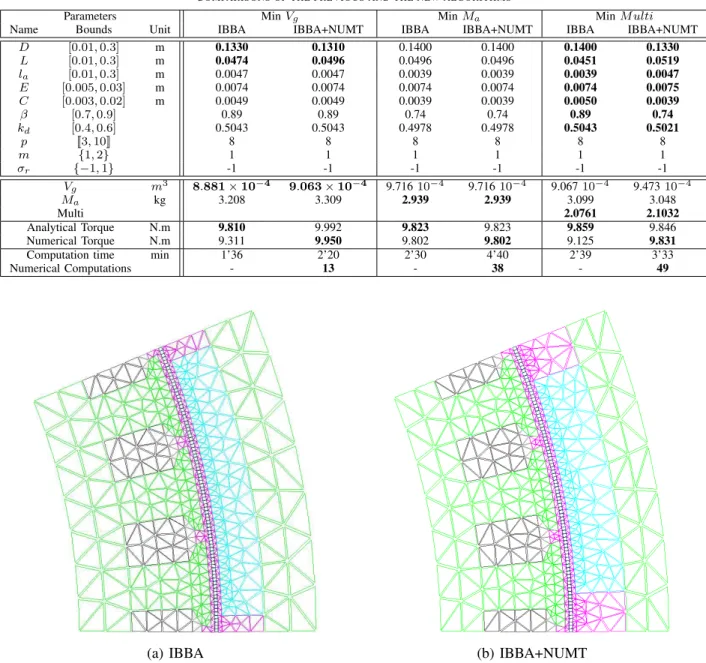
The numerical results presented in Table I correspond to the solving of respectively problem (1) in columns named IBBA, and problem (10) in columns named IBBA+NUMT.
Even if all the solutions have the same structure (8 pairs of pole and inverse rotoric configuration), the behavior of our new algorithm is never the same in the three cases. First, for the minimization of the global volume, we can note that the constraint upon the torque is not satisfied numerically for the solution obtained by IBBA. Considering the optimum given by IBBA+NUMT, only the two geometrical parameter D and L change to reach a correct value for the torque. An expert of the domain would be able to do these adjustments or equivalent ones. Nevertheless, the torque value has increased about 6.9% and the volume only about 2%.
The second minimization is different. The torque value of the solution obtained by IBBA satisfies numerically the equality constraint. The use of IBBA+NUMT algorithm con-firms the analytical solution. No new optimum has been found in the defined zone using the numerical constraint. This validates, in such a case, the methodology of design proposed in [3] combining analytical combinatorial models with IBBA algorithm.
For the multicreteria minimization, we note that the nu-merical torque of the analytical solution is close to 9 N.m. The changes of some parameters of design (for example, D
and L) are not so obvious than those for the minimization of the global volume. In this case, IBBA+NUMT found a new optimum which differs from the analytical one for all the geometrical parameters. Hence, for an expert, this solution (or an equivalent one) should be difficult to obtain. This last case show perfectly the real efficiency of our new methodology of design. We can note that the increase of the numerical torque and the volume is respectively 8% and 6.4% whereas the mass has decreased of 2% compared to IBBA. These two solutions are drawn in Figure 1.
Furthermore, we can notice in Table I that the values of the criterion of the optima obtained using the IBBA methods are better than those found using IBBA+NUMT. However, the numerical value of the torque for a solution obtained using IBBA method does not satisfy the main constraint of the torque. Therefore, the analytical solutions of design are less interesting than the numerical optima. We can also note in Table I that the analytical values are very close to the numerical ones for the solutions obtained by IBBA+NUMT.
Moreover, the computation times are rather short, less than four minutes for the slowest problem which owns an optimisation phase with 49 runs of NUMT.
These first results on small-sized design problems are very encouraging for future works. We can expected to solve more complex problems which will take into account different kinds of material or of waveform. We also should be able to include some thermal considerations by the way of introducing new constraints in problems of type (10).
VI. CONCLUSION
In this paper, one solves for the first time a more general and interesting inverse problem of design (formulated by (10)) than those already solved in [2], [3]. The so-obtained solutions using our new algorithm IBBA+NUMT satisfy now the constraint about the torque (which is fixed by the schedule of conditions) by a numerical way. Thus, the generated so-lutions are directly validated numerically. Of course, problems of type (10) are much more complicated than its corresponding problem considering the analytical equation in place of the numerical constraint (1). Thus, in this first work, only small-sized problems has been solved. However, some differences are denoted comparing solutions found for (1) and (10). Regarding the CPU-times in Table I, we can expect to solve using IBBA+NUMT more general problems of design with more parameters such as those presented in [2], [3]. This emphasizes the interest of this first work. In the field of global optimization, this is, in our knowledge, the first time that problems with a black-box constraint are solved by an exact algorithm.
REFERENCES
[1] J. A. Bastos, N. Sadowski, Electromagnetic Modeling By Finite Element
Methods. Marcel Dekker, 2003.
[2] E. Fitan, F. Messine, and B. Nogarede, A general analytical model
of electrical permanent magnet machine dedicated to optimal design,
COMPEL, Vol. 22, N. 4, pp. 1037–1050, 2003.
[3] E. Fitan, F. Messine, and B. Nogarede, The Electromagnetic Actuator
Design Problem : A General and Rational Approach, IEEE Transactions on Magnetics, Vol. 40, N. 3, pp. 1579–1590, May 2004.
COMPARISONS OF THE PREVIOUS AND THE NEW ALGORITHMS
Parameters Min Vg Min Ma Min M ulti
Name Bounds Unit IBBA IBBA+NUMT IBBA IBBA+NUMT IBBA IBBA+NUMT
D [0.01, 0.3] m 0.1330 0.1310 0.1400 0.1400 0.1400 0.1330 L [0.01, 0.3] m 0.0474 0.0496 0.0496 0.0496 0.0451 0.0519 la [0.01, 0.3] m 0.0047 0.0047 0.0039 0.0039 0.0039 0.0047 E [0.005, 0.03] m 0.0074 0.0074 0.0074 0.0074 0.0074 0.0075 C [0.003, 0.02] m 0.0049 0.0049 0.0039 0.0039 0.0050 0.0039 β [0.7, 0.9] 0.89 0.89 0.74 0.74 0.89 0.74 kd [0.4, 0.6] 0.5043 0.5043 0.4978 0.4978 0.5043 0.5021 p [[3, 10]] 8 8 8 8 8 8 m {1, 2} 1 1 1 1 1 1 σr {−1, 1} -1 -1 -1 -1 -1 -1 Vg m3 8.881 × 10⁻⁴ 9.063 × 10⁻⁴ 9.716 10−4 9.716 10−4 9.067 10−4 9.473 10−4 Ma kg 3.208 3.309 2.939 2.939 3.099 3.048 Multi 2.0761 2.1032 Analytical Torque N.m 9.810 9.992 9.823 9.823 9.859 9.846 Numerical Torque N.m 9.311 9.950 9.802 9.802 9.125 9.831
Computation time min 1’36 2’20 2’30 4’40 2’39 3’33
Numerical Computations - 13 - 38 - 49
(a) IBBA (b) IBBA+NUMT
Fig. 1. Meshes of the two solutions corresponding to the minimization of the multicriteria
[4] E. Hansen, Global Optimization using Interval Analysis, Marcel Dekker, Inc. 270 Madison Avenue, New York 100016, 1992.
[5] R.B. Keafott, Rigorous Global Search: Continuous Problems, Kluwer Academic Publishers, Drodrecht, Boston, London, 1996.
[6] Y. Lef`evre, J. Fontchastagner, F. Messine, Building a CAD system for
educational purpose based only on a mesh tool and a FE solver, IEEE
Transactions on Magnetics, Vol. 42, N. 4, pp. 1483–1486, 2006. [7] F. Messine, Extension of Affine Arithmetic: Application to
Uncon-straineded Global Optimisation, Journal of Universal Computer Science,
Vol. 8, pp. 992–1015, 2002.
[8] F. Messine, Deterministic Global Optimization using Interval Constraint
Propagation Techniques, RAIRO Operations Research, Vol. 38, N. 4,
2004.
[9] F. Messine, A Deterministic Global Optimization Algorithm for Design
Problems, chapter in Essays and Surveys in Global Optimization, Editors
Charles Audet, Pierre Hansen et Gilles Savard, pp. 267–294, 2005. [10] Messine, F. and Lagouanelle, J.L.: Enclosure Methods for Multivariate
Differentiable Functions and Application to Global Optimization,
Jour-nal of Universal Computer Science, 4 (6), Springer-Verlag, pp. 589–603, 1998.
[11] F. Messine, V. Monturet, B. Nogarede, An Interval Branch and Bound
Method Dedicated to the Optimal Design of Piezoelectric Actuators, in
Mathematics and Computers in Sciences and Engineering, ISBN 960-8052-36-X, WSES Press, pp. 174–180, 2001.
[12] F. Messine, B. Nogarede, and J. L. Lagouanelle, Optimal Design of
Elec-tromecanical Actuators: A New Method Based on Global Optimisation, IEEE Trans. on Magnetics, Vol. 34, N. 1, pp. 299–308, Jan. 1998.
[13] F. Messine, A. Touhami, Exact and Rigorous Global Optimization
Algorithm based on Affine Arithmetic and its Extensions to Quadratic Forms, Reliable Computing, Vol. 12, No. 3, 2006.
[14] R.E. Moore, Interval Analysis, Prentice Hall, Englewood Cliffs, 1966. [15] H. Ratschek, J. Rokne, New Computer Methods for Global Optimization,
Ellis Horwood, Chichester, 1988.
[16] N. Sadowski, Y. Lef`evre, M. Lajoie-Mazenc, J. Cros, Finite element
torque calculation in electrical machines while considering the move-ment, IEEE Transactions on Magnetics. Vol. 29, N. 2, pp. 1410-1413,
1992.
[17] J. R. Shewchuk, Triangle: Engineering a 2D Quality Mesh Generator and Delaunay Triangulator, First Workshop on Applied Computational
Geometry (Philadelphia, Pennsylvania),pp. 124–133, ACM, May 1996.
Available : http://www-2.cs.cmu.edu/˜quake/triangle. html.