By
John Roman Hajdukiewicz B.A.Sc. Mechanical Engineering
University of Waterloo, 1994
M.A.Sc. Mechanical and Industrial Engineering University of Toronto, 1998
Ph.D. Mechanical and Industrial Engineering University of Toronto, 2001
SUBMITTED TO THE SYSTEM DESIGN AND MANAGEMENT PROGRAM IN PARTIAL FULFILLMENT OF THE REQUIREMENTS FOR THE DEGREE OF
MASTER OF SCIENCE IN ENGINEERING AND MANAGEMENT AT THE
MASSACHUSETTS INSTITUTE OF TECHNOLOGY
FEBRUARY 2007
0 2006 John Roman Hajdukiewicz. All rights reserved.
The author hereby grants to MIT permission to reproduce and to distribute publicly paper and electronic copies of this thesis document in whole or in part in any medium now
known of hereafter created.
Signature of Author: Aikement Program December 18, 2006 Certified by: YJ'ppel 'It Accepted by: Iale Director, System Design and NThagement Program MASSACHUSETTS INSTflITE
OF TEOHNOLOGY
FEB
0 5 2008
BARKER
LIBRARIES
By
John Roman Hajdukiewicz
Submitted to the System Design and Management Program in partial fulfillment of the requirements for the Degree of Master of Science in Engineering and Management. ABSTRACT
Innovation has been long known to be difficult to accomplish in large companies that have well structured processes. Structured processes (such as the use of Six Sigma) can provide significant benefits in terms of efficiency and productivity. However, it can also hinder innovation in that it zones in on local, incremental solutions too quickly. This thesis explores different strategies corporations may take in incorporating innovation at their organizations. First, background and theory are presented to guide the discussion, grounded on ecological psychology. Second, a case study (VisionPRO Thermostat) is presented that provides insight in how innovation can work in large structured organizations; in this case, outsourcing and the use of common tools were used as the innovation strategy and transfer mechanism. Third, the discussion is expanded to broader corporate strategies that can inject innovation in product development processes. Innovation and structured processes are at odds with each other and need to be managed with different approaches. Innovation processes require creative isolation from high structure to open degrees of freedom and the design space; this can be accomplished through multiple strategies such as outsourcing, buying, injecting, incubating, co-locating, spinning-off, and distributing. Structured processes should rely on a high level of constraints that are highly predictable to push productivity and efficiency; this can be accomplished through Six Sigma and lean processes. Interfaces between the two sets of processes are critical to mediate effective transfer and insertion in product lines; in the case of the VisionPRO, common language (i.e., the common use of certain Six Sigma tools) and people played the interface role. Finally, conclusions, contributions, limitations, and future research are presented.
Thesis Supervisor: Eric von Hippel Title: Professor of Management
Table of Contents
Abstract...3
Table of contents... 4
List of Figures...5
Acknow ledgem ents... 7
Introduction...8
M otivation... 8
Purpose...13
Organization of Thesis... 14
Theory and Background... 16
Ecological Psychology... 17
Ecological Approach Applied to Business ... 24
Six Sigm a and the Product Developm ent Process ... 27
Innovation Processes... 30
Case Study - VisionPRO Therm ostat... 36
M ethodology and Hypothesis ... 36
Case Introduction and Background... 37
Program Sum m ary and Results...39
M arket Outcom e ... 45
Influencing Factors in the Success of VisionPRO ... 46
Discussion...51
Conditions that Improve the Chances for Innovation Success ... 51
Alternatives for Implementing Innovation Processes...53
Ecological Considerations ... 56
Conclusions... ... 59
List of Figures
Figure 1.1: Generic problem of shifting competitive landscape. Current product offering
is show n by the green circle... 10
Figure 1.2: Strategies focused on process for reaching the incremental targets - Look at current practices, competitors, and technologies, and implement consistent processes to be a follower. Red circle indicates new target...11
Figure 1.3: Strategies focused on outcomes for various targets - Break out of the incremental mould and enable the anticipation market shifts. Red circles indicate potential new targets. ... 12
Figure 1.4: An integrated view of the innovation/structure puzzle. ... 13
Figure 2.1: An ecological model of human-environment interactions (Hajdukiewicz, 2001; reprinted with perm ission)... 18
Figure 2.2: a) Generic market domain; b) Functional representation of offering...21
Figure 2.3: Differences between a) higher-level and b) lower-level control, using the functional representation in Figure 2.2b (Hajdukiewicz, 2001; reprinted with perm ission)...22
Figure 2.4: Factors influencing success in adapting to change from an ecological point of view (Hajdukiewicz, 2001; reprinted with permission). ... 23
Figure 2.5: The role of information in organizational behavior and the tension between the influence of market opportunities and organizational capabilities. ... 25
Figure 2.6: Business framework perspectives on the model shown in Figure 2.6. ... 26
Figure 2.7: Typical stages in a product development process using Six Sigma...28
Figure 3.2 Honeywell VisionPro Thermostat...38 Figure 3.3: Spiral iteration from exploratory concepts to product...40 Figure 3.4: Field interviews and observations in various phases...41 Figure 3.5: Inputs, methods, tools, and learnings from at different phases of data
collection ... 4 1 Figure 3.6: Industry awards for the VisionPRO. ... 46
Figure 3.7: Interface between the creative processes (Growth) and structured processes (DFSS - design for six sigma)...47 Figure 4.1: Previsualization and development speed in product development...58
Acknowledgements
This thesis would not have been possible if were not for a number of key individuals. First, I would like to thank Tom Rosback, Vice President of Engineering and Technology at Honeywell, for the opportunity to use VisionPRO as a case study for my thesis. He has also been the source of great support and mentorship throughout my
experience at Honeywell.
Second, I would like to thank Daryll Fogal, Vice President of Engineering and Technology at Honeywell, for inspiring me to think out-of-the-box and providing stretch learning experiences and opportunities for growth.
Third, I would like to thank Prof. Eric Van Hippel for inspiring me to think about innovation in new ways. His insights have motivated me to champion compelling design at Honeywell.
Fourth, I would like to thank John Beane, Larry Goldstein, and Dan Sheflin at Honeywell for providing me the opportunity to study at MIT in the System Design and Management program at the Sloan School of Management and the School of Engineering. The experience has been valuable and will guide my varied pursuits in the future.
Finally, I would like to thank my family for their continuing support in my varied and challenging adventures.
Introduction
Motivation
World economies have undergone vast and rapid changes with the proliferation of various technological innovations, increased emphasis on efficiency, quality, and safety, and shifting demands. As a response to these realities, markets have become more dynamic. Product innovation and corporate adaptation to change (i.e., adjusting processes and actions driven by a changing market context to support corporate goals) have become issues of greater importance.
Despite these needs, innovation has been long known to be difficult to achieve in large organizations, especially ones that have heavily utilized structured processes. There is a contraction because on the one hand, large companies want to grow. On the other hand, these same companies are risk averse, have organization impediments to change, and predominantly focus on the short term (e.g., quarterly results). As these firms increasingly become global, there are greater opportunities for growth and innovation but it is also anticipated to become more difficult due to issues such as communication, coordination, and distributed and asynchronous development utilizing structure processes.
An example of the above phenomenon is illustrated by a growing practice in business - Six Sigma - which a significant number of large companies have adopted. Six Sigma has been used extensively to improve product and service quality, and decrease waste, costs, and defects. Key goals of the methodology are to decrease variance in product outcomes, decrease costs, improve competitiveness in current markets, and focus
on the best business opportunities. This has resulted in enormous benefits to these corporations by streamlining processes and aligning activities to customer needs and company strategies. It has led to efficiencies for sustainable or innovations and incremental products improvements. However, the methodology has also constrained the creative design process to the point that it is very hard to develop breakthrough innovations - this is what I call the incremental trap. Companies have resorted to other strategies by necessity, such as expensive acquisitions once market signals have emerged, to insert and cross-pollinate step-out product designs.
One way to describe this problem is through an analogy for a company trying to innovate in a changing marketplace. Consider a company moving in a market environment with different constraints, shown in Figure 1.1. The current product space encompasses all available products in the market space. Average customer needs typically overlap this space. There are also edge customer needs that may not overlap current product offering or the average customer needs. In some cases, lead users point to macro-trends and gradient shifts in future needs of the average customer (von Hippel, 2005). The objective is to move from a starting point (current product offering in current
product space) to the goal (incremental or breakout innovation). A number of questions emerge: What should the target be (incremental or breakthrough change)? What are the risks and opportunities for each target? How can product transformation be
Lead Users
Average
Edge elnd Customer
Customer acto urre Needs
NeedsBarriers Current
(Technology, Product
Market) Space
Figure 1.1: Generic problem of a shifting competitive landscape. Current product offering is shown by the green circle.
Two contrasting strategies may be invoked. One strategy may be to fmd, with a consistent process, what is known about average customer needs (largest driving customer group), competitors, and the current product space (Figure 1.2). Once determined, this path can be encoded as a process or procedure and used efficiently to reach the local goal every time from a predetermined starting point (i.e., market or product position). This strategy is analogous to using the structured processes of Six Sigma (i.e., inputs are generally current market, aggregate customer data, and competitive data) and can be effective when the behaviour of the constraints, customer needs, and market participants are relatively static and predictable. The result tends to be incremental with some variation of what is currently envisioned in the market place because the inputs characterize the target close to the local product space. This approach does not enable companies to anticipate the market and tends to be support follower activity (i.e., continuously tracking and adjusting to the target and competitors).
Lead Users
Average
Edge -eO Customer cremental
Customer aCurrent Needs An Followe
Needs Barriers
C rrent rap (Techno ogy, Pr uct
Market) Sp ce
Figure 1.2: Strategies focused on process for reaching the incremental targets -Look at current practices, competitors, and technologies, and implement
consistent processes to be a follower. Red circle indicates new target.
An alternative strategy may be to understand the underlying and deep customer problems, trends, and constraints of the market environment in a timely fashion, and leave it up to the product development team to choose any feasible path to get to any selected target or goal (Figure 1.3). Novelty in the process is analogous with breakout innovation processes. The team can certainly look at incremental changes (e.g., pick a localized target), but they can also see where step-out or breakout innovations can occur (e.g., ethnographic considerations, and discovery and assessment of lead users). This strategy can be effective when the behaviour of the constraints and markets are dynamic, changing in predictable and unpredictable ways.
Breakout of
Current Mould
Lead Users
Average Edge/Future -VeCustomer
Customer Peopl rrent Needs Needs Barriers
Cu rent
1 0ogy, Pr uct
Market
Figure 1.3: Strategies focused on outcomes for various targets - Break out of the
incremental mould and enable the anticipation market shifts. Red circles indicate potential new targets.
The above example describes the type of problem found in many product
development organizations. People are constantly required to move and align processes to meet the required market demands. Part of the issue with innovation is the clear definition of the target. For example, following competitors may or may not satisfy customers, or tackling average customer needs may not result in a sustainable competitive advantage. When the behaviour of the opportunities and constraints is static
and predictable, previously successful procedures may be invoked (e.g., embodied in Six
Sigma and heavily structured corporate work processes), but competition can intensify
due to the predictability of the market. However, more and more, the behaviour of
opportunities and constraints is dynamic and unpredictable, driven by customer demand
requiring continuous adaptation for success. Product development teams need to understand the deep customer problems, relevant trends, and solution spaces to innovate.
Figure 1.4 displays the three main parts to the puzzle that can help in reasoning about the innovation and structured processes: market environment opportunities, information, and organizational capabilities. Each part must be studied in the context of the other parts to understand the key success factors in adapting to change and unravel the innovation/structure puzzle. For example, if a corporation is too constrained internally with processes, it will not be capable to attune itself to market environment breakout opportunities (i.e., it will only pay attention to the signals that lead to incremental change). If a corporation is too open, unconstrained, and chaotic, it will not be able to coordinate product development and delivery. The right balance is important
-a m-arri-age between cre-ative/innov-ative processes -and structured processes.
Market Information Organizational
Opportunities Capabilities
Figure 1.4: An integrated view of the innovation/structure puzzle.
Purpose
This purpose of this thesis is to investigate how innovation can occur in large organizations, in particular ones that have highly structured processes (e.g., Six Sigma), and focus on efficiency to drive performance. I will argue that a complete focus on efficiency results in disincentives to innovate, particularly breakout innovation. On the
other hand, a complete disconnection and focus on the creative process can be risky. A shifting, but balanced view is required. In doing this, I will draw upon the theories in ecological psychology that will help inform how the creative-structured balance, strategic interfaces, and information can improve the chances of success. Through a case study, the VisionPRO Thermostat, I assess how the theory helps explain its success. With not a breakout innovation, it stepped out the current product space and tapped into unmet customer needs resulting in significant market success. I will also postulate how companies can insert innovation strategies in highly structured organizations (e.g., heavy use of Six Sigma), and take advantage of both innovation and efficient Six Sigma techniques to drive product outcomes.
Organization of Thesis
This thesis is organized into four additional chapters. In the second chapter, I introduce concepts and theory in ecological psychology and relate them to business. This provides the foundation for the observations made during the case study and framework for discussion. I also provide a high level overview of Six Sigma in product development, including some key benefits and limitations. Finally, I discuss the role of innovation processes in product development. A number of examples are presented, including the ten faces of innovation, lead user analysis, and organizing for innovation.
In the third chapter, I present a case study of the VisionPRO Thermostat in the context of how innovation happened in a large organization with structured processes. The background, market context, problem, approach, process, organization, and outcomes are presented and discussed.
In the fourth chapter, a discussion of the implications of the results is presented in the context of what companies can do to increase the chances of innovation to drive growth. The results are discussed in the context of foundations in ecological psychology. In addition, insights based on the theory and case study that can inform product development are discussed.
In the last chapter, I provide some concluding remarks and discuss contributions, limitations and future research.
Theory and Background
The theory that is applied to the problem of innovation in large organizations stems from pioneering work in ecological psychology and the concept of the use of coordinative structures (Kelso, Holt, Kugler, & Turvey, 1980; Kelso, 1995). Coordinative structures are the linkages of resources into higher-level functional collectives; they define configuration opportunities to support higher-level functions based on moment-to-moment context. Engaging in higher-level control activates different strategies, approaches, and processes of utilizing these coordinative structures to support higher-level functions in a changing context. As applied to business, configurations are directly mapped to product development organizations, activities, practices, strategies, and their associated degrees of freedom. I will argue that in a large corporate context that is focused on efficiency with structured processes, the degrees of freedom are limited and constrain the ability of an organization to adapt to market changes and create breakout innovations; this will be discussed in the context of observed Six Sigma practices. Strategies to break this mould will be presented that increase the degrees of freedom and provide a higher-level view of the innovation space.
In this chapter, an overview of the underlying theory in ecological psychology and coordinative structures is first presented. Second, this theory is related to business contexts. Third, an overview of Six Sigma is presented in the context of observed practice in product development; I will argue that certain applications can lead to highly structured processes and create disincentives for innovation. Fourth, an overview of a number of effective practices used for innovation is presented. I will discuss that the benefits of the two perspectives (innovation processes and Six Sigma or structured
processes) could be complemented, interfaced, and architected for greater benefit in product development.
Ecological Psychology
Ecological psychology has its origins with the research of Brunswik (1956) and Gibson (1979). It advocates a systems approach for studying the interactions between people and their environments (Meister, 1989). To successfully study adaptation in changing market situations, the human/organization, environment, and their interactions need to be considered together.
Key to ecological psychology is the notion of coupling between a human and the environment; in the case of business, this is the coupling between the corporation and the market environment. At the juncture between the human/organization and environment lies the connector or interface that can help facilitate cognition, perception, and action. This interface can directly or indirectly specify the environment or market opportunity. By becoming attuned to the interface or picking up cues to reason analytically, people can be coupled to the environment, making adaptation, innovation, and coordinated action possible. In cases where interactions with the environment have highly structured processes or procedures, corporations typically behave consistently in actions, predominantly view short term opportunities and incremental changes, and are limited in their ability to adapt or innovate when markets change. Conversely, in cases where interactions with the environment are driven by a higher level perspective (e.g., understanding deeper customer purposes/needs, trends, dynamic constraints), the organization attunes to that higher-level perspective and adapts accordingly (e.g., uses different configurations, approaches, and strategies to meet customer purposes/needs).
A detailed model of the coupling between the human (or organization) and the
environment is shown in Figure 2.1. There are three parts to the model: the environment (distal structure), ambient array (proximal structure), and human (Hajdukiewicz, 2001).
The environment consists of substances, surfaces, objects, media, and events (Gibson, 1979); these characteristics define the distal structure of the environment. From a Gibsonian perspective, these aspects of the environment offer the human a large number of action possibilities. These opportunities for action are called affordances (Gibson, 1979). They are described relative to the human or organization, independent of the intentions or goals. These affordances do not need to be perceived by people or
organizations to exist. However, they offer them opportunities to act and innovate.
ENVIRONMENT (Distal Structure) Affordances 2 3 4 ___ 5 6 / AMBIENT ARRAY (Proximal Structure) Form Invariants Invariant 1 HUMAN Cognition, _ _ Perception,
Action-Figure 2.1: An ecological model of human-environment interactions (Hajdukiewicz, 2001; reprinted with permission).
Invariant 2 Invariant
3 4
The ambient array is the connection or interface between the environment and the human (or organization) that can facilitate active perception and coordinated, adaptive action. Proximal structure is formed within the ambient array emanating from various aspects of the environment through a medium. From a Gibsonian perspective (Gibson, 1979), the ambient array can have proximal structure forming invariants that can map to various aspects of the environment. Information is a result of a one-to-one correspondence between the proximal form invariants and distal affordances. From a business perspective, the artifacts and forms that users create to fill in latent needs or product gaps can serve a proximal structure to distal affordances.
The human (or organization) is composed of highly integrated and multi-layered systems. From an ecological point of view, adaptation and coordination occur at the levels of cognition, perception, and action, and are guided by goals and intentions. At these levels, the human (or organization) can actively pick up form invariants from the ambient array that map onto affordances in the environment. In this process of picking up form invariants (i.e., attunement to the proximal structure), the human (or organization) acts within the environment (e.g., manipulates objects or moves within the environment). Once this occurs, perception and adaptive, coordinated action are possible.
These concepts have been used to study human coordination. In the research area of motor control, scientists are interested in studying how the body can control and coordinate movement in anticipated or unanticipated situations with relatively few degrees of freedom from a muscular basis of relatively many degrees of freedom (i.e., numerous motor units comprising individual muscles). Bernstein (1967) argued that this
problem of many degrees of freedom may largely be resolved by linking motor units and muscles together in such a way that the individual muscles are reduced to a much smaller set of muscle groups or collectives. Movement occurs by activating these muscle collectives, constrained to act as single functional units. The muscle linkage associated with this muscle collective has been referred to as a coordinative structure (Kelso et al., 1980). This concept fits well in the discussion of the human part of the ecological model in Figure 2.1. From a business perspective, the activation of different muscle collectives is analogous to activating different strategies and processes when interacting with the market.
According to Kugler, Kelso, and Turvey (1980), the coordinative structure concept differs from traditional concepts in the motor control literature such as procedural motor programs. Procedural motor programs presume a pre-established arrangement of muscles or specific sequencing instructions to the muscles. The use of motor programs for goal-relevant movement occurs by controlling the configurations of muscles as a set of instructions for predefined movements (i.e., the specific action process to achieve the movement goal is invariant); this is analogous to what happens with many implementations of Six Sigma (see below). In contrast, the use of coordinative structures for goal-relevant movement occurs by controlling muscle collectives that specify the configuration opportunities as a function of moment-to-moment context; this is analogous to creative, innovation processes. Specific configurations are selected based on the context of the situation to achieve the selected goal or target (i.e., the movement goal or product is invariant). Consequently, the use of coordinative structures is more robust than motor programs for conditions where goals and context are changing and uncertain.
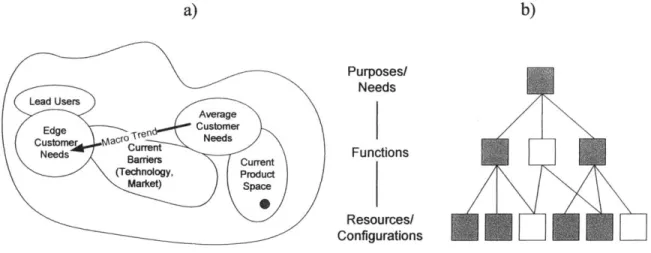
The distinction between the concepts of coordinative structures and procedural motor programs can be discussed more generically and in an integrated fashion by first modelling an environment (or market) in terms of resources, configurations, and functional opportunities that align with its purposes (or needs). Figure 2.2a shows this generic market space (i.e., a goal-relevant subset of the distal environment) with various types of constraints (e.g., technological constraints). Movement in this domain requires adaptation to cope with and take advantage of these constraints to meet the purposes or needs (articulated, unarticulated, latent, or emerging). Figure 2.2b shows a functional representation of this market domain at various levels of description. The lower levels are the physical and concrete resources or components of the market domain or product space, and the higher-levels are the functions and purposes that need to be supported.
a)
Lead Users
Average
Edge customer
CUStD r acu rn Needs Needs Barriers Currnt (Technology, Prodct Market) Space Purposes/ Needs Functions Resources/ Configurations b)
Figure 2.2: a) Generic market domain; b) Functional representation of offering.
This representation can be used to structures and procedural motor programs. level control) can be seen as focusing on
distinguish between the use of coordinative The use of coordinative structures (or higher-or supphigher-orting the higher-level functions, by
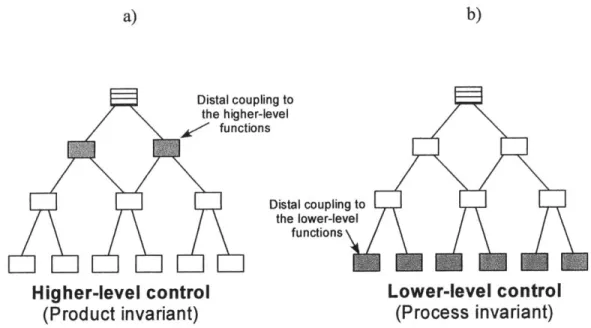
using any feasible resources or configurations at the lower-levels in a context-specific way; the higher-level functions (i.e., outcomes) are invariant (Figure 2.3a). This property of product or outcome invariance is evidence for distal coupling to the higher-level functions of the market or product domain. In contrast, the use of procedural motor programs (or lower-level control) can be seen as focusing on a specific way of using resources or configurations over time in a context-independent way; the lower-level procedures (i.e., processes) are invariant (Figure 2.3b). This property of process invariance is evidence for distal coupling to the lower-level functions of the market or product domain. a) b) Distal coupling to the higher-level functions Distal coupling to the lower-level functions
Higher-level control Lower-level control
(Product invariant) (Process invariant)
Figure 2.3: Differences between a) higher-level and b) lower-level control, using the functional representation in Figure 2.2b (Hajdukiewicz, 2001; reprinted with permission).
The theory and background in ecological psychology presented in this section can be summarized in Figure 2.4. This provides a theoretical foundation for the study of organizations, structured processes, and innovation processes.
Success in Adapting to Change
Scan result in)
Higher-Level Control
can make possible can induceand provide flexibili for
Environment
Information
Human
Opportunities
Capabilities
Invariant 1 Affordances Perceptual Attunement rn I ivariant 2 Analytical FDReasoning
o
Domain Invariant 3Resng
Physical Capabilities
Form Invariants
Distal Structure Human
Proximal Structure
Figure 2.4: Factors influencing success in adapting to change from an ecological point of view (Hajdukiewicz, 2001; reprinted with permission).
From the previous discussions, higher-level control (or distal coupling to the higher-level functions of the work domain) can theoretically lead to successful adaptation to change. Three main factors can help induce and make possible higher-level control. First, the existence of multiple affordances to reach the goals (i.e., multiple structural degrees of freedom in the market domain) is important for making possible and providing
flexibility for higher-level control in a changing environment. If one path or no path exists, the ability for the human to adapt to changes or innovate becomes very limited. Second, invariant forms (especially higher-level forms) in the proximal structure that directly map onto the distal structure of the domain (i.e., information) can help induce higher-level control. They provide opportunities for the human to perceive, as opposed to analytically derive, the affordances and higher-level structure in the distal environment. Finally, human capabilities (i.e., cognitive and physical) in perceiving and acting can induce higher-level control. In terms of cognitive capabilities, perceptual attunement of and analytical reasoning about the higher-level functions can induce higher-level control, because the human can use the higher-level information and adapt actions accordingly as the context changes. In terms of physical capabilities, being able to act on components in the environment in various and flexible ways is required for higher-level control and innovation to occur. Experience interacting with the affordances and form invariants can enhance both cognitive and physical capabilities; thus, experience plays a key role in inducing higher-level control.
Ecological Approach Applied to Business
The above discussion on ecological psychology and coordinative structures can be scaled and applied to business, industry, and markets. The environment relates to the market, competitors, and other external influencing factors. The human can be scaled to an organization or corporation with particular capabilities for product development (i.e., cognition, perception and action). Information relates to the artifacts and media utilized to attune the corporation to the market environment. What companies pay attention to is
dependent on how they are organized, what they perceive, and how they act utilizing information mediated by the interface.
Figure 2.5 shows a high level view of the interaction between corporations and their market environments. This builds on Figure 1.3 with the dimensions of Industry, Tasks, Strategies, Competencies and Social-organizational structure.
Market qOrganizational
. Information
Opportunities Capabilities
Outside-in
Competencies Social/ Markets and Goals and Strategies and Organizational
Industries Tasks Capabilities Structures
Inside-out
Figure 2.5: The role of information in organizational behavior and the tension between the influence of market opportunities and organizational capabilities.
Strategy is the point where corporate capabilities meet market opportunities. This is where information plays a critical role in informing corporations on signals to innovation, given their capabilities. Corporations that are heavily process-oriented will look at markets and opportunities on very specific ways. There are efficiency benefits to
this but step-out or breakthrough opportunities may be missed. In addition, these corporations will find it difficult to adapt to changing market environments. Alternatively, corporations that are outcome-oriented and effectively mobilize resources to achieve these outcomes can adapt to market changes more readily, switch strategies,
and capitalize on innovation opportunities.
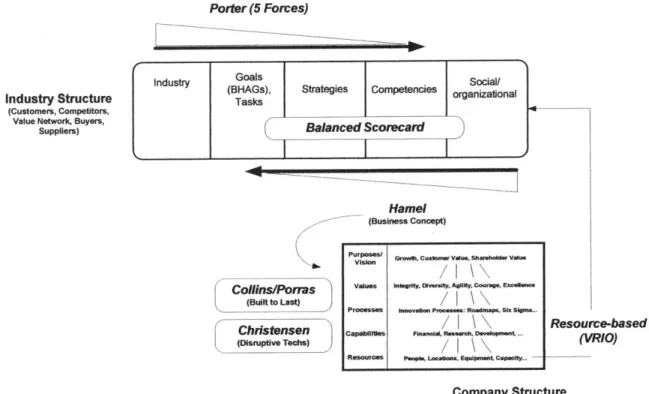
Many perspectives from business could be mapped onto this structure (Figure 2.6).
Porter (5 Forces)
Industry
Industry Structure
(Customers, Competitors, Value Network, Buyers,
Suppliers)
Goals (BHAGs)
Tasks
Social/ Strategies Competencies organizational
Balanced SCorecard Hamel (Business Concept)
K
r
Coliins/Porras Christensen (Fisrptive Techt)Figure 2.6: Business framework perspectiv
/ \ \ Resource-based
/,.b..li
.. . "(VRIO) Resources Pesple, Locaons. Equipm , Capedly
Company Structure ,es on the model shown in Figure 2.6.
Mapping of Porter's five forces (1986) is predominantly an outside-in view of corporations, revealing constraints in the market that can shape corporate action.
Conversely, the views of Hamel (2000), Kaplan and Norton (Balanced Scorecard; 1996) and Christensen (1997) are inside-out, revealing how companies and their capabilities can
'P Vision ' Gro.n, CusfotWValU., Sharehsdr Vak, I
M
Values mnftgfy. TOnrt. Aelly, Couage Esoeakes Processes Osnovss Pa : Roadmops, Six Sigma.
shape markets. Depending on the market context and timeframe, success will be determined on how well a corporation senses the market and which strategies will be most successful based on the context. The importance of how a company interfaces with the world, which lenses it chooses to develop, how it interprets signals, and how it adapts to change will influence its ability to succeed in different situations.
Six Sigma and the Product Development Process
Six Sigma is a business strategy with a set of tools and processes to systematically identify and eliminate causes of errors, defects, or failures in business operations by focusing on outputs that are critical to customers and the corporation. It incorporates rigorous measurement techniques to assess quality, and strives for near elimination of defects (i.e., anything which could lead to customer dissatisfaction) using the application of statistical methods (Pande, Neuman, & Cavanagh, 2000). In the context of Figure 2.5 it is a focus on processes and procedures to identify customer needs and requirements, and delivers these efficiently.
Six Sigma has been incorporated in product development to increase the chances of product success and minimize costs and waste in the process. For illustration, Figure 2.7 shows a typical product development process, similar to the one followed in many large organizations (Fortune 50 companies). Typically there are a number of stages, each with a gate review or screen, which define, align, and assess product milestones, opportunities, and risk. Concepts are transformed, narrowed, and combined through the stages. The development process from beginning to end could take 3-5 years, depending on priority.
Each stage utilizes a number of Six Sigma tools to assess, rank, and channel product requirements based on customer needs and corporate constraints/capabilities.
For example, the "Critical to Quality" and "Voice of the Customer" tools capture customer needs and requirements; "Quality Function Deployment" aligns and prioritized requirements and company capabilities to customer needs; "Failure Modes and Effects Analysis" assesses product risk. Most of these tools are rooted in statistics with an emphasis on 'mean' customer results for development decisions.
Product Development Process (Use of 6 Sigma Tools)
STAGE 0 STAGE 1 STAGE 2 STAGE 3 STAGE 4 STAGE 5 Discovery, Scoping Business Development Testing, Launch
Ideas Case Validation
Product
Launch
0 0
Gate 1 Gate 2 Gate 3 Gate 4 Gate 5 Idea Second Development Testing Launch Screen Screen Screen Screen Screen
Figure 2.7: Typical stages in a product development process using Six Sigma.
The early stages (Stages 0-2) have high flexibility and require relatively fewer resources compared with development and testing. Ideas are generated based on an understanding of customer needs. Larger organizations typically have targeted their best customers, ones that offer the most revenue and margins; this provides the basis for the business case. From these activities, requirements and concepts are generated and ranked by these customers. At the same time, the company assesses its capabilities, resources,
and schedules in delivery. Once these activities are complete, detailed development, testing and validation occur (Stages 3-4). Finally, the product is launched based on the marketing strategy, positioning, and segmentation (Stage 5). The main levers and flexibility in the process, with minimal impact on resources, are typically at the early stages and launch stages. It is very important to frame the requirements appropriately before development because any errors could significantly increase the risk of product failure and/or increase development costs and time due to rework.
There are a number of key benefits to Six Sigma. First, the processes and tools help ensure product requirements align with customer needs and corporate capabilities, improving consistency and the probability of product success. Second, by making explicit the processes and data on operations effectiveness, product development can be continuously assessed and improved; Six Sigma helps identify opportunities for alignment across businesses and functions, and can improve operations quality and efficiency with the elimination of waste and design defects. Third, this approach has a common product development 'language' that the entire company understands; this will result in fewer problems or errors as product concepts get transformed to end products through different parts of the organization (possibly globally).
In spite of these benefits, there are a number of limitations. First, creativity and innovation are inherently high variance activities (i.e., there could be high variability in generating and combining ideas); Six Sigma may constrain these activities to the extent that primarily incremental improvements occur in internal product development. Second, Six Sigma presumes the company is targeting the 'right' customer. Typically, these are current customers that provide the highest historical revenues and margins; this strategy
will limit benefits to sustainable or incremental innovation. Not much attention is provided to peripheral/edge or other potential customers. Third, many of the Six Sigma tools are statistically-based with a predominant focus on 'mean' customer inputs. This drives the product development process to the average user and does not exploit the outliers (lead/edge users); the company may miss out on disruptive or breakthrough innovations created by these groups already. Fourth, Six Sigma requires large amounts of data for analysis purposes; it is difficult to measure aspects of new and/or breakthrough innovations. Fifth, at times, customers may not be able to articulate their needs (especially latent needs) or reactions to abstract requirements; customers tend to focus on what they are familiar with and incremental improvements. Six Sigma takes these needs and requirements as inputs to the entire product development process. There
is a danger of missing breakthrough innovation opportunities.
Given these benefits and limitations, there is evidence that Six Sigma is very good at systematically eliminating waste and incrementally improving products; however, its ability to support breakthrough innovation is significantly limiting. Are there ways to systematically incorporate breakthrough innovation techniques in a Six Sigma context? If so, this could result in higher growth opportunities for large organizations and
minimize the risks of missing disruptive forces.
Innovation Processes
Innovation processes can be wide and varied, ranging from accidental outcomes to planned variation exploration. This section gives some examples of practices and processes that occurred to achieve certain innovations. It is not meant to be a definitive review of innovation practices (it is clearly not comprehensive), but provides an idea of
how innovation can occur and some preconditions to increase the chances of innovative outcomes. The main point to take away is that innovation processes can vary, they encourage exploration, discovery, novelty, and surprise, they rely on highly adaptive forces, perception, and coordinated action, organization can have a significant influence on results, and one does not necessarily know the outcome a priori. This is in contrast with structured processes that aim to improve predictability and consistency in results.
In the first example, the ten faces of innovation (Kelley, 2005), the author discusses strategies to perceive the world, explore, discover, organize, and build innovations through personas - learning, organizing, and building. Learning personas gather new sources of information by going out to the world and developing a deep understanding of it. Organizing personas figure out how to move ideas through an organization (e.g., for development). Building personas apply insights from learning personas and utilize the capability of organizing personas to make innovation happen.
" The Anthropologist (Learning) - This face observes human behavior and understands how people interact physically and emotionally to products, services,
and their environment (ethnography).
" The Experimenter (Learning) - This face creates prototypes continuously, learning by trial and error.
* The Cross-pollinator (Learning) - This face explores other industries and cultures, and translates findings to align with customer or development needs.
* The Hurdler (Organizing) - This face understands that innovation can take a convoluted path and knows how to move ides by going around roadblocks.
* The Collaborator (Organizing) - This face brings people with very different perspectives together to create new alternatives through combinations and multidisciplinary solutions.
* The Director (Organizing) - This face directs and coordinates staff and helps create sparks from their creative talent.
* The Experience Architect (Building) - This face designs compelling experiences that tie to deep customer needs and go beyond a mere list of functionally
contained within.
* The Set Designer (Building) - This face creates and transforms the environment from which the innovation team members can do their best work.
* The Caregiver (Building) - This face anticipates customer needs, is focused on service to the customer, and ensures the innovation aligns with customer needs. * The Storyteller (Building) - This face builds energy, morale, and awareness
through compelling narratives that tie to a human value or cultural trait.
Through the above personas, it is clear to see that there is a deep focus on the customer and problem area, a need to understand of human behavior, a need to explore and discover, an emphasis on connecting varied perspectives in teams, a focus on communication across stakeholders, and a commitment to deliver. There is less of an emphasis on [the right] process, and more of an importance on outcomes, perspectives, and personas.
In the second example, user innovations or lead users studies (von Hippel, 2005), innovation is discovered by observing and connecting with lead users. A primary focus in on identifying macro-trends in a particular area of interest, identify people and
environments that are experiencing similar pressures of the anticipated market today, understand how they are dealing with these pressures and fill in product/service gaps, and integrate their perspectives to come up with novel breakout solutions. This approach provides a particular and unique focus and target on the learning personas previously discussed. The activities identified provide a vehicle for discovery and exploration, and a focus on particular macro-trends and pressures. In many cases, there is a separation or isolation from current mainstream market offerings or segmentation strategies, since the target could be characterized very differently.
In the third example, organizing for innovation, there are many advantages and limitations of co-location and distributed teams. Allen (1977) has stressed the importance of both physical proximity and visibility for creating levels of interaction and
communication that are necessary for innovative product development; proximity supports spontaneous interactions as creative ideas are generated and transformed. Spontaneous communication decreases rapidly as a function of physical distance, although this effect may be mitigated by creating visible connections to others' work areas (e.g., dedicated and visible project rooms). However, corporations are becoming more global and distributed, due to such factors as pre-existing geographical distribution of personnel, mergers and acquisitions, economic interests, outsourcing, and distributed customer locations. Globally distributed teams can confer distinct advantages by bringing together team members with talents and expertise that are not available locally. Technologies for distributed collaboration can support work habits that actually increase productivity, by allowing easier access to information and supporting rapid decision-making. Finally, distributed teams can integrate the benefits of local networks - each
team member can consult local experts and share their resources with distant team members. This argument is corroborated by Allen's (1977) finding that, when engineers move, they temporarily carry connections from their old locations with them. With these benefits, there are also the following limitations that need to be managed: communication is less efficient and is error-prone and product development team members can be disconnected and poorly coordinated.
From the above examples, there are a number of key benefits of innovation processes. First, there are greater chances to discover breakout innovations because there is an emphasis to look outside current product and service paradigms, explore the design space, cross-pollinate ideas, and focus on outcomes (not process). Second, many of the activities require some disconnection or isolation for creative activity to nurture; this helps the team think outside the current approaches in the market and discover new product and service concepts. Third, there is a shift in the definition of the target; innovation processes can help the team look beyond a local, incremental target, and anticipate market shifts to create competitive advantage.
Despite these benefits, there are also a number of key limitations. First, innovation processes can be unpredictable and take a long time to converge on an effective solution. Second, the processes can vary and need to be adaptive to the product development and customer need context; it is difficult to define a systematic approach that independent of this context. Third, it becomes harder to innovation as the extent of distributed teams increases. This is primarily due to communication problems, disconnected behaviors, and asynchronous or uncoordinated activities; systematic
processes and norms help mitigate these challenges but could also create disincentives to innovate.
The above benefits and limitations of innovative processes help an organization expand the 'field-of-view' for product development opportunities, but can be inefficient from a process point of view. Combining innovative and structured approaches could
Case Study - VisionPRO Thermostat
To investigate the theory and arguments made above, a case study is presented in this chapter - the VisionPro Thermostat - that required both creative and structured processes for market success. As you will read, the road to success was not a direct one; there was initially significant resistance and a number of false starts. The resistance could be attributed to a lock-in to corporate processes, a predominant focus on the cost-side and an aversion to risk. The company went outside its boundaries and outsourced some key aspects of marketing and design to a creative design firm. The results required interfacing back to the main company for effective transfer of designs while taking advantage of streamlined, structured manufacturing processes. This case study dissects the activities that led to the outcome, including some of the lessons learned when innovating in large structured organizations. The results of case interviews with various stakeholders in the program are presented. The next chapter discusses the results in a broader context and relates this back to the theory presented for ecological psychology.
Methodology and Hypothesis
The case study utilized primarily a case interview method and analysis of corporate documentation to assess the factors that led to the success of the VisionPRO Thermostat. Based on the theory and arguments in the previous sections, a key hypothesis is that it is difficult to innovate with highly constrained, structured processes and the mechanisms for innovation will need to be isolated to breed from this culture. Also, success will happen when there are good transfer mechanisms to the corporation for implementation and delivery.
Case Introduction and Background
The VisionPro Thermostat is a Honeywell product that was intended to increase market share and revenues. Honeywell has had a 120 year legacy in the thermostat business with a product line that was stagnating (Figure 3.1). The company was experiencing a 1-2% share loss per year due to competitive pressures from major electro-mechanical and electronic competitors. Also, the number of helpline calls was significant at about 400,000 calls per year, revealing problems in the product line (e.g., difficulty in programming). Honeywell was not the only company that could not create a breakout in
the market; the industry did not have a thermostat product or product line that was easy to program or install. Clearly, something different had to be done.
Figure 3.1: Examples of legacy Honeywell thermostats.
During the case interviews, it became clear that the company attempted to improve the product line through internal initiatives but was confronted with some challenges. The business flinded product development efforts but the results primarily were in incremental changes and yielded a design that would not conceivably break-out of the current market position. Executives eventually went outside the company and contracted a design firm to work with Honeywell stakeholders to define a program and
breakout concepts for a sustainable product line with platform potential (i.e., ability to create variations on the product to suit different market niches).
The response and result was the VisionPRO Thermostat (Figure 3.2). The goal of the program was to change the homeowner's relationship with Honeywell and the company's role within the home by rethinking the traditional home thermostat. This program was the foundation of a sustainable business strategy that would position Honeywell as a market leader through innovation. The product's features and benefits included optimizing ease of use and increasing consumer awareness of efficient energy usage. The broader goal was to develop a strategy that would become a driver for short and long term profitability within other product lines and systems. This would enhance product and brand loyalty, help establish barriers to entry, and create new revenue
streams for growth.
VOW3~
This program was based on the focus of a developed product category for the high end of the Honeywell product portfolio. This would form the foundation for user interaction metaphors and design principles that would be utilized in the next generation of related products developed by Honeywell. In the end, the VisionPRO was well received in the marketplace and provided significant revenues and profit to the corporation.
Program Summary and Results
The program was divided up into multiple phases with an outsourced design contractor taking the lead for the upfront discovery and concept phases. Honeywell stakeholders interacted with the contractor and ensured that proper interfacing with internal development occurred. A number of artifacts and tools were used and were common across the two organizations; this helped with the transfer between creative and structured processes. Roles were distributed throughout the product development process and involved customers, marketing, engineering, manufacturing, supply chain management, finance, and legal. The activities included conducting comprehensive consumer and multi-channel research, industry analysis, voice of the customer inquires, return on investment assessments, capability reviews, concept development, sourcing options analysis, intellectual property reviews, producibility analyses, design optimization, product requirements specifications, and project plans. The design firm played a primary role in the marketing with extensive customer interactions and concept
development.
The product development team spent a significant amount of time in the field to understand stakeholder behavior and deep customer problems. It was an iterative process
with that resulted in validation or dismissing existing data, and the uncovering of new insights. It focused on both the installation contractor and homeowner as key customers. Research was representative and took place in at least four cities to represent different applications, climates, demographics and construction types. The team also used an increasing amount of quantifiable metrics to zone in on the target (Figure 3.3, 3.4, and 3.5) and reduced development cycle time by creating portable, reusable, and easily modifiable software code with embedded user interface models; this code ran on a
touch-screen display, Windows, and the target system.
A
K
v~ a
--
.p-t-hwk 13-_tZ -dp-I~i. Y
- f _ _.(0o sn.
Figure 3.4: Field interviews and observations in various phases.
Millions
Qualitative
Contextual Inquiry
Homeowners/Contractors 'Day in the life' videos
44 In-Homes (110 hrs.) 10 Focus Groups Thought Map Needs Hierarchy Level I QFD Contractor I
Homeowner needs are different Ease-of-use #1 CTQ Physically Unobtrusive Aesthetically pleasing
Hundreds
Mixed
Design Clinics 35 1-on-Is Contractor Surveys 25 Companies Block Models Interface Prototypes Storyboards Level 2 QFDDefined Customer Needs Less Complex
Fewer, better features Screen size / Readability Intuitive operation Friendly interaction collection. CL 0. U) 0 0 cm I-.SC _-Cu 0
Few
Quantitative
Concept Interviews - 300 Interviews -1 on I evaluations Interface Prototypes Working Models Level 3 QFD PriceNalue Equation Invulnerable ConceptThe following points note the program summary from market research and conceptual design strategy through production design and production. The phases build on the results from previous phases (Note, the numbering of phases is different compared with Figure 2.7, but there are common activities that align):
Discovery Research and Opportunity Identification - In this phase, the project was initiated, a design firm was selected to fulfill the research (market and user interface) and opportunity identification role. A research plan was developed for the upfront activities. Market research was conducted to gather information that provided the basis for the new, innovative thermostat product(s) or product line. The goal was to identify opportunities for a unique product offering, which will break the industry paradigm and set a new standard for thermostat products. The methodologies utilized for data collection included Discussion Groups and Contextual Inquiry with users and installers of thermostat products. Contextual Inquiries involved observing, video taping, and probing end users in their actual environments. These analyses were very deep and detailed (2 hours each in 44 Consumers homes; 3-5 hours with Contractors on the job; 110 total hours). The team captured what people thought and did as opposed to what they said.
* Needs, Features, Concept Strategy, Development - In this phase, high level Consumer and Contractor research was conducted and the team utilized quality function deployment (QFD) matrices, Consumer and Contractor needs hierarchies, and prioritized functional requirements. The team explored different concept strategies in design sessions based on the insights and discoveries gained. From this activity, it became clear that there were differences in the needs and
prioritization of these needs between Contractors and Consumers (Homeowners). The design firm then developed the most promising concepts exploring different approaches to user interaction, product configuration, product location, use scenarios, and features. The interfaces were intended to provide a unique market differentiation with an architecture that would be the foundation for future products and systems. The goal was to develop an interface that would become the center of the brand strategy for the product line and for the company.
* Design - Design Development - In this phase, the unique interface design concepts were further developed and industrial design concepts were refined in preparation for initial design validation and testing. The industrial design language formalized key product attributes and served as a guideline for future products to establish a visual identity for the product line.
* Research - Design Validation - In this phase, user research was conducted to validate the design concepts developed. From the research, a single design direction was selected for further refinement. This phase focused on measuring the concepts developed against the objectives established in the first phase. Concepts were shown to users to assess how well they fulfilled the value proposition. The team was also able to assess features and benefits at a deeper level, and look at branding, price sensitivity, and user interaction. Design Clinics were conducted as one-on-one concept evaluations utilizing block models, storyboards, and ranking exercises; these stress tested the designs using specific executions of the product.
* Design - Design Refinement - In this phase, the interface and industrial design were further refined. The concept was transferred to working test models. These models were used to validate the functional aspects of the interface and the product's design.
* Research -Quantitative Research - In this phase, quantitative measurements were used when assessing the selected design direction with end-users. Concept Interviews were conducted and provided a more realistic representation of the design concept - a previsualization of the design concept. Product models were used that approximated the final solution as closely as possible in appearance and function. The evaluation helped optimize the product by focusing on relative to specific features, attributes, and value. This phase also included a Web Survey to evaluate user interface issues. This phase allowed the team to perform a final evaluation and validation of product features and intended performance characteristics before prototype development began, providing downside risk reduction for development.
* User Interface and Product Development - In this phase, the user interface and the product design were now controlled. The product specification was frozen. This included capturing the industrial design into a Pro/Engineer database to transfer the industrial design specifications to Honeywell.
* Design - Prototype Fabrication - In this phase, a production-like prototype was developed of the physical product enclosures, integrating the interface design requirements.
" Production Development - In this phase, any revisions were incorporated from the prototype evaluations and testing. The software was designed for reuse and easy modification to enable a quick turnaround in late-stage design changes. The user interaction and product for were then finalized and transferred to the internal manufacturing department. A number of objectives were identified: 1) the design needed to conform to producibility standards (e.g., standard size panels, component spacing, etc); 2) the design needed to conform to the most capable manufacturing process; and 3) process steps and non-value added activity were minimized.
" Production - In this phase, the thermostats were manufactured. Honeywell initiated a strategy to improve the ease of manufacturing. The device required 6 main process steps to manufacture; previous developments took approximately 18 steps for similar devices. In addition there was one board that matched the capability of manufacturing. Finally, statistical analysis showed a high level of quality (0.1% component critical to quality).
Market Outcome
The outcome in the market place was positive and significant. * The product incorporated a market-driven feature set.
* It was best in class for ease-of user (90% higher as compared with representative competitors).
* Its display clarity was 60% higher than the competition. * Its appeal was 2 times higher than the competition.