The MIT Faculty has made this article openly available. Please share
how this access benefits you. Your story matters.
Citation Alley, R.B., K.A. Emanuel and F. Zhang. “Advances in weather prediction.” Science, 365, 6425 (January 2019): 342-344 © 2019 The Author(s)
As Published 10.1126/SCIENCE.AAV7274
Publisher American Association for the Advancement of Science (AAAS)
Version Author's final manuscript
Citable link https://hdl.handle.net/1721.1/126785
Terms of Use Creative Commons Attribution-Noncommercial-Share Alike
1
Profitable Prophecy: Advances in Weather Prediction
R.B. Alley1*, K.A. Emanuel2 and F. Zhang3
1Department of Geosciences, and Earth and Environmental Systems Institute, The Pennsylvania
State University, University Park, PA 16802, USA
2Department of Earth, Atmospheric and Planetary Sciences, Massachusetts Institute of
5
Technology, Cambridge, MA 02139, USA.
3Department of Meteorology and Atmospheric Science, and Penn State Center on Advanced
Data Assimilation and Predictability Techniques, The Pennsylvania State University, University Park, PA 16802, USA.
*Correspondence to: 517 Deike Building, University Park, PA 16802, USA, [email protected] .
10
Rapid advances in weather-forecast accuracy are paying large benefits for society, with potential for even greater payoffs from targeted investments.
Abstract. Weather forecasting provides societal benefits that greatly exceed costs. Advances in
15
forecasting have been rapid, arising from improved observations and models, and better
integration of these through data assimilation and related techniques. Further improvements are not yet constrained by limits on predictability, and can be enabled by targeted investments in this successful public-private partnership. Better forecasting in turn can contribute to a wide range of valuable environmental forecasting, from forest-fire smoke to bird migrations, improving
well-20
2
Eighty years ago, an intense hurricane struck New England without warning, killing more than 600 people. Since then, even though coastal populations have swelled, death tolls have dropped dramatically.
Many people and organizations contributed to this improvement, from first-responders to
architects and drafters of zoning codes. But, as the American Meteorological Society prepares to
5
celebrate its 100th anniversary, the improvement in forecasting stands out. Modern 72-hour
predictions of hurricane tracks are more accurate than 24-hour forecasts just 40 years ago (Figure 1a), giving sufficient time for evacuations and other preparations that save lives and property. The authors routinely hear jokes about prediction errors from people who wouldn’t dream of planning an outdoor activity without first checking the weather forecast. Those forecasts from
10
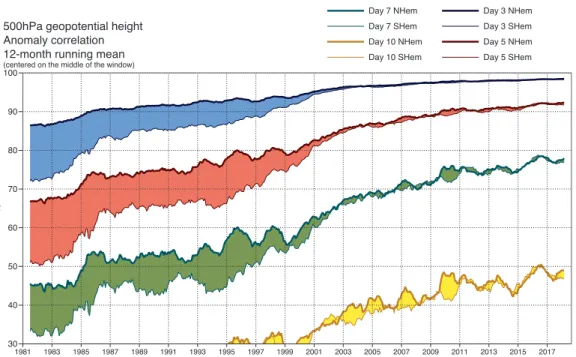
leading numerical weather prediction centers such as NOAA’s National Centers for Environmental Prediction (NCEP) and the European Centre for Medium-Range Weather Forecasts (ECMWF) have been improving rapidly—a modern 5-day forecast is as accurate as a 1-day forecast in 1980, and useful forecasts now reach 9-10 days into the future (Figure 1b) (1). Predictions have improved for a remarkably broad range of hazardous weather conditions,
15
including hurricanes, blizzards, flash floods, hail, and tornadoes, with skill emerging in predictions of seasonal conditions.
A 2009 study found that US adults obtain weather forecasts an astounding 300 billion times per year, from a great range of sources (2). That study also found the value of weather forecasts to US households is $31.5 billion, from public expenditures of just $3.4 billion and private
20
expenditures of $1.7 billion, yielding benefits more than 6 times costs (2). Studies in other nations similarly have found that the investment in weather forecasting pays large dividends, ranging from 3 to 10 times costs (3). The value of weather predictions is further confirmed by the rapid growth of businesses purchasing customized commercial forecasts from the private weather enterprise, which is increasing in capitalization, employment and innovation (4).
25
Why forecasts are improving
Three key developments enabled these advances in forecast skill: Better and more extensive observations, better and much faster numerical prediction models, and vastly improved methods of assimilating observations into models. Remote sensing of the atmosphere and surface by
30
satellites provides valuable information around the globe many times per day. Much faster computers and improved understanding of atmospheric physics and dynamics allow greatly improved numerical prediction models, which integrate the governing equations using estimated initial and boundary conditions.
At the nexus of data and models are the improved techniques for putting them together. Because
35
data are unavoidably spatially incomplete and uncertain, the state of the atmosphere at any time cannot be known exactly, producing forecast uncertainties that grow into the future. This “sensitivity to initial conditions” can never be overcome completely. But, by running a model over time and continually adjusting it to maintain consistency with incoming data, the resulting physically consistent predictions can greatly improve on simpler techniques. Such data
40
assimilation, often done using four-dimensional variational minimization, ensemble Kalman filters, or hybridized techniques, has revolutionized forecasting.
3
Sensitivity to initial conditions places strong limits on long-term forecast skill—the details of weather cannot be predicted accurately, even in principle, much beyond roughly two weeks. But weather forecasts are not yet strongly constrained by this limit, leaving optimism for continuing forecast improvement (5). Sensitivity to initial conditions varies greatly in space and time, and an important but largely unsung advance in weather prediction is our growing ability to quantify the
5
uncertainty by using large ensembles of numerical forecasts starting from slightly different but equally plausible initial states, together with perturbations in model physics.
Several features of the weather system are notably more persistent than day-to-day weather, allowing accurate predictions further into the future with even greater scope for improvement. For example, the Madden-Julian Oscillation (MJO) moves eastward around the Earth’s tropics
10
over 30-90 days, affecting rain, wind, clouds and air pressure, the onset and demise of summer monsoons (6), and more, with important agricultural and other implications. El Nino/La Nina (ENSO) variability, with a typical 4-6-year recurring cycle and varying intensity, significantly affects economies around the world by impacting most weather-dependent human activities, so increased predictive skill could be used in myriad ways to improve well-being (7).
15
In parallel with improving forecasts, communication of the growing wealth of weather data has expanded greatly, enabling a timely flow of ever more detailed and accurate information to a rich diversity of users. Only a few decades ago, one had to wait for the morning newspaper or the evening news to get the latest forecast, and warnings were delivered mostly by flags, sirens, and police bullhorns. Today, detailed weather information is available at the touch of a finger on a
20
smartphone, which is rapidly becoming a vehicle for instant, geographically targeted weather alerts.
Opportunities for Further Improvement
Weather-forecast improvement is the essential first step that will enable valuable improved
25
predictions of a great range of related environmental phenomena. For example:
àHurricanes Harvey and Florence, among others, highlighted the immense damages from precipitation-driven flooding. With over 40 million people in the US living in the 100-year floodplain, far more than previously believed (8), the value of improving flood forecasts is high, requiring improvements in forecast models to better predict flooding from hurricanes (9) and
30
other sources.
àStorm surge, so important in events including Superstorm Sandy, is increasing with sea-level rise, but depends sensitively on tides, wind, and atmospheric pressure interacting with the detailed coastal configuration, requiring dedicated forecasting driven by accurate weather predictions.
35
àSummertime sea-ice loss is opening the Arctic to shipping, recreation, resource extraction and other activities, but seasonal sea-ice regrowth heightens dangers; recent work shows bright prospects for sea-ice forecasts extending more than a month into the future (10).
àWildfire activity has been high recently, with important air-quality impacts. NOAA is
developing the High Resolution Rapid Refresh-Smoke (HRRR-Smoke) system to provide timely
40
4
àWeather drives many changes in animal behavior, which can be anticipated by weather forecasters to good effect. For example, forecasts of bird migrations can now “…reduce collisions with buildings, airplanes, and wind turbines; inform a variety of monitoring efforts; and engage the public” (11).
àAs renewables come to play an increasing role in power systems, forecasting the availability
5
of sun, wind, and river flow will take on increased importance, as will forecasts of energy demand, a large part of which is driven by weather.
Modeling centers are increasingly integrating efforts across timescales, from short-term weather to climate. Forecasters are progressing rapidly at the subseasonal to seasonal time scales, on MJO (12) and other phenomena. In the US, additional efforts by NOAA to improve forecasts at
10
the subseasonal to seasonal scale were legally mandated in 2017.
Climate models have shown skill in projecting many changes, including global mean surface temperature, and the rise of absolute humidity with the associated increase in especially intense precipitation when conditions are favorable. The models, however, remain challenged to project regional shifts. While one cannot guarantee that improved weather forecasts will lead to
15
improved regional projections, progress seems likely (13).
Ways forward
To take advantage of the growth opportunities listed above, and more closely approach the limits of predictability for weather and associated hazards at various temporal and spatial scales, the
20
entire community can strategize research and investments. The following areas are likely to be especially fruitful:
àMaintain and improve data collection, targeting regions and times of special interest, and assimilating targeted observations into models. For example, satellites and UAV observations can focused on hurricanes, providing better predictions of their tracks and intensities.
25
à Improve understanding of key physical processes that are currently not well represented in numerical prediction models (e.g., air-sea and cloud-aerosol interactions). Explore the potential use of big-data science including machine learning and neural networks to identify model uncertainties, perform bias corrections, and automate the forecast process.
à Further develop advanced data assimilation techniques, to more accurately and efficiently
30
assimilate existing and future observations. For example, cloud radiances from satellites are not commonly utilized at appropriate scales. Data assimilation can be applied more broadly to data-model integration and data-model development.
àUse advances in computer technology to produce higher resolution forecasts with larger ensembles, leading to improved probabilistic forecasts, including those of hazardous weather.
35
This can be realized if governments maintain a steady schedule of investment in high-speed computing, recognizing the strong evidence that such investments will be repaid many times over in savings to the economy.
àAccelerate research and development of operational weather forecasting by improved integration with academic research and education, providing smoother career tracks and
40
5
àBring advanced communication methods to bear on the important task of delivering weather forecasts. Our ability to quantify forecast uncertainty in probabilistic terms has arguably outrun our ability to communicate such forecasts of uncertainty, but increasing engagement of
communication experts is leading to much improved ways of communicating probabilistic weather information to those who need it.
5
With strategic investments, the future of weather forecasting and related environmental services is bright, as public-private partnerships improve our well-being.
6
References
1. P. Bauer, A. Thorpe, G. Brunet, Nature 525, 47 (2015).
2. J.K. Lazo, R.E. Morss, J.L. Demuth. Bull. American Meteorological Society 90, 785 (2009). 3. A. Perrels, Th. Frei, F. Espejo, L. Jamin, A. Thomalla. Advances in Science and Research 10, 65 (2013).
5
4. National Weather Service Enterprise Analysis Report, https://www.weather.gov/media/about/ Final_NWS%20Enterprise%20Analysis%20Report_June%202017.pdf (2017).
5. K. Emanuel, F. Zhang, J. Atmospheric Sciences 73, 3739 (2016).
6. Taraphdar, S., F. Zhang, L.R. Leung, Z. Chen, O.M. Pauluis, Geophys. Res. Lett. (early online release) https://doi.org/10.1029/2018GL078804 (2018).
10
7. P. Cashin, K. Mohaddes, M. Raissi, J. International Economics 106C, 37 (2017). 8. O.E.J. Wing et al., Environ. Res. Lett. 13, 1 (2018).
9. F. Zhang, Y. Weng, Bull. American Meteorological Society 96, 25 (2015). 10. L. Zampieri, H.F. Goessling, T. Jung, Geophys. Res. Lett. (early online release) 10.1029/2018GL079394 (2018).
15
11. B.M. Van Doren, K.G. Horton, Science 361, 1115 (2018). 12. H. Kim, F. Vitart, D.E. Waliser, J. Climate, (early online release,
https://doi.org/10.1175/JCLI-D-18-0210.1) (2018).
13. G. Krinner, M.G. Flanner, Proc. Natl. Acad. Sci. U.S.A. 115, 9462 (2018).
7
Acknowledgments: We thank colleagues at the American Meteorological Society and
elsewhere. We acknowledge partial support from the National Science Foundation under grant OPP-1738934. All authors contributed equally to the content and writing of this perspective. We know of no competing interests. No original data were used in this Perspective.
8
Figure 1a. NOAA National Hurricane Center forecast errors for Atlantic basin tropical storms and hurricanes, showing the rapid improvement in accuracy.
https://www.nhc.noaa.gov/verification/verify5.shtml https://www.weather.gov/disclaimer
9
Figure 1b. Improvement in forecast accuracy over time. The correlation between forecasts and subsequent weather is shown for forecasts 3, 5, 7 and 10 days into the future, for northern and southern hemispheres. A value of 60% is generally considered useful, and 80% is highly accurate. Updated from (1).
5 https://www.ecmwf.int/en/forecasts/charts/catalogue/plwww_m_hr_ccaf_adrian_ts?facets=undef ined&time=2018101100 30 40 50 60 70 80 90 100 % 1981 1983 1985 1987 1989 1991 1993 1995 1997 1999 2001 2003 2005 2007 2009 2011 2013 2015 2017
(centered on the middle of the window)
12-month running mean Anomaly correlation 500hPa geopotential height
Day 10 SHem Day 10 NHem Day 7 SHem Day 7 NHem Day 5 SHem Day 5 NHem Day 3 SHem Day 3 NHem