The Affordance-Based Concept
by
Peter John Gorniak
SACHUsTrS IOF TECHNOLOGY
B.Sc., University of British Columbia (1998)
LEPi1
2005
M.Sc., University of British Columbia (2000)
Submitted to the Program in Media Arts and Sciences,
LIBRARIES
School of Architecture and Planning,
in partial fulfillment of the requirements for the degree of
Doctor of Philosophy in Media Arts and Sciences
at the
MASSACHUSETTS INSTITUTE OF TECHNOLOGY
September 2005
@
Massachusetts Institute of Technology 2005. All rights reserved.
Author
Program in Media Arts and Sciences
August
5,
2005
Certified by
Deb,<Roy
Associate Professor
Program in Media Arts and Sciences
Thesis Supervisor
Accepted by
C
Andrew B. Lippman
Chair, Department Committee on Graduate Students
Program in Media Arts and Sciences
The Affordance-Based Concept
by
Peter John Gorniak
Submitted to the Program in Media Arts and Sciences, School of Architecture and Planning,
on August 5, 2005, in partial fulfillment of the requirements for the degree of
Doctor of Philosophy in Media Arts and Sciences
Abstract
Natural language use relies on situational context. The meaning of words and utterances depend on the physical environment and the goals and plans of communication partners. These facts should be central to theories of language and automatic language understanding systems. Instead, they are often ignored, leading to partial theories and systems that cannot fully interpret linguistic meaning.
I introduce a new computational theory of conceptual structure that has as its core claim that concepts are neither internal nor external to the language user, but instead span the objective-subjective boundary. This theory proposes interaction and prediction as a central theme, rather than solely emphasizing deducing, sensing or acting. To capture the possi-ble interactions between subject and object, the theory relies on the notion of perceived
affordances: structured units of interaction that can be used for prediction at certain levels
of abstraction. By using perceived affordances as a basis for language understanding, the theory accounts for many aspects of the situated nature of human language use. It provides a unified solution to a number of other demands on a theory of language understanding in-cluding conceptual combination, prototypicality effects, and the generative nature of lexical
items.
To support the theory, I describe an implementation that relies on probabilistic hierarchical plan recognition to predict possible interactions. The elements of a recognized plan provide an instance of perceived affordances which are used by a linguistic parser to ground the meaning of words and grammatical constituents. Evaluations performed in a multiuser role playing game environment show that this implementation captures the meaning of free-form spontaneous directive speech acts that cannot be understood without taking into account the intentional and physical situation of speaker and listener.
Thesis Supervisor: Deb K. Roy
The Affordance-Based Concept
by
Peter John Gorniak
Thesis Committee:
A dvisor
Deb K. Roy
Associate Professor
Program in Media Arts and Sciences
Massach
Institige of Technology
Thsis6 Reader '''- ( /
Professor Daniel C. Dennett
Professor of Philosophy
Tufts University
77-, / X,
Thesis Reader
Allen L. Gorin
Director, Human Language Technology Research
National Security Agency
Thesis Reader
Professor LeslieP Kaelbling
Professor of Computer Science and Electrical Engineering
Massachusetts Institute of Technology
Acknowledgements
Most importantly, I must thank my thesis supervisor, Deb Roy. He has given me the chance to help define and explore a new and exciting research focus. His ability to maintain his independence from established specializations and yet draw from and give back to a rich set of collaborators and communities continues to inspire me. Daniel Dennett has over the years offered his broad and deep perspective on my research endeavours, questioning my assumptions and relaying the exciting relevant theories he and others have put forward. Leslie Kaelbling and Allen Gorin critiqued this thesis and its accompanying defence talk and ensured it was appropriate for all the its embedding research areas.
The MIT Media Laboratory provided a unique and always inspiring research home for my Ph.D. work. Its research and artistic freedom as well as its sheer diversity remain unsur-passed. I would especially like to thank members and mentors of the Cognitive Machines, Synthetic Characters, Robotic Life, Affective Computing, Human Dynamics and Music Mind and Machine groups, as well as the Student Committee.
David Thomson deserves credit for commenting on the first draft of this thesis, and for playing endless hours of Neverwinter Nights with me, which both gave me the idea for the studies presented here and carried me through my degree without losing sight of what this is all about. The speech group at Sun Microsystems, especially Phillip Kwok, helped with many of the speech recognition aspects of my work.
I would also like to take this opportunity to thank some of my mentors and friends who have provided me with opportunities and inspiration over the years, and who I have to thank for preparing me for my work here at MIT. They include Josh Tenenbaum, David Poole, Alan Mackworth, Alan Richardson, Julyet Benbasat, Mark Maclean and Anette and Ian Niefiendt-Umlauff.
My parents have been enthusiastic and proud supporters of my academic work and early on instilled a love for research and the mind in me.
Finally, I can only hope to be as invaluable for my wife Cydney's time at MIT and future ahead as she has been and will be for mine.
Contents
Abstract
1 Introduction
1.1 Roadmap and Contributions . . . . 2 The Problem of Concept Detachment
2.1 Non-Mental Concepts and Human Intentionality . 2.2 Requirements for Conceptual Attachment . . . . 2.2.1 Sensory Grounding . . . . 2.2.2 Prediction and Interactivity . . . . 2.3 Existing Computational Approaches . . . . 3 The ABC Theory
3.1 Affordances . . . . 3.1.1 Affordances and Perceived Affordances 3.1.2 The Structure of Perceived Affordances 3.2 Affordance-Based Concepts . . . .
3.2.1 Objects . . . . 3.2.2 Concepts and Compositions . . . . 3.2.3 Abstract Concepts, Agents and Subjects 4 An Implementation of the ABC
4.1 Hierarchical Plans . . . . 4.1.1 Probabilistic Context Free Parsing . . . . 4.1.2 Probabilistic Earley Parsing . . . . 4.2 Earley States as Perceived Affordances . . . . 4.3 Concise Environment Descriptions . . . . 4.4 A Framework for Understanding Situated Speech
4.4.1 Speech and Text Recognition . . . . 4.4.2 Language Parsing . . . . 4.4.3 Language Grounding . . . . 4.4.4 Affordance Filtering . . . . 39 . . . 40 . . . 4 1 . . . 44 . . . 46 . . . 47 . . . 48 . . . 48 . . . 49 . . . 50 . . . 52
5 ABCs in Computer Role Playing Games 57
5.1 The World of Neverwinter Nights ... ... 57
5.2 Data Collection and Annotation . . . 60
5.3 Language and Situation Modeling . . . 63
5.4 Communication Strategies . . . 66
5.5 Affordance Filters . . . 67
5.5.1 Filter Functions . . . 67
5.5.2 Speech Act Interpretation . . . 71
5.6 R esults . . . 72
5.6.1 Detailed Performance and Mistakes . . . 74
5.7 Examples of Utterance Understanding . . . 78
5.8 Future Steps towards Individuals' Mental Models . . . 79
List of Figures
4-1 Sample Event Trace . . . 43
4-2 Sample Plan Parse Tree . . . 44
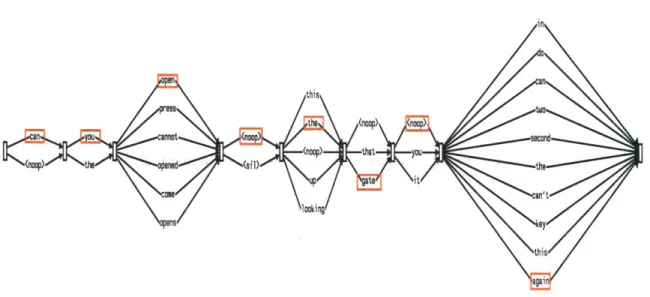
4-3 A part of a confusion network produced by Sphinx 4 for the utterance "Can you open the gate again". . . . 48
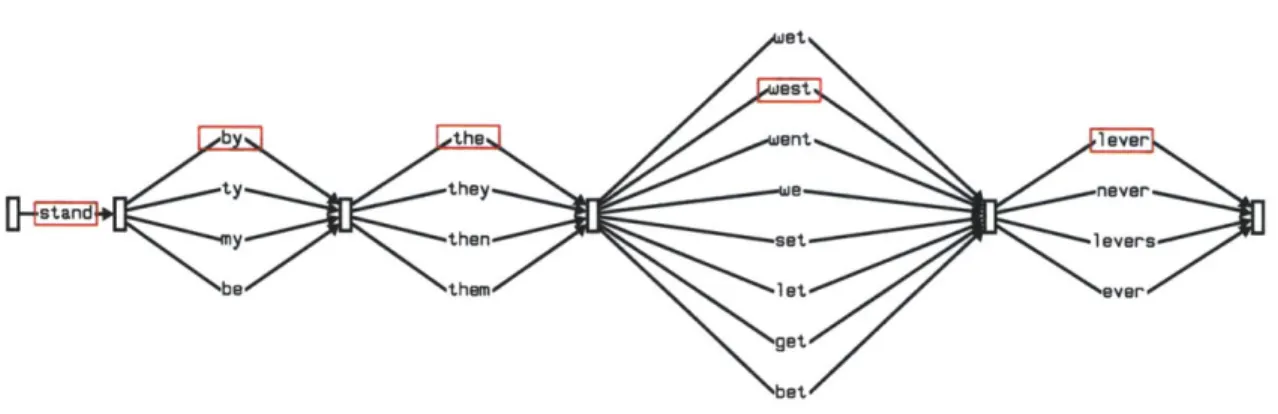
4-4 A confusion network produced by spelling correction for the utterance "Stand by the wet (sic) lever". . . . 50
4-5 A possible composition schema for grounding a constituent in ABCs . . . . 51
4-6 Simple parse tree example and affordance filters . . . 53
4-7 Filter functions applied to affordance example . . . 53
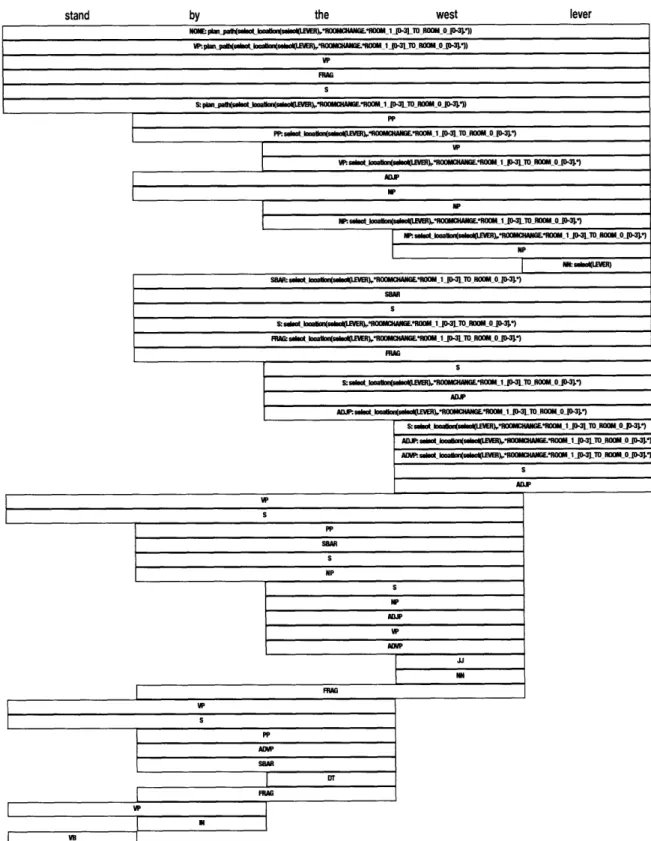
4-8 A sample parse of the utterance "stand by the west lever", including ground-ing functions . . . 55
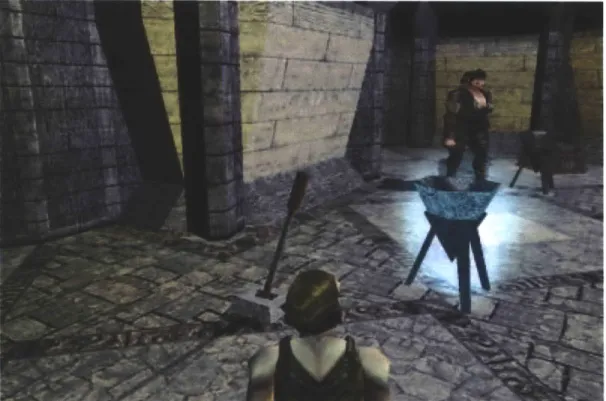
5-1 The in-game perspective of a player in Neverwinter Nights. . . . 58
5-2 The map of the module used in studies. . . . 59
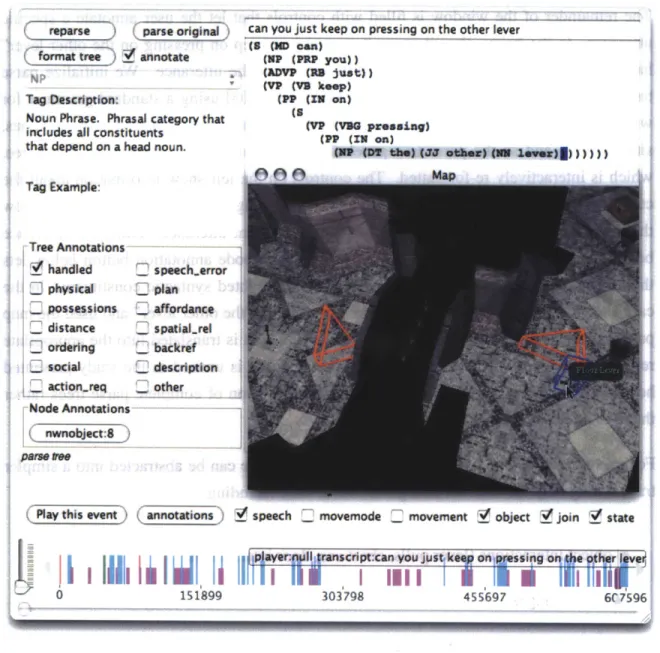
5-3 The annotation tool used to correct and annotate parse trees. . . . 61
5-4 A sample of 4 rules from the expanded affordance grammar. . . . 65
5-5 Example: Understanding "can you go to the other lever again please?" -you 80 5-6 Example: Understanding "can you go to the other lever again please?" -lever 81 5-7 Example: Understanding "can you go to the other lever again please?" -the o-ther lever . . . 82
5-8 Example: Understanding "can you go to the other lever again please?" -you go to the other lever . . . 83
List of Tables
4.1 Sample Plan Recognition Grammar Fragment . . . 42
4.2 Earley States for the Plan Parsing Example . . . 43
5.1 A Sample Event Trace Segment from a Study Session . . . 63
5.2 Words with Filter Functions . . . 71
5.3 Results of Understanding Directives in the Neverwinter Nights Puzzle Sce-nario... 73
Chapter 1
Introduction
Much of human language speaks about the world. We easily refer to objects using words such as "door" or "the blue thing for making pizza that I gave you yesterday." The relation-ship that holds between words and the world, variously and differently described by such terms as reference, intentionality and aboutness, has been the subject of many theories and debates. Most of these theories posit an intermediary step between words and the world, usually labelled as a concept. However, theories differ even on fundamental matters such as whether a concept is a mental construct of the language user, or an independent abstract entity. Only very few of these theories have computational instantiations that have been used to build larger scale natural language processing systems.
There are two highly interrelated parts to any theory of concepts: a description of the internal structure (or lack of internal structure) of a concept, and an account of how this structure comes to be about the world. In many cases, theories focus on the first and neglect the second, or at best give a vague answer to the second. Why is this? I suggest that at issue is the problem of autonomy. Human beings are autonomous in a very specific way - we interact with our immediate world ourselves, and maintain our own concepts about this world. However, we neither try to fully internalize a complete representation of the world [Brooks, 1991], nor do we individually maintain all possible concepts of our language community [Putnam, 1975]. If we are to build a machine that uses language at the human level, such a machine needs to show the same type of autonomy: it needs to be able to maintain its own concepts about its own experience, yet rely on its environment and its community to maintain most of the state of the world and the meaning of language in
general.
In building machines other than language using ones, the need for this type of autonomy is obvious: a walking robot would not be considered a walking robot if it needed to be carried by a human being to locomote. In building language using machines, however, this type of limitation is widely accepted: human beings provide input and output interpretation for these machines, alleviating the need for the machine itself to maintain any sort of inten-tionality. Thus, a machine connecting words to other words is considered language using, though it relies on human beings to establish any sort of external meaning for its words. This is not only a failure of language using machines: theories of concepts make exactly the same mistake. It is true that for other problems the human solution may not always be the optimal one: perhaps a driving robot can get around better than a walking one in many cases. However, there are good reasons to build walking robots: human beings have shaped their environment to be amenable to the type of locomotion they are good at, so if a robot wants to share this environment, it better learn how to walk. The same requirement is true of language: there may be more efficient and clearer ways for machines to define concepts without the requirement that they connect to the world like human ones do, but if we are to build language using machines that speak human language, their concepts and intentionality must be of the same type and quality as the human equivalents.
The lack of a link between language using systems and the world they are supposed to speak about supports the use of theories of concepts that neglect the intentional aspects of concepts. These theories may define words in terms of other words or symbols and call these definitions concepts. I believe that if we are to build a machine that is a true language using machine in all the ways a human being is, we need to start from scratch with a new theory of concepts that emphasizes from the ground up the importance of intentionality and tightly couples the internal structure of concepts with their need to be about the world. Any theory that draws a clear line between concepts and the world is doomed to support detached concepts that lose their intentionality. In this thesis, I provide a theory that refuses to draw such a line. Instead, it proposes that every structural element of every concept must cross over from the concept to the world, that every concept is both a property of the language using system, and of its relation to the the embedding world. These structural elements are called affordances, yielding a theory of Affordance-Based Concepts.
The Affordance-Based Concept provides a solution to the need to take into account the intentional link between the language user and the world by making predicted
interac-tions its core elements. By doing so, it also yields a substrate that addresses many other demands of a theory of concepts that have been only addressed individually before. For example, perceived affordances are naturally ranked according to typicality and context, addressing the prototypicality effects often exhibited by human concepts. Similarly, the rich predictions made by Affordance-Based Concepts naturally lend themselves to concep-tual composition. In fact, as I will show in the implementation provided here, concepconcep-tual composition can be cast as a filtering process on the complete set of affordances a situation yields. Finally, hierarchical sets of affordances give an intuitive framework for performing conceptual generalization and abstraction.
The computational realization of this theory employs plan recognition to model the link be-tween the language user and the world. In recognizing a language user's plans, it maintains sets of plan states that capture predictions about the language user relative to the structure of the world at a specific level of abstraction. These hierarchically organized probabilistic state sets correspond to the notion of affordances just introduced. In understanding lan-guage, then, the implementation introduced in this thesis understands speech by linking grammatical constituents to sets of plan recognition states. By doing so, it grounds lan-guage in a substrate that naturally represents concrete and abstract objects together with their possible interactions as sets of affordances. An evaluation using a probabilistic Earley parser as a plan recognizer to understand situated commands in a multiuser computer role playing game shows that this implementation leverages the perceived affordances to under-stand situated directives. It also provides examples of reasoning over past affordances to understand complex utterances.
1.1 Roadmap and Contributions
This thesis casts the problem of understanding situated language as that of using words and linguistic structure to filter the set of perceived affordances relevant at the time of an ut-terance. Perceived affordances, mental representations that summarize the past and predict the future at a single level of abstraction, represent a subject's possible past, current and future interactions with the situation. Language, or in the case of the studies presented here a linguistic command, filters the state of all perceived affordances down to those implied by the utterance used, resulting in a concept consisting of perceived affordances. This
concept can be used to predict the next action of someone listening to the command (as it is in the studies presented here), or more generally to capture the intended effect of an utterance taking into account the physical situation and intentional context of speaker and listener. In the course of casting concepts anew as bundles of perceived affordances this thesis sketches solutions to standing problems such as conceptual abstraction and compo-sition, and that of reasoning about other minds, and it provides constrained instantiations of the proposed solutions in the context of understanding commands in a computer role playing game. This thesis thus moves beyond the current state of the art in language under-standing by tying language to the elements of a dynamic, intentional representation of its embedding situation.
Chapter 2 To support the need for a new theory of concepts, I critique other proposed solutions, especially ones attempting to bridge the gap between concepts and the world and show how they fall short of embedding the concept in the world. With support from other recent work in Philosophy and Cognitive Science, I arrive at an interaction based theory of concepts that forces every conceptual element to represent a part of the world by making a prediction about it. In this way, concepts are the basic elements of reasoning and can be falsified when their predictions do not come true. I draw on the theory of affordances, which focuses on perceived possible interactions between an agent and the world, to flesh out the theory.
Chapter 3 To support the new theory, I then provide a computational implementation of the proposed theory using the notion of plan recognition via hierarchical parsing. The implementation supports global hierarchical plan recognition of two actors in a constrained environment, and proposes the idea of using linguistic analysis to filter the results of plan recognition to achieve understanding. It performs plan recognition via probabilistic Earley parsing, and ties the notion of an affordance to an Earley state used to summarize past actions and predict the future at one level of the parse forest hierarchy. Language is also analysed by a parser, which builds up a filter expression used to limit the set of Earley states considered to be a valid interpretation of an utterance.
Chapter 4 This chapter applies the implementation described in Chapter 3 to the concrete problem of understanding spontaneous language used by players of online role ing games. Such games provide a rich interaction environment embedding the
play-ers' characters, and the theory introduced in Chapter 2 proves useful in modelling the affordances of the environment and linking its action possibilities to the language used by the players. Specifically, the studies address the problem of understanding directives in a co-operative two player puzzle by predicting the listener's next action based on plan recognition filtered by linguistic analysis. The chapter also sketches
Chapter 2
The Problem of Concept Detachment
Adopting any given theory of concepts imposes a bias, because every theory emphasizes certain features of concepts to the detriment of others. There are thus always a host of objections to any theory. Some of these objections simply note that the theory does not cover some features, for example that a definitional theory of concepts does not explain the existence of prototypical concepts. Other criticisms are offered at a more abstract level, claiming that there are insurmountable theoretical problems with a given solution. An example of such an attack is the claim that any solution that represents concepts by their relation to each other leads to meaning holism, where any change to one concept changes all concepts at once. Laurence and Margolis as well as Prinz give good overviews of current theories of concepts and the debates surrounding them [Laurence and Margolis,
1999; Prinz, 2002].
In my view, however, many problems with traditional theories stem from a fundamental bias of their creators: that the use of concepts by an actual language using system, and thus their connection to the world, is secondary to their internal structure and formal properties. This is a persistent human bias visible also from the first attempts to create intelligent com-putational systems: human beings believe that what is easy for them, namely perceiving and acting on the physical world, must generally be easy problems. More "abstract" men-tal feats, however, such as playing chess or providing word definitions, seem to be harder problems to us. Artificial intelligence quickly foundered on this bias, because building sys-tems that could sense and act like human beings turned out to be very difficult, and still remains an unsolved problem today. Theories of concepts do not have this built-in bias
detector, because most of the people proposing new theories do not implement them in an artificial system with wide coverage, but rather pick and choose examples from human lan-guage use that they can explain. To compound this problem, researchers actually building language using systems have a cheat available that those building sensing and acting ma-chines do not have: they can de-couple the more abstract mental use of concepts from their connection to the world, by using a conveniently available natural mechanism to substitute for the ability of their system to make this connection: actual human beings. Thus, current day artificial language using systems live in a world of symbols which connect to other symbols in a myriad ways. At the beginning and at the end, however, there is always a human being feeding in the original symbols and interpreting the final ones. Thus, internet
search engines [Brin and Page, 1998], automatic essay grading programs [Valenti et al., 2003] and text summarization tools [Paice, 1990] show impressive performance and are very useful. They cannot, however, autonomously use language without the human being
serving as input and output converters.
I believe that many of the criticisms and recently proposed theoretical solutions are con-cerned with this underlying problem of Concept Detachment that both traditional theories of concepts and computational language systems share. In the following, I will relay some of these criticisms and proposals in my own words, and show how they relate to the problem of concept detachment.
2.1
Non-Mental Concepts and Human Intentionality
At its most extreme, concept detachment takes the form of the claim that concepts are not mental constructs at all, but rather are abstract entities that attach to language independent of a specific language user. While some state this view explicitly, such as Frege does when presenting his notion of sense, it is implicit in a number of theories by virtue of their lack of attention to the mechanisms of conceptual attachment [Frege, 1892]. Alternatively, a num-ber of theorists claim that there is something special about the way that human beings attach their concepts to the world, so special that a computational machine could not possibly have the same kind of intentionality. Thought experiments like Searle's Chinese Room scenario purport to show this impossibility [Searle, 1980]. Both the view that concepts attach to the world independently of the language user, or that they attach through the language user, but
in a way that is not computationally explainable, lead theorists to feel like they do not have to tell a story about how concepts connect to the world. This is not the place for a full refuta-tion of these arguments, especially as such a refutarefuta-tion has been eloquently given by others (many of these arguments are included with Searle's original publication). Suffice it to say that if one is interested in building machines that attain human level autonomous language use, they are not arguments that lead forward. To use Dennett's phrase, these thought exper-iments only work due to a failure of imagination [Dennett, 1992]. I thus assume a position very similar to Jackendoff's and Barwise and Perry's: that there is no magic in how con-cepts attach to the world, and that this attachment is a fully computationally explainable, if complicated, relationship between the language user and the world [Jackendoff, 2002; Barwise and Perry, 1983]. It is this attachment that should be the main subject of study if we are to move forward with a useful theory of concepts. It follows that if it is compu-tationally explainable, it is also compucompu-tationally implementable and there is no reason in principle why a machine cannot have exactly the same kinds of intentionality that human beings have.
Interestingly, most computational manifestations of concepts reveal the same implicit as-sumptions by not providing any details of how the data structures used as concepts attach to the physical or virtual world they are about. As these programs are often billed as language understanding systems, this either means that even computer scientists do not believe that machines can have intentionality, or that their hope is that language attaches to the world independently of language users. The first belief seems like giving up the quest for hu-man level intelligent machines without a fight, whereas the second has only led to systems that need human interpreters for input and output. It is hard to see how either justification allows room for autonomous language using machines.
2.2
Requirements for Conceptual Attachment
Accepting the position that concepts are mental constructs of the language user, there are two overarching requirements for a theory of concepts. It must detail the structure of a concept and how it can be used computationally, and it must tell a story about how this mental structure attaches to the world through the language user's perception and action. These two requirements are inextricable, and as we will see in the following it is a mistake
to treat one without the other.
2.2.1
Sensory Grounding
The most straightforward attempt to fulfill the two requirements of detailing the structure of concepts and explaining how they are attached to the world consists of taking an existing theory of concepts, such as the definitional one, and adding a link from each symbol to some sensing machinery. This is exactly Hamad's scheme [Hamad, 1990]. Here, a set of basic symbols is supported by sensory categorization machinery - a connectionist network, in Hamad's proposal. Each of these symbols thus becomes connected to the world by its categorizer's ability to pick out members of the concept from sensory input. There are a number of systems that have been built according to this paradigm, including some of our own [Roy et al., 2002; Roy, 2002]. These systems often address additional aspects of this type of grounding, such as how categories are learned by the language user [Roy, 2003]
and how concepts grounded in this way can be combined [Gomiak and Roy, 2004].
There is no denying that sensory grounding is a very important aspect of language un-derstanding. One can note immediately, however, that the systems resulting from this paradigm are severely limited in several ways. While it is to be expected that at least initially only basic words can be directly grounded in sensory perception, it is more in-teresting that these systems are almost entirely without a purpose of their own: they are programmed to interpret or produce descriptions, and have no choice but to interpret or produce descriptions. Practically, thus, these systems are severely limited by having no desires of their own, and no ability to model other's desires. Responding to anything other than hardcoded commands, or acting autonomously to reach goals, are thus out of the ques-tion. In fact, even representing actions and understanding language about actions is at best an afterthought in these systems.
There are a few examples of language using systems that use words to label actions. Some of them simply perceive actions of others and label them, making them in a way equiva-lent to systems that label other features of the world they perceive [Siskind, 2001]. Other systems are based purely on a representation of action, but do not perform what we would normally call perception -in fact, while they represent action they do not actually act them-selves, but rather understand language in terms of their built-in action representations [Bai-ley, 1997; Narayanan, 1997].
2.2.2
Prediction and Interactivity
There remain looming theoretical and practical problems for proposals of language ground-ing systems that treat perception and action separately. Separatground-ing perception and action leads one to see the perception process as a type of encoding. That is, a mental representa-tion of an external object funcrepresenta-tions as a representarepresenta-tion due to the fact that there is a close correspondence between object and representation. The theoretical objection levelled by critics like Millikan and Bickhard is that any correspondence-based theory does not allow room for errors [Millikan, 1993; Bickhard, 2001]. A correspondence representation either corresponds or does not correspond to an object - there is no sense in which it corresponds to the wrong object. Being wrong, however, is clearly a feature of mental representations, one that is crucial for basic processes like reasoning and learning.
This objection may seem unimportant to practical systems. After all, several of them learn correspondences without problems. It is important to note, however, that when they learn, the correctness of the correspondence is judged by a human observer. Take, for example, Toco, a small robot that learns an audio-visual word dictionary by listening to a teacher's speech and observing various objects named somewhere in the speech [Roy, 2003]. The robot is equipped with an algorithm that lets it find the English sounds for words like "ball" or "red" from the speech stream, together with their visual correspondences. The fact that this is the correct correspondence only stems from the fact that its designer meant for Toco to learn English words corresponding to visual features. If Toco randomly paired sounds with visual features, or, for that matter, if Toco were to spontaneously start dancing while reciting Kant in the original German, this would not be wrong behaviour for Toco itself, but only wrong given the context of Toco's purpose imposed externally by its designer. The problem that stems from viewing representation as correspondence is thus very similar to the original problem of designing language using systems that do not connect words to the world: such systems need a human being as a judge of whether their actions are correct and meaningful or not. Meaning, therefore, stays external to the system.
Now, perhaps this is not a problem. Millikan argues that normative function, which lets you say that a heart isfor pumping blood and that "red" is meant to refer to a specific perceived colour is determined by evolutionary history for natural systems. Similarly, we could argue that Toco's use of "red" is correct if Toco was designed to learn English. Here we run into another problem, however. While it is imaginable that we design a system that uses the
English language with greater sophistication than Toco, what we are after is ultimately a system that uses a natural language just like human beings use a natural language. We are thus attempting to align our design process with the outcomes of evolution. While this is abstractly true, it does not provide much guidance for the detailed design process.
A more useful view of normative function, put forward by Smith and Bickhard, proposes that representation arises from the need for prediction, and stays intimately coupled with prediction [Smith, 1996; Bickhard, 2001]. This view is useful, because it allows for nor-mativity within the conceptual system itself: the system makes a prediction based upon its representation of the world, and the world either develops according to the prediction, or it does not. Smith goes as far as to claim that this use of mental representations for prediction is what leads to the distinction between subject and object, between representer and repre-sented in the first place. He argues that subject and object must engage in an intentional
dance to be subject and object: the subject must internalize some structure of the world
and make a prediction based on this internalization, and the world has to be structured such that it allows for predictions to be successful, thus becoming an object. Most importantly, representation is cast as an active process that fuses perception, representation and action into a unified conceptual system where one cannot exist without the other two.
There are aspects of this unified conceptual structure in some artificial systems: some sys-tems learn by reinforcement, thus evaluating their predictions and model of the world based upon feedback from the world [Sutton and Barto, 1998]. However, especially in symbolic reasoning systems, which language using systems must on some level be due to the sym-bolic nature of language, it seems a common trend to separate perception and action. As discussed, these systems assume a more or less simple correspondence between perception and the symbols used, and maintain a separate system for making decisions and acting, if they have one at all. While the perception and the action systems obviously communicate in some way to produce reasonable behaviours, this communication is an afterthought. I have argued in this chapter that the link between perception, representation and action should be the central design issue for a language using system. To move forward based on this premise, however, we need a basic representation unit that can be used for perception and prediction. In the following, I argue that the notion of an affordance is exactly such a unit. While the theory introduced in the next chapter is general in nature, it should be seen as a proposal and outline with partial support from the implementation and studies that follow in the subsequent chapters. Many of the linguistic aspects of the implementation are
simple, and blatantly ignore discourse history to focus on taking into account intentional and physical history. This is a deliberate decision, because discourse history has been proposed as a way to analyse intentions and recover plans before, whereas intentional and physical history has been left unaddressed [Allen and Perrault, 1980; Litman and Allen, 1984; Stone, 2001]. This decision means that treatment of anaphora, and linguistic analysis in general are somewhat simplistic in favour of emphasizing the connection to the situation model given by the physical and intentional analysis. Similarly, while suggestive and used as a model to analyse and predict human behaviour in this thesis, there is not yet evidence for the proposed theory beyond the studies shown here, so its psychological reality should be considered in that light.
2.3 Existing Computational Approaches
Winograd's SHRDLU was one of the first situated language understanding systems [Wino-grad, 1970]. In fact, it still stands today as one of the most sophisticated ones, without much followup work to surpass it. SHRDLU uses a relatively static, symbolic representa-tion of the situarepresenta-tion and keeps the user's plans distinct from the physical (logical) situarepresenta-tion. Plans in SHRDLU are only implicitly encoded in the form of procedures applied due to the language used. In the work presented here, the situation includes a noisy estimate of the language user's plans in a highly dynamic situation. The situation thus requires categoriza-tion and representacategoriza-tion in order to be tied to language, which in turn requires interaccategoriza-tion and prediction on the part of the language understanding system. SHRDLU thus commits to the problematic assumption of the separation of linguistic concepts from the world they are about that was discussed in the previous sections.
Chapman's work describes a semi-autonomous agent in a game that follows simple linguis-tic instructions [Chapman, 1991]. While touching on elements of interaction and planning, this work de-emphasizes the linguistic component in favour of focusing on a model for interactivity. This thesis expand on that work by introducing a strong language element to cast the elements of interactivity and prediction themselves as the basis for a linguistic system.
In our own work, we have introduced both visually situated language understanding sys-tems [Gorniak and Roy, 2004] as well as interactive conversational robotic syssys-tems [Hsiao
et al., 2003]. While grounded in visual perception and pioneering the linguistic parsing and
incremental grounding strategies that lead to the work under discussion here, the former only considers language with little purpose. All of its interactions are pure visually refer-ring expression with the single purpose of communicating their referent. Here, I propose that determining the purpose behind an utterance is of prime importance to understanding its meaning. Along similar lines, our robotics work has led Roy to propose a theory for grounding linguistic concepts in physical interaction [Roy, 2005]. That work complements that presented here as a proposal for linguistic meaning based on interactions with the world at a far more detailed and fine grained of experience than considered here. In the future, we hope to give an account that encompasses both the level of representation discussed there as well the more abstract and broader interactions under investigation here.
Modem non-situated spoken language understanding systems usually attempt to fill slots in queries necessary to perform database retrievals, such as for providing flight or weather information [Zue et al., 2000; Schwartz et al., 2004]. Any recognition of the user's plans relies solely on the language used, and does not take into account the dynamics of an evolving situation - mainly because these systems do not allow the situation to evolve in interesting ways. Similarly, it is unclear how to tie a richer yet static database of symbolic knowledge such as Cyc to the dynamic situations in which most speech occurs [Lenat, 1995]. Similar to the work presented here other authors have proposed plans and plan recognition as important elements for language understanding [Pollack, 1986; Litman and Allen, 1984; Allen and Perrault, 1980] . Again, however, their view of plan recognition includes only the language used in a discourse, not the dynamic physical and intentional external situation of the discourse.
Horswill's approach to merging symbolic computation with realtime perception and robotic action has an important parallel to the work described here in its use of tags [Horswill, 2001]. Tags connect different parts of the framework by marking operations as being about the same object or role. Implicitly, this connects a set of operations that can perceive, pre-dict and act on a structural element of the world, making them similar to the notion of perceived affordances introduced here. The difference lies in the fact that affordances are represented explicitly and based on plan recognition in the work presented here, whereas they connect different sub-systems in Horswill's work. Having different representations of the same concept is an important topic not addressed here, but having an explicit structural element called an affordances allows more sophisticated reasoning and prediction of the
type employed in language understanding in the following chapters. The two contributions are thus complimentary, and it stands to reason that the higher level reasoning and under-standing employed here would benefit from integration with a lower level perception and action system in the case of a robotic platform.
In the field of language parsing, there exist many efforts to map parse structures to logical form [Zettlemoyer and Collins, 2005; Haddock, 1989; Schuler, 2003]. While this problem is very similar to the mapping performed here between parse structures and functional call structures, it is only one aspect of the overall problem of taking an interactive external situation into account to perform language understanding. None of these works address anything but static, symbolic (usually logical) language groundings.
The implementation introduced here relies on hierarchical plan recognition based on ob-serving a sequence of actions given a generative model to perform planning. While much work and many systems exist that produce hierarchical plans given goals, especially in the popular framework of HTN (Hierarchical Transition Network) planning [Erol et al., 1994; Nau et al., 2003], there exists considerably less work on applying similarly expressive and structured models to probabilistic plan recognition. Except for the use of parsers employed in the work presented here [Bobick and Ivanov, 1998; Pynadath and Wellman, 2000], the use of Abstract Hidden Markov models has been suggested, which does not produce the type of modularity required here [Bui et al., 2002]. A promising new candidate is Geib and Goldman's execution model based plan recognition framework, which maintains pending action sets that could be used instead of the Earley state sets on which the work here is based [Geib and Goldman, 2005]. The advantage of a plan library based approach using HTN style methods would be a better parametrization of the plan library, and thus easier creation of and reasoning about possible plans.
Except for work explicitly related to planning and plan recognition, some authors have proposed other predictive representations for learning and acting. Drescher uses structural elements that assemble themselves into hierarchies while interacting with a simple world [Drescher, 1991]. While strongly related to the notion of affordances used here, this work does not connect to language and it is unclear how it scales to a problem of the size tackled in the studies presented in later chapters. The work does contain many insights into how affordances might be learned and organized by interacting with a situation. More recently, Littman et al. have proposed a stochastic representation of an agent's state based upon predictions of the outcome of a series of actions the agent could take [Littman et al., 2001].
These proposed representations are promising candidates for computational instantiations of affordances. However, in the implementation presented here we rely on a known plan recognition paradigm that is suitable for the complexity and structure of the scenario inves-tigated. In other situations, for example in the robotic case where action and perception are unreliable, but plans may be less complex, these other ways of working with affordances may be more suitable.
Finally, there exists work on computationally modelling affordances more abstractly as a theoretical tool to explore linguistic mechanisms [Steedman, 2002], as well as in a non-linguistic setting to model a robot's interactions with the real world [Stoytchev, 2005]. While both research areas are relevant to the work presented here, they do not address the need for a theory linking perceived affordance to linguistic concepts in an implementable fashion. They do, however, suggest other ways to encode and reason about affordances, which could enrich the work presented here in the future.
Chapter 3
The ABC Theory
The theory of Affordance-Based Concepts provides a solution to the problem of concept detachment outlined in the last chapter. The nature of its basic units, perceived affordances, ensures that it provides the linked triplet of perception, representation and prediction at the most basic level. The theory therefore produces concepts connected to the real world in the strongest possible sense, doing away with problems of passive perception and lack of normativity. I describe the theory in this chapter, and a computational instantiation that captures many aspects of the theory in the next chapter.
3.1 Affordances
The last chapter ended by pointing out the need for a mental structure that incorporates per-ception, representation and prediction aspects into a coherent unit. This section introduces the notion of a perceived affordance to fulfill this need.
3.1.1 Affordances and Perceived Affordances
The term affordance was coined by Gibson in 1977 [Gibson, 1977]. Working in the field of visual perception, Gibson was responding to what I have called correspondence theories of perception. Rather than focusing on image-like representations that are similar to, or
correspond to, the light information impinging on the retina, he proposed that perception encodes what the external world affords the perceiver. Thus, extended surfaces are per-ceived to provide support for walking on, if the surface is of an appropriate size relative to the perceiver and sturdy enough to hold the perceiver's weight, and the perceiver is actually able to walk. However, affordances are not necessarily perceived. They are relationships between an actor and the environment embedding the actor that hold independently of the actor perceiving them. I therefore distinguish between affordances and perceived affor-dances - those that the actor perceives and thus mentally represents.
Affordances are unique in that they are primitive aspects of the physical makeup of the world that are neither objective nor subjective. They span the objective-subjective bound-ary. There is no sense in which a chair affords sitting on, unless we assume someone who is doing the sitting relative to the chair: the sitter must be of the right size and weight to get onto the chair and be supported by it. Thus, a human sized chair affords sitting for an adult human actor, but not for a horse. A chair might also afford picking up and throwing for adult humans, but not if it is bolted to the floor. The set of all affordances of an individual in an environment contains all possible interactions of the individual with the environment. This set is not identical to the set of perceived affordances of the individual. Neither is the set of perceived affordances a subset of the set of all affordances, because the individual may be wrong about what the environment affords it. If a person attempts (and fails) to sit on a cunningly designed object that looks like a wooden chair but is actually made out of paper, the individual perceived an affordance that did not actually hold.
Perceived affordances, as I have described them here, fulfill the requirements of a repre-sentation I arrived at in the last chapter: they are the product of perception of the world, they encode some aspect of the structure of the world relative to the perceiver, and they predict a possible interaction between perceiver and world. By implying a prediction, they can be falsified. However, not every wrong perceived affordance must be falsified. If in the preceding example the perceiver never decides to use the prediction and does not sit on the paper chair, the perceived affordance, though wrong, will never be falsified. The distinction between true and false perceived affordances is not necessarily a binary one. Agents may have degrees of belief in the validity of perceived affordances, and in fact the implementation presented in Chapter 4 maintains exactly such degrees of belief.
3.1.2 The Structure of Perceived Affordances
An affordance concerns possible interactions between an actor and an environment, and an interaction necessarily includes a temporal element. Given a joint state of actor and environment an affordance is a possible future interaction and thus concerns at least two points in time: the current moment, and the future point of interaction, which may also be extended in time. Remember that affordances in general are not representations - they are sets of possible interactions and thus exist simply because of the physical state of the system that includes the state of the environment and the state of the actor - in short, because of the situation. Here, we are more interested in perceived affordances, which are mental representations, and thus must be finitely describable without requiring a complete description of the situation. Due to what Smith calls the flex and slop of the world, namely the property that in the macroscopic world of everyday experience effects die off with distance, it is generally possible to produce a state description of the situation that suffices to make good predictions without describing it completely. The Markov Assumption of a state in a model proposes much the same thing: that it is possible to predict the future behaviour of the system given only a simplified encoding of its current state. Perceived affordances thus include an encoding of some aspects of the current situation. There are many examples of such state encodings in the current day literature concerning decision making for artificial agents [Boutilier et al., 1999].
In addition to a state encoding, an affordance predicts a possible interaction. This prediction may be representationally explicit, such as a list of possible ways to pick up a cup, or it may be implicit, such as an encoding of the cup's geometry together with a model of possible hand movements and configurations. Both representational styles have their place at different levels of affordances. It seems unlikely that a list is a good way to represent the myriad ways to pick up a cup, but it may serve well for thinking about what to have for breakfast. In general, as Minsky points out, there are many styles of representation that are amenable for different ways of thinking about different things, or thinking differently about the same thing [Minsky, 1985]. As long as they encode state and serve to predict possible interactions, they are candidates for affordances.
An affordance addresses the possible action prediction problem at a single level of repre-sentation. In the previous example, the possible ways to pick up a cup and the choice of breakfast foods are on very different levels of representation. They are connected, however,
in that a possible breakfast choice may include pouring a cup of milk, and thus picking up a cup. To make mental representation feasible it is important to keep these levels of affor-dances related yet distinct. Keeping them distinct allows one to reason on a single level, to achieve more concise yet still approximately Markovian state encodings and to employ the representation and reasoning methods that are best for that level. Keeping them loosely connected, on the other hand, allows for predictions that span levels and lets one fill in the details of high level plans, creating a hierarchy of perceived affordances.
3.2 Affordance-Based Concepts
3.2.1 Objects
Note that so far I have not invoked the notion of objects per se - perceived affordances are about the structure of the world that can be exploited to make predictions. These structures can be below the level of everyday objects, for example when they concern the topology of a graspable surface, which may or may not be part of a larger structure that we usually label "cup". Having replaced the notion of objects with the notion of structural elements called affordances, we can now re-introduce objects as bundles of affordances. Due to the distinction between affordances and perceived affordances, we need to distinguish between objects and concepts of objects. A cup becomes the set of interactions a cup affords, as determined by its physical properties and the agent's abilities. Due the the subject-relative nature of affordances, objects thus only exist relative to subjects. Here, as in Smith's meta-physical view, an object is only an object due to its being pinned down in the structure of the world by a subject's possible interactions with the object. When we engage in an active process of representation to distinguish objects within the structure of the world, we carve out a set of local affordances in the world and consider it an object. This process is not arbitrary, however, as it exploits the pre-existing structure of the world, including our own abilities. Thus while concepts of objects are the product of our perception, rep-resentation and actions, and while we may decide to cut up the world into different sets of objects at different times, we are externally constrained in our object categorizations by our own structure and that of our environment. In that sense, objects exist in the world. Affordances and perceived affordances thus jointly address the metaphysical and the psy-chological aspects of the existence of objects. The world must provide affordances to allow
representation of objects by a subject via perceived affordances, yielding concepts of ob-jects. As this thesis concerns a theory of and mechanism for concepts, which are assumed to be mental structures, the psychological claim is of prime importance here.
3.2.2 Concepts and Compositions
Concepts of Objects are instances of the more general class of structures I call concepts. Each concept is a bundle of perceived affordances. In addition to representing concrete everyday objects at various levels, as described in the last section, concepts can represent any other sets of structures in the world. Allowing arbitrary bundles of affordances gives the Affordance Based Concept theory a unique representational power, but the use of af-fordances imposes limits as it is subject to constraints imposed by the framing structure of subject and environment. One aspect of this power is the ability to represent abstraction. If a bundle of affordances corresponds to the perceived possible interactions with a particular red cup, one meter in front of the subject, filled with hot tea, it is only a matter of adding and dropping other affordances in a coherent manner to arrive at interactions possible with hot tea cups of all colours, filled and non-filled cups, cups I drank from yesterday, containers, objects that have handles, cup-sized objects and physical objects in general. This is not a claim that the way in which affordances are added and dropped is simple, but we will see in the next chapters that such feats of abstraction can indeed be instantiated computationally. Importantly, however, using affordances gives the power to perform these abstractions, yet maintains the notions of prediction and interactivity I have emphasized throughout.
Concepts may be labelled or unlabelled if they occur in language using creatures. A dog may have mostly unlabelled concepts, with perhaps a few labels taught to it by interaction with human beings. We, on the other hand, have labels for many of our concepts. Human language is so highly spontaneously productive and shapes our thinking so much that we can come up with labels for many abstract concepts that we have never labelled before. I have already used some such labels ("objects that have handles", "the blue thing for mak-ing pizza I gave you yesterday"). It is worth notmak-ing, and I will expand on this greatly in the following chapters, that representing concepts as bundles of affordances is amenable to performing linguistically driven conceptual combination. Thus, in parsing "objects that have handles" I propose that we perform an online conceptual specification and abstrac-tion, starting with the sets of affordances labelled by some of the individual words and
combining these according to syntactic and conceptual combination rules to arrive at a set of affordances that is the meaning of the whole phrase. Importantly, also, the concepts attached to each word already contain an immense amount of information about possible interactions, thus suggesting many rich complex combinations, such as in Pustejovsky's examples of "fast car", "fast road" and "fast food" [Pustejovsky, 1995]. Many similar combinations will be computationally explained in the following chapters.
3.2.3 Abstract Concepts, Agents and Subjects
ABCs also extend to non-physical concepts. Some labelled concepts have intuitively clear constraints on interaction possibilities associated with them, such as "mass"9 or "ease of use". But I believe there is even a story of levels of affordances to be told about a concept like "freedom". As said, I do not claim that a single type of mental representation suffices to account for all possible levels and types of affordances. The following chapters intro-duce one type of framework to maintain hierarchical levels of affordances and to perform language understanding in terms of these affordances. Some meanings of a word like "free-dom" might be representable in that framework, within the limited domain addressed. We will need to develop a representationally richer framework that relies less on explicit enu-meration of affordances to cover the full human meaning of a word in terms of affordances. I do believe this is possible in the framework of possibilities of interaction, and not out of reach computationally.
Objects with agency, be they human beings, animals, machines or other things one may want to assume the intentional stance towards [Dennett, 1989], can be treated exactly like other objects under the ABC paradigm. However, the possible interactions of one agent with another are often far more extensive than those between one agent and a non-agentive world structure. For human beings, this includes being able to speak to other human beings, folding the full interactive richness of natural language into the affordance framework. A special set of affordances forms the concept of the subject, the "self". It is clear that this set is distinct from those representing other agents, though similar in many ways. As our own affordances are quite similar to those of other agents, many of the same interaction possi-bilities exist in subject-subject interaction. Thus we can convince ourselves to do certain things, we can analyse our own abilities; in short, we can conceptualize ourselves. This level of reflection about one's own abilities is one of the most powerful aspects of human
thinking. All the aspects of Affordance-Based Concepts, from linking perception to predic-tion to supporting abstracpredic-tion ("I'm good at thinking on the spot", "I have awful hand-eye coordination") play into the full range of human thought and consciousness necessary both for human thinking and for building human-level artificial thinking machines [Singh, 2005; Minsky, 1985; Minsky, to be published].
Chapter 4
An Implementation of the ABC
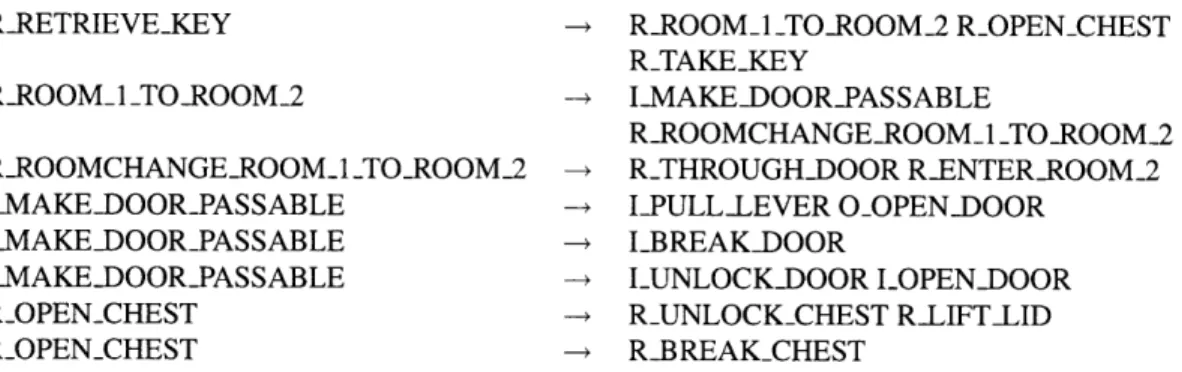
I now turn to a computational implementation of the Affordance-Based Concept theory. The implementation described here features all the aspects of ABCs:
" predictive units that capture the possible interactions at a given level of abstraction " a hierarchy relating affordances at different levels of abstraction
" a mechanism to track the current situation in terms of perceived affordances of all levels
" a set of functions to form and combine concepts from the past and current perceived affordances
" the necessary relationships linking linguistic structure to ABCs to decode language into concepts given a situation.
As the first of its kind, however, the implementation is limited in scope. While its mech-anisms are general and should be transferable to any domain and situation, it achieves co-herent treatment of hierarchical perceived affordances through uniformity: each affordance is represented in the same way. While this particular representation is useful for a number of problems and domains, I claim in no way that perceived affordances should actually be uniformly represented, or that they are so in human beings.
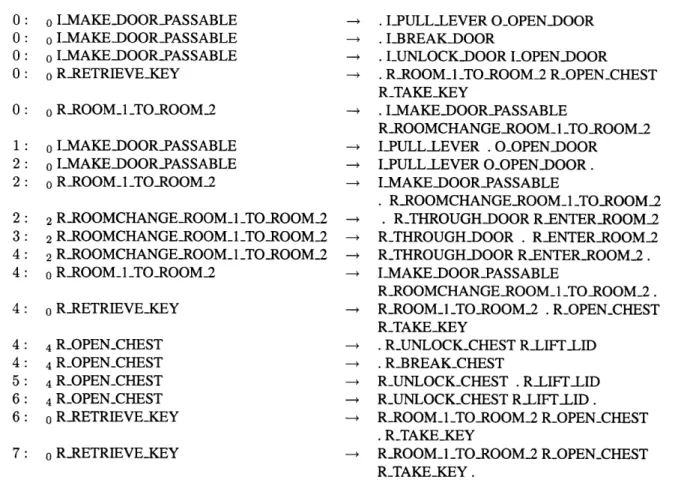
4.1 Hierarchical Plans
This implementation of affordances hinges on the notion of a hierarchical plan. A plan is a sequence of one or more steps an agent takes or considers taking. A hierarchical plan is a plan in which a top level node is expanded out into lower level nodes, with the leaves of this plan forming a non-hierarchical plan of concrete steps the agent can actually take. We explicitly or implicitly maintain hierarchical plans all the time, such as when planning to buy milk, which expands into going to the store and purchasing milk, which in turn expands into walking to the car, getting in the car, driving to the store, and so on. Hierarchical plans have the advantage of making some independence assumptions: if your goal is to buy milk, how you get to the store does not matter - you could walk, drive or bike.
Plans and planning are intimately related to perceived affordances. In fact, perceived af-fordances are the basis for planning. The current situation must contain an affordance predicting I could go buy milk, as otherwise I would not plan for it. Similarly, I will only consider driving to the store, at a different level of affordances, if I actually have access to a car, and if my encoding of the situation contains the perceived affordance of driving. Per-ceived affordances are thus not the elements of a plan, but at each step they are the possible choices a planner faces when making decisions. Thus each planner must maintain sets of affordances to perform its planning, and a hierarchical planner maintains hierarchical trees of affordances.
Note that the activities of planning and plan recognition are tightly coupled. In fact, as soon as there are two agents involved in a plan, the two activities become one and the same - to plan for two people, each individual must recognize the other individual's plan and incorporate it. In the implementation presented here, I focus on hierarchical plan recog-nition, because it allows me to model two people's intertwined affordances, model their concepts and understand their speech externally. As we will see, however, elements of planning will be necessary to understand language as well, and when building an artificial language using machine, planning takes central stage. I will outline how to proceed to a fully autonomous language using machine after describing the computational modelling of the ABCs of human speakers via plan recognition.