HAL Id: hal-02371849
https://hal.archives-ouvertes.fr/hal-02371849
Submitted on 20 Nov 2019HAL is a multi-disciplinary open access archive for the deposit and dissemination of sci-entific research documents, whether they are pub-lished or not. The documents may come from teaching and research institutions in France or abroad, or from public or private research centers.
L’archive ouverte pluridisciplinaire HAL, est destinée au dépôt et à la diffusion de documents scientifiques de niveau recherche, publiés ou non, émanant des établissements d’enseignement et de recherche français ou étrangers, des laboratoires publics ou privés.
Co-variations between plant functional traits emerge
from constraining parameterization of a terrestrial
biosphere model
Marc Peaucelle, Cédric Bacour, Philippe Ciais, Nicolas Vuichard, Sylvain
Kuppel, Josep Peñuelas, Luca Belelli Marchesini, Peter Blanken, Nina
Buchmann, Jiquan Chen, et al.
To cite this version:
Marc Peaucelle, Cédric Bacour, Philippe Ciais, Nicolas Vuichard, Sylvain Kuppel, et al.. Co-variations between plant functional traits emerge from constraining parameterization of a terrestrial biosphere model. Global Ecology and Biogeography, Wiley, 2019, 27 (9), pp.1351-1365. �10.1111/geb.12937�. �hal-02371849�
Co-variations between plant functional traits emerge from constraining 1
parameterization of a terrestrial biosphere model. 2
Running title: Functional traits variability inferred from data assimilation 3
4
Marc Peaucelle1,2, Cédric Bacour3, Philippe Ciais1, Nicolas Vuichard1, Sylvain Kuppel4, 5
Josep Peñuelas2,5, Luca Belelli Marchesini6,7, Peter D. Blanken8, Nina Buchmann9, Jiquan 6
Chen10, Nicolas Delpierre11, Ankur Desai12, Eric Dufrene11, Damiano Gianelle6, Cristina 7
Gimeno-Colera13, Carsten Gruening14, Carole Helfter15, Lukas Hörtnagl9, Andreas Ibrom16, 8
Richard Joffre17, Tomomichi Kato18,19, Thomas E. Kolb20, Beverly Law21, Anders Lindroth22, 9
Ivan Mammarella23, Lutz Merbold24, Stefano Minerbi25, Leonardo Montagnani25,26, Ladislav 10
Šigut27
, Mark Sutton15, Andrej Varlagin28, Timo Vesala29,30, Georg Wohlfahrt31, Sebastian 11
Wolf32, Dan Yakir33 and Nicolas Viovy1. 12
1Laboratoire des Sciences du Climat et de l'Environnement, CEA/CNRS/UVSQ, Gif-sur-Yvette, France 13
2CREAF, Cerdanyola del Vallès, Barcelona 08193, Catalonia, Spain 14
3NOVELTIS, Labège, France 15
4Northern Rivers Institute, School of Geosciences, University of Aberdeen 16
5CSIC, Global Ecology Unit CREAF -CSIC-UAB, Bellaterra, Barcelona 11 08193, Catalonia, Spain 17
6Department of Sustainable Agro-Ecosystems and Bioresources, Research and Innovation Centre, Fondazione 18
Edmund Mach, San Michele all'Adige, Italy 19
7Department of Landscape Design and Sustainable Ecosystems, Agrarian-Technological Institute, RUDN 20
University, Moscow, Russia 21
8Department of Geography, University of Colorado, Boulder, Colorado 22
9Institute of Agricultural Sciences, ETH Zurich, Zurich, Switzerland 23
10LEES Lab, Department of Geography and Spatial Sciences, Michigan State University, East Lansing, 24
Michigan 25
11Ecologie Systématique Evolution, Univ. Paris-Sud, CNRS, AgroParisTech, Université Paris-Saclay, Orsay, 26
France 27
12Department of Atmospheric and Oceanic Sciences, University of Wisconsin–Madison, Madison, Wisconsin 28
13Fundación CEAM, Parque Tecnológico, Paterna, Spain 29
14European Commission, Joint Research Centre, Ispra, Italy 30
15Centre for Ecology and Hydrology, Penicuik, UK 31
16Department of Environmental Engineering, Technical University of Denmark, Lyngby, Denmark 32
17CEFE, CNRS – Université de Montpellier – Université Paul-Valéry Montpellier – EPHE – IRD, Montpellier, 33
France 34
18Research Faculty of Agriculture, Hokkaido University, Sapporo, Japan 35
19Global Station for Food, Land and Water Resources (GSF), GI-CoRE, Hokkaido University, Sapporo, Japan 36
20School of Forestry, Northern Arizona University, Flagstaff, Arizona 37
21Forest Ecosystems and Society Dept, College of Forestry, Oregon State University, Corvallis, Oregon 38
22Department of Physical Geography and Ecosystem Science, Lund University, Lund, Sweden 39
23Institute for Atmosphere and Earth System Research/Physics, Faculty of Science, University of Helsinki, 40
Helsinki, Finland 41
24Mazingira Centre, International Livestock Research Institute (ILRI), Nairobi, Kenya 42
25Forest Services, Autonomous Province of Bolzano, Bolzano, Italy 43
26Faculty of Science and Technology, Free University of Bolzano, Piazza Università, Bolzano, Italy 44
27Department of Matter and Energy Fluxes, Global Change Research Institute CAS, Brno, Czech Republic 45
28A.N. Severtsov Institute of Ecology and Evolution, Russian Academy of Sciences, Moscow, Russia 46
29Institute for Atmosphere and Earth System Research/Forest Sciences, Faculty of Agriculture and Forestry, 47
University of Helsinki, Helsinki, Finland 48
30Viikki Plant Science, University of Helsinki, Helsinki, Finland 49
31Institute for Ecology, University of Innsbruck, Innsbruck, Austria 50
32Institute of Terrestrial Ecosystems, ETH Zurich, Zurich, Switzerland 51
33Earth and Planetary Sciences, Weizmann Institute of Science, Rehovot, Israel 52
53
Marc Peaucelle: [email protected] (corresponding author) 54
55
Acknowledgments 56
This work was performed using HPC resources from GENCI-TGCC (Grant
2017-57
A0030106328). The authors would like to acknowledge the financial support from the
58
European Research Council Synergy grant ERC-SyG-2013-610028 IMBALANCE-P. The
59
study was supported by the National Centre of Excellence (272041), ICOS-Finland (281255)
60
and Academy professor project (284701) funded by the Academy of Finland. N.B.
61
acknowledges various funding sources for the Swiss FluxNet, particularly from the SNF
62
(grants: 20FI21_148992, 20FI20_173691). L.M. was supported by the Swiss National Science
63
Foundation under the 40FA40_154245/1 grant agreement. This work used eddy covariance
64
data acquired and shared by the FLUXNET community, including these networks:
65
AmeriFlux, AfriFlux, AsiaFlux, CarboAfrica, CarboEuropeIP, CarboItaly, CarboMont,
66
ChinaFlux, Fluxnet-Canada, GreenGrass, ICOS, KoFlux, LBA, NECC, OzFlux-TERN,
67
TCOS-Siberia, and USCCC. The ERA-Interim reanalysis data are provided by ECMWF and
68
processed by LSCE. The FLUXNET eddy covariance data processing and harmonization was
69
carried out by the European Fluxes Database Cluster, AmeriFlux Management Project, and
70
Fluxdata project of FLUXNET, with the support of CDIAC and ICOS Ecosystem Thematic
71
Center, and the OzFlux, ChinaFlux and AsiaFlux offices. L.B.M. acknowledges the support of 72
the RUDN University program 5‐100. L L.Š. was supported by the Ministry of Education, 73
Youth and Sports of CR within the National Sustainability Program I (NPU I), grant number 74 LO1415. 75 76 77 78
Co-variations between plant functional traits emerge from constraining 79
parameterization of a terrestrial biosphere model. 80
Running title: Functional traits variability inferred from data assimilation 81
Key words: Plant functional traits, ORCHIDEE, terrestrial model, optimization, data 82
assimilation, plant acclimation. 83 84 Abstract 85 Aim 86
Mechanisms of plant trait adaptation and acclimation are still poorly understood and 87
consequently lack a consistent representation in terrestrial biosphere models (TBMs). Despite 88
the increasing availability of geo-referenced trait observations, current databases are still 89
insufficient to cover all vegetation types and environmental conditions. In parallel, the 90
growing number of continuous eddy-covariance observations of energy and CO2 fluxes has 91
enabled modelers to optimize TBMs with these data. Past attempts to optimize TBMs 92
parameters mostly focused on model performance overlooking the ecological properties of 93
ecosystems. The aim of this study is to assess the ecological consistency of optimized trait-94
related parameters while improving the model performances for gross primary productivity 95 (GPP) at sites. 96 Location 97 World 98 Time period 99 1992-2012 100
Major taxa studied 101
Trees and C3 grasses 102
Methods 103
We optimized parameters of the ORCHIDEE model against 371 site-years of GPP estimates 104
from the FLUXNET network and we looked at global co-variation among parameters and 105
with climate. 106
Results 107
The optimized parameter values are shown to be consistent with leaf-scale traits, in particular 108
well-known trade-offs observed at the leaf level, echoing the leaf economic spectrum theory. 109
Results show a marked sensitivity of trait-related parameters to local bio-climatic variables 110
and reproduce observed relationships between traits and climate. 111
Main conclusions 112
Our approach validates some biological processes implemented in the model and enables us 113
to study ecological properties of vegetation at the canopy level, as well as some traits that are 114
difficult to observe experimentally. This study stresses the need for 1) implementing explicit 115
trade-offs and acclimation processes in TBMs, 2) improving the representation of processes to 116
avoid model-specific parameterization as well as 3) performing systematic traits 117
measurements at FLUXNET sites in order to gather information on plant ecophysiology and 118
plant diversity, together with micro-meteorological conditions. 119
Introduction 121
Terrestrial biosphere models (TBMs) describe the different processes controlling exchanges 122
of energy and trace gases between the atmosphere and the biosphere. Process-based TBMs are 123
useful tools for understanding the dynamics of ecosystems under changing environment, for 124
present-day to future conditions. 125
In most TBMs, the worldwide vegetation is divided into plant functional types (PFTs) based 126
on general characteristics of the photosynthetic pathways, phenology, structure and 127
physiology. Different PFTs usually share the same equations but use different parameter 128
values to describe generic processes (photosynthesis, respiration), while biome-specific 129
equations may be used for phenology and allocation. Therefore, for a given PFT, only the 130
differences in climate and soil properties can determine spatial and temporal gradients in 131
ecosystem state variables. 132
The prescribed values of PFT-specific parameters are derived from discrete observations 133
obtained at varying spatial scales (organs, individuals, ecosystems; Reich et al., 2007; Kattge 134
et al., 2009) and in specific environmental conditions, despite the modulation of real world
135
plant traits by climate (Wright et al., 2005; Ordoñez et al., 2009; van Ommen Kloeke et al., 136
2012; Maire et al., 2015) and soil properties (Fisher et al., 2012). In addition, some TBM 137
parameters relate to traits that are difficult to measure experimentally (e.g. root turnovers or 138
carbon allocation), or are model-specific. These parameters can hardly be directly optimized 139
from observations and their adjustment to varying environmental conditions can only be 140
determined by labor intensive multi-factorial ecosystem manipulation experiments (Luo et al., 141
2017). This rigid determination of parameter values, combined with the use of single PFT to 142
cover a range of different species (Peaucelle et al., 2016), hinders a realistic representation of 143
the past, present and future ecosystem dynamics both at the local or regional scale, and their 144
response to global drivers such as climate, elevated CO2 and nutrient fertilization (Hartig et 145
al., 2012, Atkin et al., 2015; Kroner & Way, 2016; Reich et al., 2016).
146
To overcome the rigidity of the PFT representation, various approaches have been proposed 147
to provide continuous distributions of plant functional traits related to model parameters. 148
These approaches range from extrapolating trait observations across spatial gradients 149
(Verheijen et al., 2015), to estimating optimal trait values according to ecological theories and 150
plant-centered approaches (Reu et al., 2011; Pavlick et al., 2013; Prentice et al., 2014). The 151
drawback of these different approaches is that they require both spatial and temporal 152
observations for model calibration and/or validation. Despite the increasing number of geo-153
referenced trait observations (Kattge et al., 2011), current databases are insufficient to cover 154
all vegetation types and environmental conditions for projections at the ecosystem level 155
(Musavi et al., 2015, 2016). Moreover, trait observations should be co-located with process 156
and meteorology data to understand linkages between traits and ecosystem function (Law et 157
al., 2008), which is rare in existing databases although increasingly addressed for some
158
biomes (Bjorkman et al., 2018). Long-term monitoring of functional traits is needed to assess 159
the adjustments to climate. As such information is still lacking, approaches have been 160
developed that confound the spatial and temporal dimensions of trait variability. 161
Another modeling strategy consists in optimizing TBMs against observed variables sensitive 162
to ecosystem-level parameters in order to overcome these limitations. This approach assumes 163
that the model structure is unbiased, so that realistic parameters values can be estimated when 164
model simulations best match observations. Because biometric variables are sparse and often 165
depend on processes not represented in models (Thum et al., 2017), energy and trace gas flux 166
measurements are more appealing to optimize TBM parameters. Eddy-covariance data 167
provide near-continuous observations of CO2, latent heat and sensible heat fluxes, and are 168
therefore well suited for better constraining photosynthesis, respiration, transpiration and 169
carbon phenology model parameters. Eddy-covariance measurements have been extensively 170
used to improve specific performances of TBMs, i.e. their ability to reproduce specific 171
observed ecosystem behaviors (Carvalhais et al., 2010; Kuppel et al., 2012; Santaren et al., 172
2014; Schürmann et al., 2016). However, such model calibrations are disconnected, by 173
construction, from ecological theory or trait-based relationships, and do not exploit the full 174
potential of continuous flux observations across the globe, which provide both spatial and 175
temporal information. 176
In this study, we aim at assessing the consistency of model trait parameters optimized against 177
eddy-covariance flux tower measurements of growth primary productivity (GPP) using the 178
state-of-the-art ORCHIDEE land surface model (Krinner et al., 2005). In addition to classical 179
optimization analyses (i.e. looking for the optimal parameter sets resulting in the highest 180
model improvement), we focus here on the variability of optimized parameter values and on 181
inter-traits correlations or trait-environment correlations. By doing so, we address the 182
following research questions: 1) Are the parameters retrieved by optimizing the model against 183
flux tower records consistent with known relationships between traits (i.e. trade-offs) ? or 2) 184
between traits and environmental variables? and 3) What new relationship can be identified 185
with this approach? 186
Methods 188
The ORCHIDEE model
189
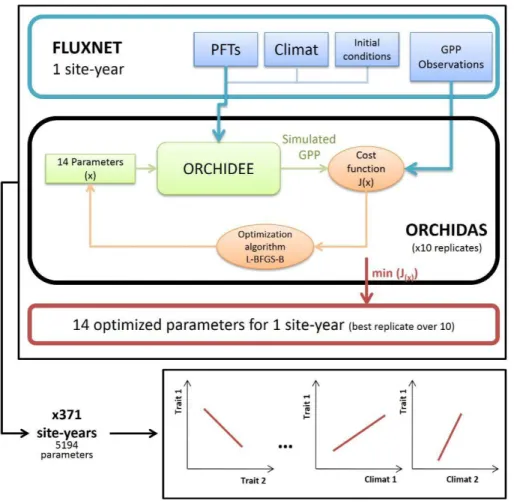
The land surface model ORCHIDEE (v1.9.6, without nitrogen cycle) computes biosphere-190
atmosphere exchanges, consistently with water and carbon storage using ordinary differential 191
equations (Krinner et al., 2005) (Figure1). Given meteorological forcing, plant and soil 192
conditions, the model simulates photosynthesis, all components of the surface energy budget 193
and hydrological processes at a half-hourly time step, while the dynamics of carbon storage 194
are calculated daily. In ORCHIDEE, the land surface is discretized into 12 plant functional 195
types (PFT) and bare soil (Table S1.1, Appendix S1). All PFTs share the same equations, but 196
use different parameter values, except for phenology (budburst/senescence), which is PFT-197
specific (Botta et al., 2000). 198
199
Eddy-covariance GPP
200
We used half-hourly flux observations from eddy-covariance sites within the FLUXNET 201
network (https://fluxnet.fluxdata.org). The sites were selected on the basis of spatial 202
homogeneity and the dominance of a vegetation type that could easily be matched to one of 203
the PFTs in ORCHIDEE, excluding crops and C4 grasses. The vegetation type information at 204
each site was obtained from http://fluxnet.ornl.gov. The list of analyzed FLUXNET sites (98 205
sites, 371 site-year) and the corresponding PFTs is given in Appendix S2. The following 206
analyses rely on GPP derived from net ecosystem exchange (NEE; reference with variable 207
USTAR threshold) after accounting for ecosystem respiration calculated using the method of 208
Reichstein et al., (2005) provided in the FLUXNET dataset. Years with less than 80% of 209
available half hourly observations were discarded. 210
Meteorological data
212
Because ORCHIDEE needs continuous half-hourly meteorological forcing, we gap-filled time 213
series of weather variables using the interpolation algorithm developed by Vuichard & Papale 214
(2015). Linear interpolation was applied between available observations when the gap-215
duration in the meteorological data was less than six hours. Otherwise, the variables were 216
interpolated and bias corrected using the ERA-interim reanalysis (~80km, Dee et al., 2011). 217
Snow and rain were identified according to air temperature (threshold for snow being 0°C). 218
219
Data assimilation procedure
220
The parameters of ORCHIDEE were optimized with the ORCHIDAS package developed by: 221
Kuppel et al., (2012); Bacour et al., (2015); MacBean et al., (2015) and Peylin et al., (2016); 222
(https://orchidas.lsce.ipsl.fr/; Figure 1). Gaussian distributions of parameter and observation 223
errors being assumed, a gradient-based approach was used to minimize the Bayesian cost 224
function J (Tarantola, 2005): 225
( 1 ) This function quantifies the difference between observations (y) and simulations (H(x)) (here 226
GPP), and between a priori (xb) and optimized parameters (x). The B and R matrices are the 227
prior error covariance matrices for parameters and observations, respectively (including in the 228
latter case eddy-covariance measurement and model errors). 229
Both R and B were taken as diagonal, as discussed in Kuppel et al. (2012). The J(x) function 230
was iteratively minimized with the L-BFGS-B algorithm (Byrd et al., 1995), which notably 231
allows bounding the range of variation of the parameters to optimize. After model calibration 232
(i.e. minimizing J), the posterior error covariance matrix (A), providing the full statistical 233
distribution of the optimized parameters was estimated by: 234
( 2 ) where H is the Jacobian of model at the minimum of J (Tarantola, 2005). The covariances of 235
errors between parameters contained in the non-diagonal terms of A inform about the ability 236
of observations given the structure of H to solve for parameters individually, or in 237
combination. High error covariance between two parameters relates to the equifinality 238
problem, whereby different values of these parameters result in model outputs equally 239
matching the observations (relative to R). 240
241
Optimized parameters
242
We restricted our exercise to the parameters involved in the assimilation of CO2 following 243
previous sensitivity analyses from Kuppel (2012). We analyzed 14 parameters controlling 244
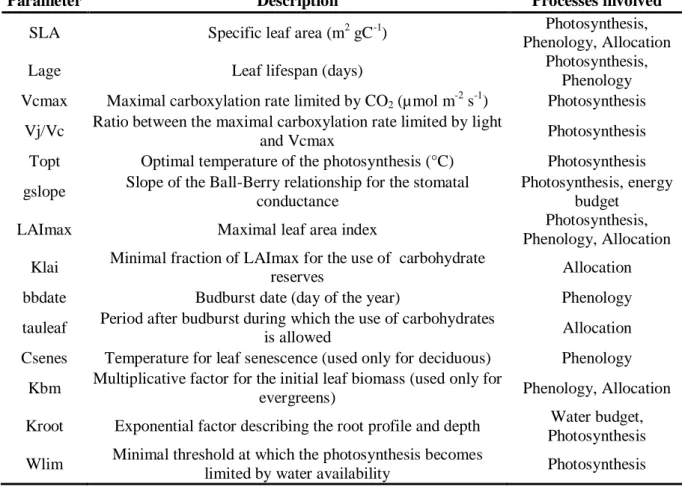
long-term and inter-annual GPP variability (Table 1). The key equations involving each 245
optimized parameter as well as their effect on the simulated GPP are described in Table S1.2 246
(Appendix S1). The parameters were related to photosynthetic capacity, phenology, carbon 247
allocation and the water budget. Photosynthetic capacity parameters were the maximal rate of 248
carboxylation limited by CO2 (Vcmax), the ratio between the maximal rate of carboxylation 249
limited by light and Vcmax (Vj/Vc), the optimal temperature of photosynthesis (Topt) and the 250
slope of the Ball-Berry model for stomatal conductance (gslope). Parameters driving 251
phenology were the specific leaf area (SLA), leaf longevity (Lage), summer maximal leaf area 252
index (LAImax) and the temperature for leaf senescence (Csenes). Allocation parameters were 253
the minimal fraction of LAImax for the use of carbohydrate reserves (Klai) and the period 254
after budburst during which the use of carbohydrates is allowed (tauleaf) for the formation of 255
new leaves. Finally, two parameters involved in the water status of the plant were the 256
exponential factor describing the root profile and length (Kroot) and the minimal threshold at 257
which photosynthesis becomes limited by minimum water potential (Wlim). In addition, two 258
scaling factor Kbm (initial biomass of leaves for evergreen species) and bbdate (spring 259
burdburst date) were added in the optimization to allow adjusting the seasonal timing of GPP. 260
The range in variation of the three parameters corresponding to observable traits (SLA, Vcmax 261
and Lage) was set from the TRY database for each PFT (Niinemets et al., 1999; Deng et al., 262
2004; Meir et al., 2007; Kattge et al., 2009, 2011; Domingues et al., 2010; Cernusak et al., 263
2011; Azevedo & Marenco, 2012; van de Weg et al., 2012; Nascimento & Marenco, 2013). 264
Species from the TRY database were assigned to corresponding PFTs based on available 265
metadata about plant structure, leaf phenology and climate information extracted from 266
species' latitude and longitude coordinates. We chose as a reference range the 2.5 - 97.5 267
percentile of the trait distributions from TRY. The variation ranges for the other parameters 268
were fixed based on expert judgment (Kuppel et al., 2014). 269
270
Simulations and assimilation set-up
271
At each flux tower site, we assumed that the eddy-covariance flux footprint was entirely 272
composed by a single PFT (Appendix S2). The model was forced by local meteorological 273
observations (see Meteorological data section) and soil texture from the harmonized 274
worldwide soil database (Nachtergaele et al., 2012) to define the residual and saturation water 275
contents, and the saturated hydraulic conductivity in the soil model (Ducoudré et al., 1993; 276
Krinner et al., 2005) based on Van Genuchten (1980). Initial soil carbon pools in equilibrium 277
with local climate were obtained with an analytical spin-up procedure (Lardy et al., 2011; Xia 278
et al., 2012). Initial biomass was simulated until reaching equilibrium (generally after a ~300
279
year-long simulations using the studied year meteorological data and constant CO2 set to level 280
of the year), thus different from the real stand age observed at each site. 281
We optimized GPP averaged over 15 days using moving windows to avoid noise from high 283
frequency variations in the parameter optimization that could induce convergence issues 284
(Bacour et al., 2015). As far as test data from eddy-covariance measurements are concerned, 285
high frequency variations in fluxes include also variation in the boundary layer that are 286
unrelated to the fluxes at the surface (Ibrom et al., 2006). Santaren et al. (2007) estimated that 287
for parameters related to photosynthesis and phenology, optimization based on half-hourly 288
observations did not improve the results. For each site, the optimizations were conducted 289
year-by-year to account for trait variability over time (Wu et al., 2013). 290
Following MacBean et al. (2015), each calibration (site-year) used ten replicates representing 291
different starting parameter sets with values randomly picked within their allowed variation 292
range (Table S1.3). Only the best calibration out of these ten replicates was retained for 293
analyses. This procedure increases the chances of finding the global minimum of J as 294
Santaren et al. (2014) showed that the gradient-based algorithm was sensitive to initial 295
conditions with a non-linear and complex model such as ORCHIDEE. 296
297
Analyses
298
We only retained calibrations for which the optimized model reproduced GPP observations 299
with high precision. The rationale for this was that optimized parameters from model runs 300
which agreed poorly with GPP observations provided little or no useable information. The 301
filtering was performed using a two-step procedure. 302
First, the criterion for ‘improved GPP simulation’ was the relative site-year posterior RMSE 303
(RMSEre) between observed and optimized GPP: 304
Whenever the value of RMSEre was higher than the all-RMSEre median plus one interquartile 305
range (IQR), the site-year was removed from the analysis. We also discarded sites with 306
‘inconsistent parameters values’, i.e. with too large differences between the ten replicates at 307
the same site reflecting convergence issues (equifinality) of the algorithm. 308
Secondly, for sites with at least two RMSEre below 10 % among the ten replicates, we 309
estimated the coefficient of variation (CV) of parameters across the replicates. We retained 310
only years for which the median CV was below the median of all CV plus one IQR of their 311
distribution. This filtering provided optimized parameters from 371 site-years (over 516 312
initially considered) for 98 sites (over 116; Appendix S2) spanning seven PFTs located in 313
boreal, temperate and tropical areas (Table S3.4; Appendix S3). 314
315
For each parameter, we calculated the uncertainty reduction (UR) as: 316
( 5 )
With post and prior being the posterior and prior parameter uncertainties (square root of the
317
diagonal elements of A and B). We then separated in the analysis the well- from the poorly-318
constrained parameters. Well-constrained parameters are defined as those with 1) UR higher 319
than the median of UR distributions for all parameters and 2) a low correlation of error with 320
other parameters (from the A matrix, Eq. 2). Note that a strong error correlation making two 321
parameters poorly constrained individually is still an interesting result as it indicates a range 322
of possible tradeoffs between these two parameters. 323
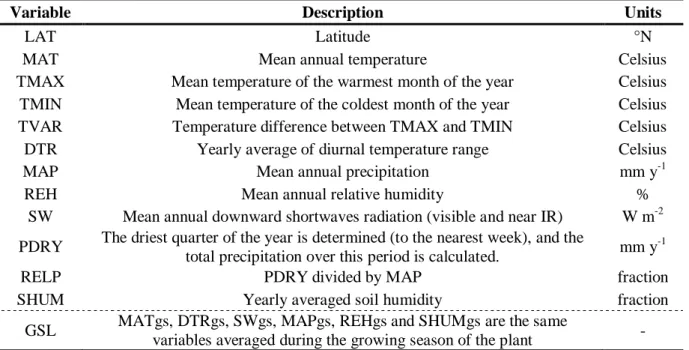
The optimized parameter values were regressed against the local background bio-climatic 324
variables (Table 2) for each site, and against the soil relative water content (volume of water 325
by volume of soil) simulated by ORCHIDEE. Bio-climatic variables were averaged over the 326
whole year and over the length of the growing season (GSL). For temperate sites, the growing 327
season was defined as the period with daily temperature above 5°C and relative soil water 328
content above 0.2 (Violle et al., 2015). In some tropical regions, the growing season length is 329
potentially limited by water availability (wet/dry seasons), we thus kept the same definition as 330
for temperate ecosystems. For boreal sites, we adapted the definition of the growing season 331
such as weekly temperature must be above 0°C. Analyses were performed with the R.3.2 332
software (R Core Team, 2016) and standardized major axis (SMA) analyses were performed 333
with the 'lmodel2' package (Legendre, 2014). Because we sought to compare simulated 334
correlations with common ecological properties observed at the global scale, we analyzed 335
different groups of PFTs: all PFTs together; deciduous versus evergreens; needleleaves versus 336
broadleaves; and C3 grasses (Table S1.1). Regressions were performed both with and without 337
a logarithmic transformation of the data. 338
Results and comparison to existing literature 339
Optimization performances
340
A full description of the optimization performances and parameter uncertainty reduction can 341
be found in Appendix S3. 342
In all cases, the optimized GPP time series better agrees with observations than the prior ones, 343
with the RMSE being reduced by 76.6 ± 13.0 % (Table S3.4; Appendix S3). The median 344
posterior RMSEre is 0.19 and the IQR is 0.11. The median CV over all parameters is 0.24 345
(IQR=0.13). After optimization, the parameter uncertainty (Eq. 5) is reduced by 30 % on 346
average (Table S3.5; Appendix S3). 347
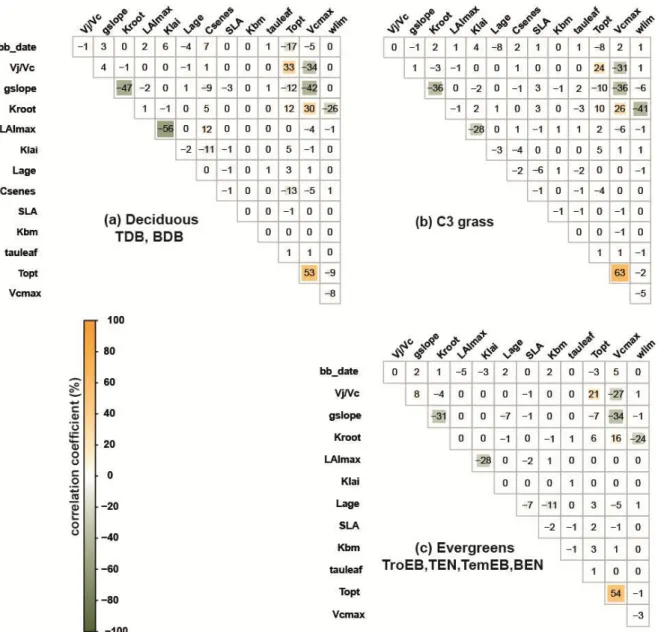
The posterior error correlation matrix A (Eq.2) reveals a positive correlation between Vcmax 348
and several other parameters including (Figure 2): Topt (r=0.57±0.05); gslope (r=-0.37±0.04); 349
Kroot (r=0.24±0.07) and Vj/Vc (r=-0.31±0.04). There also exists a negative correlation
350
between Kroot and gslope (r=-0.38±0.08), between Kroot and Wlim (r=-0.30±0.09) and 351
between LAImax and Klai (r=-0.37±0.16) (Figure 2). 352
Jointly analyzing information from the uncertainty reduction (Appendix S3) and the cross-353
parameter error correlation enables to distinguish between: 1) well constrained parameters 354
(Lage and SLA for evergreens/ Lage and Csenes for deciduous); 2) well constrained 355
parameters with a risk of equifinality (gslope, Kroot, LAImax, Topt and Vcmax); and 3) poorly 356
constrained parameters (Vj/Vc, Klai, Tauleaf and Wlim; Table 1). In the following analyses, 357
trait co-variations have to be interpreted in respect to confidence intervals (posterior error) in 358
parameter estimates. 359
Co-variation between parameters
360
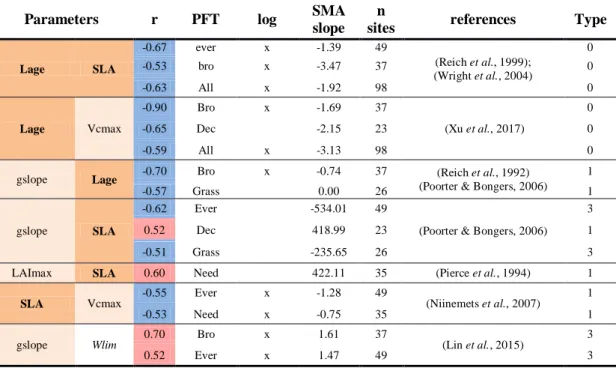
We analyzed cross-site correlations between optimized parameters in relation to expected trait 361
relationships. The co-variation between all parameters is illustrated in Figure S4.2 (Appendix 362
S4). For more clarity and considering the large number of parameters, we only describe here 363
the relationships involving four parameters related to phenology (SLA, Lage) and 364
photosynthesis (Vcmax, gslope). All relationships are provided in Table S4.6 (Appendix S4). 365
We observed a negative correlation between SLA and Lage for all PFTs (r=-0.63; Table 3) as 366
well as for evergreens (r=-0.67) and broadleaves PFTs (r=-0.53), separately. The slope of the 367
emerging relationship between LMA (1/SLA) and Lage (1.91; 1.63-2.24 95% confidence 368
interval; p < 0.05) for all PFTs was close to the observed slope from field observations (1.71; 369
1.62-1.82; Wright et al. 2004). Results highlighted other co-variations between Lage and 370
Vcmax (r=-0.59 overall PFTs), gslope and Lage (r=-0.7 for broadleaves), LAImax and SLA
371
(r=0.6 for needleleaves), and between SLA and Vcmax (r=-0.55 for evergreens). Here again, 372
the slope between Lage and Vcmax emerging for broadleaves PFTs (-1.69) was close to 373
observations (-1.13; Xu et al. 2017). 374
No relationships were reported between gslope and Lage or between glsope and SLA, but a 375
trade-off between the stomatal conductance (gs) and Lage was observed experimentally 376
(Reich et al., 1992; Poorter & Bongers, 2006), as well as a positive correlation between gs 377
and SLA (Poorter & Bongers, 2006). The optimizations showed opposite relationships 378
between gslope and SLA depending on the PFT: a positive significant correlation was 379
obtained for deciduous PFTs and a negative significant correlation for evergreens and grasses 380
(Table 3). 381
The positive relationship between SLA and LAImax emerging from optimized parameters for 382
coniferous PFTs was consistent with the positive correlation between LAI and SLA reported 383
by Pierce et al. (1994) for coniferous forests. Finally, a negative correlation between SLA and 384
Vcmax has been observed experimentally for two gymnosperms species (Niinemets et al.,
385
2007), confirming the negative relationships found in our study for needleleaves. Despite the 386
equifinality risk between gslope and the soil water stress Wlim in Figure 2, the positive 387
correlation observed for broadleaves (r=0.7) and evergreens (r=0.52) was comparable to 388
observations from independent data compiled by Lin et al. (2015). 389
Other significant correlations from the optimized parameters (Table S4.6, Figure S4.2; 390
Appendix S4) could not be verified against observations because of the correlation of errors 391
observed in Figure 2 or because of the scarcity of ecological data preventing us to conclude 392
about the true nature of those correlations, as for example between gslope and Vcmax. 393
394
Variation of trait-related parameters with climate
395
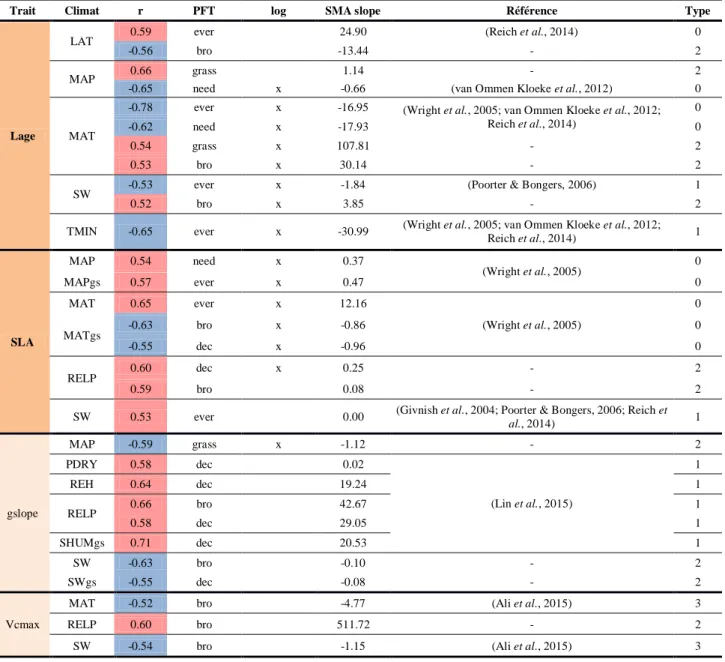
We analyzed correlations between parameters and climate variables (Table 4, Figure S5.4; 396
Appendix S5). As for co-variations between parameters, we only described here those 397
implying SLA, Lage, Vcmax and gslope. All relationships are listed in Table S5.7 and more 398
detailed analysis are available in Appendix S5. 399
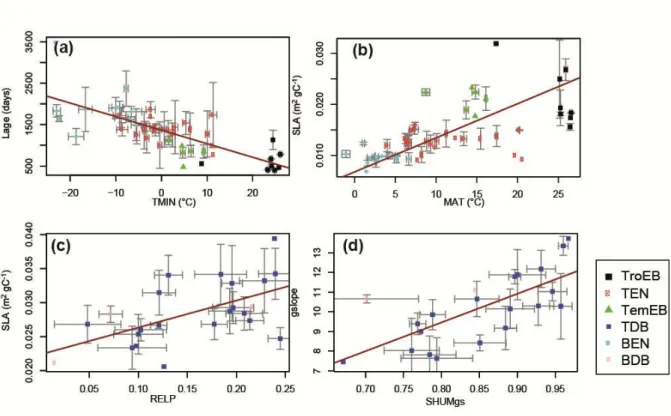
We found a strong negative correlation between leaf lifespan (Lage) and temperatures (MAT, 400
TMIN; r=-0.78/-0.65; Figure 3a) for evergreen PFTs. This correlation was independently
401
reported at global scale (Wright et al., 2005; van Ommen Kloeke et al., 2012) and confirmed 402
by Reich et al. (2014) who showed higher needle longevity with cold temperatures for boreal 403
species. However, the observed positive correlation between Lage and MAT at the global 404
scale for deciduous PFTs (Wright et al., 2005; van Ommen Kloeke et al., 2012) was not 405
found specifically for deciduous systems in our study. Nevertheless, a positive correlation was 406
observed for C3 grasses and broadleaves (including deciduous). We also found a strong 407
negative correlation between Lage and the mean annual precipitations (MAP) for evergreens 408
PFTs (r = -0.65), consistent with field data (van Ommen Kloeke et al., 2012). In addition, a 409
negative correlation between Lage and incident shortwave radiation (SW) for evergreens was 410
obtained, consistent with field observations (Poorter & Bongers, 2006). 411
412
Regarding SLA, we found opposite sensitivities to MAT for evergreen (r=0.65) and deciduous 413
forests (r=-0.55). This result is consistent with independent leaf-scale data showing a positive 414
correlation between SLA and MAT for evergreen species (Figure 3b) and a negative 415
correlation for deciduous ones (Wright et al. 2005). The model calibration also resulted in a 416
positive correlation between the relative precipitation (RELP; Table 2) and SLA for deciduous 417
trees (r = 0.60; Figure 3c). Regarding the positive correlations obtained between SLA with 418
Kroot or gslope (Table 3), it suggests that SLA is highly sensitive to water stress for deciduous
419
trees. For evergreens, positive correlation between SLA and precipitation also emerges when 420
considering the length of the growing season (MAPgs, r = 0.57; Table 4); which is consistent 421
with trait data (Wright et al., 2005). For evergreens, SLA was positively correlated to SW 422
(r=0.53), a relationship observed by Givnish et al. (2004) and Poorter & Bongers (2006). 423
424
In their meta-analysis of stomatal conductance parameters from observations of several PFTs, 425
Lin et al. (2015) showed that the slope of the stomatal conductance is positively correlated to 426
the mean air temperature over the growing period and to soil moisture stress. Here, our results 427
show the same correlation between gslope and soil moisture during the growing season 428
(r=0.71; Figure 3d) and relative precipitation (r=0.66) for deciduous or broadleaved PFTs. On 429
the contrary, we find that gslope is negatively correlated with mean annual precipitation for 430
C3 grasses (r=-0.59), and with shortwave radiation for broadleaved PFTs (r=-0.63). Medlyn et 431
al. (2011) suggested that gslope is proportional to the photosynthesis compensation point for
432
CO2, and consequently to growth temperatures of the plant (Bernacchi et al., 2001). This 433
assumption is supported by the data from Lin et al. (2015). In our study, the relationship 434
between gslope and temperature was not supported. 435
436
Finally, Vcmax is mostly sensitive to temperature and light for broadleaved PFTs, with a 437
negative correlation observed with MAT (r=-0.52) and SW (r=-0.54). This result contradicts 438
previous observations by Ali et al. (2015), who suggested a positive correlation between 439
Vcmax and seasonal temperature and light variations.
440 441
Discussion 442
Uncertainties and shortcomings of the approach
443
This section provides an overview of possible shortcomings of our approach that may explain 444
some residual mismatch between model and observations. Several factors can impact the 445
optimized value of the parameters, potentially aliasing the observed relationships: 1) flux 446
measurements errors and errors in ecosystem respiration estimates used to derive gap-filled 447
GPP; 2) optimization protocol/setup errors; and 3) model systematic errors deriving from 448
absent or poorly represented processes in the model. 449
First, we restricted our analysis to GPP. This flux is not directly measured but estimated from 450
NEE measured using the eddy-covariance method with an estimate of ecosystem respiration 451
determined using empirical models (Reichstein et al., 2005), and thus can be biased by 452
several factors (see Appendix S3 for a list of these factors). We chose GPP over a 453
combination of NEE and latent heat or evapotranspiration fluxes, which has often been used 454
to optimize ORCHIDEE (Kuppel et al., 2012; Bacour et al., 2015; Peylin et al., 2016), 455
because it implies the optimization of more parameters related to soil, respiration and energy 456
budget, and therefore increases the risk of equifinality. To reduce the uncertainties, it is 457
necessary to lower the correlation of errors between parameters by assimilating 458
complementary biophysical variables. For example, assimilating both GPP and LAI estimates 459
at the site level could improve the evaluation of parameters such as SLA or Lage, and 460
consequently improve the estimation of photosynthesis parameters. 461
Second, the Bayesian framework is based on the assumption that the model/observation errors 462
are random and that the model structure is “true”. Any bias of model structure is expected to 463
be aliased onto the estimated parameters (MacBean et al., 2016) and might therefore impact 464
the retrieved correlations. For instance, missing processes would be compensated during the 465
optimization by adjusting parameters (e.g. light attenuation, vertical distribution of LAI, 466
diffuse light, horizontal light distribution in the stand) to non optimal values. Also, while 467
traits are usually measured at the leaf level, our approach rather focuses on traits at the canopy 468
level (given the structure of ORCHIDEE and the assumed exponential attenuation of light and 469
LAI from top to bottom of canopy (Krinner et al. 2005; Table S1.2), and the assimilation of 470
GPP data). As an additional test, we conducted the above analyses using multi-year instead of 471
single-year observations in order to add more constraints on parameters (see Figure S4.3 & 472
S5.5). The same relationships were found as with single-year observations, thus strengthening 473
our conclusions, showing that spatial correlations are observed even when taking into account 474
a possible temporal variability of traits. 475
Finally, a wrong representation of species and the lack of representation of representation of 476
traits variability within a community in ORCHIDEE can affect simulated processes, which 477
will ultimately impact the estimated parameter values (see Appendix S3 for a discussion on 478
initial site conditions). Especially, the C3 grass PFT represents diverse grasslands, with 479
different species, ecophysiology (Adams et al., 2016) and management practices (Merbold et 480
al., 2014). This results in an increased variability and a high range of estimated plant
481
functional traits (Figure S3.1). A refinement of the PFT definition may improve the 482
robustness of optimizations (for instance by separating natural or semi-managed biomes), or 483
by distinguishing genera or major species (Peaucelle et al., 2016). 484
In order to decrease the impact of uncertainty in PFT composition and reduce the correlation 485
errors between parameters, the use of concomitant observations of traits and carbon fluxes at 486
the FLUXNET sites would enable a) to constrain known parameters and b) to validate 487
optimized traits. However, functional trait observations at FLUXNET sites as well as a 488
precise description of species composition are not yet systematic (Musavi et al., 2015, 2016). 489
490
Ecological consistency of trait relationships
491
The optimization of model parameters managed to reproduce many known ecological 492
properties. The optimized parameters consistently matched the well-known relationships 493
resulting from the leaf economic spectrum theory (LES, Reich et al., 1999; Wright et al., 494
2004). Particularly our results align with the trait theory that long lived canopies are 495
metabolically less active and are consistent with the LES empirical evidence that plants invest 496
either in structure or photosynthesis (Liu et al., 2010; Reich, 2014). 497
Our results also reproduced several observed trait-climate relationships at the PFT level. 498
Globally, evergreen PFT parameters showed a strong dependency on mean annual 499
temperature and radiation, while parameters for deciduous PFTs exhibited a strong sensitivity 500
to precipitation and soil moisture over the growing season (Figure S5.4). As postulated by 501
Reich (2014), climate exerts a control on the average leaf characteristics at the community 502
level. The observed relationships obtained at the PFT level might reflect, not only differences 503
in plant response to climate, but also differences in plant community composition (Shi et al., 504
2015). These results suggest that both the development of acclimation processes and trait-505
based approaches are needed in TBMs if we seek to capture the effect of biogeography on 506
ecosystem characteristics (Lu et al., 2017; Fisher et al., 2018). 507
508
Finally, while the results clearly highlight that photosynthesis and phenological mechanisms 509
implemented in ORCHIDEE are robust enough to reproduce known behaviors of several 510
vegetation species, belowground processes still appear poorly represented, which resulted in 511
weakly constrained parameters and trait co-variations inconsistent with literature. These 512
discrepancies are primarily due to a lack in eco-physiological knowledge reflecting the actual 513
difficulty to study belowground ecological processes. The rooting system uses model-specific 514
parameters (Kroot) that are hardly comparable to measured functional traits. 515
516
Concluding remarks and recommendations 517
The approach presented in this study is a new and effective way to validate the processes 518
implemented in TBMs, to better define vegetation response to climate (Liang et al., others, 519
2018), and could help improving existing data assimilation frameworks (Kaminski et al., 520
2013; LeBauer et al., 2013; Arsenault et al., 2018) by bringing ecological constraints. The 521
availability of continuous observations from eddy-covariance flux measurements gives a 522
unique opportunity to resolve the different components of the short and long-term variability 523
of traits through this approach. 524
Our results show that optimized leaf-related parameters align with plant trait theory, and 525
highlight the need to implement acclimation processes and trait-based approaches in models 526
instead of using constant parameters to reduce uncertainties in spatio-temporal patterns of the 527
modeled carbon fluxes. A first step would be to assess the behavior of the model at the global 528
scale when trait-climate relationships characterized in this study are explicitly implemented. 529
In parallel, relationships highlighted in this study may help to develop or validate new 530
methods to simulate plant acclimation. Used in a prognostic way, this approach could enable 531
to study correlations at the canopy scale and to assess the behavior of trait-related parameters 532
that are difficult to observe experimentally. 533
Several known ecological properties, observed at the site/leaf scale, emerged from model-data 534
assimilation. However, quantitative comparisons with observations were possible only for two 535
of them, SLA and Lage, which are also the two most studied traits. This is mainly because 536
TBMs use model-specific parameters that cannot be directly compared to standard trait 537
observations, but also because concomitant observations of functional traits, both in space and 538
time, are scarce in the literature. A recommendation to the TBM community would be to 539
make use of parameters (and processes) that can be related directly to observations in order to 540
unit vegetation model and functional traits (for instance the use of the Specific Root Length 541
for belowground processes). 542
We argue that co-located systematic and standardized trait observations (starting with key 543
traits related to phenology SLA, LAI, photosynthesis Vcmax, Jmax, Topt, water transport -544
gs- and allocation -Carbon:Nitrogen ratio, shoot/root-; (Law et al., 2008) along with
545
biometric data are needed at the FLUXNET sites or within other environmental observation 546
networks such as ICOS (Integrated Carbon Observation System) or NEON (National 547
Ecological Observatory Network) if we seek to distinguish temporal and spatial components 548
of trait variability across biomes and climates. The creation of a FLUXNET trait database 549
could improve our comprehension of trait acclimation and help us to disentangle the 550
differences observed at regional and local scales, to improve the up-scaling of processes from 551
the leaf to the canopy/ecosystem level and to properly calibrate/validate ecosystem models. 552
Supporting information 553
Appendix S1: Description of PFTs, model parameters and equations 554
Table S1.1: List of plant functional types. 555
Table S1.2: List of main equations involving optimized parameters. 556
Table S1.3: Default parameter value and range allowed by the optimization algorithm. 557
Appendix S2: List of FLUXNET sites used for the analyses (xlsx file). 558
Appendix S3: Optimization performances 559
Figure S3.1: Distribution of optimized parameter values. 560
Table S3.4: Mean a priori and a posteriori RMSE between observations and simulations. 561
Table S3.5: Mean parameter uncertainty reduction between prior and posterior simulations. 562
Appendix S4: Relationships between traits 563
Figure S4.2: Correlation matrices between traits optimized against site-year GPP. 564
Figure S4.3: Correlation matrices between traits optimized against site GPP. 565
Table S4.6: Extended Table 3 with all relationships 566
Appendix S5: Relationships between traits and climate 567
Figure S5.4: Correlation matrices between traits and environmental variables optimized 568
against site-year GPP 569
Figure S5.5: Correlation matrices between traits and environmental variables optimized 570
against site GPP 571
Table S5.7: Extended Table 4 with all relationships 572
573
Data accessibility 574
All FluxNet data can be downloaded at: https://fluxnet.fluxdata.org 575
Information about the ORCHIDEE model, source code and contact: http://orchidee.ipsl.fr/ 576
Information about the data assimilation system ORCHIDAS: https://orchidas.lsce.ipsl.fr/ 577
578 579
References 580
Adams, M.A., Turnbull, T.L., Sprent, J.I. & Buchmann, N. (2016) Legumes are different: Leaf 581
nitrogen, photosynthesis, and water use efficiency. Proceedings of the National Academy of 582
Sciences, 113, 4098–4103.
583
Ali, A.A., Xu, C., Rogers, A., McDowell, N.G., Medlyn, B.E., Fisher, R.A., Wullschleger, S.D., 584
Reich, P.B., Vrugt, J.A., Bauerle, W.L. & others (2015) Global-scale environmental control of 585
plant photosynthetic capacity. Ecological Applications, 25, 2349–2365. 586
Arsenault, K.R., Kumar, S.V., Geiger, J.V., Wang, S., Kemp, E., Mocko, D.M., Beaudoing, H.K., 587
Getirana, A., Navari, M., Li, B. & others (2018) The Land surface Data Toolkit (LDT v7. 2)–a 588
data fusion environment for land data assimilation systems. Geoscientific Model Development, 589
11, 3605–3621. 590
Atkin, O.K., Bloomfield, K.J., Reich, P.B., Tjoelker, M.G., Asner, G.P., Bonal, D., Bönisch, G., 591
Bradford, M.G., Cernusak, L.A., Cosio, E.G., Creek, D., Crous, K.Y., Domingues, T.F., 592
Dukes, J.S., Egerton, J.J.G., Evans, J.R., Farquhar, G.D., Fyllas, N.M., Gauthier, P.P.G., 593
Gloor, E., Gimeno, T.E., Griffin, K.L., Guerrieri, R., Heskel, M.A., Huntingford, C., Ishida, 594
F.Y., Kattge, J., Lambers, H., Liddell, M.J., Lloyd, J., Lusk, C.H., Martin, R.E., Maksimov, 595
A.P., Maximov, T.C., Malhi, Y., Medlyn, B.E., Meir, P., Mercado, L.M., Mirotchnick, N., Ng, 596
D., Niinemets, Ü., O’Sullivan, O.S., Phillips, O.L., Poorter, L., Poot, P., Prentice, I.C., 597
Salinas, N., Rowland, L.M., Ryan, M.G., Sitch, S., Slot, M., Smith, N.G., Turnbull, M.H., 598
VanderWel, M.C., Valladares, F., Veneklaas, E.J., Weerasinghe, L.K., Wirth, C., Wright, I.J., 599
Wythers, K.R., Xiang, J., Xiang, S. & Zaragoza-Castells, J. (2015) Global variability in leaf 600
respiration in relation to climate, plant functional types and leaf traits. New Phytologist, 206, 601
614–636. 602
Azevedo, G. & Marenco, R. (2012) Growth and physiological changes in saplings of Minquartia 603
guianensis and Swietenia macrophylla during acclimation to full sunlight. Photosynthetica, 604
50, 86–94. 605
Bacour, C., Peylin, P., MacBean, N., Rayner, P., Delage, F., Chevallier, F., Weiss, M., Demarty, J., 606
Santaren, D., Baret, F. & others (2015) Joint assimilation of eddy covariance flux 607
measurements and FAPAR products over temperate forests within a process-oriented 608
biosphere model. Journal of Geophysical Research: Biogeosciences, 120, 1839–1857. 609
Bernacchi, C.J., Singsaas, E.L., Pimentel, C., Portis Jr, A.R. & Long, S.P. (2001) Improved 610
temperature response functions for models of Rubisco-limited photosynthesis. Plant, Cell & 611
Environment, 24, 253–259.
612
Bjorkman, A.D., Myers-Smith, I.H., Elmendorf, S.C., Normand, S., Thomas, H.J., Alatalo, J.M., 613
Alexander, H., Anadon-Rosell, A., Angers-Blondin, S., Bai, Y. & others (2018) Tundra Trait 614
Team: A database of plant traits spanning the tundra biome. Global Ecology and 615
Biogeography, 27, 1402–1411.
616
Botta, A., Viovy, N., Ciais, P., Friedlingstein, P. & Monfray, P. (2000) A global prognostic scheme of 617
leaf onset using satellite data. Global Change Biology, 6, 709–725. 618
Byrd, R.H., Lu, P., Nocedal, J. & Zhu, C. (1995) A limited memory algorithm for bound constrained 619
optimization. SIAM Journal on Scientific Computing, 16, 1190–1208. 620
Carvalhais, N., Reichstein, M., Ciais, P., Collatz, G.J., Mahecha, M.D., Montagnani, L., Papale, D., 621
Rambal, S. & Seixas, J. (2010) Identification of vegetation and soil carbon pools out of 622
equilibrium in a process model via eddy covariance and biometric constraints. Global Change 623
Biology, 16, 2813–2829.
624
Cernusak, L.A., Hutley, L.B., Beringer, J., Holtum, J.A. & Turner, B.L. (2011) Photosynthetic 625
physiology of eucalypts along a sub-continental rainfall gradient in northern Australia. 626
Agricultural and Forest Meteorology, 151, 1462–1470.
627
Dee, D., Uppala, S., Simmons, A., Berrisford, P., Poli, P., Kobayashi, S., Andrae, U., Balmaseda, M., 628
Balsamo, G., Bauer, P. & others (2011) The ERA-Interim reanalysis: Configuration and 629
performance of the data assimilation system. Quarterly Journal of the Royal Meteorological 630
Society, 137, 553–597.
Deng, X., Ye, W.-H., Feng, H.-L., Yang, Q.-H., Cao, H.-L., Xu, K.-Y. & Zhang, Y. (2004) Gas 632
exchange characteristics of the invasive species Mikania micrantha and its indigenous 633
congener M. cordata (Asteraceae) in South China. Botanical Bulletin of Academia Sinica, 45. 634
Domingues, T.F., Meir, P., Feldpausch, T.R., Saiz, G., Veenendaal, E.M., Schrodt, F., Bird, M., 635
Djagbletey, G., Hien, F., Compaore, H., Diallo, A., Grace, J. & Lloyd, J. (2010) Co-limitation 636
of photosynthetic capacity by nitrogen and phosphorus in West Africa woodlands. Plant, Cell 637
& Environment, 33, 959–980.
638
Ducoudré, N.I., Laval, K. & Perrier, A. (1993) SECHIBA, a new set of parameterizations of the 639
hydrologic exchanges at the land-atmosphere interface within the LMD atmospheric general 640
circulation model. Journal of Climate, 6, 248–273. 641
Fisher, J.B., Badgley, G. & Blyth, E. (2012) Global nutrient limitation in terrestrial vegetation. Global 642
Biogeochemical Cycles, 26, n/a–n/a.
643
Fisher, R.A., Koven, C.D., Anderegg, W.R., Christoffersen, B.O., Dietze, M.C., Farrior, C.E., Holm, 644
J.A., Hurtt, G.C., Knox, R.G., Lawrence, P.J. & others (2018) Vegetation demographics in 645
Earth System Models: A review of progress and priorities. Global change biology, 24, 35–54. 646
Van Genuchten, M.T. (1980) A closed-form equation for predicting the hydraulic conductivity of 647
unsaturated soils. Soil science society of America journal, 44, 892–898. 648
Givnish, T.J., Montgomery, R.A. & Goldstein, G. (2004) Adaptive radiation of photosynthetic 649
physiology in the Hawaiian lobeliads: light regimes, static light responses, and whole-plant 650
compensation points. American Journal of Botany, 91, 228–246. 651
Ibrom, A., Jarvis, P.G., Clement, R., Morgenstern, K., Oltchev, A., Medlyn, B.E., Wang, Y.P., 652
Wingate, L., Moncrieff, J.B. & Gravenhorst, G. (2006) A Comparative Analysis of Simulated 653
and Observed Photosynthetic CO2 Uptake in Two Coniferous Forest Canopies. Tree 654
Physiology, 26, 845–864.
655
Kaminski, T., Knorr, W., Schürmann, G., Scholze, M., Rayner, P., Zaehle, S., Blessing, S., Dorigo, 656
W., Gayler, V., Giering, R. & others (2013) The BETHY/JSBACH carbon cycle data 657
assimilation system: Experiences and challenges. Journal of Geophysical Research: 658
Biogeosciences, 118, 1414–1426.
659
Kattge, J., Díaz, S., Lavorel, S., Prentice, I.C., Leadley, P., Bönisch, G., Garnier, E., Westoby, M., 660
Reich, P.B., Wright, I.J., Cornelissen, J.H.C., Violle, C., Harrison, S.P., Van BODEGOM, 661
P.M., Reichstein, M., Enquist, B.J., Soudzilovskaia, N.A., Ackerly, D.D., Anand, M., Atkin, 662
O., Bahn, M., Baker, T.R., Baldocchi, D., Bekker, R., Blanco, C.C., Blonder, B., Bond, W.J., 663
Bradstock, R., Bunker, D.E., Casanoves, F., Cavender-Bares, J., Chambers, J.Q., Chapin Iii, 664
F.S., Chave, J., Coomes, D., Cornwell, W.K., Craine, J.M., Dobrin, B.H., Duarte, L., Durka, 665
W., Elser, J., Esser, G., Estiarte, M., Fagan, W.F., Fang, J., Fernández-Méndez, F., Fidelis, A., 666
Finegan, B., Flores, O., Ford, H., Frank, D., Freschet, G.T., Fyllas, N.M., Gallagher, R.V., 667
Green, W.A., Gutierrez, A.G., Hickler, T., Higgins, S.I., Hodgson, J.G., Jalili, A., Jansen, S., 668
Joly, C.A., Kerkhoff, A.J., Kirkup, D., Kitajima, K., Kleyer, M., Klotz, S., Knops, J.M.H., 669
Kramer, K., Kühn, I., Kurokawa, H., Laughlin, D., Lee, T.D., Leishman, M., Lens, F., Lenz, 670
T., Lewis, S.L., Lloyd, J., Llusià, J., Louault, F., Ma, S., Mahecha, M.D., Manning, P., 671
Massad, T., Medlyn, B.E., Messier, J., Moles, A.T., Müller, S.C., Nadrowski, K., Naeem, S., 672
Niinemets, Ü., Nöllert, S., Nüske, A., Ogaya, R., Oleksyn, J., Onipchenko, V.G., Onoda, Y., 673
Ordoñez, J., Overbeck, G., Ozinga, W.A., Patiño, S., Paula, S., Pausas, J.G., Peñuelas, J., 674
Phillips, O.L., Pillar, V., Poorter, H., Poorter, L., Poschlod, P., Prinzing, A., Proulx, R., 675
Rammig, A., Reinsch, S., Reu, B., Sack, L., Salgado-Negret, B., Sardans, J., Shiodera, S., 676
Shipley, B., Siefert, A., Sosinski, E., Soussana, J.-F., Swaine, E., Swenson, N., Thompson, K., 677
Thornton, P., Waldram, M., Weiher, E., White, M., White, S., Wright, S.J., Yguel, B., Zaehle, 678
S., Zanne, A.E. & Wirth, C. (2011) TRY – a global database of plant traits. Global Change 679
Biology, 17, 2905–2935.
680
Kattge, J., Knorr, W., Raddatz, T. & Wirth, C. (2009) Quantifying photosynthetic capacity and its 681
relationship to leaf nitrogen content for global-scale terrestrial biosphere models. Global 682
Change Biology, 15, 976–991.
683
Krinner, G., Viovy, N., Noblet-Ducoudré, N. de, Ogée, J., Polcher, J., Friedlingstein, P., Ciais, P., 684
Sitch, S. & Prentice, I.C. (2005) A dynamic global vegetation model for studies of the coupled 685
atmosphere-biosphere system. Global Biogeochemical Cycles, 19, 33 PP. 686
Kroner, Y. & Way, D.A. (2016) Carbon fluxes acclimate more strongly to elevated growth 687
temperatures than to elevated CO2 concentrations in a northern conifer. Global Change 688
Biology, 22, 2913–2928.
689
Kuppel, S. (2012) Assimilation de mesures de flux turbulents d’eau et de carbone dans un modèle de 690
la biosphère continentale, Versailles-St Quentin en Yvelines.
691
Kuppel, S., Peylin, P., Chevallier, F., Bacour, C., Maignan, F. & Richardson, A. (2012) Constraining a 692
global ecosystem model with multi-site eddy-covariance data. Biogeosciences, 9, 3757–3776. 693
Kuppel, S., Peylin, P., Maignan, F., Chevallier, F., Kiely, G., Montagnani, L. & Cescatti, A. (2014) 694
Model–data fusion across ecosystems: from multisite optimizations to global simulations. 695
Geoscientific Model Development, 7, 2581–2597.
696
Lardy, R., Bellocchi, G. & Soussana, J.-F. (2011) A new method to determine soil organic carbon 697
equilibrium. Environmental Modelling & Software, 26, 1759–1763. 698
Law, B.E., Arkebauer, T., Campbell, J.L., Chen, J., Sun, O., Schwartz, M., van Ingen, C. & Verma, S. 699
(2008) Terrestrial carbon observations: Protocols for vegetation sampling and data 700
submission. FAO, Rome. 701
LeBauer, D.S., Wang, D., Richter, K.T., Davidson, C.C. & Dietze, M.C. (2013) Facilitating feedbacks 702
between field measurements and ecosystem models. Ecological Monographs, 83, 133–154. 703
Legendre, P. (2014) lmodel2: Model II Regression. R package version 1.7-2, Available at: ht 704
tp://CRAN. R-project. org/package= lmodel2 (accessed 2 March 2015). 705
Liang, J., Xia, J., Shi, Z., Jiang, L., Ma, S., Lu, X., Mauritz, M., Natali, S.M., Pegoraro, E. & Penton, 706
C.R., others (2018) Biotic responses buffer warming-induced soil organic carbon loss in 707
Arctic tundra. Global change biology. 708
Lin, Y.-S., Medlyn, B.E., Duursma, R.A., Prentice, I.C., Wang, H., Baig, S., Eamus, D., de Dios, V.R., 709
Mitchell, P., Ellsworth, D.S. & others (2015) Optimal stomatal behaviour around the world. 710
Nature Climate Change, 5, 459–464.
711
Liu, G., Freschet, G.T., Pan, X., Cornelissen, J.H.C., Li, Y. & Dong, M. (2010) Coordinated variation 712
in leaf and root traits across multiple spatial scales in Chinese semi-arid and arid ecosystems. 713
New Phytologist, 188, 543–553.
714
Luo, Y., Jiang, L., Niu, S. & Zhou, X. (2017) Nonlinear responses of land ecosystems to variation in 715
precipitation. New Phytologist, 214, 5–7. 716
Lu, X., Wang, Y.-P., Wright, I.J., Reich, P.B., Shi, Z. & Dai, Y. (2017) Incorporation of plant traits in 717
a land surface model helps explain the global biogeographical distribution of major forest 718
functional types. Global Ecology and Biogeography, 26, 304–317. 719
MacBean, N., Maignan, F., Peylin, P., Bacour, C., Bréon, F.-M. & Ciais, P. (2015) Using satellite data 720
to improve the leaf phenology of a global terrestrial biosphere model. Biogeosciences, 12, 721
7185–7208. 722
MacBean, N., Peylin, P., Chevallier, F., Scholze, M. & Schürmann, G. (2016) Consistent assimilation 723
of multiple data streams in a carbon cycle data assimilation system. Geoscientific Model 724
Development, 9, 3569–3588.
725
Maire, V., Wright, I.J., Prentice, I.C., Batjes, N.H., Bhaskar, R., Bodegom, P.M., Cornwell, W.K., 726
Ellsworth, D., Niinemets, Ü., Ordonez, A. & others (2015) Global effects of soil and climate 727
on leaf photosynthetic traits and rates. Global Ecology and Biogeography, 24, 706–717. 728
Medlyn, B.E., Duursma, R.A., Eamus, D., Ellsworth, D.S., Prentice, I.C., Barton, C.V.M., Crous, 729
K.Y., De Angelis, P., Freeman, M. & Wingate, L. (2011) Reconciling the optimal and 730
empirical approaches to modelling stomatal conductance. Global Change Biology, 17, 2134– 731
2144. 732
Meir, P., Levy, P.E., Grace, J. & Jarvis, P.G. (2007) Photosynthetic parameters from two contrasting 733
woody vegetation types in West Africa. Plant Ecology, 192, 277–287. 734
Merbold, L., Eugster, W., Stieger, J., Zahniser, M., Nelson, D. & Buchmann, N. (2014) Greenhouse 735
gas budget (CO2, CH4 and N2O) of intensively managed grassland following restoration. 736
Global change biology, 20, 1913–1928.
737
Musavi, T., Mahecha, M.D., Migliavacca, M., Reichstein, M., van de Weg, M.J., van Bodegom, P.M., 738
Bahn, M., Wirth, C., Reich, P.B., Schrodt, F. & others (2015) The imprint of plants on 739
ecosystem functioning: A data-driven approach. International Journal of Applied Earth 740
Observation and Geoinformation, 43, 119–131.