Publisher’s version / Version de l'éditeur:
Canadian Journal of Civil Engineering, 26, June 3, pp. 312-323, 1999-06-01
READ THESE TERMS AND CONDITIONS CAREFULLY BEFORE USING THIS WEBSITE. https://nrc-publications.canada.ca/eng/copyright
Vous avez des questions? Nous pouvons vous aider. Pour communiquer directement avec un auteur, consultez la
première page de la revue dans laquelle son article a été publié afin de trouver ses coordonnées. Si vous n’arrivez pas à les repérer, communiquez avec nous à [email protected].
Questions? Contact the NRC Publications Archive team at
[email protected]. If you wish to email the authors directly, please see the first page of the publication for their contact information.
NRC Publications Archive
Archives des publications du CNRC
This publication could be one of several versions: author’s original, accepted manuscript or the publisher’s version. / La version de cette publication peut être l’une des suivantes : la version prépublication de l’auteur, la version acceptée du manuscrit ou la version de l’éditeur.
For the publisher’s version, please access the DOI link below./ Pour consulter la version de l’éditeur, utilisez le lien DOI ci-dessous.
https://doi.org/10.1139/cjce-26-3-312
Access and use of this website and the material on it are subject to the Terms and Conditions set forth at
Indirect estimates of flexural strain in concrete sidewalks induced by
vertical movement
Rajani, B. B.; Zhan, C.
https://publications-cnrc.canada.ca/fra/droits
L’accès à ce site Web et l’utilisation de son contenu sont assujettis aux conditions présentées dans le site LISEZ CES CONDITIONS ATTENTIVEMENT AVANT D’UTILISER CE SITE WEB.
NRC Publications Record / Notice d'Archives des publications de CNRC:
https://nrc-publications.canada.ca/eng/view/object/?id=478d934e-4d82-4ec1-bdfa-6cac4be17d39 https://publications-cnrc.canada.ca/fra/voir/objet/?id=478d934e-4d82-4ec1-bdfa-6cac4be17d39Indirect estimates of flexural strain in concrete
sidewalks induced by vertical movement
B. Rajani and C. Zhan
Abstract: This paper examines different numerical methods to estimate flexural strain from surface elevation measurements on concrete sidewalks. Surface elevations, along a typical concrete sidewalk cross section, were monitored on a monthly basis as part of a study to determine the cracking mechanism of concrete sidewalks. These measurements were carried out in Calgary, Edmonton, and Camrose, Alberta, between 1993 and mid-1995. Finite difference, cubic spline, polynomial fit, and Fourier series methods of analyses are described for an indirect estimation of flexural strains in sidewalks. The sensitivity of these methods to measurement error is discussed. The Fourier series method is found to be the best procedure to analyse sidewalk surface elevation data for flexural strains estimates. The numerical methods to indirectly determine strain are best suited for those circumstances where installation of strain gauges is difficult, expensive, or impossible.
Key words: concrete sidewalks, indirect estimates of flexural strain.
Résumé: Cet article examine différentes méthodes numériques pour estimer la contrainte de fléxion d’après des mesures d’élévations de surfaces de trottoirs en béton. Le long d’une coupe transversale d’un trottoir en béton typique, des élévataions de surfaces ont été mesurées mensuellement pour contribuer à une étude visant à déterminer le mechanisme de fissuration de trottoires en béton. Ces mesures ont été prises à Calgary, Edmonton et Camrose de 1993 à mi-1995. Les méthodes d’analyses de différences finies, de spline cubique, de ajustement polynomial et de séries de Fourier sont décrites pour une estimation indirecte de tensions de fléxion dans les trottoirs. La sensibilité de ces méthodes à des erreures de mesures est discutée. Il a été trouvé que la méthode de séries de Fourrier était la meilleure procédure pour analyser des données d’élevation de surface d’un trottoir pour estimer les tensions de fléxion. Les méthodes numériques pour déterminer la tension indirectement sont le plus appropriées lorsque l’installation de gauge de tension est difficile, coûteuse ou impossible.
Mots clés: trottoirs en béton, estimations indirectes de contrainte de fléxion. [Traduit par la Rédaction] Rajani and Zhan 323
Introduction
Premature damage to Canadian municipal infrastructure amounts to a considerable capital expenditure and a subse-quent loss of revenue that could be put to use elsewhere. One such problem is cracked concrete sidewalks in some of the major Canadian cities and particularly in the Prairie Provinces. This problem has become acute recently and con-sequently regional municipalities are spending increasing amounts of money on the repair or replacement of side-walks. Any significant improvement in the service life of sidewalks would reduce capital cost outlays and would make budgets available for other more pressing needs.
Rajani and Zhan (1997) have described the extent of and the form of damage to sidewalks in Canada. It is estimated that the cities need to replace between 15% and 30% ($1.5
and $3.6 billion) of the 100 000 km of sidewalks in Canada. The estimated average service life of sidewalks is 20 years, but sidewalks in some western Canadian cities fail prema-turely and some as soon as 1–5 years after construction. In various cities in the Prairie Provinces, major evidence of damage to the sidewalk appears in the form of longitudinal cracks along the centre of the sidewalk. Longitudinal cracks can extend several tens of metres within a single city block. These cracks usually occur at the centre of the sidewalk and can extend through several expansion (or often called “cut”) joints before stopping abruptly. If the cracks do not open up, and if no faulting develops along these longitudinal cracks, they do not pose a safety hazard. However, this type of crack normally opens up with time and it is not uncommon to observe faulting in the order of 10 mm.
Concrete sidewalks are essentially slabs-on-grade except that their typical widths are between 1.2 and 1.5 m. The be-haviour of sidewalks is dependent on the ongoing interaction with the soil on which it rests. Thus, the behaviour of side-walks is best understood by studying the corresponding soil– structure interaction rather than the individual aspects of the structural concrete slab or the soil characteristics.
The Institute for Research in Construction of the National Research Council Canada initiated a project in collaboration with the cities of Winnipeg, Saskatoon, Regina, Edmonton,
Received May 12, 1998.
Revised manuscript accepted December 3, 1998.
B. Rajani and C. Zhan.Institute for Research in Construction, National Research Council Canada, Ottawa, ON K1A 0R6, Canada.
Written discussion of this article is welcomed and will be received by the Editor until October 31, 1999 (address inside front cover).
Calgary, and Camrose to identify the underlying mecha-nisms that lead to longitudinal cracks in sidewalks. One of the tasks within this project was to observe and analyse the behaviour of sidewalks by taking regular surface elevation measurements. This paper describes the numerical methods used to obtain indirect estimates of sidewalk rigid body movements and flexural strain in concrete sidewalks from the surface elevation measurements. The merits of each method are discussed in relation to its sensitivity to mea-surement errors and the likely behaviour of the concrete slab-on-grade.
A concrete sidewalk slab is typically 150 mm thick and a common configuration of sidewalk construction is that the distance between construction joints is marginally larger than the sidewalk width. Older sidewalks consist of two components, a flat concrete slab of uniform thickness adja-cent to an L-shaped beam that forms the curb and gutter. More recently, the preferred monolithic design is without full-depth joints between the flat slab, curb, and gutter. Both types of sidewalk are equally prone to cracks and there seems no obvious benefit in terms of performance from ei-ther method of construction.
Initial damage to most concrete sidewalks appears as hair-line cracks, and this occurrence is a confirmation that forces acting on the concrete slab are large enough to induce stresses that exceed the tensile strength of concrete. The compressive strength of concrete used for sidewalks is 25– 35 MPa. It is well known that the tensile strength of con-crete is limited and is usually in the range of 5–10% of the compressive strength. The tensile strength of concrete is usually reflected through the minimum strain at which a crack develops in concrete. Estimates for tensile failure strain of concrete are quoted (Shaker and Kennedy 1991) in the range of 200–300µε. Similarly, the flexural strain that corresponds to crack initiation in concrete is estimated to be 600–700µε.
Failure modes of concrete sidewalks
Sidewalk damage occurs in one of three failure modes (Rajani and Zhan 1997): (i) sagging mode, where either the centre of the sidewalk has a larger thaw settlement than at the edges, or instances where clays swell significantly at the edges; (ii) hogging mode, where frost heave or upwards ver-tical movement due to swelling clays is greater at the centre than at the edges; and (iii) tensile-shrinkage failure mode, where nonuniform shrinkage of underlying soils induces ten-sion in the concrete sidewalk. One way to confirm the defor-mation modes of sagging or hogging is to take vertical surface elevation measurements in the transverse direction at regular time intervals. As discussed above, the vertical sur-face elevation measurements can also be used to obtain indi-rect estimates of flexural (bending) strains which are useful to assess the impact of seasonal changes on the performance of concrete sidewalks.
Starting in August 1993, vertical surface elevation mea-surements were taken monthly at two locations in Edmon-ton, Calgary, and Camrose over a period of 2 years. These measurements were typically taken at approximately 150-mm intervals, with a minimum of six points across the width of the sidewalk. The points were permanently marked with
paint or survey pins to ensure that successive elevations were always measured at the same points. It is estimated that the surface elevation measurements can have an error of ± 1 mm. The implications of these measurement errors will be discussed later. These data are analysed and discussed in this paper.
The data on vertical surface elevations need to be pro-cessed appropriately to gain an insight into the modes of deformation and to obtain indirect estimates of flexural (bending) strains. As a first step, the nondamaging modes of movement, i.e., rigid body movements, need to be extracted from the total measured movements. The next step is to identify numerical methods that are best suited to obtain good estimates of flexural strain from differential vertical movements. A number of methods can be used to analyse the vertical movement of sidewalks, but not all methods are well suited to analyse concrete sidewalks due to their sensi-tivity to measurement errors. In this paper, four possible methods, finite difference, cubic spline, polynomial fit, and Fourier series methods, are evaluated to obtain estimates of flexural strains. Furthermore, sensitivity of these esti-mates to errors in survey measurements is discussed. Subse-quently, the most suitable method is identified and is used to analyse the history of vertical movements for the sidewalks at Calgary, Edmonton, and Camrose. Histories of rigid body movements and flexural strains are determined to assess their association with changes in climatic conditions.
Methods of analysis
What is an appropriate method to obtain good estimates of flexural strains? One method is to embed foil strain gauges within the concrete slab and monitor the development of strains with time. It is difficult to anticipate where the next crack is likely to develop, making it difficult to place the strain gauges. However, the sagging and hogging modes of deformation discussed below suggest that the best options are to place the strain gauges at the centre of the sidewalks. An alternative approach is to estimate flexural strains from vertical movements of the concrete slab measured at regular time intervals. In contrast, strain gauges can provide hourly data if so desired. However, the response of the sidewalk to climatic changes and to underlying soil is not so dynamic as to warrant measurement of surface elevations frequently. The measurements analysed in this paper were taken monthly, although weekly surface elevations would probably be ideal. Although this approach is indirect, it does avoid the installation and monitoring of strain gauges over an ex-tended period of time and permits the monitoring of side-walks at different locations with very little additional resources. In this paper, several methods to determine flex-ural strains from vertical surface elevation measurements are examined. Subsequently, the most suitable method is used to analyse the measurements from several cities.
The direction of the longitudinal cracks is well defined and the major principal stress is known to be perpendicular to the direction of the cracks. In many instances, it was ob-served that the longitudinal cracks follow in parallel with the curved sidewalk. Longitudinal cracks also stop at the ap-proach of a driveway and later resume. These observations emphasise the role of the kinematic and thermal boundary
conditions in the behaviour of concrete sidewalks. Conse-quently, for analytical purposes, it suffices to refer only to the transverse section and to analyse the sidewalk in two di-mensions only. It is assumed that the sidewalk has a width of 2b and it is cast stress free, except for any shrinkage strains that may be induced as a result of curing. Further-more, both edges of the sidewalk are assumed to have a
stress-free boundary condition, even though the edge of the sidewalk adjacent to the curb and gutter is likely to offer limited restraint. In the present analysis, the concrete side-walk is simplified as a straight beam of width 2b with a uni-form thickness d resting on a soil medium (Fig. 1a).
The known variables for the analysis are the vertical ele-vations measured at the survey points at different times. It
Fig. 1.Components of vertical movement for a typical sidewalk slab: (a) observed vertical movement; (b) uniform or floating–rigid-body movement; (c) tilting–rigid-floating–rigid-body movement; (d) first mode; and (e) second mode.
is important to establish the position of the sidewalk which corresponds to zero or no strain, since flexural strains are determined from vertical movements. Thus, topographic measurements should ideally commence immediately after the sidewalk has been cast-in-place. While it is generally difficult to plan these events in practice, the sidewalks at Edmonton had just been replaced prior to the commence-ment of the surface elevation surveys. Meanwhile, for the other sidewalks, a close look at the monthly variations of differential vertical movements indicates that the movements from June to November are minimal. Consequently, the po-sition of the sidewalk which corresponds to zero flexural strain is assumed to be the average position of the sidewalk between July and October in the year the survey started. In this paper, the vertical movement is referred to as the differ-ence between the measured elevations and the average ele-vations of the sidewalk in summer.
Analysis of rigid-body and differential movements
During the life of a sidewalk, the underlying soil under-goes frost-heave, thawing, swelling, consolidation, and shrinking processes which subject the sidewalk to primarily vertical movements. During these movements there is con-tinuous soil–structure interaction between the soil and the concrete sidewalk slab. The total vertical movement (w) of a concrete sidewalk of width 2b can be broken down into three components: two rigid-body modes (uniform or float-ing vertical movement and tilt, Figs. 1b and 1c), and differ-ential vertical movements:
[1] w(x) = wo + αx + wd
where wo is the first rigid-body mode uniform vertical
movement, and the second rigid-body movement is tilt (α). The differential vertical movement, wd, contributes to the
buildup of stress which ultimately damages or cracks the sidewalk. The uniform vertical movement and tilt can be de-termined following the usual minimization procedure of least squares (Hildebrand 1956). If the measured vertical movement is represented by w(x), then the following func-tion needs to be minimized:
[2] [ ( )w xr w x] r r =
∑
− − = 1 2 NP o α minimumwhere xris the coordinate of the survey point, and NP is the
number of survey points along a section. The components of the rigid-body movements of uniform vertical movement and tilt are given by
[3] w w x r r o NP NP = =
∑
1 1 ( ) and [4] α = − = = =∑
∑
∑
r r r r r r r x w x w x x 1 1 1 2 NP o NP NP ( )Calculated uniform vertical movement and tilt can be tracked seasonally, since points on the surface of the sidewalks are surveyed periodically at monthly intervals. The significant portion of the vertical movement in the sidewalk is the differential vertical movement, wd, and it can be evaluated
from eqs. [1] and [2], i.e., [5] wd = w (xr) – (wo + αxr)
However, as discussed by Rajani and Zhan (1997), it is diffi-cult to attach significance to the differential vertical move-ments in relation to the level of stress in the sidewalk. Nevertheless, these movements can be used to obtain an es-timate of curvatures and hence of flexural (bending) strains.
Analysis of flexural strain
Using the coordinate system given in Fig. 1, the flexural strainεbat the top and bottom fibres of a concrete sidewalk can be calculated from
[6] εb = ∂ ∂ 7d w x 2 2 2
where d is the thickness of the concrete sidewalk slab and positive strain corresponds to tension. In accordance with Euler’s beam bending theory, the second term in eq. [6] is commonly referred to as curvature. Since the concrete side-walk is treated as a beam, tension always coexists with com-pression. The flexural strain discussed in the analyses refers to the flexural strain at the bottom surface of the sidewalk. It is a challenge to calculate the curvature from vertical move-ments measured at discrete points, since a numerical differ-ential procedure is involved. Spurious results can be generated even if only minor errors are present in survey measurements. It is also tempting to measure vertical eleva-tions at as many survey points as possible but the inclusion of more points introduces higher frequency components of displacement, which may not necessarily be present in prac-tice.
Two options are available to estimate the curvature and hence flexural strains from vertical movements measured at discrete points. The first option is a nonsmoothing procedure that fits a function that obligingly passes through the mea-sured vertical movements. The other option is to fit a func-tion that minimizes the error between the measured vertical movements and the function of choice. This procedure, re-ferred to as a smoothing procedure, is accomplished here by the application of a high degree polynomial curve fit and Fourier series. Both nonsmoothing and smoothing proce-dures are discussed together with the influence of errors in measurement on the estimates of flexural strain. Only essen-tial mathematical details are presented in this paper but com-plete information can be found in well-known texts such as that of Hildebrand (1956).
The finite difference method is a nonsmoothing procedure based on a piece-wise (local) fit of a quadratic function be-tween two consecutive points. It permits the estimation of curvature (or the second derivative of vertical movement) at point i (Fig. 1) in terms of vertical movements using the fol-lowing equation:
[7] ∂ ∂ = + − +− − − − − 2 2 1 1 1 w x w w h w w h h h i i i i i i i i i ( ) ( ) ( ª ª 1)ª2
where wi–1, wi, and wi+1are the corresponding vertical
move-ments at points i – 1, i, and i + 1, respectively; and hi–1and
hiare the distances between points i – 1 and i and between
points i and i + 1, respectively.
An alternative nonsmoothing procedure is to fit a cubic spline between two consecutive points and ensure continuity of curvatures. The vertical movement between two adjacent points is given by
[8] w xe( )=weiφi +wie+1φi+1+θ ψei i+θ ψie i+1
where wie and wie+1 are the measured vertical movements at
points i and i + 1 of element e, respectively;θie andθie+1 are
the corresponding first derivatives; andφi,φi+1,ψi, and ψi+1
are the Hermite cubic functions (Reddy 1993). In finite ele-ment terminology, the eleele-ment e is the beam; wie, wi
e
+1, θie,
andθie+1are the nodal degrees of freedom (vertical and
rota-tional, respectively); andφi,φi+1,ψi, andψi+1 are the shape
functions. The internal degrees of freedom are the unknowns in a typical finite element problem, but the unknowns in the present application are the rotational degrees of freedom (θie
andθie+1). A system of linear equations is established by
im-posing the following conditions: (i) the second derivative is continuous at the internal points, and (ii) curvatures at both ends of the sidewalk are zero, i.e., no flexural stress. The flexural strain at any point along the sidewalk can be calcu-lated using eqs. [6] and [8] once the rotational degrees of freedom at each point are determined.
A polynomial function can be used to fit the measured vertical movements: [9] w x a x i N i i ( )= = −
∑
1 1where N – 1 is the degree of the polynomial function. The method smoothes the fit of the polynomial, since the un-known coefficients ai(i = 1, ..., N) are determined by
apply-ing the least-squares procedure to minimize the errors between the function and the discrete measured movements. Subsequently, the flexural strain at any point along the side-walk is determined from eq. [6] by differentiating the func-tion eq. [9].
Another practical alternative is to use specific terms of the Fourier series which smooth the measured vertical move-ments. Sine terms are most appropriate, since boundary con-ditions are automatically met:
[10] w x w x c i x b b i N i ( )= + + sin ( + ) =
∑
o α π 1 2where woandαare the first and second modes of rigid-body movement described in eq. [1]. These modes of rigid-body movement and the unknown coefficients, ci(i = 1, ..., N), are
determined using the least-squares procedure; N is the num-ber of sine function terms. The flexural strain at any point along the sidewalk is determined from eq. [6] by differenti-ating the function given in eq. [10].
It is evident that both the polynomial fit and the Fourier series automatically incorporate the rigid-body modes of movement in the analysis. The extractions of the rigid-body modes of movement for the finite difference and the cubic spline methods have to be done independently, e.g., using eqs. [3] and [4].
Sensitivity analysis of the four methods
Numerical sensitivity of nonsmoothing and smoothing procedures
The estimated flexural strains from the analysis of vertical movements using the nonsmoothing and smoothing proce-dures can be dramatically different. The differences arise be-cause the nonsmoothing procedures oblige the curve fits to pass through all the data points. Therefore, these procedures ensure that curve fits best locally (i.e., depends on neigh-bouring data points) rather than globally. These procedures ensure that estimates of flexural strain obtained as the sec-ond derivatives of the curve fit lead to high strains because the curve fits meet the local boundary conditions. In the smoothing procedures, it is tempting to increase the number of terms in the polynomial or Fourier series for a better esti-mate of flexural strains. The increase in the number of terms may not always be required because the inclusion of more terms means additional modes of deformation (Figs. 1d, 1e) that may not always be necessarily present in the type of structure under consideration.
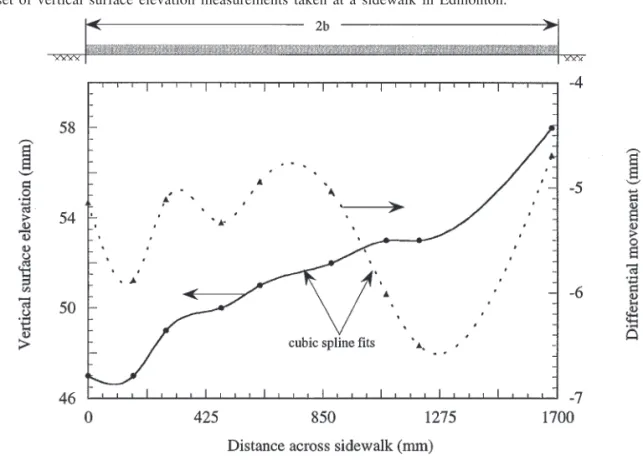
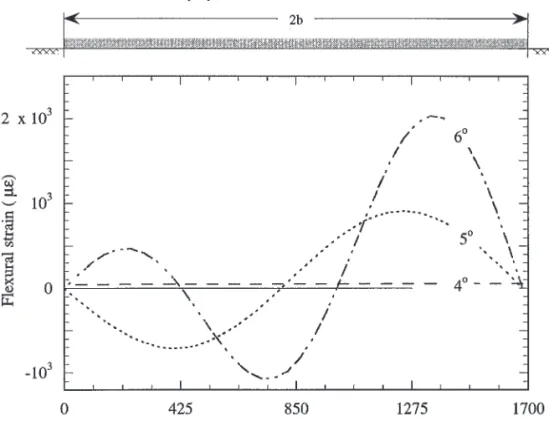
A typical set of vertical surface elevation measurements (Fig. 2) taken at a sidewalk in Edmonton on February 1994 are analysed using the nonsmoothing and smoothing proce-dures to illustrate the numerical sensitivities discussed above. In addition, Fig. 2 shows the differential vertical movement calculated using eq. [5] so that it can be related to calculated strains in Figs. 3–5. The measured surface elevations and differential vertical movement have been connected together with cubic splines in Fig. 2. Figure 3 shows the similarity in the variations of the flexural strains obtained using the nonsmoothing procedures of finite difference and cubic spline. Estimates of flexural strains from the cubic spline fit are consistently higher than those obtained with finite differ-ence. The variations in flexural strains across the width of the sidewalk are very dramatic and are unlikely to corre-spond to real behaviour. The correcorre-sponding analyses with the smoothing procedures of polynomial and Fourier series lead to estimates of flexural strain as shown in Figs. 4 and 5. It is also to be noted that the flexural strains obtained with the nonsmoothing procedures are an order of magnitude higher than those obtained with the smoothing procedures. This response illustrates the fact that numerical differentia-tion based on local data can produce spurious results.
The agreement of the estimates from the two smoothing procedures implies that both procedures capture the same mode of deformation. This example clearly shows that the inclusion of additional terms in the series excites additional modes of deformation that may not reflect reality. It is true that the use of many terms is preferred if the only intent is to obtain a solution that matches the measured vertical move-ments. However, calculation of flexural strains involves the second derivative of the displacement function that satisfies given kinematic boundary conditions. It is the second step in
the procedures that leads to spurious strains. The second de-rivative of eq. [10] will lead to a summation of the sine se-ries where each term has a factor of ci(iπ/2b)2. Therefore,
even though cimay be small, i2becomes large as i increases.
Numerical tests on typical data were conducted with a vary-ing number of Fourier terms. It was observed that in general the number of terms in the Fourier series should be less than
half the number of elevation measurement points to avoid the introduction of spurious strains.
Sensitivity to measurement errors
Field measurement errors are bound to occur in practice. Therefore, there is a need to know what is the likely impact of these errors in strain estimates determined with the
appli-Fig. 2.Typical set of vertical surface elevation measurements taken at a sidewalk in Edmonton.
ation of the four methods. A profile of expected vertical movements for a sidewalk of 1.5 m width and 150 mm thickness was assumed to follow the expression:
[11] w x x b b
( )=5sin ( + ) 2
π
where w(x) is the vertical movement, b is the half width of the sidewalk, and x is the coordinate as shown in Fig. 1.
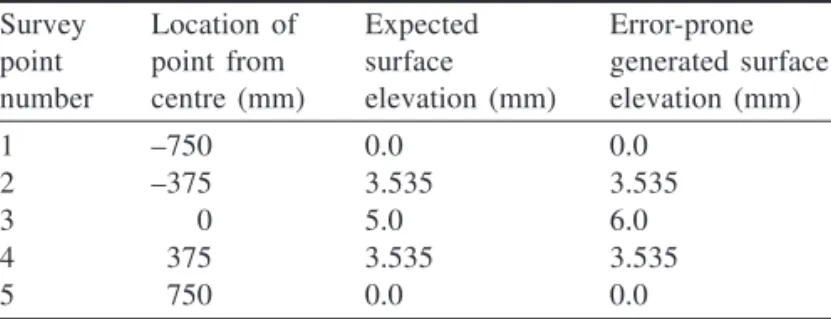
For the sake of this exercise, it is assumed that the surface elevation measurements generated by eq. [11] are taken at five equally spaced points across the width of the sidewalk. The measurement error in the vertical movement at the cen-tre of the sidewalk is arbitrarily set to 1 mm higher than the
Fig. 4.Comparisons of flexural strains obtained with polynomial fit method.
actual elevation to produce the so-called “error-prone” gen-erated surface elevations. The city surveyors indicated that the expected error in the surface elevation measurement is ±1 mm. Table 1 shows expected and error-prone generated surface elevation measurements at the survey points.
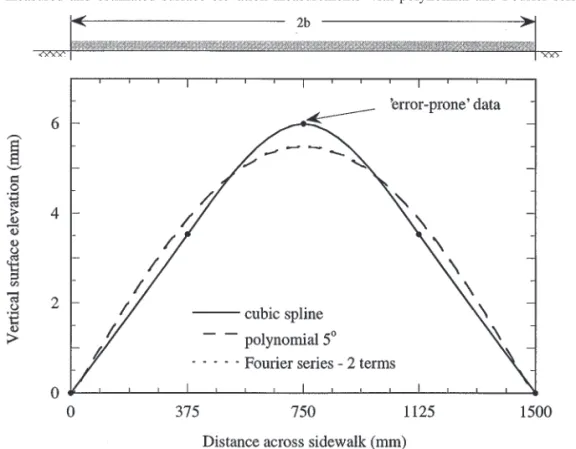
The four methods discussed earlier were used to analyse the error-prone data shown in Table 1. Figure 6 shows the comparisons between the error-prone and estimated surface elevations obtained using polynomial fit and the Fourier se-ries methods. The fit corresponding to the finite difference method is not shown because it is piece-wise and repre-sented by a local quadratic function between successive points. The fits obtained with the fifth-degree polynomial and the two-term Fourier series are very similar and difficult to dis-tinguish from each other in Fig. 6. Estimates of flexural strains from the application of the four methods to the data in Table 1 are compared with the expected strains as shown in Fig. 7. The so-called expected flexural strains can be cal-culated (eq. [11]) because a continuous function has been used to define the hypothetical deformation of the sidewalk. The expected flexural strains at the top and bottom fibres of the sidewalk slab are calculated from the expression: [12] εb( )x d π sin π( ) b x b b = + 75 2 2 2 2
where d is the thickness of the sidewalk. The estimated flex-ural strains with the cubic spline and the finite difference show larger differences compared with the expected flexural strains (Fig. 7) than those obtained with the polynomial fit and the Fourier series methods.
The ratio of calculated and expected flexural strains at the centre of the sidewalk is a good measure to compare the ability of different methods to estimate flexural strain. These ratios are 1.6, 2.44, 1.09, and 1.12 for finite difference, cu-bic spline, polynomial fit, and Fourier series methods, re-spectively. These ratios clearly indicate the inability of the finite difference and cubic spline methods to estimate flex-ural strains when the surface elevation measurements are subject to small errors. This should be of no surprise, since it was established in the previous section that poor estimates of flexural strain are obtained from nonsmoothing proce-dures. On the other hand, estimates of flexural strain com-pare very well with the application of the polynomial fit and the Fourier series methods.
The above analysis leads to the qualitative assessment of the four methods to estimate flexural strains as summarized in Table 2. It is concluded that the polynomial and Fourier
series methods are best suited to estimate the seasonal varia-tions of flexural strains. In the subsequent discussions only one term in the Fourier series method is used to estimate the flexural strains in the sidewalk, since it is unlikely that a stiff structural member such a narrow concrete sidewalk is able to deform higher than in the first mode. Furthermore, it is noted that most longitudinal cracks occur within the mid-dle third of the concrete slab width which concurs with the fact that the maximum strain response obtained with these methods is also in this region of the sidewalk slab.
Analysis of sidewalk vertical movements
The analysis of the data on vertical movement of side-walks at Edmonton, Calgary, and Camrose was previously analysed and discussed by Rajani and Zhan (1997). In this paper analysis of the data from only one particular sidewalk (62 Avenue NW) site in Calgary is presented because the fo-cus of this paper is to illustrate how different numerical pro-cedures can be used to estimate flexural strain from vertical surface elevation measurements when other means are un-available.
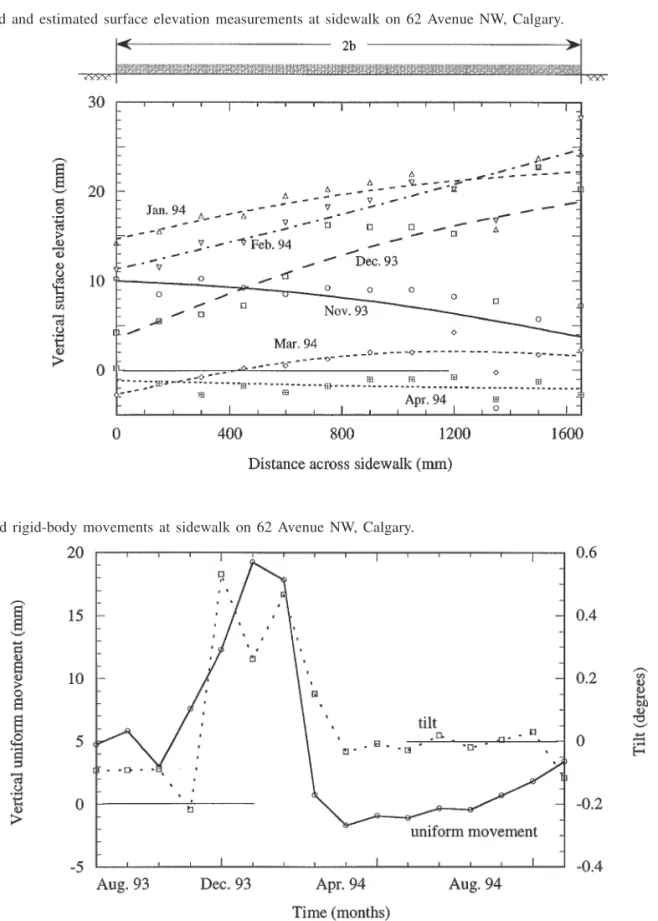
The vertical-movement profiles between November 1993 and April 1994, across the sidewalk at 62 Avenue NW, Calgary, are presented in Fig. 8. The field measurements showed a large scatter, which was quite different from the measurements at the other sidewalk sites. The lines in Fig. 8 represent interpolated values obtained from using one term in the Fourier series, i.e., sine term.
The rigid-body movements (uniform vertical movement and tilt, Fig. 9) and flexural strains (Fig. 10) were deter-mined at the end of each 30-day period. The sidewalk began to heave in October 1993 and within 3 months it had risen to a maximum value of about 18 mm in January 1994. Subse-quently, the sidewalk settled to a level about 5 mm lower than its position for the previous summer, which may indi-cate a loss of moisture in the underlying soil. During the summer and early fall, the sidewalk heaved up slowly with a rate less than 1 mm per month. During the same period, the sidewalk tilted away from the road by about 0.6° and then moved back to its initial tilt in April 1994. The degree of tilt increased concurrently with the increase of uniform vertical movement (Fig. 9); similar behaviour was observed at other sidewalk sites.
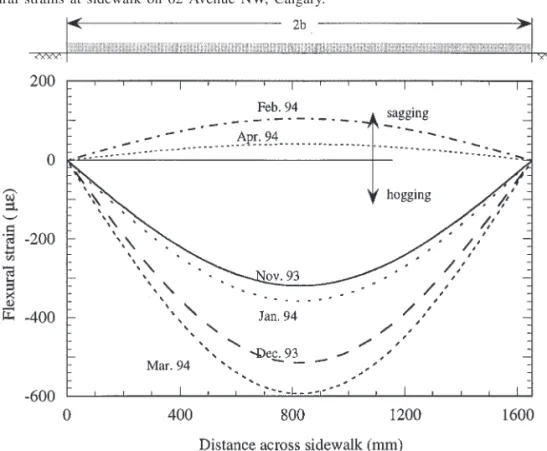
The flexural strain profiles across the sidewalk width for the period between November 1993 and April 1994 are shown in Fig. 10. The figure shows that the sidewalk is in a hogging mode of deformation except for the months of Feb-ruary and April 1994. The time dependence of flexural strain at the centre of the sidewalk is given in Fig. 11. In general, higher flexural strains are observed during the winter months than during the summer months. A maximum strain of 600
µεoccurred in March 1994, the level of strain at which con-crete is expected to crack.
Summary and conclusions
Different numerical procedures to estimate flexural strain from surface elevation measurements on concrete sidewalks were closely examined. The use of finite difference, cubic spline, polynomial fit, and Fourier series methods of
analy-Survey point number Location of point from centre (mm) Expected surface elevation (mm) Error-prone generated surface elevation (mm) 1 –750 0.0 0.0 2 –375 3.535 3.535 3 0 5.0 6.0 4 375 3.535 3.535 5 750 0.0 0.0
Table 1.Vertical movements of the sidewalk for both expected and error-prone generated surface elevation measurements.
ses were described to estimate flexural strains from surface elevation measurements across the sidewalk width. The fi-nite difference and cubic spline methods give unrealistic high flexural strains, and the two methods are particularly sensitive to the errors in measurement. Polynomial fit and Fourier series methods give similar results, and their sensi-tivities to the errors in measurement are acceptably low. The one-term Fourier series method is recommended to be the best procedure to analyse sidewalk surface elevation data for
Fig. 6.Comparisons of measured and estimated surface elevation measurements with polynomial and Fourier series methods.
Fig. 7.Comparisons of estimated flexural strains obtained with finite difference, cubic spline, polynomial, and Fourier series methods.
Numerical method Numerical sensitivity Sensitivity to errors in measurement Finite difference Very Very
Cubic spline Very Very
Polynomial fit Not Not
Fourier series Not Not
Table 2.Summary of qualitative assessment of different methods to estimate flexural strain.
flexural strains, since it is unlikely that a stiff structural ele-ment member such as a narrow concrete sidewalk is able to deform higher than in the first mode. However, the fourth-degree polynomial can be equally used. Furthermore, it is noted that most longitudinal cracks occur within the middle third of the concrete slab width which is in agreement with the fact that the maximum strain response obtained with these methods is also in this region of the slab.
The numerical methods to indirectly determine strain are best suited for those circumstances where installation of strain
gauges is difficult, expensive, or impossible. In practice, these methods to estimate flexural strains are applicable to instances where the principal mode of deformation is bend-ing and not axial or torsional.
Acknowledgements
The authors extend their appreciation to the staff at the cities of Winnipeg, Saskatoon, Regina, Edmonton, Calgary,
Fig. 8.Measured and estimated surface elevation measurements at sidewalk on 62 Avenue NW, Calgary.
and Camrose for their collaboration in the collection of field data.
References
Hildebrand, F.B. 1956. Introduction to numerical analysis. 2nd ed. McGraw-Hill Company, New York.
Rajani, B., and Zhan, C. 1997. Performance of concrete sidewalks: field studies. Canadian Journal of Civil Engineering, 24: 303–312. Reddy, J.N. 1993. An introduction to the finite element methods.
2nd ed. McGraw-Hill, Inc., New York.
Shaker, A.F., and Kennedy, D.J.L. 1991. The effective modulus of elasticity of concrete in tension. Structural Engineering Report 172, Department of Civil and Environmental Engi-neering, University of Alberta, Edmonton, Alta.
List of symbols
ai(i = 1, ..., N): unknown coefficients in the polynomial fit
method
b: half-width of the concrete sidewalk slab
Fig. 10.Estimated flexural strains at sidewalk on 62 Avenue NW, Calgary.
ci(i = 1, ..., N): unknown coefficients in the Fourier series
method
d: thickness of the concrete sidewalk slab
hi: x-coordinate distance between points i and i + 1
N: number of terms in the polynomial or Fourier series methods
NP: number of survey points along sidewalk width
w: total vertical movement
wd: differential vertical movement
wie: measured vertical movements at point i of element e in
cubic spline method
wi: vertical movements at point i
wo: first rigid-body mode of movement or uniform vertical
movement
xr: x coordinate of survey point
α: second rigid-body movement or tilt
εb: flexural strain
φi,ψi: Hermite cubic functions