ALPHA PARTICLE SOURCES FOR
CALIBRATION PURPOSES
by
KARLENE
CORBIT KLAGES
Submitted in Partial Fulfillment
of the Requirements for the
Degree of Bachelor of Science
at
the
MASSACHUSEI'TS
INSTITUTE OF TECHNOLOGY
June
1961
s
·
1.
Or
ftC
JUL 14
196
Signature of Author
.
.,,Signature redacted
.
-
.
.
...
.
.,,..
..,.
.
.,. .....
-
.
-~
--
~
.
. . .
IJ:Ert.:::.9P
ofPh¥ics,
May 20,1961
Signature redacted
Certified
by· · · · • · · ·
;
·
~
-
-
.
•
-:
;
·
·'m;~fs
·
S~p:~i;o;
•
Signature redacted
. .
. .
.
.
.
. .
. . . . .
.
.
.
Accepted
by • • • • • •Five mil wires were coated with Po210 and Th228 in an
investi-gation of their properties as calibration sources for the charged
particle analyzer. In order to obtain good sources, the wires to be
used must be thoroughly cleaned and "dipped" for the shortest length
of time possible. For Po2 1 0, Ag wire produces peaks with the highes
The author is greatly indebted to her advisor Professor W. W.
Buechner and Mr. A. Sperduto for their constant aid and encouragement. Without their help this work would have been impossible.
K& <Qi.~j<~
INTRODUCTION page
THE CARGED PARTICLE ANALYZER....so... 1
METHOD OF CALIBRATING THE MACHI... 21
CHOICE OF RADIOACTIVE SOURCES USED FOR STUDY... 2
Po2 1 0
WIRESTRIED...
WIRE SZE...
SOLUTIONS USED FOR CLEANINGWIRES...
METHODS OF CLEANING WIRES AND THEIR EFFECT
UPON THE RESULTING PEAKS... 005 0~5 ... ... 0000 DISCUSSION OF TABLEI... DISCUSSION OF TABLE1...
REPRODUCIBILITY OF THE PEAK ENERGIES AND SHAPES
FOR VARIOUS CLEANING PRCESSES...
P021 0 CONCENTRATION...
AGE AND 'RESHNESS" OF THE DIPPING SOLUTION...
DIPPING PROCEEDURE...0 EXPOSURE PROCEEDURE...**... AGING OF SOURCES... CONCIUSIONS....00. 000... ... 0~0 OsO sos ...o .*... ... s.. ... 500 ... ... ... ... ... ... ...
23
APPENDIX I - VARIATIONS IN ENERGY FROM ZONE TO ZONE
FOR DIFFERENT PLATES AND THE ENERGY GAP BETWEEN
PLATES... ... 24
.3
.3
.3
.4
.
4
.7
.7
.10 .11 .12 .12 .12 .21 Th228 .. 0 .. 0WAA3LL Q& COITh]Li~2~2S
(uOAYILNUJIi)
page
APPENDIX II - MEANS OF CORRECTING RESULTS FOR ENERGY GAP
AND ZONE DIFFERENCES•****••**•*•••••••••••...27
APPENDIX III - VARIATIONS IN THE CALIBRATION OF THE MACHINE
AND USE OF THE RESULTING CALIBRATION CURVES...29
APPENDIX IV - DESIRED ACTIVITY FOR CALIBRATION SOURCES AND
DIPPING TIME NECESSARY TO ACHIEVE SUCH ACTIVITY....32 APPENDIX V- DIPPING SOLUTIONS USED...34 APPENDIX VI- MERITS OF HYDRAZINE VS WATER AS
DIPPING SOLUTIONS...35
APPENDIX VII- MERITS OF THE SOAP DIPPING SOLUTION...37
APPEDIX VIII- METHOD OF DIPPING THE MIDDLE OF A WIRE WITH Po
APPENDIX IX - LENG OF THE WIRE SOJRCE...40 APPENDIX X - HEIGHT ADJUSTMENT ALPHA SLIT AND PRESSURE...42
APPENDIX XI- METHODS OF ANALYZING THE DATA... 43
APPENDIX XII- APPARATUS FOR COATING WIRES WITH Th228 ...
46
APPENDIX XIII- SUGGESTIONS FOR FUTURE WORK...49
INTRODUCTION4
THE CHARGED. *PMTICLE ANALYZER
The ONR-Generator group at M.I.T. uses a mass spectrometer to
analyze the reaction energies of various elements when they are
bom-barded with high energy protons or deuterons. The charged particles
upon entering the analyzer follow a curved path whose radius of
cur-vature is approximately proportional to the square root of the energr
of the particle divided by the magnetic field. The constant of
pro-portionality is 1 m/e and is different for different kinds of
parti-cles.
A set of three glass photographic plates is placed ina curval
holder which is then placed in the machine. The distance along the
plates is marked off in centimeters and each point along the plates
corresponds to a different radius of curvature with respect to the
paths followed.
METHOD OF CALIBRATING THE MACHINE
The distance along the plates is calibrated in terms of the
radius of curvature r by making numerous exposures of a calibration
source in one zone along the entire length of the three photographic
plates. This is done by varying the magnetic field, since a-tH = EC
where Eo is a constant that is proportional to the energy of the radio-active source being used and H is the magnetic field. The method of producing such a source is the actual topic of the study, but it was
complicated by the fact that the calibration of the machine is
CHOICE OF RADIOACTIVE SOURCES USED FOR STUDY
Upon a study of nuclear decay chains it was found that the
only alpha-particle chains suitable for experimentation are those
in-volving Po210, p206 Th228 and Th2 29.
Most of the work was done with
P0210 because a supply of PoCl was readily available. Th228 was studied for similar reasons.
WIRES TRIED
Copper, chromel, alumel, paladium, tungsten,'gold, silver and platinum wires were all tried as bases on which to chemically plate
Po21 0 . Gold, tungsten, and alumel were rejected because Po2 1 0 will
not plate onto them.
WIRE SIZE
It was found that the size of the wire makes no difference in the position of the 1/3 height of the peak, but smaller diameter wires
do result in sharper peaks with smaller half widths. (Note: The
position of the 1/3 height of a peak is used to calculate the energy
of the particles that formed the peak during the exposure. The exit
-ence of the peak is the result of the fact that charged particles upon
hitting a photographic plate ionize the emulsion particles in their
path and thus expose the plate.) For this reason
5
mil wires wereused when available rather than 10 mil wires.
SOLUTIONS USED FOR CLEANING WIPES
Laboratory glass cleaner (Laf Soap) manufactured by the Finger
Lakes Chemical Corporation, Inc. and concentrated HCl was used to re-move dirt, grease and various oxides from the wires. A saturated
sh-tion of BaNO was used to remove oxide from the silver wires. Hydra-zine sulfate was used during the cleaning process to remove oxides and
sulfides, and it was used after dipping to prevent the later formation
of oxides or sulfides. Distilled water was used throughout the
cleaa-ing process as a rinse.
METHODS OF CLLAiZIWG WILES
AND THEIR EFFECT UPON TEE RESULTING PEAKS
Various methods of cleaning wires were tried, and these methods
are shown listed in Tables I and II along with the energies and
half-widths of the resulting peaks. In both tables, the processes are
listed in terms of decreasing energy of the water solution peak with
the exception of sources 1 and 2 in Table I. Table I is shown on page
5 and Table II is shown on page
6.
DISCUSSION OF TABLE I
The,:source dipped and cleaned according to method 2 has the
highest energy vjille the source dipped and cleaned according to method
3 has the next highest energy. All of the remaining methods produced
wires whose energy was at least .40 key less than the energy of the
wire produced by method:?. It is interesting to note that the peaks
of the water solution wires always have higher energy that similar hydrazine dipping solution peaks when the wires have been cleaned with either Lab Soap or hydrazine before dipping. The only exception to
this rule is the wire sources produced by methods 1 and 2. The
rea-son for this exception lies in the reproducibility of the cleaning
process. For those methods which neither clean the wires with Lab
Soap nor rinse them with hydrazine before dipping,the energy of
the-peaks resulting from the hydrazine dipping solution wires is in all cases greater than the energy of peaks resulting from similar water
dipping solution wires.
AG
TABLE
I
NUMBER
I
2
3
4
5
6
7
8
9
LAB SOAP0
BANO3
S
S
0
0
0
0
0
0
CONC. HCL
0
0
0
0
0
0
0
0
HYDRAZINE
X
X
0
0
X
X
ACETONE
WATER
X
X
X
X
X
X
X
X
X
SOLUTION
H20
HYDRA.
H20
HYDRA.
H
20
HYDRA.
H20
HYDRA.-
H20
ENERGY
5299.30 5300.43 5299.71 5299.12 5299.04 5299.00 5298.31
5299.12
5299.00
1/2
WIDTH
3.04
3.60
3.60
3.65
5.13
4.56
5.19
4.60
3.33
NUMBER
10
11
12
13
14
15
16
17
LAB SOAP
0
0
0
0
BANO3 0 0CONC.
HCL
0
0
HYDRAZINEACETONE
0
0
WATER
X
X
X
X
X
X
X
X
SOLUTION
HYDRA.
H20
HYDRA.
H20
HYDRA.
SOAP.
Hg20
HYDRA.
ENERGY
5298.75 5298.42 5299.21 5298.36 5298.33 5298.00 5297.76 5297.21
1/2
WIDTH
4.07
3.65
4.45
3.81
4.42
4.80
3.43
3.49
S=STORED O BEFORE DIPPING ONLY
ENERGY AND 1/2 WIDTH IN KEV
PT
TABLE
NUMBER
I
2
3
4
5
LAB SOAP
0
0
0
0
0
CONC. HCL 0 0 0WATER
X
X
X
X
X
SOLUTION
SOAP
H20
HYDRA.
H20
HYDRA.
ENERGY
5299.85 5299.68 5299.17
5299.32 5299.06
1/2WIDTH
3.76
2.84
3.38
3.21
3.18
0 BEFORE DIPPING ONLY X a BEFORE AND AFTER DIPPING
Method 1 produced the wire with the highest peak energy. The
second highest peak energy was produced by the wire that was cleaned and dipped according to method 2.' The peaks produced by these wires were both sharply defined but the wire that was dipped and cleaned
according to method 2 has the smaller half width.
It is interesting to note once again that the peak energies of water dipping solution wires are again higher than the peak energies of the corresponding hydrazine dipping solution wires. In all cases,
the wires were cleaned with Lab Soap.
REPRODUCIBILITY -OF THE PEAK ENERGIES AND SHAPES
FOR VARIOUS CLEANING PROCESSES
Two tables are given that illustrate the reproducibility of several of the cleaning methods shown in Tables I and II. (Note:.
Reproducibility means the ability of a given cleaning and dipping
pro-cess to result in peaks of the same energy.) Table TIT indicates the
reproducibility of processes for cleaning and dipping silver wireand
Table IV indicates the repr'oducibility of cleaning and dipping processes
for platinum wire. The numbers in Tables III and IV refer to the
cor-responding cleaning and dipping processes listed in Tables I and II
respectively. Table III is shown on page 8 and Table IV on page.9.
These wires were all run after they were a day old in order to give them time to reach equilibrium.
A G
TABLE
lII
NUMBER
3
2
9
E N ER GY
5299.57 4.42 5299.28 7.13 5299.28 3.33
1/2 WIDTH
5299.82 4.31 5298.30 5.49 5299.68 5.04
IN K EV
5300.59 3.01 5298.94 9.31 5298.94 3.26
N5300.10 3.80 5301.27 4.75 5299.47 4.56
AVE. ENERGY
j5300.02±
.59 5299.44±1.83 5299.16± .92
AVE. 1/2 WIDTH
3.88
6.67
4.05
cO
PT
TABLE
NUMBER
2
3
5
ENERGY
&
5299.18
2.51 5299.17
3.38 5299.19
3.04
1/2 WIDTH
5299.94 2.89 5300.18 3.35 5298.95 3.21
IN KEV
5299.68 2.84 5299.00 3.30
AVE. ENERGY
5299.60t.42 5299.45*i.73 5299.07*.
2
AVE. 1/2 WIDTH
2.75
3.34
3.12
It is interesting to note that although Ag method 2 yielded
the highest energy for a peak during the cleaning process run, the
reproducibility of such sources is poor. That is, any given wire made according to this method may produce peaks whose energy ranges from
5301.27 key to 5298.30 key, which is an energy variation of 3.66 key.
Such a source is useless for calibration purposes since the energy of
sources to be used for calibration purposes must be known to a high degree of accuracy without having to actually measure the energy of
each source. Hence, the variation in energy from source to source must be as small as possible. In this respect, a source dipped and cleaned
according to Pt method 2 is the most reproducible since its variation
in energy is only +.42 key. The next most reproducible dipping and
cleaning method is Ag
3
which produces sources whose energy varies fromthe average by
:.
59 key. In terms of highest average energy however,method Ag3 produces better sources than method Pt 2.
P0210~ CONCENTRATION
If two silver wires are-dipped in solutions containing .5 mc/cc
of Po2 1 0 and 1.5 mc/cc of Po2 1 0 respectively for the same length of
time, the first wire is not only less active, but results in a peak
whose energy is always less than the corresponding peak energy of the
second wire. This is true regardless of how long a time interval is
taken, or the kind of dipping solution that is used (hydrazine or water).
This includes the possibility of using a hydrazine dipping solution
In addition, it was found that theIonger a wire is dipped, the
lower the resulting peak energy is. This process may have some lower limit; but before that point is reached, the sources have such a-Jow
order of activity that they are no'longer useable as calibration sources.
This statement is true regardless of the Po21 0 concentration.
AGE AND "FRESIESS" OF THE DIPPING SOLUTION
Age refers to the length of time that has passed since the
solu-tion was originally prepared. "Freshness" of a solution refers to the
number of times the solution has been used for dipping sources. The
fewer wires that have been dipped in a solution the "fresher" it is.
Age-is of no importance what-so ever, but "freshness" is very
important. The reasons why a dipping solution should be "fresh" are
as follows. First of all, wires dipped in fresh solutions never form
sulfides or oxides, whereas wires that are dipped in "old" solutions
do. The greater number of times a solution has been used, the greater
is the probability that oxides or sulfides will form. Second,the
fresher the solution, ib othe:higherethecenerg f-the resnltirgpeaks
will become and the better the peak shape will become'. Third, Po21 0
plates unto a platinum wire more readily from an unused solution than
from a used solution. In addition, there appears to be an upper limit
on the amount of Po21 0 that will plate unto a platinum wire from any
given solution;-and the more times a solution has been used, the lower
this upper limit becomes.
DLL~.L~Ii~~G rI~OCLAJ9U.LI
After cleaning, the wires were coated with a thin film of Po21 0
by placing them in a' slightly acid solution of PoCl. Normally the
activity of a finished wire is approximately proportional to the lengthe
of the dipping time. However, if the wire is left in the solution too
long, the amount of Po2 1 0 coating it reaches a maximum and then starts
to decrease until a stable activity is reached.
EXPOSURE PROCEEDURE
The wires were placed in a wire holder after dipping. The wire
holder was then placed in the target chamber of the charged particle analyzer. The wire was adjusted to the correct height by mechanical
means; and, aier the chamber was properly evacuated, the exposure was
made by opening the valve into the charged particle analyzer.
AGING OF SOURCES
A time study was made of copper, paladium,silver, platinum,
and chrome. This time study indicated that paladium and copper are
both unsuitable as calibration sources.
The paladium source yielded a triple peak that degenerated into
a double peak over the course of seven days.
The copper source yielded a double peak composed of a
high,ex-tremely sharp peak with a smaller peak immediately behind it. Over
the course of seven days the two peaks merged into one rather wide
peak with a double tip.
The Pt wire maintained a sharp -ront edge and a narrow
half-width throughout the entire time study in addition to maintaining its
or-ginal height. On the other hand both Ag and Chromel lost their
peak shape although Chromel maintained a sharp front edge whereas Ag's
front edge gradually took on a gentler slope. Both Ag and Chromel
decreased in height by 40% and 30% respectively.
The plates also indicated that Pt and Ag have a sharp dip
fol-lowed by a rise in energy during the latter part of the first day with
the rise occuring over a longer time period for Pt than for Ag. This
indication was then verified by additional time runs on Ag and Pt.
The graphs for these time runs are shown on pages 14 through 19.
The plates were calibrated with the sources on which the time study was
being made. In each case this calibration was made right after the
sources were dipped and it was later discovered that, the energy of the
sources used for the calibrations changed in an unknown manner during
the calibration. The only thing known concerning this change in energy
is the magnitude and direction of the net change. For this reason,
three different calibrations were used to analyze the data. The
un-corrected calibration curves assumed that the energy of the calibration
sources remained constant during the calibration (as we know it did
not). The corrected calibration curves were made by assuming that the
energy of the calibration sources decreased linearly with time (this
is not very likely but it is a possibility). The third graph for both Ag and Pt was made by assuming that the calibration curve of plate
3905 is universal since the energy of the calibration source in this
case was constant.
ENERGY IN KEV 2 I
I
0---* 3CHANGE OF
i iTIME IN DAYS 5 6 7 4AG WITH
TIME USING
UNCORRECTED
CALIBRATION
CURVE 3860
5302.00t 5301.00t H I 5300.001\0 I
ENERGY IN KEY 5302.00 10 5301.00 o 5300.00 I I p p 2 3 4 5 6 7 I TIME IN DAYS
CHANGE OF
AG WITH TIME
CORRECTED CALIBRATION
CURVE 3860
p
USING
ENERGY IN KEV 1: I 1 4 5 TIME IN DAYS
CHANGE OF
AG WITH TIME
CORRECTED CALIBRATION CURVE3
5303.00 t 5502.00
I
Hj 0 5301.00 5300.00 ti. 2 3 6 7USING
I3905
ENERGY IN KEV 5306.001 5305.00+ 5304.00+ 5303.00 5302.00-j 5301.00+ 0 TIME IN DAYS
CHANGE OF
UNCORRECTED
PT
WITH TIME
USING
CALIBRATION CURVE 3901
I
I
0I
FH I /I 0 2 3 4 5 6 IENERGY IN KEV 5306.001
8
00
0 0 0 0 00
° 3CHANGE OF
I\
4 5 6 0/I TIME IN DAYSPT WITH TIME USING
CORRECTED
CALIBRATION CURVE
3901
I
0 5305.00. p O 5304.00-5303.00 5302.00 2 0 IENERGY IN KEV 5307.00t 5306.00+ 5305.001.0 5304.00 5303.00 fA
.
I
. 0I
0 0 TIME IN DAYS 6CHANGE
OF
PT
WITH
TIME
CORRECTED
CALIBRATION
CURVE 3905
I
I
0 I 2 3 4 5USING
I
I`-
l
Since the exact manner in which the energy of the caiibration
sources changed is unknown, none of the three curves is exact but
they do make good approximations. However, the relationship between
all pairs of points that are connect by a straight line is the
cor-rect relationship, since it is independent of the calibration. By
means of these connected points it becomes evident that there is a
dip fobwed by a rise in energy during the latter part of the first
day for both Ag and Pt with the rise for Pt occuring over-alonger
period of time than that for Ag.
The energy of the Ag wire was measured again four weeks later
and found to have decreased by7ketj'or it decreased at arate of
2key per week. In addition, the peak shape degenerated completely.
When new, the peak had a steep slope in front and a half-width of
3.30 key which increased to 4.33 key over the course of six days.
Four weeks later it had increased to greater than 14.25 key, and -the
front slope was at approximately 450 angle to the vertical.
The Pt wire held up much better. One week after the last day
of the time study, the wire was run again and its energy had decreased
by only .75 key. In additionto maintaining its sharp front edge, the width of the peak changed very little. When new the
half-width was 3.60 key. Seven days later it was 3.92 key and seven days
after that is was only 4.10 key. The net change in the peak's half-width was only .50 key and most of that occurred during the first six
days of the time run.
COiCLUS:Oi
For conviences sake, the conclusions will be listed numerically
as follows.
1. Five mil., wire is suggested for dipping purposes since
smaller diameter wires produce better peak shapes than larger diameter wires without lowering peak energy.
2. Ag wires should be cleaned by washing with Lab Soap and
then dipping them in a saturated BaNO3 solution followed by
concentrated HCl and hydrazine. The wire should be thoroughly rinsed with distilled water between each of these solutions and just before being placed in the dipping solution. A slightly acid solution of PoCl should be used for dipping the
wire after which the wire should be throughly rinsed with dis-tilled water.
3. Pt wires should be cleaned by washing them with Lab Soap
and the dipping them in Concentrated HCl. The wire should be rinsed with distilled water before and after using the concentrated HCl. After cleaning, the wire should be dipped
in a slightly acid solution of PoCl and then thoroughly rinsed
with distilled water.
4. Neither Pt nor Ag wires should be used for calibration
purposes until they are at least one day old.. However,
over-aged sources are just as bad as under-aged sources,
particu-larily Ag, since the peak energy decreases with time and the
peak shape degenerate. In this respect, Pt is much better
than Ag for calibration purposes, but Ag wires do ted -to
yield peaks with a higher initial energy than silmiliar Pt
wires. However, this difference may rest entirely upon the positions of the wires relative to the rise in energy that
occurs during the latter part of the first day since the wires
are slightly less than one day old.
5. Slightly acid PoCl solutions should be used for dipping
purposes. The age of the solution is dnimportant, but each
solution should be used one time only. The concentration of
P0210 in the solution should be as-great as possible (there may be an upper limit to this statement but it is greater
than 2.5 me/cc of P0 2 1 0) and the dipping time as short as
possible.
Th" -"
The source presently in use was made by the Radioactivity Center of M.I.T. by using the method designed by A.C.Wahl and W.R.Danieles for the preparation of an emanating uranium source. The source was formed
by percipitating barium stearate containing 2 mc of Th228 and 2 mc of Ra228. This source has approximately 100% emanation. The resulting
radioactive gas is pumped through a closed system and attracted to the
desired target by electrical means. A 100 microcurie source can be prepared in two or three hours dipping time.
Only one Th228 wire was actually tested, but the results of the
test indicate that Th228 would make extremely good calibration sources. Even though the source was very active (1/16 mc), the peaks were sharp
and narrow. The 1/2 width of the 8 Mev peak was 4.5 key and the half=
width of the other two peaks were on the order of 3.0 key. This is
extraordinary because the more active a source of a given radioactive
element is, the more its peak shape degenerates and the lower its peak energy becomes due to the increased thichess of the radioactive coating. The ideal source thickness is one atom thick and this parti-cular source was at least 200,000 atoms thick.
In addition to the narrow half-width, the peaks have little or
no energy tails on either side of the peaks.
Two runs seperated by a period of eight and one half hours were
made using this (L.urce. During this time lag there was no apparent drop in the energy of any of the three peaks involved.
±PLAIX I
VARIATIONS IN ENERGY FROM ZONE TO ZONE
FOR DIFFERENT PLATES AND THE ENERGY GAP BETWEEN PLATES
Each plate is approximately 27 cm. long and 5 cm. wide. The
plates are exposed in three stripts that are 8 mm. wide and tun the
full length of the set of plates. These strips are denoted as zones
30, 40, and 50. If a constant energy source is used to expose all three strips, the resulting peaks should fall at the same distance along the plates for each zone. In actual practice, this not only
does not occur, but the variation in distance is different for each
set of plates
used.
This variation is shown in terms of energydif-ferences for a number of plates in the graph on page 25. The plates
with sucessive numbers are part of a set and should be viewed as a
whole.
In addition to-the above variation, the meeting point of any
two plates in a set of three represents an abrupt jump in th radius
of curvature at that point because one plate tends to be higher than the other. This height differential is different for each zone; and
hence, the jump in the radius of curvature is different for each zone.
This difference in height was measured by means of a micrometer and
then expressen in terms of a step function in energy by calculating
the change in the' radius of curvature at that point and then converting
this change into key. This gap was largest for zone 30 and varied
from .016 cm. which represents an energy differential of 1.43 key to
.025 cm. which represents a change in energy of 2.20 key. The size
& DISTANCE PLATE 3856 77 3858 77 3860 77 3861 36 3901 3902 37 3905 .77 ZONES ZONES 0 0 50 30 40 50 0 t-40 50 30 40 30 40 50 0 0 0 30 40 50 ZONES 0 50 ZONES 0 0 0 30 40 50 ZONES ENERGY IN KEV 5300.00 5302.00
ENERGY
VARIATIONS
BETWEEN ZONES 8 PLATES
0 30 0 30 0-4 0 5040 40 50 ZONES ZONES ZONES 0 30 400 3906 37 5296.00 5298.00
of the gap Lor any particularset o p was coputec by measuring
the gap a number of times and calculating the average.(Note: Between
each measurement, the plates were removed from the plate holder and then replaced.) The variations from this average were on the order of
+.002 cm or +.10 key.
APPIlDIX II
MEANS OF CORRECTING RESULTS FOR ENERGY GAP
AND ZONE DIFFERENCES
The means of adjusting the results for these differences is shown in the graph on page 28. The small circles represent energy differences between ones at the upper part of plate 3901 and the lower part of plate 3902. This was accomplished by exposing all three zones
using the same source with everything else held constant. The
dot-ted lines represent the correction that would be used if there was no height differential between the two plates. The solid lines represent the corrections to be used asuming that the variation along any given plate is linear and that the plates are displaced equally on either
side of the proper position at the position there rthe twoplates meet.
This graph is used in the foffowing manner. Given the energy
of a peak in zone 30 at the distance of 60 cm., its energy can be
compared to the energy of another peak in zone 50 by adding 2.19 key
to its measured energy. 2.19 key is just the energy difference be,
tween the solid line for zone 30 and the solid line for zone 50 at the
distance of 60 cm.
DISTANCE ALONG PLATES IN CM ZONES 30 40 50 76. 72-68 64 56
52-481
46 40-36- ZONES 30 40 50 lENERGY IN KEV -1.5 .1.0 -0.5 0.0CORRECTIONS
FOR DIFFERENCES IN ZONE ENERGIES
FOR PLATES 3901-02
APPENDIX III
VARIATIONS IN THE CALIBRATION OF THE MACHINE
AND USE OF THE RESULTING CALIBRATION CURVES
The vaiiation in calibration is illustrated by the graphs shown
on pages 30 and 31. The uncorrected calibration curves show the
ap-parent energy of an assumed constant energy source as the position
along the plate is varied. These energies are found by assuming that the p
the present calibration of the machine is correct. This calibration is obviously no longer valid, for if it were, the points would fall
along a vertical line of constant energy.
Actually the energy of the calibrating source in the cases of plates 3901 and 3860 was not constant but changed by 1.88 key and
.87
key respectively during the course of the calibration. Thecor-rected calibration curves-show the apparent energy vs position assuming
that the energies of the sources used to calibrate plates 390 and 3860
decreased linearly with time.
This variation in calibration from plate to plate was further
verfied by attempts to use the calibration curve of plate 3905 as a
universal curve and also by similar results found by other laboratory
personnel.
DISTANCE ALONG PLATES IN CM 76+ 72+ x N-i
xx
' 'I /1 I //
I / / / / I/
I
'I
1.00 2.00UNCORRECTED
3.00 4.00CALIBRATION
5.00CURVES
ENERGY IN KEV30
-
PLATE 3905
PLATE 3901
---
PLATE 3860
N%)
/
/
68It 64+ 60-56+ 52. 48 444. 40+ 36J 0DISTANCE ALONG PLATES IN CM 76 f
-PLATE
--
PLATE
-- PLATE
7 2 68 -- --.-*%~~~%%%~ I-0/
II
'III
II
a'I'
J / 'I4?
I. / <I ~1' /I,
I I I I 2.00 3.00 4.00 5.00 ENERGY IN KEVCORRECTED
CALIBRATION
CURVES
31
N)
K
64+ 60+3905
3901
3860
56t 52+ 48 44t 40+ 36+I
0 1.00APPENDIX IV
DESIRED ACTIVITY FOR CALIBRATION SOURCES AND
DIPPING TIM NECESSARY TO ACHIEVE SUCH ACTIVITY
When a radioactive wire is used for calibration purposes the
resulting peaks should have a maximum height of 250 to 300 counts.
Since peaks are counted under a microscope in strips that are 8 mm. x
.5
mm., this means a particle density of 62.5 to 75 particles persquare millimeter. This particular figure was chosen because it is
large enough to make the error due to statistical variations small and small enough to prevent counting difficulties.
The height of a peak is determined by the activity of the wire used and the exposure time. Since an exposure time of greater than
five minutes is undesirable, the activity of the wires to be used
must be on the order of 530,000 particles per minat a distance of
2.25 cm. from the activity meter when viewed through a 2 mm. hole. The short exposure time is necessary tin order that the magnetic
field does not have enough time to drift very far.
The dipping times for two kinds of wires and for two different
concentrations of Po2lO is shown in Table 0 on page
33.
TABLE
0
WIRE
SIZE
CONG. OF P0
2 10TIME
AG 5 MIL 1.5 M/CC 15 MIN.PT
5 MIL
1.5
M/cc33 MIN.
AG
5 MIL
2.5
MG/cc
10
MIN.
DIPPING SOLUTIONS USED
Three different kinds of P0210 dipping solutions were used; a
"water" solution, a hydrazine solution, and a "soap" solution.
The "water" solution is composed of PoCl dissolved in a .3N HCl
solution. It is the solution that had been used in the lab previous
to this study. However, it appeared to have two defects. First of all,
Ag wires dipped in this solution often became coated with silver
sul-fide or silver oxide, and such a coating increases peak half-width
and shifts the thi±d height towards a lower energy. Second, Pt wires
would barely collect Po
The hydrazine solution was designed to solve both of these
pro-blems. It is composed of PoCl in a 1.5N HCl solution that is saturated
with hydrazine sulfate ( NH2NH2_ 2SO4
)
The "soap" dipping solution was created when it was found that
the use of Lab Soap in the cleaning process shifts the third height
of the resulting peaks towards a higher energy. This soap solution is
composed of a standard water solution with a small amonnt of Lab Soap
added to it.
APPENDIX VI
MRITS OF HXDRAZINE VS WATER AS DIPPING SOLUTIONS
Although hydrazine was developed for two express reasons it was found to'be unnecessary for the solution of the first problem
and a defect rather than an asset in the solution of the second.
The first problem was one of the formation of sulfides and oxides on Ag wire during and after it was being dipped. It was discovered that although hydrazine prevents the formation of oxides or sulfides during the dipping process, the wires still tended to form oxides and sulfices after dipping. It was found that the
pro-blem of the formation of sulfides and oxides arises only after a
dip-ping solution has been used a large number of times. If the solution
has been used relatively few times, neither sulfides nor oxides will form on Agwire either during or after the dipping process, regardless of the kind of dipping solution used.
The second problem was that of the reluctance of a coating of
Po2lO to form of the surface of a Pt wire. In this case it was found
that hydrazine actually decreased the amonnt sof radioactivity achieved
in any given time interval by a factor of 9 over 4.
In terms of an increase in peak energy for any given method of
preparation or dipping, the value of using hydrazine is variable. For
Pt wires, the hydrazine solution always produced lower energy peaks
than similarily cleaned water solution peaks. For Ag wires the re-sults appear to depend upon the method of cleaning the wire to be
dip-ped and the concentration of Po2 1 0 in the dipping solution.
fore, that the hydrazine solution gives higher energy peaks than the
corresponding water solution when the Ag wires are neither cleaned
with Lab Soap nor rinsed with hydrazine. On the other hand, wires
that are cleaned with either Lab Soap or hydrazine yield higher energy
peaks when dipped in the water dipping solution rather than in the
hydrazine dipping solution, the only exception being cleaning and
dip-ping methods
1
and 2.
It was also found that for wires cleaned
ac-cording to processes
5
or
6,
the best dipping solution depends upon
the concentration of Po210 in the dipping solution. If the
concen-tration of Po
21 0is on the order of
.5
mc/cc, then the hydrazine
dipping solution yields peaks whose energy is slightly greater than
the energy of the-corresponding water dipping solution peaks.
How-ever, when'the concentration of Po
210is on the-order of
1.5
mc/c,
the water dipping solution produces the higher energy peaks.
APPENDIX VII
MERITS OF THE SOAP DIPPING SOLUTION
Investigation of Table I on page 5 shows that the use of the
soap dipping solution for dipping Ag wires is definitely detrimental
to the production of a high energy peak. On the other hand, the Pt
wdire that produced the highest energy peak in Table II (page 6) was
dipped in the soap dipping solution. Since only one wire of the type
was dipped, the reproducibility of this method of dipping is unknown, and it may be that that particular wire was a statistical freak.
APPENDIX VIII
METHOD OF DIPPING THE MIDDLE OF A WIPE WITH Po210
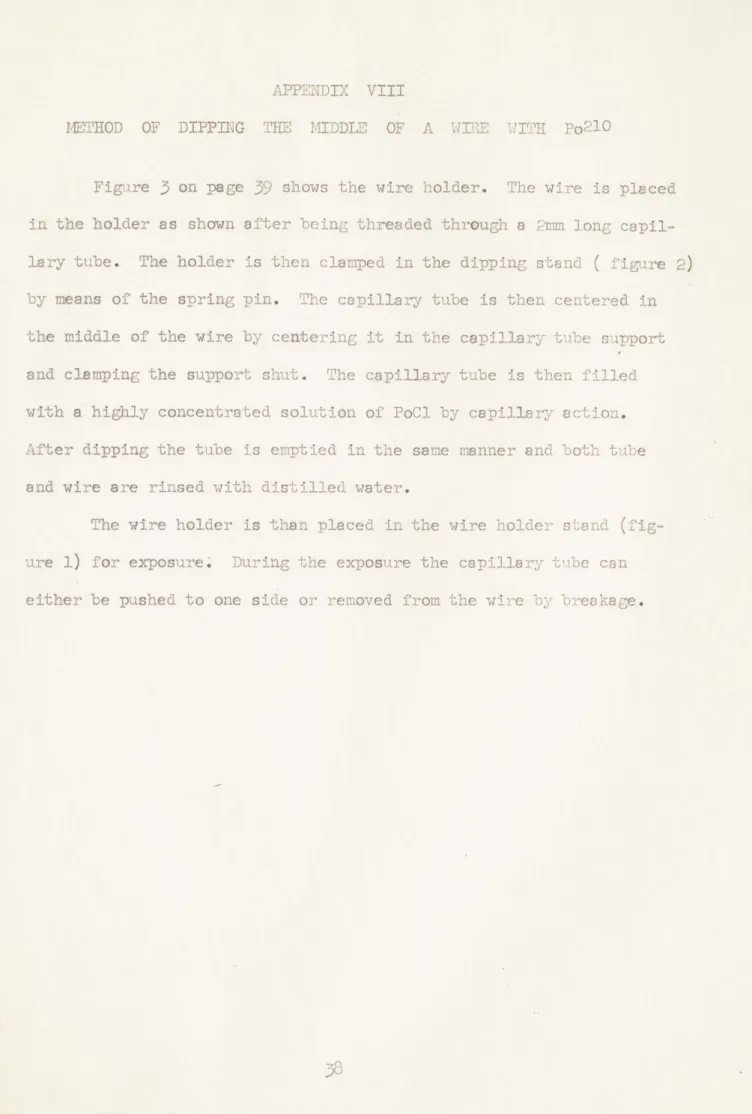
Figure 3 on page 39 shows the wire holder. The wire is placed in the holder as shown after being threaded through a 2mm long capil-lary tube. The holder is then clamped in the dipping stand ( figure 2)
by means of the spring pin. The capillary tube is then centered in
the middle of the wire by centering it in the capillary tube support
and clamping the support shut. The capillary tube is then filled
with a highly concentrated solution of PoCl by capillary action.
After dipping the tube is emptied in the same manner and both tube and wire are rinsed with distilled water.
The wire holder is than placed in the wire holder stand
(fig-ure 1) for exposure. During the exposure the capillary tube can either be pushed to one side or removed from the wire by breakage.
WIRE
HOLDEF
SPRING PIN
R
STAND
NOTE: WIRE HOLDER PLACED IN STAND SUCH THAT WIRE IS IN
EXACT CENTER OF THE STAND
FIG. I
o-2 MM LONG CAPILLARY TUBE
AND CAPILLARY TUBE SUPPORT
SPRING PIN
DIPPING
STAND
GROOVE & HOLES FOR WIRE 0
WIRE
HOLDER
PIG.
3
FIG.
2
39
AP PEiNDIX IX
LENGTH OF THE WIRE SOURCE
The wires that result from the normal dipping process are
radioactive for a distance of approximately 1.5 cm. from one end. A
wire source that is used for calibration purposes should be no longer then 2mm. For the single gap spectrograph, this requirement presents
no problems because the wire holder is designed to shield all but 2 mm.
of the wire source from being exposed. However, the multi-gap
spec-trograph t'designed to view the target or wire source over a range
of 1800. A wire holder of the type used in the single gap
spectro-graph will not work. There are three methods by which this problem can be solved.
The first solution is to dip a wire only 2 mm. from the end.
This is the method that is presently in use, but it has many drawbacks, some of which are listed below. First, surface tension no only makes
it impossible to dip exactly 2 mm. of wire but it also makes it
im-possible for the radioactive material to be evenly distributed along the wire. Sedondly, the end of the wires are always flat and ragged
from cutting which tends to assist the uneven plating of Po2 1 0 onto
the wire at that point and hence to distort the peak shape and position. Thirdly, it is difficult to make sure that the wire is perfectly hori-zontal during the exposure since it can be supported at one end only.
The second solution involves using the wire holder discussed
in Appeidix XII -for holding Th2 wires. By using this holder the
wire can be dipped an arbitrary length sinde all but 2 mm. of the wire
is shielded. This solution has one drawback. The wore holder will
necessarily become contaminated and Po210 has a tendency to spread.
shown in Appendix VIII to dip a2 mm. strip in the middle of a wire.
This solution has no apparent drawbacks and it has the advantage of
using the dipping solution only once without having to throw out a
large quantity of PoCl eacn time a wire is dipped.
APPENDIX X
HEIGHT ADJUSTMENT4, ALPHA SLIT AND PRESSURE
Having the wire at the correct height is very important sinde
a change in height of .001 cm. results in a shift in peak energy of
.21 key. However, a check was made to find out the magnitude of the
error due to variations in the heights of the wires from the correct
position. It was found that the maximum variation caused an energy
shift of only .14 key from the average energy, and the average varia-tion was +.10 key from the average energy.
The size of the opening into the analyzer was varied from4
to 8 and had little or no effedt upon the peak width or energy. Simian
larly pressure has no effect as long as it is less than 10-2 mm. of Hg.
METHODS OF ANALYZING THE DATA
Those plates which included a zone and a distance calibration were analyzed using only the considerations mentioned in Appendixes
II and III. This includes all of thePt wires, all of the dipping
and cleaning reproduction wires, and the final time study runs of Ag
and Pt.
The plates concerning the various methods of cleaning Ag wires were calibrated by zone but not by distance along the plate. Hence,
in order to analyze the plates the following assumptions were made
using the energy of the peak which resulted from a wire being dipped
according to the 6th cleaning and dipping method as the base energy. (See Table I page 5.)
1. Assume that the zone calibration is correct. This
immedi-ately gives the relative energies of peaks resulting from
pro-cesses 1,r2. and 6;3, 4 and 5; 7, 8 and 14; 11, 12, and 13 and
10, 16, and 17.
2. Assume that the energy difference between wires produced by
methods 5 and 6 favors 5 by .04 key. This assumption rests on
the fact that type 5 sources have slightly greater energy than
type6 sources when averaged over a number of such sources. This
assumption relates the energies of peaks resulting from processes 1, 2 and 5 to 3, 4 and 6.
3.
Assume that the energy of type 8 sources approximatelyGh~at, inere canL Ae ui erence Co ueweei a wire jinsed with
hydrazine and then dipped in a hydrazine dipping solution and
a wire that is metely dipped in the hydrazine dipping solution
without a previous rinse. This assumption relates the energies
of types 1 through 6 to sources of types 7, 8 and 14.
4. Assume that at most the energy of the type 13 source equals
that of the type 14 source. This assumption is based on the fact that for similarily prepared sources, the hydrazine
dip-ping solution source always has a higher energy than that of
the corresponding water dipping solution source. Hence, it
is extremely unlikely that the energy of the type 13 source would be greater than that of the type 14 source. On the
con-trary, the reverse is most likely to be true. By this means
the energies of source types 1 through
8
and 14 are related tosource types 11, 12 and 13.
5. Assume that the energy difference between the type
3
sourceand the type
9
source is equal to the average difference betweensuch types as listed in Table III (page'18). This relates the
type 9 source to the other known sources.
6. Assume that the energy of the type
9
source is greaterthan that of the type 10 source by .25 key. This assumption
is based on the fact that for similarly prepared sources the energy differential is more on the order of .50 key in favor of type
9
sources, and hence it is highly improbable that thedif-ference in energy between type
9
sources and thpe 10 sourceswould be any smaller or would favor the type 10 source.
The plates involving dipping time and solution concentration were not calibrated. However, the relationship between water dipping solution peaks and hydrazine dipping solution peaks irrespective of which is in which zone indicates not only the proper relationship
between the hydrazine dipping soliktion peaks and the water solution peaks but also an approximate zone calibration. This calibration
in turn with the'above Irelationship yields the remaining results.
The remaining.plates were analyzed qualitatively only and hence no quantitative calibration assumptions were necessary.
APPARATUS FOR COATING WIRES WITH Th
Figure 1 ohopage 47 shows the thorium dipping chamber. This
chamber is placed in the closed radioactive gas system mentioned in
the section or Th228 ( page 23). The wire is introduced into and
removed from the dipping chamber by pushing-the long rod on the left hand side of the figure through the chamber until its end extends out
thecther side. The actual dipping is accomplished by applying 900
volts DC to the push rod after the chamber has been connected to the gas system.
Since the dipping process makes the entire length of the wire
radioactive, a wire holder of the type shown in figure 2 is needed
to shield all but 2 mm. of the wire during the exposure.
Insulator
Gas
inlet
4zApply DC
Voltage
// ', -, / \N N N *. ~/, , /,~,/,~Wire
Lucite
/Brass
Gas
Outlet
X1111
~ ,, // // -. /-/~ \..\\ o // ~THORIUM DIPPING CHAMBER
Fig. I
0
o
0
0
oQo
0
3 ~,,DlA.
Wire Clamped between moving
jaw,and stationary jaw in
scratched groove
Clamp Adjustment
4:-EIII0
WIRE HOLDER
Fig.
2
- - I
A __.
SUGGESTION FOR FUTURE WORK
1. Investigate the soap dipping solution using Pt and Chromel wires.
2. Investigate the properties of Chromel wire.
3. Investigate the energy dip and rise that occurs for Po2 1 0 sources
that are coated on Pt or Ag wire.
4. Check the problems of calibration by running calibration runs in
all three zones for at least three sets of plates. If the calibrations
are not sonsistent, each individual plate should be calibrated across the top and bottom for zone variations and along one zone for distance variations.
5. Th228 should be investigated more closely as a calibration source using Pt and Chromel wires.
Wahl, A. C., and Danieles, W. R. "Emanating Power of Barium
.Stearate for .9-Second Actinon (Rn2g9)." Journal of
Inorganic and Nuclear Chemistry Vol. 6, No. T .p 273