
https://doi.org/10.4224/40002070
Vous avez des questions? Nous pouvons vous aider. Pour communiquer directement avec un auteur, consultez la Questions? Contact the NRC Publications Archive team at
[email protected]. If you wish to email the authors directly, please see the first page of the publication for their contact information.
https://publications-cnrc.canada.ca/fra/droits
L’accès à ce site Web et l’utilisation de son contenu sont assujettis aux conditions présentées dans le site LISEZ CES CONDITIONS ATTENTIVEMENT AVANT D’UTILISER CE SITE WEB.
READ THESE TERMS AND CONDITIONS CAREFULLY BEFORE USING THIS WEBSITE. https://nrc-publications.canada.ca/eng/copyright
NRC Publications Archive Record / Notice des Archives des publications du CNRC :
https://nrc-publications.canada.ca/eng/view/object/?id=d17f1143-2575-4ead-8acd-c4a131b35903
https://publications-cnrc.canada.ca/fra/voir/objet/?id=d17f1143-2575-4ead-8acd-c4a131b35903
NRC Publications Archive
Archives des publications du CNRC
For the publisher’s version, please access the DOI link below./ Pour consulter la version de l’éditeur, utilisez le lien DOI ci-dessous.
Access and use of this website and the material on it are subject to the Terms and Conditions set forth at
Auto-idle and auto shutdown systems in off-road construction
equipment
Auto-Idle and Auto Shutdown Systems
in Off-Road Construction Equipment
Final Research Report
Prepared for:
Transport Canada &
Environment and Climate Change Canada
By:
Merrina Zhang & Larry Hill
In collaboration with:
Matt Erkhart, Mark Croken, Bruce Gaudet & David Poisson
Automotive and Surface Transportation Research Centre
2021-03-31
AST-2021-0033Change Control
Version
Date
Description
Author
1.0
March 31, 2021
Initial Release
Merrina Zhang, Larry Hill
Prepared by:
______________________________________
Merrina Zhang, P. Eng. Senior Research Engineer
______________________________________
Larry Hill, P. Eng. Senior Project Engineer
Reviewed by:
______________________________________
William Mayda, P. Eng. Senior Engineer
Approved by:
______________________________________
Philip Marsh, P. Eng.
Director, Research and Development
Automotive and Surface Transportation Research Centre
Mayda, William
Digitally signed by Mayda, William Date: 2021.04.28 10:15:24 -04'00'Digitally signed by Hill, Larry DN: cn=Hill, Larry, c=CA, o=GC, ou=NRC-CNRC,
[email protected] Date: 2021.04.28 14:24:24 -04'00'
Hill, Larry
Marsh, Philip
Digitally signed by Marsh, Philip Date: 2021.04.29 17:03:17 -04'00'Acknowledgements
The inputs and contributions of the following individuals to the thoroughness and completeness of this research and document are gratefully acknowledged:
Roger Arnot, Thermex Engineered Systems Inc. Michael Assal, Taplen Commercial Construction Inc. Scott Blurton, Environment and Climate Change Canada Erik Brunet, Environment and Climate Change Canada Josette Calleja, Cummins Sales and Service
Aaron Conde, Transport Canada Kevin Dowhaniuk, PCL Construction Jonathan Gardner, Kubota Canada Ltd. Jason Gore, Cummins Southern Plains David Hill, J.R. Brisson Equipment Ltd.
Sean Hornsby, Environment and Climate Change Canada Jeff MacDonald, Amaco Construction Equipment Inc. Serge Nadon, Environment and Climate Change Canada David Reid, Liebherr-Canada Ltd.
Lauren Rowland, Environment and Climate Change Canada Grant Van Tine, John Deere
Executive Summary
On December 12, 2015, Canada and 194 other countries signed the Paris Agreement to fight climate change. Under the Paris Agreement, Canada is committed to reducing its greenhouse gas (GHG) emissions by 30% below 2005 levels by 2030, which means a reduction from 730 megatonnes of CO2
equivalent (Mt CO2E) in 2005 to 511 Mt CO2E in 2030 [1].
In 2016, Canada released the Pan-Canadian Framework on Clean Growth and Climate Change, a national climate plan, developed jointly with the provincial and territorial governments [1]. One of the measures under the framework relates to the improvement of efficiency and reduction of GHG emissions from the off-road sector [2], which is responsible for 5% of total GHG emissions in Canada [3].
A study conducted by FP Innovations in 2019, titled “Review of Technologies that Reduce GHG in Off-Road Equipment for the Agriculture, Construction, Forestry, and Mining Sectors” [4], reviewed a number of technologies that can reduce GHG emissions from off-road equipment. The study identified idle reduction technologies as having the potential, in the short term, to deliver reductions in GHG emissions and other air pollutants from the operation of off-road construction equipment.
A literature review of 108 technical documents and a technical survey of over 100 organizations was completed in order to provide insight into:
the current state-of-the-art of the technology, as well as interactions with other emission control systems;
current idling policies and legislation for the off-road sector in Canada and the United States (US); and
the potential reduction in GHG emissions if the use of these technologies were widely deployed.
For the purpose of this project, idling is defined as the engine of a piece of equipment or machinery is running, but not engaged in the work for which the equipment or machine was designed. The information gathered during the course of the project shows that construction equipment spends a great deal of time idling. There are many negative consequences due to idling for construction equipment, including poor air quality, increased fuel consumption and cost, increased emission of GHGs, accelerated wear of
equipment, wasted warranty hours, and increased noise and vibration.
At the time of research, in Canada, only the city of Vancouver regulates idling from non-road sources, while in the US, there are ten jurisdictions that regulate idling from non-road sources.
An analysis of ECCC’s NGHGI emissions data from 2015 was completed at the start of the project, which selected six construction equipment categories to focus on, including loaders, excavators, graders, tractor/loader/backhoes, off-highway trucks and dozers, as they account for 91% of all emissions within the construction section in Canada. Since 99.6% of equipment within these categories are powered by diesel engines, the GHG impact analyses are based on diesel powered units within these equipment categories.
A review of idle control related patents and construction equipment manufacturers that offer idle control features on their machines revealed that auto-idle systems operate in a similar manner across different equipment platforms, as well as different types of machines. An auto-idle system is controlled by an engine control unit through algorithms. If the machine’s engine is operating in a high idle state,
determined by a predetermined set of conditions, for a given amount of time, then the system controller will command the engine to go to a low idle state. If any of the predetermined conditions change while at the low idle state, then the system controller will command the engine speed to return to the speed defined by the high idle state. Coupled with the auto-idle systems, most manufacturers also offer an auto shutdown feature that will shut down the machine engine if the equipment remains in the low idle state for a predetermined duration of time.
The information gathered during the course of the project shows that auto-idle and auto shut down systems are already part of the standard offering of most new construction equipment, but there was a general observation from the project team during the course of this research that there seems to be a communication gap between the manufacturers, those in the sales/distributions functions and the users of the equipment with regards to idle control systems. It appears that the closer to the operation side, the less informed people are of the existence of the systems which are essentially standard on new
equipment. Thus, if the features are not enabled by default upon equipment purchase/rental delivery, it is uncertain whether the idle control systems are being utilized to the fullest extent possible.
The GHG impact analysis focused on examining the potential emission reductions if the idle control systems were more widely utilized. Due to the relatively small size of the aftermarket to add idle reduction systems to in-service equipment, no analysis was performed on equipment retrofits.
Glossary and Definitions
ARB California Air Resources Board BSFC Brake specific fuel consumption CAC Criteria air contaminants
cEGR Cooled exhaust gas recirculation CEPA Canadian Environmental Protection Act
CH4 Methane
CO2 Carbon dioxide
CO2E Carbon dioxide equivalent
CO Carbon monoxide
DEF Diesel exhaust fluid
DOC Diesel oxidation catalyst DPF Diesel particulate filter
ECCC Environment and Climate Change Canada
EF Emissions factor
EGT Exhaust gas temperature
EPA Environmental Protection Agency
HC Hydrocarbon
GDP Gross domestic product
GHG Greenhouse gas
High-idle state Engine is running at a high RPM without performing work
LF Load Factor
Low idle state Engine is running at a low RPM
LPG Liquefied petroleum gas
Mt Megatonnes
η Operational efficiency
ψ Within an hour of construction equipment operating time, how many minutes are spent in idle
NAAQS National Ambient Air Quality Standards NGHGI National greenhouse gas inventory
NOX Nitrogen oxides
N2O Nitrous oxide
OEM Original equipment manufacturer
PM Particulate matter
RPM Revolutions per minute
SCR Selective catalytic reduction
SO2 Sulfur dioxide
TAF Transient adjustment factor
UNFCCC United Nations Framework Convention on Climate Change
US United States
Table of Contents
Acknowledgements ... 1
Executive Summary ... 2
Glossary and Definitions ... 4
Introduction... 9
1.1 A Brief Overview of the Construction Sector in Canada ... 9
1.2 Equipment Used within the Sector ... 11
1.3 The Context of Internal Combustion Engine and Emissions ... 11
2 Background ... 12
2.1 Anti-idle Policies and Legislation in Canada ... 12
2.2 Anti-idle Policies and Legislation in the US ... 13
2.3 Emissions Regulations in Canada and the US ... 18
2.3.1 Criteria Air Contaminants ... 18
2.3.2 Greenhouse Gases ... 19
2.4 Review of Greenhouse Gas Emissions Data from the Construction Sector in Canada... 19
2.4.1 Final List of Equipment Selected for Detailed Review ... 21
3 An Overview of Auto-idle and Auto shutdown Systems ... 22
3.1 Technology Overview of Idle Control Systems ... 22
3.1.1 Auto-idle Systems ... 22
3.1.2 Auto Shutdown ... 23
3.2 System Implementation ... 23
3.3 Potential Interactions with Other Emission Control Systems ... 24
3.4 Examples of New Equipment Offerings ... 24
3.5 Examples of Aftermarket Offerings ... 27
4 Survey of Stakeholders ... 28
5 GHG Impact Analysis ... 31
5.1 Methods to Calculate GHG Emissions from Off-Road Sources ... 31
5.2 How Much Time Does Construction Equipment Spend Idling ... 34
5.3 Characterization of Idling ... 35
5.5 Analysis ... 37 6 Conclusion ... 42 7 Recommendations for Future Work ... 44
List of Tables
Table 1: Number of Businesses by Size within the Construction Sector in Canada [6] ... 10
Table 2: Gross Domestic Product of the Constructor Sector in Canada [6] ... 10
Table 3: Abbreviated List of Off-Road Idling Regulations from the US ... 17
Table 4: By Year of When US EPA Diesel Engine Emission Standards Came into Effect [7] ... 18
Table 5: Emissions Data from the 2015 Inventory for Equipment Categories Listed under the Construction Sector from ECCC’s NGHGI ... 20
Table 6: Emissions Data from the 2015 Inventory for the Top Emitting Construction Equipment Categories from ECCC’s NGHGI ... 21
Table 7: Emissions Data from the 2015 Inventory for the Top Emitting Construction Equipment Categories (re-organized) from ECCC’s NGHGI ... 21
Table 8: Examples of New Original Equipment Manufacturer (OEM) Product Offerings for Loaders ... 25
Table 9: Examples of New OEM Product Offerings for Excavators... 25
Table 10: Examples of OEM Product Offerings for Graders ... 25
Table 11: Examples of New OEM Product Offerings for Tractor/Loader/Backhoes ... 26
Table 12: Examples of New OEM Product Offerings for Articulated and Off-highway Trucks ... 26
Table 13: Examples of New OEM Product Offerings for Dozers ... 26
Table 14: Summary of Key findings from Stakeholders Survey ... 30
Table 15: Engine Load Factor Comparison [41] ... 34
Table 16: Summary of Construction Equipment Duty Cycle and Idle Information [43] ... 35
Table 17: Comparison of Emissions Data from 2015 and 2018 NGHGI Inventories... 37
Table 18: Summary of Construction Equipment Duty Cycle and Average Operational Efficiency (η) [43] 39 Table 19: CO2E Emissions Rate due to Work and Idle ... 40
Table 20: Idle Information for Construction Equipment ... 40
List of Figures
Figure 1: Non-Road Steady-State Cycle (ISO-C1 Test Procedure) [40] ... 32
Figure 2: ARB Study Average Load Profile by Equipment Type [40] ... 33
Figure 3: Non-Road Transient Cycle [40] ... 33
Introduction
Gases such as carbon dioxide (CO2), methane (CH4) and nitrous oxide (N2O) trap heat in the atmosphere
creating a greenhouse effect that contributes to warming on a global scale.
On December 12, 2015, Canada and 194 other countries signed the Paris Agreement to fight climate change. The Agreement aims to limit the global average temperature rise to well below 2°C and pursue efforts to limit the increase to 1.5°C [5]. Under the Paris Agreement, Canada is committed to reducing its greenhouse gas (GHG) emissions by 30% below 2005 levels by 2030, which means a reduction from 730 megatonnes of CO2 equivalent (Mt CO2E) in 2005 to 511 Mt CO2E in 2030 [1].
In 2016, Canada released the Pan-Canadian Framework on Clean Growth and Climate Change, a national climate plan, developed jointly with the provincial and territorial governments [1]. One of the measures under the framework relates to the improvement of efficiency and reduction of GHG emissions from the off-road sector [2], which is responsible for 5% of total GHG emissions in Canada [3].
A study conducted by FP Innovations in 2019, titled “Review of Technologies that Reduce GHG in Off-Road Equipment for the Agriculture, Construction, Forestry, and Mining Sectors” [4], reviewed a number of technologies that can reduce GHG emissions from off-road equipment. The study identified idle reduction technologies as having the potential, in the short term, to deliver reductions in GHG emissions and other air pollutants from the operation of off-road construction equipment.
The objective of this project is to perform research on auto-idle and auto shutdown1 technologies for
off-road construction equipment in order to provide insight into:
the current state-of-the-art of the technology, as well as interactions with other emission control systems;
current idle policies and legislation for the off-road sector in Canada and the United States (US); and
the potential reduction in GHG emissions if the use of these technologies are widely deployed.
1.1 A Brief Overview of the Construction Sector in Canada
The Canadian construction sector is defined by Industry Canada as “organizations primarily engaged in
the building, repairing and renovating of structures and engineering works, and in subdividing and developing land.” [6]
In 2019, there were 380,060 establishments in the sector across Canada, which include companies that employ one or more people, and companies that do not maintain an employee payroll. For companies that are categorized as employers, the vast majority (99%) of which employ less than 100 people as shown in Table 1.
Provinces/Territories
Employment Size Category
Micro (1-4)
Small (5-99)
Medium
(100-499)
Large (500+)
Ontario
30,347
19,254
487
37
Quebec
19,474
11,793
250
14
British Columbia
15,847
9,571
209
8
Alberta
14,310
6,916
358
23
Saskatchewan
2,859
1,763
43
0
Manitoba
2,474
2,082
43
2
Nova Scotia
2,170
1,455
25
2
New Brunswick
1,648
1,245
28
1
Newfoundland and Labrador
1,277
806
23
1
Prince Edward Island
396
275
6
0
Yukon
160
110
0
0
Northwest Territories
63
101
4
0
Nunavut
14
37
3
0
Canada
91,039
55,408
1,479
88
Table 1: Number of Businesses by Size within the Construction Sector in Canada [6]
The construction industry is a large contributor to Canada’s gross domestic product (GDP). As shown in Table 2, in 2018, the GDP for the sector was $142 billion.
Gross Domestic Product
Value in Chained 2012 ($ millions)
Provinces/Territories
2016
2017
2018
Ontario
48,122.90
51,011.30
51,914.80
Alberta
27,023.50
27,496.00
27,168.00
Quebec
21,680.80
22,850.20
23,527.30
British Columbia
18,321.90
19,825.30
20,562.30
Saskatchewan
6,210.50
6,013.80
5,861.50
Manitoba
4,306.30
4,592.70
4,742.20
Newfoundland and
Labrador
3,446.50
3,263.20
2,582.20
Nova Scotia
2,236.70
2,323.80
2,222.50
New Brunswick
1,913.40
2,036.90
2,081.00
Nunavut
318.2
439.1
578.6
Prince Edward Island
291.4
354.3
368.3
Northwest Territories
490.9
348.4
359.6
Yukon
204.5
252.4
334.9
Canada
134,567.50 140,807.40 142,303.20
1.2 Equipment Used within the Sector
A diverse range of equipment is utilized within the construction industry, considered as off-road equipment (Canada) or non-road equipment (US). The US Environmental Protection Agency’s (EPA) National Emission Inventory, lists 26 equipment categories for the construction sector including tractors, loaders, backhoes, graders, excavators and off-highway trucks [7].
According to a report by Global Market Insights [8], which organized construction equipment into three broad categories including earthmoving and road building equipment, material handling and crane, and concrete equipment, the construction equipment sector within North America is worth $30.87 billion US in 2021. The report also made mention of three distinct markets within the construction equipment sector, the new equipment market, the rental equipment market and the used equipment market, which for North America, the new and rental equipment market appear to be comparable in value.
Within Canada, the construction equipment companies with the largest market share include Caterpillar Inc. (37.26%), Deere & Company (11.45%), and Komatsu Ltd. (18.77%). [8]
1.3 The Context of Internal Combustion Engine and Emissions
The vast majority of construction equipment both in use and for sale in Canada is powered by internal combustion engines. Diesel is the primary fuel source, though some are powered by gasoline and liquefied petroleum gas (LPG), all hydrocarbon (HC)-based fuels.Internal combustion engines convert the chemical energy stored in fuels into mechanical work through direct combustion, which releases GHGs and criteria air contaminants (CACs), such as carbon monoxide (CO), nitrogen oxides (NOX) and particulate matter (PM).
2 Background
For the purpose of this project, idling is defined as the engine of a piece of equipment or machinery is running, but not engaged in the work for which the equipment or machine was designed.
Multiple sources reviewed for this project indicated the following negative consequences of idling for construction equipment:
Poor air quality of the work area and contribution to poor air quality globally due to increased emissions of CACs
Increased fuel consumption and cost
Increased emissions of GHGs contributing to the global greenhouse effect
Accelerated wear of equipment, especially engines and Tier 4 emission control components Increased maintenance
Wasted warranty hours Increased noise and vibration
2.1 Anti-idle Policies and Legislation in Canada
According to the list of “Idling Control Bylaws” maintained by Natural Resources Canada, there are over sixty municipal jurisdictions across Canada that regulate idling from on-road sources through by-laws. The following list contains examples from different provinces and territories and their respective idling limit:
Alberta: Beaumont (3 consecutive minutes within a 30-minute period)
British Colombia: North Vancouver (3 consecutive minutes within a 60-minute period) Northwest Territories: Inuvik (30 minutes)
Nova Scotia: Kentsville (3 consecutive minutes) Ontario: Ajax (2 consecutive minutes)
Quebec: Montreal-Lachine (3 consecutive minutes within a 60 minute period)
At the time of research, only the city of Vancouver regulates idling from off-road sources.
Part 36 of the Greater Vancouver Regional District Non-Road Diesel Engine Emission Regulation Bylaw
No. 1161 (enacted in 2012) limits the idling of all non-road diesel engines 25 hp (19 kW) or larger to five
consecutive minutes. While this bylaw exempts farming equipment, personal recreational equipment and emergency equipment, it is applicable to off-road construction equipment. Idling is permitted under certain circumstances, including where necessary for testing or diagnostic purposes, in emergencies, to ensure safe operations and compliance with manufacturer’s operational instructions, as well as under approved anti-idling procedures (Part 37). Contraventions to the bylaw may result in a fine not exceeding $200,000. [9]
2.2 Anti-idle Policies and Legislation in the US
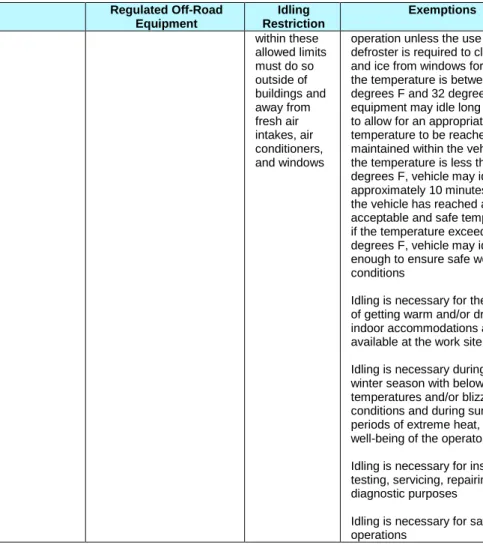
Similar to Canada, there are more jurisdictions in the US that regulate idling from on-road sources than off-road sources. Table 6 contains an abbreviated table of US Jurisdictions that regulate idling from non-road sources based on IdleBase [10], a database from the US Department of Energy that summarizes idling laws across the US. [10]
Regulated Off-Road Equipment
Idling Restriction
Exemptions Consequences of Infraction Notes and Resources
State of Alaska
Alaska Department of Transportation and Public Facilities' 8-yard dump trucks and tractors with programmable on-board computers
10 minutes Emergencies; airport ground support
No information Policy of the Alaska Department
of Transportation and Public Facilities [11] Effective December 1, 2011 http://www.dot.state.ak.us/comm/ pressbox/arch_2011/PR11-2572.shtml California – City of Auburn
All off-road diesel powered equipment over 70 horsepower rating
5 consecutive minutes
Idling is necessary to ascertain that the off-road equipment is in safe operating condition Idling is necessary for inspection, testing, servicing, repairing, or diagnostic purposes
Idling is necessary to accomplish work for which the equipment was designed other than a heater or air conditioner
Idling as needed to operate defrosters, heaters, air
conditioners, or other equipment to prevent a safety or health emergency
Idling is necessary solely to recharge a battery or other energy storage unit of a hybrid electric vehicle/equipment
Idling is necessary to operate equipment that runs intermittently
Operator: Minimum civil penalty of $50; criminal penalties to the maximum extent provided by law Owner: A warning on the first offense, followed by a $100 minimum civil penalty for a second offense, with a minimum civil penalty of $200 for all future offenses, and to criminal penalties to the maximum extent provided by law
City of Auburn Municipal Code, Title VII, Section 71.78 [12] Effective August 10, 2004
https://auburn.municipalcodeonlin e.com/book?type=ordinances#na me=71_Limitation_On_Engine_Idl ing_(Sections_71.75-71.99)
Regulated Off-Road Equipment
Idling Restriction
Exemptions Consequences of Infraction Notes and Resources
California – Placer County
All off-road diesel-powered equipment over 70 horsepower rating
5 consecutive minutes
Idling is necessary to ascertain that the off-road equipment is in safe operating condition Idling is necessary for inspection, testing, servicing, repairing, or diagnostic purposes
Idling is necessary to accomplish work for which the equipment was designed other than a heater or air conditioner
Idling is necessary solely to recharge a battery or other energy storage unit of a hybrid electric vehicle/equipment
Idling is necessary to operate equipment that runs intermittently
Operator: Minimum civil penalty of $50; criminal penalties to the maximum extent provided by law Owner: A warning on the first offense, followed by a $100 minimum civil penalty for a second offense, with a minimum civil penalty of $200 for all future offenses, and to criminal penalties to the maximum extent provided by law
Placer County Code, Article 10.14 [13] Effective January 1, 2004 http://qcode.us/codes/placercount y/ California – Sacramento
Off-road equipment 5 consecutive
minutes or an aggregate of 5 minutes within any one-hour period
Idling is necessary to ascertain that the off-road equipment is in safe operating condition Idling is necessary for inspection, testing, servicing, repairing, or diagnostic purposes
Idling is necessary to accomplish work for which the
vehicle/equipment was designed other than a heater or air conditioner
Idling as needed to operate defrosters, heaters, air
conditioners, or other equipment to prevent a safety or health emergency
Idling solely to recharge a battery or other energy storage unit of a hybrid electric vehicle/equipment
Not less than $100 nor more than $25,000 per violation
(Sacramento City Code, 1.28.010)
Sacramento City Code, Title 8, Ch. 8.116 [14]
http://www.qcode.us/codes/sacra mento/
Connecticut – Norwalk
Mobile sources 3 consecutive
minutes
Idling is necessary while stopped (i.e traffic) or mechanical difficulties over which the operator
First offense: written warning; Second offense: a fine of $100; Third and subsequent offenses: a
Code of the City of Norwalk, Connecticut, Ordinances, Chapter §68-6 and §68-10 [15]
Regulated Off-Road Equipment
Idling Restriction
Exemptions Consequences of Infraction Notes and Resources
Idling is necessary to operate heating, cooling or auxiliary equipment necessary to accomplish the intended use of the mobile source
Idling is necessary to bring the mobile source to the
manufacturer's recommended operating temperature Idling is necessary when the outdoor temperature is below 20°F
Idling is necessary when the mobile source is being repaired
separate violation of this chapter; No more than one fine shall be imposed in one twenty-four-hour period
https://www.ecode360.com/35964 412
Idaho - Ketchum
All off-road diesel powered equipment regardless of horsepower rating, and all off-road equipment regardless of fuel being used on public property and private parking lots with public access 3 consecutive minutes or an aggregate of 3 minutes within any one-hour period
Idling is necessary while stopped Idling is necessary to ascertain that the equipment is in safe operating condition
Idling is necessary for inspection, testing, servicing, repairing, or diagnostic purposes
Idling is necessary to accomplish work for which the equipment was designed, other than a heater or air conditioner
Idling is necessary to operate defrosters, heaters, air
conditioners, or other equipment to prevent a safety or health emergency, but not solely for the comfort of the operator
Idling is necessary solely to recharge a battery or other energy storage unit of a hybrid electric vehicle/equipment
Idling is necessary to operate equipment that runs intermittently
A civil penalty of twenty five dollars
Ketchum, Idaho Code of Ordinances, Chapter 8.09 [16] Effective 2009
https://codelibrary.amlegal.com/co des/ketchumid/latest/ketchum_id/ 0-0-0-11282
Regulated Off-Road Equipment
Idling Restriction
Exemptions Consequences of Infraction Notes and Resources
Ohio - Cleveland
City equipment No idle in a
non-emergency situation
Inclement weather situations and the supervisor authorizes the use of the equipment heater-defroster for the work crew’s comfort: if the outside temperature is above 32 degrees F: 5 minutes maximum; between -10 and 32 degrees F: 15 minutes maximum; below -10 degrees F: as necessary
Violations of the policy are will be documented as to the
vehicle/equipment operator, vehicle code, location, date and time, weather conditions, and circumstances of the violation
City of Cleveland Anti-Idling Policy [17] https://clevelandohio.gov/sites/def ault/files/forms_publications/AntiId lingPolicy.pdf Virginia - Richmond
City equipment 5 minutes Idling is necessary for
performance of work Idling is necessary to operate auxiliary equipment; e
Idling is necessary for Equipment to be serviced
City of Richmond, Administrative Regulation 6.6[18] Effective December 1, 2011 http://media.rvanews.com/wp-content/uploads/2014/09/AdminR egs6-06.pdf Washington – King County
Off-road equipment in all King County Executive agencies2 An aggregate of 3 minutes within any one-hour period
Idling is necessary while stopped Idling is necessary to prevent a safety or health emergency Idling is necessary for inspection, testing, servicing, repairing, or diagnostic purposes
Idling is necessary to ascertain that the equipment is in safe operating condition Idling is necessary due to mechanical difficulties
Violation of this policy may lead to discipline, up to and including termination
King County Non-Revenue Vehicle Anti-Idling Policy, FES 12-5 (AEP) [19] Effective January 18, 2007 https://kingcounty.gov/about/polici es/aep/facilitesaep/fes125aep.asp x#:~:text=6.1%20King%20County %20employees%20shall,exemptio ns%20described%20in%20sectio n%206.6.&text=2%20A%20vehicl e%20may%20idle,6.6. Washington – Pierce County
Staff operating equipment owned or leased by Pierce County Gas-powered: 30 seconds Diesel-powered: an aggregate of 3 minutes within any one-hour period Idling
Idling is necessary while stopped Idling is necessary to operate auxiliary equipment, as required for necessary business operations Idling is necessary to defog, defrost or de-ice windows. Idling must cease when fog, frost, or ice conditions have been eliminated Idling is necessary to heat or cool the inside of the equipment before
Willful or blatant violation of this policy may result in disciplinary action
Pierce County Fuel Reduction Policy [20] https://www.co.pierce.wa.us/Docu mentCenter/View/24920/Pierce- County-Fuel-Reduction-Policy?bidId
Regulated Off-Road Equipment
Idling Restriction
Exemptions Consequences of Infraction Notes and Resources
within these allowed limits must do so outside of buildings and away from fresh air intakes, air conditioners, and windows
operation unless the use of the defroster is required to clear snow and ice from windows for safety: If the temperature is between 10 degrees F and 32 degrees F, equipment may idle long enough to allow for an appropriate temperature to be reached and maintained within the vehicle; if the temperature is less than 10 degrees F, vehicle may idle for approximately 10 minutes, or until the vehicle has reached an acceptable and safe temperature; if the temperature exceeds 80 degrees F, vehicle may idle long enough to ensure safe working conditions
Idling is necessary for the purpose of getting warm and/or dry if indoor accommodations are not available at the work site Idling is necessary during the winter season with below zero temperatures and/or blizzard conditions and during summer periods of extreme heat, for the well-being of the operator Idling is necessary for inspection, testing, servicing, repairing, or diagnostic purposes
Idling is necessary for safe operations
2.3 Emissions Regulations in Canada and the US
2.3.1 Criteria Air Contaminants
Two types of regimes exist in the US for the regulation of CACs from non-road sources [21]:
1. Technical standards that restrict emissions from engines - non-road engine emission standards are based on the engine power class. Its implementation has been phased in gradually starting in 1996, as shown in Table 4. As of 2014, all engine power classes are required to meet Tier 4 final requirements, which are the most stringent to date. Compliance to the technical standards falls within the responsibility of equipment and engine manufacturers.
2. Air quality standards that place limits on the levels of emissions in the atmosphere – the US EPA establishes the National Ambient Air Quality Standards3 (NAAQS, 40 CFR part 50, subject to
periodic revisions) for six CACs. The primary standards within NAAQS refers to measures to protect public health, while secondary standards refer to measures for public welfare protection (i.e. against decreased visibility and damage to animals, crops, vegetation, and buildings) [22]. Compliance with the NAAQS falls within the jurisdiction of individual states.
In Canada, Environment and Climate Change Canada (ECCC) have the regulatory authority to regulate emissions from off-road sources through the Canadian Environmental Protection Act, 1999 (CEPA). Emission standards for off-road diesel engines were introduced in 2006. Canada’s emission standards and test methods for diesel engines are harmonized with the technical standards as set out by the US EPA. [23]
With regards to air quality, Canada and the US have an on-going agreement to control transboundary air pollution between the two countries, with specific emphasis on acid rain (SO2 and NOX), and ground level
ozone (NOX and VOCs). [24]
Engine Rating hp 1996 1997 1998 1999 2000 2001 2002 2003 2004 2005 2006 2007 2008 2009 2010 2011 2012 2013 2014 2015-2020 P < 11 11 ≤ P < 25 25 ≤ P < 50 50 ≤ P < 75 75 ≤ P < 100 100 ≤ P < 175 175 ≤ P < 300 300 ≤ P < 600 600 ≤ P < 750 P ≥ 750
Colour Legend Unregulated Tier 1 Tier 2 Tier 3 Tier 4 interim Tier 4 final
Table 4: By Year of When US EPA Diesel Engine Emission Standards Came into Effect [7]
2.3.2 Greenhouse Gases
There are currently no regimes in Canada or the US for the regulation of GHGs from off-road sources.
2.4 Review of Greenhouse Gas Emissions Data from the Construction
Sector in Canada
As a signatory to United Nations Framework Convention on Climate Change (UNFCCC), the Pollutant Inventories and Reporting Division of ECCC prepares a national greenhouse gas inventory (NGHGI) on an annual basis [25].
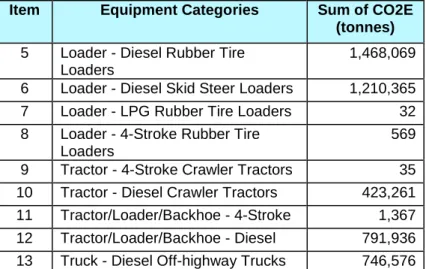
Emissions data from 2015 was obtained at the start of the project from ECCC’s NGHGI. The NGHGI combines the construction and mining sectors together and thus has a much longer list of equipment categories compared with US EPA’s National Emission Inventory. As can be seen in Table 5, the top seven equipment categories represent 91% of all GHG emissions (CO2 equivalent) within the construction
sector.
Item Equipment Categories Sum of CO2E
(tonnes) 1 Diesel Rubber Tire Loaders 1,468,069 2 Diesel Skid Steer Loaders 1,210,365
3 Diesel Excavators 1,147,958
4 Diesel Graders 987,143
5 Diesel Tractors/Loaders/Backhoes 791,936 6 Diesel Off-highway Trucks 746,576 7 Diesel Crawler Tractors 423,261
8 Diesel Rollers 216,553
9 2-Stroke Concrete/Industrial Saws 66,119
10 Diesel Bore/Drill Rigs 40,436
11 Diesel Crushing/Proc. Equipment 37,806
12 Diesel Pavers 30,990
13 Diesel Other Construction Equipment
30,022 14 4-Stroke Paving Equipment
(Concrete Finishers/Trowels)
30,248
15 Diesel Cranes 29,021
16 Diesel Signal Boards 27,164
17 Diesel Scrapers 23,410
18 Diesel Trenchers 23,342
19 4-Stroke Skid Steer Loaders 23,249 20 Diesel Plate Compactors 21,843 21 4-Stroke Concrete/Industrial Saws 17,872
22 Diesel Dumpers/Tenders 12,717
23 Diesel Concrete/Industrial Saws 11,659 24 4-Stroke Plate Compactors 9,575
Item Equipment Categories Sum of CO2E
(tonnes) 25 4-Stroke Surfacing Equipment 8,081 26 4-Stroke Cement & Mortar Mixers 7,347
27 4-Stroke Trenchers 6,286
28 Diesel Surfacing Equipment 4,426
29 4-Stroke Rollers 4,227
30 4-Stroke Other Construction Equipment
2,389 31 2-Stroke Tampers/Rammers 2,186 32 Diesel Cement & Mortar Mixers 2,082
33 4-Stroke Cranes 1,930
34 2-Stroke Bore/Drill Rigs 1,725 35 4-Stroke Tampers/Rammers 1,468 36 4-Stroke Tractors/Loaders/Backhoes 1,367 37 Diesel Tampers/Rammers 954 38 4-Stroke Dumpers/Tenders 824
39 Diesel Paving Equipment 574
40 4-Stroke Rubber Tire Loaders 569 41 Diesel Paving Equipment (Slip
Form Pavers)
195 42 4-Stroke Paving Equipment (Slip
Form Pavers)
138
43 2-Stroke Paving Equipment 109
44 4-Stroke Cranes 93
45 4-Stroke Bore/Drill Rigs 84
46 4-Stroke Excavators 75
47 4-Stroke Crawler Tractors 35
48 2-Stroke Plate Compactors 35
49 LPG Rubber Tire Loaders 32
Table 5: Emissions Data from the 2015 Inventory for Equipment Categories Listed under the Construction Sector from ECCC’s NGHGI
Since equipment categories within ECCC’s NGHGI are identified by both equipment type and by fuel type, Table 6 pulls together the full list of the top emitting construction equipment types for all fuel and propulsion types.
Item Equipment Categories Sum of CO2E (tonnes) 1 Excavator - 4-Stroke Excavators 75 2 Excavator - Diesel Excavators 1,147,958 3 Grader - Diesel Graders 987,143 4 Loader - 4-Stroke Skid Steer
Loaders
Item Equipment Categories Sum of CO2E (tonnes) 5 Loader - Diesel Rubber Tire
Loaders
1,468,069 6 Loader - Diesel Skid Steer Loaders 1,210,365 7 Loader - LPG Rubber Tire Loaders 32 8 Loader - 4-Stroke Rubber Tire
Loaders
569 9 Tractor - 4-Stroke Crawler Tractors 35 10 Tractor - Diesel Crawler Tractors 423,261 11 Tractor/Loader/Backhoe - 4-Stroke 1,367 12 Tractor/Loader/Backhoe - Diesel 791,936 13 Truck - Diesel Off-highway Trucks 746,576
Table 6: Emissions Data from the 2015 Inventory for the Top Emitting Construction Equipment Categories from ECCC’s NGHGI
2.4.1 Final List of Equipment Selected for Detailed Review
Table 7 reorganizes the expanded equipment list from Table 6 into six broad categories, including loaders, excavators, graders, and tractor/loader/backhoe, tractor/dozer and off-highway trucks. Together, these six equipment categories represent 91% of all GHG emissions within the construction equipment sector.
Item Equipment Categories Sum of CO2E (tonnes) 1 Loader 2,702,284 2 Excavator 1,148,033 3 Grader 987,143 4 Tractor/Loader/Backhoes 793,303 5 Off-highway truck 746,576 6 Tractor/Dozer 423,296
Table 7: Emissions Data from the 2015 Inventory for the Top Emitting Construction Equipment Categories (re-organized) from ECCC’s NGHGI
This project focuses on the potential of auto-idle and auto shutdown systems to reduce GHG emissions within the six construction equipment categories as per Table 7. Since 99.6% of equipment within these categories are powered by diesel, the GHG impact analysis are based on diesel powered units within these equipment categories.
3 An Overview of Auto-idle and Auto shutdown
Systems
3.1 Technology Overview of Idle Control Systems
US patent 7702450 B2 filed by Deere & Company in April 2010 [26] provides a comprehensive overview of the technical mechanism required to enable the function of idle control as it pertains to auto-idle and auto shutdown features. In general they consist of:
An engine control unit configured to control the operation of the engine
A system control unit configured to interface with key peripherals, such as the engine or engine control unit, throttle, parking brake, ignition, etc.…
Algorithms to establish a set of conditions to enable operation.
3.1.1 Auto-idle Systems
A review of idle control related patents [26] [27] [28] and construction equipment manufacturers4 that offer
idle control features on their machines revealed that auto-idle systems operate in a similar manner across different equipment platforms, as well as different types of machines.
The basic operation of the auto-idle feature is as follows:
if the machine’s engine is operating in a high idle state, determined by a predetermined set of conditions, for a given amount of time, then the system controller will command the engine to go to a low idle state; and
if any of the predetermined conditions change while at the low idle state, then the system controller will command the engine speed to return to the speed defined by the high idle state.
Each manufacturer uses their own set of inputs to establish the criteria of a high idle state and a low idle state. The list of inputs below was compiled from a review of the various equipment manufacturer’s auto-idle systems. The system controller may monitor the state of any or all of the following inputs:
Engine speed Throttle position Transmission state Park brake state Oil pressure
Ignition switch position Operator hand or foot controls Battery voltage
Hydraulic pump pressure Safety interlock
Air temperature Cabin temperature
By monitoring these inputs, the system controller can establish if the machine is actually performing work or is in either of the idle states.
Typically the operator has the option to activate the auto-idle function and can adjust the duration of time that the machine remains in the high idle state before it throttles back to the low idle state. A review of the various manufacturers’ systems revealed a range from as low as 3 seconds to as high as 20 minutes that an operator can set before the auto-idle system will initiate a reduction of engine speed.
The majority of construction equipment uses a hydrostatic drive to move the machine and hydraulic actuators to perform work. Typically an operator would set the engine speed to a high idle setting to ensure adequate hydraulic power while working with the machine. If the operator stops working with the machine, then the equipment controllers will sense that no work is being done and put the engine to a low idle state. When the operator wants to resume work, input from any of the operator controls is recognized by the systems controller to return the machine to a high idle state.
3.1.2 Auto Shutdown
Coupled with the auto-idle systems, most manufacturers also offer an auto shutdown feature (also commonly referred to as an anti-idle system) that will shut down the engine if the equipment remains in the low idle state for a predetermined duration of time. Similar to an auto-idle system, the operator typically has the option to activate the system and set the duration of time that the equipment will be permitted to remain in the low idle state before the engine is shut off.
3.2 System Implementation
Since 2015, diesel engines used in construction equipment have been regulated to meet US EPA’s Tier 4 final requirements (Table 4). According to the report by the International Council on Clean Transportation (2016) [7], in order to meet the mandated emission requirements, engine/equipment manufacturers employ a combination of emission control technologies, including:
emission control strategies at the engine level such as advanced electronic control and cooled exhaust gas recirculation (cEGR); and
after treatment strategies, such as diesel oxidation catalysts (DOC), selective catalytic reduction (SCR) and diesel particulate filter (DPF) [7]
These emission regulations have resulted in the wide adoption of technological innovations, such that the latest generation of construction equipment are electronically controlled by a network of controllers exchanging machine performance information. The equipment performance is determined through an array of sensors that monitor various system states. Therefore implementation of an auto-idle and auto shutdown system is achieved through software enhancements, likely without the need to introduce any new hardware to the machine. The sensors required to establish the idle state of the machine are the same sensors that are part of the emission control, telematics, or equipment health monitoring systems found on the latest generation of construction equipment.
3.3 Potential Interactions with Other Emission Control Systems
Auto shutdown functions/technologies must interact with the SCR emission control system to prevent damage to the diesel exhaust fluid (DEF) injectors. The DEF injector must purge DEF (ammonia and water) each time the engine is shut down. This is extremely important in the winter to prevent the DEF injector from freezing and cracking. Typically the purge cycle begins once the ignition key is turned to the “off” position and takes approximately 60-70 seconds to complete. An auto shutdown system would have to ensure that electrical power is not disconnected from the DEF pump prior to the DEF purge. Some manufacturers leave electrical accessories on after an auto shutdown requiring the operator to disconnect machine power.The auto shutdown technology implemented on the Komatsu midsize dozers identifies another interaction with the SCR emission control system. The Komatsu auto shutdown will not activate if a DEF thawing process is in operation. DEF is a blended solution of 32.5% urea and 67.5% deionized water which begins to crystalize at -11 ⁰C. SCR systems are designed to provide heating for the DEF tank and supply lines if the DEF freezes. Komatsu prevents the auto shutdown system from stopping the engine if DEF thawing is in process. Other manufacturers likely uses this as a criteria within their auto shutdown systems, though the method of how each implements the process may be different.
An auto shutdown system must also interact with the DPF emission control system. The DPFs function is to trap diesel particulate matter or soot in a honeycomb ceramic filter. The soot remains in the DPF until it is regenerated either passively or actively. Passive regeneration occurs when the exhaust gases are hot enough, at between 250°C to 400°C, to cause oxidation of the soot. Active regeneration is required when the engine spends more time at lower engine speeds resulting in lower exhaust temperatures that cause a buildup of soot increasing the back pressure of the exhaust system. During an active regeneration, fuel is injected into the exhaust upstream of the DPF in order to raise the exhaust gas temperature (EGT) high enough to burn off the soot in the filter. An active regeneration is triggered automatically by backpressure created by soot buildup in the DPF. Auto-idle systems and auto shutdown systems do not function during an active regeneration since this can cause irreparable damage to the DPF. The cycle should not be interrupted and is typically completed at engine speeds above idle to elevate the exhaust gas temperature.
A DOC is a component installed in the exhaust stream that is designed to convert CO and HCs into CO2
and water. It does not require a regeneration process, and works independent from an auto idle and auto shut down system.
3.4 Examples of New Equipment Offerings
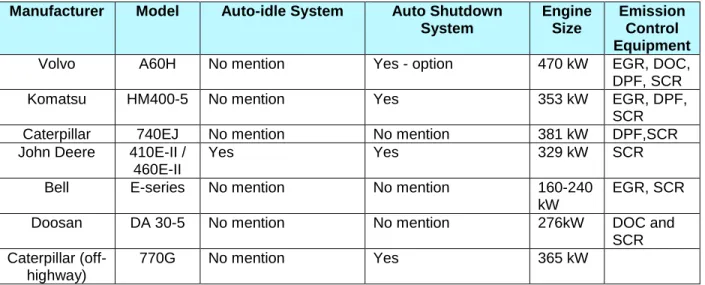
Information from construction equipment manufacturers on their newest products offering auto-idle and auto shutdown features are scarce. Examples of what is available from the top equipment manufacturers for the equipment categories selected for this project are listed in Table 8 to Table 13. A full list of current OEM equipment offerings in the seven equipment categories are provided in a separate excel document.
Manufacturer Model Auto-idle System Auto Shutdown System Engine Size Emission Control Equipment
Case G-series 3 seconds 3 minutes SCR only
Caterpillar (video) Model 962M No mention5 3, 5, 10, 20 minutes (video) 185 kW
Komatsu WA320-8 No mention 5-60 minutes 123 kW EGR, DPF, and SCR John Deere 624K/644 K/724K 1-30 minutes 30 seconds-30 minutes 139-197 kW
Doosan DL220-5 Yes6 Yes 160 hp
@ 2,100 rpm
EGR, DOC, SCR
Hyundai HL960hd No mention Yes 168 kW
JCB JCB437 Yes No mention 129 kW No DPF
Table 8: Examples of New Original Equipment Manufacturer (OEM) Product Offerings for Loaders
Manufacturer Model Auto-idle System Auto Shutdown System Engine Size Emission Control Equipment Case CX210D 5 seconds of lever
inactivity
3 minutes of no activity
124 kW EGR, DPF, and SCR Volvo ECR235E 3-20 seconds of lever
inactivity, safety bar raised
more than 4 minutes, stationary and not in gear
128 kW
Komatsu PC210LC -11
4 seconds of inactivity 5 to 60 minutes 123 kW EGR, DPF and SCR
Caterpillar 320GC Yes Yes 109 kW Tier4 final
John Deere G-Series 4 seconds 1-30 minutes 75 kW EGR and SCR, no DPF Liebherr 922 2 and 10 seconds Default 5 min 120 kW DOC and
SCR
Table 9: Examples of New OEM Product Offerings for Excavators
Manufacturer Model Auto-idle System Auto Shutdown System Engine Size Emission Control Equipment
Case 856C Yes No mention 129/142
kW
SCR only
Caterpillar CAT120 No mention Yes 104 kW
Komatsu GD655-6 No mention Yes DPF, DOC,
and SCR
John Deere G-Series Yes Yes 160-224
kW
Table 10: Examples of OEM Product Offerings for Graders
5 No information was found in the public domain
Manufacturer Model Auto-idle System Auto Shutdown System Engine Size Emission Control Equipment Caterpillar 432F After 5 seconds of no
lever control for loader or backhoe New feature on electronic Tier4 engines, manual select 75 kW DPF
Case N-series Yes Yes 74-110
kW
SCR John Deere L-series Yes Pre-set at 30 minutes,
adjustable 1-60 minutes 53-112 kW DOC and SCR, 710 series includes DPF JCB 3CX-Super Yes No mention 55-81 kW SCR
Table 11: Examples of New OEM Product Offerings for Tractor/Loader/Backhoes
Manufacturer Model Auto-idle System Auto Shutdown System Engine Size Emission Control Equipment
Volvo A60H No mention Yes - option 470 kW EGR, DOC,
DPF, SCR
Komatsu HM400-5 No mention Yes 353 kW EGR, DPF,
SCR
Caterpillar 740EJ No mention No mention 381 kW DPF,SCR
John Deere 410E-II / 460E-II
Yes Yes 329 kW SCR
Bell E-series No mention No mention 160-240
kW
EGR, SCR
Doosan DA 30-5 No mention No mention 276kW DOC and
SCR Caterpillar
(off-highway)
770G No mention Yes 365 kW
Table 12: Examples of New OEM Product Offerings for Articulated and Off-highway Trucks
Manufacturer Model Auto-idle System Auto Shutdown System Engine Size Emission Control Equipment
Case M-Series No mention No mention 50-160
kW
SCR
Caterpillar D7 No mention No mention 197 kW SCR
Komatsu D61EXi-24 No mention Yes 127 kW John Deere 450K/550 K/650K Yes Yes 60-78 kW DPF Liebherr PR 746 Litronic Yes Yes 185 kW
3.5 Examples of Aftermarket Offerings
A review of idle control system offerings available in the aftermarket for construction equipment did not identify any auto-idle systems. This is not surprisingly, since the system is more complex to implement with a requirement for a network of sensors, and the need to communicate with, and integrate with the machine’s system control unit.
Three auto shutdown products were identified in the aftermarket for construction equipment Flight Systems Inc.’s Model 277EC Engine Idle Limiter ($155 US, installation instructions
available) – A three minute shutdown sequence is initiated when the machine is in park mode. The unit needs to be connected to the run, fuel pump, or coil circuit of the engine or engine control module. [29]
Thermex Engineered Systems Inc.’s IdleStop ($2000 CAD, $600 install CAD) – programmable and available in a version that does not interfere with Tier 4 equipment regeneration cycles [30] Sell Electronic’s Engine Idle Limiter Model 277EC – Programmed to shut down the engine after a
set time of 5 minutes or 10 minutes. The company indicated on their website that the product has an Economic Commission for Europe Certificate, therefore can be used without additional testing requirements. [31]
4 Survey of Stakeholders
In an effort to better understand the perspectives related to idle reduction from key stakeholders within the construction industry, the project team reached out to 11 construction OEMs, 2 aftermarket suppliers, 3 Engine OEMs, and 115 construction fleet owners (including fleet rental companies).
Due to the challenges imposed by the pandemic, the level of the response to the survey was relatively low. Nevertheless, feedback either through formal survey or through in-depth telephone discussion was received from all of the stakeholder groups, with the equipment OEMs being the largest group. The summary of key finding from each of the user groups is found in Table 14.
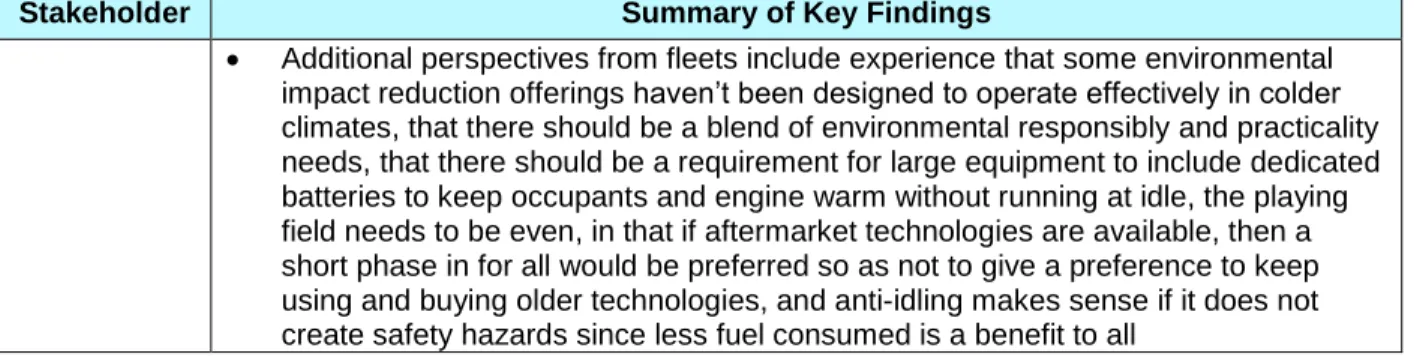
Stakeholder Summary of Key Findings Construction
Equipment OEM
Among all the OEMs that responded (Case, John Deere, Kubota, Liebherr), their product offerings cover all six equipment categories selected for the project Most product offerings are Tier 4 compliant
Most product offerings include the two idle control systems (where applicable) as standard features without extra cost (except in the case of Kubota, which does not offer auto shutdown, but provides auto-idle as a standard on certain excavators) The field is split in terms of whether the default mode upon equipment purchase
delivery for the idle control features is set to off or on
Idle control systems information are generally found in operating manuals and through sales staff (Liebherr provides special training)
The field is also split as to how prominent idle reduction features are advertised in marketing brochures
Reasons provided by manufactures for integrating idle control systems in their product offering include competitive advantage, compliance with emission policies of jurisdictions with more stringent requirements, damage prevention to emission control components, cost savings for customers (though the demand appears to depend on fuel prices), and reduction of noise and operator fatigue
Recommendations for future improvement include closing the loop during the interim period between when the US emissions regulations came into force and before the emissions regulations came into force in Canada, which allowed certain manufactures to import Tier 3 equipment into Canada (no longer an issue), as well as prohibiting the use of deletion kits and the enforcement of such prohibition Aftermarket
OEM
There are aftermarket products for auto shutdown for most of the equipment categories selected for this project
The aftermarket appears to be relatively small
For integration into some manufacturer’s equipment, the installation requires a dedicated interface
Market demand for auto shutdown systems include reasons such as cost savings, over-riding operator disregard for idle policies, and rule compliance
Market concerns for auto shutdown systems include equipment restarting, loss of productive time, and cold weather implementation
Recommendations for future improvement include providing incentives to reward fleet owners that reduce fuel/emission consumption based on proven performance, such as adjusting/rebating carbon taxes
Engine OEM Auto-idle and auto shutdown are normally features offered by the equipment OEM, enabled by programming in the electronic control unit
Stakeholder Summary of Key Findings
The engine control unit is the enabling technology for auto-idle and auto shutdown Engine control units have been used as early as some Tier 2/3 engines. Emissions
regulations were phased in based on engine power, so smaller engines and very large engines received the technology later
Equipment model years might be newer than the engine technology or model year Idling is not good for the engine, with the biggest concern being the potential
damage to emissions control systems, since hotter operating temperatures are required (and idling often results in cool operating temperatures)
While there is a difference in fuel consumption between low idle and high idle (with no load), the difference would be minor
Fuel consumption difference between idle and high RPM/heavy load is much more significant
Noise and vibration reduction may be more significant incentives to reduce engine speed than fuel consumption
The warm-up period for a larger engine is about 15-20 minutes, while a smaller engine would be considerably less. From an engine OEM perspective, an engine should not experience significant load till the operating temperature is at least 160⁰F. The heavy engines tend to retain their heat for a long period of time, so a shutdown for an extended period such as a lunch break should not cause the engine to cool significantly (so it can be restarted and worked almost immediately). From an engine OEM perspective, there’s not much benefit to a short auto-idle
setting, their target unnecessary idling is measured in minutes/hours/days, rather than seconds, for both auto-idle and idle shutdown timer
Fleet Among all fleet owners who responded, all equipment categories (except graders) selected for the project form part of their fleet
Necessary idle includes cold weather operational requirements, standard warm up requirements based on manufacturer recommendations, for safety and
maintenance inspections, and waiting for materials to be brought in
Unnecessary idle includes for operator comfort, convenience, breaks, out-of-cab operator discussions, job or equipment investigations - whatever interrupts full production mode often has the machine at idle for the duration of the interruption, as well as sometimes machines that are moved from location to location will idle specially for short distances
Unnecessary idle is discouraged for environmental concerns, premature wear on equipment, and is detrimental to diesel powered equipment that requires sustaining minimum engine speed to ensure proper performance
It does not appear that idle time is measured nor are idle policies in place, unless there is a site specific requirement
Very little communication was received from manufacturers/dealers on idle control systems on equipment in the fleets, and very little communication is provided to operators
The utilization of idle control systems appears to vary from no utilization to some utilization
There does not seem to be much knowledge of what equipment has idle control features, whether it is used in operations, and whether the features are set to on or off by default upon equipment purchase/rental delivery
Regarding how much weight the consideration of idle control features in equipment purchase decision making, the response varies from no weight to 25%. It seems that safety, function and productivity are more important considerations than those with environmental impacts
There appears to be less appetite for the consideration of aftermarket products to retrofit existing equipment, though one response did state that potential
Stakeholder Summary of Key Findings
Additional perspectives from fleets include experience that some environmental impact reduction offerings haven’t been designed to operate effectively in colder climates, that there should be a blend of environmental responsibly and practicality needs, that there should be a requirement for large equipment to include dedicated batteries to keep occupants and engine warm without running at idle, the playing field needs to be even, in that if aftermarket technologies are available, then a short phase in for all would be preferred so as not to give a preference to keep using and buying older technologies, and anti-idling makes sense if it does not create safety hazards since less fuel consumed is a benefit to all
Table 14: Summary of Key findings from Stakeholders Survey
A general observation from the project team during the course of this task was that there seems to be a communication gap between the manufacturers, those in the sales/distributions functions and the users of the equipment with regards to idle control systems and their operation. It appears that the closer to the operation side, the less informed people are of the existence of the systems which are essentially standard on new equipment. Thus, if the features are not turned on by default upon equipment
purchase/rental delivery, it is uncertain whether the idle control systems are being utilized to the fullest extent possible.
5 GHG Impact Analysis
There are many elements that influence emissions from construction equipment. According to a study of construction equipment in Hong Kong, which organized the elements into four key areas as outlined below, many are not easily measured nor quantifiable [32]:
equipment and conditions, such as make, year, model, size and engine power, overall condition, and fuel quality;
equipment maintenance, such as major and routine maintenance;
operating conditions, such as application, duty cycle and environmental conditions; and equipment operations, such as idling and control, operator skills, equipment planning and
deployment.
5.1 Methods to Calculate GHG Emissions from Off-Road Sources
The methodology used to estimate off-road emissions sources from Canada, the US EPA, the California Air Resources Board (ARB) and the European Environment Agency are all based on the following five key parameters [21] [33] [34] : Activity (hours/year)
Emission factor (EF, mass/time or mass/fuel used) [35] Average rated power (hp)
Load factor (LF, unitless, a fraction of average rated power) Equipment population (units)
Mathematically, it is represented as [33] :
𝐸𝑚𝑖𝑠𝑠𝑖𝑜𝑛𝑠 = 𝐴𝑐𝑡𝑖𝑣𝑖𝑡𝑦 ∗ 𝐸𝐹 ∗ 𝐴𝑣𝑒𝑟𝑎𝑔𝑒 𝑟𝑎𝑡𝑒𝑑 𝑝𝑜𝑤𝑒𝑟 ∗ 𝐿𝐹 ∗ 𝑃𝑜𝑝𝑢𝑙𝑎𝑡𝑖𝑜𝑛 [Equation 1]
The values used in the calculations differ for each of the authorities. For Canada, according to
communications with ECCC, activity is estimated using data from Power Systems Research, CO2 EF is based on Canadian fuel characteristics [36], the average rated power, LF and population are based on fleet profile data purchased annually.
The US EPA has incorporated a NONROAD model into the Motor Vehicle Emission Simulator model (MOVES2014b). According to the EPA, MOVES2014b [37],
“brings together information on engine populations, equipment use, and emission factors.
MOVES2014b rely on emission factors, which are estimates of the amount of pollution emitted by a particular type of equipment during a unit of use. Emission factors are based on test data where available and adjusted when necessary to account for in-use operation that differs from the typical test conditions.”
𝐶𝑂2 𝐸𝑚𝑖𝑠𝑠𝑖𝑜𝑛𝑠 = (𝐴𝑑𝑗𝑢𝑠𝑡𝑒𝑑 𝐵𝑆𝐹𝐶 ∗ 453.6 − 𝐻𝐶) ∗ 0.87 ∗ ( 44
12) [Equation 2]
𝐴𝑑𝑗𝑢𝑠𝑡𝑒𝑑 𝐵𝑆𝐹𝐶 = 𝐵𝑆𝐹𝐶𝑎𝑡 𝑠𝑡𝑒𝑎𝑑𝑦 𝑠𝑡𝑎𝑡𝑒∗ 𝑇𝐴𝐹 [Equation 3]
Where,
Adjusted brake specific fuel consumption (BSFC) refers to the in-use adjusted fuel consumption (lb/hp-hr)
453.6 refers to the conversion factor from pounds to grams
HC refers to the in-use adjusted hydrocarbon emissions (g/hp-hr), this is meant to be the correction for unburned fuel
0.87 is the carbon mass fraction of diesel 44/12 is the ratio of CO2 mass to carbon mass
𝐵𝑆𝐹𝐶𝑎𝑡 𝑠𝑡𝑒𝑎𝑑𝑦 𝑠𝑡𝑎𝑡𝑒 (lb/hp-hr) are values that can be found on table A4 of EPAs’ MOVES2014b
technical document
Transient adjustment factor (TAF, unitless) = 1 for Tier 4, values for other Tiers can be found on table A5 of EPAs’ MOVES2014b technical document
A number of publications reviewed as part of this project noted that construction equipment emissions estimates using earlier EPA NONROAD models (2008b) and ARB’s OFFROAD model are based on steady-state engine dynamometer tests (Figure 1) and an average of engine LFs, which do not adequately represent their real-world use. [32] [35] [38] [39]
Figure 1: Non-Road Steady-State Cycle (ISO-C1 Test Procedure7) [40]
A presentation from the ARB (based on a 2016 paper in Atmospheric Environment [41]) shows the average duty cycle of six common construction equipment (Figure 2), five of which are the same as those selected for this project. The activity patterns are based on simulated work tasks of a total of 27 pieces of equipment, with engine power ranging from 90 to 540hp.[40]
Figure 2: ARB Study Average Load Profile by Equipment Type [40]
Transient engine dynamometer test cycles were developed by the US EPA and the Engine Manufacturers Association, as shown in Figure 3, to better account for the varying duty cycles that equipment sees in the real world, but the test data were not part of EPA’s earlier NONROAD models [38].
![Table 1: Number of Businesses by Size within the Construction Sector in Canada [6]](https://thumb-eu.123doks.com/thumbv2/123doknet/13966736.453350/13.918.152.766.110.514/table-number-businesses-size-construction-sector-canada.webp)
![Table 4: By Year of When US EPA Diesel Engine Emission Standards Came into Effect [7]](https://thumb-eu.123doks.com/thumbv2/123doknet/13966736.453350/21.918.103.815.685.986/table-year-diesel-engine-emission-standards-came-effect.webp)


![Figure 1: Non-Road Steady-State Cycle (ISO-C1 Test Procedure 7 ) [40]](https://thumb-eu.123doks.com/thumbv2/123doknet/13966736.453350/35.918.328.638.644.938/figure-non-road-steady-state-cycle-test-procedure.webp)
![Figure 2: ARB Study Average Load Profile by Equipment Type [40]](https://thumb-eu.123doks.com/thumbv2/123doknet/13966736.453350/36.918.191.730.215.570/figure-arb-study-average-load-profile-equipment-type.webp)
