Publisher’s version / Version de l'éditeur:
Vous avez des questions? Nous pouvons vous aider. Pour communiquer directement avec un auteur, consultez la première page de la revue dans laquelle son article a été publié afin de trouver ses coordonnées. Si vous n’arrivez pas à les repérer, communiquez avec nous à [email protected].
Questions? Contact the NRC Publications Archive team at
[email protected]. If you wish to email the authors directly, please see the first page of the publication for their contact information.
https://publications-cnrc.canada.ca/fra/droits
L’accès à ce site Web et l’utilisation de son contenu sont assujettis aux conditions présentées dans le site LISEZ CES CONDITIONS ATTENTIVEMENT AVANT D’UTILISER CE SITE WEB.
Physical Review. B, Condensed Matter and Materials Physics, 79, 3, pp.
035309-1-035309-8, 2009-01-09
READ THESE TERMS AND CONDITIONS CAREFULLY BEFORE USING THIS WEBSITE. https://nrc-publications.canada.ca/eng/copyright
NRC Publications Archive Record / Notice des Archives des publications du CNRC :
https://nrc-publications.canada.ca/eng/view/object/?id=1a1af039-bd7f-46f7-8ca6-a892c9975b24
https://publications-cnrc.canada.ca/fra/voir/objet/?id=1a1af039-bd7f-46f7-8ca6-a892c9975b24
NRC Publications Archive
Archives des publications du CNRC
This publication could be one of several versions: author’s original, accepted manuscript or the publisher’s version. / La version de cette publication peut être l’une des suivantes : la version prépublication de l’auteur, la version acceptée du manuscrit ou la version de l’éditeur.
For the publisher’s version, please access the DOI link below./ Pour consulter la version de l’éditeur, utilisez le lien DOI ci-dessous.
https://doi.org/10.1103/PhysRevB.79.035309
Access and use of this website and the material on it are subject to the Terms and Conditions set forth at
Engineering photon cascades from multiexciton complexes in a
self-assembled quantum dot by a lateral electric field
Engineering photon cascades from multiexciton complexes in a self-assembled quantum dot
by a lateral electric field
Marek Korkusinski,1Michael E. Reimer,2Robin L. Williams,2and Pawel Hawrylak1
1Quantum Theory Group, Institute for Microstructural Sciences, National Research Council, Ottawa, Canada K1A0R6 2Quantum Physics Group, Institute for Microstructural Sciences, National Research Council, Ottawa, Canada K1A0R6
共Received 17 October 2008; published 9 January 2009兲
We demonstrate theoretically that by applying an in-plane electric field it is possible to engineer and tune photon cascades originating from recombination of multiexciton complexes confined in self-assembled quan-tum dots. We find the multiexciton energies and states as functions of the field using the effective-mass configuration-interaction approach with the effects of electron-hole exchange treated perturbatively, and use Fermi’s golden rule to compute the emission spectra. We show that the field-induced Stark shift of the energies of photons emitted by the biexciton and two linearly polarized excitons is strongly renormalized by the electron-hole interactions, which are governed by the separation of electrons and holes induced by the field. As a result, the effective Stark shifts of exciton and biexciton emission lines have opposite signs, leading to a removal of the biexciton binding energy at a finite field. This enables the cascade of a pair of polarization entangled photons in the presence of a finite exciton anisotropic exchange splitting. We compare these emission spectra to those of the charged exciton, the triplet biexciton, and the three-exciton complex. We find that the electric field and Coulomb interactions differentiate the biexciton-exciton cascade from other cascades, facili-tating identification of its spectra and practical implementation.
DOI:10.1103/PhysRevB.79.035309 PACS number共s兲: 78.67.Hc
I. INTRODUCTION
There is currently a great deal of interest in using self-assembled quantum dots 共SADs兲 as optically active media for generation of single photons,1–7 entangled photon pairs,1,8–10 quantum repeaters,11and in optic-based quantum computing.12–14The SADs are quasi-two-dimensional struc-tures which strongly confine both electrons and holes in the growth direction. The lateral confinement, on the other hand, is typically softer, resulting in atomiclike single-particle en-ergy shells.15–17Application of a vertical electric field allows one to control the single-dot properties, such as the total charge18and the field-induced Stark shift,19,20 as well as the tunneling in vertically coupled double quantum-dot molecules.21–25 However, only a lateral electric field allows one to tune and engineer the properties of quantum dots re-lated to their shell structure and Coulomb interactions. It has been shown that the lateral field allows one to tune the fine structure of the excitonic emission spectrum,26–28 the effi-ciency of the radiative recombination of carriers, and the total confined charge29while modifying the interplay of the single-particle confinement and interaction effects to produce the anomalous excitonic Stark effect.30–32The splitting of the excitonic emission spectrum due to the anisotropic exchange interaction is an important impediment to the generation of entangled photon pairs from the biexciton-exciton cascade.2,8,9,26,27
Here we show that the lateral electric field can be used to control the multiexciton photon cascade in a single SAD. We focus on the biexciton-exciton cascade and show that this allows a source of entangled photon pairs to be engineered even for anisotropic dots with two linearly polarized exci-tonic emission states. To demonstrate this, we approximate the SAD confinement for electrons and holes with a two-dimensional parabolic confinement and compute the energies
and states of the multiexcitons using the configuration-interaction approach with the electron-hole exchange effects treated perturbatively. Once the many-exciton states are de-rived, we utilize Fermi’s golden rule to calculate the emis-sion spectra.
Application of an in-plane electric field introduces a dis-placement of the electronic potential with respect to that of the hole. As a result, the electron-hole interactions diminish as a consequence of the field-induced separation of charges. The reduction in electron-hole attraction introduces a blue-shifting term into the energy of the exciton, which partially compensates for the Stark redshift of the single-particle elec-tron and hole energies. This compensation is even selec-tronger in the energy of the biexciton. In consequence, the emission spectra of two linearly polarized single excitons exhibit only a weak redshift, while the biexciton emission blueshifts with the increase in the field. At a finite field the biexciton binding energy is removed, and the emission peaks corresponding to photons emitted by the biexciton and the exciton cross even in the presence of the anisotropic exchange splitting brought about by the electron-hole exchange. This sets up a condition in which a pair of polarization entangled photons can be emitted.
As already mentioned, application of the electric field may change the charge state of the dot. Also, the field-induced separation of carriers leads to a reduction in the radiative recombination rate, which increases the probability of generation of higher-order multiexciton complexes. By comparing the emission spectra of the exciton and biexciton to those of the charged exciton, the triplet biexciton and the three-exciton complex, we show that the electric field and Coulomb interactions differentiate the biexciton-exciton cas-cade from other cascas-cades. This facilitates identification of the spectra and practical implementation.
The paper is organized as follows. In Sec. IIwe describe the model and the computational procedure. In Sec. III we
discuss in detail the exciton and biexciton cascade as a func-tion of the lateral electric field. In Sec. IV we present a comparison of this cascade to the emission spectra of charged excitons and other multiexciton complexes, and in Sec. Vwe give a summary of our results.
II. MODEL A. Single-particle states
Recent magnetophotoluminescence experiments17 show that the lateral confinement of the SAD can be well approxi-mated by a two-dimensional harmonic oscillator共HO兲 poten-tial. In the following we assume that this potential is acting in the x-y plane, and the external electric field Fជ= Fxˆ is di-rected along the x axis. The profile of this confinement along the field direction is shown schematically in Fig. 1共a兲, with the upper and lower parabolas representing the electron and hole potentials, respectively. The Hamiltonian of an electron with the effective mass meⴱ and charge 共−e兲 in such a
dis-placed HO potential takes the form
Hˆe= − ប2 2meⴱ ⌬ +1 2me ⴱ e 2
冋
冉
x− eF meⴱ e 2冊
2 + y2册
− 1 2meⴱ冉
eF e冊
2 , 共1兲 where បeis the characteristic HO energy. The electric fielddisplaces the origin of the potential by x0
e
= + eF / meⴱ
e
2 . The eigenstates of this Hamiltonian are the displaced HO states 兩ne, me,e典, where ne, me= 0 , 1 , . . . are the HO quantum
num-bers, ande= ⫾ 1 / 2共or ↑,↓兲 is the electron spin. Due to the
separability of Hamiltonian 共1兲, the wave functions are
simple products of one-dimensional HO states, 具r兩ne, me典
=ne共x−x0
e兲
me共y兲. The corresponding single-particle
eigenenergies, Ee共n
e, me兲=បe共ne+ me+ 1兲−ES e
, are repre-sented by bars within the upper parabola in Fig. 1共a兲. The electric field introduces a Stark shift ES
e =2m1 e ⴱ共 eF e兲 2 of HO en-ergies but without changing the energy បe. As a
conse-quence, for any F, the single-particle spectra consist of equally spaced shells 共s, p, d, etc.兲 with increasing degen-eracy. The shell structure is not changed by the symmetry breaking introduced by the field, a rather counterintuitive result. The electric-field dependence of the single-particle en-ergies is plotted in Fig. 1共b兲.
In our treatment of holes we neglect the valence subband mixing effects and write the single-hole Hamiltonian in the form analogous to Eq. 共1兲, only scaled with the heavy-hole
effective mass mhⴱand charge共+e兲, and the hole characteris-tic HO energy បh. Due to the opposite charge, the electric
field displaces the origin of the hole confinement in the di-rection opposite to that of the electron, x0
h
= −eF / mhⴱh
2 . The displaced HO hole eigenstates兩nh, mh,h典 are labeled by the
heavy-hole spin h= ⫾ 3 / 2共or ⇑,⇓兲, and the corresponding
single-particle energies Eh共n
h, mh兲=បh共nh+ mh+ 1兲−ES h
ex-hibit a Stark shift of ES
h =2m1 h ⴱ共 eF h兲 2
. The dependence of these energies on the electric field is qualitatively similar to that of the electrons, as shown in Fig.1共b兲.
In the following we express all energies in units of the electronic effective Rydberg, R = meⴱe
4/ 22ប2
, and all lengths in units of the electronic effective Bohr radius, aB
= ប2/ m
e
ⴱe2, where is the dielectric constant of the material. With meⴱ= 0.055 m0 and = 12.4 we have R = 4.867 meV and aB= 11.93 nm. In these dimensionless units the
elec-tronic oscillator length is ᐉe= 1 /
冑
⍀eand the separation of theorigins of the electron and hole confinements is ⌬x = x0
e − x0 h = 2eFᐉe2aB R 共 1 ⍀e+ 1
⍀h兲. For our model calculations we take ⍀e = 2.466R 共i.e., បe= ⍀eR = 12 meV兲 and ⍀h= 1.233R 共i.e.,
បh= 6 meV兲, and the heavy-hole effective mass mhⴱ
= 0.11 m0.
B. Many-body Hamiltonian
We populate the single-particle states with Ne electrons
and Nh holes. Denoting the creation共annihilation兲 operator
of an electron on state i⬅兵ne, me,e其 by ci
+ 共c
i兲 and the
analogous pair of operators for the hole by hi
+共h
i兲, we write
the Hamiltonian of the interacting electron-hole system as
En e rg y
x
∆
2 0 F E E= −β ∆ 0.0 0.5 1.0 1.5 2.0 2.5 3.0 3.5 -2 -1 0 1 2 3 4 5 6 7 8 En e rg y (R y )Electric field (Ry/ aB)
S
P
D
(a)
(b)
(c)
0.0 0.5 1.0 1.5 2.0 2.5 3.0 3.5 0.0 0.5 1.0 1.5 2.0 2.5 3.0 En e rg y (R y )Electric field (Ry/ a
B) hh ee V V0 = 0 eh V0
Electric field F
FIG. 1. 共Color online兲 Fundamental properties of the quantum dot in a lateral electric field.共a兲 Schematic picture of the system. 共b兲 Energies of the single-particle states of an electron as a function of the field.共c兲 Fundamental Coulomb matrix elements V0ee, V0hh, and V0ehas functions of the field.
KORKUSINSKI et al. PHYSICAL REVIEW B 79, 035309共2009兲
Hˆ =
兺
i Eieci+ci+兺
i Eihhi+hi+ 1 2兺
ijkl 具ij兩Vee兩kl典ci + cj+ckcl +1 2兺
ijkl 具ij兩Vhh兩kl典hi + h+jhkhl−兺
ijkl 具ij兩Veh兩kl典ci + h+jhkcl + HˆEHX. 共2兲The first two terms of this Hamiltonian define the single-particle energies of electrons and holes, respectively, while the third and fourth terms account for the Coulomb interac-tions among electrons and among holes, respectively. These terms are scaled by the Coulomb scattering matrix elements, which in the HO basis can be evaluated analytically. It is convenient to express their values in terms of the fundamen-tal element 具00兩Vee兩00典=V0
ee
=
冑
⍀e. As the electric fielddoes not change the oscillator energy ⍀e共h兲, the interactions
among the carriers of the same kind do not depend upon F. The fifth term in Hamiltonian 共2兲 accounts for the direct
electron-hole interaction. Since the electric field separates electrons from holes, the matrix elements of this interaction depend upon the distance ⌬x = x0
e
− x0
h
. Figure1共c兲shows the dependence of the fundamental matrix elements V0
ee
, V0
hh
, and
V0ehon the electric field.
The last term of Hamiltonian共2兲 represents the
electron-hole exchange interaction. Guided by the analysis of Takagahara,33we account for the fact that the wave functions of the exciton and biexciton are built predominantly out of the s-shell electron and hole orbitals. As a result, we expect that the details of the fine structure of the exciton will be only weakly sensitive to the asymmetry of the SAD. Follow-ing Ref.34, we approximate the exchange Hamiltonian HˆEHX with an effective operator in which the electron-hole ex-change interaction only acts on the spins of the electron and the hole but do not redistribute carriers on single-particle orbitals. The electron-hole exchange Hamiltonian is written as HˆEHX=
兺
ijkl兺
1 e 2e兺
1h2h 具i1 e , j1 h兩V X兩k2 h ,l2 e典c i1e + hj 1 h + hk 2 hcl 2 e. 共3兲 In our approximation we specify the elements 具i1e, j1h兩V X兩j2
h
, i2e典 in the basis of spinors 兵兩ie, jh典其
=兵兩i↓ , j⇑典,兩i↑ , j⇓典,兩i↓ , j⇓典,兩i↑ , j⇑典其. In this basis, the ma-trix of Hamiltonian 共3兲 involving the electron orbital i and
the hole orbital j takes the form
HˆEHX共ij兲 =1 2
冢
⌬0 共ij兲 ⌬1 共ij兲 0 0 ⌬1共ij兲 ⌬0共ij兲 0 0 0 0 − ⌬0 共ij兲 ⌬ 2 共ij兲 0 0 ⌬2 共ij兲 − ⌬0 共ij兲冣
. 共4兲The exchange matrix elements ⌬␣
ij are parametrized as ⌬␣ij共F兲 = ⌬␣ij共F = 0兲
冕
dxdy兩ie共x − x0 e,y兲兩2兩 j h共x − x 0 h,y兲兩2冕
dxdy兩ie共x,y兲兩2兩 j h共x,y兲兩2 .The elements depend on the electric field through the elec-tron and hole displacements x0
e
and x0
h
and are renormalized by the zero-field integral appearing in the denominator. We express ⌬␣ij共F兲 in terms of the fundamental elements ⌬␣
00共F = 0兲 at zero electric field. These parameters were recently estimated in high-resolution photoluminescence experiments on excitons in InAs/GaAs SADs 共Ref. 34兲 and found to be
⌬000 = 400 eV, ⌬1 00 = 180 eV, and ⌬2 00 = 90 eV. Although these parameters were found to depend on the size and ge-ometry of the SAD, we take them as model constants setting the correct energy scale of the electron-hole exchange inter-actions. The dependence of these fundamental exchange pa-rameters on the electric field is computed using the displaced 兩00典 electron and hole HO states as ⌬0
00共F兲=⌬ 0
00共F=0兲exp关 −共xe− xh兲2/ 4ᐉ2兴. A more detailed treatment of the
electron-hole exchange in the presence of the lateral electric field based on atomistic calculations will be presented elsewhere.35
C. Configurations and computational procedure
We look for the eigenenergies and eigenstates of the sys-tem of Neelectrons and Nh holes in the configuration
inter-action approach. This procedure involves creating all pos-sible configurations of the carriers on the single-particle states, constructing the Hamiltonian matrix in the basis of these configurations for each value of the electric field and diagonalizing this matrix numerically. The computation is carried out in two steps. First, we consider Hamiltonian 共2兲
without the electron-hole exchange term. This Hamiltonian conserves the projections Sz
e
and Sz h
of the total spin of elec-trons and holes, respectively. This allows one to divide the configurations into subspaces labeled by the same pair 共Sz
e
, Sz
h兲 and perform the exact diagonalization in each
sub-space separately. In constructing the many-particle configu-rations we use the single-particle states of s, p, and d shells 共altogether six states兲 for both electrons and holes. In this basis we can create, e.g., 36 configurations for an exciton, 1296 configurations for a biexciton with Sze= Szh= 0, 225 con-figurations for a biexciton with Sz
e = −1 and Sz h = + 3, and 8100 configurations for Ne= Nh= 3, Sz e = −1 / 2 and Szh= + 3 / 2. In the second step we account for the electron-hole ex-change interaction in an approximate manner. Because of the small energy scale for this interaction we build the matrix of the Hamiltonian HˆEHXin the basis of degenerate many-body eigenstates with the same value of total spin but all possible spin projections.
D. Emission spectra
We calculate the emission spectrum I共⍀兲 of the electron-hole system using Fermi’s golden rule,
I共⍀兲 =
兺
f 兩具Ne,Nh,i兩Pˆ −兩N e− 1,Nh− 1, f典兩 2␦共E i− Ef− ⍀兲. 共5兲 The radiative recombination takes place from the initial state 兩Ne, Nh, i典 of Neelectrons and Nh holes. The summationex-tends over all final states兩Ne− 1 , Nh− 1 , f典 of Ne− 1 electrons
and Nh− 1 holes. The energy of the emitted photon equals the
energy difference between the initial and final states. The amplitude of the outgoing radiation is determined from the dipole matrix element involving the interband polarization operator Pˆ−. The form of this operator depends on whether we include the above electron-hole exchange Hamiltonian in our many-body calculations. If this term is not accounted for, we take, e.g., Pˆ+−=兺ije具i兩 j典hci↓hj⇑in order to remove a single
electron-hole pair from the system so that the outgoing pho-ton is+ polarized. An analogous operator P−
−
describes the emission of the− photons. On the other hand, in the pres-ence of the electron-hole exchange a more appropriate for-malism involves horizontal and vertical polarizations so that
PˆH−=冑12兺ije具i兩 j典h共ci↓hj⇑+ ci↑hj⇓兲. In both cases each pair of
annihilation operators is scaled by the overlape具mene兩nhmh典h
of corresponding single-particle electron and hole HO func-tions. For example, the overlap between the s-shell states is
e具00兩00典h= exp关−共⌬x兲2/ 8ᐉe
2兴, while the overlap between the
s-shell electron and p-shell hole states is e具00兩01典h= 0 and e具00兩10典h=
1
2ᐉe⌬x exp关−共⌬x兲 2/ 8ᐉ
e
2兴. The dependence on the electric field enters via ⌬x = x0
e
− x0
h
so that as the electric field grows, the first of these elements decreases monotonically, while the last one increases and then decreases. In general, at zero electric field the only nonzero overlaps are found be-tween the states belonging to the same shells, while at finite fields the nonzero overlaps can appear also between states originating from different shells.
III. EXCITON-BIEXCITON CASCADE IN THE PRESENCE OF THE LATERAL ELECTRIC FIELD
A. Exciton
Let us begin our discussion by summarizing the properties of the single exciton in the presence of the lateral electric field presented in detail elsewhere.30,31 The lowest-energy configuration of the single exciton involves the two carriers occupying the respective s shells. We can generate four such configurations. One of them is 兩X,a典=c00↓
+ h 00⇑
+ 兩0典, and the remaining three differ by the alignment of the electron and hole spins. In the absence of the electron-hole exchange these configurations have the same energy, EX,a= Ee共0,0兲 + Eh共0,0兲−V
0
eh
, which is a sum of the energies of the s-shell electron and hole and their Coulomb attractions. We have already shown in Fig. 1共b兲 that the single-particle energies decrease quadratically with the electric field, introducing a redshift of the energy of the outgoing photon. However, as we have shown in Fig.1共c兲, the electron-hole attraction V0
eh
also decreases with the increase in the field, resulting in a blueshift of the photon energy. This cancellation of the Stark redshift by the decrease in the exciton binding energy leads
to a relatively weak dependence of the energy EX,a on the electric field.30,31
The lowest-energy excitonic configuration is the dominant component in the full exciton wave function computed in the configuration-interaction procedure. The configuration mix-ing effects lower the energy EX,a by the correlation correc-tion ⌬EX
c
, but the dependence of the exciton ground-state energy on the electric field remains qualitatively the same.
In order to account for the electron-hole exchange, we diagonalize the Hamiltonian HˆEHX given by Eq. 共4兲 in the basis of the four s-shell exciton configurations. Based on the selection rules described in Sec.II D, among the four result-ing exciton eigenstates we find two optically active ones. One of them, 兩XV典=冑12共c00↓ + h 00⇑ + − c00↑ + h 00⇓ + 兲兩0典, with energy
EX共V兲=EX,a+共⌬0− ⌬1兲/2, is vertically polarized, while the second state, 兩XH典=冑12共c00↓ + h 00⇑ + + c00↑ + h 00⇓ + 兲兩0典, with energy
EX共H兲=EX,a+共⌬0+ ⌬1兲/2, is horizontally polarized. The an-isotropic exchange splitting between these two states, ⌬AEX = ⌬1, decreases with the increase in the field as derived in Sec. II B.
Note that our perturbative approach to the electron-hole exchange does not reveal any correlation between the direc-tion of SAD anisotropy leading to the exchange splitting and the direction of the electric field. Results of more detailed atomistic calculations, accounting for the shape asymmetry and atomistic details of the SAD in relation with the field direction, will be presented elsewhere.35
B. Biexciton
Let us now add the second electron-hole pair to the sys-tem. The biexciton configuration with the lowest single-particle energy,兩XX,a典=c00↑
+ c 00↓ + h 00⇑ + h 00⇓ + 兩0典, is formed when all the carriers are placed on the s-shell orbital and form spin-singlet pairs. This configuration is shown schematically in the inset of Fig. 2共a兲. The energy of this configuration,
EXX,a= 2EX,a+ V0 ee + V0 hh − 2V0 eh
, contains the energy of two noninteracting excitons兩X,a典, the electron-electron and hole-hole repulsions and twice the electron-hole-hole attraction. If we neglect the exciton-exciton interactions共the three last terms兲, the biexciton energy is simply twice the energy of the exci-ton. In Fig. 2共a兲 we plot this energy as a function of the electric field with the solid red line. If we were to switch off only the electron-hole attraction 共the last term in EXX,a兲, the biexciton energy EXX,a would be given by ELIM, shown in Fig. 2共a兲 with the blue dashed line. In the presence of all interaction terms and at zero electric field the attractive electron-hole term cancels the two repulsive Coulomb terms exactly, and the full energy EXX,a, plotted in Fig. 2共a兲 with the solid blue line, is equal to 2EX,a. As the electric field increases, the attractive term decreases, resulting in an
in-crease in the energy EXX,a, which now shifts closer to its limiting value ELIM. This convergence is clear in Fig.2共a兲for large values of the field. The complete biexciton energy EXX,
accounting for the configuration mixing in the exact diago-nalization approach, is plotted in Fig. 2共a兲 with the black line. It is lowered from the single-configuration energy EXX,a by the biexciton correlation correction ⌬EXX
c
and shows a very weak dependence on the electric field. Since this
biex-KORKUSINSKI et al. PHYSICAL REVIEW B 79, 035309共2009兲
citon state is an electron and hole singlet, its energy is not renormalized by the electron-hole exchange.
C. Biexciton-exciton cascade
Figure 2共b兲 shows the emission spectra of the biexciton and exciton as functions of the electric field. The exciton emission peaks, shown in black, form a doublet split by the anisotropic exchange ⌬AEX. The positions of these peaks cor-respond simply to the respective exciton energies EX共H兲 and
EX共V兲.
The position of the biexciton emission peak corresponds to the energy difference ⍀XX= EXX− EX= EX,a+ V0
ee + V0 hh − 2V0 eh −共⌬EXX c − ⌬EX
c兲. We compare this energy to that of the
photon emitted by the exciton ⍀X= EX,a− ⌬EX c
. If we neglect the correlation effects, the cancellation of the interaction terms at zero field leads to the appearance of the exciton and biexciton peaks at the same energy. With increasing electric field, the photon emitted by the exciton redshifts while the photon from the biexciton blueshifts following the decrease
in V0
eh
and starts to redshift only when this element is suffi-ciently small. When correlations in the exciton and biexciton systems are included, the biexciton photon energy ⍀XX is
lower than the exciton photon energy ⍀X by the
field-dependent biexciton binding energy ⌬XX. Hence, if the
biex-citon photon energy is reduced below the exbiex-citon photon energy by the exciton-exciton interaction, there must be a
crossing of the exciton and biexciton emission lines for a finite electric field, as shown in Fig.2共b兲.
In Fig.2共b兲 the thickness of the lines corresponds to the emission amplitude. We find that for both the exciton and the biexciton this amplitude decreases with the increase in the field. This is due to the renormalization of the optical selec-tion rules, described in Sec.II D. In both cases the emission involves a recombination of an s-shell electron with an
s-shell hole, and the overlap of these two single-particle or-bitals decreases as the field increases.
Figure 3共a兲shows the region of fields and energies close to the crossing 关indicated in Fig.2共b兲by the rectangle兴. On this energy scale it is possible to discern the electron-hole exchange splitting in both the exciton and biexciton spectra. Because of the singlet nature of the biexciton, its energy is not renormalized by the electron-hole exchange, and the splitting visible in the figure is due to two polarizations of final-state excitons. The lower panel in Fig. 3 shows sche-matic diagrams of the biexciton-exciton cascade before
0.0 0.5 1.0 1.5 2.0 2.5 3.0 3.5 -2 0 2 4 6 8 10
En
e
rg
y
(R
y
)
Electric field (Ry/ a
B)
XX
E
a XE
,2
LIME
a XXE
,a
XX
,
0.0 0.5 1.0 1.5 2.0 2.5 3.0 3.5 -0.4 -0.2 0.0 0.2 0.4 0.6 0.8 1.0En
e
rg
y
(R
y
)
Electric field (Ry/ a
B
)
XXΩ
XΩ
(a)
(b)
c XXE
∆
XX∆
FIG. 2. 共Color online兲 共a兲 Components of the biexciton ground-state energy as functions of the electric field共see text兲. Inset shows the lowest-energy biexciton configuration.共b兲 Emission spectra of the exciton共⍀X, black兲 and biexciton 共⍀XX, red兲 as a function of the
field. Sizes of the symbols are proportional to the emission amplitudes. 1.3 1.4 1.5 1.6 1.7 1.8 0.16 0.18 0.20 0.22 0.24 0.26 0.28 0.30 E n e rg y (R y )
Electric field (Ry / a
B) XX
Ω
XΩ
A
B
A
B
0 E X E X E 2 XX E XX E +Ω
XX +Ω
X −Ω
XX −Ω
XFIG. 3. 共Color online兲 Top panel: emission spectra of the exci-ton共green and black兲 and biexciton 共red and blue兲 in the vicinity of the X − XX crossing 关the region within the black rectangle in Fig.
2共b兲兴. Bottom panel: biexciton-exciton cascade for a small electric field共A兲 and at the crossing of levels 共B兲. In the second case the energies of the transitions denoted by parallel arrows are identical, and polarization entanglement occurs.
crossing共A兲 and at crossing 共B兲. Each radiative transition is represented by an arrow whose color is matched to that of the respective spectral line in Fig. 3共a兲. We see that before the removal of the biexciton binding energy the photon pairs of the left and right cascades are different and can be distin-guished. On the other hand, the two pairs of photons gener-ated “on-resonance” cannot be energetically distinguished and would be polarization entangled, assuming that phase coherence is maintained within the emission process.36In the proposed scheme the two photons forming each pair are gen-erated in sequence, with a small delay between the recombi-nation processes. As a result, the pairs could be distinguished by a simultaneous measurement of energy and arrival time at the detector: in one cascade the low-energy photon arrives first, while in the other one the high-energy photon arrives first. However, the entanglement of the pairs can be restored to some degree by introducing appropriate delays into the optical path of each of the photons.37,38
IV. OTHER MULTIEXCITON COMPLEXES A. Charged excitons
In order to observe the electric-field tuning of the biexci-ton emission spectrum with respect to that of the excibiexci-ton, it is necessary to achieve a stable biexciton population in the SAD. In practice, however, one may have to deal with other excitonic complexes, both neutral and charged, which can obscure the desired emission spectra.
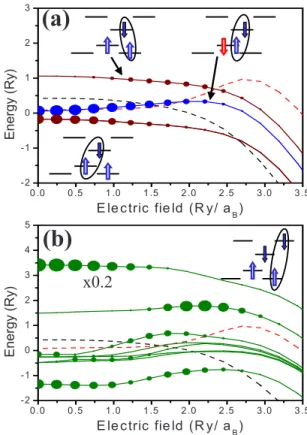
Let us begin with the analysis of the positively charged exciton X+whose emission spectra as a function of the elec-tric field are shown in Fig.4共a兲. Here we consider two pos-sible configurations of the X+ complex. The lowest-energy configuration, 兩X+S典=c00↓+ h00⇑+ h00⇓+ 兩0典, is shown in the
right-hand diagram of Fig.4共a兲. It is a hole spin singlet and gives the largest contribution into the full correlated ground state of X+. Another configuration, shown in the two left-hand diagrams, is a hole spin triplet 兩X+T典=c00↓+ h01⇑+ h00⇑+ 兩0典. The
state in which this configuration is dominant is an excited state of the X+complex. However, provided that the spin-flip relaxation of the hole to the ground singlet state is suffi-ciently slow, such a state can be detected optically.
In Fig. 4共a兲 we plot the emission spectrum of the two variants of X+: that of the X+S with the blue line and that of the X+T with the brown lines, with the symbol sizes corre-sponding to the emission amplitudes. The peak positions of the exciton and biexciton are plotted with dashed lines for reference. Note that the singlet X+exhibits only one emission line in the considered energy range: that corresponding to the recombination of the s-shell electron and the s-shell hole, as indicated in the top right-hand diagram. The optical signature of the triplet X+, on the other hand, consists of two lines. One of them, at lower energy, corresponds to the recombination of the s-shell electron with the s-shell hole共bottom left-hand diagram兲. The other one, at higher energy, involves the
s-shell electron and the p-shell hole共top left-hand diagram兲. It acquires a sizable oscillator strength only at finite fields. This is a consequence of the electric-field tuning of the di-pole matrix elements discussed in Sec. II D.
As it can be seen in Fig. 4共a兲, the emission maximum of
X+Sbehaves similarly to that of the biexciton, both in terms of its position and amplitude. However, due to the singlet configuration of the holes, the X+Scomplex does not exhibit any anisotropic exchange splitting, which makes it possible to distinguish between the two complexes. The two emission lines of X+Texhibit the fine structure, but they can be readily identified by their monotonic redshift as a function of the field and by the fact that they appear simultaneously as a pair of lines.
B. Triplet-triplet biexciton
If both electron and hole spin-flip relaxation processes are sufficiently slow, it may be possible to observe the optical signature of the triplet-triplet biexciton whose dominant con-figuration,兩XX−TT典=c01↓ + c 00↓ + h 01⇑ + h 00⇑ + 兩0典, is shown schemati-cally in the diagram in Fig. 4共b兲. In the main panel of the figure we show the emission spectra of such a complex as a function of the field, with the exciton and biexciton spectra shown with dashed lines for reference. We plot nine emission lines corresponding to nine possible configurations of the
0 .0 0 .5 1 .0 1 .5 2 .0 2 .5 3 .0 3 .5 -2 -1 0 1 2 3 E n e rg y (R y ) E le c tric fie ld (R y/ aB)
(a)
0 .0 0 .5 1 .0 1 .5 2 .0 2 .5 3 .0 3 .5 -2 -1 0 1 2 3 4 5 En e rg y (R y ) E le c tric fie ld (R y/ aB)(b)
x0.2
FIG. 4. 共Color online兲 Emission spectra of 共a兲 the positively charged exciton X+in a singlet and triplet hole configurations and 共b兲 the triplet-triplet biexciton XX−TT as a function of the lateral electric field. Sizes of the symbols correspond to the calculated emission amplitudes, while the black and red dashed lines indicate the positions of the exciton and biexciton peaks, respectively. Dia-grams show the electron-hole configurations dominant in each of the multiexciton states.
KORKUSINSKI et al. PHYSICAL REVIEW B 79, 035309共2009兲
final-state exciton on the three electron and three hole single-particle levels. The spectrum is complicated, with the stron-gest line appearing at highest energies, and corresponding to the recombination of the p-shell electron and the p-shell hole. The lowest line, on the other hand, corresponds to the recombination of the s-shell exciton. The intermediate lines correspond either to the “direct” recombination of particles from the same orbitals 共these lines have finite amplitude at zero field兲 or to the s-p recombination events 共these lines become bright at finite fields兲. As we can see, the optical signature of XX − TT is very different from that of the exciton-biexciton cascade.
C. Partially polarized biexciton and three-exciton complex
In Fig. 5 we compare the previously calculated emission spectra from the exciton-biexciton cascade, from fully spin-polarized biexciton XX − TT, and from the positively charged exciton in singlet共X+S兲 and triplet 共X+T兲 hole configurations
to the spectra of the partially spin-polarized biexciton
XX− ST and the three exciton complex XXX. We plot the emission spectra at zero electric field共F=0, left-hand panel兲 and after the biexciton-exciton crossing共F=2.2R/aB,
right-hand panel兲. The corresponding dominant initial-state con-figurations are also shown although the XX − SS state is com-posed of 1296 configurations and the XXX state is comcom-posed of 8100 configurations. As discussed before, at F = 0 the
ex-change split exciton emission line is above the two biexciton lines, while at F = 2.2R / aB it is below them. The emission
lines of the other five excitonic complexes are found in a similar spectral range, particularly at low fields. However, the XX-X cascade can be identified unambiguously by ob-serving their fine structure and evolution with the electric field. As already discussed, the positively charged exciton in the singlet state X+S 共Fig. 5, third diagram from the top兲 exhibits no exchange splitting of its emission lines. The re-maining four complexes exhibit the fine structure共not shown in Fig.5for clarity兲. However, in the three-exciton complex
XXXand the triplet-triplet biexciton XX − TT共first and fourth panels from the top, respectively兲, we deal with electron-hole pairs occupying the p shell, which results in the appearance of an additional emission maximum, located at energies by ⬃3.7R higher than the s-shell features 共not shown兲. The re-maining two systems, the charged exciton X+T in the triplet state and the singlet-triplet biexciton XX − ST 共second and fifth panels from the top, respectively兲 can be identified by observing the evolution of their emission spectra with the field. At finite fields the optical selection rules permit the radiative recombination of carriers, of which one occupies the s shell, while the other occupies the p shell 共such pro-cesses are forbidden at zero field兲. Since such pairs are found in each of these complexes, their spectra at finite fields are composed of two peaks, separated approximately by the single-particle hole energy បh.
V. CONCLUSION
In conclusion, using the effective-mass description of single-particle electron and hole quantum-dot states and the configuration-interaction treatment of the multiexciton sys-tem, we have predicted the effective Stark shift of the pho-tons obtained in the exciton and biexciton cascade in a lateral electric field. We have shown that this shift is a result of the interplay between the redshift of the single-particle states and the blueshifting component arising as a result of the decrease in the electron-hole attraction as the charges are being sepa-rated by the field. The correlation effect is stronger for the biexciton and results in a net blueshift of the photons due to biexciton recombination. As a result, at a finite electric field the photon emitted in exciton recombination has the same energy as that emitted in biexciton recombination. With the electron-hole exchange effects treated perturbatively we show that the anisotropic exchange splitting of the energies of photons due to exciton and biexciton decreases with the increase in the field but remains finite at the degeneracy point. However, the vertically polarized photon emitted by the biexciton is degenerate with the horizontally polarized photon emitted by the exciton at the same field as is the other pair of photons emitted with opposite polarizations. In con-sequence, the biexciton-exciton cascade composed of two vertically polarized photons cannot be energetically distin-guished from the cascade with opposite polarizations,
-1.5 -1.0 -0.5 0.0 0.5 Energy (Ry) E m iss io n In te n s it y -0.5 0.0 0.5 1.0 1.5 2.0 Energy (Ry)
(a)
F=0(b)
F=2.2 Ry /aB X XX-SS XX-ST XX-TT X+ S X+ T XXXFIG. 5. 共Color online兲 Emission spectra of neutral and charged excitonic complexes. From bottom to top: the single exciton X, the singlet-singlet biexciton XX − SS, the singlet-triplet biexciton XX − ST with spin-polarized holes, the triplet-triplet biexciton XX − TT, the positively charged exciton in the hole singlet X + S and hole triplet X + T configurations, and the triple exciton XXX. Dominant configurations of each complex are shown schematically in dia-grams. Panels 共a兲 and 共b兲 show the spectra at F=0 and F = 2.2R / aB, respectively. Height of the bars is proportional to the
making it possible to generate polarization-entangled photon pairs.
We have compared the exciton and biexciton emission spectra in the electric field with those of other multiexciton complexes likely to form in the SAD at low excitation pow-ers. We found that the XX-X cascade exhibits a unique sig-nature of the effective Stark shift and anisotropic exchange splitting, which allows us to distinguish it from other cas-cades. These properties of the XX-X cascade allow us to generate polarization-entangled photon pairs in
non-circularly symmetric dots even in the presence of the noise due to other carriers.
ACKNOWLEDGMENTS
The authors thank Ulrich Hohenester for useful discus-sions and acknowledge the support of the Canadian Institute for Advanced Research, QuantumWorks, the Canadian Insti-tute for Photonic Innovations, and the NSERC-NRC-BDC grant.
1A. J. Shields, Nat. Photonics 1, 215共2007兲.
2C. Santori, D. Fattal, J. Vuckovic, G. S. Solomon, and Y. Yama-moto, Nature共London兲 419, 594 共2002兲.
3Z. Yuan, B. E. Kardynal, R. M. Stevenson, A. J. Shields, C. J. Lobo, K. Cooper, N. S. Beattie, D. A. Ritchie, and M. Pepper, Science 295, 102共2002兲.
4P. Michler, A. Kiraz, C. Becher, W. V. Schoenfeld, P. M. Petroff, L. Zhang, E. Hu, and A. Imamoglu, Science 290, 2282共2000兲. 5J. Kim, O. Benson, H. Kan, and Y. Yamamoto, Nature共London兲
397, 500共1999兲.
6S. Strauf, N. G. Stoltz, M. T. Rakher, L. A. Coldren, P. M. Petroff, and D. Bouwmeester, Nat. Photonics 1, 704共2007兲. 7M. Scholz, T. Aichele, S. Ramelow, and O. Benson, Phys. Rev.
Lett. 96, 180501共2006兲.
8R. M. Stevenson, R. J. Young, P. Atkinson, K. Cooper, D. A. Ritchie, and A. J. Shields, Nature共London兲 439, 179 共2006兲. 9N. Akopian, N. H. Lindner, E. Poem, Y. Berlatzky, J. Avron, D.
Gershoni, B. D. Gerardot, and P. M. Petroff, Phys. Rev. Lett. 96, 130501共2006兲.
10A. Greilich, M. Schwab, T. Berstermann, T. Auer, R. Oulton, D. R. Yakovlev, M. Bayer, V. Stavarache, D. Reuter, and A. Wieck, Phys. Rev. B 73, 045323共2006兲.
11H.-J. Briegel, W. Dür, J. I. Cirac, and P. Zoller, Phys. Rev. Lett.
81, 5932共1998兲.
12X. Li, Y. Wu, D. Steel, D. Gammon, T. H. Stievater, D. S. Katzer, D. Park, C. Piermarocchi, and L. J. Sham, Science 301, 809共2003兲.
13D. Bouwmeester, A. Ekert, and A. Zeilinger, The Physics of Quantum Information共Springer, Berlin, 2000兲.
14E. Knill, R. Laflamme, and G. J. Milburn, Nature共London兲 409, 46共2001兲.
15P. Hawrylak and M. Korkusinski, in Single Quantum Dots: Fun-damentals, Applications, and New Concepts, Topics in Applied Physics Vol. 90, edited by P. Michler 共Springer-Verlag, Berlin, 2003兲.
16D. Gammon and D. G. Steel, Phys. Today 55共10兲, 36 共2002兲. 17S. Raymond, S. Studenikin, A. Sachrajda, Z. Wasilewski, S. J.
Cheng, W. Sheng, P. Hawrylak, A. Babinski, M. Potemski, G. Ortner, and M. Bayer, Phys. Rev. Lett. 92, 187402共2004兲. 18H. Drexler, D. Leonard, W. Hansen, J. P. Kotthaus, and P. M.
Petroff, Phys. Rev. Lett. 73, 2252共1994兲.
19S. Raymond, J. P. Reynolds, J. L. Merz, S. Fafard, Y. Feng, and S. Charbonneau, Phys. Rev. B 58, R13415共1998兲.
20P. W. Fry, I. E. Itskevich, D. J. Mowbray, M. S. Skolnick, J. J.
Finley, J. A. Barker, E. P. O’Reilly, L. R. Wilson, I. A. Larkin, P. A. Maksym, M. Hopkinson, M. Al-Khafaji, J. P. R. David, A. G. Cullis, G. Hill, and J. C. Clark, Phys. Rev. Lett. 84, 733共2000兲. 21H. J. Krenner, E. C. Clark, T. Nakaoka, M. Bichler, C. Scheurer, G. Abstreiter, and J. J. Finley, Phys. Rev. Lett. 97, 076403 共2006兲.
22M. Scheibner, M. Yakes, A. S. Bracker, I. V. Ponomarev, M. F. Doty, C. S. Hellberg, L. J. Whitman, T. L. Reinecke, and D. Gammon, Nat. Phys. 4, 291共2008兲.
23G. Ortner, M. Bayer, Y. Lyanda-Geller, T. L. Reinecke, A. Kress, J. P. Reithmaier, and A. Forchel, Phys. Rev. Lett. 94, 157401 共2005兲.
24W. Sheng and J. P. Leburton, Phys. Rev. Lett. 88, 167401 共2002兲.
25G. Bester and A. Zunger, Phys. Rev. B 72, 165334共2005兲. 26K. Kowalik, O. Krebs, A. Lemaitre, S. Laurent, P. Senellart, P.
Voisin, and J. A. Gaj, Appl. Phys. Lett. 86, 041907共2005兲. 27B. D. Gerardot, S. Seidl, P. A. Dalgarno, R. J. Warburton, D.
Granados, J. M. Garcia, K. Kowalik, and O. Krebs, Appl. Phys. Lett. 90, 041101共2007兲.
28M. M. Vogel, S. M. Ulrich, R. Hafenbrak, P. Michler, L. Wang, A. Rastelli, and O. G. Schmidt, Appl. Phys. Lett. 91, 051904 共2007兲.
29E. S. Moskalenko, M. Larsson, W. V. Schoenfeld, P. M. Petroff, and P. O. Holtz, Phys. Rev. B 73, 155336共2006兲.
30S. Ritter, P. Gartner, N. Baer, and F. Jahnke, Phys. Rev. B 76, 165302共2007兲.
31M. E. Reimer, M. Korkusinski, D. Dalacu, J. Lefebvre, J. Lapointe, P. J. Poole, G. C. Aers, W. R. McKinnon, P. Hawrylak, and R. L. Williams, Phys. Rev. B 78, 195301共2008兲.
32B. Szafran and F. M. Peeters, Phys. Rev. B 76, 195442共2007兲. 33T. Takagahara, Phys. Rev. B 62, 16840共2000兲.
34M. Bayer, G. Ortner, O. Stern, A. Kuther, A. A. Gorbunov, A. Forchel, P. Hawrylak, S. Fafard, K. Hinzer, T. L. Reinecke, S. N. Walck, J. P. Reithmaier, F. Klopf, and F. Schäfer, Phys. Rev. B
65, 195315共2002兲.
35M. Korkusinski, M. Zielinski, and P. Hawrylak共unpublished兲. 36F. Troiani, J. I. Perea, and C. Tejedor, Phys. Rev. B 74, 235310
共2006兲.
37J. E. Avron, G. Bisker, D. Gershoni, N. H. Lindner, E. A. Meirom, and R. J. Warburton, Phys. Rev. Lett. 100, 120501 共2008兲.
38G. Pfanner, M. Seliger, and U. Hohenester, arXiv:0806.0761 共unpublished兲.
KORKUSINSKI et al. PHYSICAL REVIEW B 79, 035309共2009兲