Forms and exchangeability of inorganic phosphate in composted solid
organic wastes
E. Frossard
1,∗, P. Skrabal
2, S. Sinaj
1, F. Bangerter
2& O. Traore
11Group of Plant Nutrition, Institute of Plant Sciences, Swiss Federal Institute of Technology (ETH), Research
Station Eschikon, Postfach 185 CH-8315 Eschikon-Lindau, Switzerland; 2Institute of Polymers and Laboratory
of Technical Chemistry, Department of Chemistry, ETH, CH-8092 Zurich, Switzerland (∗Corresponding author;
e-mail: [email protected])
Received 11 May 2000; accepted in revised form 4 December 2000
Key words: calcium phosphates; compost, isotopic exchange, MAS31P NMR, phosphorus, sequential extraction
Abstract
Switzerland yearly produces more than 260,000 Mg of compost, two thirds of which is recycled in agriculture and horticulture. This research was undertaken to examine the forms and availability of inorganic P (Pi) in Swiss composts made from solid kitchen and garden wastes using the isotopic exchange kinetic technique, a sequential Pi extraction and magic angle spinning (MAS) solid-state31P nuclear magnetic resonance (NMR) spectroscopy. The different approaches described in this paper demonstrate the presence of a complex mixture of Pi species in the studied composts. Isotopic exchange experiments and sequential extraction showed that these composts contained relatively large concentrations of rapidly available Pi. Significant correlations were observed between the concentration of water-soluble Pi (Cp), and the total N, C and P content of composts suggesting that organic substances partly controlled the amount of rapidly available Pi. Significant correlations were observed in alkaline composts between the amount of Pi which can not be exchanged within 3 months and the total P and Ca content. In alkaline composts solid-state MAS31P NMR results suggested the presence of a range of slightly soluble and poorly crystallized Ca-P compounds such as apatites or octacalcium phosphates and of organic P compounds. The slowly or non-exchangeable Pi present in these composts could therefore be bound to Ca in the form of apatites or octacalcium phosphates.
Introduction
Switzerland yearly produces more than 260,000 Mg compost (Candinas et al., 1999) from solid organic wastes, such as kitchen and garden wastes, which are separated at the household or industry level from other wastes and are collected by compost producers. About two thirds of the compost are then recycled in agriculture and horticulture (Candinas et al., 1999). The understanding of compost properties is important to optimize its recycling. Intensive research has been conducted on the forms of organic matter in composts and its mineralisation once added to the soil (Sikora and Yakovchenko, 1996; Gigliotti et al., 1999) and on the release of N or metals from composts to agricul-tural crops (Warman et al., 1995; Hadas et al., 1996;
Wen et al., 1999). Less information exists on the form of phosphorus (P) in composts and on its availability to plants (Preston et al., 1986; Wen et al., 1997; Kuo et al., 1999).
To date the research on P in composts has focussed on studying P extractability using a range of chem-ical extractants to estimate P forms and availability to plants and on assessing P uptake by plants from vari-ous soil/compost mixtures. The amount of P which can be extracted from composts varies from 3% of total P when water is used, up to 98% when strong acids such as citric acid or HCl are used (Pommel, 1982; Kuhn et al., 1996). Kuo et al. (1999) and Traore et al. (1999) recently used sequential extractions for char-acterizing P forms in different compost types. These investigations suggest the presence of relatively
insol-uble calcium phosphates in alkaline composts (Preston et al., 1986; Traore et al., 1999). In neutral or acidic fishwaste composts Fe and Al species could also con-trol the inorganic P concentration in solution (Kuo et al., 1999). A single study of P forms with31P NMR spectroscopy showed the presence of orthophosphate, calcium phosphate and organic phosphate in composts prepared from peat and wastes of the fish and crab pro-cessing industry (Preston et al., 1986). Use of isotopic exchange kinetics suggests that compost inorganic P (Pi) is composed of a continuum of Pi species, some of them are very rapidly exchangeable with Pi in the solution, while a majority of them are slowly or not at all exchangeable with Pi in the solution (Traore et al., 1999). The amount of P taken up by a plant from a soil/compost mixture has been shown to vary from 10 to 264% of the amount of P taken up from a water-soluble mineral fertilizer at comparable P ap-plication rates (Pommel, 1982; Sikora et al., 1982; Bezzola et al., 1994). This large variability is partly related to the differences in compost properties but also to the various methodologies and systems (plant species, soil types) used in these studies. This paper examines the forms and availability of inorganic P in Swiss composts from solid organic wastes while the fate of compost-P in soil/plant systems is studied in the following paper (Sinaj et al., 2001). In the present work, the forms and availability of Pi from a collection of composts are studied (i) by assessing the exchange-ability of inorganic P using the isotopic exchange kinetic technique as proposed by Traore et al. (1999), (ii) by correlation analysis between selected chemical characteristics of the composts and the amount of P exchangeable after various times, (iii) by sequentially extracting Pi forms and (iv) by using MAS solid-state
31P NMR spectroscopy to characterize P species in
unextracted compost samples, and after various steps of the sequential extraction.
Material and methods
Composts
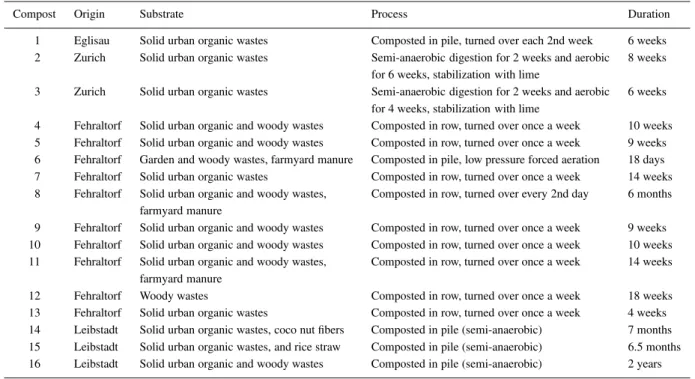
Sixteen composts were collected. The origin of each compost, the composted materials, and the compost-ing processes are summarized in Table 1. Samples were taken from at least five points along each com-post row just after it was turned, and from at least five points at 50 cm depth in each pile. The samples were then homogenized, dried at 20◦C and sieved at 2 mm.
Analysis
Total nitrogen and carbon were analyzed with a Carlo Erba C/N analyzer. The total Ca, Mg, Fe and Al were extracted from ash with hot concentrated (11.3 M) HCl after sample ignition at 600◦C during 6 hours, and measured by Inductively Coupled Plasma-Atomic Emission Spectroscopy. The total P content of com-posts was measured after digestion in hot concentrated (11.6 M) HClO4. The organic P content was
determ-ined according to Saunders & Williams (1955) and the inorganic P was calculated as the difference between total P and organic P. These data and the pH of the composts are given in the Table 2.
The sequential Pi extraction of Traore et al. (1999) was carried out with composts 1, 2, 8 and 14 at a com-post/solution ratio of 1:200 (g:ml). Samples were first extracted with distilled water, followed by NaHCO3
(0.5 M at pH 8.5), by NaOH (0.1 M) and finally by HCl (1 M). Each extraction was carried out during 16 h. After each extraction the supernatant liquid was separated from the solid by centrifugation and filtra-tion through a 0.2 µm membrane and its inorganic P concentration determined using a colorimetric method (John, 1970). According to Frossard et al. (1996), water and NaHCO3 extractable Pi is rapidly plant
available, NaOH extractable Pi is bound to Fe or Al oxides or to organic substances and HCl extractable Pi is associated with calcium in the form of slightly soluble compounds such as apatites or octacalcium phosphate. The amount of residual Pi was calculated as the difference between total Pi and the amount of Pi extracted with water, NaHCO3, NaOH and HCl.
Isotopic exchange kinetics
The theory underlying the use of this method has been described before (Fardeau, 1996). When33PO43− is
added carrier-free to a compost-solution system at a steady-state the radioactivity in solution decreases with time t (in minutes) according to Equation (1) (Traore et al., 1999), r(t) R0 = [r1min] R0 × t −n, (1)
where R is the total introduced radioactivity (MBq); r1minand r(t) are the radioactivity (MBq) remaining in
the solution after 1 and t minutes, respectively; and n describes the rate of disappearance of the tracer from the solution after 1 min.
The quantity E(t) (g P kg−1 dry matter compost) of isotopically exchangeable phosphate at a time t can
Table 1. Origin, substrates, and composting processes used in the fabrication of the studied composts
Compost Origin Substrate Process Duration
1 Eglisau Solid urban organic wastes Composted in pile, turned over each 2nd week 6 weeks 2 Zurich Solid urban organic wastes Semi-anaerobic digestion for 2 weeks and aerobic 8 weeks
for 6 weeks, stabilization with lime
3 Zurich Solid urban organic wastes Semi-anaerobic digestion for 2 weeks and aerobic 6 weeks for 4 weeks, stabilization with lime
4 Fehraltorf Solid urban organic and woody wastes Composted in row, turned over once a week 10 weeks 5 Fehraltorf Solid urban organic and woody wastes Composted in row, turned over once a week 9 weeks 6 Fehraltorf Garden and woody wastes, farmyard manure Composted in pile, low pressure forced aeration 18 days 7 Fehraltorf Solid urban organic wastes Composted in row, turned over once a week 14 weeks 8 Fehraltorf Solid urban organic and woody wastes, Composted in row, turned over every 2nd day 6 months
farmyard manure
9 Fehraltorf Solid urban organic and woody wastes Composted in row, turned over once a week 9 weeks 10 Fehraltorf Solid urban organic and woody wastes Composted in row, turned over once a week 10 weeks 11 Fehraltorf Solid urban organic and woody wastes, Composted in row, turned over once a week 14 weeks
farmyard manure
12 Fehraltorf Woody wastes Composted in row, turned over once a week 18 weeks 13 Fehraltorf Solid urban organic wastes Composted in row, turned over once a week 4 weeks 14 Leibstadt Solid urban organic wastes, coco nut fibers Composted in pile (semi-anaerobic) 7 months 15 Leibstadt Solid urban organic wastes, and rice straw Composted in pile (semi-anaerobic) 6.5 months 16 Leibstadt Solid urban organic and woody wastes Composted in pile (semi-anaerobic) 2 years
Table 2. pH, total C, N, Ca, Fe, Al, Mg, P and total inorganic P concentrations (g kg−1DM) in the studied composts
Compost pH C N Ca Fe Al Mg Total P Inorganic P 1 8.8 232.4 16.6 42.9 10.7 11.6 6.3 3.24 2.75 2 8.6 189.6 13.1 183.9 4.1 3.9 6.4 3.40 2.99 3 8.0 265.0 13.8 107.0 6.5 5.9 8.2 3.44 2.70 4 8.4 173.7 12.3 38.1 12.7 11.9 8.5 2.96 1.91 5 7.7 185.9 9.7 44.7 15.5 13.7 8.7 3.43 1.97 6 8.2 305.6 14.7 34.6 8.9 8.9 5.5 3.94 2.15 7 8.2 216.2 13.1 42.6 12.0 11.8 9.4 2.25 2.14 8 8.8 162.3 13.8 44.5 14.8 13.8 10.3 3.75 2.52 9 7.7 214.1 11.0 39.3 13.6 11.7 8.7 2.53 1.53 10 8.4 175.9 12.2 38.9 11.5 12.0 7.7 3.08 2.05 11 8.4 172.5 13.0 44.0 15.3 12.8 10.0 3.44 2.26 12 7.6 157.1 8.2 42.5 16.4 13.8 12.3 2.61 1.53 13 6.3 301.6 26.4 44.2 6.3 5.9 7.2 7.19 5.08 14 8.0 169.3 8.3 115.0 15.1 8.5 6.8 4.78 3.71 15 8.2 188.8 11.6 70.2 11.2 9.9 5.0 3.04 2.06 16 7.4 87.8 6.6 19.5 9.8 8.9 3.3 2.09 1.59
be calculated by Equation (2), assuming that31PO43−
and33PO43− ions have the same fate in the studied
system.
E(t)= 100 × Cp ×[R0] r(t) × t
n
(2) In (2) Cp is the concentration of water-soluble phosphate (g P l−1). The factor of 100 arises from the compost/solution ratio of 1 g dry matter of compost in 100 ml of water so that 100 × Cp is equivalent to the water-soluble phosphate content of the com-post expressed in g P kg−1. Isotopically exchangeable phosphate was divided into three pools as described by Traore et al. (1999): the pool of free phosphate that was approximated by the quantity E1minof phosphate
isotopically exchangeable within 1 min, the pool of phosphate exchangeable between 1 min and 3 months E1min−3mo and the pool of phosphate that is not
iso-topically exchangeable within 3 months E>3mo. The
amount of P present in the pool E1min−3mo was
cal-culated as the difference between E3mo and E1min,
which themselves were calculated with Equation (2). The amount of phosphate that can not be isotopically exchanged within 3 months E>3mo was calculated as
the difference between the total inorganic P and the amount of P exchangeable within 3 months.
Compost/water suspensions with a compost/solution ratio of 1:99 (g:ml) were first shaken during 17 h. At t = 0 minute, 1 ml of solution containing 0.1 MBq carrier free33PO
43−diluted in water was introduced
into the suspension, which was then stirred. Samples were taken from the suspension after 1, 10, 40 and 100 min, filtered through a 0.2 µm membrane and the radioactivity r(t) remaining in the solution was ana-lyzed by scintillation counting. The parameter n was deduced from linear regression analysis of log(r(t)/R0)
as a function of log(t). At the end of the experiment, the suspension was filtered through a 0.025 µm mem-brane and the Pi concentration in the solution (Cp) was measured by a colorimetric method (John, 1970).
Solid-state MAS31P NMR spectroscopy
All spectra were obtained on a Bruker AMX 400 WB spectrometer (9.395 T, 161.98 MHz for31P). Samples
were spun in zirconium rotors (7 Mm OD) at the Ma-gic Angle (54.74◦) with 6 , 7 or 8 kHz, respectively. Unless stated otherwise, compost samples were sub-mitted to two types of pulse sequences: a single pulse sequence (SP, 3.5 µs pulse length, i.e. ca. 60◦pulse angle) and a relaxation delay of 20 s for 31P nuclei,
and a cross-polarization sequence (CP, contact time of 2 ms) with a relaxation delay of 3 s for1H nuc-lei. In both cases high-power proton decoupling was applied during the acquisition time. The single pulse sequence enabled to observe all types of 31P nuclei present in the samples, while the CP sequence was used to selectively observe the31P nuclei located in close vicinity (within a few angstroms) of1H nuclei. Chemical shifts (δ in ppm) were measured relative to external NH4H2PO4which itself is observed 0.72 ppm
downfield from external 85% aqueous H3PO4. The
given chemical shifts refer to H3PO4at 0 ppm. Peaks
were further characterized by their width at half-height ( ν1/2 in Hz) and, for obtaining a very
approxim-ate measure of the P content (neglecting the various, possibly different relaxation times and/or the cross-polarization rates), by the signal/noise ratio (S/N) which was calculated from the usual equation (3). S/N= 2.5 × peak height / maximum noise width
(3) Finely ground, air-dried samples of the composts 1, 2, 8 and 14 were analyzed in addition to the solid residues obtained after the first 3 steps (H2O,
NaHCO3 and NaOH) of the sequential extraction of
composts 1 and 2. For chemical shift comparisons also the solid-state31PNMR spectra of eight reference substances were measured: Ca(H2PO4)2.H2O (Fluka
AG, 92% purity), CaHPO4.2H2O (Merck AG,
qual-ity extrapure), deoxyribonucleic acid from herring sperm (DNA, Sigma), myo-inositol hexaphosphate (I6P, Sigma, 90% purity), an hydroxyapatite from the Swiss canton of Uri (OHA), two fluoroapatites (FA1 and FA2) from the Swiss canton of Tessin, and a fluoroapatite (FA3) from a Florida phosphate rock (US National Institute of Standards and Technology). Statistical analysis
Correlation analysis between chemical characteristics of the composts (Table 2) and the parameters ob-tained from the isotopic exchange experiments was done in the general linear regression model (SYSTAT 6.0, 1996). Average coefficients of variation (CV) of 5, 14, and 18% were obtained for r1min/R0, Cp and n,
re-spectively. Average CV of 9, 13, 15, 6, and 22% were obtained for total P, inorganic P, E1min, E1min−3mo
and E>3mo, respectively. The statistical significance
Results and discussion
Total P and Inorganic P
Total P varied between 2.09 and 7.19 g kg−1 dry matter (DM) with a mean value of 3.45 (Table 2). In-organic P ranged between 54.6 and 95.1% of the total P with a mean value of 70.6%. These results are in agreement with those reported in literature for fresh and air-dried composts (Preston et al., 1986; Kuhn et al., 1996; Kuo et al., 1999; Traore et al., 1999) and confirm that the larger part of the P content in composts is present in inorganic forms. However as air-drying of plant litter or organic matter-rich soils in-duces the release of orthophosphate to the solution due to organic and microbial P mineralisation (Grierson et al., 1998), air-drying might have resulted in a slight overestimation of mineral P forms in composts. Pi exchangeability
The proportion of radioactivity remaining in solution after 1 min of isotopic exchange (r1min /R0) ranged
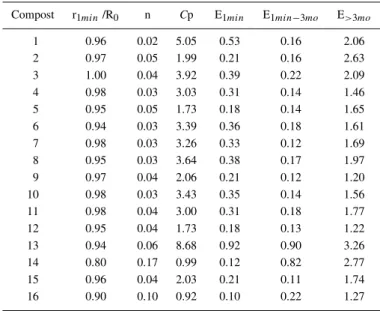
between 0.8 and 1.0. The rate of radioactivity decrease from the solution after the 1st minute of exchange (n) was between 0.02 and 0.06, except 0.10 and 0.17 for composts 16 and 14, respectively (Table 3). The mean concentration of Pi in solution (Cp) reached 3.05 mg P l−1 representing in average 8.8% of the total P. The proportion of Pi isotopically exchangeable within 1 min, E1min, varied between 2.5 and 16.4%
of total P. The proportion of Pi isotopically exchange-able between 1 min and 3 months, E1min−3mo, varied
between 3.1 and 17.1% of total P. Finally the propor-tion of Pi which could not be isotopically exchanged within 3 months, E>3mo, varied between 40.9 and
77.3% of compost total P.
These results show that in comparison to soils, composts contain a relatively large fraction of Pi ions that are instantaneously available to plants. However, the largest fraction of Pi species is trapped in physico-chemical environments which strongly hinder their exchangeability with solution-Pi.
Relation between Pi exchangeability and some chemical properties of composts
The parameters r1min /R0 and n showed too little
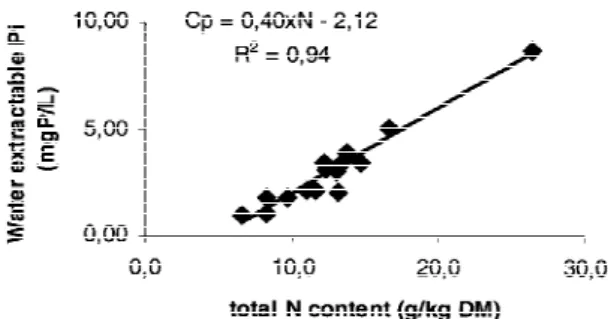
variation in this group of composts to be studied by correlation analysis. There is a positive correlation between the concentration of Pi in the solution (Cp) and the total N content (Figure 1). Linear correlations,
Figure 1. Relation between the concentration of water-extractable inorganic P (Cp) in composts and their total N content.
Figure 2. Relation between the total P content (total P) and the calculated amount of Pi which can not be isotopically exchanged within 3 months (E>3mo) in the studied composts.
although with much lower coefficients, were also ob-served between Cp and total C (r2=0.48) and between
Cp and total P (r2=0.47). Similar correlations were
obtained between the total contents of C, N and P and E1minsince the ratio r1min/R0varied between 0.8 and
1.0. These results suggest that the amount of organic matter in the composts controls the concentration of Pi in the solution. This could be due to (i) the com-position of the organic wastes themselves since these are the original sources of N and P of the composts (while some of the C was added in composts 2 and 3 as lime during composting), (ii) to the inhibitory effect of organic substances on the precipitation of Pi in insol-uble forms such as apatite or octacalcium P (Inskeep and Silvertooth, 1988), and/or (iii) to mineralisation of organic and microbial P caused by air-drying the composts before analysis (Grierson et al., 1998). The observed correlation between total N and Cp is strong enough to use the total N for this type of composts as a predictor for the amount of rapidly plant-available Pi.
The quantity of P, which could not be exchanged within 3 months E>3mo, is positively correlated to total
P (Figure 2) and total Ca (Figure 3). The outlier which is encircled in Figure 3, is the only compost exhibiting a pH lower than 7. A weak positive correlation was also observed between E>3mo and total N (r2=0.40),
Table 3. Fraction of radioactive P remaining in the solution after 1 min of iso-topic exchange (r1min/R0), factor describing the disappearance of radioactive
P from the solution after 1 min of isotopic exchange (n), concentration of Pi in the solution (Cp, mg l−1), quantity of P (g kg−1DM) isotopically exchangeable within 1 min (E1min), exchangeable between 1 min and 3 months (E1min−3mo), not exchanged within 3 months (E>3mo) in the studied composts
Compost r1min/R0 n Cp E1min E1min−3mo E>3mo
1 0.96 0.02 5.05 0.53 0.16 2.06 2 0.97 0.05 1.99 0.21 0.16 2.63 3 1.00 0.04 3.92 0.39 0.22 2.09 4 0.98 0.03 3.03 0.31 0.14 1.46 5 0.95 0.05 1.73 0.18 0.14 1.65 6 0.94 0.03 3.39 0.36 0.18 1.61 7 0.98 0.03 3.26 0.33 0.12 1.69 8 0.95 0.03 3.64 0.38 0.17 1.97 9 0.97 0.04 2.06 0.21 0.12 1.20 10 0.98 0.03 3.43 0.35 0.14 1.56 11 0.98 0.04 3.00 0.31 0.18 1.77 12 0.95 0.04 1.73 0.18 0.13 1.22 13 0.94 0.06 8.68 0.92 0.90 3.26 14 0.80 0.17 0.99 0.12 0.82 2.77 15 0.96 0.04 2.03 0.21 0.11 1.74 16 0.90 0.10 0.92 0.10 0.22 1.27
Figure 3. Relation between the total Ca content (total Ca) and the calculated amount of Pi which can not be isotopically exchanged within 3 months (E>3mo) in the studied composts. The correlation
equation was calculated without the encircled point of compost 13, which was the only compost with a pH lower than 7.
E>3mo and total Al (r2=0.42). These results suggest
that in the alkaline composts studied in this work the amount of slowly exchangeable Pi was controlled by the total amount of P and Ca present. Finally, no re-lationship could be observed between E1min−3moand
any of the compost properties shown in Table 2. Sequential extraction of inorganic P in 4 composts Almost all the inorganic P was sequentially extracted from the 4 compost samples 1, 2, 8 and 14 (Table 4).
The amount of water-extractable Pi ranged between 3.2 and 19.6% of the total Pi content. The amount of bicarbonate-extractable Pi varied between 26.1 and 34.5%, NaOH-extractable Pi varied between 7.9 and 24.8% and HCl-extractable Pi varied between 31.3 and 50.5% of the total Pi. The proportion of Pi which could not be extracted by this sequential procedure did not exceed 10%.
These results suggest that about 30 to 50% of the total Pi in these composts is rapidly plant-available (Pi extracted by water and bicarbonate), which confirms the high solubility of compost-Pi in water or saline solutions already observed for different compost types by Inbar et al. (1993), Kuo et al. (1999) and Traore et al. (1999). However, air-drying the compost samples prior to the sequential extraction might have resul-ted in an overestimation of the proportion of rapidly plant available Pi (Grierson et al., 1998). Furthermore, between 30 and 50% of the total Pi was found in the form of precipitated P-Ca compounds, which paral-lels the results for alkaline composts of different types obtained by Preston et al. (1986), Alt et al. (1994), and Traore et al. (1999). The highest concentration of HCl-extractable Pi was observed for compost 2,
sta-Table 4. Sequential extraction of inorganic P (g kg−1DM) in 4 composts Compost 1 2 8 14 Extractant H2O 0.54 (0.02)∗ 0.31 (0.03) 0.41 (0.01) 0.12 (0.01) NaHCO3 0.74 (0.02) 0.78 (0.01) 0.87 (0.03) 0.99 (0.01) NaOH 0.40 (0.01) 0.27 (0.03) 0.20 (0.01) 0.92 (0.06) HCl 0.86 (0.06) 1.51 (0.14) 0.91 (0.15) 1.32 (0.15) Residual Pi 0.21 0.12 0.13 0.36
∗Each value is the mean of four replicates, standard deviation in brackets.
Figure 4. MAS31P NMR spectra of four composts (isotropic chem-ical shift δiso; spinning side bands SSB) obtained with the single pulse (SP) sequence. Chemical shifts are relative to external 85% aqueous H3PO4at 0 ppm.
bilized with lime, which probably led to an increased precipitation of P-Ca compounds.
Solid-State MAS31P NMR spectroscopy
The MAS 31P NMR spectra of the four unextracted compost samples 1, 2, 8 and 14 obtained with the single pulse sequence (SP) are very similar (Figure 4). Considering that S/N increases with the square root of the number of scans (NS), the much higher num-ber of scans needed to obtain a spectrum for compost 1 with a signal to noise ratio similar to the S/N ra-tio obtained with the 3 other composts (Tables 5 a & b) confirm qualitatively the lower total P content of compost 1 measured in wet chemistry (Table 2). All spectra exhibit a broad signal with isotropic chemical shifts δisobetween 2.7 and 3.4 ppm. In case of the
composts 2, 8 and 14, shoulders located upfield of the main signal are observed between 0 and−5 ppm. The spinning side bands (SSB) indicate that the MAS
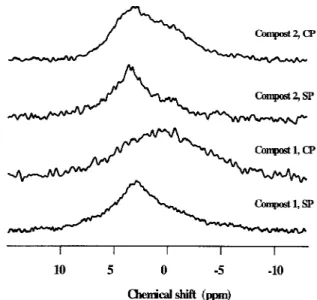
fre-Figure 5. Comparison of the MAS31P NMR spectra of unextrac-ted composts 1 and 2 obtained with the single pulse (SP) and cross polarization (CP) sequences. Chemical shifts are relative to external 85% aqueous H3PO4at 0 ppm.
quency of 8 kHz is small compared to the31P chemical shift anisotropy of the samples (Figure 4). The half-width ν1/2of the peaks varies for the four composts
between 469 and 849 Hz. In the cross polarization (CP) sequence a symmetric broad resonance ( ν1/2
of 1507 Hz) is observed for compost 1 at δisoof 0.4
ppm (Figure 5). For compost 2 an asymmetric peak is observed with ν1/2of 1128 Hz and δisoof 2.9 ppm
with a shoulder at 0 ppm. Obviously for both samples, the group of P sites at higher field is faster polarized, assuming that the contact time of 2 ms is short with respect to the proton-phosphorus distance of two and more bonds.
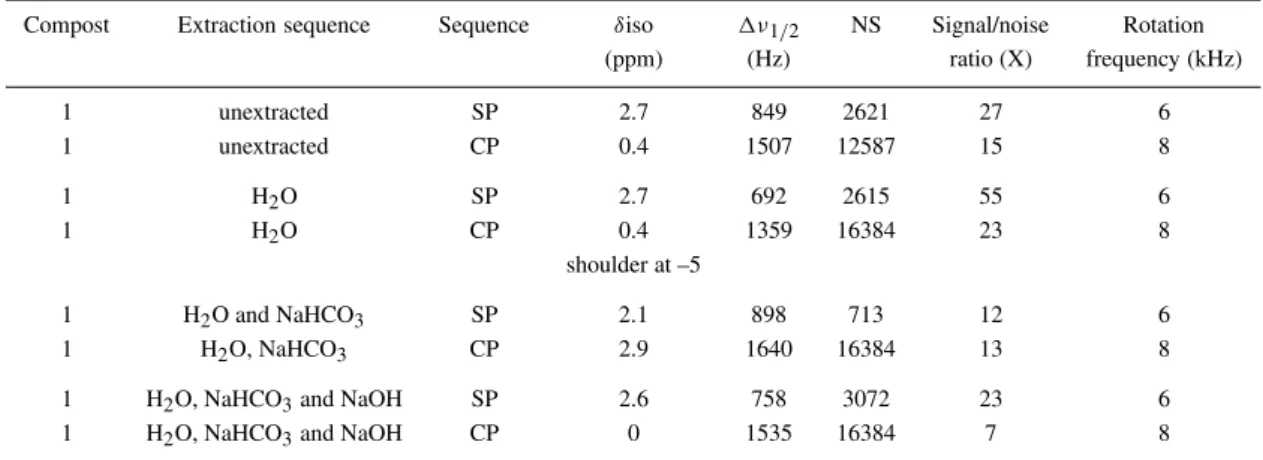
The different extractants used in the sequential extraction had little effect on the SP and CP spectra ob-tained for compost 1 (Table 5a). The only clear trend
Table 5a. MAS31P NMR results (chemical shift δiso; peak width at half height ν1/2; number of scans NS; signal/noise ratio X: 1)
obtained with single pulse (SP) and cross polarization (CP) sequences for compost 1 after various steps of the sequential extraction. Chemical shifts are referenced to aqueous 85% H3PO4at 0 ppm. For noise reduction without window function the first 256 time
domain data points (TDused) of the free induction decay (2 k) were Fourier transformed into 16 k data points (8 k real part) Compost Extraction sequence Sequence δiso ν1/2 NS Signal/noise Rotation
(ppm) (Hz) ratio (X) frequency (kHz) 1 unextracted SP 2.7 849 2621 27 6 1 unextracted CP 0.4 1507 12587 15 8 1 H2O SP 2.7 692 2615 55 6 1 H2O CP 0.4 1359 16384 23 8 shoulder at –5 1 H2O and NaHCO3 SP 2.1 898 713 12 6 1 H2O, NaHCO3 CP 2.9 1640 16384 13 8
1 H2O, NaHCO3and NaOH SP 2.6 758 3072 23 6
1 H2O, NaHCO3and NaOH CP 0 1535 16384 7 8
Table 5b. MAS31P NMR results (chemical shift δiso; peak width at half height ν1/2; number of scans NS; signal/noise ratio X: 1)
obtained with single pulse (SP) and cross polarization (CP) sequences for compost 2 after various steps of the sequential extraction and for composts 8 and 14. Chemical shifts are referenced to aqueous 85% H3PO4at 0 ppm. For noise reduction without window function
the first 256 time domain data points (TDused) of the free induction decay (2 k) were Fourier transformed into 16 k data points (8 k real part)
Compost Extraction sequence Sequence δiso ν1/2 NS Signal/noise Rotation
(ppm) (Hz) ratio (X) frequency (kHz) 2 unextracted SP 3.4 594 368 18 6 shoulder between 0 and−4 2 unextracted CP 2.9 1128 16384 33 8 shoulder at−0.2 2 H2O SP 3.0 441 2048 85 7 shoulder between −1 and −7 2 H2O CP 3.5 929 2048 16 7 shoulder at 0.2 2 H2O and NaHCO3 SP 2.7 677 618 32 6 shoulder at−1.3 2 H2O and NaHCO3 CP 1.2 1229 16348 23 8 shoulder at−2.8
2 H2O, NaHCO3and NaOH SP 2.7 716 2836 33 6
2 H2O, NaHCO3and NaOH CP 0 1494 16384 9 8
8 unextracted SP 2.9 714 368 18 6 shoulder between 0 and−5 14 unextracted SP 3.2 469 368 23 6 shoulder between 1 and−5
Figure 6. Comparison of the MAS31P NMR spectra of composts 1 and 2 extracted successively with H2O, NaHCO3 and NaOH
obtained with the single pulse (SP) and cross polarization (CP) sequences. Chemical shifts are relative to external 85% aqueous H3PO4at 0 ppm.
is a decrease of the S/N ratio for the same number of scans in the CP sequence between the sample ex-tracted with H2O and the sample extracted with H2O,
NaHCO3and NaOH whereas in the SP sequence the
S/N ratio of the unextracted sample was not different from that of the sample extracted with H2O, NaHCO3
and NaOH. This result suggests that the sequential extraction caused a larger extraction of rapidly po-larizable 31P nuclei from the solid than of slowly polarizable P.
For the extracted samples of compost 2 the δisovalue has a trend to higher field, indicating
that a low field component of P has been extracted (Table 5b). Finally, both the SP and CP sequences show that the shoulder located in the unextracted sample of compost 2 upfield of the main signal between 0 and −4 ppm disappears after the NaOH extraction (Figures 5 and 6).
According to the higher S/N observed for compost 2 with comparable scan numbers the amount of un-extracted P remains higher in this compost after each step of the extraction than in compost 1. Obviously compost 1 contains more P which is extractable with H2O, NaHCO3 as well as with NaOH than compost
2 confirming the results obtained with wet chemistry (Table 4).
The natural hydroxyapatite and the fluoroapat-ites studied as reference compounds have δiso values
Table 6. MAS31P NMR results (chemical shift δiso; peak width at half height ν1/2) obtained for the reference
compounds (CP sequence: contact time 1 ms, relaxation delay 5 s; rotation frequency 8 kHz, except for DNA (7 kHz)) Chemical shifts are referenced to aqueous 85% H3PO4 at 0 ppm. The free induction decays (4 k time
domain data points, TD) were Fourier transformed into 16 k data points (8 k real part)
Compound δiso ν1/2 (ppm) (Hz) CaHPO4.2 H2O (DCDP) 1.1 93 −1.8 a) −7.7 77 Ca(H2PO4)2.H2O (MCP) −0.3 185 −4.7 170 Hydroxyapatite (OHA) 2.2 249 Fluoroapatite 1 (FA1) 2.7 316 Fluoroapatite 2 (FA2) 2.5 125 Fluoroapatite 3 (FA3) 2.0 342 −10.9 286 Myoinositol Hexaphosphate (I6P) −2.1 1130
Deoxyribonucleic acid (DNA) −1.0 566 a) Partly resolved.
between 2.0 and 2.7 ppm (Table 6) which are in the range of the δiso values observed for natural and
syn-thetic condensed calcium phosphates such as octacal-ciumphosphate, hydroxy-, fluoro- and carbonatoapat-ites (Rothwell et al., 1980; Aue et al., 1984; Belton et al., 1988; Wu et al., 1994; Vogel et al., 1996). These results suggest that a large fraction of compost-Pi is present in the form of condensed calcium phosphates such as apatites or octacalcium phosphates. The se-quential extraction gives results consistent with this assignment since δisoof the solid residues with the SP
sequence remains between 2.1 and 3.0 after NaOH-extraction (Tables 5a & b; Figure 6). These condensed calcium phosphates are neither soluble in water nor in bicarbonate and NaOH. The extraction of31P nuc-lei with δiso ranging from 2.7 and 3.4 ppm from
compost 2 during the sequential extraction (Table 5b) suggests that P-Ca rich colloidal materials were also removed during the extraction. The reference com-pounds for organic P species (DNA and I6P) studied exhibit chemical shifts δiso of −1.0 and −2.1 ppm
(Table 6). These are in the range of chemical shifts of various organic P compounds measured in the li-quid state (Pant et al., 1999). Therefore, the shoulder located upfield from the main peak of the composts could be assigned to the presence of organic P species.
This assignment is consistent with the disappearance of this shoulder after the NaOH extraction since or-ganic P compounds are soluble in NaOH. Finally, the presence of soluble orthophosphates such as monocal-cium phosphate is also probable since its δisois around
0 ppm (Table 6). The broad signals observed with the CP sequence show that a large proportion of the 31P nuclei is located in the close vicinity of1H nuclei, in agreement with the presence of protons in all of the P species assigned above.
The half-width ν1/2of the peaks gives also
relev-ant information. The ν1/2observed for the compost
samples before and after extraction is much larger than that of natural apatites (Table 6), which itself is much larger than ν1/2 reported for synthetic crystallized
calcium phosphates (Belton et al., 1988). This could be related (i) to the structural inhomogeneity of the
31P nuclei present in the compost samples (i.e. to the
presence of a mixture of P species each with a large number of different magnetic sites), (ii) to the presence of poorly ordered minerals and (iii) to the presence of paramagnetic impurities (e.g. Fe, Table 2) or most probably to a combination of these three origins. This reasoning suggests then that the P-Ca species present in composts are not well crystallized as observed by Frossard et al. (1994) on sludge-P, and is coherent with the known ability of organic substances to inhibit the crystallization of apatites or octacalcium phosphates (Inskeep and Silvertooth, 1988).
Conclusions
The different approaches used in this investigation (isotopic exchange, sequential extraction and solid-state 31P NMR) demonstrate the presence of a com-plex mixture of inorganic P species Pi in the studied composts.
Solid-state MAS 31P NMR results strongly sug-gest in alkaline composts the presence of a range of scarcely soluble and ill-crystallized Ca-P compounds such as apatites or octacalcium phosphates. This evid-ence, together with the correlation observed between total Ca in the 15 alkaline composts (all except com-post 13) and the amount of Pi which can not be isotopically exchanged within 3 months, suggests that the slowly or non-exchangeable Pi in these composts is bound to Ca in the form of apatites or octacalcium phosphates. From an agronomic point of view this fraction of compost-P will probably have a low avail-ability to plants in neutral and alkaline soils (Fardeau
et al., 1988). Isotopic exchange experiments and se-quential extraction show that the composts contain relatively large concentrations of rapidly available Pi confirming results obtained in previous studies (In-bar et al.,1993; Kuo et al.,1999; Traore et al., 1999). The amount of water-soluble Pi, and the amount of P isotopically exchangeable in 1 min are correlated with the total N, C and P content. These relations could be due to: (i) the composition of the organic wastes themselves since these are the original sources of N and P of the composts, (ii) the presence of or-ganic substances which can inhibit the precipitation of Pi in insoluble forms such as apatite or octacal-cium P (Inskeep and Silvertooth, 1988), and/or (iii) to mineralisation of organic and microbial P caused by air-drying the composts before analysis (Grierson et al., 1998). The strong correlation between total N and Cp allows the use of total N to predict for this type of compost the amount of rapidly plant-available Pi. However, since during their preparation composts can be subjected to drying and rewetting cycles, their effect on organic and microbial P mineralisation, and more generally on orthophosphate release should be further studied.
Acknowledgements
The authors thank J. Fuchs (Frick, Switzerland) and K. Schleiss (Baar, Switzerland) for their help in select-ing the compost samples, C. Faisse (ENSAIA, Nancy, France) for assistance, Dr. P. Brack (Department of Earth Sciences, ETH Zurich, Switzerland) for lend-ing the apatites used as references, and the Research Commission of the ETH Zurich for financial support.
References
Alt D, Peters I & Fokken H (1994) Estimation of phosphorus avail-ability from composts and compost/peat mixtures by different extraction methods. Comm Soil Sci Plant Anal 25: 2063–2080 Aue WP, Roufosse AH, Glimcher MJ & Griffin RG (1984) Solid
state phosphorus 31 nuclear magnetic resonance studies of syn-thetic solid phases of calcium phosphate: Potential models of bone minerals. Biochem J 23: 6110–6114
Belton PS, Harris RK & Wilkes PJ (1988) Solid state phosphorus 31 NMR studies of synthetic inorganic calcium phosphates. J Chem Solids 49: 21–27
Bezzola LC, Lopez SC & Barbaro NO (1994) Effectiveness of different phosphatic fertilizers measured using labelled super-phosphate and phosphorus taken up by plants. Fert Res 39: 31–37
Candinas T, Golder E, Kupper T & Besson JM (1999) Nähr- und Schadstoffe im Kompost. Agrarforschung 6: 421–424
Fardeau JC (1996) Dynamics of phosphate in soils. An isotopic outlook. Fert Res 45: 91–100
Fardeau JC, Morel C & Jahiel M (1988) Does long contact with the soil improve the efficiency of rock phosphate? Results of isotopic studies. Fert Res 17: 3–19
Frossard E, Tekely P & Grimal JY (1994) Characterization of phos-phate species in urban sewage sludges by high resolution solid state 31P NMR. Eur J Soil Sci 45: 403–408
Frossard E, Sinaj S & Dufour P (1996) Phosphorus in sewage sludges as assessed by isotopic exchange. Soil Sci Soc Am J 60: 179–182
Gigliotti G, Businelli D & Giusquiani PL (1999) Composition changes of soil humus after massive application of urban waste compost: a comparison between FT-IR spectroscopy and humi-fication parameters Nutr Cycl Agroecosyst 55: 23–28
Grierson PF, Comerford NB & Jokela EJ (1998) Phosphorus miner-alization kinetics and response of microbial phosphorus to drying and rewetting in a Florida Spodosol. Soil Biol Biochem 30: 1323–1331
Hadas A, Krautsky L & Portnoy R (1996) Mineralization of com-posted manure and microbial dynamics in soil as affected by long-term nitrogen management. Soil Biol Biochem 28: 733–738 Inbar Y, Hadar Y & Chen Y (1993) Recycling of cattle manure: the composting process and characterization of maturity. J Environ Qual 22: 857–863
Inskeep WP & Silvertooth JC (1988) Inhibition of hydoxyapatite precipitation in the presence of fulvic, humic and tannic acids. Soil Sci Soc Am J 52: 941–946
John MK (1970) Colorimetric determination of phosphorus in soil and plant materials with ascorbic acid. Soil Sci 109: 214–220 Kuhn E, Eugster A & Arnet R (1996) Nährstoffeghalte von
Kom-posten aus aargauischen Anlagen. Agrarforschung 2: 81–84 Kuo S, Hummel RL, Jellum EJ & Winters D (1999) Solubility and
leachibility of fishwaste compost phosphorus in soilless growing media. J Environ Qual 28: 164–169
Pant HK, PR Warman &Nowak J (1999) Identification of soil organic phosphorus by 31P nuclear magnetic resonance spectro-scopy. Commun Soil Sci Plant Anal 30: 757–772
Pommel B (1982) Aptitude de plusieurs déchets urbains à fournir du phosphore aux cultures. Agronomie 2: 851–857
Preston CM, Ripmeester JA, Mathur SP & Levesque M (1986) Ap-plication of solution and solid state multinuclear NMR to a peat
based composting system for fish and crab scrap. Can J Spectrosc 31: 63–69
Rothwell WP, Waugh JS & Yesinowski JP (1980) High resolution variable temperature 31P NMR of solid calcium phosphates. J Am Chem Soc 102: 2637–2643
Saunders WMH & Williams EG (1955) Observations on the de-termination of total organic phosphorus in soils. J Soil Sci 6: 254–267
Sikora LJ & Yakovchenko V (1996) Soil organic matter miner-alization after compost amendment. Soil Sci Soc Am J 60: 1401–1404
Sikora LJ, Tester CF, Taylor JM & Parr JF (1982) Phosphorus up-take by fescue from soils amended with sewage sludge compost. Agron J 74: 27–32
Sinaj S, Traore O & Frossard E (2001) Effect of compost and soil properties on the availability of compost phosphate for white clover (Trifolium repens L.) Nut. Cycl. Agroecosyst. 62: 89–102 SYSTAT for windows (1996) Statistics version 6.0. SPSS Inc, USA Traore O, Sinaj S, Frossard E & Van de Kerkhove JM (1999) Ef-fect of composting time on phosphate availability. Nutr Cycl Agroecosyst 55: 123–131
Vogel J, Rüssel C, Günther G, Hartmann P, Vizethum F & Bergner N (1996) Characterization of plasma-sprayed hydroxyapatite by 31P-MAS-NMR and the effect of subsequent annealing. J Mater Sci Mater Med 7: 495–499
Warman PR, Muizelaar T& Termeer WC (1995) Bioavailability of As, Cd, Co, Cr, Cu, Hg, Mo, Ni, Pb, Se, and Zn, from biosolids amended compost. Compost Sci Util 3: 40–50
Wen G, Bates TE, Voroney RP, Winter JP & Schellenbert MP (1997) Comparison of phosphorus availability with application of sewage sludge, sludge compost and manure compost. Comm Soil Sci Plant Anal 28: 1481–1497
Wen G, Bates TE, Voroney RP, Winter JP & Schellenberg MP (1999) Influence of application of sewage sludges, and sludge and manure composts on plant Ca and Mg concentration and soil extractability in field experiments. Nutr Cycl Agroecosyst 55: 51–61
Wu Y, Glimcher MJ, Rey C & Ackerman JL (1994) A unique pro-tonated phosphate group in bone mineral not present in synthetic calcium phosphates. Identification by phosphorus-31 solid state NMR spectroscopy. J Mol Biol 244: 423–435