People’s Democratic Republic of Algeria
Ministry of Higher Education and Scientific Research Mostéfa Benboulaïd Batna 2 University
Faculty of Letters and Foreign Languages Department of English
BA, MA
Thesis Submitted in Partial Fulfillment of the Requirements for the Degree of LMD Doctorate in Applied Linguistics
Submitted by: Supervised by:
Djelloul NEDJAI Prof. Amor GHOUAR
Board of Examiners
Chairman Pr. Hachemi ABOUBOU MostéfaBenboulaïd Batna 2 University Supervisor Pr. Amor GHOUAR MostéfaBenboulaïd Batna 2 University Examiner Pr. Amel BAHLOUL MostéfaBenboulaïd Batna 2 University Examiner Pr. Abdelhak NEMOUCHI Larbi Ben M’Hidi O.E.B University Examiner Dr. Ahmed Chaouki HOADJLI Mohamed Khider Biskra University
The Use of Critical Discourse Analysis to Inquire into Cross-Cultural Perceptions and Attitudes of LMD Students of English as a Foreign Language at Batna 2
University, Algeria.
i DEDICACY
ii
ACKNOWLEDGEMENTS
This humble work is a unique opportunity to pay tribute to:
My supervisor Prof. Amor Ghouar for his invaluable guidance and support,
My father, Prof. Med-Salah NEDJAI whom I admire silently,
My mother for her permanent care and understanding, and my family,
Dr. Radia GUERZA who refined my perception of academic work, and
iii
TABLE OF CONTENTS
Page
DEDICACY ... i
ACKNOWLEDGEMENTS ... ii
TABLE OF CONTENTS ... iii
LISTE OF TABLES ... x
LISTE OF FIGURES ... xiii
ABSTRACT... xvi
CHAPTER 1 ... 1
Introduction ... 1
1.1. Introduction: Background, Purpose and Main Issues ... 1
1.2. Statement of the Problem ... 7
1.3. Research Question ... 8
1.4. Significance of the Study ... 11
1.5. Definition of Terms ... 12
1.5.1. Attitudes ... 13
1.5.2. Critical Discourse Analysis (CDA) ... 13
1.5.3. Cross-cultural Attitudes ... 13 1.5.4. Cross-cultural ... 14 1.5.5. Cross-cultural Perceptions... 14 1.5.6. Cross-cultural Studies ... 14 1.5.7. Culture ... 15 1.5.8. Intercultural ... 15 1.5.9. Perceptions ... 15
iv
1.6. Acronyms ... 15
1.7. Limitations of the Study ... 16
1.8. Delimitations of the Study ... 18
1.9. Assumptions ... 20
1.10. Conclusion: Organization of the Study ... 20
CHAPTER 2 ... 22
Review of Related Literature ... 22
Introduction ... 22
2.1. Critical Discourse Analysis (CDA) ... 23
2.1.1. Defining Critical Discourse Analysis ... 23
2.1.2. A Brief History of CDA ... 27
2.1.3. Evolution and Development of CDA ... 29
2.1.4. Critical Linguistics (CL) ... 33
2.1.5. Halliday’s Theory of Systemic Functional Linguistics (SFL) ... 35
2.1.6. Models of CDA ... 37
2.1.6.1. Fairclough’s model... 37
2.1.6.2. The socio-cognitive model ... 42
2.1.6.3. Wodak’s model of discourse sociolinguistics... 45
2.1.7. Aspects of CDA ... 47
2.1.7.1. Language as discourse ... 47
2.1.7.2. Macro vs. micro in CDA. ... 49
2.1.7.3. Text analysis and discourse interpretation. ... 50
v
2.1.8.1. Discourse analysis approaches... 52
2.1.8.2. Conversation analysis approaches. ... 52
2.1.8.3. Interaction analysis approaches. ... 53
2.2. Cross-cultural Studies ... 54
2.2.1. Defining Cross-cultural Studies... 54
2.2.2. Cross-cultural Research ... 56
2.2.3. Cross-cultural Teaching and Learning ... 59
2.3. Perceptions and Attitudes ... 62
2.3.1. Defining Perceptions ... 63
2.3.1.1. The stages of the perception process. ... 63
2.3.1.1.1. Selection (stimulation). ... 63
2.3.1.1.2. Organisation. ... 65
2.3.1.1.3. Interpretation. ... 65
2.3.1.2. Attribution theory. ... 65
2.3.1.3. Language, culture, and perception. ... 66
2.3.1.4. Effect of culture on the perception process. ... 67
2.3.2. Defining Attitudes... 69
2.3.2.1. Formation and construction of attitudes. ... 70
2.3.2.2. Changing attitudes. ... 70
2.3.2.3. Attitudes, language, and cultural learning. ... 71
2.4. Language and Culture ... 72
vi
2.4.1.1. Language as code. ... 73
2.4.1.2. Language as social practice. ... 73
2.4.2. The Meaning of Culture ... 74
2.4.2.1. Culture as an individual construct. ... 74
2.4.2.2. Culture as a social contruct. ... 75
2.4.3. The Relationship of Language and Culture... 75
2.5. Foreign-Language Learning, an Intercultural Perspective ... 76
2.5.1. A Relational Approachto Language and Culture Learning ... 76
2.5.2. An Example to Consider ... 77
Conclusion ... 79
Chapter Three... 80
Methodological Procedures ... 80
Introduction ... 80
3.1. Population and Sampling ... 81
3.2. Instrumentation... 86
3.3. Fairclough’s CDA Framework ... 88
3.4. Data-Collection ... 95
3.5. Data Analysis ... 95
3.6. Conclusion and Summary ... 97
Chapter Four ... 99
Results and Discussion ... 99
Introduction ... 99
4.1. The Relationship between our Students’ Perceptions of, and Attitudes towards, the Culture of the English Language ... 99
vii
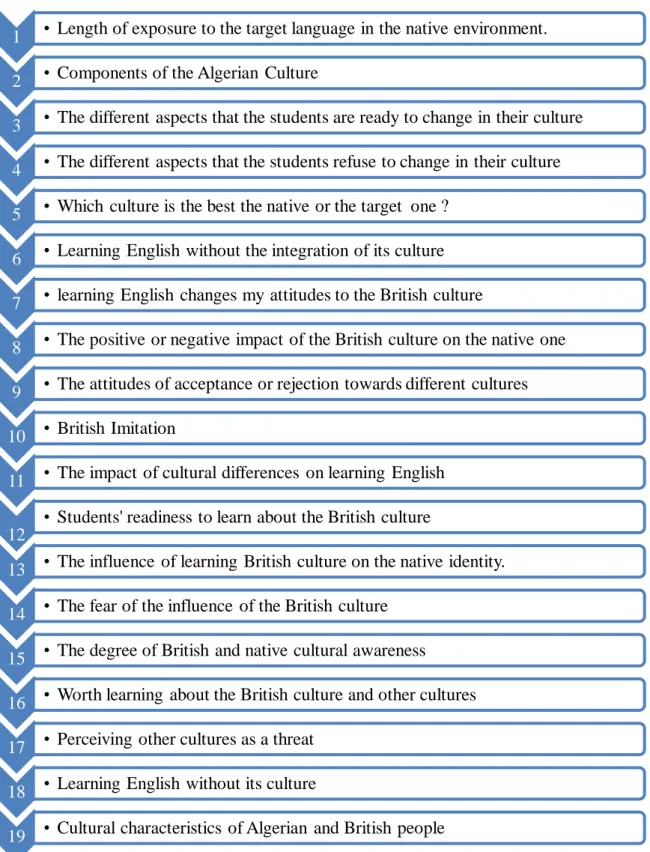
4.1.1. Length of Exposure to the Target Language in the NativeEnvironment ... 101
4.1.2. Components of the Algerian Culture ... 102
4.1.3. The Different Aspects that Students are ready to Change in their Culture ... 104
4.1.4. The Different Aspects that Students Refuse to Change in their Culture ... 106
4.1.5. Which Culture is the Best the Native or the Target one? ... 108
4.1.6. Learning English without the Integration of its Culture ... 110
4.1.7. Learning English Changes my Attitudes to the British Culture ... 111
4.1.8. The Positive or Negative Impact of the British Culture on the Native one .... 112
4.1. 9. The Attitudes of Acceptance or Rejection towards Different Cultures ... 114
4.1.10. British Imitation ... 117
4.1.11. The Impact of Cultural Differences on Learning English ... 118
4.1.12. Students' Readiness to Learn about the British Culture ... 119
4.1.13. The Influence of Learning British Culture on the Native Identity ... 120
4.1.14. The Fear of the Influence of the British Culture ... 121
4.1.15. The Degree of British and Native Cultural Awareness... 122
4.1.16. Worth Learning about the British Culture and other Cultures ... 124
4.1.17. Perceiving other Cultures as a Threat ... 126
4.1.18. Learning English without its Culture ... 127
4.1.19. Cultural Characteristics of Algerian and British People ... 128
4.1.19.1. Social gregariousness. ... 129
4.1.19.2. Geniality. ... 131
viii
4.1.19.4. Logical reasoning. ... 133
4.1.19.5. Assiduity. ... 135
4.1.19.6. Totalitarianism and integrity. ... 136
4.1.19.7. Doctrinal morality. ... 138
4.1.19.8. Rigor and systematicity. ... 139
4.1.19.9. Common sense. ... 141
4.1.19.10. Poignancy. ... 143
4.1.19.11. Cultural mannerliness and attributes. ... 144
4.2. Fairclough’s Model: An Analytical Framework to Account for Learners’ Cross-cultural Perceptions and Attitudes ... 146
4.2.1. Vocabulary ... 147
4.2.1.1. Word classification... 147
4.2.1.1.1. Learners’ predilections and dislikes towards the Algerian culture. .. 147
4.2.1.1.2. Learners’ preconceived knowledge of the British people and culture. ... 154
4.2.1.1.3. Learners’ perceptions towards the British people and culture. ... 164
4.2.1.1.4. Learners’ predilections and dislikes towards the British culture. ... 169
Features of Power and Ideology ... 173
4.2.1.2. Ideologically contested vocabulary. ... 174
4.2.1.2.1. Learners’ predilections and dislikes towards the Algerian culture. .. 174
4.2.1.2.2. Learners’ preconceived knowledge of the British people and culture. ... 178
ix
4.2.1.2.3. Learners’ perceptions of the British people and culture. ... 187
4.2.1.2.4. Learners’ predilections and dislikes towards the British culture. ... 189
4.2.1.3. Ideologically significant meaning relations. ... 192
4.2.2. Grammar ... 198
4.2.2.1. Negative and positive expressive values. ... 198
4.2.2.2. Grammatical modes. ... 201
4.2.2.3. Is agency unclear? ... 202
4.2.2.4. Positive and negative statements. ... 203
4.2.2.5. Passive and active voice. ... 204
4.2.2.6. Grammatical transitional means. ... 206
4.2.2.7. Nominalization. ... 206
Conclusion ... 209
Chapter Five ... 212
Conclusion ... 212
5.1. Summary of the Results ... 212
5.1.1. Vocabulary Instances ... 217
5.1.2. Grammar Instances ... 218
5.2. Implications and Recommendations... 220
5.2.1. Implications ... 220
5.2.2. Recommendations ... 225
Main Conclusion ... 231
References... 233
x
LISTE OF TABLES
Table Page
Table 1 ... 82
Students distribution: 2016/2017 in the department of English, Batna 2 University (Source: the department of English) ... 82
Table 2 ... 83
Numbers of questionnaires administered and collected per level ... 83
Table 3 ... 94
Farclough's approach explained ... 94
Table 4 ... 102
Components of the Algerian culture ... 102
Table 5 ... 104
Aspects students are ready to change ... 104
Table 6 ... 106
Aspects students refuse to change ... 106
Table 7 ... 147
Learners’ predilections and dislikes towards the Algerian culture ... 147
Table 8 ... 148
Run matrix coding query for dislikes ... 148
Table 9 ... 148
Run matrix coding query for likes ... 148
Table 10 ... 154
Learners' preconceived knowledge of the British people and culture ... 154
Table 11 ... 154
xi
Table 12 ... 157
Students' negative perceptions of British culture ... 157
Table 13 ... 158
Students' positive perceptions about British people ... 158
Table 14 ... 161
Students' negative perceptions of British people ... 161
Table 15 ... 164
Students' perceptions of British culture and people ... 164
Table 16 ... 165
Run matrix coding query for students' thoughts of British culture ... 165
Table 17 ... 165
Run matrix coding query for students' thoughts of British people ... 165
Table 18 ... 169
Word classification with respect to students’ predilections and dislikes towards the British culture ... 169
Table 19 ... 169
Run matrix query with respect to students' dislikes in British culture ... 169
Table 20 ... 170
Run matrix query with respect to students’ likes in British culture ... 170
Table 21 ... 174
Ideologically contested vocabulary ... 174
Table 22 ... 178
Ideologically contested vocabulary with respect to the British culture... 178
Table 23 ... 181
xii
Table 24 ... 187
Students' ideologically contested vocabulary ... 187
Table 25 ... 189
Students' ideologically contested vocabulary with respect to the British culture ... 189
Table 26 ... 192
Matrix word frequency ... 192
Table 27 ... 199
Negative and positive expressive values ... 199
Table 28 ... 203
Positive and negative statements ... 203
Table 29 ... 204
Passive and active voice ... 204
Table 30 ... 206
Grammatical transitional means... 206
Table 31 ... 207
Nominalisation ... 207
Table 32 ... 217
xiii
LISTE OF FIGURES
F Figure Page
Figure 1. A framework for critical discourse analysis of a communicative event
(Fairclough, 1995, p. 59) ... 31
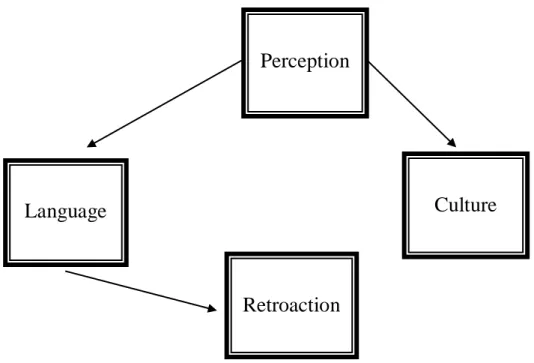
Figure 2. Interrelation between language, perception and culture (Adapted from Coleman et al., 2003) ... 67
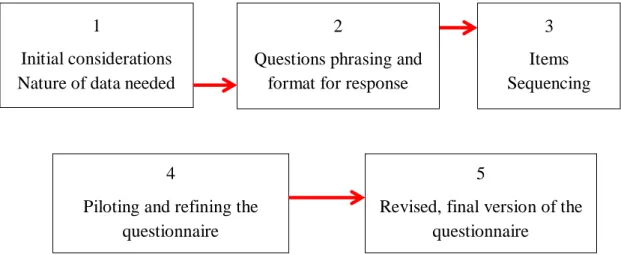
Figure 3. Steps in questionnaire conception (Source : the author) ... 88
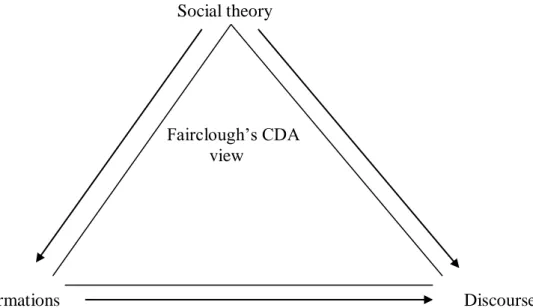
Figure 4. Fairclough’s CDA: a tripartite model of social theory. Source: O’Regan (2006) ... 89
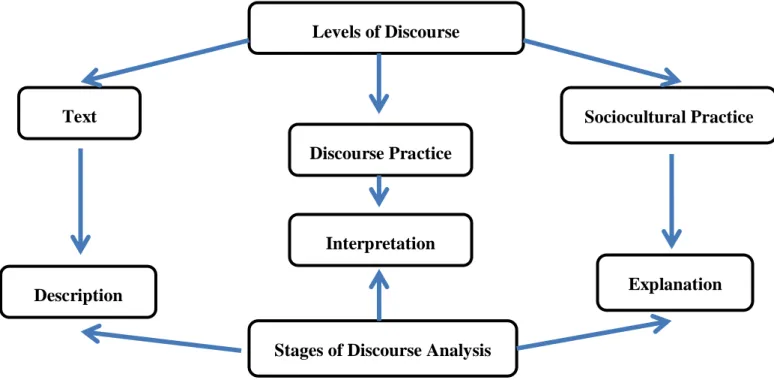
Figure 5. Fairclough’s three-dimensional view of discourse. Source: O’Regan (2006) ... 90
Figure 6. Summary of Fairclough’s overall approach. Source: Adapted from Janks (1997) ... 93
Figure 7. Students’ perceptions of, and attitudes towards, English culture ... 100
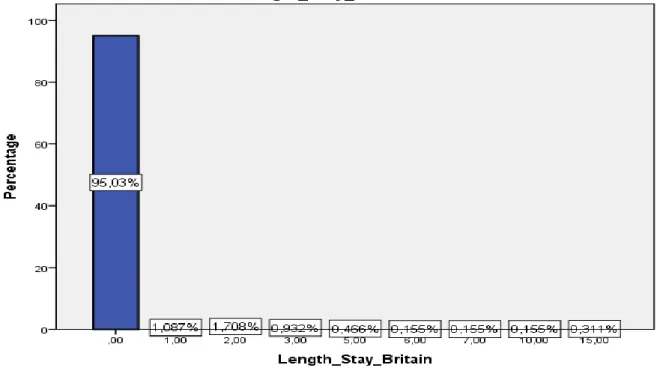
Figure 8. Chart representing length of exposure to the target language and culture .. 101
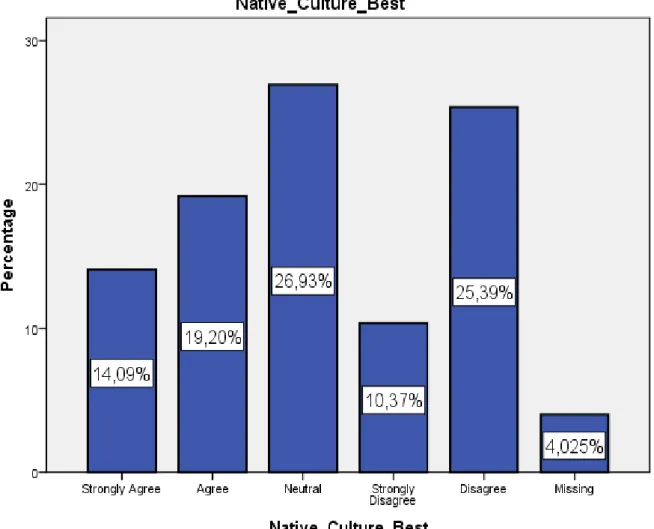
Figure 9. Students’ perceptions of the British culture ... 108
Figure 10. Students’ perceptions of the native culture ... 109
Figure 11. Learning English without its culture ... 110
Figure 12. English-learning and students’ change of attitudes towards the British culture ... 111
Figure 13. The positive impact of the Britsih culture on the native culture ... 112
Figure 14. The negative impact of the British culture on the native culture ... 113
Figure 15. The attitudes of acceptance towards different cultures ... 114
Figure 16. The attitudes of rejection towards different cultures ... 115
xiv
Figure 18. The impact of cultural differences on learning English... 118
Figure 19. Students’ readiness to learn about the Britsih culture ... 119
Figure 20. The influence of learning the British culture on the native identity ... 120
Figure 21. The fear of the influence of the British culture ... 121
Figure 22. The degree of British and native cultural awareness ... 122
Figure 23. The level of awareness of the British culture ... 123
Figure 24. The importance of learning about the British culture and other cultures .... 124
Figure 25. Students’ perceptions towards other cultures being a threat ... 126
Figure 26. Preference to learn English without its culture ... 127
Figure 27. Social gregariousness ... 129
Figure 28. Geniality ... 131
Figure 29. Loquaciousness ... 132
Figure 30. Logical reasoning ... 133
Figure 31. Assiduity ... 135
Figure 32. Totalitarianism and integrity ... 136
Figure 33. Doctrinal morality ... 138
Figure 34. Rigour and systematicity ... 139
Figure 35. Common sense ... 141
Figure 36. Poignancy ... 143
Figure 37. Cultural mannerliness and attributes ... 144
Figure 38. Word classification with respect to students' dislikes ... 150
Figure 39. Word classification with respect to students' likes ... 152
Figure 40. Word classification with respect to students' thoughts of British culture .... 166
Figure 41. Word classification with respect to students' thoughts of British people .... 167
xv
xvi ABSTRACT
The issue of cross-cultural perceptions and attitudes towards the foreign language and its culture has been momentous all along the last few decades. The main focus of this study is to account for the perceptions and attitudes of the students of English as a Foreign Language (EFL) at Batna 2 University through the application of Critical Discourse Analysis (CDA).This latter has been deployed within an interdisciplinary paradigm whereby the relationship between language, ideology, power, and social practices has been accounted for. The main purpose of this study is, firstly, to shed light on cross-cultural perceptions and attitudes. Secondly, it is aimed to bring the learner develop awareness of the self in order to understand and tolerate, in the other, those differences relevant to language, and also related to culture aspects like social values, norms, religion, and social practices. Thence, the current study endeavors to investigate the following research query: “What is the relationship between our EFL students’ perceptions of, and attitudes towards, the culture of the English language?” In reverence with this, it has been hypothesized that our LMD EFL students, like other learners of foreign languages elsewhere, may form their attitudes to the British culture on the basis of misunderstanding and misinterpretation of their perceptions rather than on well-founded evidence, facts, and knowledge. To address the focal research issue, a descriptive mixed method research design has been deployed, wherein both quantitative and qualitative data have been collected through a questionnaire administered to a sample of 600 students at the department of English at Batna 2 University randomly chosen from a total population of 3000 students from different undergraduate and post-graduate LMD levels. Data have been analyzed quantitatively using Statistical Package for Social Sciences (SPSS), and qualitatively using Fairclough’s (1989) CDA model as an analytical framework accounted by NVIVO. Results obtained confirm that EFL students have no real experience and no authentic exposure to the British culture. This would hinder their language learning and culture development. More importantly, this has resulted in some misconceptions and misunderstandings towards the target culture. It has been, as well, confirmed that the many relationships between language, ideology, and power are intertwined all throughout the learners’ discursive patters whereby the application of Fairclough’s CDA framework proved valuable to account for EFL learners’ perceptions and attitudes towards the target culture. Indeed, the current study is deemed beneficial in that it demonstrated learners’ cultural awareness, readiness, and open-mindedness that permit them to tolerate and accept the other and otherness. It has been contended, though, that respondents, in their great majority, accept positive change and show an outraged disclaimer against all aspects of injustice, mediocrity, racism, and discrimination. These powerful perceptions and attitudes were depicted both implicitly and explicitly when inquiring into leaners’ discursive patterns. Henceforth, this study is considered to be a praiseworthy contribution to call on intercultural perceptions in foreign-language education. Policy-makers, teachers, researchers, and practitioners will find, in this study, implications and recommendations for enhancing awareness and culture development within institutional and educational settings. More importantly, these recommendations are likely to foster the awareness of the self, of the other, and of the betterment of foreign-language and intercultural education in general.
CHAPTER 1
CHAPTER 1
Introduction
1.1. Introduction: Background, Purpose and Main Issues
Over the past decades, great numbers of researchers cross-world have insisted on the ultimate necessity to investigate foreign-language learners’ perceptions and attitudes towards the culture of the foreign/second language they are learning (Gardner, 1972; Littlewood, 1984; Harmer, 2007). This issue gradually became the foci of cross-cutltural studies and researchers who aim mainly at finding ways to develop the learner’s awareness of his culture first and then of the culture of the other (Diller, 1999; Byram, 2003). In doing so, researchers’ purpose is to identify, and cope with, areas that generate feelings like rejection, resistance, hostility, and fear of loss of identity and authenticity while learning a foreign/second language (Brown, 1986; Kramsch, 2004).
The other significant purpose is to bring the learner develop awareness of the self in order to understand and tolerate the differences in the other, mainly due not to language per se, but rather related to cultural aspects like socialvalues and norms, religion, and other social practices.Additionally, we believe the issue is worth investigating for many reasons. First, misunderstanding and misinterpretation of other cultures do give neither individuals nor peoples the opportunity to communicate rationally in all fields, whether in the world of education- between teachers and learners- or in domains like commerce, diplomacy, and the like (Schmidt, 2000). Second, the concern is even deeper and greater as the world is fastly globalizing. That is, social mobility is higher than ever and is henceforth pushing millions of humans to permanently move cross-world seeking studies, work and better conditions of life in general. The only example of 2015 points to about 244 million people who left their
countries of origin to live elsewhere (International Migration Report 2015, United Nations).
The need to prepare these increasing populations, and probably to smoothly integrate other cultures with harmony is crucial not only to researchers, but to politicians and decision-makers, as well. The matter has, indeed, become not only cross-cultural, but cross-continental, too.
To live in harmony with the other presupposes that we are able to communicate with him. More than that, italso means that we are able to understand and respect his culture. Actually, all is about the individual’s ability to share with the other common beliefs like respect of individuality and acceptance of differences (Byram, 2003; Kramsch, 2004). Not to be alike is not as much dramatic as when we reject the other because he is different. This problem is likely to be encountered within the same family between wife and husband just as it might be experienced at the level of groups, communities, and whole nations.
Any sound researcher raises a fundamental question that directly concerns the process he will use to conduct his study. In our specific case, the underpinning question is “How are we going to thoroughly and minutiously inquire into the cross-cultural perceptions of LMD students of English as a foreign language?” The study in itself contains language and culture, two sensitive issues whose relationship is considered as close as intimate by many researchers like Spackman (2009), and Mitchell Myles (2004), and who strongly argue that we can not separate language from its culture. One reason is that these components respectively provide support one for the other. Additionally, learners of a foreign/second language are found to be influenced by the culture of the language they are learning (Liddicoat, Papademetre, Scarino, and Kohler, 2003).
Actually, we may refer to some cultures as being more powerful than others in that they have always been referred to in official and non-official discourses as cultures which enjoy a higher status, and which implicitly infer more power. The classical reason put forward as a justification for these differences appears clearly in another discourse, whether written or oral, that refers to the Western culture in terms of more “elaborated” and more “developed” culture as compared to the culture of less technologically developed countries (Whitt, 2009).
The aforementioned language, culture and, hence, socialcomponents, and power and ideology are what critical discourse analysis (CDA) experts consider as a lay for implicit and hidden reality which needs being de-coded and unveiled. This is how we came to be convinced that the use of CDA to inquire into the cross-cultural perceptions of our LMD students of English as a foreign/second language, is a most appropriate tool. In fact, and as will be demonstrated in chapter two devotedto the review of literature, CDA is much used in educational and various other matters, like news media, to decode what is encoded in text and speech (Weiss & Wodak, 2003).
This line of inquiry led us to gradually form and construct an answer to the initially posed question concerning the research “How”, and which is set by Hayman, JR., in as early as 1968, when he stated in simple terms that “… the reasons for most behavior lie below the surface of observable events” (p. 9). This is the ultimate focus of our study for we would like to understand the extent to which the perceptions and the attitudes of learners of a foreign/second language are impacted by the culture of the foreign/second language itself.
As suggested by the American Psychological Association, APA, (2010), largely followed and used in language and educational research, chapter one which introduces the focus of the study, must begin with background information regarding the problem
under investigation. Generally, the introductory section of chapter one may vary considerably in length according to the nature of the study. Yet, it has to yield a brief summary of literature relevant to the problem being investigated, or what is named background to the problem (APA, 2010).
This part completes the background to the problem and insists on recurrent consistencies in how language, discourse and social values are constructed when cultures are shared in one way or another (White, 2002). This might happen in the case of migrants, for instance, where the contact is direct and permanent with the culture of the host country. Also, the same phenomenon can be experienced by overseas students as well as by those learners of a foreign/second language in their own homeland (Nédjai, 1987).
In this last example, the contact between the culture of the foreign language and of the learner of this language occurs through the teaching of the foreign language culture as an inclusive component of language itself. Whatever the context, many researchers suggest that patterns of decoherence, disjuncture, misunderstanding and conflict arise from cross-cultural perceptions which, in turn, will develop particular sets of behavior in the learner of the foreign/second language (Korotayer, 2001; Bolbanabed & Hanafi, 2004; Judith, 2007).
Experts in CDA like Van Dijk (1984), Fairclough (1989), Wodak (1989), Peirce (1995), and Widdowson (2007) have proned the use of CDA to study language in context, as a social activity, and its relation to power, politics and ideology. This, we believe, adds value to our rationale we have earlier discussed and wherein we came to the conclusion that CDA is most appropriate to our study. Assuredly, the analysis of cultural and cross-cultural issues opened the way to fascinating research fields like cross-cultural and language studies where CDA researchers are devoting much time to
discussing language, culture, intercultural and cultural problems (Lesley, 2010; Mervin, 2011).
CDA became so largely used that, next to researchers, increasing numbers of overseas students in UK and USA are doing their Ph.D research in the field of critical discourse analysis they use to understand variations in attitude as resulting from their compatriots learning a foreign language (Choi, 1998; Saichaie, 2011; Gonsalvez, 2013). This increase of interest in CDA is what also accounts for our choice of this particular model of analysis.
As to variation in attitude, it is explained by Greetz (1973) when he wrote that “Attitude formation is a result of learning, modeling others, and our direct experiences with people and situations” (p. 47). Naturally, one is tempted to add that this is exactly what is taking place when learning a foreign/second language and its culture. This is, we assume, what adds substance to, and accounts for, our study rationale.
Additionally, attitudes are closely related to perception. In fact, according to Lindsay and Norman (1977), perception is a process by which individuals interpret situations to produce meaningful experiences of the world, and hence of culture. The problem is that what an individual perceives and interprets may be different from contextual social reality. In other words, what is true in one cultural social context might as well be unacceptable in a different social context.
What has been mentioned so far allows for including in our research line of inquiry the way our LMD students perceive the culture of English as a foreign language, if they ever do, as demonstrated in most literature in the field. No doubt that what is regarded at this level is the process they use in a cross-cultural context where the culture of the other is at work, and hence perceived and interpreted through the social values and norms of their own culture. Consequently, the positive and/or negative attitudes
they form are likely to depend, to a large extent, on their perceptions (Lindsay & Norman, 1977).
Now that the two variables cross-cultural attitude-formation (dependent variable) and cross-cultural perception (independent variable) are identified, we would like to add that this is the causal relationship we have set to investigate, describe and critically analyse, using CDA, with the aim of proving whether our LMD students of English as a foreign/second language experience the same phenomenon like other learners engaged in foreign-language education cross-world. This issue will be widely discussed in chapter two which will comprise a pertinent selection of relevant literature.
At this level, it is most appropriate to mention that the following main issues are relevant to our study:
1. Students’ native culture components like religion, ideology, politics, morals, and social values are likely to impact and influence their perceptions of the English/British culture as in the case of other learners of foreign languages cross-world, and
2. The use of an appropriate CDA model will help to uncover, analyze and understand LMD students’ cross-cultural perceptions of the British culture and their attitude-formation towards this culture.
The purpose and the usefulness of this study are, we assume, clear enough to the reader. Further, we believe that, although the main issues will be naturally expanded in chapter two, it is worth informing briefly the reader and accounting for the use of CDA in our study.
Actually, discourse analysis (CDA) has a dual focus on both language and its context. In fact, discourse analysts combine the two concerns when analyzing the ways linguistic regularities are constrained by the discursive language structures and by social
and cultural meanings. Shiffrin (1991) believes that these factors “frame the production and interpretation of messages” (p. 3). This is the ultimate goal of our study, that is the interpretation of messages perceived by our students in a foreign language culture and how they interpret them to form attitudes towards this same culture.
This section of chapter one narrows the focus of the study and suggests a brief rationale to explain why the particular study is worth pursuing. This should lead up to the statement of the problem in section two. Before that, we would like to stress again that the main interest in this study is to gain understanding of students’ cross-cultural perceptions and attitudes via analysis of their written discourses gained through the use of a questionnaire administered to a randomly selected sample of 600 students from the total population of the department of English at Batna 2 University (3000 students) during the academic year 2016/2017. The 600 questionnaires administeredrepresent 20%, that is a fifth of the total population. Moreover, the questions posed in our study call for attention to be given to both the linguistic details of students’ discourse and to the larger cultural and social contexts that bear upon them.
1.2. Statement of the Problem
Cresswell (1994) suggests that “a problem might be defined as the issue that exists in the literature, theory, or practice that leads to a need for the study” (p. 50). Indeed, it is important to avoid obscure and vague formulations to have the problem stand out and be recognizable in a clear statement. Also, the problem should be presented in a context that provides an explanation and discussion of the conceptual framework it is embedded in. Hence, good statements of problems should answer the fundamental question: “Why does this research need to be conducted?”
With regard to the already mentioned aspects and to the main issues highlighted, cross-cultural studies offer interesting comparisons between cultures in all social
contexts like foreign-language classes where the individual is acting and behaving as a social and cognitive being. Besides, foreign-language classes involve the culture of the foreign language and the culture of the foreign-language learner. In this particular social and cognitive setting, learners use their perceptions to construct meaning and to form attitudes towards the foreign-language culture (Adevai, Silverman & McGough, 1970; Choi, Nisbett & Norenzayan, 1999).
The issue under scrutiny is, henceforth, the existing relation between the quality of the interpretation as being positive, negative, correct, wrong of the cross-cultural perceptions of our LMD students of English and how these perceptions are integrated in their attitude-formation process. This cause-and-effect relation between perceptions as an independent variable and attitudes as a dependent variable opens the way to stating the research hypothesis and the research question. Beforehand, we would like to highlight our awareness of the fact that the problem statement is among the most critical parts of any research. The reason is that it provides focus and direction for the remaining parts of the study by clearly defining the problem and the variables under investigation.
1.3. Research Question
The statement of the problem is further explicated in this section of chapter one, for research questions naturally emerge from the problem. In turn, research questions operationalize the problem as related to identify specific variables and relationships that need being examined and reported. Research questions, like hypotheses, also contribute to suggest the methodology for the study and to serve as the ground for drawing conclusions in chapter five.
In our survey of our students’ cross-cultural perceptions of, and attitudes to, the culture of the foreign language, “yes-no” questions will certainly be avoided because
they limit the scope of responses. Instead, open questions will be favoured to have access to larger written responses that will be used as a basic corpus for our analysis. This point will be further discussed in chapter three meant for research methodology design.
In this section, it is important to mention that hypotheses call for test and verification, whereas research questions-most often used in qualitative studies like ours-call for answers. According to Kerlinger (1986) and Krathwhol & Smith (2005), a hypothesis exists as a declarative statement of the relations between two or more variables; whereas a research question also states a relationship between two or more variables, but phrases this relationship under the form of a question.
In either case, we believe what is important is that hypotheses and/or research questions must be relevant to the nature of the topic and to the problem under investigation.
What we hypothesize in our study is that our LMD students of English as a foreign language, like other learners of foreign languages elsewhere, may form their attitudes to the British culture on the basis of misunderstanding and misinterpretation of their perceptions rather than on well-grounded evidence and facts, and well-founded knowledge. This directional hypothesis is inspired by the many researchers, cross-world, who claim that learners of foreign languages tend to develop resistance towards the culture of the foreign language because of their lack of intercultural awareness. A directional hypothesis as explained by Brown (1988) “can be formulated when there is a sound theoretical reason, usually based on previous research, to hypothesize that the relationship, if there is any, will be in one direction or the other” (p. 109). This point has been referred to in this section, and will obviously be thoroughly discussed in chapter two devoted to the literature overview.
Then, what we hypothesize results not only from the nature of our topic, but also from the conclusions drawn by many researchers in the field. Henceforth, our research question is phrased as follows:
“What is the relationship between our students’ perceptions of, and attitudes towards, the culture of the English language?”
In other words, we postulate that perceptions impact attitudes. Hence, on one hand, positive understanding and interpretation of perceptions resulting from cross-cultural awareness are likely to have a positive influence on attitude-formation. On the other hand, negative perceptions based on misunderstanding and misinterpretation due to lack of cross-cultural awareness would rather lead to a negative influence on attitude-formation as regards the British culture. This is, we believe, what the use of CDA will help us to uncover.
We are aware that one of the problems we will encounter is the evaluation of perceptions as a variable. This worry has already been considered when including critical discourse analysis (CDA) as a widely recognized and appropriate tool into learners’ perceptions as they appear in their written discourse gained through the use of a questionnaire. This data-gathering tool will be discussed in detail in chapter three which will comprise the research methodology design.
Although some literature in the field suggests misinterpretation and misunderstanding of perceptions that affect attitudes as a hypothesis, we favor asking the question in terms of relationship to be searched and presented as an answer to the research question, instead of hypothesizing that this relationship exists and needs being tested within our population. As will be developed in chapter three meant for methodology, the qualitative approach we will use will focus principally on the nature of implicit information we will come out with thanks to the use of CDA. This approach
has proved successful in similar research which, in our belief, is part of our research rationale and significance.
1.4. Significance of the Study
The significance of any study goes beyond aims and results obtained. Actually, the conclusions drawn and the potential value of the study will mainly serve the field of education and most particularly our LMD students of English as the identified audience. The value per se of our investigation will contribute to cultivating in our students a more elaborated awareness of the necessity to learn English without any prior attempt to separate it from its culture for they complement each other. On the other hand, cross-cultural awareness will certainly help our students diminish inhibiting factors like resistance to, and rejection and fear of the other culture. As already mentioned, to be aware of once culture is part of the process that leads to developing cross-cultural awareness. In fact, the culture of the other might be different but not necessarily negative or harmful to the self. Part of the significance of our study is to uncover students’ inhibitions and to bring them accept that what is different might as well be positive. The problem might be with the self first, and not necessarily in the other.
In this section, it is hence worth putting the focus on the fact that our study will also seek how to formulate educational implications aiming at convincing our students of the need to know more about the British culture as a natural component of the English language. On the top of that, if the relevant literature points to how learners of a foreign language fear an eventual loss of their identity, research evidence also indicates that this fear is rooted in the weakness of the self rather than in the culture of the other (Pinker, 1994).
Also, the significance of our study lies in our attempt to enrich the already existing body of knowledge as our modest study is the first in its kind in our institution,
which may open the path to further research that aims to place the foci on an intercultural perspective.
To sum up, we believe our study is significant for the following reasons:
Its newness, for it is the first time such an area is investigated at the level of our department of English,
It might have direct pedagogical implications relevant to CCL program content and other topics,
The study results may be taken into account in educational interventions, curricular, counseling, and policy,
Results obtained might serve in teaching the methodology of culture,
Results might as well initiate cultural and cross-cultural awareness to enhance the learning of both the English language and its culture without any fear of identity loss.
1.5. Definition of Terms
This section of chapter one includes definitions of the main terms and acronyms used in our study and which are either unusual or not widely understood. Similarly, common terms with special meaning in the study are added in this section. The following definitions are provided for the sake of uniformity and understanding of the main terms and concepts used in the study. Definitions developed by the author are not accompanied by a citation, while definitions taken from other sources are appropriately referenced.
Different researchers suggest almost similar definitions to the same concepts. Therefore, we select, each time, the definition (s) we believe is (are) most convenient to our study.
1.5.1. Attitudes
Early definitions of attitude were broad and contain cognitive, affective and motivational components. According to Allport (1935), an attitude is:
A mental or neural state of readiness, organized through experience, exerting a directive or dynamic influence on the individual’s response to all objects and situations to which it is related. (p. 80)
More recently, researchers like Schwarz & Strack (1991), and Eagly & Chaiken (2005) consider that attitudes are a complex combination of personality, values, motivations, beliefs and behaviors.
1.5.2. Critical Discourse Analysis (CDA)
Van Dijk (1998) defines CDA in the following terms:
CDA is not much a direction, school or organization next to the many other “approaches” in discursive studies. Rather, it aims to offer a different “mode” of, analysis, and application throughout the whole field. (p. 39)
Fairclough (1989) considers CDA along the same lines in that he argues that it studies social problems, power relations, society and culture. To Fairclough, CDA is regarded in terms of discourse analysis to explore relationships of causality and determination between discursive practices, events and texts as related to the wider social and cultural structure (Fairclough, 1993).
1.5.3. Cross-cultural Attitudes
Cross-cultural studies point to change in attitude resulting from the interaction of two or more cultures which influence each other. This process may lead to the development of positive or negative attitudes to the culture of the other depending on
the knowledge people possess of the culture of the other and their degree of cultural awareness (Piquemal, 2001; Stubben, 2001).
1.5.4. Cross-cultural
Cross-cultural may refer to comparative works like cultural studies, cross-cultural communication, intercross-culturalism and intercross-cultural relations. Hence, it refers to processes of cultural hybridity to describe cross-cultural studies (Byram & Morgan, 1994; Storti, 1994). It is important to be aware of the existence of cultural differences in perception to minimize these conflicts. In our case, negative perceptions are found by researchers to be at the origin of attitudes like hostility, rejection and resistance when engaged in the process of foreign-language learning (Van de Vijver & Leung, 2000; Lindsay & Norman, 1977).
1.5.5. Cross-cultural Perceptions
Researchers refer to cross-cultural perceptions as a source of many conflicts and communication failures between individuals or groups of different cultures. This is why it is important to be aware of the existence of cultural differences in perceptions to minimize these conflicts. In our case, negative perceptions are found by researchers to be at the origin of attitudes like hostility, rejection and resistance when engaged in the process of foreign-language learning (Van Ryn and Bunke, 2000; Lindsay and Norman, 1977).
1.5.6. Cross-cultural Studies
Cross-cultural studies refer to empirical studies conducted among members of different cultural groups using different languages and having different experiences that lead to significant differences in behavior (Brishin, Lonner & Thorndike, 1973).
1.5.7. Culture
The popular usage of the concept “culture” refers to specific kinds of interest and practice like music, literature and art (Lawton, 1975). On the other hand, culture as defined by scholars, means all what exists in society (Kramsch, 1998) and hence a social hybridity transmitted by one generation to another. Brown (2000), further suggests that culture refers to “the ideas, customs, skills, attitudes, beliefs, values and tools that characterize a given group of people in a given period of time (Brown, 2000, p. 17). This last view of culture is the one that suits our research best.
1.5.8. Intercultural
Intercultural is used to indicate exchanges that occur between two or more cultures when they co-exist in situations like foreign-language learning (Kramsch, 1998).
1.5.9. Perceptions
Perception is a process individuals use to perceive in priority what corresponds to their needs, motivations or interests. It is influenced by environmental, physiological and psychological factors. Therefrom, different individuals may perceive the same things differently and hence attribute to them different meanings (Long et al., 2011; Neuman, 1987; Broadbent, 1958).
1.6. Acronyms 1.
APA:
American Psychological Association 2.CA:
Conversation Analysis3.
CDA:
Critical Discourse Analysis 4.DA:
Discourse Analysis6.
INRP:
Institut National de Recherche Pédagogique (National Institute for Pedagogic Research).7.
L2:
Second Language8.
LMD:
A new organizational system introduced in 2004in the Algerian University. It comprises three levels (1) L. standing for “Licence”, an equivalent degree to the BA, (2) M. for Master one and master two, and (3) D. for Doctorate. Studies in the three levels last eight years, 3, 2 and 3 respectively.9.
CL:
Critical Linguistics10.
CLA:
Critical Language Awareness 11.CLS:
Critical Language Study12.
SFL:
Systemic Functional Linguistics 1.7. Limitations of the StudyLimitations of the study are generally referred to in terms of factors which are usually beyond the researcher’s control (Babbie, 2007; Kumar, 2012). Hence, a limitation in research is a potential weakness of the study, that is a factor which may affect the results of the study and/or their interpretation.
Consequently, highlighting the study limitations may be useful to both the researcher and the reader. This is why they are considered as a manner to identify and acknowledge possible errors and/or difficulties to interpret and attribute meaning to the results of the study.
Furthermore, some limitations appear only as the study develops and progresses, while they were not apparent at the very start. In any case, limitations should not be looked at as good excuses. Rather, they stand as elements that bring the researcher
closer to a truer sense of what his study results mean and to the extent to which their generalization is possible.
Additionally, only those limitations that have a significant effect on our own specific study are worth being addressed, for all investigations include some inherent limitations and weaknesses.
In our study, potential weaknesses and limitations may stem from the following factors. First, we will be using a model of critical discourse analysis (CDA) to analyze a corpus of written answers gathered from questionnaires administered to our LMD students, to gain information on their cross-cultural perceptions of, and attitudes to, the British culture in their process of learning English as a foreign language. Consequently, threats of internal validity may be greater. The reason is that information gathered might contain some bias. Also, we are aware that the nature of information reported by students about themselves might contain risk of students’ approval to satisfy the researcher. Similarly, some students might, for one reason or another, state their individual perceptions and attitudes in a vague way, or simply not fully uncover them. Due to this, we maintain that the failure of some respondents to answer with honesty may well negatively impact results and hence not accurately reflect the opinions of all members of the population included.
Taking into account all these considerations, we have worked on one sample from each level (L, M, D) that is “Licence”, Master and Doctorate. Consequently, results obtained in our study will concern the whole population of L.M.D students instead of addressing one level alone. Actually, as known to researchers, whatever the accuracy and the appropriateness of the sample, its representativeness of the large population is never fully finite. This very factor might also impact the principle of
results generalizability (Judith, 2005; Dornyei, 2007; Murray & Beglar, 2009). Further details will be provided in chapter three which will discuss methodological procedures.
Finally, due to the nature of the problem under study and to its inherent changing factors like teachers, students and methods, the results of our study would certainly concern the population of the students under investigation more than those to come in the future years. This is not our purpose for what is significant to us is more to demonstrate the existence of the problem than to pretend inventing an ever-lasting solution to it. This is why we believe that our ultimate purpose is the acceptance and the development of cross-cultural awareness, that is awareness of the self and of the other for a better foreign-language education.
1.8. Delimitations of the Study
It is useful to clearly set the delimitations of the study and its scope. This is a way to remain in the limits of the study and to have on it some reasonable degree of control. Henceforth, a delimitation is needed to explain how we will narrow down the scope of our study and how we account for things we have not decided to do.
Consequently, the delimitations of our study concern the following aspects. First, the geographic region is limited to the Wilaya of Batna where most students registered in the department of English come from. A similar study in a different university or on another generation of students might yield different results because of subjects,time and place factors. Second, our study will concern the whole population for reasons already highlighted and which will be expanded in chapter three devoted to the methodology used in our research.
Second, our data collecting processis limited to the use of a questionnaire dominated by open-ended questions to give respondents more latitude to express themselves and to give the researcher the opportunity to work on a written corpus.
Hence, data are categorized into nodes and themes toinquire into students’ written discourse. Third, the time frame for the study concerns the academic year 2016-2017. Actually, these choices obey the time schedule of our entire doctorate program wherein year one is dedicated to lectures and to the process of reading to prepare chapters one, two and three in order to spend year two on data-collection and year three on writing up the thesis.
Technically speaking, these are factors over which the researcher has more control as compared to limitations. Henceforth, aspects like manageability and data-collection and access to respondents are guaranteed thanks to the limits within which our study is conducted. In terms of managerial constraints, we will have less difficulties to cope with research risks like time and availability of participants. Besides, the researcher himself is a part-time teacher in the department of English. This will facilitate his task as a researcher within a physical and social environment he is acquainted with.
Finally, in our study, we will mainly concentrate on language discursively used by students in social context. Students’ disgression tendency from the main point they are talking about or writing on will be the focus of our analysis using Fairclough’s model of discourse analysis. Hence, results will concern the population of LMD students of English at Batna 2 University over the academic year 2016-2017. The factors of place, time and subjects operate as limits to our study. Consequently, this delimitation will certainly call for further research if expanded to another social/physical environment or replicated with another population at another time.
Although limitations and delimitations tend to overlap, as it is the case here, we have presented them one in each section to ensure more clarity.
1.9. Assumptions
Generally, assumptions presented in this section of chapter one address limitations the researcher is aware of and that may affect his study. For this reason, limitations previously highlighted are not repeated here. Nonetheless, we assume that our LMD students of English as a foreign language are no exception as compared to other learners of foreign languages cross-world.
Similarly, we assume that the majority of participants will answer all survey questions honestly and to the best of their capacities for the study is a direct concern of their life as students. Also, participants’ gender is not considered as asignificant issue in our research. One good reason is to void overloading the study. Finally, as believed by most researchers, the process of perceptions is as social as human. Consequently, our students are using it in a way similar to that of all learners of foreign languages (Eller, 1999; Dasgupta, 2009).
1.10. Conclusion: Organization of the Study
This section of the study allows readers to know which information will be found in each chapter to facilitate access to targeted information. It is also a logical smooth transition into the text of the thesis.
Actually, chapter one includes the introduction, the background and the scope of the study with the main issues. Also, the problem is clearly stated to allow us present our research question. The significance of the study is highlighted to demonstrate the value of the study. Chapter one also contains a referenced list of the definitions of terms used in our study. Limitations and delimitations are discussed in distinct sections. Finally, our assumptions are made clear. Chapter two contains the review of literature relevant to the main issues discussed in our study and related to the problem under investigation.
We have gradually moved from a broad perspective and worldwide problematic in which we have demonstrated the existence of the problem to a narrower view in which our problem is situated as related to our students of English as a foreign language. This has permitted us to identify the problem of our study, namely cross-cultural perceptions and attitudes and to select the use of CDA to inquire into them as many other researchers did (Toolan, 2002; Van Dijk, 2009; Fairclough, 2014). Similarly, we have selected Fairclough’s (1989) model for it is most used in the analysis of educational matters. Methodological procedures to gather data needed for the study and a detailed research methodology design are presented in chapter three. Results and findings to emerge from our study are comprised in chapter four and accompanied by an analysis. Finally, chapter five is devoted to the summary and findings of the study, to the conclusions we have drawn from the findings, and to implications and recommendations. A discussion of the findings and recommendations for further study are also part of chapter five.
Our work also contains a section which presents all the references cited in the text following the APA referencing style and an appendix which displays the study questionnaire.
CHAPTER 2
CHAPTER 2
Review of Related Literature
Introduction
It is commonly the case that the review of related literature provides the reader with an as relevant and comprehensive selected literature as needed. Obviously, as suggested by many experts like Haymer (1968), Judith (2005), and Murray & Bugler (2009), this chapter must greatly expand upon the information presented in the introduction and background of the problem under investigation.
The aforementioned are reasons why this chapter contains a historical review of the problem, the main models and theories relevant to the problem, important researchdata which directly concern the problem, and current trends of research related to theproblem.
Actually, chapter two is an attempt to provide an exclusive review of the literature relevant to principal selection to be presented in the following five main sections: (1) critical discourse analysis (CDA), (2) cross-cultural studies, (3) perceptions and attitudes, (4) language and culture, and (5) Foreign-language learning, an intercultural perspective.
As chapter two “is not the place for the researcher to interject any personal ideas or theories” (APA, 2010), any information attributable to other researchers are carefully acknowledged whether in the case of direct quotations, indirect quotations or paraphrasing. Also, this chapter ends with a short summary of the information it contains. It is a reappraisal of the most pertinent information contained in the review of literature.
In this chapter, we first attempt to define critical discourse analysis (CDA) as seen and comprehended by various researchers like Fairclough (1993), Van Dijk (2001), and Wodak (2005) and many others. Second, a brief history of CDA is included to bring the reader understand its evolution and development which are discussed in a third subsection. Then critical linguistics (CL) is looked at as a substitute to CDA, for both CDA and CL were first interchangeably used before opting for the only use of CDA. Halliday’s theory (1985) of systemic functional linguistics (SFL) is also presented as it was an influential model of language. The other reason is that it directly contributed to the development of CDA.
Subsection six highlights the main models of CDA, namely (a) Fairclough’s model, (b) the socio-cognitive model and (c) Wodak’s model of discourse sociolinguistics. A further subsection seven is devoted to the presentation of CDA aspects such as: (a) language as discourse, (b) macro versus micro in CDA, and (c) text analysis and discourse interpretation. A final subsection eight comprises approaches to studying classroom discourse.
The field of CDA encompasses so many other disciplines that we believe it is unreasonable to extend it to issues which are not directly tightly relevant to our investigation. One other reason why chapter two is limited to the pertinent relevant literature is to leave enough room for the other main issues already mentioned and which are part of the literature review.
2.1. Critical Discourse Analysis (CDA) 2.1.1. Defining Critical Discourse Analysis
Critical discourse analysis (CDA) is an interdisciplinary approach to the study of discourse that views language as a form of social practice. In other words, CDA is a field concerned with studying and analyzing written and spoken texts to reveal the
discursive sources of power, dominance, inequality, and bias (van Dijk, 1998). The emphasis of Van Dijk is particularly on how CDA examines discursive sources which are maintained and reproduced within specific social, cultural, political and historical contexts. CDA, then, does not move in only one direction. As put by Van Dijk (1998):
CDA is not much a direction, school or generalization next to the many other “approaches” in discursive studies. Rather, it aims to offer a different “mode” of theorizing, analysis, and application throughout the whole field. (p.39)
Fairclough and Wodak (1997) address CDA in a similar way in that they assert that CDA deals with social problems, power relations, society, and culture. Besides, they believe that discourse is a form of social action wherein discourse analysis is both interpretative and explanatory. In a similar vein, Fairclough (1993) argues that CDA is regarded in the sense of discourse analysis which aims to systematically explore often opaque relationships of causality and determination between discursive practices, events and texts with the wider social and cultural structure.
Furthermore, critical discourse analysts like Wodak (1997) and Benkee (2000) tend to define CDA as a way of addressing social problems. Henceforth, they consider the context of language to be crucial as regarded to CDA. Actually, Widdowson (2007), nicely summarizes the value of context by asserting that no matter a text may be:
The extent to which it is interpreted as coherent discourse will always depend on how far it can be related externally to contextual realities, to ideational and interpersonal schemata that readers are familiar with in the particular socio-cultural world they live in. (p.51)
Obviously, a discourse whether written or spoken depends, in its cohesion, as much on its producer as on external contextual relations. The socio-cultural
environment is very likely to impact not only the production of discourse, but its interpretation and analysis, as well (Bourdieu, 1983; Billig, 1991).
Assuredly, most critical discourse analysts point to the very fact that what somebody might mean by producing a text is very much likely to be related to broader issues of ideology and social belief. These issues are what CDA is concerned with in its attempt to go beyond text and speech to decipher and interpret all signs likely to lead to further meaning and hence better interpretation and understanding. This is what Widdowson (2007) referred to when he wrote that “… we can identify a text as a purposeful use of language without necessarily being able to interpret just what is meant by it” (p. 4). Hence, one might add that despite our attempt to think explicitly, there is always the possibility that the text or the speech we produce be interpreted otherwise.
Similarly, Titscher, Meyer, Wodak & Vetter (2000), Fairclough (2001), and O’Halloran & Kieran (2003) describe CDA as kinds of genre, institutionalized modes of thinking and social practice. As a result, CDA analysts inquire into the role played by schematic knowledge which is perceived as the operative element within a particular community of language users. Actually, humans are also acting as social individuals and, quite naturally, as language users. Consequently, social realities are explained and evaluated through language.
For these reasons, CDA also referred to as critical social analysis, consists of two main aspects of social life. The first one is studied by normative critics who consider social realities as necessary values of a well-founded society. On the other hand, explicative critics attempt to explain why these social realities are so and how they come to be maintained or modified. Sayer (2011) is one among the researchers who have widely discussed social realities. Researchers like Geuss (1981) and Raymon,
Morrow & Brown (1994) have largely expanded on the necessity to distinguish between these issues to understand how they interact.
Eventually, these two forms of critics might be extended to discourse which is, in turn, the objective of critical discourse analysis. This brings us to add that CDA means an ensemble of approaches aiming at broadly stretching the critical social analysis (Fairclough, 2006) to attain a certain recontextualization. As wrote by Theo Van Leeuwen (2008) “… recontextualization may add evaluations to elements of social practice, or to social practices as a whole” (p. 21).
Although it remains most difficult to precisely delimit CDA special practices and principles, all researchers have attempted to provide a definition of CDA. One compromise definition is suggested by Van Dijk (1994) when attempting to answer the question “What is critical discourse analysis?” His answer was:
Critical discourse analysis (CDA) has become the general label for a special approach to the study of text and talk, emerging from critical linguistics, critical semiotics and in general from a socio-politically conscious and oppositional way of investigating language, discourse and communication. (p. 17)
We understand, here, that the descriptive, explanatory and practical aims of CDA consist in attempting to disclose what is implicit and hidden in text and talk. In other words, and as explained by Van Dijk (1995) himself, “… CDA focuses on the strategies of manipulation, legitimation, the manufacture of consent and other discursive ways to influence the minds, and indirectly the actions, of people in the interest of the power” (p. 18).
2.1.2. A Brief History of CDA
Critical discourse analysis (CDA) is a combination of both theory and method and which has become the general label for special approach to the study of text and talk (Rogers, 2011; Van Dijk, 2006). Additionally, CDA emerged from critical linguistics (CL) which initially developed at the University of East Anglia in the 1970’s. Furthermore, CDA is always presented as an interdisciplinary approach to the study of discourse that views language as a form of social practice (Van Dijk, 1998; Fairclough, 2001; Wodak & Meyer, 2001; Scollon, 2001; Jager, 2001; Rogers, 2004).
In general, CDA as a school or paradigm is described by various standards. Forinstance, all methodologies are problem-oriented and are part of a large spectrum of critical studies in the humanities and the social sciences. Besides, CDA pays attention to all dimensions and aspects of discourse. Actually, this is what has made of CDA an interdisciplinary and eclectic discipline. Furthermore, CDA is portrayed by the regular premiums in de-confusing philosophies and forces through the methodical and retroductable examination of semiotic data whether written, spoken or visual (Fairclough, 1993; Wodak & Ludwig, 1999; Titscher, Wodak, Meyer, & Vetter, 2000; Wodak, 2006; Van Dijk, 2006; Van Leeuwen, 2008).
As already mentioned, CDA was produced by a gathering of language specialists and artistic scholars in the late 1970’s, at the college of East Anglia. At that time, their approach and methodology depended much on Halliday’s systemic functional linguistics (SFL). In a similar vein, CL professionals such as Trew (1979) went for considering discourse as a system and attempted to demonstrate how philosophies and ideological procedures are illustrated as frameworks and systems of linguistics characterized by processes. This major point was sought after by building up CL’s