The Effect of Pragmatic Instruction on EFL
Learners’ Constructive Peer Criticism Competence
The Case of Second Year LMD Students of
English at Batna University 2, Algeria
People’s Democratic Republic of Algeria
Ministry of Higher Education and Scientific Research
Mostéfa Benboulaïd, Batna 2 University
Faculty of Letters and Foreign Languages
Department of English Language and Literature
Thesis submitted for the requirements of Doctorat Sciences in
Linguistics
Submitted by: TOBBI Saida Supervised by: Prof. GHOUAR Amor
Board of Examiners:
Chairman: Prof. NEDJAI Med Salah (
Mostéfa Benboulaïd, Batna 2 University)
Supervisor: Prof. GHOUAR Amor (
Mostéfa Benboulaïd, Batna 2 University)
Examiner: Dr. HELLALET Souhila (
Mostéfa Benboulaïd, Batna 2 University)
Examiner: Prof. KESKES Said (
Med Lamine Debaghine, Setif 2 University
)
Examiner: Prof. SAADI Hacène (
Frères Mentouri, Constantine 1 University)
Examiner: Dr. HOADJLI Ahmed Chaouki
(Med Khider, Biskra University)
Dedication
The words can never express how much we owe to our families for their love and support through our study career.
We dedicate this work to our parents for their sacrifice.
To our brothers and sisters without exception.
To our adorable husbands: BOUCETTA Hamza and Nacer Eddine kalla,and children: Semmache Rawane, Mohamed Sif ElIslam, Kinda Miral and Adam Iyes who were besides us in every step during the whole year.
To our colleague and friend: ZOUACHE Aisha, for her support and motivation.
Acknowledgements
First and foremost, we would like to thank ALLAH, The Almighty for giving us the strength to complete this work.
We would express our sincere gratitude to our supervisor Dr. GUERZA Radia for her support and valuable guidance from the beginning.
We would, also, like to thank our parents, husbands and colleagues for their great support and patience with us.
We would like to thank our lecturers in the department of English at Batna-2 University who were behind our fruitful results.
Thanks also go to the members of jury who agreed to take part in examining our dissertation.
Finally, we would like to thank first-year LMD students in the department of English at Batna-2 University for taking the time to answer the questionnaire.
Abstract
English movies are available in many countries around the world, and they are a popular form of entertainment with many students learning English as a Foreign Language (EFL). Watching English movies with subtitles to learn a foreign language can facilitate students’ motivation, solve ambiguity, and remove some of the anxiety of the non-native learners. This study aimed to find out whether there is significant effectiveness of watching English subtitled movies on first-year English student’s speaking skill. In total, 250 first-year students of the English department at Batna-2 University participated in this study and the descriptive analysis of watching subtitled movies of speaking skill is conducted. A questionnaire was administered for this study after assigning subjects randomly. The current study assumes that watching English subtitled movies can improve students’ engagement in learning and enhancing their oral performance. However, more studies need to be done in the future in order to get the most advantages out of the movie materials in EFL classrooms.
LIST OF ABBREVIATIONS: EFL: English as a foreign language
ESL: English as a second language
L1: first language
L2: second language
CAF: Complexity, Accuracy and Fluency
VS: versus
SDH: Subdural Haemorrhage
e.g.: example
TV: television
FL: foreign language
SEEU: South East European University
Q: question
LMD Licence Master Doctorate
TABLE OF CONTENTS DEDICATION ACKNOWLEDGMENTS... 01 ABSTRACT... 02 LIST OF ABBREVIATIONS... 03 TABLE OF CONTENT... 04 LIST OF TABLES... 06 LIST OF FIGURES... 07 CHAPTER I: INTRODUCTION I-1 Background of the Study... 10
I-2- Statement of the Problem... 13
I-3-Research Questions... 15
I-4-Research Hypotheses... 15
I-5-Limitations... 15
CHAPTER II: REVIEW OF THE LITERATURE SECTION 1: Speaking Skill ... 17
Introduction... . 17
II-1-1 Definition of Speaking... 17
II-1-2 The Importance of Speaking... 18
II-1-3 Differences between L1 and L2 Speaking... 19
II-1-4 The Purposes of Speaking... 20
II-1-4.1 Informative Speech... 20
II-1-4.2 Invitational Speaking... . 20
II-1-4.3 Dispositional Persuasive Speaking... 21
II-1-4.4 Actuation Persuasive Speaking... 21
II-1-5 Speaking Evaluation... 21
II-1-5.1 Pronunciation... 21
II-1-5.2 Fluency... 22
II-1-5.3 Accuracy... 23
II-1-6-Learners’ Speaking Difficulties... 23
II-1-6.1 Lack of Motivation... 24
II-1-6.2 Inhibition... 24
II-1-6.3 Poor Listening Practice... 25
II-1-6.4 Speaking Anxiety... 25
Section 2: Learning Speaking through Subtitled Movies... 25
II-2-1 Definition of Subtitles... 25
II-2-2 Subtitles Benefits on EFL Learning: A Review of Related Studies... . 26
II-2-3 Reasons behind Watching Subtitled Movies... 27
Conclusion... 28
CHAPTER 3: RESEARCH METHODOLOGY Introduction……… 30
III.1. Population………. 30
III-2 The Students………..………… 30
III-3 Data Collection Tools ………...… 30
CHAPTER 4: ANALYITCAL FRAMEWORK Part one: Participants’ Personal Details... 32
Part two: Facts and opinion... 34
CHAPTER 5: DISCUSSION CHAPTER 6: GENERAL CONCLUSION VI. 1. Suggestions and Recommendations………. 50
VI. 2.General Conclusion……… 51
VII. BIBLIOGRAPHY……….. 52
VIII. APPENDIX………... 54
LIST OF TABLES
Table1: students’ gender………. 33
Table2: distribution of students according to their ages………. 34
Table3: students’ reasons behind watching movies……….... 35
Table4: students’ responses toward the effects of watching subtitled movies……….. 36
Table5: duration of watching movies……….. 37
Table6: Selecting movies genres to watch……….. 38
Table7: students’ responses toward pronunciation through watching subtitled movies…………. 39
Table8: students’ responses toward enhancing comprehension of the language through subtitles 40 Table9: students’ responses toward teachers’ motivation to learn though movies………. 41
Table10: students’ responses toward the impact of watching English movies with subtitles on EFL learners speaking skill……….. 42
LIST OF FIGURES
Figure1: students’ gender……….………. 33
Figure2: distribution of students according to their ages……….………. 34
Figure3: students’ reasons behind watching movies……….………….... 35
Figure4: students’ responses toward the effects of watching subtitled movies……… 36
Figure5: duration of watching movies……….. 37
Figure6: Selecting movies to watch……….. 38
Figure7: students’ responses toward pronunciation through watching subtitled movies………….. 39
Figure8: students’ responses toward enhancing comprehension of the language through subtitles. 40 Figure9: students’ responses toward teachers’ motivation to learn though movies……….. 41
Figure10: the impact of watching English movies with subtitles on EFL learners speaking skill... 42
CHAPTER I : INTRODUCTION
I-1- BACKGROUND OF THE STUDY
The English language is one of the most powerful and well known languages in the world. In each and every word, it has grown to be the language of age; that is; most attitudes toward English are positive since the majority of countries adopt it as their second or foreign language used in education, government, politics, trade, and external dealings and relations.
The Arab world, as a part of the globe, has also given English its status as the first foreign language taught in schools and academic institutions, and used it in business, in medicine, and communication with other part of the world.
In terms of instructions, teaching English is supposedly not confined only to grammar, it should include several aspects of the language such as the four skills: Listening, reading, writing, and speaking. The main focus, however, is probably devoted to writing. Students do a lot of writing since the first academic year till they submit graduation dissertation. Therefore, students need to assess efforts and time given to speaking as a vital part of language learning and they should determine the level of proficiency necessary for effective communication. One way to do so, is watching English subtitled movies.
Watching English movies can help viewers, specifically the students to enhance their vocabulary and make it in use through a direct contact with real life English language, and for them to acquire new words. In this modern generation, there are so many people watching foreign movies most of them are students who are interested in watching English movies instead of reading English books.
In the world, the cultural heritage of a nation is the language. During the last decade, learning languages has become more important. Learning a new language not only develops individual intelligence, but also it gives learners, permission to enter and gets learners near to another culture and prepares them with the essential skills to succeed and change their behavior in a rapidly changing world (Chan and Herrero, 2010). Movies are a part of visual literacy and “movies are an enjoyable source of entertainment and language acquisition” (Ismaili, 2012, p. 122).
Watching movies can support motivation of the learners because of their playful component, and they can be used as task activities to give an ideal environment for learning, as well as encouraging participation and interaction among students (Chan and Herrero, 2010). Many scholars have revealed that
watching English movies can become an essential part of language learning. This is based on the fact that movies give exposures to “Real language,” used in authentic settings and in the cultural context which the
CHAPTER I : INTRODUCTION foreign language is spoken. They also have recognized that movies attract the learner, and it can positively affect their motivation to learn (Ismaili, 2013). Herron and Hanley (1992) contented that “Watching movies serve as a bridge between learning skills and language objectives (output), and provide background information that activates foremost knowledge, which is important in stimulating the
four skills” (p.72)
Watching subtitled movies make students interact with the movies. When EFL learners watching a subtitled movie, watching and listening to the audiovisual materials, they are also understand and interact with the movie, and they make a translation, between the source language and target language. This interaction seems to be in its pick in case of watching movies in reversed subtitled mode. While watching reversed subtitled movies, learners try less to understand aural input due to their familiarity with the audio language (Gorjian, 2014).
Furthermore, Scholars have revealed that movie fragments are useful to enhance memory and improve recovery of information in reading skill and listening skill (Pezdek, Lehrer, and Simon, 1984). Using the same pattern, movies help the development of the writing skill of the learner and give interesting and motivating clues to accompany audio or written inputs, in that way they help understanding and producing of second language input/output (Ismaili, 2012). Videos that related to the content of the curriculum can be used in EFL classrooms to bring a realistic phase of what is being taught in the class. This issue work as a supporter and motivator to the learners (Furmanovsky, 1997). Within this respect,Ismaili (2012) contended that watching the movie of famous and current novels as a supplementary source for the reading.
Movies pave the way for EFL learners and give the opportunities to see the social dynamics of communication just like native speakers incorporate into real settings (Ismaili, 2012). In addition, movies provide a great chance to students to gain background understanding to combine with their own understanding of a story or concept. When students reading a text, movie features can help them connect to new information they may have not had a background in and change their new thoughts, images, and feelings to the text at hand (Gambrell and Jawits, 1993).
“The main component of watching the movies is actually enabling the reader to picture or to visualize the events, characters, narration, story and words in the context ” ( p. 123).
Draper (2012) has described visualization as a foremost prerequisite for a good reader. Helping students gain visualization skills is an essential way to advance greater understanding while reading. It
CHAPTER I : INTRODUCTION permits students the ability to become more engaged in their reading and they use their images to draw conclusions, create interpretations of the text, and recall details and elements from the text (Keene and Simmerman, 1997).
Draper (2012) has researched and recognized that expert readers impulsively and purposefully create mental images in their mind at the time, and after they read. The creation of the images comes from the five senses and emotions, and they are stored in readers’ encyclopedic knowledge. They use images to put themselves in detail while they read. The detail provides depth and dimension to the reading, engaging the reader more deeply, and making the text more memorable. Expert readers get the benefit from images to draw conclusions to create different and unique interpretations of the text, to remember the essential elements of the text, and to remember a text after it has been read. This is a good reason to support English instructors to be more imaginative and motivated using movies in EFL classrooms (Ismaili, 2012). Therefore, teachers believed that using movies in EFL classroom can increase the interaction among learners; they improve learners’ speaking skill and offer learners more opportunities to use English (Ismaili, 2012). Students are more excited to see and hear real-life situations because movies provide a relaxed atmosphere for them (Ismaili, 2012) .
In short,” films provide an invaluable extension of what we might call the technologies of language acquisition that have been used to teach students the basics of English learning in elementary and high schools or
institutes”(Sabouri, Zohrabi and Osbouei, 2015, p. 110).
Language production within a meaningful context and through interaction has been demonstrated to assist second language acquisition (Ellis and He, 1999). According to Swain’s (1993) output hypothesis, language production within a meaningful context and through interaction: (1) provides the opportunity for contextual use of linguistic resources, which leads to automaticity in language use; (2) forces syntactic processing, where students pay more attention to syntax when listening in order to use it in their own language production later on; (3) helps students to recognize what they do not know or know only partially ; (4) provides opportunity for testing out hypotheses in order to see the linguistic features that work. With the increasing access to TV, video equipment and more recently, computers, teachers have found more opportunities to use audio-visual materials at all levels of foreign language teaching, and they have frequently used them effectively in language classes (Meskill, 1996). According to Champoux (1999), movies are a comfortable familiar medium to contemporary students that can keep student s interest in the theories and concepts under discussion. Although most movies are fiction, they can offer powerful experiences that students are unlikely to have in a classroom. Film scenes can offer visual portrayal of abstract theories and concepts taught in management and social sciences courses. Explaining
CHAPTER I : INTRODUCTION concepts through different film scenes bring theories closer to realistic situations. Films can also provoke good discussion, assessment of one's values and self if the scenes have strong emotional content. Cinema's ability to create a unique experience gives it unbeatable power as a teaching tool.
Psychologists have argued in favor of films’ impact on cognitive learning of students . Blasco et al., (2006) have stated that the use of films in learning and teaching is crucial to provoking the reflective processes and attitudes in the learner. Some others (Lesser and Pearl, 2008; Casper et al., 2003; Butler et al., 2009) have also argued that learners' ability to retain and recall information as well as overall satisfaction with the learning experience was significantly higher where film was an integral part of the learning activities. Champoux (1999) maintained that movies offer both cognitive and affective experiences. Moreover, movie scenes could be very helpful in enhancing analytical skills of students and changing their worldview as they offer opportunity to connect theories to realistic situations. Researchers have considered several benefits of watching movies. For example, Pescosolido (1990) argued that watching movies can be important in learning and also highlighted that active learning can be encouraged and better supported through the use of audio-visual materials from the popular culture arena. On the other hand, Butler et al., (2009) argued that when information mentioned in texts is not consistent with information revealed in movies, students tend to recall incorrect information rather than correcting inconsistencies in information, which needs to be handled cautiously. In sum, watching captions or subtitles to facilitate the comprehension of video materials is taken for granted by many teachers and researchers. Moreover, many educators believe that television programs with captions seem to provide a rich context for foreign language.
I-2- STATEMENT OF THE PROBLEM
Speaking is one of the four macro skills necessary for effective communication in any language particularly when speakers are not using their mother tongue. As English is universally used as a means of communication, especially in the internet world, English speaking skills should be developed along with the other skills so that these integrated skills will enhance communication achievement both with native speakers of English and other members of the international community. Because of the significant role of speaking in action, the researchers argued that the main cause of weak pronunciation among ESL\EFL Arab learners may be the negative transfer of the native language _ weak pronunciation among English as a Second
Language ( ESL)\English as a Foreign Language (EFL )Arab learners may be the negative transfer of the native language (Arabic), and the lack of listening to and practicing the pure English as it is the problems of pronunciation and speaking skills of first year English students at Batna-2 University in an attempt to find new techniques for promoting their pronunciation to sound comprehensible and native-like. One of
CHAPTER I : INTRODUCTION the techniques used and would like to investigate how English movies would be beneficial for improving their speaking skill and how English movies can be used as a means for enhancing pronunciation because this technique is believed to give students the opportunity to listen to authentic spoken English from the native speakers themselves.
EFL learners, such as Arabs, specifically Algerians find it difficult to acquire the real English spoken by native speakers; that is, such language has its own special phonological system and rules differing from that of the mother tongue of the learner. Accordingly, the extent of difficulty of learning English depends greatly on its relation to the first\native language of the learner; whether it is a cognate to English (i.e., L1 and L2 are both descendants of the same language family) or not. For example, it may somehow be easier for a French person to learn English than an Arab if both learners received the same instruction under the same conditions; that is, French and English are cognates of the same family which is 'Germanic', and, therefore, both share many features, sounds and vocabulary. However, Arabic is a 'Semitic' language not Germanic, which means a total difference between Arabic and English in vocabulary, grammar, sentence structure, phonetics and phonology. As a result, Arab learners should exert extra effort to master English language in general, and speaking skill in specific. Gimson (1980, p. 322) advises EFL learners of pronunciation "to establish certain basic discriminatory skills" by distinguishing between the features of the mother tongue and those of English, in addition to recognizing the contrastive features of English itself. Another matter that should be taking care of is that although English speaking follows rules, the application of such rules is not always systematic; there are irregularities and exceptions, especially in word stress when it comes to pronouncing verbs, nouns, and derivations of the same root or stem (Gimson, 1980). In terms of connected speech, the story is more complicated because sometimes we need to switch the stress\ accent to a particular word or phrase, that originally do not receive stress, in order to convey a specific meaning or message, depending on the context of speech. Therefore, we should be aware of the way we do that in order not to be misunderstood by others especially native speakers. That is, it happens that wrong usage of stress, pitch of voice, or intonation in connected speech gets misinterpreted (Gimson, 1980).Gimson (1980, p. 297) recommends the foreign learner of English "to aim at a careful colloquial style of English in his own speech and, at the same time, be aware of the features which characterize the rapid colloquial style he is likely to hear from native speakers," which can probably be achieved by listening to English movies whether spoken with the Received Pronunciation (which is the advisable accent by Gimson), with the General American, or with any other English accent. The phase of acquiring English speaking skill through watching English movies is according to Gimson (1980),” Practice in reception and comprehension” (p.54)
CHAPTER I : INTRODUCTION
I-3-Research Questions
The current study addresses three overarching research queries:
1 .What is the status of speaking skill in the English language instruction at Batna-2 University?
2. What are the problems the first year English students suffer from in pronunciation and speaking skills? 3. To what extent do English subtitled movies have impact on improving students' pronunciation and speaking skills?
I-4-Research Hypotheses
The current study hypothesizes the following:
1. It is expected that the status of pronunciation and speaking skill learning in the English Department at Batna2 University is of minor importance.
2. First-year English students at Batna-2 University are expected to have problems in pronunciation and speaking.
3. Watching English movies is expected to have positive impact on the pronunciation and speaking skills of the first year English students at Batna-2 University.
I-5-Limitation
This study is based on a survey from where data collected from a questionnaire distributed to 250 first-year students; thus the study was limited to a relatively small number of students. Due to the short time frame, this study collected data from a questionnaire only. Future research might be conducted through interviewing students to gain more information, or designing a test of students’ speaking skill.
CHAPTER II: REVIEW OF THE LITERATURE
Section 1: Speaking Skill
Introduction:
English today is believed to be the most influential language. A large proportion of learners study English to express themselves in order to reach specific purposes, or to communicate with native speakers or speakers from other languages. This involves mastering English four skills: listening, speaking, reading and writing.
Speaking is considered as the most important skill to direct people and to communicate with them. As YunZhong (1985; 2002; p.133) states, many language teachers consider speaking as the most effective tool by which learners gain fluent reading knowledge and correct speech. For English teachers, speaking fluently is often given much more value in the field of EFL/ESL. Despite its importance, teaching speaking has been undervalued and English language teachers have continued to teach speaking just as a repetition of drills and memorization of dialogues; however, today‟s world requires that the goal of teaching speaking should improve communicative skill.
This chapter concerns itself with speaking skill on which we try to go deep and focus on the process of speaking skill. In addition, the different purposes of speaking, differences between L1 and L2 speaking, and the main cause behind the difficulty of speaking and the main challenges that face students in their learning how to speak are considered. We would, also, tackle the different activities that are used to teach speaking and how to evaluate speaking, the importance of teaching speaking in learning English, and, finally, the impact of subtitled movies on English language learning.
II-1-1 Definition of Speaking:
Speaking is a crucial part of second language learning and teaching. It was conceived as by Chaney (1988) as being:
“The process of building and sharing meaning through the use of verbal and non verbal symbols, in a variety of contexts” (p.13)
It was defined as“an interactive process of constructing meaning that involves producing and receiving and processing information.” (Brown, 1994; Burns and Joyce, 1997). It is a form of any meaning that depends on the context in which it occurs, including the participants themselves, their collective experiences, the physical environment and the purposes of speaking. It is often spontaneous, open-ended and evolving. Despite its importance, teaching speaking has been undervalued and English language teachers have continued to teach speaking just as a repetition of drills and memorization of
CHAPTER II: REVIEW OF THE LITERATURE dialogues and speech. However, today‟s world requires improving the communicative skill. According to Bygate (1989),
“Speaking is the vehicle par excellence of social solidarity, is social ranking, of professional advancement and of business. It is also the medium through which much language is learnt and which for many is particularly conductive for learning. Perhaps, then, the teaching of speaking merits more thought.” (p.1)
When interacting with a native speaker we produce incidental acquisition, that is to say, we learn unconsciously. When we speak or write to a native speaker, or even with a non-native speaker, we negotiate meaning, and it is precisely because of this negotiation that the process of learning is facilitated. The adjustments we make during a conversation, as well as the provision of negative evidence by our interlocutor (through corrections and feedback), all contribute to this process. In short, conversation or simple chatting gives us a lot of opportunities for producing modified output.
II-1-2 The Importance of Speaking:
The value of speaking has been underpinned by many scholars over the last few decades. Huxley (1958) contended that:
“ Language has made possible man's progress from animality to civilization ” (p.167)
Learning to speak English confidently is nowadays a need. A large number of EFL teachers state the importance of speaking skill during English lessons; they consider the speaking skill of a huge value especially in one‟s career. It is a tool by which learners express ideas, opinions, feelings, thoughts; travel abroad and communicate with foreign people. Within the same respect, Bygate (1987) claimed that
“Speaking is, however, a skill which deserves attention every bit much as literary skill in both first and second languages, [...]. It is a skill by which learners are frequently judged, and through which they may make or lose friends. It is the vehicle par excellence of social solidarity, of social ranking, of professional advancement and of business.” (p.1)
Hence, the importance of speaking skill is enormous for EFL learners to be especially and purposely trained in the skill of speaking which provides them with several distinct advantages in order to be well rounded communicators. An effective speaker can gain the attention of the audience, and hold it till the
CHAPTER II: REVIEW OF THE LITERATURE completion of his message Learning English as a second language offers many benefits in today‟s business world not only as a means to communicate with people on the other side of the world, but it serves to show a person‟s intelligence too. When a person is willing to commit to learn what has become known as the International Language of today‟s modern world it shows they want to be a success. And finally, having English as a second language opens up many work opportunities no matter what ethnicity, colour or background a person comes from.
II-1-3 Differences between L1 and L2 Speaking:
A considerable number of L2 speakers suffer from lacks in terms of accuracy, fluency, low pronunciation level, and so many other problems they may face. Those factors can lead to the interruption of face-to-face interaction and more precisely the lack of confidence. Like L1 speakers, L2 speakers, also, produce speech through process of conceptualizing then formulating, articulating and finally self monitoring. According to Thornbury (1998), it is too important when dealing with speaking skill to clarify the differences between first and second speaking processes.
Teachers argue that many factors are considered to be causes in developing speaking skill; thus, their grammatical and lexical knowledge is not enough. According to Thornbury (1998), the shortage of chances and opportunities for practice as well as the shortage of interactive speaking in classroom atmosphere are among those difficulties encountered. So, many L2 speakers, in spite of possessing vocabulary knowledge and grammar, are not able to speak fluently, accurately and with a good pronunciation, that is why the first step toward speaking a second language is to know the differences between L1 and L2/target language. In reverence with this, Thornbury (1988) asserted that:
“They are essentially the same and should, in theory, be transferable from the speaker’s first language into the second.” (p.28)
Comparing between L1 and L2 in term of speaking as a mental process, it seems clearly that there is probably no difference at all because this process (speaking) follows the same stages. Thornbury (1988) argued that:
“They will be attending to, their interlocutors, adjusting their message accordingly and negotiating the management of conversational turns.” (p.28)
Thornbury explains that the skill of speaking seems to be completely the same in L2, but the difference is that grammar and vocabulary knowledge is not the same, this problem of knowledge differences may be clarified when examining the availability of that knowledge. Thornbury explained this latter to be
CHAPTER II: REVIEW OF THE LITERATURE insufficient integrated into L1 speakers existing knowledge, and rarely accused or not yet easily retrievable and most important.
II-1-4 The Purposes of Speaking:
When we talk about speaking purposes, we can question why a specific speech was given and how we are supposed to use the information within a speech; that is, speakers are whether informing, persuading or something between.
II-1-4.1 Informative Speech:
The first general purpose of speaking is to inform. Speaking to inform is one of the most important skills that help students develop. Many students are concerned with building an informative speech for their audience. Informative speaking can be defined as sharing information and knowledge between people. It describes an activity, event, process, concept and many other things. In this way, the speaker is sharing meaning and ways of understanding clearly and thoroughly and increases listeners‟ knowledge; he should then be wary of overestimating what the audience know. Within this respect, Foresman (1986) contended that
“It is required when of a speaker when audience demands clarification of a particular idea or subject.”(p. 166).
Informative speaking uses facts, evidences, logic and structured presentations to help the listeners understand and remember the information presented.
Informative speaking consists of three types:
Descriptive speeches: they describe objects and events Exploration speeches: they clarify ideas and go in details.
Demonstrative speeches: they teach a process and structure of objects.
At the end of this type of speech purposes, the listener can form his own opinion about the topic that has been discussed.
II-1-4.2 Invitational Speaking:
Invitational speaking is often similar to informative speaking, but adds judgement to the mix. According to Griffen (2003), invitational speaking is a type of public speaking in which a speaker enters
CHAPTER II: REVIEW OF THE LITERATURE into a dialogue with an audience in order to clarify positions, explore issues and ideas, or articulate beliefs and values. It uses evaluation and judgemental language and rational logic to present the case. It is more difficult than difficult than informative speaking. An invitational speaker engages the audience in a civil and open investigation of a topic, and explores its complexities without trying to persuade the audience of the right decision. Academics perform invitational speaking when they criticize other‟s research.
II-1-4.3 Dispositional Persuasive Speaking:
This type of speech is more persuasive than the invitational speaking. It is designed to influence and listener‟s dispositional toward the topic and gain agreement on an attitude, value or belief. This, according to experts can be very difficult to do. Beliefs and attitudes are often closely related. For example, people valuing wisdom and believing that older people are probably wise have a favourable attitude toward older people in the workplace.
II-1-4.4 Actuation Persuasive Speaking:
Actuation speaking is a type that intends to get listeners act or perform an action. It is designed you influence behaviour. To actuate means to move someone to action. For example, a student is engaged in an actuation persuasive speaking to convince her professor reconsiders her mark. In practice, this can be easy for the simple actions and hardest of all for actions that persons may not normally undertake.
II-1-5 Speaking Evaluation:
As mentioned before, speaking is the mirror of students‟ level of mastering the language; the learners are generally judged according to their way of presenting the subject. In order to assess the speaking ability of learners, we must first ask what constitutes the speaking ability. According to Thornbury (1998),
“Testing both formally and informally takes place at the beginning and at the end of most language course, as well as at various times during the course itself […] it aims to test progress during the course, or achievement at the end of it.” (p. 124)
Following this quotation, teachers consider many criteria to assess their learners‟ pronunciation, fluency accuracy and interaction.
II-1-5.1 Pronunciation:
Kelly (2000) asserted that:
CHAPTER II: REVIEW OF THE LITERATURE “A consideration of learners’ pronunciation errors and how these can inhibit
successful communication is a useful basis on which to assess why it is important to deal with pronunciation in classroom.” (p.11)
Pronunciation generally refers to the learners‟ ability to produce intelligible utterances to fulfil the task requirements. Pronunciation is involved in the assessment of oral language proficiency and performance, but in scoring such tests. Pronunciation is sometimes explicitly included by test creators and sometimes ignored. In addition, pronunciation ability must, also, be assessed in order to create an accurate picture of student needs.
According to Harris (1997), pronunciation is the most difficult part to assess English spoken form because there is no agreement about on what good pronunciation means.
In a communicative test of speaking, students are asked to pronounce the language intelligibly even if some influences from L1 remain or through residual accent is acceptable (Hedge, 2000). In this task, learners have to produce individual sounds correctly, link words appropriately and use stress and pitch to convey the intended meaning. Hughues (2002) stated that:
“The aim of pronunciation improvement is not to achieve a perfect imitation of a native accent, but simply to get the learner to pronounce accurately enough to be easily and comfortably comprehensible to other (competent) speakers.”(p. 68) It is difficult for teachers to spend enough time in teaching their students how to pronounce English words accurately, and then students should find other ways learn words‟ pronunciation.
II-1-5.2 Fluency:
Fluency is defined by Harris and Hodges (1981) as
“The ability to read smoothly, easily, and readily with freedom from word recognition problems.”(p.120)
It is necessary to determine the impact of fluency on foreign language comprehensibility. According to Hughues (2002), it refers to
“learners’ ability to speak with normal level of continuity (speed), rate and efforts to link both ideas and language together to form coherent connected speech.” (p 77)
CHAPTER II: REVIEW OF THE LITERATURE A lack of fluency is characterised by a slow, halting pace, frequent mistakes, poor phrasing and inadequate information (Samuel, 1979). In assessing learners‟ fluency, learners are not asked to produce speech fast following the same rhythm as native speakers, but to follow a normal speed with clear continuity and logical sequencing of sentences.
II-1-5.3 Accuracy:
Accuracy refers to the mechanics of producing a target-like and free errors language, more specifically in producing clear and articulated speaking free from grammar mistakes. It is spelling words without mistakes and producing language appropriately to the situation and/or the context.
It seems that many teachers skirt around the issue of accurate language production. As long as students speak fairly intelligibly, then teachers tend not to correct. Some reasons include:
1. A lack of ability/confidence with the grammar mechanics of the language. 2. Fear of over-correction, which may lead to discouragement.
3. Fear of over-correction, which may hinder smooth speaking.
4. Students more or less understand the target material, even if they are not using it correctly at the moment.
According to Hughues (2002),
“Candidates are awarded marks for the accurate and appropriate use of syntactic forms and vocabulary in order to meet the task requirements at each level.” (p. 88)
Assessing accuracy means measuring the speaker‟s performance against the standard of native speakers. It was seen by Pye and Greenal (1996) to examine “evidence of a wide range of structures and vocabulary, errors minimal in number and gravity.” (p. 99)
II-1-6-Learners’ Speaking Difficulties:
Speaking is not an easy skill to improve; students may face several difficulties while speaking in term of CAF (Complexity, Accuracy and Fluency). They are still incompetent in communicating orally in English. It is the role of the teacher to know about the constraints and difficulties that might face their students to develop their speaking skill performances (Yang, 1993)
Ur (1996) stated many factors that may cause difficulties or challenges in the way of improving speaking.
CHAPTER II: REVIEW OF THE LITERATURE
II-1-6.1 Lack of motivation:
Gardner (2010) contended that:
“There are many explanation of how second languages are learned as well, and when the focus is on how they are learned in school contexts, the focus is often on motivation.” (p.1)
Motivation is the most important factor for students to achieve speaking proficiency, and learning in a real sense gets completed only with motivation. According to Harmer (2007, p. 98) motivation is some kind of internal drive which pushes someone to do things in order to achieve something. Crookes and Schmidt (1991) stated that:
“Motivation is identified primarily with the learners’ orientation toward the goal of learning a second language.” (p471)
EFL/ESL students consider the traditional ways of learning, such as the course books, as boring and demotivating tool to learn because basically students need to have willingness from themselves to succeed in speaking.
From another perspective, not all students in EFL speaking classrooms have the courage to speak (Widiati,p 278) It is supported by Padmadewi (1998, p.60-67), cited in Widiati and Cahyono (2006, p.278) that many of the students feel anxious in a speaking class, and some are likely to keep silent. Students attending speaking class often feel anxious due to pressure from the speaking tasks which require them to present individually and spontaneously within limited time.
II-1-6.2 Inhibition:
Students often consider inhibition as a negative factor in achieving speaking CAF. Ur, 1998 contended that:
“Foreign language learners are noticeably inhibited to talk or express their ideas in front of the others using the target language.”(p. 4)
Learners are generally afraid of speaking in front of their colleague, they are afraid of making errors and to be exposed to irony. Teachers‟ role here is to soothe them and make them relax while presenting in front of their classmates.
CHAPTER II: REVIEW OF THE LITERATURE
II-1-6.3 Poor Listening Practice:
According to Doff (1998), speaking skill cannot be achieved unless we develop listening skill.. Listening and speaking are complementary skills. When we speak, the others are listening carefully in order to understand what has been said and pick up new vocabulary, new accent, and new body language every speaker plays the role of both listener and speaker. Therefore, one is certainly unable to respond if he cannot understand what is said
Students‟ inability to speak is not only affected with the lack of motivation or interest, but also with the lack of listening practice to a model, generally native speaker. Hence, students should be aware of listening benefits on learning how to speak.
II-1-6.4 Speaking Anxiety:
For Basic (2011),
“Anxiety is often explained as a sort of fear that is manifested by visual signs.” (p. 4)
According to Basic (2011), some students show some fear when asked to speak in front of their colleagues. This fear can be noticed through some physical signs such as sweating, tension, blushing or increased pulse. It is most likely that these signs inhibit learners‟ ability to speak. It is obvious that anxiety affects learner‟s self confidence and makes him fail in expressing himself.
Section 2: learning speaking subtitled movies
II-2-1 Definition of Subtitles:
Subtitling is regarded as an inter-semiotic translation transforming speech into a written form, generally on the lower part of the screen that endeavour to recount the original dialogue of the speaker. It involves a change of medium (speech vs. writing), channel (auditory vs. visual), form of signals (phonic vs. graphic) and code (speech form vs. written form). In terms of subtitles classification, the literature identifies them as intra-lingual and inter-lingual. Intra-lingual subtitles represent the speech of a language into the written form of the same language while inter-lingual subtitles accomplish the subtitling by working with different languages (e.g. from English into Arabic).
CHAPTER II: REVIEW OF THE LITERATURE For the deaf and the hard-of- hearing (SDH)
For language learning purposes
Intra-lingual For karaoke effect
For dialects of the same language For notices and announcement For hearers
Inter-lingual
For the deaf and the hard-of- hearing (SDH)
Intra-lingual subtitling involves a shift from oral to written but stays always within the same language; however, inter-lingual implies a translation from the source into the target language.
Subtitled movies are originally made for an applied purpose, often end up in other research context, in the classroom or on the TV.
II-2-2 Subtitles Benefits on EFL Learning: A Review of Related Studies:
In the context of FL education, subtitles are very useful for users with audio-visual impairments. In recent years, there has been a significant growth in online learning. Reviewing previous studies, Lwo and Chia-Tzu Lin (2012) applied Mayer‟s framework (1993) on their study of the effect of captions on the multimedia processing of junior high school Chinese learners of English as FL. Four groups of people viewed an animation with English narrating under different conditions: no captions, Chinese captions, English captions and Chinese subtitles with English captions. The viewing was followed by the testing of vocabulary and comprehension. The researchers found a significant difference in performance based on the pupils‟ level of proficiency in English and in the nature of the test activity. They concluded that the lower attainder seemed to find “English- Chinese captions were helpful in comprehending simple sentences structures and have a positive effect on the correct repetition of the sentences.
Merita Ismaili (2012) conducted a study about the effectiveness of using movies in the EFL classroom at South East European University (SEEU) on a sample of two groups: an experimental and a control group taught conventionally. The participants in that study were pre-intermediate and intermediate level of students, the results of the study have shown significant differences between experimental and
CHAPTER II: REVIEW OF THE LITERATURE control group of students on integrated skill. She concluded that movies attract students‟ attention and present language in a more way that found in the course books.
Regarding vocabulary acquisition, results from other surveys showed that subtitles can improve EFL learners‟ speaking skill, the language used in subtitled movies is the same as real life language, and this helps learners to tick native accents and pronunciation using many idioms and expressions. Various studies (Baltova, 1999; Borrás and Lafayette, 1994; Garza, 1991; Neuman and Koskinen, 1992; Vanderplank, 1988, 1990) have demonstrated the positive effects of subtitling on productive skills such as a verbatim recall and retention of vocabulary in the proper context, as well as communicative performance in specific oral and written communication tasks. Canning-Wilson and Wallace (2000) suggest that subtitled movies encourage learners to consciously notice new vocabulary and idioms, and as such, may have potential to facilitate vocabulary acquisition without being a distraction for learners.
II-2-3 Reasons behind Watching Subtitled Movies:
Learning through movies has recently taken place among EFL learners; many reasons are behind choosing to watch subtitled movies. According to experts, this had many benefits as was mentioned before. Teachers wonder about those reasons which lead EFL students to watch English movies with subtitles.
Learning from Films is Motivating and Enjoyable:
Movies are funny, interactive, inspiring and ultimately one of the best teaching tools available to ESL professionals and are loved by students from all cultural background. Film, as a motivator, also makes the language learning process more entertaining and enjoyable.
Films Provide Authentic and Varied Language:
Movies are rich with vocabulary, accents, sounds and rhythms; they help to consolidate language that learners have been learning elsewhere. For example, learners have learnt a word in a textbook and hear it later in a movie that might help it to stick. . Film provides students with examples of English used in „real‟ situations outside the classroom, particularly interactive language – the language of real-life conversation. Film exposes students to natural expressions and the natural flow of speech. If they are not living in an English-speaking environment, perhaps only film and television can provide learners with this real-life language input.
CHAPTER II: REVIEW OF THE LITERATURE
Films Give a Visual Context:
Learning context must be extracted rapidly to aid recognition „visuality‟ of film makes it an invaluable language teaching tool, enabling learners to understand more by interpreting the language in a full visual context. It stimulates learners‟ brains and leads them to learn unconsciously. Films assist the learners‟ comprehension by enabling them to listen to language exchanges and see such visual supports as facial expressions and gestures simultaneously. These visual clues support the verbal message and provide a focus of attention.
Conclusion:
Learning speaking is a complicated and a dynamic process. To express an idea, learners have to speak, but this is not an easy task to do once specific criteria are taken into consideration. This chapter has shown, according to previous surveys and experiments that watching English movies with subtitles has a great impact on learning English as a foreign language and especially on learners‟ oral production
CHAPTER III : RESEARCH METHODOLOGY DESIGN
Introduction
This present study is conducted to investigate the effectivness of students speaking skill through watching English subtitled movies. To perform this research, a questionnaire was designed for first-year students at the department of English, Batna-2 University. To collect data and examine the hypothesis assuming that watching English movies with subtitles is expected to have positive impact on the pronunciation and speaking skills of the first year English students at Batna2 University, this will enhance students speaking skill and oral performance used in the movies and thus motivate students to learn.
1-Population: 1-1 The students:
First-year English students at Batna-2 University represent the entire population. We dealt with250 students who were chosen randomly out of the whole population about900. Students were divided into (16) groups. The reason behind choosing the first-year students is that they are new in the field of EFL, so they want to express themselves better in oral performance.
2-Data collection Tool:
In order to fulfill the purposes of our study, a questionnaire was designed for students who were selected randomly, 250 copies were distributed among first-year students at the English department of Batna-2 University.
This questionnaire is composed of seventeen (17) questions, and it consists of two (2) parts, the first part deals with participants’ personal details and the second part deals with attitudes and perceptions toward the impact of watching English subtitled movies on learners speaking skill. According to Sunderland (2010),
“Research questions are important, as helpful tools When collecting and analyzing data “(p.9).
In addition to that, this questionnaire took only five (5) minutes for first-year students to fill up. All these procedures for this study were conducted in the second semester of 2017.
CHAPTER IV : ANALYITCAL FRAMEWORK
ANALYITCAL FRAMEWORK
For quantitative data analysis, statistical tools of Excel software for windows (version 2007) were used for data input and analysis. The statistical results were presented in tables form then converted to graphs, charts and pie charts, with details‟ description and analyzed in combination with qualitative data. At the end, a combination had been conducted with the previous literatures to draw a conclusion.
Part one: Participants’ Personal Details
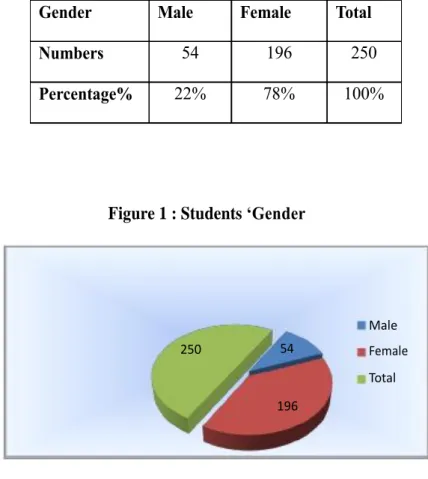
Table 1: Distribution of Students According to their Genders.
Figure 1 : Students ‘Gender
Male
250 54 Female
Total 196
If we take a look at the table above, we can notice that the majority of first-year students at department of English at Batna-2 University are females. They are of a considerable number rather than males. 196 participants of this questionnaire are females making up (78%) of the whole sample. 250 students, on the other hand, 54 males represent (22%) of the whole sample.
CHAPTER IV : ANALYITCAL FRAMEWORK
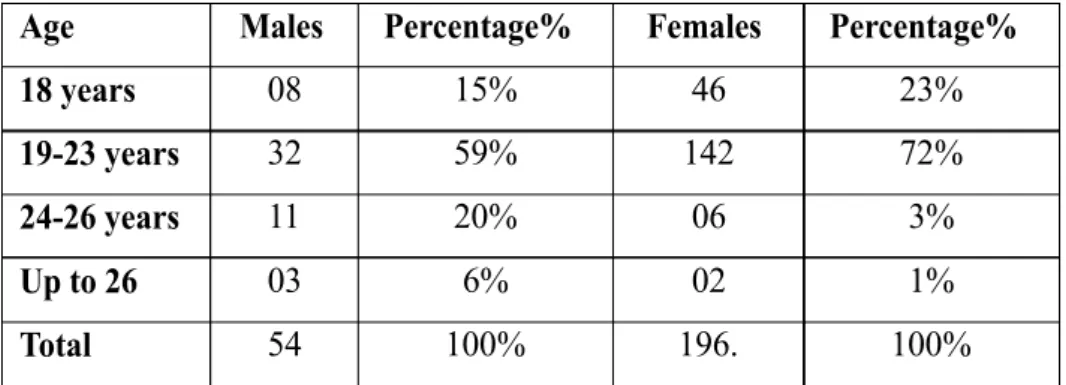
Table 2: Distribution of Students According to their Ages
Figure2: Students ‘Age
Males
Females
11 18 years 06 18 years 32 57 54 19-23years 24-26years 142 198 02 196 19-23years 24-26years 08 03 Up to 26 Total 46 Up to 26 TotalThe table above consists of four (4) rows. Each row represents the age of the participants. It includes both genders “Male and Female”. (15%) and (23%) are percentages that describe the students who are aged 18 years. With a look to the table, we can notice that most of the participants of this
questionnaire are aged between 19-23 years with an estimated rate of (72%) of female and (59%) of male which is the highest rate within this respect proved that students whether” Male” or “Female” are studying English language in their normal average age. On the other hand, (3%) of female and (20%) of female are students aged between “24-26” years. Whereas, only (1%) of female and (6%) of male are participants aged up to 26 years. These percentages indicate that both genders are studying English only to ameliorate their levels to get a job.
CHAPTER IV : ANALYITCAL FRAMEWORK
Part two: Facts and opinion
Table1 : Q1. Do you watch English movies?
Figure1: Students’ Choices of Watching Movies
Yes No total
Females
54 49 196 189 Yes No total 5 7The results illustrated in the table above show whether first-year students “Male, Female” are watching English movies. These results are considered as a bridge to accomplish our study. The results showed that nearly all of the students that have been taken as a sample to our study are watching movies.
CHAPTER IV : ANALYITCAL FRAMEWORK
Table 2: Q2. Do you watch English movies with subtitles?
Figure2: Students’ Choices of Watching Movies with Subtitles
Males
Females
54 50 Yes No 196 161 Yes No 4 total 35 totalA quick look at this pie- chart design can infer that there were no significant differences between “Males and females” on watching subtitled movies. In addition, the majority of the participants from both genders were answered with “Yes”. The percentages are respectively (93%) of male and (82%) of female. However, only (7%) of male and (8%) of female were answered with «No”. From these results, we conclude that watching English subtitled movies is the choice of the majority of students rather than watching movies without subtitles because they think that subtitles can enhance students speaking skill and oral performance, moreover, their scores increased significantly.
En te rt ain me … Lan gu ag e… To tal O th er s(s p ec … Percentage
CHAPTER IV : ANALYITCAL FRAMEWORK
Table 3: Q3. What are the reasons that lead you to watch subtitled movies?
Figure3: Students’ Reasons of Watching Movies
60 50 40 30 20 10 0 Male Male 200 100 0 Female Female Percentage
This chart shows the reasons that led the students to watch English subtitled movies. A quick look to the chart reveals that both genders are nearly equal with the following respective percentages Male (65%) and Female (69%), and the majority of them tend to choose “language skill improvement” because they believe that English movies with subtitles can provide them with authentic and varied language while (19%) of male and (28%) of female are watching movies to enjoy only. On the other hand, (17 %) of male and (04%) of female are students who chose others specify.
CHAPTER IV : ANALYITCAL FRAMEWORK
Table 4: Q4: Do you think that watching subtitled movies has beneficial effect on learning English?
Figure4: The Effect of Watching Movies
60 50 40 200 150 30 20 10 0 Yes No Total Male Percentage 100 50 0 Yes No Total Percentage Female
What is shown in Table (4) is something quite hopeful. (83 %) of male and (88%) of female are participants from both genders who agreed that watching English movies with subtitles have the beneficial effect on learning English language. This is an excellent feedback to use English subtitled movies as a purpose for learning a language. From this day forwards, it is a good recommendation for students to watch English subtitled movies as a beneficial way to learn English language along with other ways.
CHAPTER IV : ANALYITCAL FRAMEWORK
Table 5: Q5: How often do you watch movies for the sake of educational purposes?
Figure5: Duration of Watching Movies.
100 50 100% 100% 100% 0 99% 99% Percentage Female Male Percentage
The table above (5) shows that the majority of the participants from both genders are approximately similar in their percentages. Furthermore, most of them are light watchers of English subtitled movies representing the rate of (57%) of male and (63%) of female, they are watching movies (1 to 3) hours per week. It can be said that 1-3 hours of watching movies per week is not enough to improve the speaking skill and learn a language, at least,a learner needs to watch movies 4-6 hours per week which is estimated with (22%) for both genders. (20%) of male and (15%) of female they are participants who watch subtitled movies more than six hours per week. These participants can be called heavy watchers. Being a heavy movie watcher will be a good approach to learn English language quite faster, if followed by attention and focus.
CHAPTER IV : ANALYITCAL FRAMEWORK
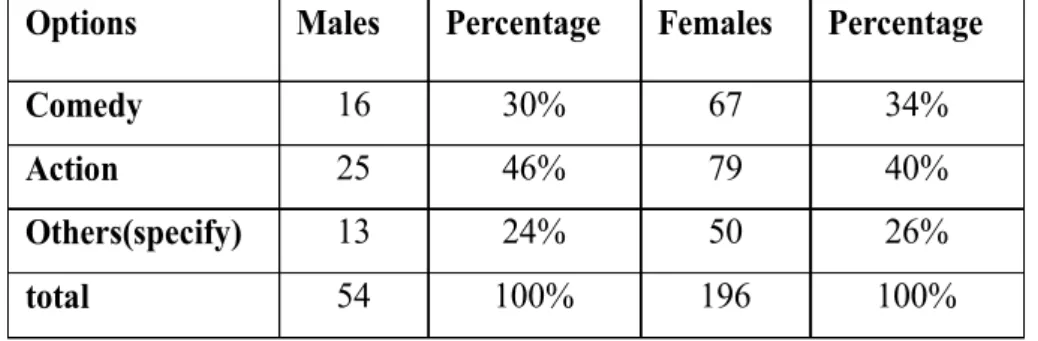
Table 6: Q6: Which genre do you prefer to watch?
Figure6: Selecting Movies to Watch
60 50 40 30 20 10 0 16 25 13 54 Male Percentage Male 100% 100% 100% 99% 99% 67 79 50 196 Percentage Female
Movies have several genres including: comedy, action, drama, documentary horror, and many others. Depending on these genres, the impact of the movies on learning language changes because of the statements in the movie which are the most important feature, and they affect the learner‟s comprehension. As it is shown in table (6), the majority of the participants from both genders (46%) of male and (40%) of female stated that they prefer watching action movies. (30%) of male and (34%) of female are watching comedy movies and (24%) of male and (26%) of female are watching other genres like, romance, drama, documentary.
CHAPTER IV : ANALYITCAL FRAMEWORK
Table 7: Q7-Does watching subtitled movies improve your pronunciation?
Figure7: Students’ Pronunciation through Movies
60 200 50 40 100 Female 30 Male 0 Yes No Total Percentage Female 20 10 0 Percentage Yes No Total
For EFL learners, English pronunciation is a challenge and extremely difficult, and when you read words,it is hard to know how they should be said. Hearing native English speakers „talk to each other will help learners to hear how words are pronounced. If they are using English subtitles, they will also be able to see how the words are written. As it is shown in table (7), the majority of the participants from both genders (87%) have answered with »yes». Whereas only (13%), from both genders believed that watching English subtitled movies is not the best way to improve their pronunciation.
CHAPTER IV : ANALYITCAL FRAMEWORK
Table 8: Q8-Do subtitles enhance comprehension of the language used in the movies and thus motivate
students to learn?
Figure8: Comprehension of the Language.
Male
Female
54 24 3 Yes No 196 164 Yes No27 i do not know i do not know
Total
11 21 Total
In English classes, students learn a huge amount of vocabulary and grammar, but they may not know how to use it in real life. Watching English subtitled movies will help them understand how to use all the knowledge they have learnt in everyday situations. That is why, the results above reveal that the majority of participants from both genders (44%) of male and (84%) of female believed that subtitles enhance comprehension of the language used in the movies and thus motivate students to learn.
CHAPTER IV : ANALYITCAL FRAMEWORK
Table 9: Q9-do your teachers encourage you to watch English movies for the sake of learning English
language?
Figure9: Motivating Students.
Male
Female
10 Yes 66 Yes 44 54 54 No Total 130 196 196 No TotalMotivation is a significant key to succeed. Students need to be motivated and encouraged in order to pass the barriers. That is why; teachers are the role models of students. So, they have a big role on learning their students and they should be motivators of their students. In the questionnaire, as it is shown in the table (9) in the response of the question (Do your teachers encourage you to watch movies for the sake of learning English, (81%) of male and (66%) of female are participants from both genders who answered with (Yes) which is the highest percentage and (19%) of male and (34%) of female are participants who answered with (No).
CHAPTER IV : ANALYITCAL FRAMEWORK
Question 10:
EFL students learn correct pronunciation through movies :
2,56 5,1 Female Male 3,7 16,32 13,12 14,81 24,07 41,83 40,74 22,22 0 5 10 15 20 25 30 35 40 45
StronglyAgree Agree Uncertain Desagree Stronglydesagree
EFL students understand unfamiliar accents and dialects through movies :
7,4 10,06 Female Male 16,84 42,85 19,38 16,66 29,62 27,8 13 0 0 5 10 15 20 25 30 35 40 45
StronglyAgree Agree Uncertain Desagree Stronglydesagree
CHAPTER IV : ANALYITCAL FRAMEWORK
Learners learn new vocabularies from movies:
34,29 42,34 Female Male 5,61 2,4 11,73 13 24 43 0 7,4 0 5 10 15 20 25 30 35 40 45 50
StronglyAgree Agree Uncertain Desagree Stronglydesagree
The subtitles in the movies help you understand the conversation better:
39,29 33,7 Female Male 11,24 10,2 2,75 42,6 20,4 13 9,25 2 0 5 10 15 20 25 30 35 40 45
StronglyAgree Agree Uncertain Desagree Stronglydesagree
CHAPTER IV : ANALYITCAL FRAMEWORK
English subtitled movies are good for teaching both listening and speaking for students:
46 32 Female Male 5 14,24 12 13 26 35 9 6 0 5 10 15 20 25 30 35 40 45 50
StronglyAgree Agree Uncertain Desagree Stronglydesagree
In English, people often say that 30% of what we say expressed through our words and the other 70% is all about how you say it, knowing what someone is saying is important. But knowing how they are saying it is even more important:
Figure one: It represents the percentages of student‟s opinion with respect to watching subtitled movies that will not improve their pronunciation. Among all participants,82 ℅ participants disagree on pronunciation improvement.
Figure two: It shows that watching subtitled movies will not help the EFL students to understand unfamiliar accents and dialects. Within this regard, 68℅ of the respondents disagree
Figure three: It represents the percentages of student‟s opinion on learners and how they learn new vocabularies from movies. 80℅ of the participants agree
Figure four: It represents the percentages of student‟s perception on watching subtitled movies. The figure shows that watching subtitled movies will improve their English life and help them understand the conversation better with a rate of 90℅ of the participants who agreed
Figure five :Among all the items, participants tend to agree most on English subtitled movies as being
good for teaching both listening and speaking with a rate of 90℅ of participants
CHAPTER V : DISCUSSION
Discussion
The results gathered from the analysis revealed that watching subtitled movies has an effect on the development of students speaking skill.
The findings of the present study have statistically proven that females have a considerable number in learning a foreign language rather than males. This is based on the scientific truth. Studies have, also, proven that females‟ brains show greater activity in the areas used for language encoding. On the other hand, males‟ brains are more analytical, and thus, they tend to prefer structured work, and they need some sensory reinforcement to process the data. For males the most effective way to study language is to learn visually (listening, seeing the word written down and repeating it) (Kate Figueredo, 2014).
In the second part of the students‟ questionnaire, students from both genders are approximately similar in their percentages. They show a great willingness to learn English and speak it fluently. The collected data show that the majority of the students are watching subtitled movies. This finding is considered as a bridge to conduct our study. Also, it is worth considering that «the more you interact,and contact with native spreaker,the more you learn and acquire a language” Vygotsky‟s claimed (p.86). From here, it could be assumed that English movies with subtitles could provide students with examples of English used in „real life‟ situations. Also,they expose students to natural expressions and the natural flow of speech. If they are not living in an English-speaking environment, the only one way to speak English fluently is watching English movies with subtitles which can provide learners with this real-life language input. According to Brain Stow and Lavaur (2011), “subtitles can be used to; enhance comprehension” (International Journal of Psychology 46.6, 455-462). Various studies (Baltova, 1999; Borrás and Lafayette, 1994; Garza, 1991; Neuman and Koskinen, 1992; Vanderplank, 1988, 1990) have demonstrated the positive effects of subtitling on productive skills such as a verbatim recall and retention of vocabulary in the proper context, as well as communicative performance in specific oral and written communication tasks. This information reveals that the majority of first-year students are watching English subtitled movies for language skill improvement because they believed that English with subtitles can provide them with authentic and varied language. In addition, watching subtitled movies for the sake of educational purposes requires to be a heavy watcher which means to watch English subtitled movies more than 6 hours per week, and this is a good approach to learn English quite faster if followed by attention and focus. Furthermore, English pronunciation is extremely difficult, but according to Marian (2009)” the presence of written text in films is beneficial to language learning”(p.88). Watching English movies with subtitles will help students improve their pronunciation by hearing native English speakers talk to each other and see how the words are written .
CHAPTER V : DISCUSSION
Finally, subtitles play a capital role in movie comprehension, so that English movies with subtitles are an integral part of students‟ lives. It makes perfect sense to bring them into the language and speak fluently.
Conclusion
The results of the present study conclude that movies are powerful tools that can help in developing students’ language skill. The participants in the study have positive attitudes toward the integration of subtitled movies in their daily life. The study, also, indicates that watching movies can enhance the students’ motivation to learn the language. The students believe that movies can improve their vocabulary acquisition, comprehension of the language, and pronunciation improvement.