An algorithmic theory of caches
by
Sridhar Ramachandran
Submitted to the
Department of Electrical Engineering and Computer Science
in partial fulfillment of the requirements for the degree of
Master of Science
at the
MASSACHUSETTS INSTITUTE OF TECHNOLOGY.
December 1999
Massachusetts Institute of Technology 1999.
All rights reserved.
Author
Department of Electrical Engineering and Computer Science
Jan 31, 1999
Certified by
/
-f Charles E. Leiserson Professor of Computer Science and Engineering Thesis SupervisorArthur C. Smith
Chairman, Departmental Committee on Graduate Students
Accepted byMSSACHUSVTS INSTITUT OF TECHNOLOGY
An algorithmic theory of caches
by
Sridhar Ramachandran
Submitted to the
Department of Electrical Engineering and Computer Science on Jan 31, 1999 in partial fulfillment of the
requirements for the degree of Master of Science.
Abstract
The ideal-cache model, an extension of the RAM model, evaluates the referential locality exhibited by algorithms. The ideal-cache model is characterized by two parameters-the cache size Z, and line length L. As suggested by its name, the ideal-cache model practices automatic, optimal, omniscient replacement algorithm. The performance of an algorithm on the ideal-cache model consists of two measures-the RAM running time, called work complexity, and the number of misses on the ideal cache, called cache complexity.
This thesis proposes the ideal-cache model as a "bridging" model for caches in the sense proposed by Valiant [49]. A bridging model for caches serves two purposes. It can be viewed as a hardware "ideal" that influences cache design. On the other hand, it can be used as a powerful tool to design cache-efficient algorithms. This thesis justifies the pro-posal of the ideal-cache model as a bridging model for caches by presenting theoretically sound caching mechanisms closely emulating the ideal-cache model and by presenting portable cache-efficient algorithms, called cache-oblivious algorithms.
In Chapter 2, we consider a class of caches, called random-hashed caches, which have perfectly random line-placement functions. We shall look at analytical tools to compute the expected conflict-miss overhead for random-hashed caches, with respect to fully asso-ciative LRU caches. Specifically, we obtain good upper bounds on the conflict-miss over-head for random-hashed set-associative caches. We shall then consider the augmentation of fully associative victim caches [33], and find out that conflict-miss overhead reduces dramatically for well-sized victim caches. An interesting contribution of Chapter 2 is that victim caches need not be fully associative. Random-hashed set-associative victim caches perform nearly as well as fully associative victim caches.
are algorithms that do not require knowledge of the parameters of the ideal cache, namely
Z and L. A cache-oblivious algorithm is said to be optimal if it has asymptotically optimal
work and cache complexity, when compared to the best cache-aware algorithm, on any ideal-cache. Chapter 3 describes optimal cache-oblivious algorithms for matrix transpo-sition, FFT, and sorting. For an ideal cache with Z = Q(L2), the number of cache misses
for an rn x n matrix transpose is
0(1
+m
In/L). The number of cache misses for either ann-point FFT or the sorting of n numbers is 0(1 + (n/L)(1 + logzn)). Chapter 3 also pro-poses a 0(mnp)-work algorithm to multiply an rn x n matrix by an n x p matrix that incurs 0(1 + (in + np + mp)/L + mnp/L Z) cache faults. All the proposed algorithms rely on recursion, suggesting divide-and-conquer as a powerful paradigm for cache-oblivious al-gorithm design.
In Chapter 4, we shall see that optimal cache-oblivious algorithms, satisfying the "reg-ularity condition," perform optimally on many platforms, such as multilevel memory hi-erarchies and probabilistic LRUcaches. Moreover optimal cache-oblivious algorithms can also be ported to some existing manual-replacement cache models, such as SUMH [8] and HMM [4], while maintaining optimality.
Thesis Supervisor: Charles E. Leiserson
Acknowledgments
I thank my advisor Charles E. Leiserson for his invaluable guidance. I thank Harald Prokop for introducing me to his work on cache-oblivious algorithms. I enjoyed work-ing with him on this subject. I am grateful to Matteo Frigo and Derek Chiou for their contribution to this thesis.
I owe a lot to the research environment at LCS. I thank Phil Lisiecki, Bin Song, Dimitris Mitsouras, Nitin Thaper, and Don Dailey for making Supertech an interesting group. Spe-cial thanks to Alejandro Caro, Jan-Willem Maessen, James Hoe, and Sandeep Chatterjee.
Contents
1 Introduction
1.1 Ideal-cache model: a bridging model for caches 1.2 Contributions of the thesis . . . . 2 Building the impossible: an ideal cache
2.1 Related work
2.2 Probabilistic LRU caches . . .
2.3 Balls and bins . . . . 2.4 Victim caches . . . . 2.5 Random-hashed victim caches
2.6 Simulation results . . . . 2.7 Conclusion . . . .
3 Cache-oblivious algorithms
3.1 Matrix multiplication . . . . .
3.2 Matrix transposition and FFT
3.3 Funnelsort . . . . 3.4 Distribution sort . . . .
3.5 Conclusion . . . . 4 Cache-oblivious algorithms on other cache models
4.1 4.2 4.3
M ultilevel caches . . . . Probabilistic LRU caches . . . . Memories with manual replacement: SUMH and
9 . . . . 1 0 . . . . 1 3 17 . . . . 19 . . . . 2 2 . . . . 2 6 . . . . 2 9 . . . . 3 4 . . . . 3 6 . . . . 3 8 43 . . . . 4 6 . . . . 4 9 . . . . 5 3 . . . . 5 8 . . . . 6 2 65 . . . . 6 6 . . . . 6 8 HM M . . . . 69 4.4 Conclusion Conclusion Bibliograpy 5 A 74 77 81
CHAPTER 1
Introduction
As processor clock rates increase rapidly, computer throughput is increasingly limited by memory bandwidth [41]. Main memory is typically much slower than the CPU. To im-prove memory performance, computer architects add one or more levels of caches to the memory hierarchy. Caches are small, fast memories close to the CPU which hold items that the CPU is likely to access. Today, almost all computers include one or more levels of on-chip or off-chip caches [28].
Among all mechanisms to improve computer performance, caches are arguably the simplest and most effective. Extensive research has been done in academia and industry to build faster, bigger, more concurrent, and smarter caches. Simulation studies of caching mechanisms on memory traces generated by programs are the most popular and widely accepted method of analyzing caches. Few theoretically sound caching mechanisms have been implemented, however. Consequently, a need exists for a theoretical framework to evaluate the worth of caching mechanisms.
While designing caches, computer architects tacitly assume that memory accesses made by programs exhibit spatial and temporal locality. Unfortunately, most algorithms today are engineered for efficient execution in flat memory models, such as the RAM [7] model. These algorithms do not generally exhibit much locality of reference. Consequently, a need exists for caching models that evaluate and reward referential locality displayed by algo-rithms.
This thesis proposes an extension of the RAM model, called the ideal-cache model, as a "bridging" model for caches. Section 1.1 elaborates the notion of a bridging model, and advocates the ideal-cache model as a bridging model for caches. The rest of the thesis justi-fies this proposal, as summarized in Section 1.2, by providing theoretically sound caching mechanisms and portable cache-efficient algorithms.
1.1 Ideal-cache model: a bridging model for caches
This thesis advocates the ideal-cache model as a bridging model for caches. In this sec-tion, we discuss the what a bridging model for caches is, and we review related work in modeling caches. This section then presents the ideal-cache model-an automatic, fully associative cache model with optimal replacement.
What is a bridging model?
The notion of a bridging model is inspired by Valiant's bridging model for parallel compu-tation [49]. Valiant's bridging model, called the BSP (Bulk-Synchronous Parallel) model, aims at providing an abstraction for parallel computers. Algorithm designers optimize their algorithms for the BSP model, while computer architects improve the BSP parame-ters of their parallel compuparame-ters.
In a similar vein, a bridging model for caches, as illustrated in Figure 1-1, provides a framework for algorithm and cache design. In this thesis, the ideal-cache model is pro-posed as a bridging model for caches. Algorithm designers develop algorithms that work efficiently on the ideal-cache model. On the other hand, computer architects design mem-ory hierarchies that perform nearly as well as the ideal cache.
Traditional cache models
Before looking at the ideal-cache model, we shall review previous work in cache model-ing. The traditional approach to modeling caches is to propose a parameterized model capturing the nonuniform memory access cost in memory hierarchies. HMM [4], BT [5], and UMH [8] are examples of such parameterized models. An algorithm is optimized to work efficiently for the parameters of the memory hierarchy. Cache designers are expected to improve the parameters for their caches.
El
I.
--- Ideal cache model
Figure 1-1: Bridging model for algorithm and cache design.
Figure 1-2: Memory hierarchies of typical modem processors.
Many traditional models suffer from a drawback, however. Traditional cache models typically assume software control over caches [4, 5, 81. On the other hand, most practical caches are transparent to the programmer [32, Section 2.4.2]. In fact, a programmer does not have total control over caches in any of the architectures shown in Figure 1-2.
Given the legacy of automatically managed caches, we can appreciate that software cache control only augments, but does not replace, automatic cache management. I believe that providing complete software control over caches may result in complexity that hard-ware designers may choose to avoid. Recently, the Computer-Aided Automation Group at MIT Laboratory for Computer Science, started the Malleable Caches project [17] to re-search limited cache-control directives.
The drawback of designing algorithms for cache models that assume software-managed caches is twofold. Firstly, the algorithm designer must manage the memory hierarchy
Processor Li L2
Pentium III 16K/16K 4-way associative 256K 8-way associative AMD K6-III 32K/32K 2-way associative 256K 4-way associative
HP PA-8500 512K/1M 4-way associative
UltraSparc 2 8K/8K direct-mapped 512K direct-mapped Alpha 21164 8K/8K direct-mapped 96K 3-way associative
--manually. According to my experience, efficient manual management of a multilevel memory hierarchy is a strenuous exercise. Secondly, efficient algorithms developed for software-managed cache models cannot necessarily be easily ported to typical memory hierarchies that are automatically managed. Consequently, the assumption of software-managed caches degrades the usefulness of a cache model.
The assumption of manual memory management is reasonable for out-of-core memory models, however. Using software environments such as TPIE [211, a programmer can exert complete control over external memory. Shriver and Nodine [43], and Vitter [50] show that memory models with explicit management aid the development of efficient external memory algorithms.
Ideal-cache model
The ideal-cache model is a simple, two-level cache model with automatic replacement, that evaluates the performance of algorithms using two complexity measures-the work complexity and the cache complexity. We now look at the details of the ideal-cache model. The ideal-cache model, which is illustrated in Figure 1-3, consists of a computer with a two-level memory hierarchy consisting of an ideal (data) cache of Z words, and an ar-bitrarily large main memory. Because the actual size of words in a computer is typically a small, fixed size (4 bytes, 8 bytes, etc.), we shall assume that word size is constant; the particular constant does not affect our asymptotic analyses. The cache is partitioned into
cache lines, each consisting of L consecutive words which are always moved together
be-tween cache and main memory. Cache designers typically use L > 1, banking on spatial locality to amortize the overhead of moving the cache line. We shall generally assume in this thesis that the cache is tall:
Z = Q(L(2
which is usually true in practice.
The processor can only reference words that reside in the cache. If the referenced word belongs to a line already in cache, a cache hit occurs, and the word is delivered to the processor. Otherwise, a cache miss occurs, and the line is fetched into the cache. The ideal cache is fully associative [28, Ch. 5]: cache lines can be stored anywhere in the cache. If the cache is full, a cache line must be evicted. The ideal cache uses the optimal off-line
Main memory
Augmentation to the RAM model
Cache, size =Z words
optimal replacement CPU Q cache misses; W work IE
Line length = L words
Figure 1-3: The ideal-cache model.
strategy of replacing the cache line whose next access is furthest in the future [10], and
thus it exploits temporal locality perfectly.
Unlike various other hierarchical-memory models [4, 5, 8, 11] in which algorithms are
analyzed in terms of a single measure, the ideal-cache model uses two measures. An
algo-rithm with an input of size n is measured by its work complexity W(n)-its conventional running time in a RAM model [7]-and its cache complexity Q(n; Z, L)-the number ofcache misses it incurs as a function of the size Z and line length L of the ideal cache. When
Z and L are clear from context, we denote the cache complexity simply as Q(n) to ease
notation.
1.2 Contributions of the thesis
The rest of this thesis justifies the ideal-cache model as an apt bridging model for caches.
In this section, we look at various issues involved in adopting the bridging framework,
and a brief outline of results addressing these issues. The contribution of this thesis can
be broadly characterized into three categories. The first category of results, presented in
Chapter 2, relates to the design of theoretically sound caching mechanisms closely
emulat-ing the ideal-cache model. Results in this category justify the ideal-cache model as a
hard-ware "ideal" influencing cache design. The second category of results, presented in Chap-ter 3, relates to the design of portable cache-efficient algorithms, called cache-oblivious algorithms, that perform well on any ideal cache without any tuning whatsoever. Results in this category justify the ideal-cache model as a powerful model for algorithm design. The third category of results, presented in Chapter 4, relates to the portability of cache-oblivious algorithms to more complicated cache models-such as multilevel caches and some traditional cache models that assume software-controlled caches-without loss of efficiency.
Ideal-cache model: a hardware ideal
Optimal replacement depends on the future accesses made by the algorithm [10]. Since cache line replacement is an online problem, ideal caches cannot be implemented in prac-tice. We therefore address the question,
How can we design caches that exhibit near-optimal performance?
in Chapter 2. Sleator and Tarjan [45] show that fully associative LRU caches are asymp-totically competitive to proportionally smaller ideal caches. Unfortunately, fully associa-tive caches do not have efficient practical implementations [28, pg. 568]. Cache design-ers limit the associativity of caches to achieve fast lookup. Typical set-associative caches have small associativity, as shown in Figure 1-2. Limiting cache associativity creates con-flict misses [30], which are also called interference misses. The concon-flict-miss overhead for set-associative caches has been studied extensively using simulation [29, 40, 41], and to a restricted extent, using analytical techniques [2]. Recently, pseudorandom line placement was proposed as a mechanism to reduce conflict misses [27]. In Chapter 2, we consider a class of caches, called random-hashed caches, that have perfectly random line-placement functions. We shall look at analytical tools to compute the expected conflict-miss over-head for random-hashed caches, with respect to fully associative LRU caches. Specif-ically, we obtain good upper bounds on the conflict-miss overhead for random-hashed set-associative caches. We shall then consider the augmentation of fully associative victim caches [33], and find out that conflict-miss overhead reduces dramatically for well-sized victim caches. An interesting contribution of Chapter 2 is that victim caches need not be fully associative. Random-hashed set-associative victim caches perform nearly as well as
fully associative victim caches. To summarize, Chapter 2 justifies the ideal-cache model as a hardware ideal by suggesting practical designs for near-ideal caches.
Ideal-cache model: a powerful model for algorithm design
Usually, algorithms that perform efficiently on a parameterized cache model require the knowledge of the cache parameters. We refer to such algorithms as cache-aware algo-rithms. The ideal-cache model has two parameters, namely Z and L. A cache-aware algorithm requires the values of these parameters to tune itself. In this thesis, we shall focus on cache-oblivious algorithms, that do not require the parameters Z and L. In other words, oblivious algorithms exhibit good performance on all ideal caches. A cache-oblivious algorithm is said to be optimal if it has asymptotically optimal work and cache complexity, when compared to the best cache-aware algorithm, on any ideal-cache. Being a subset of cache-aware algorithms, optimal cache-oblivious algorithms may be harder, if not impossible to design. We therefore address the following questions:
How can optimal cache-oblivious algorithms be designed? What are the applicable paradigms?
Do all problems permit optimal cache-oblivious algorithms?
Chapter 3, which presents research done jointly with Matteo Frigo, Charles Leiserson and Harald Prokop, describes optimal cache-oblivious algorithms for matrix transposi-tion, FFT, and sorting. For an ideal cache with Z = Q(L2), the number of cache misses
for an m x n matrix transpose is 0(1 + mn/L). The number of cache misses for either an n-point FFT or the sorting of n numbers is
0(1
+ (n/L)(1 + logZn)). I shall alsopro-pose a 0(mnp)-work algorithm to multiply an m x n matrix by an n x p matrix that incurs 0(1 + (mn + np + mp)/L + mnp/L VZ) cache faults. All the proposed algorithms rely on recursion, suggesting divide-and-conquer as a powerful paradigm for cache-oblivious al-gorithm design. For the last question regarding the power of cache oblivious alal-gorithms, however, existing insight seems discouraging. Bilardi and Peserico [11] show that some computation DAGs do not permit optimal cache-oblivious execution in the HRAM model. Peserico believes that this result can be extended to the ideal-cache model [381. I have still not encountered a practical problem that is not solvable by an optimal cache-oblivious al-gorithm, however. The results presented in Chapter 3, I feel, justify the ideal-cache model
as a powerful model for algorithm design.
Porting cache-oblivious algorithms
The ideal-cache model assumes a perhaps-questionable and overly simplified cost model. We therefore address the question,
How do optimal cache-oblivious algorithms perform on complex memory hierarchies?
In Chapter 4, which presents research done jointly with Matteo Frigo, Charles Leiserson and Harald Prokop, we shall see that optimal cache-oblivious algorithms on ideal caches perform optimally on many platforms. These platforms include multilevel memory hierar-chies and probabilistic LRU caches. Optimal cache-oblivious algorithms can also be ported to some existing manual-replacement cache models, such as SUMH [8] and HMM [4], while maintaining optimality. We shall also look at some automated memory manage-ment routines that enable porting.
Chapter 5 contains my concluding remarks on this thesis along with open problems that interest me. Two interesting open questions are the following:
Do the caching mechanisms proposed in this thesis have practical significance? How do cache-oblivious algorithms perform on real computers with caches?
We shall look at preliminary results and related work addressing these questions in Chap-ter 5.
CHAPTER 2
Building the impossible: an ideal cache
Building an ideal cache is impossible, since optimal replacement cannot be implemented in an online setting such as caches [10]. Cache designers should, therefore, be satisfied with caches that exhibit near-optimal performance. This chapter makes a strong case for caches with random line-placement functions by proving that such caches are nearly ideal. Fully associative LRU [28] caches are provably comparable to proportionally smaller ideal caches [45]. Unfortunately, searching an item in a fully associative cache consumes too much time, severely limiting their practical worth [28, pg. 568]. Cache designers prefer set-associative caches due to their faster search times [30, 41]. A line-placement function
H is used to map a memory address to a set in the cache, as shown in Figure 2-1.
Con-flict misses [30] occur when too many data items map to the same set, causing potentially reusable cache lines in the set to be flushed out, despite sufficient capacity in the overall cache. Typically, the line-placement function is a simple modulo function implemented by extracting bits from the memory address. Some computations are significantly slowed down in set-associative caches having this naive line-placement function, however [25,27]. Intuitively, we can see that conflict misses are largely due to bad line placement rather than low associativity. In this chapter, we theoretically and using simulation prove this intuition. Specifically, we analyze caches with perfectly random line-placement functions,
Address-Cache, size = Z words
_ _ I _ _ _
_ _ I _ _
I_
S lines per setL words
ILIIIII---Set
II|
11 1
Figure 2-1: Set-associative cache with line-placement function H.
called random-hashed caches. We bound the "conflict-miss overhead," which is the
frac-tion of memory accesses that are conflict misses, for random-hashed set-associative caches. Cache designers add victim caches [331 to reduce conflict misses. In this chapter, we an-alyze the benefits of adding victim caches, theoretically. If the victim cache is capable of holding the expected number of "overflowing lines," the conflict-miss overhead is reduced by a factor exponential in the size of the victim cache. We also look at random-hashed set-associative caches as a scalable alternative to proportionally smaller fully associative victim caches.
We now look at the notation used and assumptions made throughout the chapter. A set-associative cache with a capacity of Z words and S-way associativity, such as that shown in Figure 2-1, is partitioned into cache lines holding L words, each of which be-longs to a set holding S cache lines. We are interested in caches with small associativity S. The number of cache lines in the cache is denoted by nL = Z/L. The total number of sets
in the cache is denoted by ns = Z/SL. Cache lines in a set are maintained using LRU re-placement. Since at most S cache lines belong to a set, maintaining LRU information takes only [lg S1 bits. Hwang and Briggs [32, pg. 116] present some possible designs for small LRU-managed sets. The main memory is also divided into lines of L contiguous words. Each line is associated with a line address. Each set is assigned to a set address ranging from 0 to ns -1. The line-placement function
H :0, 1, 2, ... } a e0r...,nse-1
random hash function, which satisfies the distribution
Pr{(H(ii) i)A -A (H(ik) jk)} 1nk
for any k > 0, valid line addresses 1, ik, and valid set addresses k... 11, ... ,
The rest of this chapter is as follows. We first discuss previous work related to this chapter in Section 2.1. Section 2.2 presents an interesting class of randomized caches called probabilistic LRU caches. An "absence" function P completely characterizes a probabilistic LRU cache, also called, a P-LRU cache when the absence function P is known. Section 2.2 proves that the expected number of cache misses of a P-LRU cache has a conflict-miss overhead of P(i) when compared to a fully associative cache with i cache lines. Proba-bilistic LRU caches are valuable since random-hashed set-associative caches are P-LRU caches for a computable absence function P. Section 2.3 deals with obtaining good upper bounds and approximations for the absence function using the well-studied balls and bins problem [36, Section 3.1]. Random-hashed set-associative caches augmented with victim caches [33] are also probabilistic LRU caches. Section 2.4 evaluates the absence function for such caches. In Section 2.5, we consider victim caches that are not fully associative. Set-associative victim caches with random-hashed line placement can replace proportionally smaller fully associative victim caches without considerable degradation in performance. Section 2.6 presents simulation results predicting the expected cache misses incurred by some SPEC95 floating point benchmarks on random-hashed caches. These results, plotted in Figures 2-9 through 2-15, show that caches with small associativity can exhibit prov-ably close performance to fully associative LRU caches, and that small victim caches can remarkably reduce the miss rate. Section 2.7 presents my concluding remarks on this chap-ter relating my work to previous and ongoing research on cache design.
2.1
Related work
The replacement algorithm used by a cache heavily influences its miss rate. Many re-searchers have analyzed various cache replacement algorithms theoretically. Belady [10] proved that the best replacement strategy is to replace the cache line accessed farthest in the future. Due to its dependence on the future of the memory-access sequence, Belady's algorithm cannot be used in an online setting.
Since optimal cache replacement is impossible, theoreticians have pursued algorithms that could nearly match the performance of ideal caches.
Definition 1 A cache replacement strategy is said to be ri-competitive if there exists a constant b,
such that, on every sequence of requests, the number
Q
of cache misses is at most TjQ* + b, whereQ*
is the number of cache misses on an optimal cache.In 1985, Sleator and Tarjan [45] proved that an LRU cache with k lines is k/(k -k* + 1)-competitive to an optimal cache with k* lines. They also proved that better bounds cannot be achieved by deterministic caching algorithms. If we compare LRU and ideal caches of the same size, the competitive ratio is
k k
k -k* +1 k-k+1
= k
which is not impressive. If we compare LRU caches with smaller ideal caches, however, the competitiveness result can be attractive.
Lemma 2 Consider an algorithm that causes Qideal(n; Z, L) cache misses on a problem of size n
using a (Z, L) ideal cache. Then, the same algorithm incurs QLRU(n;Z, L) < 2Qideal(n; Z/2, L) cache misses on a (Z, L) cache that uses LRU replacement.
Proof. The number k of lines in the LRU cache is k = Z/L. The number k* of lines in the
ideal cache is k* = Z/2L = k/2. Therefore, the competitive ratio is
k 2k*
k -k*+1 k* +
< 2.
Thus, from Definition 1, QLRU(n; Z, L) < 2Qidea(n; Z/2, L) + b, where b is a constant. If both
caches are empty initially, the constant b is 0 [45].
EZ
In other words, an LRU cache performs at most twice as many cache misses as an ideal cache half its size. The importance of this result lies in the fact that the analysis is indepen-dent of the access sequence. In practice, fully associative LRU caches perform much better than the theoretical bound [54]. To summarize, fully associative LRU caches excel from a theoretical and practical standpoint.
Apart from the miss rate, cache design involves other performance metrics such as hit time and miss penalty. The hit time for a fully associative caches is dominated by the time
to perform an associative search. In the late 1980's, the use of caches with limited associa-tivity was justified on the basis of their superior hit times, although their miss rates were slightly inferior in simulations [29, 401. The cost of associativity is high even in current practice [28].
If a modulo line-placement function is used, some programs experience inordinate con-flict misses. A common class of such memory-access sequences is shown in [27, Section 3]. Even simple matrix computations can generate many conflict misses for certain dimen-sions of a matrix [25, Figure 4 and 51.
As early as 1982, Smith's survey on caches [46] mentions the use of pseudorandom line-placement functions to reduce conflict misses. At that time, the advantage of using such functions did not justify the additional complexity in the cache. Recently, interest has been revived in this area. Using simulation techniques, GonAlez, Valero, Topham, and Parcerisa [27] extensively study the performance gains in using placement functions based on XOR and polynomial arithmetic [42].
The well-studied random-replacement caches [36] differ slightly from random-hashed caches. To locate an item with line address x, random-hashed caches search only the set
H
(x).
On the other hand, a random-replacement cache must perform an associative search. Consequently, random-hashed caches can have better hit times than random-replacement caches. There are differences in performance as well. Consider a memory-access sequence of the form a, b, a, b,..., where a and b are two different line addresses. A random-hashed cache with associativity S =1, places a and b in sets H(a) and H(b). Every access is a cache hit if H(a) # H(b), and otherwise every access is a cache miss. A random-replacement cache evicts a random cache line and may incur both cache hits and cache misses in the sequence.Numerous other techniques have been proposed to reduce conflict misses in direct-mapped and set-associative caches. Jouppi [33, 34] proposed the addition of a victim cache to hold items that are evicted from the limited-associativity cache. Hash-rehash caches [1] and column-associative caches [3] use two hashing functions to avoid conflict misses.
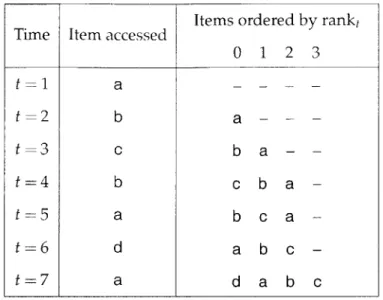
Figure 2-2: Example showing the rank of items in a fully associative LRU cache.
2.2
Probabilistic LRU caches
In this section, we describe probabilistic LRU caches, an interesting class of randomized caches. A probabilistic LRU cache can be fully characterized by its absence function. Random-hashed caches discussed in this thesis belong to the class of probabilistic caches. We shall analyze the properties of probabilistic LRU caches in this section. Later, in Sec-tions 2.3, 2.4, and 2.5, we shall show that some random-hashed caches are probabilistic LRU caches, and we shall obtain approximations and bounds on their absence functions.
We first look at fully associative LRU caching in more detail. Let us consider the cache misses made by algorithm A. During the execution of algorithm A, we can associate each line in the memory with a rank that gives the number of other distinct cache lines accessed after its most-recent access. The rank of a line x before the tth memory operation is given by rankt (x). On the first access of a line x in A, its rank is oo, since the most-recent access of x is undefined. Figure 2-2 shows the rank of items for a sample memory-access sequence. In the example, the rank of item c at time t = 4 is 2. Items not displayed in the table have
rank oo.
Lemma 3 Let line x be accessed by the tth memory operation of algorithm A. Then, line x is held
in a fully associative LRU cache capable of holding i cache lines if and only if rankt (x) < i.
Proof. A fully associative LRU cache maintains the i most-recently accessed cache lines.
Time Item accessed Items ordered by rankt 0 1 2 3
tim Ite acse
t=1 a - --t=2 b a - -t=3 C b a -t=4 b c b a -t=5 a b c a -t=6 d a b c -t=7 a d a b c
The lemma follows from the definition of rank.
In order to simplify the forthcoming discussion, we define a function Val: {false, true} -{0,1} as
Val(A) =
1if A is true,
0 otherwise.
to simplify forthcoming mathematical presentation. The following corollary to Lemma 3
expresses the number of cache misses incurred on a fully associative cache using the Val function.
Corollary 4 A memory-access sequence x1,..., xT incurs
T
QLRU (1) = Val (rank t(x t) > 1) (2.1)
t=1
cache misses on a fully associative LRU cache with i cache lines. Consequently, the function
QLRU(i)
is
monotonicallydecreasing, i.e.,
T = QLRU(0) QLRU(1) > QLRU( 2) > - EThe characterization of fully associative LRU caches, as given by Lemma 3, can be extended to incorporate randomized caches.
Definition 5 Consider a memory-access sequence x1, ..,xT. Let P: {0,12, . ..} - [0,1] be a
monotonically increasing function. For all t > 0, a probabilistic LRU cache with absence func-tion P misses xt on the tth access with probability (exactly)
1 - P(rankt (xt)) .
Any embodiment of a probabilistic LRU cache should include a random process, ex-cept, of course, fully associative LRU caches. A fully associative LRU cache can be defined as a probabilistic LRU cache with absence function P satisfying
P (1) =_ Val (i < Z),
for all i > 0.
Another possible embodiment of a probabilistic LRU cache is as follows. Consider a cache capable of maintaining any set S of lines. We assume that the cache does not have any capacity constraint on the cardinality of set S. Upon a cache hit, the set S remains unchanged. Upon a cache miss on line x, a coin having success probability p is tossed. If
El
0.9 -0.8 -0.7 -0.6 -a- 0.5 -0.4 0.3 0.2 -0.1 0 0 50 100 150 200
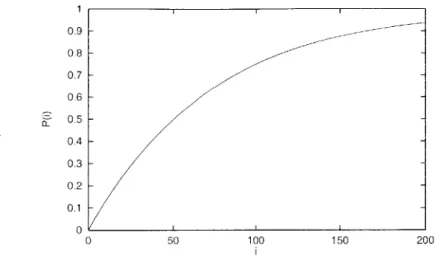
Figure 2-3: Graph showing an exemplary absence function P.
the coin toss is a success, line x is added to the set, i.e., S - S U {x}. Otherwise, the cache
is flushed before incorporating x, i.e., S +- {x}. Let us analyze the probability that the tth access in the memory-access sequence x1,..., xT, is a cache hit. If rankt (xt) is oo, the cache
misses on xt, since xt has not been accessed previously. Otherwise, rankt(xt) distinct lines are accessed after the most-recent access of xt. For each distinct line accessed, the cache is not flushed with probability p. Therefore, the tth access is a cache hit with probability prank, (x,). In other words, the cache under consideration is a P-LRU cache with absence function
P(i) =I- p,
for all i > 0. Figure 2-3 shows the absence function of the above cache, for p = 1/21/50.
According to the figure, an access made to a line after 50 other distinct lines have been accessed is a cache miss with probability exactly 1/2. An access made to a line with rank 100, is a cache miss with probability exactly 0.75. Although probabilistic, a P-LRU cache exhibits very "predictable" behavior, since P is a function associated with the cache and not the memory-access sequence.
The following lemma shows that the expected number of cache misses is a weighted sum of the cache misses incurred in fully associative LRU caches of all possible sizes.
Lemma 6 Let QLRU(i) be the number of cache misses incurred by algorithm A on an LRU cache
E [Q] of cache misses is given by
E [Q]= rP(0) +
Y
QLRU(i) (P(i) - P(i-1)) - (2.2) i>0Proof. The expected number of cache misses is T
t=1
T rankt (xt)
= P(O) + Y P(i) - P(' - 1)
t=1 (i=1
= TP(0) + Val(rankt(x) > i)(P(i) - P(i-1)) t=1 i>O
T
= TP(O)+ (P(i) - P(i -1)) Val(rank(xt) > i)
i>O t=1
= TP(0) + QLRU (i) (P(i) -P(i-- 1)) i>O
from Equation (2.1) in Corollary 4.
We now look at a rigorous definition of conflict-miss overhead.
Definition 7 Consider any memory-access sequence x1, .. . , XT. Let QLRU be the number of cache
misses on a fully associative LRLU cache capable of holding i lines. A random-hashed cache has conflict-miss overhead (i) if, for every memory-access sequence, the number Q of cache misses is at most QLRU + -(i)T.
Let us consider an example illustrating Definition 7. Consider a random-hashed cache with expected conflict-miss overhead 0.01 with respect to a fully associative LRU cache of half the size. Compared to the fully associative LRU cache, the random-hashed cache incurs misses on an extra 1% of its memory accesses.
We now bound the conflict-miss overhead of probabilistic LRU caches.
Theorem 8 A P-LRU cache has an expected conflict-miss overhead /3(i) = P(i) with respect to a
fully associative cache capable of holding i cache lines.
Proof. Let T be the number of memory operations, and let QLRU (i) be the number of cache misses in a fully associative cache capable of holding i cache lines. The expected number of cache misses according to Lemma 6 is
E [Q] = P(0) + TQLRU (1) (P(I) - P(I - 1)), i>O
Definition 5 states that P is a monotonically increasing function. Furthermore, we have
T > QLRU(1) > QLRU(2) >
-according to Corollary 4. Thus, we can bound the expectation of the number of cache misses as
E [Q] < TP (Z)+ lim QLRU(Z)(P(i) -
P(Z))
" T P(Z)+ QLRU(Z)(1 -
P(Z))
" TP(Z)+QLRU(Z),
since P(i) < 1 for all i. E
Unlike Lemma 6, Theorem 8 makes no assumption about the QLRU function. In other words, Theorem 8 gives a "competitive" analysis of the conflict-miss overhead. Although the analysis made by Theorem 8 is not exact, the following lemma shows that it cannot be made any tighter.
Lemma 9 There exists a memory-access sequence that incurs an expected conflict-miss overhead
of P(i) in a P-LRU cache with respect to a fully associative cache capable of holding i cache lines.
Proof. Consider an infinite sequence of the form
al sa2, ...- ai, a,, ..--. ai, aj,
-where each a1 is distinct. Every element accessed after the first i accesses has rank i. There-fore, the probabilistic LRU cache misses on these elements with probability P(i). A fully associative cache capable of holding i lines does not miss after the first i accesses. Since we consider an infinite sequence, the conflict-miss overhead tends to P(i). El
2.3 Balls and bins
In this section, we analyze the performance of random-hashed set-associative caches. First, we prove that random-hashed set-associative caches are probabilistic LRU caches having absence functions expressible as solutions to the balls and bins problem given in [36, Sec-tion 3.1]. Then, the absence funcSec-tion for random-hashed caches with small associativity is
approximated. Finally, Theorem 8 is used to evaluate conflict-miss overhead of random-hashed set-associative caches.
Recall that for set-associative caches, we defined parameters nL as the number of cache lines, ns as the number of lines in a set, and S as the associativity. A random hash function
H is used to map the line address to a set address. Cache lines in a set are maintained
using LRU replacement.
We now prove a crucial lemma showing that random-hashed caches are P-LRU caches for some absence function P. But first, we develop a notation to represent the balls-and-bins distribution.
Definition 10 Consider i balls thrown uniformly at random into n initially empty bins. The
random variable B B(i, n) denotes the number of balls in a given bin.
Lemma 11 A random-hashed set-associative cache having ns sets of associativity S is a
probabilis-tic LRU cache. The absence function P satisfies
P(i) =Pr{BB(i,ns) > S}
Proof. Consider a memory-access sequence x1,..., x. When a line xt is accessed by the tth operation, it is cached in set H(xt). Line xt can be evicted only by cache lines accessed after its most-recent access. From the definition of rank, we know that rankt(xt) distinct lines have been accessed after the most-recent access of xt. If less than S of these lines
map to H(xt), the access to xt hits the cache, an event which happens with probability
Pr{BB(i,ns) < S}. Thus, the random-hashed cache is a P-LRU cache satisfying P(i) =
Pr{BB(i,ns) > S}. E
Corollary 12 A random-hashed direct-mapped cache is a probabilistic LRU cache with absence
function
P(1) =1I- (I-- 1/ndi ,
for all i > 0. The expected conflict-miss overhead such a cache with respect to a fully associative cache holding i cache lines is P(i).
Proof. We use the definition of P as in Lemma 11. The probability that at least one ball is
present in a given bin after placing i balls is given by
The rest of the lemma follows from Theorem 8. El
The analysis done in Corollary 12 can be extended to random-hashed caches with small set-associativity.
Corollary 13 A random-hashed cache having associativity S
<
ns is a P-LRUL cache, whereP(i)
-
e-l/"s. (i/ns) j=0 J.Proof. The probability of
j
balls falling in a bin is(
I 1) 1 )n,-j " (I/ns)j ns ns 1! ns)
(i/ns)] -i/1s
for 1 < J< ns. The result follows from Lemma 11. l
For large S, we can use the Chernoff bound as follows.
Corollary 14 A random-hashed set-associative cache with nL cache lines and associativity S is a
P-LRL cache, where
P(i) <
1+(
J
for = n/i-1.
Proof. The proof is similar to Corollary 12. The absence function is given by
Pr {less than S balls are placed in a given bin}
Let indicator random variable Xj be defined as
Xj = Val(Ball j is placed in the given bin)
The absence probability is given by
P(i) = Pr { Xj < S j=0
which is a binomial random variable with expectation i/ns. A binomial random variable X with expectation p satisfies the inequality
according to the Chernoff bound given in [36, pg. 681. We can apply this bound to yield
P(i) <
where = nsS/i-1 =n/i1. El
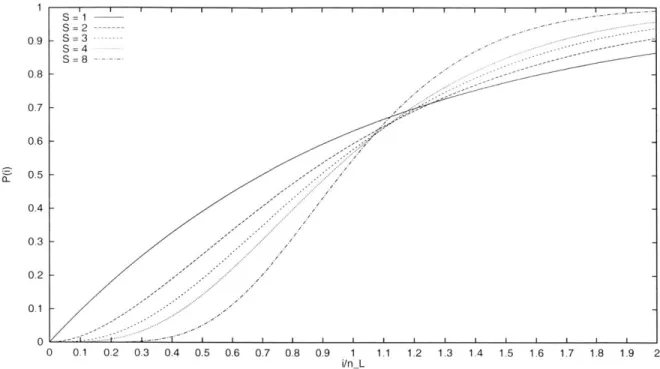
Curiously, Corollaries 12, 13, and 14 relate P(i) to functions of S and /nL that do not require the value of i. Corollary 13 gives good approximations for P(i) function for typical values of S and nL. Figure 2-4 plots the function P(i) versus i/nL for associativities S = 1,2,3,4,8, using Corollary 13. From Theorem 8, we have 0(i) = P(i). We can, therefore, interpret this graph as the conflict-miss overhead 13(i) of a random-hashed set-associative cache versus the ratio of the fully associative cache size i to the set-associative cache size
nL. For example, when we compare random-hashed caches with fully associative caches
of the same size, the conflict-miss overhead is around an unimpressive 60% for the curves plotted in Figure 2-4. If we compare random-hashed caches with fully associative caches of half the size, the conflict-miss overhead is around 5% for S = 4, and around 40% for S = 1. Thus, higher associativity reduces the conflict-miss overhead if we look at proportionally smaller LRU caches. On the other hand, if we compare random-hashed caches with LRU caches bigger by a factor of more than 1.3, caches with smaller associativity exhibit better conflict-miss overheads.
The conflict-miss overhead shown in Figure 2-4 is approximately tight for the worst-case, from Lemma 9 and Corollary 13. These values are not impressive, however, for typ-ical set-associativities between 2 and 4. In the next section, we shall remarkably improve the worst-case conflict-miss overhead using victim caches. In Section 2.6, we shall see that SPEC95 floating point benchmarks perform much better than predicted in Figure 2-4 on random-hashed set-associative caches.
2.4
Victim caches
In this section, we analyze random-hashed set-associative caches augmented with victim caches [33]. A victim cache is a small fully associative LRU cache that holds items knocked out by the hashed set-associative cache. Let n v be the number of lines in the victim cache. Intuitively, the advantage of adding a victim cache is to avoid thrashing caused by as many as nv badly-mapped cache lines, which we refer to as overflowing lines. Victim
0.9 3 -S=4 S=8 0.8 0.7 0.6 0.5 0.4 0.3 0.2 0.1-0 ... I I I I I I I 0 0.1 0.2 0.3 0.4 0.5 0.6 0.7 0.8 0.9 1 1.1 1.2 1.3 1.4 1.5 1.6 1.7 1.8 1.9 2 i/n_L
Figure 2-4: Plot of P(i) versus
i/nL
for set associativity S =1,2,3,4,8. The random-hashed cache is capable of holding nL lines. P(i) is also the worst-case conflict-miss overhead 0(i) of the random-hashed cache with respect to a fully associative cache of size i.cache do not help if all lines in the memory-access sequence are mapped to the same set. Consequently, caches with deterministic line-placement functions perform only as well as a fully associative cache of size ny + S, for certain tailored memory-access sequences. In our cache model, however, victim caches have significant provable gains. Specifically, for nV greater than a certain threshold, the conflict-miss overhead is reduced by a factor exponential in nv.
The analysis of adding victim caches, presented in this section, works for a large class of probabilistic LRU caches including random-hashed set-associative caches. The proba-bilistic LRU caches belonging to this class satisfy the following technical condition.
Definition 15 A P-LRU cache is said to be negatively correlated on exclusion if during any
access, the probability that cache lines with ranks i1, i2, - , ik are not present in the cache is at most
P(ii)P(i2) . .. P(ik).
We now prove that random-hashed set-associative caches satisfy the technical condi-tion given in Definicondi-tion 15.
S 1 2. .
Lemma 16 Random-hashed set-associative caches are negatively correlated on exclusion.
Proof. Let us consider cache lines with ranks i1, i2, .. , ik and estimate the probability that all of them are excluded from the cache. Let event Ej denote the exclusion of the cache line with rank ij.
Consider the probability Pr
{
Ej+I Ei A ... A E1j}. Let line x correspond to eventEj+1-We are given that a particular set of
j
cache lines have been thrown out of the cache, even though they have been accessed after x. Therefore, if x is mapped to any one of those sets, it would be eliminated even if the j cache lines were not accessed. If x did not map to one of those sets, the j accesses would not matter. Thus, if it is given that cache lines with rank I1,2,... ,ij are excluded, we can ignore thej
accesses, whencePr{Ej+1|E1A---AEj} P(Ij+1-]) <_P(ij+I)
= Pr{Ej+1
-From Bayes' Rule [36, 440], we have
k-i
Pr{ElA---AEk} = 7 Pr{Ej+I El...Ej}
j=0 k-1
< fPr{Ej+1 j j=0
< P(II)P(12) --. -Mik)d
We can now bound the number of overflowing lines and prove the worth of adding a victim cache.
Lemma 17 Let C be a P-LRU cache negatively correlated on exclusion that is augmented with a
victim cache capable of holding nv lines. Then, C is a Pv-LRU cache satisfying
Pv(i)
< P(i) - ( ) ) , (2.3)where 1 + v = nv/T 1
4
P(j).Proof. Let x be the element accessed in the tth memory operation, and let i = rankt(x).
indicator random variable defined as Xj = Val(Ej). Cache C augmented with the victim cache does not hold the cache line with rank i if and only if
1. at least S lines map to H(x), and
2. at least n v cache lines with rank smaller than i are excluded from the P-LRU cache. Therefore, we have
Pv(i)=Pr EiA
(X;>nv}
which proves that C is a probabilistic LRU cache.
Since events E0, E1,..., Ei are negatively correlated, we can upper bound Pv(a) with
an analysis where all the events are independent. In particular, we can apply the Chernoff bound on
Y
Xi having expectation T P(i). The result follows. El Augmenting a victim cache to a P-LRU cache negatively correlated on exclusion re-duces P(i) by a factor exponential in the size of the victim cache, provided the size of the victim cache is greater than Y'_1 P(j). We refer to the expression T'_) P(j), as the expectednumber of overflowing lines after i accesses. Lemma 17 applies to all probabilistic LRU
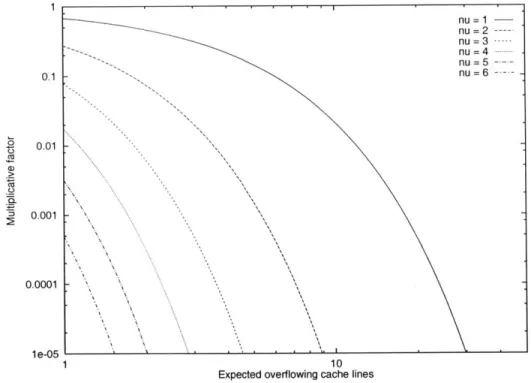
caches negatively correlated on exclusion, and consequently it applies to random-hashed set-associative caches (from Lemma 16). A simple upper bound on this summation is iP(i). For small values of S, however, we can obtain good approximations by numerically com-puting the expected number of overflowing lines. Such an approximation, obtained by numerical integration is shown in Figure 2-5. We can see that the function is concave. Figure 2-6 shows the reduction in conflict-miss overhead caused by the addition of victim caches for various values of v in (2.3). This graph is very impressive, since the multiplica-tive factor reduces below a millionth for v =2, once the expected number of overflowing lines is greater than 10.
Using the relations shown in Figures 2-4, 2-5, and 2-6, we can compute the absence function Pv for common configurations of caches. An illustrative example is shown below.
Example 18 Consider a 16KB random-hashed 4-way set-associative cache with 32-byte cache lines. The cache has nL = 512 cache lines. The absence function P associated with the cache is shown in Figure 2-4. Let us augment the cache with an n v = 8 victim cache lines.
0 0.5
i/nL
1.5 2
Figure 2-5: Graph showing the expected number of overflowing lines after i accesses, divided by
nL, versus i/nL. 0 0 Cu Ca C-, a-0.01 0.001 0.0001 1 e-05 10
Expected overflowing cache lines
Figure 2-6: Multiplicative factor in P(i) caused by the addition of a (1 + v)a-line victim cache, versus the expected number a of overflowing lines after i accesses.
1.2 S=1 S=2 ----S=3 --S=4 -S=8 - ---. .... 7.-E C,, 0.8 0.6 0.4 0.2 0 nu = 1 nu = 2 nu=3 ---nu=4 -nu=5 ----nfu = 6 1 1 0.1 1
0.16 0.14 -0.12 -0.1 0.08 0.06 0.04 0.02 0 0 50 100 150 200 250
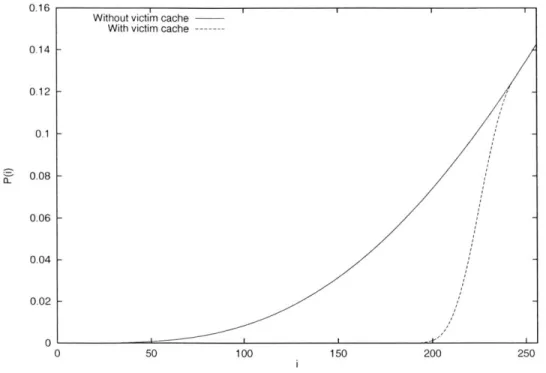
Figure 2-7: Graph showing absence function P(i) versus i before and after adding an 8-line victim cache to a 512-line 4-way set-associative random-hashed cache.
The ratio nvl/nL ~ 0.16. Consequently, for all i such that F~ -jP(j) < 0.16, we can apply the victim cache reduction given in (2.3). Figure 2-7 shows how the addition of the victim cache improves the P(i) function. We can see from Figure 2-7 that accesses to items with rank less than 200 are almost certainly cache hits.
2.5 Random-hashed victim caches
A drawback of fully associative victim caches is their poor scalability. In today's architec-tures, victim caches hold few cache lines, since they are fully associative. In this section, we shall study victim caches that are not fully associative. Specifically, this section analyzes the performance of random-hashed set-associative victim caches, thereby making a case for set-associative victim caches.
Lemma 19 Let C be a P-LRU cache negatively correlated on exclusion, that is augmented with a
P'-LRU victim cache. Then, C is a Pv-LRU cache satisfying the condition that for any n v, we have
PV((i) < (i)-V v + P'(nv))
-(+ V)1+v)
Without victim cache
---where 1
+
v = nv/ YjI'O P(j).Proof. This proof is similar to the proof for Lemma 17. Let x be the element accessed in
the tth memory operation, and let i = rankt(x). Let Ej be the event that the cache line with rank
j
is not present in cache C. Let Xj be an indicator random variable defined byXj= Val (Ej). Similarly, let us define events E' for the victim cache. The cache C augmented with the victim cache does not hold the cache line with rank i if and only if
1. at least S lines map to H(x), and
2. the victim cache does not hold the cache line with rank j, where j is the number of cache lines evicted from C with rank smaller than i.
Then, we have
Pv(i) = Pr Ei / EiIX
which proves that C is a probabilistic LRU cache. We can upper bound Pv(i) as i- I
Pv(i) = Pr Ei
( (
Xj > nv V E1 )}
(j=0
Since events E0, E1,..., Ei are negatively correlated, we can upper bound Pv(a) with an
analysis where all the events are independent. In particular, we can apply the Chernoff bound on T Xi having expectation _ P(i), for any suitable nV.
In (2.4), the parameter n v is a free variable. In other words, (2.4) works for any value of
nv. The choice of an appropriate nv therefore becomes crucial in obtaining a good upper
bound on P(i). In (2.4), the factor attenuating P(i) consists of two terms. The first term decreases with increasing nv, while the second increases with increasing nv. Due to the presence of nv in the exponent of the first term, we can expect value of nv to be close to F'11 P(j), for large victim caches.
The impact of Lemma 19 is illustrated in the following example.
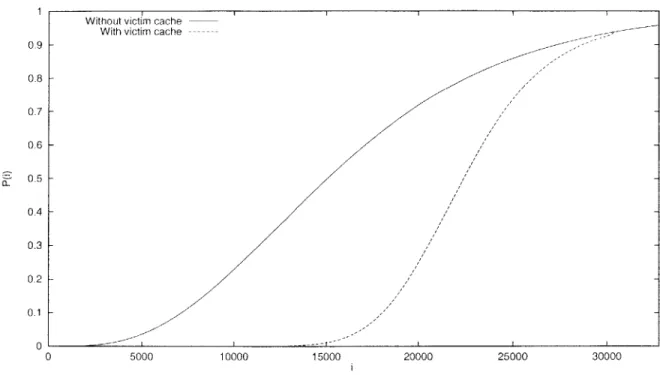
Example 20 Consider a 512KB random-hashed 4-way set-associative cache with 32-byte cache lines. The cache has nL = 16K cache lines. The absence function P associated with the cache is shown in Figure 2-4. Let us augment the cache with an 8-way set-associative random-hashed cache with 256 cache lines. In this example, we choose the optimal value for nv. Figure 2-8 shows the P(i) function before and after adding the victim cache. Notice
0.9 0.8 0.7 0.6 0.5 0.4 0.3 0.2 0.1 0 ---0 5000 10000 15000 20000 25000 30000
Figure 2-8: Graph showing absence function P(i) versus i before and after adding an 256-line 8-way set-associative victim cache to a 16K-line 4-way set-associative random-hashed cache.
that the conflict-miss overhead, when compared to a same size LRU cache, is given by
P(16K) which has a very impressive improvement. Moreover, the size of the victim cache
is 1/64th the size of the primary cache. Since both caches are set-associative, such an implementation seems possible.
2.6 Simulation results
Until now, the analysis of random-hashed caches has been independent of the memory-access sequence, providing generic guarantees on performance. Such analysis accounts for the worst-case memory-access sequences (given in Lemma 6), however, and tends to be loose. We can tighten the analysis of expected cache misses using simulation studies for certain memory-access sequences. In this section, we use Lemma 6 to determine the expected number of cache misses for some SPEC95 benchmarks.
The strategy for evaluating good bounds on the expected number of cache misses is as follows. Traces of benchmark programs are simulated to evaluate the cache misses incurred on fully associative LRU caches of all sizes. This data can be plugged in (2.2) to
Without victim cache With victim cache
22 8=1 S=2 --- x 20 S=4 --+ -LRU 18 -16 -14 -rn 12 E 10 -0~ X8 6 4 0 5 10 15 20 25 30 35
Cache size (in KB)
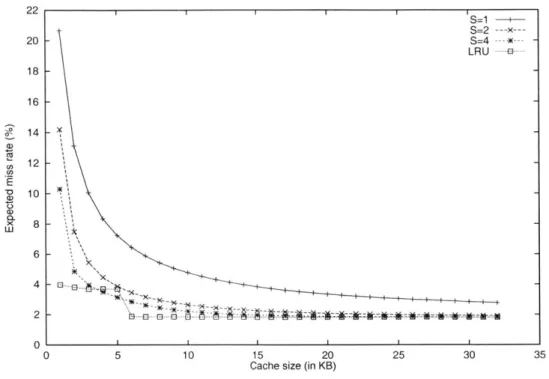
Figure 2-9: Graph showing expected miss rate in random-hashed set-associative caches with 32 byte line length, for mgrid SPEC floating point benchmark, versus cache size.
give good estimates of the expected number of cache misses. I used the Hierarchical Cache Simulator developed for the Malleable Cache Project [17] at MIT Laboratory for Computer Science. Derek Choiu, a postdoctoral student in the Computer Structures Group, MIT LCS, helped me perform the simulation. The simulator operates on pdt traces generated from programs compiled on the simplescalar platform [16].
Figure 2-9 shows the expected number of cache misses during 100 million accesses in the mgrid SPEC95 floating-point benchmark for various cache sizes and associativity S = 1,2, and 4. The cache line length was assumed to be 32 bytes. With the addition of an 8-line fully associative victim cache, the expected cache misses are as shown in Figure 2-10. Similar results are shown for some other SPEC95 floating point benchmarks in Figures 2-11 through 2-15. For the cache sizes considered, the performance of direct-mapped hashed caches with the victim cache is usually better than 4-way set-associative random-hashed caches of same size.
Figure 2-9 and Figure 2-10 exhibit a few anomalies. Firstly, some random-hashed caches outperform fully associative caches for small cache sizes. This phenomenon is caused by the abrupt absence of cache hits having ranks in the range 2K-5K.
Random-10 S=1 -S=2 ---x 9 S=4 ---LRU 8 7 00 6 E 5 4 i' 3 -2 - - - -1 I I 0 5 10 15 20 25 30 35
Cache size (in KB)
Figure 2-10: Graph showing expected miss rate versus cache size for random-hashed set-associative caches with 8-line victim cache and 32-byte line length for mgrid SPEC floating point benchmark.
hashed caches that hold around 5K cache lines partially capitalize on cache hits of rank larger than 5K, unlike fully associative caches of the same size. Secondly, for cache sizes between 2K-4K, in Figure 2-10, the expected number of cache misses increases for increas-ing associativity. Again, this behavior stems from the forbidden rank range 2K-5K. Fig-ure 2-4 shows that smaller associativity caches have smaller absence probability P(i) for
i > nL. Since, for i > nL, P(i) weights cache hits with rank larger than 5K in (2.2) caches
with lower associativity tend to perform better.
2.7
Conclusion
In this section, we shall relate the results presented in this chapter to previous and ongo-ing research on cache design, and we shall look at interestongo-ing open problems that deserve scrutiny. Specifically, we shall compare our results with the analytical cache model pro-posed by Agarwal, Horowitz, and Hennessy [2]. The independence of our analysis from the memory-access sequence is both a strength and weakness. We shall discuss this issue. We shall also look at other caching mechanisms that achieve similar performance, thereby