HAL Id: hal-03130938
https://hal.archives-ouvertes.fr/hal-03130938
Submitted on 3 Feb 2021HAL is a multi-disciplinary open access archive for the deposit and dissemination of sci-entific research documents, whether they are pub-lished or not. The documents may come from teaching and research institutions in France or abroad, or from public or private research centers.
L’archive ouverte pluridisciplinaire HAL, est destinée au dépôt et à la diffusion de documents scientifiques de niveau recherche, publiés ou non, émanant des établissements d’enseignement et de recherche français ou étrangers, des laboratoires publics ou privés.
Development of electrospun composite as substitutive
diaphragm membrane
E Mohsenzadeh, Nabyl Khenoussi, Laurence Schacher, Dominique Adolphe,
Joseph Hemmerle, Anne Schneider, Nadia Bahlouli, Christiane Wagner-Kocher
To cite this version:
E Mohsenzadeh, Nabyl Khenoussi, Laurence Schacher, Dominique Adolphe, Joseph Hemmerle, et al.. Development of electrospun composite as substitutive diaphragm membrane. 17th World Tex-tile Conference AUTEX 2017- TexTex-tiles - Shaping the Future, May 2017, Corfu, Greece. pp.062008, �10.1088/1757-899X/254/6/062008�. �hal-03130938�
PAPER • OPEN ACCESS
Development of electrospun composite as
substitutive diaphragm membrane
To cite this article: E Mohsenzadeh et al 2017 IOP Conf. Ser.: Mater. Sci. Eng. 254 062008
View the article online for updates and enhancements.
Related content
Surface, interphase and tensile properties of unsized, sized and heat treated basalt fibres
T Förster, G S Sommer, E Mäder et al.
-Recent progress concerning the production of controlled highly oriented electrospun nanofibrous arrays
L R Manea, L Hristian, A L Leon et al.
-Structure and properties of electrospun PLLA single nanofibres
Ryuji Inai, Masaya Kotaki and Seeram Ramakrishna
-Recent citations
Zoe Hancox et al
1
Content from this work may be used under the terms of theCreative Commons Attribution 3.0 licence. Any further distribution of this work must maintain attribution to the author(s) and the title of the work, journal citation and DOI.
Published under licence by IOP Publishing Ltd
1234567890
17th World Textile Conference AUTEX 2017- Textiles - Shaping the Future IOP Publishing
IOP Conf. Series: Materials Science and Engineering 254 (2017) 062008 doi:10.1088/1757-899X/254/6/062008
Development of electrospun composite as substitutive
diaphragm membrane
E Mohsenzadeh1, N Khenoussi1, L Schacher1, D Adolphe1, J Hemmerlé2, A
Schneider2, 3, N Bahlouli4and C Wagner-Kocher1, 5
1Laboratory of Physics and Textile Mechanics, EA 4365 - UHA, Mulhouse, France 2National Institute of Health and Medical Research, UMR S 1121- INSERM,
Strasbourg, France
3Pediatric Surgery Department, University Hospital of Strasbourg, Strasbourg, France 4Laboratory of Engineering Science, data processing and imaging, UMR 7357
-ICUBE, Strasbourg, France
5Mechanical and Civil Engineering Laboratory, Montpellier University, LMGC,
Montpellier, France
Email: [email protected]
Abstract. The diaphragm is the most important muscle for respiration with a bi-domed
structure, which is separating thoracic cavity from abdominal cavity. Partial formation of diaphragm, with unknown reason during fetal development caused a birth defect called congenital diaphragmatic hernia (CDH). It allows the abdomen contents to go up into the chest cavity resulting in pulmonary hypoplasia, which is the major cause of the mortality. There are several types of membrane, which can be used as prostheses to close the existing hole. In this project, we study the tensile properties of electrospun PA-6 nanowebs and electrospun PA-6/B composite as substitution membrane by a comparison with the tensile properties of tendon part of pig’s diaphragm.
1. Introduction
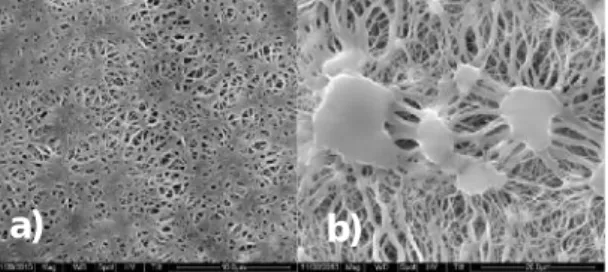
The diaphragm is a layer of muscle and tendon that serves as the main part of respiration and plays a vital role in the breathing process. Diaphragmatic hernia that occurs in about 1 in 5,000 live births, is defined as congenital or acquired defect [1]. As the treatment, if the opening in the diaphragm is small then it can be sewn. Otherwise, if it has a large size then the surgeon will require implanting an additional tissue or membrane. Currently, Gore-Tex® (PTFE) as a synthetic biocompatible material is used to patch this opening in University Hospital in Strasbourg/France (figure 1).
The problem is that Gore-Tex® implantable membrane is not elastic enough to follow the natural growth of the child, so this patch usually requires replacement later by the child growth [2].
Figure 1. SEM images of double-faced current implanted Gore-Tex; a) Smooth surface b) Rough surface
2
Main objective of our study is to design a substitution membrane by electrospun nanofibers web. Mechanical properties of substitutive membrane have to be close to the human diaphragm that have been represented by pig’s diaphragm in this study.
2. Materials and Methods
2.1. Uniaxial Tensile Test on: Pig’s Diaphragm, electrospun PA-6 nanofibers and electrospun PA-6/B composite
The insufficiency of data on mechanical behaviour of human soft tissue is firstly because of the difficulty of obtaining human tissues for testing and secondly because of the lack of the standard testing technics for mechanical testing of soft tissues [3]. For this reason, we performed some mechanical tests on pig’s diaphragm (withdrawn from University Hospital, Strasbourg/France), which is the most feasible, and the nearest case to simulate the human one.
Diaphragm is contained of dense collagen fibres, arranged diagonally from lateral to medial direction.
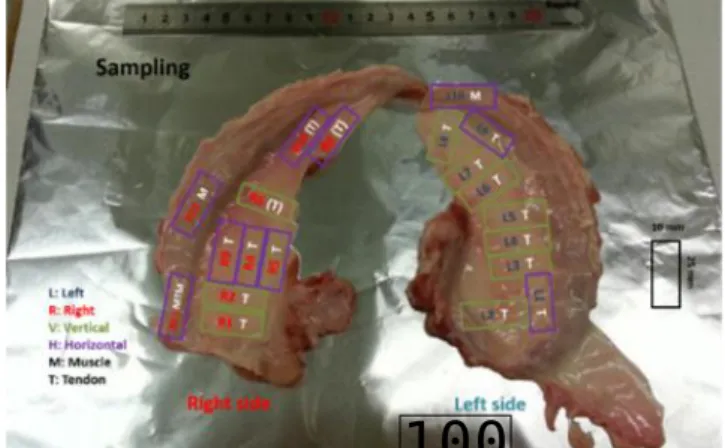
Therefor pig’s samples were excised from different parts of diaphragm from the left and right side, vertically and horizontally based on the tendon fiber orientation (figure 2).
Figure 2. Sampling from the fresh pig’s diaphragm, left and right part
Soft tissue and electrospun samples have been placed between special frames using pneumatic gripes before being tested. A velocity of 10 mm/min and gripes distance of 15 mm are set on MTS machine for all the tested samples by following ISO 527-3 standard. A temperature controller chamber (Instron 3119.005) was mounted to the MTS tensile machine to keep the temperature stable at 37°C (human body temperature). To reduce the slippage of the samples between the gripes, which was challenging during the tensile test one-side sandpaper frame with waterproof backing which the samples were stitched to them was used.
2.2. Electrospinning of PA-6 electrospun nanofibers and PA-6/B composite
PA-6 was chosen as a polymer to produce electrospun nanoweb because of its biocompatibility and expected adequate mechanical properties. Different electrospinning conditions have been tested by using a vertical homemade electrospinning booth to obtain optimal conditions of producing PA-6 nanofibers. To improve the strain properties of electrospun PA-6 nanofibers, a thin layer of elastomer material (material B) was used while electrospinning of PA-6 solution. Electrospinning time was varied: 15, 30, 60, 90 minutes. Electrospun nanofibers were observed via SEM micrographs and diameters were measured thanks to ImageJ software.
3. Results and discussion
Mechanically, tendon works as a force transmitter during rapid muscle contraction. A basic similarity is considered in the structure and function of most tendons. Tendon shows a non-linear behaviour in
3
1234567890
17th World Textile Conference AUTEX 2017- Textiles - Shaping the Future IOP Publishing
IOP Conf. Series: Materials Science and Engineering 254 (2017) 062008 doi:10.1088/1757-899X/254/6/062008
uniaxial tension. Once a load is applied (toe region of load- strain curve), the fibres start stretching parallel to the load direction. As the load further increases, the collagen fibres reorient in order to carry a greater proportion of load. By continuing to increase the load, a transition from low to high stiffness occurs and is known as the strain stiffening effect where the fibres will be over stretched and begin to rupture until the failure happens [4].
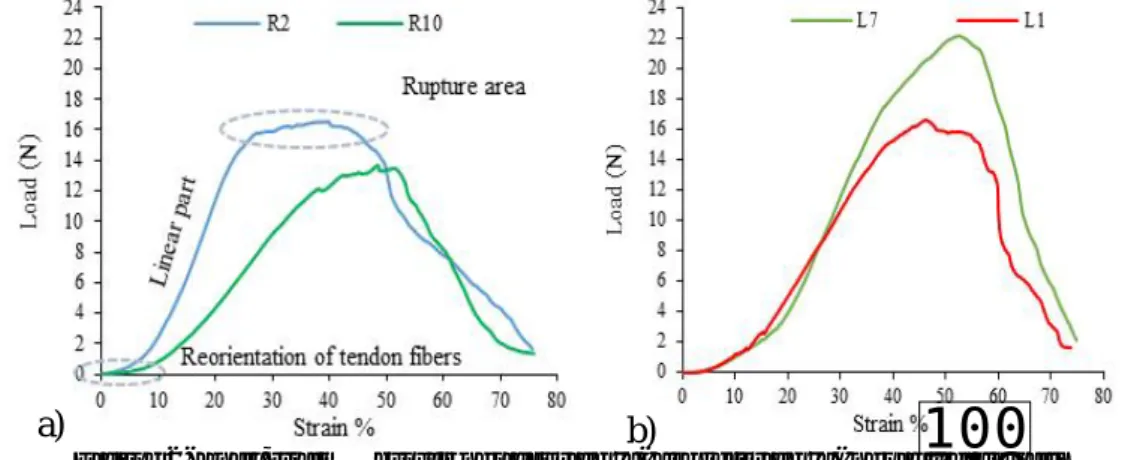
The specimens, slipped from any of the grippes, were not included in the results. The tensile curves of two tendon samples of right (R10: cut vertically and the R2: cut according to the tendon direction) and left (L7: cut vertically and L1: cut according to the tendon direction) side of the diaphragm are shown in figure 3 a and b.
Figure 3. Load-strain % curves of right side (a) and left side (b) of pig’s diaphragm
The interval of maximum load between 7 and 18 N as well as the interval of strain between 27 and 50 percent are obtained by testing different numbers of samples from right side of diaphragm. Load-Strain % curves of the left side samples revealed the interval of maximum load between 8 and 23 N and strain between 15 and 53 percent.
To produce electrospun PA-6 nanofibers, 20 wt. % solution of PA-6/Formic acid with 0.1 mL/h feed rate was injected to the needle by applying 30 kV of voltage between needle and collector with a distance of 15 cm. In figure 4, the SEM micrograph of electrospun PA6 nanofibers after 15 minutes electrospinning is presented.
Figure 4. SEM image of 15 minutes electrospun PA-6 nanofibers
30 single nanofibers diameter were randomly measured by ImageJ software. The SEM micrograph displays the nanofibers with an average diameter of 184 nm.
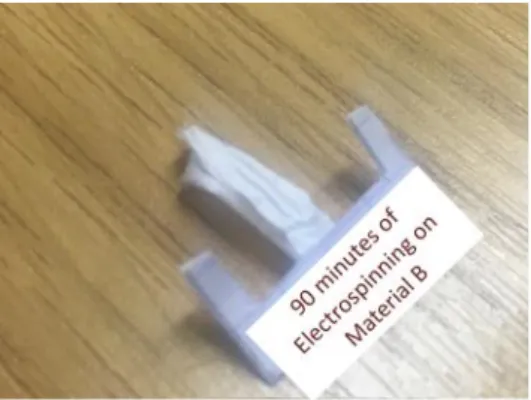
Tensile test results on shorter time of spinning of electrospun PA-6 nanofibers shows improved mechanical properties. By increasing electrospinning duration on material B (after 30 minutes of electrospinning), delamination has been observed between two layers leading us to conclude that shorter time of electrospinning on material B is more favourable (figure 5).
4
Figure 5. Delamination between material B and Electrospun PA-6 nanofibers
A comparison between tensile results of 15 minutes electrospun PA-6 and electrospun PA-6/B composite is demonstrated in figure 6.
Figure 6. Comparison load-strain % curves of 15 minutes electrospun PA-6 and electrospun PA-6/B composite
Electrospun PA-6/B composite displays more deformation for example for the load of 2 N compared to electrospun PA-6 nanofibers web with the same time of electrospinning.
4. Conclusion
The mechanical tests confirmed that regardless of the sampling region, the pork’s diaphragm presented isotropic properties. For the optimum electrospinning conditions, an average diameter of 184 nm without defects was obtained. It was also observed that by increasing the time of electrospinning, the rupture force of the sample increased but the strain decreased. Moreover, an important increase of the electrospinning time, led to a total loss of the elasticity of elastomer material and delamination was occurred.
References
[1] Rehan V K, Laipraset J, Wallach M, Rubin L P and McCool F D diaphragm dimensions of the healthy preterm infant 1999 Pediatric Research 45 317A
[2] Schneider A, Koob M, Sananes N, Senger B, Hemmerlé J and Becmeur F computed tomographic study of the pediatric diaphragmatic growth: Application to the treatment of congenital diaphragmatic hernia 2016 European Journal of Pediatric Surgery 27(02) 177-180
[3] Gaur P, Chawla A, Verma K, Mukherjee S, Lalvani S, Malhotra R and Mayer C characterisation of human diaphragm at high strain rate loading 2016 Journal of the mechanical behavior of biomedical materials 60 603-616
[4] Evans J H and Barbenel J C structural and mechanical properties of tendon related to function 1975 Equine veterinary journal 7(1) 1-8