RESEARCH OUTPUTS / RÉSULTATS DE RECHERCHE
Author(s) - Auteur(s) :
Publication date - Date de publication :
Permanent link - Permalien :
Rights / License - Licence de droit d’auteur :
Bibliothèque Universitaire Moretus Plantin
Institutional Repository - Research Portal
Dépôt Institutionnel - Portail de la Recherche
researchportal.unamur.be
University of Namur
Heterolingualism in Second World War Films
Labate, Simon
Published in:
Emerging Research in Translation Studies
Publication date:
2013
Document Version
Publisher's PDF, also known as Version of record
Link to publication
Citation for pulished version (HARVARD):
Labate, S 2013, Heterolingualism in Second World War Films: "The Longest Day" and "Saving Private Ryan". in
Emerging Research in Translation Studies: Selected Papers of the CETRA Research Summer School 2012.
CETRA Summer School Papers, 24th CETRA Summer School, Leuven, Belgium, 20/08/12. <http://www.arts.kuleuven.be/cetra/papers/files/labate>
General rights
Copyright and moral rights for the publications made accessible in the public portal are retained by the authors and/or other copyright owners and it is a condition of accessing publications that users recognise and abide by the legal requirements associated with these rights. • Users may download and print one copy of any publication from the public portal for the purpose of private study or research. • You may not further distribute the material or use it for any profit-making activity or commercial gain
• You may freely distribute the URL identifying the publication in the public portal ? Take down policy
If you believe that this document breaches copyright please contact us providing details, and we will remove access to the work immediately and investigate your claim.
Heterolingualism in
Second World War Films
:
The Longest Day and
Saving Private Ryan
Simon Labate
University of Namur, Belgium
National Fund for Scientific Research, Belgium
Abstract
This paper deals with the treatment of foreign languages in the Second
World War films The Longest Day (1962) and Saving Private Ryan
(1998). Through quantitative and qualitative analyses, it describes how
heterolingualism is used in these films and how it influences
characterisation and plot, in both the original and French-dubbed
versions. The study shows that The Longest Day features a sizeable
amount of scenes featuring French and German due to the narrative
structure of the film as it gives a comprehensive overview of the parties
involved in D-Day operations, while Saving Private Ryan contains fewer
passages in foreign languages because it adopts a narrower perspective
by focusing on a group of American soldiers. Most of the
heterolingualism disappears in the French-dubbed version of The
Longest Day, although it is sometimes evoked by accents, whereas the
French version of Saving Private Ryan generally leaves foreign
languages as such, illustrating what appears to be a recent tendency in
audiovisual translation to maintain the original difference.
Keywords
heterolingualism, multilingualism, audiovisual translation, dubbing,
Second World War films
A CETRA Paper
2012
3
Acknowledgements
Thanks are due to two anonymous peer reviewers, to Dirk Delabastita
(Université de Namur) and to Elena Voellmer (Universitat Pompeu Fabra
and 2013 CETRA Summer School alumna) for their comments, which
helped me improve this paper significantly.
A CETRA Paper
2012
1
1. Introduction
In the history of cinema, a large amount of motion pictures have been devoted to the Second World War to the point of constituting the genre of the Second World War combat film (Basinger 2003). Among these are the both critically and popularly acclaimed films The Longest Day (1962; henceforth: TLD) and Saving Private Ryan (1998; henceforth: SPR), which are taken under scrutiny in this paper. TLD depicts a series of events happening on 6 June 1944 (popularly known as D-Day), when the Allies landed in Normandy to free Europe from the Nazi regime. SPR focuses on a group of American Rangers who go on a mission to rescue a soldier whose three brothers were killed. Both films feature characters from several nationalities who take part in an armed conflict and who are distinguished from each other visually and linguistically.
The use of heterolingualism – i.e., language difference, which can manifest itself through “foreign” accents, words or grammar (see Delabastita and Grutman 2005;
Meylaerts 2006; Grutman 2012)1 – is rarely politically innocent: each language
carries particular social values, which may trigger processes of identification or distancing in the reader or spectator. However, these associative meanings and effects are sometimes modified or lost in the translation of audiovisual texts, among others due to the semiotic constraints inherent in the latter or to certain political motivations. Many scholars have already discussed a wide range of issues linked to audiovisual translation (e.g., Gambier and Gottlieb 2001; Orero 2004; Díaz Cintas et al. 2010; Remael et al. 2012). In recent years, a number of researchers have focused on the topic of heterolingualism in films, as attested by the studies conducted by Bleichenbacher (2008) and O’Sullivan (2011) as well as the papers presented at the conference on The Reception and Translation of Multilingual Films at the University of Montpellier in June 2012. This paper feeds on these insights to deal with the use of heterolingualism in TLD and SPR, both in the original film versions and in their French-dubbed versions, and to see how it contributes to the representation of war.
1. As O’Sullivan puts it, heterolingualism, the “motivated deployment of multiple languages in fiction”, has to be distinguished from “sociolinguistic multilingualism as in diglossia or code-switching” (2011: 20). In this paper the terms heterolingual(ism) and multilingual(ism) reflect this definition.
A CETRA Paper
2012
2
Bleichenbacher (2008: 24) argues that there are four ways to treat heterolingualism in films: presence, evocation, signalisation and elimination. Presence is the conservation of the original utterances in a foreign language. Evocation consists in a recreation of heterolingualism in the film’s main language on phonological, lexical and grammatical levels. Signalisation is a strategy by which an explicit reference to a foreign language is made by the narrator or a character, although it is never used. Finally, elimination, sometimes referred to as homo-genisation (O’Sullivan 2011: 26-28), is the complete absence of heterolingualism in favour of the film’s main language, without any hint at the real-world discrepancy. The audience’s comprehension of content can theoretically range from none to total, with obscure passages possibly translated by subtitles or by an interpreter in the film.
Although Bleichenbacher (2008) does not deal with translation, I suggest that his taxonomy of strategies can be applied by translators working on a dubbed version. Choices can be made according to a series of factors including the spectators’ assumed familiarity with the other language(s) (e.g., one might consider using a few cognates), concerns of profitability (e.g., the assumption that viewers are reluctant towards subtitles and that a film should be in the viewers’ language as much as possible to avoid alienating them) or a political agenda (e.g., foreign languages should be avoided in the name of the preservation of a language).
Second World War films are particularly interesting to analyse in terms of heterolingualism and its translation because they inherently depict events taking place in the context of an armed conflict, with at least two groups of individuals who can be distinguished not only narratologically (they have different positions and interests) and visually (e.g., their uniforms) but also linguistically (the protagonists speak the standard dialect of the film’s main language, while the villains use their own language or an inflected variety of the aforementioned dialect). No less than the content of the lines uttered by a film’s characters, heterolingualism is an element that filmmakers can use to build binary and even antagonistic oppositions between Good and Evil, or between Us and the Other (Bleichenbacher 2008).
This nexus between language and conflict is explored in Baker (2006). As Baker points out, “we must continually remind ourselves that all conflict starts and ends with constructing or deconstructing an enemy” (ibid.: 14). She uses the term “narrative” to refer to “stories we tell ourselves and other people about the world(s) in which we live. These stories are constructed – not discovered – by us in the course of
A CETRA Paper
2012
3
making sense of reality, and they guide our behaviour and our interaction with others” (ibid.: 169). Translators also play a role in creating narratives, in that they
necessarily reconstruct narratives by weaving together relatively or considerably new configurations in different temporal and spatial settings. Each new configuration modifies and reinterprets the narratives that went into its making. One consequence of this process is that translating a narrative into an original narrative itself may be threatened with dilution or change. (ibid.: 62)
Baker goes on to argue that translators carry out a selective appropriation of textual material which is “realised in patterns of omission and addition designed to suppress, accentuate or elaborate particular aspects of a narrative encoded in the source text” (2006: 114). For instance, by modifying features such as dialect and register, characters can be “repositioned in relation to each other”, allowing the translators to “reconfigure the relationship between here and there, now and then,
them and us” (ibid.: 132, original emphasis). Following this line of thinking, this
paper sets out to describe the functions fulfilled by foreign languages in the source films to create particular narratives (intentionally or not), how the latter are modified through translation and which effects they have on the perception of the Other.
2. Methodology
I conducted qualitative and quantitative analyses on TLD and SPR to examine how heterolingualism influences characterisation and plot, both in their original and French-dubbed versions. The choice to take these two films under scrutiny for the present case study was partly motivated by their common status as blockbusters and by the 36-year time gap separating their theatrical releases. This gap may help identify, however provisionally, possible historical shifts regarding the use of heterolingualism in the original and the French-dubbed versions. Finally, these films belong to the genre of the serious combat films (Basinger 2003) in that they give an earnest depiction of the war effort. Heterolingualism contributes to enhance the realism of the scenes and create distinctions between the characters (Delabastita and Grutman 2005: 24; O’Sullivan 2011: 24). As such, the two films discussed in this
A CETRA Paper
2012
4
paper may be opposed to comic treatments of the war found in French war comedy films such as La Grande Vadrouille (1966) and Mais où est donc passée la septième
compagnie? (1973), or in sitcoms such as ’Allo ’Allo (1982-1992; see Delabastita
2010).
For both TLD and SPR I have used their DVD versions. The two films were first
segmented into scenes to facilitate the comparison with the French-dubbed versions.2
I considered that a scene began whenever the settings changed, whenever there was a break in the time continuity (i.e., flashback or flashforward) or a new action started. The following series of parameters were selected for the analysis: the languages spoken in each scene; the number of lines in English, French and German (a line being the word(s) spoken by a character until he/she is interrupted by another or until the scene changes); the presence of accents; the amount of subtitles and other written signs such as title cards (i.e., written information on the settings or characters superimposed on the screen) and the conservation of words or lines in the French-dubbed version. All the data were collected in an Excel sheet in order to calculate totals and percentages with the help of pivot tables. The figures included in section 3 provide background for the qualitative analysis of selected fragments from the films. The fragments are explored to illustrate the various strategies at work in the original and French-dubbed versions.
3. Analysis
In this section I present my observations on the data drawn from the corpus. The first part describes the use of languages in the original version of TLD and SPR (section 3.1), and the second analyses how heterolingualism is rendered in their French-dubbed versions (section 3.2).
2. Although there is a tendency to redub older films for their DVD releases in France (e.g., The
Towering Inferno 1974), TLD’s original French-dubbed version is still featured on all DVD and BluRay
discs nowadays; its dialogues were translated by Maurice Griffe and Jacques Monteux in 1962. SPR’s French version was written by Christian Dura and was released in September 1998; it is currently the only one in use.
A CETRA Paper
2012
5
3.1. Languages in the original versions
Several bar charts represent the distribution of the languages featured in all scenes, the context of use and their function, the amount of lines uttered in each of the different languages in both films and a series of additional elements like the presence of subtitles and title cards.
3.1.1. The Longest Day
Figure 1 presents the distribution of languages and language combinations in all the scenes of TLD.
Figure 1. Languages used in all scenes (N = 176) of TLD’s original version.
Among the 212 scenes in the film, 36 did not contain any lines, which means that there are 176 speaking scenes left. By grouping several shares in Figure 1, we see that English is present in 55% (n = 97) of the scenes, while German can be heard in
about 30% (n = 58) of them and French in slightly less than 16% (n = 29).3
Another finding is that 95% of the speaking scenes (n = 168) are monolingual and only 3% (n = 8) present a verbal exchange between protagonists from two language communities. Although the film is multilingual in that it features a sizeable amount of scenes in French or German (i.e., presence), these languages are rarely co-present, suggesting that the different parties involved in the conflict hardly ever
3. The total exceeds 100% because of the overlap between different categories. 91 4 23 2 54 2 0 20 40 60 80 100
English English &
A CETRA Paper
2012
6
engaged in a dialogue. For instance, there is no interlingual dialogue in the scene where a German listens to the first verse of Verlaine’s poem Chanson d’automne (“Les sanglots longs des violons de l’automne”) on the radio before reading out the second verse (see also example 3 in section 3.2.1).
However, there are five scenes in which there is a meaningful exchange between different language communities, such as when a soldier calls another in German before questioning a woman in French:
(1) Hans, wo bist du? Mais qu’est-ce qui se passe? Qu’est-ce qui se passe ici? Qui est avec vous?
‘Hans, where are you? What’s going on? What’s going on around here?
Who’s with you?’4
Elsewhere, a few Germans are seen surrendering; they rush out of a bunker shouting “Bitte! Bitte!” [“Please! Please!”] and are killed on the spot by an American soldier who wonders what the Germans were saying. This exemplifies the unfortunate consequence of a lack of linguistic understanding. Finally, the most significant moment in terms of multilingual dialogue is the scene where Mayor Lenaux greets a group of Scottish soldiers with a bottle of champagne:
(2) LENAUX: Oh, my friends! What a day, what a day! Welcome to France,
welcome to Colleville!
LOVAT: That’s most kind of you, very nice to meet you.
LENAUX: Look at this. I kept it for you, but I don’t think there will be
enough for everyone. […] Oh boy! Thank you boys, thank you! Vive la France! Vive la France, vive les Alliés! […] Welcome! Welcome to you all!
‘[…] Long live France! Long live France, long live the Allies! […]’
Lenaux speaks English with a French accent. By addressing the liberators in their own language, he makes a significant gesture in order to show his gratitude for their intervention against the German occupants.
A CETRA Paper
2012
7
After taking a look at whole scenes, let us analyse the distribution of languages in each line of TLD, as represented in Figure 2.
Figure 2. Languages used in each line (N = 862) of TLD’s original version.
Most of the 862 lines in TLD are in English spoken by native speakers (63%; n = 541), while French (8%; n = 65) and German (29%; n = 250) can be heard relatively less often. This is further evidence that French and German add up to a sizeable amount of lines in the film. Nevertheless, multilingual lines are scarce: three feature words in English and French, two lines combine French and German, one line mixes English and German.
Some 316 English subtitles appear on the DVD version to translate the heterolingual passages. Not every utterance in French or in German is subtitled, though. For instance, forms of address like “Herr General” [“General”] or cognates, such as “Mein Gott” [“My God”], remain untranslated, just like parts of lines that are repeated. Subtitles also tend to be missing for lines spoken by secondary characters (e.g., aides, second-rank officers) who are not the focus of the action in a particular scene. This is especially the case of utterances heard in the background. In eight scenes, small parts of speech are not subtitled due to title cards which appear at the bottom of the screen to help viewers identify a character. If subtitles had been used, the viewers would have had to read two unrelated bits of text in a short time. Interlingual subtitles are subject to time and space constraints which frequently lead
541 3 65 1 250 2 0 100 200 300 400 500 600
English English & French
French French & German
German English & German
A CETRA Paper
2012
8
to a more condensed target text (Díaz Cintas and Remael 2007). Yet, the messages
seem to be reduced more than usual – in this DVD version at least.5
Regarding title cards as such, no fewer than 39 bits of text appear over the pictures to identify characters (27 occurrences, see Figure 3), to specify the spatiotemporal circumstances (10 occurrences, see Figure 4) or to announce the film’s title and the end credits (two examples). While the latter two categories are always spelled out in English, seven Germans and four Frenchmen are introduced in their own language, as exemplified by Figure 3.
Figure 3. Title card presenting a character in German.
Figure 4. Title card presenting the context in English.
However, there is not always a one-to-one relationship between a protagonist’s language and the language of his/her title card. Indeed, three German and two
5. It would be necessary to check whether this tendency is observed in the original version as it was released in cinemas in 1962.
A CETRA Paper
2012
9
French characters are (perhaps erroneously) presented in English, incidentally at the very beginning of the film only.
The fact that the film contains only eight multilingual scenes despite the sizeable presence of German and French overall seems to suggest that there was little interaction between the different camps during the depicted events. The same observation applies to the very few scenes in which American and British soldiers appear together, the most important ones being the meeting during which General Eisenhower decides to launch the invasion of Normandy, and a dialogue between an American soldier and an RAF pilot.
3.1.2. Saving Private Ryan
Similar to TLD, SPR’s original version resorts to the strategy of presence to incorporate heterolingualism in the story, as reflected in Figure 5.
Figure 5. Languages used in all scenes (N = 128) of SPR’s original version.
Of the 147 scenes that make up SPR, 19 contain no lines, which were therefore not taken into consideration. Figure 3 shows a rather different distribution in comparison with TLD since English alone is featured in two thirds of the scenes (n = 84), while other languages or language combinations present much smaller shares. In total, English can be heard in nearly 91% of the scenes (n = 116), which suggests that the film takes a dominantly American perspective, unlike TLD. The second most
84 7 1 24 1 10 1 0 20 40 60 80 100
English English & French English, French & German English & German
A CETRA Paper
2012
10
present language is German, which is found in 27% of the scenes (n = 35), while French appears in 7% of them (n = 9), despite the French settings. There is even one very short scene featuring a soldier praying in Spanish. Incidentally, this is the first instance of heterolingualism in the film, only appearing on minute 21 (contrastively,
TLD starts off with ten minutes in French and German).
In comparison with TLD, SPR contains fewer monolingual scenes (75%; n = 96) and therefore more multilingual scenes (25%; n = 32). Among the latter, 25 scenes feature English and German, although there are hardly any substantial verbal exchanges between American and German soldiers. Indeed, only three scenes depict dialogues between an American interpreter and a German soldier who was made a prisoner; the former even sympathises with the latter, who has been ordered to dig graves for dead soldiers. When he realises that he is about to be executed, he tries to save himself by uttering a meaningless string of phrases pertaining to American culture: “Please, I like America! Fancy schmancy! What a cinch! Go fly a kite!”. Eventually, the German’s life is spared and he is told to walk away with a blindfold, owing to the interpreter’s empathy. In the remaining scenes in which Americans and Germans make contact, there is no real dialogue, as in the scene that which depicts a sudden standoff between Americans and Germans shouting at each other. Other scenes feature only short sentences like orders and shouts heard in the background. This observation also applies to the few scenes featuring English and French, e.g., when a song by Edith Piaf is played throughout four scenes or during the encounter between the American soldiers and a French family (see Table 1 in section 3.2.2). Finally, the only scene in which English, French and German can be heard does not feature any dialogue between different language communities either: while Americans are talking, an unseen Frenchman shouts something and a German officer holds a triumphant soliloquy through a loudspeaker in the background.
To get a more precise quantification of the use of languages, Figure 6 presents the distribution of the different languages or language combinations used in each line of SPR.
A CETRA Paper
2012
11
Figure 6. Languages used in each line (N = 1192) of SPR’s original version.
In comparison with TLD, the film features about 38% more lines (1192 instead of 862), which entails that they are shorter since SPR is itself shorter. This difference stems from the fact that the film contains many scenes with quick exchanges between the different participants (e.g., when instructions are given to different group members).
The amount of monolingual lines in English (n = 1069) overshadows the number of lines in French (n = 35) and German (n = 84), not to mention a single line in Spanish referred to above. Just like TLD, SPR does not contain many multilingual lines: two present a mix of English and German (a Jewish soldier mocks German prisoners: “I’m Juden [“Jewish”], you know. Ju-den.”; a German prisoner pleads for his life) and one features English and French (an American tries to ask a question to locals).
While the DVD version of TLD features 316 subtitles, SPR does not use any captions at all to help the English-speaking viewers understand the French and German passages. Two reasons could have motivated such a choice. First, the presence of an interpreter works not only in the benefit of the characters in the story, but also to that of the audience in significant moments because what the interpreter translates from a foreign language can be understood by both parties. Second, a large number of lines in French and German are actually background lines, which therefore do not contribute very much to the story except to either add a hint of realism (via French) or to signal the presence of the enemy (via German). In the latter case, the
1069 35 84 1 1 2 0 200 400 600 800 1000 1200
English French German Spanish English &
French
English & German
A CETRA Paper
2012
12
omission of subtitles creates suspense because the English-speaking audience does not have access to the characters’ intentions (for a discussion of suspense and heterolingualism, see Delabastita 2012).
3.2. Languages in the French-dubbed versions
In the following sections I analyse the French-dubbed versions of TLD and SPR. Dubbing has been described as a translation mode which replaces the verbal signs present in the acoustic channel by another set of verbal signs in another language, respecting a series of constraints such as lip-synchrony (Díaz Cintas and Remael 2007). However, this definition only holds true for the dubbing of monolingual films, in which the source language is completely replaced by the target language. When it comes to multilingual films, the concepts of source and target languages have to be redefined because of the co-presence of several languages in the source text. As explained in section 1, the people in charge of making a dubbed version can choose between presence, evocation, signalisation and elimination (Bleichenbacher 2008: 24) when confronted with a foreign language. The French-dubbed versions of TLD and SPR illustrate those strategies.
3.2.1. The Longest Day
As explained in section 3.1.1, the original version of TLD features a large amount of lines in languages other than English. The multilingual nature of the film was quite weakened in the French-dubbed version because the strategy consisted in using French as often as possible by eliminating English and evoking German via an accent, as shown in Figure 7 below.
A CETRA Paper
2012
13
Figure 7. Languages in all scenes (N = 176) of TLD’s French-dubbed version.
French is present in the vast majority of the TLD scenes, while English is virtually absent and German occupies a far smaller share than in the original version. If we group several categories, French can be heard in no less than 87% of the speaking scenes (n = 153), German in 13% (n = 23) and English in 3% (n = 5). Furthermore, the film contains monolingual scenes almost exclusively (97%; n = 171) and multilingual scenes are scarce (3%; n = 5). Figure 8 shows the distribution of languages more precisely.
Figure 8. Languages used in each line (N = 872) of TLD’s French-dubbed version.
3 2 148 3 20 0 20 40 60 80 100 120 140 160
English English &
French French French &German German
5 834 2 31 0 200 400 600 800 1000
A CETRA Paper
2012
14
Figure 8 confirms the overwhelming presence of French in the dubbed version: 834 lines in the target audience’s language (96%) were found. There are just a few lines in foreign languages (i.e., limited presence): 34 in German (3%), 5 in English (0.005%) and 2 mixing French and German (0.002%). Whenever German can be heard, it serves the purpose of underlining the antagonistic nature of the German characters, more particularly when the American, British or French protagonists are the focus of the action and Germans are also present, for instance, in the sequence where the paratroopers land in France and are shot by Germans. In most cases, German can only be heard in the background or is spoken by characters who appear for a couple of seconds to utter shouts such as “Hilfe!” [“Help!”]; these are taken over from the original version.
While the French-speaking audience hears American and British protagonists speak French throughout the film, a limited number of passages are in English. There are three instances of songs which remain unchanged in the French version, namely when British soldiers sing while on board a glider (two scenes) and while the end credits are rolling. Furthermore, two background lines in English have not been edited out during sound editing.
Despite the attenuation of heterolingualism the translation used different strategies to distinguish the various parties involved in the story (i.e., evocation). The Germans are the characters whose difference is most clearly marked off, not only via the background lines discussed above, but also through the use of accents. All the French actors who lent their voices to the German characters used a more or less realistic German accent. For instance, having had a bilingual education, Curd Jürgens dubbed his own part (General Blumentritt) almost without accent, while Jean-Claude
Michel interpreted Major Pluskat’s role with faithful tone inflections.6 However, to
dub Josef Priller’s character, Yves Brainville adopted a pronunciation reminiscent of the accent stereotypically attached to French-speaking Belgians. Since Priller gesticulates and shouts most of the time, and given the silliness associated with the Belgian accent (see Francard 2001), the German pilot becomes a laughable character, while it was not so much the case in the original version. The inclusion of a few words in German, such as “Kriegsspiele” [“war games”] or “Mein Gott!” [“My God”], mainly in forms of address, such as “Oui, Herr General” [“Yes, General”] (pronounced with
A CETRA Paper
2012
15
initial /g/ instead of /Ʒ/) or “Jawoll, Herr Feldmarschall” [“Yes, Field Marshal”], also contributes to evoke linguistic difference. An English accent can be heard in the only scene in TLD that features both French résistants and British soldiers: one of the characters wonders what the coded radio messages stand for by asking “Ça te dit quelque chose, Mack?” [“Does it mean anything to you, Mack?”], keeping the original informal form of address to add to his Britishness. Besides, there is no real difference to be noticed between American and British characters (the nationalities are signalled a few times), except that register often reflects the hierarchy between the officers’ speech and that of the soldiers: some of them are given idiosyncrasies and intonations typical of Parisian slang, e.g., when an American soldier asks another
“Hé, t’as jamais entendu la 5e de Beethov’?” [“Hey, have you ever listened to
Beethoven’s 5th?”]. In the original version all the officers speak standard American or
British English, with some of the low-rank soldiers having Cockney, Scottish and Italian-American accents.
Regarding the French lines, nearly all of the utterances that were originally in French were left unchanged. Only a few lines had to be redubbed, either because they also featured some English or because French was used as a foreign language. In the latter case, it makes sense that the lines were dubbed, not only because of the foreign language accent, but also in order to guarantee voice consistency since the characters concerned appear elsewhere in the film. For instance, Private Steele practices basic conversation skills before jumping from a plane:
(3) Bonjour Madame, je suis Américain. Bonjour Mademoiselle, je suis
Américain. […] Je suis Américain. Je suis Américain. Voulez-vous? Mademoiselle?
‘Hello Madam, I’m American. Hello Miss, I’m American. I’m American. I am American. Would you? Miss?’
In the French-dubbed version only the beginning of the utterance is kept, while the rest is replaced by more varied stereotypical pickup lines:
(4) Bonjour Madame, je suis Américain. Bonjour Mademoiselle, je suis
bourré de dollars. […] Je vous offre un verre aux Champs-Élysées. On fait un tour à Montmartre? Préférez-vous Montparnasse?
A CETRA Paper
2012
16
‘Hello Madam, I’m American. Hello Miss, I’ve got plenty of dollars. I’m buying you a drink on the Champs-Élysées. Shall we go for a walk in Montmartre? Would you prefer Montparnasse?’
On the DVD, 32 subtitles appear on the French-dubbed version to translate the title cards that are imprinted on the DVD’s master copy and therefore could not be
substituted by new French titles.7 Instead, subtitles in full capitals appear at the top
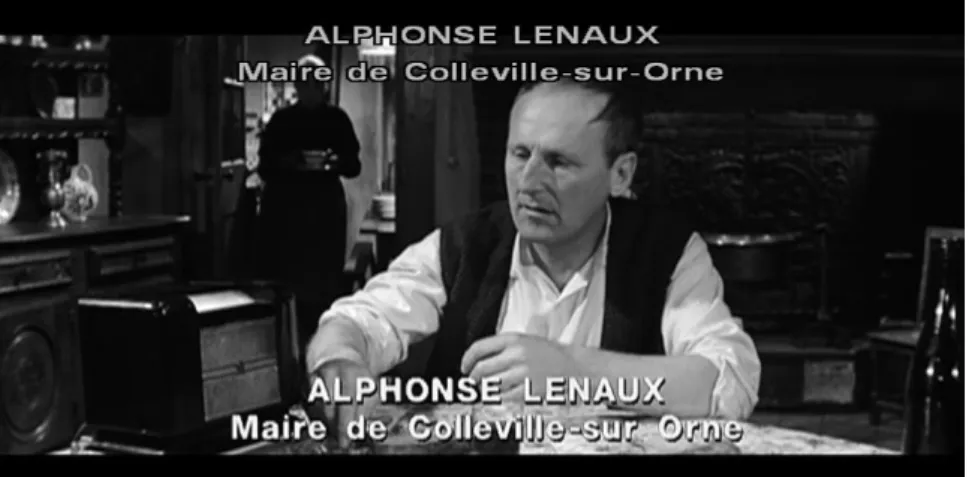
of the screen. However, eight of them are not translated: three titles were in French (no translation needed), four in German and one in English. An extra subtitle appears in scene 53 to translate the words on a German general’s birthday cake. Finally, it is worth noting that an error seems to have occurred in scene 45: when a title card presents Mayor Lenaux in French the same text is repeated quite needlessly above the picture, as illustrated by Figure 9.
Figure 9. Redundant subtitle in the TLD’s French-dubbed version.
7. This might not be the case in the version(s) released in cinemas and broadcast on television: separate master copies are sometimes made for the different markets with written verbal signs in the target audience’s language. The TLD DVD uses only the original master copy, which provides the pictures for all the versions featured, on which the different audio tracks and/or sets of subtitles are added when the viewer makes his/her choice in the language menu. It would, therefore, be necessary to examine a version specifically targeted at the French market to check how subtitles were used originally – if that ever were the case.
A CETRA Paper
2012
17
3.2.2. Saving Private Ryan
While the French-dubbed version of TLD makes extensive use of the elimination strategy to be enjoyed by the largest audience possible, this technique is only partially applied in SPR. Figure 10 shows that English was completely replaced by French.
Figure 10. The languages in all scenes (N = 128) of SPR’s French-dubbed version.
As stated in section 3.1.2, the proportion of passages in foreign languages is smaller than in TLD. French is present in 92% of the speaking scenes (n = 118), while German is featured in 23% of them (n = 29). There is just one scene in Spanish, like in the original: the only line that it contained was kept as such. Figure 11 gives more precise indications as to the distribution of languages in each line.
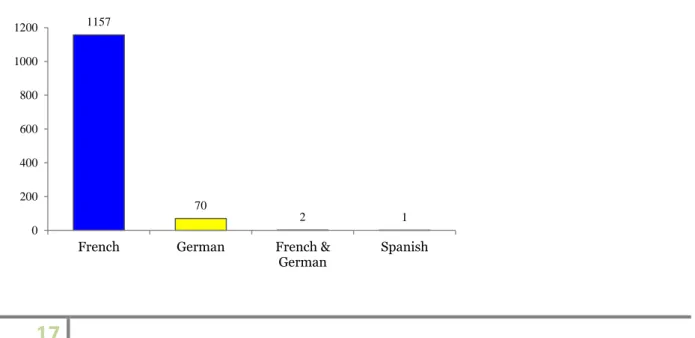
Figure 11. Languages of each line (N = 1230) of SPR’s French-dubbed version.
1157 70 2 1 0 200 400 600 800 1000 1200
French German French &
German Spanish 98 20 9 1 0 20 40 60 80 100 120
A CETRA Paper
2012
18
No fewer than 1157 French lines can be heard in the dubbed version, making up 94% of the total. By contrast, there are 70 lines in German plus two bilingual lines. There is not a single word of English to be found in the film because the background lines have been carefully dubbed and because the film does not contain any element which would have typically been left unchanged, such as songs. The French-dubbed version contains 38 additional lines in comparison with the original, a difference which can be explained by a strategy of expansion: the people in charge of dubbing
SPR added some background lines, especially during the battle sequences.
Most of the lines in German were not translated at all, except in some scenes featuring a dialogue between the American interpreter (Upham) and the German prisoner: while the latter’s lines were only redone in one scene because he originally spoke English and German, for Upham’s part French voice actor Mathias Kozlowski reproduced the original utterances himself in three scenes. In the French-dubbed version, German has the same function as in the original: most of the lines are short and simply meant to distinguish the American protagonists from their German opponents, therefore enhancing realism. The lines in German do not contain clues to help viewers identify them positively or negatively. The absence of subtitles and the small amount of translations provided by Upham suggests that those lines are not really relevant.
As to the treatment of French, all the lines originally uttered by French characters were kept as such, except the lines spoken by Upham when he is translating for the French family: the text had to be modified in order to avoid the redundancy created by the interpreting act, as the dialogue quoted in Table 1 below illustrates.
A change in the character’s profile can be observed: in the original version the interpreter simply translates what the Frenchman is saying, while in the French one he looks like Miller’s aide in that he plays the intermediary between the latter and the Frenchman. The two lines that are dropped occur in quick exchanges while the camera is showing the civilians. On the whole, this scene works, except that Miller wants to check for a second time that the civilians are not soldiers when he is already standing in front of them.
A CETRA Paper
2012
19
Table 1. A scene from SPR involving interpretation into French and its translation.
Original version French-dubbed version Back translation
MILLER: Upham, tell them to show
themselves.
MILLER: Upham, vérifie s’ils sont
pas allemands.
MILLER: Upham, make sure they’re
not Germans. UPHAM: vous!
Montrez-vous!
UPHAM: vous!
Montrez-vous!
UPHAM: Show yourselves! Show
yourselves! MAN: On n’est pas armés, on est
des civils! Tirez pas! […]
MAN: On n’est pas armés, on est
des civils! Tirez pas! […]
MAN: We’re unarmed, we’re
civilians! Don’t shoot! […] MILLER: Ask them if they know
where the Germans are.
MILLER: Qu’est-ce que t’en penses?
Ce sont vraiment des Français?
MILLER: What do you think? Are
they really French?
UPHAM: Où sont les Allemands? UPHAM: Où sont les Allemands? UPHAM: Where are the Germans?
MAN: Je sais pas! Ils sont partout!
Vous êtes passés par Valognes? Il faut que vous emmeniez les enfants!
MAN: Je sais pas! Ils sont partout!
Vous êtes passés par Valognes? Il faut que vous emmeniez les enfants!
MAN: I don’t know! They’re
everywhere! Have you been in Valognes? You’ve got to take the children with you!
MILLER: What’s he saying? MILLER: Qu’est-ce qu’il raconte? MILLER: What’s he saying?
UPHAM: He says something about
the children.
UPHAM: Il veut qu’on emmène les
enfants.
UPHAM: He wants us to take the
children.
MILLER: Kids?!? Ø Ø
UPHAM: He wants us to take the
children.
Ø Ø
MILLER: No no no, we can’t take the
kids!
MILLER: Non non non non non! On
n’prend pas les enfants!
MILLER: No no no no no! We’re not
taking the children! UPHAM: Nous ne pouvons pas les
prendre avec nous!
UPHAM: Nous ne pouvons pas les
prendre avec nous !
UPHAM: We can’t take them with
us!
4. Conclusion
The two films analysed in this study offer different views on the Second World War.
TLD offers an unusual look at D-Day since it depicts all the parties involved in the
Normandy landings and has the characters speak their own language (presence), while other war pictures on the period would have used accents (evocation). Producer Zanuck probably wanted to give an “epic” dimension to his film so that it would appeal to a wide audience, not only in America and in Britain but also in France and in Germany. Most of the protagonists are presented as heroes, but Germans are not portrayed as fundamentally evil enemies: their defeat after D-Day is attributed to a combination of adverse circumstances and to the overconfidence of some military
A CETRA Paper
2012
20
leaders. It should not be interpreted as a consequence of immanent justice punishing
Germans for their ideology,as other combat films on the Second World War suggest.
In contrast, SPR adopts a narrower perspective as it focuses on a small group of Americans who come across some locals and Germans, resulting in very few verbal exchanges between different language communities and therefore in less heterolingualism than in TLD. Foreign languages add a touch of realism and, somewhat like the acoustic equivalent of the soldiers’ uniforms, help to distinguish Germans from Americans. The Germans, most often present in the background, are presented as ruthless enemies; they are nameless and soulless parts of a war machine that is driven by the evil ideology of national-socialism. The use of French and German triggers suspense in that these foreign languages indicate that the protagonists are moving in an unknown and potentially dangerous environment, even though French is not the language of the enemy. As an interpreter, Upham is a very useful element for Miller’s group since he is the only one who has a perfect command of the languages spoken by both the locals and the enemies, but his skills are only required in a handful of scenes. However, it is precisely his knowledge of German that makes him feel compassion for a prisoner and eventually saves the man who later kills a fellow soldier and Captain Miller. In the end, Upham executes the German, a vengeful gesture which has a cathartic dimension.
In the French-dubbed version of TLD foreign languages have been largely eliminated to the benefit of French to maximise the audience’s acoustic understanding. The original exoticism and realism only subsist through evocation via German accents, sometimes adding a touch of humour not necessarily intended at first (as in the scene with Priller discussed in section 3.2.1). These strategies might have been chosen for both financial and ideological reasons. Indeed, as some scholars have pointed out (e.g., Luyken et al. 1991; Whitman-Linsen 1992), it is virtually necessary to dub a film to make it profitable in France (and other French-speaking territories where it is shown). This element could explain why the choice was made to use French almost exclusively instead of adopting the rather unusual heterolingual layout of the original version. Besides, using German in a serious, mainstream film was perhaps going to be frowned upon given the fact that the Second World War had ended only seventeen years prior to the TLD’s release.
In the French version of SPR, however, elimination only concerns the lines originally in English, as is usual in a dubbed version. Some parts of the text were
A CETRA Paper
2012
21
manipulated in order to do away with the lines involving interpreting French into French, but nearly all the utterances in German are exactly the same as in the original version. The fact that German was kept is linked with its relatively small presence in the film and its functions in the film. Indeed, German is mainly used in the background as a way to signal the enemy’s “otherness” realistically through language difference (besides visual clues).
In conclusion, while TLD and SPR have been praised for their rendition of events during the Second World War through the presence of foreign languages instead of their evocation, in their French-dubbed versions the attenuation of heterolingualism and the reconfiguration of the linguistic setup limits the recreation of realism. The general elimination of heterolingualism is nevertheless accepted by the French-speaking audience thanks to a convention-based “willing suspension of disbelief” enabling both Allies and Germans to speak French. The narratives (Baker 2006) carried by the films are therefore somewhat modified (e.g., the image of the Other changes), just because of the choices made to translate heterolingualism, not because of alterations to the lines. Further research could examine the treatment of languages in the German-dubbed versions of the films and, in the case of TLD, at Cornelius Ryan’s book on which it was based. Other case studies could be conducted on other film genres such as comedies about the Second World War.
A CETRA Paper
2012
22
ReferencesBaker, Mona. 2006. Translation and Conflict: A Narrative Account. London: Routledge.
Basinger, Jeanine. 2003. The World War II Combat Film: Anatomy of a Genre. Middletown, CT: Wesleyan University Press.
Bleichenbacher, Lukas. 2008. Multilingualism in the Movies: Hollywood Characters and Their
Language Choices. Tübingen: Francke.
Delabastita, Dirk. 2010. “Language, comedy and translation in the BBC sitcom ’Allo ’Allo!”. In
Translation, Humour and the Media, D. Chiaro (ed). London and New York: Continuum. 193-221.
Delabastita, Dirk. 2012. Thrilled by Trilby? Dreading Dracula? Late-Victorian Thrillers and the Curse
of the Foreign Tongue. Paper presented at the conference The Voices of Suspense and their Translation in Thrillers. Spain: Comillas Pontifical University. October 2012.
Delabastita, Dirk and Grutman, Rainier (eds). 2005. Fictionalising Translation and Multilingualism. Special issue of Linguistica Antverpensia New Series 4.
Díaz Cintas, Jorge and Remael, Aline (eds). 2007. Audiovisual Translation: Subtitling. Manchester: St. Jerome.
Díaz Cintas, Jorge, Matamala, Anna and Neves, Josélia (eds). 2010. New Insights into Audiovisual
Translation and Media Accessibility. Media for All 2. Amsterdam and New York: Rodopi.
Francard, Michel. 2001. “L’accent belge: mythe et réalités”. In French Accents: Phonological,
Sociolinguistic and Learning Perspectives, M.-A. Hintze, A. Judge and T. Pooley (eds). London:
Centre for Information on Language Teaching and Research. 251-268.
Gambier, Yves and Gottlieb, Henrik. 2001. (Multi) Media Translation. Concepts, Practices, and
Research. Amsterdam and Philadelphia: John Benjamins.
Girard, Laurent. 2005. “Le Jour le plus long (1962)”. Voxofilm. http://voxofilm.free.fr/vox_J/ jour_le_plus_long.htm. Visited June 2013.
Grutman, Rainier. 2012. “Traduire l’hétérolinguisme: questions conceptuelles et (con)textuelles”. In
Autour d’Olive Senior: hétérolinguisme et traduction, M.-A. Montout (ed). Angers: Presses de
A CETRA Paper
2012
23
Luyken, Georg M., Herbst, Thomas, Langham-Brown, Jo, Reid, Helen and Spinhof, Herman (eds). 1991. Overcoming Language Barriers in Television: Dubbing and Subtitling for the European
Audience. Manchester: European Institute for the Media.
Meylaerts, Reine (ed). 2006. Heterolingualism in/and Translation. Special issue of Target 18 (1). Orero, Pilar (ed). 2004. Topics in Audiovisual Translation. Amsterdam and Philadelphia: John Benjamins.
O’Sullivan, Carol. 2011. Translating Popular Film. Basingstoke: Palgrave and Macmillan.
Remael, Aline, Orero, Pilar and Carroll, Mary (eds). 2012. Audiovisual Translation and Media
Accessibility at the Crossroads. Media for All 3. Amsterdam: Rodopi.
Whitman-Linsen, Candace. 1992. Through the Dubbing Glass: The Synchronization of American
Motion Pictures into German, French and Spanish. Frankfurt, Berlin, Bern, New York, Paris and
Vienna: Peter Lang.
Filmography
’Allo ’Allo. 1982-1992. Produced by David Croft, John B. Hobbs, and Mike Stephens. London: BBC
One. DVD.
Close Encounters of the Third Kind. 1977. Produced by Julia Phillips and Michael Phillips and directed
by Steven Spielberg. Los Angeles: Columbia Pictures. DVD [Special Edition].
La Grande Vadrouille. 1966. Produced by Robert Dorfmann and directed by Gérard Oury. Paris and
London: Les Films Corona/The Rank Organisation. DVD.
Mais où est donc passée la septième compagnie? 1973. Produced by Alain Poiré and directed by
Robert Lamoureux. Paris: Gaumont Film Company. DVD.
Saving Private Ryan. 1998. Produced by Ian Bryce, Mark Gordon, Gary Levinsohn and Steven
Spielberg and directed by Steven Spielberg. Los Angeles: Paramount Pictures. DVD.
The Longest Day. 1962. Produced by Darryl F. Zanuck and directed by Ken Annakin, Andrew Marton,
A CETRA Paper
2012
24
The Towering Inferno. 1974. Produced by Irwin Allen and directed by John Guillermin. Los Angeles:
20th Century Fox. DVD.
Simon Labate studied Germanic philology (Dutch and English) at the University of Namur and the University of Leuven (Belgium). He wrote an MA thesis that dealt with the French-dubbed versions of the cartoon series Family Guy and The Simpsons, focusing on the translation of intertextual references and puns. Thanks to a grant from the National Fund of Scientific Research, he is now working on a PhD project which combines insights from Audiovisual Translation Studies, Film Studies and History in his investigation of the representation of war through language in Second World War films and their French translations. Email: [email protected].