Publisher’s version / Version de l'éditeur:
Canadian Journal of Civil Engineering, 20, 3, pp. 366-373, 1993-06-01
READ THESE TERMS AND CONDITIONS CAREFULLY BEFORE USING THIS WEBSITE. https://nrc-publications.canada.ca/eng/copyright
Vous avez des questions? Nous pouvons vous aider. Pour communiquer directement avec un auteur, consultez la première page de la revue dans laquelle son article a été publié afin de trouver ses coordonnées. Si vous n’arrivez pas à les repérer, communiquez avec nous à [email protected].
Questions? Contact the NRC Publications Archive team at
[email protected]. If you wish to email the authors directly, please see the first page of the publication for their contact information.
NRC Publications Archive
Archives des publications du CNRC
This publication could be one of several versions: author’s original, accepted manuscript or the publisher’s version. / La version de cette publication peut être l’une des suivantes : la version prépublication de l’auteur, la version acceptée du manuscrit ou la version de l’éditeur.
Access and use of this website and the material on it are subject to the Terms and Conditions set forth at
Differential thermal expansion and contraction: a mechanistic approach
to adhesion in asphalt concrete
Elhussein H. Mohamed; Abd El Halim, A. O.
https://publications-cnrc.canada.ca/fra/droits
L’accès à ce site Web et l’utilisation de son contenu sont assujettis aux conditions présentées dans le site LISEZ CES CONDITIONS ATTENTIVEMENT AVANT D’UTILISER CE SITE WEB.
NRC Publications Record / Notice d'Archives des publications de CNRC:
https://nrc-publications.canada.ca/eng/view/object/?id=411bf2f8-5c81-4b38-bdba-eddbadbeaec2 https://publications-cnrc.canada.ca/fra/voir/objet/?id=411bf2f8-5c81-4b38-bdba-eddbadbeaec2
Diffe re nt ia l t he rm a l e x pa nsion a nd c ont ra c t ion: a m e c ha nist ic
a pproa c h t o a dhe sion in a spha lt c onc re t e
N R C C - 4 0 3 1 6
E l h u s s e i n H . M o h a m e d ; A b d E l H a l i m , A . O .
J u n e 1 9 9 3
A version of this document is published in / Une version de ce document se trouve dans:
Canadian Journal of Civil Engineering, 20, (3), pp. 366-373, June 1, 1993
http://www.nrc-cnrc.gc.ca/irc
The material in this document is covered by the provisions of the Copyright Act, by Canadian laws, policies, regulations and international agreements. Such provisions serve to identify the information source and, in specific instances, to prohibit reproduction of materials without written permission. For more information visit http://laws.justice.gc.ca/en/showtdm/cs/C-42
Les renseignements dans ce document sont protégés par la Loi sur le droit d'auteur, par les lois, les politiques et les règlements du Canada et des accords internationaux. Ces dispositions permettent d'identifier la source de l'information et, dans certains cas, d'interdire la copie de documents sans permission écrite. Pour obtenir de plus amples renseignements : http://lois.justice.gc.ca/fr/showtdm/cs/C-42
366
Differential thermal expansion and contraction: a mechanistic approach to adhesion
in asphalt concrete
H. MOHAMED EL HUSSEIN
Institute for Research in Construction, National Research Council of Canada, Ottawa, Ont., Canada KIA OR8
AND
A. 0. ABD EL HALIM
Department of Civil Engineering, Carleton University, Ottawa, Ont., Canada KJA 5B6
Received December 24, 1991
Revised manuscript accepted August 21, 1992
The difficulties associated with developing reliable roadway failure prediction models are due to the lack of sound
theoretical analyses to assess the true causes of pavement distress. Low-temperature cracking and stripping may be
two of the causes of pavement distress that are difficult to predict. This paper introduces a simple mechanistic approach that describes the response of the asphalt-aggregate system to temperature changes. The concept recognizes the thermal incompatibility between asphalt cement and aggregate. Owing to the considerable difference in the coefficients of thermal expansion of aggregate and asphalt, the asphalt matrix will attempt to contract more than the aggregate during thermal cooling. An analytical model was derived to estimate the thermally induced stresses resulting from differential thermal
contraction. The experimental investigationt which is part of a study investigating adhesion, verified the findings of
the analytical approach. Findings from this study explained field and laboratory observations made earlier by other
investigators. These observations were associated with asphalt concrete low-temperature performance and its resistance
to stripping.
Key words: differential thermal contraction, asphalt matrix, localized damage, stripping.
Les difficultes associees au developpement de modeles fiables de prevision des defaillances des chaussees sont dues
au manque d'analyses th6oriques des vraies causes de dCsordre. La fissuration et Ia desolidarisation du revS.tement
a
faible temperature peuvent etre deux causes de dt\faillance difficilesa
prevoir. Cet article presente une approchemeca-nistique simple qui dCcrit la r6ponse de systemes 。ウーィ。ャエ・セ。ァイ・ァ。エ@ aux changements de temperature. Le concept tient
compte de l'incompatibilite thermique entre le ciment asphaltique et l'agregat. Etant donne Ia difference considerable
dans les coefficients de dilatation thermique de l'agrCgat et de l'asphalte, la matrice d'asphalte aura tendance
a
se 」ッョセ@tracter davantage que l'agregat durant le refroidissement thermique. Un modele analytique a ete developpe afin d'evaluer
les contraintes thermiques qui rCsultent de Ia contraction thermique diffl:rentie1le. Cette analyse experimentale, qui
fait partie d'une etude de !'adherence, avail pour but de verifier les resultats de Ia methode analytique. Les resultats
de cette etude ont corrobore les observations faites precedemment en laboratoire et sur le terrain par d'autres 」ィ・イcィ・オイウセ@
c・ャャ・ウセ」ゥ@ concernaient la performance du bCton asphaltique A faible temperature et sa resistance
a
Ia desolidarisation.Mots c/es: contraction thermique diffCrentielle, matrice d'asphalte, dommage circonscrit, dCsolidarisation.
[Traduit par Ia redaction]
Can. J. Civ. Eng. 20, 366-373 (1993)
Introduction
Loss of strength due to adhesion failure associated with the presence of moisture in asphalt concrete pavements motivated many researchers to investigate the nature of the adhesive bond between aggregate and asphalt cement. Theoretical concepts of adhesion cited in the literature include mechanical, chemical reaction, molecular attraction, and interfacial energy theories. In spite of these and other theoretical developments, quantification of stripping poten-tial prior to the mixture design stage remains difficult. Current laboratory methods for the prediction of stripping susceptibility of asphalt concrete mixtures are inadequate. Existing adhesion theories do not identify all the factors governing the bond performance. One major deficiency has been the inability to describe bond performance with tem-perature changes. The bond between asphalt and aggregate has been considered constant and any drop in the bond strength has been related to the influence of stripping.
aggregate bond characterization. The asphalt-aggregate interaction with temperature changes and the development of thermally induced stresses at low temperatures are described. The concept can be incorporated in prediction models dealing with low-temperature performance and moisture-associated damage.
Differential thermal expansion and contraction The new approach recognizes the problems of thermal incompatibility between the asphalt cement and the mineral aggregates. Table I shows typical values of the coefficients of thermal expansion of aggregates and asphalt cement. Owing to the considerable difference in these coefficients, it is hypothesized that the asphalt matrix will tend to con-tract more than the aggregate during thermal cooling. The asphalt matrix is defined here as the mixture of asphalt cement, sand, and other fines. Since contraction of the asphalt matrix during thermal cooling is limited by aggregate contraction, a contact pressure will develop at the aggregate-asphalt matrix interface. It has long been known that at low temperatures asphalt performs basically as a brittle elastic solid. Therefore, the contact pressure produced This paper introduces a new approach to
asphalt-NOTE: Written discussion of this paper is welcomed and will be
received by the Editor until October 31, 1993 (address inside front cover).
EL HUSSEIN AND ABD EL HALJM ]fi7
TABLE I. Coefficient of linear thermal expansion for typical
asphalt concrete components
Component
Coefficient of linear thermal expansion
(/OC) Gravel"' l.imestone* Sand (silica)* Asphalt cement 1 Asphalt concrete1
*Reference: BRE Digest 228
tReference: Jones et al. 1968.
:Reference: Haas and Phang 1988.
4-5
x
w-•
2-3x
w-•
2 X 10 _,o.8-2.1 x
w-•
1.7-3.2 x
w-'
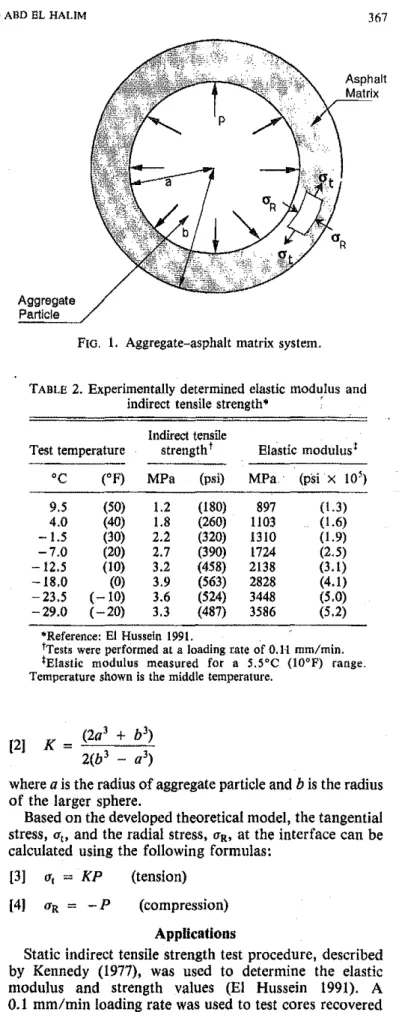
hy differential contraction will result in radial and tangential stresses in the asphalt matrix surrounding an individual aggregate particle. These stresses are not expected to relax through flow as in the case of high temperatures. As a result, the asphalt matrix around the aggregate will be under ten-sion, as shown in Fig. I. With further cooling, the tangential stresses will continue to increase and at some point may exceed the fracture strength of the matrix. The following section will describe the state of stress resulting from dif-ferential contraction during thermal cooling as estimated by an analytical model.
Analytical investigation
Because of a lack of information on the properties of asphalt matrix, a mechanistic model was developed to inves-tigate the influence of thermal incompatibility in a simplified geometry shown in Fig. 1 (El Hussein 1991). A number of simplifying assumptions were used:
(i) At sufficiently low temperature, bitumens will perform as an elastic solid, i.e., no stress relaxation through creep or flow.
(ii) The state of stress was analyzed for a single spherical aggregate particle surrounded by a mixture of asphalt cement, sand, and other fine material used as filler (matrix). Therefore, the assumed system consists of two spheres where the aggregate particle occupies the core of the larger sphere, as shown in Fig. I.
(iii) Uniform temperature distribution was assumed, since the volume investigated was small.
(iv) The coefficient of thermal contraction and the Poisson's ratio were assumed constant within the investigated temperature range.
The following formula was derived, based on the work done by Timoshenko and Goodier (1951), to calculate the contact pressure, P, at the interface due to differential con-traction during thermal cooling. The full derivation for the equation is in
El
Hussein (1991).[I] p
セ@
/:;T
(<>2 _<>,>([K(l -
P2)+
v2
+
I -2v,]
E2 E,
where
/:;Tis
the change in temperatureT; a
1 and a2 are thecoefficients of thermal contraction of aggregate and asphalt matrix (JOC), respectively; £1 and £2 are the Young's
moduli of aggregate and asphalt matrix (within/:; T), respec-tively; v1 and v2 are the Poisson's ratios for aggregate and
asphalt matrix, respectively; and
Aggregate
Particle
[2]
FIG. 1. Aggregate-asphalt matrix system.
TABLE 2. Experimentally determined elastic modulus and
indirect tensile strength"' ' Indirect tensile
Test temperature strength 1 Elastic modulus::
oc (oF) MPa (psi) MPa· (psi X IO')
9.5 (50) 1.2 (180) 897 (1.3) 4.0 (40) 1.8 (260) 1103 (1.6) -1.5 (30) 2.2 (320) 1310 (1.9) -7.0 (20) 2.7 (390) 1724 (2.5) -12.5 (10) 3.2 (458) 2138 (3.1) -18.0 (0) 3.9 (563) 2828 (4.1) -23.5 ( -10) 3.6 (524) 3448 (5.0) -29.0 ( -20) 3.3 (487) 3586 (5.2) *Reference: El Hussein 1991.
trests were performed at a loading rate of 0. H rnm/min.
fEiastic modulus measured for a 5.5°C (l0°F) range.
Temperature shown is the middle temperature.
(2a3
+
b3)K セ@ ]セM]MMGM
2(b3 - a3)
where
a
is the radius of aggregate particle and b is the radius of the larger sphere.Based on the developed theoretical model, the tangential stress,
u,,
and the radial stress, "•· at the interface can be calculated using the following formulas:[3] u, セ@ KP (tension) [4] "• セ@ -P (compression)
Applications
Static indirect tensile strength test procedure, described by Kennedy (1977), was used to determine the elastic modulus and strength values (El Hussein 1991). A 0.1 mm/min loading rate was used to test cores recovered from a newly constructed pavement section. The elastic modulus was determined for each 5.5°C (10°F) temperature interval, tlT. The elastic modulus and indirect tensile strength values are given in Table 2. These values were then
368 CAN. J. CIV. ENG. VOL. 20, 1993
TABLE 3. Calculated tangential stress for different asphalt matrix thickness
Cumulative tangential stress in MPa (psi)
Temperature Matrix thickness, (b-a) mm (in,)
"C ("F) 6.3 (0.25) 5. 1 (0.20) 3.8 (0. 15) 2.5 (0. 10) 1.3 (0.05) 9.5 (50) 0.3 (48) 0.3 (51) 0.4 (53) 0.4 (57) 0.4 (61) 4.0 (40) 0.7 (108) 0.8 (113) 0.8 (119) 0.9 (127) 0,9 (137) -1.5 (30) 1.2 (178) 1.3 (187) 1.4 (198) 1.4 (211) 1.6 (227) -7.0 (20) 1.9 (271) 1.9 (284) 2.1 (301) 2.2 (321) 2.4 (345) -12.5 (10) 2.7 (386) 2.8 (405) 2.9 (428) 3.1 (457) 3.4 (492) -18.0 (0) 3.7 (537) 3.9 (564) 4.1 (597) 4.4 (637) 4.7 (686) -23.5 (- 10) 5.0 (722) 5.2 (758) 5,5 (801) 5.9 (856) 6.3 (922) -29.0 ( -20) 6.3 (914) 6.6 (959) 7.0 (1015) 7.5 (1083) 8.0 (1158)
Aggregate radius, a = 13 mm (0.5 in.).
MPa psi 1200 8 (b-a}= 1 .3 mm la=13mml 1000 2.5mm Q)
セ@
6 mm Experimentallyセ@
800 Determined Q) 1 Strength .c:-
.,
mm 600:g
4 セ@l!!
i/5
400セ@
"
Q) 2 C) c: 200セ@
0-セ@o
m
セ@ 60 0Asphalt Concrete Temperature F
-40 -30 -10 0
Asphalt Concrete Temperature°C
FIG. 2. Calculated thermally induced stresses in the asphalt matrix.
used to calculate the contact pressure and the tangential stresses due to thermal cooling between l0°C and - 30°C, using [1]-(4]. The results are given in Table 3. A constant value of the coefficient of thermal contraction was used throughout the investigated temperature range. This value depends on the proportions of the asphalt matrix compo-nents. An aggregate radius,
a,
of 13 mm and various asphalt matrix thicknesses ((b - a) from I .3 to 6.3 mm) were used to calculate tangential stresses in the matrix, as shown in Table 3. Figure 2 shows the relationship between tangential stresses and temperature as estimated in Table 3. Experimen-tally determined values of indirect tensile strength, from Table 2, were also plotted in the same figure. From Fig. 2 it is clear that tangential stresses may exceed the mix tensilestrength at relatively low temperatures. A thin asphalt matrix cover results in higher tensile stresses and the mixture will be more vulnerable to localized damage if exposed to the assumed temperature condition.
Results from the above parametric analysis performed using calculated stress values can be used to explain many of the observations made in the past concerning low-temperature performance and adhesion failure due to stripping.
Low-temperature performance
The performance of asphalt concrete mixtures at low tem-peratures received considerable attention in the early 1960s and 1970s. Attempts were made to predict the critical
con-EL HUSSEIN AND ABD con-EL HALIM 369
Tensile strength
-30 -20 -10 0 10
Temperature (0
C)
FIG. 3. Typical indirect tensile strength- temperature relationship.
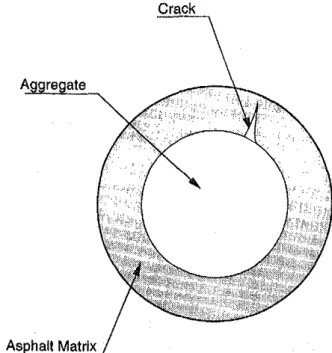
dition when cracks may develop due to low temperatures (Haas and Phang 1988; Ruth eta/. 1982; Monismith e/ a/. 1985). These studies related cracking susceptibility to the increase in stiffness of the asphalt concrete and (or) asphalt cement. One common observation which has not yet been explained involves the drop in the tensile strength of laboratory-prepared samples and field cores, after peaking, at very low temperatures. Figure 3 shows a typical tensile strength-temperature relationship (C.G.R.A. Ad Hoc Com-mittee 1970). Thermally induced tensile stresses, developed as a result of differential contraction during thermal cooling, can result in such behaviour when tangential tensile stresses exceed the matrix strength. Localized damage in the form of hairline cracks, similar to that shown in Fig. 4, and resulting from high tensile stresses, may result in reducing the mix resistance to externally applied loads.
Moisture-associated damage (stripping)
Based on the definition of the problem of stripping, the strength of the adhesive bond determines the mixture resis-tance to separation. Differential thermal contraction, as explained earlier, may influence the bond performance as a result of the state of stress developing at the asphalt matrix-aggregate interface due to temperature changes. One of the following mechanisms will dominate as a result of thermally induced stresses:
(i) High thermally induced tensile stresses, exceeding the strength of the asphalt matrix, result in localized damage in the shape of hairline cracks in the matrix similar to that shown in Fig. 4. Such cracks not only may reduce the mate-rial resistance to externally applied loads, but also expose the interface to water penetration from water accumulat-ing in air voids. Locataccumulat-ing the water path to the interface is of great significance to efforts seeking a solution to the problem of stripping. Initiation of cracks at low tempera-tures and penetration of water through these cracks to the aggregate-matrix interface at temperatures above freezing
Flo. 4. Localized damage caused by thermally induced stresses. may trigger stripping. This mechanism explains the effect of freeze-thaw cycles on asphalt concrete. In the past, investigators found it extremely difficult to explain why freeze-thaw cycles, used for conditioning of samples, pro-duce more stripping damage than warm water soaking (Parker and Garaybeh 1988).
(ii) If the increase in tangential tensile stresses, initiated by differential contraction, is not enough to cause internal cracks, then the change in state of stress will result in an improved bond strength. In the past, the rapid increase in stability with decreasing temperature has been related totally to the increase in the stiffness of the mixture. Improved strength after moisture conditiong could not be explained accurately. Such an improvement was thought to be due to a hydration process similar to that of Portland cement con-crete (Gilmore eta/. 1984). However, tensile strength (and by inference indirect tensile strength) is a function of both adhesion and cohesion. The increase in radial compressive stresses due to an increase in the contact pressure caused by differential thermal contraction explains how adhesion may be improved during thermal cooling, leading to higher tensile strength. The compressive radial stresses contribute to the mixture's resistance to separation at the asphalt matrix-aggregate interface, leading to less damage due to stripping.
Experimental investigation
The main objective of the experimental program was to investigate the effect of temperature changes on bond per-formance. The tests were originally performed as part of a study investigating moisture-associated damage, with con-centration on temperature changes and compaction tech-niques as factors affecting mixtures resistance to stripping (EI Hussein eta/. 1991, 1992). Exposure to low temperature was limited to two levels (2°C and - 30°C), Temperature conditioning in the warm range was also needed to prove that the influence temperature covers the whole range experienced in the field. Therefore, temperature conditioning included exposure to 18, 43, and 60°C. Indirect tensile
370 CAN. J. CJV, ENG. VOL. 20, 1993
TABLE 4. Indirect tensile strength results• (2-day exposure)
Conditioning
temperature Bulk specific
(OC) gravity -29 2.460 2.366 2.421 2 2.434 2.450 2.366 18 2.463 2.413 2.377 43 2.435 2.438 2.376 60 2.456 2.358 2.429 Permeable voids
(%)
1-2 3-4 2-3 3-4 2-3 4-5 1-0 1-2 3-4 1-2 1-2 3-4 1-2 2-3 Indirect tensile strength (KPa) 788 663 876 655 751 692 714 665 568 610 548 564 619 450 Average strength (KPa) 776 699 649 574 534Control group - vacuum saturated and tested at 24°C
2.351 4-5 703 694
2.399 3-4 660
2.450 1-2 719
*All indirect tensile strength tests were conducted at room temperature
(24°C) following conditioning at various temperatures.
TABLE 5. Indirect tensile strength results• (14-day exposure) Indirect
Conditioning Permeable tensile Average
temperature Bulk specific voids strength strength
(oC) gravity (o/o) (KPa) (KPa)
-29 2.415 2-3 648 652 2.397 3-4 681 2.384 3-4 627 2 2.444 2-3 730 694 2.379 3-4 679 2.369 4-5 672 18 2.350 4-5 551 565 2.397 3-4 531 2.459 2-3 612 43 2.413 2-3 468 433 2.405 2-3 432 2.388 3-4 398 60 2.409 4-5 319 282 2.415 3-4 263 2.366 4-5 263
Control group - vacuum saturated and tested at 24°C
2.351 4-5 703 694
2.399 3-4 660
2.450 1-2 719
*All indirect tensile strength tests were conducted at room temperature (24°C) following conditioning at various temperatures.
strength tests were used to estimate the loss or gain in bond strength following temperature conditioning of partially saturated cores recovered from the field. To eliminate the
TABLE 6. Freeze-thaw test data (three freeze-thaw cycles)'
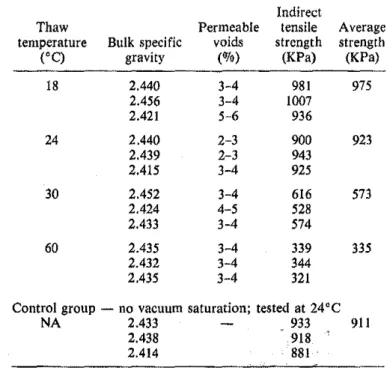
Thaw temperature (oC) 18 24 30 60 Bulk specific gravity 2.440 2.456 2.421 2.440 2.439 2.415 2.452 2.424 2.433 2.435 2.432 2.435 Permeable voids (%) 3-4 3-4 5-6 2-3 2-3 3-4 3-4 4-5 3-4 3-4 3-4 3-4 Indirect tensile Average strength strength (KPa) (KPa) 981 975 1007 936 900 923 943 925 616 573 528 574 339 335 344 321
Control group- no vacuum saturation; tested at 24°C
NA 2.433 933 911
2.438 918 "
2.414 881
"'All indirect tensile strength tests were conducted at room temperature
(24°C) following freeze-thaw cycles (freezing at -24°C).
effect of faults initiated during compaction, which is a prob-lem associated with compaction using conventional steel rollers, a prototype of the new asphalt multi-integrated roller (AMIR) (Svec and Abd El Halim 1991) was used to compact separate sections of the field trial. This new compaction tech-nique produces compacted surfaces free from construction-induced cracks, as explained in a number of publications (Selvadurai 1990; Liljedahll990). The field test sections were constructed on the campus of the National Research Coun-cil of Canada (NRC), Ottawa.
The recovered cores were vacuum saturated (36 em mer-cury) and soaked in a water bath at the specified tempera-tures for a 2-day period. The - 30°C group was stored in an environmental chamber after saturation and wrapping of cores in plastic sheets. All cores were then moved to a water bath at room temperature for 2 hours prior to loading. The results of the indirect tensile strength test are given in Table 4. Other sets of cores from the same section were also exposed at the same conditions for a 14-day period and the results are given in Table 5. All indirect tensile strength tests were performed at room temperature (24 °C).
Three freeze-thaw cycles were also used for the condi-tioning of other sets of cores. Cores of these sets were vacuum saturated at room temperature prior to application of freeze-thaw cycles. Each cycle included freezing the wrapped cores (- 30°C) for 20 hours followed by thawing at various temperatures. The thawing temperatures included 18, 24, 30, and 60°C. Different thawing temperatures were used in order to compare the effect of the previously described conditioning method with the effect of freeze-thaw cycles. The indirect tensile strength test results follow-ing this conditionfollow-ing procedure are given in Table 6.
Results and discussion
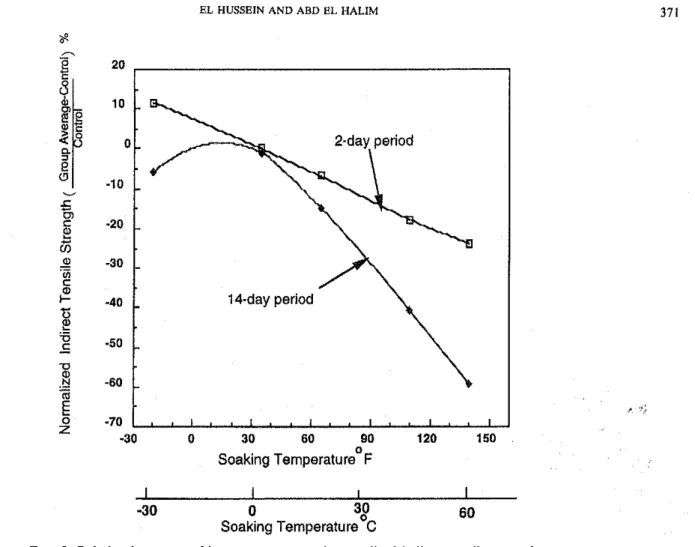
The relationship between the normalized values of indirect tensile strength and soaking temperature for the 2- and
EL HUSSEIN AND ABD EL HALIM 371 -." セ@
g
c 208
"
10 セ・@""
.1( 0 0 c. セ@e
(!) ·10セ@
c: ·20 !:! -Cf) Cj) -30 セ@cセ@
-40 14-day period 0 !:! '0 -50.s
-oNセ@
-60 "iii§
0 -70z
·30 0 30 60 90 120 150 Soaking Temperature°
F·30
0 30 Soaking Temperature°
C60
FIG. 5. Relation between soaking temperature and normalized indirect tensile strength.
14-day soaking periods is shown in Fig. 5. From the fignre, the effect of thermal cooling after the 2-day exposure dura-tion was an increase in the strength of the cores exposed to temperatures below freezing. Cores exposed to - 30°C showed an 11.8o/o increase in strength compared with the unconditioned group. Above room temperature, the strength of soaked cores decreased with a maximum drop of 23% due to exposure to 60°C conditioning temperature. The per-formance of the mix was approximately linear between the two extreme temperatures. This result clearly indicates the sensitivity of the bond, as reflected by tensile strength, to temperature changes. The increase in strength with decreas-ing temperature indicated that the net effect of thermal cool-ing was an improved bond as a result of increased radial compressive stresses caused by differential contraction.
The effect of thermal cooling at -30°C for a 14-day exposure period (Fig. 5) was a 6% drop in the strength of the cores as compared to the 11.8% increase after a 2-day exposure period. This change in behaviour indicates that the net effect of differential contraction after continued exposure results in internal damage in the asphalt matrix, exceeding the gain from radial compression around individ-ual aggregate particles. After exposure to high temperatures for 14 days the indirect tensile strength test results indicate loss of bond. A high degree of stripping was visually observed at the failure surface of the cores after testing. Differential thermal expansion had the effect of relaxing the compressive stresses, thus leading to less resistance to strip-ping. At these higher exposure temperatures the process is more complex, since asphalt flow also contributes to the
physical changes inside the cores. Structural changes in the bituminous cover around aggregate caused by exposure to high temperature (60°C) also contribute to the deterioration of the adhesive bond (El Hussein 1991).
The influence of the moisture and temperature condition-ing described above may be summarized as follows:
(i) Exposure of cores to a low temperature for an extended period resulted in a decrease in strength. The decrease is attributed to internal damage in the cores caused by differential contraction, as described in the analytical approach.
(ii) Exposure to low temperatures for short periods resulted in an improved strength, indicating improvement in the asphalt matrix-aggregate bond. The increase in bond strength is attributed to an increase in radial compressive stresses caused by differential contraction. The short period seems to reduce the probability of propaglltion of thermally induced cracks.
(iii) Exposure of cores to warmer temperatures resulted in less strength as a result of reduced bond strength caused by differential thermal expansion, regardless of the duration of exposure. Reduced bond strength led to less resistance to stripping damage.
Freeze-thaw
The other factor discussed in the analytical approach concerns the influence of thermally induced cracks, caused by differential contraction, on the stripping resistance of asphalt concrete. Figure 6 shows the relationship between indirect tensile strength and thawing temperature. The results
372 CAN, J. CIV. ENG. VOL. 20, 1993
20
0
·20 Simple Soaking 2 days
-40 ·60 3 Freeze-Thaw Cycles ·80 ·30 0 30 60 90 120 150 0 Conditioning Temperature F
I
·30 0 30 Conditioning Temperature° C 60F1o. 6. Relationship between normalized indirect tensile strength and conditioning temperature (freeze-thaw cycles).
of the 2-day exposure period are also plotted for compari· son. It is clear that freeze-thaw cycles produced more strip-ping damage as estimated from the indirect tensile strength test results. This increase in stripping was verified by visible inspection of the failure surface. The difference in perfor-mance between the two conditioning methods may be attributed to the localized damage inflicted by the freezing part of the cycle. Cracks initiated by differential thermal contraction during the freezing process acted as a route for water to flow freely into the interface. The presence of water will enable stripping to recommence at the beginning of the warm part of the cycle and progress more rapidly.
Conclusions and recommendations
(i) The results of the analytical and experimental investigation verified the hypothesis that differential thermal contraction and expansion influence the performance of the aggregate-asphalt bond as a result of temperature changes. Differential contraction improved the bond in the short exposure period and caused internal damage after the long exposure period. Differential thermal expansion led to a reduced bond strength throughout the warm temperature range.
(ii) The performance of the aggregate-asphalt matrix system, described by the concept of differential contraction and expansion, explains previously reported behaviour of asphalt concrete mixtures when exposed to temperature changes. These include the following:
(a) The observed drop in indirect tensile strength after peak· ing dnring thermal cooling. Localized damage, caused by high tensile stresses, reduces the mix resistance to externally applied loads.
(b) The significant reduction in the mix strength caused by
stripping after freeze-thaw cycles compared with simple soaking is the result of cracks initiated by differential contraction. These cracks are capable of delivering sig· nificant amounts of water to the aggregate-asphalt interface.
(iii) The performance of the identified subsystems (aggregate particles, asphalt matrix) must be investigated and physical as well as mechanical properties must be determined accurately throughout the pavement service temperature range. Accurate properties will improve the ability of the analytical model in estimating thermally induced stresses.
Acknowledgements
The authors would like to express their deep appreciation for the financial support provided by the Ministry of Transportation of Ontario (MTO); the Industrial Research Assistance Program, National Research Council of Canada; and the Natural Sciences and Engineering Research Council of Canada. Acknowledgement is also due to Dr. G.J. Kennepohl of MTO and Prof. R. Haas of University of Waterloo for reviewing the initial text showing the concept and to my colleagues Drs. 0
.J.
Svec and J .H. La Verne Palmer for their assistance during the preparation of this paper.C.G.R.A. Ad Hoc Committee. 1970. Low temperature pavement
cracking in Canada: the problem and its treatment. Annual
Meet-ing, Canadian Good Roads Association, Montreal, Que. El Hussein, H.M. 1991. Stripping of asphalt concrete surfaces.
Ph.D. thesis, Department of Civil Engineering, Carleton Uni·
versity, Ottawa, Ont.
El Hussein, H.M., Abd El Halim, A.O., and Kennepohl, G.J. 1991. Influence of temperature on the stripping of asphalt
con-EL HUSSEIN AND ABD con-EL HALIM 373 ' crete mixtures. Canadian Technical Asphalt Association Con·
ference, Montreal, Que., November 17-21, pp. 115-134. El Hussein, H.M., Abd El Halim, A.O., and Kennepohl, G.J.
1992. Influence of construction induced cracks on asphalt con·
crete stripping resistance to moisture damage. TI'ansportation Research Board cッョヲ・イ・ョ」・セ@ Washington, D.C., January. Gilmore, D.W.1 Lottman, R.P<l andScherocman, J.A. 1984. Use
of indirect tension measurements to examine the effect of
additives on asphalt concrete durability. Proceedings of the Association of Asphalt Paving Technologists, 53: 495-524. Haas, R.C.G., and Phang, W.A. 1988. Relationships between mix
characteristics and low-temperature pavement cracking. pイッセ@
ceedings of the Association of Asphalt Paving Technologists,
57: 290-319.
Jones, G.M., Darter, M.I., and Lifflefield, G. 1968. Thermal
expansion-contraction of asphalt concrete. Proceedings of the
Association of Asphalt Paving Technologists, 37: 56-100. Kennedy, T. W. 1977. Characterization of asphalt pavement mate·
rials using the indirect tensile test. Proceedings of the Association
of Asphalt Paving Technologists, 46: !32-150.
Monismith, C.J., Epps, J.A., and Finn, F.N. 1985. Improved
asphalt mix design. Proceedings of the Association of Asphalt
Paving Technologists, 54: 347-406.
Liljedahl, B.O. 1990. Rolling and compacting. Centerline. The Michigan Asphalt Paving Association Magazine, 1990 Summer
Issue.
Parker, F., Garaybeh1 G.A. 1988. Evaluation of tests to assess
stripping potential of asphalt concrete mixtures, Transportation
Research Record 1171, Transportation Research Board, Washington, D.C., pp. 18-26.
Phang, W.A. 1987. Low temperature asphalt pavement cracking: non A.C. considerations. International State of the Art Colloquium in Low Temperature Asphalt Pavement Cracking,
Hanover, N.H., May 6.
Ruth, B.E., Bloy, L.A.K., and A vital, A.A. 1982. Prediction of
pavement cracking at low·temperatures. Proceedings of the aウウッセ@
ciation of Asphalt Paving Technologists, 51: 53-103.
Selvadurai, A.P.S. 1990. Flexural tests on asphalt beams recovered from test sections compacted by using steel and AMIR compac· tors. Final Report on Research Contract 989-44095, Institute for
Research in Construction, National Research Council of Canada,
Ottawa, Ont., pp. 1-67.
Svec, O.J., and Abd El Halim, A.O. 1991. Field verification of a new asphalt compactor, AMIR. Canadian Journal of Civil Engineering, 18{3): 465-471.
Timoshenko, S., and Goodier, J.N. 1951. Theory of elasticity. McGraw·Hill Company, New York, N.Y.