Building Healthy: A feasibility study of developing a “Healthy” Office Tower
by
Alexandra Hayes Stratouly
B.A., Economics, 2015
Boston College
Submitted to the Program in Real Estate Development in Conjunction with the Center for Real Estate in Partial Fulfillment of the Requirements for the Degree of Master of Science in Real Estate Development
at the
Massachusetts Institute of Technology
February, 2021
©2021 Alexandra Hayes Stratouly All rights reserved
The author hereby grants to MIT permission to reproduce and to distribute publicly paper and electronic copies of this thesis document in whole or in part in any medium now known or hereafter created.
Signature of Author_________________________________________________________ Center for Real Estate
January 14, 2021
Certified by_______________________________________________________________ Kairos Shen
Executive Director, MIT Center for Real Estate Associate Professor of the Practice
Thesis Supervisor
Accepted by______________________________________________________________ Professor Siqi Zheng
Samuel Tak Lee Professor of Urban and Real Estate Sustainability Faculty Director, Center for Real Estate & Sustainable
Building Healthy: A feasibility study of developing a “Healthy” Office Tower
by
Alexandra Hayes Stratouly
Submitted to the Program in Real Estate Development in Conjunction with the Center for Real Estate on January 14, 2021 in Partial Fulfillment of the Requirements for the Degree of Master of Science in Real
Estate Development
ABSTRACT
In the real estate development industry, there have been many influential forces that have created change in the baseline expectations and performances of buildings. These changes have occurred in response to market demands by tenants, capital demands made by investors and inherent evolution in technology. This thesis will focus on the market evolution of
environmentally driven changes to building design and operations due to LEED parameters and now the inclusion of indoor environmentally healthy requirements through WELL building parameters.
This thesis focuses specifically on the financial feasibility of developing a Well Certified office building. It compares two hypothetical office tower developments: a LEED standard development to a WELL certifiable development. The thesis explores what design considerations a WELL building must address and how these Well standards compare to systems in existing buildings. It explores the physical implications of WELL level infrastructure and the
comparative costs associated with the changes. Ultimately, this thesis evaluates the financial feasibility of building a WELL building as compared to a LEED standard Building. It will surmise that while initially less economically appealing than a LEED standard development, the market forces will push WELL parameters to be requirements of the next evolution of Class A office building development.
Thesis Supervisor: Kairos Shen
Title: Executive Director, MIT Center for Real Estate Associate Professor of the Practice
Dedication
They say it takes a village, and this thesis would not have been
possible without the support of a village of people. Thank you to my
advisor, Kairos Shen, who helped me find my footing when the world
felt like it was imploding. Thank you to my parents, without whom I
would have only eaten cereal and drowned in all of my thoughts.
Thank you to Caitlin Dutkiewicz, for reigning in my comma usage and
encouraging periods. Thank you to Riaz Cassum and Lori Mabardi from
JLL, for connecting me to anyone they thought could help and for their
thoughtful responses to my many questions. I can’t wait for our
professional paths to cross. Thank you to Brian Hubbard, for helping
me provide visuals of the developments that were in my head. Thank
you to Andy Hoar at CBRE for giving me an inside look at the tenant
market and its drivers. Thank you to Erica Weeks, who helped me
understand how wellness was translating into the workplace. Thank
you to Elizabeth Lowery and Kristen Fritsch, from Elkus Manfredi, for
giving me a real look into the thought process required to design an
office for optimal wellness. Thank you to Ken Scott for spending
endless hours on zoom calls, working through my financial models and
keeping me calm every time it blew up. Thank you to the entire
Congress Group whose support, as always, was infallible. You Thank
you to my brother for always over explaining; he told me about
dispatch elevators and DOAS systems before I even knew I would be
writing this thesis. Thank you to Bob Leber of Cosentini, who
responded to every email and phone call, essentially teaching me the
fundamentals of thermo dynamics in the course of a few weeks—your
patience was exemplary. Finally, thank you to MIT for providing me
the environment to explore the built environment. My sincerest
gratitude to you all!
Table of Contents
Introduction ... 5
1.1 Defining “Healthy” Buildings ... 6
1.2 Certifications ... 17
2.1 Standard LEED Development ... 23
2.2 Case Studies ... 26
2.3 WELL Development ... 36
3 Comparison ... 40
3.1 Physical ... 40
4 Conclusion ... 50
Appendix A - Standard LEED Development ... 55
Appendix B - WELL Development ... 65
Appendix C - Comparison ... 76
Appendix D – WELL & Fitwel Score Cards ... 81
Appendix E – Interviews ... 93
Introduction
In real estate development, we often speak about the “built environment” and the need to understand how a project influences a user’s experience. The Oxford dictionary defines the term “built environment” as “man-made structures, features, and facilities viewed collectively as an environment in which people live and work.” The scope of this definition has expanded over the pasty twenty years, as climate change and green initiatives such as LEED have pushed the
development industry to make considerations beyond the structural environment. In a world that is becoming increasingly health-conscious, the development industry is now beginning to consider the interior environment quality (IEQ) and the healthy implications of these structures. Now, everyone from a project’s investors to its tenants consider the building’s impact on the global environment. In the last 5-6 years, the wellness trend has become more present in the office, tenant, and
development world.i The public awareness the COVID-19 pandemic has brought to the importance
of air quality and filtration systems will only accelerate the importance and market expectations regarding IEQ. The real estate development industry is on the verge of a change in the market priorities, and we need to consider the logistics of how a response can be incorporated into projects today.
This thesis will delve into the concept of healthy buildings and analyze the feasibility of implementing the necessary building design elements to develop a healthy office tower. The concept of wellness in commercial real estate is a recent notion. The amount of available quantifiable data in the industry is limited for three main reasons. 1. There is not a clear, market -wide definition. The notion of wellness is frequently referred to, but there is no codified standard of what the term encompasses. 2. There is not a significant amount of supply to study. With no clear definition, it is difficult to define which buildings and which space should be considered in a study. It can depend on wellness certifications, but there is still not a significant number of certified buildings in the U.S. The first WELL certified office building in Boston is currently under construction. There are only three Fitwell built building certified office buildings in Boston.ii This thesis will explore these
certifications, but it is important to understand that the majority of wellness certifications have occurred at the tenant level of development. 3. The impact of wellness is difficult to isolate. It is a
concept that is intertwined with many building qualities: sustainability, design, amenities and building management. It can be difficult to determine if it is the wellness approach of a building that has led to its rental success or that the simple incorporation of a fitness center and outdoor space appeals to the tenants. The goal of this thesis is to take a moderately abstract concept that has little quantitative available and determine the feasibility of developing a healthy office tower. First, the thesis will seek to define what it means for a building to be healthy. Second, it will explore the certification
processes for the two most popular IEQ assessment programs in North America: Fitwel and WELL. This thesis will then explore how to incorporate fundamental healthy design elements into a development. Through a hypothetical standard LEED development, we will create a baseline building and a parallel WELL certified development. Given the infancy of the wellness field of development, this thesis will rely on interviews and the knowledge of industry leaders across various fields of development. Finally, this thesis will compare the two hypothetical developments and, referencing existing projects and industry specialists’ knowledge, attempt to analyze and understand the economic feasibility of developing a healthy office.
1.1 Defining “Healthy” Buildings
The concept of healthy buildings considers the environment buildings are creating for the people who live within them. In the context of office space, the concept acknowledges that healthier spaces lead to improved cognition and productivity from employees who work in the space.
People are inherently drawn to spaces where the environment, in one way or another, is more conducive to their work productivity. Whether it is a student going to a library because they need a noise-controlled space, or an investor having meeting where they can sit outside to get fresh air and a cup of coffee, people are instinctively drawn to spaces that provide environments that improve their cognition. Scientific research has begun evaluating healthy lifestyles and attempting to quantify the concept that the human brain performs better in specific environments. Joseph Allen and John Macomber, two of the leading experts on healthy buildings wrote Healthy Buildings: How Indoor Spaces Drive Performance and Productivity. It is one of the first books that compiles the research
and applies the research to North American business thinking. They proffer that employers must pay attention to the actual environment that their employees are expected to perform in and how the environment can aid in their cognitive abilities. They posit that this environment includes everything
from air quality to light exposure, which all effects a company’s employees’ performances and, ultimately, the company’s bottom line.iii
Allen and Macomber are both professors at Harvard University and have worked with the university’s School of Public Health to understand and define the relationship between the built environment and the people who operate within. In conjunction with The Harvard T.H. Chan School of Public Health, they identify 9 foundations of a healthy building:
1. Safety and Security: Safety and security refers to a tenant’s base need is to feel safe. Beyond
simply the distraction of feeling unsafe in a space, the chemical response from the “fight or flight” instinct can trigger cortisol and adrenaline, increasing heart rate and blood pressure.iv
To implement safety and security into a healthy building, Allen and Macomber suggest you: Meet Fire and life safety standards, such as fire suppression
systems and carbon monoxide monitoringv
Establish “secure flow,” allowing for porosity, but utilizing security checkpoints to establish private areasvi
Enact an Enterprise Security Risk Management (ESRM) plan that addresses the five points of securityvii
Consider Safety and Security as a base management functionviii
In light of the COVID-19 pandemic, the industry has been forced to rethink safety as it considers how to protect tenants from the spread of
Figure 1: 9 Foundations of a Healthy Building
germs. While this element could be expanded to encompass the entire operation of the building, for the purposes of this thesis we will keep the concept of security’s COVID-19 response to a building’s accessibility program. This means having touchless systems, such as dispatch elevators and motion activated fixtures, tenant tracing systems and management programs to limit occupancy numbers. We will continue to address COVID-19’s impact in the HVAC design.
2. Dusts and Pests: Dusts and pests, similarly to safety and security, is a straightforward healthy
foundation, but is often overlooked, particularly depending on a project’s location. In a city like Boston, significant concern regarding rodents exists. In warmer climates such as Miami,
concerns around insect infestations prevail. Regardless of location, however, pests are a danger to tenants’ health. From excrement, general dirt and the allergens they leave behind, to the nagging distraction of worrying about a mouse running across your desk, pests inhibit productivity. Dust is in fact an extension of these pests; according to Allen, “Dust mites are microscopic pests that feed on shedded human and animal skin cells…” and while they “… do not bite or ting, their feces and body parts create a harmful allergen (Der p1) that can
dramatically impact human health.”ix These impacts can be everything from asthma to hay
fever.x No one can be productive if they have watery eyes, are having a hard time breathing or
are watching a mouse run across their office floor.
How to think about implementing dust and pest health into an office building:
Ensure the building is well sealed. Uphold a high construction standard to ensure that where the building connects to its surroundings is properly insulated and has tight seals. Adhere to proper building maintenance to shore up any degrading materials.
Have sufficient cleaning protocols. Consider building trash removal, food storage and disposal. Clean with HEPA vacuums and periodic deep cleaning of all surfacesxi
Maintain a pest management protocol. Consistent maintance prevents instances of infestation and increased dust particulates that are introduced into the space from pests.xii
3. Water Quality: Having proper access to clean water is paramount to provide a healthy
environment for tenants. Studies show that staying hydrated affects your thinking, whether it be through your mood or your performance.xiii Similarly to pests, water quality control needs can
treatment as water coming into a building in Detroit; however, drinking water is regulated in the United States. The National Primary Drinking Water Regulations set standards which must be met. However, even if the sourced water is safe, building systems can contaminate it and alter its PH, creating unhealthy levels. Depending on the condition and ages of the domestic water piping, contaminants, such as lead, can enter the water; furthermore, stagnant points in the water system can lead to the growth of Legionella, a dangerous bacterium that can lead to outbreaks of Legionnaires’ disease.xiv Luckily, due to ASHREA Standard 188, human-occupied commercial
buildings are required to have a Legionella management plan.xv Maintaining healthy water quality
in an office building is paramount to the health of its tenants.
How to think about implementing water quality health into an office building:
Have annual testing of water at the point-of-use to ensure it meets the US Safe Drinking Water Act.xvi
Be aware of any places where water can be stagnant and perform regular tests to ensure absence of Legionella.xvii
Monitor water systems to ensure stable conditions.xviii
Use additional filtration systems, such as Brita or Quench.xix
4. Moisture: While water is pivotal to human health, it can also be one of the most damaging
forces a building contends with. With the complexity of architecture and façade designs, and roof connections combined with the maze of plumbing features and fixtures, water has many ways to enter get into a building. Water in buildings can cause immediate and long-term damage. Beyond the aesthetic and comfort displeasures for a tenant who experiences water damage, the potential for mold growth is significant, which can cause allergic reactions, congestion and headaches.xx
How to think about implementing moisture health into an office building:
Focus on quality. Have superior design, with particular focus on mechanical, electrical and plumbing (MEP) and follow best practices for construction quality. The best way to avoid water damage is by being thorough in the design phase and paying attention to the
connection points and flashing detail on the building enclosure system. Coordinate the design with consultants to ensure proper waterproofing measures are being taken in the
construction of the shell.xxi Spend time with the MEP consultants and ensure proper
installation by the construction team to make sure they are implementing all plumbing elements properly.xxii
Focus on maintenance. Once the building is completed, maintaining the building and monitoring the structure for, and to prevent, potential sources of moisture are imperative steps.xxiii This work should include maintaining thermal systems, a healthy foundation in
itself. In humid climates, not sustaining adequate thermal controls can lead to elevated internal levels of humidity and moisture build up which can result in elevated levels of mold.
5. Thermal Health: Thermal health includes more than just having heat and air-conditioning to
maintain temperatures in the tenant’s space; it is also about maintaining the humidity, air circulation within that space and comfort. Imagine an employee’s performance if they were outside on a humid day with no wind, when the air feels so thick it’s hard to breath. Thermal health is more than just a perceived discomfort. A study in 2016 compared two sets of college students, one living in a dormitory with air-conditioning and one without. It found that the students in the temperature-controlled dormitory performed better and more consistently on a cognitive function test than those in the dormitory without air-conditioning.xxiv The results
determined that a 2-degree variation in temperature led to a 1% reduction in cognitive production.xxv These results may not seem substantial, but when considering 1% decrease in
performance across a building of over 1000 employees who are effecting multiple millions of dollars of work output, the difference can have significant effect many tenants’ economic output.xxvi
Controlling for thermal health is difficult because it depends on how a building responds to external temperatures and humidity. Building HVAC systems expel steams of cold air to counteract high humidity levels. How employees dress is another consideration for thermal health. People wear lighter clothes in the summer and heavier clothes in the winter in response to outdoor temperatures, while the indoor temperature controls will provide the opposite environments.xxvii
xxviii
While ASHRAE provides thermal standards, those standards do not
necessarily adhere to the comfort needs of a tenant. Berkley’s Center for the Built Environment has an online “Thermal Comfort Tool” which attempts to calculate ideal comfort conditions factoring external and personal factors and shows that thermal health is far more dynamic than one universal number.xxix
How to think about incorporating thermal health into an office building:
Examine thermal efficiency during design and use the energy modeling system not just to determine sizing mechanical systems, but also to study the thermal effects of material uses. Consider what type of façade system is being used and how to ensure thermally efficient insulation and window systems.xxx
When choosing cooling and heating systems, consider options for multiple zones and ability to have in-space controls.
Manage the thermal conditions of the building proactively in response to weather changes.xxxi
6. Noise: The concept of noise control to ensure a high IEQ and safeguard productivity refers to
the quality of the acoustical controls is in a building to ensure employees’ peak performance. According to the W.H.O., term exposure above 70dB can cause hearing damage, and long-term exposure to noise at levels of 65-70dB can disrupt normal cardiovascular and
psychophysiological functions.xxxii
xxxiii
xxxiv
Noise can also be disruptive to cognitive functions. A study of the impact of noise on male students showed that small changes in background noises had a significant effect of working memory. If a company is having a meeting and the noise from a heat pump system behind the wall is noticeable, that noise could be the deciding factor in employees retaining pertinent facts and being able to accurately respond to meeting topics. The need to consider how noise effects office spaces will only increase as the way offices function change in response to a post-pandemic world. Office was already starting to favor open floor plates, meaning fewer walls to dampen noise. 73% of companies in a CBRE survey said they needed to have a balanced workplace environment, with most believing they will never have 100% of employees back in the office. It will become increasingly more important when people are in the office that the space optimize the effectiveness of in-person interactions. Additionally, as companies seek to de-densify and offer more space between employees, employees’ ability to communicate across larger spans of space without degradation of the message due to background noise pollution will be paramount. The concept of spacing people apart is undermined if they must go sit right next to their colleague to have a productive conversation.
Understand where systems might cause high levels of noise pollution and understand how it may interact with the user’s space. If heat pumps share a wall with the kitchen, less sound proofing will be necessary than if it shares the wall of the main conference room.
Discern which space in the office will be used for what means and coordinate finishes with those spaces. If the office is largely open concept, consider using noise dampening materials like carpet or wood rather than polished concrete.
Increase soundproofing in specific places where people will require silence or need to be loud without disrupting other workers.
7. Lighting and Views: Like noise control, the importance of lighting and views has always been
a matter of importance and consideration when developing an office building. The concept of corner offices and conference rooms with views and daylight that will impress clients has long been a factor in achieving the market’s top rental rates; however, as employers and employees begin to become more aware of the IEQ they work in, it only makes sense that they begin to demand light qualities be considered across the entire office space. We inherently recognize that different lighting affects our moods, whether it be sitting in a room lit by the light of a fireplace to help us feel relaxed or laying on a patch of grass under bright sunlight to help us feel
reenergized. Studies have begun to be performed trying to identify and quantify the effect lighting has on cognitive function; however, the numerous variables and areas of effect in these studies have led to a mixed understanding of the degree of impact light has on cognitive function.
xxxvi
xxxv All of the studies do, however, show that there is a connection to color and type of
light exposure on a person’s mood and performance, particularly in connection to natural
circadian cycles and sleep-associated health. Studies show that being exposed to appropriate light balanced melatonin levels and circadian rhythm functions, leading to improved alertness and cognitive performance.
How to think about incorporating light health in an office building:
Use an informed lighting consultant. Put in system that appropriately illuminates the space and considers color spectrum and intensity, both generally and in response to the time of day.
8. Air Quality: Indoor Air Quality (IAQ) has long been a consideration when designing buildings.
We have acknowledged that volatile organic compounds (VOCs) are chemicals that can be emitted from common building materials such as paint and carpets and that they are all
detrimental to a person’s health and cognitive function. While VOC effects depend on length of the exposure, immediate symptoms include headaches and memory impairment.xxxvii A challenge
in achieving a healthy IAQ, is that though a product may be identified as low VOC, harmful chemicals can still be released, particularly if materials have been exposed to extreme conditions like long periods of direct sunlight.
How to think about incorporating IAQ health into a building:
Consider material selections and the environment they will used in. Select low VOC and be as informed as possible about chemicals content.
Have sensors that are monitoring air quality, such as carbon monoxide monitors. Install a notable HVAC system that cycles high levels of fresh air.
Support individual air filtration units.
Perform annual in-depth air quality testing.xxxviii
9. Ventilation: Healthy ventilation is centered around conditioning the air which is coming in
from the ambient environment and cycling the indoor air to keep it clean. Ventilation is one of the most important characteristics of today’s office building. Not only does the amount of fresh air brought into the building effect the health of a tenant, but it is also a critical piece of
foundation for creating a healthy IAQ. Studies show that high levels of CO2 can impede a person’s cognitive function, particularly when tired or stressed.xxxix Increasing the number of
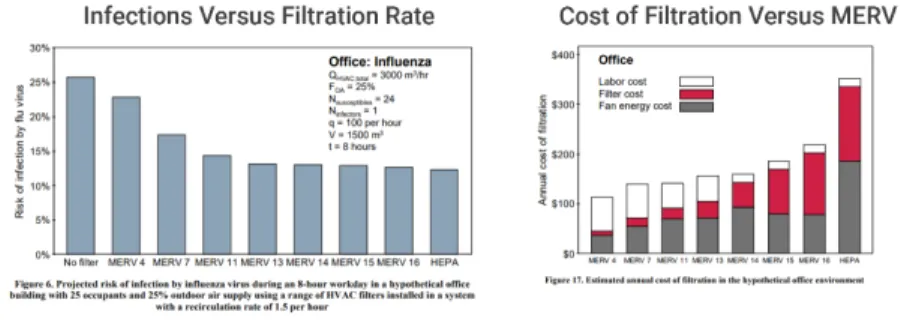
times a HVAC system cycles and introduces fresh air into the building can keep CO2 levels low and performance of tenant employees high. Another modification to the HVAC system that improves the ventilation quality is an upgrade in the filtration system. By increasing the density of the filter in a system, the HVAC system not only distributes cleaner ambient air, but also recirculates cleaner interior air. Introducing denser filters, however, requires more space and pressure to push the same amount of air through a system which was able to be introduced in the building with a lower grade filter. This means a healthier ventilation system will require more power or larger ventilation ducts, which often impedes the efforts to retrofit HVAC systems in older buildings.xl Finding the right balance between outdoor air supply and indoor air
recirculation function in a HVAC system is a complicated engineering balance of system alterative and geographic location of a project. A building in LA will require more filtration of the outdoor air than a building in Charlotte, but require less cooling; conversely, a building located in New York will require maximization of both components.
How to think about implementing ventilation health into an office building:
Consider the amount of fresh air being introduced. The standard is 30-50% or 5 turns an hour.
Look at filter grades. The typical MERV level of office building filters is 6 but can go as high as 13.
While the 9 foundations of a healthy building are a valuable concept when constructing a healthy office tower, there are additional components of the design process that will directly affect tenants’ health and cognitive function. For example, if an office layout puts conferences rooms on the perimeter of an office space layout, locating cubicles at the core, the largest windows on the market will not provide sufficient sunlight to reach those seated in the cubicles. For the definition of healthy in this thesis, we will consider three additional characteristics in achieving a healthy indoor environment: layout, biophilic design and amenity spaces.
Layout: The tenant office layout is the basis of the way people occupy and interact within the space and is elemental in employees’ productivity. An effective layout should be a direct reflection of user activity. By understanding and addressing employees’ needs through the layout, productivity and overall IEQ can be increased.xli While a developer may not be able to foresee the operational layout
needs of a future tenant, the base building layout can be designed and constructed to lend itself to flexible tenant fit out options
How to think about implementing layout health in an office building:
Consider the overall floor plate size. The size should not be too deep to have wasted interior space, but deep enough to provide options for various types of space i.e., typically a total of 25,000-30,000 sf with dimensions of roughly 150’ by 200’. The core to perimeter wall should not exceed 45’. In addition, the million spacing and column-grid should run in 5’ increments to provide optimal furniture layout options.
Through architectural design, alternative floor plate geometries can be achieved, but thought must be given to how the interior space can be effectively laid out and utilized by the tenant. Examine the column grid. They need to be spaced far enough apart to provide open spaces,
but close enough to create clear delineations between space and, of course, provide cost effective structural integrity i.e., typical column grid of 30’ on the perimeter and 40’/45’ on interior when structurally required.
Biophilic Design: Interior layout quality can be influenced by the philosophy of biophilic design. Biophilic design is the notion of incorporating elements of nature into the design and finishings of the building’s interiors.
There are three elements of biophilic design:
“Nature in the Space” including physical elements of nature in the space i.e., plants, water features, views of nature.xlii
“Natural Analogues” including materials that look like nature i.e., natural materials, artwork that mimics nature and general patterns found in nature.xliii
“Nature of the Space” special layout that mimics natural environments i.e., large open spaces simulating open fields, closed off spaces simulating protective caves.xliv
While it may be hard to believe that our society which has found ways to exist predominantly on digital platforms and spends majority of time indoors, needs, and benefits from, exposure to natural elements, studies have proven that the inclusion of the three components in biophilic design not only improve long term health characteristics, but also energy and employee productivity.xlv As we
deal with the consequences of COVID-19 and forced lockdowns, it is reasonable to assume the need for exposure to nature and natural elements indoors, and the acknowledgement of that need, will only bring immediate and greater demands to the forefront of conversations and design requests.
Amenities: Amenities are an interesting aspect of building a healthy building. They have already started to be demanded by larger tenants in order to improve their employees’ work experiences and quality of life.
xlvii
xlvi Concepts such as WeWork and Tishman Speyer’s ZO tenant application show the
response to office users wanting a greater sense of community and non-work-related experiences within their workplace. Whether it is a WeWork coffee bar, or ZO’s building-wide knitting club
and lunchtime yoga sessions, tenants are demanding more from a building than just their own office space.
What amenities to think about adding for a healthy office building: Fitness Center
Outdoor spaces i.e., terraces and balconies Coffee and cafeteria offerings
Welcoming lobbies with ample seating areas Overflow workspace and meeting areas
1.2 Certifications
Having explored what it means to build a healthy office building and the core elements for consideration, we now must understand how the certification processes contribute to the goal of creating healthy office spaces. By setting standards that must be verified, certifications offer 3rd party
verification and approval of the methods and management processes a building has deployed. For the purposes of this thesis, we will focus on the two main certifications that focus on the indoor environment of buildings and have begun to be recognized in the North American market: Fitwel and WELL.
Fitwel Fitwel was created in 2017 by the Center for disease Control, U.S. General Services Administration and Center for Active design. It analyzes seven categories of impact:
Fitwel provides multiple options for certifying different development product types. It has
certification options for the core building, single tenant space as well as for a portfolio of projects. Fitwel offers a design certification for buildings that are designed, but not yet completed which can then be converted to a built certification. Fitwel is particularly accessible for existing buildings that Figure 3 Fitwel’s Seven Health Impact Categories
can be modified and receive certification. The certification requires a one-time application with recertification every 3 years. The certification is based on a scorecard with a total of 144 available points. Buildings are awarded 1-3 stars
based on the number of points received on the scorecard. One star is awarded for 90-104 points, two stars are awarded for 105-124 points, three stars are awarded for 125- 144 points. The cost to certify the building includes an initial cost of $500 and a square footage-based fee that can be found in Figure 4.
Fitwel has been more readily adopted by developers, because certification is less expensive than WELL and is considered easier to achieve. It only requires evaluation through the application process and has lower scoring thresholds.xlviii Fitwel is designed to be straightforward and does not
have any pre-requisites that render projects ineligible. Companies which have reached “Champion” status by certifying 6 or more projects in a 12-month period include companies such as Skanska, Cushman and Wakefield and Boston Properties.xlix Fitwel, though perhaps not as rigorously as it
could, provides an accessible accreditation process that covers the foundations of what we defined as being a healthy office.
WELL: The WELL Building Standard (WELL) was created by the International WELL Building Institute in 2014 after six years of research and development.l There are two main types of
certifications, WELL Core and Owner Occupied. WELL Core focuses on the base building and is available for buildings where 75% is occupied by
more than 1 tenant. Owner Occupied focuses on the user and their occupied space. WELL uses a “dynamic” scorecard system that considers the specific characteristics of an individual project, creating customized scorecard. This specificity allows Owner Occupied to be able to achieve WELL certifications within a space without being reliant on what infrastructure may be available in base building; likewise, WELL Core allows the focus to be on the Core and Shell of the building and does not hold the certification dependent on tenant fit out instructions. The scorecard becomes more complicated by defining space and occupant type.
Space Types:li
• Whole Building
• Extent of Developer Buildout • Leased Spaces
• Non-leased Spaces
• Building Management Staff • Direct Staff
There are three levels of certification gained through points. Silver is 50 points; Gold is 60 points and Platinum is 80-100 points. Additionally, at least 2 points must be earned in each section of the scorecard with an extra ten points available for elements of “innovation”. WELL not only requires a third-party validation of all applications by the Green Business Certification Inc, but also requires onsite testing and evaluation. This requirement means a project cannot receive its certification until the building is complete and can pass threshold tests. Similar to Fitwel, buildings have to recertify every 3 years; however, WELL also requires annual reporting on the conditions of the building. To achieve all of this, WELL has a $2,500 enrollment fee, a $.16 per square foot of program fee starting at $6,500 capping at $98,000 and an onsite evaluation testing beginning at $6,500. The cost of the certification process is one of the biggest hurdles of adoption;lii however, the rigorous testing and
Figure 5: Ten Concepts in WELL v2
approvals process ensures that the certification has a real impact on the tenant’s environment. The certification’s ten concepts are, additionally, very much in alignment with what we previously defined as the foundations of a healthy building.
Amenities Biophilic Design
i Interview with Crissy Haley ii (Fitwel Project Directory, n.d.) iii (Allen, Joseph G., 2020) iv(Allen et al., 2017) v (Allen, Joseph G., 2020, p. 121) vi Ibid vii Ibid viii Ibid ix (Allen et al., 2017, p. 21) x (Allen et al., 2017) xi (Allen, Joseph G., 2020, p. 110) xii (Allen, Joseph G., 2020, p. 110) xiii (Allen, Joseph G., 2020) xiv (Allen, Joseph G., 2020) xv (Allen, Joseph G., 2020, p. 104) xvi (Allen, Joseph G., 2020, p. 105) xvii Ibid
xviii Ibid xix ibid
xx (Allen, Joseph G., 2020, p. 106) xxi (Allen, Joseph G., 2020) xxii Ibid
xxiii ibid
xxiv (Jose Guillermo Cedeño Laurent et al., 2018) xxv (Allen, Joseph G., 2020)
xxvi Ibid xxvii Ibid
xxviii (CBE Thermal Comfort Tool, n.d.) xxix (Allen, Joseph G., 2020)
xxx Ibid xxxi Ibid
xxxii (Comnoise-4.Pdf, n.d.) xxxiii (Abbasi et al., 2020)
xxxiv (Boston Road to Recovery: Summary Insights on Office and City Reopening, 2020, p. 8) xxxv (Fabio et al., 2015)
xxxvi (Sarah Laxhmi Chellappa et al., 2011) xxxvii (US EPA, 2014)
xxxviii (Allen, Joseph G., 2020) xxxix (Künn et al., 2019) xl Interview with Bob Leber xli (Candido et al., 2019)
xlii (The Economics of Biophilia, 2012, p. 8) xliii Ibid
xliv (“Did You Know There Are 14 Patterns of Biophilic Design?,” 2015) xlv (The Economics of Biophilia, 2012)
xlvi (IT’S NOT JUST AN OFFICE, IT’S AN EXPERIENCE, n.d.) xlvii (Sisson, 2019)
xlviii (WELL or Fitwel? Getting to Know Healthy Building Certification Systems, n.d.) xlix (Fitwel, n.d.)
l (WELL Standard, n.d.)
2.1 Standard LEED Development
To understand the applicability of introducing healthy foundation into a building, we must first establish the base line development. To do this we will proforma a hypothetical LEED development. The full proforma can be found in the appendix. This demonstration development will be based on a real piece of land in the central business district of Nashville, TN.
Cost Assumptions:
The site is a little under one acre of land and we will assume there are no zoning issues with building a standard Class A, 24-story office tower. The sale price of the land in the proforma is $15,000,000, which is the prorated share that this parcel, in conjunction with its neighboring parcel, is under agreement for. As the base development, the building has a 27,000-sf floor plate straight across the 24 floors, with the double-height lobby being the only non-revenue generating floors. To reach the required parking, the building program assumes there will be one floor of below grade parking and four floors of above grade parking.
The hard costs used in the model were provided by Hunt Construction Group who are doing other projects in the area. Because the focus of this thesis is really in the cost of building the office tower itself, the proforma uses a simple per unit cost plug provided by Hunt for the parking and retail. The cost plug is $50,000 per parking space and $230 per square foot of retail. The hard costs for the office are based on the building meeting the International Building Code, and being built to a LEED Gold standard. The reason the standard development building is being built beyond code regulations and to LEED standards is because LEED standards are effectively code. Not only do many cities require new
developments to meet LEED certification
standards, but investors and the REITs and pension funds that ultimately buy the buildings also require LEED standards.liii
The proforma assumes the soft costs are the same as the soft cost budget used for a nearby building of similar quality. The
architectural and engineering soft costs total $13,70,000. Adding in financing and legal costs, the total project costs are $316,000,000, with the office portion being responsible for $280,000,000 of thatliv.
Financial:
The capital structure of the development assumes a Limited Partner (LP) and a General Partner (GP), and a construction loan. The GP/LP split is carried at 20/80 with the LP equity. The construction loan is assumed to be 65% loan to cost with interest carried at LIBORlv
plus 450 basis pointslvi. Nashville has a very large range of office rents
HARD COST ESTIMATE Office
0
ALL 535,500 GSF 73.76%
Demolition $267,750 $0.50
Environmental / Soil Remediation $267,750 $0.50
site utilities $2,677,500 $5.00
site improvements $2,677,500 $5.00
excavation/foundations/slurry walls $10,710,000 $20.00
structure & roof $34,807,500 $65.00
exterior wall $40,162,500 $75.00
partitions & finishes $8,032,500 $15.00
specialities / appliance $2,677,500 $5.00 elevators $6,961,500 $13.00 fire protection $4,284,000 $8.00 plumbing $4,685,625 $8.75 hvac $13,387,500 $25.00 electric $8,434,125 $15.75 tel-data $2,677,500 $5.00 security $1,606,500 $3.00 General Requirements $5,355,000 $10.00 Subtotal $149,672,250 $280
and because there is no global definition for regulating what can be considered Class A office, the proforma assumes rental rates of $50 psf base stop. For simplicity, the model assumes this rate as a constant across the building, instead of adding any increase or decrease based on the floor. The $50 psf is based on two main assumptions: 1) Nashville is a growing city that has continually, even though the pandemic, attracted the relocation of large corporations. Building on the foundation of Bridgestone’s corporate headquarters, companies like Alliance Bernstein and, at the height of the pandemic, Revance Therapeutics announced their relocation to Nashville. 2) the average rent currently achieved at one of the newest office buildings in Nashville is about $48 psf, $50 at a 3-5-year delivery horizon is reasonable. Using a market standard of 5% for the exit cap rate, the standard office development model projects a return of $129,000,000, with a levered IRR of 21.91% and an equity multiple of 2.17. These metrics show that this standard development office tower is
financially feasible.
Land Costs (Incl. Closing) $15,225,000
Hard Costs $244,289,000
Architectural & Engineering Costs $13,963,000
Legal $1,500,000
Development Fees $16,715,000
Administration Fees $2,300,000
Real Estate Taxes $792,000
Marketing & Start Up $1,500,000
Brokerage Fees $13,651,000
Insurance $2,693,000
Permit & Impact Fees $3,593,000 Financing & Interest Costs $23,630,000 Soft Cost Contingency $5,671,000
Total $345,522,000 TOTAL COSTS Total GSF 726,000 Office GSF 535,500 Rentable SF 407,400 76% Efficiency Retail SF 4,500 Parking 455 Spaces SPACE PROGRAM RETURNS Unrended Trended Net Operating Costs $17,986,504 $22,854,783 Return on Costs 5.21% 6.62% INVESTMENT INDICATORS
Equity Multiple 1.81
Profit $98,463,468
Leveraged Returns 16.60% LXIRR Unleveraged Returns 12.37% XIRR
2.2 Case Studies
Before we dive into the metrics of turning this standard office into a WELL certifiable office, let us examine some projects that have strived for incorporating WELL in their buildings.
Lendlease Nextplace – Tenant
1201 Demonbreun St. Nashville, TN 24,000 SF/Full Floor
Lendlease is a multinational construction, development, and investment firm.
lviii
lvii They
designed their individual office space in Nashville to be the first of their North American offices to be WELL certified and the first WELL certification in the state of Tennessee. The first item of significance in this WELL office is that the base building, 1201 Demonbreun St., is not WELL Core certified. There were no healthy or WELL level infrastructure elements in place when Lendlease decided to certify their space as WELL Silver. One benefit of WELL using a dynamic score card is that Lendlease got relief on some of the WELL standards, because some functions were out of their control.
What did they do?
Layout: A significant part of the health effects of
the office are in the layout. There are no offices and instead the layout focuses on “neighbor hooding.” The concept of creating neighborhoods is an offshoot of the concepts underlying biophilic design; spaces are designed to reflect what the workers are using them for. They have large open spaces for group work and socializing and small protected areas for quiet work. This layout allows for space functionality and adheres to the biophilic concept of “nature of the space,” supporting employees’ needs to be productive. Another benefit of having no offices are the ample opportunities for views and natural light. The façade is floor-to-ceiling glass, and with few obstructions and most locations in the office have direct views through
Infrastructure: Though few walls obstructed
access to daylight from the windows, they incorporated a web-based color-tuning lighting system that adjusted to reflect daylight to improve their employees’ circadian rhythms. The base building had already provided touchless fixtures, such as motion sensor faucets, so there was no modification necessary by Lendlease. They did switch out the HVAC filter to the higher grade of MERV 13 filters to improve air quality. Due to the quality of the general contractor who built the main building, there were little concerns about dust and pests, and the GC adhered to best practices by providing substantial acoustical buffering around loud areas such as mechanical rooms.lx
Design: Lendlease spent a lot of time
ensuring the incorporation of biophilic design elements. All materials, from moss-like carpet patterns to wood plank flooring, were chosen specifically to be reflective of nature. They also included several areas of living nature such as green walls and air plants.lxi
Outcome
Ultimately Lendlease was able to achieve a WELL certified office space for just under their $100 sf budget (including TI dollars). Due to the nature and size of their business, Lendlease may have been able to achieve some discount pricing in the materials they used. They still use the core building’s contractor. The main cost increases were found in the soft costs of the certification and the hiring of a consultant to effectively design the healthier space. According to the consultant, the majority of costs were in line with the typical LEED required items, so there was not a significant
Figure 8 from Hastingsarchitecture.com
add in instituting WELL standards on top of the LEED. Another significant cost impact came from the operational costs associated with providing WELL-approved healthy foods and the hiring the staff required to operate and maintain that F&B element. The biggest challenge in achieving the WELL certification within their budget was simply that someone had to pay attention to every detail and decision from day one.
Whether it was deciding to use polished concrete in the main areas with a raised wood floor in the office spaces, selecting furniture that allowed for flexibility across the spaces, or choosing floral wallpaper, every decision had to be made with intent. The nature of Lendlease’s operations means that employees work at construction sites and have the flexibility to work remotely. Since employing these healthy attributes to their office, however, office attendance has dramatically increased.
Lendlease has also seen an overall increase in participation is office-wide events. lxii One can assume
that higher attendance and participation will lead to improved performance of certain tasks.
Why did they do it?
Lendlease’s motivation for spending the time and effort to create a healthy office space was their Environmental, Social, and Corporate Governance (ESG). Companies are now expected to look beyond just their corporate governance policies and consider their environmental and social impact. Their founder, Dick Dusseldorp, in 1973 said, "Companies must start justifying their worth to society, with greater emphasis placed on environmental and social impact rather than straight economics."lxiii Over 50 years ago, Lendlease was a company that believed in their social and
environmental impact, and even with that awareness at the core of their company, it is only in the past couple of year that they have begun to change their office space and office behavioral standards to reflect the company’s ethos.
AEW Capital North American Headquarters – Tenant
2 Seaport Ln. Boston, MA 75,000 SF/2 Floors
AEW Capital is a multinational real estate asset management firm with over $80 billion under managementlxiv. They invest in Core, Core Plus, Opportunistic and Security real estate
strategies.lxv They have been located on the 15th and 16th floors of 2 Seaport Ln for almost 20 years
and have recently relocated their employees to the Financial District to renovate their office space and achieve a WELL certification. Two key elements of this renovation worth noting: 1) AEW’s new, private, space is within a building built in 2001 2) AEW’s business is asset management in the real estate industry.
What did they do?
Layout: AEW is working with Elkus Manfredi’s interior design team to completely reorganize
the layout of their offices in response to employee feedback. The process is a gut-renovation of the entire space where. They are moving the offices to the core of the building to allow for more open, flexible workspaces along the exterior wall.
lxvii
lxvi This layout also allows for deeper daylight penetration
and better views of nature for all employees. AEW is also expanding their footprint on the 16th floor
and reclaiming the space within the above mechanical floor to provide employees with a lounge area and an outdoor deck. Though AEW plans to maintain assigned work stations, the overall layout is similar to Lendlease’s space in that it is centered around the concept of creating work
neighborhoods; spaces designed to enable productivity based on the style of work.
Infrastructure: Through their layout change and utilization of dead space in in the mechanical
penthouse of the building, AEW is not only adding outdoor space for an alternative work
environment, but also giving employees direct access to unlimited fresh air. They are also punching in windows into the new occupiable mechanical space, which will add to daylight penetration and accessibility of views. As part of the renovation, AEW is also rethinking their food and beverage service. They are converting the café to be more of a coworking space and redesigning the layout of the food.lxviii Not only will they provide more healthy options, but they will also display the food in a
way that encourages employees to choose the healthy options over the less healthy options.lxix AEW
is including a small fitness area and locker rooms for its employees. Additionally, they have enough water stations so that no employee has to walk more than 100’, per the WELL standard for
promotion of drinking. Both additions are interesting because they require a significant amount of additional plumbing. The locker rooms themselves are a significant addition of cost because they require more plumbing, hot water capacity, ventilation, waterproofing, and in general more expensive finishes. The locker rooms could be located near the building’s core, allowing for easier connection to existing plumbing. This allows for an efficient plumbing layout and improve cost control. The water fountains, however, will require a significant amount of additional plumbing, because they have to be spread out across the entire floorplate.
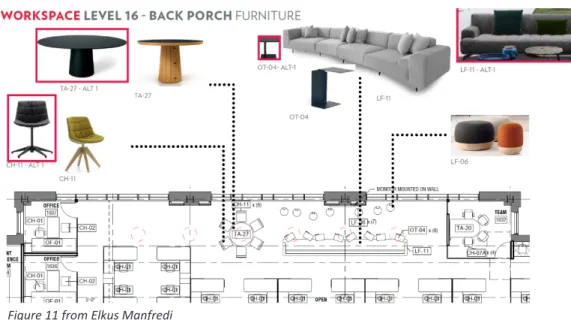
Design: The design by Elkus Manfredi draws on biophilic philosophy. They included a
concept of a “back porch” in every section of office space. The “porch” is along the exterior wall and gives employees a way to change their position, whether that be sitting on a soft stool or standing at a bar height table. In addition to providing this more mobile, flexible open workspace, the design team was conscious of their material choices.
According to the team, the material selection process was the most time intensive element of the entire design development. AEW wanted to incorporate a significant amount of art in the workspace. This focus is
particularly interesting considering the AEW “About” webpage begins by relating the meaning of a unique piece of art in the lobby, and how it is a reflection of the company’s mindset.
Figure 11 from Elkus Manfredi
Outcome
The renovation is still underway, but is nearing completion. The cost to rebuild and expand
the two-floor office was about $200 psf. The space will not be officially WELL certified until it is occupiable and able to be evaluated and tested by the IWBI. That being said, the space was already WELL certified in its original form, so it is unlikely it will not be able to achieve the certification with their upgrades. While the space is not finished, AEW has clear goals it hopes to achieve from these changes. They specifically made design changes to encourage space flexibility, so that their employees have more opportunities to interact and more options to be in spaces that inspire quality work.
Why did they do it?
Similar to Lendlease, AEW’s motivations stem from its core values and ESG. According to their website’s corporate responsibility section, “AEW has instituted a systematic approach to improve the operating metrics of its investments by incorporating ESG elements…into its asset analyses, inclusive of underwriting, due diligence and asset management.”lxx Under their
environmental goals they directly reference Fitwel and WELL as building certifications they want to explore; additionally, their social goals are to create “healthy work environments for employees and tenants, where possible, to stimulate productivity and promote sustainable communities.”lxxi
Needless to say, the ESG goals of AEW play a significant factor in their willingness to expend funds in creating a healthy environment for their employees, but additionally shows that they do believe healthy IEQ offices are beneficial and will improve productivity. Another important factor in their motivation is their desire to be able to attract top talent. They want to have the best employees and to do that they want to be able to attract the top talent. AEW believes being able to offer highly functional, healthy office space to prospective employees is critical to not only ensure they have the best employees, but also that their company remains highly successful. While AEW has set this healthy standard for their own offices and has healthy IEQ as a fundamental part of their ESG, they have not incorporated the WELL standard in any of their development assets.
Winthrop Center Office - Developer
Winthrop Square Boston, MA 770,000SF/23 Floors
The Winthrop Center project is a mixed-use development by Millennium Partners (MP). It is a 690’ tall tower that was designed in response to an RFP put out by the City of Boston. The project contains three elements: a large public lobby and thoroughfare, roughly 770,000 sf of office and 620,000 sf of residential.lxxii
lxxiii
The office portion is planned to be Passive House and WELL certified gold and will be the first WELL certified core and shell in Boston.
What did they do?
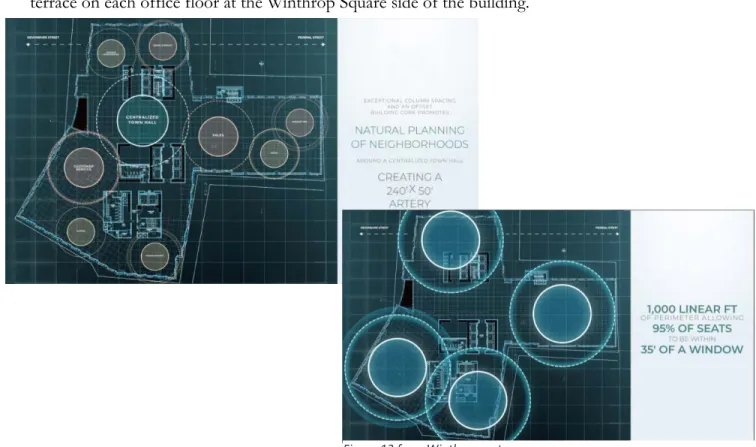
Layout: The building is designed in a t-shape which, according to MP, increases the
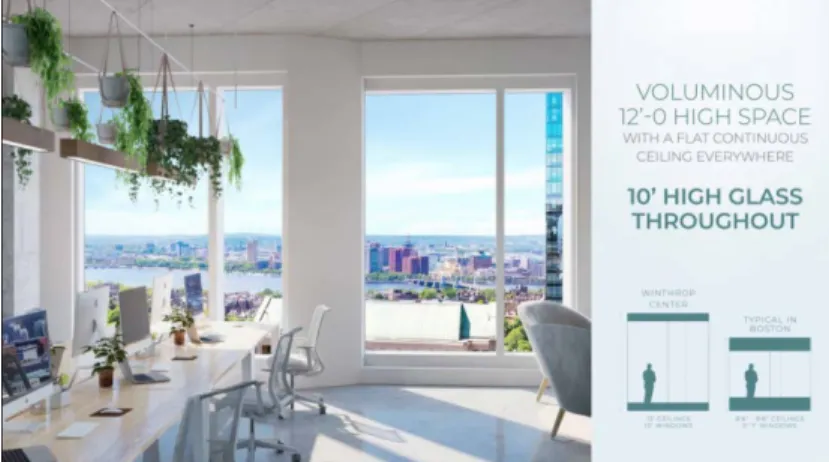
optionality of tenant fit out. They believe the t-shape will allow for optimal neighborhood layout designs for tenants; additionally, the dimensions of the building and the glass façade mean, theoretically, 95% of employees will be within 35’ of a window, providing ample daylight
penetration and accessibility to views. Additionally, the layout of the building provides an outdoor terrace on each office floor at the Winthrop Square side of the building.
Infrastructure: The infrastructure MP is
implementing in the building as part of the WELL certification is somewhat complicated, as the first step for MP was designing for the Passive House
certification.lxxiv This certification promotes a
significant level of energy efficiency within a building’s total energy consumption. The façade selection and implementation were specifically chosen and designed to improve the thermal efficiency of the building. It is a triple glazed, triple pane, insulated glass system with thermal breaks and has a
continuous air and moisture barrier. This system will improve thermal comfort for employees. The HVAC system will utilize energy recovery units (ERU) and Direct Outdoor Air Systems (DOAS). This system is energy efficient and provides 50-60% more fresh air than standard code compliant office buildings. The humidity level will also be more easily
controlled, as the ERU uses a core comprised of perpendicular layered corrugated material that passes outside air across indoor air, allowing the heat and humidity from the indoor air to condition the colder outside air.lxxv The base HVAC system will
be a fan coil system. This is an energy efficient system with lower operating costs than a typical VAV
system, because it uses hot and cold water to manage temperature. It has a large fan coil unit in the ceiling, which receives a mixture of indoor and outdoor air, which a fan then passes through the hot and cold-water coils, conditioning the temperature of the air. MP is also set to employ a building-wide app that will allow for environmental
Figure 14 from Handelarchitects.com
Figure 16 from CIBSEjournal.com Figure 15 from Winthropcenter.com
monitoring and tenant feedback.lxxvi
lxxvii
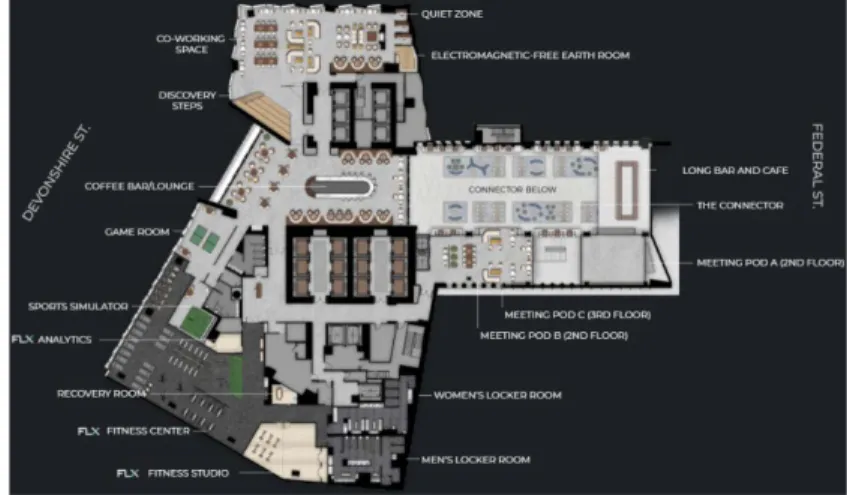
Additionally, MP is providing a significant amenity floor which will offer extra meeting space, a fitness center, a co-working space and a coffee bar and lounge.
Design: Because MP is the developer, they do not have a significant impact on the design
elements of the building office spaces themselves. They have designed the lobby to be a large open area that will act as a “connector”lxxviii, which is in line with the biophilic concept of creating large
open expanses that mimic the savannahs. The design also shows utilization of natural materials and green walls in some of the common areas. They are also including healthy food options in their lounge area, and curated experiences for the tenants. Additionally, they are incorporating a green roof which will be a significant source of living nature in accordance with biophilic design principles.
Outcome
The building is currently under construction. The office portion, let alone the building in its entirety, has not yet topped out, so it is not surprising that they have no preleases in place for the office yet. They do believe that they are building the “responsible, resourceful and renewable office space” that the 21st century market is demanding.lxxix
lxxxi
lxxxii
The space is currently being marketed at around $80 a square foot.lxxx There has been significant market activity, and tenants have expressed interest;
however, no leases have been signed as of yet. Like the AEW space, the space has not yet
officially earned the WELL Gold certification, but it is likely they will as it is a new build which they can modify, and they have been diligently reviewing computer modeling of the projected
performance of the building. They are also only certifying the office space, not the residential or lobby areas. In terms of the cost metrics, achieving the WELL certification for the building was negligible and mostly only incurred through the soft costs of added consulting and certification fees. The added costs were not there, because the WELL certification came after the decision to certify the building as Passive House, and the elements required to create a WELL Core building are easily
folded into creating the Passive House environment. To design to the Passive House standard, there was a 2-3% increase in total project budget.lxxxiii
Why did they do it?
A crucial element in MP’s developing a healthy office tower is the company mindset in approaching development. A parallel to a company’s ESG is the company’s reputation, and
reputation relies heavily on how a company market’s itself. MP relies on a branding strategy for their developments. They derive market power from being very clearly associated with their developments and there being an expectation of what that product is. Their ability to readily associate themselves with well-executed, quality development likely played a factor in their winning the city’s RFP; however, it also means that they are conscious of the non-quantifiable factors of development. According to their website, “By taking locations others viewed as ordinary and making them extraordinary, Millennium Partners has pioneered the ‘new urbanism’, a development model that’s redefining the entire industry.”lxxxiv
lxxxv
lxxxvi
This company ethos means they more consciously consider incorporating “extraordinary,” or non-market-standard, elements into their projects. Another meaningful aspect of their decision is that the WELL certification for the office came after they had agreed to build a Passive House certified building. Their decision to build a healthy office tower is more reflected in how they rationalized spending 2-3% more in costs to build a Passive House building. The proforma was ultimately accepted after extensive research on the benefits and effects of Passive House. They also relied heavily on computer energy modeling to understand what savings would actually be recouped through the improved energy conservation methods.
2.3 WELL Development
Now that we have examined a few scenarios of how the industry has incorporated the fundamentals of healthy IEQ through WELL certification criteria, we will now examine how incorporating these elements will change the metrics of this thesis’ demonstrative development.
Program:
The WELL development will have the same gross square footage as the standard development; however, there will be less rentable area. This is because one floor will be converted to amenity space, to include a fitness center, café and lounge area and overflow meeting and co-working space. Additionally, the overall building form will slightly alter to include two terraces. This changes the rentable square footage, but same amount of buildable square footage.
Terrace
Terrace Amenity Floor
Cost Assumptions:
Based on the input from industry professionals, the hard costs changed based on the updated technologies and the estimated cost increases. The most significant infrastructure change is in going from a VAV HVAC system to a chilled beam with direct outdoor air supply system. This raises the HVAC to $28.50 per sf, or roughly 10% increase. In addition to the upgraded HVAC systems, the model also assumed an increase in the electrical and tel-data systems to account for upgrades in the electrical and data systems of the building to support improved IEQ monitoring and control systems. The model also carries an increased hard cost
assumption for specialties/appliance to account for the cost of outfitting the amenity areas.
In the engineering section of the soft costs budget, a new “WELL certification” line accounts for the cost of a WELL consultant and certification. The operating budget carries the addition of costs for operating the amenity areas and increased building maintenance and
management. There is also an increase in the electrical and gas in response to the change in HVAC systems. The proforma carries a total of $17.50 psf in operating a WELL building.
The model also carries an increased tenant improvement (TI) allowance for tenants of $100. Through conversations with leasing professionals, it is expected that with developers asking for additional rent for the WELL Core infrastructure, tenants will ask for more TI allowances. Tenants will want more TI dollars to compensate for the increased dollars the alternate HVAC system places on their outfitting budget. The tenant will likely have to spend another $50 psf in order to complete their space fit out to the same healthy standards as the core building.
HARD COST ESTIMATE Office
0
ALL 535,500 GSF 73.76%
Demolition $267,750 $0.50
Environmental / Soil Remediation $267,750 $0.50
site utilities $2,677,500 $5.00
site improvements $2,677,500 $5.00
excavation/foundations/slurry walls $10,710,000 $20.00
structure & roof $34,807,500 $65.00
exterior wall $40,162,500 $75.00
partitions & finishes $8,032,500 $15.00
specialities / appliance $3,748,500 $7.00 elevators $6,961,500 $13.00 fire protection $4,284,000 $8.00 plumbing $4,685,625 $8.75 hvac $15,261,750 $28.50 electric $10,040,625 $18.75 tel-data $3,748,500 $7.00 security $1,606,500 $3.00 general requirements $5,890,500 $11.00 Subtotal $155,830,500 $291
Financial:
According to an MIT research paper, Fitwel and WELL certified spaces achieve between a 4.4% and 7% premium over non-certified spaces.lxxxvii Based off this conclusion, the proforma
carries an increased rent rate of $52.50, or a 5% increase. Given these assumptions the investment indicators drop significantly. The total profit is $98,000,000 with a levered IRR of 16.60% and an equity multiple of 1.81. Typically for a development to secure financing, the levered IRR needs to be close to 20% and reach an equity multiple of 2.
Total GSF 726,000 Office GSF 535,500 Rentable SF 407,400 76% Efficiency Retail SF 4,500 Parking 455 Spaces SPACE PROGRAM Land Costs (Incl. Closing) $15,225,000
Hard Costs $244,289,000
Architectural & Engineering Costs $13,963,000
Legal $1,500,000
Development Fees $16,715,000
Administration Fees $2,300,000
Real Estate Taxes $792,000
Marketing & Start Up $1,500,000
Brokerage Fees $13,651,000
Insurance $2,693,000
Permit & Impact Fees $3,593,000 Financing & Interest Costs $23,630,000 Soft Cost Contingency $5,671,000
Total $345,522,000
TOTAL COSTS
INVESTMENT INDICATORS
Equity Multiple 1.81
Profit $98,463,468
Leveraged Returns 16.60% LXIRR Unleveraged Returns 12.37% XIRR
RETURNS
Unrended Trended Net Operating Costs $17,986,504 $22,854,783 Return on Costs 5.21% 6.62%
liii Interview with Riaz Cassum
liv Full development budget can be found in the appendix
lv This thesis will use LIBOR as there has been no institutionally accepted alternative as of the date this thesis was completed.
lvi Riaz Cassum
lvii (Construction & Development In The US - Property & Investment Management | Lendlease, n.d.) lviii (“Lendlease,” n.d.)
lix Interview with Erica Weeks lx Ibid
lxi Ibid lxii Ibid
lxiii (About Us | US | Lendlease, n.d.) lxiv (Investment Strategies | AEW, n.d.) lxv Ibid
lxvi (Times, 2020) lxvii Ibid
lxviii Ibid
lxix Interview with Anne Peck
lxx (Corporate Responsibility | AEW, n.d.) lxxi Ibid
lxxii (Acitelli, 2019)
lxxiii (Vision | Winthrop Center, n.d.) lxxiv Interview with Brad Mahoney lxxv (This Old House, 2019)
lxxvi All information unless otherwise noted (Architects, 2021) lxxvii (The Collective | Winthrop Center, n.d.)
lxxviii (Vision | Winthrop Center, n.d.) lxxixIbid
lxxx Interview with Andy Hoar lxxxi Ibid
lxxxii (Architects, 2021)
lxxxiii Unless otherwise cited, this information is from the interview with Brad Mahoney lxxxiv (Home, n.d.)
lxxxv Brad Mahoney lxxxvi Ibid