Publisher’s version / Version de l'éditeur:
Construction Canada, 43, July 4, pp. 16-19, 2001-07-01
READ THESE TERMS AND CONDITIONS CAREFULLY BEFORE USING THIS WEBSITE.
https://nrc-publications.canada.ca/eng/copyright
Vous avez des questions? Nous pouvons vous aider. Pour communiquer directement avec un auteur, consultez la
première page de la revue dans laquelle son article a été publié afin de trouver ses coordonnées. Si vous n’arrivez pas à les repérer, communiquez avec nous à [email protected].
Questions? Contact the NRC Publications Archive team at
[email protected]. If you wish to email the authors directly, please see the first page of the publication for their contact information.
NRC Publications Archive
Archives des publications du CNRC
This publication could be one of several versions: author’s original, accepted manuscript or the publisher’s version. / La version de cette publication peut être l’une des suivantes : la version prépublication de l’auteur, la version acceptée du manuscrit ou la version de l’éditeur.
Access and use of this website and the material on it are subject to the Terms and Conditions set forth at
New protocol for testing mechanically attached single-ply roofing system
Baskaran, B. A.; Cohen, C.
https://publications-cnrc.canada.ca/fra/droits
L’accès à ce site Web et l’utilisation de son contenu sont assujettis aux conditions présentées dans le site LISEZ CES CONDITIONS ATTENTIVEMENT AVANT D’UTILISER CE SITE WEB.
NRC Publications Record / Notice d'Archives des publications de CNRC: https://nrc-publications.canada.ca/eng/view/object/?id=cdb6fcb4-e315-4e5a-8098-aa51a1a2f1ca https://publications-cnrc.canada.ca/fra/voir/objet/?id=cdb6fcb4-e315-4e5a-8098-aa51a1a2f1ca
New protocol for testing mechanically attached single-ply roofing system
Baskaran, B.A.; Cohen, C.
A version of this paper is published in / Une version de ce document se trouve dans : Construction Canada, 43 (4), July, 2001, pp.16-19
www.nrc.ca/irc/ircpubs
Construction Canada – SIGDERS 1/5 08/02/01
A new protocol for testing mechanically attached single-ply roofing
system
By A. Baskaran and Cathy Cohen
For built-up roofing systems, the Factory Mutual and Underwriters Laboratories certification tests are used as indicators of the wind resistance provided by roofs in service. Familiar to most architects and specification writers, the Factory Mutual static pressure test uses a steady positive air pressure under a roof sample to test the roofing systems, classifying them as I-60, I-90 and so on. The Underwriters Laboratories 580 test adds alternating suction on the roof exterior to the steady pressure, to certify roof systems as Class 60, 90 and so on.
At present, the same tests are also being used to certify roofing systems with
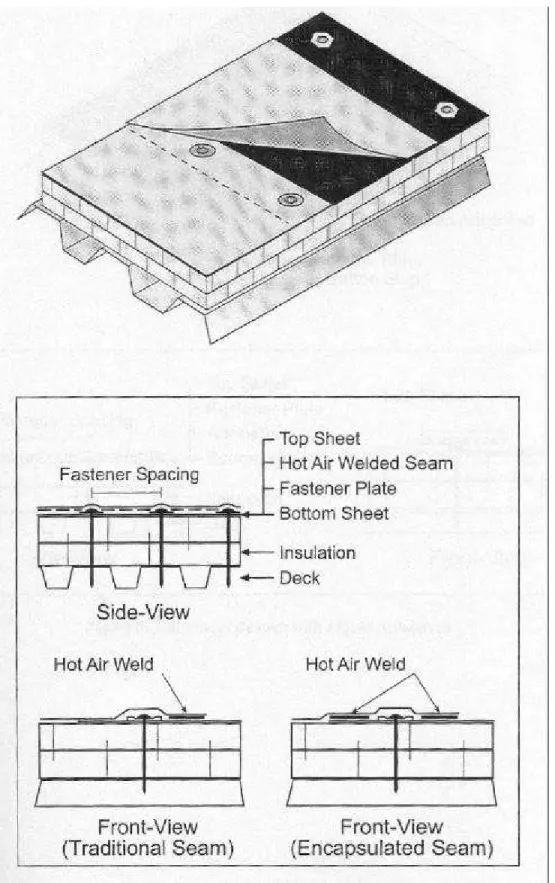
mechanically attached single-ply membranes. These roofs consist of a roof deck and a single membrane, along with insulation and vapour and air barriers/retarders. Using batten bars or plates and fasteners, the waterproofing membrane attached to the deck at various spacings, depending on the design pressure and the type of roofing system (Figure 1).
Unfortunately, these newer roofs tend to perform differently from built-up roofs, with the membrane billowing and jerking on the fasteners in gusty winds. Most failures are due to the dynamic effect of the wind and the roof system response. As a result, the existing tests misrepresent the true wind load resistance of these roofs. Although safety factors have been suggested and a variety of fastener design approaches have been tried, the biggest problem is that the test methods do not reflect the fluctuating dynamic wind loads that cause failure.
Wind Effects on Roofs
Wind passing over and around a building with a low-slope roof causes positive pressure on the windward side, negative pressure (suction) on the leeward side and the sides parallel to the flow direction, and suction over most of the roof area. The pressure exerted by the wind at any particular roof location depends on wind speed, turbulence intensity or gustiness, wind direction, building topography, building geometry, and architectural features. Commercial roofs, with their almost-flat profiles and low parapets, are likely to experience high local suction pressures at the corners and along the perimeter.
New Protocol for Testing
Work done at the National Research Council’s Institute for Research in Construction (IRC) on behalf of the Special Interest Group for the Dynamic Evaluation of Roofing Systems (SIGDERS) has resulted in the development of a new test protocol designed to certify mechanically attached single-ply membrane roofing systems.1 Developed using a test facility specially designed and built at IRC, the new protocol simulates real wind
effects by subjecting the roof sample to a series of eight loading sequences that mimic actual loading on the roof membrane. In the SIGDERS protocol, the loading sequences are grouped into five series, starting with lower pressures and gradually increasing with each series, until the roof sample is tested under simulated gusts of twice the design pressure (see Figure 2). The test facility itself incorporates a gust simulator so that the loading series continues uninterrupted, similar to actual conditions.
The SIGDERS protocol was developed after painstaking analysis of results from
investigations carried out at the NRC’s wind tunnel facility in Ottawa. There, the roofing samples were sized 3 m by 3 m, with over 80 pressure taps measuring the pressure exerted by wind on the roof surface. The measurements were taken twice for each
sample: once with the wind direction perpendicular to the roof, and once at an angle of 45 degrees to the roof. The information derived from these investigations was used to design the dynamic roofing facility and a suggested loading sequence.
The new protocol has been submitted to the CSA for evaluation as a possible national standard. In addition, the test method could be used by manufacturers hoping to ship to Europe, where commonly used tests for roofing systems include dynamic loading but are very time-consuming. The SIGDERS test method takes much less time than is required for the most-used European procedure.
Using the SIGDERS dynamic roofing facility, researchers tested a variety of roof systems that included four types of membrane: modified bituminous, thermoplastic olefin (TPO), ethylene propylene diene monomer (EPDM) and polyvinyl chloride (PVC). The roof samples tested were approximately 2 m by 6 m. The IRC researchers also tested roof samples under the Factory Mutual method and the European Union of Agreement load cycle to compare results with those obtained using the SIGDERS protocol. While the Factory Mutual test produced different failure modes and much higher wind resistance estimates, the SIGDERS dynamic test and the European fatigue test correlated well with each other and with results obtained in the field.
Once the new SIGDERS protocol is approved, manufacturers will be able to test roofing systems more accurately to determine the expected wind resistance. As new materials and components are developed, we can expect innovative and effective roofing systems that are both safe and durable. The new protocol will also mean that architects and
specification writers can be more sure that the roof system they choose will offer the necessary wind resistance. This should result in fewer unexpected roof failures in the regions of Canada that experience particularly high winds such as the west and east coast, and in the Arctic.
More recent research at the dynamic facility has investigated thermal effects in
combination with wind pressures. In addition, the facility was used to produce benchmark data on a variety of roofing systems. This new information will be available later this year.
Construction Canada – SIGDERS 3/5 08/02/01
The SIGDERS participants include Canadian Roofing Contractors' Association, Industrial Risk Insurers, National Roofing Contractors' Association, Roof Consultants Institute, Canadian General Tower Ltd./Prospex Roofing Products Ltd., Carlisle SynTec Inc., GAF Materials Corporation, Firestone Building Products Co., IKO Industries Canada, JPS Elastomerics Corp. – Construction Products Group, Soprema Canada, Vicwest Steel, Canada Post Corporation, Department of National Defence, and Public Works and Government Services Canada.
Dr. A. Baskaran is Head of the Roofing Systems sub-program at the National Research Council’s Institute for Research in Construction. Cathy Cohen is a freelance writer and editor specializing in construction technology.
Construction Canada – SIGDERS 5/5 08/02/01
Figure 2. The SIGDERS dynamic wind load cycle
1
Internal Report No. IRC-IR–699, Standard test method for the dynamic wind uplift resistance of mechanically-attached membrane roofing systems, Sept. 2000