Human Reproduction vol.14 no.5 pp.1213–1216, 1999
International, collaborative assessment of 146 000
prenatal karyotypes: expected limitations if only
chromosome-specific probes and fluorescent in-situ
hybridization are used
M.I.Evans
1,9, G.P.Henry
2, W.A.Miller
3, T.H.Bui
4,
R.J.Snidjers
5, R.J.Wapner
6, P.Miny
7, M.P.Johnson
1,
D.Peakman
2, A.Johnson
1, K.Nicolaides
5,
W.Holzgreve
7, S.A.D.Ebrahim
1, R.Babu
8and
L.Jackson
61Departments of Obstetrics and Gynecology, Molecular Medicine and Genetics, and Pathology, Hutzel Hospital/Wayne State University, 4707 St Antoine Blvd, Detroit, MI 48201, USA, 2Reproductive Genetics Center, Denver, CO,3Prenatal Diagnostic Center, Lexington, MA, USA,4Karolinska Institute, Stockholm, Sweden,5Kings College, London, UK,6Jefferson Medical Center, Philadelphia, PA, USA,7Departments of Medical Genetics and Ob/Gyn, University of Basel, Basel, Switzerland and
8Quest-Nichols Institute, San Juan Capistrano, CA, USA 9To whom correspondence should be addressed
The development of chromosome-specific probes (CSP) and fluorescent in-situ hybridization (FISH) has allowed for very rapid identification of selected numerical abnormalit-ies. We attempt here to determine, in principle, what percentage of abnormalities would be detectable if only CSP–FISH were performed without karyotype for prenatal diagnosis. A total of 146 128 consecutive karyotypes for prenatal diagnosis from eight centres in four countries for 5 years were compared with predicted detection if probes for chromosomes 13, 18, 21, X and Y were used, and assuming 100% detection efficiency. A total of 4163 abnor-malities (2.85%) were found including 2889 (69.4%) (trisomy 21, trisomy 18, trisomy 13, numerical sex chromo-some abnormalities, and triploidies) which were considered detectable by FISH. Of these, 1274 were mosaics, transloca-tions, deletransloca-tions, inversions, rings, and markers which would not be considered detectable. CSP–FISH is a useful adjunct to karyotype for high risk situations, and may be appro-priate in low risk screening, but should not be seen as a replacement for karyotype as too many structural chromo-some abnormalities will be missed.
Key words: cytogenetics/FISH/karyotype/molecular
cytogenet-ics/prenatal diagnosis
Introduction
One of the classic frustrations for cytogenetic prenatal diagnosis is the time required to obtain karyotype results from fetal tissue. In the late 1970s and early 1980s, enormous improvements, including the addition of super-enriched media, decreased result times from approximately 4 weeks to 2 weeks (Chang et al., 1990; Johnson and Miller, 1992). In the late 1980s and early 1990s, the
© European Society of Human Reproduction and Embryology 1213
development of in-situ technologies further decreased reporting time to as little as 7–10 days (Van Opstal et al., 1993). Such improvements have only increased the demand for immediate answers, and have made clinicians and their patients even more intolerant of delays in receiving results. Increased utilization of chorionic villus sampling (CVS) and cordocentesis have further increased the pressure for very rapid results, particularly for patients who have an ultrasound diagnosed abnormality (Holzgreve et al., 1990; Evans
et al., 1998). Advances in molecular techniques, including
chromosome-specific probe (CSP) and in-situ hybridization techniques, have generated considerable demand for extremely rapid results, particularly as they can be applied to uncultured cells (Martin et al., 1996). These have been applied to common trisomies and monosomies, with a rapid acceptance in the early 1990s of the use of fluorescent in-situ hybridization (FISH) in high risk situations. However, there has also been pressure towards its utilization in low risk situations (Evans et al., 1992).
Conflicting reports have emerged as to the true sensitivity and specificity of FISH diagnoses with ranges of diagnostic accuracy reported between 80–98% (Henry and Miller, 1992; Christensen et al., 1993; Clark et al., 1993; Ward et al., 1993). There have also been considerable arguments about abandoning proven ‘gold’ standards for newer techniques. In the era of ‘cost, not quality’ there will clearly be debates as to whether or not to eliminate expensive cytogenetic culturing and karyotyping in favour of quicker and faster FISH techniques. The purpose of this study was to compare the theoretical detection of abnormalities using the five generally available FISH probes (13, 18, 21, X, Y) to the cytogenetic analysis of prenatally determined karyotypes performed in the last 5 years from eight large prenatal diagnostic centres worldwide on 146 000 karyotypes.
Materials and methods
Prenatal cytogenetic results from eight centres in four countries: [Wayne State University, Detroit; Karolinska Institute, Stockholm; University of Mu¨nster, Mu¨nster; Kings College, London; Jefferson, Philadelphia; Prenatal Diagnostic Center, Boston (Lexington); Reproductive Genetics Center, Denver; and Quest-Nichols Institute, San Juan Capistrano, CA] were analysed. The eight centres vary in location, academic affiliations, and referral patterns. Three (Detroit, Stockholm, and Philadalphia) are university academic programmes with large CVS programmes (40–50%), and also see large numbers of patients in the second trimester referral for ultrasound abnormalities. Two (Mu¨nster and London) have especially large proportions of patients referred with ultrasound abnormalities. Two (Denver and Boston) are private institutions that mostly
M.I.Evans et al.
perform second trimester evaluation for genetic risks, and one (Quest-Nichols Institute) is a national reference laboratory. All prenatal cases from each of the centres were included. These cases included amniocentesis, chorionic villus sampling, and fetal blood sampling. The proportion of each varied considerably among the centres. Centres with large first trimester emphasis such as Philadelphia and Detroit had about 25% of cases of CVS, whereas others such as Denver, Boston, had hardly any. London had a disproportionate share of fetal blood samples reflecting the high referral for ultrasound anomalies and physician preference for fetal blood sampling.
Numerical abnormalities of chromosomes 13, 18, 21, X, and Y including trisomies, monosomies, and triploidies were considered detectable by FISH. Inversions, deletions, duplications, rings, isochromosomes, and numerical or structural aberrations of other chromosomes were considered non-detectable. FISH accuracy of 100% was assumed for the percentages calculated. Inconsequential findings such as inv (9) were not counted as abnormalities. Potential detection frequencies were compared with actual karyotypes to determine those cases which would have been detectable from those which would not have been.
Results
A total of 146 128 prenatal karyotypes were performed during a 5 year period which included 4163 abnormalities (2.85%). There were a total of 1425 trisomy 21, 585 trisomy 18, 203 trisomy 13, 508 sex chromosome aneuploidies, 119 triploidies, and 1613 others including translocations, inversions, deletions, and markers.
There were considerable differences in the patterns of abnormalities seen among the centres. The differences were mainly in the proportion of cases that were either trisomy 18 or 13. Two centres, Mu¨nster and London, which have a high proportion of their cases as referrals for abnormal ultrasounds, had the highest percentage of these trisomies. We therefore defined a new parameter, i.e. the ratio of trisomy 13 plus trisomy 18 divided by trisomy 21, to reflect this issue. We created this ratio to give a quick way of separating the highly varied nature of patient recruitment. Those centres with high ratio would imply a large proportion of ultrasound among referrals (e.g. London). Those with a low ratio would suggest a high proportion of advanced maternal age or other non-ultrasound referrals.
The centres varied from a low of 0.38 (Stockholm) to a high of 0.85 (London) (Table I). The incidence of sex chromosome abnormalities, inversions, duplications, markers, and others also varied, but did not show any specific pattern of variation. Breakdown of the undetectable cases shows considerable variation in the incidence of inversions, translo-cations, and other aberrations among the centres, but again with no specific pattern (Table I). A number of the undetectable cases, e.g. many of the mosaics, markers, inversions, and translocations, might not have obvious phenotypic abnormalities, but could alter the prognosis later or for future pregnancies.
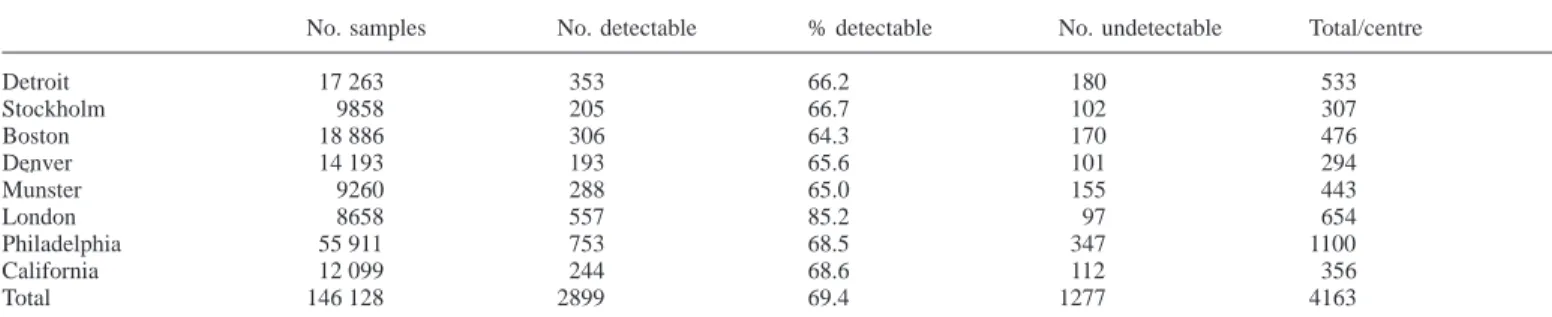
With probes for 13, 18, 21, X, and Y, 2889 of the 4163 abnormalities would have been detectable (69.4%). The percentage detectable varied by centre, Detroit 66.2%, Stockholm 66.7%, Boston 64.3%, Denver 65.6%, Mu¨nster 1214
65.0%, London 85.2%, Philadelphia 68.5%, and California 68.6% (Table II). As expected, because of the increased trisomy 18 and trisomy 13, centres that had a high proportion of referrals for ultrasonographic abnormalities also had the highest proportion detectable by probes.
In terms of cost, assuming US$400 for a complete karyotype, and US$200 for FISH, the cost for karyotyping all 146 128 cases would be US$58 451 200, and US$29 225 600 for FISH alone – a saving of US$29 225 600. However, some of the 1277 ‘missed’ cases would result in phenotypically abnormal newborns. Current estimates for the care of a Down’s syndrome baby are US$450 000. Obviously, some of the missed cases would be of negligible cost and significance, and others more so than Down’s syndrome. If half the missed cases (638/1277) are ‘important’, and if half of those (319) cost the same as Down’s syndrome, the cost would be US$143 550 000 – nearly five times the ‘saving’ of skipping the karyotype. This also does not include any medicolegal expenditures.
These are, of course, rough estimates and, in practice, the differences could be greater or potentially considerably less. Depending upon developments in the costs of these laboratory services, potential changes in the cost of cell culturing, facilities and equipment, as well as FISH probes are all likely. Thus, all cost estimates must be interpreted with caution.
Discussion
Using only generally available FISH chromosome-specific protocols, only 69.4% of karyotypic abnormalities would have been detected by FISH in this collaborative study of 146 000 karyotypes. Such incomplete ascertainment must, therefore, be weighed against the 100% expected yield, but higher cost of karyotype (Henry and Miller, 1992; Clark
et al., 1993; Ward et al., 1993). FISH technology is likely
to be appropriate for use in certain ‘low risk’ screening programmes such as using fetal cells in maternal blood. Its use in high risk populations should generally be as an adjunct to karyotyping and not as a replacement of karyotyping. We believe that if the FISH results agree with ultrasound anomalies, the test is confirmatory. We have shown in a series of over 300 high risk patients that there was 100% concordance between ultrasonographic predictions of aneuploidy, and confirmation with FISH results. There were a few false negatives but no false positives (Feldman
et al., 1998). Furthermore, if one were to exclude the
trisomy 13 and 18 cases, many of which would have been detected by ultrasound, the detection of non-visualizeable cases would be reduced in this series to 2101 of 3375 (62.3%). The potential detection rates further assume a 100% accuracy of FISH probes which is also not a reality. Recent publications have suggested 80–99% informative cases, and 80–98% accuracy of informative cases. False negatives are more problematic than false positives (Warburton, 1991; Henry and Miller, 1992; Ward et al., 1993; Feldman et al., 1998). If certain translocations (or markers) are known beforehand, those patients would
Assessment of FISH for prenatal diagnosis
Table I. Anomalies by centre
No. samples Trisomy 21 Trisomy 18 Trisomy 13 13118 Sex chrom. Triploidy Trans- Inversions
21 abn. locations Detroit 17 263 141 50 33 0.59 20 20 60 24 Stockholm 9858 112 30 12 0.38 38 13 63 15 Boston 18 886 155 60 16 0.49 75 6 97 59 Denver 14 193 108 34 12 0.43 33 6 63 30 Mu¨nster 9260 122 56 22 0.64 62 26 71 10 London 8658 241 151 53 0.85 82 30 41 9 Philadelphia 55 911 421 149 38 0.44 130 16 117 115 California 12 099 125 55 17 0.58 28 2 80 14 Total 146 128 1425 585 203 0.55 508 119 592 275
Table II. Numerical abnormalities theoretically detectable and undetectable by centre
No. samples No. detectable % detectable No. undetectable Total/centre
Detroit 17 263 353 66.2 180 533 Stockholm 9858 205 66.7 102 307 Boston 18 886 306 64.3 170 476 Denver 14 193 193 65.6 101 294 Mu¨nster 9260 288 65.0 155 443 London 8658 557 85.2 97 654 Philadelphia 55 911 753 68.5 347 1100 California 12 099 244 68.6 112 356 Total 146 128 2899 69.4 1277 4163
automatically proceed to karyotype for definitive diagnosis. Eliminating such cases would certainly lower the percentage of ‘missed cases’. However, in our experience, the majority of cases such as translocations are detected de novo, even when the fetus is ultimately shown to have inherited the translocation (or marker) from a parent.
It can be argued that a considerable percentage of the ‘missed’ cases would be clinically insignificant. There were, for example, 285 balanced translocations, of which 124 were de novo and 161 inherited. We do not know how many of the inherited ones were known beforehand, and how many were detected serendipitously because of the proband. Likewise, there were 24 trisomy 20, nine trisomy 22 and 14 trisomy 16. As a rough approximation, about half of the missed cases might have immediate consequences. Others would have implications for genetic counselling for the individual and their relatives. A detailed economic analysis is beyond the scope of this paper, but our rough analysis suggests that the economic cost of the missed cases would seem to far outweigh the saving. A thorough analysis would also have to address considerable medicolegal exposure for undetected cases that eventually caused harm to the current pregnancy, a later one, or another relative.
As experience and available probes increase, it may be possible significantly to increase the yield of potentially detectable abnormalities in which case the equation may change. For now, however, the limitations of FISH must be weighed in the balance of cost and speed. There are also considerable public health issues which need to be considered. Similar to the arguments surrounding biochemical screening
1215 that are keyed to Down’s syndrome detection per se and not other aneuploid conditions, there exists a very real possibility that in the rush to lower short term medical costs, non-physician administrators might perceive that a reputed 80–90% sensitivity rate of detection of trisomy 21 obviates the need for tissue culture and karyotyping. Such potential imposition of new standards should be viewed with extreme caution. At what point do decreased short term costs constitute a mandate to lower the capabilities of complete detection? This will be a social question beyond the scope of this paper. Furthermore, our data suggest that the percentage of anomalies missed would be substantially higher than numbers often quoted (Ward et al., 1993), which further changes the balance from a public health perspective, particularly since the patient has already assumed the risks of an invasive procedure.
In summary, our data suggest that (i) at its theoretical best, FISH would detect about 70% of anomalies actually found on karyotyping by eight large prenatal diagnosis laboratories in four countries; (ii) the cost of the missed cases far outweighs the saving; (iii) we believe that it is clinically reasonable to rely upon a FISH result, when that result is consistent with an ultrasound anomaly; (iv) FISH is a good methodology that will continue to improve; and (v) with such improvements, the balance of the equation may change. Finally, the development of new technologies such as FISH, while intrinsically exciting, must be viewed in the overall context of their sensitivity, specificity, costs, and social impact (Evans et al., 1998). Much more data and reflection are needed.
M.I.Evans et al.
References
Chang, H.J., Clark, R.D. and Bachman, H. (1990) The phenotype of 45,X/ 46,XY mosaicism: an analysis of 92 prenatally diagnosed cases. Am. J. Hum. Genet., 46, 156–167.
Christensen, B., Bryndorf, T., Philip, J. et al. (1993) Prenatal diagnosis by in situ hybridization on uncultured amniocytes: reduced sensitivity and potential risk of misdiagnosis in blood-stained samples. Prenat. Diagn., 13, 581–587.
Clark, B.A., Kenney, K. and Olson, S. (1993) The need to reevaluate trisomy screening for advanced maternal age in prenatal diagnosis. Am. J. Obstet. Gynecol., 168, 812–816.
Evans, M.I., Johnson, M.P., Fisk, N. et al. (1998) Prenatal diagnosis. In Gleisher, N., Buttino, L. Jr, Elkayam, U. et al. (eds) Principles and Practices of Medical Therapy in Pregnancy, 3rd edn. Appleton and Lange, Norwalk, pp. 178–191.
Evans, M.I., Klinger, K.W., Isada, N.B. et al. (1992) Rapid prenatal diagnosis by fluorescent in situ hybridization of chorionic villi: an adjunct to long term culture and karyotype. Am. J. Obstet. Gynecol., 167, 1522–1525. Feldman, B., Ebrahim, S.A.D., Gyi, K. et al. (1988) Routine prenatal diagnosis
of aneuploidy by FISH studies in high risk pregnancies. 48th Annual meeting of the American Society of Human Genetics, Denver, October 27–31, 1998 (poster presentation).
Henry, G.P. and Miller, W.A. (1992) Early amniocentesis. J. Reprod. Med.,
37, 396–462.
Holzgreve, W., Miny, P., Gerlach, B. et al. (1990) Benefits of placental biopsies for rapid karyotyping in the second and third trimesters (late chorionic villus sampling) in high-risk pregnancies. Am. J. Obstet. Gynecol.,
162, 1188–1192.
Johnson, M.P. and Miller, O.J. (1992) Cytogenetics. In Evans, M.I. (ed.) Reproductive Risks and Prenatal Diagnosis. Appleton and Lange, Norwalk, pp. 237–250.
Martin, L.S., Ben-Yoseph, Y., Ebrahim, S.A.D. et al. (1996) Laboratory techniques for prenatal diagnosis. In Hillier, S.G., Kitchener, H. and Neilson, J.P. (eds) Scientific Essentials of Reproductive Medicine. Saunders, Philadelphia, pp. 300–311.
Van Opstal, D., Eussen, H.J., Van Hemel, J.O. et al. (1993) Application of fluorescent in situ hybridization for ‘de novo’ anomalies in prenatal diagnosis. Prenat. Diagn., 13, 825–832.
Warburton, D. (1991) De novo balanced chromosome rearrangements and extra marker chromosomes identified at prenatal diagnosis: clinical significance and distribution of breakpoints. Am. J. Hum. Genet., 49, 995–1013.
Ward, B.E., Gersen, S.L., Carelli, M.P. et al. (1993) Rapid prenatal diagnosis of chromosomal aneuploidies by fluorescence in situ hybridization: clinical experience with 4500 specimens. Am. J. Hum. Genet., 52, 854–865. Received on October 7, 1998; accepted on January 14, 1999