HAL Id: hal-01096211
https://hal.archives-ouvertes.fr/hal-01096211
Submitted on 17 Dec 2014
HAL is a multi-disciplinary open access
archive for the deposit and dissemination of
sci-entific research documents, whether they are
pub-lished or not. The documents may come from
teaching and research institutions in France or
abroad, or from public or private research centers.
L’archive ouverte pluridisciplinaire HAL, est
destinée au dépôt et à la diffusion de documents
scientifiques de niveau recherche, publiés ou non,
émanant des établissements d’enseignement et de
recherche français ou étrangers, des laboratoires
publics ou privés.
Reusing and Combining UI, Task and Software
Component Models to Compose New Applications
Christian Brel, Philippe Renevier, Alain Giboin, Anne-Marie Dery, Michel
Riveill
To cite this version:
Christian Brel, Philippe Renevier, Alain Giboin, Anne-Marie Dery, Michel Riveill. Reusing and
Combining UI, Task and Software Component Models to Compose New Applications. BCS HCI,
http://hci2014.bcs.org/, Sep 2014, Southport, United Kingdom. �hal-01096211�
Reusing and Combining UI, Task and
Software Component Models to Compose
New Applications
Christian Brel
CNRS, Laboratoire I3S - UMR 7271 - UNS CNRS FR-06900 Sophia Antipolis Cedex
Philippe Renevier Gonin Universit Nice Sophia Antipolis, Laboratoire I3S - UMR 7271 - UNS CNRS
FR-06900 Sophia Antipolis Cedex [email protected] Alain Giboin
INRIA, Laboratoire I3S - UMR 7271 - UNS CNRS INRIA FR-06900 Sophia Antipolis Cedex
Michel Riveill
Universit Nice Sophia Antipolis, Laboratoire I3S - UMR 7271 - UNS CNRS
FR-06900 Sophia Antipolis Cedex [email protected] Anne-Marie Dery
Universit Nice Sophia Antipolis, Laboratoire I3S - UMR 7271 - UNS CNRS
FR-06900 Sophia Antipolis Cedex [email protected]
Composing applications by considering in parallel both software components and UI elements is a complex process not yet very well supported by any current composition process model or composition environment. To contribute to better support the composition process, we propose a new composition model and a prototype of a component assembler, the so-called OntoCompo, which implements the model. The model describes applications in terms of Task, UI and software components. The prototype allows a composition mainly driven by the direct manipulation of UI elements, the other components being hidden, but still being linked to the UI elements. We performed a user testing with actual developers to evaluate if the composition process was actually facilitated by our modeling approach and the prototype implementing it.
UI Composition ; Model-Based Development ; User Testing
1. INTRODUCTION
Facilitating the development work of software developers was the motivation of the OntoCompo approach reported in this paper. We could call this approach the Developer-Friendly Development (DFD) approach, by comparison to the so-called End-User Development (EUD) (Lieberman et al. (2006)). EUD has been defined ”as a set of methods, techniques, and tools that allow users of software systems, who are acting as non-professional software developers, at some point to create, modify or extend a software artefact”. In 2006, (Lieberman et al. (2006)) foresaw that ”the goal of human-computer interaction will evolve from just making systems easy to use (...) to making systems that are easy to develop”, implied end-users to develop. Our DFD approach aims at making
application composition easier for professional developers themselves.
Composing applications, by considering in parallel both software component assembly and User Interfaces (UI), is a complex process not yet very well supported by any current modeling approach or composition environment. The need to combine applications may grow with the increase of specialized applications available on application stores. For example, Google Maps is often integrated for geo-localization. In an idealistic way, developers must be able to reuse existing functionalities with minor developments. There is a need in supporting developers in their task of combining elements of existing applications to create a new application.
c
The Authors. Published by BISL.
Rather than having to learn API of applications such as Google Maps and to code from scratch, or rather than having to abstract existing applications (in terms of tasks, services or UI) and to transform such abstractions in some new application, we propose a new composition model and a prototype, the so-called OntoCompo, to simplify the composition work. The model describes applications in terms of links between Task, UI (i.e., graphical elements) and Software Components. By preserving and by reasoning on these links, during developers’ direct manipulations on the UI, we intend to enhance the consistency of the composition. In our case study, we consider the UI elements as an entry point. Developers can indicate directly on the UI which visible parts of the application are required for the composition. By considering at the same time UI, task and software models, i.e., by following the linked UI, Task and Software descriptions, we could transfer such UI direct manipulations to the whole application description.
We assumed that hiding the three models would hide a part of the complexity of the process, and consequently facilitate it. To evaluate if the composition process was actually facilitated by our approach through the prototype implementing it, we performed a user testing with actual developers. This article is structured as follows. After having presented related work, we describe our application model for composition. Next we present the OntoCompo prototype. Then we report the user testing (method, results and discussion). Finally we conclude with future works.
2. RELATED WORK 2.1. Software Composition
For software composition, ”Composition can be defined as any possible and meaningful interaction between the software constructs involved” according to (Lau and Rana (2010)) where a taxonomy of composition mechanisms (e.g., orchestration, aspect oriented programming, etc.) is defined. When the application code is not available, we can only access to published interfaces and we have to use connectors (Mehta et al. (2000)).
2.2. UI Composition
2.2.1. UI composition approaches
We distinguish two different UI composition ap-proaches. (1) The first approach bases the UI composition on abstract description, like in UsiXML (Lepreux et al. (2010)), the ServFace project (Pa-tern `o et al. (2011)), Alias (Joffroy et al. (2011)) and Transparent Interface (Ginzburg et al. (2007)). Those
models are defined by XML languages. Final UIs are obtained thanks to model transformations. (2) The second composition approach is based on ”UI Components”, which are reusable high-level widgets, available in repositories. Compose (Gabillon et al. (2011)), COTS-UI (Criado et al. (2010)), CRUISe (Pietschmann et al. (2009)), WinCuts (Tan et al. (2004)), UI fac¸ades (Stuerzlinger et al. (2006)) and on-the-fly mashup composition (Zhao et al. (2008)) illustrate such composition. Several of these works, e.g., (Nestler et al. (2009); Gabillon et al. (2011)), express and manipulate requirements with tasks. 2.2.2. Models used in UI composition
Three kinds of models are used in the two approaches: Task models (e.g., trees of users’ tasks), UI models (e.g., hierarchies of graphical elements), and Software models (e.g., assemblies of components). Table 1 reports the kinds of models used as entry point (i.e., the models manipulated in order to drive the composition) in the related work we analyzed. The last row of the table represents the characteristics we wanted to include in our approach: we wanted (1) to use the three kinds of models in order to make the composition easier, and (2) to reuse existing applications in order to avoid re-designing what has been already designed. Requirement (1) led us to rely on the existing approaches and/or systems considering several kinds of models instead of only one model.
ServFace (Patern `o et al. (2011); Nestler et al. (2009); Patern `o et al. (2009)) and Service-Interaction Descriptions (Vermeulen et al. (2007)) start with building a new Task Tree, associate Service to tasks, then produce a new UI by assembling abstract UI fragment associate to services and finally complete the new UI. In those works, the composition produce a new UI and is based on an abstraction of the wished composition. On-the-fly service composition (Zhao et al. (2008)), COTS-UI (Criado et al. (2010)) and CRUISe (Pietschmann et al. (2009)) compose web services or software components and their UI, but without considering tasks.
Compose (Gabillon et al. (2011)) starts with the translation in term of tasks of a requirement express in natural language and then a new UI is computed. Compose is designed for end users in a context of UI adaptation while our context is application designs made by developers.
2.3. Implications for Our Approach
From the analysis of these works, we noted that we can compose the UI (respectively, the functional parts) of former applications, but that we must build
Related Work Entry Point Used Models Results S1 Task UI S1 Task UI Reuse G2
Service Approach: BPEL4WS (Khalaf et al. (2003)) - BPEL (Alves et al. (2007)) - Web Service Composition OWL-S (Sohrabi and McIlraith (2010))
x x x
Component Approaches : Fractal (Bruneton et al. (2006)), SCA
(et al. (2005); Ope (2007)) and SLCA (Hourdin et al. (2008)) x x x
ALIAS (Joffroy et al. (2011)) ; Transparent interface
composition (Ginzburg et al. (2007)) x x x serv
4
UI ServFace (Patern `o et al. (2011); Nestler et al. (2009); Patern `o
et al. (2009)) ; Service-Interaction Descriptions (Vermeulen et al. (2007))
x x x x x serv4 UI
on-the-fly service composition (Zhao et al. (2008)) x x x x x
Task Composition (Bourguin et al. (2007)) x x x code3
Task Tree Merge (Lewandowski et al. (2007)) x x x x
Compose (Gabillon et al. (2011)) x x x x x
ComposiXML (Lepreux et al. (2010)) x x UI
Migratable UI (Luyten et al. (2002)) x x x CUI
WinCuts (Tan et al. (2004)) ; UI fac¸ades (Stuerzlinger et al.
(2006)) x x x
COTS-UI (Criado et al. (2010)) x x x x
CRUISe (Pietschmann et al. (2009)) x x x x x
OntoCompo Expected Features x x x x x x x
1Software Component 2Generation 3code to be completed 4services
Table 1: Classification of Composition Approaches
again the functional parts (respectively, the UI). Moreover, none of these works allows reusing former applications and supporting replacement of UI parts. Because of our two aims, easing the composition and reusing former part of applications, we opted for a component-based modeling linked with a UI model and a Task model. The composition will be performed by transforming the manipulation on models to manipulation on components.
3. APPLICATION MODEL FOR COMPOSITION
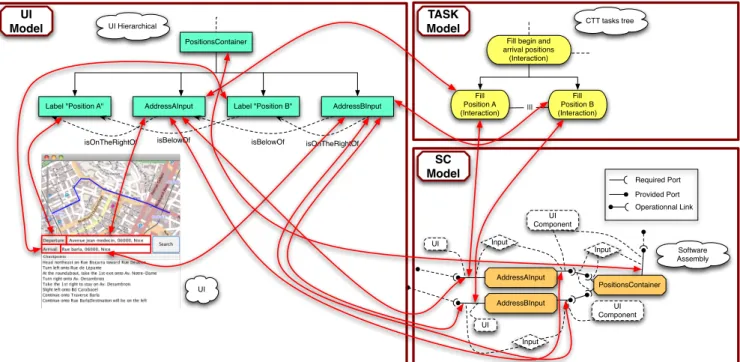
OntoCompo exploits the three points of view for application composition identified in the state of the art, i.e., the three descriptions: UI, Tasks and Software Component (Assembly). The originality of this approach is to connect each of those models with the two others (Brel et al. (2011)) by linking corresponding entities: (1) each graphical element is linked to tasks it supports; (2) each task is linked to graphical elements used to perform it; (3) each graphical element is linked to the software component surrounding it; (4) each software component is linked to graphical element surrounded by it ; (5) each task is linked to software component used to performed it; (6) each software component is linked to tasks it supports. Those links are expressed by annotations on the three models. We model UI with a classical hierarchical description of graphical elements. That description is annoted
with layout links such as on the left, below, etc. We model Tasks as ConcurTaskTrees (CTT) (Patern `o et al. (1997)). We model Software Assembly as Component Assembly. Components are connected through their ports. A connection between two components is between a requiring port and a providing port. So ports are characterized by their nature (”required” or ”provided”), their type
(”trigger” for activating actions, ”input” for entering
or providing values or ”output” for displaying or
storing data), and their role (”UI” when concerning
the graphical interface, ”UI component” when
concerning the manipulation of graphical element, etc.). The links with software components and tasks or graphical elements are done on their ports. Figure 1 illustrates the application model for composition. For example, the text entry ”AddressAInput” is connected with the task ”Fill Position A” and with the two ports of the software component ”AddressAInput”: one, with the port tagged ”UI”, for getting the typed value and the other, with the port tagged ”UI Component”, for graphical element exchange between software components in order to build the UI.
The approach is applied to the application composi-tion driven by UI manipulacomposi-tion. Thus, starting from a selected part of the UI, corresponding software com-ponents are identified. The connections between models are exploited in a process of selection, com-position by substitution and layout reorganization.
1. Selection consists in selecting the parts of UI
required for the composition. Thanks to the UI model, the selection is completed in order to obtain an operational and usable selection. Moreover, thanks to extensions (query based on the models), the selection is eased by following the connection. For example, all graphical elements required for achieving a parent task can be retrieved. Let consider the selection of the graphical element ”AddressAInput”. The latter is connected with the task ”Fill Position A” which parent task is ”Fill begin and arrival position” (FBaAP). We extend the selection of graphical elements to all graphical elements connected to (at least) the task ”FBaAP” or one of its subtasks. We obtain a set of graphical elements composed of ”AddressAInput” and ”AddressBInput”. Then, we consider all software components connected to (at least) one of these graphical elements or to the task ”FBaAP” (or to its substasks). If there are unsatisfied required ports in the selection, corresponding missing software components and graphical elements connected with such missing components are added to the selection, until there is no unsatisfied required port left. The final selection is { {AddressAInput, AddressBInput}U I ; {”Fill
begin and arrival position}task ; {AddressAInput,
AddressBInput}SC }.
2. Composition by substitution allows to replace
a selected component by another ”equivalent” component. The substitution is based on the connections between software components. Thanks to the characterization (nature, type, role) of component ports involved in connection, the substitution is realized by the addition of adapters between already connected ports or between ports to connect. So the links between the initial applications are set up to create the new application, by accordingly modifying the software component assembly (Brel et al. (2012)).
In the context of application composition driven by UI manipulation, to perform such substitution, actions on graphical elements are propagated to corresponding software components. To choose how to make a substitution, i.e., which port must replace which port, the approach allows to apply different strategies: asking for the user, applying an algorithm, etc. In our approach, we generate skeleton of adapters whose code needs to be completed.
3. Layout reorganization is a simple step where
remaining selected UI elements are placed in the windows. Once the placement done, the final application is generated: a new component assembly is produced and also the skeleton of adapters. A developer has to fill the content of those adapters in order to finalize the composition.
The model for application composition enables several possible interactions. Wanting to determine the better way to apply the approach, we developed OntoCompo in order to experiment a simple use of the model in a composition process. OntoCompo sequentially implements the ”selection-substitution-layout reorganization” process. OntoCompo also hides underlying models to the developer performing a composition. The developer only manipulate graphical elements. In the next section, we present an implementation of OntoCompo.
4. IMPLEMENTATION OF ONTOCOMPO
Our application models are developed thanks to ontologies, allowing us to quickly perform the necessary requests for composing. OntoCompo (Brel et al. (2011)) manipulates applications with Fractal1components (Bruneton et al. (2006)), which
must be semantically described. To implement our functions and algorithms, we make SPARQL requests, processed by the semantic engine CORESE / KGRAM (Corby et al. (2012)).
The initial applications are developed according to component architecture, defined by the Julia im-plementation (in Java) of the Fractal model. The whole application, whether its features or its graphi-cal interface, is implemented by components. Some components encapsulate graphical elements (from the SWING library of java) and are recognizable by their particular ports with the ”UI Component” role. The architecture of OntoCompo consists of three interrelated parts (see Figure 2): (1) The Application Loader, for loading software components and models (semantic descriptions); (2) the OntoCompo GUI, implementing the three application composition steps; and (3) the OntoCompo API. This API is the main part of the architecture; it handles all the manipulations to be made by our algorithms on fractal components or semantic descriptions. Through a collection (a map) allowing to associate a Swing component with the encapsulating fractal component, the API can retrieve and manipulate fractal components from selected graphical elements given by the OntoCompo GUI.
A video illustrating OntoCompo and the sce-nario used in the experimentation is available at http://goo.gl/QEqf4g .
5. USER TESTING OF ONTOCOMPO: METHOD
To validate our approach of the application composition driven by the manipulation of UI
1This software component model was named ”Fractal” because
AddressAInput AddressBInput Fill Position A (Interaction) Fill Position B (Interaction) |||
Fill begin and arrival positions (Interaction) PositionsContainer Required Port Provided Port Operationnal Link Label "Position A" AddressAInput Label "Position B" AddressBInput
PositionsContainer isBelowOf isBelowOf isOnTheRightOf isOnTheRightOf UI UI UI Component UI Component Input Input Input UI Model TASK Model SC Model UI Hierarchical UI Software Assembly CTT tasks tree
Figure 1: Excerpt of the application model linking UI, Tasks and Software Components (SC).
Figure 2: Architecture of the OntoCompo prototype.
elements, we performed the following user testing with actual developers.
5.1. Evaluation Method Type
Quantitative methods are classically preferred over qualitative methods to evaluate systems. For exam-ple: (a) evaluating their UsiXML-based composition tool GrafiXML, (Lepreux and Vanderdonckt (2007)) used the GOMS method to establish the time gain during the use of GrafiXML; (b) user testing their platform for migrating interface components to a target device, (Patern `o et al. (2011)) submitted a quantitative questionnaire (with Likert scales) to the users of the platform. In our case, using strictly quan-titative methods to evaluate our approach and its supporting tool was considered premature. We had to qualify developers’ actual practices of composition before to quantify them. Hence we needed a method that was both qualitative and quantitative. We used
a variant of the ”cooperative evaluation” method of (Monk (1993)).
5.2. Goal and Hypotheses
Our goal was to evaluate the understanding and acceptance of the OntoCompo approach as performed through the OntoCompo tool. We envisioned two working hypotheses:
• Strong hypothesis: Developers can perform their composition task by manipulating graph-ical elements only; any of the three models (UI model, Task model and Software-Components model) is necessary. Manipulating the code of the resulting application is not necessary either. This hypothesis reflects the ideal we sought to facilitate the composition work of the developer.
• Weak hypothesis: To perform their composition task, in addition to graphical elements, devel-opers need to manipulate the three kinds of models, but to different degrees. Manipulating the code of the resulting application remains not necessary. This hypothesis means that development work facilitation is variable.
5.3. Participants
Two kinds of developers participated to the user testing: four developers who never handled an application composition tool; five developers who already used some composition tool (not necessarily a tool for composing applications). Since no
differences in their behavior were noticed, we decided to consider them as a single group.
5.4. Material
The material used during the experimentation was: (a) the OntoCompo Prototype; (b) the composition task instructions; (c) the ”additional information” to be provided on demand to developers or during the debriefing phase; this information consisted of printed documents representing: the Task Model, the Software-Component Model, the UI Model, and the generated code; excerpts of the models are given in Figure 1; and (d) the composition task scenario, including the UIs of the two source applications and the UI of the resulting application (described in detail in the next subsections).
5.4.1. Composition task scenario and related UIs Composition task scenario: ”A developer has at her disposal two applications: one, called ”Movie Theaters”, for displaying movies played in cinema near a specified location, and another, called ”Maps”, for searching directions on a map. She wants to produce a new application to search movie theaters closed to a specified address. Once a movie theater is selected, then the directions from that address to the selected theater are displayed.”
The ”Movie Theaters” UI includes at the top of the window a text field to enter the address that will be the geographical center of the research. The application uses a Web Service form the Web Site http://www.allocine.com, a French web site about movies and theaters. The Web Service enables queries to find theaters from a location, to list the movies played in a theater, etc. The user calls that service by clicking the ”search” button. The table on the left of the window is fullfilled with the received answers. By clicking on a line of that table, another query is made to the Web Service to get the list of played movies with their showtimes. The returned list is displayed in the table on the right of the window. The ”Maps” UI is vertically organized. At the top, there is the panel for displaying the map. At the middle, there is the form to fill the start and the arrival. At the bottom, there are the main intersections of the found route.
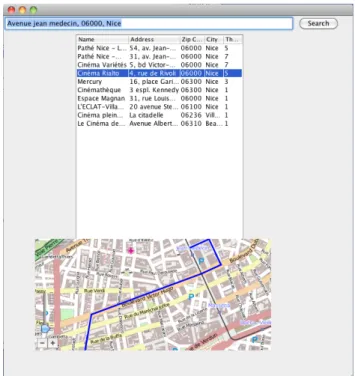
The resulting UI: an example of the UI resulting from the composition scenario is given in Figure 3. Only one text field is left, to enter the start of the route for the ”Maps” application and to enter the geographical center of the search for the ”Movie Theaters” application. From the latter, only the list of the closed theaters is displayed. It is only after selecting one theater that the route is displayed on the maps, coming from the ”Maps” application.
Figure 3: UI of the application resulting from the composition scenario.
5.4.2. Extensions of selection
During the selection step, the developers can use consistent extensions of selection thanks to queries in all models, as described in Section 3.
5.4.3. Scenario difficulties
To make the scenario realistic, we included three main difficulties for the substitutions in the application composition task of the developer. Difficulty 1: A misleading similarity of two graphic elements. Two buttons present in both applications had the same shape and the same title ”Search”. This similarity can mislead the developer who may be tempted to merge them, a merging that is not in the composition scenario. One button (from ”Movie Theaters”) must be kept, the second one (from ”Maps”) must be substituted by a trigger associated with the selection of one theater in the list.
Difficulty 2: A substitution of two heterogeneous graphic elements. The first element, to be kept, was a list of the closest cinemas in the application ”Movie Theaters”. The second element, to be replaced, was an entry text (allowing to inform the address of arrival necessary for the calculation of the route in the application ”Maps”). The list is obviously an ”Output”, and the entry text an ”Input”. The substitution was possible because the software element associated with the list supplies a port of type ”Input” to obtain the selected cinema.
Difficulty 3: A generated adapter source code (to be completed) including two methods with the same signature. This difficulty comes from the code presented to the developer after a substitution. It indicates the same method signature twice. The adapter generated by the substitution has several ports. Each of them corresponds to an implementation of a software interface. In the adapter source code, since two different software interfaces include the same method signature, there is twice the same signature of method public String getInput(). Even if this difficulty comes from the language Java, which does not allow to make the difference between both methods of the same signature resulting from two different software interfaces, we expected that the developer would know how to react. Indeed in this example, both methods getInput() have to produce the same result: merging the two methods is here possible.
5.5. Procedure
Each developer was placed in front of the OntoCompo prototype, next to the experimenter leading the developer’s testing session. As the developer went along, additional information was given to her on demand. Explanations on the use of the prototype were also given by the experimenter when requested by the developer. Each session consisted of three phases: (1) a familiarization phase where the developer freely manipulated the
prototype interface to become familiar with it; (2) a task-performance phase where the developer
performed the substitution task proposed by the experimenter; at the end of this phase, the developer was presented with the code generated on the outcome of the composition. The developer was expected to understand and explain that this code corresponded to an adapter generated during substitutions; (3) a debriefing phase where the
developer provided further feedback.
5.6. Data Collection and Analysis
5.6.1. Data collection
The manipulation of OntoCompo was video-recorded. Oral exchanges between the developer and the experimenter were also recorded. An ob-server was sitting back the developer to take notes on the developer’s behavior. The experimenter also took notes when possible for him. Data collected consequently were: experimenter’s and observer’s written notes; videos; developers’ verbalizations. 5.6.2. Data analysis
The analysis consisted in determining if the develop-ers achieved each composition task (or stage of the process: selection, substitution, layout reorganiza-tion) using graphical elements only (Strong Hypoth-esis), or if they needed to rely on the UI, Task and
Extension Type Use Asked Information
UI 44% (4/9) No
Task 67% (6/9) Yes (for 5 developers) No (for 1 developer)
Software 11% (1/9) Yes
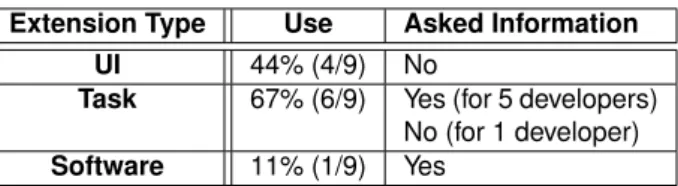
Table 2: Extension uses during user tests.
Performing at least 1 section with n extensions n=0 n=1 n=2 n=3
33% (3/9) 78% (7/9) 22% (2/9) 0%
Table 3: Proportion of extension uses.
Software Components models (Weak Hypothesis), i.e., if they asked for the additional documentation representing these models.
6. USER TESTING OF ONTOCOMPO: RESULTS AND DISCUSSION
On one hand, the nine developers well understood the composition process, and succeeded in manipu-lating the tool and in performing what they planned; however, only 55% (5/9) succeeded in making the composition without error. On the other hand, it emerges that additional information helped most developers (67%; 6/9) to achieve the composition. The results are essentially qualitative. In order to present the experimentation result, we summarized developers’ comments and feelings. For example, 67% of developers needed additional information means that by analyzing the 9 experimentation sessions, we found that 6 of them required more information, either thanks to their comments or thanks to their used of printed additional information.
6.1. Developers’ General Performance
6.1.1. How extensions were used
Table 2 summarizes the uses of extensions. The test containing several selections, the developers varied in the use of the extensions. They made sometimes at least a selection without extension, sometimes with two extensions, and often with one extension (including combination of several extensions applied at the same time). They had several opportunities to use one or several extensions, so the percentage accumulation is upper to 100% in Table 3.
We notice that 44% (4/9) of the developers used a combination of two extensions, in particular task with software extensions, e.g., extending the selection by the software component links while preserving only elements involved in the same task.
6.1.2. How scenario difficulties were addressed
Difficulty 1 (close resemblance of two ”Search” buttons) confused several developers. A difference
exists clearly between what we had considered as manipulations before performing the tests and the manipulations which the developers effectively made. This difficulty, for 44% (4/9) of the developers, led them to merge both buttons directly even though this substitution was identified as not necessary.
Difficulty 2 (substitution of two heterogeneous elements, a list and an entry text) led most
developers to substitute not the list with the entry text but rather with an element of the list (among others, the address of the selected cinema). Yet, this action was not allowed by the approach because each modeled graphical element was considered as indivisible. The expected substitution was always achieved, but 44% (4/9) of the developers strongly hesitated and achieved the right substitution after having eliminated the other possibilities.
Difficulty 3 (adapter source code including two methods with the same signature) was
circumvented by developers by suppressing the redundant method, but without fully understanding why. This highlights a lack of information.
6.2. Developers’ Need for Models
A general analysis underlined that additional information would ease the use of OntoCompo. The developers’ preferences during the debriefing are summarized in Table 4. A majority of them (78% - 7/9) asked for an interactive representation of the task model during the phase of selection. This integration would allow to match the selection of the tasks with the associated graphical elements and vice versa. The task tree was indicated as the most intuitive model to analyze the behavior of the application especially if it allows to identify the correspondences between graphical elements and tasks. We also noted that 67% (6/9) of developers (cf. Table 2) having used the Task extension made an ”abstract” deviation towards the software component model, deducting links between components exclusively from the information on the tasks. Moreover, the expressed preferences showed that for the substitution step, 67% of the developers wished an access to the software component models. On the contrary we noticed that no additional information was necessary for the use of UI Extensions. However 44% (4/9) of the developers (not necessarily the same that those who used this extension) expressed the fact that the representation of UI model seems necessary with more complex graphical interfaces. According to the developers, this model would highlight the information on the interweaving of UI elements.
6.3. Discussion
The results of this user testing are encouraging. Participant developers welcomed well our model of application and the composition process. They generally succeeded in realizing the expected application. Difficulties met by the developers are the most often related to the lack of information about the underlying models. The identified needs for additional information show that the strong hypothesis we formulated rarely correspond to the developers’ practices. In other words, we have to say that the composition task can not be only driven by the manipulation of UI graphical elements. The weak hypothesis seems to be the most realistic: to perform their composition task, developers need to manipulate the three kinds of models together, but to different degrees. In other words, we have to say that the composition task must be driven by at least two of the three models (UI model, Task model, and Software Components model), depending on the process step. Results of the user testing revealed the most interesting models in the different steps, i.e., the additional information to be provided at these steps: (1) the UI model and the Task model are
the most adaptedfor selecting the relevant part of
applications. This can be explained because the two models are used to describe the interactions in user-centered design. (2) The Software Components model, and to a lesser extent the Task model, is the
most adaptedfor the substitution step, because of
the underlying impact on the software components. Such additional information will help developers to predict and to explain both the result of a selection extension, and the possible substitutions. Such information must be be kept until the final application is generated in order to provide explanations to the developer when needed. Providing the developers with the underlying models would not only guide and reassure them, but also limit their cognitive load.
7. CONCLUSION AND FURTHER WORK
We have presented our approach of application composition based on three application descriptions or models, namely the UI, Task and Software Components descriptions or models. We described OntoCompo, the prototype applying our approach to an application composition driven by manipulation of UI graphical elements only. The user testing we performed with OntoCompo highlighted that this restricted manipulation was not enough to achieve an appropriate composition. Results led us to conclude that the most realistic of our working hypotheses was the weak hypothesis, namely: to perform their composition task, developers need to manipulate the three kinds of models together, but to
Selection Substitution UI Reorganization UI Informationneeded by 44% (4/9) of
the developers (when the applica-tions would be more complex)
Informationnot needed Informationnot needed (needs in
keeping information used during selection and substitution)
Task Informationneeded by 78% (7/9) of
the developers
Information needed by 22%
(2/9) of the developers
Informationnot needed Software Informationneeded by 44% (4/9) of
the developers
Information needed by 67%
(6/9) of the developers
Informationnot needed
Table 4: UI, Task or Software-Components additional information needed by the developers during the different steps of the
composition process.
different degrees; developers must have the control of the three models; they need to visualize and manipulate these models when needed. However, to achieve the composition, developers did not need to manipulate the code of the resulting application. From a system development point of view, further work will be orientated toward making the man-agement of the three models by the developers as fluent and appropriate as possible. To elaborate new specifications for the system (especially for deter-mining the strict level of information necessary for composing), we will further exploit the comments developers made during the initial user testing. Iter-ative user testing of the next versions of the system will be performed. Initially interested in designing the OntoCompo approach and system for developers, we will consider to design them for end users too, so contributing to the End-User Development trend.
REFERENCES
Alves, A. et al. (2007), Web Services Business Pro-cess Execution Language Version 2.0, Technical report, OASIS Web Services Business Process Execution Language (WSBPEL) TC.
Bourguin, G., Lewandowski, A. and Tarby, J.-C. (2007), Defining task oriented components, in ‘Task Models and Diagrams for User Interface Design’, Springer, pp. 170–183.
Brel, C., Pinna-D ´ery, A.-M., Renevier, P. and Riveill, M. (2011), OntoCompo: A Tool To Enhance Application Composition, in ‘13th IFIP TC13 Conference in Human-Computer Interaction INTERACT 2011(Interact 2011)’, , pp. 588–591. Brel, C., Renevier, P., Pinna-D ´ery, A.-M. and
Riveill, M. (2012), Annotated Component-Based Description for Application Composition, in ‘The Seventh International Conference on Software Engineering Advances (ICSEA 2012)’.
Bruneton, E., Coupaye, T., Leclercq, M., Qu ´ema, V. and Stefani, J.-B. (2006), ‘The fractal component model and its support in java: Experiences with
auto-adaptive and reconfigurable systems’, Softw. Pract. Exper.36(11-12), 1257–1284.
Corby, O., Gaignard, A., Faron-Zucker, C., Montag-nat, J. et al. (2012), Kgram versatile inference and query engine for the web of linked data, in ‘Proceedings of the International Conference on Web Intelligence’, pp. 1–8.
Criado, J., Padilla, N., Iribarne, L. and Asensio, J.-A. (2010), User interface composition with cots-ui and trading approaches: Application for web-based environmental information systems, in ‘Knowledge Management, Information Sys-tems, E-Learning, and Sustainability Research’, Springer, pp. 259–266.
et al., M. B. (2005), ‘Service component architecture - building systems using a service oriented architecture’, A Joint Whitepaper by BEA, IBM, Interface21, IONA, SAP, Siebel, Sybase .
Gabillon, Y., Petit, M., Calvary, G., Fiorino, H. et al. (2011), Automated planning for user interface composition, in ‘Proceeding of the 2nd SEMAIS workshop of the IUI 2011 conference’.
Ginzburg, J., Rossi, G., Urbieta, M. and Distante, D. (2007), Transparent interface composition in web applications, in ‘Proceedings of the 7th international conference on Web engineering’, Springer-Verlag, pp. 152–166.
Hourdin, V., Tigli, J.-Y., Lavirotte, S., Rey, G. and Riveill, M. (2008), Slca, composite services for ubiquitous computing, in ‘Proceedings of the International Conference on Mobile Technology, Applications, and Systems’, Mobility ’08, ACM, New York, NY, USA, pp. 11:1–11:8.
Joffroy, C., Caramel, B., Dery-Pinna, A.-M. and Riveill, M. (2011), When the functional composi-tion drives the user interfaces composicomposi-tion: pro-cess and formalization, in ‘Proceedings of the 3rd ACM SIGCHI symposium on Engineering inter-active computing systems’, EICS ’11, ACM, New York, NY, USA, pp. 207–216.
Khalaf, R., Mukhi, N. and Weerawarana, S. (2003), Service-Oriented Composition in BPEL4WS, in ‘Proceedings of the 20th Internation World Wide Web Conference (Alternate Papers Track)’, WWW’03, Budapest, Hungary.
Lau, K.-K. and Rana, T. (2010), A taxonomy of software composition mechanisms, in ‘Proc. 36th EUROMICRO Conference on Software Engineering and Advanced Applications’, IEEE, pp. 102–110.
Lepreux, S. and Vanderdonckt, J. (2007), Towards a support of user interface design by composition rules, in ‘Computer-Aided Design of User Inter-faces V’, Springer, pp. 231–244.
Lepreux, S., Vanderdonckt, J. and Kolski, C. (2010), User Interface Composition with UsiXML, in ‘Proceedings of the 1st Int. Workshop on User Interface Extensible Markup Language’, Berlin, Germany, pp. 141–151.
Lewandowski, A., Lepreux, S. and Bourguin, G. (2007), Tasks models merging for high-level component composition, in ‘Human-Computer Interaction. Interaction Design and Usability’, Springer, pp. 1129–1138.
Lieberman, H., Patern, F., Klann, M. and Wulf, V. (2006), End-user development: An emerging paradigm, in H. Lieberman, F. Patern and V. Wulf, eds, ‘End User Development’, Vol. 9 of Human-Computer Interaction Series, Springer Netherlands, pp. 1–8.
Luyten, K., Vandervelpen, C. and Coninx, K. (2002), Migratable user interface descriptions in component-based development, in P. Forbrig, Q. Limbourg, B. Urban and J. Vanderdonckt, eds, ‘DSV-IS’, Vol. 2545 of Lecture Notes in Computer Science, Springer, pp. 44–58.
Mehta, N. R., Medvidovic, N. and Phadke, S. (2000), Towards a taxonomy of software connectors, in ‘Proceedings of the 22nd international conference on Software engineering’, ICSE ’00, ACM, New York, NY, USA, pp. 178–187.
Monk, A. (1993), Improving Your Human-Computer Interface: A Practical Technique, The BCS Practitioner Series, Prentice Hall.
Nestler, T., Feldmann, M., Preuner, A. and Schill, A. (2009), Service composition at the presentation layer using web service annotations, in ‘Proceed-ings of the 1st Intl. Workshop on Lightweight Integration on the Web’, San Sebastian, Spain, pp. 63–68.
Ope (2007), SCA Service Component Architecture -Assembly Model Specification. Version 1.00.
Patern `o, F., Mancini, C. and Meniconi, S. (1997), Concurtasktrees: A diagrammatic notation for specifying task models, in ‘Proceedings of the IFIP TC13 Interantional Conference on Human-Computer Interaction’, INTERACT ’97, Chapman & Hall, Ltd., London, UK, UK, pp. 362–369. Patern `o, F., Santoro, C. and Spano, L. D.
(2009), ‘Maria: A universal, declarative, multiple abstraction-level language for service-oriented ap-plications in ubiquitous environments’, ACM Trans. Comput.-Hum. Interact.16(4), 19:1–19:30.
Patern `o, F., Santoro, C. and Spano, L. D. (2011), ‘Engineering the authoring of usable service front ends’, J. Syst. Softw.84(10), 1806–1822.
Pietschmann, S., Voigt, M., R ¨umpel, A. and Meißner, K. (2009), Cruise: Composition of rich user interface services, in ‘Web Engineering’, Springer, pp. 473–476.
Sohrabi, S. and McIlraith, S. A. (2010), Preference-based web service composition: A middle ground between execution and search, in ‘Proceedings of the 9th International Semantic Web Conference (ISWC-10)’, Shanghai, China, pp. 713–729. Stuerzlinger, W., Chapuis, O., Phillips, D. and
Roussel, N. (2006), User Interface Fac¸ades: Towards Fully Adaptable User Interfaces, in ‘UIST ’06: ACM Symposium on User Interface Software and Technology’, ACM - SIGCHI & SIGGRAPH, ACM, Montreux, Suisse, pp. 309–318.
Tan, D. S., Meyers, B. and Czerwinski, M. (2004), Wincuts: manipulating arbitrary window regions for more effective use of screen space, in ‘CHI’04 extended abstracts on Human factors in computing systems’, ACM, pp. 1525–1528. Vermeulen, J., Vandriessche, Y., Clerckx, T., Luyten,
K. and Coninx, K. (2007), Service-interaction descriptions: Augmenting services with user interface models, in J. Gulliksen, M. B. Harning, P. A. Palanque, G. C. van der Veer and J. Wesson, eds, ‘EHCI/DS-VIS’, Vol. 4940 of Lecture Notes in Computer Science, Springer, pp. 447–464. Zhao, Q., Huang, G., Huang, J., Liu, X. and Mei,
H. (2008), A web-based mashup environment for on-the-fly service composition, in ‘Service-Oriented System Engineering, 2008. SOSE’08. IEEE International Symposium on’, IEEE, pp. 32– 37.