HAL Id: cea-02342067
https://hal-cea.archives-ouvertes.fr/cea-02342067
Submitted on 31 Oct 2019
HAL is a multi-disciplinary open access
archive for the deposit and dissemination of
sci-entific research documents, whether they are
pub-lished or not. The documents may come from
teaching and research institutions in France or
abroad, or from public or private research centers.
L’archive ouverte pluridisciplinaire HAL, est
destinée au dépôt et à la diffusion de documents
scientifiques de niveau recherche, publiés ou non,
émanant des établissements d’enseignement et de
recherche français ou étrangers, des laboratoires
publics ou privés.
Laser Pyrolysis Derived Silicon-Carbon Core-Shell
Nanomaterials for Lithium Ion Battery Anodes
John P. Alper, Florent Boismain, Julien Sourice, Willy Porcher, Olivier
Sublemontier, A. Bordes, E. de Vito, A Boulineau, Cécile Reynaud, C Haon,
et al.
To cite this version:
John P. Alper, Florent Boismain, Julien Sourice, Willy Porcher, Olivier Sublemontier, et al.. Laser
Pyrolysis Derived Silicon-Carbon Core-Shell Nanomaterials for Lithium Ion Battery Anodes. LiBD-8,
Jun 2017, Arcachon, France. �cea-02342067�
AUachment : Resume
Laser Pyrolysis Derived Silicon-Carbon Core-Shell Nanomaterials for Lithium Ion Battery Anodes
Alper J.P.
l,Boismain F.
l,Sourice J. 1,2, Porcher W.
2
, Sublemontier 0.
1
, Bordes
A.
3,De Vito E.
3,Boulineau A.2,
Reynaud C.
l,Haon C?, Herlin-Boime N.
l.1 CEA-DSM/lRAMISINIMBE/LEDNA CEA Saclay, 91191, Gif-sur-Yvette, France
2 CEA-DRT/LITEN/DEHT CEA Grenoble, 38054, Grenoble, France
3 CEA-DRT/LITEN/MINATEC-Campus CEA Grenoble, 38054, Grenoble, France
4 Université Paris Sud, ICMMO, 91405, Orsay, France
CUITent LiB technology relies on graphitic carbon as the anode material, with a theoretical capacity of 372 mAh/g. In order to increase the energy density of LiBs, anode materials with a greater capacity for lithium storage are under intense investigation. Materials which form alloys with lithium such as antimony, germanium, silicon, and tin, all have theoretical capacities which far surpass graphite. However
silicon, as the most naturally abundant e1ement and possessing a theoretical capacity of 3579 mAh/g in the LilsSi4 alloy, is the most
promising for global adoption in next generation LiBs . ...;,
There are issues which require resolution before silicon can be implemented. Large volumetric changes associated with the
lithiation-delithiathion process (~300%) result in material pulverization and loss of electrical contactl. AIso unstable solid-e1ectrolyte-interphase
(SEI) formation during cycling results in the consumption of lithium during operation and capacity fade2. Previous studies have
conclusively shown that the former issue may be mitigated by utilizing nano-scale silicon materials, with particles under 150 nm in
diameter remaining intact during the swelling and contraction associated with cycling3. It has also been demonstrated that encapsulation of
silicon nanomaterials in carbon shells shows promise in stabilizing the SEI. Highly rational silicon-carbon architectures have been
developed to accomplish this, such as the carbon clamped hollow silicon nanosphere, "yolk in shell", and pomegranate geometries4 which
achieve high capacity and robust performance over hundreds of cycles. Guided by these achievements, we seek to develop a scalable process to synthesize silicon nanoparticle in carbon shell nanostructures which may enable robust battery anodes with enhanced energy
storage capacity.
i
•
hv
J-...
---=~==
:l-Scbeme 1: General reactor scbematic.
Specifically we are utilizing laser mediated pyrolysis which has the capability to produce kg/h of high purity nanoparticles within a
narrow size distribution. This technique has aIready been used to produce various cerarnic, oxide, and metallic particless, and implemented
for industrial scale silicon nanoparticle production. In this work, a novel two stage gas flow reactor, which synthesizes silicon nanoparticles
in the frrst stage and adds a nanometric carbon shell in the second stage, is being developed and is pictured in Scheme 161n summary,
silane diluted with belium is introduced into the frrst stage, contained by an argon sbeath. Tbe silane molecues absorb photons from the 10.6 J.1m IR laser and decompose to form silicon nanoparticles. A carbon precursor, ethylene, is then added to the particle flow. A second pass of tbe laser decomposes the ethylene, depositing a carbon shell. The particles are collected on an external vacuum filter. Tbe technique avoids any manipulation of the pure silicon powders prior to carbon coating, mitigating oxidation and particle degradation, as well as worker exposure to nanopowders.
Tbe CUITent reactor design can operate continuously for over three bours and in the bencb scale, synthesize over 10
glb
oi
core-shellmaterial. Furtbermore control of particle size and coating thickness can be achieved by varying the precursor flow rates and dilution in the
reactor. As shown in Figure 1, we have developed process parameters to yield a range ofparticle sizes, from ~1O-100 nm diameters, with
Figure l.
shells of
nanparticles thickness.
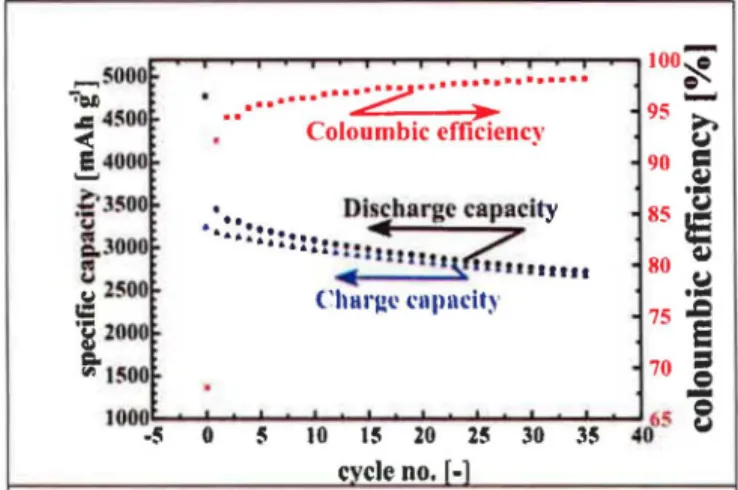
Cycling capacity of CUITent crystalline silicon core-carbon shell materials reaches -2500 mAh/g at C/lO and retains over 70% capacity at a 2C rate over 500 cycles? As amorphous silicon has been demonstrated to have improved fracture behavior, lithiation kinetics, and first cycle performance8,9, methods to produce amorphous silicon particles and their performance will be discussed. In order to achieve higher rate capabilities, this study is also focused on developing procedures to supply dopant atoms to the carbon shell via ammonia addition at the second stage and improve shell conductivity. Initi~l results indicate improved cycling performance, with a capacity of -3000 mAh/g achieved after 10 cycles at C/5, as shown in Figure 2. Optimization of the carbon doping is on-going and our most recent results will be discussed. .-. 5000r""'""""T~-r--r-"'-',...-r--'-"T""""-1""""''""""T'''''''''' 1 00 ~ j . f I • • • • • • • • ...-:--... • • • • • • • • • • • • ..., - ," ~.. 9~ ~ 4500 •• Coloumbic efficiency . ~ 14000 90
~
,€
3500 ••••• Disch.argc capaclty 8" 'C~~3000
... A:...
.. OIIIIIIIII( ~ - ~ _ .. ··.!lHllllrr ~lS
~ Il!.! 1111111111 80~
2500ClIIII'Il~ l'III)IICit~
'
75:S
.~ 2000e
&-t!iOO 70g
-tOOO_~
4065B
" 0 5 10 t!l 20 25 30 35 cvcle no. [-1Figure 2: Specifie charge and discharge capacity and coulombic efficiency of silicon nanoparticles coated with nitrogen doped carbon, at a C/5 rate.
Physico-chemical analysis results and development of methods to increase the lifetime of these materials during application, such as by mixing with graphite and encasing in pyrolized polymers to reduce solid electrolyte interphase formationlO, will also be presented.
Currently we observe an increase in first cycle coulombic efficiency of -20% and an increase of -4% for subsequent cycles, as shown in Figure 3, when using a PYC polymer precursor, mechanically mixed with the core-shell nanoparticles prior to pyrolysis in Ar. Other dispersion techniques such as spray drying and electrospinning are to be compared, and the performance dependence on polymer choice elucidated. - 100 ~ A A A A A A
•
A A-
t-
A=
• •
•
•
•
~•
•
.
-
u 95•
e
•
~.!:t
.c
80 \ SI(lrC' - çumpusltve
75C/5
.2
=
SJ@C
.
B
70/
65 0 5 10cycle no.
-Figure 3: Coulombic efficiency comparison between silicon particles in a carbon shell (Si@C) and Si@C encapsulated in a graphite-PYC derived composite, at a C/5 cyclin rate.