HAL Id: hal-01558239
https://hal.sorbonne-universite.fr/hal-01558239
Submitted on 11 Jul 2017
HAL is a multi-disciplinary open access
archive for the deposit and dissemination of
sci-entific research documents, whether they are
pub-lished or not. The documents may come from
teaching and research institutions in France or
abroad, or from public or private research centers.
L’archive ouverte pluridisciplinaire HAL, est
destinée au dépôt et à la diffusion de documents
scientifiques de niveau recherche, publiés ou non,
émanant des établissements d’enseignement et de
recherche français ou étrangers, des laboratoires
publics ou privés.
Exploiting One-Dimensional Exciton–Phonon Coupling
for Tunable and Efficient Single-Photon Generation with
a Carbon Nanotube
A. Jeantet, Y. Chassagneux, T Claude, P Roussignol, J.S. Lauret, J Reichel,
Christophe Voisin
To cite this version:
A. Jeantet, Y. Chassagneux, T Claude, P Roussignol, J.S. Lauret, et al..
Exploiting
One-Dimensional Exciton–Phonon Coupling for Tunable and Efficient Single-Photon Generation with
a Carbon Nanotube.
Nano Letters, American Chemical Society, 2017, 17 (7), pp.4184-4188.
�10.1021/acs.nanolett.7b00973�. �hal-01558239�
single-photon generation with a carbon nanotube.
A. Jeantet,1 Y. Chassagneux,1 T. Claude,1 P. Roussignol,1 J.S. Lauret,2 J. Reichel,3 and C. Voisin1, ∗
1Laboratoire Pierre Aigrain, ´Ecole Normale Sup´erieure, CNRS, Universit´e Pierre et Marie Curie, Universit´e Paris Diderot, PSL,
Sorbonne Paris Cit´e, Sorbonne Universit´e, 24, rue Lhomond, F-75005 Paris, France 2Laboratoire Aim´e Cotton, CNRS, Univ. Paris-Sud,
ENS Cachan, Universit´e Paris-Saclay, 91405 Orsay, France 3
Laboratoire Kastler Brossel, ´Ecole Normale Sup´erieure, CNRS, Universit´e Pierre et Marie Curie, 24 rue Lhomond, F-75005 Paris, France
(Dated: June 22, 2017)
Condensed-matter emitters offer enriched cavity quantum electrodynamical effects due to the coupling to external degrees of freedom. In the case of carbon nanotubes a very peculiar coupling between localized excitons and the one-dimensional acoustic phonon modes can be achieved, which gives rise to pronounced phonon wings in the luminescence spectrum. By coupling an individual nanotube to a tunable optical micro-cavity, we show that this peculiar exciton-phonon coupling is a valuable resource to enlarge the tuning range of the single-photon source while keeping an excellent exciton-photon coupling efficiency and spectral purity. Using the unique flexibility of our scanning fiber cavity, we are able to measure the efficiency spectrum of the very same nanotube in the Purcell regime for several mode volumes. Whereas this efficiency spectrum looks very much like the free-space luminescence spectrum when the Purcell factor is small (large mode volume), we show that the deformation of this spectrum at lower mode volumes can be traced back to the strength of the exciton-photon coupling. It shows an enhanced efficiency on the red wing that arises from the asymmetry of the incoherent energy exchange processes between the exciton and the cavity. This allows us to obtain a tuning range up to several hundred times the spectral width of the source.
Light-matter interaction can be controlled at the ul-timate level where a single quantum emitter interacts with a single photon by means of optical micro-cavities [1]. The small mode volumes and high quality factors achieved in such cavities provide a new means to tailor the optical properties of the emitter through the so-called cavity quantum electrodynamical (CQED) effects. In the weak coupling regime where the losses remain larger than the interaction strength between the emitter and the elec-tromagnetic mode, it is possible to control the sponta-neous emission rate of the emitter and to funnel efficiently the photons into a single photonic mode by reshaping the local density of states (Purcell effect [2]). This effect has been demonstrated with a number of solid-state emit-ters [3] and more recently with carbon nanotubes [4–6]. In this regime, a figure of merit of CQED effects is the Purcell factor Fp defined as the ratio of the radiative
emission rate into the cavity mode to the radiative rate in free-space. In addition, in the case of a broad emitter, the Purcell effect also allows to reshape the spectral prop-erties of the emitter through the so-called cavity feeding effect. In particular for solid-state emitters, the envi-ronment induced broadening is a new resource that can be exploited to enhance the tuning range of the photon source, while keeping a narrow spectral output and large efficiency [7].
∗Corresponding author : [email protected]
This approach has been implemented in quantum dots where local electrostatic fluctuations and the three di-mensional phonons of the matrix induce some level of pure dephasing of the excitonic line [8]. Nevertheless, this effect remains limited to an energy window of the order of a few cavity line-widths (' 800µeV). In carbon nan-otubes at low temperature the situation is radically dif-ferent because of the coupling of localized excitons to the truly one-dimensional acoustic phonon bath. This gives rise to a diverging effective exciton-phonon coupling for low-energy vibrational modes resulting in phonon wings extending over several meV even though the zero-phonon line (ZPL) is typically 10 to 100 times narrower [9–12]. As first noted by Galland et al. the strong asymme-try of the wings is the signature of non-Markovian de-coherence processes due to the one-dimensional confine-ment of acoustic phonons [9]. In addition, this dephasing is to some extent adjustable by means of proper nan-otube/matrix coupling resulting in variable exciton and phonon localization lengths [10]. When the nanotube is coupled to a tunable micro-cavity, this spectral broaden-ing enlarges considerably the tunbroaden-ing range of the photon source while keeping excellent anti-bunching properties [5].
In this work, we show that this peculiar exciton-phonon coupling results in an asymmetric incoherent en-ergy exchange between the cavity mode and the emitter. This enables an enhanced cavity feeding effect on the red wing, possibly by-passing the intrinsic limit for the efficiency of the source. We investigate this effect
ex-2 perimentally by scanning continuously the working
fre-quency of a fiber micro-cavity coupled to a nanotube, thereby measuring the single-photon generation spectral efficiency. Beside a globally enhanced brightness, we show that the spectral efficiency of the source at lower mode volumes does not map out the free-space PL spec-trum of the emitter anymore. In particular, the efficiency of the source on the red phonon wing is more enhanced than at the ZPL. This effect is interpreted quantitatively in the framework of the Jaynes-Cummings model where the exciton-phonon coupling is described in the spin-boson approximation [13–16] with an effective phonon mode taking into account the coupling to all acoustic branches [17].
The experimental setup was described in Ref. [5]. In brief, PFO coated CoMoCat nanotubes embedded in a 120 nm thick layer of polystyrene [18] are deposited on a flat dielectric mirror. All the measurements are con-ducted at 15 K. The individual nanotubes are selected by means of a micro-photoluminescence (PL) setup us-ing a cw excitation wavelength near 800 nm. After a full free-space characterization the nanotube is inserted into a micro-cavity by approaching the top mirror (ra-dius of curvature of ∼ 10µm) which is engineered at the apex of an optical fiber by laser ablation [19]. The fiber is mounted on a three-dimensional piezo stage in order to adjust the spatial mode matching and the cav-ity length. The luminescence collected from the cavcav-ity or from the PL microscope (free-space emission) is dis-persed in a 500 mm spectrometer and detected with a nitrogen-cooled CCD camera.
The free-space luminescence spectrum of a carbon nan-otube at 15 K is presented in Fig. 1 (a). Its charac-teristic profile consists of a sharp ZPL together with a low intensity blue wing and a higher intensity red wing. This profile is well understood in the framework of one-dimensional acoustic phonon side bands of a localized ex-citon [10–12]. As a consequence of phonon confinement in PFO-wrapped nanotubes, the ZPL becomes largely decoupled from the phonon wings [10, 12].
When phonon side-bands represent a sizable fraction of the transition oscillator strength, the CQED effects modify the recombination dynamics both for the ZPL and for the sidebands, which makes it possible to tune the source over a broad spectral range with a large efficiency (Fig. 1 (b)). We checked that the anti-bunching level remains below 0.03 ± 0.02 both at the ZPL frequency and on the phonon wings (Fig. 1 (c-d)). In addition this anti-bunching is very robust to an increased pumping rate since it remains below a few percents up to a pumping intensity of the order of the saturation intensity.
In order to quantify the strength of the exciton-photon coupling in the cavity feeding regime, we traced back the coupling strength ¯hg to the dependence of the efficiency of the photon source on the detuning ¯hωcav− ¯hωZP L.
This coupling g (equal to half the vacuum Rabi
split-−200 −100 0 100 200 0 0.5 1 1.5 2 time (ns) g (2) −200 −100 0 100 2000 1 2 0.5 1.5 1.3750 1.38 1.385 1.39 1.395 1.4 1.405 0.2 0.4 0.6 0.8 1 Energy (eV) Intensity (a.u.) Energy (eV) Intensity (a.u.) 1.3750 1.38 1.385 1.39 1.395 1.4 0.2 0.4 0.6 0.8 1 1.405 (a) (b) (c) (d) time (ns) g (2)
FIG. 1. (a) Free-space PL spectrum of a single carbon nan-otube recorded at 15 K for a cw excitation at λ =800 nm. (b) Spectra of the single-photon source obtained with this nan-otube for several cavity detunings showing the high spectral purity and high efficiency of the single-photon source on a broad tuning range. The excitation density is kept constant for all the spectra. (c) and (d) Intensity correlation functions g(2)(t) measured under pulsed excitation for a nanotube cou-pled to a cavity in resonance with the ZPL (c) or in resonance with the red phonon wing at a detuning of 5 meV (d). (For technical reasons, these data were not recorded on the nan-otube studied in the rest of the paper and correspond to the data published in [5].)
ting) corresponds to the interaction energy between the transition dipole and the electrical field of the zero-point quantum fluctuations of the optical mode. The single-photon source efficiency β(f ) (where f is the optical fre-quency) is defined as the probability for a photon to be emitted by the cavity for each single excitation launched into the nanotube. For a given excitation density, this efficiency is proportional to the output intensity. In fact, for a fixed cavity length, the output of the source I(f ) is a narrow line as shown in Fig. 1 (b) which simply reads I(f ) ∝ Scav
fc (f ) · β(fc), where S
cav is the
normal-ized Lorentzian profile of the cavity centered at fc. In
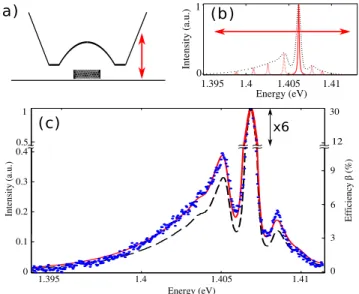
order to get the variation of the efficiency with the de-tuning, we scan the cavity length continuously at a fre-quency Ω = 25 Hz and record the time-average spectrum of the output (Fig. 2 (a)). The cavity scanning range spans a window slightly broader than the nanotube emis-sion spectrum (Fig. 2 (b)) so that the dwell time of the cavity is constant all over the spectrum. A strong en-hancement of the signal is observed at resonance with the ZPL, whereas the intensity remains sizable when the cavity probes the phonon side bands (Fig. 2 (c)). Note that the full scanning window (' 20 meV) corresponds to a relative change in the cavity length of 1.4% and thus to a change in the mode volume of about 2%, which is negligible (see SI in [5]).
This efficiency spectrum can also be measured for sev-eral values of the mode volume by changing the length of the cavity by steps of λ/2, i.e. by changing the longitudi-nal mode order. Overall, the mode volume can be varied by at least of factor of 2. Basically, the output intensity increases when decreasing the mode volume as expected from the Purcell effect (Fig. 3 (a)). However, the spec-tra are not homothetic to each other and the intensity of the phonon wings grows at a faster pace than that of the ZPL when decreasing the mode volume (Fig.3 (b)).
1.395 1.4 1.405 1.41 0 1 Intensity (a.u.) Energy (eV) (b) (a) 12 Intensity (a.u.) Energy (eV) 1 0 3 6 9 30 Efficiency β (%) ~ ~ ~~ ~~ ~ ~ 0.5 x6 1.395 1.4 1.405 1.41 0 0.1 0.2 0.3 0.4 (c)
FIG. 2. (a) A nanotube is in the cavity formed by a planar mirror and a concave mirror engineered at the tip of an opti-cal fiber. The cavity length oscillates at frequency Ω to cover the full nanotube spectrum. (b) Sketch of the spectrum of the source for selected detunings (e.g. solid red line when the cav-ity is in resonance with the ZPL). The dotted line represents the efficiency spectrum as obtained from the envelope of the spectra when the detuning is scanned continuously (see main text). (c) Experimental efficiency spectrum (blue dots) for the lowest mode volume together with the normalized free-space spectrum (dashed black) of the same nanotube and a fit to the data (solid red) according to eq.( 1). Note that the data from all the figures 2-5 were taken on this same nanotube, as well as the values discussed in the main text.
This behavior can be captured quantitatively by a gen-eralized Jaynes Cummings model where the coupling to the phonon bath is treated in the spin-boson framework within the NIBA approximation [16]. In this approach, an elementary excitation is launched in the exciton popu-lation and the efficiency of the source is calculated as the time-integrated output of the cavity mode. The outcome of the model is that the efficiency of the source reads :
β(fcav) =
g2κ ˜Sem(fcav)
g2κ ˜Sem(f
cav) + g2γ ˜Sabs(fcav) + κγ
(1)
where κ stands for the cavity decay rate, γ for the ex-citon free-space recombination rate, ˜Sem(f ) and ˜Sabs(f )
are normalized (R S(f )df ≡ 1) emission and absorp-tion free-space spectra convoluted by the normalized Lorentzian cavity mode profile. Note that when the cav-ity mode is much narrower than the ZPL, the convolu-tion can be omitted and ˜Sem(f ) represents the
proba-bility for the free-space radiative recombination to occur within a frequency band df around f when one exciton is launched in the nanotube.
6 7 8 9 10 1.4 1.402 1.404 0.1 0.2 0.3 0.4 6 7 8 9 10
Energy (eV) Mode Number
0.42 0.40 0.38 0.36 0.34 0.32 0.30 Intensity (a.u.) RW/ZPL Ratio ( a ) ( b ) (c) (d) 0 0.1 0.2 0.3 0.4 0.5 0 20 40 60 80 λ3/V Fp n=6 n=10 0 0.2 0.4 0 10 20 30 0.1 0.3 0.5 λ3/V (µeV) n=6 n=10 g ZPL (c) (d)
FIG. 3. (a) Evolution of the spectral efficiency of the same emitter for selected mode volumes labeled by longitudinal mode number (zoom on the red phonon wing). (b) Ratio of the intensity at the maximum of the red wing to the maximum of the ZPL as a function of the longitudinal mode number (red dots). Theoretical values (blue open dots) as obtained from eq. (1) and the data of panel (d). The solid blue line is a guide to the eye. (c) Purcell factor of an individual nanotube coupled to a micro-cavity tuned at the ZPL frequency for sev-eral cavity lengths, extracted from lifetime measurements (eq. (6)). The blue dashed line shows the 1/V behavior. (d) Cou-pling factor gZP Lfor different mode volumes, extracted from lifetime measurements (red crosses) and from the fit of the efficiency spectrum according to eq. (1) (black open dots). The dashed blue line shows thep1/V behavior. The mode volume is deduced from the cavity free spectral range (FSR) [5].
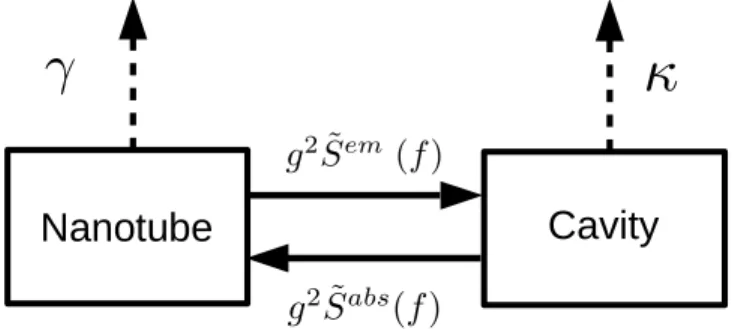
Although this formula is established in a rigorous way within the spin-boson model [16], it is enlightening to infer it in a heuristic way by considering incoherent en-ergy exchanges between the emitter and the cavity mode (Fig. 4). In this picture, one can show that when the cav-ity is detuned, the energy exchange rate becomes g2S˜em
for the emission process whereas it becomes g2S˜abs for
the absorption process (SI). As a consequence, the total decay rate of the emitter becomes γ + g2S˜em whereas the
4 Hence, the probability for a photon in the cavity mode
to reach the detector reads :
pcav→det= κ/[κ + g2S˜abs] (2)
the probability for the photon to be reabsorbed by the emitter reads :
pcav→N T = g2S˜abs/[κ + g2S˜abs] (3)
and the probability for the excited emitter to emit into the cavity mode reads :
pN T →cav= g2S˜em/[γ + g2S˜em] (4)
Finally, the total probability for a photon to be emit-ted by the source when a single excitation is launched in the emitter (which is the above defined efficiency of the source) reads :
β = pN T →det= pN T →cav[1 + pcav→N TpN T →cav+ ...
+ (pcav→N TpN T →cav)n]pcav→det (5)
which yields eq. (1). This heuristic approach shows that the combined effect of the exciton-phonon and exciton-photon couplings boils down to asymmetric en-ergy exchanges between the cavity and the nanotube. In addition, the full derivation shows that this conclusion remains valid even when the coupling g becomes larger than the loss rates γ and κ (strong coupling regime in a two-level picture) [16].
The emission spectrum ˜Sem can be directly obtained
from the measurement of the free-space photolumines-cence spectrum. The absorption spectrum of the nan-otube can be deduced from a mirror symmetry with re-spect to the ZPL as is well known for emitters showing Huang-Rhys phonon coupling profiles [20].
Nanotube
Cavity
FIG. 4. Heuristic model of the dynamics of the exci-ton/cavity/phonon system based on incoherent energy ex-changes between the emitter and the cavity.
Figure 2 (c) shows the efficiency spectrum measured for the smallest mode volume of ∼ 2λ3obtained for a cavity
length of 6λ/2 together with the free-space emission spec-trum normalized to the same ZPL intensity. Obviously,
the relative efficiency of the single-photon source at the phonon wings is boosted by the cavity as compared to the intensity at the ZPL frequency. This behavior is quanti-tatively reproduced by the model as shown by the red line which is a fit according to eq. (1) with a single free param-eter, the coupling strength g (all the other parameters : loss rates, emission profile,... are deduced from indepen-dent measurements, see SI). In addition, the ratio of the efficiency of the source at the red phonon wing maximum over the one at the ZPL shows a dependence as a function of the cavity length (Fig. 3 (b)) which is well accounted for by eq. (1), using the fact that g2∝ 1/V . We obtain
values ranging from ¯hg = 23 ± 4µeV to ¯hg = 40 ± 4µeV for the largest and smallest mode volumes respectively (obtained for longitudinal mode orders ranging from 6 to 10).
Interestingly, these values of g can be benchmarked to those deduced from time-resolved photo-luminescence. In this case, we focus on measurements done at the ZPL. Using pulsed excitation and a fast photon counting mod-ule, we obtain the life-time τ of the exciton both in free-space and in the cavity for several mode volumes (SI). The change of lifetime ∆τ gives access to the effective Purcell factor Fp provided that the PL quantum yield η
of the emitter is known [21] :
Fp=
∆τ
ητ (6)
In the present case η represents the effective quantum yield of the ZPL which includes the Debye-Waller factor. It is obtained from saturation measurements in pulsed ex-citation [5]. As expected, the Purcell factors we deduce from this method follow a 1/V law (Fig. 3 (c)), where V is the mode volume, in agreement with the Purcell for-mula Fp = 3/(4π2)(λ/n)3Qe/V where λ is the emission
wavelength, n is the optical index and Qeis an effective
quality factor such as Q−1e = Q−1cav+ Q−1ZP L[22]. Notably, these values of Fp, up to Fp = 60 are much larger than
our previous data (of the order of 5 to 10) [5]. This arises from the much reduced radius of curvature of the top mir-ror leading to a mode-volume reduction of the order of 5 in line with the observed increase of Fp. Such high
val-ues of Fpare particularly valuable for a dim emitter like
carbon nanotubes (that show an intrinsic quantum yield η of the order of 1%) because it directly translates into an enhanced brightness of the source even for a pump-ing intensity well below the saturation. Here, we infer that the effective quantum yield of the nanotube coupled to the cavity amounts up to ηFp/(1 + ηFp) ∼ 40% ± 5,
which is in qualitative agreement with the values deduced from the fitting of the efficiency spectrum with eq. (1). Given the short life-time of nanotubes (100 ps or below) and the nearly perfect extraction efficiency, we anticipate that the single-photon generation rate could reach up to several GHz.
This cavity induced reduction of life-time is a direct consequence of the strength of the exciton-photon cou-pling gZP L. In a simple Lorentzian picture, which is
rea-sonably applicable for the ZPL, the coupling gZP L can
be traced back to the change of lifetime through gZP L=
1/2p(1/τcav− 1/τfs)ωZP L/Qe, where τcav (resp. τfs)
stands for the lifetime of the emitter coupled to the cav-ity tuned at the angular frequency ωZP L (resp. the
free-space lifetime). Interestingly, gZP L can be measured
ex-perimentally with higher accuracy than Fp since it does
not rely on any calibration of the setup detection effi-ciency (needed to assess the quantum effieffi-ciency used in (6)). Finally, the coupling deduced from this life-time measurements can be related to g deduced from the fit-ting of the efficiency spectra using gZP L = g ∗
√ DW , where DW = 0.4 is the Debye-Waller factor (SI). The two approaches agree within the error bars as shown in Fig. 3 (d). −4000 −300 −200 −100 0 100 0.2 0.4 0.6 0.8 1 β 40 µeV 80 µeV 120 µeV 160 µeV 200 µeV Asymptot κ/(κ+γ)
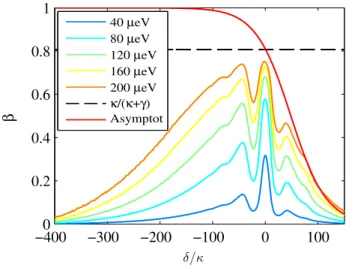
FIG. 5. Simulated evolution of the efficiency (for different values of the coupling parameter g) as a function of the cav-ity detuning δ = ω − ωZP L expressed in units of the cavity linewidth κ. This representation shows readily the remarkable tuning capabilities of the source. The red line corresponds to the asymptotic efficiency β∞while the dashed black one cor-responds to the intrinsic limit for markovian decoherence.
It is interesting to examine the asymptotic behavior of the system when the coupling strength g is increased (eq. (1)). The efficiency spectrum becomes more and more distorted, the red phonon wing becoming eventu-ally higher than the ZPL (Fig. 5). This striking effect arises from the asymmetry between the absorption and emission processes on the red phonon wing at low tem-perature, the former being much less likely than the lat-ter on the red side. Thus, the nanotube cavity coupling becomes favorably asymmetric with enhanced emission probability of the nanotube into the cavity mode and re-duced reabsorption probability. This allows to bypass the natural limit κ/(κ + γ) observed at the ZPL where both
processes are equiprobable. For ¯hg values of the order of 40 µeV and for nanotubes showing a ZPL width of the or-der of 900 µeV the tuning range of the source can already reach up to 10 meV (2.5 THz). Using a stabilized cavity, the source width (itself set by the cavity mode width) can be reduced down to below 10 GHz [19]. Thus, the tuning range represents up to several hundred times the spectral width of the source, opening the way to wide-range multiplexing in quantum communications. This is in contrast to the plasmonic approach where the large tuning range is obtained at the expense of the brightness [23].
In conclusion we have shown that the peculiar exciton-phonon coupling in carbon nanotubes is a valuable re-source to expand the bandwidth of a single-photon source. The most original feature of this system is the asymmetry in the energy exchange processes that al-lows to bypass the intrinsic limit for the efficiency of the source and ultimately to reach a close to 100% yield, pro-vided that the coupling is strong enough. This could be achieved in future integrated devices using photonic crys-tal resonators that have much reduced mode volumes. In addition, the use of carbon nanotubes of diameters of the order of 1.1 nm or of functionalized carbon nan-otubes would bring the single-photon source in the tele-com bands [24]. The indistinguishability of our source is currently estimated to 0.25 (see SI), but could be sensibly increased by tuning the coupling and finesse of the cav-ity [25] thus paving the way to the tunable generation of indistinguishable single photons using carbon nanotubes. This work was supported by the C’Nano IdF grant ”ECOQ” and the ANR grant “NC2”. JSL is partly funded by “Institut Universitaire de France”. We thank A. Leclercq for the mechanical fabrication, N. Izard for helping in sample preparation.
[1] K. J. Vahala, Nature 424, 839 (2003).
[2] E. M. Purcell, Phys. Rev. 69, 681 (1946), abstract B10, page 681.
[3] I. Aharonovich, D. Englund, and M. Toth, Nature Pho-tonics 10, 631641 (2016).
[4] R. Miura, S. Imamura, R. Ohta, A. Ishii, X. Liu, T. Shi-mada, S. Iwamoto, Y. Arakawa, and Y. K. Kato, Nat Commun 5, (2014).
[5] A. Jeantet, Y. Chassagneux, C. Raynaud, P. Roussignol, J. Lauret, B. Besga, J. Est`eve, J. Reichel, and C. Voisin, Physical Review Letters 116, 247402 (2016).
[6] F. Pyatkov, V. F¨utterling, S. Khasminskaya, B. S. Flavel, F. Hennrich, M. M. Kappes, R. Krupke, and W. H. P. Pernice, Nature Photon 10, 420427 (2016).
[7] A. Auff`eves, J.-M. G´erard, and J.-P. Poizat, Phys. Rev. A 79, 053838 (2009).
[8] S. L. Portalupi, G. Hornecker, V. Giesz, T. Grange, A. Lemaˆıtre, J. Demory, I. Sagnes, N. D.
Lanzillotti-6
Kimura, L. Lanco, A. Auff`eves, and P. Senellart, Nano Lett. 15, 6290 (2015).
[9] C. Galland, A. H¨ogele, H. E. T¨ureci, and A. m. c. Imamo˘glu, Phys. Rev. Lett. 101, 067402 (2008). [10] F. Vialla, Y. Chassagneux, R. Ferreira, C. Roquelet,
C. Diederichs, G. Cassabois, P. Roussignol, J. Lauret, and C. Voisin, Phys. Rev. Lett. 113, 057402 (2014). [11] V. Ardizzone, Y. Chassagneux, F. Vialla, G. Delport,
C. Delcamp, N. Belabas, E. Deleporte, P. Roussignol, I. Robert-Philip, C. Voisin, and J. S. Lauret, Phys. Rev. B 91, 121410 (2015).
[12] I. Sarpkaya, E. D. Ahmadi, G. D. Shepard, K. S. Mistry, J. L. Blackburn, and S. Strauf, ACS Nano 9, 6383 (2015). [13] B. Krummheuer, V. M. Axt, and T. Kuhn, Phys. Rev.
B 65, 195313 (2002).
[14] A. J. Leggett, S. Chakravarty, A. T. Dorsey, M. P. A. Fisher, Anupam, and W. Zwerger, Rev. Mod. Phys. 59, 1 (1987).
[15] I. Wilson-Rae and A. Imamolu, Physical Review B 65 (2002).
[16] Y. Chassagneux, A. Jeantet, T. Claude, and C. Voisin, http://arxiv.org/abs/1706.05204 (2017).
[17] D. T. Nguyen, C. Voisin, P. Roussignol, C. Roquelet,
J. S. Lauret, and G. Cassabois, Phys. Rev. B 84, 115463 (2011).
[18] N. Ai, W. Walden-Newman, Q. Song, S. Kalliakos, and S. Strauf, ACS Nano 5, 2664 (2011).
[19] D. Hunger, T. Steinmetz, Y. Colombe, C. Deutsch, T. W. H¨ansch, and J. Reichel, New Journal of Physics 12, 065038 (2010).
[20] B. Henderson and G. F. Imbusch, Optical spectroscopy of inorganic solids (Clarendon Press, Oxford, 1989).
[21] A. Faraon, P. E. Barclay, C. Santori, K.-M. C. Fu, and R. G. Beausoleil, Nat Photon 5, 301 (2011).
[22] A. Auff`eves, D. Gerace, J.-M. G´erard, M. F. Santos, L. C. Andreani, and J.-P. Poizat, Phys. Rev. B 81, 245419 (2010).
[23] Y. Zakharko, A. Graf, S. P. Schiessl, B. H¨ahnlein, J. Pe-zoldt, M. C. Gather, and J. Zaumseil, Nano Lett. 16, 32783284 (2016).
[24] X. Ma, N. F. Hartmann, J. K. S. Baldwin, S. K. Doorn, and H. Htoon, Nat Nano 10, 671 (2015).
[25] T. Grange, G. Horneckern, D. Hunger, J.-P. Poiza, J.-M. Gerard, P. Senellart, and A. Auffeves, Phys. Rev. Lett 114, 193601 (2015).