HAL Id: hal-00295188
https://hal.archives-ouvertes.fr/hal-00295188
Submitted on 15 May 2002
HAL is a multi-disciplinary open access
archive for the deposit and dissemination of
sci-entific research documents, whether they are
pub-lished or not. The documents may come from
teaching and research institutions in France or
abroad, or from public or private research centers.
L’archive ouverte pluridisciplinaire HAL, est
destinée au dépôt et à la diffusion de documents
scientifiques de niveau recherche, publiés ou non,
émanant des établissements d’enseignement et de
recherche français ou étrangers, des laboratoires
publics ou privés.
NAT-rock formation by mother clouds: a microphysical
model study
S. Fueglistaler, B.P. Luo, C. Voigt, K.S. Carslaw, Th. Peter
To cite this version:
S. Fueglistaler, B.P. Luo, C. Voigt, K.S. Carslaw, Th. Peter. NAT-rock formation by mother clouds: a
microphysical model study. Atmospheric Chemistry and Physics, European Geosciences Union, 2002,
2 (2), pp.93-98. �hal-00295188�
www.atmos-chem-phys.org/acp/2/93/
Atmospheric
Chemistry
and Physics
NAT-rock formation by mother clouds: a microphysical model study
S. Fueglistaler1, B. P. Luo1, C. Voigt1, K. S. Carslaw2, and Th. Peter1
1Atmospheric and Climate Science, ETH Z¨urich, Switzerland 2School of the Environment, University of Leeds, Leeds, UK
Received: 11 December 2001 – Published in Atmos. Chem. Phys. Discuss.: 14 January 2002 Revised: 19 April 2002 – Accepted: 29 April 2002 – Published: 15 May 2002
Abstract. Polar stratospheric clouds (PSCs) of type 1a or 1a-enh containing high number densities of nitric acid trihydrate (NAT) particles, can act as mother clouds for extremely large NAT particles, termed NAT-rocks, provided the air below the clouds is supersaturated with respect to NAT. Individual NAT particles at the cloud base fall into undepleted gas phase and rapidly accelerate due to a positive feedback between their growth and sedimentation. The resulting reduction in num-ber density is further enhanced by the strong HNO3 deple-tion within a thin layer below the mother cloud, which de-lays subsequent particles. This paper introduces the basic microphysical principles behind this mother cloud/NAT-rock mechanism, which produces 10−4 cm−3 NAT-rocks with radii around 10 µm some kilometers below the mother cloud. The mechanism does not require selective nucleation and works even for a monodisperse particle size distribution in the mother cloud.
1 Introduction
Denitrification of the Arctic stratospheric vortex is be-lieved to enhance halogen-catalyzed chemical reactions lead-ing to ozone depletion (WMO, 1999; Waibel et al., 1999; Tabazadeh et al., 2001; Gao et al., 2001). A major finding of the SOLVE/THESEO-2000 campaign is the widespread oc-currence of large nitric acid hydrate particles of up to 10 µm in radius in extremly low number densities (n ≈ 10−4cm−3) (Fahey et al., 2001). Most likely these large particles were composed of NAT ≡ HNO3·3 H2O (commonly called “NAT-rocks” [Fahey, pers. comm.]). They are mostly out of thermodynamic equilibrium with the ambient gas phase due to their low number densities, which leads to long par-ticle/gas phase equilibration times. In turn, this allows the
Correspondence to: S. Fueglistaler
particles to grow to the observed sizes which enable them to sediment rapidly and thus to efficiently denitrify the corre-sponding layers of the polar stratosphere.
PSCs of type 1a and 1a-enh, presumably consisting of NAT, have been extensively studied for several years (Brow-ell et al., 1990; Toon et al., 1990; Tsias et al., 1999; Toon et al., 2000; Voigt et al., 2000). While 1a-enh PSCs have typical number densities n ≈ 0.1 cm−3 and are therefore close to thermodynamic equilibrium with the ambient gas phase, type 1a PSCs have lower particle number densities and longer equilibration times (∼ 1 day) (Biele et al., 2001).> NAT clouds with n∼ 10> −2cm−3have limited particle radii r∼ 2.5 µm.< Such particles have only small sedimenta-tion velocities and thus cannot lead to efficient denitrifica-tion. Here we show that dense NAT clouds can be efficient sources for NAT-rocks (a similar mechanism is suggested by, Dhaniyala et al., 2002) explaining their observed character-istics with respect to particle number density and size with-out highly selective nucleation, e.g. homogeneous freezing of NAT (Tabazadeh et al., 2001).
2 The basic mechanism
In this study a mechanism is proposed where NAT clouds with high particle number densities (n∼ 0.01 cm> −3) act as “mother clouds”, that is, as efficient sources for NAT-rocks
via sedimentation. Mother clouds are close to
thermody-namic equilibrium, i.e. the saturation ratio SNAT of HNO3 with respect to NAT within the cloud is close to unity. How-ever, below the cloud where NAT particles are absent or ex-tremly low in number density, SNATmay be larger than 1 (see e.g. Fueglistaler et al., 2002, for observations). NAT particles that sediment out of the mother cloud fall into this supersat-urated air, begin to grow and hence accelerate. In this paper we show results of a model that solves the coupled equations for particle growth, sedimentation and gas phase depletion.
94 Fueglistaler et al.: NAT-rock formation by mother clouds S<1, n=0 S<1, =0n SNAT < 1
Altitude
S<1, =0n S<1, =0n S=1, >10n - 2 S>1, =0n S>1, =0n Mother cloud FRL S>1, ~10n - 4(a)
(b)
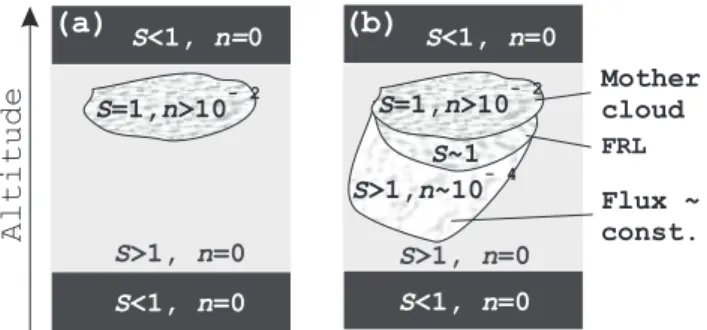
S~1 Flux ~ const. S=1, >10n - 2Fig. 1. Schematic vertical cross section of NAT particle
sedimen-tation out of a mother cloud floating in supersaturated air. S is the saturation ratio with respect to NAT, n the NAT particle number density. (a) A few hours after mother cloud formed. (b) A few days later after NAT particles have sedimented out. The flux reduction layer (FRL) is shown schematically. Sizes in drawing not in pro-portion, deformation in (b) sketches deformation caused by wind shear.
However, we will first present a theoretical discussion to gain insight into the suggested mechanism.
To break down the complex interplay of particle growth, acceleration and gas phase depletion, we first consider the hypothetical case where the growing particles do not de-plete the gas phase. All particles then experience the same growth and sedimentation once they leave the mother cloud. The sedimentation velocity vsedof a particle can then be ex-pressed as a function of altitude z alone. This stationary solu-tion conserves the particle number flux jp(i.e. the sedimen-tation velocity, particle number density and particle number flux are functions of the altitude but do not explicitly depend on time):
jp(z) = n(z) · vsed(z) =const . (1)
Since vsedis roughly proportional to the square of the par-ticle radius r (M¨uller and Peter, 1992), the parpar-ticle accelera-tion due to growth alone, i.e. ignoring gas phase depleaccelera-tion, is able to significantly reduce the particle number density. For a dense mother cloud with n = 1 cm−3an increase in ra-dius from 1 µm (the approximate NAT particle rara-dius in the mother cloud in thermodynamic equilibrium) to 10 µm leads to a reduction of the particle number density by two orders of magnitude.
The particle number flux will not remain constant when HNO3gas phase depletion is taken into account. The falling NAT particles remove HNO3from the gas phase, and subse-quent particles (falling through depleted air) will grow more slowly and hence accelerate less readily, leading to a de-crease in the particle flux. We show below that this effect controls the particle flux in the vicinity of the cloud base, but becomes less important with increasing distance from the mother cloud, where particles fall rapidly and therefore den-itrify less.
Thus, there are two particle flux regimes: in the vicinity of the cloud base, particle number flux is reduced by the HNO3 depletion by the sedimenting particles, here termed flux re-duction layer (FRL). In contrast, sufficiently far below the mother cloud the flux is approximately conserved (Fig. 1).
3 Description of the microphysical model
We use a 1-D microphysical model to study the physical pro-cesses taking place at the base of a mother cloud. The gas phase is modeled on an irregularly spaced Eulerian grid with 8800 points. Centered at the cloud base, 8000 points are used to model this important region with a vertical resolution of 1z =1 cm. Elsewhere the vertical resolution is 10 m, cover-ing a column from 15 km to 23 km altitude.
The NAT particles are modelled as individual particles, storing particle positions and radii. About 50 000 particles were required to obtain a statistically sufficient number of particles at all altitude levels. The NAT particle size distri-bution in the mother cloud may be freely prescribed and is chosen to be monodisperse for the base line calculation, with the radius determined from the particle number density in the mother cloud and the available HNO3in thermodynamic equilibrium. For each timestep (1t = 30 s) HNO3 parti-tioning between the gaseous and condensed phases is calcu-lated from the kinetic growth/evaporation equations for the NAT particles and by assuming equilibrium between the su-percooled ternary solution (STS) droplets and the gas phase. The HNO3vapour pressure of NAT is calculated according to Hanson and Mauersberger (1988), the partitioning into STS according to Carslaw et al. (1995). Particle sedimentation velocities are calculated including the Stokes and slip-flow regimes (M¨uller and Peter, 1992). The shape of the parti-cles undergoing growth/evaporation and sedimentation may be prescribed and is chosen to be spherical in the base line case.
The model was initialized with a constant H2O volume mixing ratio (VMR) of 5 ppmv and a constant total HNO3 VMR of 8 ppbv (typical for SOLVE/THESEO-2000 mid-winter conditions). The time-independent temperature pro-file is chosen such that initially SNAT = 10 in the entire column. This corresponds to a temperature of ≈ 3 K be-low TNATand a negligible HNO3partitioning into STS (less than 1% for 0.1 ppbv H2SO4). In the mother cloud, NAT particles are then allowed to reduce the saturation ratio to SNAT = 1. These idealized conditions have been chosen to study the mechanism without effects caused by complex gas phase and temperature profiles.
4 Results
Model calculations have been performed for a wide range of cloud and gas phase parameters. Figure 2 shows the detailed results for a monodisperse mother cloud with n = 0.1 cm−3
0 20 40 60 80 100 120 time [h] 16 18 20 22 altitude [km] 0 20 40 60 80 100 120 time [h] 16 18 20 22 altitude [km] (e) 0.02 0.07 0.23 0.78 2.65 9.00 jHNO3 [ppb .km/day] 0.02 0.07 0.23 0.78 2.65 9.00 jHNO3 [ppb .km/day] 16 18 20 22 altitude [km] 16 18 20 22 altitude [km] (a) 0.0 2.2 4.4 6.6 8.8 11.0 SNAT 0.0 2.2 4.4 6.6 8.8 11.0 SNAT 16 18 20 22 altitude [km] 16 18 20 22 altitude [km] (c) 10-5 10-4 10-3 10-2 10-1 100 n [cm -3] 10-5 10-4 10-3 10-2 10-1 100 n [cm -3] 16 18 20 22 altitude [km] 16 18 20 22 altitude [km] (b) 0 3 6 9 12
mean radius [um] 0
3 6 9 12
mean radius [um]
16 18 20 22 altitude [km] 16 18 20 22 altitude [km] (d) 10-4 10-3 10-2 10-1 jp [cm -2s -1 ] 10-4 10-3 10-2 10-1 jp [cm -2s -1 ]
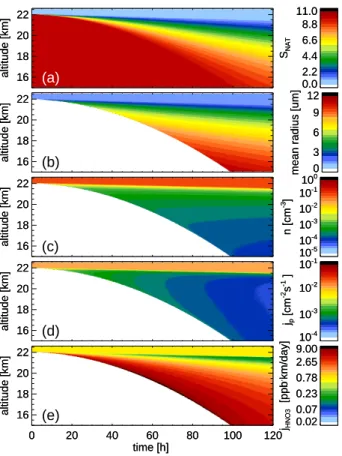
Fig. 2. 1-D model results for base line case as described in text. (a)
Saturation ratio SNAT(z, t )with SNAT=1 in the mother cloud and
>1 below. (b) – (e) Resulting radius r(z, t), number density n(z, t)
particle flux jp(z, t )and HNO3mass flux jHNO3(z, t ). The
mini-mum in the HNO3flux (panel e) just below the mother cloud base
is a direct consequence of the strong particle number flux reduction
in this region (the Flux Reduction Layer). The total HNO3is shown
in Fig. 4a.
(typical for type 1a-enh) and standard parameters mentioned above.
The flux reduction layer (FRL), due to strong HNO3 de-pletion below the cloud base, causes an impressive reduction in both particle number density (c) and flux (d) by 2 orders of magnitude. Panel (e) shows the HNO3mass flux. A flux of 1 ppb × km/day corresponds to 1 ppb HNO3being trans-ported downward by 1 km within one day. The HNO3mass flux due to NAT-rocks reaches up to 9 ppb × km/day, while it is 0.8 ppb × km/day within the mother cloud and remains limited to the corresponding small altitude range.
A quantification of the effect of gas phase depletion, caused by the sedimenting particles, on particle number den-sity is given in Fig. 3. Particle number denden-sity profiles for the base line case, a more dense (n = 1 cm−3, all other parame-ters as in base line case) and a less dense (n = 0.01 cm−3, all other parameters as in base line case) mother cloud are com-pared to their corresponding stationary solution. Three con-clusions follow from this comparison: (1) The decrease of
n [cm
-3]
10-4 10-3 10-2 10-1 1 -1.5 -1.0 -0.5 0.0 0.5 relative altitude [km]Mother
Cloud
FRL
(a)
n
120/ n
ss 10-2 10-1 1(b)
Fig. 3. (a) Vertical profiles of particle number density without gas
phase depletion (stationary solution, dashed lines) and with gas phase depletion (full model, solid lines). All calculations use the same parameters as the baseline case shown in Fig. 2, except for the
particle number density in the mother cloud (red: n = 1cm−3,
rNATequil≈0.6 µm; green: n = 10−1cm−3, rNATequil≈1.25 µm; blue:
n = 10−2cm−3, rNATequil ≈ 2.7 µm). The model results show the number density profile after 5 days (120 h). The stationary calcu-lations use the same initial conditions as the corresponding model calculations but neglect gas phase depletion. (b) The number
den-sity of the model calculations after 5 days (n120) divided by the
number density of the corresponding stationary solution (nss). This
ratio allows a quantification of the effect of the gas phase depletion on particle number density reduction. The effect is most prominent within a thin layer below the mother cloud, the flux reduction layer (FRL).
particle number density due to gas phase depletion and due to particle acceleration are of the same order of magnitude; (2) The effect of gas phase depletion on particle number density reduction is most prominent in a relatively thin layer just be-low the mother cloud, the flux reduction layer (FRL); (3) The combination of particle acceleration and gas phase depletion leads to particle number densities around 10−4cm−3 a few kilometers below the mother cloud, independently of the par-ticle number density in the mother cloud. Hence, the sug-gested mother cloud/NAT-rock mechanism produces the ob-served NAT-rock particle number densities, n ≈ 10−4cm−3, from the whole range of mother cloud particle number den-sities.
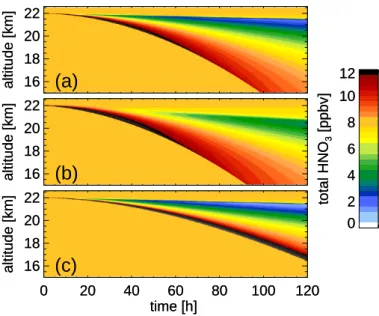
The resulting total HNO3 VMR (gas plus condensed phase) of the base line case is shown in panel (a) of Fig. 4, allowing a quantification of denitrification. The most severe denitrification is found in the FRL, where it reaches up to 75%. After 5 days, a vertical layer of about 2 km is deni-trified by more than 50%. Conversely, more than 4 km be-low the mother cloud renitrification would result if all parti-cles were to evaporate at this time. Each additional day with SNAT∼ 1 increases the denitrification significantly.>
Figure 4 compares the total HNO3VMR of the base line case (a) with two other relevant cases. Panel (b) refers to
96 Fueglistaler et al.: NAT-rock formation by mother clouds 16 18 20 22 altitude [km] 16 18 20 22 altitude [km]
(a)
16 18 20 22 altitude [km] 16 18 20 22 altitude [km](b)
0 20 40 60 80 100 120 time [h] 16 18 20 22 altitude [km] 0 20 40 60 80 100 120 time [h] 16 18 20 22 altitude [km](c)
0 2 4 6 8 10 12 total HNO 3 [ppbv] 0 2 4 6 8 10 12 total HNO 3 [ppbv]Fig. 4. Total HNO3(sum of gas phase and particulate). (a) Base
line case as in Fig. 2. (b) Mother cloud with n = 0.01 cm−3, all
other parameters as in (a). Sedimentation begins earlier, but
denitri-fication is less pronounced than in (a). (c) Total HNO3for initially
SNAT =65 in entire column, which reduces to SNAT ≈30 due to
HNO3uptake by STS aerosol, all other parameters as in (a). The
HNO3-uptake of the STS aerosol delays sedimentation compared to
(a).
a less dense mother cloud (n = 10−2cm−3). In this case, the FRL does not develop strongly, but the flux conserva-tion regime suffices to reduce number densities to about 10−4cm−3(see also Fig. 3), yielding a total HNO
3very sim-ilar to the base line case. Conversely, increasing the number density within the mother cloud (n = 1 cm−3) strengthens the role of the FRL (see also Fig. 3), again leaving the verti-cal redistribution of HNO3at lower altitudes unchanged (not shown). Panel (c) shows the effect of supercooled ternary solution droplets (STS) on denitrification. In contrast to pan-els (a) and (b), here temperatures were chosen such that half of the total HNO3is taken up by STS, lowering the HNO3 VMR to initially 4 pbbv below the cloud. This leads to ap-proximately halving the sedimentation distance of the NAT particles below the mother cloud and a corresponding slow-ing of the denitrification process.
5 Model limitations and sensitivity tests
Various effects may alter the idealized computations shown above, such as non-monodisperse size distributions, particle shape, gas phase and eddy diffusion, and dynamical effects, e.g. particle dispersion caused by wind shear. A measure of the denitrification strength is the integrated HNO3mass flux R dzjHNO3(z, t ). Table 1 compares various sensitivity runs in terms of this quantity normalized to the base line result.
Table 1. Denitrification strengthR jHNO3(z, t )dz for t = 3 days
normalized to base line case (Fig. 2) with R jHNO3(z, t )dz =
14.6 km2ppbv/day
Scenario Norm. denitrification
strength
base line case 1
aspheric particles (aspect ratio 1:3) 1.03
lognormal size dist. (σ = 1.4) 1.03
without gas diffusion 0.99
mother cloud with n =0.01 cm−3 1.37
mother cloud with n =1 cm−3 0.91
STS below mother cloud 0.73
Vertical thickness the of mother cloud. All calculations assume an infinitely thick mother cloud to demonstrate the basic properties of the sedimenting particles. A finite thick-ness limits the time particles can sediment out of the mother cloud (which then eventually ceases to exist) but does not affect the particle flux, number density or radius of the sed-imenting particles. To allow ongoing sedimentation out of the mother cloud for 5 or more days, a thickness of ∼ 12 m,> >
∼ 68 m, and ∼ 440 m is required for a mother cloud with> n = 1 cm−3, n = 0.1 cm−3, and n = 0.01 cm−3, respec-tively.
Effect of particle size distribution. A noteworthy aspect is the insensitivity of denitrification to the initial size distribu-tion. Lognormal and monodisperse distributions yield simi-lar results as the particle number density reduction is dom-inated by the flux reduction/flux conservation scheme dis-cussed above and not by preferrential sedimentation of ini-tially larger particles. However, a wider distribution of parti-cle sizes in the mother cloud yields also a wider distribution of particle sizes in the sedimenting particle ensemble.
Particle shape. The asphericity of NAT particles affects their sedimentation velocity and growth time. The sedimen-tation velocity of spherical particles is about 25% higher than of aspherical particles with an aspect ratio of 1:3, which serves as a case of extreme asymmetry (M¨uller and Peter, 1992). In addition, this small difference is partly compen-sated by more rapid growth of 5–10% of the aspherical par-ticles.
Gas phase and eddy diffusion. Implementation of gas phase diffusion in the model leads to an initially increased HNO3supply for particles above the cloud base, but changes the results in Figs. 2–4 negligibly. The same holds true for stronger eddy diffusion, although it leads to a more pronounced transport of HNO3 into the mother cloud and smoothing of the entire resulting HNO3profile.
Dynamical effects. A microphysical column model
not reflect the 3-D wind and temperature fields. Wind shear leads to a distortion of the sedimenting particle ensemble, and we may no expect to observe large NAT-particles directly below type 1a/1a-enh PSCs. Furthermore, during mother cloud formation, e.g. in a mountain lee wave event involv-ing ice particles (Carslaw et al., 1998; Tsias et al., 1999; Voigt et al., 2000), mesoscale variations in NAT particle number density may initially obscure signs of sedimentation, which become apparent only after about one day. In addition, wind shear causes particles to sediment through different air-masses, which increases the volume of air denitrified by the sedimenting particles (Dhaniyala et al., 2002).
6 Conclusions
This model study shows that type 1a and type 1a-enh PSCs with n = 0.01 – 1.0 cm−3 can be a source of NAT-rocks, which efficiently denitrify the polar vortex. Sensitivity stud-ies show that the basic propertstud-ies of the mother cloud/NAT-rock mechanism are surprisingly robust against changes in the particle number density, size distribution and shape within the mother cloud, as well as to gas phase or eddy diffusion effects. Large scale transport and wind shear may lead to geographic distortions of the sedimenting NAT-rock population, but neither to enhanced nor reduced denitrifica-tion as long as the air remains supersaturated with respect to NAT and mixing processes are not dominant. The re-sulting NAT-rock number densities and HNO3vertical flux agree well with in situ measurements. For 20 January, Fa-hey et al. (2001) estimate the particle number concentration for the larger mode to be 2.3 × 10⁻⁴cm−3with a mode ra-dius of 7.25 µm and a HNO3 flux of 2.6 ppbv × km / day. Our model runs in Figs. 2 and 3 show particle number den-sities to range from 1 × 10⁻³cm−3 about 2 km below the mother cloud to less than 1 × 10⁻⁴cm−3at lower altitudes. The modelled HNO3flux a few kilometers below the mother cloud ranges from 1 to 5 ppb × km/day, with a maximum of 9 ppb × km/day close to the leading edge of the sedimenting NAT-rocks. The model indicates that severe denitrification occurs only if the NAT particles sediment in ambient air with temperatures below the NAT existence temperature for sev-eral days. Even in a very cold Arctic winter like the winter 1999/2000 (Manney and Sabutis, 2001), this requirement re-duces the number of type 1a/1a-enh clouds which are suited for the development of NAT-rocks.
Acknowledgements. We are grateful to S. Dhaniyala, K. A. McK-inney, P. Wennberg, R. S. Gao and D. W. Fahey for
fruit-ful and critical discussions. SF has been supported through
the EC-project THESEO-2000/EuroSOLVE (under contract BBW 99.0218-2, EVK2-CT-1999-00047) and through an ETHZ-internal research project.
References
Biele, J., Tsias, A., Luo, B. P., Carslaw, K. S., Neuber, R., Beyerle, G., Peter, Th.: Nonequilibrium coexistence of solid and liquid particles in Arctic stratospheric clouds, J. Geophys. Res., 106, 22991–23007, 2001.
Browell, E. V., Butler, C. F., Ismail, S., Robinette, P. A., Carter, A. F., Higdon, N. S., Toon, O. B., Schoeberl, M. R., and Tuck, A. F.: Airborne lidar observations in the wintertime arctic strato-sphere: polar stratospheric clouds, Geophys. Res. Lett., 17, 385– 388, 1990.
Carslaw, K. S., Luo, B. P., and Peter, Th.: An analytic expression for
the composition of aqueous HNO3-H2SO4stratospheric aerosols
including gas phase removal of HNO3, Geophys. Res. Lett., 22,
1877–1880, 1995.
Carslaw, K. S., Wirth, M., Tsias, A., Luo, B., D¨ornbrack, A., Leut-becher, M., Volkert, H., Renger, W., Bacmeister, J. T., Reimer, E., and Peter, Th.: Increased stratospheric ozone depletion due to mountain-induced atmospheric waves, Nature, 391, 675–678, 1998.
Dhaniyala, S., McKinney, K. A., and Wennberg, P. O.: Lee-wave clouds and denitrification of the polar stratosphere, Geophys. Res. Lett., (in press), 2002.
Fahey, D. W., Gao, R. S., Carslaw, K. S., Kettleborough, J., Popp, P. J., Northway, M. J., Holecek, J. C., Ciciora, S. C., McLaugh-lin, R. J., Baumgardner, D. G., Gandrud, B., Wennberg, P. O., Dhaniyala, S., McKinney, K., Peter, T., Salawitch, R. J., Bui, T. P., Elkins, J. W., Webster, C. R., Atlas, E. L., Jost, H., Wilson, J. C., Herman, R. L., and Kleinb¨ohl, A: The detection of large
HNO3-containing particles in the winter Arctic stratosphere,
Sci-ence, 291, 1026–1031, 2001.
Fueglistaler, S., Luo, B. P., Buss, S., Wernli, H., Voigt, C., Peter, Th., M¨uller, R., Neuber, R., Hostetler, C., Poole, L., Flentje, H., and Fahey, D. W.: Large NAT particle formation by mother clouds: analysis of SOLVE/THESEO-2000 observations, Geo-phys. Res. Lett., (in press), 2002.
Gao, R. S., Richard, E. C., Popp, P. J., Toon, G. C., Hurst, D. F., Newman, P. A., Holecek, J. C., Northway, M. J., Fahey, D. W., Danilin, M. Y., Sen, B., Aikin, K., Romashkin, P. A., Elkins, J. W., Webster, C. R., Schauffler, S. M., Greenblatt, J. B., McEl-roy, C. T., Lait, L. R., Bui, T. P., and Baumgardner, D.: Obser-vational evidence for the role of denitrification in Arctic strato-spheric ozone loss, Geophys. Res. Lett., 28, 2879–2882, 2001. Hanson, D. and Mauersberger, K.: Laboratory studies of nitric acid
trihydrate: implications for the south polar stratosphere, Geo-phys. Res. Lett., 15, 855–858, 1998.
Manney, G. L. and Sabutis, J. L.: Development of the polar vortex in the 1999–2000 arctic winter stratosphere, Geophys. Res. Lett., 27, 2589–2592, 2001.
M¨uller, R. and Peter, Th.: The numerical modelling of the sedi-mentation of polar stratospheric cloud particles, Ber. Bunsenges. Phys. Chem., 96, 353–361, 1992.
Tabazadeh, A., Jensen, E. J., Toon, O. B., Drdla, K., and Schoeberl, M. R.: Role of the stratospheric polar freezing belt in denitrifica-tion, Science, 291, 2591–2594, 2001.
Toon, O. B., Browell, E. V., Kinne, S., and Jordan, J.: An anal-ysis of lidar observations of polar stratospheric clouds, Geo-phys. Res. Lett., 17, 393–396, 1990.
Toon, O. B., Tabazadeh, A., Browell, E. V., and Jordan, J.: Analysis of lidar observations of Arctic polar stratospheric clouds during January 1989, J. Geophys. Res., 105, 20 589–20 615, 2000.
98 Fueglistaler et al.: NAT-rock formation by mother clouds
Tsias, A., Wirth, M., Carslaw, K. S., Biele, J., Mehrtens, H., Re-ichardt, J., Wedekind, C., Weiss, V., Renger, W., Neuber, R., Von Zahn, U., Stein, B., Santacesaria, V., Stefanutti, L., Fierli, F., Bacmeister, J., and Peter, Th.: Aircraft lidar observation of an en-hanced type 1a polar stratospheric cloud during APE-POLECAT, J. Geophys. Res., 104, 23 961–23 969, 1999.
Voigt, Ch., Schreiner, J., Kohlmann, A., Zink, P., Mauersberger, K., Larsen, N., Deshler, T., Kr¨oger, Ch., Rosen, J., Adriani, A., Cairo, F., Di Donfrancesco, G., Viterbini, M., Ovarlez, J.,
Ovar-lez, H., David, Ch., and D¨ornbrack, A.: Nitric acid trihydrate (NAT) in polar stratospheric clouds, Science, 290, 1756–1758, 2000.
Waibel, A. E., Peter, Th., Carslaw, K. S., Oelhaf, H., Wetzel, G., Crutzen, P. J., P¨oschl, U., Reimer, E., and Fischer, H.: Arctic ozone loss due to denitrification, Science, 283, 2064–2069, 1999. WMO: Scientific Assessment of Ozone Depletion: 1998, Rep. 44, World Meteorological Organization, Geneva, Switzerland, 1999.