The MIT Faculty has made this article openly available. Please share
how this access benefits you. Your story matters.
Citation Belger, Christian et al. “Colorimetric Stimuli-Responsive
Hydrogel Polymers for the Detection of Nerve Agent Surrogates.” Macromolecules 48.21 (2015): 7990–7994.
As Published http://dx.doi.org/10.1021/acs.macromol.5b01406
Publisher American Chemical Society (ACS)
Version Author's final manuscript
Citable link http://hdl.handle.net/1721.1/108069
Terms of Use Article is made available in accordance with the publisher's policy and may be subject to US copyright law. Please refer to the publisher's site for terms of use.
This document is confidential and is proprietary to the American Chemical Society and its authors. Do not copy or disclose without written permission. If you have received this item in error, notify the sender and delete all copies.
Colorimetric Stimuli-Responsive Hydrogel Polymers for the Detection of Nerve Agents
Journal: Macromolecules Manuscript ID: Draft
Manuscript Type: Article Date Submitted by the Author: n/a
Complete List of Authors: Belger, Christian; MIT, Chemistry
Weis, Jonathan; Massachusetts Institute of Technology, Chemistry Ahmed, Eilaf; Emory University, of Chemistry & the Wallace H. Coulter Department of Biomedical Engineering; MIT,
Swager, Timothy; Mass. Inst. of Tech., Chemistry; Massachusetts Institute of Technology, Department of Chemistry 18-597
Colorimetric Stimuli-Responsive Hydrogel
Polymers for the Detection of Nerve Agents
Christian Belger, Jonathan G. Weis, Eilaf Ahmed and Timothy M. Swager*
Massachusetts Institute of Technology, Cambridge, Massachusetts, 02139, United States
CWA detection, Stimuli-responsive hydrogels, ROMP
ABSTRACT
The threat of chemical warfare agents (CWAs) necessitates the development of functional materials that not only quickly detect the presence of CWAs but also actively protect against their toxicity. We have synthesized responsive units that exhibit colorimetric responses upon exposure to CWAs and incorporated them into a versatile detection platform based on copolymers prepared by ring-opening metathesis polymerization (ROMP). The theoretical detection limits for CWA simulants in solution for these polymers are as low as 1 ppm. By incorporating hydrogel-promoting units as pendant chains, we are able to obtain polymers that instantly respond to CWA vapors and are easy to regenerate to the deactivated state by simple treatment with ammonium hydroxide vapor. We further demonstrate a collapse of the polymer gels in response to trifluoroacetic acid (TFA), a strong acid that produces a more fully ionized state as a result of its more caustic nature.
3 4 5 6 7 8 9 10 11 12 13 14 15 16 17 18 19 20 21 22 23 24 25 26 27 28 29 30 31 32 33 34 35 36 37 38 39 40 41 42 43 44 45 46 47 48 49 50 51 52 53 54 55 56 57
Introduction
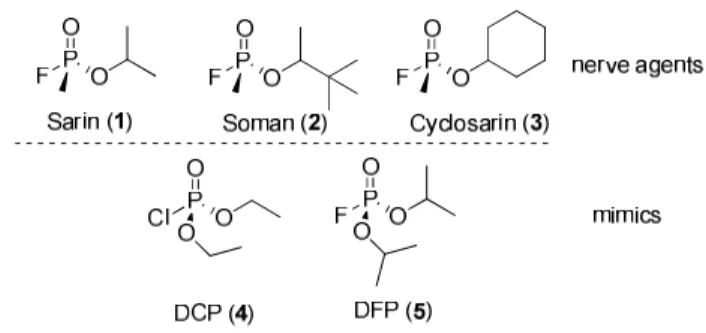
Chemical warfare agents (CWA) have been a threat for more than a century and continue to pose significant dangers in the homeland as well as on the battle field. Organophosphorus nerve agents are a subclass of CWAs; their relatively easy synthesis and high toxicity renders them an enduring threat. The mode of action for these nerve agents is the inhibition of the enzyme acetylcholinesterase, which results in continuous overstimulation of muscles that can ultimately result in death. Figure 1 details selected nerve agents and their simulants with similarly electrophilic phosphorus (V) cores. Sarin (1), for example, is volatile and extremely toxic (LD50 = 70 µg/kg) whereas cyclosarin (3) is more persistent with an even higher toxicity (LD50 = 17 µg/kg). As a result of the regulation of CWAs and their extreme toxicity, the use of simulants such as diethyl chlorophosphate (DCP, 4, LD50 = 11 mg/kg) and diisopropyl fluorophosphate (DFP, 5, LD50 = 2 mg/kg) is common in laboratory experiments.
Figure 1. Nerve agents and their mimics often used as less toxic substitutes
The need for proper protection against these threats has led to the development of a variety of detection schemes for CWAs over the past few decades,1,2 including chromatographic,3-6 spectroscopic,7-10 electrochemical,11-15 fluorogenic,16-25 and colorimetric26-29 approaches. Fewer reports can be found for polymer-based detection schemes.30-32
It is inadequate to only have sensitive and selective detection methods; protective apparel is essential, as nerve agents are easily absorbed through the skin.33 Modern full body protective
3 4 5 6 7 8 9 10 11 12 13 14 15 16 17 18 19 20 21 22 23 24 25 26 27 28 29 30 31 32 33 34 35 36 37 38 39 40 41 42 43 44 45 46 47 48 49 50 51 52 53 54 55 56 57 58
suits can block external chemical threats, at the cost of breathability of the fabric, hence limiting their wearability.33 The duration of wearability could be significantly extended if dynamic responsive materials are incorporated into the fabric, enabling breathability in the absence of threat and creating a protective barrier upon exposure to CWAs. The incorporation of responsive units into polymers results in more robust materials, and the activation by a CWA can be used to trigger a mechanical change in the material. In order to develop the next generation of protective fabrics, we were interested in polymers that exhibit (1) a strong colorimetric response to CWAs for detection and (2) a mechanical response upon contact with CWAs for protection.
Synthesis
Herein, we describe polymers that possess a simple colorimetric probe based on triarylmethanol-containing derivatives that are able to detect nerve-agent mimics. Colorimetric sensing experiments with trifluoroacetic acid (TFA) and DCP (4) demonstrate that the CWA-responsive units described here exhibit a significant bathochromic shift and undergo a color change from colorless to red or green, depending on the substituent groups on the triarylmethanol-based chromogenic moiety. Furthermore, by incorporating the responsive units into hydrogel-containing polymers, a volumetric response to TFA could also be demonstrated.
We chose polymers produced by ring opening metathesis polymerization (ROMP) as the basis for our responsive material in order to allow for simple tuning of the polymers’ properties. The colorimetric probes are inspired by the work of Costero and coworkers26,27 and more recently, analogues have been utilized in polymers developed by our group.32 The triarylmethanol groups are readily incorporated into monomers 9, 10 and 11, as outlined in Scheme 1. We chose highly arylated tertiary alcohols as responsive units for the detection of CWA as a result of their
3 4 5 6 7 8 9 10 11 12 13 14 15 16 17 18 19 20 21 22 23 24 25 26 27 28 29 30 31 32 33 34 35 36 37 38 39 40 41 42 43 44 45 46 47 48 49 50 51 52 53 54 55 56 57
excellent reactivity with nerve agent simulants by phosphorylation of the hydroxyl moiety and subsequent ionization resulting in a rapid colorimetric response.
Scheme 1. Synthetic route to monomers 9–11.
The reaction of the diarylketones with organolithium derivatives of 8 provided the desired building blocks (9, 10 and 11) in moderate to high yields (32–86%). As shown in Scheme 2, ROMP of monomers 10 and 11 gave the corresponding polymers (HP-1 and HP-2) using Grubbs’ third generation catalyst (G3). Gel permeation chromatography (GPC) measurements in tetrahydrofuran, relative to polystyrene standards, showed moderate number-average molecular weights (Mn) that range from 23 kDa in HP-1 with a dispersity (Đ) of 1.58 to 52 kDa in HP-2 with a Đ of 1.20. We were unsuccessful in producing a homopolymer of building block 9 under the reaction conditions shown in Scheme 2.
3 4 5 6 7 8 9 10 11 12 13 14 15 16 17 18 19 20 21 22 23 24 25 26 27 28 29 30 31 32 33 34 35 36 37 38 39 40 41 42 43 44 45 46 47 48 49 50 51 52 53 54 55 56 57 58
Scheme 2. Synthesis of homopolymers HP-1 and HP-2.
Figure 2 illustrates the colorimetric response of monomers 10 and 11 upon addition of 100 equivalents DCP (4) at room temperature and ambient conditions. The colorless solution of compound 10 in dichloromethane (DCM) displays an absorption band around 265 nm (Figure 2a). Addition of DCP (4) to a solution of 50 µg 10 in 3 mL DCM gives rise to two absorption bands at 450 nm and 620 nm, resulting in a significant bathochromic shift in the absorption spectrum (∆λ = 350 nm). The change in color from colorless to green was observed immediately upon addition of DCP. This bathochromic shift is consistent with previous reports where a phosphorylation-reaction between the electron-deficient phosphorus in DCP (4) and the nucleophilic hydroxyl moiety in compound 10/11 results in ionization to the highly colored carbocation.26,27 Compound 11 has fewer electron-donating groups than compound 10, and reaction with DCP (4) results in a colorless to red bathochromic shift from 300 nm to 490 nm (∆λ = 190 nm) (Figure 2b). The reduced bathochromic shift can be attributed to the more limited electron delocalization in the carbocation from 11 as compared to that generated from 10.
3 4 5 6 7 8 9 10 11 12 13 14 15 16 17 18 19 20 21 22 23 24 25 26 27 28 29 30 31 32 33 34 35 36 37 38 39 40 41 42 43 44 45 46 47 48 49 50 51 52 53 54 55 56 57
OH N n DCP N n R = H (HP-2) DCP N N n R R = NMe2(HP-1) DCP N N OH N N DCP R R = NMe2(10) R = H (11)
Figure 2. UV/Vis spectra and photographs of compounds 10 (a) and 11 (b) in DCM before and
after addition of 100 eq. DCP. UV/Vis spectra and photographs of polymers HP-1 (c) and HP-2 (d) in DCM before and after addition of 100 eq. DCP.
We further tested the reactivity of homopolymers HP-1 and HP-2 with DCP (4). Both polymers showed responses very similar to their respective monomers with dramatic and simultaneous colorimetric changes indicating the formation of the highly colored carbocation. The regeneration of monomers 10 and 11 and polymers HP-1 and HP-2 is achieved by the addition of a basic aqueous solution such as 2M sodium hydroxide or tetrabutylammonium hydroxide to the colored solutions.
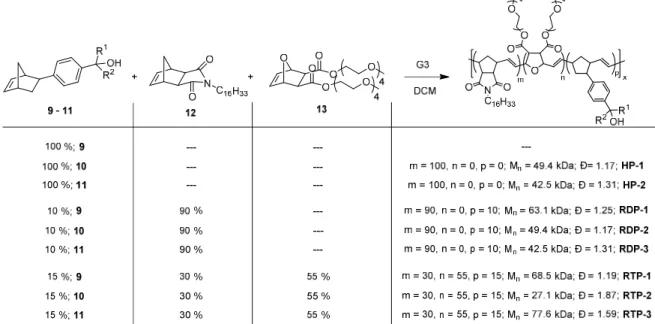
To obtain polymers with improved solubility and hydrogel character we have targeted random double and triple copolymers. An overview of the polymers synthesized can be found in Table 1. The copolymer prepared with monomer 9, which could previously not be synthesized as homopolymer, exhibited similar reactivity in solution compared to the copolymers prepared with monomers 10 and 11. Random, copolymers containing two of three comonomers were obtained.
3 4 5 6 7 8 9 10 11 12 13 14 15 16 17 18 19 20 21 22 23 24 25 26 27 28 29 30 31 32 33 34 35 36 37 38 39 40 41 42 43 44 45 46 47 48 49 50 51 52 53 54 55 56 57 58
Table 1. Synthesis of homopolymer HP-1/HP-2, random copolymers containing two, RDP-1/RDP-2/RDP-3, or three, RTP-1/RTP-2/RTP-3, comonomers were produced.
In addition to the CW responsive and hydrogel promoting monomers initially investigated, we found that the addition of comonomer 12, possessing a long alkyl chain increased the solubility and film forming properties of the resulting polymers. In order to establish theoretical detection limits, we measured the change in absorption of RDP-1, RDP-2 and RDP-3 in DCM for the addition of different amounts of DCP (4) (see supporting information). The detection limits obtained are 1 ppm for RDP-1 after 120 seconds of exposure time, as well as 5 ppm for RDP-2 and 8 ppm for RDP-3 after only 30 seconds of exposure time.31 In the following section, we discuss only the data obtained for RDP-2 and RTP-2 because the change in color of these polymers is the most substantial. Furthermore RDP-2 and RDP-3 show a faster response time toward CWA mimics. The data obtained for the other polymers (RDP-1 and RDP-3, RTP-1 and
RTP-3) can be found in the supporting information.
We were able to obtain RDP-2 with molecular weights of 49k and a narrow Đ of 1.17 by random copolymerization of monomers 10 and 12. RDP-2 is very soluble, but behaves poorly
3 4 5 6 7 8 9 10 11 12 13 14 15 16 17 18 19 20 21 22 23 24 25 26 27 28 29 30 31 32 33 34 35 36 37 38 39 40 41 42 43 44 45 46 47 48 49 50 51 52 53 54 55 56 57
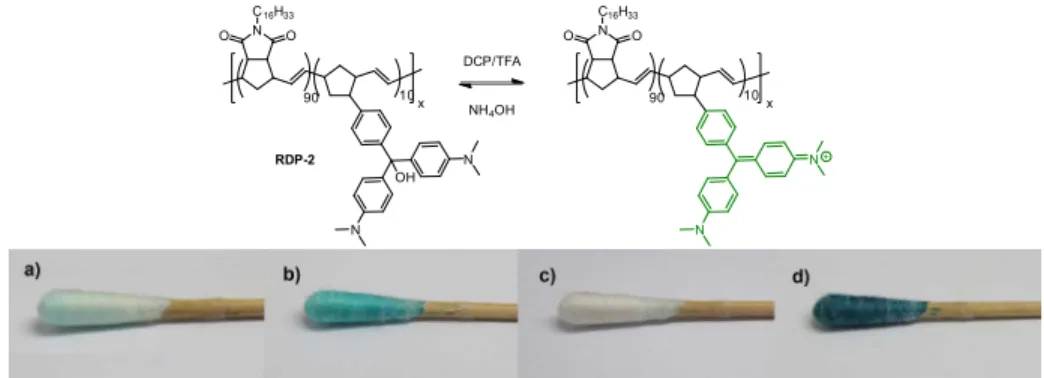
when dropcast or spincoated, resulting in brittle and non-transparent films. The polymer was therefore deposited on cotton (Figure 3), and in this construct the polymer can easily be regenerated with near instantaneous color loss upon exposure to ammonium hydroxide vapor.
N C16H33 O O 90 N 10 N x RDP-2 N C16H33 O O 90 OH N 10 N x DCP/TFA NH4OH
Figure 3. Polymer RDP-2 coated on a cotton tip (a) responds rapidly to DCP (b) and TFA (d)
vapors and can be regenerated upon exposure to vapor from an aqueous NH4OH solution (c).
In pursuit of the goal of designing highly breathable membranes, we envisioned triple copolymers that also incorporate hydrogel units (comonomer 13) to promote swelling and collapsing. We therefore prepared random triple copolymers (RTP, Table 1) using the previously established ROMP conditions (see supporting information). RTP-2 can be used to create thin films that show the same response toward DCP as polymers HP-1 and RDP-2.
3 4 5 6 7 8 9 10 11 12 13 14 15 16 17 18 19 20 21 22 23 24 25 26 27 28 29 30 31 32 33 34 35 36 37 38 39 40 41 42 43 44 45 46 47 48 49 50 51 52 53 54 55 56 57 58
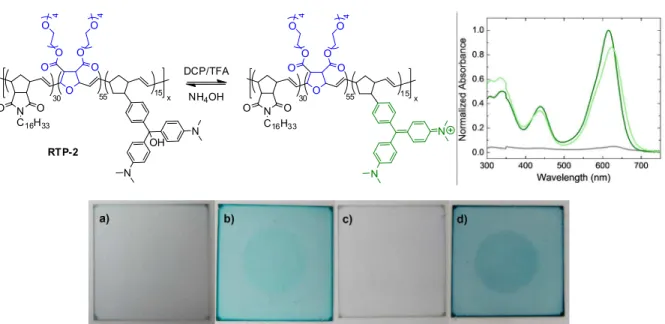
O 55 OH N 15 N x DCP/TFA N O O C16H33 30 O O O O O O 4 4 O 55 N 15 N x N O O C16H33 30 O O O O O O 4 4 RT P-2 NH4OH
Figure 4. Molecular structure of RTP-2. Spin coated film from chloroform solution before
exposure (a, grey curve in absorption spectra) and after exposure to DCP (b, light green curve in absorption spectra) at room temperature. Regeneration is complete upon exposure to ammonium hydroxide vapor (c). After exposure to TFA vapor (d, dark green curve in absorption spectra).
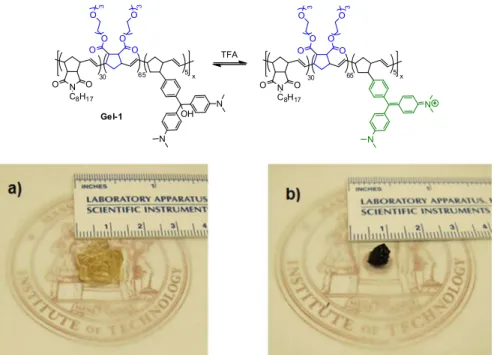
As detailed in Figure 4, RTP-2 can be easily regenerated from the active state by exposing it to ammonium hydroxide vapor. This cycle has been repeated several times without a visual loss of activity. Several attempts to determine the film thickness before and after exposure to TFA and DCP were unsuccessful because the dropcasted material is very soft (compliant) before the exposure to the analyte, thus preventing analysis by profilometry. However upon exposure a hardening of the polymer film is observed. The mechanical and volumetric changes are best demonstrated by observation of a bulk hydrogel that has been exposed to TFA vapor (Figure 5).
3 4 5 6 7 8 9 10 11 12 13 14 15 16 17 18 19 20 21 22 23 24 25 26 27 28 29 30 31 32 33 34 35 36 37 38 39 40 41 42 43 44 45 46 47 48 49 50 51 52 53 54 55 56 57
65 OH N 5 N x TFA N O O C8H17 30 O O O O O O 3 3 65 N 5 N x N O O C8H17 30 O O O O O O 3 3 Gel-1
Figure 5. Molecular structure of triblock Gel-1 and its response to TFA (b). Swollen state of
hydrogel after treatment with 2M NaOH or (Bu)4NOH (a).
In its swollen, unreacted state Gel-1 has a diameter of more than 1 cm and is relatively soft. Upon exposure to TFA vapor Gel-1 shows the characteristic color change to dark green. When collapsed, Gel-1 has a diameter is 0.5 cm. It should be noted that the volumetric response was only achieved using TFA vapor. In the presence of DCP, the swollen hydrogel only showed its characteristic color change. We attribute this to the lower vapor pressure of DCP compared to TFA. This incomplete ionization prevents the substantial gel collapse that is observed upon exposure to TFA. Future work is aimed at improving the response toward CWA mimics and demonstrating the collapse in polymer thin films.
Conclusions
In summary we synthesized two highly sensitive probes for the detection of CWA mimics and successfully incorporated them into random double and triple copolymers. Low ppm theoretical
3 4 5 6 7 8 9 10 11 12 13 14 15 16 17 18 19 20 21 22 23 24 25 26 27 28 29 30 31 32 33 34 35 36 37 38 39 40 41 42 43 44 45 46 47 48 49 50 51 52 53 54 55 56 57 58
detection limits toward DCP were demonstrated in all cases. Furthermore, we show the tunability of the obtained polymers by incorporating alkyl-containing and hydrogel-promoting building blocks. These polymers show fully reversible responses toward DCP and can be regenerated with ammonium hydroxide vapor. A bulk hydrogel collapse upon exposure to TFA could be demonstrated, suggesting the use of these materials in dynamic, CWA-responsive films for application in protective fabrics.
ASSOCIATED CONTENT
Supporting Information.
1
H and 13C NMR for monomers and GPC data for polymers, detection limit experiments and synthesis of the polymers. This material is available free of charge via the Internet at http://pubs.acs.org.
AUTHOR INFORMATION Corresponding Author Email: [email protected]
Author Contributions
The manuscript was written through contributions of all authors. All authors have given approval to the final version of the manuscript.
Funding Sources 3 4 5 6 7 8 9 10 11 12 13 14 15 16 17 18 19 20 21 22 23 24 25 26 27 28 29 30 31 32 33 34 35 36 37 38 39 40 41 42 43 44 45 46 47 48 49 50 51 52 53 54 55 56 57
Chemical and Biological Technologies Department at the Defense Threat Reduction Agency (DTRA–CB) via grant BA12PHM123 in the “Dynamic Multifunctional Materials for a Second Skin D[MS]2” program.
ACKNOWLEDGMENT
The authors would like to acknowledge the financial support of the Chemical and Biological Technologies Department at the Defense Threat Reduction Agency (DTRA–CB) via grant BA12PHM123 in the “Dynamic Multifunctional Materials for a Second Skin D[MS]2” program.
REFERENCES
(1) Eubanks, L. M.; Dickerson, T. J.; Janda, K. D. Chem. Soc. Rev. 2007, 36, 458.
(2) Kim, K.; Tsay, O. G.; Atwood, D. A.; Churchill, D. G. Chem. Rev. 2011, 111, 5345.
(3) Hook, G. L.; Kimm, G.; Betsinger, G.; Savage, P. B.; Swift, A.; Logan, T.; Smith, P. A. J.
Sep. Sci. 2003, 26, 1091.
(4) Kimm, G. L.; Hook, G. L.; Smith, P. A. Journal of Chromatography A 2002, 971, 185.
(5) Creasy, W. R.; Rodríguez, A. A.; Stuff, J. R.; Warren, R. W. Journal of Chromatography A
1995, 709, 333.
(6) Steiner, W. E; Klopsch, S. J.; English, W. A.; Clowers, B. H.; Hill, H. H. Ana.l Chem. 2005,
77, 4792.
(7) Cotte-Rodríguez, I.; Cooks, R. G. Chem Commun. 2006, 2968.
(8) Kanu, A. B.; Haigh, P. E.; Hill, H. H. Analytica Chimica Acta 2005, 553, 148.
3 4 5 6 7 8 9 10 11 12 13 14 15 16 17 18 19 20 21 22 23 24 25 26 27 28 29 30 31 32 33 34 35 36 37 38 39 40 41 42 43 44 45 46 47 48 49 50 51 52 53 54 55 56 57 58
(9) Francis, G. J.; Milligan, D. B.; McEwan, M. J. Anal. Chem. 2009, 81, 8892.
(10) Joo, B.-S.; Huh, J.-S.; Lee, D. D. Sensors and Actuators B 2007, 121, 47.
(11) Khan, M. A. K.; Kerman, K.; Petryk, M.; Kraatz, H.-B. Anal. Chem. 2008, 80, 2574.
(12) Diakowski, P. M.; Xiao, Y.; Petryk, M. W. P.; Kraatz, H.-B. Anal. Chem. 2010, 82, 3191.
(13) Wang, J.; Pumera, M.; Collins, G. E.; Muchandani, A. Anal. Chem. 2002, 74, 6121.
(14) Mlsna, T. E.; Cemalovic, S.; Warburton, M.; Hobson, S. T.; Mlsna, D. A.; Patel, S. V.
Sensors and Actuators B 2006, 116, 192.
(15) Wang, F; Gu, H.; Swager, T. M. J. Am. Chem. Soc. 2008, 130, 5392.
(16) Bencic-Nagale, S.; Sternfeld, T.; Walt, D. R. J. Am. Chem. Soc. 2006, 128, 5041.
(17) Burnsworth, M.; Rowan, S. J.; Weder, C. Chem. Eur. J. 2007, 13, 7828.
(18) Zhang, S.-W.; Swager, T. M. J. Am. Chem. Soc. 2003, 125, 3420.
(19) Knapton, D.; Burnsworth, M.; Rowan, S. J.; Weder, C. Angew. Chem. Int. Ed. 2006, 45, 5825.
(20) Lei, Z.; Yang, Y. J. Am. Chem. Soc. 2014, 136, 6594.
(21) Wu, X.; Wu, Z.; Ham, S. Chem. Commun. 2011, 47, 11468.
(22) Dale, T. J.; Rebek Jr., J. J. Am. Chem. Soc. 2006, 128, 4500.
3 4 5 6 7 8 9 10 11 12 13 14 15 16 17 18 19 20 21 22 23 24 25 26 27 28 29 30 31 32 33 34 35 36 37 38 39 40 41 42 43 44 45 46 47 48 49 50 51 52 53 54 55 56 57
(23) Walton, I.; Davis, M.; Munro, L.; Catalano, V. J.; Cragg, P. J.; Huggins, M. T.; Wallace, K. J. Org. Lett. 2012, 14, 2686.
(24) Wallace, K. J.; Fagbemi, R. I.; Folmer-Anderson, F. J.; Morey, J.; Lynth, V. M.; Anslyn, E. V. Chem. Commun. 2006, 3886
(25) de Grenu, B. D.; Moreno, D.; Torroba, T.; Berg, A.; Gunnars, J.; Nilsson, T.; Nyman, R.; Persson, M.; Pettersson, J.; Eklind, I.; Wasterby, P. J. Am. Chem. Soc. 2014, 136, 4125.
(26) Gotor, R.; Costero, A. M.; Gil, S.; Parra, M.; Martínez-Mánez, R.; Sancenón; F. Chem. Eur.
J. 2011, 17, 11994.
(27) Costero, A. M.; Parra, M.; Gil, S.; Gotor, R.; Martínez-Manez, F.; Sancenón, S.; Royo, S.
Eur. J. Org. Chem. 2012, 4937.
(28) Costero, A. M.; Gil, S.; Parra, M.; Mancini, P. M. E.; Martínez-Mánez, R.; Sancenón; F.; Royo, S. Chem. Commun. 2008, 6002.
(29) Royo, S.; Costero, A. M.; Parra, M.; Gil, S.; Martínez-Mánez, R.; Sancenón, F. Chem Eur.
J. 2011, 17, 6931.
(30) Sarkar, S.; Shunmugam, R. Chem. Commun. 2014, 50, 8511.
(31) Pangeni, D.; Nesterov, E. E. Macromolecules 2013, 46, 7266.
(32) Weis, J. G.; Swager, T. M. ACS Macro Lett. 2015, 4, 138.
(33) Boopathi, M.; Singh, B.; Vijavaraghavan, R. The Open Textile Journal 2008, 1, 1.
3 4 5 6 7 8 9 10 11 12 13 14 15 16 17 18 19 20 21 22 23 24 25 26 27 28 29 30 31 32 33 34 35 36 37 38 39 40 41 42 43 44 45 46 47 48 49 50 51 52 53 54 55 56 57 58
Table of Contents Graphic and Synopsis
Colorimetric Stimuli-Responsive Hydrogel Polymers for the Detection of Nerve Agents Christian Belger, Jonathan G. Weis, Eilaf Ahmed and Timothy M. Swager
OH N n DCP N n R = H (HP-2) DCP N N n R R = NMe2(HP-1) 3 4 5 6 7 8 9 10 11 12 13 14 15 16 17 18 19 20 21 22 23 24 25 26 27 28 29 30 31 32 33 34 35 36 37 38 39 40 41 42 43 44 45 46 47 48 49 50 51 52 53 54 55 56 57