HAL Id: hal-03155065
https://hal.archives-ouvertes.fr/hal-03155065
Submitted on 2 Mar 2021HAL is a multi-disciplinary open access archive for the deposit and dissemination of sci-entific research documents, whether they are pub-lished or not. The documents may come from teaching and research institutions in France or abroad, or from public or private research centers.
L’archive ouverte pluridisciplinaire HAL, est destinée au dépôt et à la diffusion de documents scientifiques de niveau recherche, publiés ou non, émanant des établissements d’enseignement et de recherche français ou étrangers, des laboratoires publics ou privés.
Jadielson Moura, Ana Paula Cabral, Fatima Dargam, Isabelle Linden, Pascale
Zaraté
To cite this version:
Jadielson Moura, Ana Paula Cabral, Fatima Dargam, Isabelle Linden, Pascale Zaraté. Collab-Net version 3: Technical Report. [Research Report] IRIT/RR–2016–06–FR, IRIT. 2016. �hal-03155065�
Report
Page 1
Collab-Net version 3: Technical Report
Authors :
Jadielson Moura, Universidade Federal de Pernambuco, Recife, Brazil
Ana Paula Cabral, Universidade Federal de Pernambuco, Recife, Brazil
Fatima Dargam, SimTechnology, Graz, Austria
Isabelle Linden, Université de Namur, Namur, Belgium
Pascale Zaraté, Toulouse University – IRIT, Toulouse, France
Report
Page 2
Technical Report of Collab-Net Project Version 3
1. Introduction
Social network analysis produces an alternative view concerned with the relationships
and ties among actors within the network, not minding with emphasis to the discrete
units of analysis. Actually, it focuses on how the structure of ties affects individual
nodes within the network. Such individual nodes represents an actor, which can be
persons, organizations, states and their relationships. Social network analysis can
provide insights into both interaction patterns and network statistics [1]. Its power
mainly stems from its difference from traditional social scientific studies [2-3].
Several types of social networks are present in the literature between them collaboration
and affiliation networks. This type of network can be seen as an individual connected by
common membership in membership in groups of some sort, such as clubs, teams, or
organizations [4]. Usually, data from affiliation networks are more reliable than data
stemming from other social networks, since membership of a group can often be
precisely determined as a relationship. Similarly, scientific collaboration networks are
typical social networks with vertices representing scientists and edges representing
collaborations among them [5]. Tangible and well-documented forms of collaboration
among scientists include co-authorship and co-citation [4, 6].
Over the years, the EURO Working Group on Decision Support Systems (EWG-DSS)
of the Association of the European Operational Research Societies has identified the
need to better structure its collaboration dynamics, in order to provide its members with
better chances for joint research work. Since its foundation in 1989, a number of
well-qualified research co-operations within group members have been established, which
have generated valuable contributions in the DSS field such as journal publications.
More recently, these publications have been extensively encouraged by the organization
of the EWG-DSS annual research events. Evidences of these editions can be found in
[7-15]. Since 2008, the EWG-DSS Co-ordination Board has been undertaking a network
analysis project, called Collab-Net project, defining a publication co-authorship network
structure, which has been subject of further enhancements and updates up to date.
Recently, the EWG-DSS Collab-Net has advanced in its development and an online
platform was deployed linking the collaboration data of the EWG-DSS members,
through their publication relationships. Initially, this platform will collect data from the
Google Scholar publication database. The Collab-Net platform aims to investigate these
publication relationships in an automatic way, allowing researchers to analyze their own
collaborative network. Moreover, also allows possibilities for future collaboration
among EWG-DSS members only using a Web-based platform, anywhere at any time.
Another relevant feature of the Collab-Net system is to enable two kinds of end-users
profiles (administrator and member) with their specific access permission in the system.
This report describes the specifications, versions, and recent web-based platform
developed of the EWG-DSS Collaboration Network Project (EWG-DSS-Collab-Net),
Report
Page 3
showing its new trends and advances. The following section introduces shortly the
EWG-DSS-Collab-Net project (versions 1 and 2). It is also demonstrate and explain the
technologies used in software development process and after the web-based platform
resulted of such process. All features and functionalities of the web-based platform also
presented. Finally, a brief comment is presented to the new trends and proposals of the
current developments of the EWG-DSS collaboration network. In the conclusion
section, a final consideration of the work with future work will presented.
2. The EWG-DSS and Project EWG-DSS-Collab-Net
Recently, the evolution of Collab-Net project has deployed a web-based platform to
support the linking collaboration data among the members of the EURO Working
Group on Decision Support Systems (EWG-DSS), on a social network perspective of
DSS-research collaboration in Europe. This online platform extends and implements
some concept and models proposed by earlier versions of the Collab-Net project,
version 1 and version 2. It focuses on automating the data input via online publication
database, specifically the google scholar database.
2.1 EWG-DSS-Collab-Net Project Version 1 and Version 2
Earlier version of the Collab-Net project has tackled the structure for providing
collaboration analysis among the member of EWG-DSS group and other external
researchers. In the first version, all the affiliated members of EWG-DSS group was
requested by the coordination board to submit relevant information, concerning their
publications since 1989, stating for each of them the main areas of research, apart from
the co-authorship and edition details. Therefore, the acquisition process of this
information was the responsibility of members who usually did it manually, which takes
a long time to complete all data acquisition. Furthermore, lack of data and imprecise
information could hinder both extraction and transformation process.
The second version of the Collab-Net project extends the original implementation of
Version 1. However, had significant evolutions on the methodology, model of the
publication relationship structure, ontology structure model, and collaboration
relationship structure. A hybrid methodology was proposed to the input data collection
(manual and automatic), using web mining of electronic databases to automatically
detect relationships of members and collect such information. Besides, a refined model
of the publication relationship structure has also been proposed, taking into account
“author
title
journal/conference-multiple keywords-multiple topics”.
Other
improvements were related to an ontology-based data structure model and a more
refined model of the collaborative relationship structure.
All advances in the Version 2 aims to perform collaboration trend analysis, showing
co-authorships and co-citations to further illustrate the dynamics of EWG-DSS
publications overtime. Furthermore, plans to promote continued new research and
collaboration among the academic members of the group and attract new members for
further fruitful collaboration. Nonetheless, the development of a Web application is
essential to the success of these objectives, supporting data collection automatically
based on the new publication relationship structure and aggregating the other features
proposed by the current version of the Collab-Net project.
Report
Page 4
2.2 New advances in the EWG-DSS-Collab-Net Project
Based on the previous assumption about the Version 1 and Version 2, a new version of
the Collab-Net project has been released. This version brought the automation of data
collection via google scholar database publication, interactive environment to support
members search by name or knowledge area, tools for export the collected data, and a
local database for the collected data. Such improvements are the first steps of
development of web-based platform that could be aggregate several databases and all
features required in the Version 2.
In the current version of the Collab-Net, the proposed platform aims to enable the
affiliated members to investigate the publication relationship of the collaborative
interaction among papers authors within a publication database. It performs in an
automatic way by the selecting either one or more affiliated member. All data about the
selected members will collect from the google scholar database, imported to the local
database and can be exported as Excel format.
2.2.1 The Database Model and Software Development Technologies
Initially, the Collab-Net platform uses the google scholar database for the purpose to
collect members’ publication data, as well as provide inputs to investigate the
relationship collaboration among the EWG-DSS group members and external
researchers. The collect process captures information for open members’ profile
information in the google scholar database as a feed of authors’ publications data. Each
publication data is composed of title of document, published journal, year of
publication, amount of document cites number, and the list of coauthors. These data are
processed and stored in the Collab-Net database for export and/or future consultancies.
The elaboration of the entity-relationship model to data storing was the first step of the
Collab-Net platform. The Information relating to authors, areas of knowledge,
document published, keywords and logs of the system entities could be stored in their
specific table with some relevant data. Once developed the conceptual data model, all
feature were implemented in the MySQL database using Structured Query Language
(SQL). It will responsible for all interaction involving data management either of the
captured data or from retrieving stored data. The Fig. 1 shows the conceptual
entity-relationship of the Collab-Net Platform.
Report
Page 5
Fig. 1. Conceptual Entity-Relationship of the Collab-Net Platform
Once the database was ready, the web-based system can be started. First, the Eclipse
Integrated Development Environment (IDE) was used to develop the Web application,
incorporating the Java development language together with Java Servlet Page (JSP).
Tomcat server also used to run the web application. Therefore, all platforms of software
development and database system are free, which means that are not limited use or
constraints. Despite it was the main motivation of these technology usages, other key
motivation also be relevant, such as: easy integration these technologies, reliability and
portability of Java framework, further online support and established technologies.
2.2.2 The Web-Based Collab-Net Platform and New Functionalities
As a resulting from the software development process, a web-based system to support
the needs of Collab-Net project was available to the affiliated members. This system
offers a simple environment to allow affiliated researchers to analyze their own
collaborative network, as well as possibilities for future collaboration among EWG-DSS
members. It can be accessed and used as two end-users profiles: Administrator and
Member profiles.
For system login of the affiliated members’ profile, any registered member may select
“As member” as an access system option and fill out a required field with their
registered email. After validated the member’s email, the web-based EWG-DSS
environment it’s available to find all registered members by the knowledge area or
members’ name. The logged members also can update their own profile information, as
well as change their personal email used to login in the system. In order to search
publication information of members, one or more members can be checked at the initial
screen, and then execute the “Run” option on the follow screen. At the end of
researching process, the logged member can export the results related to checked
members by selecting “Export” option, which will perform the download of that
information in Excel format with title, journal, year, cite number, and coauthors data.
The Fig. 2 shows the main screen of logged member profile.
Report
Page 6
Fig. 2. Member Profile Screen
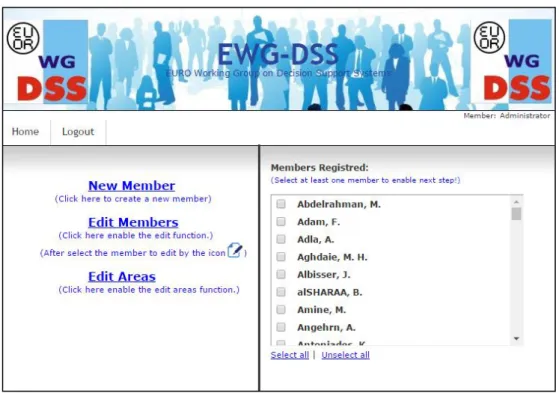
Differently of the affiliated member’s profile, the administrator profile is restricted to
some members who are in the coordination board of the EWG-DSS group. The system
login is allowed by a required token that must be filled when the member selecting “As
administrator” as the access system option. Once logged as administrator profile, the
member may manage all registered members; editing members profile information,
create a new, edit or remove the knowledge areas, and register a new member.
Furthermore, the administrator profile also has the same tools of the affiliated members’
profile, which allows it to run searches of members’ publication information and export
the results via download of that information in Excel format. The Fig. 3 shows the main
screen of administrator profile.
Report
Page 7
Fig. 3. Administrator Profile Screen
As a way to present the navigability in the web-based Collab-Net system, the Fig. 4
shows the flow of both administrator and affiliated members’ profiles when using the
system. It shows from the member login until the possible results of the searches, as
well as all functionalities of the system.
Report
Page 8
3 Conclusion
In this report, we revisited the earlier versions (1 and 2) and describing the new
advances of the Collab-Net project in a current extended version with a web-based
system. Its improvements aim to support the research collaboration network for the
EURO Working Group on DSS on a web-based platform. Some details of this current
version were presented here, including improvement requirements of the Collab-Net
project evolution based on earlier versions, new requirements for data collection
automatically, conceptual entity-relationship model to support data storage locally,
technologies used in the software development process, and main features and
functionalities of the web-based platform. These last improvements carried out by the
current version of Collab-Net project provides to DSS community in Europe with more
accurate and up-to-date information about research projects and co-authorships
automatically from the data stored in google scholar. Furthermore, it also provides an
interactive environment, which encourages the affiliated members in generating better
future collaboration opportunities.
In terms of future work, new features still need to be implemented in the web-based
platform and will be focused in the future versions. Although the present platform
brings a new perspective of the collaboration analysis, its focus is on the acquisition and
extraction process in one publication database. Therefore, a new version could develop
new features, such as: mechanisms to filter and transform the collected data; support the
data collection process in more than one publication database; provide an
intra-communication mechanism to encourage members to interacting via the available
web-based platform; enable the sending of invitation to affiliation; and
offer an environment
to proceed the network analysis with textual and graphical information about the nodes
connections of own member or other member network.
To proceed with the planned and pending developments, the EWG-DSS Coordination
Board needs the support of all researchers within the group and the DSS Community,
via their participation in access the Collab-Net web-based platform by the link
www.collab-net.com. After access the system, selecting the option “As member” and
fill in the requested field with the email registered EWG-DSS database. Their
constructive feedback and help are fundamental as development force.
References
1. Sun, S., Manson, S.: Social network analysis of the academic GIScience
community. The Professional Geographer 63(1), 18–33 (2011)
2. Newman, M.E.J.: The structure and function of complex networks. SIAM Review
45(2), 167–256 (2003)
3. Freeman, F.: Visualizing social networks. Journal of Social Structure 1(1) (2000)
4. Newman, M.E.J.: Scientific collaboration networks. II. Shortest paths, weighted
networks, and centrality. Physical Review E 64, 016132 (2001)
5. Shi, Q., Xu, B., Xu, X., Xiao, Y., Wang, W., Wang, H.: Diversity of social ties in
scientific collaboration networks. Physica A 390, 4627–4635 (2011)
6. Newman, M.E.J.: Scientific collaboration networks. I. Network construction and
fundamental result. Physical Review E 64, 016131 (2001)
Report
Page 9
7. Dargam, F., Delibasic, B., Hernandez, J., Liu, S., Ribeiro, R., Zarate, P.: Editorial
on Decision Systems. In: Proceedings of the EWG-DSS London 2011 Workshop,
London, UK, IRIT Research Report: RR–2011-14—FR. Université Paul Sabatier
(June 2011)
8. Dargam, F., Delibasic, B., Hernandez, J., Liu, S., Ribeiro, R., Zarate, P.: Editorial
on Policy Analytics and Collaborative Decision Making. In: Proceedings of the
EWG-DSS/DASIG Joint-Workshop, IRIT, Research Report IRIT/RR–2011-21-FR,
Université Paul Sabatier (November-December 2011)
9. Hernández, J.E., Zarate, P., Dargam, F., Delibašić, B., Liu, S., Ribeiro, R. (eds.):
EWGDSS 2011. LNBIP, vol. 121. Springer, Heidelberg (2012)
10. Dargam, F., Delibasic, B., Hernandez, J., Liu, S., Ribeiro, R., Zarate, P.: Editorial
on Decision Support Systems & Operations Management Trends and Solutions in
Industries. In: Proceedings of the EWG-DSS 2012 Liverpool Workshop (April
2012) ISBN: 978-09561122-4-8
11. Dargam, F., Delibasic, B., Hernandez, J., Liu, S.: Special Issue on Networking
Decision Making and Negotiation (Part 1). International Journal of Decision
Support System Technology, IJDSST 4(2) (2012)
12. Dargam, F., Delibasic, B., Hernandez, J., Liu, S.: Special Issue on Networking
Decision Making and Negotiation (Part 2). International Journal of Decision
Support System Technology, IJDSST 4(3) (2012)
13. Papathanasiou, J., Liu, S., Zaraté, P.: Special Issue on Collaborative Decision
Support Systems. The International Journal of Information and Decision Sciences,
IJIDS (2012)
14. Ribeiro, R.A., Moreira, A.M., Broek, P.V.D., Pimentel, A.: Hybrid Assessment
Method for Software Engineering Decisions. Decision Support Systems 51, 208–
219 (2011)
15. Hernández, J.E., Mula, J., Poler, R., Pavón, J.: A multi-agent negotiation based
model to support the collaborative supply chain planning process. Studies in
Informatics and Control 20(1), 43–54 (2011)
Report
Page 10
Annex
Collab-Net v3
Report
Page 11
1 [email protected] Andrew Lyons University of Liverpool, UK
2 [email protected] A. Boza
Centro de Investigación de Gestión e Ingeniería de la Producción (CIGIP), Universitat Politècnica de València, Spain 3 [email protected] Adiel Almeida Filho Universidade Federal de Pernambuco, Brazil
4 [email protected] Abdelkader Adla Oran University, Algeria
5 [email protected] Athi Salo Aalto University, Department of Mathematics and Systems Analysis, Finland
6 [email protected] Antonio Jimenez
Martinez Univ. Politécnica de Madrid, Spain
7 [email protected] Antonio Rodrigues University of Lisbon, Portugal
8 [email protected] Albert Angehrn INSEAD, France
9 [email protected] Alessio Ishizaka University of Portsmouth, UK
10 [email protected] Alex Zabeo Università Ca' Foscari Venezia, Italy
11 alexandre.gachet@assentis.
com Alexandre Gachet Assentis Tech. AG, Fribourg, Switzerland
uk Ali Alkhuraiji Universiyt of Plymouth, UK
13 [email protected] Adiel Almeida Universidade Federal de Pernambuco, Brazil
14 [email protected] Arnaud Martin IRIT Toulouse, France
15 [email protected] Amin Karami University of Buffalo, New York, USA
16 [email protected] Ahmed Musa University of Central Lancashire, UK
17 [email protected] Ana Isabel Barros Netherlands Defence Academy & TNO Defense, Security & Safety, Netherlands
18 [email protected] Anat Goldstein Tel Aviv University, Israel
19 [email protected] Andre Branco Entrepreneur, Rio de Janeiro, Brasil
Report
Page 12
21 [email protected]hofer.de Andrea Zielinski Fraunhofer Institut, Germany
r Andreia Pereira
Federal University Rio de Janeiro UNIRIO, Brazil
23 [email protected] Anna Dabrowska
Digital Enterprise Research Institute, National University of Ireland. Galway,
Ireland
24 [email protected] Anna Zamansky Vienna University of Technology, Austria
25 [email protected] Ana Paula Cabral Universidade Federal de Pernambuco, Brazil
26 [email protected] Arshad Alam Prairie View A&M University, Texas, USA
27 [email protected] Pierre-Emmanuel Arduin LAMSADE, Paris Dauphine University, France
28 arijit.bhattacharya2005@g
mail.com Arijit Bhattacharya Dublin City University, Ireland
29 [email protected] Oglaza Arnaud IRIT Toulouse, France
30 [email protected] Atiyeh Vaezipour Queensland University of Technology, Australia
31 [email protected] Aykan Akincilar Gazi University, Ankara, Turkey
32 [email protected] Aykut Olcer Newcastle University, Newcastle upon Tyne, UK
33 [email protected] Bedour Alrayes Royal Holloway - University of London, UK
34 [email protected] Prabir Bagchi George Washington University, Washington, USA
35 [email protected] Baruch Keren SCE-Shamoon College of Engineering, Israel
36 [email protected] Barbo Back Åbo Akademi University, Turku, Finland
37 [email protected] Beatriz Andrés
Centro de Investigación de Gestión e Ingeniería de la Producción (CIGIP), Universitat Politècnica de València, Spain
Report
Page 13
39 [email protected] Bertrand Mareschal Université Libre Bruxelles, Brussels, Belgium
40 [email protected] Pin-Chen Jiang
Department of Asia-Pacific Industrial and Business Management, National University
of Kaohsiung, Taiwan
41 [email protected] Brian Reddy
National Centre for Pharmacoeconomics, St. James's Hospital, Trinity College Dublin,
Ireland
42 [email protected] Alexander Brodsky Volgenau School of Engineering, George Mason University, Virginia, USA
43 [email protected] Burcu Yılmaz Kaya
Gazi University Faculty of Engineering Industrial Engineering Department, Ankara,
Turkey
44 [email protected] Csaba Csaki Corvinus University of Budapest and University College Cork, Ireland
45 [email protected] Camelia Ram London School of Economics, UK
46 [email protected] Jacques Calmet Karlsruhe University, Germany
47 [email protected] Camelia Dogaru European Commission, Brussels, Belgium
48 [email protected] Guy Camilleri IRIT, Toulouse, France
49 [email protected] Carlos Antunes INESC, Coimbra, Portugal
50 [email protected] Carlos Bana e Costa IST Technical Univ. of Lisbon, Portugal
51 [email protected] Christer Carlsson IAMSR / Åbo Akademi University, Turku, Finland
52 chattopadhyayasis@hotmail
.com Asis Kr. Chattopadhyay Calcuta University, India
53 [email protected] Chi-Cheng Huang Aletheia University, New Taipei City, Taiwan
54
[email protected] Claudia Loebbecke University of Cologne, Germany
55 [email protected] Julien Cotret LIRMM / Normind, France
Report
Page 14
57 [email protected] Dobrila Petrovic Conventry University, UK.br Danielle Morais Federal University of Pernambuco, Brazil
[email protected] Daouda Kamissoko University of Toulouse, France
60 [email protected] David Pérez Perales Polytechnic University of Valencia, Spain
61 [email protected] Boris Delibasic University of Belgrade, Serbia
[email protected] Dorien De Tombe NOSMO, Amsterdam, Netherlands
63 [email protected] D. E Fac. Eng., University of Porto, Portugal
64 [email protected] Dionisios Giannakopoulos Technological Institute of Piraeus, Greece
[email protected] Dirk Kenis PHL University College, Liege, Belgium
66 [email protected] Dragana
Becejski-Vujaklija Fac.Org. Sciences, Univ. Belgrade, Serbia
67 [email protected] Andreas Edelmayer MTA-SZTAKI, Hungarian Academy of Sciences, Hungary
68 [email protected] Eduardo Manuel Natividade Jesus
ISEC, Coimbra Institute of Engineering, Portugal
69 [email protected] m
Edson Felipe Capovilla
Trevisan USP, Sao Paulo, Brazil
70 [email protected] Ertan Güner Industrial Engineering, Gazi University, Ankara, Turkey
71 [email protected] Erol Sahin
Department of Industrial Engineering, Gazi University, Faculty of Engineering, Ankara,
Turkey
72 [email protected] Estelle Van Wyk Industrial and Systems Engineering, University of Pretoria, Pretoria, South Africa
om Fátima Dargam
SimTech Simulation Technology, Graz, Austria
Report
Page 15
74 [email protected] Fernando Crespo Pontificia Universidad Católica de Chile
75 [email protected] Frédreric Adam University College Cork, Ireland
76 [email protected] Fadime Üney- Yükesektepe
İstanbul Kültür University, Department of Industrial Engineering,
Turkey
77 [email protected] Christophe Fagot Normind, Montpellier, France
78 [email protected] Faiez Gargouri Armenia
79 [email protected] Manuel Díaz-Madroñero
Research Centre on Production Management and Engineering, Universitat
Politècnica de València, Spain
80 fenio.annansingh@plymout
h.ac.uk Fenio Annansingh
Business School and Management, Plymouth University, Plymouth, UK
81 [email protected] Frits Claassen WUR - Wageningen Univ. Research Centre, The Netherlands
82 [email protected] Frieder Stolzenburg Hochschule Harz, Germany
83 [email protected] Peter Gelleri Budapest Univ. Tech. Economics, Hungary
84 [email protected] Gennady Fedulov Independent Developer, Georgia
85 [email protected] Gabriela Florescu ICI, Bucharest, Romania
86 [email protected] Gwendolin Geier University of Central Lancashire, UK
.uk Ghada Elkady Plymouth University, Plymouth, UK
88 [email protected] Sahar Ghrab High Institute of Computer Science and Multimedia, Sfax, Tunisia
89
[email protected] Gilles Coppin ENST, Bretagne, France
ac.uk Guilan Kong MBS, University of Manchester, UK
Report
Page 16
92 [email protected] Giovanni KingGökhan Kaya
Ekin Technology, Turkey94
[email protected] Gurvan Uguen ENST, Bretagne, France
95 [email protected] Gloria Wren Loyola College, University of Maryland, USA
96 [email protected] Harney Owen ??
97 [email protected] Hossein Attari Management school, University of Liverpool, UK
98 [email protected] Hoong Chin Lau Singapore Management University, Singapore
99 [email protected] Hacer Guner Goren Department of Industrial Engineering, Pamukkale University, Denizli, Turkey
100 [email protected] Hojat Mianabadi
[email protected] Hossam Ismail University of Liverpool, UK
102 [email protected] Hamidreza Soltani University of Central Lancashire, UK
103 [email protected] J. Darzentas University of Aegean, Greece
104 [email protected] Isabel L. Nunes
UNIDEMI, Dept. Mechanical and Industrial Eng.,
Campus da FCT/UNL, Portugal
105 [email protected] Inès Saad Univ. of Picardie Jules Verne, France
k Irina Neaga
Graduate School of Management & Plymouth Business School, Plymouth
University, UK.
e Isabelle Linden University of Namur, Liége, Belgium
108 [email protected] Zhong Yao School of Economics and Management, Beihang University, Beijing, China
Report
Page 17
109 [email protected] Ilya Ashikhmin Cork Constraint Comp. Centre, Ireland
.uk Jorge E. Hernández University of Liverpool, UK
111 [email protected] Kwakkel Jan Technical University of Delft, Delft, Netherlands
112 [email protected] Jason Papathanasiou University of Macedonia, Greece
113 [email protected] jorge.industrial@gmail
Jorge Esteban Hernández
Hormazábal University of Valencia, Spain
[email protected] Jean Dezert Onera, France
115
[email protected] Jean-Marc Tacnet. Cemagref, France
116 [email protected] Tawfik Jelassi Ecole des Ponts Business School, ENPC, France
117 [email protected] Jeremy Forth Imperial College, London, UK
118 [email protected] Jorge Freire de Souza Engineering University of Porto, Portugal
119 [email protected] Jiang Pan Plymouth University, Plymouth, UK
120
[email protected] jonathan.moizer@plymouth
.ac.uk
Jonathan Moizer Plymouth University, Plymouth, UK
121 [email protected] Joao Lourenço IST, Technical University of Lisbon, Portugal
122 [email protected] Joao Soares IST, Technical University of Lisbon, Portugal
123 Johannes.gettinger@tuwien
.ac.at Johannes Gettinger Vienna University of Technology, Austria
124 [email protected] Johannes Leitner OR Institute, University of Graz, Austria
125 [email protected] Jonatas A de Almeida Universidade Federal de Pernambuco (UFPE), Brazil
Report
Page 18
127 [email protected]m José Merigo Portugal
128 [email protected] Jean Pierre Brans Vrije Universiteit Brussel, Belgium
129 [email protected] Jorge Pinho de Sousa Institute for Systems and Computer Engineering of Porto, Portugal
130 [email protected] Julien Maheut Universitat Politècnica de Valéncia, Spain
u.au Kristian Rotaru Monash University, Australia
132 [email protected] Kostas Vergidis University of Macedonia, Thessaloniki, Greece
133 [email protected] Li Ching Ma National United University, Taiwan
134 [email protected] Luis Cândido Dias INESC, Coimbra, Portugal
135 [email protected] Lehner University of Passau, Germany
136 [email protected] Maria Leonilde R. Varela University of Minho, Portugal
137 [email protected] Ting Lin Lee National University of Kaohsiung, Taiwan
138 [email protected] Ljiljana Kašćelan University of Montenegro/Faculty of Economics, Montenegro
139 [email protected] Lourdes Canos University of Valencia, Spain
140 [email protected] Ladislav Lukas University of West Bohemia, Czech Republic
141 [email protected] Markku Heikkilä IAMSR / Åbo Akademi University, Turku, Finland
142 mahmoud.abdelrahman@m
bs.ac.uk Mahmoud Abdelrahman University of Manchester, UK
143 [email protected] María Del Mar Alemany
Díaz University of Valencia, Spain
144 margaretha.gansterer@univ
ie.ac.at Margaretha Gansterer University of Vienna, Austria
Report
Page 19
m146 [email protected] Maria Litsardaia TEI of Piraeus, Greece
147 [email protected] Marija Jankovic Ecole Central Paris, France
148 [email protected] Marko Bohannec Jožef Stefan Institute, Slovenia
149 [email protected] Marta Gomes IST, Technical University of Lisbon, Portugal
m Martin Arnaud ?? France
151 [email protected] Michael Bruhn Barfod Technical University of Denmark, Denmark
152
[email protected] Miklos Biro Corvinus University of Budapest, Hungary
153 [email protected] Carlo Meloni Dept. Eletrotecnic & Electronics, Politecnico di Bari, Italy
154 [email protected] Matthias Meckel University of Central Lancashire, UK
155 [email protected] Metin Dagdeviren Gazi University. Ankara, Turkey
156 michael.filzmoser@tuwien.
ac.at Michael Filzmoser Vienna University of Technology, Austria
e Michael Hogan
National University of Ireland Galway, Ireland
158 [email protected] Miguel Covas Portugal Telecom, Portugal
s Milos Jovanovic University of Belgrade, Serbia
160 [email protected] A. Mirakyan Karlsruhe, Germany
161 [email protected] Miguel Lejeune George Washington University, USA
162 [email protected] Mariam Nouh Center for Complex. Engineering Systems at. KACST and MIT, USA
Report
Page 20
164 [email protected] Jose Maria MorenoJimenez Zaragoza University, Spain
165 [email protected] Mr.Zouky
166 [email protected] Maria Jose Verdecho University of Valencia, Spain
167 [email protected] Maria Theiner University of Salzburg, Austria
168 [email protected] M. Amine France
169 [email protected].
uk Nadia Papamichail University of Manchester, UK
170 natalio.krasnogor@nottingh
am.ac.uk Natalio Krasnogor University of Nottingham, UK
171 [email protected] N. Egge George Mason University, Virginia, USA
172 [email protected] Nikolaos F. Matsatsinis Technical University of Crete, Greece
173 [email protected] Nikos Tsotsolas University of Piraeus, Greece
174
[email protected] Olaf Herden
Duale Hochschule Baden-Württemberg, Stuttgart, Germany
175 [email protected] Orlando Belo University of Minho, Portugal
176 [email protected] Odabasi A. Yucel Istanbul Technic University, Turkey
177 [email protected] Osman Kulak Pamukkale University,Turkey
178 [email protected] Dan O'Leary University of Southern California, USA
179
Pascale Zaraté IRIT, University of Toulouse, France
180 [email protected] Pavlos Delias Eastern Macedonia and Thrace Institute of Technology, Kavala, Greece
181 [email protected] Peter Keenan University College Dublin, Ireland
182 [email protected] Philip Powel School of Business, Economics and Informatics
Report
Page 21
Birkbeck, University of London, UK183
[email protected] Philippe Lenca Telecom Bretagne, France
184
[email protected] Philippe Marrast Université Toulouse 3 Paul Sabatier, France
185 [email protected] Pierre Kunsch University Libre Bruxelles, Brussels, Belgium
186 [email protected].
fr Suzanne Pinson LAMSADE, Univ.Paris-Dauphine, France
187 [email protected] Niko Ploskas University of Macedonia, Thessaloniki, Greece
188 [email protected] Persefoni Polychronidou Eastern Macedonia and Thrace Institute of Technology, Kavala, Greece
189 [email protected] Patricia Xufre ISEGI — Universidade Nova de Lisboa, Portugal
190 [email protected] Rahma Bouaziz IRIT, Toulouse, France
m Ramiro Sanchez Lopez Best Balances y Estudios, Madrid, Spain
m Paulo Ramos Florianópolis, Brazil
193 [email protected] Rita Ribeiro UNINOVA – CA3, Lisbon, Portugal
194 [email protected] Rui Carlos Botter Escola Politécnica da USP, Sao Paulo, Brazil
195 [email protected] Renate Tippler University of Salzburg, Austria
196 [email protected] Ana Respício University of Lisbon, Portugal
197 [email protected] Ricardo Mateus Consultancy, Portugal
198 [email protected] George Rigopoulos National Technical University of Athens, Greece
199 [email protected] Robert Stratton King's College London, UK
Report
Page 22
201 [email protected] Renato Rocha Souza Fundação Getulio Vargas (EMAp), Brazil
202 [email protected].
at Rudolf Vetschera University of Vienna, Austria
203 [email protected].
uk Zainab Dangana Plymouth University, UK
204 [email protected] Sarah Tuck Plymouth University, UK
205 [email protected] Santiago Arango Universidad Nacional de Colombia, Colombia
206 [email protected] e.fr
Camille Rosenthal
Sabroux LAMSADE, Univ.Paris-Dauphine, France
207 [email protected] Sahar Karimi Edge Hill University, Ormskirk, Lancashire, UK
208 [email protected] Nikolaos Samaras University of Macedonia, Thessaloniki, Greece
209 [email protected] Antonio Carlos Saraiva
Branco Fundação Getulio Vargas (EMAp), Brazil
210 [email protected] Sarma Yadavalli University of Pretoria, South Africa
211 [email protected] Michael Schneider
Business Information Systems and Operations Research, University of
Kaiserslautern, Germany
212 [email protected] Susan M Farley George Mason University, Virginia, USA
213 [email protected] Suzana de Suzana Dantas
Daher Federal University of. Pernambuco, Brazil
214 [email protected].
uk Shaofeng Liu University of Plymouth, UK
215 [email protected] Hossein Sharifi University of Liverpool, UK
216 simon.d.turner@magnoxsit
es.com Simon Turner
Magnox Limited, Berkeley, Gloucestershire, UK
217 [email protected] Efstratios S. Livanis University of Macedonia, Thessaloniki, Greece
Report
Page 23
218 [email protected] Susanne Stadler University of Salzburg, Austria219 [email protected] Frantisek Sudzina Copenhagen Business School, Denmark
220 [email protected] Stavros Valsamidis Eastern Macedonia and Thrace Institute of Technology, Kavala, Greece
n Wei Sun
Beijing University of Technology, Beijing, China
222 [email protected] Sanja Petrovic University of Nottingham, UK
[email protected] Nora Taghezout Oran 1 University, Algeria
224 [email protected] Thiago Barros Brito USP University of Sao Paulo, Brazil
225 [email protected] Tina Comes University of Agder, Norway
wice.pl Tomasz Wachowicz University of Economics in Katowice, Poland
227 [email protected] Toms Reizinsh Ventspils University College, Latvia
228 [email protected] Maria Theiner University of Salzburg, Austria
229 [email protected] Thomas Soboll University of Salzburg, Austria
e.fr Alexis Tsoukias CNRS, Paris, France
231 [email protected] Thanasis Spyridakos Technological Educational Institute of Piraeus, Grece
232 [email protected] Alberto Turón Lanuza University of Zaragoza, Spain
233 uchitha.jayawickrama@ply
mouth.ac.uk Uchitha Jayawickrama University of Plymouth, UK
ts.it Valentina Boschian
Dept. of Industrial Engineering and Information Technology, Polytechnic of Bari,
Italy
Report
Page 24
236 [email protected] Warren E. Walker Technical University of Delft, Netherlands
237 [email protected] Wei Xu University of Plymouth, UK
238 [email protected] Wenjuan Zhang Warwick Business School, UK
239
[email protected] Xavier Gandibleux University of Nantes, France
240 [email protected] Xiaojun Wang University of Bristol, UK
241 [email protected] Xiaoliang Fan Lanzhou University, China
242 [email protected] Yuly Andrea Arboleda Valencia
Universidad Nacional de Colombia, Colombia
243 [email protected] Boris Yatsalo Obninsk Inst. of Nuclear Power Eng., Russia
244 [email protected] Yi Yang Karlsruhe University, Germany
245 [email protected] Yossi Hadad Industrial Engineering and Management, SCE - Shamoon College of Engineering, Israel
.fr Youssef Tlili
IRSTEA-Engees, University of Strasbourg, France
247 [email protected] Zarghaami
248 [email protected] Constantin Bala Zamfirescu
Univ. of Sibiu, Faculty of Engineering, Department of Computer Science and Automatic Control, Sibiu, Romania
249 [email protected] Zohar Laslo Industrial Engineering and Management, SCE- Shamoon College of Engineering, Israel