1
Tidally-induced variations of pH
1
at the head of the Laurentian Channel
2 3
Alfonso Mucci1, Maurice Levasseur2, Yves Gratton3, Chloé Martias1, Michael Scarratt4, 4
Denis Gilbert4, Jean-Éric Tremblay2, Gustavo Ferreyra5 and Bruno Lansard6 5
1- GEOTOP and Department of Earth and Planetary Sciences, McGill University, 3450 6
University Street, Montréal, QC, Canada H3A 0E8 7
2- Québec-Océan and Département de Biologie, Université Laval, 1045 Avenue de la 8
Médecine, Québec, QC, Canada G1V 2R3 9
3- Institut national de la Recherche Scientifique, Eau Terre et Environnement, 490 rue de la 10
Couronne, Québec, QC, Canada G1K 9A9 11
4- Fisheries and Ocean Canada, Maurice Lamontagne Institute, 850 Route de la Mer, Mont-12
Joli, QC, Canada QC G5H 3Z4 13
5- Québec-Océans et Institut des Sciences de la Mer de Rimouski, 310 Allée des Ursulines, 14
Rimouski, QC, Canada G5L 3A1 15
6- Laboratoire des Sciences du Climat et de l’Environnement, avenue de la Terrasse, 16
domaine du CNRS, bât. 12, 91198, Gif-sur-Yvette, France 17
18
ABSTRACT 19
The head of the Laurentian Channel (LC) is a very dynamic region of exceptional 20
biological richness. To evaluate the impact of freshwater discharge, tidal mixing, and biological 21
activity on the pH of surface waters in this region, a suite of physical and chemical variables was 22
measured throughout the water column over two tidal cycles. The relative contributions to the 23
water column of the four source-water types that converge in this region were evaluated using an 24
optimum multi-parameter algorithm (OMP). Results of the OMP analysis were used to reconstruct 25
the water column properties assuming conservative mixing, and the difference between the model 26
properties and field measurements served to identify factors that control the pH of the surface 27
waters. These surface waters are generally undersaturated with respect to aragonite, mostly due to 28
Can. J. Fish. Aquat. Sci. Downloaded from www.nrcresearchpress.com by GOTEBORGS UNIV on 09/20/17
2 the intrusion of waters from the Upper St. Lawrence Estuary and the Saguenay Fjord. The presence 29
of a cold intermediate layer impedes the upwelling of the deeper, hypoxic, lower pH and aragonite-30
undersaturated waters of the Lower St. Lawrence Estuary to depths shallower than 50 meters. 31
32
RÉSUMÉ 33
La tête du chenal Laurentien est une région très dynamique d’une richesse biologique 34
exceptionnelle. Afin d’évaluer l’impact des apports en eaux douces, du mélange tidal, et de 35
l’activité biologique sur le pH des eaux de surface dans cette région, une suite de variables 36
physiques et chimiques a été mesurée dans la colonne d’eau sur deux cycles de marée. La 37
contribution relative des quatre sources d’eau-type qui convergent dans cette région a été évaluée 38
à l’aide d’un algorithme d’optimisation multi-paramétrique (OMP). Les résultats de l’OMP ont été 39
utilisés pour reconstruire les propriétés de la colonne d’eau en assumant un mélange conservateur 40
et la différence entre les propriétés issues du modèle et des mesures effectuées sur le terrain ont 41
servies à identifier les facteurs qui contrôlent le pH des eaux de surface. Les eaux de surface sont 42
généralement sous-saturées par rapport à l’aragonite, surtout à cause de l’intrusion d’eau provenant 43
de l’estuaire fluvial du Saint-Laurent et du fjord du Saguenay. La présence de la couche 44
intermédiaire froide (CIF) durant les marées de morte-eau tamponne l’acidification des eaux de 45
surface dans cette région de l’estuaire. La présence d’une couche intermédiaire froide limite la 46
remontée des eaux profondes, hypoxiques, de faible pH et sous-saturées par rapport à l’aragonite 47
de l’estuaire maritime du Saint-Laurent à des profondeurs de moins de 50 mètres. 48
49
50
Can. J. Fish. Aquat. Sci. Downloaded from www.nrcresearchpress.com by GOTEBORGS UNIV on 09/20/17
3 INTRODUCTION
51
The oceans have absorbed approximately 30% of the anthropogenic CO2 released to the 52
atmosphere since the beginning of the industrial revolution (Sabine et al. 2004). Consequently, 53
over the last century, the pH of the global ocean surface has decreased by an estimated 0.1 unit, 54
equivalent to a 30% increase in the proton concentration (Caldeira and Wickett 2005). The 55
increased acidity has lowered the saturation state of ocean waters with respect to calcite and 56
aragonite (the two most common CaCO3 polymorphs that constitute the shells and skeleton of 57
many marine organisms) and, in combination with other stresses such as global warming, likely 58
affected the ecology of carbonate-secreting organisms (Fabry et al. 2008, Miller et al. 2009; Ries 59
et al. 2009; Kroeker et al. 2013) as well as non-calcifiers because pH plays a critical role in 60
mediating many physiological processes (Fabry et al. 2008; Kroeker et al. 2013). 61
The pH of surface waters in coastal systems is controlled by more dynamic processes than 62
in the open ocean. In these systems, the pH of surface waters may exhibit important short (hours) 63
and long (season) term variations in response to freshwater inputs and vertical mixing (Abril et al. 64
2000; Feely et al. 2010). Freshwater rivers and inner estuaries are typically supersaturated in CO2 65
with respect to the atmosphere (Meybeck 1993; Raymond et al. 1997; Barth et al. 1999; Bauer et 66
al. 2013; Dinauer and Mucci 2017) as a result of inputs from their drainage basin and the activity 67
of heterotrophic organisms sustained by natural or anthropogenic terrestrial and riverine organic 68
carbon inputs (Frankinouille et al. 1996, 1998; Feely et al. 2010). Consequently, waters are often 69
characterized by circum-neutral to slightly acidic pHs (Wallace et al. 2014) and are a net source 70
of CO2 to the atmosphere (see compilation in Chen and Borges 2009). The high primary 71
productivity characterizing estuarine systems, in combination with their deep-water circulation, 72
favor the accumulation of respiratory CO2 at depth in stratified estuaries and a further decrease in 73
Can. J. Fish. Aquat. Sci. Downloaded from www.nrcresearchpress.com by GOTEBORGS UNIV on 09/20/17
4 pH (Taguchi et al. 2010; Cai et al. 2011; Mucci et al. 2011, Wallace et al. 2014; Hagens et al. 74
2015). In urbanized areas, this phenomenon can be exacerbated by eutrophication (Borges and 75
Gypens 2010; Sunda and Cai 2012; Melzner et al. 2013). Since variations in pH in coastal waters 76
are typically recurrent and of greater amplitude than those observed in the open ocean, one could 77
surmise that the estuarine biota will be more resilient to pH fluctuations than open ocean biota. In 78
order to evaluate the risk posed by ocean acidification on marine organisms in coastal systems, it 79
is thus essential to know the chemical properties of source waters, the relative contribution of each 80
to the coastal waters and their temporal variations. This knowledge is also required in order to 81
develop realistic experimental protocols to assess the sensitivity of estuarine organisms to ocean 82
acidification. 83
84
The head of the Laurentian Channel at the western limit of the Lower St. Lawrence Estuary 85
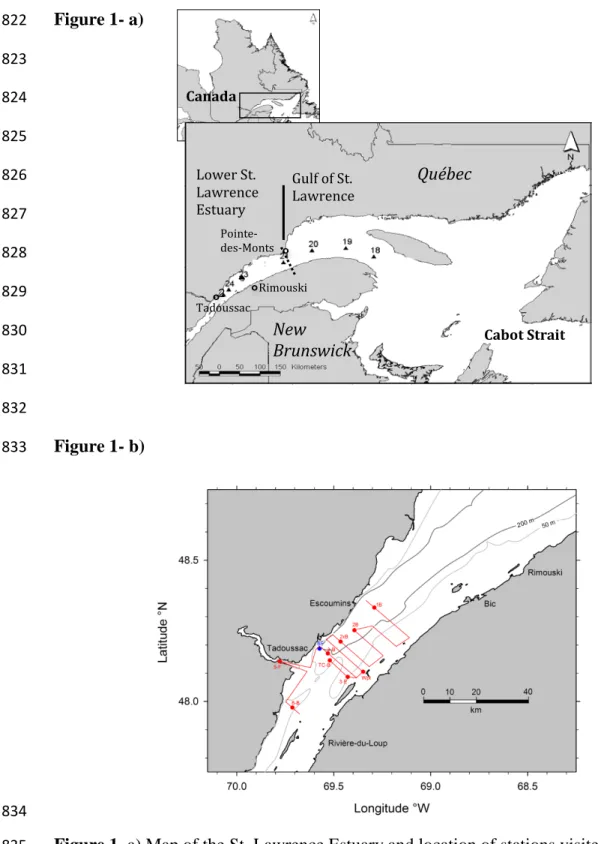
(LSLE, Figure 1) is one of the most dynamic regions of the St. Lawrence Estuary. Here, complex 86
tidal phenomena due to rapid shoaling (tidal movements, including internal tides and strong flows 87
over the steep entrance sill) generate significant mixing of near-surface waters with the deeper 88
saline waters, resulting in a nutrient-rich surface layer that sustains the feeding habitat of several 89
large marine mammals. Four different water masses converge at this location: the brackish surface 90
waters of the Upper St. Lawrence Estuary (USLE), the brackish surface waters discharged at the 91
mouth of the Saguenay Fjord, the cold intermediate layer (CIL) waters of the LSLE and the 92
hypoxic bottom waters of the LSLE (Mucci et al. 2011). With the exception of the Saguenay River 93
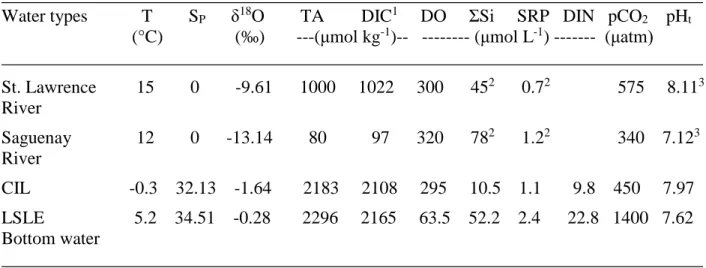
waters, the other water masses are supersaturated in CO2 with respect to the atmosphere (Table 1), 94
the supersaturation having been acquired from their tributaries and/or the accumulation of 95
metabolic CO2 from microbial respiration of autochtonous or allochthonous organic matter (Yang 96
Can. J. Fish. Aquat. Sci. Downloaded from www.nrcresearchpress.com by GOTEBORGS UNIV on 09/20/17
5 et al. 1996; Barth et al. 1999; Wang and Veizer 2000). The objective of this study was to assess 97
how the confluence and mixing of these different water masses affect the chemical and biological 98
properties of the surface waters over two tidal cycles at a fixed station at the head of the Laurentian 99
Channel. After identifying the properties of the individual end-member water-mass types, we 100
estimated the relative contribution of each water-mass type to the surface waters at the fixed station 101
by solving for a set of linear equations for conservative and non-conservative properties. A 102
reconstruction of the water column properties at the fixed station and a comparison with field 103
measurements are used to identify factors that control the pH of surface waters in this region over 104
the study period. 105
106
Study Site:
107
The St. Lawrence Estuary
108
The St. Lawrence Estuary (SLE) receives the second largest freshwater discharge (11900 m3 109
s-1) in North America (El-Sabh and Silverberg 1990). It begins at the landward limit of the salt 110
intrusion near Ile d’Orléans and extends 400 km seaward to Pointe-des-Monts and the Gulf of St. 111
Lawrence (GSL), a semi-enclosed sea connected to the Atlantic Ocean via Cabot Strait and the 112
Strait of Belle-Isle (Fig. 1). The Upper St. Lawrence Estuary (USLE) is the relatively shallow, well 113
mixed, and fully oxygenated transition zone between the mouth of the St. Lawrence River at 114
Quebec City and the marine region (SP≈ 25 and greater) beginning at Tadoussac (Fig. 1). At the 115
transition between the Upper and Lower St. Lawrence Estuary, the water column deepens from 50 116
m to 300 m over less than 20 km, in an area characterized by diverse and complex tidal phenomena 117
(Gratton et al. 1988; Saucier and Chassé 2000). The dominant bathymetric feature of the Lower 118
St. Lawrence Estuary (LSLE) is the Laurentian Channel, a 1240 km long, 250-500 m deep 119
Can. J. Fish. Aquat. Sci. Downloaded from www.nrcresearchpress.com by GOTEBORGS UNIV on 09/20/17
6 submarine valley that extends from the edge of the eastern Canadian continental shelf, through 120
Cabot Strait, to the confluence of the St. Lawrence Estuary and the Saguenay Fjord at Tadoussac. 121
The water column in the LSLE is strongly stratified and, throughout most of the year, is 122
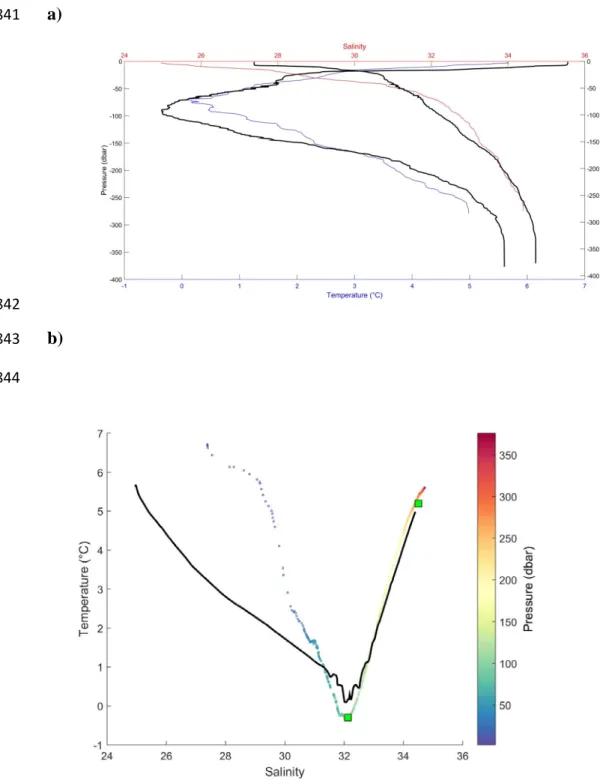
characterized by three distinct layers (Dickie and Trites 1983): (1) a thin surface layer (25-50 m 123
deep) of low salinity (27-32) flowing seaward, (2) an intermediate cold (-1 to 2°C) and saline 124
(31.5-33) layer (CIL) that originates in the Gulf in the winter, extends to about 150 m depth, and 125
flows landward, and (3) a warmer (4-6°C) and saltier (34-34.6) deep layer (150+ m) that flows 126
landward (El-Sabh and Silverberg 1990). Two typical vertical profiles taken at one of our sampling 127
stations, station 1B (Figure 1b: 48°19.8’N, 069°17.4’W; June 11, 2013; 16:48GMT) and at station 128
18 (Figure 1a: 49° 16.0, 064° 16.5; June 7, 2013; 16:01 GMT) are reproduced in Figure 2. The 129
surface layer displays large seasonal variations in temperature and salinity due to atmospheric and 130
buoyancy (i.e., runoff events) forcing. In winter, the surface layer becomes progressively colder 131
and denser, as tributary flow decreases, air temperatures plummet, and ice forms, until it merges 132
with the intermediate layer (Gilbert and Pettigrew 1997; Galbraith 2006). The deep waters are a 133
mixture of Labrador Current and North Atlantic Central waters whose proportions vary on a 134
decadal or secular timescale (Bugden 1991; Gilbert et al. 2005). The transit time of a parcel of 135
water between the seaward end of the Laurentian Channel at the edge of the continental shelf and 136
the head of the Channel at Tadoussac has been estimated at 4 to 7 years (Bugden 1991, Gilbert 137
2004) whereas the mean age of the deep waters of the LSLE is believed to be ~20 years (Mucci et 138
al. 2011). Given the properties of the source waters, benthic and pelagic respiration along the 139
Channel, and their mean age, the bottom waters of the LSLE are hypoxic (<20% oxygen saturation; 140
Gilbert et al. 2005), charged with metabolic CO2 and therefore acidified (Mucci et al. 2011). The 141
landward end of the Laurentian Channel marks the transition from the Lower to the Upper St. 142
Can. J. Fish. Aquat. Sci. Downloaded from www.nrcresearchpress.com by GOTEBORGS UNIV on 09/20/17
7 Lawrence Estuary, the mouth of the Saguenay Fjord, and the marine region (SP≈ 25 and greater) 143
beginning at Tadoussac (Fig. 1). Typical semi-diurnal (M2) tidal current amplitudes in the LSLE 144
are on the order of 0.2 m s-1 (Saucier and Chassé 2000), so that tidal excursions are on the order 145
of 3 km. 146
The Saguenay Fjord
147
The Saguenay Fjord is a 93 km long, 1-6 km wide and 275 m deep U-shaped submerged 148
valley, bounded by sheer, vertical walls that reach up more than 300 m above the water line. 149
Situated approximately 150 km northeast of Quebec City on the north shore of the St. Lawrence 150
Estuary, it connects with the estuary at Tadoussac through a 20-m deep sill. Its bathymetry is 151
defined by three basins separated by two sills at 60 and 120 m depth, located approximately 20 km 152
and 30 km, respectively, from the mouth of the fjord. A short account of its geological history and 153
physiographic features can be found in Schafer et al. (1990) and Locat and Levesque (2009). 154
The water column of the Saguenay Fjord is characterized by a sharp pycnocline that 155
separates two distinct water masses. The thick bottom layer is well-mixed and oxygenated, with 156
waters penetrating landward from the St. Lawrence Estuary as they episodically spill over the sills 157
(Therriault and Lacroix 1977; Siebert et al. 1979; Stacey and Gratton 2001; Bélanger 2003; Belzile 158
et al. 2015). Bottom-water salinities are approximately 30.5 (Mucci et al. 2000), with temperatures 159
ranging from 0.4 to 1.7oC (Fortin and Pelletier 1995). The surface layer consists of brackish waters 160
(SP~0-10) resulting from the turbulent mixing of the outflow from the Saguenay River (and smaller 161
tributaries such as the Valin, Ha! Ha! and Mars Rivers) and the underlying marine waters. The 162
thickness of the surface layer, perhaps best defined by the depth of the 18.00 sigma-tee isopycnal, 163
typically increases towards the mouth of the fjord, but pinches off towards the surface at high tide 164
Can. J. Fish. Aquat. Sci. Downloaded from www.nrcresearchpress.com by GOTEBORGS UNIV on 09/20/17
8 or when denser waters overspill the entrance sill. The surface water temperatures range from 165
freezing in winter to 16ºC in summer (Fortin and Pelletier 1995). Detailed hydrographic 166
characteristics of the fjord can be found in Schafer et al. (1990) and Gratton et al. (1994). 167
Figure 3 shows a 3-day average of sea-surface temperatures derived from satellite data 168
(OGSL 2014). A prominent tongue of cold surface waters due to upwelling and tidal mixing 169
extends from the head of the Laurentian Channel (near Tadoussac) to about Rimouski. Our fixed 170
station is located at the northern edge of this cold tongue. 171
Methods
172
Water column sampling
173
On June 10-15, 2013, we sampled the whole water column at six stations and surface waters 174
(3 – 5 m below the surface) at four stations along a saw-tooth transect at the head of the Lower St. 175
Lawrence Estuary (LSLE), the mouth of the Upper St. Lawrence Estuary (USLE) and the mouth 176
of the Saguenay Fjord (Figure 1). In addition, we sampled the whole water column every four 177
hours and surface waters (~3 m) every two hours over 50 hours at a fixed station (48°11.2’N, 178
69°34.4’W) a few kilometers east of the fjord’s mouth in the northern half of the head of the LSLE 179
in order to characterize changes in the properties of these surfaces waters over two tidal cycles. 180
Finally, the whole water column at four stations (Stations 23, 22, 20, 18) in the LSLE and western 181
Gulf of St. Lawrence was sampled on an earlier cruise (June 3-8, 2013) and these results served to 182
better define the properties of the source-water types encountered at the fixed station (see Water 183
mass analysis section below). Water samples were collected using a 12-Niskin bottle/CTD
184
(SeaBird SBE 911) rosette sampler onboard the R/V Coriolis II. Sampling depths were typically, 185
3, 10, 20, 40, 60, 80, 100, 150 m deep, in addition to 15 m above the bottom.The pH (on the NBS 186
Can. J. Fish. Aquat. Sci. Downloaded from www.nrcresearchpress.com by GOTEBORGS UNIV on 09/20/17
9 scale - pHNBS), dissolved oxygen (DO), temperature and conductivity probes were calibrated by 187
the manufacturer during the winter months preceding the cruise. Nevertheless, discrete samples 188
were taken from the Niskin bottles for laboratory measurements of pH (total proton concentration 189
scale – pHT), DO and salinity and the CTD records re-calibrated post-cruise. Additional surface 190
water samples were collected, on distinct outings, in Chicoutimi (Saguenay River end-member) 191
and near Quebec City (St. Lawrence River end-member) during or within a week of the research 192 cruise. 193 194 Analytical methods 195
Discrete salinity samples taken throughout the water column were analyzed on a Guildline 196
Autosal 8400 salinometer calibrated with IAPSO standard seawater. The instrument has a 197
theoretical accuracy < ± 0.002. Dissolved oxygen (DO) concentrations were determined by 198
Winkler titration (Grasshoff et al. 1999) of water samples recovered from the Niskin bottles. The 199
relative standard deviation, based on replicate analyses of samples recovered from the same Niskin 200
bottle, was better than 1%. These measurements further served to calibrate the SBE-43 oxygen 201
probe mounted on the rosette. 202
Water samples destined for pH and titration alkalinity (TA) measurements were transferred 203
directly from the Niskin bottles to, respectively, 125 mL plastic bottles without headspace and 250 204
mL glass bottles, as soon as the rosette was secured onboard. In the latter case, a few crystals of 205
HgCl2 were added before the bottle was sealed with a ground-glass stopper and Apiezon® Type-206
M high-vacuum grease. 207
Can. J. Fish. Aquat. Sci. Downloaded from www.nrcresearchpress.com by GOTEBORGS UNIV on 09/20/17
10 The pH of the 125 mL samples was determined onboard using a Hewlett-Packard UV-208
Visible diode array spectrophotometer (HP-8453A) and a 5-cm quartz cell after thermal 209
equilibration of the sampling bottles in a constant temperature bath at 25.0±0.1°C. Phenol red 210
(PR; Robert-Baldo et al. 1985) and m-cresol purple (mCP; Clayton and Byrne 1993) were used as 211
indicators. The absorbance at the wavelengths of maximum absorbance of the protonated (HL) 212
and deprotonated (L) indicators were measured and recorded. A similar procedure was carried out 213
several times each day using TRIS buffers prepared at practical salinities (SP) of ~35 and ~25 214
(Millero 1986). The pH on the total proton concentration scale (pHT) of the samples and buffer 215
solutions were calculated according the equation of Byrne (1987). The salinity-dependence of the 216
dissociation constants and molar absorptivities of the indicators were taken from Robert-Baldo et 217
al. (1985) for phenol red and from Clayton and Byrne (1993) for m-cresol purple. The salinity-218
dependence of the phenol red indicator dissociation constant and molar absorptivities was 219
extended (from SP = 5 to 35; Bellis 2002) to encompass the range of salinities encountered in this 220
study, but computed pHTs from the revised fit were not significantly different from those obtained 221
with the relationship provided by Robert-Baldo et al. (1985). All measurements were converted to 222
the total proton scale using the salinity of each sample and the HSO4- association constants given 223
by Dickson (1990). Reproducibility and accuracy of our TRIS buffer measurements were on the 224
order of 0.005 pH units or better. The computed pHTs at 25°C and 1 atmosphere total pressure 225
were then used in combination with the measured TA to calculate the pHTs at the in-situ 226
temperature and pressure using the Microsoft Excel version of CO2SYS (Pierrot et al. 2006), based 227
on the original algorithm of Lewis and Wallace (1998), and the carbonic acid dissociation 228
constants of Cai and Wang (1998), the total boron concentration [B]T value from Uppström (1974), 229
and the standard acidity constant of the HSO4- ion (K(HSO4)) from Dickson (1990). 230
Can. J. Fish. Aquat. Sci. Downloaded from www.nrcresearchpress.com by GOTEBORGS UNIV on 09/20/17
11 The titration alkalinity (TA) was determined at the land-based laboratory within one week 231
of sampling by open-cell automated potentiometric titration (Titrilab 865, Radiometer®) with a pH 232
combination electrode (pHC2001, Red Rod®) and a dilute (~0.025N) HCl titrant. The latter was 233
calibrated against Certified Reference Materials (CRM Batch#94, provided by A. G. Dickson, 234
Scripps Institute of Oceanography, La Jolla, USA). Samples were drawn from the 250 mL sample 235
bottle and weighed on an analytical balance to ± 0.1 mg. The average relative error, based on the 236
average relative standard deviation on replicate standard and sample analyses, was better than 237 0.15%. 238 239 Nutrients 240
Subsamples for nutrient determinations were filtered through a 0.45 µm disposable syringe 241
filter to remove particles. Dissolved NH4+ concentrations were determined immediately onboard 242
with the fluorometric method described by Holmes et al. (1999), with a detection limit of 0.01 µM. 243
For nitrate, nitrite, soluble reactive phosphorus (SRP) and soluble reactive silicon (SRS), filtered 244
samples were collected into acid-washed 15-ml polyethylene tubes and quickly frozen and stored 245
at -20°C. Back at home laboratory, frozen samples were rapidly thawed and concentrations of 246
inorganic nutrients were determined using the routine colorimetric method adapted from Hansen 247
and Koroleff (2007) with a Bran and Luebbe Autoanalyzer III. The analytical detection limit was 248
0.02 µM for nitrite, 0.04 µM for nitrate+nitrite (hereafter dissolved inorganic nitrogen, DIN), 0.05 249
µM for SRP and 0.1 µM for silicate. 250
251
Can. J. Fish. Aquat. Sci. Downloaded from www.nrcresearchpress.com by GOTEBORGS UNIV on 09/20/17
12
Isotopic composition
252
Water samples for isotopic analysis were collected in 13 mL screw-top plastic test tubes. 253
The stable oxygen isotopic composition (δ18O) of the water samples was analyzed at the GEOTOP-254
UQAM stable isotope laboratory. 200-μL aliquots of the water samples and two laboratory internal 255
reference waters were transferred into 3-mL vials stoppered with a septum cap. The vials were 256
then placed in a heated rack maintained at 40°C. Commercially available CO2 gas was introduced 257
in all the vials using a Micromass AquaPrep and allowed to equilibrate for 7 hours. The headspace 258
CO2 was then sampled by the Micromass AquaPrep, dried on a -80°C water trap, and analyzed on 259
a Micromass Isoprime universal triple collector isotope ratio mass spectrometer in dual inlet mode. 260
Data were normalized against the two internal reference waters, both calibrated against V-SMOW 261
and V-SLAP. Data are expressed in ‰ with respect to V-SMOW, and the average relative standard 262
deviation on replicate measurements of sample waters is better than 0.05‰. 263
264
Water mass analysis
265
The water mass analysis was performed using the optimum multi-parameter algorithm 266
(OMP) of Karsteen and Tomczak (1999), originally developed by Tomczak (1981). OMP analysis 267
is based on a simple model of linear mixing. It assumes that all water mass properties undergo the 268
same mixing process, i.e. their mixing coefficients are identical, as is the case in turbulent mixing. 269
The spatial water mass distribution can therefore be determined through a linear set of mixing 270
equations. OMP determines the contributions of pre-defined end-member water masses (so called 271
source-water types or SWT) to a sample. The SWT contributions or fractions (Xi) for each data 272
point are obtained by finding the best linear mixing combination in parameter space defined by 273
temperature, salinity, oxygen, total alkalinity and δ18O which minimizes the residuals in a non-274
Can. J. Fish. Aquat. Sci. Downloaded from www.nrcresearchpress.com by GOTEBORGS UNIV on 09/20/17
13 negative least squares analysis. The solution includes two physically realistic constraints: (i) the 275
contributions from all sources must add up to 100%, and (ii) all contributions have to be non-276
negative. 277
Based on the description of the water circulation in the LSLE, four different source-water 278
types contribute to the water column properties at the head of the Laurentian Channel: the 279
freshwaters of the St. Lawrence and Saguenay Rivers, the saline and cold intermediate layer water 280
and the upwelling saline hypoxic bottom water of the LSLE. Even though the properties of the 281
source-water types are variable in both space and time, we use the dataset acquired during this 282
study as well as data acquired a week before on another cruise along a seaward transect through 283
the Lower Estuary and Gulf of St. Lawrence to define the most representative properties for each 284
source-water type (Table 1). This allows the direct comparison of the water mass fractions and 285
their vertical distribution at the time of sampling. Whereas OMP analysis was initially used to 286
distinguish and calculate the relative contributions of each source-water type in a parcel of water 287
using temperature, practical salinity (SP) and nutrient data (Mackas et al. 1987), in this study, we 288
used SP, the titration alkalinity (TA), and δ18O(H2O) as conservative tracers as well as temperature 289
and dissolved O2 (DO) concentrations as non-conservative tracers, to constrain the water mass 290
analysis. Non-conservative tracers should be applied with caution in OMP, because of temporal 291
and spatial variability, particularly in the surface waters. For example, the temperature of the 292
Saguenay River water ranges from 0°C in winter to +16°C in summer whereas the temperature of 293
the St. Lawrence River ranges from 0°C in winter to >20°C in summer. Dissolved O2 concentration 294
was also used as a non-conservative tracer, because it is a function of temperature (e.g. O2 295
solubility increases with decreasing temperature and salinity) and, like ΣSi and SRP, also a 296
function of primary production and biological respiration. Consequently, end-member matrix and 297
Can. J. Fish. Aquat. Sci. Downloaded from www.nrcresearchpress.com by GOTEBORGS UNIV on 09/20/17
14 sample observations were multiplied by a diagonal weight matrix to account for differences in 298
tracer reliability, environmental variability, and precision of the data (Table 2). The error 299
associated with the water mass fraction analysis was estimated to be about ±10% of the fractional 300
values (Macdonald et al. 1989; Lansard et al. 2012). 301
302
Results and discussion
303
Variations of the water properties over two tidal cycles
304 305
Figures 4a-l show time-series of water property profiles from the CTD (1-m resolution) at 306
the fixed station (SF) over two tidal cycles from June 13 to June 15, 2013. Results of the OMP 307
analysis are presented in Figures 5a-d. 308
The tides are very strong in the fixed station region. The impact of tides on the local 309
circulation is described in detail in Saucier and Chassé (2000). Near the SF, the tidal elevation in 310
the channel can be larger than 5 m (unpublished data) at the spring tide. Mertz and Gratton (1990) 311
reported internal oscillations on the order of 40-60 m over a tidal semi-diurnal cycle. Similar 312
oscillations can be observed on Figures 4a,b,c. The cold, upwelled water can reach the surface and 313
be observed flowing downstream as on Figure 3. As observed on this figure, our SF is located at 314
the edge of these cold surface waters. 315
Surface salinities decrease and temperatures increase during ebb tide (Figs. 4a,b), as 316
freshwaters from the Saguenay and the St. Lawrence Rivers, but mostly of the latter (Figs. 5a,b), 317
intrude into the Lower St. Lawrence Estuary (LSLE) and at our fixed station. The intrusion is 318
detectable to depths of about 30 m and accompanied by a slight (less than 0.1 pH unit) decrease in 319
pH (Fig. 4f). Higher salinity, lower temperature and higher pH waters impinge closer to the surface 320
Can. J. Fish. Aquat. Sci. Downloaded from www.nrcresearchpress.com by GOTEBORGS UNIV on 09/20/17
15 during the flood tide whereas patches of low pH waters from the Saguenay Fjord persist at the 321
surface well into flood tide (Figs. 4a,b,f). The former correspond to the upwelling/invasion of the 322
cold intermediate layer (CIL) nearly up to the surface where it accounts for more than 80% of the 323
mixture (Fig. 5c). Temporal variations of the surface-water titration alkalinity (TA) and dissolved 324
inorganic carbon (DIC) concentrations are almost perfectly correlated with those of the salinity 325
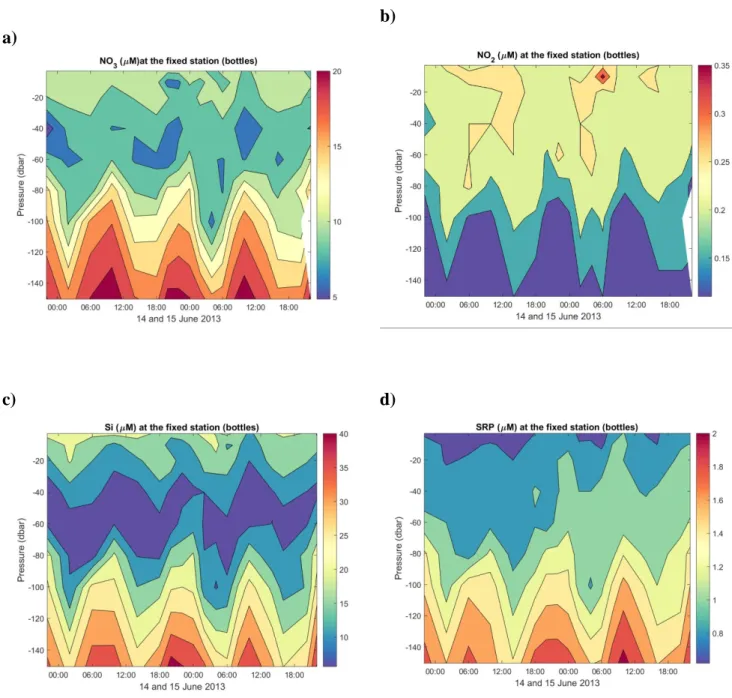
(Figs. 4e,g). Temporal variations of the surface-water major nutrient concentrations are more 326
diffuse, but are nonetheless either correlated (SRP (r2 = 0.63); Fig. S1) or anti-correlated (DIN (r2 327
= 0.46) and ΣSi (r2 = 0.62); Fig. S1) to salinity in the top 3 m, reflecting the differential input from 328
the freshwaters (Saguenay and St. Lawrence Rivers) and the CIL. 329
Irrespective of the tide, dissolved oxygen concentrations remain high (> 260 µM, Fig. 4d) 330
throughout the top 80-100 m of the water column. Likewise, the computed pCO2 in the top 80 m 331
of the water column is slightly supersaturated with respect to the atmosphere (~ 400 µatm) and 332
shows few discernible features, except for a greater pCO2 supersaturation at low tide when the 333
contribution of freshwaters from the St. Lawrence River and Saguenay Fjord, both of which are 334
rich in metabolic CO2 and dissolved silicate (as well as ammonium in the latter case) relative to 335
the CIL, are maximum (Fig. 5a,b). 336
As expected, below 150 m depth, hypoxic bottom waters are dominated by Atlantic waters 337
that enter the Gulf and Estuary through Cabot Strait. These waters intrude to depths as shallow as 338
80 m at high tide (Fig. 5d). 339
340
pH in the surface waters
341 342
Can. J. Fish. Aquat. Sci. Downloaded from www.nrcresearchpress.com by GOTEBORGS UNIV on 09/20/17
16 The pHT of the surface waters (top 3 m) varied from 7.855 to 7.934 during the 50-hour 343
survey, nearly as much as the world’s oceans have experienced as a result anthropogenic CO2 344
uptake over the last century (Caldeira and Wickett 2005). The pHT of surface waters is determined 345
by the relative contribution of the three source-water types (SLW, SRW, and CIL), itself 346
determined in great part by tidal mixing, as well as by gas exchange with the atmosphere, the 347
addition of metabolic CO2 through bacterial respiration and biological uptake of CO2 through 348
photosynthesis. Mucci et al. (2011) reported on the variation of surface-water (0-16 m depth 349
interval) pH over the period 1933-2009 (also limited to the ice-free season) in the Lower St. 350
Lawrence Estuary (LSLE). Unlike the deeper waters that have become hypoxic and acidified, the 351
pH of surface waters shows no systematic variations over this period. Although the intra-annual 352
variability reaches ~0.1 pH unit, the inter-annual variability is nearly null (slope = 0, p > 0.05; i.e., 353
no statistically significant temporal variation). Along the Estuary and Laurentian Channel, pH 354
variations can exceed the intra-annual variability in the LSLE as the salinity and balance between 355
respiration and photosynthetic rates vary (Dinauer and Mucci 2017). 356
357
Throughout the three-day survey, waters in the surface layer (0-3 m) at the sampling sites 358
were always supersaturated in CO2 (443-550 μatm) with respect to the atmosphere at the time of 359
sampling. The saturation state of the surface mixed layer water with respect to aragonite, given by: 360
ΩA = [Ca2+][CO32-]/K*A (1)
361
where K*A is the stoichiometric solubility of aragonite at the in-situ temperature and salinity and 362
1 atmosphere total pressure (Mucci, 1983), varied little during the sampling period and was close 363
to saturation (ΩA = 0.88 to 1.02, 0.95 ± 0.03, n=27, Fig. 6), but fell slightly below saturation (as 364
low as ΩA = 0.88) at low tide. Given the ratio of the stoichiometric solubility constants (K*A/K*C 365
Can. J. Fish. Aquat. Sci. Downloaded from www.nrcresearchpress.com by GOTEBORGS UNIV on 09/20/17
17 = 1.5; Mucci, 1983), the saturation state of the surface waters with respect to calcite was close to 366
1.5. Deeper waters became undersaturated with respect to aragonite below 60-80 m reaching 367
saturations as low as 0.70, but remained supersaturated with respect to calcite to the bottom at the 368
fixed station. 369
370
Validation of the OMP analysis
371 372
Using the results of the OMP analysis and the source-water type properties in Table 1, the 373
total alkalinity (TA), DIC and nutrient concentrations of each discrete water sample at the fixed 374
station was calculated, over the whole time series, assuming conservative mixing (i.e., closed 375
system). These computed values were then used as input parameters into CO2SYS to calculate the 376
pHT of the mixture and results compared to measured values. Differences between the calculated 377
and observed surface waters properties are compiled in Table 3; these reflect changes to the water 378
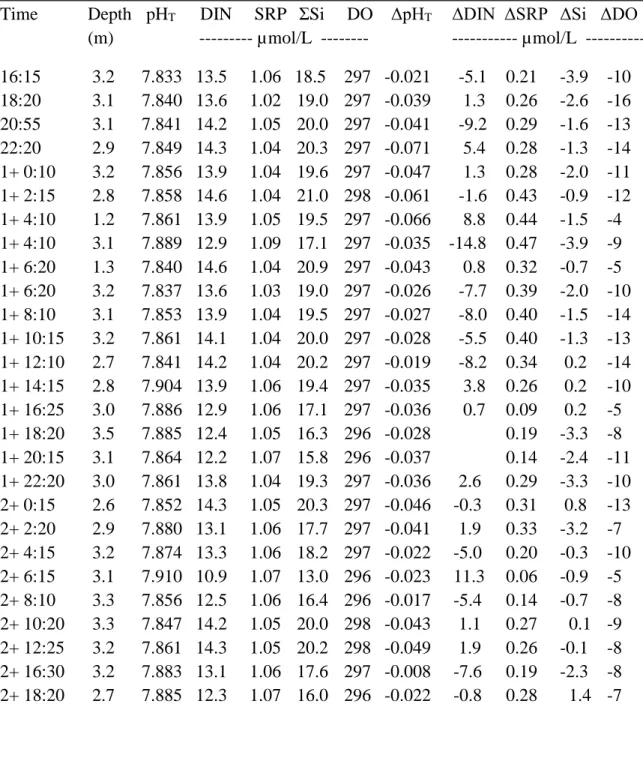
properties beyond those that can be accounted for by mixing of the source waters. The ΔpHcalc-379
meas values (thereafter referred to as ΔpHT) of the surface waters (1-3 m) are all negative (-0.004 380
to -0.066), indicating that either CO2 was lost by ventilation to the atmosphere or taken up by 381
photosynthesis during our observation period. As indicated above, surface waters remained 382
supersaturated with respect to the atmosphere throughout the sampling period and thus served as 383
a net source to the atmosphere. CO2 exchange across the air-sea interface is, however, a slow 384
process, much slower than for oxygen and most other gases (Zeebe and Wolf-Gladrow, 2001), 385
particularly under the low wind conditions (~5-28 knots) experienced during the cruise. Given 386
these wind speeds, the parameterizations of Raymond and Cole (2001) and Wanninkhof (2014) 387
for the gas transfer velocity, an average surface water pCO2 of 499 (± 26 μatm) during the sampling 388
Can. J. Fish. Aquat. Sci. Downloaded from www.nrcresearchpress.com by GOTEBORGS UNIV on 09/20/17
18 period, and a local atmospheric pCO2 of 391 μatm, we estimated the air-sea CO2 efflux (loss of 389
CO2 to the atmosphere) to range between 2.6 and 4.8 mmol m-2 d-1. Over our sampling period, the 390
loss of CO2 to the atmosphere did not affect the DIC budget significantly (less than 1 μmol/kg) 391
and would have increased the surface-water pH by at most 0.003 unit, slightly below the 392
uncertainty of our field measurements. The positive ΔpCO2, ΔDIN and ΔSRP values (net DIC and 393
nutrient uptake) as well as negative ΔDO values (net oxygen production) in the surface waters are 394
clear evidence that photosynthesis (CO2 uptake, pH increase) dominated over respiration (CO2 395
production and pH decrease) and ventilation over the whole sampling period (Table 3). 396
Unfortunately, in the absence of independent estimates of the absolute photosynthetic and/or 397
respiration rates, we can only determine which of these two processes dominates. It is also 398
interesting to note that, despite the large uncertainties in the model and the intrinsic patchiness of 399
our measurements, the average ΔDIN:ΔSRP ratio (11 ± 4) nearly corresponds to the Redfield 400
stoichiometry of 15-16 (Redfield et al. 1963) and the DIN: SRP ratio (12, r2 = 0.79) below 30 m 401
depth in the LSLE. When the surface-water ΔpHT, ΔDIN, ΔSRP, ΔΣSi and ΔDO values are plotted 402
as function of the time of the day, no systematic variation with daylight is apparent (Fig. 7). The 403
study region is known to be an area of high primary productivity, notably during the spring tide 404
periods when upwelling and internal waves amplitude are maximum (Therriault and Levasseur 405
1985, Levasseur and Therriault 1987), but can be strongly suppressed spring fresh-water runoff 406
(Zakardjian et al. 2000). Hence, it is not surprising that we observe net autotrophy in the surface 407
waters but our conservative mixing model is not able to resolve the diurnal cycle of photosynthesis 408
and respiration, likely because it is not sensitive enough. Note that we have not modeled temporal 409
variations of pH below the surface mixed layer (SML) because, as shown in Figure 5, below ~30m, 410
the water column is entirely dominated by two water masses, the CIL between 30 and 50 m and 411
Can. J. Fish. Aquat. Sci. Downloaded from www.nrcresearchpress.com by GOTEBORGS UNIV on 09/20/17
19 Atlantic (deep LSLE) waters below 150 m. In other words, with the exception of the SML, 412
significant variations in water column composition in response to the tide are only found between 413
50 and 150 m. Given that these waters are isolated from the atmosphere (no gas exchange), below 414
the euphotic zone (no photosynthesis), and respiration rates are negligible on the time scale of the 415
experiments, temporal variations are simply due to tidal oscillations. 416
417
Susceptibility of estuarine waters to acidification resulting from direct anthropogenic CO2 uptake 418
419
As noted above, most inner (river-dominated) estuaries are net sources of CO2 to the 420
atmosphere (Cai and Wang 1998; Chen and Borges 2009; Regnier et al. 2013). Their elevated DIC 421
enrichments and pCO2 supersaturations can mainly be attributed to the in situ microbial 422
degradation of internally and externally supplied organic carbon and the lateral transport of 423
inorganic carbon from rivers, coastal wetlands and ground waters (Bauer et al., 2013). Thus, these 424
waters do not directly take up anthropogenic CO2 from the atmosphere. Nonetheless, there have 425
been several reports of weak CO2 uptake by strongly stratified and/or marine-dominated (outer) 426
estuaries (Koné et al. 2009; Maher and Eyre 2012; Cotovicz Jr. et al. 2015), including the Lower 427
St. Lawrence Estuary (Dinauer and Mucci 2017). The resistance of these estuarine waters to a
428
decrease in pH in response to CO2 uptake is equated to a multiple of the carbonate ion
429
concentration ([CO32-]) (Stumm and Morgan 1996), and the latter, within the pH range of most of
430
these (7.5 < pHT <8.1), is approximated by TA – DIC (Broecker and Peng 1982).
431
Variations of the saturation state of waters with respect to aragonite (or calcite) depend
432
on the calcium and carbonate ion concentration product and the mineral solubility under in-situ
433
conditions (Eqn. 1). The [Ca2+] in estuarine waters is determined by the composition and mixing 434
Can. J. Fish. Aquat. Sci. Downloaded from www.nrcresearchpress.com by GOTEBORGS UNIV on 09/20/17
20 ratio of the freshwater and seawater end-members, but given its high and conservative 435
concentration in seawater, the freshwater signature typically becomes indistinguishable (within a 436
1% deviation of the diluted seawater value) from that of seawater above a salinity of ~14. The 437
minimum salinity measured during our survey was 24.82. Hence, the [Ca2+] can accurately be 438
estimated from the measured salinities, i.e., [Ca2+] = SP * 0.01028/35 (Millero 2013). Both [Ca2+] 439
and K*A increase with salinity and to a similar extent (31% and 32.5%, respectively, over the range 440
of salinities encountered during our study), so that ΩA varies almost exactly with the [CO32-]. 441
Hence, again, the impact of CO2 uptake on the saturation state of most marine-dominated estuaries 442
is almost exclusively related to changes in [CO32-] which, as noted above, can be approximated by 443
(TA – DIC).
444 445
Biological response of some local CaCO3-secreting invertebrates to ocean acidification 446
447
Atmospheric CO2 uptake lowers the pH, the carbonate ion concentration and saturation 448
state of natural waters with respect to calcite and aragonite (ΩC and ΩA, respectively).
449
Consequently, the ability of many organisms to calcify is reduced by a decrease in the saturation
450
state of the waters and sediments they inhabit (Gazeau et al. 2013; Clements and Hunt 2017). 451
Aragonite being 50% more soluble than calcite (Mucci, 1981), organisms whose shells or skeletons 452
are partially or wholly aragonitic will be more susceptible to acidification. 453
Aragonite-undersaturated waters (ΩA < 1) dominate the top 20 metres of the water 454
column at the head of the Laurentian Channel except when the CIL intrudes almost up to the 455
surface at high tide. Below the CIL, the aragonite saturation depth (ΩA = 1) oscillates between 40 456
and 90 m reaching the shallowest depths at high tide when these waters are brought closer to the 457
Can. J. Fish. Aquat. Sci. Downloaded from www.nrcresearchpress.com by GOTEBORGS UNIV on 09/20/17
21 surface. Hence, the recruitment, growth, metabolism and survival of calcifying invertebrates and 458
other benthic organisms exposed to these waters could be deleteriously affected (Parker et al. 2012; 459
Gazeau et al. 2010; Talmage et al. 2010; Kuhihara 2008). 460
Commercial harvesting of bivalve shellfish (scallops, soft-shell clams, mussels, Atlantic 461
surf-clams, Atlantic razor clams), echinoids (green sea urchin), and gastropods (common whelk) 462
in Quebec sustains several coastal communities with annual landings in the range of 2.5-4 million 463
dollars (DFO; http://www.qc.dfo-mpo.gc.ca/peches-fisheries/recreative-recreational/mollusque-464
mollusc-eng.asp?p=/peches-fisheries/recreative-recreational/mollusque-mollusc-eng.html). 465
Scallops (e.g., Chlamys islandica), soft-shell clams (e.g., Mya arenaria), the common whelk (e.g., 466
Buccinum undatum) and the green sea urchin (e.g., Stronylocentrotus droebachiensis) are found
467
on the seafloor near the head of the Laurentian Channel and, with the exception of scallops (Hutin 468
et al. 2005), are mostly harvested from no more than 20 m depth (Bernard Saint-Marie, DFO, pers. 469
comm.). Except for the green sea urchin, harvesting of the other species has declined steadily 470
since the beginning of the new millennium and there are currently no active commercial shellfish 471
fisheries in this region while recreational harvesting of scallops is now forbidden. The shells of 472
most bivalves and whelks found in the study area are composed of a combination of calcite and 473
aragonite (micro-) structural components (groups and layers) whereas the body and spines of sea 474
urchins are typically composed of high-magnesium calcite (more soluble than aragonite) and, thus, 475
their constant exposure to the aragonite-undersaturated (corrosive) waters in the top 20 m of the 476
water column and along the shorelines in the vicinity of the study area could possibly have 477
contributed, along with overfishing (Archambault and Goudreau 2006), to their decline. Since the 478
habitat of scallops extends to depths of 80 meters (the largest scallop bed in the vicinity of 479
Tadoussac is situated 5-10 km downstream of Ile Rouge in 40-80 m of water; Hutin et al. 2005), 480
Can. J. Fish. Aquat. Sci. Downloaded from www.nrcresearchpress.com by GOTEBORGS UNIV on 09/20/17
22 this would put them well into the aragonite-undersaturated (corrosive) waters found below the 481
CIL. 482
To our knowledge, no specific study of the impacts of elevated pCO2s (lower pH and 483
ΩA) has been carried out on Chlamys islandica and Buccinum undatum, but studies conducted on 484
other species of scallops and whelk have reported deleterious effects on calcification and growth 485
of the former and the nutritional properties of the latter (Tate et al. 2017; Andersen et al. 2013). 486
Conversely, in addition to lowered calcification rates, the impacts of elevated pCO2 on Mya 487
arenaria were found to extend to their burrowing behavior, post-settlement dispersal (Clements et
488
al. 2016) as well as predator-prey interactions (Glaspie et al. 2017) whereas, in the case of 489
Stronylocentrotus droebachiensis, the effects extend to the fecundity, gonad growth, feeding rates
490
and susceptibility to metal toxicity (Lewis et al. 2016; Dupont et al. 2013; Siikavuopio et al. 2007). 491
Notwithstanding the potential impact of ocean acidification (OA) on the organisms 492
listed above, one should consider that these organisms may have, over time, developed a tolerance 493
or acclimatized to the high-amplitude and high-frequency (diurnal, seasonal) variations of 494
environmental variables (T, S, pH) encountered in dynamic estuaries such as the USLE, as has 495
been demonstrated in long-term exposures to elevated pCO2 (Dupont et al. 2013; Moulin et al. 496
2015; Uthicke et al. 2016). Whereas the above discussion is limited to commercially-harvested 497
CaCO3-secreting benthic organisms, OA may impact on the metabolic activity (e.g., survival, 498
growth, reproduction) of many other organisms, but an expanded discussion of these would be 499
well beyond the scope of this paper given the range of responses documented in the literature (e.g., 500
Doney et al. 2009). 501
502
Can. J. Fish. Aquat. Sci. Downloaded from www.nrcresearchpress.com by GOTEBORGS UNIV on 09/20/17
23 In summary, the pH of surface waters at the head of the Laurentian Channel is modulated 503
by tides and mixing of three source–water types, the relatively high alkalinity (TA) and dissolved 504
inorganic carbon (DIC)-rich water of the St. Lawrence River (TA-DIC <0), the TA and DIC-poor 505
water of the Saguenay River (TA-DIC) <0) and saline waters of the TA and DIC-rich cold 506
intermediate layer (CIL) of the St. Lawrence Estuary (TA-DIC) >0) that upwell in this region. 507
Consequently, in-situ pHT values lower than 8.0 are found below the CIL or 80 m depth and in the 508
top 30 m of the water column. Nevertheless, upwelling of the TA-rich CIL and mixing with lower 509
salinity waters near the surface limit pH excursions within a narrow range (7.86 to 7.93) as the 510
(TA-DIC) of the mixture at our study site (head of the Laurentian Channel) was always positive. 511
The presence of the CIL also appears to impede the upwelling of the hypoxic, CO2-rich and 512
aragonite-undersaturated bottom waters of the Lower St. Lawrence Estuary (LSLE) to depths 513
shallower than about 80 m (Figure 5), although the large density gradient, as well as the tidal (~5 514
m) and internal-wave amplitudes (maximum 50-60 m), would not allow bottom waters to intrude 515
at the surface. The CIL is not unique to the SLE as similar layers are common in other subpolar 516
basins (Osafune and Yasuda 2006; Cyr et al. 2015). Organisms living within the first 20 meters of 517
the water column at the head of the Laurentian Channel are bathed, at low tide, by aragonite-518
undersaturated waters (ΩA < 1) intruding from the St. Lawrence and Saguenay Rivers. Likewise, 519
those that live below 80 meters depth, below the CIL, such as the largest scallop bed in the area, 520
are continuously exposed to the aragonite-undersaturated bottom waters (ΩA < 1) of the LSLE that 521
upwell up to nearly 40 metres from the surface at high tide. Whereas the growth, recruitment, and 522
other metabolic functions of CaCO3-secreting invertebrates exposed to these aragonite-523
undersaturated waters may be deleteriously affected, some of these organisms may have, over 524
time, developed a tolerance or acclimatized to the high-amplitude and high-frequency (diurnal, 525
Can. J. Fish. Aquat. Sci. Downloaded from www.nrcresearchpress.com by GOTEBORGS UNIV on 09/20/17
24 seasonal) variations of environmental variables (T, S, pH) encountered in this dynamic 526 environment. 527 528 529 530 Acknowledgements- 531
We wish to thank the Captain and crew of the Coriolis II for their help during a trying research 532
cruise. We also wish to acknowledge the help of Gilles Desmeules and Sylvain Blondeau for their 533
dedicated electronic and field sampling support as well as Dr. Michel Starr, Qiang Chen, Liliane 534
St-Amand, Sonia Michaud, Hourssem Gaalloul, Jory Cabrol, Robin Bénard, Honghai Zhang for 535
their help in field data acquisition. Most of the plots in this study were created with the ODV 536
Software [Schlitzer, 2009]. This research was funded by a Team grant from the Fonds Québécois 537
de recherche nature et technologies (FQRNT-Équipe-165335) and a Ship-Time Allocation grant 538
from the Natural Sciences and Engineering Research Council of Canada (NSERC-STAC-436804-539
2013). Finally, we would like to thank the journal reviewers for their constructive comments. 540
Can. J. Fish. Aquat. Sci. Downloaded from www.nrcresearchpress.com by GOTEBORGS UNIV on 09/20/17
25
References
541
Andersen, S., Grefsrud, E.S. and Harboe, T. 2013. Effect of increased pCO2 levels on early shell 542
development in great scallop (Pectin maximus Lamarck) larvae. Biogeosci. 10: 6161-6184. 543
544
Archambault, P., and Goudreau, P. 2006. Effect of the commercial fishery on the Ile Rouge Iceland 545
scallop (Chlamys islandica) bed in the St. Lawrence estuary: assessment of the impacts on scallops 546
and the benthic community. DFO Can. Sci. Advis. Sec. Res. Doc. 2006/079. 547
548
Barth, J.A.C., and Veizer, J. 1999. Carbon cycle in St Lawrence aquatic ecosystems at Cornwall 549
(Ontario), Canada: seasonal and spatial variations. Chem. Geol. 159: 107–128. 550
551
Barwell-Clarke, J,, and Whitney, F. 1996. Institute of Ocean Sciences Nutrient Methods and 552
Analysis. Can. Tech. Rep. Hydrogr. Ocean Sci. 182: vi + 43 p. 553
554
Bauer, J.E., Cai, W.-J., Raymond, P.A., Bianchi, T.S., Hopkinson, C.S., and Regnier, P.A. 2013. 555
The changing carbon cycle of the coastal ocean, Nature 504: 61–70. 556
Bélanger, C. 2003. Observation and Modelling of a Renewal Event in the Saguenay Fjord. Ph.D. 557
thesis, Institut des Sciences de la Mer de Rimouski, Université du Québec à Rimouski, Rimouski, 558
QC, 235 pp. 559
Bellis, A. 2002. Spectrophotometric determination of pH in estuarine waters using Phenol Red. 560
B.Sc. Thesis, Department of Earth and Planetary Sciences, McGill University, 53pp. 561
Belzile, M., Galbraith, P.S., and Bourgault, D. 2015. Water renewals in the Saguenay Fjord. J. 562
Geophys. Res. Oceans 120: 1-20 doi:10.1002/2015JC011085 563
Broecker, W.M., and Peng, T-H. 1982. Tracers in the Sea, Eldigio Press, Palisades, NY, 690 pp. 564
Bugden, G.L. 1991. Changes in the temperature-salinity characteristics of the deeper waters of the 565
Gulf of St. Lawrence over the past several decades. In The Gulf of St. Lawrence: Small Ocean or 566
Big Estuary? Edited by J.-C. Therriault, Can. Spec. Publ. Fish. Aquat. Sci. 113: 139-147. 567
Byrne, R.H. 1987. Standardization of standard buffers by visible spectrometry. Anal. Chem. 59: 568
1479-1481. 569
Cai, W.-J., and Wang, Y. 1998. The chemistry, fluxes, and sources of carbon dioxide in the 570
estuarine waters of the Satiala and Altamaha Rivers, Georgia. Limnol. Oceanogr. 43: 657-668. 571
Cai, W.-J., Hu, X., Huang, W.-J., Murrell, M. C., Lehrter, J. C., Lohrenz, S. E., Chou, W.-C., Zhai,
572
W., Hollibaugh, J. T., Wang, Y. , Zhao, P., Guo, X. , Gundersen, K., Dai, M., and Gong, G.-C.
573
2011. Acidification of subsurface coastal waters enhanced by eutrophication. Nature Geosci. 4,
574
766–770.
575 576
Caldeira, K., and Wickett, M.E. 2005. Ocean model predictions of chemistry changes from carbon 577
dioxide emissions to the atmosphere and ocean. J. Geophys. Res.-Oceans 110: C09S04, 578
doi:10.1029/2004JC002671. 579
Can. J. Fish. Aquat. Sci. Downloaded from www.nrcresearchpress.com by GOTEBORGS UNIV on 09/20/17
26 Chen, C.-T. A., and Borges, A.V. 2009. Reconciling opposing views on carbon cycling in the 580
coastal ocean: Continental shelves as sinks and near-shore ecosystems as sources of atmospheric 581
CO2. Deep-Sea Res. II 56: 578-590. 582
Clayton, T.D., and Byrne, R.H. 1993. Spectrophotometric seawater pH measurements: total 583
hydrogen ion concentration scale calibration of m-cresol purple and at-sea results. Deep-Sea Res. 584
40: 2115–2129.
585 586
Clements, J.C., and Hunt, H.L. 2017. Effects of CO2-driven sediment acidification on infaunal 587
marine bivalves: A synthesis. Mar. Poll. Bull. 117: 6-16. 588
Cotovicz Jr., L. C., Knoppers, B. A., Brandini, N., Costa Santos, S. J., and Abril, G. 2015. A strong 589
CO2 sink enhanced by eutrophication in a tropical coastal embayment (Guanabara Bay, Rio de 590
Janeiro, Brazil), Biogeosciences 12: 6125–6146 591
Cyr, F., Bourgault, D., and Galbraith, P.S. 2015. Behavior and mixing of a cold intermediate layer 592
near a sloping boundary. Ocean Dynamics 65: 357-374. 593
594
Dickie, L., and Trites, R.W. 1983. The Gulf of St. Lawrence. In Estuaries and Semi-enclosed Seas, 595
Edited by L. Dickie and R.W. Trites, Elsevier Scientific Publication, Amsterdam, pp. 403-425.
596
Doney, S.C., Balch, W.M., Fabry, V.J., and Feely, R.A. 2009. Ocean acidification: A critical 597
emerging problem for ocean sciences. Oceanogr. 22: 16-25. 598
Dickson, A.G. 1990. Standard potential of the (AgCl + 1/2H2 = Ag + HCl(aq)) cell and the 599
dissociation constant of bisulfate ion in synthetic sea water from 273.15 to 318.15 K. J. Chem. 600
Thermodyn. 22: 113-127. 601
Dinauer, A., and Mucci, A., 2017. Spatial variability of surface-water pCO2 and gas exchange in 602
the world’s largest semi-enclosed estuarine system: St. Lawrence Estuary (Canada). 603
Biogeosciences (in press). 604
Dupont, S., Dorey, N., Stumpp, M., Melzner, F., and Thorndyke, M. 2013. Long-term and trans-605
life-cycle effects of exposure to ocean acidification in the green sea urchin Strongylocentrotus 606
droebachiensis. Mar. Biol. 160: 1835-1843.
607
El-Sahb, M.I., and Silverberg, N. 1990. The St. Lawrence Estuary: introduction. In Oceanography 608
of a Large-scale Estuarine System. Edited by M.I. El-Sabh and N. Silverberg, Springer-Verlag, 609
New York, pp. 1-9. 610
Fabry, V.J., Seibel, B.A., Feely, R.A., and Orr, J.C. 2008. Impacts of ocean acidification on marine 611
fauna and ecosystem processes. ICES journal of Mar. Sci. 65: 414-432. 612
Feely, R. A., Alin, S.R., Newton, J., Sabine, C.L., Warner, M., Devol, A., Krembs, C., and Maloy, 613
C. 2010. The combined effects of ocean acidification, mixing, and respiration on pH and carbonate 614
saturation in an urbanized estuary. Estuar. Coast. Shelf Sci. 88: 442−449. 615
616
Can. J. Fish. Aquat. Sci. Downloaded from www.nrcresearchpress.com by GOTEBORGS UNIV on 09/20/17
27 Fortin, G.R., and Pelletier, M. 1995. Synthèse des connaissances sur les aspects physiques et 617
chimiques de l’eau et des sédiments du Saguenay. Environnement Canada Technical Report., 618
Conservation de l’environnement, Centre Saint-Laurent, Montreal, QC 619
Frankignoulle, M., Bourge, I., and Wollast, R. 1996. Atmospheric CO2 fluxes in a highly polluted 620
estuary (The Scheldt). Limnol. Oceanogr. 41: 365–369. 621
622
Frankignoulle, M., Abril, G., Borges, A., Bourge, I., Canon, C., Delille, B., Libert, E., and Théate, 623
J.M. 1998. Carbon dioxide emission from European estuaries. Science 282: 434–436. 624
625
Galbraith, P.S. 2006. Winter water masses in the Gulf of St. Lawrence. J. Geophys. Res. Oceans 626
111: C06022. doi: 10.1029/2005JC003159Gazeau, F., Gattuso, J.-P., Dawber, C., Pronker, A. E.,
627
Peene, F., Peene, J., Heip, C. H. R., and Middelburg, J. J. 2010. Effect of ocean acidification on 628
the early life stages of the blue mussel Mytilus edulis, Biogeosciences, 7: 2051–2060. 629
630
Gazeau, F., Parker, L.M., Comeau, S., Gattuso, J.-P., O'Connor, W.A., Martin, S., Pörtner, H.-631
O., and Ross, P.M., 2013. Impacts of ocean acidification on marine shelled molluscs. Mar. Biol. 632
160:2207–2245. 633
634
Gilbert, D. 2004. Propagation of temperature signals along the northwest Atlantic continental shelf
635
edge and into the Laurentian Channel. Abstract, ICES CIEM Annual Science Conference
636
September 22–25, Vigo, Spain.
637
Gilbert, D., and Pettigrew, B. 1997. Interannual variability (1948-1994) of the CIL core 638
temperature in the Gulf of St. Lawrence. Can. J. Fish. Aquat. Sci. 54: 57-67. 639
Gilbert, D., Gobeil, C., Sundby, B., Mucci, A., and Tremblay, G. 2005. A seventy-two year record 640
of diminishing deep-water oxygen levels in the St. Lawrence estuary: the northwest Atlantic 641
connection. Limnol. Oceanogr. 50: 1654-1666. 642
Grasshoff, K., Kremling, K., and Ehrhardt, M. 1999. Methods of seawater analysis (3rd ed.). 643
Wiley-VCH, Weinheim, Germany. 644
645
Gratton, Y., Mertz, G., and Gagné, J.A. 1988. Satellite observations of tidal upwelling and mixing 646
in the St. Lawrence Estuary. J. Geophys. Res. 93: 6947-6954. 647
648
Gratton, Y., Lefaivre D., and Couture, M. 1994. Océanographie physique du fjord du Saguenay. 649
In Le fjord du Saguenay: Un Milieu Exceptionnel de Recherche. Edited by J.-M. Sévigny and C.
650
M. Couillard, Ministère des Pêches et des Océans, Institut Maurice-Lamontagne, 8–16. 651
Hansen, H.P., and F. Koroleff F. 2007. Determination of nutrients. Methods of Seawater Analysis. 652
Wiley-VCH Verlag GmbH. p. 159-228. 653
Holmes, R.M., A. Aminot, R. Kéroue, B.A. Hooker, and B.J. Peterson. 1999. A simple and precise 654
method for measuring ammonium in marine and freshwater ecosystems. Canadian Journal of 655
Fisheries and Aquatic Sciences 56(10):1801-1808. 656
Can. J. Fish. Aquat. Sci. Downloaded from www.nrcresearchpress.com by GOTEBORGS UNIV on 09/20/17
28 Hutin E., Y. Simard, and P. Archambault. 2005. Acoustic detection of a scallop bed from a single-657
beam echosounder in the St. Lawrence. ICES J. Mar. Sci. 62: 966-983. 658
Intergovernmental Panel on Climate Change. 2007. Summary for Policymakers. In Climate 659
Change 2007: The Physical Sciences Basis. Working Group I Contribution to the Fourth 660
Assessment Report of the IPCC, Edited by S. Solomon, S. et al., Cambridge Univ. Press, 661
Cambridge. 662
Karsteen, J. and M. Tomczak, 1999. OMP Analysis Package for Matlab, Version 2.0, Available 663
from http://omp.geomar.de/. 664
665
Koné, Y. J. M., Abril, G., Kouadio, K. N., Delille, B., and Borges, A. V. 2009. Seasonal variability 666
of carbon dioxide in the rivers and lagoons of Ivory Coast (West Africa), Estuaries and Coasts, 32: 667
246–260. 668
669
Kroeker, K.J., Kordas, R.L., Crim, R., Hendriks, E., Ramajo, L., Singh, G.D., Duarte, C.M., and 670
Gattuso, J.-P. 2013. Impacts of ocean acidification on marine organisms: quantifying sensitivities 671
and interaction with warming. Global Change Biol. 19: 1888-1896. 672
673
Kurihara, H. 2008. Effects of CO2-driven ocean acidification on the early developmental stages 674
of invertebrates, Mar. Ecol.-Prog. Ser., 373: 275–284. 675
676
Lansard, B., Mucci, A., Miller, L.A., Macdonald, R.W., and Gratton, Y. 2012. Seasonal variability 677
of water mass distribution in the southeastern Beaufort Sea determined by total alkalinity and δ18O. 678
J. Geophys. Res.-Oceans 117: C03003, 19 pp. 679
680
Levasseur, M., and Therriault, J.-C. 1987. Phytoplankton biomass and nutrient dynamics in a 681
tidally induced upwelling: the role of the NO3:SiO4 ratio. Mar. Ecol. Prog. Ser. 39: 87-97 682
Lewis, E., and Wallace, D.W.R. 1998. Program Developed for CO2 System Calculations. 683
ORNL/CDIAC-105. Carbon dioxide Information Analysis center, Oak Ridge National Laboratory, 684
US Department of Energy, Oak Ridge, TN. Available from 685
http://cdiac.esd.ornl.gov/oceans/co2rprt.html. 686
Locat, J., and Levesque, C. 2009. Le Fjord du Saguenay: Une physiographie et un registre 687
exceptionnels. Revue des Sciences de l’Eau 22: 135-157. 688
Maher, D. T., and Eyre, B. D. 2012. Carbon budgets for three autotrophic Australian estuaries: 689
Implications for global estimates of the coastal air‐water CO2 flux, Global Biogeochem. Cycles 690
26: GB1032, doi:10.1029/2011GB004075.
691
Macdonald, R.W., Carmack, E. C., McLaughlin, F., Iseki, A.K., Macdonald, D. M., and O'Brien, 692
M.C. 1989. Composition and modification of water masses in the Mackenzie shelf estuary. J. 693
Geophys. Res. 94: 18057-18070 694
Mackas, D.L., Denman, K. L., and Bennett, A.F. 1987. Least squares multiple tracer analysis of 695
water mass composition. J. Geophys. Res. 92: 2907-2918. 696
Can. J. Fish. Aquat. Sci. Downloaded from www.nrcresearchpress.com by GOTEBORGS UNIV on 09/20/17
29
Melzner, F., Thomsen, J., Koeve, W., Oschlies, A., Gutowska, M.A., Bange, H.W., Hansen, H.P.,
697
and Körtzinger, A. 2013. Future ocean acidification will be amplified by hypoxia in coastal
698
habitats. Mar. Biol. 160: 1875–1888.
699 700
Mertz, G., and Gratton, Y. 1990. Topographic waves and topographically induced motion in the 701
St. Lawrence Estuary, In Oceanography of a Large-Scale Estuarine System: The St. Lawrence. 702
M.I El-Sabh and N. Silverberg. vol. 39. New York, Springer-Verlag, pp. 94-108. 703
Meybeck, M. 1993. Riverine transport of atmospheric carbon: sources, global typology and 704
budget, Water Air Soil Poll. 70: 443–463. 705
706
Miller A. W., Reynolds, A.C., Sobrina, C., and Riedel, G.F. 2009. Shellfish face uncertain future 707
in high CO2 world: influence of acidification on oyster larvae calcification and growth in estuaries. 708
PLoS ONE 4(5): e5661, doi:10.1371/journal.pone.0005661. 709
Millero, F. J. 1986. The pH of estuarine waters. Limnol. Oceanogr. 34: 839-847. 710
Millero, F.J. 2013. Chemical Oceanography, 4thEdition, CRC Press, Boca Raton, 469 pp. 711
Mucci, A. 1983. The solubility of calcite and aragonite in seawater at various salinities, 712
temperatures and one atmosphere total pressure. Amer. Jour. Sci. 283: 780-799. 713
Mucci, A., Richard, L.-F., Lucotte, M., and Guignard, C. 2000. The differential geochemical 714
behavior of arsenic and phosphorus in the water column and sediments of the Saguenay Fjord 715
Estuary, Canada. Aquat. Geochem. 6: 293-324. 716
Mucci, A., Starr, M., Gilbert, D., and Sundby B. 2011. Acidification of Lower St. Lawrence 717
Estuary bottom waters. Atmosphere-Ocean 49: 206-213. 718
719
Observatoire Global du Saint-Laurent-OGSL, Available from http://ogsl.ca, (data downloaded on 720
October 16, 2014). 721
722
Osafune, S., and Yasuda, I. 2006. Bidecadal variability in the intermediate waters of the 723
northwestern subarctic Pacific and the Okhotsk Sea in relation to 18.6-year period nodal tidal 724
cycle. J. Geophys. Res. 111: C05007, 14 pp. 725
726
Parker, L. M., Ross, P. M., O’Connor, W. A., Borysko, L., Raftos, D. A., and Pörtner, H.-O. 727
2012. Adult exposure influences offspring response to ocean acidification in oysters, Glob. 728
Change Biol., 18: 82–92 729
730 731
Pierrot, D., E. Lewis, E., and D. Wallace, 2006. MS Excel Program Developed for CO2 System 732
Calculations. ORNL/CDIAC-105a, Carbon Dioxide Information Analysis Center, Oak Ridge 733
National Laboratory, U.S. Department of Energy, Oak Ridge, Tennessee. 734
735
Raymond, P. A., and Cole, J. J. 2001. Gas exchange in rivers and estuaries: Choosing a gas transfer 736
velocity. Estuaries and Coasts 24(2): 312–317. 737
Can. J. Fish. Aquat. Sci. Downloaded from www.nrcresearchpress.com by GOTEBORGS UNIV on 09/20/17
30 Raymond P.A., Caraco, N.F., and Cole, J.J. 1997. Carbon dioxide concentration and atmospheric 738
flux in the Hudson River. Estuaries 20: 381–390. 739
740
Redfield A.C., Ketchum, B.H., and Richards, F. A. 1963. The influence of organisms on the 741
composition of sea water, In The sea, Vol. 2, Edited by M. N. Hill, pp. 26–77. Wiley. 742
Regnier, P., Friedlingstein, P., Ciais, P., Mackenzie, F.T., Gruber, N., Janssens, I.A., Laruelle, 743
G.G., Lauerwald, R., Luyssaert, S., Andersson, A.J., Arndt, S., Arnosti, C., Borges, A.V., Dale, 744
A.W., Gallego-Sala, A., Goddéris, Y., Goossens, N., Hartmann, J., Heinze, C., Ilyina, T., Joss, F., 745
LeRowe, D.E., Liefeld, J., Meysman, F.J.R., Munhoven, G., Raymond, P.A., Spahni, R., 746
Suntharalingam, P., and Thullner, M. 2013. Anthropogenic perturbation of the carbon fluxes from 747
land to ocean, Nat. Geosci., 6: 597–607 748
Ries, J. B., Cohen, A.L. and McCorkle, D.C. 2009. Marine calcifiers exhibit mixed responses to 749
CO2-induced ocean acidification. Geology 37: 1131-1134. 750
Robert-Baldo, G., Morris, M.J., and Byrne, R.H. 1985. Spectrophotometric determination of 751
seawater pH using phenol red. Anal. Chem. 57: 2564-2567. 752
Sabine, C.L., Feely, R.A., Gruber, N., Key, R.M., Lee, K., Bullister, J.L., Wanninkof, R., Wong, 753
C.S., Wallace, D.W.R., Tilbrook, B., Millero, F.J., Peng, T.-H., Kozyr, A., Ono, T., and Rios, A. 754
2004. The oceanic sink for anthropogenic CO2. Science 305: 367-371. 755
Saucier, F.J., and Chassé, J. 2000. Tidal circulation and buoyancy effects in the St. Lawrence 756
Estuary. Atmosphere-Ocean 38: 505-556. 757
758
Schafer, C.T., Smith, J.N., and Côté, R. 1990. The Saguenay Fjord: A major tributary to the St. 759
Lawrence Estuary. In Oceanography of a Large-Scale Estuarine System: The St. Lawrence. M.I 760
El-Sabh and N. Silverberg. vol. 39. New York, Springer-Verlag, pp. 378-420. 761
Schlitzer, R. 2009. Ocean Data View, http://odv.awi.de/, Alfred Wegener Inst. for Polar Mar. Res., 762
Bremerhaven, Germany. 763
764
Siebert, G.H., Trites, R.W., and Reid, S.J. 1979. Deepwater exchange processes in the Saguenay 765
Fjord. J. Fish. Res. Board Can. 36: 42-53. 766
Stacey, M.W., and Gratton, Y. 2001. The energetics and tidally induced reverse renewal in a two-767
silled fjord. J. Phys. Oceanogr. 31: 1599-1615. 768
Sunda W. G., and Cai, W.-J. 2012. Eutrophication induced CO2-acidification of subsurface coastal
769
waters: interactive effects of temperature, salinity, and atmospheric pCO2. Environ. Sci. Technol.
770
46: 10651–10659.
771 772
Stumm W., and Morgan J. J. 1996. Aquatic Chemistry: Chemical Equilibria and Rates in Natural 773
Waters. 3rd ed., John Wiley & Sons, Inc., New York, NY, 780 pp.
774 775
Can. J. Fish. Aquat. Sci. Downloaded from www.nrcresearchpress.com by GOTEBORGS UNIV on 09/20/17