HAL Id: hal-01262365
https://hal.inria.fr/hal-01262365
Submitted on 14 Dec 2016
HAL is a multi-disciplinary open access
archive for the deposit and dissemination of
sci-entific research documents, whether they are
pub-lished or not. The documents may come from
teaching and research institutions in France or
abroad, or from public or private research centers.
L’archive ouverte pluridisciplinaire HAL, est
destinée au dépôt et à la diffusion de documents
scientifiques de niveau recherche, publiés ou non,
émanant des établissements d’enseignement et de
recherche français ou étrangers, des laboratoires
publics ou privés.
Distributed under a Creative Commons Attribution| 4.0 International License
Trust Driven Strategies for Privacy by Design
Thibaud Antignac, Daniel Le Métayer
To cite this version:
Thibaud Antignac, Daniel Le Métayer. Trust Driven Strategies for Privacy by Design. 9th IFIP
International Conference on Trust Management (TM), May 2015, Hamburg, Germany. pp.60-75,
�10.1007/978-3-319-18491-3_5�. �hal-01262365�
Trust Driven Strategies
for Privacy by Design
Thibaud Antignac and Daniel Le MétayerInria, Université de Lyon
[email protected]/[email protected]
Abstract. In this paper, we describe a multi-step approach to privacy
by design. The main design step is the choice of the types of trust that can be accepted by the stakeholders, which is a key driver for the construction of an acceptable architecture. Architectures can be initially defined in a purely informal way and then mapped into a formal dedicated model. A tool integrating the approach can be used by designers to build and verify architectures. We apply the approach to a case study, an electronic toll pricing system, and show how different solutions can be suggested to the designer depending on different trust assumptions.
1
Introduction
The general philosophy of privacy by design is that privacy should not be treated as an afterthought but rather as a first-class requirement in the design of IT systems. In other words, designers should have privacy in mind from the start when they define the features and architecture of a system. Privacy by design will become a legal obligation in the European Union if the current draft of the General Data Protection Regulation (GDPR) [8] eventually gets adopted. However, it is one thing to impose by law the adoption of privacy by design, quite another to define precisely what it is intended to mean and to ensure that it is put into practice. In fact, privacy by design is a particularly challenging endeavour, for plenty of reasons:
– First, privacy itself is a very general principle, but it is also a very subjective
notion, which evolves over time and depends very much on the cultural and technological context. Therefore, the first task in the perspective of privacy by design is to define precisely the privacy requirements of the system.
– Privacy is often (or often seems to be) in tension with other requirements, for
example functional requirements, ease of use, performances or accountability.
– A wide array of privacy enhancing technologies (PETs) have been proposed
during the last decades (including zero-knowledge proofs, secure multi-party computation, homomorphic encryption, etc.) Each of them provides differ-ent guarantees based on differdiffer-ent assumptions and therefore is suitable in different contexts. As a result, it is quite complex for a software engineer to make informed choices among all these possibilities and to find the most appropriate combination of techniques to solve his own requirements.
In this context, a major challenge for the designer is to understand all the possible options and their strengths and weaknesses. On the basis of the above, we believe that the most urgent needs in this area are:
1. The availability of strategies for the search of solutions based on the different requirements of the system and the available PETs.
2. The possibility to express these solutions in a formal framework and to reason about their properties.
3. The existence of a link between the strategies and the formal framework to capitalise on the knowledge gained in the design phase to facilitate the specification and verification phases.
The last item is of prime importance especially because designers should not be expected to be experts in formal methods (or even to be ready to be confronted with them at all). Therefore, the output of the design phase, which is conducted in a non-formal environment, should be translated automatically in the formal framework. In addition, this translation should take advantage of the knowledge conveyed by the designer during the first phase because this knowledge can be exploited to set the assumptions and prove the required properties. To this respect, a key decision which has to be made during the design phase is the choice of the trust relationships between the parties: this choice is both a driving factor in the selection of architectural options and a critical assumption for the proof of properties of the solution.
In this paper, we propose an approach for the reasoned construction of ar-chitectures and we illustrate it with one aspect of privacy which is often called data minimisation. We describe the overall approach and methodology in Sec-tion 2 and outline CAPRIV, our computer assisted privacy engineering tool in Section 3. In Section 4, we apply the approach to a case study, an electronic toll pricing system. Section 5 discusses related work and Section 6 outlines directions for further research.
2
Trust Driven Strategies
A wide range of PETs are now available, which can provide strong privacy guar-antees in a variety of contexts [6,11,17,27]. However, the take-up of privacy by design in the industry is still rather limited. This situation is partly due to legal and economic reasons, but one must also admit that no general methodology is available to help designers choosing among existing techniques and integrat-ing them in a consistent way to meet a set of privacy requirements. The next challenge in this area is therefore to go beyond individual cases and to establish sound foundations and methodologies for privacy by design [7,34]. We advocate the idea that privacy by design should first be addressed at the architectural level because the abstraction level provided by architectures makes it easier to express the key design choices and to explore in a more systematic way the design space. In this section, we first set the stage and define the type of system and re-quirements considered here (Subsection 2.1) before defining briefly our notion of
architectures (Subsection 2.2) and describing the overall strategies and criteria used for the construction of a privacy compliant architecture (Subsection 2.3).
2.1 Context: Data Minimisation and Integrity
Data minimisation is one of the key principles of most privacy guidelines and regulations. Data minimisation stipulates that the collection and processing of personal data should always be done with respect to a particular purpose and the amount of data strictly limited to what is really necessary to achieve the purpose1.
In practice, however, apart from cases in which the purpose can be achieved without the collection of any personal data at all, there is usually no real notion of minimality in a mathematical sense of the term. This is the case for different reasons: first, the purpose itself cannot always be defined formally and so is sub-ject to interpretation; for example, services can sometimes be improved through the disclosure of additional personal data2. In addition, different requirements
(functional or non functional) usually have to be met at the same time and these requirements can be in tension or conflicting with data minimisation. One common requirement which has to be taken into account is what we call “in-tegrity” in the sequel, to describe the fact that some stakeholders may require guarantees about the correctness of the result of a computation. In fact, the tension between data minimisation and integrity is one of the delicate issues to be solved in many systems involving personal data. For example, electronic toll pricing systems [33,16,26] have to guarantee both the correctness of the com-putation of the fee and the limitation of the collection of location data; smart metering systems [10,20,28] also have to ensure the correct computations of the fees and the supply-demand balance of the network while limiting the collection of consumption data, etc.
The best that can be done to cope with these requirements is therefore to be able to describe them in a uniform framework and to reason about their relationships, to select the architecture that meets them all if possible or to decide whether certain assumptions could be changed (for example by introducing a trusted third party) or whether certain requirements can be relaxed.
In this paper we illustrate our approach with the two types of requirements discussed here: on the one hand, minimisation as a requirement of the data subject and, on the other hand, integrity as a requirement of both the service provider and the data subject who need guarantees about the result of a compu-tation involving personal data. The meaning of these requirements depends on the purpose of the data collection, which is equated to the expected functionality of the system. In the sequel, we assume that this functionality Ω is expressed as the computation of a set of equations3as described in Table 1.
1
See for example Article 5(c) of the draft of the GDPR [8].
2 Indeed, improving the user’s experience through personalisation is a common excuse for justifying the collection of large amounts of data.
3
Table 1. Functionality Language.
Ω ::= {X = T }
T ::= X | F (X1, . . . , Xn) | F (X)
The notation {Z} is used to define a set of elements of category Z and T defines terms over (array or simple) variables X ∈ Var. Function applications are denoted F (X1, . . . ,Xn) with F ∈ Fun and iterative function applications are
denoted by F (X) with F the function iteratively applied to the elements of the array X (e.g. sum of the elements of X if F is equal to +).
As an example, electronic toll pricing allows drivers to be charged depending on their actual behavior (mileage, time, . . . ). The global fee (fee) due to the toll service provider (SP) at the end of the billing period is based on the use of the road infrastructures modeled as trajectory location parts (denoted by an array
loc metered by the on-board unit (OBU) of the driver’s vehicle over periods of
time n). The service fee = Pn(F (locn)) (where F stands for a pricing function)
is expressed in our language as Ω = {fee = + (p) , p = F (loc)} (with p an intermediate array variable standing for the prices corresponding to loc).
Privacy requirements are used to express the expected properties of an archi-tecture in terms of confidentiality and integrity. The syntax is defined in Table 2.
Table 2. Privacy Requirements Language.
φ ::= Hasalli (X) | Hasnonei (X) | Hasonei (X)
| Ki(Eq) | Bi(Eq) | φ1∧ φ2
Eq ::= T1Rel T2 Rel ::= = | < | > | ≤ | ≥
The subscript i stands for a component index and Eq are equations over terms T and operators Rel. Hasall
i (X) expresses the fact that component Ci
can obtain the value of X (or all the values of X in the case of an array).
Hasnone
i (X) is the confidentiality property stating that Ci cannot obtain the
value of X (or any element of X in the case of an array). Finally, Hasone i (X)
expresses the fact that component Cican obtain the value of at most one element
of the array X. It should be noted that Hasall
i (X), Hasnonei (X), and Hasonei (X)
properties only inform on the fact that Ci can get values for the variables but
they do not bring any guarantee about the correctness of these values. Such integrity requirements can be expressed using the Ki(Eq) and Bi(Eq) properties
establish with certainty the truthfulness of Eq while Bi(Eq) expresses the fact
that Ci can establish with certainty or with a limited (and reasonable) amount
of uncertainty this truthfulness (Ci may detect its falsehood if he can test this
truthfulness for a sample).
In the example, the provider can obtain the value of the global fee (Hasall SP(fee)).
Moreover, we assume that the driver does not want the provider to obtain the value of its locations (loc) or intermediate prices (p). However, the reception by the provider of a sample of these values is allowed if needed for a posteriori integrity verification (Hasone
SP (loc) and HasoneSP (p)). Moreover, the architecture
must ensure that the provider can test the correction of the computation of the prices (BSP(p = F (loc))) and establish the correction of the aggregation of these
prices (KSP(fee = + (p)))4. 2.2 Architectures
Many definitions of architectures have been proposed in the literature. In this paper, we adopt a definition inspired by [3]5: The architecture of a system is the
set of structures needed to reason about the system, which comprises software and hardware elements, relations among them and properties of both. In the context
of privacy, the components are typically the PETs themselves and the purpose of the architecture is their combination to achieve the privacy requirements of the system. As suggested above, an architecture is foremost an abstraction of a system and, as argued in [3], “this abstraction is essential to taming the complex-ity of a system”. Following this principle, a set of components Ci is associated
with relations describing their capabilities. These capabilities depend on the set of available PETs. For the purpose of this paper, we consider the architecture language described in [1] as detailed in Table 3.
The subscript j is introduced along with i to denote a component index.
Hasi(X) expresses the fact that variable X is an input variable located at
com-ponent Ci (e.g. sensor or meter) and Receivei,j({S}, {X}) specifies that
compo-nent Cican receive a set of declarations {S} and variables {X} from component
Cj. These declarations can be proofs (Proof ({P}) with {P} being equations or
attestations) and attestations (Attesti({Eq})), that is to say simple declarations
by a component Ci that properties {Eq} are true. A component can also
com-pute a variable defined by an equation X = T (denoted by Comcom-putei(X = T )),
check that a set of properties {Eq} holds (denoted by Checki({Eq})), verify a
proof received from another component (denoted by VerifProof
i (Pro)), verify the
origin of an attestation (denoted by VerifAttest
i (Att)), or perform a spot-check
(i.e. request by a component Cja value taken from array X and check that this
value satisfies equations {Eq}, which is denoted by Spotchecki,j(X, {Eq}) with j
4
Other requirements would be relevant (such as the requirements concerning OBU) but we limit our example to the concerns of SP for the sake of conciseness.
5
This definition is a generalisation (to system architectures) of the definition of soft-ware architectures proposed in [3].
Table 3. Privacy Architecture Language.
A ::= {R}
R ::= Hasi(X) | Receivei,j({S}, {X})
| Computei(X = T ) | Checki({Eq})
| VerifProofi (Pro) | Verif Attest i (Att)
| Spotchecki,j(X, {Eq}) | Trusti,j
S ::= Pro | Att Att ::= Attesti({Eq})
Pro ::= Proof ({P}) P ::= Att | Eq
a component index). Last but not least, trust assumptions are expressed using
Trusti,j (meaning that component Ci trusts attestations from component Cj)6.
The semantics S (A) of an architecture A is defined as the set of states of the components Ci of A resulting from compatible traces as described in [1].
A compatible trace contains only events that are instantiations of relations (such as Hasi(X), Receivei,j({S}, {X}), etc.) in A. The semantics S(φ) of a
privacy property φ is defined as the set of architectures meeting φ. For example,
A∈ S (Hasnone(X)) if and only if for all states σ ∈ S (A), the state σi is such
that σi(X) = ⊥, which expresses the fact that the component Ci cannot obtain
the value of the variable X (or none of them in the case of an array). A sound and complete axiomatics has been defined to derive the integrity and privacy properties from the architecture. The decidability of this axiomatics depends on the reasoning power offered to the components.
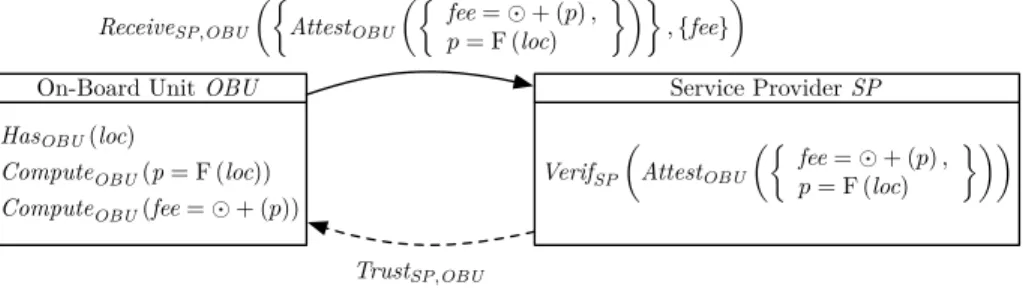
An illustration of an architecture is given in Figure 1. It relies on the relations defined previously to fulfill the functionality Ω. The OBU measures the locations
loc, computes the global fee fee, and sends this latter to SP along with an
attes-tation of integrity. SP trusts the declaration coming from OBU and verifies its authenticity. As can be seen, architectures provide an abstract, high-level view of a system. For example, we do not express at this level the particular method used by a component to verify that another component has actually attested (e.g. signed) a declaration. The objective at this stage is to be able to express and reason about the architecture rather than diving into technical details.
2.3 Design Strategies
In order to help designers finding their way among the variety of possible options, our approach is based on a succession of interaction steps. Each step consists in a question to the designer whose answer is used to trim the design space and
6
It can be noted this language is extensible with new relations to model other PETs as needed.
HasOBU(loc)
ComputeOBU(p = F (loc))
ComputeOBU(fee = § + (p))
On-Board Unit OBU
VerifSP
3
AttestOBU3; fee = § + (p),
p= F (loc)
<44 Service Provider SP
ReceiveSP,OBU
3;
AttestOBU3; fee = § + (p),p= F (loc)
<4< ,{fee}
4
TrustSP,OBU
Fig. 1. Example of architecture relying on VerifAttesti (Att) and Trusti,j primitives.
drive the search for a suitable solution. The two key ingredients affecting the effectiveness of the process are the criteria to be used at each step and the order in which the questions should be asked. Based on our experience in the design of privacy preserving solutions, we propose the following strategies defined by steps 1 to 5 below. Steps 1 and 2, which have an overall effect on the possible solutions, are applied for the whole system. Then each equation of the definition of the functionality Ω is considered in turn in a bottom-up fashion7 and Steps
3 to 5 are applied to each of them. Each choice adds a relation or a property to the architecture.
1. Constraints: The first question to be answered by the designer concerns the potential constraints imposed by the context or architectural choices that may have already been made by the designer. For example, the location of the input variables (e.g. sensors or meters) is often imposed by the environment and the absence of a direct communication channel between certain compo-nents may be a strong constraint. This criterion may typically have an impact on the occurrence of Hasi(X), Receivei,j({S}, {X}), or Computei(X = T )
relations for metering, communications, or computations respectively. 2. Anonymity: The second question is the potential anonymity requirement.
When anonymity is required, it can be expressed as a relationship between components. This type of requirement has an overall effect on the possible solutions because it introduces the need to implement anonymous channels between certain components and to specify the identifying values that have to be protected.
3. Accuracy: The first question for each equation is the level of accuracy re-quired for the result. If an approximate solution is acceptable, then tech-niques such as perturbation, rounding (on individual values), aggregation, or sampling (on sets of values) can be considered (and the functionality Ω be augmented with a new function to perform this approximation). Otherwise these techniques are ruled out.
7
Starting from input variables is more efficient because their location is usually im-posed by the context and they are often personal data.
4. Type of Trust: The next question for each equation is the type of trust which can be accepted by the components, which is a key driver for the construction of a solution. We distinguish three types of trust:
(a) Blind trust is the strongest form of trust: if a component Ci blindly
trusts a component Cj, it assumes that Cj will always behave as
ex-pected and all its attestations Attestj({Eq}) will be accepted as true
after verification (by VerifAttest
i (Attestj({Eq}))). This is expressed by a
relation Trusti,jadded to the architecture. Blind trust should obviously
be used parsimoniously because it leads to the weakest solutions (tech-nically speaking), or the solutions most vulnerable to misplaced trust. However, there are very reasonable (and even unavoidable) uses of blind trust, for example on the sensors providing the input values, or on secure hardware components. As far as techniques are concerned, this type of trust only requires authentication (e.g. for Ci to check that a message
has indeed been sent by Cj: because Cj is assumed to be trustworthy,
the content of his message will be accepted as such). Figure 1 depicts an architecture relying on blind trust.
(b) Verifiable trust (a posteriori verification) also considers by default that the trusted component behaves as expected but it is not as absolute as blind trust: it provides for the possibility of a posteriori verifications that this trust is not misplaced. Two types of techniques are typically used to implement this kind of trust: commitments (for the initial, and privacy preserving, declaration of the values) and spot-checks (for the verification of sample values). In this case, the architecture includes a
Spotchecki,j(X, {Eq}) relation with X the array that can be sampled
and {Eq} the equations which should be satisfied (using the sampled
X). The architecture illustrated in Figure 2 relies on verifiable trust for
the computation of p = F (loc).
(c) Verified trust (a priori verification) could be presented as a “non trust” option (or trust in the technology only) in the sense that a component
Ci does not accept a statement as true if it is not able to verify it by
itself (by a computation Computei(X = T ), a check Checki({Eq}) or
the verification of a proof VerifProof
i (Proof ({P}))). Useful techniques to
provide this level of guarantees include zero knowledge proofs, secure multi-party computations and homomorphic encryptions. The example in Figure 2 relies on verified trust for the computation of fee = + (p) (through a homomorphic scheme relying on a hash function H).
5. Assessment: The last, but not least, question has to do with the preferences (e.g. in terms of performances, usability, or costs) that may lead to the rejection of certain solutions and with the detection of inconsistencies which may lead to the addition of new elements (e.g. a missing communication). For example, the limited computing power of a component, the low throughput of a communication channel, or the extra burden on the users can go against the use of certain Receivei,j({S}, {X}), Computei(X = T ), or VerifProofi (Pro)
relations. This step is the counterpart of Step 1 (which concerns the a priori knowledge of the designer before the start of the design procedure): it leads
to the filtering of the potential options resulting from the application of the previous steps of the procedure.
HasOBU(loc)
ComputeOBU(p = F (loc))
ComputeOBU(fee = § + (p))
ComputeOBU(cp = H (p))
On-Board Unit OBU
CheckSP({H (fee) = § ◊ (cp)})
Service Provider SP ReceiveSP,OBU(ÿ, {fee, cp})
SpotcheckSP,OBU(loc, {cp = H (F (loc))})
Fig. 2. Simplified PrETP electronic toll pricing architecture relying on verifiable trust
for the computation of F and on verified trust for + (inspired by [2]).
These strategies guide the designer step-by-step through a succession of ques-tions until an acceptable architecture is derived. Such architectures can be used in a purely informal way and represented as annotated graphs manipulated by designers who get an intuitive understanding of their meaning. However, this does not give strong guarantees that the obtained architectures really satisfy the privacy and integrity requirements of the system. One way to strengthen these guarantees is to rely on the formal framework detailed in [1].
This systematic design process is supported by a tool which is presented in the next section. This tool guides the designer and seamlessly builds a formal model of the architecture which can then be verified.
3
CAPRIV tool
The CAPRIV computer aided privacy engineering tool has been developed to help non-expert designers to build architectures by following the strategies pre-sented in this paper and to verify that the privacy requirements are met according to the formal model detailed in [1]. The interface and the back-end have been themselves developed with privacy by design in mind. For example, two com-ponents are not linked by any direct communication channel unless explicitly declared by the designer. The design of the tool makes it possible to hide the formal aspects of the model to the designer who does not want to be exposed to mathematical notations. This is mainly achieved through the use of a graphical user interface (GUI) and natural language statements. CAPRIV implements an iterative design procedure allowing the designer to come back to previous steps at any time. This section presents a functional description of the tool, followed by a brief overview of its implementation.
Functional description. The GUI is divided into two parts: a Model and a
The View part is composed of three other panes: Specification, Architecture, and Proofs. The View part shows the results of the interactions of the designer with the Model part.
Specification. The first task of the designer is to declare all the elements
(com-ponents, variables, and functions) that will be used during the design process. Different properties of these elements, such as the fact that a variable is an ar-ray or a function is not invertible, can be selected throughout the process. The equations defining the functionality Ω are then declared (using these elements). Finally, the confidentiality and integrity requirements φ are defined based on the components and on the functionality. The current version of CAPRIV only supports simple equations (without function application nesting). This limita-tion can be circumvented by decomposing the funclimita-tionality equalimita-tions in simpler subequations.
Design. The next step for the designer is to build an architecture A meeting the
requirements. To this aim, CAPRIV implements a design cycle following the strategies presented in Section 2.3. The designer must define the pre-existing constraints before choosing, for each equation in the functionality of the system, a location for the computation and a type of trust. Finally, the designer can add the missing communication links to make the architecture consistent. The Design panel is shown in Figure 3.
Fig. 3. Design view in CAPRIV at the end of the design process leading to the
Verification. If he chooses to do so, the designer can then verify whether the
obtained architecture meets the requirements. The first verification concerns the consistency of the architecture (for example, the fact that the arguments of a computation must themselves be produced in one way or another and be available to the component performing the computation). The designer can then formally verify the satisfaction of the confidentiality and integrity requirements.
Implementation. Some of the verification features rely on external theorem
provers and CAPRIV acts as a frontend interface for the Why3 framework [4].
Why3 is a platform in which theories can be expressed in an ML-flavored
lan-guage. Standard libraries are provided to easily model structures such as rings and arrays for instance. Why3 relies itself on external provers such as Alt-Ergo [5] or Z3 [23] to prove theorems. CAPRIV automatically generates theories corre-sponding to the architecture (as axioms and conjectures to be proven), then calls
Why3, and finally handles its answer.
When the expected property cannot be proved, an advanced designer can choose to use the Why3 GUI offering an interactive theorem proving environ-ment in which specific provers can be called with the possibility to apply different solving strategies. An expert designer can even exploit the detailed configuration or modify the theories — but these skills are not expected for a standard use of CAPRIV. This choice to rely on external tools for some parts of the verifica-tion shows that it is possible to integrate privacy by design methodologies with existing formal verification tools.
4
Electronic Toll Pricing Case Study
In this section, we apply the methodology presented in Subsection 2.3 to the electronic toll pricing example introduced in the previous sections.
Architecture Requirements. As a reminder, the functionality for our case
study is expressed by Ω = {fee = + (p) , p = F (loc)}. The privacy require-ments are Hasone
SP (loc), HasoneSP (p), and HasallSP(fee) for the confidentiality
prop-erties and KSP(fee = + (p)) and BSP(p = F (loc)) for the integrity properties
as defined in Subsection 2.1.
Architecture Design.
1. Constraints. The first task of the designer is to identify the unavoidable
constraints that must be taken into account in the design of the system. For this case study, the locations are measured by the on-board units: HasOBU(loc).
The designer has also to make explicit other predefined choices (either imposed by the customer or resulting from his own knowledge or experience). We as-sume here that he chooses to locate the computations on the on-board units to minimise personal data disclosure as follows: ComputeOBU(p = F (loc)) and
ComputeOBU(fee = + (p)). Another obvious constraint is for the provider to
get the fee: ReceiveSP,OBU(∅, {fee}).
2/3. Anonymity and Accuracy. No anonymity channel is required by the designer
for this architecture and no approximation technique can be applied because the fee has to be computed accurately.
4. Type of Trust. The key step in the process is the choice of the types of
trust accepted by the parties for each part of the functionality (the compu-tation of individual prices and their sum). We assume that verifiable trust is acceptable for the service provider (which is consistent with the use of the pri-vacy requirement BSP defined previously). Pricing will therefore be checked a
posteriori by comparing a sample of the actual locations loc with the corre-sponding commitments cp (using a one-way homomorphic hash function H) sent by the driver (in fact his OBU): SpotcheckSP,OBU(loc, {cp = H (F (loc))}) and
ReceiveSP,OBU(∅, {cp}). The homomorphism property of the function H (such
that H (Σ0≤i≤n(Ti)) = Π0≤i≤n(H (Ti)) for all terms Ti) enables the provider to
check the integrity property for the computation of fee = + (p) by verifying that the product of the committed prices is equal to the hashed fee as follows:
CheckSP({H (fee) = × (cp)}).
5. Assessment. The last tasks for the designer are to check the consistency of
the architecture and, if necessary, to add the missing elements to get a consistent architecture. In our example, it is necessary to add ComputeOBU(cp = H (p)) to ensure that a component is in charge of computing the cp variables.
Figure 3 illustrates the design view of CAPRIV when the choices made pre-viously have been input. Figure 2 pictures the architecture (which is a simplified version of [2]) obtained at the end of the design process. This latter is expressed in the formal language detailed in [1].
Architecture Verification. The designer can then formally verify that the
architecture meets the requirements. This verification can be made (either auto-matically or interactively) using the CAPRIV tool sketched in Section 3 which implements the axiomatics presented in [1].
The solution designed here relies on heavy on-board units able to perform the billing computations. Moreover, it assumes a direct link between the on-board unit and the provider: the driver has to trust the on-board unit not to disclose too much data to the provider. This issue could be solved by adding a proxy under the control of the driver which would filter the communications between
SP and OBU. This alternative can be expressed in the same framework by adding
another component but space considerations prevent us from presenting it here.
5
Related Work
Several authors [12,19,17,24,30] have already pointed out the complexity of “pri-vacy engineering” as well as the “richness of the data space” [12] calling for the
development of more general and systematic methodologies for privacy by design. As far as privacy mechanisms are concerned, [17,21] points out the complexity of their implementation and the large number of options that designers have to face. To address this issue and favor the adoption of these tools, [17] proposes a number of guidelines for the design of compilers for secure computation and zero-knowledge proofs whereas [9] provides a language and a compiler to perform computations on private data by synthesising zero-knowledge protocols. In a dif-ferent context (designing information systems for the cloud), [22] also proposes implementation techniques to make it easier for developers to take into account privacy and security requirements. Finally, [31] proposes a development method for security protocols allowing to derive a protocol by refinement. However, this method does not offer decision support for the designer to choose among different possibilities as we do.
The recent proposal [18] also emphasizes the importance of architectures for privacy by design. [18] proposes a design methodology for privacy (inspired by [3]) based on tactics for privacy quality attributes (such as minimisation, enforcement or accountability) and privacy patterns (such as data confinement, isolation or Hippocratic management). The work described in [18] is complemen-tary to the approach presented here: [18] does not consider formal aspects while this paper does not address the tactics for privacy by design.
Design patterns are used in [14] to define eight privacy strategies8 called
re-spectively: Minimise, Hide, Separate, Aggregate, Inform, Control, Enforce and Demonstrate. Other authors put forward pattern-based approaches: [13] pro-poses a language for privacy patterns allowing for a designer to choose relevant PETs; [29] describes a solution for online interactions; at a higher level, [25] pro-poses a decision support tool based on design patterns to help software engineers to take into account privacy guidelines in the early stage of development.
All the aforementioned work is very helpful and paves the way for a wider adoption of privacy by design. We believe however that there is still a gap be-tween techniques or methods (such as design patterns or tactics) which are de-scribed informally at a very high abstraction level and formal models of privacy that usually address precise technical issues or specific requirements (such as protocols dedicated to smart metering, electronic toll pricing, or electric vehi-cle charging). The former are intended as guidelines for software designers and engineers but do not provide any formal guarantees; the latter provide formal guarantees but they are very specific and can hardly be used by software engi-neers to build a new product. Moreover, they are generic frameworks and they do not include any specific privacy by design methodology.
Filling this gap is precisely the objective of this paper. Previous work on this very topic is scarce. One exception is the framework introduced in [19] which defines the meaning of the available operations in a (trace-based) operational semantics and proposes an inference system to derive properties from architec-8 Strategies are defined as follows in [14]: “A design strategy describes a fundamental approach to achieve a certain design goal. It has certain properties that allow it to be distinguished from other (fundamental) approaches that achieve the same goal.”
tures. Even though the goal of [19] is to deal with architectures, it remains at a lower level of abstraction than the framework sketched here and it can hardly be extended to other privacy mechanisms. In addition, it is not associated with design strategies as proposed in Section 2 of this paper. Complementary work by the authors are [1] which presents the formal framework (language of archi-tectures and requirements, semantics, and axiomatics) and illustrates it with a smart metering example, and [32] which completes the formal framework with a link between architectures and actual implementations (as protocols). Any protocol consistent with an architecture would then meet the properties of the architecture as defined in this paper.
6
Conclusion
Considering that there is usually no absolute notion of personal data minimality, the only solution is to specify the requirements of the parties and try to find a solution to meet them all or to iterate otherwise. For example, in the electronic toll pricing case study discussed in Section 4, a solution has been found in which the only personal data disclosed to the provider is the fee to be paid by the driver (which can harldy be avoided) and occasionally (when a spot-check is initiated) the position of the vehicle. Other solutions can be found which do not involve spot-checks but rely on more expensive secure on-board units.
In addition to its interest in the design phase, the use of the methodology proposed here provides a key benefit in terms of accountability which will become an obligation with the new GDPR [8]. Accountability is defined in the Article 22 as the following obligation for data collectors: “The controller shall adopt appropriate policies and implement appropriate and demonstrable technical and organisational measures to ensure and be able to demonstrate in a transparent manner that the processing of personal data is performed in compliance with this Regulation. . . ”. A significant byproduct of the approach described in this paper is to provide to data collectors a documented and rigorous justification of the design choices, which will become a key asset for the implementation of their accountability requirements.
Another benefit of the approach presented here is that designers do not have to opt from the outset for a formal framework. Rather, they can first explore the design space based on initial inputs provided in a non formal language and analyse the suggested architectures based on their graphical representations. They can content themselves with this step or wish to go beyond and try to prove other properties of their architectures. In the latter case, depending on their level and type of expertise, they can either rely on an automatic verification mode or choose among the verification tools integrated within the design environment.
For the reasons discussed in Section 2, the approach described in this paper focuses on architectures. An extension of this work is the integration of other types of trust such as the trust in pairs, in particular trust conditional on the endorsement of a declaration by a minimal number (or ratio) of pairs. From an academic perspective, another avenue for further research is the use of the formal
framework presented here to provide a classification of solutions presented in the literature (in the style of [15]) based on formal criteria.
Acknowledgement. This work was partially funded by the European project
PRIPARE / FP7-ICT-2013-1.5, the ANR project BIOPRIV, and the Inria Project Lab CAPPRIS (Collaborative Action on the Protection of Privacy Rights in the Information Society).
References
1. Antignac, T., Le Métayer, D.: Privacy architectures: Reasoning about data min-imisation and integrity. In: Mauw, S., Jensen, C.D. (eds.) Security and Trust Man-agement, Lecture Notes in Computer Science, vol. 8743, pp. 17–32. Springer (2014) 2. Balasch, J., Rial, A., Troncoso, C., Geuens, C.: PrETP: Privacy-Preserving elec-tronic toll pricing. In: Proceedings of the 19th USENIX Security Symposium. pp. 63–78. Washington DC, USA (Aug 2010)
3. Bass, L., Clements, P., Kazman, R.: Software Architecture in Practice. SEI series in Software Engineering, Addison-Wesley, 3rd edn. (September 2012)
4. Bobot, F., Filliâtre, J.c., Marché, C., Paskevich, A.: Why3: Shepherd your herd of provers. In: In Workshop on Intermediate Veri cation Languages (2011)
5. Conchon, S., Contejean, E.: The Alt-Ergo automatic theorem prover. http: //alt-ergo.lri.fr/ (2008)
6. Deswarte, Y., Aguilar Melchor, C.: Current and Future Privacy Enhancing Tech-nologies for the Internet. Annales Des Télécommunications 61(3–4), 399–417 (2006) 7. Diaz, C., Kosta, E., Dekeyser, H., Kohlweiss, M., Girma, N.: Privacy preserving
electronic petitions. Identity in the Information Society 1(1), 203–209 (2009) 8. European Parliament: General data protection regulation, ordinary legislative
pro-cedure: first reading (March 2014)
9. Fournet, C., Kohlweiss, M., Danezis, G., Luo, Z.: Zql: A compiler for privacy-preserving data processing. In: Proceedings of the 22Nd USENIX Conference on Security. pp. 163–178. SEC’13, USENIX Association, Berkeley, CA, USA (2013) 10. Garcia, F., Jacobs, B.: Privacy-friendly energy-metering via homomorphic
encryp-tion. In: Cuellar, J., Lopez, J., Barthe, G., Pretschner, A. (eds.) Security and Trust Management, LNCS, vol. 6710, pp. 226–238. Springer (2011)
11. Goldberg, I.: Privacy Enhancing Technologies for the Internet III: Ten Years Later, vol. Digital Privacy: Th., Tech., and Pract., pp. 3–18. Auerbach Publications (2007) 12. Gürses, S., Troncoso, C., Diaz, C.: Engineering Privacy by Design. Presented at
the Computers, Privacy & Data Protection conference (Jan 2011)
13. Hafiz, M.: A Pattern language for developing privacy enhancing technologies. Soft-ware: Practice and Experience 43(7), 769–787 (2010)
14. Hoepman, J.H.: Privacy design strategies. In: Cuppens-Boulahia, N., Cuppens, F., Jajodia, S., Abou El Kalam, A., Sans, T. (eds.) ICT Sys. Sec. and Priv. Protection, IFIP Adv. in Inf. and Comm. Tech., vol. 428, pp. 446–459. Springer (2014) 15. Jawurek, M., Kerschbaum, F., Danezis, G.: Privacy technologies for smart grids
-a survey of options. Tech. Rep. MSR-TR-2012-119, Microsoft (November 2012) 16. de Jonge, W., Jacobs, B.: Privacy-Friendly electronic traffic pricing via commits.
In: Degano, P., Guttman, J., Martinelli, F. (eds.) Formal Aspects in Security and Trust, vol. 5491, pp. 143–161. Springer Berlin Heidelberg, Berlin, Heidelberg (2008)
17. Kerschbaum, F.: Privacy-preserving computation (position paper). Presented at the Annual Privacy Forum conference (2012)
18. Kung, A.: PEARs: Privacy enhancing architectures. In: Proceedings of the Annual Privacy forum. Greece (2014)
19. Le Métayer, D.: Privacy by design: A formal framework for the analysis of architec-tural choices. In: Proc. of the Third ACM Conf. on Data and Application Security and Privacy. pp. 95–104. CODASPY ’13, ACM, New York, NY, USA (2013) 20. LeMay, M., Gross, G., Gunter, C.A., Garg, S.: Unified architecture for large-scale
attested metering. In: 40th annual Hawaii International Conference on System Sciences (HICSS’07). pp. 115–124 (Jan 2007)
21. Maffei, M., Pecina, K., Reinert, M.: Security and privacy by declarative design. In: Computer Security Foundations Symp. (CSF), 2013 IEEE 26th. pp. 81–96 (2013) 22. Manousakis, V., Kalloniatis, C., Kavakli, E., Gritzalis, S.: Privacy in the cloud: Bridging the gap between design and implementation. In: Franch, X., Soffer, P. (eds.) Advanced Information Systems Eng. Workshops, Lecture Notes in Business Information Processing, vol. 148, pp. 455–465. Springer Berlin Heidelberg (2013) 23. de Moura, L., Bjørner, N.: Z3: An efficient SMT solver. In: Tools and Algorithms
for the Construction and Analysis of Systems, 14th International Conf., TACAS 2008. LNCS, vol. 4963, pp. 337–340. Springer (April 2008)
24. Mulligan, D.K., King, J.: Bridging the gap between privacy and design. University of Pennsylvania Journal of Constitutional Law 14(4), 989–1034 (April 2012) 25. Pearson, S., Benameur, A.: A decision support system for design for privacy. In:
Fischer-Hübner, S., Duquenoy, P., Hansen, M., Leenes, R., Zhang, G. (eds.) Privacy and Identity Management for Life, IFIP Advances in Information and Communi-cation Technology, vol. 352, pp. 283–296. Springer Berlin Heidelberg (2011) 26. Popa, R.A., Balakrishnan, H., Blumberg, A.J.: VPriv: protecting privacy in
Location-Based vehicular services. In: Proceedings of the 18th USENIX Security Symposium. pp. 335–350. Montreal, Canada (Aug 2009)
27. Rezgui, A., Bouguettaya, A., Eltoweissy, M.Y.: Privacy on the web: facts, chal-lenges, and solutions. Security Privacy, IEEE 1(6), 40–49 (Nov 2003)
28. Rial, A., Danezis, G.: Privacy-Preserving smart metering. Technical report MSR-TR-2010-150, Microsoft Research (Nov 2010)
29. Romanosky, S., Acquisti, A., Hong, J., Cranor, L.F., Friedman, B.: Privacy patterns for online interactions. In: Proc. of the 2006 Conference on Pattern Languages of Programs. pp. 12:1–12:9. PLoP ’06, ACM, New York, NY, USA (2006)
30. Spiekermann, S., Cranor, L.F.: Engineering privacy. IEEE Transactions on Soft-ware Engineering 35(1), 67–82 (2009)
31. Sprenger, C., Basin, D.: Developing security protocols by refinement. In: Proceed-ings of the 17th ACM Conference on Computer and Communications Security. pp. 361–374. CCS ’10, ACM, New York, NY, USA (2010)
32. Ta, V.T., Antignac, T.: Privacy by design: On the conformance between protocols and architecture. In: 7th Int. Symp, FPS 2014. LNCS, Montreal (Nov 2014) 33. Troncoso, C., Danezis, G., Kosta, E., Preneel, B.: Pripayd: privacy friendly
pay-as-you-drive insurance. In: Ning, P., Yu, T. (eds.) Proc. of the 2007 ACM Workshop on Privacy in the Electronic Society, WPES 2007. pp. 99–107. ACM (2007) 34. Tschantz, M.C., Wing, J.M.: Formal methods for privacy. In: Cavalcanti, A., Dams,

![Fig. 2. Simplified PrETP electronic toll pricing architecture relying on verifiable trust for the computation of F and on verified trust for + (inspired by [2]).](https://thumb-eu.123doks.com/thumbv2/123doknet/14390989.508138/10.918.204.722.252.382/simplified-electronic-pricing-architecture-verifiable-computation-verified-inspired.webp)