HAL Id: hal-02883389
https://hal.inria.fr/hal-02883389
Submitted on 29 Jun 2020HAL is a multi-disciplinary open access
archive for the deposit and dissemination of sci-entific research documents, whether they are pub-lished or not. The documents may come from teaching and research institutions in France or abroad, or from public or private research centers.
L’archive ouverte pluridisciplinaire HAL, est destinée au dépôt et à la diffusion de documents scientifiques de niveau recherche, publiés ou non, émanant des établissements d’enseignement et de recherche français ou étrangers, des laboratoires publics ou privés.
pyts: A Python Package for Time Series Classification
Johann Faouzi, Hicham Janati
To cite this version:
Johann Faouzi, Hicham Janati. pyts: A Python Package for Time Series Classification. Journal of Machine Learning Research, Microtome Publishing, 2020, 21, pp.1 - 6. �hal-02883389�
pyts: A Python Package for Time Series Classification
Johann Faouzi [email protected]
Aramis Lab, INRIA Paris Brain and Spine Institute 75013 Paris – France
Hicham Janati [email protected]
Parietal team, INRIA Saclay Neurospin, Bˆat 145 CEA Saclay 91191 Gif sur Yvette – France
Editor: Andreas Mueller
Abstract
pyts is an open-source Python package for time series classification. This versatile toolbox provides implementations of many algorithms published in the literature, preprocessing functionalities, and data set loading utilities. pyts relies on the standard scientific Python packages numpy, scipy, scikit-learn, joblib, and numba, and is distributed under the BSD-3-Clause license. Documentation contains installation instructions, a detailed user guide, a full API description, and concrete self-contained examples. Source code and doc-umentation can be downloaded from https://github.com/johannfaouzi/pyts.
Keywords: time series, classification, machine learning, python
1. Introduction
A time series is a sequence of values indexed in chronological order. Given their structured nature, they are very common in many real-world applications. With the increasing avail-ability of sensors and the development of Internet of things devices, the amount of time series data and the number of applications is continuously growing. Applications can be found in a virtually unlimited number of fields ranging from finance and econometrics (Per-ron, 1989) to geology with earthquake prediction (Amei et al., 2012), and climate science with weather forecasting (Agrawal et al., 2012).
In machine learning, exploiting the structural patterns of the data in order to assign a certain label to a new observation is known as classification. Classifying time series data can solve several real-world problems including disease detection using electrocardiogram data (Olszewski, 2001), household device classification to reduce carbon footprint, and image classification (Ratanamahatana and Keogh, 2005). However, standard machine learning classification is not always well suited for time series because of the possibly high correlation between back-to-back time points. One typical example is the Naive Bayes algorithm, which assumes a conditional independence between each feature given the class the time series belongs to. For this reason, algorithms dedicated to time series classification have been developed such as bag-of-words models, shapelet-based approaches and modifications to standard tree-based algorithms.
c
Faouzi and Janati
In this paper we present pyts, a Python package for time series classification. To the best of our knowledge, among several Python packages for time series analysis, pyts is the only Python package entirely dedicated to time series classification. The following sections describe the project development, the dependencies, the API design, a comparison to related Python packages and future works.
2. Project Development
Code quality. The package comes up with a lot of unit tests, leading to 97% code coverage for the release of version 0.10. Moreover, analysis tools such as PEP8 and Flake8 are used and LGTM1 gives the package an A+ grade for code quality.
Continuous integration. In order to ensure new code integration and backward compatibil-ity, continuous integration is performed on all supported platforms.
Collaborative development. The package is hosted on GitHub, which allows for collaboration between the developers and any contributor, discussion on eventual issues, and feature requests.
Documentation. A detailed documentation is hosted on Read the Docs with installation instructions, a comprehensive user guide, the whole API documentation and numerous examples.
3. Dependencies
NumPy: the base N-dimensional array package. numpy (Walt et al., 2011) provides among other things a powerful N-dimensional array object, linear algebra operations, Fourier trans-form, and random number capabilities.
SciPy: the fundamental library for scientific computing. scipy (Jones et al., 2001–) contains mathematical algorithms, statistical tools, sparse matrices, and convenience functions built on top of numpy.
Scikit-learn: machine learning in Python. scikit-learn (Pedregosa et al., 2011) is a ver-satile toolbox for data mining and data analysis consisting of many machine learning algo-rithms and utility tools.
Joblib: running Python functions as pipeline jobs. joblib is a set of tools to provide lightweight pipelining in Python, such as transparent disk-caching of functions and simple parallel computing.
Numba: a high performance Python compiler. numba (Lam et al., 2015) translates Python functions to optimized machine code at run time using the LLVM compiler library. Numba-compiled numerical algorithms in Python can reach the speeds of C or FORTRAN.
4. API Design
As illustrated in Listing 1, the pyts API is inspired by the scikit-learn API and is de-signed to be compatible with scikit-learn tools such as cross validation, model selection,
1. https://lgtm.com/projects/g/johannfaouzi/pyts?mode=list
1 f r o m p y t s . c l a s s i f i c a t i o n i m p o r t B O S S V S
2 f r o m p y t s . d a t a s e t s i m p o r t l o a d _ g u n p o i n t
3
4 # L o a d the G u n P o i n t d a t a set
5 X_train , X_test , y_train , y _ t e s t = l o a d _ g u n p o i n t ( r e t u r n _ X _ y = T r u e )
6
7 # C r e a t e the c l a s s i f i e r
8 clf = B O S S V S ( w i n d o w _ s i z e = 2 8 )
9
10 # Fit the c l a s s i f i e r on the t r a i n i n g set
11 clf . fit ( X_train , y _ t r a i n )
12
13 # C o m p u t e the a c c u r a c y on the t e s t set
14 a c c u r a c y = clf . s c o r e ( X_test , y _ t e s t )
15
16 # P r i n t a c c u r a c y
17 p r i n t( a c c u r a c y )
18 0 . 9 8
Listing 1: Code snippet illustrating pyts’s intuitive API on a classification example.
and pipelines. All transformers have three main methods: fit derives statistics on the data set if applicable, transform computes the transformation with the learned statistics, and fit transform is an optimized version of fit followed by transform when possible. All classifiers have two main methods: fit learns statistics from the data set and predict derives predicted classes.
5. Assumptions on Input Data
One important challenge with time series is their number of time points. A data set of equal-length time series consists of time series that all have the same number of time points. A data set of varying-length time series consists of time series that may have different numbers of time points. For computational efficiency, most algorithms implemented in pyts can only deal with data sets of equal-length time series. One exception is our implementation of Dynamic Time Warping (Sakoe and Chiba, 1978) and its variants.
Data sets of univariate and multivariate are both supported, being represented as two-dimensional arrays and three-two-dimensional arrays respectively.
6. Comparison to Related Software
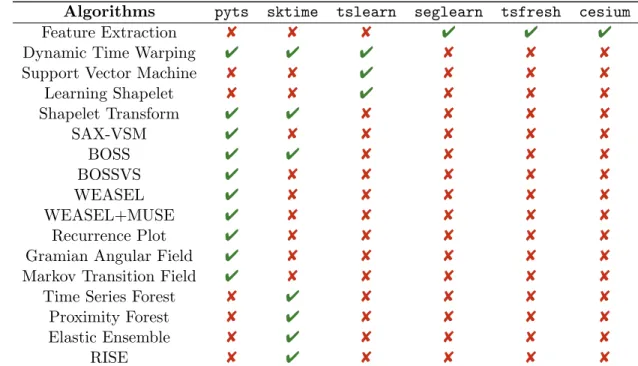
pyts is not the only Python package providing tools for time series classification. sktime (Lning et al., 2019) and tslearn (Tavenard, 2017) are dedicated to time series analysis in general, while tsfresh (Christ et al., 2018), cesium (Naul et al., 2016) and seglearn (Burns and Whyne, 2018) are focused on extracting statistics-based features from time series. Ta-ble 1 provides an extensive comparison of availaTa-ble algorithms for time series classification in these packages. sktime and pyts stand out with their numbers of implementations of
Faouzi and Janati
Algorithms pyts sktime tslearn seglearn tsfresh cesium
Feature Extraction 8 8 8 4 4 4
Dynamic Time Warping 4 4 4 8 8 8
Support Vector Machine 8 8 4 8 8 8
Learning Shapelet 8 8 4 8 8 8 Shapelet Transform 4 4 8 8 8 8 SAX-VSM 4 8 8 8 8 8 BOSS 4 4 8 8 8 8 BOSSVS 4 8 8 8 8 8 WEASEL 4 8 8 8 8 8 WEASEL+MUSE 4 8 8 8 8 8 Recurrence Plot 4 8 8 8 8 8
Gramian Angular Field 4 8 8 8 8 8
Markov Transition Field 4 8 8 8 8 8
Time Series Forest 8 4 8 8 8 8
Proximity Forest 8 4 8 8 8 8
Elastic Ensemble 8 4 8 8 8 8
RISE 8 4 8 8 8 8
Table 1: Availability of several algorithms for time series classification published in the literature. Packages (versions): pyts (0.10.0), sktime (0.3.1), tslearn (0.2.5), seglearn (1.1.0), tsfresh (0.13.0), cesium (0.9.10).
Adiac ECG200 GunPoint MiddlePhalanxTW Plane
(Sch¨afer, 2015) 0.765 0.870 1.000 0.526 1.000
pyts 0.752 0.870 1.000 0.526 1.000
Table 2: Accuracy scores on the test set for the BOSS transformer followed by a one-nearest neighbor classifier with the BOSS metric on several data sets.
algorithms published in the literature. sktime provides more tree-based algorithms, while pyts is more focused on dictionary-based and image-based models.
In order to provide users confidence in our implementations, we also track the predictive performance of our implementations on some data sets and compare them to the results published in the literature. Table 2 highlights the accuracy scores on the test set for the BOSS transformer (Sch¨afer, 2015) followed by a one-nearest neighbor classifier with the BOSS metric (Sch¨afer, 2015) on several data sets.
7. Conclusion
The pyts Python package is a versatile toolbox for time series classification, providing implementations of several algorithms published in the literature, preprocessing tools, and data set loading utilities. A detailed documentation and concrete examples illustrate the
use of the functionalities made available. Future works include better support for data sets of unequal-length time series and multivariate time series.
References
A. Agrawal, V. Kumar, A. Pandey, and I. Khan. An application of time series analysis for weather forecasting. International Journal of Engineering Research and Applications, 2: 974–980, 2012.
A. Amei, W. Fu, and C. H. Ho. Time series analysis for predicting the occurrences of large scale earthquakes. International Journal of Applied Science and Technology, 2, 2012. D. M. Burns and C. M. Whyne. Seglearn: A python package for learning sequences and
time series. Journal of Machine Learning Research, 19(83):1–7, 2018.
M. Christ, N. Braun, J. Neuffer, and A. W. Kempa-Liehr. Time series feature extraction on basis of scalable hypothesis tests (tsfresh – a python package). Neurocomputing, 307: 72–77, 2018.
E. Jones, T. Oliphant, Peterson P., et al. Scipy: Open source scientific tools for python, 2001–. URL http://www.scipy.org/.
S. K. Lam, A. Pitrou, and S. Seibert. Numba: A LLVM-based python JIT compiler. In Second Workshop on the LLVM Compiler Infrastructure in HPC, pages 7:1–7:6. ACM, 2015.
Markus Lning, Anthony Bagnall, Sajaysurya Ganesh, Viktor Kazakov, Jason Lines, and Franz J. Kirly. sktime: A unified interface for machine learning with time series, 2019. B. Naul, S. van der Walt, A. Crellin-Quick, J. Bloom, and F. Prez. cesium: Open-source
platform for time-series inference. In Python in Science Conference, pages 27–35, 2016. R. Olszewski. Generalized Feature Extraction for Structural Pattern Recognition in
Time-Series Data. PhD thesis, Carnegie Mellon University, 2001.
F. Pedregosa, G. Varoquaux, A. Gramfort, V. Michel, B. Thirion, O. Grisel, M. Blon-del, P. Prettenhofer, R. Weiss, V. Dubourg, J. Vanderplas, A. Passos, D. Cournapeau, M. Brucher, M. Perrot, and E. Duchesnay. Scikit-learn: Machine learning in python. Journal of Machine Learning Research, 12:2825–2830, 2011.
P. Perron. The great crash, the oil price shock, and the unit root hypothesis. Econometrica, 57(6):1361–1401, 1989.
C. Ratanamahatana and E. Keogh. Three myths about dynamic time warping data mining. In International Conference on Data Mining, pages 506–510. Society for Industrial and Applied Mathematics, 2005.
H. Sakoe and S. Chiba. Dynamic programming algorithm optimization for spoken word recognition. IEEE Transactions on Acoustics, Speech, and Signal Processing, 26(1):43– 49, 1978.
Faouzi and Janati
Patrick Sch¨afer. The BOSS is concerned with time series classification in the presence of noise. Data Mining and Knowledge Discovery, 29(6):1505–1530, November 2015. ISSN 1384-5810, 1573-756X. doi: 10.1007/s10618-014-0377-7.
R. Tavenard. tslearn: A machine learning toolkit dedicated to time-series data, 2017. URL https://github.com/rtavenar/tslearn.
S. van der Walt, S. C. Colbert, and G. Varoquaux. The numpy array: A structure for efficient numerical computation. Computing in Science Engineering, 13(2):22–30, 2011.