
HAL Id: tel-03215019
https://tel.archives-ouvertes.fr/tel-03215019
Submitted on 3 May 2021HAL is a multi-disciplinary open access archive for the deposit and dissemination of sci-entific research documents, whether they are pub-lished or not. The documents may come from teaching and research institutions in France or abroad, or from public or private research centers.
L’archive ouverte pluridisciplinaire HAL, est destinée au dépôt et à la diffusion de documents scientifiques de niveau recherche, publiés ou non, émanant des établissements d’enseignement et de recherche français ou étrangers, des laboratoires publics ou privés.
New confined metal complexes built from
hemicryptophane ligands for catalysis in confined space
and predictable chirality control at the metal core
Gege Qiu
To cite this version:
Gege Qiu. New confined metal complexes built from hemicryptophane ligands for catalysis in confined space and predictable chirality control at the metal core. Catalysis. Ecole Centrale Marseille, 2020. English. �NNT : 2020ECDM0008�. �tel-03215019�
École Doctorale des Sciences Chimiques (ED250) L’Institut des Sciences Moléculaires de Marseille (iSm2)
THÈSE DE DOCTORAT
pour obtenir le grade deDOCTEUR de l’ÉCOLE CENTRALE de MARSEILLE
Discipline : Chimie
Nouveaux complexes métalliques confinés au sein de ligands
hémicryptophanes pour la catalyse en milieux confiné et le
contrôle de la chiralité autour du centre métallique
Par
Monsieur Gege QIU
Directeur de thèse : Pr. MARTINEZ Alexandre
Soutenue le 22 octobre 2020 devant le jury composé de :
M. Sebastien GOEB, Chargé de recherche CNRS à,l’Université d'Angers Rapporteur M. Matthieu RAYNAL, Chargé de recherche CNRS à Sorbonne Université Rapporteur Mme Jalila SIMAAN, Directeur de recherche CNRS à L’Université d’Aix Marseille Examinatrice
M. Alexander SOROKIN, Directeur de recherche CNRS à l’IRCELYON Examinateur
M. Cedric COLOMBAN, CNRS à l’Université Aix Marseille Membre invité Mme Paola NAVA, Maître de conferences à l’Université Aix-Marseille Co-directrice de
thèse
2
Acknowledgements
First of all, I would like to thank my PhD supervisor Pr. Alexandre Martinez for his supervision and direction. He is so knowledgeable in a wide range of disciplines that I benefit a lot every time when we discussed together. And meanwhile, he is such a nice and patient person. As the director of group, he gets along very well with everyone, but he never behaves like a boss, with whom you have to speak in a very gentle way, so it’s always a pleasant talk with him. Despite his strong academic background, he is also a person who works so hard. All of this has impressed and inspired me a lot, that I will appreciate forever.
I would like to thank Dr. Paola NAVA, who is my co-supervisor. At the beginning, I didn't know anything about computational chemistry, but she was very patient and taught me a lot of computational chemistry.
I also have to thank Cedric COLOMBAN. He is very knowledgeable and helpful, and I can always get useful suggestions from him when I encounter some problems in chemistry.He is also a very careful person, who could pick up some minor details, which leaves me very deep impression. Besides, he provided me with some technical support which facilitated my research a lot. He gave me a lot of patient guidance about chemistry and many experimental techniques. I would also like to thank Dr. Bastien Chatelet, an associate professor of Centrale Marseille in our group. He will always explain to you some synthesis problems very tirelessly.
Next, I would like to send my sincere thanks to Dr. Sabine Chevallier-Michaud for Mass; Dr. Roseline Rosas for liquid NMR; Dr. Christophe Chendo and Valérie Monnier for HRMS; Dr. Michel Giorgi for single crystal X-ray diffraction; Dr. Nicolas Vanthuyne and Marion Jean for HPLC.
I would also like to thank jury members of my PhD defense: M. Sebastien GOEB, Chargé de recherche, Université d'Angers ; M. Matthieu RAYNAL, Chargé de recherche, Sorbonne Université ; Mme Jalila SIMAAN, Directeur de recherche, Université Aix-Marseille , M. Alexander SOROKIN, Directeur de recherche, IRCELYON, for their examination and comments on my PhD work, that I appreciate so much.
I passed three years full of joy in Marseille which is definitely attributed to my friends and colleagues. They helped me so much especially in my life, and I spent very
3
pleasant time with them. I want to express my sincere gratitude to you from the bottom of my heart: Damien, Hervé, Didier, Laurent, Xiaotong, Magalie, Lingyu, Augustin, Marc, Romain, Chunyang, Donglin, Peng, Xuru……
I would also like to address my gratitude to China Scholarship Council for financial support during my three years of PhD study in Marseille.
In the end, I would like to express my greatest gratitude to my parents and my wife Fangfang for their unconditional love and support, which motivates me forward. No more words could express my gratitude, but I still want to say thank you, I love you!
4
List of abbreviations
Ac = acetyl aq = aqueous Ar = aryle Bn = benzyl cat. = catalyst CTV = cyclotriveratryleneCuAAC = copper(I)-catalyzed alkyne-azide cycloaddition d = doublet
DBU = diazabicycloundecene DCC = dynamic covalent chemistry DCM = dichloromethane
DFT = density functional theory DHP = dihydropyranne
DMF = N, N-dimethylformamide δ = chemical shift
ECD = electronic circular dichroism ee = enantiomeric excess
Et = ethyl
ESI = electrospray ionization h = hour
Hz = hertz
HPLC = High Performance Liquid Chromatography HRMS = High Resolution Mass Spectroscopy IR = infrared spectroscopy
J = coupling constant in hertz m = multiplet
5
Me = methyl
NMR = Nuclear Magnetic Resonance spectroscopy Otf = triflate
Ph = phenyl
ppm = parties per million rt = room temperature s = singlet t = triplet t-Bu = tertbutyl THF = tetrahydrofuran THP = tetrahydropyranne
TLC = thin film chromatography TON = turnover number
TOF = turnover frequency
TPA = tris(2-pyridylmethyl)amine tren = tris(2-aminoethyl)amine
6
Table of contents
General Introduction ... 8
Chapter I: Bibliography ... 10
I.1: Synthesis and applications of hemicryptophane organic cages ... 11
I.1.1 Introduction ... 11
I.1.2 Synthesis of hemicryptophanes ... 12
I.1.3 Enantiopure hemicryptophanes obtained by means of chiral HPLC resolution... 14
I.1.4 Host-guest chemistry ... 16
I.1.5 Catalysis in confined space... 18
I.1.6 Conclusions ... 23
I.1.7 References ... 25
I.2 Chirality transfer in tripodal supramolecular cages ... 28
Control and transfer of chirality within well-defined tripodal cages ... 29
I.2.1 Abstract ... 29
I.2.2 Introduction ... 29
I.2.3 Propagation of the chirality in tripodal cages ... 30
I.2.4 Chiral-sorting in tripodal cages ... 36
I.2.5 Control of the host chirality through guest binding ... 40
I.2.6 Conclusion and discussion... 42
I.2.7 References ... 44
Chapter II: New small tris(2-pyridylmethyl)amine-based hemicryptophane for predictable control of the ligand’s helicity by chirality transfer ... 48
II.1 Chirality Transfer in a Cage Controls the Clockwise / Anticlockwise Propeller-like Arrangement of the tris(2 pyridylmethyl)amine Ligand ... 50
II.2 Annex N°1: ... 60
II.3 Preliminar catalytic tests on copper-catalyzed asymmetric transformations using enantiopure 1-CuI(Cl) catalyst ... 61
II.4 Computational calculations: explanation of the chirality transfer and molecular dynamic of cage 1 ... 62
II.4.1 Computational details:... 63
II.4.2 Chirality transfer (issue 1): ... 64
II.4.3 Dynamic Aspects (issue 2) : ... 65
II.5 Conclusions ... 69
II.6 Reference ... 70
Chapter III: Design, preparation, and applications of novel tris-triazole based hemicryptophanes ... 74
III.1 Introduction ... 75
III.1.1 Site selective and enantioselective CuAAC reaction. ... 79
III.1.2 Construction of rotaxane and cages by mean of CuAAC reaction ... 81
III.2 Result and discussion ... 84
III.2.1 Synthesis ... 84
III.2.2 CuAAC in confined space : first catalytic tests ... 89
III.3 Conclusions ... 96
III.4 References ... 97
Chapter IV: Design and preparation of a novel hemicryptophane cage with two different metal binding-site ... 100
7
IV.1 Introduction ... 101
IV.2 Result and discussion ... 102
IV.2.1 Synthesis and characterization of cage 4 ... 104
IV.2.2 Preparation and 1H-NMR characterisation of the corresponding diamagnetic Zinc complex. ... 109
IV.2.3. Solid states studies ... 112
IV.2.4 Study of the interaction of CuII(cage 4)(OTf) 2 with N3. ... 113
IV.3 Conclusion and perspectives... 117
IV.4 References... 119
Chapter V: Synthesis of CTV-based self-assembled supramolecular cages ... 122
V.1 Introduction ... 123
V.2 Result and discussion ... 124
V.2.1 Synthesis and characterization of pyridine-based CTV ligands ... 124
V.2.2 First self-assembly results (group of M. Hardie) ... 128
V.3 Conclusions ... 130
V.4 References ... 131
General conclusions and perspectives ... 134
8
General Introduction
In the fields of host-guest chemistry and supramolecular catalysis, hemicryptophanes are molecular cages that have attracted an increasing attention over the last years. This organic capsules combine a cyclotriveratrylene (CTV) group and another C3 symmetrical unit, that could be, for example, a ligand for metal-ions complexation. In this line, hemicryptophane-based complexes have been recently reported as more selective and efficient catalysts compared to they parent models devoid of cavity. This is why we are focusing on the developement of new hemicryptophane-based catalysts.
The main goal of this thesis was to design, prepare and apply new hemicryptophane cages as supramolecular ligand for metal coordination in confined space. In particular, this work aimed at developping new methods to obtain (i) enantiopure complexes with controlled helicity, and (ii) new confined catalyst with enhanced efficiency and selectivity.
First par of the Chapter I of the thesis consist in an overview of the recent progresses in the synthesis of hemicryptophanes. This chapter also consists in a comprehensive literature review about (i) history of the development of such cage compounds, as well as their applications in recognition and catalysis in confined space; and (ii) recent examples of control and transfer of chirality within tripodal cages.
The second Chapter describes the study of a novel small molecular hemicryptophane (1), which is directly composed of one CTV part and one tris(2-pyridylmethyl)amine (TPA) ligand, connected by three methylene –CH2- bridges. We explain how chirality transfer in this new hemicryptophane can control the propeller arrangement of the TPA ligand and its corresponding copper-complex. Besides, related computational simulations have been used to study, understand, and explain this transfer of chirality.
In Chapter III we have proposed the design and synthesis of two new hemicryptophane cages built from the TBTA ligand, which is a common ligand for
9
copper-catalyzed azide alkyne cycloaddition (CuAAC) reaction. We have studied these new TBTA-based hemicryptophane cages as new ligands for CuAAC reactions in confined space aiming at improving the stability and selectivity of the catalyst.
In Chapter IV, new hemicryptophane cages displaying two metal binding-sites in a single cavity have been developed aiming at reproducing the key structure of methane monooxygenases enzymes. This new cage has been studied as ligand for the coordination of CuII and ZnII metal ions.
Finally, we have designed and synthesized three novel CTV derivatives, which have the potential to form new supramolecular metalla-cages through self-assembly processes (chapter V). Such CTV ligands, substituted by pyridine derivatives, have been sent to the group of Prof. M. Hardie (University of Leeds, UK), to engage the first self-assembly tests. We indeed believe that such CTV-based ligands might be used to build novel self-assembled capsules.
10
Chapter I: Bibliography
Part I: Synthesis and applications of hemicryptophane organic cages Part II: Chirality transfer in tripodal supramolecular cages
11
I.1: Synthesis and applications of hemicryptophane organic cages
I.1.1 Introduction
Molecular cages holding a three-dimensional cavity are attracting considerable attention in modern supramolecular chemistry due to their potential applications in molecular recognition, catalysis, drug delivery, biosensing, separation, and storage. [1-5] Among these different cages, hemicryptophanes, which are combining a cyclotriveratrylene (CTV) unit with another different C3-symmetrical moiety, have recently received a growing interest. The chemistry of hemicryptophane has been developed quite slowly before 2005.[6] In 1982, Lehn and Collet described the first two members of a new type of molecular cages called speleands (Figure 1.1a), which associated a CTV and a crown ether unit, showing potential recognition properties toward methylammonium cations.[7] However, it was not before 2005 that the first synthesis of an enantiopure hemicryptophane was described by Crassous and Dutasta (Figure 1.1b)[8]
Figure 1.1 (a) Representation of the racemic mixture of the first hemicryptophane 5
reported in 1982; (b) representation of the first enantiopure hemicryptophane 6 reported in 2005.
12
blossoming field of research, particularly for molecular recognition. A series of sophisticated enantiopure hemicryptophanes has been synthesized benefiting from the inherent chirality of the CTV unit. These receptors could be interestingly used for stereoselective recognition of chiral guest molecules.[9] An important aspect of hemicryptophanes is indeed their inherent chirality arising from the CTV unit (M or P configuration), whereas their southern part commonly aims at introducing inner functionalities.
Due to the growing demand for artificial hosts, the preparation of hemicryptophanes could be considered as a significant breakthrough for applications in recognition or catalysis. On this basis, the first part of this chapter will first focus on the different strategies that has been developed to prepare, purify and characterize this emergent class of molecular capsules. We will then turn to the recent examples of their applications in recognition and catalysis in confined space.
I.1.2 Synthesis of hemicryptophanes
There are two main routes for designing and synthesizing hemicryptophanes: (i) by connecting the CTV and the other unit with covalent bonds (organic cages) or (ii) through a self-assembly process involving metal-ligand linkage (metalla-cage). Altrough self-assembled hemicryptophane capsules are currently attracting some attention due to the developments of self-assembling strategies[10], this section will only focus on the first strategy (covalent cages), as it is the approach developed in the team of A. Martinez. The preparation of covalent hemicryptophanes usually needs multistep synthesis, and often the main drawback of these syntheses is a low to modest overall yield. Covalent hemicryptophanes could be obtained following two main methods: (i) by intramolecular macrocyclization reaction (template approach, Figure 1.2a) and (ii) by connecting directly the CTV part and the southern part ([1+1] coupling strategy (Figure 1.2b).
13
Figure 1.2 Representation of the two different strategies usually used for the
synthesis of hemicryptophane hosts: (a) formation of the CTV unit as the final step; (b) [1 + 1] coupling of two parts.
The first way to prepare hemicryptophanes consists in the building the CTV unit at the end of the synthesis by using the “template method” previously reported for the synthesis of cryptophanes.[11] Indeed, the Friedel−Crafts alkylation is a common approach for the synthesis of CTV and therefore cryptophanes and hemicryptophanes. This acid-catalyzed cyclization reaction usually needs Bronsted (HCOOH) or Lewis acid (Sc(OTf)3) catalysts. This intramolecular cyclodehydration closes the hemicryptophane by three final Friedel–Crafts alkylations to generate the CTV at the last step (Figure 1.3I).[12] Yields and difficulty in purification usually depend on the structures of the hemicryptophane precursors.
The second way ([1+1] coupling) is very effective in many cases and is particularly well suited for the preparation of enantiopure hemicryptophanes (starting from enantiopure CTV precursors, Figure 1.3 II). [13] It should be noted that another feasible way to introduce the southern unit to the functionalized CTV scaffold exists. In this way hemicryptophanes are formed by an intramolecular cyclization that
14
generate the southern part .[14] This approach has been seldom used compared to strategies based on the cage closure reaction at the north part or the [1 + 1] coupling presented above.
Figure 1.3 (I) formation of the CTV by HCOOH-catalyzed macrocyclization as the
last step. (II) [1 + 1] coupling between one aldehyde based CTV part and the tris(2-aminoethyl)amine unit.
I.1.3 Enantiopure hemicryptophanes obtained by means of chiral
HPLC resolution
Enantiopure compounds are very important in chemical sciences, especially in the fields of molecular recognition and host-guest systems. Furthermore, chiral molecular receptors are the basis of many biorecognition processes and have important implications for biochemistry or pharmacology. The design, preparation
15
and purification of synthetic chiral hosts, such as molecular cages, is however a very difficult task. In order to separate two enantiomers of one chiral cage, the chiral semi-preparative high-performance liquid chromatography (HPLC) technique plays an important role for the resolution of racemic mixtures. Using this purification method, enantiopure hemicryptophane cages can be obtained by (i) resolution of CTV-based precursors first, or (ii) resolution of the final hemicryptophane racemate. In 2010, the first example of the resolution of a racemic mixture of hemicryptophane molecular cages using the chiral semipreparative HPLC purification technique was reported by Martinez, Dutasta and co-workers.[15] Through injections (8.0 mg/mL solutions in CDCl3) of the racemic mixture on a (S,S) Whelk-O1 chiral column, they successfully separated the two enantiomers of the following cage (M-8 and P-8 in Figure 1.4). The excellent enantiomeric excess values obtained for the M- and P- enantiomers of 8 (up to 96% and 99%) demonstrate the efficiency of the separation. However, this resolution of hemicryptophane enantiomers only stayed at the hundred of milligram scale, and the efficiency of the chiral HPLC separation is highly sensitive to the structure of the desired capsules. The efficiency of the chiral HPLC-separation could be significantly improved by the initial resolution of a CTV-based precursor racemate followed by its functionalization to form the enantiopure cage. In 2016, Martinez and co-workers have successfully separated 2 grams of each M- and P-enantiomers of the precursor CTV(CH2CH2Br)3 (M-11 and P-11 in Figure 1.4) with an enantiomeric excess >99.5%.
Figure 1.4 Structrures of the enantiopure hemicryptophanes M-8 and P-8 (left) and
16
I.1.4 Host-guest chemistry
Host–guest chemistry is one of the defining concepts of supramolecular chemistry that describes the formation of unique complexes between two or more molecules, via non-covalent interactions. A host molecule has an internal space (the so-called ‘cavity’) in which another molecule, the guest molecule, can be incorporated. Since Pedersen, Lehn and Cram proposed the concept of host-guest chemistry, it has opened the way to the construction of supramolecular (inclusion) complexes. Several types of host molecules have been reported, including crown ethers, cryptands, spherands, carcerands and cyclodextrins (Figure 1.5). The guest molecule can be incorporated in the cavity of host molecule.
Figure 1.5 Structures of some host molecules.
The hemicryptophanes can work as excellent receptors due to some advantages : (i) their rigid CTV scaffolds can provide cavities of variable shape and size, (ii) different kind of southern groups that offer special recognition capabilities can be incorporated,
17
and (iii) the chirality of the CTV itself. For examples, hemicryptophanes have shown good complexation properties with ammoniums, ion pairs,[16-21] and fullerenes[22].
Among the possible non-covalent interactions between one hemicryptophane host and a guest, most of them are hydrogen bonds or interactions with charged species (ammonium, ion pairs, zwitterions). For instance, the first hemicryptophane, (1 in Figure 1.1) can interact strongly with ammonium ions through cation-π interactions with its CTV unit[7]. Hemicryptophanes can also encapsulate ion-pairs. The host– guest interactions between Me4N+Cl and cage 8 have been studied using a DFT approach (Figure 1.6a).[23] In 2008, another heteroditopic hemicryptophane cage was reported by Jabin et al.. This host interacts with the anion (chloride ion) and the cation (ammonium ion) simultaneously. [21] Interestingly, hemicryptophanes could also perform partial encapsulations. Makita and cowokers indeed reported in 2016 the partial encapsulation of acetylcholine within a hemicryptophane host : the X-ray structure indicates that the ammonium unit of the acethylcholine (Ach+) is inside the cavity (due to the cation-π interactions), while the acetyl unit and chloride counterions are outside the cavity (Figure 1.6b).[24] Finally, in 2011, Zhanting Li’s group developed a new (CTV)-based capsule that can strongly encapsulate C60 and C70 fullerenes by combining hydrogen bonding[22].
Figure 1.6. Examples of hemicryptophane-based host-guest complexes (a)
18
I.1.5
Catalysis in confined space
Catalysis plays an important role in the development of the chemical industry and society. A large number of materials and chemical intermediates are synthesized directly and indirectly with catalysts. In nature, many chemical reaction processes require enzymatic catalysis, usually with the advantages of high efficiency and high selectivity. However, the enzymes are not so easy to mimic, because the structure of enzymes is complicated, and some reactions are performed in specific confined spaces displaying multiple functionalities.
Advances in transition state theory and computer technology have made possible the simulation and understanding of the enzyme’s active-sites [25]. In order to mimic the efficient chemistry found in enzymes, the catalysis in confined space aims at reproducing the second coordination sphere of enzymes. In the past decades, metal-organic cages, metal-metal-organic frameworks, metal-organic hosts, and nanoreactors have therefore attracted a growing interest.[26] In the following, some related research examples of homogeneous catalysis in confined spaces, will illustrate the effect of constrained mediums on catalytic selectivity and efficiency. Among the various examples of supramolecular catalysis, we will particularly focus on the examples where catalysis takes place inside the cavity of hemicryptophanes cages.
Inspired by enzymes, chemists have tried to mimic their confined environment through the development of organic architectures, such as cyclodextrins or calixarenes,[27] which contain well-defined cavities. Similarly, the hemicryptophanes show potential to work as ligand for complexing metal ion. Because the hemicryptophane cavity can be modified and adapted to different substrates, selective transformations could be envisioned. In 2009, Martinez and co-workers have shown, for the first time, that hemicryptophane-based transition metal complexes are efficient
supramolecular catalysts (Figure 1.7).[28] The diastereomeric
hemicryptophane−oxidovanadium(V) complexe 12 successfully oxidized the sulfide substrates to sulfoxide with 10 mol% catalyst and cumene hydroperoxide (CHP) as oxygen source. It was found to be an efficient supramolecular catalyst in the oxidation of thioanisol with yields up to 95%. Comparing with its parent model ligand, devoid of cavity, the hemicryptophane catalyst show higher yield due to the role of
19
hemicryptophane hydrophobic cavity (protect themetal-active site).
Figure 1.7 Structures of the P- (a) and M- (b) enantiomers of the hemicryptophane–
oxidovanadium(V) complexe 12.
In 2013, the group of Alexandre Martinez used a Copper-Hemicryptophane (13) complex as a catalyst for the oxidation of cycloalkane by H2O2 (Figure 1.8).[29] By comparing with the open model complex (Figure 1.8b) and the Cu(II) salt Cu(ClO4)2(H2O)6, the reaction with the Cu(II)-hemicryptophane complex shows better yield (28% and 15%, respectively) demonstrating the great potential of such an approach for the C-H oxidation. The stability of the catalyst is improved by encapsulating the active site in the molecular cavity. Other reasons may be the preferential encapsulation of the alkane substrate in the hydrophobic cavity and the ejection of the first oxidation product (alcohol).
20
Figure 1.8 Structure of (a) Hemicryptophane-copper(Cu) complexes 13, and (b) the
open model catalyst. (c) GC-monitored oxidation of cyclohexane catalyzed by hemicryptophane-copper(Cu) complexes, the model catalyst, and Cu(ClO4)2(H2O)6.
In addition, the group of Martinez reported a new functionalized cage in 2018, which contains a Verkade’s superbase motif and can be used as a tool to create frustrated Lewis pairs.[30] They tested the reaction between p-chlorobenzaldehyde and cyclopentenone with the cage 14 and the model Verkade’s superbase 15 lacking cavity (Figure 1.9). Performances are improved with the cage system. The cage 14 was more efficient due to confinement of the Verkade’s superbase in the cavity of the hemicryptophane host. The key role of the cavity has been highlighted: the acid-base reaction with the Lewis acidic partner (TiCl4) cannot take place due to the confinement of the Verkade’s superbase in the cavity of the hemicryptophane host, thus providing an effective system for the reaction.
21
Figure 1.9 The Morita Baylis Hillman reaction catalyzed by 14 and model superbase 15
Hemicryptophane ligands have also been used for the oxidation of methane: Sorokin, Martinez, and co-workers have compared the iron cage-complex FeII(Hm-TPA) with
the model FeII(TPA) for this reaction ( shown in Figure 1.10).[31] The cage-complex
shows better results in terms of efficiency (total turnover number TON are double) and selectivity in the mono-oxidized methanol product (multiplied by a factor 2). This improvement results from several factors: (i) the hemicryptophane acts as an efficient receptors for CH4, (ii) the confined iron catalyst is more stable and therefore more efficient, and (iii) the over-oxidation of the polar CH3OH product is limited due to its ejection from the cage’s cavity .
22
Figure 1.10 The result of oxidation of CH4 by H2O2 using FeII(TPA) and FeII
(Hm-TPA). Structure of the hemicryptophane catalysts FeII(Hm-TPA) and its
corresponding model FeII(TPA) (top left). Comparison of the turnover numbers
(TON) and selectivity in methanol observed during the oxidation of CH4 by H2O2 catalyzed by FeII(TPA) (blue) and FeII(Hm-TPA) (purple).
Finally, it should be noted that organic cages are not only supramolecular structures, which could be used to achieve confined catalysis. Numerous self-assembled cages and coordination cages have been used as nano-reactors. These molecular capsules are structured by weaker interactions than covalent bonds, such as metal coordination or hydrogen bonding. They have different geometric shapes, which may induce unexpected regioselectivity or stereoselectivity. For instance, Fujita and coworkers compared an organopalladium cage (16 in Figure 1.11) to a bowl system, for the stoichiometric Diels-Alder reaction between anthracene and phthalimide guests. The Diels-Alder reaction of anthracenes in the presence of the bowl 17 yields the expected product 19 (9,10-position ring). On the contrary, the use of the cage leads to an unusual isomer, the 1,4-adduct 18 (Figure 1.11).[32] When a reaction is performed in such a capsule, different selectivities might be observed due to the existence of the confined space.
23
Figure 1.11 Diels-Alder reaction between 9-hydroxymethylanthrancene and
N-cyclohexylphthalimide, in the presence of the self-assembled hosts 16 and 17, leading to unusual regioisomer 18 within the cavity of cage 16, and the normal product 19 with the presence of the bowl 17
I.1.6 Conclusions
In this part, the synthesis of hemicryptophane organic cages has been described. In terms of molecular recognition and restricted-space catalysis, hemicryptophanes have great potential, because their CTV part can bring unique chirality and help structuring the three-dimensional cavity of the cage. Furthermore hemicryptophanes have been reported as particularly useful scaffold for homogeneous catalysis in confined space often yielding to stable, efficient, and more selective catalysts. By comparing with
24
some model catalysts, it has been proved that the catalytic process occurred inside the hemicryptophane cavity. Importantly, no inhibition of the catalysis by the product has been observed by using this kind of capsules. These results therefore demonstrate that hemicryptophanes are flexible structures that allow for the ejection of the products that is not blocked inside the cage.
More new hemicryptophane cages need to be designed for host-guest chemistry or for enantioselective catalysis. Such hemicryptophane cages can be tested and applied in various catalytic reactions that are presently under consideration in our laboratory. It is also very interesting to study if the chirality of the CTV could be transferred to the bottom part to prepare new chiral cage-ligands with controlled chirality.[32]
25
I.1.7 References
1. Ajami, D., L. Liu, and J. Rebek, Jr., Soft templates in encapsulation complexes. Chem Soc Rev, 2015. 44(2): p. 490-9.
2. Jin, Y., et al., Dynamic covalent chemistry approaches toward macrocycles,
molecular cages, and polymers. Acc Chem Res, 2014. 47(5): p. 1575-86.
3. Durot, S., J. Taesch, and V. Heitz, Multiporphyrinic cages: architectures and
functions. Chem Rev, 2014. 114(17): p. 8542-78.
4. Yu, G., K. Jie, and F. Huang, Supramolecular Amphiphiles Based on
Host-Guest Molecular Recognition Motifs. Chem Rev, 2015. 115(15): p. 7240-303.
5. Zarra, S., et al., Molecular containers in complex chemical systems. Chemical Society Reviews, 2015. 44(2): p. 419-432.
6. J. L. Atwood, J.E.D.D., D. D. MacNicol, F. Vögtle und J.‐M. Lehn. ,
Comprehensive Supramolecular Chemistry. Angewandte Chemie International
Edition, 1996. 109(9): p. 2.
7. Canceill, J., et al., Speleands. Macropolycyclic receptor cages based on
binding and shaping sub-units. Synthesis and properties of macrocycle cyclotriveratrylene combinations. Preliminary communication. Helvetica
Chimica Acta, 1982. 65(6): p. 1894-1897.
8. Gautier, A., et al., Chiral Trialkanolamine-Based Hemicryptophanes:
Synthesis and Oxovanadium Complex. Organic Letters, 2005. 7(7): p.
1207-1210.
9. Wei, J., et al., Versatile syntheses of hemi-cryptophanes and a
metallo-cryptophane from a hexa-functionalized C3v -symmetrical
tribenzotriquinacene (TBTQ) derivative. Chem Asian J, 2015. 10(5): p. 1150-8.
10. Hardie, M.J., Self-assembled Cages and Capsules Using
Cyclotriveratrylene-type Scaffolds. Chemistry Letters, 2016. 45(12): p. 1336-1346.
11. Brotin, T. and J.-P. Dutasta, Cryptophanes and Their Complexes—Present and
26
12. Raytchev, P.D., et al., A new class of C3-symmetrical hemicryptophane hosts:
triamide- and tren-hemicryptophanes. J Org Chem, 2010. 75(6): p. 2099-102.
13. <Chatelet et al. - 2011 - Shorter and Modular Synthesis of Hemicryptophane-t.pdf>.
14. Gosse, I., et al., A thiophosphorylated hemicryptophane: structure of the
toluene inclusion complex. New Journal of Chemistry, 1999. 23(5): p. 545-548.
15. Perraud, O., et al., Resolution and absolute configuration assignment of a
chiral hemicryptophane molecular cage. Chirality, 2010. 22(10): p. 885-888.
16. Kataoka, K., et al., Amine-triggered molecular capsules using dynamic
boronate esterification. Chemical Communications, 2009(13): p. 1682-1684.
17. Schmitt, A., et al., Synthesis of the First Water-Soluble Hemicryptophane Host:
Selective Recognition of Choline in Aqueous Medium. Organic Letters, 2014.
16(9): p. 2374-2377.
18. Schmitt, A., et al., Chiral Discrimination of Ammonium Neurotransmitters by
C3-Symmetric Enantiopure Hemicryptophane Hosts. Chirality, 2013. 25(8): p.
475-479.
19. Perraud, O., et al., Hemicryptophane host as efficient primary alkylammonium
ion receptor. Organic & Biomolecular Chemistry, 2012. 10(5): p. 1056-1059.
20. Zhang, D., et al., Insights into the Complexity of Weak Intermolecular
Interactions Interfering in Host–Guest Systems. ChemPhysChem, 2015.
16(14): p. 2931-2935.
21. Le Gac, S. and I. Jabin, Synthesis and Study of Calix[6]cryptamides: A New
Class of Heteroditopic Receptors that Display Versatile Host–Guest
Properties Toward Neutral Species and Organic Associated Ion-Pair Salts.
Chemistry – A European Journal, 2008. 14(2): p. 548-557.
22. Wang, L., et al., Hydrogen Bonding-Directed Quantitative Self-Assembly of
Cyclotriveratrylene Capsules and Their Encapsulation of C60 and C70. The
Journal of Organic Chemistry, 2011. 76(9): p. 3531-3535.
23. Perraud, O., et al., The cooperative effect in ion-pair recognition by a ditopic
27
24. Makita, Y., et al., A tri-aromatic amide hemicryptophane host: synthesis and
acetylcholine binding. Tetrahedron Letters, 2016. 57(46): p. 5112-5115.
25. Garcia-Viloca, M., et al., How Enzymes Work: Analysis by Modern Rate
Theory and Computer Simulations. Science, 2004. 303(5655): p. 186.
26. Crini, G., Review: a history of cyclodextrins. Chem Rev, 2014. 114(21): p. 10940-75.
27. Dai, Y., et al., 8.14 Chromatographic Separations and Analysis: New
Stationary Phases. 2012: p. 286-310.
28. Martinez, A. and J.-P. Dutasta, Hemicryptophane–oxidovanadium(V)
complexes: Lead of a new class of efficient supramolecular catalysts. Journal
of Catalysis, 2009. 267(2): p. 188-192.
29. Perraud, O., et al., Oxidation of cycloalkanes by H2O2 using a
copper-hemicryptophane complex as a catalyst. Chem Commun (Camb), 2013. 49(13):
p. 1288-90.
30. Yang, J., et al., Endohedral Functionalized Cage as a Tool to Create
Frustrated Lewis Pairs. Angewandte Chemie International Edition, 2018.
57(43): p. 14212-14215.
31. Ikbal, S.A., et al., Bioinspired Oxidation of Methane in the Confined Spaces of
Molecular Cages. Inorg Chem, 2019. 58(11): p. 7220-7228.
32. Qiu, G., et al., Chirality transfer in a cage controls the
clockwise/anticlockwise propeller arrangement of the
tris(2-pyridylmethyl)amine ligand. Chem Commun (Camb), 2019. 55(94): p.
28
I.2 Chirality transfer in tripodal supramolecular cages
This part consist in a mini review article that has been submitted to the journal “Frontiers in Chemistry”, in August 2020, for publication in an article collection on
29
Control and transfer of chirality within well-defined tripodal cages
Gege Qiu, Paola Nava, Cédric Colomban*, and Alexandre Martinez*
I.2.1 Abstract
The development of new strategies to turn achiral artificial hosts into highly desirable chiral receptors is a crucial challenge in order to advance the fields of asymmetric transformations and enantioselective sensing. Over the past few years, C3
symmetrical cages have emerged as interesting class of supramolecular hosts that has been reported as efficient scaffolds for chirality dynamics (such as generation, control, and transfer). On this basis, this mini review, which summarizes the existing examples of chirality control and propagation in tripodal supramolecular cages, aims at discussing the benefits and perspectives of each approach.
I.2.2 Introduction
Stereoselective bindings are essential events for biochemical functions such as enzymatic catalysis and recognition of natural metabolites. In order to reproduce the efficiency of the stereoselective receptors found in the biological world, the synthesis of chiral artificial hosts has attracted considerable attention over the past few decades. In this context, the development of new strategies for preparation of chiral receptors as well as the discovery of the factors that govern both chirality genesis and selective binding events are of particular interest. In this context, the supramolecular approach appears as particularly promising as it allows for the construction of tridimensional hosts that could, for example, mimic enzymes cavities.[1] Among supramolecular hosts, organic or self-assembled cages built from chiral building blocks are of particular interest due to their ability to bind guests within their interior. A variety of chiral organic, [2] or metallo-cages [3,4] have been constructed over the past years, via covalent bond or coordination driven assembly processes respectively.
30
However, being able to induce, control, and transfer chirality within supramolecular cages (and their related host-guest complexes), remains a highly challenging task. In this line, C3 symmetrical cages have recently emerged as particularly interesting scaffolds because of their tendency to form triple-stranded helix or propeller-like structures. Aiming at providing a general view about recent progress in the preparation of chiral tripodal cages displaying control and/or transfer of chirality, this mini-review summarizes current knowledge on how the chiral information can (i) propagate along tridimensional architectures, and (ii) can be controlled upon chiral sorting, or guest binding.
The first part of the review will be devoted to examples of propagation of the stereochemical information from one chiral unit to another part of the C3 symmetrical architectures. Its second part will described how chiral-sorting events could lead to the preferential formation of enantiopure tripodal hosts. Finally, the last part will focus on the highly challenging on-demand control of the host-chirality dictated by binding of external guests.
I.2.3 Propagation of the chirality in tripodal cages
A straightforward strategy to generate chiral hosts consists in the covalent substitution of a chiral precursor, aiming at creating an inner cavity. In particular, chiral C3 symmetrical cages have been obtained by connecting one chiral moiety with another tripodal unit, by three linkers. The presence of three identical linkers connected to one chiral component represents an interesting structural motif as it allows for the formation of a triple-stranded helical structure with controlled orientation. It has been indeed observed that the stereochemical information of the chiral unit could propagate along the structure to (i) induce a controlled propeller-like arrangement of the linkers and (ii) turn another linked achiral part into a chiral structure. Chirality transfer events within tripodal hosts were firstly evidenced between the chiral unit and its nearest linkers, resulting in a remote control of their helical arrangement (Figure 1.12). For example, Badjić et al. reported the preparation and characterization of the gated stereoisomeric basket (20).[5] Such C3 symmetrical cavitand was built from a basket unit owning a P- or M- twisted structure, decorated by three aminopyridines gates at its rim. The authors demonstrated, through a
31
combination of 1H/13C-NMR analysis and computational results, that the aminopyridine substituents display a right- or left-handed propeller like arrangement maintained by an intramolecular N-H…N hydrogen-bond network. Interestingly, the unidirectional orientation of the gates folding is dictated by the chirality (P- or M-) of the southern twisted chiral basket. By mean of computational studies, the authors indeed suggests that the P- basket framework imposes an anti-clockwise orientation while a clockwise orientation of the gate is predicted for the M- basket.
By replacing aminopyridine by quinolone gates, the same team reported, one year later, the enantiopure basket (21), that displays a solvent dependent transfer of the stereochemical information of the basket to the rim.[6] By comparison with 20, 21 exhibits π–stacked gates instead of hydrogen-bonded ones. 2D 1H-NMR characterizations, exciton-coupled circular dichroism (ECD) analysis, and computational modeling, reveal that the clockwise and/or anticlockwise orientations of the quinolone gates exist in acetonitrile, while the three substituents remains randomly oriented in the non-polar dichloromethane solvent.
In the same vein, hemicryptophanes are organic cages built from a northern bowl-shaped, and C3 symmetrical cyclotriveratrylene (CTV) unit, connected to another tripodal moiety by three spacers.[7] Due to the inherent chirality of the CTV unit, hemicryptophanes are chiral cages with M or P configuration. Enantiopure versions of this kind of hosts are commonly obtained following two main strategies: (i) the chiral HPLC resolution of a racemic mixture of P and M structures and (ii) the addition of another chiral moiety and separation of the resulting diastereoisomers.[8] A hemicryptophane (22), which connects a CTV unit and a phophotrihydrazone moiety, through three butylene (-C4H8-) linkers, was reported in 2016 as ligand for GaIII and FeIII octahedral metal ions.[9] The authors observed, trough XRD analysis, that the butylene linkers of 22 displayed a clockwise/anticlockwise helical orientation (α or β helicity): interestingly, for both 22 and its corresponding metal complexes GaIII(22) and FeIII(22), such solid state helical arrangement of the linkers (α or β) was imposed by the configuration of the CTV unit. Indeed only (M-)CTV-(β-)helix and (P-)CTV-(α-)helix pairs of enantiomiers were observed. In 2018, the group of Martinez reported a new example of a hemicryptophane cage displaying a remote control of the linkers helical arrangement, dictated by the CTV unit.[10] The hemicryptophane (23),
32
which displays linkers constituted of both amine and amide groups, was prepared. Analysis of its X-ray molecular structure reveals H-bond interactions between the amide and the amine functions of each arm resulting in a triple-stranded helical arrangement of the linkers (Figure 1.12, D). Interestingly, the chirality of such triple helices was dictated by the chirality of the CTV unit (P- or M-). The hemicryptophane
(P)-23, indeed displayed a Δ propeller-like arrangement of the linkers while the (M)-23 revealed a Δ orientation. Moreover, careful 1H-NMR analyses allow the authors to suggest that the controlled arrangement observed in the solid state, may be retained in solution. This example highlights the remarkable flexibility of the whole organic structure that is strongly twisted and displays a propagation of the CTV’s chirality over nine bonds.
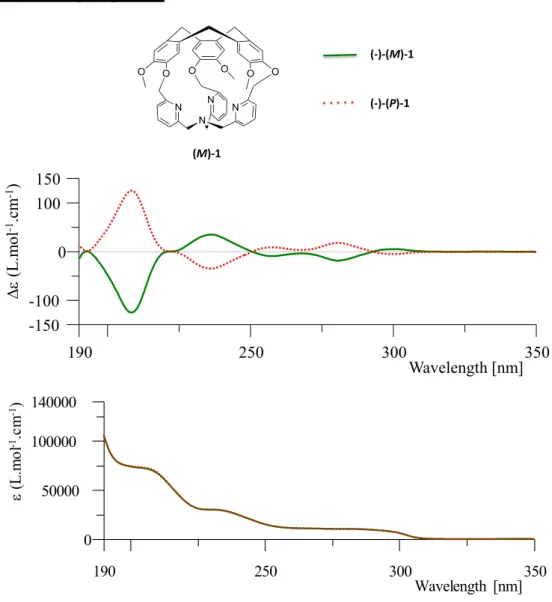
Based on theses interesting examples of chirality transfer between chiral unit and linkers, the supramolecular chemists asked themselves: could this phenomenon be extended in order to control the helical arrangement of another achiral C3 symmetrical unit? The remote control of the helical arrangement by some tripodal units is indeed of particular interest, as it might allow to turn an achiral artificial ligand into an enantiomerically-pure binding site. For example, the control of the helicity of the C3 symmetrical tris(2-pyridylmehyl)amine (TPA) ligand has attracted considerable attention due to its versatile applications, ranging from bio-inspired models,[11] catalysts,[12] to chiral sensors.[13] This ligand could display a propeller-like arrangement of its pyridine units that rapidly interconvert between clockwise and anticlockwise enantiomeric conformations. Therefore, by controlling the sense of its pyridines twist, the achiral TPA could be switched into a highly desirable chiral coordinating structures. In 2019, the X-ray structure of the TPA-based hemicryptophane 24 was reported during the study of this cage-ligand for selective metal-based methane oxidation.[14] This solid-state structure reveals a CTV-dictated triple-stranded helical arrangement of the phenyl linkers of 24, but no orientation of the southern TPA part was observed. On this basis, Colomban, Martinez and co-wokers have designed the structurally contracted cage 1 [15] where the phenyl linkers are replaced by single methylene –CH2- (Figure 1.12, F). The authors resonated that a closer proximity between the chiral northern CTV cap and the southern TPA ligand would result on the propagation of the chirality of the CTV to the TPA ligand allowing for a predictable control of its helicity. These expectations turn out to be
33
accurate since the organic cage 1, which represents the smallest hemicryptophane ever reported, remarkably displayed a controlled clockwise / anticlockwise propeller arrangement of the TPA unit dictated by the chirality of the CTV unit (M- or P-). The covalent capping with a M-CTV unit indeed results in a left-handed propeller arrangement of the TPA (while P-CTV lead to a right-handed propeller arrangement). It should be noted that enantiopure version of (M)-1 and (P)-1 were obtained in an highly efficient purification step based on the chiral-HPLC resolution of the racemic mixture (+/-)1 (ee values >99.5%). Importantly, this strong chirality transfer is maintained upon metallation of the TPA moiety with Cu(I) metal ion. The resulting complex CuI(1)(Cl), (Figure 1.12, F) display a rare T-shaped coordination geometry
along with a controlled helicity of the TPA unit that is maintained in both the solution and the solid state (XRD, 1H-NMR, ECD analysis). To the best of our knowledge this approach was the first, and to date unique, example of a predictable and robust control of the TPA helicity, achieved through its covalent substitution with a chiral C3 symmetrical unit. Furthermore, in sharp contrast with other chiral TPA-based cages found in the literature, which often display structural studies of the helicity based on computational methods, the chirality transfer in 1 and CuI(1)(Cl) were
unambiguously evidenced through XRD analysis. Finally the design of the cage-ligand 1, that allows the authors to report an unprecedented Cu(I) complex with a controlled helicity of the TPA-Cu(I) core, highlight the promises of the approach for the preparation of novel optically pure metal-based catalysts and receptors.
This strategy, combining chiral CTV cap and short spacers to control the chirality of another C3 symmetrical unit, has been further exemplified by Martinez and his team through the preparation of the hemicryptophane 25.[16] Due to its ability to engage strong hydrogen-bonds, the benzene-1,3,5-tricarboxamide (BTA) unit has been widely reported as a useful building block for the preparation of supramolecular assemblies. [17,18] Therefore, methods able to tune and control its structural properties are of particular interest. With such considerations in mind, the nanosized cage 25 was built aiming at controlling the sense of rotation of the three amides of the BTA unit. Hemicryptophane 25, consists in a southern BTA covalently linked to a chiral CTV cap by three ethylene –C2H4- linkers (Figure 1.12, G). Interestingly, the close proximity between CTV and BTA units in this cage, allows for a remote control of the Λ/Δ orientation of the three amides of the south part dictated by the chirality of
34
the CTV cap. It was indeed demonstrated, though XRD analysis of single crystal of the racemic mixture of (+/-)25, that the BTA unit capped with a M-CTV displays a Λ orientation of their amides, while the cage built from a P cap result in an Δ arrangement of the chiral conformation. It was shown that the enantiopure cages (M-Λ)-25 and (P-Δ)-25 could be easily obtained, with excellent ee values (ee >97.5 %,) through straightforward chiral-HPLC resolution of the racemic mixture followed by ECD-based assignment of the absolute configurations. Finally, the authors proposed, based on 1H-NMR observations, that the chirality transfer observed in the solid states might be retained in solution.
Another remarkable strategy to achieve a predictable control of the chirality of a tripodal ligand consists in its non-covalent capping with a chiral concave open-cage structure, through intermolecular ionic contacts. This so-called “Russian nesting doll” approach have been reported in 2016 by Badjic and coworkers, which used the chiral molecular baskets developed by this team to create and control a propeller-like arrangement of a TPA-based Zinc complex.[19] The self-assembled architecture
ZnII(27)(Cl) is based on supramolecular ionic interactions between a zinc complex
substituted with three positively charged ammonium groups ZnII(TPANH3)Cl, and the
chiral molecular nest 26 (displaying three negatively charged carboxylates at its rim). Formation of the entrapped Zn complex ZnII(27)(Cl) in its nesting form, without
appearance of intermolecular aggregates, was evidenced by 1H-NMR titration, ESI-MS analysis, and computational simulations. The preferential formation of the Russian nesting dolls conformation of ZnII(27)(Cl) was explained by both
hydrophobic effect and nonpolar interactions between the two hydrophobic shell of 26 and ZnII(TPANH3). It was interestingly observed that the chirality of the anionic
basket 26, which display (S)-alanine amino acids groups at its rim, is efficiently transferred to the cationic ZnII(TPANH3)Cl moiety, resulting in a controlled
propeller-like arrangement of the TPA’s pyridines. It was indeed proven through careful analysis of computed structures and circular dichroism (CD) spectrum, that the supramolecular interactions between the three carboxylates of 26 and the ammoniums of ZnII(TPANH3)Cl were responsibles for the exclusive formation of a left-handed (M)
Zn-TPA core. Interestingly, this study allows the authors to demonstrate, for the first time, that a predictable control of the helical arrangement of TPA-based complexes, could be achieve by an ionic contract-based transfer of chirality within tripodal cages.
35
In 2017, the same group further exemplified the approach by studying the capture of several metallated and non-metallated TPA derivatives by both anionic and cationic molecular baskets.[20] Molecular dynamic computational simulations and 1H NMR / ITC experimental analysis were performed to better understand the formation of the nesting complexes, which was found to be driven by hydrophobic effects and assisted by ionic host/guest contracts.
Figure 1.12 Examples of tripodal cages displaying a transfer of chirality between a
chiral unit and its side arms. Schematic representation and computed structures of open cages 20 (A) and 21 (B) together with the schematic representation and XRD structures of hemicryptophanes 22 (C), 23 (D) and 24 (E) (the XRD structure of 22 and 24 displays an entrapped molecule of toluene and CH2Cl2 respectively). (II.)
36
Examples of C3 symmetrical cages showing a propagation of the stereogenic information from a chiral unit to another tripodal ligand. Schematic representation and XRD structures of hemicryptophane 1 and its corresponding CuCl complex (F) and hemicryptophane 25 (G), along with the chemical structures of the nesting complex
ZnII(27)(Cl) and its precursors 26 and ZnII(TPANH3)Cl (H). Purple arrows depicts
the observed chirality transfers.
I.2.4 Chiral-sorting in tripodal cages
This second part of the mini-review aims at describing how the chirality of one coupling partner could influence the chirality of a second precursor during the formation of chiral tripodal cages. Could the thermodynamic resolution of a racemic mixture of precursors by its coupling with another enantiopure unit, result in the exclusive formation of optically pure C3 symmetrical cage ? To answer this question Martinez and coworkers studied in 2015 the [1+1] coupling reaction between a racemic mixture of an aldehyde-based CTV derivative (+/-)28 (M- and P-) and a chiral TREN unit (S,S,S)-29.[21] Thanks to this novel chiral-sorting based strategy, the synthesis of the enantiopure cage M-(S,S,S)30 was successfully reported. Enantiopure (S,S,S)-TREN precursors displaying methyl, isopropyl, and phenyl substituent were tested and, in all cases, the reductive amination results in the exclusive formation of a single diastereomer M-(S,S,S) of the tripodal cage 30 in a 15% average yield. The high diastereoselectivity of the cage formation was indeed evidenced through 1H-NMR, XRD diffraction, and ECD analysis in both solid-state and solution. It was clearly demonstrated that the reaction between the chiral TREN unit and the two enantiomers of the CTV unit provides two different products: while the condensation with M-CTV gives a well defined cage M-(S,S,S)30, the reaction involving P-CTV results in the formation of insoluble polymeric species. As highlighted by the authors, such thermodynamic resolution could be seen as a transfer of the stereochemical information of the CTV unit through a remarkable ten-bonds distance (10 Å).
As part of chiral discriminations, the self-sorting phenomenon, in which a racemic mixture of cage-precursor is spontaneously sorted in narcissistic or social assemblies, is particularly challenging since homo- and heterochiral structures only differ from
37
the spatial orientations of the enantiomers. Interesting examples of chiral self-sorting
events have been reported during the formation of supramolecular
architectures.[22,23] This strategy has been recently applied to access enantiomerically pure C3-symmetric cages built from two identical cofacial chiral units. Within the few examples of chiral self sorting achieved through dynamic covalent chemistry (DCC), Mastalerz and coworkers reported, in 2017, the preparation of an enantiopure tripodal cage build from two cofacial triaminotribenzotriquinacene chiral units 31 assembled by three bis(salicyaldehyde) linkers 32.[24] The reaction between a racemic mixture of 31 (M and P) and the linkers leads to the preferential formation of the narcissic self-sorted products
(M/M)-33 and (P/P)-(M/M)-33 rather that the social one (M/P)-(M/M)-33. Therefore, a remarkable control
of the chirality of the two partners, resulting in to the selective formation of chiral salicyimine based-cages was achieved, no matter the nature of the organic solvent. Based on experimental observations, the authors were able to explain such preferential self-sorting event by the rather low solubility of the social self-sorting product (M/P)-33, both product formations being in thermodynamic equilibrium during the condensation process. A combination of semi-empirical calculations and variable temperature (VT) 1H NMR analysis allow the authors to conclude that enthalpy favors the social self-sorting product (M/P)-33 (by 6.5 +/- 3.4 kJmol-1) while entropy favors the formation of the narcissic self-sorting product (M/M or P/P)-33 (by 38 +/- 11JK-1mol-1). This work demonstrates that a selective preparation of chiral covalent tripodal cage could be achieved following a chiral self-sorting strategy taking advantage from (i) the favorable entropy of homochiral architecture and (ii) the difference in solubility between homo- and heterochiral compounds.
In the same line, enantiopure self-assembled metallacages have been constructed through the spontaneous chiral self-sorting of racemic mixtures of ligands, upon metal coordination.[25,26]. Although several reports of chiral metal-based assemblies, obtained by chiral self-sorting events, can be found in the literature, examples of C3 symmetrical self-assembled cages, constructed from two cofacial tripodal ligand, are more rare. Goeb, Sallé and co-workers very recently reported the preparation of a tripodal self-assembled metallacage 36 constituted of two cofacial truxene units 34 assembled by the diruthenium bridging complexes 35.[27] The truxene building block
38
derivatisation of the hexabutyl truxene. The achiral 34 is described as a face-rotating ligand meaning that it displays two different faces with opposite directionalities. The rotation of the methylene bridges of 34 indeed results in one clockwise (C) and one anti-clockwise (A) face (Figure 1.13). As consequence, cages resulting from the cofacial assembly of 34 could either lead to hetero-chiral assembly (C/A)-36 or homochiral stereoisomers (C/C)-36 or (A/A)-36. The self-assembled cage 36 was prepared by reacting the truxene building block 34 (1 equiv.) with 1.5 equivalent of diruthenium complexe 35Napth, which act as the three wall of the C
3-symmetrical cages. Interestingly, the self-assembly leads in the exclusive formation of a mixture of [M6L2] chiral cages (C/C)-36 and (A/A)-36. 1H NMR, 2D COSY and DOSY NMR analysis, and XRD solid-state characterizations indeed allow the authors to conclude that the self-assembly is dictated by an homo-chiral self-sorting event. Such remarkable behavior, where homo-chiral cages emerges from a mixture of achiral building blocks, was found to be dictated by (i) the through-space interactions between the alkyl substituants of both cofacial units and (ii) the tilt value of the ruthenium-based wall.
To summarize, these examples highlight the fact that chiral tripodal cages, constructed from dynamic covalent bonds or metal-ligand linkages, could be effectively obtained following a chiral-sorting approach. This strategy, that could involve two different chiral coupling partners,[21] two enantiomers of the same building blocks,[24] or two identical achiral ligands,[27] displays crucial benefits regarding the desired straightforward preparation of enantiopures hosts avoiding tremendous purifications steps.
39
Figure 1.13 Examples of tripodal chiral cages obtained by chiral sorting. (A) Preparation of the enantiopure hemicryptophane 30. (B) Chiral sorting of the homo-chiral covalent cage 33 together with the XRD structure of (M,M)-15 displaying two encapsulated molecules of THF. (C) Sorting of the homochiral metallacage 36 and XRD structure of (A-A)36. (II) Examples of guest-dictated control of the chirality in tripodal cages. (D) Schematic representation of the preparation of TPA-cages 37a-c. (E) Schematic representation of the capsule (M)-39 along with XRD structures of (M)39(-) (contain a disordered CH2Cl2 molecule, not represented) and (M)39(+)(C2H4Cl4).
40
I.2.5 Control of the host chirality through guest binding
The on-demand control of the chirality of an artificial receptor is a particularly challenging goal for chemists aiming at reproducing the allosteric recognition processes found in the biological world. Therefore, the discovery of systems that allow for a switch of chirality dictated by an external stimulus is of particular interest.[28,29]. On this basis, tripodal cages displaying helical arrangements and able to encapsulate guests within their inner space, appear as promising systems since a guest-dictated control of the host chirality might arise from specific binding events.
As highlighted in the first part of this mini-review, the control of the propeller arrangement of ZnII and CuII complexes made from the TPA derivatives is of particular interest for the development of chiral molecular sensors with characteristic CD absorption features.[30] With such considerations in mind, the team of Zonta has explored the possibility of constructing flexible TPA-based cages able to switch between a clockwise (P) or anticlockwise (M) orientation of the pyridine’s propeller arrangement, depending on the nature of the encapsulated guest. Their indeed report, in 2019, the preparation and characterizations of the chiral tripodal cages 37 based on two cofacial TPA coordinating units connected through chiral diamines linkers (38a,
38b and 38c).[31] The host-guest adducts were formed in situ through the addition of
5 equivalents of the diamine linkers 38a-c to a mixture of the ZnII(TPAPhCHO)
complex (2 equiv.) and dicarboxylate guest Cn (1 equiv.), (Figure 1.13). This
template approach allows for the complete formation of cage with entrapped dicarboxylate guests ranging from C4 to C8 (while uncomplete cage formation are
reported for the longer C9 and C10 guests). The authors characterized the resulting supramolecular architectures in solution by mean of 1H-NMR, 2D-NMR and MS techniques and determined their chiroptical properties through electronic circular dichroism (ECD) analysis. It was observed that an unexpected change in the ECD spectra of the ZnII(TPA)–based cage 37a, occureed upon moving along the C4-8 guest
series. Upon increasing the molecular length of the guest, a gradual negative to positive switch of the ECD signal, accompanied with a red shift of the maximum of absorbance, was indeed reported (in the case of cage 37a, that display di-aryl linkers). The authors ruled out the hypothesis that the observed inversion of ECD spectra
41
might result from modifications in the guests chiroptical properties or binding behaviors as (i) the alkyl-based guests do not absorb in this region and (ii) the observed ECD absorption were founded to be concentration independent. Based on these observation, it was postulated that the changes in the chiroptical properties of the host-guest system (ECD spectra), upon changes of the length of the guest, arouse from structural modification of the tripodal host that displays two stereodynamic TPA ligands and six stereogenic centers. As previously shown for this kind of host, the cavity size in 37a (Zn-Zn distance) is indeed dictated by the size of the entrapped guest.[32] This assumption was supported by calculated CD spectra, which confirmed that changes in the helicity of the TPA units induce an inversion of the CDs. Although no XRD structures of the hosts were reported, the mechanism of the guest lenght-dependent ECD changes was further elucidate by mean of DFT calculations of the cage conformation for each host-guest complexes. The guest-dependent breathing ability of the host arises from an increase or decrease of the dihedral angle between the vicinal amine that results in a switch in the helicity of the TPA ligand.
Another interesting example of guest-dependent control of the TPA’s dynamic chirality has been reported, the same year, by Badjic and coworkers.[33] The organic cage 39, constituted of a TPA-based ligand (TPANH2) covalently linked to a chiral
molecular basket 40 (M- or P-), derived from a previous work on switchable chiral host for the on-demand accommodation and release of small guests upon protonation/deprotonation of the TPA unit.[34] As an extension of this work, the authors reported, in 2019, a detailed structural study demonstrating that the rapid interconversion of the arrangement of the cage’s TPA (between clockwise(+) and anticlockwise(-) orientations) could be frozen upon encapsulation of haloalkane guests. The structural modifications of the tripodal host (M)-39, upon encapsulation of chlorinated or brominated guests, have been experimentally evidenced in both solution (NMR spectroscopy) and solid-state (XRD) (Figure 1.13). Furthermore the relative stability, upon guest binding, of the two diastereomeric forms of the capsule displaying clockwise (M)-39(+) or anticlockwise (M)-39(-) arrangements of the TPA, was computationally determined (DFT). While the encapsulation of the small CH2Cl2 did not influence the (+) or (-) orientation of the pyridines, these results remarkably demonstrate that the accommodation of larger guests such as CCl4, C2H4Cl4, or CBr4 leads to the formation of a (M)-39(-) / (M)-39(+) mixture with a 3:1 ratio. In other
![Figure 1.2 Representation of the two different strategies usually used for the synthesis of hemicryptophane hosts: (a) formation of the CTV unit as the final step; (b) [1 + 1] coupling of two parts](https://thumb-eu.123doks.com/thumbv2/123doknet/14557263.726181/14.892.150.739.95.555/figure-representation-different-strategies-synthesis-hemicryptophane-formation-coupling.webp)




![Figure 2.3 (a) Partial 1 H NMR spectra (500 MHz, CDCl3, 298 K) of 1 (top) and [1·H]-Cl (bottom)](https://thumb-eu.123doks.com/thumbv2/123doknet/14557263.726181/57.892.178.696.139.860/figure-partial-h-nmr-spectra-mhz-cdcl-cl.webp)
![Figure S8. Comparison of the 1 H-NMR spectra (CDCl 3 , 500 MHz) of [1.H]-Cl at 298K and 220K (top)](https://thumb-eu.123doks.com/thumbv2/123doknet/14557263.726181/81.892.107.785.115.990/figure-s-comparison-nmr-spectra-cdcl-mhz-cl.webp)

