Disaster Risk Reduction
in WASH
Experience in DRR mainstreaming in Nicaragua
This document has been published by the sector regulatory body, the Instituto Nicaraguense de Acueductos y Alcantarillados (Nicaraguan Institute of Aqueducts and Sewerage) INAA, with the technical and financial support of the Swiss Agency for Development and Cooperation, SDC.
The second version has been updated and published in 2014 by Swiss Cooperation Office in Central America. The third English version has been published in June 2015.
Consultant: Andrew Blackwell. SDC:
Ing. Miriam Downs – DRR and CCA Specialist Ing. Carmen Pong – Water and Sanitation Specialist Inputs:
Ing. Urs Hagnauer Design and lay-out: David Guardado
First edition: June 2015
This document may be partially or fully reproduced provided that the source and credits are cited.
1. Context . . . 4
1.1 The global threat of climate change and natural disasters. . . 5
1.2 Water and sanitation sector context . . . 5
1.3 Municipal context . . . 6
2. Background . . . 8
2.1 Starting Point . . . 9
2.2 Time Line and Scope . . . 10
2.3 Phases . . . 11
2.4 Situation in 2015. . . 17
3. Analysis . . . 19
3.1 Success factors . . . 20
3.2 Challenges . . . 27
4. Conclusions and Lessons learned . . . 29
Tables 1. Damage caused by Mitch to WASH systems in Central America. . . 9
2. Phases and Stages in DRR and WASH Integration from 1998 to 2017 . . 10
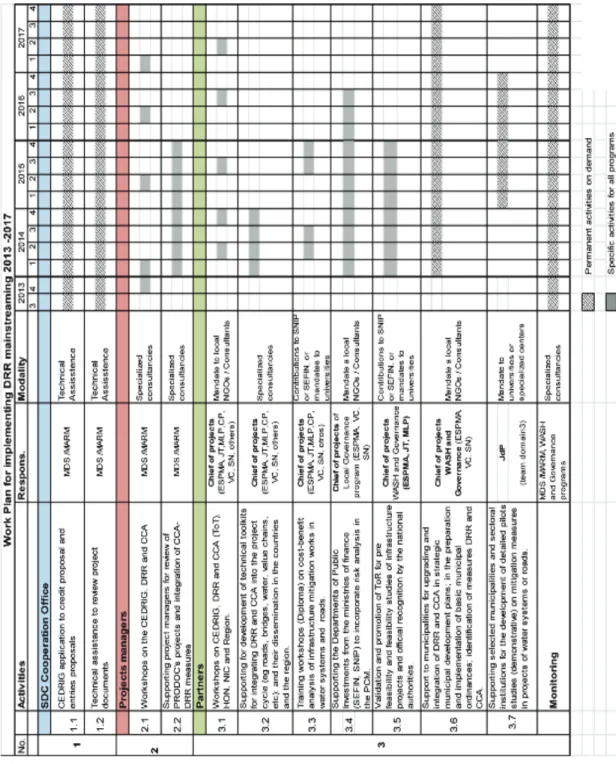
3. Work plan for DRR mainstreaming 2013-2017 . . . 23
Figures 1. Hazards, Vulnerability, Risk, and DRR measures for WASH systems . . . 21
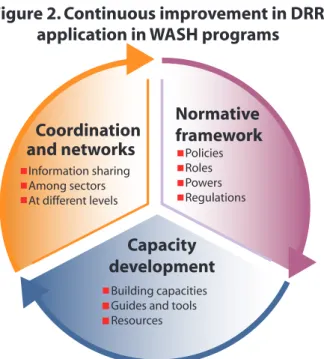
2. Continuous improvement in DRR application in WASH programs . . . 21
Cases 1. Reconstructing after disasters: Build back better after Hurricane Felix . . . . 31
2. Protecting Water Project in the community of El Jobo . . . 32
1.1 The global threat of climate change and natural
disasters
The risk of disasters is high throughout Central America. In Nicaragua, multiple natural hazards (earthquakes, tsunami, hurricanes, tropical storms, drought, landslides) combine with severe levels of socio-economic vulnerability, placing the country near the top of all international lists of countries with high disaster risk. Nicaragua is ranked 4th in the Climate risk index published by German watch in 2015. Multiple global, national, and local factors augment the hazards faced by water, sanitation and hygiene (WASH) services and increase their vulnerability. Intense tropical storms and hurricanes are affecting regularly the water systems infrastructure. More frequent and less predictable droughts and intense deforestation have deprived the Nicaraguan dry zone of the water needed for human consumption and agricultural production over prolonged periods.
1.2 Water and sanitation sector context
Responsibilities for water management in Nicaragua are strikingly disperse. Prior to 1998, the Nicaraguan Institute for Water and Sewerage (INAA) was in charge of designing, building, operating and maintaining water supply systems throughout the country. In 1998, as part of a governmental reorganization that separated regulatory and operational bodies, the Nicaraguan Aqueduct and Sewer Company (ENACAL) and the National Commission for Potable Water and Sanitary Sewers (CONAPAS) were created with operational and policy-development mandates, respectively.. While INAA became a regulatory agency, ENACAL became the operational body responsible for urban water systems.
Project development and financing for small water and sanitation systems was assigned to the National Emergency Social Investment Fund (FISE); and the operation, maintenance and administration was left in the hands of municipalities and Water Supply and Sanitation Committees (CAPs).
6
In 2010 a new law, gave legal status to the CAPs. That same year, without affecting the mandates of CONAPAS, INAA, ENACAL, FISE, the municipalities and the CAPs; the National Assembly approved a Water Law that created the National Commission of Water Resources (CNRH) and the National Water Authority (ANA), both with broad legal powers but very limited resources.
The resulting institutional constellation has not been followed by an effective distribution of resources. ENACAL is largely self-financed through the fees charged for water supply in urban areas. FISE is the ordained channel for all donor support for water and sanitation services in small towns and rural areas. INAA lacks the resources to enforce the existing regulations and CONAPAS lacks the political clout needed to ensure effective inter-institutional coordination for policy development. Small municipalities and CAPs depend on donors and project financing procedures established by FISE. Consequently, in order to exercise any influence in the sector, SDC’s WASH program, like other donor-financed programs aimed at supporting water services for Nicaraguan communities, has to work simultaneously with INAA, ENACAL, FISE, municipalities, and local community water committees (CAPs). Staff turnover in governmental agencies is always a problem when policy application requires knowledgeable personnel, trained in new areas that are not covered in traditional curricula as DRR. Efforts to train municipal and national agency staff in the application of measures designed to reduce disaster risk are lost when the trained staff is replaced constantly.
1.3 Municipal context
In relation to the rural water sector, where water systems are owned and operated by municipal governments and local CAPs, an important aspect of the political shift has been an erosion of municipal autonomy. Decisions are centralized at the presidential level. Consequently, considerations about the political impact of financing specific projects can take precedence over technical issues, including those related to disaster risk.
7
In 2013, the National Assembly approved the Law 850, Law on Amendments to the Law 466 "Law on Transfers of Budget to Municipalities"; this law established that Municipal governments should allocate a minimum annual investment of municipal budget for the following priority sectors: Health 5%, Education 5%, Environment 5 %, Water and Sanitation 7.5%.
At the local level, the major factor increasing the threat to rural water supply and sanitation systems comes from the pattern of deforestation that accompanies a steady ongoing expansion of the agricultural frontier and intensive soil degradation. Soil erosion and increased runoff of rainwater reduce aquifer recharge capacity and increasingly threaten the sources that feed small rural water systems.
While community-based water committees (CAPs) are usually able to maintain the water supply system infrastructure and manage normal system operations, they rarely have the mandate and capacity to address micro-watershed management.
2.1 Starting Point
The disaster caused by Hurricane Mitch in Nicaragua and Honduras at the end of October, 1998, shocked both countries and the international community into an awareness of the need to reduce Central American vulnerability to further natural hazards. The destruction of water supply and sanitation systems was among the most significant threats to human health. The damages to WASH systems affected thousands of families in four countries and, as indicated in Table 1, represented direct financial losses of almost $100,000,000.
The dramatic impact of Hurricane Mitch captured the attention of people, countries and development agencies throughout the world. SDC was no exception; early in 1999, Switzerland created a program for Central America to relief and rehabilitate from the damage caused by the hurricane and to reduce the risk of similar disasters in the future.
The new program was designed to work in parallel with the Central American development program, including the existing WASH program. Although Hurricane Mitch clearly demonstrated the vulnerability of water supply and sanitation systems, as well as the way that destruction augmented the human suffering caused by the disaster; it took many different steps carried out over a number of years, in the various stages of two distinct phases, to integrate disaster risk reduction (DRR) as part of the mainstream activity of SDC’s WASH program.
Source: OPS. Emergencias y desastres en sistemas de agua potable y saneamiento. Junio, 2004.
Honduras At least 90% of the population was left without potable water at the beginning of November, 1998, and 40% still lacked water at the end of the month.
$58,000,000
Nicaragua 800 water systems were damaged, representing 32% of the total water infrastructure. 10,000 latrines were destroyed.
$19,800,000
Guatemala 369 communities were left with damaged systems; 20,000 latrines were destroyed.
$16,100,000 El Salvador Severe damage to the water infrastructure. $2,400,000
Country Damages to water and sanitation systems Loss in US$
Table 1. Damage caused by Mitch to WASH systems in Central America
2013 - 2017 Maintenance, growth, scaling and refinement.
Climate change and DRR is a Domain of PRAC 2013-2017
Ongoing training throughout
Central America among regional instances (CSUCA, FOCARD, FOPREL)
Accompaniment and monitoring of implementation
Refinement,
Scaling Up
and
Monitoring
Starting Point: Hurricane Mitch, 1998
Critical turning point: Hurricane Felix , 2007
Time Line and Scope
Internalization of the process
Years/Description Activities and events
Awareness
1998 – 2006 1998 - 2002 Mitch. Shock, awareness and demand InternalizationCreation of Humanitarian Aid Office and DRR Program
Awareness workshops, search for synergies Creation of DRR National System
DRR as a work focus
Mixed DRR/Wash working group created PAHO+INAA produce a first general Guide 2003 – 2006
Critical
turning point:
Hurricane
Felix , 2007
2007 Hurricane Felix. Formalization (DRR mandate from Berne)DRR in PCM (SDC- Humanitarian Aid Tool) DRR in regional program (PRAC 2007-12) DRR in Strategy and Annual WASH Work Plan
DRR Mainstream concept and work plan developed. Rehabilitation activities: Contiguum approach 2008 - 2010 Development of tools and capacity-building.
Inter institutional committee created (RASNIC, INAA, ENACAL, FISE, SDC) Preliminary Detailed Guidelines Training effort to create a “critical mass” Validation of DRR in Watsan Guide
Tools and
training
2011 - 2012 Consolidation and application.
Field testing of instruments
More WASH training focused on tools in Central America
Application by WASH program and their partners (Indicator,
activities and budget)
Application,
monitoring
and
consolidation
P
H
A
SE
2
P
H
A
SE
1
P
H
A
SE
3
10
Table 2. Phases and Stages in DRR and WASH Integration from 1998 to 2017
2.2 Time Line and Scope
The process leading to mainstreaming DRR in the WASH program is summarized in the following table. It identifies the scope of activities and events linking the DRR and WASH programs in different stages on the time line between 1998 and 2015.
2.3 Phases
Phase 1
Stage 1: Awareness . 1998-2002:
Immediately in the wake of Mitch, national institutions and donor agencies sought to understand the causes of such major destruction and also to determine how best to channel huge commitments for humanitarian aid. Following the creation of SDC’s Humanitarian Aid (HA) Program, the staff began a dialogue with the WASH project to identify elements for close collaboration. The staff identified that HA needed WASH to repair damaged water systems that were crucial for human health, while WASH needed DRR to help avoid future destruction of water and sanitation installations.
As a result of the identification of this mutual need, a course on DRR for project leaders was held jointly by HA and WASH in 2000. It was intended as a first step towards ongoing collaboration, and it was followed by a number of ad hoc interchanges that, like the course, heightened awareness of DRR issues. Nevertheless, at this stage, since both HA and WASH staff were focused on their respective parallel programs, no ongoing organizational link was established.
Stage 2. Internalization. 2003 – 2006:
In 2003 INAA and the Pan-American Health Association (PAHO) collaborated in the preparation of a “Technical Guide for the Reduction of Vulnerability in Water Supply and Sanitation Projects” that was published in 2004. The Guide was extensive, quite general, and somewhat discursive and abstract, but it represented an important first step towards integrating DRR into WASH projects in Nicaragua.
In this stage, although SDC did not play an active leadership role in advancing DRR in the water sector as a whole, the WASH program collaborated by promoting efforts to make use of the INAA/PAHO Technical Guide in its projects. At the same time, numerous steps were taken towards formalization of what had previously been ad hoc efforts to consolidate collaboration between the HA and development programs, with a focus on WASH projects.
12
An important step occurred in 2003, when the Central American program defined the incorporation of disaster prevention as a challenge. A working group was formed to address the challenge; it defined the WASH program as one of two priority areas (the other was the micro-finance program). Seeking a practical tool to guide DRR in project design and implementation, between 2003 and 2006, members of the working group made several attempts to develop a checklist for disaster prevention. Unfortunately, all of the draft checklists proved to be very technically complex.
The working group realized that simple tools, validated by their intended users, were needed in order to ensure that DRR measures would be adopted and used in development projects.
In parallel, in the preparation of the Disaster Reduction Program plan for the period 2005-2008, HA staff identified components and results for local projects that called for mainstreaming disaster prevention into municipal planning, including water projects.
Simultaneously, starting in 2005, the WASH programs began to work with FISE to train municipal and community leaders in protection of water sources and reduction of water system vulnerability.
Turning Point. Hurricane Felix and formalization. 2007:
Further steps toward formalization took place from January to August 2007. The working group proposal prepared to incorporate DRR into the regional strategy and the project cycle was formalized and approved at the start of year. It identified WASH as the priority program for applying DRR and indicated that the HA staff would participate in planning and evaluating WASH projects.
Later, in August, DRR became a theme in the WASH regional workshop and it was determined that the WASH program would designate a representative to participate in the national and regional bodies established to address disaster response and risk reduction. These measures taken at the level of the national program in Nicaragua were supported by the emission of a DRR Guide in the project cycle management and the mandate issued from SDC - HA headquarters in Berne indicating that all programs should systematically address DRR.
Then, between August 31 and September 5, Hurricane Felix swept across the North Caribbean Autonomous Region (RACN) of Nicaragua, flattening a broad swath of forest, lifting off roofs from housing, and damaging almost all the water systems in the region. SDC had been an important contributor to the construction of many of the damaged systems and it was clear that the lack of attention to DRR issues in their design had left them vulnerable to damage by the hurricane. To assist in repairing the damage, SDC, through HA and WATSAN programs assigned $245,000 in emergency relief and rehabilitation, with the stipulation that risk analysis, risk reduction measures (like gabions, reforestation, etc ) and DRR training were to be included as part of the water system rehabilitation.
Just as Hurricane Mitch in 1998 demonstrated the high degree of vulnerability in Nicaragua and Honduras, catalyzing national and regional efforts to manage humanitarian aid and beginning to address DRR; it was another storm, Hurricane Felix in 2007, that demonstrated the ongoing need to incorporate DRR in all development projects, and catalyzed SDC’s commitment to mainstreaming DRR measures in the WASH program. The long period of internalization and debate, the new disaster, and the mandate from Berne to address DRR as part of projects, combined to catalyze and trigger the DRR mainstreaming process in a structured way in WASH program.
14
Phase 2
Stage 1. Tools and Training. 2008-2010:
The primary difficulty encountered in early efforts to introduce DRR measures in WASH projects was the distance between the technical complexity of DRR measures and the technical capacity of the community groups, municipal and institutional personnel responsible for supervising, designing, building and operating rural water and sanitation systems. To overcome this difficulty, the WASH and HA teams in the Central American office of SC decided to support training activities to prepare a “critical mass” of technical personnel in national agencies and municipalities, able to apply technical tools, and—at the same time—to support the preparation of more precise and practical technical guidance documents, taking into account the previous experience during the Hurricane Felix. Starting in 2008 a number of national courses and workshops were organized to provide training in DRR measures related to water supply and sanitation systems for staff from INAA, ENACAL, FISE and Nicaraguan municipalities, as well as in similar institutions in Honduras.
Rather than continuing with its own separate “checklist” development process, the SDC WASH and HA team focused its tool preparation efforts on working with the national regulatory authority (INAA), the national water system operator (ENACAL) and other members of the Nicaraguan WASH network to update and improve the technical guide published by INAA and PAHO in 2004.
The resulting 2011 edition of INAA’s Technical Guide for Reduction of Vulnerability of WASH Systems was much more focused than the 2004 version, providing a comprehensive overview of the DRR issues related to designing, building and operating small and medium sized WASH systems as well as more precise practical guidance for addressing them.
Stage 2. Application, monitoring and consolidation - 2011-2012:
With the publication of the revised Technical Guide by INAA and SDC and its validation in a series of workshops in Nicaragua and Honduras, and the ongoing training activities underway in the key WASH agencies as well as in national universities, the stage was set to incorporate DRR measures into the activities of the national institutions in charge of water and sanitation and to apply DRR procedures in the design, construction and operation of local municipal and community WASH systems.
Throughout 2011 and 2012, SDC supported NGO´s, Municipalities and FISE’s efforts to ensure such application, at the same time training activities continued at the regional, national and local levels.
Phase 3. Refinement, Scaling Up and Monitoring.
2013-2017:
By 2013, although national regulatory and operational agencies in charge of WASH activities had staff trained in DRR and a comprehensive technical tool for their use, national priorities were no longer fed by immediate memories of major disasters. In this context, renewed political interest in quickly providing water services to as many communities as possible, overruled the caution required by DRR principles.
Technical staff and consultants employed by municipalities find themselves pressured to downplay risks that, if taken seriously, would impede project approval without the commitment of significant additional resources.
16
SDC’s institutionalized linkage between its HA and WASH programs plays an important role in sustaining the commitment to ensuring attention to DRR needs in WASH projects. A very important part of the role played by SDC has been to monitor local application of the technical guide recommendations, and then introduce changes to improve compliance. Reports by consultants hired in 2011 to carry out site visits in communities where SDC financed water systems, indicate that there were some failings in applying the recommendations. In some cases, a high degree of discretionary judgment was exercised in project proposal evaluations and also in construction criteria, almost always with a clear intent to minimize estimates of risk and vulnerability and to reduce costs. In response to this information, SDC has renewed its support for ongoing intensified training, continued its development of improved technical tools, and strengthened its oversight of project funding approvals. A key decision, resulting from the field visit reports and an evaluation of the 2011 Technical Guide, was to revise the document and then re-edit it as part of SDC’s Risk Reduction Toolkit, 2,000 documents were distributed among 21 universities, in all municipalities of Nicaragua (153), in regulatory and implementing institutions at national and regional levels, and also among consultants.
The new, 2013, version of the Guide is much shorter and it has much less descriptive text. It focuses on basic principles of DRR and highlights a practical series of detailed checklists to be incorporated into the project cycle. These checklists cover: a) natural hazards, potential impacts, physical, social, economic, institutional and environmental vulnerability; b) factors affecting project resilience; c) the location of each component of the system, its construction quality, and potential damages; and d) matrixes with clear criteria for providing numerical ratings of each sociocultural, organizational, economic, environmental and health factor affecting vulnerability; as well as e) tables for recording mitigation and repair measures and their costs. Use of these checklists reduces the range of potentially discretionary interpretation and facilitates a discreet identification of the levels of vulnerability found in the specific project proposal. This version took into account the CEDRIG and also local instruments developed in the frame of the DRR program in Nicaragua. In recognition that more intensive training and more precise technical instruments still provide no guarantee that the expected level of DRR vigilance will be applied when municipalities develop and submit project
proposals, and when FISE reviews them, SDC also decided to require a review of all potential projects by its own WASH program staff prior to releasing funds for project financing.
At the same time, several courses on planning WASH projects integrating DRR are developed in selected universities in Central America, funded by SDC. DRR and WASH programs are working together in collaboration with the Central American Council of Universities (CSUCA) to increase the critical mass of specialized technicians in WASH and DRR in order to make the waters systems more sustainable and resilient to face disasters.
2.4 Situation in 2015
Through a lengthy stage-by-stage process with an initial phase characterized by ad hoc initiatives sporadically undertaken by individual program officials and project leaders and a second phase where continuity and progressive improvement have been sustained by formal institutional commitments, SDC’s Central American program has developed a comprehensive model for DRR mainstreaming in a WASH program that has caught the attention of WASH and DRR institutions in Central America, and there is interest in its potential replication.
18
The situation created through the evolution of the model now in place in Nicaragua, and to a lesser extent in Honduras and C.A, is as follows:
■ Systematic analysis of hazards and vulnerabilities, identification of risks,
and design of avoidance or mitigation measures is now a requirement for WASH project funding from SDC.
■ Technical guides have been field tested and continuously improved,
devolving into detailed user-friendly and comprehensive checklists for evaluation of the risks associated with each stage of the project cycle and appropriate mitigation measures for each proposed water and/or sanitation project.
■ Ongoing staff training ensures a critical mass of personnel able to apply
the technical guides, both at the national level in regulatory, operational and project funding agencies and at the local level, in municipal governments, community water system committees, and construction contractors.
■ To ensure continuous training, DRR and WASH programs are working
together in collaboration with the Central American Council of Universities (CSUCA) to increase the critical mass of specialized technicians in WASH and DRR in order to make the waters systems more sustainable and resilient to face disasters.
■ DRR program is working with the Department of National Public
Investment, to integrate DRR as part of National System of Public Investment, that includes water and sanitation projects. The Terms of reference and the methodology for feasibility planning projects will be improved taking into account the Technical Guide for Reduction of Vulnerability of WASH Systems, published in 2014.
■ Direct and parallel monitoring of compliance by SDC has been
established to compensate for institutional fragmentation and less effective enforcement of the application of DRR measures by national agencies.
■ SDC WASH and DRR officials are working together on local monitoring
and discussing ways to help build an enforceable national regulatory framework.
20
3.1 Success factors
There are four factors that appear to have been key in this advance towards establishing an effective model for mainstreaming DRR in the WASH program in Nicaragua. These are:
■ adoption of a clear and comprehensive conceptual framework that
is easy to communicate.
■ a solid work-plan with dedicated human resources and an annual
budget.
■ a focus on development of tools for technical guidance and training
in their use.
■ 4. implementation monitoring.
Comprehensive conceptual framework
The conceptual framework that has been adopted and can be easily communicated to WASH practitioners at both the national and local levels includes two main components.
The first simply demonstrates that hazards and vulnerability combine to create risks for the components of a WASH system, and define the need to identify and implement risk prevention and mitigation measures. For the critical issue of defining and selecting specific DRR measures, training for technical personal emphasizes the following criteria:
■ Effectiveness: will the measure actually reduce the risk?
■ Cost/benefit: the measure should not cost more than the installation it
is to protect.
■ Feasibility: the measure should not be too complex; the required
materials should be available; community members should be able to build it.
■ Sustainability: the measure should require little maintenance; the local
water committee should be able to provide all necessary effort and resources.
NATURAL HAZARDS Landslides Earthquakes Floods Volcanic eruptions Drought VULNERABILITY Exposure of WASH system
System operativity Administrative capacity RISKS
for components of WASH system
Identification and implementation of RISK PREVENTION AND MITIGATION
MEASURES
This component can be illustrated in the following figure.
Figure 1. Hazards, Vulnerability, Risk, and DRR measures for WASH systems
The second component identifies the elements needed to establish an ongoing sustainable process with the possibility of continuous improvement in DRR application in the WASH sector. As illustrated in figure 2, these elements form a circle that converts exploratory efforts into lessons learned, and lessons learned into required practice that then becomes the basis for new exploration.
Coordination Normativeframework
Building capacities Guides and tools Resources Information sharing Among sectors At different levels Policies Roles Powers Regulations and networks Capacity development
Figure 2. Continuous improvement in DRR application in WASH programs
22
COSUDE has focused on the element of capacity development, while participating and promoting active coordination and networking. A major effort is still needed to ensure that lessons learned are put into obligatory practice, and there is no regulatory platform to sustain continuous improvement on a national scale.
Work-plan evolution, budget & resources
The preparation of a detailed work plan with clearly identified responsibilities for the implementation of activities expected enables the achievement of specific objectives within specified timelines and becomes realistic once there are staff, a budget, and a corporate mandate that ensures such resources will continue to be available during the period covered by the plan.
For the 2013-2017 period covered by the current work-plan has a DRR budget of CHF 500,000 and WASH has a mandate to incorporate DRR expenses in project costs and to vet specific water projects to ensure compliance with DRR guidance.
The result is an ongoing, constant, programmable process of coordination between the DRR and WASH teams, in which activities are planned and monitored together as the DRR team pushes to mainstream DRR and the WASH team pulls to incorporate
T a b le 3 . W o rk p la n f o r im p le m e n ti n g D R R m a in st re a m in g 2 0 1 3 -2 0 1 7
Training and tools
WASH and DRR-CCA staff participate in national and regional wat/san and DRR networks, addressing one third of the conceptual circle for
sustainable DRR
mainstreaming.
Meanwhile, the focus of SDC’s own work-plan is
on capacity
development, through training and tool development activities. So far, between April 2008 and December 2014, SDC has sponsored 9 courses and workshops, training 228 WASH leaders in municipalities, national agencies, construction contractors, and NGOs in
DRR and risk
management. In
addition, in 2015 DRR has been incorporated into universities water and sanitation programs in Nicaragua and subsequently in other parts of the region, at least 90 technicians are taking these courses. The result is the creation of a modest but critical mass of leaders able to make use of technical tools.
At the same time, SDC has played a leading role in dramatically improving the available tools. The current document is easy to use and practical for local WASH system planners, addressing the critical issue of location as well as procedures to follow in each stage of the full project cycle. Table 3, below, indicates how the 2013 Guide provides specific tools for use at different moments in the project cycle.
Project Cycle with a Risk Focus P ro je ct Id en ti fi ca ti on
WHAT IS THE POTENTIAL DISASTER REDUCTION?
Hazards in the Area
Tool: Matrix1. Disaster Risk Reduction (DRR) Potential Vulnerability of Site P ro je ct A ss es sm en t
HOW RESILIENT IS THE PROJECT?
Resilience Assessment
Tool:Matrix 6. Preliminary damage assessment and needs analysis
Post-disaster Phase P ro je ct Im pl em en ta ti on
HOW PREPARED IS THE PROJECT FOR DISASTER? Risk Monitoring Project Monitoring Optional
Tools: Project’s Environmental Management, Plan or Monitoring Programme Contiguum Approach • Pre-disaster Phase • During • Post-disaster Phase Tools:
Matrix 4. Vulnerability analysis in drinking
water systems
Matrix 5. Risk mitigation measures and CCA Matrix 6. Preliminary damage assessment and
needs analysis P ro je ct P re pa ra ti on
WHAT IS THE REAL RISK OF DISASTER? Rapid Risk Assessment (RRA)
Tools:
Matrix 2. RRA – Resilience Matrix 3. RRA – Do no harm
Tool:
Risk Assessment methodology (see pg. 10) Definition of Measures Matrix 5. Risk mitigation
measures and CCA Detailed Assessment
26
Implementation monitoring
Good tools, even in the hands of trained staff, can be effective only when they are actually used by those who build and manage WASH systems. To help ensure such use, the new version of the Technical Guide has been evaluated by government agencies, municipalities and community leaders. Their responses indicate, at least, their intention to make use of the Guide, and their belief that they have received the training needed to do so effectively.
Declared intentions, of course, do not necessarily become effective actions. To help determine the degree to which DRR measures are in fact put into place in WASH projects, SDC supports FISE’s process for accompanying municipalities and communities as they design and build water and sanitation systems. In addition, SDC also periodically hires consultants to conduct field visits to accompany and monitor the implementation of the Technical Guide in local WASH projects in both Nicaragua and Honduras. As indicated above (see point 2.8), the monitoring reports prepared prior to publication of the new version of the Guide revealed some problems with implementation and prompted decisions to make improvements in training and accompaniment as well as to require individual project review and approval by SDC staff prior to release of funds by FISE.
It is hoped that the next monitoring reports will indicate that on-the-ground implementation has improved.
3.2 Challenges
To convert the model in place for WASH projects financed by COSUDE into a national process that mainstreams DRR in all domestic and internationally-financed water and sanitation activities, a number of challenges remain. Crucial among them are:
■ overcoming governmental “centralism”. ■ creating a regulatory framework.
■ demonstrating net gains in long-term cost-benefit of DRR activities.
Overcoming governmental “centralism”
Rural WASH systems are built and managed by municipalities and local communities, but funds and technical supervision come through national agencies.
In practice, as a result, national agency personnel often concentrate effective decision-making at the national level.
To ensure effective application of DRR measures throughout the country, national agencies need to support local authorities in the development and management of rural WASH projects. Low wages also interfere with responsible and effective local vigilance to reduce the risk of disaster, since it is difficult for municipal governments to retain trained personnel.
Creating a regulatory framework
Currently, the application of the technical Guide is not obligatory for water sector institutions. However, the regulatory agency for the water and sanitation sector, INAA staff and directors have indicated their willingness to work on preparing technical regulations that would make DRR measure obligatory in WASH projects.
SDC is interested in working together with INAA and FISE, but also with the Department of Public Investment to assure that the DRR guide is part of the National System of Public Investment and can become an obligatory normative.
28
Cost-benefit analysis
An underlying challenge is posed by the natural interest of all parties to try to maximize the social benefits of the limited resources available for installing water and sanitation systems. It is difficult for planners to invest in DRR measures that elevate the costs of each individual system rather than taking the chance that natural hazards will not cause damage and thereby provide cheaper systems in more communities, since they all need water now.
To face this challenge, and facilitate understanding of the need for DRR, the risk of damage needs to be translated into current dollars. This is a task that needs to be priority into COSUDE’s work-plan. Initial efforts are already underway to calculate the net present value of probable future damage from 10, 25, and 50 year events. The calculations are still preliminary, however, and considerably more work is needed, not only to ensure accuracy, but also to design and carry out an effective communication and training strategy. A project funded by SDC is underway with the Public investment Department to develop a methodology and training on cost-benefits analysis of DRR measures in Water projects that will contribute to this aim.
Conclusion
30
The lessons learned in COSUDE’s sixteen years of experience with efforts to apply DRR principles in WASH program delivery can be summarized as follows:
a) The most promising entry point is the establishment of technical DRR requirements for each step in the project cycle of local WASH projects. b) A systemic approach is needed, involving multiple steps including:
■ long term capacity development at local and national institutional
levels,
■ technical tool development, and updated ■ repetitive staff training,
■ ongoing monitoring at the local level, and
■ linkage of funding release to compliance with technical
requirements.
c) The monitoring process developed by SDC demonstrated that the comprehensive model to integrate DRR into WASH projects is working. It is being adopted by WASH practitioners at both, national and local levels.
d) In spite of the advances, some problems still remain, to face it the process should be continuous, systematic and monitored. Knowledge of local conditions, including the awareness, training and attitudes of municipal leaders and local construction contractors is essential for effective project oversight linked to funding decisions.
e) To facilitate such knowledge and avoid duplication of effort, SDC support for local WASH projects should be targeted geographically to areas where SDC also supports multi-hazard DRR mapping and local development planning.
f ) Integrating DRR into development projects is a long process that needs to be well planned, funded and with specific roles and functions of human resources.
Rehabilitation activities
■ Training on DRR around water system
protection, DRR, water quality, hygiene
■ Community-based water management
committee was created and trained
■ Risk analysis with communitarian
participation carried out in 6 water systems
■ Identification of DRR measures
■ Building back - better with communitarian
participation of 6 rural small water systems
Risk Analysis Hazards and impacts
Landslides (High)affecting the catchment zone Flood exposure, (high) the air crossings are broken or partially damaged. Deforestation (high): depletion of water. Soil Erosión (low) is affecting the conduction line. Water pollution (medium) Vulnerabilities
Phisical: the air crossings are broken or partially damaged
Organizational factor: The communities have not addressed micro-watershed management. Community-based water committees (CAPs ) are not organized. Economic Beneficiaries do not pay the water tariff, Operational: Lack of spare stock; No tools to operate and maintain the water system; Communities do not give maintenance to the water system.
after Hurricane Felix
Population served About 8000 people in 6 communities
Siuna, Autonomous Region of North Atlantic, Nicaragua
Background:
Hurricane Felix hits 07/04/2007 Category 5 winds> 260 km / hour). USD 300 mio. in losses.
Damage:
32.359 families affected; 188.726 people affected
130 people dead
10,145 homes destroyed; 9,057 homeless 179 public buildings destroyed
13.438 latrines destroyed 11,519 contaminated wells Response and Relief
activities
■ Damage and needs assessments carried
out by Humanitarian Aid and WASH programs.
■ Distribution of drinking water, and water
filters
Observations/ Challenges Municipality
Planning, Design & Construction Process
Planning and design process managed by FISE from 2006 to 2010 with World Bank financing. Community-managed construction in 2013 and 2014, supervised by FISE, with SDC financing.
Very lengthy design period with a three-year pause before construction.
After a risk analysis introduced by SDC the treatment plant was relocated to a more stable slope. Bioengineering measures were recommended.
Operation In December, 2014, shortly after system inauguration, a 50-year local extreme rainfall event, caused a landslide at the water catchment and soil erosion in the treatment plant area.
Financing future repairs may be an issue because users are not paying for the service at the moment. They will start in September 2015.
DRR accions ■ Community water committee members are
building a fence to protect and reforest the water intake area.
■ Protective measures (retaining walls) against
landslides are designed and will be built with financial resources saved by community-managed construction committee.
■ Bioengineering measures are implemented to
face erosion in the treatment plant area and tank.
■ 51 social promoters are being organized by FISE
in order to maintain the system and sensitizing activities with population around water system protection.
2. Protecting Water Project in the community of El Jobo
Population served
About 2000 people in 403 houses located in El Jobo and 4 other communities.
Municipality Matiguás, Department of Matagalpa
Widely dispersed communities located up to 15 km. from water source make community-based system management very difficult.
The response to the problems demonstrates good coordination between the municipal government,FISE and the community-based water management committee, but it relies on extraordinary commitment by community leaders. Observations/challenges
32
Carlos Flores, Community water committee coordinator.Population served About 2500 people in 530 houses located in El Hular and 5 other communities.
Matagalpa
Local leaders spent years requesting a water and sanitation project.
Design & Construction Process
Design contracted by FISE. Community-managed construction in 2014 with local supervisory engineer. Oversight by FISE and municipal wat/san unit.
Close working relations among community leaders, supervisory engineer, and municipal staff.
Problems Soil erosion on steep slope of treatment plant site identified during construction.
All parties agreed to address the problem. Response Community-based water committee will use
part of their $30,000 reserve to finance a contention wall. Material are in site, and construction will start in the next weeks.
Strong community leaders enabled user decision to use their own funds to address risks. Municipality and FISE agreed not to hand over system until DRR measures are
complete.
However, communitarians need water, and water supply initiated with a by-pass over the treatment plant, but with minimal measures to improve quality like boiling.