Delirium in advanced age and dementia: A prolonged
refractory course of delirium and lower
functional status
SOENKE BOETTGER,M.D.,1JOSEF JENEWEIN, PH.D., M.D.,1AND WILLIAM BREITBART, PH.D., M.D.2
1Department of Psychiatry and Psychotherapy, University Hospital Zurich, Zurich, Switzerland
2Department of Psychiatry and Behavioral Sciences, Memorial Sloan Kettering Cancer Center, New York, New York (RECEIVEDJuly 1, 2014; ACCEPTEDJuly 10, 2014)
ABSTRACT
Objective: The factors associated with persistent delirium, in contrast to resolved delirium, have not been studied well. The aim of our present study was to identify the factors associated with delirium resolution as measured by the Memorial Delirium Assessment Scale (MDAS) and functional improvement as measured by the Karnofsky Performance Status (KPS) scale.
Method: All subjects were recruited from psychiatric referrals at the Memorial Sloan Kettering Cancer Center (MSKCC). The two study instruments were performed at baseline (T1), at 2 – 3 days (T2), and at 4 – 7 days (T3). Subjects with persistent delirium were compared to those with resolved delirium in respect to sociodemographic and medical variables.
Results: Overall, 26 out of 111 patients had persistent delirium. These patients were older, predominantly male, and had more frequently preexisting comorbid dementia. Among cancer diagnoses and stage of illness, brain cancer and terminal illness contributed to persistent delirium or late response, whereas gastrointestinal cancer was associated with resolved delirium. Among etiologies, infection responded late to delirium management, usually at one week. Furthermore, delirium was more severe in patients with persistent delirium from baseline through one week. At baseline, MDAS scores were 20.1 in persistent delirium compared to 17 to 18.8 in resolved delirium (T2 and T3), and at one week of management (T3), MDAS scores were 15.2 and 4.7 to 7.4, respectively. At one week of management, persistent delirium manifested in more severe impairment in the domains of consciousness, cognition, organization, perception, psychomotor behavior, and sleep – wake cycle. In addition, persistent delirium caused more severe functional impairment.
Significance of results: In this delirium sample, advanced age and preexisting dementia, as well as brain cancer, terminal illness, infection, and delirium severity contributed to persistent delirium or late response, indicating a prolonged and refractory course of delirium, in addition to more severe functional impairment through one week of management.
KEYWORDS: Age, Dementia, Persistent delirium, Course of delirium, Antipsychotics, Cancer
INTRODUCTION
Delirium is a common condition in the course of hos-pitalization depending on the age of the patient and
the severity of their illness (Francis et al., 1990; Voyer et al.,2007). The occurrence of delirium varies depending on its presentation. On admission, in older patients the prevalence rate varies between 14 and 24% and in the course of hospitalization the incidence rate is between 6 and 56% (Bucht et al.,
1999; Lipowski, 1989). In the general hospital set-ting, the incidence of delirium ranges between 15 Address correspondence and reprint requests to: Soenke
Boett-germ University Hospital Zurich, Ramistrasse 100, CH-8091 Zurich, Switzerland. E-mail:[email protected].
and 30% of patients, in the hospitalized elderly 10 – 40% (Bucht et al.,1999; Lipowski,1989), in patients with cancer 57 – 85%, and in terminal illness up to 85% (Bond et al., 2006; Breitbart & Strout, 2000; Massie et al., 1983). Furthermore, delirium can have long-term consequences and is associated with poor functional outcome, increased morbidity and mortality, and prolonged hospitalization (Inouye,
1998;2006).
Several medical conditions have been identified as risk factors for delirium relevant to a specific cancer setting: low albumin levels, bone metastases, and the presence of hematological malignancy (Ljubisavl-jevic & Kelly, 2003). Medications represent another risk factor for developing delirium, where the admin-istration of benzodiazepines, corticosteroids, and opioids has been associated with incidence of delirium (Gaudreau et al.,2005; Rothberg et al.,2013). Another etiology representing a risk factor for delirium is hypoxic illness, which has been recognized to interfere with the reversibility of delirium, whereas the admin-istration of opioids or dehydration has been associated with reversible delirium (Lawlor et al.,2000a).
In a study on the occurrence and persistence of delirium symptoms (Levkoff et al.,1992), advanced age and cognitive impairment have been identified as a risk factor for increased incidence within a popu-lation. Persistence of delirium has been documented at three and six months after discharge from the hos-pital, leading to the conclusion that delirium may be a common disorder during the course of hospitaliz-ation and is much less transient than previously thought. Several studies have documented persistent delirium symptoms, some lasting for six months and longer (Kiely et al., 2006; McCusker et al., 2001;
2003). Furthermore, an association between length and persistence of delirium symptoms and functional recovery has been documented. Moreover, persistent delirium has been shown to be a predictor of greater mortality (Kiely et al.,2009; Lee et al.,2011). In con-trast, the persistence of delirium symptoms for less than two weeks has been associated with excellent functional recovery (Kiely et al.,2006), and resolved delirium is associated with decreased mortality (Kiely et al., 2009). Another factor contributing to worse delirium outcomes is the severity of delirium, with more severe episodes leading to more serious outcomes (Marcantonio et al.,2002).
Although there is evidence for the persistence of delirium symptoms and consequent functional sta-tus, our knowledge of risk factors and persistence of delirium in the more acute setting remains limited. In order to further explore these issues in a hospital setting, we performed an analysis that assessed the sociodemographic and medical variables associated with prolonged and refractory delirium.
METHODS Subjects
All subjects were referred for delirium management to the Memorial Sloan Kettering Cancer Center (MSKCC) Psychiatry Service from July of 2004 to June of 2006. The MSKCC is a 470-bed, private hos-pital specializing in the treatment of cancer and has an average of 20,000 admissions annually. Its consul-tation – liaison psychiatry service performs more than 2,000 consultations each year.
All patients included in our study met the criteria for diagnosis of delirium according to the Diagnostic and Statistical Manual of Mental Disorders (4th ed., text revision) (DSM – IV– TR) (American Psychiatric Association, 2000). Exclusion criteria were an inability to comply with delirium assessment, objec-tions on the part of the patient or family to taking medication or to treatment of delirium with any antipsychotic, and imminent death. All patients and families gave their verbal consent. For patients with a limited capacity to provide consent due to de-lirium, the primary caregiver provided verbal con-sent with the patient’s precon-sent.
Clinical data were recorded in an MSKCC Psy-chiatry Service clinical database approved by the in-stitutional review board, and a waiver was obtained for future analysis.
Measurements
Sociodemographic and medical variables such as age, sex, cancer diagnosis, stage of cancer (localized, metastatic, or terminal), psychiatric diagnosis, pre-existing dementia, presence of brain metastases, and delirium etiology were collected at baseline assessment and reevaluated during the observation period.
Delirium severity was assessed with the Memorial Delirium Assessment Scale (MDAS), a 10-item, 4-point clinician-rated scale (range 0 – 30) (Breitbart et al., 1997). MDAS item scores range from 0 to 3 (0 ¼ absent, 1 ¼ mild, 2 ¼ moderate, and 3 ¼ severe in presentation). It provides clear instructions on the rating process and defines the severity of present-ing symptoms. Scale items assess such aspects of delirium symptomatology as (1) a disturbance in arou-sal and level of consciousness, (2) impaired cognitive functioning, (3) weakened psychomotor activity, and (4) disturbed sleep– wake cycle. MDAS scores greater than 10 have been validated to identify the presence of delirium. In contrast, resolution of delirium is ident-ified by MDAS scores equal to or less than 10 (Kaz-mierski et al.,2008; Lawlor et al.,2000b).
Level of functioning was assessed with the Kar-nofsky Performance Status (KPS) scale, which
Boettger et al.
1114
https://doi.org/10.1017/S1478951514000972
indicates physical performance ability, and was devel-oped particularly for cancer patients (Karnofsky & Burchenal,1949). Scale scores range from 10 to 100, and lower scores indicate a higher degree of functional impairment and more severe illness (Appendix 1). Procedures
In accordance with the guidelines for management of delirium promulgated by the American Psychiatric Association (Trzepacz et al., 1999), environmental and psychopharmacological interventions were utilized. In addition to such environmental inter-ventions as providing a safe environment and fre-quent reorientation, antipsychotic medications were also initiated upon diagnosis of delirium and subsequently adjusted, with modifications deter-mined by clinical response. The standard approach is to manage delirium with antipsychotic medication and continue the necessary medical treatment, with the use of medications that can be classified as risk factors for delirium (e.g., opiates and corticosteroids). Underlying reversible causes such as infections were also treated.
The MDAS, KPS scoring, and side-effect rating were performed at baseline (T1), repeated at 2 – 3 days (T2), and at 4 – 7 days (T3). The observation periods ended after seven days, and patients were continued on antipsychotic medications as necessary. Statistical Analysis
Analyses for the trial were performed with the Stat-istical Package for the Social Sciences (SPSS, v. 20), a statistical software package for Windows. Our pri-mary interest was persistent delirium in contrast to resolved delirium in respect to sociodemographic and medical variables. The secondary interests were delirium severity and the phenomenology of delirium as described by total MDAS score and MDAS subscores. The dataset was defined as subsets representing persistent delirium, resolved delirium at T2, and resolved delirium at T3. Descriptive stat-istics were run in order to describe the sociodemo-graphic and medical variables.
A number of statistical tests were employed in our analysis. For parametric data on an interval scale (e.g., comparison of age between groups), a t test for independent samples was implemented. For non-parametric data (e.g., MDAS or KPS scores during the observation period), Friedman’s test for repeated measures was employed for dependent measures, and the Kruskal – Wallis test was utilized for inde-pendent measures (e.g., MDAS or KPS scores between groups). Pearson’s chi-square (x2) was im-plemented for categorical data (e.g., evaluation of cancer diagnoses and etiologies contributing to
delir-ium). Afterward, alpha (a) was corrected using the Bonferroni method, and the significance level for a was set at p , 0.05.
RESULTS
Baseline Characteristics
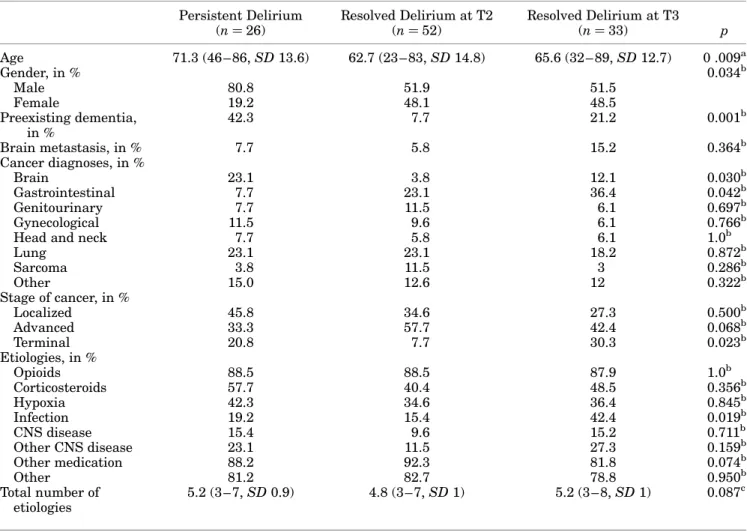
Overall, some 111 patients with delirium were retrieved, and 26 of these (23.4%) had persistent delirium (Table 1). Most patients (52, 47%) achieved delirium resolution within 48 to 72 hours.
Differences with respect to sociodemographic and medical variables between persistent and resolved delirium at T2 and T3 were as follows. Patients with persistent delirium were predominantly male and older than those with resolved delirium at T2 or T3, and preexisting dementia contributed to per-sistent delirium. In contrast, the absence of dementia was associated with faster recovery. Furthermore, factors contributing to late response or persistent de-lirium included the presence of brain cancer and terminal cancer. One fifth of patients with persistent delirium had brain cancer, in contrast to 3.8 – 12.1% with resolved delirium at T2 or T3. Terminal illness was present in 20% with persistent delirium and about 33% with resolved delirium at one week, in con-trast to 3.8% of those with resolved delirium at T2. Thus, the absence of brain cancer or terminal illness were associated with faster recovery with 72 hours of management. Among the etiologies, infection was usually associated with a later response to delirium management within one week.
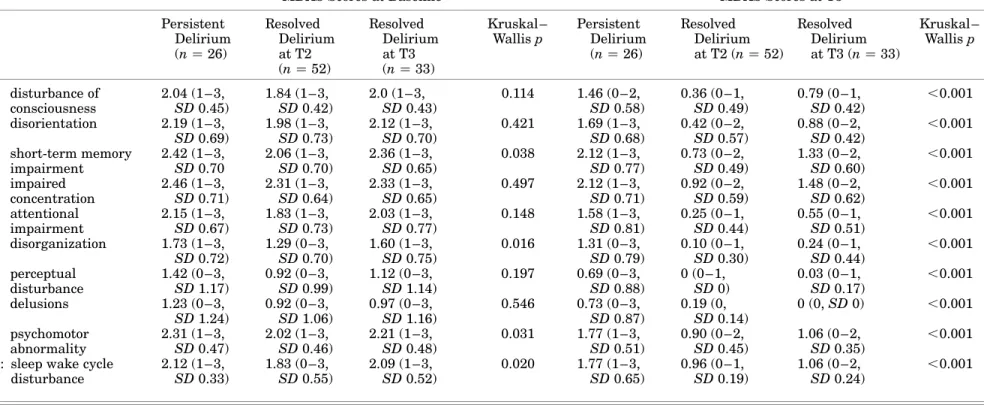
Description of Delirium Severity and Phenomenology in Persistent and Resolved Delirium at Baseline At baseline, delirium was more severe in patients with persistent delirium. The phenomenology of delirium as measured by the MDAS subitems was not much different. Marginal differences existed in the domains of short-term memory, organization, psychomotor behavior, and sleep – wake cycle. Patients with persistent delirium were slightly more impaired than patients with resolved delirium at T2 or T3. There were no differences with respect to the domains of consciousness, orientation, concen-tration, attention, perception, or delusions (see
Table 3).
Management Characteristics and Course of Delirium
In both persistent and resolved delirium at T2 and T3, MDAS scores improved over the course of man-agement. However, differences existed in MDAS scores at baseline, T2, and T3 (Table 2). Patients
Table 1. Baseline characteristics of persistent and resolved delirium at T2 and T3 Persistent Delirium (n ¼ 26) Resolved Delirium at T2 (n ¼ 52) Resolved Delirium at T3 (n ¼ 33) p Age 71.3 (46 – 86, SD 13.6) 62.7 (23 – 83, SD 14.8) 65.6 (32 – 89, SD 12.7) 0 .009a Gender, in % 0.034b Male 80.8 51.9 51.5 Female 19.2 48.1 48.5 Preexisting dementia, in % 42.3 7.7 21.2 0.001b Brain metastasis, in % 7.7 5.8 15.2 0.364b Cancer diagnoses, in % Brain 23.1 3.8 12.1 0.030b Gastrointestinal 7.7 23.1 36.4 0.042b Genitourinary 7.7 11.5 6.1 0.697b Gynecological 11.5 9.6 6.1 0.766b
Head and neck 7.7 5.8 6.1 1.0b
Lung 23.1 23.1 18.2 0.872b Sarcoma 3.8 11.5 3 0.286b Other 15.0 12.6 12 0.322b Stage of cancer, in % Localized 45.8 34.6 27.3 0.500b Advanced 33.3 57.7 42.4 0.068b Terminal 20.8 7.7 30.3 0.023b Etiologies, in % Opioids 88.5 88.5 87.9 1.0b Corticosteroids 57.7 40.4 48.5 0.356b Hypoxia 42.3 34.6 36.4 0.845b Infection 19.2 15.4 42.4 0.019b CNS disease 15.4 9.6 15.2 0.711b Other CNS disease 23.1 11.5 27.3 0.159b Other medication 88.2 92.3 81.8 0.074b Other 81.2 82.7 78.8 0.950b Total number of etiologies 5.2 (3 – 7, SD 0.9) 4.8 (3 – 7, SD 1) 5.2 (3 – 8, SD 1) 0.087c SD ¼ standard deviation. at test. b x2test.
cKruskal – Wallis test.
Table 2. Management characteristics of persistent and resolved delirium at T2 and T3 (medication doses administered at T3, MDAS, KPS scores and delirium resolution at baseline, T2, and T3)
Persistent Delirium (n ¼ 26) Resolved Delirium at T2 (n ¼ 52) Resolved Delirium at T3 (n ¼ 33) Kruskal – Wallis p Medications administered at T3 (in mg) Haloperidol (n ¼ 35) 3.7 (1 – 8, SD 2.2) 5.0 (1 – 8, SD 2.4) 5.4 (1 – 16, SD 5.0) 0.470 Risperidone (n ¼ 32) 1.5 (1 – 2, SD 0.5) 1.1 (0.5 – 2, SD 0.6) 1.4 (0.25 – 3, SD 0.9) 0.453 Olanzapine (n ¼ 22) 7.9 (2.5 – 15, SD 5.3) 5.5 (2.5 – 15, SD 3.3) 4.2 (2 – 5, SD 1.4) 0.515 Aripiprazole (n ¼ 22) 13.0 (10 – 20, SD 4.5) 18.2 (10 – 30, SD 6.0) 24.0 (20 – 30, SD 5.5) 0.025 MDAS at baseline 20.1 (13 – 30, SD 4.4) 17.0 (11 – 29 (SD 4.5) 18.8 (11 – 27 (SD 4.4) 0.080 T2 16.3 (11 – 25, SD 4.5) 6.5 (1 – 10, SD 2.3) 13.2 (11 – 24, SD 2.9) ,0.001 T3 15.2 (11 – 23, SD 4.6) 4.7 (1 – 10, SD 2.5) 7.4 (1 – 10, SD 2.2) ,0.001 KPS score at baseline 23.1 (10 – 30, SD 6.2) 25.8 (20 – 40, SD 6.10 22.1 (20 – 30, SD 5.7) 0.015 T2 23.5 (10 – 30, SD 6.9) 34.4 (20 – 60, SD 11.4) 23.6 (20 – 40, SD 10.9) ,0.001 T3 26.2 (10 – 40, SD 9.4) 39.8 (10 – 70, SD 13.5) 27.6 (20 – 50, SD 13.2) ,0.001 MDAS ¼ Memorial Delirium Assessment Scale; KPS ¼ Karnofsky Performance Status; SD ¼ standard deviation.
Boettger et al.
1116
https://doi.org/10.1017/S1478951514000972
Table 3. MDAS mean subscores at baseline and T3
MDAS Scores at Baseline MDAS Scores at T3
Persistent Delirium (n ¼ 26) Resolved Delirium at T2 (n ¼ 52) Resolved Delirium at T3 (n ¼ 33) Kruskal – Wallis p Persistent Delirium (n ¼ 26) Resolved Delirium at T2 (n ¼ 52) Resolved Delirium at T3 (n ¼ 33) Kruskal – Wallis p 1: disturbance of consciousness 2.04 (1 – 3, SD 0.45) 1.84 (1 – 3, SD 0.42) 2.0 (1 – 3, SD 0.43) 0.114 1.46 (0 – 2, SD 0.58) 0.36 (0 – 1, SD 0.49) 0.79 (0 – 1, SD 0.42) ,0.001 2: disorientation 2.19 (1 – 3, SD 0.69) 1.98 (1 – 3, SD 0.73) 2.12 (1 – 3, SD 0.70) 0.421 1.69 (1 – 3, SD 0.68) 0.42 (0 – 2, SD 0.57) 0.88 (0 – 2, SD 0.42) ,0.001 3: short-term memory impairment 2.42 (1 – 3, SD 0.70 2.06 (1 – 3, SD 0.70) 2.36 (1 – 3, SD 0.65) 0.038 2.12 (1 – 3, SD 0.77) 0.73 (0 – 2, SD 0.49) 1.33 (0 – 2, SD 0.60) ,0.001 4: impaired concentration 2.46 (1 – 3, SD 0.71) 2.31 (1 – 3, SD 0.64) 2.33 (1 – 3, SD 0.65) 0.497 2.12 (1 – 3, SD 0.71) 0.92 (0 – 2, SD 0.59) 1.48 (0 – 2, SD 0.62) ,0.001 5: attentional impairment 2.15 (1 – 3, SD 0.67) 1.83 (1 – 3, SD 0.73) 2.03 (1 – 3, SD 0.77) 0.148 1.58 (1 – 3, SD 0.81) 0.25 (0 – 1, SD 0.44) 0.55 (0 – 1, SD 0.51) ,0.001 6: disorganization 1.73 (1 – 3, SD 0.72) 1.29 (0 – 3, SD 0.70) 1.60 (1 – 3, SD 0.75) 0.016 1.31 (0 – 3, SD 0.79) 0.10 (0 – 1, SD 0.30) 0.24 (0 – 1, SD 0.44) ,0.001 7: perceptual disturbance 1.42 (0 – 3, SD 1.17) 0.92 (0 – 3, SD 0.99) 1.12 (0 – 3, SD 1.14) 0.197 0.69 (0 – 3, SD 0.88) 0 (0 – 1, SD 0) 0.03 (0 – 1, SD 0.17) ,0.001 8: delusions 1.23 (0 – 3, SD 1.24) 0.92 (0 – 3, SD 1.06) 0.97 (0 – 3, SD 1.16) 0.546 0.73 (0 – 3, SD 0.87) 0.19 (0, SD 0.14) 0 (0, SD 0) ,0.001 9: psychomotor abnormality 2.31 (1 – 3, SD 0.47) 2.02 (1 – 3, SD 0.46) 2.21 (1 – 3, SD 0.48) 0.031 1.77 (1 – 3, SD 0.51) 0.90 (0 – 2, SD 0.45) 1.06 (0 – 2, SD 0.35) ,0.001 10: sleep wake cycle
disturbance 2.12 (1 – 3, SD 0.33) 1.83 (0 – 3, SD 0.55) 2.09 (1 – 3, SD 0.52) 0.020 1.77 (1 – 3, SD 0.65) 0.96 (0 – 1, SD 0.19) 1.06 (0 – 2, SD 0.24) ,0.001
MDAS ¼ Memorial Delirium Assessment Scale; SD ¼ standard deviation.
Advanced age, dementia, and persis ting delirium 11 1 7 https:/www.cambridge.org/core
. University of Basel Library
, on
30 May 2017 at 13:29:57
, subject to the Cambridge Core terms of use, available at
with persistent delirium had a more severe con-dition at baseline and through one week. In persist-ent delirium, MDAS scores improved from a baseline of 20.1 to 16.3 and 15.2 ( p , 0.001) at T3, in resolved delirium at T2 from a baseline of 17.0 to 6.5 and 4.7 at T3 ( p , 0.001), and in resolved delirium from a baseline of 18.8 to 13.2 and 7.4 ( p , 0.001).
Medication doses were comparable between groups and medications. When haloperidol, risperi-done, and olanzapine were administered, the mean dose at T3 was not different between the persistent and resolved delirium groups. Only with aripiprazole administration was the dose higher in patients with resolved delirium, particularly for those achieving delirium resolution at T3.
Functional status as measured by KPS score improved in both persistent and resolved delirium; however, persistent delirium caused more severe functional impairment. In persistent delirium at T2, KPS scores improved marginally from 23.1 to 23.5 at T2 and 26.2 at T3 ( p , 0.015), in those with resolved delirium at T2 from 25.8 to 34.4 and 39.8 ( p , 0.001), and in resolved delirium at T3 from 22.1 to 23.6 at T2 and 27.6 ( p , 0.001). At baseline, KPS scores were only marginally different; however, KPS scores at T2 and T3 improved more in patients with resolved delirium, indicating superior func-tional recovery.
Delirium Phenomenology in Persistent and Resolved Delirium at One Week of Management At one week, the differences between persistent and resolved delirium were more prominent and existed across MDAS subscores (Table 3). In persistent delirium, the disturbance of consciousness was more pronounced; orientation, short-term memory, concentration, attention, and level of organization were more severely impaired; perceptual disturb-ances and delusions were more severe; and psychomo-tor abnormalities and sleep – wake cycle disturbances worsened.
DISCUSSION
These results indicate that advanced age, preexisting dementia, brain cancer, terminal illness, infection, and delirium severity are factors that interfere with the resolution of delirium and contribute to a prolon-ged and refractory course of the condition, and they can cause functional impairment with up to one week of management with antipsychotic medi-cations.
Previous studies have found contradictory results with respect to the occurrence and persistence of
delirium in dementia. While some authors demon-strated an increased occurrence in advanced age as well as cognitive impairment and persistence of de-lirium symptoms at several months after hospital discharge, and concluded that delirium may be more common during the course of hospitalization and much less transient than formerly accepted (Kiely et al., 2006; Levkoff et al., 1992; Levkoff & Marcantonio, 1994; Levkoff et al., 1994; McCusker et al.,2001;2003), other investigators were not able to find an association between dementia and prolon-ged delirium (Kelly et al.,2001; Koponen et al.,1989; Manos & Wu,1997). However, the absence of demen-tia was associated with complete reversal of all delir-ium symptoms and a better outcome (Camus et al.,
2000; Inouye et al.,2007).
Among the studies documenting an interaction be-tween length and persistence of delirium symptoms and functional recovery, the persistence of delirium symptoms for less than two weeks was associated with excellent functional recovery (Kiely et al.,
2006). Advanced age and preexisting dementia. which have also been identified as risk factors for de-lirium (Ljubisavljevic & Kelly,2003) and have been associated with persistence of delirium, may have an impact on the course of delirium and outcome, and can result in a prolonged and refractory course, even when concomitant to active management with antipsychotics. In contrast, the absence of dementia has been associated with complete reversal of delir-ium symptoms (Camus et al., 2000; Inouye et al.,
2007). Due to the severe consequences that persist-ent delirium symptoms and unmanaged delirium can have, more awareness of this population and different clinical approaches may be required. For one thing, this population may require more rigorous screening for delirium and more proactive manage-ment of the symptoms of delirium until remission.
In addition, not only is dementia a risk factor for persistent delirium, but it has been identified as the leading risk factor for developing delirium. Two thirds of cases with delirium occurred in patients with dementia (Cole,2004), and dementia was found to increase the risk of becoming delirious by 40% (McNicoll et al.,2003). Also, delirium has been shown to increase the risk of being diagnosed with dementia in patients with no known premorbid dementia (Rahkonen et al., 2000), to accelerate cognitive decline in dementia (Fong et al., 2009a), and has been associated with poor functional outcomes, in-creased morbidity and mortality, as well as prolonged hospitalization (Inouye,1998).
From this analysis, we found that patients with persistent and resolved delirium were not different with respect to various sociodemographic and medi-cal variables. A higher proportion of male patients
Boettger et al.
1118
https://doi.org/10.1017/S1478951514000972
had persistent delirium, and an increased proportion of brain cancer or terminal illness was documented in persistent delirium or late response, whereas gastro-intestinal cancer was associated with faster delirium resolution. Furthermore, delirium was more severe in those with persistent delirium. By itself, it was not surprising that delirium severity or brain cancer would predict persistent delirium and contribute to persistent delirium, as has previously been indicated (Breitbart et al.,2002; Marcantonio et al.,2002).
Among the etiologies contributing to delirium in the cancer setting, opioids, corticosteroids, and benzo-diazepines have been identified as risk factors (Gau-dreau et al., 2005). This result suggested that they may contribute to the occurrence of delirium, as opi-ates and corticosteroids were among the most frequent causes of multifactorial delirium in this sample. However, they did not interfere with delirium resol-ution. In contrast to previous findings indicating that hypoxic illness may be a factor that interferes with the reversibility of delirium (Lawlor et al., 2000a), hypoxia has not been associated with persistent delir-ium. However, infection has been found to contribute to a late response at one week of management.
The functional status at baseline was similar be-tween patients with persistent and resolved delirium. In the course of management with antipsychotics, patients with persistent delirium were more function-ally impaired throughout, indicating that persistent delirium also has an impact on level of functioning.
Different dosing regimens contributing to persist-ent delirium in contrast to resolved delirium was not found, except with aripiprazole. Antipsychotic dosing was not different for haloperidol, risperidone, and olanzapine. When aripiprazole was administered, the dose at T3 was higher in patients with resolved delirium. With respect to the greater sensitivity to side effects in patients with advanced age and de-mentia, this difference may have only a small effect (Alexopoulos et al., 2004). In particular, the fact that the pharmacodynamics and receptor occupancy for 13- and 20-mg doses of aripiprazole may be simi-lar would render this difference negligible (DeLeon et al.,2004;Taylor,2003).
A number of strengths and limitations of this analysis can be noted. The delirium database con-tains clinical data on the treatment of delirium with haloperidol, risperidone, aripiprazole, and olan-zapine. Data collection was prospective. Delirium and contributing etiologies were systematically eval-uated and documented. All subjects were assigned naturalistically to a medication, and this assignment was not random. The number of subjects with demen-tia was rather low. The etiology of demendemen-tia was not differentiated due to the limited number of patients with delirium and dementia. It was not possible to
obtain a baseline assessment of the level of cognitive dysfunction due to the naturalistic design of the data collection and long-lasting persistence of delirium symptoms in this population. All subjects had cancer diagnoses, and the generalizability of our results to the noncancer population remains to be studied. The use of antipsychotics in the management of delir-ium is not approved by the regulatory agencies, and the use of antipsychotics in elderly patients with de-mentia carries a black-box warning of increased risk of death (Jeste et al.,2008; Schneider et al., 2005). The utilization of antipsychotics in the management of delirium has been debated (Fong et al., 2009b). Considering the finding of lower delirium resolution rates in advanced age and preexisting dementia, a longer observation period would have been favorable. Despite these limitations, our results may provide further insight into advanced age, dementia, and brain pathology with respect to delirium phenomen-ology and in regard to the course of delirium in patients actively managed with antipsychotics.
In summary, advanced age and preexisting de-mentia, as well as the presence of brain cancer, term-inal illness, infection, and delirium severity were associated with a prolonged and refractory course of delirium or late response and lower functional status at one week of management with antipsychotics.
CONFLICTS OF INTEREST
The authors state that they have no conflicts of interest to declare.
REFERENCES
Alexopoulos, G.S., Streim, J., Carpenter, D., et al. (2004). Using antipsychotic agents in older patients. Journal of Clinical Psychiatry, 65(Suppl. 2), 5 – 99; discussion 100 – 102; quiz 103 – 104.
American Psychiatric Association (2000). Diagnostic and statistical manual of mental disorders, 4th ed., Text revision (DSM – IV– TR). Washington, DC: American Psychiatric Association.
Bond, S.M., Neelon, V.J. & Belyea, M.J. (2006). Delirium in hospitalized older patients with cancer. Oncology Nur-sing Forum, 33, 1075 – 1083.
Breitbart, W. & Strout, D. (2000). Delirium in the termin-ally ill. Clinics in Geriatric Medicine, 16, 357 – 372. Breitbart, W., Rosenfeld, B., Roth, A., et al. (1997). The
Memorial Delirium Assessment Scale. Journal of Pain and Symptom Management, 13, 128 – 137.
Breitbart, W., Tremblay, A. & Gibson, C. (2002). An open trial of olanzapine for the treatment of delirium in hos-pitalized cancer patients. Psychosomatics, 43, 175 – 182. Bucht, G., Gustafson, Y. & Sandberg, O. (1999). Epidemiol-ogy of delirium. Dementia and Geriatric Cognitive Dis-orders, 10, 315 – 318.
Camus, V., Gonthier, R., Dubos, G., et al. (2000). Etiologic and outcome profiles in hypoactive and hyperactive
subtypes of delirium. Journal of Geriatric Psychiatry and Neurology, 13, 38 – 42.
Cole, M.G. (2004). Delirium in elderly patients. American Journal of Geriatric Psychiatry, 12, 7 – 21.
DeLeon, A., Patel, N.C. & Crismon, M.L. (2004). Aripiprazole: A comprehensive review of its pharmacology, clinical efficacy, and tolerability. Clinical Therapeutics, 26, 649–666.
Fong, T.G., Jones, R.N., Shi, P., et al. (2009a). Delirium accelerates cognitive decline in Alzheimer disease. Neu-rology, 72, 1570 – 1575.
Fong, T.G., Tulebaev, S.R. & Inouye, S.K. (2009b). Delirium in elderly adults: Diagnosis, prevention and treatment. Nature Reviews. Neurology, 5, 210 – 220.
Francis, J., Martin, D. & Kapoor, W.N. (1990). A prospective study of delirium in hospitalized elderly. The Journal of the American Medical Association, 263, 1097 – 1101. Gaudreau, J.D., Gagnon, P., Harel, F., et al. (2005).
Psy-choactive medications and risk of delirium in hospital-ized cancer patients. Journal of Clinical Oncology, 23, 6712 – 6718.
Inouye, S.K. (1998). Delirium in hospitalized older patients. Clinics in Geriatric Medicine, 14, 745 – 764. Inouye, S.K. (2006). Delirium in older persons. The New
England Journal of Medicine, 354, 1157 – 1165. Inouye, S.K., Zhang, Y., Jones, R.N., et al. (2007). Risk
fac-tors for delirium at discharge: Development and vali-dation of a predictive model. Archives of Internal Medicine, 167, 1406 – 1413.
Jeste, D.V., Blazer, D., Casey, D., et al. (2008). ACNP white paper: Update on use of antipsychotic drugs in elderly persons with dementia. Neuropsychopharmacology, 33, 957 – 970.
Karnofsky, D.A. & Burchenal, J.H. (1949). The clinical evalu-ation of chemotherapeutic agents in cancer. In Evaluevalu-ation of chemotherapeutic agents. C.M. Macleod (ed.), pp. 191–205. New York: Columbia University Press. Kazmierski, J., Kowman, M., Banach, M., et al. (2008).
Clinical utility and use of DSM – IV and ICD – 10 criteria and the Memorial Delirium Assessment Scale in estab-lishing a diagnosis of delirium after cardiac surgery. Psychosomatics, 49, 73 – 76.
Kelly, K.G., Zisselman, M., Cutillo-Schmitter, T., et al. (2001). Severity and course of delirium in medically hos-pitalized nursing facility residents. American Journal of Geriatric Psychiatry, 9, 72 – 77.
Kiely, D.K., Jones, R.N., Bergmann, M.A., et al. (2006). Association between delirium resolution and functional recovery among newly admitted post-acute facility patients. The Journals of Gerontology, Series A, 61, 204 – 208.
Kiely, D.K., Marcantonio, E.R., Inouye, S.K., et al. (2009). Persistent delirium predicts greater mortality. Journal of the American Geriatrics Society, 57, 55 – 61.
Koponen, H., Stenback, U., Mattila, E., et al. (1989). Delir-ium among elderly persons admitted to a psychiatric hospital: Clinical course during the acute stage and one-year follow-up. Acta Psychiatrica Scandinavica, 79, 579 – 585.
Lawlor, P.G., Gagnon, B., Mancini, I.L., et al. (2000a). Occurrence, causes, and outcome of delirium in patients with advanced cancer: A prospective study. Archives of Internal Medicine, 160, 786 – 794.
Lawlor, P.G., Nekolaichuk, C., Gagnon, B., et al. (2000b). Clinical utility, factor analysis, and further validation of the memorial delirium assessment scale in patients
with advanced cancer: Assessing delirium in advanced cancer. Cancer, 88, 2859 – 2867.
Lee, K.H., Ha, Y.C., Lee, Y.K., et al. (2011). Frequency, risk factors, and prognosis of prolonged delirium in elderly patients after hip fracture surgery. Clinical Orthopedics and Related Research, 469, 2612 – 2620.
Levkoff, S.E. & Marcantonio, E.R. (1994). Delirium: A major diagnostic and therapeutic challenge for clinicians car-ing for the elderly. Comprehensive Therapy, 20, 550– 557. Levkoff, S.E., Evans, D.A., Liptzin, B., et al. (1992). Delir-ium: The occurrence and persistence of symptoms among elderly hospitalized patients. Archives of Internal Medicine, 152, 334 – 340.
Levkoff, S.E., Liptzin, B., Evans, D.A., et al. (1994). Pro-gression and resolution of delirium in elderly patients hospitalized for acute care. The American Journal of Geriatric Psychiatry, 2, 230 – 238.
Lipowski, Z.J. (1989). Delirium in the elderly patient. The New England Journal of Medicine, 320, 578 – 582. Ljubisavljevic, V. & Kelly, B. (2003). Risk factors for
devel-opment of delirium among oncology patients. General Hospital Psychiatry, 25, 345 – 352.
Manos, P.J. & Wu, R. (1997). The duration of delirium in medi-cal and postoperative patients referred for psychiatric con-sultation. Annals of Clinical Psychiatry, 9, 219–226. Marcantonio, E., Ta, T., Duthie, E., et al. (2002). Delirium
severity and psychomotor types: Their relationship with outcomes after hip fracture repair. Journal of the American Geriatrics Society, 50, 850 – 857.
Massie, M.J., Holland, J. & Glass, E. (1983). Delirium in terminally ill cancer patients. The American Journal of Psychiatry, 140, 1048 – 1050.
McCusker, J., Cole, M., Dendukuri, N., et al. (2001). Delir-ium in older medical inpatients and subsequent cogni-tive and functional status: A prospeccogni-tive study. Canadian Medical Association Journal, 165, 575 – 583. McCusker, J., Cole, M., Dendukuri, N., et al. (2003). The course of delirium in older medical inpatients: A pro-spective study. Journal of General Internal Medicine, 18, 696 – 704.
McNicoll, L., Pisani, M.A., Zhang, Y., et al. (2003). Delirium in the intensive care unit: Occurrence and clinical course in older patients. Journal of the American Geria-trics Society, 51, 591 – 598.
Rahkonen, T., Makela, H., Paanila, S., et al. (2000). Delir-ium in elderly people without severe predisposing dis-orders: Etiology and 1-year prognosis after discharge. International Psychogeriatrics, 12, 473 – 481.
Rothberg, M.B., Herzig, S.J., Pekow, P.S., et al. (2013). Association between sedating medications and delirium in older inpatients. Journal of the American Geriatrics Society, 61, 923 – 930.
Schneider, L.S., Dagerman, K.S. & Insel, P. (2005). Risk of death with atypical antipsychotic drug treatment for dementia: Metaanalysis of randomized placebo-control-led trials. The Journal of the American Medical Associ-ation, 19(294), 1934 – 1943.
Taylor, D.M. (2003). Aripiprazole: A review of its pharma-cology and clinical use. International Journal of Clini-cal Practice, 57, 49 – 54.
Trzepacz, P.T., Breitbart, W., Franklin, J., et al. (1999). Prac-tice guideline for the treatment of patients with delir-ium. The American Journal of Psychiatry, 156, 1 – 20. Voyer, P., McCusker, J., Cole, M.G., et al. (2007). Factors
associated with delirium severity among older patients. Journal of Clinical Nursing, 16, 819 – 831.
Boettger et al.
1120
https://doi.org/10.1017/S1478951514000972
Appendix 1. Karnofsky Performance Status Scale: Definitions, ratings (%), and criteria (Karnofsky & Burch-enal,1949)
Able to carry on normal activity and to work; no special care needed.
100 Normal; no complaints; no evidence of disease.
90 Able to carry on normal activity; minor signs or symptoms of disease.
80 Normal activity with effort; some signs or symptoms of disease.
Unable to work; able to live at home and care for most personal needs; varying amount of assistance needed.
70 Cares for self; unable to carry on normal activity or do active work.
60 Requires occasional assistance, but is able to care for most of his personal needs.
50 Requires considerable assistance and frequent medical care. Unable to care for self; requires equivalent of
institutional or hospital care; disease may be progressing rapidly.
40 Disabled; requires special care and assistance.
30 Severely disabled; hospital admission is indicated, though death not imminent.
20 Very sick; hospital admission necessary; active supportive treatment necessary.
10 Moribund; fatal processes progressing rapidly.