Temporal and Spatial Distribution of the Oriental Beetle (Coleoptera:
Scarabaeidae) in a Golf Course Environment
HENRY T. FACUNDO,1MICHAEL G. VILLANI, CHARLES E. LINN, JR.,AND WENDELL L. ROELOFS2
Department of Entomology, Barton Laboratory, NYSAES, Cornell University, Geneva, NY 14456
Environ. Entomol. 28(1): 14Ð21 (1999)
ABSTRACT The mating season of the oriental beetle, Exomala orientalis (Waterhouse), in 1994 and 1995 at Bethpage State Park, Farmingdale, NY (408 459 N, 738 289 W) began in the middle of June, peaked in the 1st wk of July, and ended in the middle of August. There were differences in the emergence schedule among fairways as well as local differences between roughs and fairway. Both sexes were most active around sunset on shorter-cut turf (i.e., fairways, greens, and tees, versus roughs), and the few individuals seen during the daylight hours were mostly males. These males were generally found perched on vegetation at the border of the fairway. Feeding was not observed, except on ßowers by females devoid of mature eggs. This study conÞrms our observations on the pattern of activity in an earlier study conducted with the use of synthetic pheromone traps. It also explains the difÞculty encountered by earlier workers in Þnding adults of this insect in the Þeld. Implications of the above Þndings on the management of the oriental beetle are discussed.
KEY WORDS Exomala orientalis, temporal and spatial distribution, golf course
THE ORIENTAL BEETLE, Exomala orientalis (Waterhouse) (5Anomala orientalis) (Coleoptera: Scarabaeidae: Rutelinae), has become the most important grub pest of turf and woody ornamental plantings in the Long Island region of New York, northern New Jersey, and Connecticut. However, because of its relatively lim-ited range and the cryptic nature of the adults, the oriental beetle has not gained notoriety status like that of the more ubiquitous and conspicuous turf pest the Japanese beetle, Popilla japonica Newman (Scarabaei-dae: Rutelinae). Oriental beetle grub damage in the Northeast is still often attributed to other species, especially the Japanese beetle. Currently, Japanese and oriental beetle grubs are managed similarly be-cause of the similarity between their life cycles (Alm et al. 1995). However, differential susceptibility of Japanese and oriental beetle grubs to soil insecticides (Villani et al. 1988) and an insect growth regulator (Cowles and Villani 1996) have been documented. This underscores the need for accurate identiÞcation of the pest causing the problem to efÞciently and effectively use insecticides or other control measures for environmental as well as economic reasons.
The identiÞcation and synthesis of the female sex pheromone of the oriental beetle (Leal 1993, Zhang et al. 1994) has led to the development of an effective synthetic pheromone trap that has greatly facilitated monitoring and detection of oriental beetle popula-tions. Facundo et al. (1994) demonstrated the
pher-omoneÕs potency by catching an average of 1,000 male beetles per trap per day in 2 golf course fairways in Norwich, CT, using a 100-mg dosage of either (Z)-7-tetradecen-2-one or an 89/11 (Z/E) blend on a rubber septum. It was further determined that 10mg was the minimum concentration with which no signiÞcant de-crease in catch was observed. Before the development of a pheromone trap, soil sampling for grubs was the only way to conÞrm the presence of this species. Grubs found in soil samples have to be identiÞed by examining rastral patterns (arrangement of spines, hairs, and bare spaces at the ventral area of last ab-dominal segment just anterior to the anus), which is the only reliable way to distinguish oriental beetle grubs from other turf-infesting scarabs (Tashiro 1987). In lieu of a pheromone detection system, scouting for adults may be a viable alternative if the ecology of the adults is well understood. Additionally, knowledge of the adultÕs natural history and behavior may lead to more effective use of the synthetic pheromone for the management of this insect.
The current study was conducted to document ac-tivities of oriental beetle adults in a golf course envi-ronment during summer at Bethpage State Park, Farmingdale, NY. This environment is in contrast to earlier reports of scouting in home lawns in New Haven, CT, by Friend (1929) and those in southeast-ern New York by Hallock (1930), and observations done by Bianchi (1935) in sugarcane Þelds of the Oahu Sugar Company in Oahu, HI. SpeciÞcally, the current study addressed the following 4 questions: (1) What is the seasonal and daily pattern of adult emergence from the soil? (2) Does this insect exhibit protandry
1Current address: Department of Entomology, University of the Philippines Los Ban˜os, College, Laguna 4031, Philippines.
2To whom reprint requests should be sent.
NY (408 459 N, 738 289 W). The fairway measured 180 m long by 28 m wide with .10 m wide roughs areas at both sides. One side of the fairway was bordered by another fairway and the other by thick vegetation composed of bushes, shrubs, and trees. Both the fair-way and roughs are composed of a combination of several grass species: perennial ryegrass (Lolium
pe-renneL.), Kentucky bluegrass (Poa pratensis L.), an-nual bluegrass (P. annua L.), and chewing fescue
(Fes-tuca rubra commutataGand.), with cutting heights at 1.6 and 4.3 cm, respectively.
Emergence Cones. Nine screened wire-mesh
emer-gence cones (0.6 m basal diameter and 1.0 m high) were positioned, at least 10 m apart, at the roughs along one side of the fairway on 29 June 1994. Care was taken to ensure that the edges in contact with the turf were sealed to prevent beetle escape. The cones were monitored daily at 1000, 1400, 1800, and 2100 hours from 30 June to 16 July 1994. An additional 9 cones were similarly set up at the roughs of a 2nd fairway (site 2) '250 m from the 1st. These were monitored immediately after the Þrst 9 were checked. Monitoring of each site took '30 min.
Turf and Soil Sections. Each day from 1 to 16 July
1994, 5Ð9 soil sections (0.3 by 0.3 by 0.2 m) were sampled around randomly chosen emergence cones (see above) at the 1st site. Each section was removed '1-m radius around a cone at 1 of 8 compass points. All samples on a given day were taken at the same compass direction. Each section was inspected at 2.5-cm depth intervals at a time for presence of all developmental stages of the oriental beetle. The lo-cation in the soil of each individual was recorded and all individuals were kept in separate 29.6-ml cups with soil for later species identiÞcation (upon reaching the adult stage).
Fifteen-Minute Random Walk. To determine the
seasonal ßight pattern, a 15-min random walk was executed daily at 2130 hours from 29 June to 17 July 1994 to sample the adult population present on the fairway surface. Based on pheromone trap catch, adult activity is highest at 2100 hours or around sunset (Fa-cundo et al. 1994). Monitoring was done by walking through the fairway, turning at randomly chosen points, with the aim of covering the entire fairway within the 15-min period. All oriental beetle adults encountered during the walk were captured and placed in a resealable plastic bag for gender determi-nation and total count.
and activities such as resting, antennae waving, and feeding were recorded.
Pheromone Trapping. To determine the onset of
the ßight season, a Trece JB trap (Salinas, CA) baited with 10mg of (Z)-7-tetradecen-2-one on rubber sep-tum (Thomas ScientiÞc, Swedesboro, NJ) and posi-tioned such that the mouth of its funnel was at ground level was installed at site 2 during the 1st wk of June in 1994Ð1996. The trap was monitored daily until the 1st beetles were caught. Temperature data were ob-tained from the Nassau County Department of Public Works weather station in Mineola, NY (15 km west of Bethpage State Park), to compute for degree-day ac-cumulation at 108C base temperature. To determine the seasonal ßight pattern using synthetic pheromone, 6 traps were installed in 6 different fairways at 2 ad-jacent golf courses. Monitoring was done at 0800 hours daily from 19 June to 19 July 1995. Beetles caught in each trap were poured into individual resealable plas-tic bags for later counting. Baits were changed every other week.
Transect. A 312-m transect was set up across the
roughs, fairway, litter, bare soil, and other vegetation (bushes, shrubs, trees) of hole 13 of the Black course (site 3). In addition, to naturally occurring ßowers of grasses and weeds, 2 small artiÞcial ßower patches composed of roses, chrysanthemum, petunia, and other annuals were set up. Oriental beetles found within 1 m2 by walking along this transect at 1000, 1200, 1500, 1800, 1900, 2000, 2100, 2200, 2300, and 2400 hours on 21 and 26 June and 6, 8, and 18 July 1995 were noted in terms of sex, position on the plant, posture, and activities. The following are the total areas cov-ered by each vegetation type in square meters: fair-way 5 104, roughs 5 99, tall grass 5 23, shrub/bush 5 50, tree (mostly white pine) 5 13, ßower 5 11, and litter/bare soil 5 12. The total number of males and females found per area covered by each vegetation type was later computed and compared using 2-way analysis of variance (ANOVA) with time of day as the 2nd factor.
Sampling for Pupae. To test for the occurrence of
protandry in this insect, 15 additional turf and soil sections (as described above for 1994, but only up to a depth of 10 cm) were sampled on the edges of the fairway of site 2 on 10 and 17 June 1996 (i.e., 5 d before and 2 d after the 1st male was caught in 1996, respec-tively). Pupae found were sexed, whereas larvae were
reared in 29.6-ml cups with soil for later sex determi-nation.
Statistical Analyses. Data from the emergence
cones, 5-min random walk, and vegetation visits were analyzed separately using the Wilcoxon signed-rank test for the difference between sexes at each moni-toring time, and the Friedman test for differences among times of day for each sex (Conover 1980). Standard error was computed and shown in graphs where appropriate.
Other Locations. The rose gardens of Planting
Fields Arboretum, Planting Fields, NY, and Pinelawn Cemetery, Farmingdale, NY, were inspected for the presence of oriental beetle on roses on 15 and 17 July 1995, respectively. Activities such as feeding, mating, and resting on the ßowers were recorded before col-lecting the beetles. All females found were later dis-sected for oviposition status.
Emergence Pattern in the Laboratory. Third-instar
grubs collected from Bethpage on 8 September 1996 were individually placed in 29.6-ml cups with soil and grass seeds. These were stored at 108C and transferred by batch of 150 individuals to 258C on 19 February and 26 March 1997. Each cup was inspected for pupae 3 wk after the transfer to 258C (16:8 [L:D] h) and each week thereafter. The pupae were inspected daily to closely monitor eclosion. Male and female eclosion patterns were compared using KolmogorovÐSmirnov test ata 5 0.05 (Siegel 1956).
Results Seasonal Pattern
Difference Between and within Sites. The 1st male
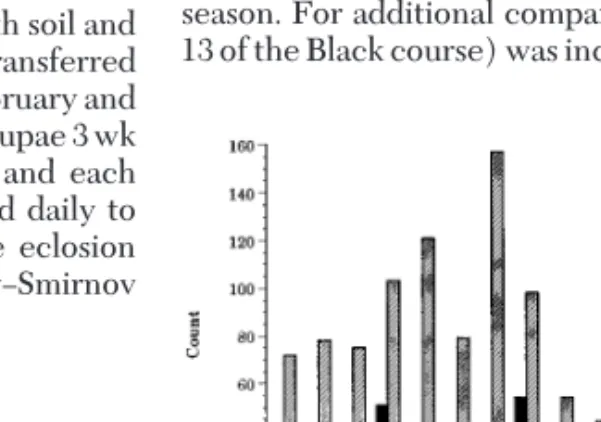
was caught in synthetic pheromone traps on the 16th of June 1994, the 12th of June 1995, and the 15th of June 1996 at Bethpage State Park (357.2, 307.5, and 357.5 DD, respectively). The pattern of emergence was unimodal with the peak occurring in the 1st half of July (Figs. 1 and 2). However, there was signiÞcant variation between adjacent areas (Fig. 1) and even
local differences among areas that were managed dif-ferently, such as the roughs versus the fairway (Fig. 1 versus Fig. 3). Data from emergence cones indicate that the 2nd site had a signiÞcantly earlier peak than the 1st (Fig. 1; t-test on median, P , 0.0001). Fig. 3 presents data from the 15-min random walk in the fairway of the 1st site. Although no direct statistical comparison can be made between data collected using 2 sampling methods, it can be noted that the median dates of both males and females in the fairway (4 July; Fig. 3) were 4 d earlier than those of the roughs (8 July; Fig. 1). This suggests localized differences within a small area perhaps the result of local heterogeneity in vegetation type, grass height, soil moisture, and soil type.
The 1995 pheromone trapping supports the appar-ent difference in the emergence schedule between the 2 sites (Fig. 2). The median dates were 7 July and 4 July for 1st and 2nd site, respectively, as in the 1994 season. For additional comparison, 1 other site (hole 13 of the Black course) was included in the graph. This
Fig. 1. Beetles collected from emergence cones set in the roughs areas of 2 sites at Bethpage State Park, Farming-dale, NY, in 1994. Arrows at the bottom indicate the dates when median catch was reached for each site and sex.
Fig. 2. Beetles caught (mostly males) in synthetic
pher-omone traps in 3 sites at Bethpage State Park, Farmingdale, NY, in 1995. Arrows at the bottom indicate the dates when median catch was reached for each site; trap was not installed on 19Ð22 June at site 1, and 20Ð23 June at sites 2 and 3.
Fig. 3. Number of beetles encountered at the fairway of
site 1 during 15-min random walks at 2130 hours. Arrows at the bottom indicate the dates when median of the total number of individuals collected during the monitored season was reached for each sex.
site is '2 km away from either of the 2 main sites and had a median date 1 d later than site 1.
Protandry. The daily cumulative adult eclosion
pat-tern of 2 batches of oriental beetle grubs reared in the laboratory are indicative of protandry (Fig. 4). The 1st individuals to reach the imaginal stage in each batch were males. The 1st male to eclose for batches 1 and
populations (251.89 6 49.00 versus 229.67 6 33.33/m3, respectively). The only adult beetles found in the soil on the 17 June 1996 sampling were males (Table 1). In 1994, data on the males and females and teneral adults sampled in the soil during the mating season are indicative of protandry as well. The date when half of all mature males unearthed throughout the monitored season were found was 3 d earlier than that of females (6 and 9 July, respectively; Fig. 5). More males were found at the onset of the monitored season, and then the sex ratio changed to '50:50. In contrast, more teneral females than teneral males were found throughout the monitored season (Fig. 5).
Differences Among Developmental Stages. Fig. 5
shows the mean number of each developmental stage found in the soil blocks sampled around the cones. There was a dramatic decrease in the number of pupae sampled after 3 July 1994, followed by an increase in the number of teneral adults. Third instars were present throughout the monitored season, the late ones presumably overwintering the 2nd time (2-yr cycle; Tashiro 1987). Only three 2nd-instar grubs were found.
Daily Pattern
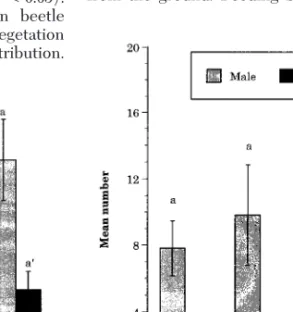
Time of Day. SigniÞcantly more males and females
were collected in the emergence cones at 2100 hours than at any other time (Fig. 6). Data from 5-min random walks in the fairway of site 1 at different times
Fig. 4. Daily cumulative adult eclosion in the laboratory
at 258C of 2 batches of 150 grubs collected on 8 September 1996 at Bethpage State Park, Farmingdale, NY. Total number of eclosed males and females for batch 1 were 20 and 19, respectively; and 20 and 12, respectively, for batch 2. Male and female distributions were signiÞcantly different for the 2 batches (P , 0.001 and P , 0.01, respectively) using the KolmogorovÐSmirnov test. Arrows at the bottom indicate the dates when median of the total number of individuals that eclosed was reached for each sex and batch.
Table 1. Mean number of males and females of each stage sampled before and during the start of adult emergence at Bethpage State Park, Farmingdale, NY (date of 1st male caught in pheromone trap is 15 June 1996)
Sampling date *Mean no./m
3
Adultsa Pupae Prepupae Larvae
10 June 1996
Male 0 274.11 6 186.67a 22.22 6 11.89a 22.22 6 11.89a
Female 0 96.33 6 92.22b 14.78 6 10.11a 29.67 6 13.11a
Unknown sexb Ñ 96.33 6 151.11 281.44 6 38.89 103.67 6 29.67
17 June 1996
Male 22.22 6 11.89a 251.89 6 49.00a 0 7.44 6 7.44a
Female 0b 229.67 6 33.33a 0 22.22 6 11.89a
Unknown sexb Ñ 14.78 6 10.11 51.89 6 18.33 29.67 6 13.11
Means followed by the same letter for each stage and sampling data are not signiÞcantly different (paired t-test,a 5 0.05). aP 5 0.082 for male versus female adults sampled on 17 June 1996.
bAll pupae whose sex were undetermined were crushed during sampling in the Þeld. All prepupae whose sex were undetermined died before reaching the pupal stage during laboratory rearing. Fourteen and 25% of larvae whose sex were undetermined for 10 and 17 June, respectively, were crushed during sampling, and the rest died during laboratory rearing without reaching the pupal stage.
of the day also showed this pattern (Fig. 7) and is consistent with a previous study (Facundo et al. 1994) in which pheromone and blacklight traps were used. In surrounding vegetation (bushes, shrubs, and trees), however, there was no signiÞcant differences in the number of beetles present at different times of the day (Fig. 8). Observations and data on the 1995 transect at a different site corroborate the 1994 data. The 1995 transect data conÞrmed that the oriental beetle is a crepuscular/nocturnal insect, being most active at the Þrst 2 h of the scotophase (Friedman test, P , 0.05). The above-mentioned difference between beetle presence in fairways versus surrounding vegetation will be discussed in the section on spatial distribution.
Difference Between Sexes. One obvious difference
between males and females is the greater presence of males at all times in both the fairway (Fig. 7) and the surrounding vegetation (Fig. 8). Male beetles perch on surrounding vegetation mostly within the 1st m from the ground. Feeding by males was rarely
ob-Fig. 5. Soil sampling data showing counts of individuals
of different developmental stages found throughout the mon-itored season. Arrows at the bottom indicate the dates when half of the mature males and females unearthed throughout the monitored season were found.
Fig. 6. Beetles collected from emergence cones at
dif-ferent times of the day from 30 June to 16 July 1994. Bars of the same kind with the same letter (and superscript) are not signiÞcantly different ata 5 0.001. For comparison between sexes: *, P , 0.05; **, P , 0.01; ***, P , 0.001.
Fig. 7. Number of beetles encountered in 5-min random
walks on the fairway of site 1 in 1994. Bars of the same kind with the same letter (and superscript) are not signiÞcantly different ata 5 0.05. For comparison between sexes: *, P , 0.05; **, P , 0.005; ***, P , 0.001.
Fig. 8. Number of beetles encountered during visual
inspection of vegetation on the border of site 1 in 1994. Bars of the same kind with the same letter (and superscript) are not signiÞcantly different ata 5 0.05. For comparison be-tween sexes: *, P , 0.05; 0, P , 0.068.
served and mating was not observed on surrounding bushes, shrubs, or pine trees.
Females, by comparison, were rarely seen perched on nearby vegetation. The small number seen during the day were mostly on turf and this number slowly increased to a peak at around sunset. Females are behaviorally more cryptic, emerging from the soil when light intensity decreases and immediately going back to soil after mating (H.T.F., unpublished data; also observed in the laboratory, see Facundo et al. 1999).
Spatial Distribution
Most individuals unearthed in all developmental stages were within 10 cm from the surface (Fig. 9). Second-instar grubs were found at the Þrst 7.5 cm of the soil proÞle. Although 3rd-instar grubs were mostly in the upper 5.0 cm, many were also found below 5.0 cm. This 3rd-instar population may be composed of those still feeding within the root zone at the Þrst 5.0 cm, and those moving down to pupate. Pupae, how-ever, seem to prefer the portion of the soil proÞle .2.5Ð12.5 cm. As expected, teneral adults were found at depths .5.0Ð10.0 cm, which is within the zone
where most pupae were located. Adults were found within the upper half of the sampled proÞle (Fig. 9). Above ground, males are more likely to be found on fairways at around dusk, and on bushes, shrubs, and low-growing plants at the border of the course throughout the day (Fig. 10, see also Figs. 7 and 8). While perched, they stay on leaves of low-growing plants (as well as leaves or needles of trees) within 0.3Ð1.0 m high. Females, however, are generally only visible around sunset and are found more in the fair-way than in any other part of the golf course envi-ronment (Figs. 10 and 7 and 8). Most pairings occur on fairways and areas with shorter-cut turf and coincides with this female emergence from the soil.
Adults found feeding and perched on ßowers, es-pecially roses and chrysanthemum, were mostly fe-males. Although no statistical difference exists be-tween the sexes on ßowers in the transect data (Fig. 10), collections in the rose gardens of Pinelawn Cem-etery (45 females out of 51 individuals found on roses) and of Planting Fields Arboretum (14 out of 16) con-Þrm the sex bias. Dissection of the reproductive tracts revealed that the majority of females found on roses did not have mature eggs, indicating that these were older females who had oviposited (mean mature eggs
per female 5 1.53; n 5 45; range 0Ð14; versus 21.2 eggs per female in virgin females, n 5 10; range, 13Ð37; Facundo 1997).
Discussion
In this study, the mating season of the oriental bee-tle at Bethpage commenced in mid-June, peaked dur-ing the 1st half of July, and decreased toward mid-August. There was a signiÞcant difference (4 d at most, based on dates of median catch) in emergence sched-ules between fairways and even within a local area (e.g., the fairway versus the roughs). This variation may be of importance in planning sampling and con-trol techniques involving pheromones. A case in point is the use of this pheromone to predict grub density in the subsequent fall. If shorter term adult sampling during the summer using synthetic pheromone is pre-ferred over season-long sampling, a 4-d difference in emergence pattern between fairways can potentially complicate the analysis of a single day sampling or reduce its predictive value. Therefore, a nightly trap-ping schedule that spans this difference (e.g., 4 suc-cessive nights of trapping) might be essential to dilute such discrepancies and in effect make the emergence schedule in different locations more uniform.
A major goal of the current study was to examine the temporal and spatial distribution of beetles without using the synthetic pheromone. In terms of daily
ac-tivities, although earlier workers reported that noc-turnal activities occur (Johnson 1927, Friend 1929), the general perception has been that the beetle is most active during the day, with most ßights occurring be-tween 0800 and 1600 hours, especially during very warm and sunny days (Hallock 1930, 1933). With the development of a synthetic pheromone trap, it has been demonstrated that the crepuscular and noctur-nal movements are more important than previously thought, in that most ßights occur around sunset (Fa-cundo et al. 1994). The current study supports the results obtained in 1993 (Facundo et al. 1994) in terms of the peak of daily activity, and it also explains the difÞculty of earlier workers in Þnding the adults in the Þeld. The relatively small number of ßights observed during the day may be the result of male response to calling females or a response to high soil, thatch, and crown temperatures. In the case of the former, it is not uncommon to Þnd males converging to a common point (a calling female), which may explain the in-stances when earlier workers found oriental beetles “swarming like bees over lawns” during the day (Hal-lock 1930). In the latter case, temperatures at ground level could be fatal during some parts of the day (e.g., 42.22 6 1.278C at 1130 hours; Facundo 1997). Close observations showed that some males tend to stay at ground level within the thatch or crown area of the turf while extending their antennae to the air (also, Facundo et al. 1999). Similarly, females may call
Fig. 10. Standardized transect data showing relative abundance of oriental beetles at different area (vegetation) of site
3 in 1995. Bars with the same letter (and superscript) are not signiÞcantly different ata 5 0.05. For comparison between sexes at speciÞc vegetation type: *, P , 0.05.
because females generally call, mate, and deposit their eggs within a very small radius from the point of emergence from the soil (Facundo 1997, Facundo et al. 1999). Flowers apparently provide additional nu-trients for a femaleÕs subsequent oviposition bout(s); as such, females were able to oviposit an additional 5.46 6 0.96 fertile eggs (Facundo 1997). If this is the only natural mode of dispersal, then the natural spread of this beetle would be slow. This speculation is con-sistent with the observed general consistency and lim-ited local infestation year after year and the beetleÕs present limited range in the United States (Facundo 1997). Bianchi (1935) also made such a supposition to explain the slow rate of spread of the oriental beetle in Hawaii, because he occasionally found females that were mostly devoid of mature eggs in copula on ßow-ers that were removed from the focus of grub infes-tation in a sugarcane Þeld. Hallock (1930) speculated that natural spread was slow because oriental beetles were rarely engaged in long ßights and thus shipment of infested sod, rose blossoms with hidden females, and other infested plants with ball of earth was of considerable importance in the spread of this insect.
Acknowledgments
We thank Jim Evans and Bruce Lattmann of Bethpage State Park for their generous cooperation and ample toler-ance to the inconveniences that go with researches like this. Tracy Wilson and a number of her crew are also acknowl-edged for their help in monitoring the traps. Maria Cinque and Kevin Masarik of the Cornell Cooperative Extension, Nassau County, also assisted in the monitoring of season-long traps in 1996. We also thank Patricia Duncan-Grady of Plant-ing Fields Arboretum and Samuel Boiko of Pinelawn Cem-etery for allowing us to conduct observations and collect grubs at those sites. Much gratitude is due to Dan Gilrein of the Long Island Horticultural Research Laboratory and Scott Clark of the Cornell Cooperative Extension, Suffolk County, for their help in the logistics. Loretta V. Dionisio of Nassau County Department of Public Works provided us with tem-perature data from 1994Ð1996. Charles Eckenrode lent us the emergence cones. Alison Power and Cole Gilbert are also
Conover, W. J. 1980. Practical nonparametric statistics, 2nd ed. Wiley, New York.
Cowles, R. S., and M. G. Villani. 1996. Susceptibility of Jap-anese beetle, oriental beetle, and European chafer (Co-leoptera: Scarabaeidae) to halofenozide, and insect growth. J. Econ. Entomol. 89: 1556Ð1565.
Facundo, H. T. 1997. The reproductive ecology of the ori-ental beetle, Exomala oriori-entalis (Waterhouse) (Co-leoptera: Scarabaeidae). Ph.D. dissertation. Cornell Uni-versity, Ithaca, NY.
Facundo, H. T., A. Zhang, P. S. Robbins, S. R. Alm, C. E. Linn, Jr., M. G. Villani, and W. L. Roelofs. 1994. Sex phero-mone responses of the oriental beetle (Coleoptera: Scar-abaeidae). Environ. Entomol. 23: 1508Ð1515.
Facundo, H. T., C. E. Linn, Jr., M. G. Villani, and W. L. Roelofs. 1998a. Emergence, mating and mate-locating behaviors of the oriental beetle, Exomala orientalis (Co-leoptera: Scarabaeidae). Insect Behav. (in press). Friend, R. B. 1929. The Asiatic beetle in Connecticut. Conn.
Agric. Exp. Stn. Bull. 304: 585Ð664.
Hallock, H. C. 1930. The Asiatic beetle, a serious pest in lawns. U.S. Dep. Agric. Circ. 117: 7.
Hallock, H. C. 1933. Present status of two Asiatic beetles (Anomala orientalis and Autoserica castanea) in the United States. J. Econ. Entomol. 26: 80Ð85.
Johnson, J. P. 1927. Soil treatment and scouting for the con-trol of the Asiatic beetle. J. Econ. Entomol. 20: 373Ð376. Leal, W. S. 1993. (Z)- and (E)- Tetradec-7-en-2-one, a new type of sex pheromone from the oriental beetle. Natur-wissenschaften 80: 86Ð87.
Siegel, S. 1956. Nonparametric statistics for the behavioral sciences. McGraw-Hill, New York.
Tashiro, H. 1987. Turfgrass insects of the United States and Canada. Cornell University Press, Ithaca, NY.
Villani, M. G., R. J. Wright, and P. B. Baker. 1988. Differ-ential susceptibility of Japanese beetle, oriental beetle, and European chafer (Coleoptera: Scarabaeidae) larvae to Þve soil insecticides. J. Econ. Entomol. 81: 785Ð788. Zhang, A., H. T. Facundo, P. S. Robbins, C. E. Linn, Jr., J. L.
Hanula, M. G. Villani, and W. L. Roelofs. 1994. Identi-Þcation and synthesis of female sex pheromone of oriental beetle, Anomala orientalis (Coleoptera: Scarabaeidae). J. Chem. Ecol. 20: 2415Ð2427.
Received for publication 23 September 1997; accepted 16 September 1998.