November 1996
LIDS-P-2372
Research Supported By:
AFOSR-F496-20-93- 1-0604 ARO DAAL03-92-G-0015
A CANONICAL CORRELATIONS APPROACH TO
MULTISCALE STOCHASTIC REALIZATION
LIDS-P-2372
A CANONICAL CORRELATIONS APPROACH TO
MULTISCALE STOCHASTIC REALIZATION
William W. Irving
Alan S. Willsky
Abstract
We develop a realization theory for a class of Inultiscale stochastic processes having white-noise driven, scale-recursive dynamics that are indexed by the nodes of a tree. Given the correlation structure of a 1-D or 2-D random process, our methods provide a systematic way to realize the given correlation as the finest scale of a multiscale process. Motivated by Akaike's use of canonical correlation analysis to develop both exact and reduced-order model for time-series, we too harness this tool to develop multiscale models. We apply our realization scheme to build reduced-order multiscale models for two applications, namely linear least-squares estimation and generation of random-field sample paths. For the numerical examples considered, least-squares estimates are obtained having nearly optimal mean-square errors, even with multiscale models of low order. Although both field estimates and field sample paths exhibit a visually distracting blockiness, this blockiness is not an important issue in many applications. For such applications, our approach to multiscale stochastic realization holds promise as a valuable, general tool.
*The work of William Irving and Alan Willsky was supported by the Air Force Office of Scientific Research, under grant AFOSR-F496-20-93-1-0604, the Army Research Office, under grant ARO DAAL03-92-G-0015.
1
Introduction
A class of stochastic processes inlexed b1 the nodes of a tree was introduced in [4]. These processes have white-noise driven, scale-recursive (l-nallics. directly analogous to the time-recursive dynam-ics of Gauss-Markov time-series models. Experimental and theoretical results have demonstrated that this class of processes is quite rich statistically: the self-similarity of fractional Brownian mo-tion can be represented [4], as can any given 1-D wide-sense (WS) reciprocal process or 2-D Markov random field (WSMRF) [12].1 Complementing this statistical richness are the efficient image pro-cessing algorithms to which multiscale models lead. For example, a scale-recursive algorithm has been developed that directly generalizes the KIalman filter and related Rauch-Tung-Striebel (RTS) smoother [4]. This algorithm incorporates noisy measurements of a given multiscale process to calculate both smoothed estimates and associated error covariances. Another algorithm has been developed for likelihood calculation [11]. In contrast to traditional 2-D optimal estimation for-mulations based on Markov random fields. which have a per-pixel computational complexity that typically grows with image size. these multiscale algorithms have a per-pixel complexity indepen-dent of image size. Substantial computational savings can thus result, as evidenced by the work in [13] on calculating optical flow and the work in [7] on interpolation of sea level variations in the North Pacific Ocean from satellite measurements.
Just as Kalman filtering requires the prior specification of a state-space model, so does multiscale statistical processing. In this paper. we develop a general approach for building multiscale models.
Given the correlation structure of a l-D or 2-D random process- our methods provide a systematic way to realize the given correlation as the finest scale of a multiscale process. Because there is typically a conflict between model complexity and accuracy, we mainly focus on the case where a constraint is imposed on the allowed model state dimension; the objective then is to build a model whose finest-scale correlation structure best matches the desired correlation, subject to the
'The definition and properties of wide-sense reciprocal processes and WSMRFs are nicely summarized in [5].
2
The terminology 1-D, 2-D or multidimensional random process is used here to indicate that the dimension of the independent variable of the process is I-D. 2-D. or multidimensional.
dimension constraint. In general. oiir focus on realizing finest-scale statistics is motivated bv the not insignificant class of applications in which the finest-scale is really the only one of interest. For instance. in many de-noising applications. the finest-scale process is a pixel-by-pixel representation of the image. the measurements are nloisy observationis of each pixel. and the objective is to estimate the value of each image pixel. For suich plroblelIs. the multiscale fraiimework provides an efficient statistical approach for obtaining estimates and error covariances, even though every other aspect of these problems involves only the finest scale.
There is a close relationship between the multiscale stochastic realization problem and its more traditional. time-series counterpart. This relationship can be made clear once the Markov property of multiscale processes is noted. To describe the Markov property of multiscale processes. we first observe that in a q-th order tree each node has q children and a single parent. and hence partitions the remaining nodes into (q + 1) subtrees, one associated with each of these child and parent nodes. (A second-order tree. which is often used to index multiscale representations of time series, is illustrated in Figure 1.) Now, the .Markov property states that if x(s) is the value of the state at node s, then conditioned on x(s) the states in the corresponding (q + 1) subtrees of nodes extending away from s are uncorrelated. The connection to the time-series realization problem is that in both contexts, the role of state information is to provide an information interface among subsets of the process. This interface must store just enough process information to make the corresponding process subsets conditionally uncorrelated. In the time-series case, this interface is between two subsets of the process (i.e., the past and the future), while in the multiscale case, the interface is among multiple (i.e.. (q + 1)) subsets of the process.
We exploit the connection between the time-series and multiscale realization problems by adapt-ing to the multiscale context work done in [1] and [2] on reduced-order time-series modeladapt-ing. The work in [1] and [2] addresses two issues. First. for exact realizations, a method is devised for finding the minimal dimension and corresponding information content of the state. Second, for reduced-order, approximate realizations, a method is devised for measuring the relative importance of the components of the information interface provided by the state, so that a decision can be made
about which components to discard in a redll(ced-order realization. The latter is accomplished using a classical tool from muiltivariate statistics. naniely canonical correlation analysis [8].
\We
decompose our multiscale problem of decorrelating jointly (q + 1) process subsets into a collection of q problems of decorrelating pairs of process .subsets. iWe then demonstrate that with respect to a particular decorrelation metric, canonical correlation analysis can in principle be used to solve optimally each of the pairwise decorrelation problems. Furthermore, these pairwise solutions can be concatenated to yield a sub-optimal solution to the multi-wacy decorrelation problem. The solution to this decorrelation problem leads readily to values for all the multiscale model parameters.
We apply our realization scheme to build reduced-order multiscale models for two applications, namely linear least-squares estimation and generation of random-field sample paths. For the nu-merical examples considered, we obtain least-squares estimates having mean-square errors that are nearly optimal, even with multiscale models of very low order. Although both field estimates and field sample paths exhibit a visually distracting blockiness, this blockiness is not really an issue in many applications. For such applications, our approach to multiscale realization holds promise as a valuable, general tool.
This paper is organized in the following way. In Section 2, the multiscale framework is more formally introduced, and a measure of decorrelation is defined. In Section 3, the modeling problem is precisely formulated, and a solution is overviewed for the case that full-order, exact models are sought. In Section 4, the solution to the modeling problem is presented for the more challenging case that reduced-order, approximate models are sought. In Section 5, two numerical examples are presented. and finally in Section 6, a sumiiiary is provided,l together with suggestions for future work. Details of the proofs are relegated to appendices at the end of the paper.
Root node
S "I
Sal
SaX
5s 5sC
Figure 1: The first four levels of a 2-nd order tree are shown. The parent of node s is denoted by s7 and the two offspring are denoted by sat and so2. The random vectors Us and %., contain, respectively, the finest-scale state
information that does and does not descend from the node s.
2
Preliminaries
2.1 State-Space Models on q-th Order Trees
The models introduced in [4, 13] describe multiscale stochastic processes indexed by nodes on a tree. A qth-order tree is a pyramidal structure of nodes connected such that each node has q offspring nodes. 'We associate with each node s a vector-valued state .c(s), where in general, the qm state vectors at the m-th level of the tree (for m = 0. 1,... ) can be interpreted as information about the m-th scale of the process. In keeping with the conventions established in [4, 13], we define an upward (fine-to-coarse) shift operator , such that scy is the parent of node s, and a corresponding set of downward (coarse-to-fine) shift operators aci. i = 1,2... q, such that the q offspring of node
s are given by scsl, sc2,..., saq. Figure 1 depicts an example of the relative locations of s, s3, and
sc 1l, sca2 in a second order tree.
The dynamics implicitly providing a statistical characterization of z(s) have the form of an autoregression in scale:
This regression is initialized at rhe root ilode. ., = 0. with a state variable x(0) having mean zero and covariance P(0). The ternm l(.') represents white driving noise. uncorrelated across scale and space. andl also iuncorrelated with the initial condition .r(0): this noise is assumed to have mean zero and covariance Q(.s). Since xr() and , are zero-mlean. it follows that .c(s) is a zero-meanr(.s) random process3. Furthermore. since the driving noise t1(.s) is white, the correlation structure of the process xr(s) is characterized completely by P(0) and the tautoregression parameters .4(s) and
Q(s) for all nodes s 5f 0.
The statistical structure of multiscale processes can be exploited to yield an extremely efficient algorithm for estimating x(.), based upon noisy observations y(-). These observations take the form
j(..) = C( )
where the noise v(s) is white. has covariance R(s). and is uncorrelated with x(-) at all nodes on the tree. Just like the KIalman filter and the RTS smoother, this estimation algorithm has
a recursive structure, and yields both state estimates and associated error covariances. For a
multiscale process having states of dimension A\ and indexed on a tree with NV nodes, the number of required computations is O(.X,\3). Thus. the algorithm is quite efficient, particularly when the
dimension of the state vectors is low.
2.2 Markov Property of Multiscale Processes
Multiscale processes possess an important MIarkov property. stemming directly from the whiteness of w(s). WVe here describe a special form of this property, closely related to our main focus in this paper, namely the finest-scale of multiscale processes. To proceed, we associate with each tree node
s a set F~, where -s contains all of the finest-scale nodes that descend from s. WVe also associate
with each node s the random vectors c, and 5, c. The random vector c, contains the elements of the set {x(r); a E .Fs}, stacked into a vector. while sc contains the elements of the complementary
set {x(o-): E 0Fo}nl{x(ca); C jr, }c .stacked into a vector. It will sometimes prove convenient
3
to denote ,Sc by we wsaq.l' freely ulse both forms. To relate c and .r(a). we introduce the matrix
Hsa. where H,jlx(or) is the linear least-sqcllres estimate of %. given x(a). These conventions are
illustrated in Figure 1.
The MIarkov property. as it relates explicitly to the finest scale. can now be stated as follows:
C c ".5C( HSf!,,, Isa I s
=Sa2
H.,,)ls
sals
S~~~O X·(S) f~+ (2) C iSOq+l / Hs\,g+1l" U saR+tils withC(S.). 9cCwI. C u.oq~ltls uncorrelated. (3)
We use this property to relate the dimension of x(s) to the correlation among the vectors J,
(s,2,.. , ),Sq+i. Towards this encl. (2) and (3) together imply that
Pi
= Hs.jsPr(s) HTas (i j). (4)
(Here and elsewhere, we adhere to the notational convention that P, is the covariance of random vector x and Py is the cross-covariance of random vectors .r and y). By elementary linear algebra [18]1, the rank of the cross-covariance in (4) is upper-bounded by the rank of P,(s), which in turn is upper-bounded by the dimension of .(s). The following proposition thus follows:
Proposition 1
dimeu.sion(x(s)) > max rank(Pc8
~i
8S')If the finest-scale covariance P.% must match exactly some prespecified covariance, then this proposition provides a lower bound on the required multiscale state dimension. In the rather likely case that the involved cross-covariance matrices have full rank, this dimension constraint becomes quite stringent. Thus, to keep the nlultiscale estimation algorithm computationally efficient, we find considerable motivation to turn to reduced-order (approximate) realizations.
2.3
The Generalized Correlation Coefficient
For the purposes of developing redullced-ordler models. it will prove convenient to have a scalar
measure of the correlation ainong a collection of randlol vectors. We thus introduce a so-called
generalized correlation coefficient. Ill keeping with stand(ard conventions. we define as follows the
correlation coefficient P(0ll 772) bIetween two scalar valued random variables
771
and 772:{
",p;;X;7 if P,/j > 0, for i = 1, 2,
P(,0¥
(.5)
0' otherwise.
Then, for a pair of vector-valued random variables 711 and 772, we define their generalized correlation
coefficient P(r/1, 712) by
P(111 12) , t Y { p(mt' /1.1 fT2) }
where the dummy argument fi (for i = 1. 2) is a column vector having the same dimension as Pri. Finally, we extend the definition of pi(.. ) to a collection of random vectors rl,r2,... ,r77k, in the following way:
P (71 r12.... 17k) -- ax P i(r7i, 77j).
Each of these correlation coefficients has a conditioned version. To define them, we first let random vector z contain the conditioning information. Also, we let =i = ri- E (7ilz), where (here
and elsewhere) we adhere to the convention that E(xly) is the linear least-squares estimate of x given y. Finally, we define
P (r/~.,?= ...
*,|) -
rk
P(01,2,..
,nk).
(6)
3
Formulation and Initial Investigation of Realization Problem
The realization problem of interest in this paper is to build a multiscale model. indexed on a given tree structure, to realize sonle pre-specified, finest-scale covariance. We begin with a random vector Xo, having the pre-specified covariance P,,O and having an established correspondence with
the finest scale of the given tree. For -;xalnple. \o might be a random field (written for simplicity as a vector). with the finest scale of the tree (e.g.. a quladtree) being a pixel-by-pixel representation of the field. Our objective is to specify valuaes for the niodel parameters P(0). .4(.) and Q(.). to achieve the best match possible between the actual. realize(l covariance P,, and the desired covariance P
o.
0Because the desirable model propIerties of low dimeniesion and high fidelity) are typically in conflict, we impose a dimension constraint: for all .:. the state vector .x(s) is constrained to have dimension no greater than A,:
dlinlension(.rl(..s)) > A,. (7)
3.1
Full-Order, Exact Realizations
When the dimension constraint is cliscardedl. the realization problem becomes conceptually simpler
and exact realizations (i.e., realizations for which P,0 = Px0) become possible. We begin by
analyzing this case.
A notable class of multiscale processes in this context is those in which each state variable x(s) is a linear function of the finest-scale process:
:.(.s-) = Wsc;s. (8)
A state vector x(s) obeying this relationship can clearly be seen to represent an aggregate (coarse) description of the finest-scale process descending from s. We refer to the matrix Ws associated with node s as the node's internal matrix, and we refer to multiscale processes for which (8) holds Vs as internal realizations. The notion'of internal stochastic realizations is standard in time-series analysis [10, 16], with our use of the concept representing a natural adaptation.
Our interest in internal realizations stems from the convenient fact that the model parameters
P(O), A(.), and Q(-) can be specified completely in terms of the internal matrices and the
finest-scale covariance. In other words, once values values for the internal matrices have been determined, values for the model parameters P(0), A(-) and Q(.) follow easily. To see this fact, we begin by
substituting (8) evaluated at S = () into P(O) = E >.r(O)x.r(()) to yield
P(0) = Ili )PI- r (9)
The parameters .l(s) and Q(.-) can then be compulted by noting that (1) represents the linear least-squares prediction of x(.s) based lpon .1(.K',). plus the associated prediction error:
.'(.) = E
[.x(.s)
i
.x(s-)] + ,7(.s) (10)Comparing (1) and (10), and using standard results from linear least-squares estimation, the model parameters can be seen to satisfy the following relations:
A.(s) = P(s)z~ j x(s^!) (la)
2Q(.) = P,(S),- PL(sJ:(s,) P(,sr) p(s)x(9S). (lib)
Finally, again using (8), the covariances appearing in (11) can be expressed as simple functions of the internal matrices and the finest-scale covariance:
Pxa (s).x(S^!) = I7Psqs Tls~= (12a)
,(s) = 1'V1 P(l VsTx. (12b)
Clearly, the key to constructing an exact, internal realization of a given finest-scale covariance is to devise the internal matrices. At the finest-scale nodes, these matrices are implicitly defined by the association between finest-scale nodes and the components of 0yo for example, if each scalar component of yo is assigned to a distinct finest-scale node, then clearly TVs = 1 for each finest-scale node. At the coarse-scale nodes (i.e., all the nodes above the finest scale), the Markov property of multiscale processes becomes key. In particular. a necessary condition for (2) and (3) to hold at a coarse-scale node s in an exact. internal mnodel is that TI, fulfill the following decorrelating role:
/5 (\~,. \.,. *... *\,~,,+,l
I
I's \) = O. (13)In essence, the rows of WT must contain suitable linear combinations of the random vector ¥s, such
suppose that for a desired covariance P,, it Iatrix 11," satisfying (13) is found for each coarse-scale node.4 Suppose, further, that the rlesultiriing 11' matrices are substituted into (9). (11) and (12) to calculate values of P(O). .4( ) andl Q(-). Thein the resulting inultiscale model will have the desired finest-scale covariance (i.e.. P,0 = Pk,,).
In summary, there is a three-stage procedlure for realizing exactly any desired finest-scale co-variance: (i) establish a correspondence between finest-scale nodes and components of the vector Xo, thereby implicitly specifying 1.V for each finest-scale node, (ii) find a matrix WV, satisfying (13) for every coarse-scale node, and finally (iii) substitute the resulting IV, values into (9), (11) and (12) to calculate values for P(O). A(-) and Q(-). A very attractive feature of this procedure is that it decomposes the realization probllem into a collection of independent sub-problems, each myopically focused on determining the information content of the state vector at a single node to fulfill the decorrelating role (13). WVe hasten to add, however, that the resulting state vectors will typically have an impractically high dimension, and thus this construction is mainly of interest for motivating our approach to reduced-order modeling.
3.2
Reduced-Order, Approximate Realizations
For the rest of the paper, we reinstate the constraint (7) on multiscale model state dimension. With this constraint in effect, Proposition 1 shows that exact equality between P 0o and Pxo will
in general be impossible to achieve. Therefore, we no longer look for WV, matrices that fulfill the decorrelation condition (13) exactly: instead, we look for matrices that do the best decorrelation job possible, subject to the dimension constraint.
To describe the WV, condition we use in lieu of (13), we must first introduce some notation. WVe define the random vectors \, and ,c, to have the same relation to yo as Js and ,'c have to J. To be more precise, suppose that the i-th component of , (lc) maps to the n,(i)-th (nc(i)-th) component of Jo; then, the i-th component of , (Y\C) maps to the n,(i)-th (nsc(i)-th) component
4
The choice W, = I, so that x(s) = cs is universally valid, though of virtually no practical value, owing to the high dimension for x(s) to which it leads.
of 0. It will sometimes prove convenielnt to leniote d.,,. by \y·,' we freely use both forms. ~Nonw. in lieu of (13). we seek
T1,
llatrices satisf'ing1'es = arl lll ii /(!u\,,!h. \p2' .I * - - \. ~11 11') . (14)
where ;,., is the set of matrices having A, or fewer rows (and a number of columns implicitly defined
by context). We refer to (14) as the decorrelLtio,1 problem. Once values for the TVl matrices have been found, we mimic our approach to the full-order realization problem: values for the multiscale parameters P(O), A(-) and Q(.) are set using analogues to (9), (11), and (12) in which P~s is
replaced by eplaced by PChiSxS. Thus. our reduced-order modeling procedure is
very similar to our three-stage, full-order nlodeling procedure (see Section 3.1), with the principal exception being that now condition (14) is used in lieu of condition (13).
There are several comments to make about this modeling approach. First, the approach shares with its full-order counterpart the computational benefit that we can find all the model parameters in a single sweep from coarse to fine scales, determining TVs for each node as we go along, and
thereby implicitly specifying P(O). A(-) and Q(). WVe emphasize, though. that the condition (14)
is a heuristic one. Certainly, this condition is reasonable, from a myopic, node-by-node view of the realization problem; however, the condition does not provide tight control over the overall match between P(o and Pxo. Indeed, an open research challenge is to find a way to build a reduced-order model, in which the parameters P(O), A(.) and Q(.) are chosen explicitly to minimize some global
measure of the discrepancy between Pko and P~o0. This problem appears to be very challenging.
We will focus only on the more myopic problem of solving (14).
As an additional comment. models constructed with our approach will not in general be internal realizations. In other words, (8) will not hold in general. Consequently, in reduced-order models, the WV matrices should be interpreted as merely auxiliary constructs, which aid in setting values for the parameters P(O), .4(.) and Q(-).
matrix 1IT,1
/P(.Yscal3.nt
IX
WY0) = /5(saj. Xsoe.- 'XSaq-TI
xT5)where I,1/ is a matrix whose rows forln an orthollormial basis for the row space of IV,. Hence. defining the set VAx to be the subset of .xA having orthonormal rows. we see that
rin fP(.YsalX sYsa2 * Saq+l I1 V1\V) = i(.slXsCal, ain , ,sa2 ,- X Iq+ IVWxS,)
W1E'Mx, IENIx,
Thus, without loss of optimality. we can replace the constraint set AMxA in (14) with the set Ax,. When convenient, we will freely make this replacement.
4
Decorrelating Sets of Random Vectors
4.1 Decorrelating a Pair of Random Vectors
We here analyze a special case of the decorrelation problems in which there are only two vectors to decorrelate. Denoting these vectors by rll and a12 and stacking them as 77 = (r] T 2 o)T, our objective is to find the optimal matrix solution to the following optimization problem:
T' = arg rmin p(7.1 2 l W1). (15)
IVE.Mx
Playing a central role in the solution is a standard result from canonical correlation theory. For the purposes of stating this result precisely, we denote the rank of the ni x ni covariance matrix
P7i by mi (for i = 1, 2), and the rank of P,,172 by n1112. Also. we let In be an identity matrix having
n rows and columns.
Theorem 1 There exist matrices T1 and T2. of dimension ml x nl and m2 x n2, respectively, such that
(a
T 0 2 8 Pr1 Prl ,2j
(:
T 08>O
_ Imi DT T
T0 72 T
~
T D rT m13and
(T
+
0
I
D,,,,T
o
(
P
p
( ~ ID - ) ( O -P7 ) r1 Pql
0
T.+
Dk
T 1,
. 0 The = PTThe matrix D has dimension rn x elm nd.l is g(iv1en by D = (diag
(b,
o) where D = riag(di, d, .*., (inl2)1 > dl _> t2 >_ ... > dl., > 0: for (a given~. (Pr:l ' P,2.~ qP,2). the matrix D is unique. Finally. T + is
the Moore-Penrose pseudoinverse of Ti, antl is given by TI+ = P, iTT, (i = 1, 2).
We refer to the triple of matrices (T1, T2,D) as the canonical correlation matrices associated with (r71, 7r2). For convenience, we introduce truncated versions of T2 (for i = 1, 2), denoted by Ti,k and defined to contain the first k: rows of Ti; as a special case, we define ti to contain the first m1 2 rows of Ti. Results very similar to Theorem 1 can be found in several places, including [3, 14, 15] and [6]. A proof of the theorem, as exactly stated here. can be found in [9]. As these proofs reveal, the calculation of the canonical correlation matrices can be carried out in a numerically sound fashion using the singular value decomposition; this calculation requires O(V3) floating point operations,
where N = max(nl, n2).
Theorem 1 can be used to perform a change of basis on the vectors rl7 and 172, to simplify
maximally the correlation between them, and thus to simplify analysis of the decorrelation problem. We define the random vectors /. p11 and P2 via
T
g _
(
UT T T= (i-1,2),where thanks to Theorem 1, Al and A2 have covariance= P(1TL P/2
(
DT im2and the transformation from (771. 172) to (/I1. P2) is invertible in a mean-square sense,
E[(rli - Til)(i - T+.i)] =
0,
(i = 1,2).Lemma 1
',/ .q11 2 1 I VTri) = tP( l. Z.2 ' ILZ) (16a)
i(I '11. ! II ,i) ' =
fl
(ll.l2 II T+lT) (161))mrail /5( qI. '12 1 I'1) = (IL. I12' I L) aIIiI (16c)
As a special case of (16a) and (16b). we note that Pfi(r1.772) = P(/Il, /2). The lemma is a direct
consequence of the definition of the generalized correlation coefficient, together with Theorem 1; we omit the details of the proof.
Equipped with the foregoing theorem and lemma, we can now solve (15).
Proposition 2 For 0 < A < < 11 1
.tl.1
for i = 1. '2.min ,i( /1,r/7 2 I tV 1) =
mliln
(11l. 72 V1rll) = p(1/,q7'2 I TI,,A7l) = dx+l. (17a)WEMx, EV.",
For A > m12,
min P(fq1,772 I 1W1) = m fiP(71 l72
i
WVlr71) = P(T71,r/2 I Tl7l) = 0. (17b)WEMIx IIE.\EMx
Proof: In Appendix 1, we demonstrate that for ,\ < ml2,
min P(IL1,]~2 I Wt)-= min p(Lll2) Vl) 1 1 = P(l1,112 -)
(
I 0)
dA±+, (18a) while for A >_ m1 2,min P(/1, n2 i. 1 0 [Li) = (18b)
Once these facts are established. the results (17a) and (17b) then follow. In particular, with regard to (17a), we have the following sequence of identities:
min P(771,72 1 ;11) = ilin l P(ll. 2 I TW) = fiG(/l,2 ( I\ 0 )Al)
WE:Mx I'." /
= (1.121 - ( [,\ 0
)
T1q) = dA+I. (19) 15The first equality followvs from (16c'). tile (,se(on(l fromI (18a). the third from (16a) and the fourth from (18a). The result (171)j can be prove(l froln (1sb) in a very similar fashion: the details are omitted. QED.
There are two important points to note al)ollt this proposition. The first is that solving (15) is essentially a problem of calculating the canonical correlation matrices associated with (7ll, r72); indeed. (15) can be solved simultaneously for all values of A by calculating just once these canon-ical correlation matrices. The second point is that there is no harm in having the decorrelating information Wr7 be a linear function of either 71 or 172 alone.
4.2
Decorrelating Multiple Random Vectors
'We now turn to the general decorrelation problem (14). for which we develop a suboptimal solution. This solution has an intuitively appealing structure motivated by the solution to the simpler problem (15). We emphasize that to the best of our knowledge, the task of characterizing the optimal solution to (14) is an unsolved problem.
Our approach is to decompose the decorrelation problem into a collection of q sub-problems. In the i-th sub-problem, we focus on decorrelating y,,; from y,,j for all j :A i; specifically, we exploit Proposition 2 to solve
Wi,ki = arg min
m
i ( ic- Y(si)C I WXSai) (20)IV[,' EMki
where for now we treat kl,... , kq as free parameters. By choosing Wi,ki as in (20), we effectively decorrelate X,Si from ,~j (for all j - i) all at once; in particular, it is clear that
P('sai, :scaj I(IT .ki i < P• (ysc (sai) W i,kiXsai)
j
i,
(21)and so, if the right side of (21) is small, then the left side will also be for all j
#
i.To see how we combine WtL,kr ... It',l, to solve (14) approximately, let us consider the quantity
which we can express more succinctly as (\,,,...n ksol
11'(k
.
.... kq)b,) by defining theblock-diagonal matrix 1WV(kl ... k - lq) iag(ll'l k ... I,.kq). Since the i-th block component of this
matrix has been specially designedl to (le(orrelate \k(,, fromn \,se. j ~ i. we intuitively expect that
all the block components will work rogether to make (22) snmall. Furthermore, if
Zki <
A\,,
(23)i=l
then WVs(kl,... , kq) E JtA, implying that IWs(kl,... , kq) is in the feasible set of the optimization
problem (14), and can indeed be used as an approximate solution to (14).
To characterize precisely the behavior of IV'(kl,... , kq), we first must establish a result
describ-ing the non-increasdescrib-ing nature of the generalized correlation coefficient as the amount of conditiondescrib-ing information increases:
Proposition 3
P(l1-112TVii) _ < P(l;72), i = 1,2. (24)
Proof: In Appendix B. we demonstrate that
Pl [L2 l U'X1i)
•)<
p(1lL_) (25)Once this fact is established, the result (24) follows. In particular, we have the following sequence of relations:
(771,772 1 Vii7) = l)(;ll. '2
I
Wl tHi) iT < P(11,/.2) = P(7l,1772)The first relation follows from (161)). the second from (25) and the third from (16a). QED. We emphasize that if the conditioning information is not a function of either a7l or 712 alone, then the function p(,
I
)
may become an increasing one. For instance, if(P,II
P,,11
12)(
0.5)V
1
PZ1,2
P.,2 2 \0.5
1
then Pi(r1l, 2) = 0.5, but fi(71,r12 |I l + '12) = 1
We can. however. slightly strengthen Proposition 3 by relaxing our restriction that all of the conditioning information be a linear function of either Ill or t/2' in lieu of this restriction, we restrict
each individual scalar component of this conditioning information to be a function of either r71 or q2. WVe state this result as a corollary:
Corollary 1
(711,72 1 WIVlVil,l'Vri2._,) < P('Ip12 I I'VI1i,). (i1
i2)
E {{1,2} x {1,2}}Proof:
P(q11,772 |I VWTil,VV1 2q1i2) (II1-E( E 1 i ) 1 *772 - E(li) -E( 1lV 1il) I VI'2 ( -- (ltVl7l))(7i2
< P/('1 - E (1 I iT,) . /12 - E (11I11 il)) = P (.q. 11'2 1 "T'1i
)
The first and third lines here represent direct applications of (6), while the second line represents application of Proposition 3. QED.
Using this corollary, we now return to consideration of the behavior of Ws(kl,... , kq). Proposition 4
Pi(Xsal, .. Xsaq+l
I Ws(k...kq)ks) <
max pi(Xsai, X(s,) IW,(ki,... , q)Xs) (26a)< m ax P(xsa, X(sai)c I Ws,kiXYsai) (26b)
Proof: The first inequality in (26) is a direct consequence of the definition of the generalized correlation coefficient. The second is then a direct consequence of the corollary to Proposition 3. QED.
The important point to note about this proposition is that WT,(kl,...
,
kq) leads to a valuefor the objective function in (14) that is no greater than the maximum of the values obtained in the q problems (20). In other words. by concatenating together the solutions to the q sub-problems (20) into the block-diagonal matrix ¥T-(kl,... , kq), we obtain an approximate solution
to (14) having a value upper-b)ounded by the maximum valule of these q solutions to (20). This
observation suggests a way to select values for the p)arameters kl,..., kq. In particular. subject to
the constraint (2:3). we should choose these plaralleters to fulfill the following miniinax condition:
(k*.. .. *.q) = arg rin
m
fmaX
(\.,.a.
k(sa,)C I'"Vi.ki ) (27)1 .k '1 7 1 ...q ...
By choosing the ki parameters in this fashion. we minimize the right side of (26b), which upper-bounds the left side of (26a). The matrix TIS:(k,.. kq) then can serve as a suboptimal solution to (14).
To describe the solution to (27), we denote by (TF,v T(s,)c, Ds,i) the canonical correlation
matri-ces associated with (Xs,, Y(s( )c)w. where the diagonal elements of Ds,i are denoted by ds'. d' i,....
For simplicity of exposition only, we assume that ki is strictly less than the rank of the cross-covariance Pysx (aifc, for i = 1.... q. Then. thanks to Proposition 2, it follows that..
P(\sai, X(sai)c I ti.k.Ysa¥,) = dki+l'1
Hence, the minimax definition (27) is equivalent to the following, where we again impose the constraint (23):
(k,
*) = arg min { max dk,
' i}
ql,...,. q ki+
This discrete optimization problem can easily be solved, once the canonical correlation quantities
(Tsai, Si) associated with (,ss. \ (si)c) have been calculated, for i = 1,2,... ,q [9].
4.3 Calculating the Canonical Correlation Matrices
For problems of practical interest to us. the dimension of :y and Xsc can be on the order of a thousand (or greater), thus prohibiting the exact calculation of the associated canonical correlation matrices (Ti, D/). However, if the correlation between *y and Xsc has a certain special structure, then we can achieve a substantial reduction in the complexity of the computation. In essence, we
assume that the correlated component of yk and ySC lives in some low-dimensional subspace that
is easily defined: we then
(1o
all of oulr :olnplltarionswith
low-dimensional random vectors that livein this subspace. and thereby achieve oulr complexity reduction.
To be more precise. we introduce the randoim vectors pI, andl ,c as
lYs = \ lln(l L, - = Oc sc. (28)
Here, (O and GO., are matrices havinlg havting full row rank and such that
E [(X -
E(\ii)) (X-
- E(\lp))r] = 0, (29)for both z = U, and ' = u- ~. It is not difficult to see that if (Tf',T .2,/
D)
are the canonical correlation matrices for (/s, ,uSc). thenT. = T[2,, and bD =
Dfs.
(30)This result leads to considerable computational savings when yo is a wide-sense Markov ran-dom process or field. Even if 0o represents a RWSMRF as large as 256 x 256, then the canonical
correlation matrices associated with (,y, yc) can be computed in a manageable fashion to machine
precision. Moreover, for non-Markov processes and fields, a slight generalization of this approach serves effectively as a method for obtaining good approximate results.
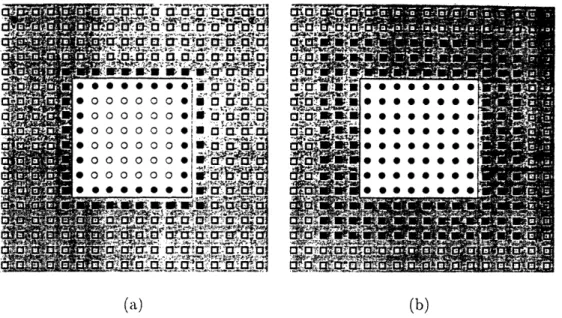
We illustrate the approach by considering a 2-D example. In the example, we let Xo represent the values of a first-order, scalar-valued WSMIRF over a discrete lattice having dimensions 256x 256. We focus on a particular node s for which x, and yc contain the values of the field at the subsets of points displayed in Figure 2a. Specifically, ¥y contains the values of the field at the 64 grid points marked with circles. both filled and not filled, in the white region, while X,S contains the values at the all other grid points: subsets of these other grid points are marked with squares, both filled and not filled.
Thanks to the Markov property, we can devise by inspection matrices 9E and (2 to fulfill (29).5
In particular, we can let es and (2e be selection matrices chosen such that ts, and ,sc contain the values of y, and X,s at their respective boundary points, where these boundary points are marked with filled-in circles and squares, respectively. To see the computational savings that can result by
p:
··
· · · · ·
e
*
o o o o
0o
-a tc'
-O:
'
*·
*
*
*
*
*
I
E-· o 0a-oooi~i 0
(a)
(b)
Figure 2: Illustration of our approach to finding the canonical correlation matrices associated with (,s .,s¥:) for (a) a first-order WSMRF, and (b) a non-.larkov random field.
using (30) to calculate T.7 and bD. we note that the dimension of uSC is roughly 5 x 10⁻⁴ times the
dimension of Xc, this approach reduces the computational cost of determining (T's Df) by roughly
a factor of 6 x 10⁹. From this example, the structure of our approach should be clear, for any case in which we are modeling a WSMIRF.
For non-Markov random fields. there is no guarantee that the correlated component of (Xs, ¥sC) can be captured by boundary information over a region as thin as the one used in our foregoing example. To compensate for this fact, we modify our approach slightly for the non-Markov case. Our modified strategy is to make the boundary region as thick as possible for each of Xs and Xsc,
subject to the constraint that the resulting vectors /, and [zc have dimension no greater than some
prescribed limit. Using the same graphical conventions as in Figure 2a, this idea is illustrated in
Figure 2b. where 132 is the limiting dimension of both /,s and /,c. Once
u/s
and ,sc have beendefined, we proceed exactly as in the M.\arkov case.
5
Numerical Examples
In this section, we present two niunerical examples that suggest the promise of our modeling approach. In all cases, the mo(lels we build are indexed on quadtrees. Also, for the purposes of calculating the canonical correlation matrices, we set 0 rows = 260.
5.1
Reduced-order Representations of Isotropic Random Fields
For our first example, we consider a scalar. wide-sense stationary, zero-mean, isotropic (but non-Markov) random field y(m, 7) that is of interest in the geological sciences [17]. The correlation function for this field can be expressed analytically as follows:
1
-3/2(r/f) + 1/2(r/)
30
<
r<
e,
_Ry(i,j) = E [y(m + i, n + j)y(m, n)] = Ry(-r) = (31)
0
r>e,
where r = /i2 + j2, and C is the characteristic length of the function. A plot of this function for
e
= 80 is represented by the solid curve in Figure 4; we see from this plot that there is significant long-range correlation, at least relative to the total grid size we will be using.We build multiscale models to realize the correlation function (31) on a 128 x 128 grid. We build four models, each involving a different constraint on the state dimension; we constrain the state dimension to be no greater than the respective values 64, 32, 16 and 8.
In Figure 3a, we display as a contour plot the exact correlation function (31). Then, in Fig-ures 3b, c and d, we display as contour plots the correlation function associated with our multiscale models of order 32, 16, and 8, respectively. Because our multiscale models have reduced order, ther lead to correlation structures that are only approximately stationary, and thus we must define carefully what is being plotted in Figures 3b. c and d. Towards this end, we let CX denote the
random vector comprising the finest-scale of the particular multiscale process in which the state vectors are constrained to have dimension no greater than A\; we thus have 8, ~16, and 32 We denote the (i,j)-th component of cA by A(i.j) (for i.j = 0,1,... ,127). In terms of these conven-tions, the plots in Figures 3b, c. and d display contours of the function Rx(., ), for A = 32, 16 and
8 respectively, where
'127-m 1'27-7
RA (m.rn) E[(i+m.j+ ) )] (3
R~x n) =(1'28- in)(12 - - n)5
~--0 j=O
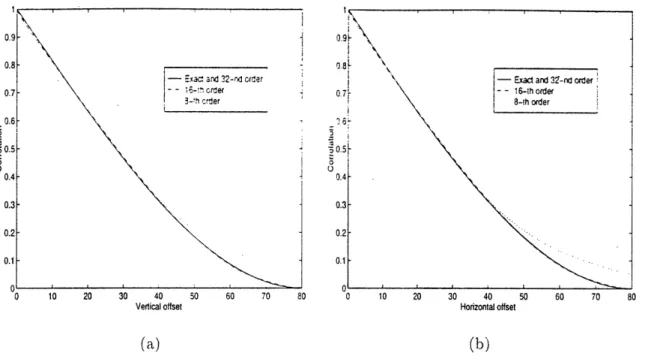
We do not include a contour plot for orur mo(Lel of order 64. because for orders greater than just 16, our multiscale models capture virtually all of the significant correlation structure. This fact is reinforced in Figures 4a and b. where we display horizontal and vertical slices of these contour plots.
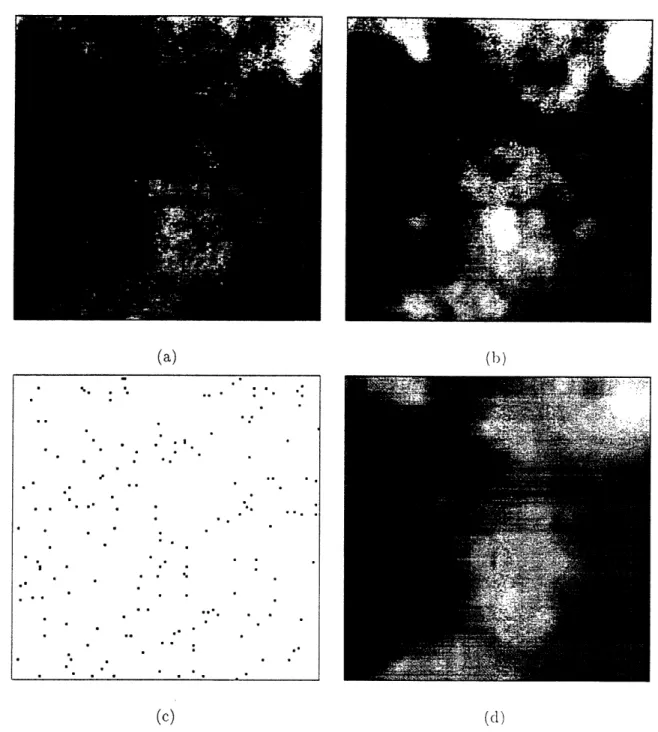
Let us consider the use of these multiscale models to carry out linear least-squares estimation. In Figure 5a, we display the original signal that we will be attempting to estimate. This signal consists of 128 x 128 pixels and has a Gaussian distribution. It is drawn from the exact distribution implied by (31) with e =
so.
This field generation is effected by embedding the 128 x 128 grid into a larger 256 x 256 toroidal lattice, and extending the definition of Ry(-, ) to have periodic boundary conditions; for e = 80, this approach leads to a valid (i.e., positive definite) correlation function.We consider two estimation problems related to the signal in Figure 5a. For the first, we corrupt the signal with spatially stationary white noise having covariance one, thus leading to an SNR of OdB (since the signal also has a variance of one, as indicated by (31)). In Figure 5b, we display an estimate based on our multiscale model of order 64. The sample MSE here is 0.0498. While there is no computationally feasible way to determine the mean-square error of an optimal estimator for this problem, we can obtain a fairly tight lower bound for the optimal MSE. In particular, let us consider the problem of estimating the value of the 256 x 256 signal, from which our 128 x 128 signal has been extracted. Since this 256 x 256 signal is stationary and is indexed on a toroidal lattice, exact calculations are possible. In particular, for estimating this signal in OdB white noise, the optimal, FFT-based estimator has an MISE of 0.0458, which must lower-bound the WMSE of an optimal estimator in our original estimation problem. By comparison, then, our measured MSE of 0.0498 is quite satisfactory. Although not shown in the Figure, the same level of performance is also achieved by our lower-order multiscale models; specifically, our models of order 32, 16 and 8
60 60
40 40
>I .>
-60 -40 -20 0 20 40 60 -60 -40 -20 0 20 40 60
Horizontal offset Horizontal offset
(a) (b) 60 . ,' ' 40 40 -20
~~~~~~~-40
~
~ ~
" : -40 I20/ -60 -60 -60 -40 -20 0 20 40 60 -60 -40 -20 0 20 40 60Horizontal offset Horizontal offset
(c) (d)
Figure 3: These four figures display contour plots associated with R,(, -), defined in (31), with the contour levels at 0.9, 0.7, 0.5, 0.3 and 0.1. (a) The exact. desired correlation function. (b), (c), and (d) The correlation function associated with multiscale models of order 32. 16 and 8, respectively. These three have beeh determined by Monte-Carlo simulation, using enough trials so that every estimated correlation value is within 0.005 of its correct value.
0.9 0- 9
0.8
~0.8
E-
Eac: and cfder - Eact and 3-nd order
0.7 X- cr' e er 7 |-- th order 3-!h crder 8-th order 0.6 0o.5- .i o 0.4 0.4 0.3- 0.3 0.2 0.2 - o 0.1 0.1 0 10 20 30 40 50 60 70 80 0 10 20 30 40 50 60 70 80
Vertical offset Horizontal offset
(a) (b)
Figure 4: Comparison of (a) vertical and (b) horizontal slices of the correlation contour plots in the previous figure. Again, these plots are based on Monte-Carlo simulation. where each point is within 0.005 of its correct value with 95 percent confidence.
achieve sample MSEs of 0.0501, 0.0533 and 0.0544, respectively, which are all close to the optimal. The second estimation problem we consider is one for which the FFT is of little practical use. In particular, we consider the problem of estimating the signal displayed in Figure 5a, based on noiseless measurements at the extremely sparse set of points displayed in Figure 5c. These points provide only 1.11% coverage of the image region. Their irregular distribution is the key reason that FFT techniques are not useful. On the other hand, in Figure 5d, we display the estimate that results from use of our multiscale model of order 64. In light of the sparsity of our measurement coverage. this estimate has impressively captured the coarse qualitative features of the true signal; in fact, the sample MSE of this estimate is only 0.1147.
5.2 Reduced-order Representations of Warped-version of Isotropic Correlation
Function
For our second example, we build multiscale representations for a stationary random field having a correlation function that is a warped version of the isotropic correlation function Ryy(k, I) in (31.
(a) (b)
4·
(c) (cl)
Figure 5:
These four figures relate to linear least-squares estimation of a signal having the isotropic correlationfunction in (31). (a) The original signal, with Gaussian deviates. drrawnl fron the exact distribution using FFT-based techniques. (b) Estimate of the sample path in (a), based on noisy. delnselv distribute:d measurements of the signal, with OdB SNR; a 64-th order multiscale model is used to obtain this estimalte. (c) Locations of observed pixels, for a second estimation experiment; these observed pixels provide only 1.11 't coverage of the ilmage. (d) Estimate of the sample path in (a), based on noiseless observations of the observed pixels (displayed in (c)).
Our warped version, which we dtenote by R'U(k.
1)
is defined its follows:Ryy(i. j)- Rvy(i .j').
(33a)
=( ( souse 57- ) ?II. ( 1 () ) = . (33b)
j\i'
k\04
-sillno (0os0
413
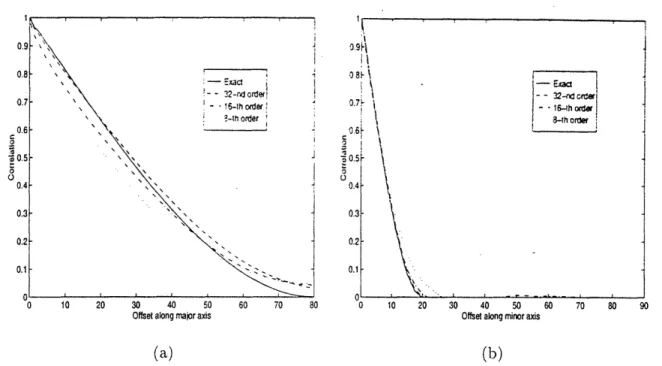
The characteristic length t of Ryy(i. j) (see (31)) is again set to e = 80. A contour plot of Ryy(i.j) is displayed in Figure 6a, while slices of this correlation function along the directions of strongest and weakest correlation are displayed in Figures 7a and b, respectively.
We consider the problem of building a multiscale model, indexed on a quadtree, to realize the correlation function (33b) on a 128 x 128 grid. We constrain the multiscale model dimension to the respective values of 64, 32, 16 and S.
In Figures 6b, c and d, we display as contour plots the correlation function associated with our multiscale models of order 32. 16, and 8, respectively. Just as in our previous example, we must carefully define the precise meaning of these contours. As in the previous example, we let C denote the random vector comprising the finest-scale of the particular multiscale process in which the state vectors are constrained to have dimension no greater than A; we thus have 0, 016, and
32. We denote the (i,j)-th component of A\ by Ib (i,j) (for i,j = 0,1, . . ,127). In terms of these
conventions, the plots in Figures 6b. c, and d display contours of the function Rx(-,
.),
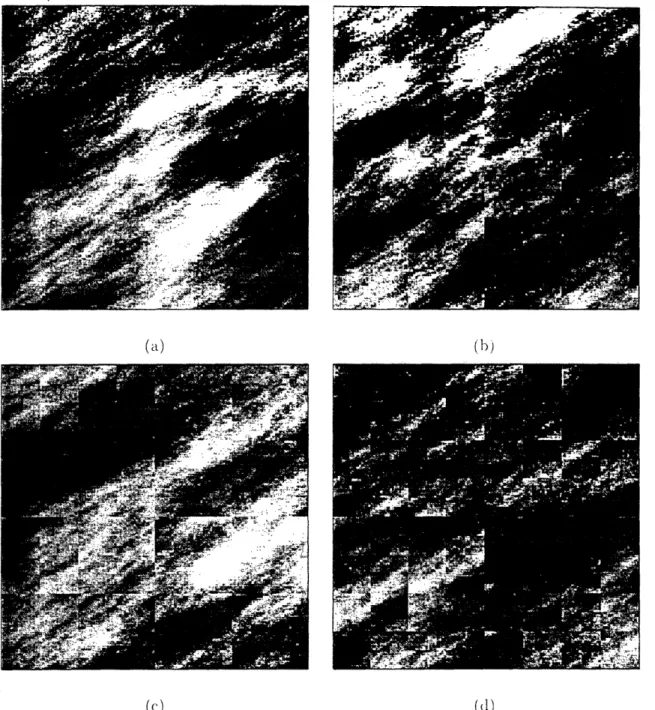
for A = 32, 16 and 8 respectively, where RAx( .) is defined in (32). We do not include a contour plot for our model of order 64, because at this order, the contour plot is indistinguishable from the ideal, desired correlation in (a). To allow for more direct comparison of these contours, we overlay slices of them in Figures 7a and b; more specifically. Figure 7a represents a slice of the contour plots, along the direction of strongest correlation. while part b represents a slice of the contour plots along the direction of weakest correlation.In Figure 8, we display sample paths of this random field using Gaussian deviates, generated with our models of order 64, 32. 16 and S. We see that unless a relatively high order model is used, the sample paths exhibit visually distracting blocky artifacts at the quadrantal boundaries.
-50 ^ - i -40 -0 -30 -30--20 -20 ii -10 -lo. o 0 Ho > 10 20 30 - 30 40 40 l50- _ o 50 -50 -40 -30 -20 -10 0 10 20 30 40 50 -50 -40 -30 -20 -10 0 10 20 30 40 50
Hoizontal offset Horizontal offset
(a) (b) -50 6: T -s!3 -30 -20- 2 10 C~~~~~~~o > I1 >10 20 20 30 30 40 40 -50 -40 -30 -20 -10 0 10 20 30 40 50 -50 -40 -30 -20 -10 0 10 20 30 40 50
Horizontal offset Horizontal offset
(c) (d)
Figure 6: These four figures display contour plots associated with RP,(','), defined in (33b), wvith the contour levels at 0.95, 0.85, 0.75, 0.6, 0.45, 0.3 and 0.15. (a) The exact, desired correlation function. (b), (c), and (d) The correlation function associated with multiscale models of order 32, 16 and 8, respectively. These three have been determined by Monte-Carlo simulation, using enough trials so that every estimated correlation value is within 0.005 of its correct value.
I I 0.9 s 0.F1 0.8 117 oee
I
0.7 X\- -0h 7oeder -- 16h r ?-th order 8-th order 0.6 - .6 0o o 0.4 - 0.4 0.4 03 04 0.3 - 0.2 0.2 02. 0.1'"-' ,. 0 10 20 30 40 50 60 70 80 0 10 20 30 40 50 60 70 80 90Offset along mapor as Offset along minor axis
(a) (b)
Figure 7: Comparison of slices of correlation contour plots in the previous figure. (a) A slice along the direction of the major axis of the ellipses in part (a) of the previous figure. (b) A slice along the direction of the minor axis of
the ellipses in part (a) of the previous figure. Again, these plots are based on Monte-Carlo simulation, where each
point is within 0.005 of its correct value with 95 percent confidence.
While in many applications, these artifacts are devoid of any statistical significance, they may be important in other contexts. One way to eliminate these artifacts is employ a relatively high-order model multiscale model; for instance, as shown in Figure Sa, the 64-th order model is effective in this regard. An alternative, arguably more elegant approach to eliminating these artifacts is to use so-called overlapping tree models, in which distinct tree nodes correspond to overlapping portions of the image domain; this idea is described in detail in [9].
6
Conclusions and Suggestions for Future Work
This paper develops elements of a theory for multiscale stochastic realization, focusing on the problem of building multiscale models to realize. either exactly or approximately, pre-specified finest-scale statistics. A key challenge has been to generalize the time-series notion of state vectors serving as an interface between the past and the future of a random process. The generalization is
(
)
((d)
Figure 8: These four figures displa ampIle peths of a ralndom y field having tilhe correlation function given in (33b,
for a 128 x 128 pixel region. The sampll pathts in (a). (1). (c) and (lI) correspond to multiscale mlo(lels of order 64, 32, 16 and 8. respectively. using (altssiitt ('dev'iate's.
made by introducing a generalized correlation coefficient. which is used to make precise the notion of multiscale state vectors serving to decorrelate multiple subsets of a multiscale process. Once the reduced-order multiscale modeling problem has been formalized, we harness canonical correlation analysis to develop a sub-optimal model-building algorithm. We demonstrate the practicality of this algorithm in problems of random-field estimation and generation. In the context of field generation, we demonstrate an ability to build multiscale processes having a finest-scale correlation matching very closely desired correlations. In the context of field estimation, we build multiscale models that are in turn used to carry out least-squares estimation, with the resulting field estimates having nearly optimal mean-square error.
The work presented raises a number of interesting research questions. What is the optimal solution to the general decorrelation problem addressed in Section 4? Is the bound on state di-mension in Proposition 1 tight? In other words. can a multiscale model be devised in which the bound holds with equality at every node? If not, what then constitutes a minimal realization of a given finest-scale covariance? Is the class of internal realizations rich enough to always include a minimal realization? This last question is particularly intriguing, because in the time-series case, the answer is yes [10, 16].
Finally, other interesting questions arise when we consider more carefully the issue of inter-scale propagation of information in multiscale processes. Consider, for example, the problem of building a multiscale model indexed on a second-order tree (i.e., a tree for which q = 2) having three scales to realize exactly the following finest-scale covariance:
1 0 0 0
0 110 P(o = (34) 0 110 0001 31One possible exact realization uses the following values for the internal matrices:
-o ( O 1 ( )
(°)o
=
((
0
).
oV0~., II= u,0,2 = I011021, 1 = T1'Oc2, = 1. (35)
A valid alternative, which also leads to an exact realization, is to replace Wl/ in (35) with W0,
,VV = diag(,1, 1, 1,1),
while retaining the same values as in (35) for the other internal matrices. There is an important difference between the models that result from these two choices for the internal matrices. The first choice leads to a model in which coarse-scale information is preserved in its journey to the finest scale; in particular, we see that x(.s) = Wss. and so indeed the first realization is internal. On the other hand, the second choice leads to a model in which information is lost in its journey to the finest scale. In fact, by using WV, in lieu of W0, we have somewhat perversely created a multiscale
model in which the entire finest-scale process is generated at the root node, and then some of this information is immediately discarded in the transition to the middle scale, whence new values for this discarded information are generated in the transition to the third, finest scale. Although the finest scale process does have the correct, desired correlation, the realization is not internal5. In particular, x(O) = WVo0 o.
In light of this example, how can our modeling approach be refined to propagate information more explicitly from scale to scale? One answer is presented in [9], though the suggested approach is not numerically practical. As a related issue, how can we extend our modeling approach to realize jointly pre-specified fine and coarse scale statistics?
All of these unanswered questions highlight the fact that multiscale stochastic realization is a relatively new subject, with this paper serving only as a beginning. Many interesting challenges remain.
5
A
Proof of Proposition 2
In this appendix, we complete the proof of Proposition 2. by establishing the validity of (18a) and (18b). For this purpose. we continue to use the notation established in Section 4.1.
We begin by making explicit the connection between the value of P/(/l,/2 I W1T ; 1 ) and the
cross-covariance. D between [l and /12. To proceed. we define the linear least-squares residual f
via
2 _=
(AT
(
f T )- E(
IW[L),
(36)
where by elementary theory of linear least-squares estimation theory,
p, =
p
- PVWT (W PWT)- WP, P (37)For this analysis, we set W = (WV 0). so that WI/y = WlV1 1. In terms of (37), we then define the
sets F1 and F2 as follows:
Fi - {{f; frpAif = 1} (i=1,2). (38)
Now, using the definitions in Section 2.3, we find that if either F1 or F2 is empty, then P(1, d2
IWll)
=0, and otherwise
P(1, 2 I IVlUl) = max f TP,1 2f2. (39)
f1EF ,f2EF2
In general, the sub-matrices PA,, P,12 and P41l 2 of PA in (37) can have messy analytical forms.
However, if W1 has orthonormal rows (i.e., TW1 E ,V', for some A), then simplification is possible.
We begin by noting that
P(Al.A 2I Ttj
1) = P(
W
1.1
2I VLW,'
1)
(40)
where L' and anre related respectively to [li and WV1 via unitary (but otherwise arbitrary) matrix
U:
-/ UT-1-,
V
= W -'I , l [L' - E(4I VC14) (41)Letting WVjL be a matrix whose rows form an orthonormal basis for the nullspace of Wl. we set
U = (IWT (CWl/)T), so that
WIV
= (Ix 0). Then. thanks to (37),P,
P-,
0 lm, -nA WID(
P
l A ID A2 )i
°])(
r
)(42)
£//1)m2
-DTIv[W
1D
Finally, adapting (40)-(42) to (36)-(38), the following lemma results:
Lemma 2 Let W1 E MAx, 0 < A < ml, and let WTl be a matrix whose rows form an orthonormal
basis for the nullspace of W1. Then,
A(L I ,/2
I V1
1L,) = x {gmV 1IDg2} (43a)gl2Eg2EG 91
= max 11 W'Dg92 112, (43b)
where G1 and G2 denote the following sets:
G1 = g E Rm l- = lTg }
G2 = {g E 'Rm 2 gT(In, - DTwTwV D)g = 1}.
As a direct consequence of this lemma,
dx+l, 0
A
< m22(tl 2
I
(IA
O)-1)=
A+
0<
A
< 12(44)
O A > ml2
This fact establishes (18b).
What remains is to establish (1Sa). To proceed, we temporarily constrain W to have either of the two forms
W = (vW
10)or
(
W2 ),
(45)
and we find a matrix W E /VA that minimizes iP(/tl. #A2 I Wit), subject to this additional constraint.