HAL Id: hal-01664474
https://hal.archives-ouvertes.fr/hal-01664474
Submitted on 2 Jun 2020
HAL is a multi-disciplinary open access
archive for the deposit and dissemination of sci-entific research documents, whether they are pub-lished or not. The documents may come from teaching and research institutions in France or abroad, or from public or private research centers.
L’archive ouverte pluridisciplinaire HAL, est destinée au dépôt et à la diffusion de documents scientifiques de niveau recherche, publiés ou non, émanant des établissements d’enseignement et de recherche français ou étrangers, des laboratoires publics ou privés.
challenges
Christian Gary, Raphaël Metral, Aurelie Metay, Léo Garcia, Anne Merot,
Nathalie Smits, Jacques Wéry
To cite this version:
Christian Gary, Raphaël Metral, Aurelie Metay, Léo Garcia, Anne Merot, et al.. Towards an agroeco-logical viticulture: advances and challenges. 20. GiESCO International Meeting, Nov 2017, Mendoza, Argentina. �hal-01664474�
TOWARDS AN AGROECOLOGICAL VITICULTURE: ADVANCES
AND CHALLENGES
HACIA UNA VITICULTURA AGROECOLÓGICA: AVANCES Y DESAFÍOS
GARY, Christian1*, METRAL, Raphaël2, METAY, Aurélie2, GARCIA, Léo2, MEROT, Anne1, SMITS,Nathalie1, WERY, Jacques2
1Inra, UMR System, F-34060 Montpellier, France 2Montpellier SupAgro, UMR System, F-34060 Montpellier, France
*Corresponding author: [email protected]
Abstract
To improve its sustainability, viticulture should increase the provision of ecosystem services to decrease its use of inputs and the resulting environmental impact while maintaining high socio-economic performance. Soil functions in relation with their physical, chemical and biological properties can be regulated by proper soil surface management. Cover crops deliver ecosystem services such as protection of soils, better water infiltration and nitrogen fixation. Yet to avoid trade-off between provision of services and production of grapes, the management of cover crops should adapt to climate variations and to the yield objective. Pest and diseases can be regulated by various technical levers, including the control of the grape vegetative development. The assessment of damages due to pests and disease and of their consequences on yield losses is a key component of the design of alternative strategies of crop protection. This knowledge provides clues for designing management strategies with low pesticide use and high agro-ecological performance. A French national network of experiments has quantified the reduction of pesticide use with decision support systems, biocontrol or resistant varieties. To go further the challenge is now to design agroecological vineyards that combine innovations in management, and also in spatial organization at field, farm and landscape scales.
Key words: viticulture, ecosystem services, soil management, crop protection, diversity Resumen
Para mejorar su sostenibilidad, viticultura
debería
aumentar la prestación de servicios ecosistémicos para reducir su uso de insumos y el impacto ambiental resultante, manteniendo un alto desempeño socioeconómico. Las funciones del suelo en relación con sus propiedades físicas, químicas y biológicas pueden ser reguladas por un manejo adecuado del suelo. Cubiertas vegetales brindan servicios ecosistémicos tales como protección de suelos, mejor infiltración del agua y fijación de nitrógeno. Sin embargo, para combinar prestación de servicios y producción de uva, el manejo de cubiertas vegetales debe adaptarse a las variaciones climáticas y a los objetivos de producción. Las plagas y enfermedades pueden ser reguladas por varias técnicas, incluyendo el control del desarrollo vegetativo de la uva. La evaluación de los daños debidos a plagas y enfermedades y sus consecuencias sobre las pérdidas de rendimiento es un componente clave del diseño de estrategias alternativas de protección de cultivos. Este conocimiento proporciona pistas para diseñar estrategias de manejo con bajo uso de pesticidas y alto desempeño agroecológico. Una red nacional francesa de experimentos ha cuantificado la reducción del uso de pesticidas con sistemas de apoyo a la decisión, control biológico o variedades resistentes. El desafío presente es diseñar viñedos agroecológicos que combinan innovaciones en manejo y organización espacial a los niveles del campo, de la granja y del paisaje.Palabras clave: viticultura, servicios ecosistémicos, manejo del suelo, protección de cultivos, diversidad
Introduction
Whereas viticulture claims strong links with its environment (its “terroir”), its sustainability is questioned regarding its negative impacts on this environment, particularly in the soil management and crop protection domains (Meziere et al., 2009; Gary et al., 2010). In the recent years, several projects
have aimed at revisiting these issues within an agroecological framework in order to (i) determine how soil functions and pests and diseases can be regulated in vineyard agroecosystems with minimal use of inputs, and (ii) design agroecological management strategies that provide the set of products and environmental services expected from viticulture. The present communication aims at reviewing recent advances our research group contributed to achieve, and at identifying major challenges in this field.
Enhancing ecosystem services to reduce inputs in vineyards
Viticulture relies on a high use of inputs, yet with variations among regions and among grape growers within the same region (Meziere et al., 2009). Pesticides come first to control pests and diseases, then fertilizers, depending on the expected yield level, and water in drylands. In contrast, an agroecological approach of viticulture should mobilize natural controls (e.g. of pests and diseases) within the agroecosystem to enhance the provision of ecosystem services and reduce input use (Fig. 1). Several of these ecosystem services have been assessed for the recent year, which provides clues for improving management strategies.
Regulating soil functions
The environmental sustainability of viticulture strongly relies on the maintenance of good soil quality, particularly in terms of physical structure, resource availability and biological activity. Polge de Combret – Champart et al. (2013) observed a high frequency of soil compaction in 69 plots located in several French vineyards. The distribution and intensity of compaction within the soil profiles varied with soil vulnerability to compaction (in relation with texture, waterlogging and stoniness) and traffic geometry. It could be moderated with some agricultural practices such as cover cropping, use of low-pressure tyres and limitation of traffic. Salomé et al. (2016) considered a larger range of indicators of soil quality, including physical, chemical, biological and nematode ecological indicators. They observed this set of indicators over 146 plots located in French Mediterranean vineyards. If soil quality varied with its specific characteristics (Ca carbonate content, stoniness), it was also affected by soil management practices such as fertilization, weeding and cover cropping. Organic rather than mineral fertilization tended to stimulate the soil physical, chemical and biological quality, yet with contrasted patterns among soil types and depending on the fertilizer policy. Similarly, the type of weeding management (chemical vs. mechanical) generated contrasted effects among soil types. Only cover cropping, permanent or temporary, improved most of soil quality indicators, whatever the soil type. In these two surveys, cover cropping appeared to improve a large range of indicators of soil quality. The soil processes and the resulting ecosystem services behind these indicators have been studied, with a specific focus on the soil water and nitrogen balances. Cover cropping regulates various water fluxes. It increases evapotranspiration but is also increases water infiltration during the rainy seasons (Gaudin et al., 2010) providing more water for grapevine absorption in deep soil horizons (Celette et al., 2008). Cover cropping also regulates the nitrogen fluxes, directly by uptaking nitrogen for its own development, reducing nitrate leaching or fixing atmospheric nitrogen if it includes legumes, and indirectly by drying the upper soil layer and then reducing biological activity and mineralization (Celette et al., 2009). These processes may generate periods of competition for the soil resources between grapevine and cover crop (Celette and Gary, 2013). Consequently, cover cropping alters, positively or negatively, the time course of resource availability during the grapevine cycle, and the resulting formation of grape yield and quality (Guilpart et al., 2014; Ripoche et al., 2011a).
Therefore cover cropping, and more generally soil surface management, regulates soil functions in ways that may lead to the provision of either ecosystem services (better water infiltration, symbiotic N fixation) or disservices (lower availability of soil resources for grapevine). Various technical levers are available to tune the balance between services and disservices: cover crops species with very contrasted functional traits are available (Kazakou et al., 2016), they may cover all or part of the field surface area (between and/or under rows), they may be set only off-season and/or during the grapevine crop cycle. By simulating the water balance resulting from a large number of soil surface management strategies, Ripoche et al. (2011b) showed that an appropriate management should adapt permanently for the cropping system to provide stable grape yield and quality and stable environmental services
despite strong changes in the rain regime over the years. Indicators such as the availability of soil water at budbreak can be used to this end (Gaudin and Gary, 2012).
Regulating pest and diseases
The grapevine is confronted with major pests and diseases that must be regulated to protect the quality of grapes and the sustainability of this perennial crop. In an extensive analysis of agricultural practices in a set of about 5000 vineyard fields in ten French wine-producing regions, Meziere et al. (2009) identified four classes of strategies: systematic crop protection, non-systematic protection, integrated protection (adoption of alternatives to pesticides), and organic farming. The average treatment frequency index (TFI) varied a lot among these classes (from 21.3 with systematic crop protection to 8.4 with integrated protection) and also among regions (it was much lower in Mediterranean regions than in northern vineyards). There is also a strong variability among grape growers, the most common technical levers to reduce TFI being the late timing of the first fungicide spray and the adoption of mechanical weeding or cover cropping instead of chemical weeding (Mailly et al., 2017). Some technical levers aiming more explicitly at regulating pests and diseases are promising (grapevine varieties resistant to major fungi, biocontrol agents, mating disruption) yet their level of adoption among grape growers is still uneven (Pertot et al., 2016).
The processes of interaction among the various communities of plants, fungi and arthropods in vineyards have extensively been studied by biologists and ecologists. An original agronomist view point has been brought by Valdés-Gómez et al. (2008, 2011) who observed a good correlation between soil resource availability, grapevine vegetative growth and the development of powdery mildew and grey mould. They showed that, in some respect, the control of grapevine development through the management of soil resources can be an effective way of regulating fungi attacks. Guilpart et al. (2017) found that inter-annual variation in water stress at grapevine flowering is a key driver of the balance between grape yield and grapevine susceptibility to powdery mildew and grey mould in relation with vegetative development. Their results suggest opportunities to reduce fungicide use when a win–win situation occurs, combining good grape yield and quality and reduced vegetative development.
Another agronomic challenge is the assessment of yield losses in relation with attacks of pests and diseases, which is increasingly relevant in a context of reduction of pesticide use. The clue is to identify the links between epidemics, injuries, damages and economic losses. In viticulture, a first attempt has been carried out by Leroy et al. (2013) who introduced in the Sticks grapevine crop model a function of damage caused by downy mildew onto leaves and fruits; this damage function determines a percent reduction of potential leaf area and yield. The next step are to consider the pathosystem as a whole with a multiple pest damage function (Smits et al., 2015) and to develop indicators to assess the intensity and impact of pests and diseases in farmer’s fields condition (Fermaud et al., 2016).
Designing agroecological management strategies
Improving our knowledge about the links between cropping techniques and provision of ecosystem services is not enough for grape growers to change their management. These pieces of knowledge, these indicators and decision rules must be assembled within coherent management strategies that fit with the objectives and constraints of grape growers in a specific soil-climate context. This is particularly true in the field of the reduction of pesticide use, which remains very slow over the years despite the availability of agroecological alternatives (Mailly et al., 2017). That is why specific research programmes have been launched to design low input cropping systems in viticulture.
A systemic approach
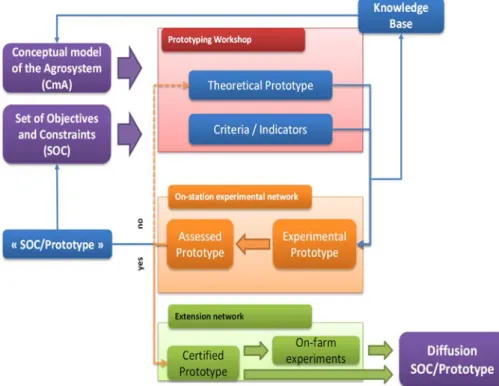
The Ecoviti project has been a unique opportunity to gather a large range of experts in viticulture (scientists, extensionists, farmers) to enter in a process of participative design of cropping systems with low pesticide use (Lafond et al., 2013). The process included four steps: (1) the listing of a set of objectives and constraints specific to the production situation under study, (2) the sharing of a conceptual model of the agroecosystem to be improved, (3) the participative construction of novel
prototypes of cropping systems, and (4) the experimental assessment of the prototypes that may lead either to their implementation at larger scale or to a new round of prototyping (Figure 2).
The resulting prototypes have been designed on the basis of specific starting points (biocontrol, decision support systems, resistant varieties), by aggregating to them consistent sets of technical operations. They aimed at reducing significantly pesticide use, without reducing grape yield and quality, nor increasing working time and production costs. The technical changes mainly concerned soil management without herbicides, reduction of the number and dose of pesticide applications based on crop monitoring (Valdés-Gómez et al., 2017) and use of biocontrol agents. They have been implemented and assessed from 2012 to 2017 in six experimental platforms gathering a total of 45 fields and located in various French grape-growing regions.
The proof of concept
From 2013 and 2015, 85 % of the tested cropping systems reduced TFI by more than 25% over the three years, in conventional as well as organic cropping systems, and over the six experimental platforms. At least half reduced TFI by 50% and more. Yield was acceptable with no or very low losses, even when high pressures of powdery and downy mildew were recorded. The prototypes that combined various levers (innovative decision rules, biocontrol, resistant varieties) provided higher yield. Some prototypes led to a high pesticide reduction (over 70%), yet they did not reach the expected yield. In that case, the adjustment of the set of objectives had to be discussed in a new prototyping workshop. The wine market could allow re-adjusting the economic model to increase the profitability of these prototypes with high environmental performances.
A multiple criteria analysis was carried out for an overall assessment of the performances. This assessment was based on the aggregation of environmental, social and economic criteria with the DEXi software (Métral et al., 2015). One third of the situations (cropping system x plot x year) were positively assessed for all criteria; 66% presented an overall performance score higher than 4 over 5. 40% of the cropping systems presented an overall performance score higher than 4 over 5 every year. The transition to agroecology
When moving to agroecology, farming systems often get more complex. In a survey carried out in vineyards in transition to organic farming, Merot and Wery (2017) observed the consequences of this technical change on the farmers’ organization of activities. At farm scale, the structure and management of vineyards got more complex, with more diversity of management plans among fields, and more labour involved. The transition is a period of training for farmers. It may lead to temporary lower performance, for example in terms of yield losses due to pests or diseases, yet studies show that this risk is limited (Merot and Thiollet-Scholtus, 2017).
Conclusion
There is now a strong body of evidence that increasing biodiversity in cropping systems promotes natural controls, and that it is an effective way of reducing the use of anthropogenic inputs without jeopardising economic performances. The controls of pests and diseases and soil functions provide services to grape growers; other services such as C sequestration of water quality may be provided to the society. This scientific knowledge, combined to the expertise of farmers and extensionists, feeds the design of agroecological cropping systems that prove to meet both ecological and economic objectives.
These advances go with methodological changes. We should in particular better integrate the analysis of ecosystem services and cropping system design (Rapidel et al, 2015), and better articulate on station and on farm experimentation within participative approaches.
Literature Cited
CELETTE F., GAUDIN R., GARY C., 2008. Spatial and temporal changes to the water regime of a Mediterranean vineyard due to the adoption of cover cropping, European Journal of Agronomy, 29, 153-162.
CELETTE F., FINDELING A., GARY C., 2009. Competition for nitrogen in an unfertilized intercropping system: The case of an association of grapevine and grass cover in a Mediterranean climate. European Journal of Agronomy, 30, 41-51.
CELETTE F., GARY C., 2013. Dynamics of water and nitrogen stress along the grapevine cycle as affected by cover cropping. European Journal of Agronomy, 45, 142-152.
DURU M., THEROND O., MARTIN G., MARTIN-CLOUAIRE R., MAGNE M.A., JUSTES E., JOURNET E.P., AUBERTOT J.N., SAVARY S., BERGEZ J.E., SARTHOU J.P., 2015. How to implement biodiversity-based agriculture to enhance ecosystem services: a review. Agronomy for Sustainable Development, 35, 1259-1281. FERMAUD M., SMITS N., MEROT A., ROUDET J., THIERY D., WÉRY J., DELBAC L. 2016. New multipest damage
indicator to assess protection strategies in grapevine cropping systems. Australian Journal of Grape and Wine Research, 22, 450–461.
GARY C., HOFFMANN C., MUGNAI L., DUBOIS P.H., BLUM B., VIRANYI F., FERMAUD M., WIEDEMANN-MERDINOGLU S., THIERY D., BARBIER J.M., LOLAS M., CALONNEC A., VALDÉS H., RADDI P., 2010. Pesticide use in viticulture, available data on current practices and innovations, bottlenecks and need for research. Deliverable DR1.23, Grapevine Case Study, European Network for Durable Exploitation of crop protection strategies (Endure), 14 p (http://www.endure-network.eu/content/download/5613/43692/file/ENDURE_DR1.23.pdf).
GAUDIN R, CELETTE F, GARY C, 2010. Contribution of runoff to incomplete off season soil water refilling in a Mediterranean vineyard. Agricultural Water Management, 97, 1534–1540.
GAUDIN R, GARY C, 2012. Model-based evaluation of irrigation needs in Mediterranean vineyards. Irrigation Science, 30, 449–459.
GUILPART N., METAY A., GARY C. 2014. Grapevine bud fertility and number of berries per bunch are determined by water and nitrogen stress around flowering in the previous year. European Journal of Agronomy, 54, 9-20.
GUILPART N., ROUX S., GARY C.,METAY A., 2017. The trade-off between grape yield and grapevine susceptibility to powdery mildew and grey mould depends on inter-annual variations in water stress. Agricultural and Forest Meteorology, 234-235: 203-211.
KAZAKOU E., FRIED G., RICHARTE J., GIMENEZ O., VIOLLE C., METAY A. 2016. A plant trait-based response-and-effect framework to assess vineyard inter-row soil management. Botany Letters, 163, 373-388.
LAFOND D., COULON T., MÉTRAL R., MEROT A., WÉRY J. 2013. EcoViti: a systemic approach to design low pesticide vineyards. IOBC WPRS Bulletin, 85, 77-86
LEROY P., SMITS N., CARTOLARO P., DELIERE L., GOUTOULY J.-P., RAYNAL M., ALONSO UGAGLIA A. (2013). A bioeconomic model of downy mildew damage on grapevine for evaluation of control strategies. Crop Protection, 53, 58-71.
MAILLY F., HOSSARD L., BARBIER J.M., THIOLLET-SCHOLTUS M., GARY C., 2017. Quantifying the impact of crop protection practices on pesticide use in wine-growing systems. European Journal of Agronomy, 83, 23-34.
MEROT A., WERY J. 2017. Converting to organic viticulture increases cropping system structure and management complexity. Agronomy for Sustainable Development, 37(3), 19.
MEROT ET THIOLLET-SCHOLTUS, 2017. Success of organic grapes in different vineyard conditions: yield and berry quality. Proceedings of the 40th World Congress of Vine and Wine, 28th-30th may 2017, Sofia Bulgaria
MÉTRAL R., LAFOND D., GARY C., MEROT A., METAY A., WÉRY J. 2012. How do design and experiment new cropping systems with low pesticide inputs for vineyards. In: Stoddard F.L (ed.) Abstracts of ESA12 (p. 92-93).
Presented at 12th Congress of the European Society for Agronomy, Helsinki, FIN (2012-08-20 - 2012-08-24).
METRAL R., RAPIDEL B., DELIERE L., PETITGENET M., LAFOND D., CHEVRIER C., BERNARD F.-M., SERRANO E., THIOLLET-SCHOLTUS M., WÉRY J. 2015. A prototyping method for the re-design of intensive perennial
systems: the case of vineyards in France. Presented at 5th International Symposium for Farming Systems Design
(AGRO2015), Montpellier, FRA (2015-09-07 - 2015-09-10).
MEZIÈRE D., GARY C., BARBIER J.M., RIO P., BERNOS L., CLÉMENT C., CONSTANT N., DELIÈRE L., FORGET D., GROSMAN J., MOLOT B., SAUVAGE D., SENTENAC G., 2009. Ecophyto R&D, vers des systèmes de culture économes en produits phytosanitaires. Tome III, analyse comparative de différents systèmes en viticulture, MEEDDAT-MAP-INRA, 57 p. + annexe (http://inra.dam.front.pad.brainsonic.com/ressources/afile/224982-5cdd0-resource-ecophyto-r-d-tome-iii.html)
PERTOT I., CAFFI T., ROSSI V., MUGNAI L., HOFFMANN C., GRANDO M.S., GARY C., LAFOND D., DUSO C., THIERY D., MAZZONI V., ANFORA G., 2016. A critical review of plant protection tools for reducing pesticide use on grapevine and new perspectives for the implementation of IPM in viticulture. Crop Protection, 97, 70-84. POLGE DE COMBRET – CHAMPART L., GUILPART N., MEROT A., CAPILLON A., GARY C., 2013. Determinants of
the degradation of soil structure in vineyards with a view to conversion to organic farming. Soil use and management, 29, 557–566.
RAPIDEL B., RIPOCHE A., ALLINNE C., METAY A., DEHEUVELS O., LAMANDA N., BLAZY J.-M., VALDES-GOMEZ H., GARY C. 2015. Analysis of ecosystem services trade-offs to design agroecosystems with perennial crops. Agronomy for Sustainable Development, 35, 1373-1390.
RIPOCHE A., METAY A., CELETTE F., GARY C., 2011a. Changing the soil surface management in vineyards: immediate and delayed effects on the growth and yield of grapevine. Plant and Soil, 339, 259–271.
RIPOCHE A., RELLIER J.P., MARTIN-CLOUAIRE R., PARÉ N., BIARNÈS A., GARY C., 2011b. Modelling adaptive management of intercropping in vineyards to satisfy agronomic and environmental performances under Mediterranean climate. Environmental Modelling and Software, 26, 1467-1480.
SALOMÉ C., COLL P., LARDO E., METAY A., VILLENAVE C., MARSDEN C., BLANCHART E., HINSINGER P., LE CADRE E. 2016. The soil quality concept as a framework to assess management practices in vulnerable agroecosystems: A case study in Mediterranean vineyards. Ecological Indicators, 61, 456–465.
SMITS N., DAGHER A., AUBERTOT J.-N. 2015. A simple grapevine growth model: towards grape-pest, a X-pest model of damage caused by multiple pests on grapevine. Presented at IPM Innovation in Europe, Poznan, POL (2015-01-14 - 2015-01-16).
VALDÉS-GOMEZ H., FERMAUD M., ROUDET J. CALONNEC A., GARY C., 2008. Grey mould incidence is reduced on grapevines with lower vegetative and reproductive growth. Crop Protection, 27, 1174-1186.
VALDÉS-GÓMEZ H., ARAYA-ALMAN M., PAÑITRUR-DE LA FUENTE C., VERDUGO-VÁSQUEZ N., LOLAS M., ACEVEDO-OPAZO C., GARY C., CALONNEC A., 2017. Evaluation of a decision support strategy for the control of powdery mildew (Erysiphe necator [Schw.] Burr.) in grapevine in the central region of Chile. Pest Management Science, http://dx.doi.org/10.1002/ps.4541
VALDÉS-GÓMEZ H., GARY C., CARTOLARO P, LOLAS-CANEO M., CALONNEC A., 2011. Powdery mildew development is positively influenced by grapevine vegetative growth induced by different soil management strategies. Crop Protection, 30, 1168-1177.
WERY J., METRAL R., GARY C., GUILPART N., METAY A., MEROT A., SMITS N. 2013. Designing cropping systems with high productive performance and low use of pesticides: concepts, methods and knowledge, with illustration on vineyards. In: Pertot I., Ioriatti C., Lescourret F., Wolf M (eds) .Book of Abstracts (p. 27). Presented at Future IPM in Europe, Riva del Garda, ITA (2013-03-19 - 2013-03-21).
Figure 1. From efficiency/substitution-based viticulture (left) to biodiversity-based viticulture (right),
adapted from Duru et al. (2015).
Figure 2. The framework for prototyping agroecological management strategies (Metral et al., 2012,
2015; Wery et al., 2013).
Artificialized viticulture
Best management of anthropogenic inputs
Substitution of anthropogenic inputs with organic and
biological inputs Management of planned and associated biodiversities Provisioning services (grapes) Environmental services Disservices
Low biodiversity High biodiversity