Algorithms for Matrix Completion
by
Yu Xin
Submitted to the Department of Electrical Engineering and Computer
Science
in partial fulfillment of the requirements for the degree of
Master of Science in Computer Science and Engineering
at the
MASSACHUSETTS INSTITUTE OF TECHNOLOGY
February 2012
@
Massachusetts Institute of Technology 2012.
ARCHIVES
OF TECHNOLYMAR 2 0
2012
LIBRARIES
All rights reserved.
I
-Author ... ...
Department of Electrical Engineering and Computer Science
September 8, 2011
7I
Certified by...
I-Tommi S. Jaakkola
Professor
Thesis Supervisor
Accepted by ...
Professor LeLlie
A. Klodziejski
Chair of the Committee on Graduate Students
Algorithms for Matrix Completion
by
Yu Xin
Submitted to the Department of Electrical Engineering and Computer Science on September 8, 2011, in partial fulfillment of the
requirements for the degree of
Master of Science in Computer Science and Engineering
Abstract
We consider collaborative filtering methods for matrix completion. A typical ap-proach is to find a low rank matrix that matches the observed ratings. However, the corresponding problem has local optima. In this thesis, we study two approaches to remedy this issue: reference vector method and trace norm regularization. The refer-ence vector method explicitly constructs user and item features based on similarities to reference sets of users and items. Then the learning task reduces to a convex re-gression problem for which the global optimum can be obtained. Second, we develop and analyze a new algorithm for the trace-norm regularization approach. To facilitate smooth primal optimization, we introduce a soft variational trace-norm and analyze a class of alternating optimization algorithms. We introduce a scalable primal-dual block coordinate descent algorithm for large sparse matrix completion. The algorithm explicitly maintains a sparse dual and the corresponding low rank primal solution at the same time. Preliminary empirical results illustrate both the scalability and the accuracy of the algorithm.
Thesis Supervisor: Tommi S. Jaakkola Title: Professor
Acknowledgments
I wish to express my deepest gratitude to my advisor Prof. Tommi Jaakkola. The
thesis would not have been possible without his extraordinary help and endless pa-tience. I'd also like to thank my family for supporting me spiritually throughout my life. Finally, I thank Yuezhi for her love and support.
Contents
1 Introduction
2 Background
2.1 Low Rank Matrix Factorization 2.2 Trace Norm Regularization . . .
2.2.1 Algorithms . . . . 2.2.2 Spectral Regularization . 2.3 Bayesian Approach . . . . 3 Reference method 3.1 Selection criteria ... 3.2 Similarity metric . . . . 3.3 Regression model . . . . 3.4 Greedy selection of reference
3.5 Contextual information . . . 3.6 Online update . . . .
3.7 Active learning . . . . set
4 Efficient algorithm for optimization with trace
4.1 Trace norm regularization for matrix completion 4.2 Alternating primal algorithms . . . ...
4.2.1 General convergence proof for alternating 4.2.2 Closed form update . . . .
7
norm regularization
optimization algorithm
4.2.3 Proximal gradient method . . . . 38
4.3 A primal-dual algorithm.. . . . . . . . 39
4.3.1 Variations of trace norm regularization . . . . 45
4.4 Generalization to Wf, . . . . 49
5 Experiments 51 5.1 Experiments with reference method . . . . 51
5.2 Experiments with primal algorithms . . . . 52
5.3 Experiments with primal-dual algorithm . . . . 53
6 Conclusion 63 A Proof 65 A.1 Proof of theorem 4.2.1 . . . . 65
List of Figures
5-1 Test performance of RMSE as a function of the number of reference
vectors. . . . . 52 5-2 Convergence rates of the objective function with a) A = 0.1 and b)
A = 10... . . . . 56 5-3 Distance to the matrix solution obtained by AGP with a) A = 0.1 and
b) A= 10. ... ... 57
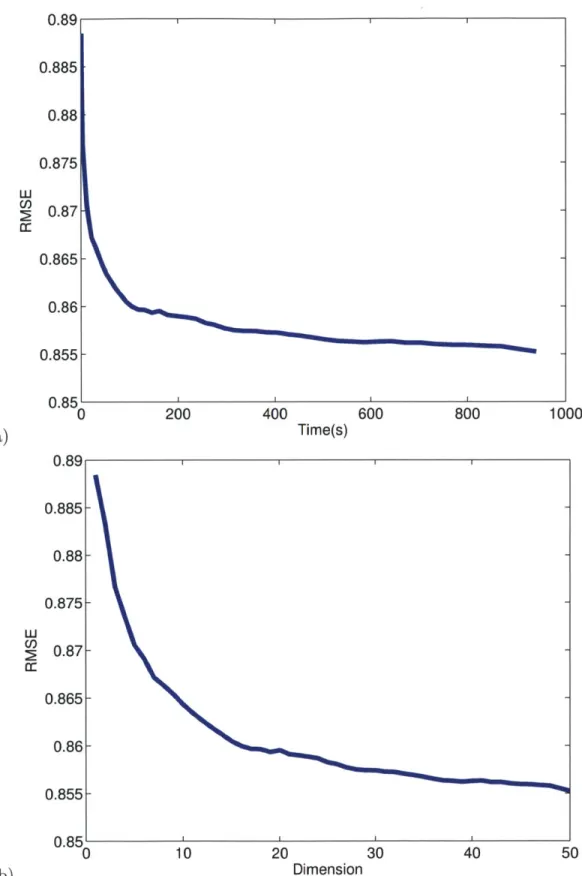
5-4 a) test RMSE as a function of training time. b) test RMSE as a function of the number of dual constraints. . . . . 58 5-5 a) test RMSE as a function of A. b) Maximum eigenvalue as a function
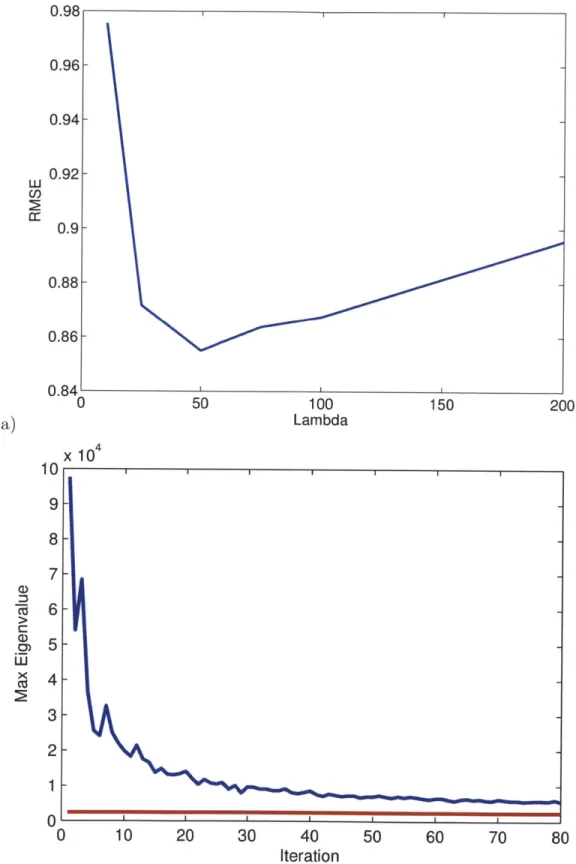
of iteration. . . . . 59 5-6 a) Dual objective as a function of iterations. b) Test RMSE as a
function of iterations . . . . 60 5-7 Maximum iteration as a function of Lambda . . . . 61
List of Tables
Chapter 1
Introduction
Recommender systems (RS) suggest items to users. They are widely used by many content providers such as Amazon and Netflix. The idea is that each user's history reflects their personal interests, so it's possible to predict their future behavior based on that. User's history may include ratings, clicks, purchases and so on. A typical setup involves three entities: users, items and ratings. Rating is a value that repre-sents how much user likes a particular item and may be given as number of stars or as binary indicator. User histories are recorded as triplets where each triplet contains a user ID, an item ID and a rating value. Only some of the possible triplets are observed. The task is to predict the missing ratings baed on user IDs and item IDs and can be seen as a matrix completion problem. The goal is to complete the sparse user-item matrix by filling the missing ratings.
Recommender Systems can be divided into content based methods and collabo-rative filtering (CF) methods. Content based methods assume that descriptions of items are given in addition to ratings. The descriptions are usually turned into feature vectors as in ordinal regression models [35]. Given item feature vectors and associ-ated user ratings, the regression model can be learned for each user separately. One advantage of this approach is that prediction can be made for a new item without ratings. However, performance strongly depends on the quality of the feature vec-tors. In contrast, CF does not rely on item descriptions. It assumes instead that users with similar histories have similar preferences. Starting from the rating matrix, the
method aims to complete the matrix by adding constraints on the possible matrices. For example, a common constraint is low rank. Then the corresponding problem is to find a complete low rank matrix that matches the observed ratings. Different from the content based method, the predications for all users and items will be learned jointly. Our focus is on CF since it has been successfully used in many systems
([1],
[4], [5]).There are three main issues with CF methods scalability, sparsity and robustness. In RS, the number of users and items can easily be in the thousands, and ratings in millions. A CF method must be able to handle such large matrices. A careful design is necessary so the algorithms scale well to large problems. For instance, evaluating all the similarities between users has complexity is O(n2d) where n is the number of users and d is the number of common ratings. This is not possible to do for large matrices.
Only a small portion of all ratings are observed. For instance, in Netflix and Movielens dataset, less than 5% ratings are available. This raises a critical over-fitting problem, i.e. only a few parameters can be estimated reliably from few ratings. One way to solve this problem is by adding constraints or regularization. Examples in-clude low-rank constraint and trace norm regularization. By choosing an appropriate regularization parameter, trace norm regularization will guarantee a low rank matrix solution (cf. section 4).
An interesting question is how many ratings are needed before accurate prediction can be made. "Cold start" problem refers to the case when only a few or even no ratings are provided for a user or an item. This is common since new users join frequently. To address this problem, extra data such as item description and user demographic are necessary. A challenge is to incorporate these data into CF methods. The robustness is also an issue. Adversarial users can trick RS by providing fake ratings for their own interest. For instance, they can provide ratings as normal users while giving high or low ratings to a subset of items. Detecting such adversarial behavior is hard since it can hardly be distinguished from actual preferences. If the number of adversarial users is small compared to all users, performance may not be
degraded significantly. However, in some web-based systems, single user may register multiple accounts. When the number of adversarial accounts is comparable to normal accounts, predictions can be manipulated.
In this thesis, we focus on CF methods that address above three issues. One successful method is low-rank matrix factorization. As we discussed above, low-rank assumption is the key to efficient updates and to avoid over-fitting. The method solves a non-convex optimization problem by alternatingly optimizing user and item feature vectors. However, since objective function is not convex, the algorithm can easily be trapped at a local minimum. While a local minimum may be good enough for prediction, accuracy is not guaranteed.
In chapter 3, we propose a new CF method based on reference vectors. We start by selecting a set of reference users and items that represent distinctive types. Then we express users' feature vectors as similarities to reference users, and similarly for items. Given these feature vectors, predictions are made by solving a convex optimization problem. The alternating optimization algorithm can still be used in this method. But unlike low-rank matrix factorization, the reference method has a convex objective function, so the algorithm will converge to a global minimum.
One of our main contribution is an efficient algorithm for trace norm regulariza-tion. Trace norm regularization favors low rank solutions. It is a convex relaxation of the low rank constraint
[6].
Previous approaches like proximal gradient algorithms require computing Singular Vector Decomposition (SVD) of rating matrix in each iteration. This is very expensive for large problems. In Chapter 4, we first study an alternating primal algorithm based on a variational form of trace norm. This algo-rithm is faster than accelerated proximal gradient algoalgo-rithm, but still requires SVD in each iteration. Next we study the dual problem. We propose an efficient primal-dual algorithm that doesn't require SVD. Preliminary empirical results illustrate both the scalability and the accuracy of this algorithm.We expand on the dual problem by adding constraints on the dual variables. For instance, previous research on robust CF considers rating matrix as a sum of low rank and sparse matrices (e.g. [18]). We find that the method is equivalent to adding
a simple constraint on each dual variable. Other possible extensions include group sparsity and item categories.
Chapter 2
Background
Given a partially observed matrix R
E
Rmxn, the collaborative filtering problem is to predict the missing entries in R. Here each column i C {1, 2, ...n} represents an item,each row u E {1, 2, ... , m} represents a user, and entry Ruj represents the rating of user
u of item i. In most CF problems, R is large and sparse, thus highlighting efficiency and over-fitting issues. For instance, Netflix training dataset contains 100, 480, 507 ratings that 480,189 users gave to 17, 770 movies. Only 1.2% ratings are observed. Movielens 10M dataset has 10M ratings for 10,000 movies by 72,000 users where only 1.4% ratings are observed.
2.1
Low Rank Matrix Factorization
One of the most widely used methods is low-rank matrix factorization. Let P E R dxm
and
Q
E Rdx be feature matrices for users and items. Column vectors P" andQj
represent user u's preferences and item i's properties respectively. Given P andQ,
the rating matrix is predicted as R= PTQ. Intuitively, only a few factors affects userinterests so the dimension d could be small. To avoid over-fitting, we need to reduce the number of free parameters. The number of free parameters is proportional to the
dimension, so d should be small.
optimiza-tion problem
minp,Q
E
Loss(Ra,i, PIQi)
+ A(Z |Pl
1
+
||Qi||3
)
(2.1)
(u,i)EQ u i
where Loss(-, -) is a loss function over observed ratings and A(E
||Pull+Ei ||,
Q1||)
is regularization. The choice of loss function depends on the problem itself. For numer-ical ratings, L is usually the squared loss: Loss(Rui, PQi) = (R, - PQ)2 [4]. Forbinary classification problem, the loss function can be hinge loss Loss(Rui, PTQi) = max(O, 1 - Ru,iPTQi) [5]. Regularization is very important. Empirical results show
that the method doesn't perform well without regularization as it will overfit quickly as d increases.
When one of P and
Q
is fixed, the objective function is convex. But it's not jointly convex w.r.t. P andQ.
An algorithm for solving the optimization problem can easily be trapped in a local minimum. For some CF problems, local minima are good enough. But prediction accuracy may change when algorithms converge to different local minima.To sovle the optimization problem, we can use alternating optimization algorithm that sequentially updates one of P or
Q
while fixing the other,Pu = (
QiQ[
+ AJ)-( [ R,Q), U = 1, 2, ..., m (2.2)i:(U,i) E Oi:(u,i)EQ
Qi=
(>
P P+AI)1 ( [ RP), i= 1, 2,..., n (2.3)u:(u,i)EQ i:(U,i)EQ
The above update rules make use of sparsity because the computations only involve observed ratings. The algorithm stops when P and
Q
change little in one iteration.For extremely large data, stochastic gradient descent (SGD) algorithm is a better option. A single update of the corresponding columns of P and
Q
are made in response to each observed rating in the order of their appearance: given (u, i, Rui),we update only
Pu = Pu - a[(PTQi - Ru,i)Qi + APu) (2.4)
Qi = Qi - a[(PlQi - Ru,i)Pu + AQi) (2.5)
where a is step size. The value of a is critical in SGD. In practice, a is usually manually set by empirical analysis. The algorithm can be easily adapted to online learning scenario when new ratings are continuously observed.
2.2
Trace Norm Regularization
Trace norm is a 1-norm penalty on singular values of the matrix, i.e.
||W1|
= 1 0kwhere ck is W's kth singular value. It naturally leads to low-rank solutions with sufficient regularization (see section 4). In CF, the optimization problem with trace norm regularization is
minw Y3 Loss(Ru,i, Wu,i) + AllW||* = minwL(W) + A
lW||*
(2.6) (u,i)CQwhere Loss(., -) is a loss function, L(W) is the aggregate loss over observed ratings and W is prediction of rating matrix. Trace norm regularization is necessary for generalization to missing ratings. It is closely related to low-rank matrix factorization
since
WK~~ 2mnTw(P~~ (2.7)
||W||, = miner Q=w| 2 (11F + 1F)
But the objective function is now convex.
2.2.1
Algorithms
One key difficulty with this method is that ||W I* is not differentiable. A number of approaches have been proposed to deal with this problem. Proximal gradient
approach is one of them [3]. The approach first approximates loss function via Taylor expansion, then update W by solving the following optimization problem
Wr+1 = argminw(L(W') +V L(W')(W - W') + |W -- Wr||2 + AI|W||*)
2T (2.8)
where r controls the step size. There is a closed form solution to this problem which consists of two steps:
Xr
Wr+1
= Wr -TVwL(W) (2.9)
(2.10) - STA(Xr)
where SA is a shrinkage operator. Suppose SVD of Xr is Xr = Uo-(Xr)VT, then
STA(X') = UDVT (2.11)
where D is a diagonal matrix with entries Dj,j = max(0, oi(X) - TA). The algorithm
is guaranteed to converge when T is small enough [3]. One drawback of this approach is that it requires SVD in each iteration. The complexity of SVD is 0(n3) which is infeasible for large scale problems.
Trace norm can also be cast as a constrained optimization problem [6]. Actually, ||W||, < t iff there exist A and B such that
>- 0 and tr(A) + tr(B) < 2t (2.12)
XT
With this new formulation, the primal optimization problem can be rewritten as
minw L(W) + -(tr(A) + tr(B)) 2
A
X
s.t.
LXT
B
The optimization problem is a semi-definite program (SDP). Exactly solving large SDPs is still difficult, but we can use approximation algorithms [34].
2.2.2
Spectral Regularization
The idea of using trace norm to obtain low rank solution can be generalized to spectral regularization [10]. Suppose user profiles and item profiles are elements in Hilbert space U and I. Consider a linear preference function f(-, -):
f
(U, i) = (u, F i) (2.14)where F is a compact operator that maps from U to I. The empirical loss of F is defined as
RN(F) = F
3
Loss((u, F i), R,) (2.15)(u,i)GQ
where Loss(-, -) is a loss function. Consider the case where u is simply an indicator vector for user u, and i is an indicator vector for item i. Then (u, F i) = Fuj. Spectral regularization can be described as a function that only depends on F's singular values
d
IF(F) = si(o-i(F)) (2.16)
where si is a non-decreasing penalty function satisfying si(O) = 0 and o-i(F) is F's
singular value. Let UN and IN be the linear span of Uk, k = 1, ... , N and ik, k = 1, ... , N. There exists a matrix a E R"x" such that,
m n
F = aa,bpaqb (2.17)
a b
where (pi, ... pm) and (qi, ..., qn) form orthogonal bases of UN and IN. The singular values of F are the same as matrix a's singular values. With the empirical loss and spectral regularization, the estimation problem is
F = argminFEB(U,I) RN(F) + AID(F) (2.18)
where B(U, I) is the set of compact operators from U to I. An interesting class of
spectral regularization is si(o- (F)) = o-i(F) ' where
#
= 0, 1, 2 specifies rank, tracenorm, or Frobenius norm regularization, respectively.
2.3
Bayesian Approach
In a probabilistic version of matrix factorization, user and item feature vectors are drawn from some distribution, and ratings are assumed to be conditionally indepen-dent given feature vectors. The conditional distributions are given by [20]:
P(R|U, V, a) = fJ A(RUi|PTQi, -I) (2.19)
P(Plau) = flAN(Ps|0,ajI) (2.20)
P(Qlaj) = flAN(Qil0, a1 1I) (2.21)
Inferring posterior distribution with above assumption is analytically intractable due to its complexity. Instead, predictions are usually made by finding the MAP esti-mate. One drawback is that the values a, au and ai are essential for the approach to generalize well, but they can only be easily tuned manually, for instance by searching.
However, searching for the optimal values is computationally expensive for large prob-lems. Another way to deal with this issue is to employ a Bayesian approach where we introduce priors for hyper-parameters and integrate over them to automatically control the generalization capacity [20]. Though exact inference is still intractable in this case, approximate inference can be performed by a MCMC algorithm. Empirical results show that this approach performs better than probabilistic matrix factoriza-tion.
Chapter 3
Reference method
One drawback of basic low rank matrix factorization is that the objective function is not convex, so learning algorithms can be trapped in a local minimum. One way to deal with this issue is by explicitly specifying one of the feature matrices for users and items, and learning the other. In this case, the objective function is convex and we can obtain the global minimum. The method is unable to explore the whole low rank space however since one feature matrix is fixed. But it may still outperform the local minimum from matrix factorization if the features are carefully designed.
In this chapter, we propose a new method for collaborative filtering. The method first selects a set of reference users and items, then specifies user and item features based on similarities to reference users and items. We consider two prediction models. One fixes the user feature matrix and learns the unknown item feature matrix. The other operates in the reverse order. The two models are then combined linearly. The unknown user and item feature matrices can be obtained by solving a convex optimization problem with an alternating optimization algorithm.
3.1
Selection criteria
We start from user features. Let IC denote the set of reference users. Its size d is chosen as d < min(m, n). A user is described as Rn,. where R are ratings after taking out user and item means, and R 2 = 0 if the rating is missing. The distance between
two users is the Euclidean distance between their ratings d(u, v) =
||RU,.
-RV,.||2
. Weuse a greedy packing algorithm to select the reference set. The first reference user is selected as uo = argmax| Ru,.l. Then the algorithm iteratively select one reference user by solving the following optimization problem:
a = argmaxuminverd(u, v) (3.1)
The algorithm selects a user that is furthest from current reference users. Actually, the reference users are vertices of the convex hull that contains all users. On the other hand, since missing ratings are considered as 0, the algorithm is inclined to choose users with more ratings, such that the ratings of all reference users are able to cover most of items. Another reasonable selection criteria is to select the cluster centers in user vector space as reference users.
3.2
Similarity metric
Since each reference user has distinctive preferences, the user's similarity to reference user reveals his/her personal interests. We express the user features as similarities to the reference set which gives us feature matrix A
A(u, v) = S(Rf,., RKv),.) (3.2)
where S is a similarity function and IC(v) is the vth reference user. The similarity function is not necessarily symmetric and might not correspond to any kernel function. In a neighborhood method, similarities between two users are used directly as weights in prediction. To make prediction for all users at the same time, the neighborhood method needs to compute the similarities between any pair of users which is very expensive. Our method is different since the similarities are only used to parameterize users, and only the similarities to reference users are needed.
Ex-amples include Cosine similarity and Pearson similarity :
Sc(R.. RV,.) = " "'~ (3.3)
ck'EN( v*R , - R
Sp(RU,., RV,.) = - - Rv) (3.4)
Z3jCN(Ruj - U)2 ZjCN(RVJ
-where Ru is the average rating of user. These similarity metrics are based on Euclidean distance between users' rating vectors.
In RS, relative order is more important than the rating. We consider a weighted ranking function
[7]
as similarity metric. Suppose the scale of rating is 5, then the similarity between Ru,. and Rv,. is defined as:Sr (RUIRv,.) = (ab)CT.,v 6(Rv,a > Rv,b)6(Ru,a < R,)
()
Z(a,b)ETu, 6(Ru,a :$ Ru,b)
where T, = {a, b (u, a), (u, b), (v, a), (v, b) c Q} are shared ratings of two users and
6(x) = 1 if x > 0 and 0 otherwise. The similarity metric compares all pairs of
observed ratings and counts the number of different rating orders. It is more robust than Pearson and Cosine similarity, but at the same time, it is more expensive to evaluate. Let 1 be the average number of ratings two users share. The time to compute weighted ranking similarity is O(2) ,while Cosine and Pearson similarity can be evaluated in 0(l). In CF, I may be small because of sparsity, so the difference in computation may be insignificant.
The above similarity metrics only depend on the observed ratings shared by both users. Generally, the more ratings two users share, the more confident is their simi-larity value. In the previous section, we mentioned the selection of reference set tends to select users with more ratings. This is one of its motivations.
3.3
Regression model
Following the same procedure, we can generate a reference set and feature matrix B for items. Given A and B, we consider a regression formulation
minP,Q (RU'i - P1B - ATQi 2 +± A
1 Pfl2 + A2HQI12 (3.6)
(u,i)GQ
where P
C
Rdxm and Q E Rdxm are parameters for users and items. PTBi and AQ, can be seen as two linear regression models where P andQ
are learnt jointly. Different from low rank matrix factorization method, the objective is convex with respect to P andQ,
so we are able to find the global minimum. The problem can be solved by alternating optimization algorithm with closed form update,P = ( + Al)-( E (R, UBiB[ - ATQZ)Bi) (3.7)
i:(u,i)EQ
Qi
( AuA + A2I)--1( E (RUi - PuTBi)Au) (3.8)u:(u,i) E
u:(u,i) ESelecting the size of reference set is tricky since it involves a trade-off between expressiveness and avoiding over-fitting. Alternatively, we can start from a large value of d, and use trace norm regularization to encourage a low rank solution,
minp,Q E (RUi - PTB- - ATQi)2 + A||P||, + A2|Q||*
(3.9) (u,i)GQ
The above formulation does not consider the interaction between A and B. We can add an additional term to take this into account,
minP,Q,w 1 (RU, - PfB- - ATQi - A7T WBi )2 +
AlHpfl
2+
A
2HQ12
+ A31|W|(.10)(u,i) C
where W
E
RdXd characterize how user features and item features are related in3.4
Greedy selection of reference set
The performance of reference method highly depends on the feature matrices A and B. One issue about previous procedure is that A and B are pre-fixed before learning process, but ideally the construction of A and B should take learning results as feedback to improve performance.
We start with formulation 3.6. Define residual ratings as R' PTBi -TAQ, for (u,i) eQ. The residual error at iteration r over a validation set S is er
(isf(E(U,i)eS(RUi)2)2.
The following algorithm iteratively selects a user and an itemwith the largest norm of residual ratings into the reference set:
0. Select no argmaxZ E Q R and io = argmaxi E(ui)e R2, into reference
set Reu and Re'. Starting from r = 1 and eo = inf, repeat 1 - 4 until er-1 - er < 6.
1. Update A and B by adding a column of similarities to new reference user and
item.
2. Solve optimization problem 3.6 to obtain residual R',
3. Add v = argmax,
E,)C(Rui)
2 andj
argmaxE(
yic(R ,) 2 into refer-ence set Reu and Rei respectively,4. Evaluate er and let r = r
+
1.In step 3, reference user and item are selected based on residual ratings. Users and items with large norm of residual ratings mean that the current prediction model does not work well for these users and items. By adding them into reference set, the method will put more weight on them, and it will likely improve overall performance. One thing to notice is that the selection criteria is not always good since it might select outlier users and items with many ratings.
To avoid over-fitting, step 4 uses a validation set to estimate current performance. The algorithm terminates when adding a new reference user and item gives small improvement.
Step 2 is the most computationally intensive part. For optimization problem
3.6, there isn't a closed form solution. But since we only add one column to A
optimization algorithm used for solving the optimization problem may converge after a few iterations.
In the above algorithm, A and B expand one column every iteration. All columns of P and
Q
are updated in step 2. An alternative approach is to fix P andQ
learned in previous iteration and only update the new columns, thinking PiTB and A'Qi as 1-dimensional linear models. The approach is similar to boosting. It also has a computational advantage since the optimization problem 3.6 reduces to simple linear regression.3.5
Contextual information
Some Recommendation Systems may collect contextual information besides ratings. This information can be user demographic data, item category, expert opinion or possibly a short description of each item. Incorporating contextual information can help improve accuracy of predictions. They can also be used to solve cold start problem when only a few ratings are provided for a particular user or item.
The contextual information can be represented as additional feature vectors for users and items. Let Ce, denote the user features. We can first estimate the contextual parameters without any CF signal, fix the parameters and estimate CF.
minD,T E(RUi - CTDi)2 +
A3||D12 + A2 |T||2 (3.11)
(u,i)EQ
minp,Q,1
(
(RU'i - PTBj - ATQ, - piCuDi)2 + A, pJ2 + A2I
Q
2 (3.12) (u,i)EQwhere p is a constant depending on the contextual information's reliability. For a new user with no previous ratings, Au = Pu = 0. But if the user feature Cu is provided, we can still predict the user's rating as CTDj. Similarly, we can also incorporate contextual information of items.
The contextual information might not be available for all users and items. In this case, we impute 0 for those missing features. One interesting problem is to infer contextual information when they are missing. For instance, a missing Cu can be
inferred as
Cu = argminc ( RU, - PIBi - AUQ - uD- uST) 2 (3.13)
(u,i)EQ
3.6
Online update
In RS, data are collected persistently. New data may change users's interest or item's popularity. To reflect these changes, the prediction model must be updated. Exactly solving the optimization problem is inefficient, but an approximation can be quickly obtained.
We will focus on the formulation 3.6. Suppose the objective function has reached the optimum with current ratings. When a new rating Ru,i comes, the derivative of objective function is:
= 2(PTBi + A Qi - Ru,)Bi (3.14)
apu
S2(PBi
+ ATQi - Ru,i)Au (3.15)Qi
2A simple update rule modifies P and Qi with step size y,
P
=
PU-
p (3.16)'8PU
af
Qi
=Qi
- p
Qi1Qi (3.17)The above update is based on a linear approximation of the objective function. We can use the second order method to make more accurate approximation. Since our objective function is relatively simple, we can compute the Hessian matrix of Pu and
[Zj,(u,j)
EQ BjBT
+ Al
BhA
T1C =+ 3 (3.18)
A stronger Newton-Raphson update rule is:
P P af
PJ
PU
C-1
(3.19)
L L Lagi _
One advantage of this update is that it doesn't need a step size P, which is usually estimated empirically.
3.7
Active learning
Ratings in recommender systems are expensive to collect. We'd like to reduce the number of necessary ratings for making predictions. A technique that can achieve this goal is active learning. Instead of assuming all the ratings are given in the beginning, active learning interactively collects new ratings by making queries to users.
The formulation 3.6 can be seen as a probabilistic model,
P(RFiPQi) = N(0,os) (3.20)
P(PU) = NA(O, o) (3.21)
P(Qi) = NJ(0, o) (3.22)
where uo, ou and o-i are variances that satisfy o-2/o- = A, and o-2/o- = A. One common strategy is to query unknown rating Ruj such that after incorporating Ruj the variance of P(PA|R,
Q)
is reduced most,j = argmink (uek) Qdet[( BZB[+BkBIj I) 1] (3.23) i,(u,i)eQ
= argmaxk(Bk) q T(
(
BZB[ + AlI>-1B (3.24)i, (u,i)en2
However, it does not take into account that P and
Q
are correlated. At the optimum,Q*=
( A + AI)-'( E A T(Rsi - PsB)) (3.25)(n,i)En (u,i)E
A better strategy is to consider conditional distribution P(P|Q*(Pa), R) instead.
P(PIQ*(P), R) follows Gaussian distribution, and the variance of P" before new
query is given by
(1 - A (
v,(v,i)EQ
AAV + A21) 1Au)BiBi] + All) 1 (3.26)
After querying unknown rating R,ki, the variance become
k =
(
E
i,(U,i)En
[(1 - AT( AvAT + A2 )-~1Au)BiB) T v,(V,i)EQ
+ (1-A(
(
AvA + ±A 2I)-1Au)BkB T +kI)-The corresponding active learning strategy is to query item j that reduces the variance most which is equivalent to
j
argmaxk(uk) Q[(1 - AuT5
V,(o,i)EQAvAT + 2IA1)>Au)BkYuBT]
The term (1 - A T (Zv(vi)cQ AvAT + A2I)-A) serves as weight for item k.
E
=
(
E
i,(U,i)G
(3.27)
Chapter 4
Efficient algorithm for optimization
with trace norm regularization
In this chapter, we consider algorithms for sparse matrix completion problem [26]. The goal is to predict the missing entries of a n x m (n ;> m) real valued target matrix R based on a small subset of observed entries. We analyze an alternating primal algorithm based on a variational form of trace norm. The algorithm has a closed form update and is guaranteed to converge at a linear rate. One shortcoming of the alternating primal algorithm and many proximal gradient methods (e.g. [29]) is that they are infeasible for large scale problems since they require SVD in each iteration. We then introduce a primal-dual algorithm that explicitly exploits sparse rating matrices and has an efficient updates.
4.1
Trace norm regularization for matrix
comple-tion
The predicted matrix W can be constrained to have low rank via trace norm regu-larization (e.g., [27, 6])
F(W) = Loss(Ru, Wu,j) + AHIW||, = L(W) + A
lWII
(4.1)where Loss(R,,, W.,i) is a convex loss function of W,i such as the squared loss. L(W) denotes the aggregate loss function across the observed entries. The trace-norm
||W|
* is a 1-norm penalty on the singular values of the matrix, i.e.,||W||,
= T7"1 oj (W)where oj (W) > 0 is the 1 h singular value of W. The trace norm is the dual norm
of spectral norm, i.e. ||W||, = supy(tr(WTY)||Y|| < 1) where ||Y|| = maxj(U(Y)). The convexity of trace norm follows from the point-wise max of linear function. For large enough A, some of the singular values are set exactly to zero, so the predicted matrix W has a low rank.
One key optimization challenge is that though
||W||*
is convex, it's not differ-entiable. We seek to remedy this by casting||W|,,
as a minimization problem over weighted Frobenius norms (see also [27, 23, 31])|W||* = inf tr(A-1 WTW) + -tr(A) (4.2)
A>0
4
where the A is a symmetric positive definite m x m matrix. To see this, consider the singular value decomposition W = Udiag(o-(W))VT, where -(W) is the vector of singular values. By differentiating the variational form with respect to A, and setting
it to zero, we get
A = 2(W TW) - 2Vdiag(o-(W))VT (4.3)
Plugging this A back into the objective function yields W =
Ei
-(W) as desired. In [31], the variational form was used to obtain a closed form solution for multi-task learning with trace norm regularization. However, the solution only exists when the predicted matrix W has full rank..Note that by placing additional constraints on the choice of A, we can obtain different regularizers. For example, by constraining A to be diagonal in addition to positive definite, we obtain a group Lasso penalty over the rows of W: E
|W||
2 =ZU
minA(|WU1|/Au
2+
Au/4) where W denotes the uth row. As another example, consider index sets I1,. . ., Ik that form a k-partition of the rows {1, ... , n}. Forcingover the blocks: 1_1
|WI,
1|*
where W1, is the sub-matrix of rows in partition I1.Other constraints are possible as well.
We use the variational form to facilitate optimization by solving the infimum over
A together with W. In other words, we would optimize
Jo(W, A) = L(W) + X tr(A1WT W) + tr(A) (4.4)
with respect to A and W. The mapping (A, W) -* WA-WT is operator convex ([25],
Proposition 8.5.25), so Jo(W, A) is jointly convex in W and A. However, the infimum is not attained (A-1 diverges) unless WTW has full rank. As a result, by setting A in response to W in the course of optimization, we may prematurely exclude certain dimensions of WTW. To remedy this and to ensure that the regularizer remains strictly convex in W and A, we introduce the soft trace norm
8WS ni tr(A-W TW) + E2tr(A-1) + Itr(A) = of(W) + E2(4.5)
i=21
The minimum over A is always attained at A = 2(c2I+ WTW)I and remains positive definite regardless of W. The extended objective JE(W, A) is thus more appropriately defined in terms of the variational soft trace-norm:
JE(W, A) = L(W) + A tr(A±WTW) + E2tr(A )+ -tr(A) (4.6)
f ~ 4
Comparing to Jo(W, A), JE(W, A) has an additional term AC2tr(A-1). It can be
bounded as 0 < Ae2tr(A- 1) < Ane when A = 2(e21+ WTW)2 for some W. J (W, A) is also more amenable to alternating optimization as discussed below.
4.2
Alternating primal algorithms
4.2.1
General convergence proof for alternating optimization
algorithm
Let F(W) be the objective to be minimized with respect to matrix W and let J(W, A) denote an auxiliary function such that F(W) = minACAJ(W, A). We consider primal optimization algorithms that can be written in the following alternating form:
A' C arg min J(Wr, A), Wr C arg min J(W, A') (4.7)
AA WEW
Both A and WN are assumed to be compact sets and the auxiliary function is assumed to be bounded from below. The respective minima can be attained but need not be unique in general.
We begin by characterizing such algorithms' convergence rate under specific as-sumptions about F(W) and the auxiliary function J(W, A). Notationally, dwF(W) indicates the sub-differential of F(W) at W, and &wF(W) E dwF(W) is a (sub-)gradient.
Theorem 4.2.1. Let W and A be compact sets and define F(W) = minAC4 J(W, A).
We assume that F(W) is bounded from below within W. Let W* C argminwEw F(W). In addition,
1) OwJ(W, A) E dwF(W) for any A E argminAgE J(W, A)
2) OwJ(W, A) is Lipschitz continuous with constant L for a fixed A.
Then, if F(W) is strongly convex with constant k, the alternating algorithm attains F(Wr) - F(W*) < 6 in O(log(l)) iterations. If F(W) is only convex, F(Wr)
-F(W*) < 6 in O(1) iterations. When F(W) is not convex, the alternating op-timization algorithm still converges in O(!) iterations to the solution set
{W
||8wF(W))||F
6}-For completeness, we prove the statements in Appendix A. 1. The assumption that the respective sets A and W are compact is not strong for monotone algorithms. For
example, typically the set W =
{W
: F(W) < F(Wo)} is compact for some initial Wo Moreover, the monotone updates would necessarily keep W within such a set. Note that the assumption 2) pertains to the (sub-)gradient of J(W, A), not the functionitself.
We consider the function JC(W, A) defined earlier for the soft trace norm. Let F,(W) = minA JC(W, A) = J(W, A*) = L(W) + ||W||, where A* = 2(WTW + e2)2.
Since L(W) is convex and
||W||,
is strongly convex (lemma A.2), F,(W) is strongly convex and lim||wIIj+FE(W) = oc . W is therefore bounded in a compact set ) = {W: Fe(W) < F(Wo)} for some initial Wo.Lemma 4.2.2. Soft trace norm
||W||,
is strongly convex in{W
: ||W|F < C} suchthat (8| W1 |,l - &||W 2||s,W1 - W2) 2 |W - W2|| . (for proof, see Appendix
A.2)
The first assumption in theorem 4.2.1 is satisfied since awJe(W, A*) = dwL(W)
+
2AW(A*)-l = dwL(W) + AW(WTW + I)-= 2 dwL(W) + Adw||W||s E dwFE(W).The partial derivative contains one term from loss function and one linear term from soft trace norm regularization. Assuming the aggregate loss function L(W) has a Lipschitz continuous derivative, and since A is bounded, 0wJe(W, A*) is Lipschitz continuos. Therefore the two assumptions in Theorem 4.2.1 are satisfied by JC(W, A).
Note that the convergence guarantees in the theorem are relative to the function Fe(W) = minA J,(W, A), not the original trace-norm regularization problem.
How-ever, it can be shown that Fe(W) is Ce close to the actual regularization objective F(W). Since Fe(W) is strongly convex, the algorithm converges in O(log(l)) steps.
The problem of Jo(W, A) without the relaxation of soft trace norm is that A* = argminA JO(W, A) is not necessarily achieved in the positive definite matrix set A =
{AIA > 0}.
4.2.2
Closed form update
The alternating optimization algorithm for 4.6 has a closed form update for the squared loss. Let
L4,
={i
: (u, i) E Q} be the index set of observed elements for a row(user) u, and @b be the index vector such that Dui = 1 iff i C I4. By differentiating
J(W, A) with respect to W, and setting it to zero, we get
W= Ru(AA 1-+diag(TD))- 1 (4.8)
Reordering rows and columns in A, the above equation can be simplified as
Wu = [Ru,iu, 0]
]
A
=
RUiu(AI + AzE.)
1Aru,.
(4.9)
where Iu is the complement set of IT. Due to sparsity, the size of Iu is much smaller
than the number of items, so the above equation can be computed efficiently.
4.2.3
Proximal gradient method
Another example of an alternating algorithm for minimizing Eq.(4.1) is the proximal gradient method such as [29, 22]
Wr+1 = argmin w ||W||* + L(W) + (8L(Wr),W --Wr) + 2ttFJ||W -- Wr||1 (4.10)
For this, we assume that the aggregate loss function L(W) is twice continuously differentiable in addition to having a Lipschitz continuous derivative with constant L. We use the following auxiliary function (note the order of the arguments):
J(W, A) = ||A\\* + L(W) + (8L(W), A - W) + ||A - (4.11)
The proximal step relative to this function is Ar = argminA J(Wr, A), whereas
Wr+l = arg minw J(W, A') merely sets Wr+1 = Ar provided that t < 2/L. Note
that F(Wr) = minAJ(W, A) is not the value of the regularization problem at Wr but rather the predicted (upper bound) value after the proximal gradient update. Nevertheless, at the optimum F(W*) has the same value as the regularization objec-tive. At Ar', w J(W Ar) = (I/t - 02L(W))(W - A) is Lipschitz continuos since we
assume L(W) is twice continuously differentiable. The objective function F(W) can be written as
1 t
F(W) = minA(|A||,+
-||A
- W + tOL(W) 1||) + L(W) - -(OL(W)2t 2
t
= eth(W - tOL(W)) + L(W) - -(aL(W))2 (4.12) 2
where eth(x) = min,(h(y) + (1/2t)||y - X 12) is the Moreau envelope of function
h(x) =
||z||4.
It is convex and continuously differential with Veth(x) = (1/t)(z - y*)where y* = argminy(h(y) + (1/2t)||y - X112) ([36], Theorem 2.26). The derivative of
F(W) is
dF(W) = (I -
ta
2L(W))(Veth(W - t8L(W))) + OL(W) - ta2L(W)&L(W)t
(I/t - a2L(W))(W - tOL(W) - A') + &L(W) - tO2L(W)oL(W)
=
w J(W,
Ar)
(4.13)
The two assumptions of Theorem 4.2.1 are therefore satisfied by proximal gradient method.
4.3
A primal-dual algorithm
The primal methods discussed earlier are infeasible for large problems as they update the full rating matrix in each iteration. We consider here dual algorithms that intro-duce dual variables only for each observed entry, thus leading to a sparse estimation problem. The algorithm works for any strongly convex loss function such as square loss and sigmoid loss. For illustration, the dual maximization problem (derived below)
for square loss function is given by
where
Qs,i
= 0 for all unobserved entries (u, i) V Q. Solving the dual problem hasthree challenges. The first one is the separation problem involving the spectral con-straint QTQ < A2
I. We iteratively generate constraints since only a few of them are
relevant. The second challenge is effectively solving the dual under a few spectral constraints for which we derive a new block coordinate descent approach (cf.
[33]).
The third challenge concerns the problem of reconstructing the primal rating ma-trix from the dual solution. The algorithm explicitly maintains a sparse dual and corresponding low rank primal solution throughout the optimization.
Derivation of the dual. We begin with a modified primal minimization problem
J(W, B) = Loss(R,,i - W,,) + 1tr(B-WTW) + 2 tr (B) (4.15)
2 2
(u,i)EQ
where B > 0 is an m x m symmetric matrix, defined as B = A/(2A) in terms of the earlier notation. We assume that the loss function is a strictly convex function between the observed and predicted entries to ensure that the (dual) solution is unique.
To this end, the dual problem involves Legendre conjugate transformations of the
loss functions:
Loss(z) = max {qz - Loss*(q)} (4.16)
where the conjugate Loss*(q) is also strictly convex. For example, for the squared
loss, Loss*(q) = q2/2. The Lagrangian involving both primal and dual variables is given by
L(QW, B) = QU'i(RU'i - W,)- Loss*(Qu,i) + Itr(B-1WTW) + tr(1.17)
To solve for W,, we set d/W, L(Q, W, B) = 0, and get
-
Q,
+ [WB-],, = 0, (v,j) E D (4.18)[WB-1l],j = 0, (v, j) V D (4.19)
or, equivalently, W = QB. This is how the primal solution is reconstructed from the dual. Inserting this definition back into the Lagrangian, we obtain
L(Q,
B)
=
QUi(R.,2
[QB]Ui)
-
Loss*(Qui)
+
tr(QTQB) +
t(!)(u,i)
-= tr(QTR) - E Loss*(Qui) + Itr((A21 _ QTQ)B) (4.21) 2
(ui)EQ
The dual objective to be maximized is then
L(Q) tr(QTR) - E Loss*(Qj) + I inf tr((A21 _ QTQ)B) (4.22) 2 B>O
(U'i) EQ
Note that it is no longer necessary to require B > 0 (B > 0 suffices). The infimum equals -oc unless QTQ < A21 implying that the dual can be written in the constrained form
maximize tr(QTR) -
5
Loss*(Qu,i) subject to QTQ < A21 (4.23) (u,i)EQThe matrix B appears as Lagrangian multipliers for the QTQ < A21 constraint. We will solve the dual by adding one constraint at a time in a cutting plane fashion, and also reconstruct B in the process. Only a few constraints may be necessary to approximately enforce QTQ < A21 and to reconstruct B.
The separation problem. The constraint QTQ < A21 is equivalent to
||Qb |2
A2 for all b such that ||b|| = 1. We will iteratively add constraints represented by b.
The separation problem is then: find b such that
||Qb|
2 > A2 for currentQ.
It can be easily solved by finding the eigenvector of QTQ with the largest eigenvalue. Forexample, the power method
b = randn(m, 1). Iterate b + QTQb, b - b/|||| (4.24)
is particularly effective with sparse matrices. If
||Qb||
2 > A2 for the resulting b of the power method, then we add a single constraint||Qb|
2 < A2 into the dual. Note thatb does not have to be the eigenvector with largest eigenvalue, any b provides a valid
albeit not necessarily the tightest constraint.
Assuming the largest eigenvalue of QTQbO = 4Obo satisfying
@io
> A2 + q. Theinitial vector b = aobo+a1bi where b1 is a normalized vector such that
||QTQbi||
< A2.After k iterations of the power method, bk = (QTQ)kb = ao/okbo + (QTQ)kbi. We have
||bk||
< aoV4 ±a1Ak and||bk+1||
aOok+1 - a1A2(k+1). The two inequalities yieldthat ||QTQ(bk/|b kJ) > A2 when k > log(2a
1A2/ao)/log(1 +/A 2) = O(jlog(j)). In sum, after O(Ilog(!)) steps, the power method is able to find a violated constraint.
Primal-dual block coordinate descent. The second problem is to solve the
dual subject to
||Qb'
12 A2, 1 = 1,... , k, in place of the full set of constraintsQTQ < A21. This partially constrained dual problem can be written as
k
tr(QTR) - E Loss*
(Qu,2) - h(I Qb1 2 - A2) (4.25)
(u,i)~ 1=1
where h(z) = oc if z > 0 and h(z) = 0 otherwise. Since a1zi + a2z2 > 0 with aG > 0
and ai
+
a2 = 1 stands only if zi > 0 or z2 > 0, h(aizi + Oa2z2) < aih(zi) + a2h(z2),so h(z) is convex. h(z) is also nondecreasing from its definition. Then the convexity of h(||Qb |2 - A2) follows from
h(J|(a1Q1 + a2Q2)b |2 - A2) < h(a1||Q1b 2 + a2||Q2b||2 - A2) (4.26)
< aih(||Qib||2 - A) + a
2h(||Q2b||2 - A) (4.27) where ai + a2 = 1. The first inequality is from the convexity of
||Qb||
2 and theobtain its conjugate dual as
h(||Qb 12 - A2)
= sup{(||Qb |2 - A2) /2} = sup {vQb - ||v |2/(2 ) - (A2/2} (4.28)
where the latter form is jointly concave in ( , v) where b is assumed fixed. This step lies at the core of our algorithm. By relaxing the supremum over ((, v), we obtain a
linear, not quadratic, function of Q. The new Lagrangian is given by
L(Q, VI) tr(QTR) - E Loss*(Q,) - ( -
-= tr(QT(R - >3l(bI)T)) - >3Loss*(Qs,)
(u,i)en
+ 2 +'A 2 (4.29)
which can be maximized with respect to Q for fixed (el, v), 1 = 1,..., k. Indeed, our primal-dual algorithm seeks to iteratively minimize £(V,() = maxQ L(Q, V,() while explicitly maintaining Q = Q(V, (). Note also that by maximizing over Q, we reconstitute the loss terms. The predicted rank k matrix W is obtained explicitly W =
El
v1(bl)T. By allowing k constraints in the dual, we search over rank k predictions.The iterative algorithm proceeds by selecting one 1, fixing ( J, vi),
j
#
1, andoptimizing L(V, () with respect to
(',
v'). The initial values of V1 and (' are set to0. The dual objective L(V, () is monotonically decreasing with respect to V and ( L(vl, 1, ... , v1+1, (+1, ... , kf (f ;f v ,(1 ., 1 ... , ok, (k) ( .0
where v and ( are values for iteration i. Because of the monotonicity, the algorithm doesn't require a learning rate.
Let W = Zo vj(bJ)T, where only the observed entries need to be evaluated. By minimizing over vi we get vi = ('Qbl. The remaining minimization problem over
(' > 0 is
max tr(QT(R - W)) - E Loss*(Qui) - (Qb'l 2 - A2)/2 (4.31)
(u,i)n I
where we have dropped all the terms that remain constant during the iterative step. Let
Q(
')
denote the maximizingQ
for a fixed (e. For the squared loss,Q(
1)
is obtained in closed form:Q U, ( ')= (Ru,1 u - , 1 - bis (b')T TU , = 1,. . ., n(4.32)
where I4 = {i : (u, i) E Q} is the index set of observed elements for a row (user) u.
In general, an iterative solution is required. The optimal value (' > 0 is subsequently set as follows. If ||Q(0)bl12 < A2, then (' = 0. Otherwise, since ||Q( ')bll
2 is
mono-tonically decreasing as a function of (', we find (e.g., via bracketing) (' > 0 such that
||Q( ')b' 12 = A2.
Algorithm 1: Primal-Dual Block Coordinate Descent
For i = 0, 1, 2, ..., k, update b and W according to the following iterations:
Step 1 Compute
Qs,i
= Ruj - Wu,i if (u, i) E Q and 0 otherwise. Find b such thatlQb'1|2
> A2 via power method.Step 2 Update V, , W by function Update(V, , W, i) (4.3)
Function: Update (V, (, W, i) For l = i, 0, 1, 2, ...i - 1,i,
Step 1 W = W - (v'b'.
Step 2 Compute
Q()
from equation 4.32. If ||Q(0)bl||2 < A2, then' = 0. Otherwise
find (* such that ||Q( *)bl |2 = A2 via bracketing and set =