Publisher’s version / Version de l'éditeur:
Vous avez des questions? Nous pouvons vous aider. Pour communiquer directement avec un auteur, consultez la
première page de la revue dans laquelle son article a été publié afin de trouver ses coordonnées. Si vous n’arrivez pas à les repérer, communiquez avec nous à [email protected].
Questions? Contact the NRC Publications Archive team at
[email protected]. If you wish to email the authors directly, please see the first page of the publication for their contact information.
https://publications-cnrc.canada.ca/fra/droits
L’accès à ce site Web et l’utilisation de son contenu sont assujettis aux conditions présentées dans le site LISEZ CES CONDITIONS ATTENTIVEMENT AVANT D’UTILISER CE SITE WEB.
Technical Translation (National Research Council of Canada), 1964
READ THESE TERMS AND CONDITIONS CAREFULLY BEFORE USING THIS WEBSITE.
https://nrc-publications.canada.ca/eng/copyright
NRC Publications Archive Record / Notice des Archives des publications du CNRC :
https://nrc-publications.canada.ca/eng/view/object/?id=6cc42ed7-3225-4614-94f1-a9c3d5fa508c https://publications-cnrc.canada.ca/fra/voir/objet/?id=6cc42ed7-3225-4614-94f1-a9c3d5fa508c
Archives des publications du CNRC
For the publisher’s version, please access the DOI link below./ Pour consulter la version de l’éditeur, utilisez le lien DOI ci-dessous.
https://doi.org/10.4224/20386640
Access and use of this website and the material on it are subject to the Terms and Conditions set forth at
Durability of asphaltic materials
Hamada, M.; Kishitani, K.; National Research Council of Canada. Division of
Building Research
The durability of asphaltic materials has been studied by the Organic Materials Section of the Division of Building
Research and others for several years. Asphalt is one of the
oldest engineering materials and since it is extensively used throughout the world it is also the subject of research by
dif-ferent organizations. This technical translation is a report
of the work undertaken on this study in Japan. This report
contains the results of the work of several research
organiza-tions after a ウゥクセケ・。イ cooperative research programme under the
direction of Prof. Hamada of Tokyo University.
The results are divided into five sections, a general summary, and results of natural exposure, accelerated exposure,
chemical resistance and freeze-thaw tests. Included in these
are some interesting correlating studies between natural and accelerated weathering and between durability and the chemical and physical properties of the asphalts.
The Division of Building Research is grateful to Mrs. H.J. Kondo for her work in making this translation.
Ottawa
August
1964
R.F. Legget Director
Technical Translation 1146
Title: Durability of asphaltic materials, Parts 1 -
5
Authors: M. Hamada et al.
Referenoe: Proceedings of the Architectural Institute of Japan, 69:
53-12,
1961
PART 1
Structural Asphalt Research Committee Chief Researcher: Full member M. Hamada*
Co-Researcher: Full member K. Kishitani**
and 16 others*** 1. Introduction
Asphalt and its products are widely used in various parts of buildings
for waterproofing, vapour-proofing and for resistance to chemicals. However,
there ha'a been little research on the durability of asphalt, and there is still much to be learned about the qualities and properties that contribute to this
characteristic. Recently research has been carried out at various places on
asphalt products (e.g. roofing, felt) and results are forthcoming.
Investiga-tions on the durability of asphalt, however, require many years' work by an
organized research committee. The present committee was formed by a number of
investigators concerned with asphalt products and has been devoting itself to
this problem for the past six years. During that time various durability
in-vestigations have been carried out and much basic information has been
obtained. However, studies will have to be continued on the improvement of
quality with a view to greater durability. The committee has brought together
the results of its research since inauguration, and these are now pUblished here together with the tentative conclusions that have been drawn.
The research was carried out under a
1955
Ministry of Education scientifictest research grant.
2. Outline of Research Programme
2.1 Categories of research and research organizations
To carry out the investigations the programme was broken down into the following categories assigned to various research committees:
a. Coordination: Research guidance, administration of committees, Tokyo
University, M. Hamada
*
Tokyo University, Professor of Engineering**
Tokyo University, Assistant Professor of Engineeringb. Literature search: Showa Petroleum Co. Ltd., Shinagawa Laboratory c. Preparation of asphalt test material: Tokyo University
d. Testing of properties: Showa Petroleum Co. Ltd., Technical Division, Shinagawa Laboratory; Showa Chern. Ind. Co. Ltd.; Tajirna Applied Chern. Co. Ltd.; Hokkaido University
e. Natural exposure testing: Tokyo University; Hokkaido University; Tajima Applied Chern. Co. Ltd.
f. Accelerated aging tests: Tokyo University; Showa Petroleum Co.,
Technical Division, Shinagawa Laboratory; Tajima Applied Chern. Co. Ltd. g. Chemical resistance testing: Showa Petroleum Co. Ltd., Technical
Division, Sekiya Factory
h. Freezing and thawing tests: Hokkaido University.
Members of research corrunittee (at the time of inauguration) Tokyo University: M. Hamada, K. Kishitani, M. Koike
Hokkaido University: C. Itakura, T. Sugahara, A. Nakajima Showa Petroleum Co. Ltd., Technical Division: B. Urakawa
Showa Petroleum Co., Shinagawa Laboratory: A. Wakana, E. Kikuchi, T. Hirokawa
Showa Petroleum Co., Sekiya Factory: I. Nakamura
Showa Chern. Ind. Co. Ltd.: H. Kariya, R. FUjikawa, K. Tokura Taj1ma Applied Chern. Co. Ltd.: E. Tajirna, K. Shinozaki, H. Sato,
N. Fushimi.
2.2 Outline of the research programme
This research was started in April
1955
and brought to a close in June1961,
a period of6
years and 2 months. First, a number of petroleum refiningcompanies in the country were asked to ッ「エ。セョ the test material (both blown and straight asphalt) and a wide variety of sanwles of asphalts in use at the time was obtained. These were distributed among the above-mentioned investi-gators who carried out their tests and then held regular committee meetings to discuss them.
3.
Outline of Research Findings 3.1 Literature surveyReferences concerning structural asphalt were selected from Chemical Abstracts
(1945 - 1955.7),
which were classified under the two headings con-struction and durability, and summarized. A summary of information on asphalt additives was compiled from two or three references, which may be outlined as follows:(a) Construction: Asphalt is used for roofing, floors, jointed boards, paint, waterproofing, inSUlation, etc., the important point beint to choose the
rlght quality for the given purpose. To improve specific properties various additives are often employed. For example, for roofing blown asphalt with a penetration of 10 - 30 is normally used for the surface coating and should show good water resistance, weather resistance and compatibility, with a small low-temperature susceptibility, a small low-temperature brittleness and little tendency to form bubbles, physical and chenlical stability and a high flash point. The addition of 10 - 20% mineral matter is powdered or fibrous form increased the weather resistance, insulating power and impact resistance.
(b) Weather resistance: Asphalt is affected by the weather (air, sun-light and humidity) and in time will deteriorate due to oxidation, polymeriza-tions, etc., as a result of which it becomes brittle, cracks and is no longer fit for use. The general property changes are as follows: the colour becomes paler; the uniformity deteriorates; the material loses its gloss; the density, viscosity, hardness, hardening point, softening point, flash point, carbon cOlnponent and asphaltene component increase. The spreading rate, shear
strength, adhesive power, volatility, CS2 , naphtha, soluble petroleum and oil
components decrease.
There are two methods of testing the weather resistance - the natural exposure test (outdoor exposure test) and the use of the weatherometer in the
laboratory. The weather resistance of asphalt depends on the qualities and processing method of the crude oil, but with the aid of various additives it can be セョーイッカ・、N Possible additives include oxidation inhibitors, powdered or fibrous mineral matter, fats, naphthenates, natural and synthetic resins, and rubber.
(c) Asphalt additives: In itself asphalt is inexpensive, and excels in water resistance, weather resistance, adhesive power and chemical stability. With the aid of various additives its specific characteristics may be improved. For example, adhesiveness may be increased or decreased, viscosity and temper-ature sensitivity decreased, tensile strength increased, weather resistance, fire resistance, water resistance and resistance to humidity improved. At the time of application the raw asphalt and the additives must be selected and mixed so as to obtain the optimum product for the given purpose.
3.2 Testing the properties of the asphalt specimens
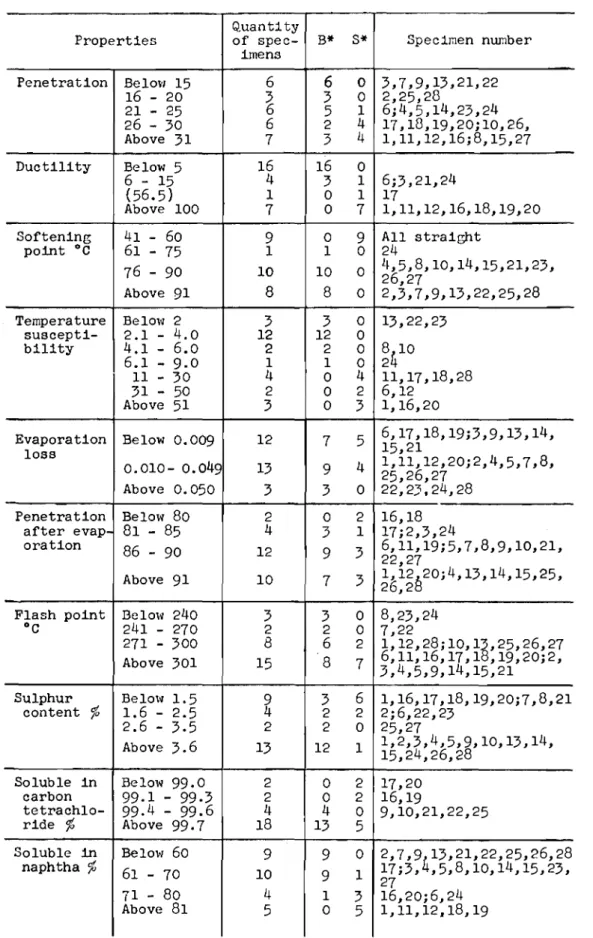
A general test was conducted on the 28 types of asphalt obtained (9 straight and 19 blown). The results are shown in Table I. Under several of the headings the measured values of both Showa Petroleum and Tajima are given, and there is a slight difference between them in some cases. The distribution of properties is given in Table II. These results were to be compared with various future tests results.
3.3
Heather resistance testsThe outdoor natural exposure tests were carried out at Tokyo University, Tahima Applied Chern. Ind. and Hokkaido University. In each case asphalt was applied to an aluminiwll panel which was inclined at an angle of 45°, facing south. The accelerated aging tests with the weatherometer were carried out at Tokyo University, at Tajima Applied Chem. Ind. and at Showa Petroleum Company. The test method at Tokyo University was generally the same as the method for synthetic resin, but at Tajima Applied Chem. Ind. and Showa Petroleum the A.S.T.M. procedure was followed. The results may be summarized as follows:
(a) After the outdoor natural exposure the asphalt showed a marked in-crease in the softening point and a decrease in penetration and ductility. The softer the blown asphalt the greater the change in penetration due to exposure (Showa Petroleum).
(b) After exposure straight asphalt sagged and could not be tested. (Tokyo Univ., Hokkaido Univ., Tajima).
(c) In the course of the outdoor exposure test the cracks in the 「ャッセュ
asphalt penetrated right through to the back over almost the entire area with-in four years. This was determined from measurements of the electrical con-ductivity. The number of months needed for more than two-thirds conduction is about 12 to 48 (Tajima). However, Tokyo University showed a slightly better result. The results at Tajima Applied Chern. Co. indicated a poorer weather resistance than the results at Tolcyo University. This could be the result of an unfavourable environment due to the presence of smoke, and also to the fact that the underside of the test stand was completely covered with board (there was none at Tokyo University), causing the temperature to increase in the day-time. However, the details are not clear.
(d) For blo\ffi asphalt it may be said that the greater the penetration and ductility, and the lower the softening point, the greater is the weather re-sistance, assuming that the tested asphalts have all been obtained from the same crude oil by the same process. This is probably because the softer the as-phalt, the longer it will take for a crack to develop. Similarly in (a) above, the softer the asphalt, the longer it took to reach a certain penetration, and if cracks occur at a certain penetration, there is no contradiction here.
(e) Point (c) applies to blown asphalts if derived from the same crude oil, but not necessarily otherwise. Generally speaking if the [(flash point) - 2 (softening point)] is above 120°C the weather resistance will be very good (Tokyo University).
(f) A correlation exists between density and weather resistance. For blown asphalts, other things being equal, the smaller the density, the greater the weather resistance (Tajima).
(g) There is no correlation between water absorbency and weather resistance (Tajima).
(h) There is no correlation with the paraffin content (usually several percent).
(i) For blown asphalt there is a close relationship between the results of natural exposure tests and the accelerated aging tests with the weatherom-eter (Tokyo Univ., Showa Petroleum and Tajima) with respect to the number of months of weather resistance.
(j)
There seems to be no relation between the chemical component asphal-tene or the saturated compounds and the weather resistance.3.4
Chemical resistance testsAsphalt itself is highly resistance to
80%, 50%
and 12% sulphuric acid and to 10% hydrochloric acid, but the acid often penetrates the surface coat to reach the ferrous material inside, resulting in expansion and oxidation. The addition of diatomite, natural or synthetic rubber aggravated this effect. Against salts such as ammonium sulphate, asphalt itself is resistant. Nearly all asphalts are discoloured by alkalis.3.5
Freezing and thawing testsIn cold regions all parts of a building undergo repeated freeZing and thawing. The freezing and thawing test was therefore carried out on asphalt mortar. When freeZing and thawing are repeated 20 times on straight asphalt air bubbles form and the surface becomes pitted; however, when the testing is carried beyond the 20 repetitions the surface recovers its original appearance before 40 cycles have occurred. Blown asphalt does not show much outward change. In the ductility test, however, straight asphalt shows a slower rate of decrease than blown asphalt. Straight asphalt seems to be the more
resistant to repeated freeZing and thawing. The air bubbles probably develop in the initial stages of freezing and thawing because the water absorbency of regular asphalt is greater than that of blown asphalt.
4.
ConclusionThe present report has reviewed the literature on the durability of asphalt, and given the findings from the general test of properties. The re-sults of natural exposure tests, accelerated aging tests, chemical resistance tests and freeZing and thawing tests made by the various assigned investiga-tors have been discuBsed. Clarification of the durability of asphalt is a very difficulty problem and this research has only succeeded in discovering a few characteristics and relations pertaining to quality and durability. How-ever, it is to be hoped that efforts will be continued with the cooperation of the various parties concerned.
PART 2. Natural Exposure Test Results
Structural Asphalt Research Committee Chief Researcher: Full member M. Hamada* Co-Researcher: Full member M. Koike** and
16
others1. Aim
As a contribution to the research on the durability of structural asphalt the purpose was to conduct natural exposure tests with a view to assessing the durability of asphalt and effecting improvements in quality and usage.
2. Test Material and Specimens
The tests were carried out on 18 types of blown asphalt and 10 types of straight asphalt. For the results of tests on the general properties see Part 1.
The specimens were produced as follows. First the asphalt was heated to 180°C and melted; it was then poured on an alwniniwn panel (90 x 150 x 1.6 nun)
and rolled to a thickness of 0.6 - 0.7 rom with a special pre-heated roller. Finally the surface was heated with an infrared lamp and given a smooth, uniform finish .
. 3.
Test イセ・エィッ、Tests were carried out at Tokyo University, Hokkaido University and
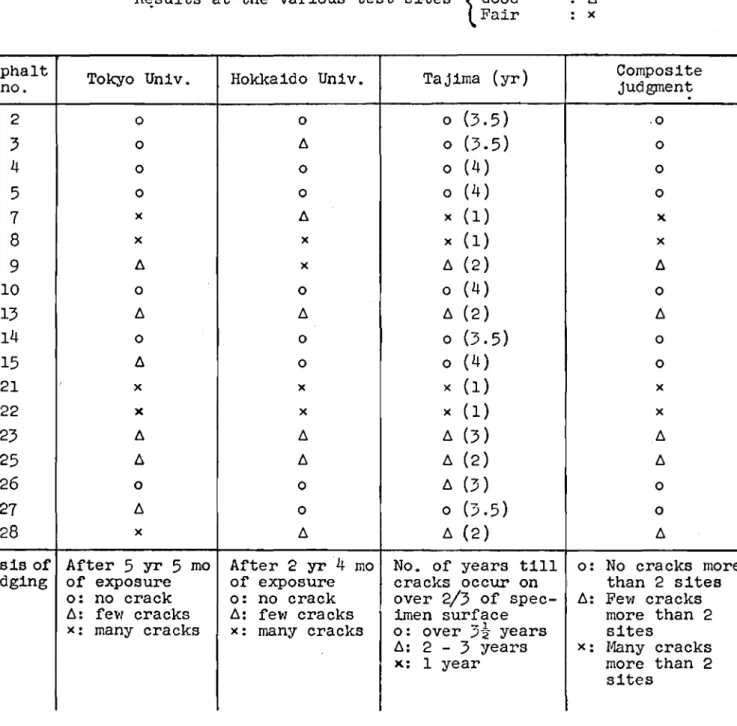
Tajima Applied Chern. Ind. Co., all using the same test material. The specimens were exposed facing south at an inclination of 45°. Table III gives details of test location and methods applied to the judging of the results.
4.
Test Results 4.1 Blown asphaltThe surface generally lost its lustre after 1 - 2 months. In the early stages of exposure, tiny wrinkles appeared on the surface of most of the
specimens, but this is a superficial change and does not develop directly into a crack.
* TO}QJo University, Professor of Engineering
The エゥセ・ of occurrence of cracks varied widely, dependinG on the location. Tajima Applied Chem. Ind. was the earliest, then Hokkaido University and
finally 'I'okyo Uni vers i ty. In what I'o Ll.ows the results are discussed according to test location.
Tolyo Th1ivcrsity. None of the test materials developed cracks until the third year. From the fourth year on cracks started to appear, and at 5 years
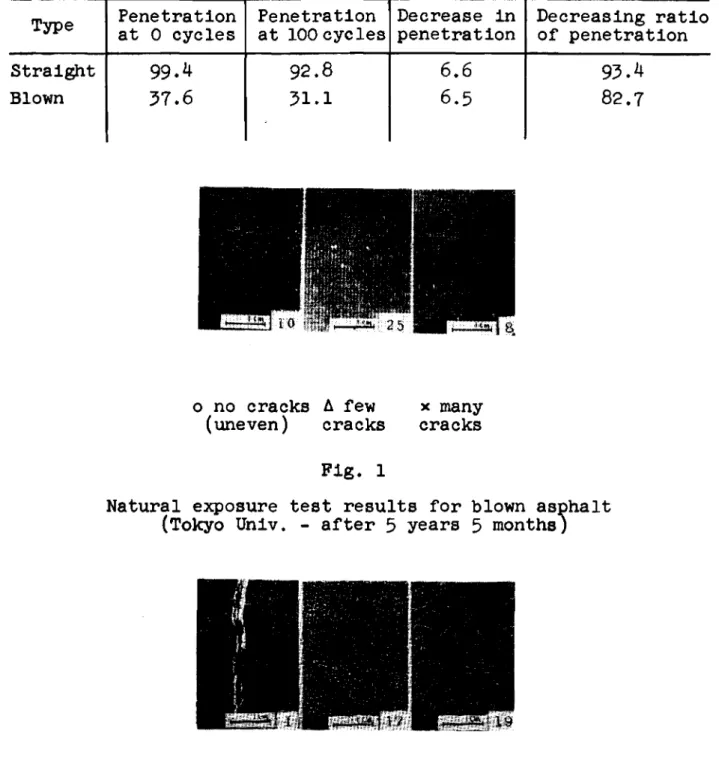
5 months, 7 of the 18 types had no cracks, 11 had cracks (6 few, 5 many). No pronounced sagginG of the test material could be observed (see Fig.
1).
Hokkaido University. After 2 years and
4
months of exposure8
of the asphalts still had no cracks, while 10 showed cracks (6 showed f'ew, 4 many) but none of the cracks had reached the aluminium panel. A sliding of test material was observed in one type of asphalt.Tajima Applied Chem. Ind. Co. Compared with the two places mentioned above, cracks occurred early. After one year,
6
of the asphalts had cracks reaching the aluminium panel, and after 3 years this number had increased to16. After 4 years all the asphalts had cracks reaching the aluminium panel on over two-thirds of the total specimen area. There were also 5 asphalts that showed cracking of the test material.
Thus, there were marked differences in the results for each location. Nevertheless, when the test materials are classified into 3 categories of excellent, good and fair, the results run parallel in the manner shown in Table IV. To the results from t。ェQョセ Applied Chern. have been added the number of years it took for cracles to develop over two-thirds the total test material area. Table V gives the results of characteristics of the material after 5
years and 5 months exposure at Tokyo University. 4.2 Straivpt asphalt
Generally speaking the softening point is low compared with the exposure temperature, so that most of the test material showed some sliding. From an early stage of exposure the surface lost its lustre and developed a vlrinkled film. In time, houever-, this film brolee on the surface and the inner asphalt surface appeared, presenting a glossy, irregularly lined appearance. This process was repeated and gradually, as the crrnobled surface was washed away by the rains the specimen decreased in thickness, and in some cases the support was even laid bare. The following is an outline of the results for each test location.
Tokyo University. After 5 years and 5 months of exposure all specimens had undergone some sliding, Which, however, had ceased. The surfaces showed fine wrinkles, some with a coarse pattern, some with a fine pattern. Of the
10 types,
3
showed exposed panel (Fig. 2). Table VI gives the changes in the properties of the asphalt due to exposure.Holdcaido University. After 2 years and 4 months of exposure, 7 asphalts showed definite sliding and 3 showed slight sliding. The surface was wrinkled, but none of the panels were exposed. Generally speaking many pockmarks
appeared.
Tajima Applied Chem. Co. Ltd. After 5 years and 2 months the changes here wer-e more severe than at the other 2 locations. Of the 10 asphalts tested only one did not have its foundation exposed, in the other
9
cases the surfaces were partially exposed. These specimens also showed traces of severe sliding, although the process had ceased. Some showed cracks similar to those in blown asphalt. Those セクーッウ・、 horizontally to avoid creep of the test mater-ial became uneven, although the creep was slight, and on some of the testmaterials the panel was visible. However, on the part where the panel was not exposed there was no conduction with the aluminium panel.
5. Study of Test Results
The differences in the results due to the location were great,
especially between Tokyo University and Tajima Applied Chern. Co., although these are in the same city. The reasons for this are not known but the fol-lowing differences in exposure conditions may be noted. TaJima Applied Chern. Co. is in the manUfacturing district where there is a great deal of smoke. The place of exposure is on エィセ ground and the underside of the test piece is boarded so that the temperature can rise easily. At Tokyo University the specimens wer-e exposed on a rooftop and the test piece had no lining board, so that the ventilation was good. Thus there was about 10°C difference in the maximum surface temperatures, 58°C at Tokyo University and 68.5°C at TaJima. However, the temperature changes were ョセイ・ severe at Tokyo University. The
ュゥョゥュセセ temperature seems to be especially low, but the difference between the
two is not clear.
For the exposure test at t。jセョ。 Applied Chern. Co. the relation between the number of years until cracks reaching the foundation developed over two-thirds of the test ョセエ・イゥ。ャ area and the physical properties and chemical components is as shown in Fig. 3 to 10. (The physical properties are values measured by TaJima Applied Chern.)
The water absorbency rate and the paraffin content show no interrelation with the weather resistance.
The greater the penetration, ductility and flash point, and the smaller the softening point, density and the asphaltene content, the better the
weather resistance; however to deduce the weather resistance from these prop-erties would involve too great an error. This relation can be accurate for blown asphalts derived from the same crude oil by the same process. Figure
9
shows the relation of weather resistance to the kind of crude oil and to the softening point. There are not many specimens divided according to crude oil, but in the case of Arabian crude oil, as an example, we see that the lower the softening point the better the weather resistance. However, this relationship does not hold between different kinds of crude oil.
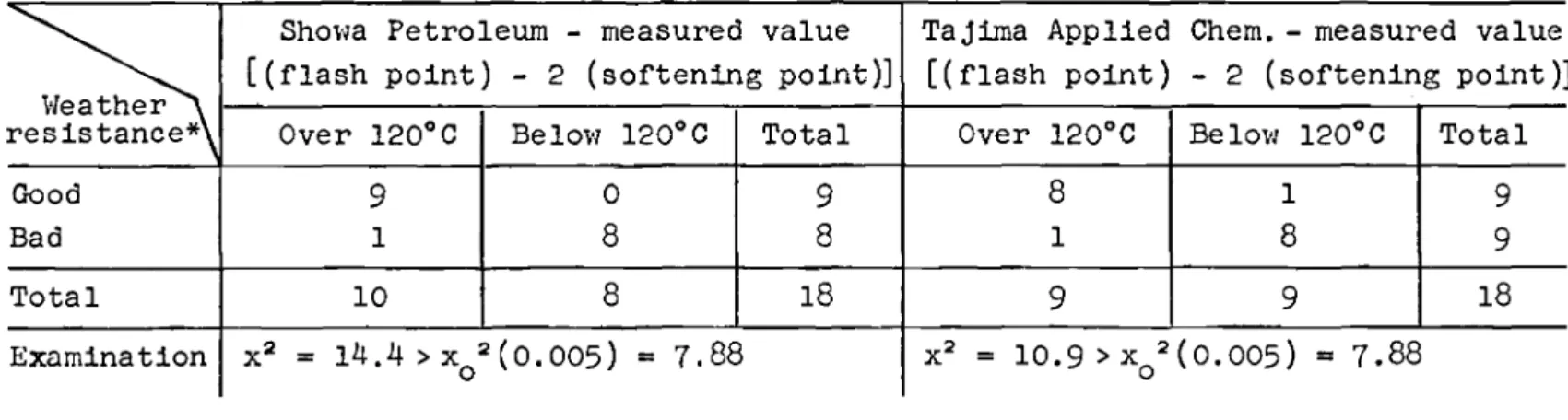
We now consider two physical properties in relation to the weather resistance. Figure 10 shows the relation of weather resistance to softening point and flash point. The physical properties are the measured values of Showa Petroleum; the weather resistance used was the composite result from Table
IV.
According to this diagram, the straight line for [(flash point) -2(softening point)]=
120°C seems to divide the weather resistance into good and bad. Therefore the ィセセッエィ・ウゥウZ "If [(flash point) - 2(softeningpoint)] セ 120°C, weather resistance is good" is studied by xt. distribution. The physical properties differ somewhat depending on the source of the test material and the observer, so by taking the measurement results of both Showa Petroleum and Tajima Applied Chem , , \'Je get an error of 0.5%, as in Table VII, and the hypothesis stands up.
In Table VIII we present the relation between the penetration of asphalt after exposure at Tokyo University and the weather resistance. In measuring the penetration, the \'Ihole test material was-re-melted, so that the penetration of the specimen surface \<'111 be less than the value shown. This test showed that the limit of crack occurrence is at a penetration of about
5
to7.
The increase in the softening point was27 -
58°C or 25 -73%
of the initial value. The decrease in ductility was striking, falling to less than 0.5 cm in all test materials.5.2 Straight asphalt
Straight asphalt has a low softening point, which resulted in sliding. For building purposes this fact would not be taken into account by itself, but care is necessary on this point.
The wrLnkLee produced on the test material surface at the beginning of exposure seem to be due to oxidation. As aging progresses, the oxidized film contracts and breaks, exposing a new asphalt surface. This process is repeated and the test material gradually oxidizes and becomes powdery from the surface inwards and is washed away by the rain.
In Hokkaido eruptions like pockmarks developed on the surface, but this was probably due to the absorption and freeZing of water in pinholes.
As shown in Fig. 11, the decrease in penetration and the rise in soften-ing point which accompany the agsoften-ing of straight asphalt follow different courses from those of b Lown asphalt. After aging, the softening point of
straight asphalt is lower than that of ordinary structural blown asphalt of equal penetration and in close to that of what used to be called blown asphalt B. The penetration decreased by 53 - 70%, the softening point increased by
12 - 52%. 6. Conclusion
Since the test materials were obtained six years ago, they may differ in some respects from those derived from the crude oils being imported today. However, the conclusions drawn from the results of these tests are as follows. 6.1 Blown asphalt
(1) For 「ャッセュ asphalts derived from the same crude oil by the same
process, the weather resistance seemed to improve with increasing penetration, ductility and flash point, and with decreasing softening point and density. However, the lowest softening point suitable for the conditions of application should be determined.
(2) The natural exposure resulted in notable decreases in penetration and ductility and marl{ed increases in softening point. The penetration at the time of crack occurrence was around 5 - 7. The rise in softening point was of the order of 27 - 58°C, an increase of 25 to 73% compared with the original softening point. The ductility was below 0.5 cm in all cases.
(3) It cannot be said that the number of test materials was absolutely sufficient, but by taking those showing [(flash point) - 2(softening point)] セ 120°C there is a high probability of obtaining a good weather resistance.
(4) The weather resistance differs greatly with the location of exposure, but the sequences of the changes are closely parallel.
6.2 Straight asphalt
(1) cッイイセ。イ・、 with blown asphalt, the tirrle until cracks appear is long,
but since the softening point is ャッLセ there is a risk of slippage, so that great care is needed in application.
(2) Straight asphalt which as aged showed a lower softening point in this test compared with ordinary blown asphalt of equal penetration, and came close to that of what used to be called blown asphalt B. The decrease in penetra-tion was 53 - WセセL the increase in softening point 12 - 52%.
PART
3.
Accelerated Aging Test ResultsStructural Asphalt Research cッョセゥエエ・・
Chief Researcher: Full member 1-1. Hamada* Co-Researcher: Full member E. Tajima**
and 16 others 1. Introduction
In this report, as a·further step in the durability studies of construc-tional asphalt, accelerated aging tests were carried out on blown asphalts with the aid of the weatherometer. The results were compared with those obtained from the natural exposure tests, their interrelationships were exam-ined and a study was made of the relation between the properties of the
asphalts and their durability. That is to say, the results of accelerated aging tests conducted by four different methods are compared with the results of the natural ・aセッウオイ・ tests conducted in the Adachi Ward of Tokyo City, followed by a discussion of the relation of the results from one of the four methods of accelerated aging to the properties of the asphalt with respect to penetration, softening point, ductility, density, paraffin content and water absorbency.
2. Test Haterial
The test material was the same as in Part 2, i.e. 18 kinds of blown
asphalt were applied on aluminium panels (75 x 150 x 1.6 mm) in a thickness of
0.6 - 0.7 mID. Table IX shows the properties of these test materials.
3.
Test Method(1) Accelerated aging method NE-2
Accelerated aging was carried out for 700 hours using Toyo Rika's
weatherometer model セセMRN This corresponds to the amount of ultraviolet rays received during a nominal
3!
years of natural exposure.Test conditions: Carbon arc
Lamp specifications
Temperature inside apparatus
2 lamps
120 - 140 v, 15 - 18 amp
SOoC
* Tokyo University, Professor of Engineering
The
Hater sprinkling
Rotation of drwn supporting the specimen
condition of the test material
6 min every 30 min
1 rpm
after 700 hours in the weatherometer was categorized as follows: no cracks ..•• 0, few cracks ...• セL cracks over
the whoLe surface x, melted and slumped •... rnj the durability \'18S then
determined.
(2) Accelerated aging method C-2
The same apparatus as in (I), Toyo Rika vffi-2, was used and the tests were carried out on the basis of the C cycle method(l) as laid down in the ASTN Standards. Test conditions: Carbon arc l。ョセ specifications t・ョセ・イ。エオイ・ inside apparatus Ha ter sprinkling 2 lamps 120 - 140 v, 15 - 18 amp 60°C
12 min every 120 min continuous operation for 22 hr
Rotation of drum supporting
the specimen 1 rpm
Cooling
If
hr in air at -23°CAccelerated aging \'13S carried out under the above conditions for 10 days,
and during that time the test material was taken out of the cooler every day and tested for cracks with a pinhole detector.
(3) Accelerated aging method C-l
The tests were based on the C cycle method(l) laid down in the ASTf·1 Standards.
Test conditions: Carbon arc
Temperature inside apparatus Hater sprinkling
1 lamp
130 - ャャセU v , 15 - 17 amp 60
±
2°Cfrom fixed nozzle once every 20 min continuously for 22 hr Rotation of drum supporting
the specimen 1/20 rpm
Cooling ャセ hr in air at -23°C
Accelerated aging was carried out under the above conditions until craclcs developed over the entire specimen surface. After each cycle the specimen '-JaS
removed from the cooler and any cracks reaching the aluminiwn panel were sub-mitted to an electrical conductance test with an
ッィセョ・エ・イHSIN
The durability was assessed in the follouing manner: the test material surface was civided into 15 sections and the ntrnmer of cycles required for conductance to occurover two-thirds of the specimen area, that is, over 11 scctions, fas taken as an index of durability.
(4) Accelerated aGing method 5l-9C
The tcstinc.; machine is made up of the weathe rornet er- and an apparatuB which sprinkles water of +5°C at intervals. The test was carried out by the 5l-9C cycle method(2) described in ASTM Bull. 69, April, 1956.
fest conditions: Carbon arc t・ョセ・イ。エオイ・ inside apparatus \1ater sprinlcling 1 lamp 130 - 145 v, 15 - 17 amp 60 :t 2°C
water of +5°C for
9
min every 60 min from fixed nozzleRotation of drum supporting
the specimen 1 rpm
Accelerated aging was carried out under the above conditions until cracks developed over the 1'Ihole specimen surface, and during that period electric conductance tests(3) were made every 20 hours \1ith an ohmmeter to determine whetne r- there were cracks reaching the aluminium board. The durability index was obtained in the same 'l!lay as for the accelerated aging method C-l.
4. Test Results
Table XI shows the results of durability tests by natural exposure and by the four accelerated aging methods.
5. Comments on the Test Results
5.1 The interrelation between accelerated aging and natural exposure test results
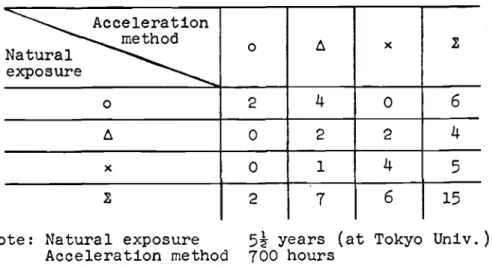
(1) \'m-2 acceleration method and natural exposure
The method of 、・エ・イセゥョゥョァ durability in this test was to show the condi-tion of the test material after 700 hours of accelerated aging and after 5t yr of natural exposure, using the 0, x, 6, m symbols mentioned previously. Of
these, m was excepted because of the difficUlty in assessing durability with it. For the other ssllibols, the reciprocity of the test results of natural exposure and accelerated aging \':8S examined by x2 distribution. The results
of the examination showed a risk ratio of 5%, which is not useful. However, at a risk ratio of 10% there is significance and there seems therefore to be some correlation.
(2) The C-2 method and natural exposure
Since durability is assessed in the C-2 acceleration method by the number of cycles at which the test material first shows conductance, we thus used
from the nat.ur-al exposur-e tests the number- of months at which the conductance first appears and the following correlation coefficient was obtained:
r セ 0.543 (n セ 18)
0.542> r(18-2, 0.05) cr 0.455 [
r - correlation coefficientl
n - no. of samples
J
Thus a correlation can be said to exist between the C-2 method and the natural exposure method. One cycle in the C-2 method corresponds to 4.53 months of natural cJ-..."posure, and the acceleration factor is about 140.
(3) C-l method and natural exposure
The C-l method indicates the durability by the number of cycles at which more than two-thirds of the test surface shows conductance, we thus took the
ョセセ「・イ of months in the natural exposure tests at which a slinilar conductance
was found. The following correlation coefficient between them was obtained: r セ 0.755 (n セ 18)
0.755 >r(18-2, 0.01) セ 0.589
This is highly significant and correlation may be said to exist between the C-l method and the natural exposure method. One cycle of the former method corresponds to 1.43 months of natural exposure and the acceleration factor is about 44.
(4) The 51-9C method and natural exposure
The correlation coefficient between the 51-9C acceleration method and natural exposure was obtained in the manner described above, i.e. for conduc-tance over more than two-thirds of the test area:
r セ 0.827 (n "" 17)
0.827 >r(17 .2, 0.01)
=
0.605This is again highly significant and a correlation may be said to exist between the 51-9C method and the natural exposure method. The acceleration factor by this method is about 57.
5.2 Study of the four accelerated aging methods
As mentioned above, of the four accelerated aging methods, C-2, C-l and 51-9C show correlation with the natural exposure method. Of these, however, the 51-9C method has the largest correlation so this method must be the most suitable for the durability testing of blown asphalt. No correlation with natural exposure was obtained for the vill-2 method, but this is probably because the method of assessment was by symbols, and since m was omitted from the
examination as unsuitable for assessment purposes the number of samples was greatly reduced.
5.3 On the properties of test material and durability (51-9C method) (1) Penetration and durability
Taking the functional relation between the penetration from Table IX and durability test results obtained by the 51-9C method of Table X by the method of least squares, we get
y
=
12.9 x + 142.4* (1)where x
=
penetration, y=
durability in hoursEquation (1) is represented in Fig. 12 by the line AB. According to equation (1), then, greater the penetration, the greater the durability. The correlation coefficient is r
=
0.878* (n=
17), which is highly significant. However, when the kinds of crude oil and the manufacturing methods differ these factors do not always coincide. In another investigation by the present authors the results showed that with blown asphalt obtained from the same kind of crude oil by the same manufacturing method, the durability increased with increasing penetration.(2) Softening point and durability
vllien the relation between the softening point and the durability is obtained by the method of the least squares, then as above
y = 1275 - 9.45 x* •.... ·(2)
where x
=
softening point in°c,
y=
durability in hoursEquation (2) is represented in Fig. 13 by the line CD. Equation (2) shows that the higher the softening point, the poorer the durability. The correlation coefficient is r
=
-0.67* (n=
17), which is highly significant.In this instance, as in the previous one, when the kinds of crude oil and their manufacturing processes differ, they do not always agree. However, in
another investigation by the present authors on blown asphalts obtained from the sanle crude oil by the same manufacturing process, we found that the greater the softening point, the poorer the durability.
(3) Ductility and durability
セヲオ・ョ the relation between ductility and durability is obtained in the
above manner then
y
=
91.2 x + 157*···(3)where x
=
ductility in em, y=
durability in hours*
Error in original; corrected by technical editor.Equation (3) is represented in Fig. 14 by the line EF. Equation (3) shows that the greater the ductility, the greater the durability. The cor-relation coefficient is r
=
0.503*
(n=
17) and is significant. Here again as in the case of softening point and durability, another investigation by the present authors showed that for blown asphalts obtained from the same crude oil by the same manufacturing process the greater the ductility, the greater the durability.(4) Density and durabilitl
セィ・ョ the relation between density and durability is obtained in the above manner then
y =
-569000
x +59654···(4)
where x セ density in glee, y セ durability in hours
In Fig. 15, equation (4) is represented by the line GH. According to equation (4) the greater the density, the poorer the durability. The cor-relation coefficient is r セ
-0.633
(x セ 17) and is highly significant.(5) Paraffin content and durability
\fuen the correlation coefficient of the paraffin content and the durabil-ity is obtained in the above manner we get r
=
-0.382
(n=
17). This is not significant, i.e. there is no correlation between paraffin content anddurability.
It has formerly been held that the paraffin content harms the quality of asphalt, and especially at low temperature tends to harden it and make it brittle. It has also been reported that up to
4.5%
the paraffin content has no appreciable influence on the durability, but no confirmation of this was obtained from the present investigation. In another investigation by the pre-sent authors in which paraffin wax was added to blown asphalt the paraffin component separated out during the durability test and as a result the durabil-ity was poor. However, this added paraffin is of a different kind to what is found naturally in the original asphalt, so that it cannot be said definitely that the size of this native paraffin content affects the durability. Further-more, since the kind of solvent used in measuring the paraffin component and the difference in the separation temperature will influence the result, the relation between the paraffin content and the quality of the asphalt requires further study.(6) Absorbency and durability
When the correlation coefficient of absorbency and durability is obtained in the above ョセョョ・イ we get r セ -0.12 (n
=
17), which is not significant,i.e. no correlation could be observed between absorbency and durability.
6.
SummaryAs a contribution to the study of the durability of structural asphalt, 18 kinds of blown asphalt were obtained from Japanese petroleum refining companies and the durability was measured by natural exposure and by acceler-ated aging tests on test coatings 0.60 - 0.70 mID thick. The accelerated aging
methods were studied by correlation with the natural exposure tests. The relation between the various properties of blown asphalt and their durability was studied and the following conclusions were reached.
(1) Of the four accelerated aging methods employed the C-2, C-l, 5l-9C methods showed a correlation with durability, the latter two
especially exhibiting a very close correlation.
(2) Of the four accelerated aging methods, the 5l-9C method seems to be most suitable for characterizing the durability of blown asphalt. (3) The kind of asphalt manufacturing process by which it is obtained
from the crude oil seems to have an influence on the durability. (4) For blown asphalts obtained from the same crude oil by the same
pro-cess it may be said that the greater the penetration and the ductility and the lower the softening point, the greater the durability.
(5) Between density and durability a negative correlation was found. (6) No correlation was found between the paraffin content or the
absorbency rate and the durability. References 1. ASTM Standards, D 529 - 39 T. 1955.
2. Kleinschmidt, L.R. and Greenfeld, S.H. ASTM Bull. 69, 1956.
3.
Streiter, O.G. Proceedings of ASTM,33
(1): 381, 1933. 4. U.O.P. Method, A 46-40.***
and 3 others, K. Shinozaki, H. Sato, N. Fushimi (Tajima Applied Chern. Ind. Co. Research Dept.)PART 4. Chemical Resistance Test Results
Structural Asphalt Research Committee Chief Researcher: Full member M. Hamada*
Co-Researcher: R. Fuj1kawa**
and 16 others
1. Introduction
This investigation consisted in testing the resistance of asphalt to acids and alkalis and was conducted at Showa Petroleum Co., Ni1gata Oil
Refinery, Sek1ya Branch Factory, as one phase in the "Research on the durabil-ity of structural asphalt".
As indicated in Part 1 of this joint study, 19 types of blown asphalt, 8 straight, 1 compound, i.e. a total of 28 kinds, were submitted for testing. In one part of the acid resistance test, an additional 6 types of asphalt (1 blown, 4 straight, 1 compound) from other crude oils, and compounds of asphalt with rubber or other inorganic fillers added were also tested. 2. Chemicals Used in the Tests
1. Alkali resistance test i1. Acid resistance test
3. Types of Asphalt tested
Saturated lime solution
Sulphut1c acid 80%, 50% and 12% Hydrochloric acid 10%
(Salts) Ammonium sulphate 15%
Tables XII and XIII show the type and properties of the asphalts and compounds tested in addition to the 28 kinds listed in Part 1.
The Johns Manville Company asphalt 1n Table XII is a mixture of Flux No.5 (penetration 7, softening point 110°C) and No.16 (penetration 24, softening point 73°C) in a ratio of 1 : 1.
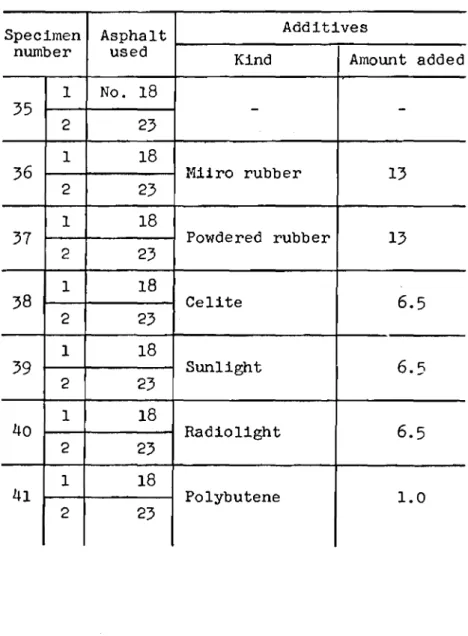
Table XIII lists the additives that were combined with two kinds of asphalt, No.18 (straight 20 - 30) and No.23 (blown 20 - 30) to produce com-pounds. In the course of preparation No.18 was heated to 150°C, No.23 to 200°C. The respective additives were then added to them and the mixtures were stirred for 30 minutes at these temperatures.
* Tokyo University, Professor of Engineering
4.
Preparation of Test Specimens1. Alleali resistance test
A glass rod 200 mm long, and 15 mm in diameter was immersed in the molten test asphalt; the asphalt was made to adhere to the lower 120 mm of the glass
rod, which was then drawn out, left to cool and used for testing. The melting
temperature of the straight asphalt test material was l20°C,that of the blown asphalt 200°C.
ii. Acid resistance test
A steel rod 200 mm long, 10 mm in diameter was immersed in asphalt as for the alkali resistance test; a film about 170 mm long was made and used as the test specimen.
5. Test Conditions
Test specimens prepared in the above manner were dipped in alkali and
acid solutions in test tubes, to depth of 150 mm. These were left standing at
room temperature and the changes in the asphalt were observed at intervals. For the alkali resistance test with calcium hydroxide liquid paraffin was used
to seal the top of the solution from the air in order to avoid a reaction of
the calcium hydroxide with atmospheric carbon dioxide. Three of the test
specimens were prepared for each type of asphalt. 6. Test Results
i. Alkali resistance test
Table XIV shows the results. With the exception of No.6 and No.19 all
specimens changed colour to greyish white or brown. However, none showed
cracks or abrasion. Generally, in the process of changing colour in the course
of time they first turned more or less greyish white, then grey and finally
greyish brown. At this point some of the specimens developed small wrinkles.
In the straight asphalts the inside, where asphalt adheres to the glass
sur-face, generally had a glossy appearance, but many of the blown asphalts had
lost their lustre. The extent of the discolouring also differed on the front
and back of the test specimens. A similar difference was also observed
between the part of the specimen that was in the shadow of the label pasted on
the test tube and the part not so covered. This phenomenon is probably due to
the influence of light. Thus the underside of the specimen and the part
hidden by the label underwent comparatively little change of colour.
The inside of the asphalt observed from the cut end had a lustre and the
layer that had changed colour was thin. For the most part the immersion
The numbers in the last column of Table XIV stand for the corresponding colours in the Colour Sample Book of the Japan Paint industry Association Standards. \fuere two numbers are bracketed together this signifies a colour midway between the two. An asterisk indicates the colour of the underside or the part under the label.
ii. Acid resistance test
Table XV shows the results of tests on 28 kinds of asphalt using
80%
sUlphuric acid. Generally speaking, no tendency towards corrosion etc. can be observed on asphalt, but cracks, bulges and air bubbles form. This must be because the acid solution ,penetrates to the inside through pinholes in the coating and reacts with the iron to form a sulphate which expands and forms a bulge beneath the surface coat. This eventually leads to cracking andexfoliation.
Table XVI shows the results of tests using 80% sUlphuric acid on com-pounds of No.18 (Klamono, regular 20 - 30) and No.23 (Klamono, Kuwait, blown 20 - 30) with rubber and other additives. Regardless of the additives or the kind of asphalt, by 30 - 70 days all showed cracks and flaking off of the
coating, while in the acid solution a great deal of precipitation was observed. This was due perhaps less to any direct effect of the additives, than because of the fact that their presence was detrimental to the impermeability of the coating. As a consequence the acid solution could penetrate deeper and facilitated the above-rrlentioned chemical reaction between the acid solution and the iron, and hence also the disintegration of the coating.
Table XVII shows the test results for the other six kinds of asphalt against sulphuric acid, hydrochloric acid and anmlonium sulphate. In each case there was some transformation, though to different degrees, and in some cases there was a change of colour in the solution. Ammonium sulphate is a salt which sィoセis acidity, but the same phenomenon was observed with it.
7. Conclusions
i. With lime-saturated solution, blown and straight asphalts both show dis-coloration of the coating, but there is no cracking or flaking off, and
durability is good.
ii. In the presence of sulphuric aCid, hydrochloric acid and ammonium sul-phate all asphalts showed some transformation, exfoliation or crumbling. Generally speaking, blown asphalt appears to have good acid resistance, but the coating quality does not appear good. Straight asphalt on the other hand has a good quality of coating, but compared with blown asphalt, its acid resistance is not so good. It would appear, therefore, that the application
of a regular asphalt coat1ng to blown asphalt would afford a certa1n degree of ac1d res1stance.
111. The ac1d res1stance of the compound 1s not good. However, one cannot say absolutely that the cause 1s due to the compound 1tself or that 1t 1s due to the propert1es of the coat1ng made by this compound.
PART
5.
Results of Freezing and Thawing TestsStructural Asphalt Research Conunittee Chief Researcher: Full member M. Hamada* Co-Researcher: Full member C. Itakura** 1. Object and Types of Tests
The purpose of these tests was to study the changes in the properties of structural asphalt due to-repeated freezing and thawing uninfluenced by light. The tests can be classified as follows:
(1) Observation of outward changes in coats of asphalt applied to
aluminium panels in thicknesses of 0.6 - 0.7 nun and measurement of any changes of weight.
(2) Measurement of any changes in the viscosity or bonding power of the thin filnl (about oNャセI constituting the asphalt mortar, relative to the grains of sand.
a. change of density of the asphalt mortar b. penetration change of the asphalt mortar
c. changes in the cohesiveness of asphalt mortar. 2. Test fllethod
(1) Freezing and thawing tests of asphalt applied on aluminium panel With 2 sheets of each kind of asphalt test material, applied to aluminium panels 90 mm x 150 イイセ in the イイセョョ・イ described in Part 2 of this research,
freezing and thawing were repeated 140 times for each series. After every twenty repetitions the change in weight was measured and at the same time any visible change in the asphalt coating was noted. At the beginning of the experiment, the weight was measured to the nearest 0.1 g, but after 40 repeti-tions a chemical balance with an accuracy of 0.0001 g was employed.
Freezing temperatures of -10 to -15°C in the low temperature room of the laboratory were applied for one hour, after which the specimens were thawed by immersion in water of 20°C for 2 hours.
(2) Freezing and thawing tests of asphalt mortar a) Test material
Twenty-nine types of asphalt (in addition to the 28 varieties of the
*
Tok'Jo University, Professor of Engineeringprevious report, a paving asphalt with a penetration of 100 to 150 was included as No.O).
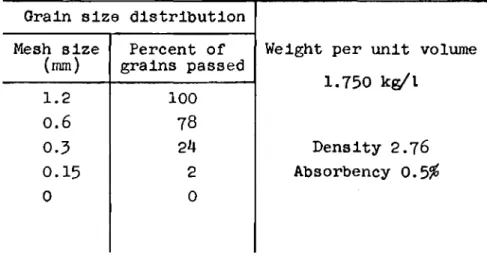
The sand was fine sand from Nishikioka Beach; its physical properties are given in Table XVIII.
b) Dimensions and numbers of test specimens
Samples measuring 3.6 cm x 3 cm. For each variety of asphalt there were
three specimens for each test.
c) cッョセッウゥエゥッョ (percent by weight)
Asphalt 6%, sand ァャセEL thickness of asphalt coat about oNャセN
d) Preparation of teet specimen
The asphalt was melted at 60 - gOOc, mixed with sand heated to 100°C and
then stirred for a few minutes at go - 120°C. It was then poured into a heated
cylindrical mould, cooled to 40 - 60°C and placed in a press to which a
pres-sure of 200 kg/cm2 (2,306 kg) was applied. The specimen was then cooled,
removed from the mould and stored in a cold room at O°C while preparations for the test were made.
e) The freezing and thawing process
The specimen was placed for 2 hours in a freeZing room at -10 to -15°C after which it was removed from this room and thawed by immersion for one hour
in a water bath at 20°C. This constituted one full freeZing and thawing cycle.
f) Measurement
i) Density change
Freezing and thawing were repeated. After every 20, 40, 60, 80 and 100
cycles the weights were measured in air and in water and the density was
determined.
ii) Penetration change
The penetration test was conducted at 200 g, 5 sec, 35°C. That is, the
test piece was put in a penetrometer which was filled with water to 5 mm above the top of the specimen; this was frozen and thawed and the penetration
measured every 20 cycles.
iii) Change of cohesiveness
The cohesiveness was measured at 35°C by means of a Page impact tester
with falling weights converted to 750 g. After the specimen had been sUbjected
to a given number of freezing and thawing cycles it was submerged in a
con-stant temperature water bath at 35°0. The impact test was then carried out by
recording the height of the fall of the hammer at which a crack occurred in
the specimen and that at which it broke. This was taken as the cohesiveness
3.
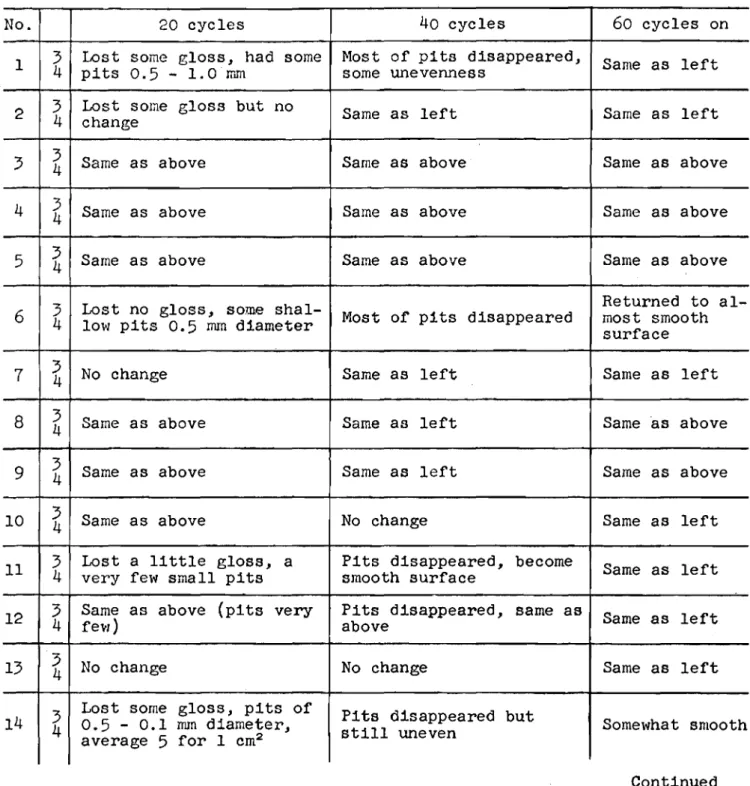
Test Results(1) The external changes due to repeated freezing and thawing of the asphalt coats applied to the aluminium panel are indicated in Table XIX. Table XX shows the changes in weight.
(2) Results of freezing and thawing tests of asphalt mortar specimens a) Changes of density. The results for the 29 varieties of asphalt mortar were not very clear. The reasons for this are as follows:
i) The freezing and thawing process increased water absorbency and water could easily enter the pores of the specimen piece. It was therefore difficult to determine the density from weight measurements only.
ii) Changes of volume were brought about both by swelling and by flak-ing due to brittleness, so that the true changes of volume could not be
measured.
However, a general tendency for specimens to increase in volume by 4 to
5%,
due to an increase in water absorbency after freeZing and thawing, was observed and the apparent density showed an increase of 0.01 to 0.02 as a result of repeated freezing and thawing. This applied to all varieties, so that no differences in quality could be inferred from this.b) Change of penetration. The hardening of asphalt due to repeated freeZing and thawing was measured by the change in penetration of the asphalt mortar specimen. Table XXI gives the results.
c) Changes of cohesiveness. The changes in cohesiveness due to repeated freezing and thawing of the specimens are indicated in Table XXII and Fig. 17*.
In
Fig. 17 the dotted line gives the cohesiveness value at the time of crack-ing, the solid line that at the time of breaking.4. Observations on the Test Results
(1) Exterior changes and changes in weight of asphalt applied to aluminium panel.
a) External changes. Changes occurred even before 20 cycles of freeZing and thawing. Most of the regular asphalt specimens developed small pockmarks. This seems to be because water penetrates the tiny air bubbles in the asphalt and these erupt during freeZing. As indicated in Table XIX this applies to almost all of the regular asphalt specimens, although in differing degrees.
Pockmarks also appeared in blown asphalt specimens No.14 and No.15.
Some of this may be due to the conditions of preparation of the specimen, but as a general rule it appears that regular asphalt contains many air
bubbles.
However, after 40 freezing and thawing cycles almost all of these marks had disappeared, leaving only a few slight surface irregularities. After 60 cycles no difference could be observed.
b) Change of weight. At the start of the experiment little change of weight was expected, so that different sensitivities of balance were used for the initial and sUbsequent weighings. An accurate assessment can thus not be stated, but in the values. of Table XX the weight of the aluminium panel is included and the percent obtained assumes the weight of the asphalt to be 25 g.
As is evident from Table XX, for both regular and blown asphalts weight increases were recorded up to 20 freezing and thawing cycles, after which the weight showed a tendency to decrease. Further investigations are needed to clarify this phenomenon.
From the above results a) and b) it is difficult to draw any conclusions on the relative merits of the different asphalts.
(2) Changes in asphalt mortar a) Penetration
Comparison of regular and blown asphalts from Table
XXI
produced TableXXIII.
That is to say, repeated freezing and thawing tends to decrease the penetration. With respect to the rate of decrease there is almost no differ-ence between straight and blown asphalt, but blown asphalt shows a smaller absolute value of the penetration, so that the effect of 」ィ。ョセウ in the soft-ness must be considered greater for blown asphalts.
Penetration changes of over 10 are recorded for specimens No.3, 11, 12, 17, 19 and 24; with the exception of No.3, these are comparatively large penetration values. The penetration of No.3 is SIMll, but the decrease is large. In the case of No.17 there is a slight increase in penetration, but, as shown in Table
XXI,
the variation is irregular. No.24 has an irregular variation like No.17 and the decrease in cohesiveness is small. Withoutexamining the quality, therefore, it would be difficult to base any assessment on these results.
b) Change in cohesiveness
i) All the asphalts tested showed reduced cohesiveness after 100 cycles of freezing and thawing. In general, those that had high cohesiveness at the outset still exhibited a high value after 100 cycles (see Fig. 18). This can be said regardless of the variety of asphalt.
ii) In the case of straight asphalts when penetration is high, high cohesiveness values are obtained both at the outset and after 100 cycles
(Fig. 19). The same holds for blown asphalts, with the exception of No.3,
8
and 21, as far as the initial values are conceTI1ed. After 100 cycles, however, we find scarcely any connection with penetration (Fig. 20). The cohesiveness after 100 cycles is lower for blown asphalt than for straight asphalt.
iii) For both straight and blown asphalt, it may be said that the higher the softening point, the lower the cohesiveness at the beginning cycles and the greater its reduction after 100 cycles. It is interesting to note here that there is a clear difference with respect to the softening point in the two types of asphalt (see Fig. 21).
iv) The above relation is too ゥイイ・セオャ。イ to permit graphical representa-tion. If new data are obtained according to crude oil and refining process, a more definite result would probably ensue.
v) Comparing straight asphalt and blown asphalt" the ratio of the aggregate average cohesiveness after 100 cycles to the initial values is 69.1%
for straight and 56.1% for blown asphalt, and the rate of decrease is greater for blown asphalt. In general, for a given penetration the cohesiveness of blown asphalt is often lower, probably because the forces binding the
individual grains of sand are comparatively small.
The thin coating of blown asphalt seems to be less resistant than straight asphalt to repeated freezing and thawing. This difference is probably due to the difference in binding powers of the two kinds of asphalt, in other words, to the adhesiveness with respect to the grains of sand.
(3)
With respect to the change in properties of asphalt due to repeated pure freezing and thawing with the light excluded, the present tests suggest the softer the asphalt the ョセイ・ durable it will be, and that straight asphalts can be said to be superior to blown asphalts in this respect.This is not in marked contradiction to the results of the outdoor exposure tests. From the supplement of creeping, straight asphalt is inferior, but this could be dealt with by careful selection of the blowing process or by some other method, or by planning the material and method of operation according to where it is to be applied.
(4) To determine differences according to crude oil it would be necessary to choose the varieties systematically.
(5) As test methods for asphalt, study should be carried out using the Fraass brittleness point, the Schott abrasion test and others.
>. ..., I< ..., e '" Chemical composition•• '" I< s:: s:: e 1:::: NNNLセ '" '" .0 0 o 0 "'" ..., s:: ... I;i '"
"
セセ 9 '" ... ... ..."
... "'e " ..."
-o ..."
..., ""1<+> "".0 0'" 0 " 0...
'" Water'" "'..., ..., e"
Softening e e Ol"'Ol Ol'" "'.-< 0 "'0'-< '" J:: "'J:: ...'" ...,..., Penetration Ductility
"" 1<...,,, "...,
'" .-<,OJ:: .-<
'"
.-<..., ..., absorbed '""
oe e"
0 Crude 011 Kind point 00 """'0"''''
J::>"
,Ol<u .0 .-< ,OJ:: "'S:: ...,'" ...'" "'"セ Ol 25"C, 100 g crn 0..-< "'Ol'"
"'''' "'" " ""''''
" "
"'"
セセ 10 days Asphaltene ",e ...,e ..."
...
Rand B Ol" '" EO Ol'-< J:: '-<01< .-< Ol .-<'" " 0 !'l0 " 0
...
0"
c 5 sec > '" > "'Ol .-<u'"
o ..., 0 ... o c i.o.."'"
Uセ セセl<l
'"
'" 8 " iォッセ .-< '" '" '" '" '" ..., S '" '" ""
..., <II0 " 0 0 c, :E Shows '" ",0 «0 0"' Taj1ma Showa Tajima Showa Taj1ma 'f, 'f, ·C 'f, 'f, % 'f, glrn' % Insoluble
% '% '%
Pet. Pet. Pet. % in n-hexane
1 R San Joaquin 30 - 403 36 32 >140 >130 52 52 PNPQセT 93 84.50 298 1.49 99.91 - 88.75 1.29 - - 6.8 18.9 24.1 50.2 2 " Abqaiq 10 - 20B 17 17 3.0 2.7 100 100 0.034 85 2.70 328 3.58 99.74
-
68.42 7.98 1.167 0.062 32.0 22.0 16.8 29.2 3 " Qatar " 14 17 2.0 2.7 96 97 0.008 85 2.50 329 3.63 99.68-
61.95 2.86 1.252 0.068 31.8 22.3 25.9 20.0 4 " Abqaiq 20 - 30B 24 21 3.5 3.1 85 88 0.04§i
2.96 320 3.62 99.77 - 64.95 4.65 1.206 0.069 33.5 34.6 26.0 5.9 5 " Agha Jari " 22 21 3.5 3.2 79 85 0.044 3.34 318 3.75 99.85-
64.65 6.30 1.086 0.063 30.5 28.6 27.1 13.8 6 H [TOYOkawaYatsuhashi 110 20 - 30S 24 20 15 >130 55 57 0.007 88 42.00 305 1.66 99.93 99.82 79.70 2.37 - - 14.9 19.7 24.1 41.3 7 " Asahigal<a 10 - 20B 15 14 2.0 1.6 93 94 0.011 87 2.55 264 1.01 99.73 99.83 59.92 2.44 4.300 0.246 42.9 30.5 14.3 12.3 8 " " 30 - 4013 33 26 4.0 3.3 79 87 0.013 87 5.0 236 1.04 99.74 99.82 66.09 2.06 5.990 0.340 33.8 34.2 9.6 22.4 9 3 Arabia 10 - 20B 15 14 3 2.4 103 102 0.00 89 2.33 324 3.67 99.6 99.8 58.9 2.84 0.824 0.045 )5.3 28.0 24.6 12.1 10 " " 20 - 30B 27 27 5 4.7 77 76 0.00 86 4.40 300 3.80 99.6 99.8 67.8 7.76 0.895 0.050 30.4 34.3 35.8 9.5 11 B Hafra 40 - 60s 49 43 >150 >130 46 52 0.02 88 30.41 340 4.96 99.7 99.8 81.85 3.57 - - 7.7 16.0 50.8 25.5 12 A [Arabia 32%Praselita 30 - 603 37 39 >150 >130 55 53 0.02 91 39.62 291 2.51 99.8 99.9 80.07 5.82 --
16.7 25.4 30.7 27.2 VXセ 13 " Arabia 10 - 20B 15 17 2 2.6 104 98 0.00 93 2.00 291 3.78 99.8 99.9 58.48 9.03 1.102 0.064 30.4 23.9 25.5 20.2 14 " " 20 - 30B 24 27 2.5 2.7 90 89 0.00 93 2.27 310 3.71 99.8 99.9 61.3 3.82 0.734 0.040 29.7 27.0 2.22 21.1 15 " " 30 - 40B 34 32 3.5 3.3 79 85 0.00 92 RNUセ 310 3.56 99.8 99.9 64.6 5.67 0.850 0.046 31.1 34.5 21.3 13.1 [ Nogami, 16 U Innai 30 - 403 37 27 >150 >130 48 52 0.00 77 62.5 398 1.11 99.08 99.32 80.15 7.32 - - 14.0 28.0 28.9 29.1 Shonai 17 " Yatsuhashi " 29 28 56.5 26.7 58 58 0.00 83 15.72 302 0.67 97.41 99.0 69.23 9.96-
- 25.5 27.4 26.1 21.0 18 " K1amono 20 - 303 29 19 >145 >130 54 64 0.003 73 24.57 356 1.52-
99.62 80.85 3.67 --
20.2 21.8 28.0 30.0 19 " Niitsu " 27 18 >145 >130 51 58 0.002 86 - 336 0.94 99.25 99.11 86.85 3.18 - - 10.6 22.1 29.0 38.3 20 " Innai " 26 32 >150 >130 48 54 0.02 91 77 309 1.08 98.56 98.85 79.32 2.65 - - 17 .0 25.6 27.4 30.0 21 " Klamono 10 - 20B 12 13 3 2.6 81 90 0.005 87 3.36 312 1.53 99.35 99.35 59.41 6.24 1.006 0.054 29.5 21.1 24.3 25.1 22 " [ K1a:nonoKUll8it " 15 15 2.2 1.7 97 99 0.05 87 1.88 255 2.11 99.51 99.47 59.89 6.04 0.678 0.030 40.2 32.2 17.1 10.5 23 " KU1:ait 20 - 30B 24 22 2.2 2.6 90 90 0.11 88 1.52 240 2.36 98.52 99.20 68.35 4.42 0.839 0.048 36.6 26.3 19.8 17 .3 24 " Toriumi 10 - 20B 24 33 14.5 >130 67 55 0.387 81 8.8 207 4.49 98.9 98.84 75.82 3.04 --
17.7 14.0 28.2 40.1 25 K (Arabia 9Iran 1 " 18 17 2.2 2.2 100 100 0.040 93 2.5 228 3.41 99.63 99.73 56.21 4.46 3.092 0.178 30.6 25.1 6.7 37.6 26 " Arabia 20 - 30B 26 27 3.2 3.0 80 86 0.043 91 3.2 298 3.56 99.68 99.76 60.33 7.14 2.840 0.169 27.4 24.4 18.2 30.0 27 " " 30 - 40B 32 32 3.5 3.1 90 81 0.046 90 3.5 285 3.49 99.69 99.78 61.8 3.18 3.104 0.180 27.3 29.2 19.7 23.8 28 " (Compound) Compound 16 31 22.2 2.1; 103 101 0.041 92 2.3 286 3.66 99.65 99.74 59.00 7.54 3.019 0.167 33.6 - --• Taj1ma Applied Chern. Co. Ltd. •• Test reau1ts of Hokkaido Univ. • . . The rest are test results of Showa Petroleum Co. Ltd. Note: B denotes "blown" material and 3 denotes "straight-run" material.
I
ro
'D
Table II
Distribution of properties Quantity
Properties of spec- B* S* Specimen nwnber
imens Penetration Below 15 6 6 0 3,7,9,13,21,22 16 - 20 3 3 0 2,25,28 21 - 25 6 5 1 6;4,5,14,23,24 26 - 30 6 2 4 17,18,19,20;10,26, Above 31 7 3 4 1,11,12,16;8,15,27 Ductility Below 5 16 16 0 6 - 15 4 3 1 6;3,21,24 (56.5) 1 0 1 17 Above 100 7 0 7 1,11,12,16,18,19,20
Softening 41 - 60 9 0 9 All straight
point °c 61 - 75 1 1 0 24 76 - 90 10 10 0 26,274,5,8,10,14,15,21,23, Above 91 8 8 0 2,3,7,9,13,22,25,28 Temperature Below 2 3 3 0 13,22,23 suscepti- 2.1 - 4.0 12 12 0 bllity 4.1 - 6.0 2 2 0 セTQP 6.1 - 9.0 1 1 0 11 - 30 4 0 4 11, 17, 18, 28 31 - 50 2 0 2 6,12 Above 51 3 0 3 1,16,20 Evaporation Below 0.009 12 7 5 6,17,18,19;3,9,13,14, loss 15,21 0.010- 0.049 13 9 4 1,11,12,20;2,4,5,7,8,25,26,27 Above 0.050 3 3 0 22,2),24,28 Penetration Below 80 2 0 2 16,18 after evap 81 - 85 4 3 1 17;2,3,24 oration 86 - 90 12 9 3 6,11,19;5,7,8,9,10,21,22,27 Above 91 10 7 3 26,21,12
820;4,13,14,1
5,25, Flash point b・ャo|セ 240 3 3 0 8,23,24 °c 241 - 270 2 2 0 7,22 271 - 300 8 6 2 1,12,28;10,1§,25,26,27 Above 301 15 8 7 3,4,5,9,14,15,216,11,16,17,1 ,19,20;2, SUlphur b・ャッLセ 1.5 9 3 6 1,16,17,18,19,20;7,8,21 content%
1.6 - 2.5 4 2 2 2;6,22,23 2.6 - 3.5 2 2 0 25,27 Above 3.6 13 12 1 1,2,3,4,5,9,10,13,14,15,24,26,28 Soluble in Below 99.0 2 0 2 17,20 carbon 99.1 - 99.3 2 0 2 16,19 tetrachlo- 99.4 - 99.6 4 4 0 9,10,21,22,25 ride%
Above 99.7 18 13 5 Soluble in Below 60 9 9 0 2,7,9 413,21,22,25,26,28 naphtha%
61 - 70 10 9 1 17;3, ,5,8,10,14,15,23,27 71 - 80 4 1 3 16,20;6,24 Above 81 5 0 5 1,11,12.18,19Testing method
No.of test
Location Environment Expoaur-estarted Exposureended Duration Assessment ofresults by spec-imens Temperature (for
each kind)
Tokyo Univ. Tokyo, BunkyoHard, rooftop Dec. Nay Observation and {Direct radiation
1955 1961 5 yr 5 mo determinationof properties* 4 max. 5Bocmin. -Boc
Hokkaido Univ. Sapporo City,rooftop Feb. June 2 yr 4 mo Total average
1956 1958 Observation 4
Tokyo,
temperature 4°c
Ta-jima Adachi Ward f.1arch Nay Observation and Direct radiation
(factory area) 1956 1961 5 yr 2 mo conductivity 2
on ground -tests**
max. 68.5°C
* On completion of exposure, the test material was renloved from the specimen, remelted and the penetration, softening point and ductility were measured.
** The conductivity test determines vlhether a crack has reached the aluminium panel, from the electrical conductivity between the surface of the test material and the aluminium panel, using an electrolyte
(3
parts water, 1 part methanol, table salt3%).
I
\.>l
...
Table IV
{
Exce l l en t : 0
rセウオャエウ at the various test ウセエ・ウ Good : 6
Fair : x
Asphalt Tokyo Univ. Hokkaido Univ. TaJima (yr) Composite
no. ju、ァイョ・ョセ
2
0 0 o(3.5)
.03
0 6 o(3.5)
04
0 0 o(4)
05
0 0 o(4)
07
x 6 x(1)
x8
x x x(1)
x 9 6 x 6(2)
610
0 0 0(4)
013
6 6 6(2 )
614
0 0 o(3.5)
015
6 0 o(4)
021
, x x x(1)
x22
x x x(1)
x23
6 6 6(3 )
625
6 6 6(2 )
626
0 0 6(3 )
027
6 0 o(3.5)
028
x 6 6(2 )
6Basis of After
5
yr5
mo After2
yr4
mo No. of years till 0: No cracks morejUdging of exposure of exposure cracks occur on I than
2
sites0: no crack 0: no crack over
2/3
of spec- 6: Few cracks6: fel'! cracks 6: fel'1 cracks 1men surface more than
2
x: many cracks x: many cracks 0: over SセM years sites
6:
2 - 3
years x: I'1any cracksx:
1
year more than2
Properties after 5 years 5 months of exposure at Tokyo University
Penetration (25°C 100 g 5 sec) Softening Point (OC R and B) (cm) (25°C)Ductility
Asphalt Before After Difference Before After Difference Before After
no. expos. expos.
%
expos. expos.%
expos. expos.Decrease Decrease Increase Increase
2 17 8 9 53 100 127 27 27 3.0 <0.5 3 14 9 5 36 96 119.5 23.5 25 2.0 <
o.
5 4 24 11 13 54 85 113 28 33 3.5 <0.5 5 22 10 12 55 79 114 35 44 3.5 <0.5 7 15 7 8 53 93 130 37 40 2.0 <0.5 8 33 5 28 85 79 137 58 73 4.0 <0.5 9 15 8 7 47 103 133.5 30.5 30 3.0 <0.5 10 27 12 15 56 77 105.5 28.5 37 5.0 <0.5 13 15 10 5 33 104 138 34 33 2.0 <0.5 14 24 10 14 58 90 136 46 51 2.5 <0.5 15 34 10 24 71 79 130.5 51.5 65 3.5 <0.5 21 12 6 6 50 81 I I I 30 37 3.0 <0.5 22 15 8 7 47 97 130 33 34 2.2 <0.5 23 24 8 16 67 90 128 38 42 2.5 <0.5 25 18 8 10 56 100 127 27 27 2.2 <0.5 26 26 11 15 58 80 125.5 45.5 57 3.2 < 0.5 27 32 11 21 66 90 127.5 37.5 42 3.5 <0.5 28 16 8 8 50 103 142 39 38 2.2 <0.5Note: Measured values by Showa Petroleum, Showa Chern. Ind.
I \)J \)J I