Atomic Resonance and Scattering
3.
Atomic Resonance
and Scattering
Academic and Research Staff
Prof. D. Kleppner, Prof. D.E. Pritchard, Dr. T. Ducas, Dr. D. Kelleher, Dr. A.M. Lyyra, Dr. K.L. Saenger, Dr. W. Spencer, Dr. G. Vaidyanathan, Dr. X. Zhong
Graduate Students
S. Atlas, L. Brewer, S.L. Dexheimer, C.W. Engelke, T. Gentile, P.L. Gould, B. Hughey, R.G. Hulet, M.M. Kash, P.D. Magill, A.L. Migdall, P.E. Moskowitz, W.P. Moskowitz, T.P. Scott, N. Smith, B.A. Stewart, R.E. Walkup, G.R. Welch
3.1 Rydberg Atoms in a Magnetic Field
National Science Foundation (Grant PHY79-09743)
Michael M. Kash, Daniel Kleppner, George R. Welch, Zhong Xubin
The general structure of atomic hydrogen in an arbitrarily strong magnetic field remains an unsolved problem of atomic physics. The Hamiltonian for hydrogen in a uniform magnetic field is known; the eigenstates are not. Theoretical research has yet to produce solutions which can elucidate the atom's behavior at all levels of excitation and field strength.
Highly excited, or Rydberg, atoms in laboratory-sized magnetic fields (about 10 Tesla) have strong principal quantum number "mixing". Even numerical solutions fail in this regime. Our studies suggest, however, that there is an approximate dynamical symmetry. In principle, identifying this symmetry provides a complete solution to the problem. The clue to the symmetry's existence is the near crossing of energy levels of different principal quantum numbers for states of the same azimuthal quantum number and parity. The "no-crossing theorem" implies that there must be a constant of motion, or another observable which commutes with the Hamiltonian, at least in an approximate fashion.
Is this suggestion of an approximate dynamical symmetry correct, or are these near crossings of hydrogen's energy levels in a magnetic field merely manifestations of the fundamental inadequacy of the numerical methods? We hope to answer this question by experiment.
The immediate goal of our research is to map out the energy levels of a Rydberg atom in a strong magnetic field in the region of a level crossing. The use of an atomic beam permits the measurement of energy levels without the first-order Doppler shift because the beam moves parallel to the magnetic field so that there is no electric field in the rest frame of the atom, and hence no motional Stark shift. The experiment employs dye lasers provided by the M.I.T. Regional Laser Center. These lasers are
Atomic Resonance and Scattering
actively stabilized and have a short-term linewidth of about 5 MHz, permitting a relatively high resolution experiment. (Previous experiments had over a 1000 MHz linewidth.)
The excitation scheme for producing lithium Rydberg atoms is 2s-*3s via two photons of 735 nm, and 3s-~--40p via one photon of ~620 nm. This method produces odd parity Rydberg states. In the presence of a magnetic field, only angular momentum states of the same parity are coupled by the diamagnetic term in the Hamiltonian. The Rydberg states accessed in this experiment cannot contain any zero angular momentum states. Consequently, they have minimum perturbation from the non-hydrogenic core of lithium. (The residual level repulsion from the core penetration of the 40p state is estimated to be 300 MHz.)
Detection of Rydberg atoms is accomplished by field ionization. The excited atoms drift into a region of high electric field and are ionized. The electrons are detected with a surface barrier diode.
I
I
GHz
i
Figure 3-1: Two-Photon Resonance in Lithium
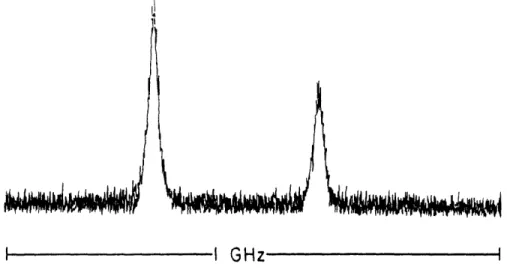
We have observed the initial state of excitation, two-photon 2s--+3s transition. Atoms in the 3s state spontaneously decay to the 2p state, emitting 813 nm photons, and then decay to the 2s state, emitting 617 nm photons. The latter signal is collected by an optical fiber, and passed through an interference filter which rejects the 735 nm laser light. The fluorescence is detected with a photomultiplier tube. Results are shown in Fig. 3-1. Both the 22S1/2 and 32S1/2 states possess hyperfine structure. The scan width is 1 GHz. Knowing the ground state hyperfine splitting of 7Li,
803.5 MHz, yields a result for the 32S1/ 2 hyperfine splitting of about 170 MHz. Most of the linewidth is
from the Doppler shift of the unapertured atomic beam. Publications
Kleppner, D., M.G. Littman, and M.L. Zimmerman, "Rydberg Atoms in Strong Fields," in R.F. Stebbings and F.B. Dunning (Eds.), Rydberq States of Atoms and Molecules, (Cambridge University Press, 1982).
Atomic Resonance and Scattering
3.2
Multiphoton Ionization
National Science Foundation (Grant PHY79-09743) National Bureau of Standards (Grant NB-8-NAHA-3017)
Lawrence R. Brewer, Fritz Buchinger, Daniel Kelleher, Daniel Kleppner
Multiphoton ionization can occur whenever intense light interacts with matter. The study of multiphoton ionization is an active area of contemporary research in optical physics because of its intrinsic interest and because it often has dramatic experimental consequences. Theoretical interest lies in understanding the breakdown of perturbation theory, the role of coherence in multiphoton processes, and the restructuring of atomic states in intense fields. Experimental interest stems from the rich variety of multiphoton processes that can be observed, and the challenge of executing well characterized experiments which can be compared in detail with theory. A significant theoretical advance is the recent work by Reinhardt and his colleagues who have developed a non-perturbative theory for multiphoton ionization of hydrogen.' We have studied resonant four photon ionization of hydrogen near threshold. The resonant process is the three photon excitation of the ls-2p transition: a fourth photon then ionizes the atom at threshold.
The experiment is carried out in an atomic beam. Hydrogen is provided by a liquid nitrogen cooled rf dissociator. The atoms pass through an accommodator which can be cooled to liquid helium temperature. The system is pumped by a baffled oil diffusion pump.
Photoionization occurs by absorption of four identical photons at a wavelength near 364.6 nm. Our system employs a tunable dye laser-amplifier near 554.6 nm, which is pumped by a Nd:YAG laser. 50 mJ is produced in a 5 nsec pulse at a repetition rate of 10 pps. This pulse is mixed with a 150 mJ pulse at 1060 nm (the Nd:TAG fundamental), providing 15 mJ at 364.6 nm. The dye laser frequency is monitored with an Iodine absorption cell.
The photoions are swept out by a pair of field plates and collected by a linear electron multiplier. The signal is integrated, digitized, and stored in a computer.
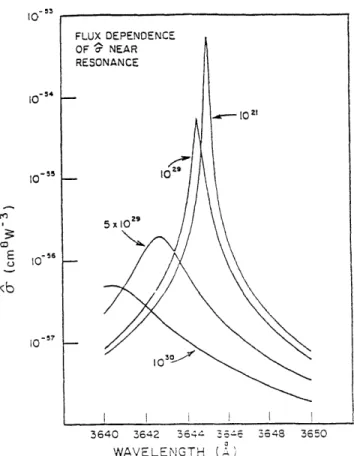
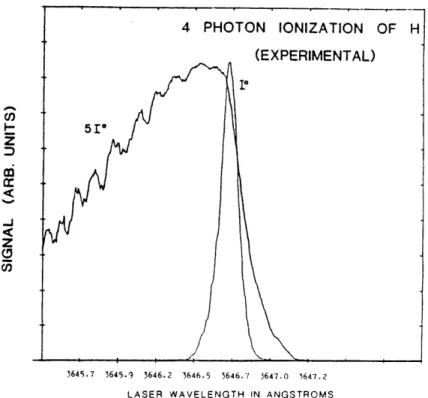
Fig. 3-2 shows lineshapes for the process we are studying as calculated by the methods of Ref. 1. Two features are conspicuous: as the laser power increases, the line center shifts to the blue of the threshold frequency for ionization, and the line broadens. We have observed both of the features in our data. We have recently obtained our first results using multimode laser light. Data is shown in Fig. 3-3. The signal to noise ratio is high and the change in shape of the photoionization curve with increasing laser power is marked.
References
1. C.R. Holt, M.G. Raymer, and W.P. Reinhardt, Phys. Rev. A 27, 2971 (1983).
Atomic Resonance and Scattering It to 3 co
E
10-5 10 io " 3640 3642 3644 3665 3648 3650 WAVELENGTH (!)Figure 3-2: The cross section for 4 photon ionization of atomic hydrogen
as calculated by Reinhardt for a single frequency laser. To
facilitate comparison, the cross section has been divided by
13.
As the intensity increases, the peaks shift to the blue and
become broader.
3.3 Atoms in "Circular" States
Joint Services Electronics Program (Contract DAAG29-80-C-0104) National Science Foundation (Grant PHY82-10486)
U.S. Navy - Office of Naval Research (Contract N00014-79-C-0183) Randall G. Hulet, Daniel Kleppner
We have produced a population of atoms in Rydberg states with
Iml
= n - 1, where m and n are the
magnetic and principal quantum numbers respectively. We refer to these states as "circular"
because in the classical limit they describe an electron in a circular orbit. Atoms in circular states
possess a number of useful and interesting properties: among all the states with a given principal
quantum number, they have the largest magnetic moment, smallest Stark effect and longest radiative
lifetime. Their collision cross sections are expected to be highly anisotropic. Only one transition is
available for spontaneous emission (n -- n
- 1; ml
-- Iml - 1), allowing them to serve as usefulRLE P.R. No. 125 rII L.LJA h L~r OF
9
RESOI .3 ,-· I I i i i iAtomic Resonance and Scattering D C,
Z
I--D7Z
z C', 3645.7 3645.9 3646.2 3646.5 3646.7 3647.0 3647.2LASER WAVELENGTH IN ANGSTROMS
Figure 3-3: Ionization profiles produced by laser intensity 10 and at five times that intensity 510. As the laser intensity is increased, the ionization profile becomes broad and asymetric and is shifted to the blue of threshold.
approximations to two level systems. For these reasons, and others, the circular states are particularly attractive for high precision Rydberg state spectroscopy.
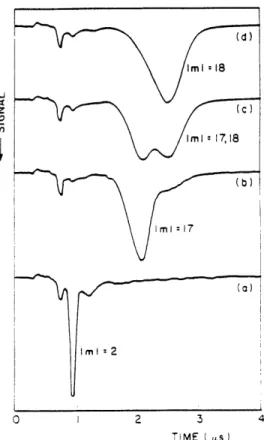
We have developed a simple method for transferring a population of atoms in a low-m Rydberg state to a circular state, with essentially 100% efficiency. The atoms are transferred by a series of adiabatic rapid passages induced by a microwave field and an electric field which decreases linearly with time. Each adiabatic rapid passage causes Iml to increase by 1; the process terminates when the atom reaches the circular state. We have demonstrated the method with lithium, n = 19, but for ease of explanation we shall consider hydrogen, n = 4, neglecting electron and nuclear spin.
The energy of hydrogen (in cm ) in an electric field F is given to first order by
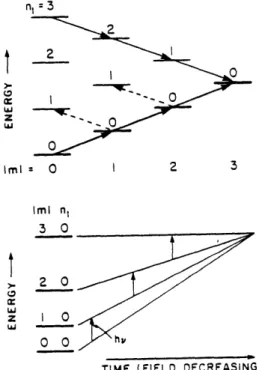
W = -(1/2n 2 - 3nF(n - n2))R, where n, and n2 are the parabolic quantum numbers (n1 + n2+ Iml +1 = n). R is the Rydberg constant, and F is in atomic units, 5.14 x 10⁹V/cm. The energy levels for n = 4 are shown in Fig. 3-4a. Initially, the lowest Iml = 0 state is populated: Iml = 0, n1 = 0. A series of
transitions satisfying A ml = 1, An1 = 0 is induced by adiabatic rapid passages, as indicated by the
heavy arrows. Because of the second order Stark effect (not shown in Fig. 3-4a), the transitions occur consecutively in time.
Atomic Resonance and Scattering
To further illustrate the process, the energy levels for the n
I=
0
states are shown in Fig. 3-4b with
the second order Stark effect
W
,included and exaggerated for clarity. The microwave frequency is
slightly below the resonance frequency for the initial transition
Iml
=
0
-41. As the field decreases,
the transitions are consecutively encountered as shown in Fig. 3-4b.
n =3 \ml = 0 2 3 Iml n, 3 0 2 0 1 0 00
TIME (FIELD DECREASING)
Figure 3-4: Schematic diagram of the excitation process, illustrated with
hydrogen, n = 4. a) (above) Energy levels in an electric field,
neglecting the second order Stark effect. The bold arrows show
the excitation path used to populate the circular state, Iml
=
3;
the light arrows show an alternative excitation route; the dashed
arrows show "leakage" transitions which must be avoided. b)
(below) The progression of n
1=
0
levels in a decreasing field,
with the second order Stark effect exaggerated for clarity. An
adiabatic rapid transition can occur whenever the energy level
separation passes through resonance with the microwave
frequency v. Because of the second order Stark effect these
transitions occur successively,
"stepping"
the population along
the route shown in a), above.
The experiment employed the n = 19 manifold of lithium. An atomic beam was used and the
Rydberg state was populated by two-step pulsed excitation: 22S1/ 2 --, 22P3/2 (671 nm) and
22P3/
2-- Rydberg
(-354
nm). An electric field was applied using copper field plates which were
carefully spaced 6.9 mm apart.
Ions
were collected through a grid drilled in the lower plate over a
length of 20 mm.
Atomic Resonance and Scattering
The atoms were excited by 5 ns laser pulses in a field of 830 V/cm. The microwave power was turned on and the field was linearly decreased to 806 V/cm during a 5 [s period. The first transition (Iml = 2--+3) occurred at 824 V/cm; the last (Iml = 17--418) occurred at 810 V/cm. The microwave
power was turned off and the atomic population analyzed by field ionization. The field was abruptly
switched to 4.4 kV/cm and then ramped to 5.9 kV/cm over a 2.5
/s
period. During this period Iml
states which ionize at progressively higher fields were successively detected and recorded by a
transient analyzer.
-J
z
0 I 2 3
TIME ( 4s )
Figure 3-5: Distribution of population in lithium for various values of
Iml
as
revealed by selective field ionization. States are n
=
19, n. = 0.
The ionization field increases with time.
The ionization
thresholds occur in increasing fields as Iml increases. a)
Iml
= 2
states initially populated by laser excitation in a field of 830
Vcm
1. The signal is clipped due to saturation of the detector.
The small peak to the left is due to
Iml
= 0 atoms. The small
peak to the right is due to
Iml
= 2 atoms which ionizehydrogenically. The
Iml
=2 peak occurs at approximately
4.5kVcm
1. b) Same as a), but with the adiabatic rapid passage
field ramp on for a time Trp = 41s. The
Iml
= 2 population hasbeen transferred predominantly to
Iml =
17. c)
7
increased:
ionization signals for Iml = 17 and 18 are both visi'le. d) TrP >
4.5.
ps.
The Iml = 18 circular states is populated. No further
change in the ionization signal occurs with increasing
'rp.The
ionizing field is approximately 5.9 kVcm
--1'1.RLE P.R. No. 125
i
Atomic Resonance and Scattering
Experimental results are shown in Fig. 3-5. To demonstrate the progression of the population
transfer, the "on" time of the rapid passage field ramp and of the microwave power, was successively
increased. In curve
a,
7
<
1 [Ls,
no transitions have occurred and the initial states, n = 19, ml = 2, are
displayed. Because of the laser linewidth (0.1 cml), and power broadening effects, an m =
0
state is
also excited; its ionization signal occurs at the lowest field. The
Im
= 2 states appear as a well
resolved peak shortly thereafter.
As the time
7
is increased, the ionization signal moves to longer times, indicating that the atoms are
being transferred to higher
Iml
states as shown in curves b and
c.
The ionization signal from adjacent
Iml
states overlap in this region, but as higher values of
Iml
are reached, the signals start to be
resolved. Finally, as shown in curve
d,
for
7
>
4.5 jis, the circular state,
m
i= 18, is populated. No
further changes occur with increasing
T.The signals are in good agreement with ionization rate
calculations.
3.4 Laser
Induced
Fluorescence Study of NaAr
National Science Foundation (Grant CHE79-02967-A04)Walter P. Lapatovich, A. Marjatta Lyyra, Philip E. Moskowitz, Mark D. Havey, David E. Pritchard
Van der Waal molecules are interesting from the standpoint of molecular physics because they are
so different from ionic and covalent molecules. Not only are the potentials weaker by a factor
of
100-1000 and the interatomic separations correspondingly larger, but the spectra contain information
from a wider range of internuclear separations. For instance, levels up to dissociation are often
thermally populated.
The study of NaAr represents a situation where most of the observed vibrational levels in the
excited states (A
2r and B
2 +from the Na 3p atomic limit) are
<15%
from the dissociation limit.
Long range analysis has been utilized extensively to predict unobserved vibrational levels and their
deperturbed rotational constants as well as potential parameters for the above mentioned electronic
states. Several perturbations close to the A2n
1/2
dissociation limit have been observed and
analyzed. The observation of highly excited vibrational levels of the A
2nr state
also enabled us to
determine the ground state well depth from long range analysis.
The NaAr study together with our earlier work on NaNe
1'
2represent the state of the art in diatomic
van der Waals molecular spectroscopy and provide the most accurate determination of the potentials
experimentally possible.
Atomic Resonance and Scattering
References
1.
R.A. Gottscho, R. Ahmad-Bitar, W. Lapatovich,
I.
Renhorn, and D.E. Pritchard, J. Chem. Phys.
75,
2546-2559 (1981).
2. W.P. Lapatovich, R. Ahmad-Bitar, P.E. Moskowitz, I. Renhorn, R.A. Gottscho, and D.E. Pritchard, J. Chem. Phys. 73, 5419-5431 (1980).
3.5 Vibrationally
Inelastic
Collisions
U.S. Air Force - Office of Scientific Research (Contract AFOSR-81-0067) National Science Foundation (Grant CHE79-02967-A04)
Susan L. Dexheimer, Charles W. Engelke, Peter D. Magill, Katherine L. Saenger, Neil Smith, David E. Pritchard
During the past few years we have developed a general picture of Rotationally Inelastic (RI) Collisions involving both theoretical and experimental advances. We have shown that the hundreds of measured rate constants describing these collisions can be reproduced to within 10% by simple analytic expressions containing 3 to 4 fitting parameters and that the qualitative behavior of these rate constants is easily explained in terms of simple dynamical ideas.
The more complete understanding of collision induced energy transfer that we desire, however, requires study of Vibrationally-Rotationally Inelastic (VRI) processes. The increased complexity of VRI collisions (they involve a change in both vibrational and rotational quantum numbers) makes them more interesting to examine but more challenging to explain with the simplicity that worked so well for pure RI collisions. Previous theoretical treatments have been hampered by the lack of high quality experimental data and are inadequate due to their neglect of rotation.
During this past year we have started to measure level to level rate constants k . for Li*--rare
V.)j.4 Ivf 2 gas atom systems. Our preliminary results for Xe are shown in Fig. 3-6 where we have plotted
k. versus jf for v. = 4, AV = -3 and
J.
= 14, 28, 44. With increasing j- there is both a dramatic increase in the magnitudes of the rate constants and a narrowing of their distribution in jf. Nothing like this has been observed previously. These are important clues to the significant role of rotation in vibrational energy transfer.3.6 Diffraction of Sodium Atoms by a Standing Wave Laser Field
National Science Foundation (Grant CHE79-02967-A04)
Philip E. Moskowitz, Phillip L. Gould, Susan Atlas, David E. Pritchard
Perhaps the most important problem which has arisen in atomic physics as a result of the laser
concerns effects of intense optical radiation on simple atomic systems. The momentum transferred to
Atomic Resonance and Scattering
3x10"1
E
uC)-0
12
24
36
48
Figure 3-6
atoms by a standing wave optical frequency field is a central question in this arena because the force
on the atoms is simply the spatial gradient of the energy of the combined atom-field system-the
"dressed" atom. A study of atoms scattered by a perpendicularly oriented standing wave field is a
study of the basic induced dipole interaction between atoms and optical frequency fields.
-rr (A
z
L&J z i Z'i-i
-10
-8 -6
•-4
-2 0
o2
*4
*G
DEFLECTION
[.K]
48 *(0
*I2
Figure 3-7
In revealing the nature of the interaction of intense radiation fields on atomic systems, our
experiment resolves a controversy apparent in the many relevant theoretical publications of the last
few years. In contrast to two previous experimental efforts
1'
2which have been inconclusive, we have
constructed a supersonic beam machine with the momentum resolution of a single photon (p = hk),
and an atom-field interaction time of the order of the spontaneous lifetime of the sodium
3S1/2-3P3/2
transition. The single frequency dye laser is tuned near resonance with this transition, one of
RLE P.R. No. 125
C , , · . i _ i i .i i. q
li
,
j1
Atomic Resonance and Scattering
the so-called sodium "D-lines". This, and a state-of-the-art neutral atom detector, has enabled us to display phenomena previously unobserved: a symmetric splitting of the atomic beam and a periodic modulation of 2hk in the momentum distribution (Fig. 3-7).
The observed magnitude of the splitting as a function of the field strength has enabled us to apply certain semiclassical theories3
to our data with success. We have also explained the periodic modulation as originating from an adiabatic interaction of the atom with the field, and have called this diffraction.4
References
1. E. Arimondo, H. Lew, and T. Oka, Phys. Rev. Lett. 43, 753 (1979).
2. V.A. Grinchuk, E.F. Kuzin, M.L. Nagaeva, G.A. Ryabenko, A.P. Kazantsev, G.I. Surdutovich, and V.P. Yakovlev, Phys. Lett. 86A, 136 (1981).
3. A.P. Kazantsev, G.I. Surdutovich, and V.P. Yakovlev, Opt. Comm. 43, 180 (1982).
4. P.E. Moskowitz, P.L. Gould, S. Atlas, and D.E. Pritchard, Phys. Rev. Lett., submitted for publication.
3.7
A Search for Radiative Transitions in Atom-Molecule
Systems
Joint Services Electronics Program (Contract DAAG29-83-K-0003)
Alan L. Migdall, Robert E. Walkup, David E. Pritchard
A new transition mechanism has been proposed1-3 as a generally useful spectroscopic tool with specific applications to producing population in otherwise optically inaccessible molecular states. The process consists of an atom and a molecule during a collision acting as a quasi-molecule that makes a single photon radiative transition that leaves the atom in a new electronic state while the molecule changes its vibration and/or rotation state.
We have developed guidelines for choosing a system in which to best observe such a transition. Using these guidelines we chose two optimal systems to study. Our experimental measurements on these systems showed that even under these favorable conditions radiative collisions are difficult to observe. This observation, along with our guidelines, leads us to conclude that this type of radiative process will not have the general applicability that has been suggested.
References 1. P. Hering and Y. Rabin, Chem. Phys. Lett. 77, 506 (1981). 2. J. Lukasik and S. Wallace, Phys. Rev. Lett. 47, 240 (1981).
3. J.C. White, Opt. Lett. 5, 199 (1980).
Atomic Resonance and Scattering
3.8
Rotationally
Inelastic
Collisions
U.S. Air Force - Office of Scientific Research (Contract AFOSR-81-0067) Timothy A. Brunner, Neil Smith, Thomas P. Scott, David E. Pritchard