HAL Id: cea-02491657
https://hal-cea.archives-ouvertes.fr/cea-02491657
Submitted on 26 Feb 2020HAL is a multi-disciplinary open access archive for the deposit and dissemination of sci-entific research documents, whether they are pub-lished or not. The documents may come from teaching and research institutions in France or abroad, or from public or private research centers.
L’archive ouverte pluridisciplinaire HAL, est destinée au dépôt et à la diffusion de documents scientifiques de niveau recherche, publiés ou non, émanant des établissements d’enseignement et de recherche français ou étrangers, des laboratoires publics ou privés.
How Digital Autoradiography Technique can be useful
for D&tD projects ?
P. Fichet, R. Haudebourg
To cite this version:
P. Fichet, R. Haudebourg. How Digital Autoradiography Technique can be useful for D&tD projects ?. International Symposium on Preparation for Decommissioning, Feb 2016, Lyon, France. �cea-02491657�
PREDEC 2016: How Digital Autoradiography Technique can be useful for D&D projects ?, February
16-18, Lyon, France
1 Abstract A52888PF
How Digital Autoradiography Technique can be
useful for D&D projects ?
Pascal FICHET*, Raphaël HAUDEBOURG
CEA SACLAY, DEN/DANS/DPC/SEARS/LASE PC 171, 91191 Gif Sur Yvette France *corresponding author: [email protected]
Keywords: characterization, decommissioning, beta, alpha, mapping.
For many stakeholders, it is obvious that radiological characterization is essential for D&D projects and all of them have its own specificities. Different types of techniques have been developed for characterizations not only by destructive methods but also by in situ investigations. Since 2010, the LASE laboratory, in charge of characterizations of different radionuclides that can be found in nuclear wastes, has developed the Digital Autoradiography (DA) technique [1]. DA technique is in routine use commercially for biological researches to obtain images of labelled molecules containing H-3, C-14, I-129, … i.e. radionuclides difficult to measure. The needs to investigate these hard to observe radionuclides were one of the R&D subjects for D&D proposed recently and highlighted by OCDE [2].
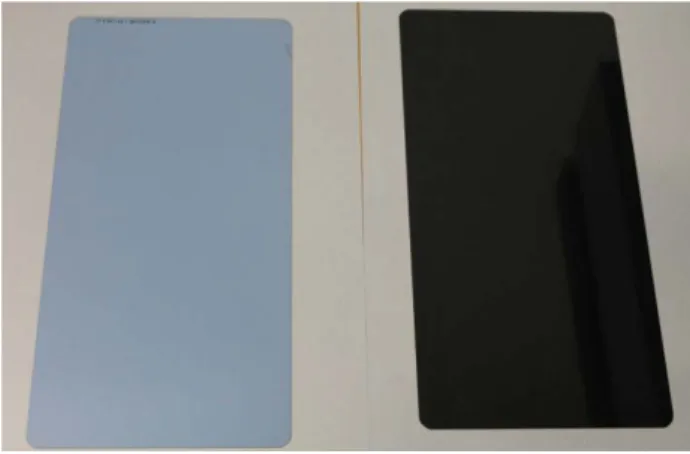
Since the beginning of the researches on DA technique two main applications have been developed: - the radiological mapping in nuclear facilities under dismantling – and the studies of particular samples. In facilities to be characterized, Digital Autoradiography was chosen as a promising technique to analyze in situ tritium and other radionuclides. By using reusable screens (Figure 1), it was possible after data processing and Kartotrak software use, to obtain reliable two dimensional mappings of radioactivity traces for several 200 m2 laboratories.
Figure 1:
Phosphor screen used in the study; left: sensitive side, right: back side;type: TR,commercialized by Perkin Elmer; size: 12.5 x 25 cm²
The software is able to calculate uncertainties of the different measurements and to calculate contaminated surfaces in order to provide accurate results to work on D&D scenario to minimize risks and costs. Apart from these developments on mapping results, Digital Autoradiography has also been developed for optimization of samplings required for destructive analysis. High accurate techniques providing analysis of radionuclides that must be surveyed for nuclear waste repository requires the
PREDEC 2016: Title of the communication, February 16-18, Lyon, France
Abstract A52888PF 2
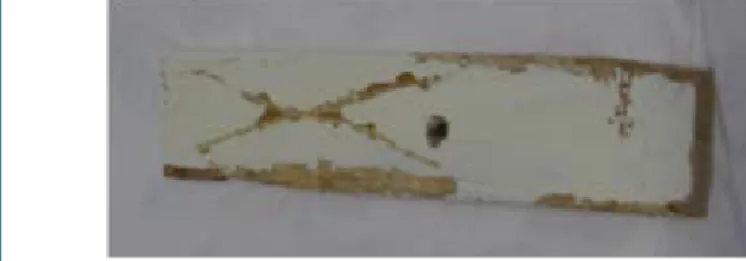
digestion of very small amount of solids, muds, … (typically less than one g) that must be chosen and Digital Autoradiography is efficient for sampling process. Hot spots can be observed on DA images providing very significant samples (Figure 2). The possibility to provide image of radioactivity is a great advantage in many applications that has been developed by LASE laboratory: wipes sorts, core investigations, ….
Figure 2: Tritium measured on a piece of wood References
[1] A Leskinen, P Fichet, M Siitari-Kauppi, F Goutelard "Digital autoradiography (DA) in quantification of trace level beta emitters on concrete", J Radioanal Nucl Chem, 298 : 153-161, 2013.