Academic and Research Staff
Prof. Daniel Kleppner Prof. Stuart S. B. Crampton Dr. Theodore W. Ducas
Prof. David E. Pritchard Dr. Richard R. Freeman
Graduate Students
Riad N. Ahmad William E. Cooke William D. Phillips Jerome Apt III Michael G. Littman Naser S. Saleh
Gary M. Carter Myron L. Zimmerman
RESEARCH OBJECTIVES AND SUMMARY OF RESEARCH JSEP
Our interests center on the structure and interactions of atoms and simple molecules, and on their interactions with radiation at optical and radio frequencies. Experimental methods involve colliding beam scattering, atomic and molecular beam resonance spec-troscopy, and optical excitation by tunable lasers.
1. Optical Frequency Standard
Joint Services Electronics Program (Contract DAAB07-74-C-0630) David E. Pritchard
We are trying to develop a simple and economical "frequency meter" to be used with a tunable laser to preset the laser frequency, measure the laser frequency, or provide frequency marker pulses when the laser frequency is swept.
A prototype system capable of 50 MHz accuracy is nearing completion and should soon be ready for calibration.
2. New Methods for Radiation Detection
Joint Services Electronics Program (Contract DAAB07-74-C-0630) Daniel Kleppner
The possibility of creating a gas of highly excited atoms in essentially unperturbed states offers new opportunities for efficient detection of optical, infrared, and micro-wave photons. We have undertaken a theoretical study of some properties of highly excited atoms relevant to this application. An atomic beam apparatus has been con-structed and work has started on the preparation of atoms in high-lying states using stepwise excitation with pulsed lasers. We have performed spectroscopy and measured
ionization characteristics of these high-lying states. JSEP
3. Studies of Superradiance and Coherence
U. S. Air Force Office of Scientific Research (Contract F44620-72-C-0057) Daniel Kleppner
The objectives of this work are to study superradiance in small systems and to inves-tigate the nature of atomic systems in a radiation field.
(IV. ATOMIC RESONANCE AND SCATTERING)
We have extended the analysis of two-particle superradiance at small distances as manifested by the interaction between single-electron atoms. In small systems the energy shift which accompanies superradiance can play an important dynamical role, and may be used to bind two free atoms into a superradiant complex. Apparatus has been developed for creating these complexes by laser excitation in a high-density atomic beam, and for observing the fluorescent spectra and lifetimes.
We have demonstrated the feasibility of exciting a parity-forbidden dipole optical transition by applying a static electric field. The method has been used to excite the 6D and 7D states in CS. Lifetimes and Stark mixing coefficients have been measured.
Work is in progress on quantum-beat spectroscopy on the 6D state in hydrogen.
4. Van der Waals Molecules
National Science Foundation (Grant GP-39061X1) Daniel Kleppner, David E. Pritchard
The objective of this work is to study magnetic interactions between alkali and rare gas atoms by applying molecular beam resonance methods to alkali-rare gas van der Waals molecules. We have measured the spin-rotation constant and the hyperfine inter-action in potassium-argon. The hyperfine interaction in potassium is shifted by the argon atom; the resulting hyperfine spectrum has resolved structure which yields a detailed picture of how the hyperfine shift varies with internuclear separation. Both positive and negative shifts are evident, reflecting two separate interaction mechanisms. The results provide a much more detailed check of theory than is provided by optical pumping pressure shift measurements.
Work is in progress on measuring the shift in the electronic g-factor between a free alkali and an alkali bound with a rare-gas atom.
A. ENERGY-TRANSFER STUDIES USING VELOCITY-SELECTED ATOMS AND MOLECULES
National Science Foundation (Grant GP-39061X1) Jerome Apt III, David E. Pritchard
Collisional transfer of energy from one molecule or atom to another and/or among the sublevels of one molecule is important in many electronic devices, such as plasma devices, gas discharge lasers, and chemical lasers. The dependence of the collision cross sections for energy transfer on the relative velocity of the collision partners is, after the magnitude of the cross section, the single most important feature of the energy-transfer collision process, first because it governs the temperature dependence of the energy-transfer process, and second because it provides a sensitive indicator of the detailed nature of the molecular processes occurring in the collision. In spite of this, there have not been extensive experimental studies of the energy dependence of energy-transfer processes because the means of doing so experimentally are complicated (e. g.,
shock tubes) or do not work over a very wide range of collision velocities (e. g., they change the temperature of the apparatus).
We have recently proposedI a general method for achieving velocity selection in the study of energy-transfer collision cross sections involving atoms and molecules excited by a monochromatic laser. This method is based on the Doppler shift and promises to permit us to study collisions in which the velocities correspond to thermal energies from 3000 K to roughly 2, 0000 K without changing the temperature of our apparatus. The method produces a velocity-selected excited-state population in the following manner. If the frequency v of a highly monochromatic laser beam is slightly offset from the res-onance frequency vo of an atomic or molecular transition, then (to first order) only those atoms or molecules whose component of velocity along the beam is
Vl z = c(v-vo)/Vo
will be Doppler shifted into resonance and hence excited.
During the last few months we have applied this method to the study of electronic excitation transfer between Na and Rb
Na* + Rb - Na + Rb,
where the star refers to electronic excitation. We used a single-mode tunable dye laser (Spectra Physics Model No. 580 System) to excite the Na to either the j = 3/2 or j = 1/2 fine-structure level of its 3p state. Fluorescence from the 5Pl/z and 5
P3/2 states of rubidium was collected by an f: 1 collection lens and detected by a cooled RCA 31034 photomultiplier tube. The rubidium fluorescence radiation and the sodium fluorescence
(IV. ATOMIC RESONANCE AND SCATTERING)
radiation were distinguished by three-cavity interference filters and colored glass fil-ters.
Velocity selection was achieved by offsetting the laser frequency from the center of the desired fine-structure transition line by an amount Av, which yielded a specific rel-ative velocity Vrel. The cross section for excitation transfer to a particular fine-structure level of Rb can then be determined from the ratio of the measured light intensity from the appropriate Rb fluorescence line, FRb, to that from the sodium, FNa' by using the relation (valid in the absence of radiation trapping)
Q (Vre) = FRb(Av)/(nRbVrel NaFNa(Av)),
where nRb is the density of rubidium, and TNa is the excited-state sodium lifetime. We have studied the dependence of
Q
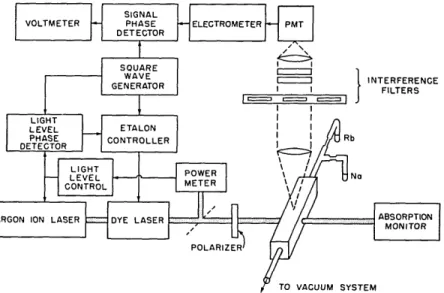
upon Vrel, and have verified that Q is roughlyinde-pendent of nRb, but have not yet attempted to measure the absolute magnitude of Q. Our experimental chamber was a heated quartz cell connected to separately heated sidearms containing Na and Rb metal, as shown in Fig. IV-1. The pressure in the cell was maintained below 1 tm by a zeolite trapped oil diffusion pump. At this pressure,
the time between collisions is roughly 103 times the decay time of the excited-state sodium. The biggest experimental problem proved to be scattered light from the cell walls, which limited our maximum energy to roughly 6 kT, in spite of the use of a phase
detector in synchronism with frequency modulation of the laser on and off the desired
SIGNAL
VOLTMETER PHASE -ELECTROMETER - PMT
DETECTOR SQUARE GEEAREOR INTERFERENCE GENERATOR FILTERS LIGHT LEVEL ETALON PHASE CONTROLLER I Rb DETECTOR LEVEL POWER No
I/
ARGON ION LASER DYE LASER ABSORPTION
MONITOR
POLARIZER
TO VACUUM SYSTEM
Fig. IV-1. Apparatus. Output from the light-level phase detector is applied to the etalon controller to equalize the laser intensity at the two frequencies between which it is chopped.
- 1 fluorescence signal (x) with
Gaus-i sian curve (solid line) and Lorentz
S/ \ curve (dashed line). The Lorentz
Zx / curve is drawn under the
assump-Stion that the atoms have zero
veloc-ity along the laser beam. -J -5 -4 -3 -2 -1 0 I 2 3 4 5 6 7 v-vo (GHz) Ecm+k (OK) 550 700 1000 1500 2000 3000 10 i I I I I I I i 7 - :- No-(p )- Rb p,) I O 10 - Na-(p3/2 PCLRLARTION -Rb (p3/2) Fig. IV-3.
Io7 Dependence of excitation transfer
cross sections on the center of mass
0 energy of the collision, E The
05 cm
solid lines show a cross section which varies as E -1/2" I-mcm- 3 Z0 Na(p CIRCUL AR Rb*( 3/2 POLARIZATION 3/2 S7 < 5 X s s sI section which o I 2 3 Y-Yo (GHz) Li
(IV. ATOMIC RESONANCE AND SCATTERING)
portion of the line.
Figure IV-2 shows the observed sodium fluorescence as a function of the laser offset from the line center (the double hump is caused by the presence of the two sodium ground-state hyperfine components). The solid curve is the fluorescence spectrum expected from Doppler broadening alone at the temperature of the cell (4850 K) and the agreement of the data with this expectation is evidence that our velocity-selection method is working. The dashed curve shows the natural (Lorentzian) line shape of sodium atoms, with Doppler broadening ignored. This shows the ultimate limit of our technique. If we attempt to select atoms with energies higher than approximately 10 kT we shall be in the region where the Lorentzian line shape dominates: we then excite more slow-moving atoms (through their Lorentz tail) than velocity-selected atoms because so few have the required velocity.
Figure IV-3 shows results for Na (3Pl/2 and 3P3/ 2) + Rb -Na + Rb (5P3/2). In each case we find that Q(v) varies as 1/v within experimental error. The P3/2 data were taken with both linear and circularly polarized light in order to study the influence of level crossings which can increase the observed Na fluorescence slightly. Our data
in which the Rb is in the 5Pl/2 state display similar velocity dependence. This is consistent with the behavior of cross sections for quenching of metastable Hg.' (3p) by collisions with molecular targets.2
Work is now in progress to extend these measurements to higher velocities by both reducing background and increasing the cell temperature. We are also preparing to
study the system Na +Ba, in which kinetic energy must be added to make the transfer; here we hope to study the velocity dependence in the threshold region.
References
1. W. D. Phillips and D. E. Pritchard, Phys. Rev. Letters 33, 1254 (1974). 2. H. F. Krause, S. Datz, and S. G. Johnson, J. Chem. Phys. 58, 367 (1973).