HAL Id: hal-00299279
https://hal.archives-ouvertes.fr/hal-00299279
Submitted on 20 Apr 2006
HAL is a multi-disciplinary open access
archive for the deposit and dissemination of
sci-entific research documents, whether they are
pub-lished or not. The documents may come from
teaching and research institutions in France or
abroad, or from public or private research centers.
L’archive ouverte pluridisciplinaire HAL, est
destinée au dépôt et à la diffusion de documents
scientifiques de niveau recherche, publiés ou non,
émanant des établissements d’enseignement et de
recherche français ou étrangers, des laboratoires
publics ou privés.
south-western Umbria, central Italy: types, extent,
damage and risk assessment
M. Cardinali, M. Galli, F. Guzzetti, F. Ardizzone, P. Reichenbach, P.
Bartoccini
To cite this version:
M. Cardinali, M. Galli, F. Guzzetti, F. Ardizzone, P. Reichenbach, et al.. Rainfall induced landslides
in December 2004 in south-western Umbria, central Italy: types, extent, damage and risk assessment.
Natural Hazards and Earth System Science, Copernicus Publications on behalf of the European
Geo-sciences Union, 2006, 6 (2), pp.237-260. �hal-00299279�
www.nat-hazards-earth-syst-sci.net/6/237/2006/ © Author(s) 2006. This work is licensed under a Creative Commons License.
and Earth
System Sciences
Rainfall induced landslides in December 2004 in south-western
Umbria, central Italy: types, extent, damage and risk assessment
M. Cardinali1, M. Galli1, F. Guzzetti1, F. Ardizzone1, P. Reichenbach1, and P. Bartoccini21CNR – IRPI, via Madonna Alta 126, 06 128 Perugia, Italy 2Consultant, via Vittorio Veneto 14/A, 06 050 Papiano, Italy
Received: 13 September 2005 – Revised: 11 January 2006 – Accepted: 22 February 2006 – Published: 20 April 2006
Abstract. The autumn of 2004 was particularly wet in Um-bria, with cumulative rainfall in the period from October to December exceeding 600 mm. On 4–6 December and on 25– 27 December 2004, two storms hit the Umbria Region pro-ducing numerous landslides, which were abundant near the town of Orvieto where they affected volcanic deposits and marine sediments. In this work, we document the type and abundance of the rainfall-induced landslides in the Orvieto area, in south-western Umbria, we study the rainfall condi-tions that triggered the landslides, including the timing of the slope failures, we determine the geotechnical properties of the failed volcanic materials, and we discuss the type and ex-tent of damage produced by the landslides. We then use the recent event landslide information to test a geomorpholog-ical assessment of landslide hazards and risk prepared for the village of Sugano, in the Orvieto area. Based on the results of the test, we update the existing landslide hazards and risk scenario for extremely rapid landslides, mostly rock falls, and we introduce a new landslide scenario for rapid and very rapid landslides, including soil slides, debris flows and debris avalanches.
1 Introduction
The autumn and early winter of 2004 were particularly wet in the Umbria Region of central Italy. Repeated rainfall episodes and high intensity storms resulted in a cumulative rainfall in the period from October to December exceed-ing 600 mm. On 4–6 December and on 25–27 December 2004, two severe storms hit the Umbria Region. The rain-fall events produced numerous landslides, which were par-ticularly abundant along the Tiber River valley, E and SE of Todi, and in the Orvieto area (Fig. 1).
Correspondence to: M. Cardinali
Through reconnaissance field surveys carried out after the rainfall events, we mapped 486 landslides in Umbria, for a total landslide area of about 9.40×10⁵m2, and an esti-mated total landslide volume of about 1.7×10⁶m3. Average landslide density was 1.7 slope failures per square kilome-tre, and locally exceeded 12 landslides per square kilometre. The rainfall induced landslides produced damage to private homes, the road network, and agriculture. Damage was par-ticularly severe in the municipalities of Orvieto and Porano (Fig. 1b). In these municipalities, slope failures were most abundant at Benano, Porano, and Sugano.
In this work, we investigate the rainfall induced landslides which occurred in the Orvieto area. The purpose of this study was to: (i) document the type, abundance and magnitude of the rainfall-induced landslides, and in particular the shallow slope failures which occurred in weathered volcanic rocks and soils present in the area, (ii) study the rainfall conditions that triggered the shallow landslides, including the timing of the slope failures, (iii) determine the geotechnical properties of the failed volcanic materials, and (iv) describe the type and extent of damage produced by the triggered slope failures. We further use the available event landslide information to test and update a geomorphological assessment of landslide hazards and risk for selected areas in Umbria, including the village of Sugano (Fig. 1b) (Reichenbach et al., 2005).
2 Lithological and morphological setting
The Orvieto area is characterized by a tabular volcanic mesa rimmed by a distinct escarpment, from a few to tens of me-ters in height. Buttes and isolated mesa remnants are lo-cally present. Elevation in the area ranges from 110 to 636 m. Slopes bounding the volcanic escarpment are very steep (>65◦), locally vertical or overhanging. The remain-ing territory has slopes in the range from 0◦to 40◦, with a modal value of ∼15◦. Volcanic rocks cropping out in the area
Figure 1
Foligno
Umbertide
Perugia
Orvieto
Terni
Todi
B
A
Orvieto Benano Sugano Porano C D Sugano Leone creekPassone creek Porano
C
D
Fig. 1. Location and setting of the study area. (A) Shaded relief map of Umbria. Yellow and red lines show areas where field investigations
to map landslides (shown as green dots) were conducted after the 4–6 December 2004 and the 25–27 December 2004 rainfall events. (B) Location of the Orvieto study area where landslides described in this paper (shown in green) were mapped through field work. Area of individual landslides exaggerated for illustration purposes. Violet lines show location of geological cross sections. (C) Simplified geological cross section at Sugano. Orange, volcanic deposits; grey, marine sediments. (D) Simplified geological cross section at Porano. Orange, volcanic deposits; grey, marine sediments.
Table 1. Rain gauges used to study the rainfall conditions that resulted in landslides in the Orvieto area in December 2004. For the Allerona
and the Orvieto Scalo rain gauges historical rainfall records were not available to compute the mean annual precipitation (MAP).
Rain gauge Latitude Longitude Elevation MAP Period
(m) (mm) (years) Orvieto 42◦4300800 12◦4300800 315 816 69 Orvieto Scalo 42◦4305700 12◦0704900 117 – – Allerona 42◦4701300 12◦0104800 147 – – Perugia 43◦0903600 12◦2604400 493 850 79 Foligno 42◦5602200 12◦4003200 235 878 52 Umbertide 43◦1703500 12◦1804900 247 900 56 Todi 42◦4703900 12◦2405900 411 867 74 Ripalvella 42◦5004000 12◦1800100 453 953 5
are part of the Monti-Vulsini volcanic complex, and contain lava flows, ignimbrites and pyroclastic deposits. These rocks overlie marine sediments Pliocene to Pleistocene in age, con-sisting manly of clay and silt, and subordinately of sand and gravel (Nappi et al., 1982, 1995; Buonasorte et al., 1988; Costantini et al., 1988; Faraone and Stoppa, 1988).
Landslides are abundant in the area. The geomorpholog-ical inventory map prepared for the Umbria Region by An-tonini et al. (2002) shows a continuous belt of deep seated landslide deposits in the Orvieto area extending laterally for several kilometres. Landslides occur in the jointed volcanic cap and in the underlying marine clay. Stress analyses car-ried out on the Orvieto cliff have shown that failure of the volcanic cap has two main causes: (i) the increase of tensile stresses in the volcanic rock due to the different deforma-bility of the pyroclastic rock in contrast to the more plastic underling marine sediments, and (ii) the reduction of the re-sisting stresses at the base of the cliff, due to landsliding in the underlying clay (Lembo-Fazio et al., 1984; Cecere and Lembo-Fazio, 1986; Barla et al., 1990; Diamanti and Soc-codato, 1981). Guzzetti et al. (1996) determined that in the volcanic rocks slope movements are represented chiefly by: (i) falls, topples and slab failures of prismatic rock elements and related rock slides, (ii) differential (mostly vertical) low-ering of the external-most portions of the volcanic cap, and (iii) relative movements of isolated blocks that locally form overhanging slopes. In the underlying stiff clay slides are ro-tational and translational. The latter failures are deep seated with a distinct retrogressive behaviour, and in some places turn into flow slides at the toe. Small shallow slides and flows develop in the colluvial cover of large landslide deposits or in the talus debris that locally covers the toe of the volcanic cap.
3 Rainfall
To investigate the rainfall conditions that resulted in land-slides in the Orvieto area in December 2004, we used rainfall measurements obtained by eight rain gauges (Fig. 2 and Ta-ble 1). Of the eight rain gauges, the Orvieto, Orvieto Scalo and Allerona stations are located in south-western Umbria, at or near the area where landslides were most abundant. The Ripalvella, Todi and Perugia rain gauges are located in cen-tral Umbria, in or near areas where rainfall-induced slope failures were also numerous. The remaining two rain gauges are located in northern (Umbertide) and eastern (Foligno) Umbria (Fig. 2).
3.1 Antecedent rainfall
From 1 October to 3 December 2004, the Umbria Region experienced prolonged and intense rainfall with cumulative values over the 64-day period exceeding 300 mm (Figs. 2a, b). Locally, the cumulative rainfall for the selected period exceeded 49.5% of the mean annual precipitation (MAP) (Fig. 3). In the selected period, significant rainfall episodes occurred on 10–19 October, 26–31 October, 6–11 November, and 29–30 November (Fig. 2a). During these rainfall periods, total precipitation was most abundant in south-western Um-bria (Fig. 2b). The first rainfall episode, from 10 to 19 Oc-tober, was characterized by cumulative precipitation in ex-cess of 150 mm. Precipitation was particularly abundant at Orvieto (189 mm) and at Ripalvella (165 mm), and rainfall intensities peaked at Umbertide (62.2 mm in 24 h) and Orvi-eto (56.6 mm in 24 h). The second rainfall episode, from 26 to 31 October, was less severe, and was located in north-ern Umbria where cumulative precipitation was as much as 58.0 mm near Umbertide. In the period, rainfall was more in-tense at Umbertide, where 27.6 mm in 24 h were measured. The third rainfall episode, from 6 to 11 November, was char-acterized by total precipitation in the range from 34.4 mm (at Umbertide) to 90.6 mm (at Orvieto). The highest rainfall in-tensity was measured at Orvieto, where 28.0 mm in 24 h were
Figure 2 260 240 300 220 200 320 300 280 28 0 Perugia 185 mm Umbertide 276 mm Foligno 266 mm Ripalvella 329 mm Todi 266 mm Orvieto Scalo 343 mm Orvieto 404 mm Allerona 277 mm 043 360 45 50 55 60 65 70 8 0 8 5 90 45 40 75 Perugia 42 mm Umbertide 46 mm Foligno 34 mm Ripalvella 92 mm Todi 60 mm Orvieto Scalo 78 mm Orvieto 98 mm Allerona 68 mm 0 20 40 60 80 100 120 00.00 03.00 06.00 09.00 12.00 15.00 18.00 21.00 00.00 03.00 06.00 09.00 12.00 15.00 18.00 21.00 00.00 03.00 06.00 09.00 OR OS RI TO FO PG AL Cumu lativ e rainfa ll (m m)
4 December 5 December 6 Dec 0 100 200 300 400 500 600 700 1-Oct 8-Oct 15-Oct 22-Oct 29-Oct 5-N o v 12-N o v 19-N o v 26-N o v 3-D e c 10-D ec 17-D e c 24-D ec 31-D ec Cumu lativ e rainfa ll (m m) 10-19 Oct 26-31 Oct 6-11 Nov 4-6 Dec Dec 25-27 OR UM OS RI TO FO PG AL 29-30 Nov
25 December 26 December 27 December 0 20 40 60 80 100 120 00.00 04.00 08.00 12.00 16.00 20.00 00.00 04.00 08.00 12.00 16.00 20.00 00.00 04.00 08.00 12.00 16.00 20.00 00.00 UM OS TO FO PG AL OR RI Cumu lativ e rainfa ll (m m) B A 60 55 50 55 50 4045 65 75 70 80 90 9 5 100 Perugia 60 mm Umbertide 46 mm Foligno 38 mm Ripalvella 85 mm Todi 63 mm Orvieto Scalo 95 mm Orvieto 100 mm Allerona 98 mm D C E F
Fig. 2. Rainfall conditions that resulted in landslides in Umbria in December 2004. (A) Rainfall history for the period from 1 October to
31 December 2004 (antecedent conditions). (B) Map showing cumulative rainfall in the period from 1 October to 3 December 2004. (C) Rainfall history for the period between 4 December, at 00:00, and 6 December 2004, at 09:00. (D) Map showing cumulative rainfall for the 4–6 December 2004 rainfall event. (E) Rainfall history for the period between 25 December, at 00:00, and 27 December, at 24:00. (F) Map showing cumulative rainfall for the 25–27 December 2004 rainfall event. Rain gauges arranged geographically in two groups. Group 1, dark blue triangles in the maps and dark blue lines in the graphs: Or, Orvieto; Os, Orvieto Scalo; Al, Allerona; Ri, Ripalvella. Group 2, light blue triangles in the maps and light blue lines in the graphs: To, Todi; Fo, Foligno; Pg, Perugia; Um, Umbertide. In the maps, thick lines show the Umbria regional boundary, thin lines are contours of rainfall, red lines outline areas where landslides were mapped through field investigations. Yellow polygon shows the Orvieto study area (Fig. 6). Area of the individual landslides exaggerated for illustration purposes. recorded on 10 November. The last rainfall episode, from 29
to 30 November, was characterized by cumulative rainfall in the range from 20.2 mm (at Orvieto Scalo) to 33.0 mm (at Todi). This short rainfall episode was less severe that the previous episodes, and occurred four days before the 4–6 December 2004 rainfall event that resulted in abundant land-slides.
3.2 The 4–6 December 2004 event
At the end of a particularly wet season, and following the 29– 30 November rainfall episode, a particularly intense rainfall event hit the south-western part of the Umbria Region from 4 to 6 December 2004 (Figs. 2c, d). The event started in the early hours of 4 December with a light rain. Less than 6 mm
were measured between 05:00 and 22:00. Rainfall intensity increased rapidly between 22:00 and 22:30. The first rainfall burst lasted 6.5 h, from 22:30 of 4 December to 05:00 of 5 December. During this period, the Allerona rain gauge mea-sured 5.4 mm in 30 min, and 10.2 mm in 1 h, with a cumu-lative rainfall for 6.5 h exceeding 45 mm. The rainfall event continued with a reduced intensity until 10:00, when a sec-ond rainfall burst started with an intensity of about 3 mm/h and lasted until about 17:00 (maximum intensity was mea-sured at Allerona with 6.6 mm/h). The event ended at ap-proximately 05:00 on 6 December with two consecutive rain-fall bursts exhibiting rainrain-fall intensities of 2.3 and 2.2 mm/h, respectively. At the Orvieto rain gauge, precipitation totalled 100 mm in 48 h, corresponding to an average intensity in ex-cess of 2 mm/h. Comparable values were observed at Orvi-eto Scalo (94.8 mm) and at Allerona (97.8 mm). The other rain gauges exhibited a similar temporal trend of the rainfall, with little or no difference in the time and the duration of the individual rainfall bursts (Fig. 2c). Figure 2d reveals a distinct geographical pattern for the rainfall. The cumulative rainfall for the 30-h period was highest between Orvieto and Allerona, and decreased rapidly to the N (45.8 mm at Um-bertide) and to the E (38.1 mm at Foligno).
3.3 The 25–27 December 2004 event
The last rainfall event in the studied period hit the Umbria Region from 25 to 27 December 2004 (Figs. 2e, f). In the south-western part of Umbria, the rainfall event started in the early morning of 25 December with a light rain. Less than 4 mm of rain were measured in the 14-h period be-tween 06:00 and 20:00 on 25 December. Rainfall intensity increased between 20:00 and 22:00, and increased markedly after 22:00. The intense rainfall lasted 12.5 h, until 10:30 on 26 December, with an average intensity of 3.5 mm/h (at Orvieto). The intense rainfall period was characterized by individual bursts, which lasted from less than one hour to few hours. Inspection of Fig. 2e indicates differences in the time and the duration of the individual rainfall bursts. During this intense rainfall period, the Orvieto rain gauge measured 6.8 mm in 30 min, 10.6 mm in 1 h and 15.8 mm in 2 h, with a cumulative rainfall for 12.5 h exceeding 43 mm. The event continued with a reduced rainfall intensity (about 1.6 mm/h at Orvieto and 0.7 mm/h at Allerona), and ended between 09:00 and 15:00 on 27 December. In the latter period, indi-vidual rainfall bursts were observed, e.g., at the Orvieto rain gauge between 19:00 and 20:00 on 26 December. The event was more severe and lasted longer in south-western Umbria, between Orvieto and Ripalvella, and was shorter and less in-tense in the northern (Umbertide) and eastern (Foligno) Um-bria (Fig. 2e). Figure 2f shows that the geographical pat-tern of the event precipitation was similar to the patpat-tern ob-served for the 4–6 December event. The cumulative rain-fall for the 66-h period between 06:00 on 25 December and 24:00 on 27 December exhibits maximum values between
Orvieto (98.4 mm) and Ripalvella (92.0 mm), and decreases rapidly to the N (42.4 mm at Perugia) and to the E (34.4 mm at Foligno).
3.4 Historical rainfall data
Figure 3 shows the distribution of the MAP for 39 rain gauges in Umbria and in the surrounding areas, for the 79-year period between 1921 and 1999. During this period, in the central part of the region where open valleys and hills are present, MAP was less than about 950 mm, with a mini-mum value of 754 mm at Castiglione del Lago. In the same period, along the Apennines Mountain range MAP exceeded 1300 mm, with a maximum value of 1390 mm at Scirca. In the southern and the south-western parts of the region, where morphology is tabular or hilly, MAP ranged between 826 (Orvieto) and 1156 mm (Soriano del Ciminno and Proceno)1. Figure 4 shows the cumulative rainfall measured at the Orvieto rain gauge in October, November, and December, 2004. In the considered period, the monthly rainfall was from 53% (November) to 186% (December) higher than the average monthly values in the period form 1921 to 1999 (red dashed lines in Fig. 4). Analysis of the available histori-cal record indicates that monthly rainfall at the Orvieto rain gauge exceeded 200 mm nine times in October, four times in November, and four times in December, with a maxi-mum monthly value of 313.5 mm in October 1964. Based on the available historical record, the return period of the ob-served monthly rainfall for December 2004 was less than 17 years. However, analysis of the cumulative rainfall for the 3-month period from October to December (Fig. 5a) indicates that only once (in 1964, 644 mm) the cumulative rainfall for the 3-month period from October to December exceeded the cumulative value measured in 2004 (592 mm), and only twice (in 1960, 744 mm, and in 1928, 734 mm) the cumula-tive precipitation for the 4-month period from September to December (Fig. 5b) exceeded the rainfall measured in 2004 (710 mm). This information indicates that the return period for the 2004 rainfall sequence was between 26 and 40 years. Analysis of the historical daily-rainfall record further indi-cates that high intensity rainfall is not uncommon in the Orvi-eto area. At the OrviOrvi-eto rain gauge, in the 79-year period from 1921 to 1999, daily rainfall exceeded six times 100 mm, and 23 times 60 mm. At the same rain gauge, nine events exceeding 100 mm, and three events exceeding 150 mm in 2 days were recorded. Particularly severe 2-day events oc-curred on 21–22 October 1946 (141.0 mm), and on 21–22 October 1993 (137.8 mm).
1Source of rainfall data: Servizio Idrografico Nazionale and
Figure 3 9 50 1 0 5 0 1 00 0 11 00 1150 950 900 800 850 900 900 950 950 1 0 0 0 900 10 00 1050 950 1150 12 00 12 50 950 1 0 5 0 900 1 0 0 0 1 0 5 0 1100 1050 1100 Gubbio 1038 mm Scirca 1390 mm Gualdo Tadino 1196 mm Nocera Umbra 1178 mm Assisi 903 mm Rasiglia 1043 mm Preci 928 mm Castelluccio 970 mm Norcia 830 mm Visso 1015mm Cascia 941 mm Piedipaterno 976 mm Spoleto 1048 mm San Gemini 1071 mm Foligno 878 mm Montefalco 861 mm Ussita 969 mm Stroncone 1015 mm Narni 1037 mm Amelia 1027 mm Todi 870 mm Alviano 842 mm Orte 930 mm Soriano del Cimino 1156 mm Prodo 979 mm Città di Castello 923 mm Umbertide 903 mm Perugia 850 mm San Casciano 1053 mm Ficulle 930 mm Orvieto 826 mm Castiglione del Lago 754 mm Monte Gabbione 998 mm Cetona 1130 mm Proceno 1156 mm Casalina 893 mm Bagnoregio 969 mm Montefiascone 874 mm Acquapendente 994 mm Mean annual p rec ip ita tion (mm) 754 1390 1050 900 1200
Fig. 3. Umbria Region. Map showing mean annual precipitation (MAP) for 39 rain gauges (red triangles) in the 78-year period between
1921 and 1999. Figure 4 Cumulative rainfall (mm) October November 101 232 104 159 December 255 89 0 50 100 150 200 250 300
Fig. 4. Bars show cumulative rainfall at the Orvieto rain gauge for
October (31 days), November (30 days), and December (27 days) 2004. Red lines and italic numbers show long-term (1921–1999) monthly averages.
4 Landslide inventory
Following the December 2004 rainfall events we performed field surveys to identify and map the rainfall induced land-slides. Landslides were mapped in the field at 1:10 000 scale using topographic base maps published in 1993 and ortho-rectified aerial photographs taken in 1999. To map the rain-fall induced landslides in the Orvieto area, six geomorpholo-gists in two teams searched an area of about 42 km2(yellow line in Fig. 6a) in 5 days. To map the landslides, we drove systematically along the main, the secondary, and the farm roads present in the study area. We stopped where single or multiple landslides were identified, and at scenery points to check individual and multiple slopes. Care was taken in map-ping slope failures in urban and sub-urban areas. In the field, we took single and pseudo-stereoscopic photographs of each landslide or group of landslides. We used the photographs to precisely locate the landslides on topographic maps, to help characterize the type and the size of the mass movements, to determine the local terrain gradient, and to estimate the thickness of the material involved in the failure and the size of individual fallen blocks. We searched information on the
time of failure and the speed and the type of movements by interviewing local people. Due to the presence of a dense for-est, mapping of the landslide features was problematic along the sub-vertical escarpment that rims the volcanic deposits between the villages of Benano and Porano (Figs. 1 and 6). In this area, uncertainty in the location of the landslides is due to the small size of the slope failures, the thick forest cover, and to the poor quality of the available topographic maps along the sub-vertical escarpment (Fig. 6b).
The obtained event landslide inventory map for the Orvi-eto area (Fig. 6a) shows 105 landslides, for a total landslide area of 1.01×10⁵m2, 0.02% of the study area. The estimated total landslide volume exceeds 1.38×10⁵m3. These figures represent 10.8% of the total mapped landslide area, and 8.1% of the total mapped landslide volume produced by the rainfall events in December 2004 in Umbria. In the Orvieto area, the average landslide density was 2.5 slope failures per square kilometre, and locally exceeded 8 landslides per square kilo-metre (e.g. in the vicinity of the Sugano and the Benano vil-lages, see Figs. 6b, c).
In the Orvieto area, the rainfall induced landslides were chiefly shallow and subordinately deep seated failures (Ta-ble 2) that affected marine deposits and weathered volcanic rocks, soils and debris. Shallow failures encompassed soil slides, debris flows, debris avalanches, mud flows, and de-bris and rock falls. Deep seated failures were translational and complex landslides. Shallow and deep seated landslides affecting the marine sediments were typical for the area, whereas shallow landslides affecting the volcanic deposits were less well known and poorly documented in Umbria (Guzzetti et al., 1996).
4.1 Landslides in weathered volcanic deposits
Landslides that originated from weathered volcanic deposits were mostly composite movements (WP/WLI, 1990; Cruden and Varnes, 1996) encompassing shallow slides and falls that turned abruptly into rapid moving flows and avalanches. The landslide material travelled along the sub-vertical volcanic escarpment, and was deposited at the base of the cliff where the terrain gradient is low, horizontal in places. Adopting the classification of mass movements proposed by Cruden and Varnes (1996), we classify the shallow landslides in the volcanic deposits into three, partially overlapping groups (Fig. 7). The first group (Group A) consists of composite fail-ures including soil slides, debris flows, and debris and rock falls. The second group (Group B) consists of soil slides that rapidly evolved into debris avalanches or debris flows. The third group (Group C) encompasses rock falls and topples. Distinction between the three landslide groups is fuzzy, and attribution of individual landslides to one of the three groups was a matter of interpretation.
Group A (soil slide – debris flow – debris and rock fall, Fig. 7a), with 29 mapped slope failures (27.6%) was the most numerous group of landslides in weathered volcanic
materi-Figure 5
1960 (744 mm) 1928 (734 mm) 2004 (710 mm) 0 200 400 600 800Year, rank order
B
Year, rank order
1964 (644 mm) 2004 (592 mm) 1928 (579 mm) 0 200 400 600 800
A
Cumulative rainfall (mm)
Cumulative rainfall (mm)
Fig. 5. Blue bars show cumulative rainfall for the Orvieto rain
gauge, for the 3-month period from October to December (A), and for the 4-month period from September to December (B), in the pe-riod between 1921 and 1999. Bars arranged from high (left) to low (right) values of cumulative yearly rainfall. Red bars show cumula-tive rainfall for the same 3-month and 4-month periods in 2004.
als. Slope failures in this group covered the largest landslide area (1.46×10⁴m2, 14.4%), and an estimated total volume of 2580 m3(1.9%) (Table 2). The smallest landslide in this group has an area of 38 m2, the largest mapped failure covers 3134 m2, and the average landslide area is 503 m2(st. dev. = 586 m2). Inspection of Figs. 6a and b shows that landslides were most abundant near Sugano. In this area, field surveys revealed that a 2 to 10 m thick layer of basalt formed a sub-vertical, rocky cliff within the larger volcanic escarpment, and that most of the landslides originated from the upper part of the escarpment, above the rock cliff. Landslides initiated chiefly as shallow, translational slides (soil slide) on slopes ranging from 30◦ to 70◦ (average 60◦), and involved soil,
weathered volcanic rock, and man made debris (Figs. 8a, c). In the source area, thickness of the failed material ranged be-tween 30 cm and 2 m (estimated average 60 cm), for a source volume in the range from 10 m3to 700 m3(estimated aver-age 90 m3). Most of the soil slides mobilized completely, leaving empty scars from which the soil or the debris slid or flowed (Fig. 8a, c). Along the transport area, the failed ma-terial mostly flowed along the steep slope until it reached the
Table 2. Characteristics of 105 landslides triggered by high-intensity rainfall events on 4–6 December and on 25–27 December, 2004, in the
Orvieto area. Landslides inventoried through fieldwork.
Landslides Landslide area Landslide volume
type of movement material number percent total min max mean total min max mean
% m2 m2 m2 m2 m3 m3 m3 m3
shallow soil slide – debris flow – volcanic 29 27.6 14 600 38 3134 503 2580 10 1000 89
debris and rock fall
shallow soil slide – debris avalanche volcanic 4 3.8 9445 642 6556 2361 2000 200 1200 500
shallow rock fall and topple volcanic 3 2.9 1500 176 738 505 155 25 80 51
shallow soil slide marine sediments 38 36.2 19 300 35 1745 509 2280 7 250 60
shallow debris flow marine sediments 17 16.2 12 700 101 2737 750 2050 20 600 120
shallow mud flow marine sediments 8 7.6 3600 219 1394 453 560 35 220 70
deep seated translational slide marine sediments 6 5.7 40 100 813 18 612 6683 128 500 500 100 000 21 416
Total all types 105 101 245 35 18 612 966 138 130 7 100 000 1315
Table 3. Location and time or period of occurrence of landslides and inundation produced by the 4–6 December 2004, and the 25–27
December 2004, rainfall events in the Orvieto area. ID refers to landslide localities shown in Fig. 6.
ID date time or period type of event area
1 5 December Beginning in the early morning Landslides and debris flows Corbara road
2 Beginning in the early morning Shallow landslides Torre San Severo
3 Beginning in the early morning Shallow landslides Benano to Orvieto road
4 Beginning in the late morning Inundation along the Paglia River Ponte Giulio 5 Beginning in the late morning Inundation along the Paglia River Orvieto Scalo
6 6 December During the day Deep seated landslide Badia and Podere Cipresso
7 During the day Soil slide – debris avalanche Sugano to Scalette road
8 27 December 11:15 Soil slide – debris avalanche Sugano
sub-vertical cliff (debris flow). At the cliff edge the type of movement changed, and the landslide material travelled by a combination of falling, flowing and sliding. Along the rock cliff, the slope failures caused little erosion of the soil, the debris and the rock fragments present on the steep slope, i.e., landslide entrenchment was minimum. Where the volcanic cliff was vertical or overhanging, erosion did not occur, and only vegetation was locally disrupted (Fig. 8c). The land-slide material deposited at the base of the escarpment, form-ing rock and debris cones that locally incorporated disrupted vegetation. In places, individual boulders of volcanic rock, up to 0.5 m3in volume, travelled a short distance beyond the toe of the deposit (Fig. 6b).
Group B (soil slide – debris avalanche, Fig. 7b) con-tains four slope failures (3.8%), for a total landslide area of 9445 m2, and an estimated total landslide volume of 2000 m3 (Table 2). Area of individual landslides ranges from 642 m2 to 6556 m2(average = 2361 m2, st. dev. = 2429 m2), with an estimated volume in the range between 200 m2and 1200 m3 (average = 500 m3). Two of these composite failures curred at and near Porano (Fig. 6a), and the other two oc-curred near Sugano (Fig. 6b). The mass movements
origi-nated as shallow translational slides from slopes in the range between 40◦and 70◦(average 50◦). After failure, the slides rapidly mobilized into debris avalanches. Inspection of the source areas allowed estimating the original landslide vol-ume of the soil slides in the range between 150 m3to 800 m3. In the transport area, the material accelerated possibly to avalanche speed, and locally incorporated soil, debris, frac-tured and weathered bedrock, and vegetation, largely in-creasing the individual landslide volume (Table 2). The land-slide material was deposited at the base of the steep volcanic escarpment. Geometry of the deposit varied depending on the mobility of the landslide material at the base of the es-carpment, and on local morphology. As an example, the de-bris avalanche at Porano (Figs. 6c, 7b, 8e) travelled for more than 70 m on a slope having a gradient of 10◦or less.
Group C lists three rock falls and topples (2.9%), for a to-tal landslide area of 1500 m2(1.5%), and an estimated total landslide volume of 155 m3 (Fig. 7c and Table 2). Area of individual landslides ranges from 176 m2to 738 m2, with an average value of 505 m2 (st. dev. = 239 m2). These land-slides initiated from very steep (>70◦), locally vertical or overhanging slopes, as single or multiple rock falls (Fig. 7c).
Figure 6 Alluvial deposit
Marine sediment Volcanic deposit
Boundary of study area Enlargement Benano Sugano Porano Orvieto 2 6 4 1 5 7 8 3 8H 8G 8I 8J 11C
Soil slide - debris avalanche Rock fall and topple Rock fall boulder
Volcanic escarpment
Soil slide - debris flow - debris rock and fall Soil slide
Deep-seated slide Debris flow, mud flow Soil slide - debris avalanche Rock fall and topple
Soil slide - debris flow - debris and rock fall
11F 8B 8F 8A 8D Sugano 7 8 7A 7C B Soil slide Deep-seated slide 8K 11B 11A 6 Podere Cipresso P2 8E Porano 7B Soil slide
Soil slide – debris avalanche Volcanic escarpment D C B P1 S1 C D A
Fig. 6. Event landslide inventory map for the Orvieto area. (A) Simplified geological map, and distribution of 105 rainfall induced landslides. (B) Portion of landslide event inventory map for the Sugano village. (C) Portion of landslide event inventory map for the Porano area. (D) Portion of landslide event inventory map for the Badia and Podere Cipresso area. Numbers in circles show location of samples for
geotechnical analyses (Fig. 10). Numbers in squares show location of landslides for which the time or period of occurrence is known (Table 3 and Fig. 9). Numbers in hexagons indicate location of landslides shown in Figs. 7, 8 and 11.
Locally, natural soil and debris resulting from human activi-ties was incorporated in the slope movements. Initial move-ment was characterized by toppling (Fig. 8g) or minor slid-ing. Following detachment, the landslide material proceeded rapidly down slope by flying, bouncing and subordinately sliding, and was deposited at the base of the escarpment forming distinct rock and debris cones, which locally con-tained disrupted trees and chaparrals. Individual rock fall
boulders, 0.5 m3to 8 m3 in volume (Fig. 8f), travelled well beyond the toe of the main rock fall deposit, and up to a dis-tance of 100 m from the base of the cliff.
4.2 Landslides in marine sediments
Landslides in marine sediments, including clay, silt, sand and gravel, were mostly slow moving, shallow and subordinately deep seated slides (Fig. 6d). A few debris flows and mud
SLOPE THICKNESS VOLUME MOVEMENT MATERIAL A 20 - 60 1 - 5 Flow, Slide, Roll 70 - 90 0 - 0.5 0 - 300 Fall, Flow, Slide Debris, fractured and weathered bedrock 30 - 70 0.3 - 2 10 - 700 Slide, Flow
Soil and gravel
(°) (m)
(m3)
SOIL SLIDE – DEBRIS FLOW – DEBRIS AND ROCK FALL
SOURCE TRANSPORT DEPOSIT ION Figure 7 SOURCE TRANSPORT DEPOSIT ION SOURCE TRANSPORT DEPOSIT ION SLOPE THICKNESS VOLUME MOVEMENT MATERIAL B 5 - 20 1 - 5 Flow, Slide 70 0.2 - 0.5 50 - 400 Flow Debris, fractured and weathered bedrock 40 - 70 1 - 2 150 - 800 Slide
Soil and gravel
(°) (m)
(m3)
SOIL SLIDE – DEBRIS AVALANCHE
SLOPE THICKNESS VOLUME MOVEMENT MATERIAL C 10 - 50 1 - 5 Roll, Bounce, Slide 50 - 90 0 - 0.5 Fly, Roll, Bounce 70 - 90 0.5 - 2 5 - 100 Fall or Toppling Debris, fractured and weathered bedrock (°) (m) (m3)
ROCK FALL AND TOPPLE
Fig. 7. Rainfall-induced landslides in volcanic rocks, soils and man made debris in the Orvieto area. Landslides classified in three groups,
based on type of movement. For each group, main features in the source (dashed yellow line), travel (dotted yellow line), and deposition (continuous yellow line) areas are shown. (A) Group A, soil slide – debris flow – debris and rock fall. Photograph shows landslide at Sugano (Fig. 6b). (B) Group B, soil slide – debris avalanche. Photograph shows landslide near Porano (Fig. 6c). (C) Group C, rock fall and topple. Photograph shows landslide at Sugano (Fig. 6b).
flows were mapped in terraced slopes and in badlands, re-spectively.
Soil slides were the most abundant type of failure in ma-rine sediments (38 in number, 36.2%), and covered 1.93×10⁴ m2, 19.0% of the total mapped landslide area (Table 2). The shallow failures were rectangular or circular in shape, from 4 m to 62 m long (average = 28 m), and with an area rang-ing from 35 m2to 1745 m2 (average = 509 m2). The slides occurred on slopes not exceeding 20◦, and involved chiefly the weathered soil, with an estimated depth in the range from 20 cm to 1 m. Based on the geometry and the morphology
of the soil slides, we estimate that the shear surface in the detachment area was mostly planar and parallel to the topo-graphic surface. Soil slides were most abundant in cultivated areas, and in the deposit of large, pre-existing landslides.
A total of 17 debris flows (16.2%) and 8 mud flows (7.6%) were mapped where marine deposits crop out. These shallow landslides were long and narrow failures, ranging from 20 m to 100 m in length (average = 35 m), and from 5 m to 35 m in width (average = 15 m). Landslide area ranged from 101 m2 to 2737 m2(average = 750 m2), with estimated landslide vol-umes in the range from 20 m3 to 600 m3(Table 2). Debris
Figure 8
Fig. 8. Landslides triggered by intense rainfall in December 2004 in the Orvieto area. Dashed yellow line shows source area, dotted yellow
line shows travel area, continuous yellow line shows deposition area. (A), (B) and (C) landslides near Sugano, pertaining to Group A (soil slide – debris flow – debris and rock fall). (D) Soil slide – debris avalanche near Sugano occurred at 11:15 on 27 December (8 in Table 3 and Fig. 6b). (E) Deposition area of a soil slide – debris avalanche near Porano. (F) Rock fall boulder near Sugano that travelled beyond the toe of the main rock fall deposit. (G) Toppling of pyroclastic blocks at Castel Rubello. (H) Soil slide on marine sediments S of Orvieto. (I) Mud flows in active badlands area in marine sediments. (J) Debris flow from a terraced slope and road cut where gravel and sand crop out.
(K) Detail of the escarpment of the Badia and Podere Cipresso deep seated slide (6 in Table 3 and Fig. 6d).
and mud flows both originated from locally very steep slopes (>60◦). Mud flows were mapped in actively eroding areas and in minor badlands (Fig. 8i), where fine sediments (i.e., clay and silt) prevail. Debris flows developed from terraced slopes and road cuts (Fig. 8j), where coarse sediments (i.e., gravel and sand) crop out.
Six (5.7%) deep seated, mostly translational landslides in-volving clay and silt, and subordinately sand, were mapped where marine sediments crop out. The six landslides covered a total of 4.01×10⁴m2, corresponding to 39.6% of the to-tal mapped landslide area (Table 2), and ranged in size from a few tens to few hundreds of meters in length, and from
813 m2to 1.86×10⁴m2in area (Table 2). For one slope fail-ure (Badia and Podere Cipresso, see Figs. 8k, 11a, b) land-slide volume was estimated exceeding 1.00×10⁶m3.
5 Landslide timing
Following the December 2004 landslide-triggering rainfall events, we attempted to collect information on the time of the triggered slope failures. Despite our efforts, by interviewing local residents we obtained reasonably accurate information on the time of failure for only one debris avalanche at Sugano
Figure 9
A
4 December 5 December 6 December
30 minutes rainfall (mm) Cumulative rainfall (mm)
0 1 2 3 4 5 6 7 8 9 10 00.00 03.00 06.00 09.00 12.00 15.00 18.00 21.00 00.00 03.00 06.00 09.00 12.00 15.00 18.00 21.00 00.00 03.00 06.00 09.00 12.00 15.00 18.00 21.00 0 20 40 60 80 100 120 24.00 B
25 December 26 December 27 December
30 minutes rainfall (mm) Cumulative rainfall (mm)
0 1 2 3 4 5 6 7 8 9 10 00.00 03.00 06.00 09.00 12.00 15.00 18.00 21.00 00.00 03.00 06.00 09.00 12.00 15.00 18.00 21.00 00.00 03.00 06.00 09.00 12.00 15.00 18.00 21.00 24.00 0 20 40 60 80 100 120
Fig. 9. Events rainfall history and timing of landslides. (A) 4–6
December 2004 event. (B) 25–27 December 2004 event. Vertical bars show 30 min cumulative rainfall. Blue lines show event cumu-lative rainfall. Periods of landslides are shown by horizontal red lines. Red dot shows exact timing of the Sugano soil slide – de-bris avalanche. Black circle shows approximate timing of the Badia and Podere Cipresso deep-seated landslide. Red square shows max-imum discharge recorded along the Paglia River.
(Fig. 8d). From the Civil Protection Office of Orvieto (Co-mune di Orvieto, 2005) we obtained information on the date of occurrence of other seven landslides (and floods) (Table 3 and Fig. 6a).
Based on the collected information, during the 4–6 De-cember 2004 rainfall event landslides began to occur in the early morning of 5 December, at an imprecise time (Fig. 9a). The slope failures were mostly minor soil slides and debris flows that caused damage to roads, particularly near Torre San Severo and Benano (2 and 3 in Table 3 and Fig. 6a), and E of Orvieto (1 in Table 3 and Fig. 6a). In the morning of 5 December, inundations along the Paglia River occurred between Ponte Giulio and Orvieto Scalo (4 and 5 in Table 3 and Fig. 6a). Peak discharge along the Paglia River was mea-sured at the 16:00 on 5 December (red square in Fig. 9a). Deep seated and shallow landslides were reported also on 6 December, again at an imprecise time (6 and 7 in Table 3 and Fig. 6a). For the 25–27 December rainfall event, informa-tion on the time of failure is available only for a soil slide
– debris avalanche at Sugano (8 in Table 3 and Figs. 6a, b), which occurred at 11:15 on 27 December (red dot in Fig. 9b). Based on an eyewitness’s account, the slope failure moved “almost instantaneously” (i.e., rapidly and without notice) from a very steep slope, incorporating vegetation, soil and debris.
5.1 Correlation with rainfall
Despite the scarcity of information on the exact (or even the approximate) time of landslides, we attempt a correlation between the rainfall history and the time of the slope fail-ures. Figure 9 shows the rainfall measured at the Orvieto rain gauge for the period from 00:00 on 4 December to 24:00 on 6 December, and for the period from 00:00 on 25 December to 24:00 on 27 December. In Fig. 9, the 30 min rainfall (ver-tical bars) and the cumulative rainfall (continuous lines) are shown together with the reported time or periods of occur-rence of landslides and inundations (Table 3).
Figure 9a shows that in the early morning of 5 December landslides began after about 6 h of intense rainfall, at the end of the first rainfall burst, and when the cumulative rainfall had exceeded about 50 mm. Small, shallow landslides con-tinued to occur throughout 6 December, with rainfall intensi-ties of less than 2–3 mm in 30 min. Peak discharge along the Paglia River was measured at the Ponte dell’Adunata gage at 16:00, when cumulative rainfall exceeded 80 mm, but inun-dations had started in the morning of 5 December. The Badia and Podere Cipresso deep seated landslide (6 in Table 3 and Figs. 6a, d) and the Sugano soil slide – debris avalanche (7 in Table 3 and Figs. 6a, b) occurred at an imprecise time on 6 December (Fig. 9a), towards the end of the rainfall event, when the cumulative rainfall exceeded 90 mm, correspond-ing to an average event intensity over a 30-h period of about 3 mm/h. Figure 9b shows that a second soil slide – debris avalanche at Sugano occurred at 11:15 on 27 December, at the end of the rainfall event. At this time the cumulative rainfall exceeded 90 mm, for average event intensity over a 40-h period exceeding 2 mm/h.
Lack of precise information on the time of landslide occur-rence impeded us from establishing a specific rainfall thresh-old for the initiation of shallow landslides in the Orvieto area. However, a few considerations can still be made. Inspection of Fig. 9a reveals that the first landslides to occur were the shallow slope failures, mostly soil slides and debris flows (1 to 3 in Table 3), which were apparently triggered by the high-est rainfall intensity. The deep seated landslide (6 in Table 3) moved at the end of the rainfall event, well after the peak dis-charge was measured along the Paglia River. On 6 Decem-ber, shallow landslides also occurred at the end of the rain-fall event, and not as a result of a particularly intense single rainfall burst. The same occurred for the 25–27 December event, with the Sugano soil slide – debris avalanche failing at the end of the event, and not in correspondence with an in-tense rainfall period. We consider this an indication that the
Figure 10 Sand (%) clay silty clay silty clay loam clay loam sandy clay sandy clay loam
sandy loam loam silt loam silt S ilt (% ) Cla y (% ) τ (kPa) σ (kPa) Percentage
Clay Silt Sand Gravel
Particle size (mm) B D A
*
*
*
Plasticity in dex (%) Liquid limit (%) 0 10 20 30 40 50 60 70 0 10 20 30 40 50 60 70 80 90 100 CL-ML A-lin e CH CL ML&OL & MH OH C 0 20 40 60 80 100 0.0001 0.001 0.01 0.1 1 10 0 50 100 150 0 50 100 150 200 250 300 φ’ = 24.2° c’ = 2.37 kPa 0 10 20 30 40 50 60 70 80 90 100 0 10 20 30 40 50 60 70 80 90 100 0 10 20 30 40 50 60 70 80 90 100 loamy sand sandFig. 10. Geotechnical characteristics of volcanic materials in the Orvieto area. Sample P1 (triangle) and P2 (circle) obtained in the head
scarp of a large debris avalanche S of Porano (Fig. 6c). Sample S1 (square) obtained in the head scarp of a small soil slide – debris fall E of Sugano (Fig. 6b). (A) Granulometric curves. (B) Textural diagram. (C) Plasticity chart. (D) Results of consolidated, drained shear tests.
short-term (event) cumulative rainfall was important for the initiation of the shallow landslides in the Orvieto area. Anal-ysis of the historical rainfall record (§ 3.4 and Fig. 5) has shown that the 3-month and the 4-month antecedent cumula-tive rainfall was also important for the initiation of landslides in the Orvieto area.
No clear spatial pattern for the rainfall induced landslides was observed in the Orvieto area. Landslides triggered by the 25–27 December event did not reactivate landslides initiated by the 4–6 December event.
6 Geotechnical properties of weathered volcanic
mate-rials
We obtained general and site-specific geotechnical informa-tion on the failed volcanic materials through: (i) review of site specific investigations completed immediately after the landslide events to solve local instability conditions, and (ii) laboratory analyses conducted on three samples. We col-lected two samples (P1 and P2) in the head scarp of a large debris avalanche near Porano (Fig. 6c), and we obtained the third sample (S1) near the head scarp of a small soil slide – debris fall W of Sugano (Fig. 6b). Samples were obtained using steal tubes 100 mm in diameter and 30 cm in length, inserted into the soil with a heavy hammer. On the three
sam-ples we performed: (i) grain size analyses, (ii) determination of the Atterberg limits, and (iii) shear tests.
Grain size analyses were performed by sieving for grain particles in the range from 6.3 mm to 0.075 mm, and by den-sity settling for particle sizes smaller than 0.075 mm (ASTM standards). Inspection of the obtained grain-size distribu-tions (Fig. 10a) indicates that the tested volcanic materials are poorly sorted, with abundance of particle sizes in the range from 0.3 mm to 0.075 mm, i.e., from medium to fine grained sand. Textural analyses (Fig. 10b) indicate that the sampled volcanic materials range from sandy loam (P1 and S1) to loam (S1). In the examined samples, clay content (φ≤0.002 mm) ranged from 19%, for sandy loam soils (P1 and S1), to 26%, for loam soils (P2). We further tested the fine-grained part of the samples to determine the liquid limit (LL) and the plasticity index (PI). Results are listed in Ta-ble 4 and shown in Fig. 10c. According to the Unified Soil Classification system, the weathered volcanic materials are inorganic silty soils and organic soils of low compressibility (ML, OL) (P2 and S1), and inorganic silty soils and organic soils of high compressibility (MH, OH) (P1). Lastly, we performed consolidated and drained shear tests on a recon-structed sample (S1). The shear tests revealed a low value of cohesion (2.37 Kpa), and a friction angle of 24.2◦(Fig. 10d). Table 4 summarizes the results of the performed labora-tory tests, and compares the obtained values with published
results of similar geotechnical investigations completed on volcanic soils in Campania Region, southern Italy (Celico et al., 1986; Guadagno, 1991; Guadagno and Magaldi, 2000; Aceto et al., 2003; Crosta and Dal Negro, 2003).
The grain-size distributions of the three examined samples (P1, P2, and S1, Fig. 10a) exhibit a large proportion of grains in the range from 0.08 mm to 0.3 mm, and fall in the field of sediments defined as “in situ soils” by Guadagno (1991), who analysed in situ and reworked (by landslides) volcan-oclastic soils in the Lattari and Piacentini mountain ranges, in Campania region. The grain-size distributions of our three samples are also in reasonable agreement with the grain-size distributions obtained by Guadagno and Magaldi (2000) and by Aceto et al. (2003), who examined volcanic soils in the source areas of the Braciliano, Episcopio, Quindici and Siano debris flows of 5–6 May 1998. Results of our grain-size anal-yses are slightly different from those obtained by Crosta and Dal Negro (2003), which also analysed volcanic soils in the head scarps of shallow slides that resulted in large debris flows in Campania region in 1998. Our analyses indicated that volcanic soils in the Orvieto area are finer in size than the in situ soils examined by Crosta and Dal Negro (2003). Inspection of Table 4 reveals that friction and cohesion values for the volcanic soils in the Campagna region are generally higher than the value obtained from the single, reconstructed sample taken at Sugano (φ0=24.2◦, c0=2.37 kPa). The value of the friction angle measured for the Sugano soil (S1) is con-siderably smaller than the values given by Guadagno (1991) for reworked pyroclastic deposits in Campania region. The dry unit weight γd of sample S1 is in the high range of
val-ues measured for volcanic materials in Campania region. We attribute this to the fine texture of the weathered volcanic ma-terials at Sugano. Lastly, we note that the Plastic Limit (PL) and the Plasticity Index (PI) obtained for sample S1 are lower than the corresponding values for volcanic soils in Campania (Table 4).
7 Landslide damage
In the Orvieto area, landslides in December 2004 produced damage to the transportation network, local homes, and agri-culture. We obtained information on landslide damage from different sources. The primary source of information was the Office of Civil Protection in Orvieto (Comune di Orvi-eto, 2005), which conducted systematic surveys to establish the location and the extent of landslide damage in the pe-riod from December 2004 to January 2005. We obtained additional information through field work conducted mostly along the roads, and by interviewing local residents. Ta-ble 5 summarizes our findings, and Fig. 11 shows examples of landslide damage in the Orvieto area.
Soil slides – debris avalanches were responsible for se-vere damage near Porano and Sugano. The large failures that occurred at Porano threatened a group of houses under
construction (Fig. 7b). No direct damage was posed to the houses, but construction was halted, producing an indirect economic damage. In the Sugano village a soil slide – debris avalanche threatened a house and damaged a road (Fig. 11f). For safety reasons, the inhabitants were evacuated from the house, and the road was closed resulting in an indirect dam-age to the population. Soil slides – debris flows – debris and rock falls were responsible for damage to the transportation network (Figs. 8j, 11d, e). Due to these landslides, at least eleven roads were temporarily interrupted, and several others were endangered. Damage was caused by debris and muddy water that flowed over the roads (Figs. 11d, e). Rock falls and topples posed a threat to a farm road in the Sugano area (Fig. 8f), and to a building at Castel Rubello, W of Porano.
Deep seated landslides were responsible for damage to roads, and posed a threat to private homes, some of which had to be temporarily abandoned. The Badia and Podere Ci-presso landslide (Figs. 11a, b) damaged a private road and threatened the stability of four buildings. For safety reasons, about 20 people were evacuated.
The Office of Civil Protection of Orvieto (Comune di Orvieto, 2005) attempted an estimate of the direct costs of the emergency actions and the remedial works. Figures are summarized in Table 5, and sum to EUR 150 000 for emer-gency works, and to EUR 4 770 000 for completing the re-medial works. We consider these figures as lower estimates of the total economic damage. The estimates were obtained mostly after the 4–5 December event, and do not consider: (i) all the sites damaged by landslides, (ii) damage produced by the 25–27 December rainfall event, (iii) the cost of lo-cal emergency works done by private citizens, (iv) damage to agriculture, and (v) indirect damage caused by the slope failures.
8 Validation of a landslide risk assessment for the
Sug-ano area
In the framework of a national attempt to ascertain landslide risk in Italy (Gazzetta Ufficiale della Repubblica Italiana, 1998), in the period from 1999 to 2000 we assessed land-slide hazards and risk in 79 villages in Umbria (Cardinali et al., 2002; Reichenbach et al., 2005). One of the investigated sites was the village of Sugano, where landslides were most numerous in December 2004 (Fig. 6b). The recent rainfall in-duced landslides provide a good opportunity to test the risk assessment prepared for the Sugano area. In this section, we briefly describe the methodology adopted to ascertain land-slide hazards and risk in Umbria, we show the hazards and risk zoning prepared for the Sugano village, and we compare the hazard zoning and the risk assessment with the December 2004 rainfall-induced landslides in the Sugano area. Based on the obtained results, we prepare a new landslide risk as-sessment for Sugano village.
Table 4. Geotechnical properties of volcanic materials in the Orvieto area and in Campania Region, southern Italy. Samples P1 and P2
obtained in the head scarp of a large debris avalanche S of Porano (Fig. 6c). Sample S1 obtained in the head scarp of a small soil slide – debris fall E of Sugano (Fig. 6b). γ , natural unit weight; γS, weight of grains; γd, dry unit weight; w, Water content; LL, Liquid limit; PL,
Plasticity limit; PI, Plasticity index; CI, Consistency index; φ0friction angle (peak); φ0rfriction angle (residual); c, cohesion.
Area γ γS γd w LL PL PI CI φ0 φr0 c
kN/m3 kN/m3 kN/m3 % % % ◦ ◦ kPa
This work (P1, Porano) Orvieto 24.70 62.98 69.82 47.75 22.07 0.31
This work (P2, Porano) Orvieto 25.28 39.06 47.07 32.67 14.40 0.56
This work (S1, Sugano) Orvieto 16.37 25.58 12.74 27.95 34.00 26.01 7.99 0.73 24.2 2.37
Celico et al. (1986) Campania 10–15 31–36 0–20
Guadagno (1991) Campania 9–13 20–30 34–40
Guadagno and Magaldi (2000) Campania 6.6–10.5 14.0–70.1 42.7–82.4 47.0–58.9 12.8–27.6 35 27–29 20
Scotto di Santolo et al. (2000) Campania 10.0–13.5 32–35.5 3–13
Aceto et al. (2003) Campania 10–14 23.5–25.8 6–10 33–35 3–5
Crosta and Dal Negro (2003) Campania 7.2–9.9 39–78 35.5–44.9 35.0–41.2 0–34
Table 5. Landslide damage in the Orvieto area. Site information and economic damage from Office of Civil Protection of Orvieto (Comune
di Orvieto, 2005) and from surveys conducted for this work.
Landslide site Buildings Roads People Types of damage Economic damage (EUR)
# # # Emergency Repair
Badia and Podere Cipresso 4 1 ∼20 Stability of houses threatened, damage to a farm house, 35 000 1 200 000
(Figs. 6d, 8k, 11a, d). failure of minor retaining walls,ground deformations,
road temporarily interrupted.
Sugano, municipality road “delle 2 1 ∼10 Stability of houses threatened, ground deformations, minor road 50 000 3 500 000
Scalette” (Fig. 11f). interrupted.
Sugano, homes along the volcanic 5 ∼30 Stability of houses threatened, ground deformations. undetermined undetermined
escarpment.
Porano, homes under construction 1 Stability of a house threatened, ground deformations, construction undetermined
along the volcanic escarpment halted.
(Fig. 7b).
Porano, local police headquarters 1 ∼20 Stability of a house threatened. undetermined
Various provincial, municipal, and 12 ∼1000 Several roads interrupted due to slope failures, mostly from road 65 000 70 000
farm roads. cuts.
Total ∼1080 150 000 4 770 000
8.1 Geomorphological approach to the definition of land-slide risk
In 1999, we devised a methodology to assess landslide haz-ards and risk at site scale (Cardinali et al., 2002; Reichenbach et al., 2005). The method was based on the interpretation of multiple sets of aerial photographs, combined with the anal-ysis of site-specific and historical information, and requires the careful scrutiny of the “state of nature”, i.e., of all the ex-isting and past landslides that can be identified in the study area. Based on the observed changes in the distribution and pattern of landslides, the possible short term evolution of the slopes, the probable type of failures and their expected fre-quency of occurrence are ascertained. The obtained informa-tion is used to estimate the landslide hazards and to evaluate the associated risk.
The methodology, described in detail by Cardinali et al. (2002) and Reichenbach et al. (2005), involves multi-ple steps, including: (i) the definition of the extent of the
study area, constituted by one or more “elementary slopes”, i.e., terrain units bounded by drainage and divide lines, (ii) the preparation of a multi-temporal landslide inventory map through the systematic analysis of aerial photographs of dif-ferent dates and field surveys, including classification of landslides into slow moving (e.g., slides and flows), rapid moving (e.g., debris flows), and extremely rapid moving (e.g., rock falls) failures, (iii) the outline of one or more land-slide hazard zone (LHZs), defined as areas of possible (or probable) short-term evolution of an existing landslide, or a group of landslides of similar characteristics (i.e., type, vol-ume, depth, velocity), (iv) the assessment of landslide haz-ards, considered a function of the estimated frequency of landslide movements and of the expected landslide intensity (i.e., of landslide volume and velocity), (v) the identification and mapping of the elements at risk, including the popula-tion, and the assessment of their vulnerability to different landslide types, and (vi) the evaluation of specific and total landslide risk.
Figure 11
Fig. 11. Examples of damage caused by rainfall-induced landslides in December 2004 in the Orvieto area. Dashed yellow line shows source
area, dotted yellow line shows travel area, continuous yellow line shows deposition area. (A) and (B) Badia and Podere Cipresso deep-seated translational slide; figures show ground deformations, damage to a farm house and to a farm road. (C) Debris flow deposit along the Corbara road; damage consisted in interruption of the road. (D) Debris flow along road, which was temporarily interrupted. (E) Soil slide – debris avalanche, which partly interrupted a road. (F) Soil slide – debris avalanche at Sugano; the figure shows a house threatened by the slope failure and the landslide material deposited on the “Le Scalette” road, which was interrupted. Panels (A) to (D) courtesy of Civil Protection Office of Orvieto.
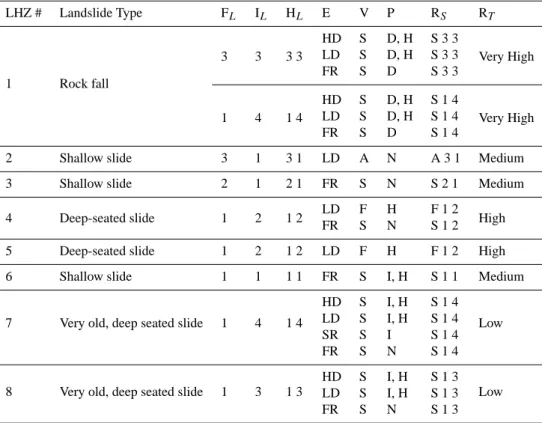
The methodology relies on a set of empirical correlation tables, which are used to define landslide frequency and in-tensity, to ascertain landslide hazard, to evaluate the expected damage to the vulnerable elements, and to attribute levels of specific and total landslide risk (Cardinali et al., 2002; Re-ichenbach et al., 2005). Landslide hazard and specific land-slide risk are expressed using a multiple-digit positional in-dex that shows all the variables used to ascertain landslide hazard and risk, i.e., intensity, frequency and vulnerability (Cardinali et al., 2002; Reichenbach et al., 2005).
8.2 Risk assessment for the Sugano village
Figures 12a–d show the landslide hazard zoning prepared for the Sugano village by Reichenbach et al. (2005). Through the analysis of three sets of aerial photographs taken in September 1954 at 1:33 000 scale, in June 1977 at 1:13 000 scale, and in March 1994 at 1:36 000 scale, supplemented by field reconnaissance in May 2000, four landslide types were identified in the Sugano area, namely (i): extremely rapid landslides, rock falls, topples and rock slides (Fig. 12a), (ii) slow-moving, shallow rotational and translational slides and slide earth-flows (Fig. 12b), (iii) slow-moving, deep seated
Sugano Leon e cr eek 9 1 Sugano Leon e cr eek Sugano Leon e cr eek 5 4 Sugano Leon e cr eek 7 8 Leon e cr eek Sugano 1 Sugano Leon e cr eek 2 3 6 Figure 12 A F E B D C m 250 0
N
Fig. 12. Maps show December 2004 rainfall-induced landslides (black), pre-existing landslides (dark colours), and landslide hazard zones
(LHZs) (light colours) for different types of mass movements. Thick black line portrays extent of the single “elementary slope” identified in the study area. Numbers indicate location of LHZs listed in Tables 5 and 6. Maps (A) to (D) show LHZs defined by Reichenbach et al. (2005) for four landslide types: (A) extremely rapid landslides rock falls, topples and rock slides (red), (B) slow-moving, shallow rotational and translational slides and slide earth-flows (green), (C) slow-moving, deep seated slides and slide earth-flows (blue), (D) slow-moving, very large and relict deep-seated block slides (orange). Map (E) shows updated LHZ for extremely rapid rock falls and topples (Table 7). Map (F) shows new LHZ for rapid to very rapid shallow landslides, including soil slides, debris flows and debris avalanches (Table 7).
slides and slide earth-flows (Fig. 12c), and (iv) slow-moving, very large and relict deep-seated block slides (Fig. 12d). A single large LHZ was identified for extremely rapid rock falls, topples and rock slides which erode the volcanic cliff, endangering the houses located at the edge of the escarpment (1 in Fig. 12a). Three LHZs were identified for slow-moving shallow rotational and translational slides and slide earth-flows (2, 3 and 6 in Fig. 12b), which were mapped primarily in the deposit of pre-existing, deep seated landslides. Two LHZs were mapped for slow-moving, deep-seated slides and slide earth-flows (4 and 5 in Fig. 12c) also recognized in the marine clays. Two LHZs were defined for the relict, deep-seated block slides (7 and 8 in Fig. 12d), which were recog-nized in the marine clays underlying the volcanic rocks.
To ascertain landslide risk, information on the location and type of the vulnerable elements is necessary. Figures 13a–d show the distribution and type of elements at risk in the Sug-ano area. Four types of elements were considered, namely: (i) build-up areas with high population density (HD); (ii) build-up areas with low population density and scattered houses (LD); (iii) secondary roads (SR), and (iv) farm roads and other minor roads (FR) (Reichenbach et al., 2005).
By combining the landslide hazard zonings (Figs. 12a–d) and the information on the vulnerable elements (Figs. 13a– d), specific and total risk levels were determined (Reichen-bach et al., 2005). Results area listed in Table 6. Based on the established terrain subdivisions, on the available infor-mation on the type, abundance and frequency of historical mass-movements, and on the location and type of the vul-nerable elements, landslide risk in the Sugano area was esti-mated as very high where rock falls, topples and rock slides were expected, mostly along and down slope from the vol-canic escarpment (1 in Table 6 and Fig. 12a). In these areas casualties and structural damage to houses and minor roads was considered possible (Table 6). Where sparse houses and farms were affected by deep seated slides of medium inten-sity, landslide risk was considered high (4 and 5 in Table 6 and Fig. 12c). Where low-density settlements and minor roads were affected by shallow landslides, risk was ascer-tained medium (2, 3 and 6 in Table 6 and Fig. 12b). Fi-nally, where the relict deep-seated block-slides were mapped, landslide risk was ascertained low (7 and 8 in Table 6 and Fig. 12d), because reactivation of the entire landslides was not considered likely under the present climatic and seismic conditions (Reichenbach et al., 2005).
8.3 Comparison with the recent rainfall induced landslides
The maps shown in Fig. 12 show the location and abundance of the rainfall induced landslides in December 2004 (black areas). This information allows for a comparison with the existing hazards and risk assessment prepared for Sugano (Table 6 and Fig. 12). In the Sugano area, intense rainfall did not result in deep-seated block-slides, in slow-moving deep-seated rotational and translational slides, or in
slow-moving shallow landslides. Thus, the three corresponding landslide scenarios (Figs. 12b, c, d) cannot be validated. However, a few deep-seated translational slides, and sev-eral slow-moving shallow landslides occurred at other sites in the Orvieto area, locally causing significant damage (e.g., Figs. 11a, b). We consider this an indication that slow mov-ing, deep seated and shallow landslides can occur in the Sug-ano area, particularly where marine sediments crop out, and we maintain the existing hazard scenarios (Figs. 12a, c, d) and the associated risk assessments (2 to 8 in Table 6).
In the Sugano area, the recent rainfall resulted in rapid to extremely rapid shallow failures. Extremely rapid landslides, including rock falls, topples and minor rock slides, were pre-dicted by the landslide hazards and risk assessment prepared for Sugano (Fig. 12a, 1 in Table 6). Comparison between the extents of the LHZ for extremely rapid failures and the loca-tion of the recent rock and debris falls reveals that all the falls initiated inside the single LHZ defined for extremely rapid landslides (1 in Fig. 12a), and that most of the fallen land-slide material was deposited inside the same LHZ. However, three individual rock fall boulders (black squares in Fig. 12a) travelled outside the LHZ, indicating that the geomorpholog-ical criteria used to define the maximum travel distance of rock falls was insufficient to precisely determine the rock fall hazard locally.
Several of the recent rainfall induced landslides in the Sug-ano area were shallow, rapid slides, flows, and avalanches in-volving loose soil and natural and man made debris. These failures were not predicted by the hazards and risk assess-ment prepared for Sugano. This was a limitation. We in-vestigated the reasons for the failure in recognizing the rapid shallow landslides. Shallow soil slides and flows on steep slopes leave only small and superficial empty scars, which are quickly covered by vegetation. The failed material de-posited at the base of the escarpment was loose, easily re-movable by rainfall or surface runoff, or reworked and dis-placed by human actions. Thus, persistence of the morpho-logical features that allows recognizing the shallow slides and flows is limited, making it hard to recognize old shallow landslides from the aerial photographs or in the field. Field surveys conducted in the Sugano area in July 2005, a period when vegetation was particularly abundant along and at the base of the volcanic escarpment, confirmed the difficulty in recognizing and mapping some of the shallow landslides oc-curred only a few months before the survey.
Due to the steepness of the slopes along the volcanic es-carpment, shallow landslides involving soil and debris were rapid to extremely rapid failures. We can attempt a compar-ison between the location of the shallow slope failures and the landslide scenario originally proposed for the extremely rapid landslides, i.e., for rock falls (Fig. 12a). The compar-ison is significant because some of the shallow slope fail-ures exhibited a fall component. The comparison between the extents of the LHZ for extremely rapid failures and the location of the shallow failures (slides, flows, and avalanches
Sugano B Leon e cr eek C D Figure 13 Leon e cree k Sugano A E F 1 9 1 2 3 6 7 8 5 4 Leon e cr eek Sugano Leon e cree k Sugano Leon e cr eek Sugano Leon e cree k Sugano m 250 0 N
Fig. 13. Distribution and types of elements at risk in the Sugano area. Legend: Oblique grey pattern=built up areas with high population
density (HD), solid grey=built up areas with low population density and scattered houses (LD), thick black line=secondary road (SR), thin dotted line=farm road or minor road (FR). Coloured polygons show LHZs for different landslide types. Numbers indicate location of LHZs listed in Tables 6 and 7. Maps (A) to (D) show LHZs defined by Reichenbach et al. (2005) for: (A) extremely rapid rock falls (red), (B) slow-moving, shallow landslides (green), (C) old and recent, slow-moving seated slides (blue), (D) very old (relict) slow-moving deep-seated landslides (orange). Map (E) shows updated LHZ for extremely rapid rock falls, topples and rock slides (Table 7). Map (F) shows new LHZ for rapid to very rapid shallow landslides, including soil slides, debris flows and debris avalanches (Table 7).
involving volcanic soil and debris) reveals that most of the landslides initiated on soil or debris at or close to the edge of the volcanic escarpment, i.e., inside the LHZ for extremely rapid failures (Fig. 12a). Further inspection reveals that all the landslide material transported by shallow slope failures was deposited inside the LHZ delimited for the extremely rapid failures.
8.4 New landslide hazards and risk assessment for Sugano
Based on the event inventory of rainfall-induced landslides in the Sugano area, and on the critical evaluation of the perfor-mance of the existing hazard assessment and the associated risk scenarios, we have updated the landslide hazards and risk assessment for Sugano. The new assessment contains: